IJEDR1702306
International Journal of Engineering Development and Research (www.ijedr.org)1967
Comparison of Various Error Diffusion Algorithms
Used in Visual Cryptography with Raster Scan and
Serpentine Scan
1Digvijay Singh, 2Pratibha Sharma
1Student M.Tech, CSE 4th SEM., 2Assistant Professor CSE Career Point University, Hamirpur (H.P.), India
________________________________________________________________________________________________________ Abstract: This paper represents the encoding of secrets image into halftone image with in the scheme of Visual Cryptography. Halftone generation is the first step in the Visual Cryptography. Visual cryptography is a cryptographic technique which allows optical information to be encrypted. A particular halftoning method named as error diffusion method is used for the better generation of halftoned image .Here we can use 3 error diffusion algorithms with raster scan and serpentine scan in order to generate halftone of secret image. Simulation results shows which algorithm is best for halftone generation as compare to others with raster scan and serpentine scan.
Keywords: Error Diffusion, Half toning, Raster scan, Serpentine scan, PSNR, WSNR, LDM, UQI.
________________________________________________________________________________________________________ I. INTRODUCTION
Visual cryptography (VC), proposed by Naor and Shamir [1], is a method for protecting image based secrets that has a computation-free decryption process. In the (2, 2) VC scheme each secret image is divided into two shares such that no information can be reconstructed from any single share. Each share is printed in transparencies. The decryption process is performed by stacking the two shares and the secret image can be visualized by naked eye without any complex cryptographic computations. Visual cryptography is a new type of cryptographic technique in which no cryptographic computation is needed at the decryption end. In this technique text or picture should be fed as a digital image in the system as the input and the system generates ‘n’ (2_n) numbers of different images (called shares), look like images of random noise.[1]halftone generation is the first step of visual cryptography. It is used to make visual cryptography process fast because it reduces the size of image with effective way. in VC we deals with larger size image. So its make processing slow .with the help of halftoning it is easy to deal with such type of larger image in visual cryptography. In order to generate halftone of image we use various error diffusion algorithms. We deal with error diffusion algorithms with raster scan and serpentine scan.
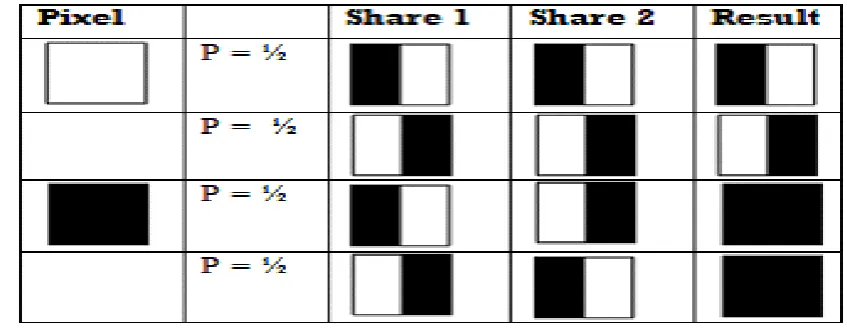
In the below basic VC scheme, each pixel of the secret image is encrypted into a pair of sub pixels in each of the two shares. If pixel is white, one of the two columns under the white pixel in Fig. 1 is selected. If pixel is black, one of the two columns under the black pixel is selected. In each case, the selection is performed randomly such that each column has 50% probability to be chosen. Then, the first two pairs of sub pixels in the selected column are assigned to share 1 and share 2, respectively. Since, in each share, pixel is
Encrypted into a black–white or white–black pair of sub pixels, an individual share gives no clue about the secret image. By stacking the two shares as shown in the last row of Fig.1, if ‘pixel’ is white it always outputs one black and one white sub pixel, irrespective of which column of the sub pixel pairs is chosen during encryption. If ‘pixel’ is black, it outputs two black sub pixels [2].
IJEDR1702306
International Journal of Engineering Development and Research (www.ijedr.org)1968
0 (BLACK) 96(GRAY) 256(WHITE)
Error-Diffusion half toning
Error diffusion is a simple but efficient way to halftone a grayscale image. The quantization error at each pixel is filtered and fed into a set of future inputs. The quantization error depends upon not only the current input and output but also the entire past history. The error filter is designed in such a way that the low frequency difference between the input and output image is minimized. The error that is diffused away by the error filter is high frequency or “blue noise.” These features of error diffusion produce halftone images that are pleasant to human eyes with high visual quality. [4]
Error diffusion works by “diffusing” – or spreading – the error of each calculation to neighboring pixels. If it finds a pixel of 96 gray, it too determines that 96 are closer to 0 than to 255 – and so it makes the pixel black., because 96 is closer to 0. When it moves to the next pixel, the error diffusion algorithm adds the error of the previous pixel to the current pixel. If the next pixel is also 96 gray, instead of simply forcing that to black as well, the algorithm adds the error of 96 from the previous pixel. This results in a value of 192, which is actually closer to 255 – and thus closer to white! So it makes this particular pixel white, and it again makes note of the error – in this case, the error is -63, because 192 is 63 less than 255, which is the value this pixel was forced to. In case of color images it deals with more colors but in case of gray scale images it deals only black, gray and white colors [3]
Raster scan and Serpentine scan: In this paper I implement the halftone share of select image with Raster scan type and Serpentine scan. In raster scan beam will move across the screen, one row at time. The direction of movement is top to bottom. When beam move from top to bottom beam will be on or off so pattern of spots is created. In Serpentine scan, the horizontal direction of scan alternates between lines. This process is called as serpentine scanning or Boustrophedon transforms dithering. III. HALFTONED BASED ERROR DIFFUSION ALGORITHMS WITH RASTER SCAN AND SERPENTINE SCAN There are 3 error diffusion algorithms to perform halftoning on color images.
A. Floyd Steinberg Halftoning algorithm. B. Jarvis halftoning algorithm.
C. Stuckie halftoning algorithm.
A. Floyd Steinberg Halftoning algorithm This error-diffusion algorithm is proposed by Floyd and Steinberg. Here the idea to keep track of the error. The algorithm compares the grayscale value of the current pixel that is represented by an integer value between 0 and 255, to some threshold value (typically 128). If the grayscale value is greater than the threshold, the output pixel is considered to be black (value 0), else it is considered white (value 1). The difference between the pixel’s original grayscale value and the threshold is considered as an error. And the track of this error is kept by this algorithm. This error is different from pixel to pixel. In below figure ‘star’ symbol is indicating the pixel and its error which is distributed to other pixels.
error 3/8
1/8 1/8
B. Jarvis half toning algorithm: Another error diffusion algorithm has been proposed by Jarvis, Judice and Ninke. It diffuses the error in the 12 neighboring cells instead of 4 cells as in the Floyd-Steinberg algorithm as shown in figure below . As a result, this algorithm is even slower.
IJEDR1702306
International Journal of Engineering Development and Research (www.ijedr.org)1969
C. Stuckie Error Diffusion Half toning Algorithm: Stucki diffused the error in the 12 neighboring cells as shown in Figure below. The only difference between Jarvis algorithm and Stucki algorithm is the fraction which is added to the neighboring pixels.error
IV.RESULT AND ANALYSIS
The experimental results of the entire error-diffusion half-toning algorithms used in color visual cryptography. We will compare these algorithms on the basis of following parameters and the algorithm which leads to better quality of image will be considered as the best error diffusion algorithm. All 3 algorithms are compared with Raster scan and Serpentine Scan. At the end we got the result that which algorithm is best with Raster scan and Serpentine scan. And which scan type is good with these 3 algorithms. PSNR (peak signal to noise ratio): Higher is better
WSNR (weighted signal to noise ratio): Higher is better
LDM (Linear Distortion measure): lower is better
UQI (Universal quality index): higher is better
The table showing the different parameter values in case of 2 input images named as “School.jpg” “Tulips.jpg”. one image named as “Tulips.jpg” is taken from computer system and second is self clicked named as “School.jpg”. both images are used as input data set. The error diffusion algorithms are generated halftone of selected images with raster scan and serpentine scan. IN CASE OF “tulips.jpg” with Raster Scan:
IJEDR1702306
International Journal of Engineering Development and Research (www.ijedr.org)1970
b) Jarvis half toned share c) Stucki half toned share
IN CASE OF “School.jpg” with Raster Scan
a) Original image b) Floyd half toned share
b) Jarvis half toned share c) Stucki half toned share
IJEDR1702306
International Journal of Engineering Development and Research (www.ijedr.org)1971
a) Original image b) Floyd half toned share
b) Jarvis half toned share c) Stucki half toned share
IN CASE OF “School.jpg” with Serpentine Scan
IJEDR1702306
International Journal of Engineering Development and Research (www.ijedr.org)1972
b) Jarvis half toned share c) Stucki half toned share
Parameters value with Raster Scan :-
For image named as Tulips.jpg with raster scan type ,the parameters are given below: Images Scan type Algorithms PSNR
RATIO WSNR RATIO LDM RATIO UQI RATIO
Tulips Raster
Floyd-Steinberg
4.62744 9.93803 0.20134 0.270399
Tulips Raster Jarvis 4.5602 9.30273 0.221207 0.250528
Tulips Raster Stuckie 4.588 9.50367 0.213806 0.253641
Parameters value with Serpentine Scan :-
For image named as Tulips.jpg with Serpentine scan type ,the parameters are given below: Images Scan type Algorithms PSNR
RATIO WSNR RATIO LDM RATIO UQI RATIO
Tulips Serpentine
Floyd-Steinberg
4.62245 9.928344 0.201996 0.292496
Tulips Serpentine Jarvis 4.55706 9.32296 0.222275 0.253883
Tulips Serpentine Stuckie 4.5832 9.50926 0.214279 0.255657
Parameters value with Raster Scan:-
For image named as School.jpg with Raster scan type ,the parameters are given below: Images Scan type Algorithms PSNR
RATIO WSNR RATIO LDM RATIO UQI RATIO
School Raster
Floyd-Steinberg
5.20004 10.6025 0.232498 0.119385
School Raster Jarvis 5.01133 9.2424 0.28537 0.111756
School Raster Stuckie 5.08471 9.6814 0.266525 0.112498
Parameter values with Serpentine Scan :-
For image named as School.jpg with Serpentine scan type, the parameters are given below: Images Scan type Algorithms PSNR
RATIO WSNR RATIO LDM RATIO UQI RATIO
School Serpentine
Floyd-Steinberg
5.19512 10.5392 0.234863 0.119256
School Serpentine Jarvis 5.00782 9.22385 0.28653 0.108482
School Serpentine Stuckie 5.07969 9.64936 0.267929 0.10874
IJEDR1702306
International Journal of Engineering Development and Research (www.ijedr.org)1973
Different algorithms for error diffusion are compared. The comparison is done on the basis of WSNR, LDM, UQI and the PSNR values. From the implementation of all the algorithms, it is observed that :1. Image quality is high when Floyd algorithm is implemented.
2. Floyd Algorithm is best either we use Raster scan or Serpentine scan. 3. Floyd Algorithm is best with raster scan as Compare to Serpentine scan.
Thus, Floyd-Steinberg can be concluded as the best Error Diffusion algorithm out of 2 other algorithms with Raster Scan as Compare to Serpentine Scan.
REFERENCES
[1] Jayanta Kumar Pal1, J. K. Mandal et.al, “A (2, N) VISUAL CRYPTOGRAPHIC TECHNIQUE FORBANKING APPLICATIONS”, International Journal of Network Security & Its Applications (IJNSA), Vol.2, No.4, October 2010 [2] Morampudi Naresh kumar et.al, “A Novel Approach for Cheating Prevention through Visual Cryptographic Analysis”,
International Journal of Computer Science & Engineering Survey (IJCSES) Vol.2, No.4, November 2011
[3] Meenakshi Rana, “Comparison and Review of Various Error Diffusion Algorithms used in Visual Cryptography” International Journal of Engineering and Computer Science Volume 2, Volume 6 Issue No. 6, 2016.