An Adhoc Network for Wireless Technology: Daknet
1
Nirav K. Shah,
2Vibha H. Mehta,
3Parag B. Makwana
1Assistant Professor, 2Assistant Professor, 3Assistant Professor 1
Computer Sc ience, 1
Shree Swa minarayan College of Co mputer Sc ience, Bhavnagar, India
_________________________________________________________________________________________ _______________
Abstract – Current trend in world technology advancements have changed the way people communicate with each other. The massive growth of internet boosted up developing countries to adopt the new scenario. but still some loop holes remained like the Int ernet Communication Technology advanced in urban areas of de velopi ng countries but the rural and remote areas were still lacking behind. In this paper an attempt has been made to familiarize the network that proved to be a blessing to remote people giving them opportunity to use the world’s biggest chain of ad hoc networks Internet- called ―DAKNET‖.
IndexTerms—Wireless, data connectivity, network, Wi-Fi, donkeynet, dak, wireless catalyst
________________________________________________________________________________________________________
I. IN TRO DUC TION
Daknet is very easy to connect to the world. Now in remote villager travel to talk to family me mber or to get form which citizen in developed countries can call up on a computer in a matter of milliseconds. Now-a-days government tries to connect every village using advanced technology and think that telephone is the cheapest way to provide connectivity but in advanced technology, wireless technology make running copper wire to an analog telephone much more e xpensive than broadband internet connectivity. Daknet – an adhoc network uses wireless technology to provide digital connectivity. This technology take an advantage of existing technology to transport data and developed by MIT. Daknet derived from hindi word “DAK” for postal combines a physical means of transportation with wire less data transfer to extend the internet connectivity that a uplink, a cyber cafe or post office provides. DakNet has been successfully deployed in remote parts of both India and Cambodia at a cost two orders of magnitude less than that of traditional landline solutions. Villagers now get affordable Internet services and they are using them.
II.WHYDAKNET
Real time commun ications need large capital investment and hence high level of user adoption to receiver costs. The average villager cannot even afford personnel communications device such as a telephone or computer to recover cost, users must share the communication infrastructure Studies show that the current market for successful rural Informat ion and Commun ication Technology (ICT) services does not appear to rely on real-time connectivity, but rather on affordability and basic interactivity. The poor not only need digital services, but they are willing and able to pay for them to offset the much higher costs of poo r transportation, unfair pric ing, and corruption.
III.ADHOCNETWORK
An ad-hoc wireless network is a collection of wireless mobile hosts forming temporary network without the aid of any established infrastructure or centralized control. Ad -hoc networks require a peer-to-peer architecture, and the topology of the network depends on the location of the different users, which changes over time.
In addition, since the propagation range of a given mobile is limited, the mobile may need to enlist the aid of other mobiles in forwarding a packet to its final destination. Thus the end -to-end connection between any two mobile hosts may consist of mu ltiple wireless hops.
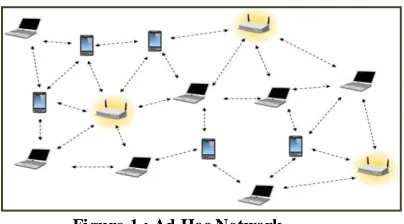
Figure 1 : Ad-Hoc Network
In the ad-hoc network, computers are brought together to form a network "on the fly." As shown in Figure, there is no structure to the network; there are no fixed points; and usually every node is able to communicate with every other node. An algorithm in ad-hoc network architectures uses a broadcast and flooding method to all other nodes to establish who's. Current research in ad -ad-hoc wireless network design is focused on distributed routing. Every mobile host in a wireless adhoc network must operate as a r outer in order to maintain connectivity information and forward packets from other mobiles. Routing protocols designed for wired networks are not appropriate for this task, since they either lack the ability to quickly reflect the changing topology or ma y require excessive overhead. Proposed approaches to distribute routing that quickly adapt to changing topology without excessive overh ead include dynamic source and associatively based routing. Other protocols that address some of the difficu lties in supporting mu ltimedia applications over ad-hoc wireless networks include rate-adaptive compression, power control, and resource allocation through radio clustering.
IV.AD-HOCMOB ILEROUTINGPROTOCOL
Routing protocols between any pair of nodes within an ad -hoc network can be difficult because the nodes can move randomly and can also join or leave the network. This means that an optima l route at a certain time may not work seconds later. Discus sed below are three categories that existing ad-hoc network routing protocols fall into (A) TABLE DRIVEN PROTOCOL (B) ON DEMAND PROTOCOL (C) HYBRID PROTOCOL
Figure 2 : Ad-Hoc MRP
(C)Hybri d Protoc ol : it combine Table Based Routing Protocols with On De mand Routing Protocols. They use distance -vectors for more precise metrics to establish the best paths to destination networks, and report routing information on ly when there is a change in the topology of the network. Each node in the network has its own routing zone, the size of which is defined by a zone radius, which is defined by a metric such as the number of hops. Each node keeps a record of routing informa tion for its own zone. Zone Routing Protocol (ZRP) is an e xa mple of a Hybrid routing protocol.
V.HOWITSWORK
DakNet integrates inexpensive Customer Off -The-Shelf (COTS) hardware components, open source software, and FMS’s proprietary software to create an asynchronous Internet hub and spoke system. Co mputers at the hub are connected to the internet in real time , while computers at the end of the spoke are connected asynchronously.
Figure 3 : Daknet Cycle
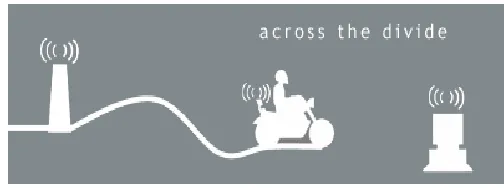
Traditional transport mechanisms such as cars, motorbikes, buses, or even donkeys transport data between the hub and spoke
VI.DAKNETARCHITECTUR E
DakNet is unique and proprietary network software that distributes bandwidth from Internet connection points as far as the ro ad goes. Existing backbones become wireless uplinks for Mobile Access Points that are mounted on vehicles to provide broadband "drive-by WiFi" access as they pass through rural areas.The ma in parts of DakNet architecture are
(1)Mobile Access Point
DakNet offers data to be transmitted over s hort pointtopoint links. It co mbines physical and wireless data transport to enable high -bandwidth intranet and internet connectivity among kiosks (public computers) and between kiosks and hubs. Data is transported by means of a mobile access point, which automatically and wirelessly collects and delivers data from/to each kiosk on the network. Low cost WIFI radio transceivers automatically transfer the data stored in the MAP at high bandwidth for each point - to- point connection. Mobile Access Point is mounted on and powered by a bus or motorcycle, or even a bicycle with a small generator. MAPs are installed on vehicles that norma lly pass by each village to provide store -and-forward connectivity.
Figure 4 : MAP on motorcycle
MAP e qui pment use d on the bus/motorcycle includes
A custom embedded PC running Linu x with 802.11b wireless card and 512 Mbytes of compact flash memory.
A 100-mWa mplifier, cabling, mounting equipment, and a 14-in Omn i directional antenna.
A session occurs each time the bus comes within range of a kiosk and MAP transfers data. The speed of the connection between the access point and the kiosk or hub varies in each case. But on average, they can move about 21Mb or 42 M b bidirectional per session.
The average good put or actual throughput for a session, during which the MAP and kiosk go in and out of connection because o f mobility and obstructions, is 2.3Mbps. Omni d irectional antennas are uses on the bus and either directional or omni directional antennas are located at each of the kiosks or hubs. The actual throughput depends on gain of antenna and orientation of each kiosk with the road.
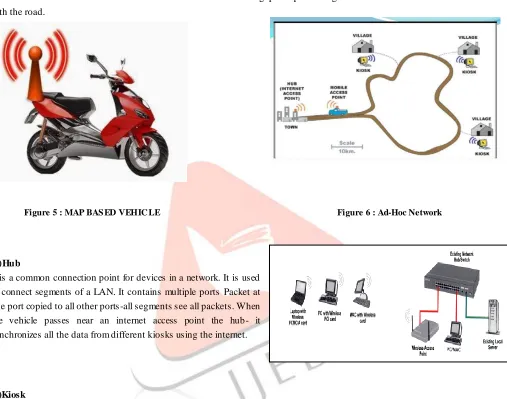
Figure 5 : MAP BAS ED VEHIC LE Figure 6 : Ad-Hoc Network
(2)Hub
It is a common connection point for devices in a network. It is used to connect segments of a LAN. It contains multiple ports Packet at one port copied to all other ports -all segments see all packets. When the vehicle passes near an internet access point the hub- it synchronizes all the data from different kiosks using the internet.
(3)Kiosk
It is a booth providing a computer related service such as ATM. In each village there is kiosk. It requires a user interface that can be used without training. It enable user to enter and display information on the same device. Either directional or
omni directional antennas are located at each of the kiosks or hubs. Amplifiers are used to boost the signal and range for higher. In Daknet a wire less card i.e wifi card is mounted on a vehicle that travels around to remote villages and exchanges updated informat ion with each kiosk it encounters through WiFi.
Figure 8 : Kiosk
Advantages of using WiFi cards are :
Increase mobility
Cost for setting up a network is much less than running wires.
WiFi has a global set of standards.
VII. DAKNETPACKAGE
DakNet offers an affordable and complete connectivity package, including: Wireless hardware (wire less transceiver and antennas) , Networking software , Server and cache software , Custom applications, including ema il, audio/video messaging, and asynchronous Internet searching and browsing API enabling organizations to easily integrate DakNet with their e xisting applications.
VIII.MERIT&DEMERIT
(A) MERIT
Since it avoids using phone lines or expensive equipment, Daknet provides one of the lowest -cost accessibility solutions in the world.
The same hardware, software and user interface can be used to enjoy real-time information access.
It has the ability to provide a seamless method of upgrading to always -on broadband connectivity.
Easy to imp le ment on widespread basis.
Lower uplink costs and maintenance requirements.
Bandwidth does not decrease with distance.
Seed infrastructure that is scalable with demand.
Reduced regulatory challenges and licensing fees.
(B)DEMERIT
Token ring constraint if a lower t ier goes down, all higher tier goes down
Expe rience and Expert ise person can only handled kiosk
Effic iency of bandwidth reduced for each tier
IX.CONCLUS ION
DakNet’s low deployment cost and its enthusiastic reception by rural users has motivated dozens of inquires for further deployments. The larger goal is to shift the policy focus of the government’s universal-service-obligation funds from wire line village telephones to wireless ad hoc networking. Country wide connectivity through Daknet.
REFERENCES
[1]http://landrecords.karnataka.gov.in [2]http://www.ratanakiri.co m/
[3]http://ntrg.cs.tcd.ie/undergrad/4ba2.05/group11/