The Sociology Of Classroom And Student’s Family Background Influencing Student’s Learning: A Study At University Of Sargodha
Malik Muhammad Sohail (Scholar, Department of Sociology, University of Sargodha, Sargodha, Pakistan)
Babak Mahmood (Assistant Professor, Department of Sociology, University of Sargodha, Sargodha, Pakistan)
Mumtaz Ali (Assistant Professors, Department of Social work, University of Sargodha, Pakistan)
Sadia Rafi (Assistant Professors, Department of Social work, University of Sargodha, Pakistan)
513 Author (s)
Malik Muhammad Sohail Scholar, Department of Sociology, University of Sargodha, Sargodha, Pakistan
Babak Mahmood Assistant Professor, Department of Sociology, University of Sargodha, Sargodha, Pakistan
Mumtaz Ali Assistant Professors, Department of Social work, University of Sargodha, Pakistan
Sadia Rafi Assistant Professors, Department of Social work, University of Sargodha, Pakistan.
The Sociology of Classroom and Student’s Family Background Influencing Student’s Learning: a Study at University of Sargodha
Abstract
For several decades now, social scientist interested in the relationship between education and social stratification. The purpose of this study was to gain insight into the impact of cultural capital and sociology of classroom on students‘ learning. The opinions of 152 university students regarding the influence of cultural capital, gender differences, students‘ confidence and perception about teacher on students‘ learning have shown some results which are not similar to conventional researches. This study raised questions about the extent to which sociology of classroom is significant to be studied for educational progress, and offers ideas for further researches in this area. Quantitative method of research was applied. A sample of 152 respondents was chosen by applying stratified and convenience sampling techniques from 23 Departments of University of Sargodha. The results of the study were diverse in comparison to conventional researches in this domain. It was found that gender differences don‘t negatively affect students‘ learning. Cultural capital was found influential for students‘ learning. Students‘ confidence and perception about teacher was not found significant to influence students‘ learning. Keywords: Cultural Capital; Sociology of Classroom; Gender Differences; Student‘s Learning
Introduction
There have been several studies carried out regarding the effects of sociology of classroom on student‘s academic achievements. This study also helps to reveal that how classroom‘s social settings, patterns of social interaction, gender differences, specifically student‘s cultural capital, affects students‘ learning. Sociologists often focus on how social status, role relationships, and structural inequalities affect individuals in a social context (Thoits, 1995). In the context of a classroom, social status can include the gender, race, caste, age, locality and social class of the students and the instructor. For example, students with lower status backgrounds may experience more difficulty adjusting to college or university life than their higher status peers do. Behavioral scientists have been concerned with specific characteristics of individuals as explanations for success or failure in classroom. Such
characteristics may include intelligence or social class background (cohen, 1972) .Sociologists study the classroom as a distinct social system. This social system contains its own culture. Gibbs defined ―classroom culture‖ as the culture, or the climate, of the classroom as an atmosphere or feelings and as energy that is related to child‘s opportunity to learn and social development (Featherstone, 2008).
514 social system of classroom. Feedback (class
participation) is also linked with student status in classroom (Cohen, 1972).
What is the student status? ―Cohen‖ defined status as ‗the thinking of individuals‘. Rank in a status order carries with it specific expectations for capability to do certain tasks explain what to be competent or incompetent. Gender is also considered a distinct status. Katz found that to be a female is to have a lower initiation rate in classroom. They are also active in extracurricular activities. All this effects their achievements in class (ibid). Social advantage is largely transmitted through institutional and systemic agents that maintain the status quo such that one‘s privileged position is preserved across generations. In socially-reproducing societies, the privileged position of one‘s family is the best predictor of an individual‘s future position. In more open societies, future generations‘ positions along the social ladder are not static but vary based on individual competence and luck. Inequalities in educational settings must be eradicated. Dewey added, ―It is also the aim of
progressive education to take part in correcting unfair privilege and unfair deprivation, not to perpetuate them‖. Although higher education offers avenues of social mobility through which individuals can improve their occupational and economic status, educators have a responsibility to address intentional inequities so all students can take advantage of its resources. Social class may affect education in several ways. First, attitude towards education held by parents and children vary with social class. Second, the social class membership of children determines where his family lines and this in turn determine the public school attends (R.K.Merton, 1973).
Objectives
The objectives of this research are:
1. To study the influence of student‘s cultural capital on students‘ learning.
2. To examine the effects of student‘s perception about teacher on students‘ learning. 3. To analyze the effects of gender differences on students‘ learning.
Conceptual framework
Detailed conceptual framework:
Cultural capital Sociology of classroom Dependent variable Parent‘s education
Parent‘s occupation Learning habits
Gender differences
Student‘s perception about teacher Confidence of student
Students‘ learning
Hypotheses:
Strong cultural capital positively influences the students‘ learning with special
reference to parents‘ education, occupation and learning habits acquired by them.
Student‘s
learning
Sociology
of
classroom
Cultural
515 Higher the gender difference, lower
will be the students‘ learning.
Student confidence and perception about teacher strongly influence on students‘ learning.
Literature Review
Cultural capital and students’ learning The French sociologist Pierre Bourdieu, working with various colleagues, developed the concept of cultural capital in the early 1960s in order to help address a particular empirical problem—namely, the fact that ―economic obstacles are not sufficient to explain‖ disparities in the educational attainment of children from different social classes (Bourdieu & Passeron, 1979). Bourdieu argued that, above and beyond economic factors, ―cultural habits and…dispositions inherited from‖ the family are fundamentally important to school success (Bourdieu & Passeron, 1979). In doing so, he broke sharply with traditional sociological conceptions of culture, which tended to view it primarily as a source of shared norms and values, or as a vehicle of collective expression. Instead, Bourdieu maintained that culture shares many of the properties that are characteristic of economic capital. In particular, he asserted that cultural ―habits and dispositions‖ comprise a resource capable of generating ―profits‖; they are potentially subject to monopolization by individuals and groups; and, under appropriate conditions, they can be transmitted from one generation to the next.
Bourdieu‘s research further shows that French students from less privileged families are more likely to choose technical and vocational options (Bourdieu, 1984). He argues that the accumulation of cultural capital acquired by elite students through the educational system then contributes to the maintenance of their privileged position in the social structure (Bourdieu & Passeron, 1977).
Cultural capital is one resource that privileged parents and students can draw upon to keep up their educational advantages. Most scholars argue that one reason cultural capital gives students an educational advantage is that it
fosters better communication with teachers, communication that contributes to teachers‘ positive perceptions of these students. According to this view, then, cultural capital boosts students‘ academic outcomes because of its positive effect on student–teacher relationships .No other definition of cultural capital as clearly distills the key components of the concept than does the definition advanced by Lamont and Lareau (1988). They defined cultural capital as ―institutionalized, i.e., widely shared, high-status cultural signals (attitudes, preferences, formal knowledge, behaviors, goods and credentials) used for social and cultural exclusion‖ (Lamont and Lareau 1988:156). This definition emphasizes two of the key components of the concept— that cultural capital is institutionalized and that it is used to maintain group advantage. Bourdieu (1984) similarly argued that members of the upper class use culture to distinguish themselves from and maintain social distance between themselves and those beneath them on the class hierarchy.
As the word ―capital‖ implies, cultural capital is an advantage that can be used to gain other kinds of possessions such as educational credentials. Intergenerational diffusion of cultural capital, along with blocking others from acquiring cultural capital, ensures that children from the elite group hold cultural capital that they can utilize into academic success. For Bourdieu all goods, whether material or symbolic have an economic value if they are in little supply and considered valuable of being required after in a particular social structure. He describes a process in which ‗classes‘ spend their cultural capital in academic settings (Bourdieu, 1977). Because the upper, and to a lesser extent, the middle classes, have the means of investing their cultural capital in the best possible educational setting, their investments are extremely profitable. From this point of view educational establishments can be viewed as mechanisms for producing social profits (Bourdieu and Passeron, 1977).
516 carry their own student ―cultural capital‖ to the
classroom, and often, it is ignored or lost in the dynamics of classroom teaching and management (Oakes, 1985). Despite a large number of reforms aimed at making teacher instruction more transformative, most students are still taught in a conventional manner (Doyle, 1986). Most teachers still view education as the mere diffusion of routine technical information, rather than constructively developed ideas, concepts, and behaviors. In school, students are to sit and listen, which are often not easy jobs for minority, poor, and non-mainstream students to master, who often do not learn these jobs at home, but instead have learned different cognitive ways of knowing (Gillian, 1982).
Therefore, many educators believe that unless we make a determined effort to include cultural relevance in the public school curriculum, public education will continue to fail. Teachers must understand how students use their existing knowledge to make sense of what is occurring in the classroom (Floden, 1991). A large part of that existing knowledge is influenced by culture.
Parent’s education and students’ learning The social origin of the family sets the financial, social, and cultural context for the child‘s nurture. Social origin characteristics include parents‘ education, family income, family size, and socioeconomic status (an index usually comprised of father‘s educational level and occupational prestige) (Hauser & Warren, 1997). These social origin characteristics are largely measures of the financial and human capital that families have to invest in their children‘s future and as such can affect the degree to which students expect to continue their education (Blake, 1989; Turley, Santos, & Ceja, 2007). Parents‘ educational success influences their children‘s educational hopes in terms of providing financial resources and as a model of college-going behavior (Attanasi, 1989; Buchmann & Dalton, 2002; Cohen, 1987). Parent‘s education helps to maintain a positive mind in children. In addition it can help students to receive guidance about choosing field, career or profession because parents are good observant for them. Obvious interrelation has
been found among parental involvement, empowerment, and satisfaction and how these variables are related to higher levels of achievement among students (Maddaus, 1990). Parent’s occupation and students’ learning Among those who influence students‘ educational hopes, parents play an early and significant role (Bennett & Gist, 1964; Teachman & Paasch, 1998). Parent‘s occupation is also a depiction of structural inequalities among students. Parents‘ occupational prestige depends on the nature of their job. Socioeconomic status (SES) and the children‘s own intelligence and to examine possible mediators of the effects of parents‘ education on children‘s educational and occupational outcomes.
Learning habits and students’ learning Cultural capital is one resource that privileged parents and students can draw upon to keep up their educational advantages. It may also be in the form of learning habits acquired by educated family. In turn, the gaining of cultural capital enables students‘ academic mastery, in particular that which requires abstract and theoretical thinking. Many researchers suggest some of the home characteristics that are likely to be influential in school achievement. Children, whose parents encourage exploration take care to explain what they are doing ,listen to them and tailor the difficulty of environment to their abilities and interests tend to be more successful academically. Another factor that has been found to influence childern‘s success in school is the extent to which patterns of language use in the home match those that teachers expect in the classroom.
Sociology of classroom and students’ learning
socio-517 economic status and with diverse intellectual
endowments in cognitive skills in terms of facts and skills. Besides teacher‘s pedagogical role, she/he represents the adult world of authority and is expected to explain pupils with proper codes of conduct in the classroom, institution and society (Lucy Wairimu Kimokoti, 2008). These entire phenomenons are included in the social dynamics of classroom. Education itself is a social experience as knowledge is transmitted by social interaction.
All the social actions taking place within the classroom are incorporated in sociology of classroom. Palmer (1998) offered that knowing and learning are communal acts shared among individuals. Because most classes are held with the same participants over several weeks or months, one can consider them group. Such groups hold their own beliefs, norms, values, leaders and motives which further shape their actions. All class members belong to the same classroom community, it follows that the classroom setting has the potential to become a site of community itself. As students and teachers develop relationships over time through interaction and common goals, social forces appear that either facilitate or hamper learning in classroom. These social influences can also be considered the sociology of the classroom. Gender differences and students’ learning There are gender inequalities in the educational systems. A classroom may have gender discrimination. The picture of classroom is different in minds of boys and girls. Researches demonstrate that boys and girls are different in assuming classroom as a learning place or just a fun. Both genders see teacher‘s treatment differently. These gender differences were found negatively affecting students‘ learning in many studies. The social origin characteristics of students have been associated to the changing gender gap in higher education (Buchmann & DiPrete, 2006). Families often make educational investment decisions based on a cost-benefit analysis of increased utility (Becker, 1991). Historically, as part of the gender socialization process, parents have communicated to their children the ―appropriate‖ postsecondary
education expectations; poorer families often rationalized investing in their sons‘ education while wealthier families had the luxury to invest in daughters‘ education (Becker, 1991). Due to cultural changes associated with greater financial opportunities and necessities for women, such as the decline in sex-role stereotyping and gender discrimination (Buchmann & DiPrete, 2006 , increased occupational options requiring postsecondary education, and increased marital instability (i.e., women can no longer rely on their marriage partner for financial stability), parents‘ investment in education has shifted to provide greater equity between daughters and sons (Buchmann & DiPrete, 2006). There is also discrepancy in understanding of students‘ learning process between teachers of both genders. This discrepancy sometimes turns into inappropriate treatment by teachers which results into deterrent and discouragement for students. In particular, the climates of some classrooms seem to inhibit active participation by women, which in turn may negatively influence their learning (Heller, Puff, & Mills, 1985).
518 students cooperate or are they opposites
(Fisher, 2006)?
A student‘s perception of the instructor‘s expertise influences interest in and satisfaction with the course (Eom, Wen, & Ashill, 2006). Students are more receptive to ideas that originate from credible sources, and this receptivity is a core component of learning motivation and enjoyment ( Szulanski et al., 2004). Moreover, resistance to learning occurs when the knowledge source is not considered reliable, hampering both the student‘smotivation and ability to understand the course material. Positive perception about instructor‘s expertise increases the depth and richness of information exchanged and reduces barriers to the process of building understanding of causal relationships.
Students’ confidence and students’ learning Confidence offers a form of ―social energy‖ that makes classroom alive while its lack demoralizes it. Confidence enhances the belief that the instructor or classmates will favorably receive one‘s remarks or questions and thus constitutes a minimum condition for any participation in the classroom. On the other hand, insufficient confidence likely generates submissiveness and removes and undermines the harmony, cohesiveness, and energy of the group. According to Fassinger (1995), confidence was the single most important factor students saw as affecting class participation. As a form of social energy, however, confidence not only ―upholds the social structure‖ but also is ―produced by it‖ (Collins, 1984, p. 385). Hence, students‘ confidence will be shaped by other variables that relate to the formal and informal structure of the classroom but will directly affect class participation. For instance, a strong perception of faculty as an authority might undermine students‘ confidence in the contribution they might be able to offer. Confidence relates to fear of peer disapproval or teachers‘ criticisms which becomes a barrier to participation. Students’ Learning
In education one of the most burning problems is to help students develop effective methods for learning. ―Learning is the attainment of new behavior patterns, or the strengthening or
weakening of old behavior patterns, as the result of practice.‖ Learning includes a wide variety of changes in behavior. The changes may be readily detected in the overt behavior of the individual or they may be changes in his reserve of ideas. Motives or drives are basic to the learning process. If we are to learn, we must first have some goals and then come across some block that stop us from achieving that goal. If we encounter no block-no difficulty of any kind-the chances are that we have already learned the behavior necessary to reach the goal or that we will not learn it until our goal becomes more attractive and more demanding (Srivastava, 2006). Learning is a complex concept and activity. Most teachers and pupils would recognize the importance of the social and emotional elements of learning, in addition to cognitive aspects of learning, thinking and problem solving (Hewitt, 2008).
Bloom's taxonomy - Learning domains Bloom's Taxonomy, ('Bloom's Taxonomy of Learning Domains') was initially published in 1956 under the leadership of American academic and educational expert Dr. Benjamin S Bloom. 'Bloom's Taxonomy' was originally created in and for an academic context, whose aim was to develop a system of categories of learning behaviour to assist in the design and assessment of educational learning. Bloom's Taxonomy has since been expanded over many years by Bloom and other contributors (notably Anderson and Krathwhol as recently as 2001, whose theories extend Bloom's work to far more complex levels than are explained here, and which are more relevant to the field of academic education than to corporate training and development). Bloom's Taxonomy model is in three parts, or 'overlapping domains'. Again, Bloom used rather academic language, but the meanings are simple to understand:
1. Cognitive domain (intellectual capability, ie., knowledge, or 'think')
2. Affective domain (feelings, emotions and behaviour, ie., attitude, or 'feel')
3. Psychomotor domain (manual and physical skills, ie., skills, or 'do')
4.
519 was the first published part of Bloom's
Taxonomy, featured in the publication: 'Taxonomy Of Educational Objectives:
Handbook 1, The Cognitive Domain' (Bloom, Engelhart, Furst, Hill, Krathwohl, 1956) & (Chapman, 2006).
Bloom’s taxonomy - cognitive domain - (intellect - knowledge - 'think')
Bloom's Taxonomy 1956 Cognitive Domain is as follows. An adjusted model was produced by Anderson and Krathwhol in 2001 in which the levels five and six (synthesis and evaluation) were inverted (Atherton, 2010).
Detailed model: Cognitive domain
Level Category Behavior description
1 Knowledge Remembering previously learned
information, memorise
2 Comprehension Grasping the meaning of information,
interpret
3 Application Applying knowledge to actual situation,
put theory into practice
4 Analysis Breaking down objects or ideas into
simpler parts and seeing how the parts relate and are organized, interpret elements of structure
5 Synthesis Rearranging component ideas into a new
whole, develop creative thinking
6 Evaluation Make judgments about value of ideas or
materials, assess effectiveness
Research Methodology
Statistical techniques for data analysis
520 Percentage
In order to bring the data into comparable form, percentages of various categories of data were used in the present study.
The percentages were calculated by following formula:-
ƒ
Percentage = --- x 100 N
Where
ƒ = Absolute
Frequency
N = Total
Number of items Chi-Square
Chi-square test was applied to examine relationship between independent and dependent variables. 2 was computed by following formula:
(O - E)2 2 = ---
E
Where:
O = Observed
values
E = Expected
values
= Total sum
If the calculated value of chi-square was equal to or higher than the table value at 0.05 level of probability at the given degree of freedom, the relationship was statistically significant. If it is less than the table value (0.01 level of probability) it is termed as highly significant (Sher, 2008). Where the calculated value is less than the table value at 0.05 level of significance. It is declared as non-significant. The data is statistically analyzed on (PC) using the SPSS software. Gamma Statistics
The value of Gamma showed the strength and direction of the relationship between independent and dependent variables (Chaudhry and Kamal, 1996). Calculations were made by using the following formula:
Ns - Nd Gamma = --- Ns + Nd Where:
Ns = Same order pair Nd = Different order pair
Indexation of variables
Variable No. of
items in Matrix Question
No. of
categories in Index variable
Min. Score
Max. Score
Mean Score
Standard Dev.
Alpha value
Cultural capital 9 5 24.00 45.00 35.7500 3.8794 .810
Gender difference
5 5 8.00 25.00 18.3882 2.5058 .792
Student
confidence and perception about teacher
11 5 25.00 55.00 37.6974 4.8638 .766
Descriptive analysis
The table 9 contains descriptive statistics of first independent variable in this study. Five columns of table describe frequencies of responses given by respondents. Final two columns describe mean and standard deviation.
The data presented in table 1 illustrate that mostly respondents are agreed upon the influence of cultural capital on students‘ learning in classroom. An examination of these results exposes the influence of cultural capital on students‘ learning.
Table-1 Cultural capital
521
agree agree nor
disagree
disagree deviation
Economic status of a student helps to establish positive attitude towards knowledge 49 32.2% 70 46.1% 17 11.2% 14 9.2% 2 1.3%
2.01 .963
Availability of books, computer and internet helps
to gain
knowledge 98 64.5% 43 28.3% 8 5.3% 1 .7% 2 1.3%
1.46 .745
Parents‘
occupation helps in acquiring new skills 44 28.9% 76 50.0% 18 11.8% 13 8.6% 1 .7%
2.02 .902
Parents‘
education helps to maintain an open mind 73 48.0% 64 42.1% 8 5.3% 4 2.6% 3 2.0%
1.68 .849
Schooling helps in getting fast learning 64 42.1% 74 48.7% 10 6.6% 4 2.6% - -
1.70 .710
Locality affects student‘s attitude about classroom 29 19.1% 86 56.6% 28 18.4% 9 5.9% - -
2.11 .777
Learning habits acquired from family helps in increasing knowledge 56 36.8% 80 52.6% 7 4.6% 6 3.9% 3 2.0%
1.82 .849
Parents guided me to choose subject/field of my choice 32 21.1% 52 34.2% 20 13.2% 34 22.4% 14 9.2%
2.64 1.289
My siblings know well about my natural trends 26 17.1% 68 44.7% 41 27.0% 15 9.9% 2 1.3%
2.34 .920
My parents never imposed any restriction on choosing my profession 59 38.8% 61 40.1% 20 13.2% 8 5.3% 4 2.6%
1.93 .984
Table 9 illustrates the responses of respondents on the influence of cultural capital on students‘ learning. The response of first statement ―Economic status of a student helps to establish positive attitude towards knowledge‖ is positive as 46.1% showed agreed response. A huge majority of respondents i.e., 64.5%
believe that availability of books, computer and internet (objectified state of cultural capital) helps to gain knowledge. These findings support all those past researches which clearly shows the association between cultural capital and students‘ learning. The 3rd
522 that fathers‘ occupation helps in acquiring new
skills. The next statement shows that little less than half i.e., 48.0% strongly believe that parent‘s education helps to maintain an open mind. The statement ―Schooling (institutionalized state of cultural capital) helps in getting fast learning‖, 0% respondents were disagree with it. A huge majority i.e., 48.7% is agreed that schooling affects students‘ learning. Response of 6th statement shows that more than half i.e., 56.6% respondents think locality affects student‘s attitude about classroom. Response of statement ―Learning habits (embodied state of cultural capital)
acquired from family helps in increasing knowledge‖,89.4% responses are strongly agreed and agreed. It‘s a response by huge majority. The statement ―Parents guided me to choose subject/field of my choice‖ shows 34.2% agreed but 22.4% disagreed. The responses of disagreed are not ignorable. The next statement ―My siblings know well about my natural trends‖ indicates ‗agreed‘ response by 44.7% respondents. Last statement of this table ―My parents never imposed any restriction on choosing my profession‖ only 2.6% are strongly disagreed.
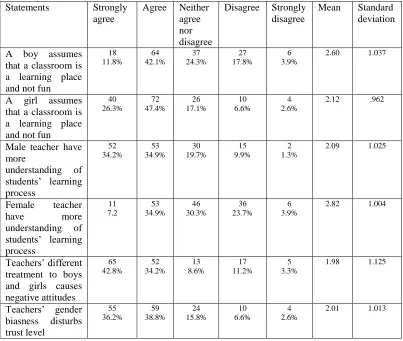
Table-2 Gender differences Statements Strongly
agree
Agree Neither agree nor disagree
Disagree Strongly disagree
Mean Standard deviation
A boy assumes that a classroom is a learning place and not fun
18 11.8%
64 42.1%
37 24.3%
27 17.8%
6 3.9%
2.60 1.037
A girl assumes that a classroom is a learning place and not fun
40 26.3%
72 47.4%
26 17.1%
10 6.6%
4 2.6%
2.12 .962
Male teacher have more
understanding of students‘ learning process
52 34.2%
53 34.9%
30 19.7%
15 9.9%
2 1.3%
2.09 1.025
Female teacher
have more
understanding of students‘ learning process
11 7.2
53 34.9%
46 30.3%
36 23.7%
6 3.9%
2.82 1.004
Teachers‘ different treatment to boys and girls causes negative attitudes
65 42.8%
52 34.2%
13 8.6%
17 11.2%
5 3.3%
1.98 1.125
Teachers‘ gender biasness disturbs trust level
55 36.2%
59 38.8%
24 15.8%
10 6.6%
4 2.6%
2.01 1.013
The 1st statement of this table,‖ A boy assumes that a classroom is a learning place and not fun‖ reveals that only 11.8% responses are strongly agreed. The 2nd statement, ―A girl assumes that a classroom is a learning place and not fun‖ has got 26.3% responses of strongly agreed.
523 agreed responses. The statement,―Teacher‘s
different treatment to boys and girls causes negative attitudes‖ demonstrates only 11.2% disagreed responses. 36.2% are strongly agreed
with the last statement ―Teacher‘s gender biasness disturbs trust level‖. Only 2.6% are strongly disagreed with it.
Table-3 Students‘ perception and confidence Statements Strongly
agree
Agree Neither agree nor disagree
Disagree Strongly disagree
Mean Standard deviation
Knowledge is strongly linked with grades 14 9.2% 32 21.1% 28 18.4% 46 30.3% 32 21.1%
3.33 1.275
Teachers‘ well dressing is good for interaction 34 22.4% 68 44.7% 29 19.1% 17 11.2% 4 2.6%
2.27 1.016
Use of English is directly linked with teachers‘ teaching skill 21 13.8% 58 38.2% 33 21.7% 30 19.7% 10 6.6%
2.67 1.138
Scores I achieve in sessional marks clearly reflect my abilities 18 11.8% 58 38.25 26 17.1% 36 23.7% 14 9.2%
2.80 1.196
Teachers‘ high qualification is not linked with teaching skills 27 17.8% 46 30.3% 23 15.1% 37 24.3% 19 12.5%
2.84 1.319
My perception about teachers‘ assessment methods affects my abilities 20 13.2% 78 51.3% 32 21.1% 16 10.5% 6 3.9%
2.41 .979
Teachers‘ use of mobile in classroom hampers student learning 33 21.7% 73 48.0% 23 15.1% 12 7.9% 11 7.2%
2.31 1.117
My perception about teachers‘ teaching skills affects my feedback 23 15.1% 79 52.0% 37 24.3% 13 8.6% - -
2.26 .820
My perception about teachers‘ treatment with
26 17.1% 78 51.3% 27 17.8% 16 10.5% 5 3.3%
524 both genders
affects my attitude with teacher
Grades have weak link with confidence level of student
21 13.8%
61 40.1%
22 14.5%
41 27.0%
7 4.6%
2.68 1.148
My confidence does not depend on teachers‘ flexible behavior
21 13.8%
45 29.6%
23 15.1%
52 34.2%
11 7.2%
2.91 1.218
My confidence is directly linked with supportive classroom environment
52 34.2%
75 49.3%
15 9.9%
7 4.6%
3 2.0%
1.91 .894
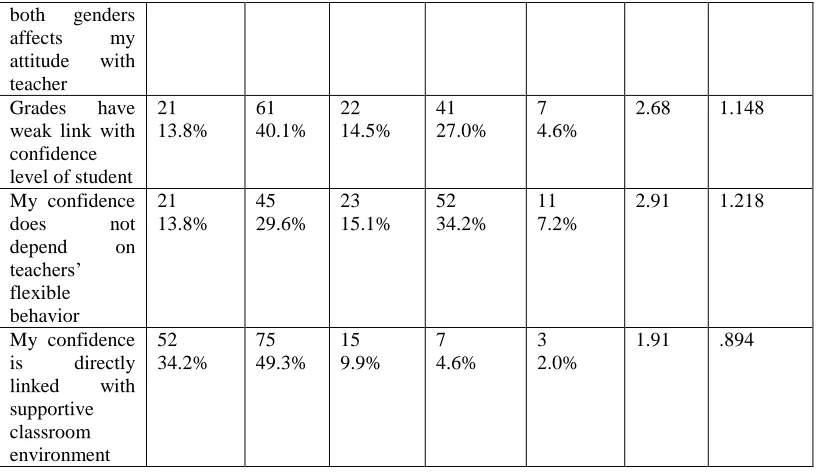
There is very assorted response for the statement ―Knowledge is strongly linked with grades‖, i.e., 9.2% are strongly agreed, 21.1% agreed, 18.4% neutral, 30.3% disagreed and 21.1% are strongly disagreed. A considerable figure of responses 44.7% are agreed with the statement ―Teachers‘ well dressing is good for interaction‖. 19.7% are disagreed and 21.7% are neutral with statement ―Use of English is directly linked with teachers‘ teaching skill‖. Only 11.8% are strongly agreed with 4th statement ―Scores I achieve in sessional marks clearly reflect my abilities‖. 5th statement show 30.3% responses of statement ―Teachers‘ high qualification is not linked with teaching skills‖. A large majority 51.3% responses agreed with statement ―My perception about teachers‘ assessment methods affects my abilities‖. An unignorable amount of respondents 48.0% consider that ―Teachers‘ use of mobile in classroom hampers student learning‖. 8th statement ―My perception about teachers‘ teaching skills affects my feedback‖ has shown the response 52.0% agreed. 17.1% are strongly agreed with statement ―My perception about teachers‘ treatment with both genders affects my attitude with teacher‖. A majority of 40.1% are agreed with the statement ―Grades have weak link with confidence level of student‖. The statement ―My confidence does not depend on teacher‘s flexible behavior‖ has shown diverse
responses, 13.8% are strongly agreed, 29.6% agreed, 15.1% neutral, 34.2% disagreed and 7.2% strongly disagreed. 49.3% are agreed with statement ―My confidence is directly linked with supportive classroom environment‖.
22.4% are strongly agreed with ―I am given skill of remembering previously learned information‖. About half i.e., 51.3% are agreed with ―I am given skill of grasping the meaning of information‖. About 13.8% are disagreed and 13.2% neutral with statement ―I am given skill of applying knowledge to actual situation‖. 22.4 are strongly agreed with ―I am given skill of breaking down objects or ideas into simpler parts and seeing how the parts relate and are organized‖. 50.7% are agreed with statement ―I am given skill of rearranging component ideas into a new whole‖. 55.9% are agreed with ―I am given skill of making judgments about value of ideas or materials‖.
Bivariate Analysis
Bivariate descriptive analysis:
525 averages.e.g. Differences between means (Blaikie, 2003).
Table-4 Learning I am given sufficient skills within my courses to meet
professional needs listed below:
Strongly agree
Agree Neither agree nor disagree
Disagree Strongly disagree
Mean Standard deviation
Remembering previously learned information
34 22.4%
82 53.9%
18 11.8%
15 9.9%
3 2.0%
2.15 .947
Grasping the meaning of information
33 21.7%
78 51.3%
30 19.7%
9 5.9%
2 1.3%
2.14 .869
Applying knowledge to actual
situation
37 24.3%
67 44.1%
20 13.2%
21 13.8%
7 4.6%
2.30 1.122
Breaking down objects or ideas into simpler parts and seeing how the parts relate and are organized
34 22.4%
78 51.3%
21 13.8%
16 10.5%
3 2.0%
2.18 .966
Rearranging component ideas into a new whole
24 15.8%
77 50.7%
33 21.7%
16 10.5%
2 1.3%
2.31 .908
Make judgments about value of ideas or materials
39 25.7%
85 55.9%
14 9.2%
10 6.6%
4 2.6%
2.05 .923
Testing Of Hypotheses
Hypothesis 1: Strong cultural capital positively influence the students’ learning. Table- 5 Association between cultural capital and students‘ learning
Cultural Capital
Student learning Total
Low Medium High
Low 6 10 6 22
27.3% 45.5% 27.3% 100.0%
Medium 12 53 25 90
526
High 5 12 23 40
12.5% 30.0% 57.5% 100.0%
Total 23 75 54 152
15.1% 49.3% 35.5% 100.0%
Chi-square = 14.66 d.f. = 4 P-value = .005** Gamma = .348 ** = Highly Significant
The cross table constructed for the two variables; cultural capital and students‘ learning clearly shows that the maximum learning of student is existing with high cultural capital. The table clearly indicates that as the strength of cultural capital increased, have effects on students‘ learning.
Chi-square value (14.66) shows a highly significant (P = .005) association between cultural capital and student learning. Gamma
value shows a strong positive relationship between the variables. Above table indicates that low cultural capital had low, medium and high (27.3%, 45.5% and 27.3%) student learning, respectively. In medium cultural capital a major proportion had medium to high student learning and a majority (57.5%) had high cultural capital and student learning. So the hypothesis ―Strong cultural capital positively influence the student learning‖ is accepted.
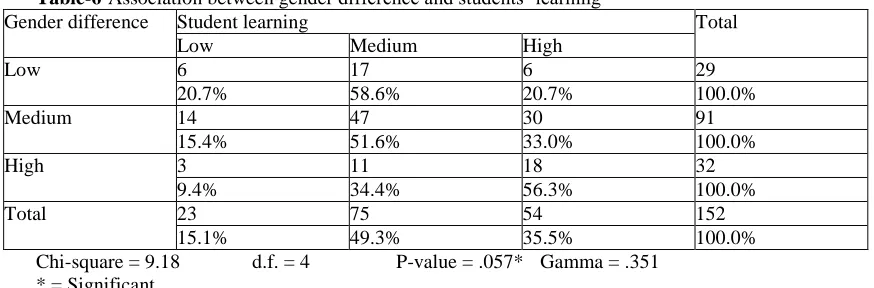
Hypothesis 2: Higher the gender difference, lower will be the students’ learning. Table-6 Association between gender difference and students‘ learning
Gender difference Student learning Total
Low Medium High
Low 6 17 6 29
20.7% 58.6% 20.7% 100.0%
Medium 14 47 30 91
15.4% 51.6% 33.0% 100.0%
High 3 11 18 32
9.4% 34.4% 56.3% 100.0%
Total 23 75 54 152
15.1% 49.3% 35.5% 100.0%
Chi-square = 9.18 d.f. = 4 P-value = .057* Gamma = .351 * = Significant
In contrast to past researches, the cross table constructed for the two variables; gender differences and students‘ learning indicates that high gender differences positively affect students‘ learning.
Chi-square value (9.18) shows a significant (P = .057) association between gender difference and student learning. While Gamma value shows a strong positive relationship between the variables. It‘s mean if the gender
difference is high than they had more learning in the study area. Above table also depicts that majority of those respondents who perceived medium to high gender differences also had medium to high perception about student learning. So gender difference positively associated with the student learning. So the hypothesis ―Higher the gender difference, lower will be the student learning‖ is rejected.
Hypothesis 3:Student confidence and perception about teacher strongly influence on students’ learning.
Table -7 Association between student confidence and perception about teacher and students‘ learning
Student confidence and perception about teacher
Student learning Total
Low Medium High
527
24.4% 48.9% 26.7% 100.0%
Medium 11 42 33 86
12.8% 48.8% 38.4% 100.0%
High 1 11 9 21
4.8% 52.4% 42.9% 100.0%
Total 23 75 54 152
15.1% 49.3% 35.5% 100.0%
Chi-square = 5.93 d.f. = 4 P-value = .204NS Gamma = .268 NS = Non-Significant
The cross table constructed for the two variables; student‘s confidence & perception and students‘ learning illustrates that high confidence increases students‘ learning to some extent but not significantly.
Chi-square value (5.93) shows a non-significant (P = .204) association between student confidence and perception about teacher and their learning. Gamma value shows a positive relationship between the variables. It means student confidence and perception about teacher positively associated with student learning, while these variables had non-significant association between them. So the hypothesis ―Student confidence and perception about teacher strongly influence on student learning‖ is rejected
Conclusion
In this research, I investigated whether student‘s parents‘ education, parents‘ occupation, learning habits acquired by family and sociology of classroom influence students‘ learning. Analysis and interpretation of data have empirically demonstrated that parents‘ education and occupation strongly influence students‘ learning in positive direction. Interpreting sociology of classroom, it is found that gender differences do not negatively affect students‘ learning in classroom. The results of effects of students‘ confidence and perception about teacher, on students‘ learning are not found considerable. The hypothesis ―Student confidence and perception about teacher strongly influence on student learning‖ is rejected. One finding of this study is in highly contrast to previous studies. In previous studies a strong negative relation was found between gender differences and learning. This study shows a positive relation between gender differences and learning.
References
Allwright, D. (1989) Interaction in the language classroom: Social problems and pedagogic possibilities. In Actes des Etats Generaux des Langues (Proceedings of the International Symposium on Language Teaching and Learning) (pp. 32–53). Paris: Association Pour Les Etats Genreaux des Langues.
Amy S. Hirschy, M. E. (2002) sociology of classroom and its influence on student learning. peabody journal of education . Atherton, J. (2010, February 10). Learning and Teaching; Bloom's taxonomy. Retrieved
August 13, 2011, from
www.learningandteaching.info:
http://www.learningandteaching.info/learning/ bloomtax.htm.
Attanasi, L. C. (1989) “Getting in: Mexican Americans‘ perceptions of university attendance and the implications for freshman year persistence‖ The Journal of Higher Education Vol. 60, pp.247–277.
Becker, G. S. (1991). A treatise on the family. Cambridge, MA: Harvard University Press. Bennett, W. S., Jr., & Gist, N. P. (1964). Class and family influences on student aspirations. Social Forces Vol.43, pp.167–173. Blake, J. (1989). Number of siblings and educational attainment. Science, 245(4913), 32, 36.
Bourdieu, P., & Passeron, J. C. (1977). Reproduction in education, society and culture. London: Sage.
528 Buchmann, C., & Dalton, B. (2002)
Interpersonal influences and educational aspirations in 12 countries: The importance of institutional context. Sociology of Education, 75(2), 99–122.
Buchmann, C., & DiPrete, T. (2006). The growing female advantage in college completion: The role of family background and academic achievement. American Sociological Review, 71, 515–541.
Chapman, A. (2006). Retrieved August 13, 2011, from www.businessballs.com: http://www.businessballs.com/bloomstaxonom yoflearningdomains.htm.
Chaudhry, S.M. and S. Kamal. (1996). Introduction to Statistical Theory. Part-II. Ch. No. 14. Markazi Kutub Khana Urdu Bazar, Lahore.
Cohen, e. g. (1972). sociology and the classroom: setting the conditions for teacher-student interaction. chicago: american educational reseaech institution.
Cohen, J. (1987). Parents as educational models and definers. Journal of Marriage and Family, 49, 339–35.
Collins, R. (1984). The role of emotion in social structure. In K. R. Scherer & P. Ekman (Eds.), Approaches to emotion (pp. 385 –396). Hillsdale, NJ: Lawrence Erlbaum Associates. Doyle, W. (1986). Academic work. In T.M. Tomlinson & H.J. Walber (Eds.), Academic work and educational excellence. Raising Student Productivity, 175-195. Berkeley, CA: McCutchan.
Eom, S. B., Wen, H. J., & Ashill, N. (2006). The determinants of students‘ perceived learning outcomes and satisfaction in university online education: An empirical investigation. Decision Sciences Journal of Innovative Education, 4, 215–255.
Fassinger P.A. (1995). Understanding classroom interaction: students‘ and professors‘ contribution to students‘ silence. Journal of Higher Education 66, 82–96. Featherstone, T. (2008). visual culture in the classroom. edith cowan university.
Fisher, D. (2006). Contemporary Approaches to Research on Learning Environments: Worldviews. River Edge.NJ.USA: World Scientific.
Floden, R. E. (1991). What Teachers Need to Know About Learning. In M. M. Kennedy (Ed.), Teaching Academic Subjects to Diverse
Learners (pp. 181-202). New York: Columbia University Teachers College.
Gillian, C. (1982). In a different voice. Cambridge: Harvard University Press.
Hauser, R. M., & Warren, J. R. (1997/2001). Socioeconomic indexes of occupational status: A review, update, and critique. In D. B. Grusky (Ed.), Social stratification in sociological perspective: Class, race, and gender (2nd ed., pp. 281–286). Boulder, CO: Westview Press.
Heller, J. F., Puff, C. R., & Mills, C. J. (1985). Assessment of the chilly college climate for women. Journal of Higher Education, 56, 446-461.
Hewitt, D. (2008). Understanding Effective Learning. Buckingham: Open University Press.
Lamont, Michèle, and Annette Lareau.(1988). ―Cultural Capital: Allusions, Gaps and Glissandos in Recent Theoretical Developments.‖ Sociological Theory 6(2):153-68.
Lucy Wairimu Kimokoti, A. (2008). Fundamentals of Sociologyof Education with reference to Africa. University of Nairibi Press.
Maddaus, J. (1990). Parental choice of school: What parents think and do. In C. B. Cazden (Ed.), Review of research in education (Vol. 16, pp. 267- 295). Washington, DC: American Educational Research Association. Mahmood, B. (2008). Sociological study of behavioral change in textile manufacturing organizations of Punjab, Pakistan: In context of global business culture. Ph.D. Thesis, Department of Rural Sociology, Univ. of Agri., Faisalabad.
Oakes, J. (1985). Keeping track: How schools structure inequality. New Haven: Yale University Press.
Palmer, P. J. (1998). The courage to teach: Exploring the inner landscape of a teacher‘s life. San Francisco: Jossey-Bass.
R.K.Merton. (1973). The Sociology of Science. Chicago: University of Chicago Press.d
529 Sher, M.C. (2008). Introduction to statistical
theory, Part-I. Ilmi Kitab Khana, Kabir Street, Urdu Bazaar, Lahore, 54000.
Srivastava, N. (2006). Educational Psychology. Global Media.
Szulanski, G., Cappetta, R., & Jensen, R. (2004). When and how trustworthiness matters: Knowledge transfer and the moderating effect of causal ambiguity. Organization Science, 15, 600–613.
Teachmann, J. D., & Paasch, K. (1998). The family and educational aspirations. Journal of Marriage and the Family, 60, 704–714. Thoits, P. (1995). Social psychology: The interplay between sociology and psychology. Social Forces, 73, 1231–1243.