Marlene Asselin
University of British ColumbiaGrade 6 Research Process Instruction:
A n Observation Study
Current literacy standards include students' abilities to conduct research as an inquiry process and to gather, evaluate, and synthesize information from multiple sources. Observa-tion data from 19 grade 6 classrooms were analyzed to describe research process instrucObserva-tion. Results showed that most of the teachers used traditional approaches to research tasks, monitored and supported students' procedural work through research projects, and that students used reference and textbooks far more than trade books and other types of texts. Findings suggest that students acquire topic-driven conceptions of the research process, encounter limited points of view about their research topic, and lack sufficient instruction on the cognitive processes of research. Implications for teacher educators and teacher-librarians are offered.
Les normes actuelles selon lesquelles on evalue l'ecriture et la lecture impliquent la capacite des eleves ä poursuivre une recherche en tant que processus d'enquete, et ä recueillir, evaluer puis mettre en rapport de Vinformation provenant de plusieurs sources. Des donnees obte-nues par I 'observation de 19 Salles de classe de sixieme annee ont ete evaluees pour arriver a une description des directives fournies lorsque les eleves entreprennent une recherche. Les resultats indiquent que la plupart des enseignants manifestent des approches traditionnelles face a la recherche et quits suivent et appuient les täches operatoires des eleves par le biais de
projets de recherche. Nous constatons egalement que les eleves ont recours aux ouvrages de reference et aux manuels de classe bien plus souvent qu'aux publications commerciales ou qu'aux autres textes. Les conclusions indiquent que les connaissances des eleves sur le processus de recherche sont ä base de themes, que la recherche qu'effectuent les eleves les met en contact avec des points de vue limites, et que Venseignement aux eleves des processus cognitifs relatifs ä la recherche est insuffisant. Nous evoquons des repercussions pour les formateurs d'enseignants et les enseigants-bibliothecaires.
Educating children for the 21st century entails instruction geared to living and learning in an information-rich environment (Breivik & Senn, 1998; Leu & Kinzer, 2000). Literacy standards now include students' abilities to conduct research as an inquiry process by generating ideas and questions and by posing problems; and to gather, evaluate, and synthesize information from a variety of technological and informational sources (International Reading Association and the National Council of Teachers of English, 2000). Similarly, current views of the research process, or the cognitive activities involved in conducting research, are based on locating and using multiple sources of information to construct new understanding (Kuhlthau, 1995). When students reach the inter-mediate grades, they spend significant amounts of time carrying out research tasks. Studies indicate that students tend to conceive of research as collecting information about a topic rather than engagement in multiple processes to
M . Asselin
learn about an issue or interest (Gordon, 1996; McGregor, 1995) and that instruction about the research process is incidental rather than systematic (Pitts, 1995). The complexity of the research process (Kuhlthau, 1989) presents unique instructional challenges (Dreher, Davis, Waynant, & Clewell, 1998; Tower, 2000). This article describes how grade 6 teachers support students' development of research skills during content-area learning projects.
Constructivism, Inquiry, and Resource-Based Learning: A Framework for Research Process Instruction
A constructivist perspective on teaching and learning underlies current educa-tional reform. Based on cognitive psychology and social interactionism, con-structivism views learning as an active process of solving problems and making meaning that takes place in and is influenced by social contexts (Tharp & Gallimore, 1988). A constructivist approach to teaching is represented by the notion of scaffolding, a term that originally referred to interaction between a child and parent where the parent supported the child " i n achieving an in-tended outcome" (Bruner, 1975, p. 12). Teachers scaffold students' learning in a variety of ways. Forms of instruction include direct instruction, modeling, and providing opportunities for guided practice. Scaffolded instruction is focused on cognitive processes, particularly metacognition, not only on procedures or products of learning. Although the goal of instruction is always independence, the teacher also continually assesses for new needs. Finally, constructivist teaching uses social contexts, such as small groups, to promote learning. Con-structivist classrooms feature a language-rich environment, the teacher as coach, and opportunities for higher level thinking, social interaction, and ex-ploration of problems (Brooks & Brooks, 1993).
Inquiry-based approaches to learning flow from a constructivist perspec-tive. Students develop their own questions and problems and use a variety of resources to pursue them. From the teacher's perspective,
curriculum as inquiry means that instead of using the theme to teach science, social studies, mathematics, reading, and writing, these knowledge systems and sign systems become tools for inquiry-exploring, finding, and researching students' own questions. Curriculum does not focus on activities and books, but on inquiry. (Short et al., 1996, p. 11)
However, research projects in schools often mean that students gather information on a topic and write a report. The goal of inquiry-based research is learning rather than completing a series of procedures. With an inquiry-based approach, "the student is done only when he has understood the problem, and come to his own judgment" (Sheingold, 1987, p. 81). Resource-based learning supports this goal in that teachers coach students while students actively engage in structuring meaningful inquiries and construct their own knowledge through the use of multiple print and electronic resources. It is also the primary learning strategy teacher-librarians use to guide students to develop informa-tion literacy skills and strategies (Doiron & Davies, 1998). Sheingold (1987) summarizes conditions for motivating students' inquiry: using real and impor-tant problems and questions, access to excellent resources, making communi-cation an integral part of the process, and ensuring that teachers and teacher-librarians help students manage the inquiry process.
Research Process: Models and Student Conceptions
Over the last decade we have learned much about the cognitive processes that underlie effective research tasks, particularly processes preceding report-writ-ing. Kuhlthau (1989) investigated the processes high school students use when faced with a research task. Her resultant model of the information search process (ISP) identified feelings, thoughts, and behaviors associated with each of six stages (task initiation, topic selection, prefocus exploration, focus for-mulation, information collection, and search closure). Subsequent studies (Davis-Lenski, 1994; McGregor, 1994; Pitts, 1995) confirmed Kuhlthau's model and presented key concepts about the research process: it takes place over time; it is complex and holistic; it is recursive; and it begins with feelings of uncer-tainty and anxiety that resurface part-way through the process.
The process-based view of research sees information-searching as one of the "knowledge systems ... [that is] a tool for inquiry" (Short et al., 1996, p. 11) However, students' own views of the research process vary. Most students appear to have a product-oriented view of research-something to get done, "another hoop through which students must jump to get to the finish line" (Gordon, 1996, p. 29). McGregor (1995) found that product-oriented students "were often unaware of the thinking they were doing, and were not conscious of ways in which they could alter their thinking to be more productive. They often operated from a belief that the process of thinking was a mystical, unex-plainable phenomenon" (p. 31). Their activities were predominantly catego-rizing, sequencing ^and copying from sources. In contrast, process-oriented students used analysis and synthesis skills, tended not to copy from sources, and "seemed to recognize that learning should be a result of their process" (p. 32). These students appeared more in sync with how their teachers viewed research: "discovering information that becomes new knowledge that supports problem solving and discovery learning" (Gordon, 1996, p. 29).
Following 11- and 12-year-olds through self-selected research projects, Many, Fyfe, Lewis, and Mitchell (1996) found that students held one of three task impressions of research: assimilation of information (finding and record-ing information), transfer of information (searchrecord-ing, findrecord-ing, and recordrecord-ing), and transforming information (all stages including reviewing and presenting). Similarly, Nelson and Hayes (1988) found that students had different goals (content or issue-driven) and strategies (low or high investment) during re-search activities. Students with content-driven goals emphasized fact-gather-ing, whereas students who were issue-driven sought information to support a point of view. High-investment strategies were more time-consuming and entailed more complex combinations of reading and writing for the purpose of exploring resources.
Research Process Instruction
M. Asselin
Successful implementation of inquiry- and resource-based learning depends on and provides the context for instruction in research skills. When instruction is absent, students flounder as evidenced by these responses to one teacher's attempt to introduce inquiry-based learning to her grade 4 class:
I don't know what you mean by project.
I have no clue what my topic will be like. Can you help me? I don't even know what you mean ...
Where am I going to get my information about dogs? I think I will need help. This is going to be hard. (Tower, 2000, p. 551)
Their teacher admitted, "Students generally didn't know the how of research. They didn't seem to understand how to find sources, how to use them effec-tively, and how to share what they found" (p. 555).
In the late 1980s, Macorie (1988) presented a framework for conducting inquiry-based learning, but the model lacked the specific skills and strategies students need to learn to move through the research process toward inde-pendence. Some recent professional resources (Harvey, 1998) explain how to guide elementary students through a research project based on personal mean-ing-making and teacher scaffolding. Tower (2000) found that her grade 4 students could carry out research tasks when she modeled the process and provided guided practice. Dreher et al. (1998) identified instructional methods that helped grade 4 students with average and below average reading abilities transfer research skills to other contexts. Specific research strategy instruction that was integrated into inquiry-based social studies projects included (a) formulating a model of the research process with students and referring to that model throughout the project, (b) using research projects throughout the year, and (c) organizing substantial time periods for research work into focus lessons on a research process problem identified in previous sessions, a review of research-process strategy, a work period, end-of-session collective sharing, and individual written reflections on the research process.
The teacher-librarian literature corroborates and extends these findings about effective instruction of the research process within a constructivist, in-quiry-based framework (Garland, 1995; Kuhlthau, 1997; McGregor, 1999; Stri-pling, 1995). Effective instruction focuses on process as well as content, continues throughout the whole research process, emphasizes metacognition, and provides for guided practice. These specific principles should take place within a constructivist perspective that entails student generation of research questions, multiple sources, student collaboration, and needs-based instruc-tion.
A major premise missing in the literacy literature on effective research process instruction is collaboration between the teacher and teacher-librarian as outlined in current guidelines for school library programs (American A s -sociation of School Librarians and the As-sociation of Educational Communica-tions and Technologies [AASL & AECT], 1998; Canadian Library Association, 2001; International Federation of Library Associations and Institutions, 1999). This is partly explained by teachers' lack of understanding of the roles of teacher-librarians as (a) information literacy experts; and (b) partners in plan-ning, teaching, and evaluating integrated, resource-based research projects (Moore, 2000; Pickard, 1993). Although teachers appear to view research as
problem-solving and learning, there "seemed to be a dichotomy in thinking about research when it took place in the library media center rather than in the classroom activities. Library research was not considered a priority or even part of the curriculum" (Gordon, 1996, p. 29).
When teachers and teacher-librarians collaboratively plan and teach resource-based units that are grounded in core curriculum, they address the skills and strategies students need to use information resources and students achieve higher levels of learning, problem-solving, and information and tech-nology skills (Haycock, 1996). However, studies of collaboration show that fewer than one third of teachers team up with teacher-librarians (National Center for Education Statistics, 1994). In the province where this study was conducted, school libraries and teacher-librarian positions had been drastically reduced or eliminated, as they have across Canada generally. In a recent survey of one large urban school district in the province (Asselin, in press a), more than half the teacher-librarians reported spending more than half their time providing relief time for teachers, and only 38% reported that they participated in effective collaborative planning and teaching with their staff (as defined by Loertscher, 1988). Clearly the potential for collaborative planning and teaching of research skills, as well as development of a rich and relevant curriculum-based resource collection, is greatly undermined by these cuts (Lance, Wel-born, & Hamilton-Pennell, 1993).
Given the increasing prominence of information literacy in literacy educa-tion and how little is known about how it is taught in Canadian classrooms, the main question directing this study was "What does research process instruc-tion look like in grade 6 classrooms?" Based on observainstruc-tion data in many classrooms, the study intended to paint a broad picture of instruction in this area of literacy. The second research question was "What evidence of construc-tivist approaches to teaching is there during classroom research project ac-tivities?" Specific aspects of instruction that took place during research project time that were observed were: the use of questions and problems to guide student research, types of student grouping, types of resources used, opportu-nities for language use, and use of scaffolded and traditional instructional strategies.
Methodology
Data for this study come from a larger observation study of grade 6 language arts instruction. The design of the study is based on Durkin's (1978-1979) multi-classroom observation of reading instruction. This section first describes the sample, research instrument, and research procedures for the larger study; then explains how episodes of research process were identified.
Observation Study of Language Arts Instruction: Sample, Research Instrument, and Research Procedures
instruc-M . Asselin
Hon, process writing, and integration across the curriculum. Language arts and reading programs that follow these principles are common in schools.
The schools included in the study were chosen either randomly or by district staff. The principal approached individual teachers, who then volun-teered their classrooms for observation on three consecutive days. Many class-rooms contained a multicultural mix of students representative of the population of the districts. Four classes were grade 5-6 splits, 11 classes con-tained grade 6 students, and eight were 6-7 splits. Eighteen of the teachers were female, and five were male. Information from a questionnaire revealed that teaching experience ranged from one to 28 years, with a mean of 11.48 years.
Teachers were asked to identify their orientation to teaching language arts from a choice of three approaches: whole language, traditional, and mixture of whole language and traditional. A t the time of data collection other terms were emerging to describe teachers' orientations such as balanced literacy; however, whole language and traditional were more familiar to most teachers. A whole language approach is characterized by reading, writing, and talking for mean-ing; learning language skills in context of meaningful use of language; using whole rather than fragmented texts; using trade books rather than basals to teach literacy skills; and the teacher as coach. A traditional approach features a focus on learning skills in isolation from meaningful use; repeated drill or practice of isolated skills; the use of part texts (sentences or paragraphs in isolation); the use of textbooks and commercial programs to teach literacy skills; and the teacher as teller. Thirteen teachers described their language arts program as whole language, seven reported their program as traditional, and three did not reply to this item.
Teachers were told that the purpose of the observations was to construct a broad description of language arts instruction. Volunteers were familiar with the categories of observation before formal observations began. Although teachers knew the days observers were to be in their classrooms, they agreed not to alter what would normally happen on those days.
A checklist was developed to record each instructional event. Researchers recorded all activities from first to last bell based on half-minute intervals. The checklist was intended to capture an overview of the place of language arts generally in the school day, as well as to represent the multiple dimensions of language arts instruction. For each instructional event, the following categories were recorded: (a) focus of instruction (e.g., language arts, subject areas, in-tegrated language arts, management); (b) type of language arts activity (e.g., reading aloud, writing); (c) type of materials used by both teacher and students (e.g., trade books, textbooks, worksheets); (d) type of instructional grouping (e.g., whole-class, small-group, individual activities); (e) form of the language activities engaged in by the teacher and students (e.g., speaking, listening, talking, writing, reading); and (f) type of instruction that was given (e.g., lecture, modeling, guided practice, giving directions). Instructional episodes were coded in sub stages—that is, opening, application, and closure.
Because many activities can occur simultaneously in a classroom, the re-searchers focused on what they considered to be the dominant activity in the class. Each observer sat unobtrusively in the room for three consecutive days. After each day, teachers were invited to discuss the coding, clarify their
tional decisions, and talk about specific events. During the pilot, interrater reliability was .80. After the pilot, the researchers observed separate class-rooms. However, they observed and coded one class in common with inter-rater reliability of .90. Field notes to augment the checklist were written at the end of each day.
Research Process Instruction: Identification of Episodes
The analysis reported in this article focuses on instruction that occurred during research project activities. A l l classroom episodes coded as having an in-tegrated language arts focus and the main activity as reading or the writing process were first identified. Examination of the field notes revealed which of these episodes involved students' engagement in different stages of research projects; that is, assignments in which students were expected to collect infor-mation about a topic or problem and then compose a report. Teachers con-firmed that these observed activities were part of research assignments. A l l research work that was observed occurred in the context of two curricular areas: social studies and science. Nineteen of the 23 classrooms were involved in research projects during the observation periods. Research activities ac-counted for 11% of the total observation time and 53% of time spent in in-tegrated language arts.
Results
Findings about what research process instruction looks like in grade 6 class-rooms are reported under two broad categories: (a) the instructional context, and (b) instructional strategies. The instructional context pertains to the use of questions and problems to guide student research, types of student grouping, types of resources used, opportunities for language use, and collaboration between teachers and teacher-librarians. Instructional strategies report the use of scaffolded and traditional instructional strategies.
The Instructional Context
A l l classrooms were following the prescribed provincial curriculum topics for science and social studies. However, there was no evidence that students were pursuing self-chosen questions or problems within the parameters of cur-ricular subjects. Rather, students were given wide topic assignments for which they were responsible for a specific focus. For example, students had to re-search teacher-designated aspects of these topics: salmon, the environment, Japan, France, and Canadian law. One teacher permitted her students to choose a country where they would like to vacation for their research projects. H o w -ever, this remained a topic-driven rather than inquiry-based formulation.
The balance of whole-class, small-group, and individual work time was examined. Table 1 lists the amount of time spent in different groupings during research projects.
M. Asselin
Table 1
Time in Instructional Groupings
Grouping Total % Social Studies % Science %
Whole class 836 38 525.5 39 310.5 35 Individual 806 36 386.5 29 419 46 Small group 411.5 18 325.5 24 88 10
Partner 182.5 8 97.5 7 85 9
Note. Time refers to number of minutes. % refers to percentage of total amount of time available in this category.
Types of texts students used as sources of information during research projects were determined. A s seen in Table 2, across both subject areas students predominantly used reference books (encyclopedias, dictionaries, and thesauri) to gather information for their assignments.
Other major sources of information for students' research work were text-books (prescribed social studies or science texts), which were used 25% of the time, and multimedia (video, Internet, CD-ROM), used 22% of the time. Trade books ("authentic" books not written as part of educational programs) were used least of all, accounting for 10% of the total time that reference books and textbooks were used. Finally, total time spent with public information texts (newspapers, magazines, public brochures) was only slightly more than the total time with trade books.
In the subject areas, students used textbooks much more in social studies than in science research tasks; and relied on reference books in science and textbooks hardly at all. Although multimedia texts were the most used type of text for science research, nearly half of that amount of time represents demon-stration of C D - R O M S and students' use of Internet resources that were downloaded and printed at home. Internet access was available in two school libraries but in none of the classrooms; however, no use of the Internet was observed. The number of texts that students worked with over an instructional period varied from one to five or more. Because students sometimes used multiple texts during observations, the time data about texts adds up to more than the actual time of the episodes.
Table 2
Time with Types of Texts Used for Information Sources
Text Type Total % Social Studies % Science %
Reference Books 875 38 576.6 37 298.5 41 Textbook 585.5 25 545.5 34 40 5 Multimedia 521 22 167 11 354 48 Public Information 176 8 133 8 43 6
Trade 159 7 159 10 0 0
Note. Time refers to number of minutes. % refers to percentage of total amount of time available in this category.
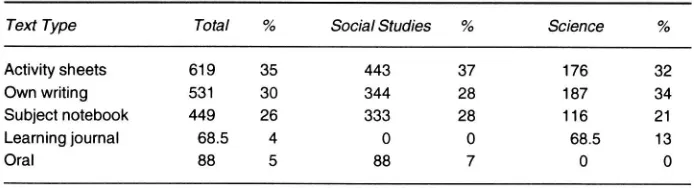
As an integral part of the research process, the amount of time students spent talking and writing during research work periods was also calculated (see Table 3).
Students spent 35% of the time filling in teacher-made or commercial worksheets followed closely (30% of the time) by their own writing (blank pages for notes and drafts). Subject area notebooks consisted mostly of collec-tions of worksheets and sometimes served as a place to keep drafts of reports. Students wrote in these approximately one quarter (26%) of the writing time. Learning journals were observed being used in only three classes. Class or group discussions (oral texts) accounted for the least amount of the time (5%). The pattern of dominant types of writing and talking in the individual subject areas was consistent with the time spent across subjects.
Instructional Strategies
Some insight into whether teachers operated from a constructivist or tradition-al perspective was gained by examining teachers' overtradition-all approach to language arts instruction. First, the researchers reviewed data collected in each category on the observation checklist and classified teachers according to Bergeron and Rudenga's (1996) criteria for authentic learning and then compared these clas-sifications with teachers' self-reported approach. There was a consistent match between researchers' categories of constructivist and traditional and teachers' self-reported approaches to language arts instruction. Instructional activities of self-reported whole language teachers allowed for greater student choice, more genuine resources, increased relevance, audiences beyond the teacher, and communicative purposes of using language. These teachers supported and scaffolded students' understanding of cognitive processes and were catego-rized as constructivist (n=ll). In contrast, instructional activities of self-reported traditional teachers and other teachers who did not describe their program on the questionnaire were less authentic according to Bergeron and Rudenga's (1996) criteria. Resources were contrived, audience was assigned, there was little student choice, low levels of relevance prevailed, and the purpose of language use was primarily evaluative or for practice. The teachers provided little support or scaffolding to help students cope with complexity. These teachers were categorized as traditional (n=8).
Table 3
Time Spent Writing and Talking during Research Work Periods
Text Type Total % Social Studies % Science %
Activity sheets 619 35 443 37 176 32 Own writing 531 30 344 28 187 34 Subject notebook 449 26 333 28 116 21 Learning journal 68.5 4 0 0 68.5 13
Oral 88 5 88 7 0 0
M. Asselin
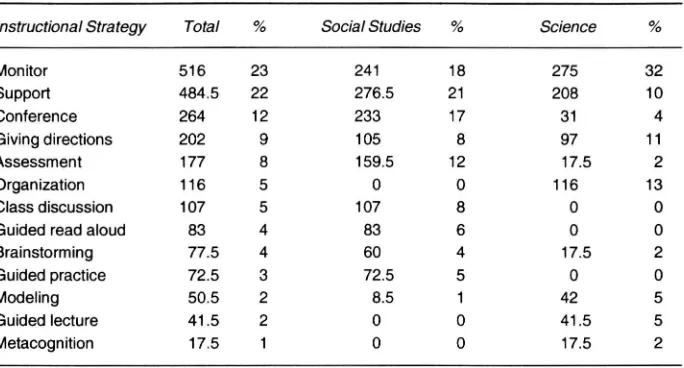
Table 4 identifies types of instructional strategies teachers used during research project work, and Appendix A defines the strategies.
Across both subject areas, teachers supported and monitored students for nearly half of the entire time they were engaged in research project tasks. For another quarter of the entire time, teachers conferenced, gave directions, and assessed students. Teachers' organizational tasks and leading class discussions accounted for another 10% of student research project work time. Scaffolded instruction, or types of instruction representative of constructivism, was counted as brainstorming, guided lecture, guided reading, guided practice, modeling, and metacognitive instruction. Total time in scaffolded instruction was 336.5 minutes and accounted for 16% of the total time. Similar amounts of scaffolded instruction occurred in the two subject areas where students were involved in research tasks.
Scaffolded instruction during research assignments was observed 20 times across eight of the 19 teachers. These eight teachers scaffolded the following stages of the research process: topic selection, locating information (including key word identification), evaluating sources, note-taking and fact-gathering, ordering notes, drafting (topic sentence construction), and presentation. Les-sons on note-taking were observed in four classrooms, key word identification in two classrooms, and topic sentence writing in three classrooms. Two teach-ers facilitated students' planning of their projects by demonstrating how to set timelines for each stage. One teacher began a research assignment by leading a student brainstorm of nontraditional genres of presentation (skit, poster, game, fashion show). Single incidents of instruction about other stages of the research process were observed. Frequency of observations of instances in classrooms of instructional support about a particular research stage ranged from one to five and ranged in duration from 4.5 to 52 minutes.
Table 4
Time Spent in Different Instructional Strategies During Research Process Activities
Instructional Strategy Total % Social Studies % Science %
Monitor 516 23 241 18 275 32
Support 484.5 22 276.5 21 208 10 Conference 264 12 233 17 31 4 Giving directions 202 9 105 8 97 11 Assessment 177 8 159.5 12 17.5 2 Organization 116 5 0 0 116 13 Class discussion 107 5 107 8 0 0 Guided read aloud 83 4 83 6 0 0 Brainstorming 77.5 4 60 4 17.5 2 Guided practice 72.5 3 72.5 5 0 0
Modeling 50.5 2 8.5 1 42 5
Guided lecture 41.5 2 0 0 41.5 5 Metacognition 17.5 1 0 0 17.5 2
Note. Time refers to number of minutes. % refers to percentage of total amount of time available in this category.
The eight teachers who provided some degree of scaffolded instruction engaged in extended periods of modeling, guided reading, metacognition in-struction, and guided practice. Their introductory sessions to the research work period consisted of specific instruction about one stage of the research process, and focus skills were reviewed and extended either during the closure component of the lesson and/or the following day. For example, one teacher used guided reading with a text about salmon to teach note-taking. Following an independent reading, the teacher led students to identify key information and important terms. As she read the text aloud, she stopped at critical points, discussed if and how information and terms were important, and directed students to underline these points in blue (information) or red (terms) pencils. Her reading extended, probed, and clarified the students' construction of meaning. The next day the teacher repeated the guided reading strategy with another text and stopped at the last paragraph for students to underline inde-pendently what they thought was important. She checked their work immedi-ately and asked students to explain their decisions. She then gave a guided lecture about the physical structures of male and female salmon using a color-ful book cover and posters and wove this information into the main topic of spawning. She finished by writing three headings on the board (Journey, Changes, Spawning) that students copied into their notebooks. Students were to synthesize information gained from the multiple sources of the information texts, posters, and oral discussion in their own words. Thus aspects of the research process were carried across time, used in multiple contexts, and sup-ported with differential degrees of scaffolding.
Teachers who used scaffolded instruction at the whole-class level also scaf-folded during independent work times. For example, one class was starting a project on the environment, and students were to formulate a cause-effect question to direct their research. When checking students' understanding of the assignment during the work period, the teacher questioned students about their research problem, their hypotheses about environmental impacts, and what kind of resources they would need to answer their question. The teacher also guided the students to think about what they already knew about the topic and to use this to find appropriate information. Another teacher, while circulat-ing durcirculat-ing the work period, asked students to think about the process they were going through, ensuring they were actually taking notes and writing paragraphs. She discussed with one student how he had collected many facts but that they did not answer the focus question. She led another student through a guided reading of a text to locate key information and then take notes. She also looked at students' learning journals to assess the quality of their notes and progress through the research process.
M . Asselin
instructional episodes. Telling was used instead of showing. In other words, teachers told students to write notes in their own words, to fill in viewing guides with the teachers' words, and to use multiple sources rather than teaching them how to transform information, identify main ideas, and syn-thesize information.
Six teachers used the school library over nine instructional periods for a total of 328 minutes. A teacher-librarian was present during seven of these times. Both the teacher and teacher-librarian predominantly supported and monitored students as they worked independently to collect information that was recorded on worksheets. Teacher-librarians were observed teaching strategies for locating information once and demonstrating a C D - R O M twice.
Discussion
Results of this study sketch a picture of research process instruction in grade 6. Across classrooms there was little evidence of an inquiry-based approach to research projects. Students mostly worked with assigned topics rather than posing their own questions or problems. The province's new social studies curriculum, implemented after this study was conducted, is based on a par-ticular inquiry-based model of learning (Case & Daniels, 1999), so findings might have been different just a few years later.
Use of quality multiple resources is integral to research inquiry to provide diverse sources of information and perspectives as well as a range of reading levels (Doiron & Davies, 1998; Harvey, 1998). However, results of this study indicate that teachers rely on reference books and textbooks, sources with limited points of view and challenging readability. Each classroom had its own set of encyclopedias (many sets more than 10 years old) and class sets of science and social studies textbooks. In contrast, access to trade books was limited to what the teacher or students brought into the classroom. Although teachers are probably aware of the many superior trade books from which information can be gained, they may need assistance both in getting them into their students' hands and learning how to use them to support their students' research abilities. This seems particularly urgent in science research where no trade books were observed being used. The lack of school library programs and teacher-librarians may be a factor in this limited use of resources (Lance et al., 1993).
That use of multimedia or electronic information sources was limited to downloaded pages from students' homes could be explained by the fact that many schools were in the process of being connected to the Internet the year the data were collected. Observations today would probably yield a different picture of use of electronic texts. However, although students appeared to access the Internet at home to collect information, there was no observation of instruction on reading or evaluating Internet sources, a critical information literacy skill.
Fewer than half the classes used multiple texts during their work periods, which suggests reliance on single sources, although it could be that students synthesized information at some time other than during the observation periods. Only one instance of instruction about discourse synthesis—trans-forming text from multiple sources into new knowledge—was observed. Many
et al. (1996) regard this ability as essential to perceiving the research process as transforming information.
Findings from this study also provide information on the degree and types of constructivist teaching that occur when students are learning research pro-cess skills. Although teachers in this study worked in a provincial construc-tivist curriculum, eight of the 19 who were observed during research project instruction used traditional approaches to learning tasks. Eight of the 11 con-structivist teachers used scaffolding strategies, whereas the other three in this group tended to use traditional instruction during research projects. Eight teachers scaffolded students' abilities during both whole-class instruction and independent work times. In contrast, other teachers predominantly gave direc-tions, monitored, and encouraged during research activities. It appears that teachers who provide constructivist learning activities in the language arts may not necessarily transfer this way of teaching to research assignments. Teachers may be more influenced by their own past experiences with research as a series of steps to get through rather than a process requiring specific instructional support. In addition, teachers may not do much research themselves, which would inhibit a process-based understanding. When Tower (2000) drew on her recent personal experience with the research process to help her students, they were able to replicate the process for themselves. Results of this study concur with others (Pitts, 1995) by suggesting that most teachers either assume that students do not require careful scaffolded instruction to proceed through re-search assignments or are unsure how best to support students.
Current models of the information and research process present at least six stages (Kuhlthau, 1989). Observations from this study suggest that students skip several important early stages: task initiation, prefocus exploration, and focus formation. They appear to move from topic selection directly to collect-ing information. A s well, there was no evidence of the last stage of the informa-tion search process, search closure. Again, students seemed to go directly to report-writing and stages of the writing process. Findings suggest that al-though teachers are familiar with guiding their students through the writing process, they are less aware of the other aspect of research, the information search process and specific methods of instructional support throughout the process (Garland, 1995; Stripling, 1995). Although nearly all teachers had their students use various worksheets to organize their information during collec-tion and before drafting written reports, there were few observacollec-tions of sys-tematic direct instruction such as modeling, guided lecture, and guided practice of this prevalent activity or any of the preceding stages.
M. Asselin
writing focused on content rather than control of their research processes, suggesting that teachers had more developed knowledge of writing-to-learn strategies than information-searching processes.
School Library Connections
The few observations of school library connections during research assign-ments indicate that the roles of the teacher-librarian as information literacy expert and teacher are undeveloped in schools and that the potential of cooperatively planned and taught resource-based units of study is unrealized. A recent report on effective teaching from the National Commission on Teach-ing and America's Future identifies the urgent need for collaboration among teachers and specialists in schools: "If our recommendations were followed, virtually everyone in schools would be doing some teaching and some cur-riculum work, and much collaborative planning" (Darling-Hammond, 1997, p. 34). Current guidelines for school library programs (AASL & A E C T , 1998; Canadian Library Association, 2001) are based on this principle of effective teaching.
Research and information literacy skills are being incorporated into the literacy literature. The National Research Center on English Learning and Achievement (2000) has just released "new media and technology literacy standards" that are based on expanding notions of literacy in an information-and technology-based society. Similarly, the International Reading Association and National Council of Teachers of English (2000) identify two of 12 standards directly related to research and information literacy:
Students conduct research on issues and interests by generating ideas and ques-tions, and by posing problems. They gather, evaluate, and synthesize data from a variety of sources to communicate their discoveries in ways that suit their purpose and audience. (Standard #7)
Students use a variety of technological and informational resources to gather and synthesize information and to create and communicate knowledge. (Standard #8)
These new thrusts in the literacy literature are the foundations of guidelines and standards of school libraries (AASL & A E C T , 1998; Association for Teach-er-Librarianship in Canada and the Canadian School Library Association, 1997). In contrast to older notions of research skills taught in isolation from the curriculum and classroom, current frameworks of research process pedagogy in the school library literature are grounded in principles of curriculum-based learning and collaborative planning and teaching (Doiron & Davies, 1998; Kuhlthau, 1997; Stripling, 1995). A school district administrator recently told me that in her experience teacher-librarians are the most underutilized resource in schools. Successful implementation of collaborative, curriculum-based research instruction depends on a team approach to teaching (including administrators, teachers, and teacher-librarians), a mutually held constructivist view of information-searching, a shared commitment to teaching information skills, and competence in designing activities and strategies to improve student learning (Kuhlthau, 1993). Lack of time, confusion of roles, and poorly designed activities inhibit the implemention of a process-based approach to information skills. Although this study of classroom instruction of the research
process did not examine these factors, teachers, teacher-librarians, and admin-istrators can refer to these factors to assess and restructure how students learn research skills.
Conclusions and Implications
Both literacy and school library programs aim to support students' develop-ment of an inquiry-based conception of research and the processes necessary to learn from a variety of sources. Results of this study suggest there is much work to be done in effective classroom instruction of the research process. The research activities that were observed were largely topic- and teacher-driven, and students appeared to be implicitly expected to gather important informa-tion about the topic from limited sources. Results of this study suggest students are forming product-based views of the research process that consist of as-similation or transfer of information in contrast to issue-driven inquiries sup-ported by a process-based view of research. However, data for this study are drawn from an investigation designed to capture the scope and breadth of language arts instruction. Results represent a wide-angle rather than in-depth view of some major aspects of research process instruction. Examining products of students' research activities would help illuminate the link be-tween research process instruction and student outcome. Similarly, case studies involving observations of and interviews with teachers, teacher-librarians, and students would enlighten understanding about cognitive processes of research tasks and their instruction and students' resultant con-ceptions of the research process. Finally, action research focused on both in-struction and student work would help teachers and teacher-librarians reflect on how the multiple aspects of teaching research are based in meaningful inquiries and cognitive processes. In sum, findings from this study serve as a starting point for ongoing investigations in explicit and systematic planning of students' inquiry-based learning, how to address metacognition, the teaching and monitoring of students' concept development and making of meaning, the place of language discourse and instructional conversation in promoting inde-pendent and interdeinde-pendent learning, and the importance of authentic topics and tasks for student inquiry.
This overview offers implications for teacher educators and teacher-librarians. Teacher educators, particularly those involved in literacy education, need to introduce preservice teachers to the role of the teacher-librarian as a partner in students' learning in an information age. The American Library Association's Presidential Committee on Information Literacy (1989) recom-mended that "teacher education and performance expectations should be modified to include information literacy concerns" and that preservice teachers should work with teacher-librarians in school libraries "to promote an under-standing of resources available in that facility and other community libraries and to emphasize the concepts and skills necessary to become a learning facilitator" (Committee Recommendations #5). A successful project in a large western Canadian university provides one model for carrying out this recom-mendation (Asselin, in press b).
M . Asselin
to develop research inquiries (Case & Daniels, 1999). Once inquires are formed, teacher-librarians can provide enriching texts, especially trade books and electronic sources. This provides a meaningful context to teach information literacy skills and strategies that are part of the literacy curriculum. When teachers see the link between their literacy curriculum and teacher-librarian's information literacy curriculum, it will be easier to plan collaboratively. One thing can lead easily to another, and each situation will permit a different degree of partnership to develop. Instruction aimed at preparing students for living in the information age can be improved by collaborative efforts between teachers and teacher-librarians that focus on systematic instruction of research skills in authentic learning tasks. Finally, with an extra teacher working with the classroom teacher, constructivist teaching strategies may be used more frequently to support students' development of the multiple and complex cognitive processes required to be information literate.
References
American Association of School Librarians and the Association of Educational Communications and Technologies. (1998). Information power: Building partnerships for learning. Chicago, IL: American Library Association.
American Library Association Presidential Committee on Information Literacy. (1989). Final report. (ERIC Document Reproduction Service N o . E D 315074) [On-line]. Retrieved M a y 23, 200 from the W o r l d Wide Web: http://www.infolit.org/documents/89Report.htm Asselin, M . (in press a). Factors of effective school libraries: A survey of perspectives of teachers,
teacher-librarians, and principals. San Jose, C A : L M C Source.
Asselin, M . (in press b). A case study of partners in educational change: Teachers and teacher-librarians. Do you read me? Conference proceedings of the International Association of School Librarians. San Jose, C A : L M C Source.
Association for Teacher-Librarianship in Canada and the Canadian School Library Association. (1997). Students' information needs in the 21st century: Competencies for teacher-librarians. [Online]. Retrieved June 15,2000 from the World Wide Web:
http://www.cla.ca/divisions/cslaf/pub_2htm
Bergeron, B., & Rudenga, E. (1996). Seeking authenticity: What is "real" about thematic literacy instruction? Reading Teacher, 49,544-551.
Breivik, P.S., & Senn, J.A. (1998). Information literacy: Educating children for the 21st century. Washington, D C : National Education Association.
Brooks, J.G., & Brooks, M . G . (1993). In search of understanding: The case for constructivist classrooms. Alexandria, V A : Association for Supervision and Curriculum Development.
Bruner, J.S. (1975). The onotogenesis of speech acts, journal of Child Language, 2,1-40.
Canadian Library Association. (2001). A position statement on effective school library programs in Canada. Ottawa: Author.
Case, R., & Daniels, L.R. (Eds.). (1999). Critical challenges in social studies for upper elementary students. Richmond, BC: Critical Thinking Cooperative.
Darling-Hammond, L. (1997). A n interview with Linda Darling-Hammond. Journal of Staff Development, 28(1),34-37.
Davis-Lenski, S.J. (1994). The research process of middle-school students. Reading Improvement, 32,224-242.
Doiron, R., & Davies, J. (1998). Partners in learning: Students, teachers, and the school library. Englewood, C O : Libraries Unlimited.
Dreher, M.J., Davis, K . A . , Waynant, P., & Clewell, S.F. (1998). Fourth-grade researchers: Helping children develop strategies for finding and using information. National Reading Conference Yearbook, 47,311-322.
Durkin, D . (1978-1979). What classroom observations reveal about reading comprehension instruction. Reading Research Quarterly, 14,481-533.
Garland, K . (1995). The information search process: A study of elements associated with meaningful tasks. School Libraries Worldwide, 1(1), 41-53.
Gordon, C . A . (1996). Is fish a vegetable? A qualitative study of a ninth-grade research project. School Library Media Quarterly, 25,27-33.
Harvey, S. (1998). Nonfiction matters: Reading, writing, and research in grades 3-8. York, M E : Stenhouse.
Haycock, K. (1996). Research in teacher-librarianship and the institutionalization of change. In L . A . Clyde (Ed.), Sustaining the vision: A collection of articles and papers on research in school librarianship (pp. 13-23). San Jose, C A : H i Willow Research & Publishing.
International Federation of Library Associations and Institutions. (1990). The school library in teaching and learning for all: IFLA/UNESCO school library manifesto. [Online]. Retrieved June 15, 2000 from the W o r l d Wide Web: h t t p : / / w w w . i f l a . o r g / v l l / s l l / p u b s / m a n i f e s t . h t m
International Reading Association and the National Council of Teachers of English. (2000). Standards for the English language arts [Online]. Available:
http://www.ncte.org/standards/standards.shtml
Kuhlthau, C . C . (1989). Information search process: A summary of research and implications for the school library media program. School Library Media Quarterly, 18,19-25.
Kuhlthau, C . (1993). Implementing a process approach to information skills: A study identifying indicators of success in school library media programs. School Library Media Quarterly, 22, 11-18.
Kuhlthau, C . (1995). The process of learning from information. School Libraries Worldwide, 1(1), 1-12.
Kuhlthau, C . (1997). Teaching the library research process (2nd ed.). Metuchen, NJ: Scarecrow Press. Lance, K . C . , Welborn, L., & Hamilton-Pennell, C . (1993). The impact of school library media centers
on academic achievement. Castle Rock, C O : H i Willow Research & Publishing. Leu, D.J., & Sinzer, C . K . (2000). The convergence of literacy instruction with networked
technologies for information and communication. Reading Research Quarterly, 35(1), 108-127. Loertscher, D . L . (1988). Taxonomies of the school library media program. Englewood, C O : Libraries
Unlimited.
Macorie, K. (1988). The I-Search paper. Portsmouth, N H : Heinemann.
Many, J.E., Fyfe, Lewis, G., & Mitchell, E. (1996). Traversing the topical landscape: Exploring students' self-directed reading-writing research process. Reading Research Quarterly, 31,12-36. McGregor, J.H. (1994). Cognitive processes and the use of information: A qualitative study of
higher-order thinking skills used in the research process by students in a gifted program. School Library Media Annual, 12,124-133.
McGregor, J.H. (1995). Process or product: Constructing or reproducing knowledge. School Libraries Worldwide, 2(1),28-40.
McGregor, J.H. (1999). Teaching the research process: Helping students become lifelong learners. Bulletin, 53(605),27-35.
Moore, P. (2000). Primary school children's interaction with library media: Information literacy in practice. Teacher-Librarian, 27(3), 7-11.
National Center for Education Statistics. (1994). School library media centers in the United States 1990-91. Washington, D C : U S Department of Education, Office of Educational Research and Improvement.
National Research Center on English Learning and Achievement. (2000). New media and technology literacy standards for K-12 teaching and learning [Online]. Retrieved July 12,2000 from the World Wide Web: http://cela.albany.edu/standards/index.html
Nelson, J., & Hayes, J.R. (1988). H o w the writing context shapes college students' strategies for writing from sources. Technical Report No. 16. Pittsburgh, P A : Center for the Study of Writing. Pickard, P.W. (1993). The instructional consultant role of the school library media specialist.
School Library Media Quarterly, 22(2),115-121.
Pitts, J . M . (1995). Mental models of information: The 1993-94 A A S L / H i g h s m i t h Research A w a r d Study. School Library Media Quarterly, 23,177-184.
Sheingold, K . (1987). Keeping children's learning alive through inquiry. School Library Media Quarterly, 15,80-85.
Short, K G . Schroeder, J., Laird. K., Lkaiffam, G., Ferguson, M.J., & Crawford, K . M . (1996). Learning together through inquiry: From Columbus to integrated curriculum. York, M E : Stenhouse. Stripling, B.K. (1995). Learning-centered libraries: Implications from research. School Library Media
Quarterly, 23(3), 163-170.
Tharp, R.G., & Gallimore, R. (1988). Rousing minds to life: Teaching, learning, and schooling in social context. Cambridge, U K : Cambridge University Press.
M. Asselin
Appendix A: Definitions for Coding Instructional Interactions
Instructional Strategy Definition
Assessment/testing
Brainstorming Conferencing Giving directions Guided lecture
Guided practice Guided reading
Metacognition Modeling
Monitoring
Organization
Supporting
Recording data about students' abilities/ understandings or formally assessing students
Eliciting knowledge from students about content/ process. With individual students or small groups about their work Giving information about procedures of task/activity.
Instruction of new strategy/concept using questions and student involvement.
Feedback during student use of new language strategy.
Scaffolding student comprehension of text during teacher's or students' oral reading.
Giving information about cognitive processes.
Using exemplars/explication of thinking processes to demonstrate while engaging in an activity related to students' instructional activity. Ensuring students' on-task behaviors—teacher often at desk or a progress check questioning students' accomplishment of the activity. Dealing with "paperwork," arranging displays, writing messages on board, conferring with person(s) other than student or correcting student work in isolation.
Confirming, encouraging, and seeking clarification or extension about students' understandings of and progress through an instructional activity—teacher in close proximity to students.