ANN based training methodology for solving
Linear Programming Problem
L.R.AravindBabu*
*Assistant Professor in Information Technology, CSE Wing, DDE Annamalai University, Annamalainagar-608002
Abstract
Linear Programming Problems are mathematical models which are used to find out the conditions in the way of objective functions and constraint. Nowadays, we have various methods and techniques to find out these problems occurring in the Linear Programming Problem. When developing a Linear Programming model, system and researchers often include all possible constraints although some of them may not be binding at the optimal solution. To achieve optimality in computational effort and also in accuracy, we proposed a hybrid algorithmic structure with training model for optimization of parameters in real time linear programming problem. This algorithm proposes the class based on the environment. It constructs input information using the input parameters and constraints using formal or conventional methods like complex algorithm and/or identifying redundant constraints before the predicted time. It forecasts the appropriate parameters. In case the predicted time or value belongs to any of the conditions, the value of parameters may vary. Forecast the appropriate parameters with the physical sensitivities. This structure improves the accuracy of bounded variables in linear programming problem model by suggesting the training and learning of parameters and constraints. This training is possible in real world application by applying artificial neural network.
Keywords: Linear Programming, Neural Network, Redundant Constraints, Back Propagation, Training Parameters
Introduction:
The Revised Simplex Method (Bharambhe, 1996), bounded complex algorithm (ArvindBabu et al., 2007)load
forecasting using the conventional methods such as regression-based method (Papalexopoulos&
Hesterberg,1990) Kalman filter (Trudnowski et al.,2001) concentrated only on achieving best computational
effort whereas, accuracy of these systems may go down due to reducing number of constraints and number of
iteration. To achieve optimality in computational effort and also in accuracy, we proposed a hybrid algorithmic
structure with training model for optimization of parameters in real time linear programming problem. This
algorithm proposes the class based on the environment. It constructs input information using the input
parameters and constraints using formal or conventional methods like complex algorithm and/or identifying
redundant constraints before the predicted time. It forecasts the appropriate parameters. In case the predicted
time or value belongs to any of the conditions, the value of parameters may vary. Forecast the appropriate
parameters with the physical sensitivities. This structure improves the accuracy of bounded variables in linear
programming problem model by suggesting the training and learning of parameters and constraints. This
Proposed work – Developing Hybrid Method
All the above methodologies concentrated only on achieving best computational effort whereas,
accuracy of these systems may go down due to reducing number of constraints and number of iterations. To
achieve optimality in computational effort and also in accuracy, we proposed a Hybrid Algorithmic Structure.
If we reduce number of iterations, the time complexity become optimal, but the accuracy of the system become
reduced. To improve the accuracy, we suggested training and learning of parameters and constraints. This
training is possible in real world application by applying Artificial Neural Network (ANN). The ANN has been
applied for various applications to predict forecasting of parameters, constraints and also to obtain optimality in
real world parameters. To proceed further, we consider a real world application, for (eg.,) load forecasting. Load
forecasting is essential in the electricity market for the participants to manage the market efficiently and stably.
However, the electric power load forecasting problem is not easy to handle due to its nonlinear and random-like
behaviors of system loads, weather conditions, and variations of social and economic environments, etc. Many
studies have been reported to improve the accuracy of load forecasting using the conventional methods such as
Regression-based method, (Papalexopolulos and Hesterberg, 1990) Kalman filter (Trudnowski et al., 2001) and
Knowledge-based expert system (Rahman and Bhatnagar,1988).
Proposed Hybrid Method
Complex algorithm / redundant constraints are used to achieve optimal in computational effort whereas ANN
is applied to achieve accuracy in any process model. This training is possible in real world application by
applying Artificial Neural Network (ANN). The ANN has been applied for various applications to predict
forecasting of parameters, constraints and also to obtain optimality in real world parameters.
Figure1: Hybrid Method
Input
Parameters
and Constraints
ANN
Proposed Hybrid Algorithm:
Step1: If the predicted day / time are belonging to class-1 environment, go to step 4 otherwise, it is class-2 environment.
Step2: Construct input information using the input parameters and constraints using any formal or conventional methods like complex algorithm and or identifying redundant constraints before the predicted day or time.
Step3: Forecast the appropriate parameters.
Step4: In case that the predicted day or time belongs to a class-1 situation, the value of parameters may vary.
Step5: Forecast the appropriate parameters with the physical sensitivities calculated in step 4. After taking the above steps, the normalized value of parameters is calculated from the data obtained. Thereafter, the parameters for any class of situation are forecasted from the normalized value.
IV Result
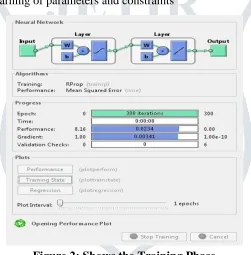
The following figure (2) shows the training phase of the network with the help of Artificial Neural Network. The training of the hybrid structure improves the accuracy of bounded variables in linear programming problem suggesting the training and learning of parameters and constraints
Figure 2: Shows the Training Phase
The figure (3) shows the plot performance of the training phase, here the performance is (0.0239374 and the
Figure: 3 Plot Performance of the Training State
Conclusion
The Hybrid Algorithmic Structure that improves the accuracy of bounded variables in Linear Programming
Problem model by suggesting the training and learning of parameters and constraints. The Training is possible
in applications by applying Artificial Neural Network. We believe, the proposed algorithm shows increased
performance in accuracy. The Hybrid Algorithm must be optimal in both computational effort and accuracy.
All the above methodologies concentrated only on achieving best computational effort and reduce time whereas,
accuracy of these systems may go down due to reducing number of constraints and number of iteration. To
achieve optimality in computational effort and also in accuracy, we proposed a structure called Hybrid
Algorithmic Structure with training model for optimization of parameters in a real time Linear Programming
Problem.
References:
1. Anderson E.D. and Andersen K.D., 1995, “Pre-solving in linear programming”, Mathematical Programming Series, Vol.2, No.7, pp.221-245.
2. ArvindBabu L.R., Samueeullah A.M. and Palaniappan B., 2007, “Complex algorithm for bounded variables”, ActaCienciaIndica, Vol. XXXIII M, No.2, pp.633-636.
3. Bakirtzis A.G. et al., 1996, “A neural network short-term load forecasting model for the Greek power system,” IEEE Trans Power System, Vol. 11, No.2, pp.858-863.
4. Bharambhe M.T., 1996, “A New Rule for Entering a variable in the basis in Revised Simplex Method”, Mathematical Programming, Vol. 6, pp.278-283.
5. Brearley A.L., Mitra G. and Williams H.P., 1975, “Analysis of Mathematical Programming Problem prior to applying the Simplex algorithm”, Mathematical Programming, Vol.8, pp.54-83.
11.ArvindBabu L.R. and Palaniappan B., 2009, “Identification of Redundant constraints in LPP Using Various methods: A Comparative Study”, ACCST Research Journal, Vol. VII, No.2, pp.57-65.
12.Lamedica R.et al.,1996, “A Neural Network based technique for short-term forecasting of anomalous load periods ,“IEEE Transaction Power System, Vol.11, No.4, pp.1749-1756.
13.Loslovich I.,2002, “Robust Reduction of a class of large scale linear program”, SIAM Journal of Optimization, Vol.12, pp.262-282.
14.Meszaros C. and Suhl U.H., 2003, “Advanced preprocessing techniques for linear and quadratic programming”, Operations Research Spectrum, Vol.25, pp.575-595.
15.Mori H. and Yuihara A.,2001, “Deterministic annealing clustering for ANN based short term load forecasting”, IEEE Transaction Power System, Vol. 16, No.3, pp.545-551.
16. Nayak and Sharma, 2000, “A Hybrid Neural Network and simulated annealing approach to the unit