The Alberta Journal of Educational Research Vol. XLV, No. 2, Summer 1999,170-183
Rhonda L. Boudreau
Eileen Wood
Wilfrid Laurier University
Teena Willoughby
Brock University
and
Jacqueline Specht
University of Western Ontario
Evaluating the Efficacy of Elaborative Strategies
for Remembering Expository Text
This study investigated whether elaborative interrogation would be an effective learning strategy for lengthy expository text. One hundred undergraduates (65 females and 35 males) comprised the study's five experimental groups: (a) unsupported elaborative interrogation, (b) self-study, (c) repetition, (d) elaborative interrogation with preunderlined main ideas, and (e) elaborative interrogation with preunderlined main ideas plus structured why questions.
All students read an eight-page passage on childhood education, studied the main ideas (preidentified or not), used their instructed strategies, and completed a free recall and multiple-choice test. Of interest is that in unsupported conditions students had difficulty recognizing the main ideas in the passage. Elaborative interrogation was maximized when supported with preunderlined ideas and also was enhanced by providing specific why
questions in addition to preunderlined ideas.
Cette étude visait à déterminer si l'interrogation elaborative représenterait une stratégie d'apprentissage efficace pour de longues rédactions descriptives. Cent étudiants du premier cycle (65 femmes et 35 hommes) ont été répartis parmi les cinq groupes expérimentaux de l étude: (a) l'interrogation elaborative sans appui, (b) l'étude auto-dirigée, (c) la répétition, (d) l'interrogation elaborative avec les idées principales soulignées, et (e) l'interrogation elaborative avec les idées principales soulignées et des questions structurées sur l'adverbe "pourquoi". Tous les étudiants ont lu un texte de huit pages sur l'éducation des enfants, étudié les idées principales (soulignées ou non), mis en pratique les stratégies qu'on leur avait suggérées et complété un test de rappel libre et un test composé de questions à choix multiples. Il est intéressant de noter que les étudiants qui n'avaient pas reçu d'appui ont manifesté de la difficulté dans l'identification des idées principales. L'interrogation elabora-tive a profité le plus à ceux pour qui on avait souligné les idées principales. Le fait d'ajouter des questions précises structurées sur l'adverbe "pourquoi" a également rendu l'apprentis-sage plus efficace.
Rhonda Boudreau is in the doctoral program at OISE. She completed her master's degree at Wilfrid Laurier University in the Developmental Psychology program.
Eileen Wood is an associate professor in the Department of Psychology. She works in the areas of developmental and educational psychology.
Teena Willoughby is an associate professor in the Department of Child and Adolescent Studies. Her primary areas of research are educational and developmental psychology.
Regardless of academic level, all students are faced with the challenging task of acquiring information from expository text. Although both adult and child students are capable of using many sophisticated memory strategies (e.g., verbal elaboration, mnemonics, and imagery) they often rely on less sophisti-cated strategies such as repetition when studying text material (Garner, 1990; Willoughby, Wood, & Khan, 1994; Woloshyn, Willoughby, Wood, & Pressley, 1990). It is difficult to understand why students would resort to less sophisti-cated strategies when faced with a difficult task. Some researchers have sug-gested that although students may have familiarity with relevant sophisticated strategies they may lack the practical experience to execute the procedures reliably (Wood, Motz, & Willoughby, 1998). One way to circumvent this prob-lem would be to introduce a sophisticated strategy that is easy to acquire and consistent with existing learning demands. A strategy that is potent, rapidly acquired, and easily executed would be especially useful for older students who have less class time available for strategy instruction.
Recently a great deal of emphasis has been directed toward teaching stu-dents to use a verbal memory strategy called elaborative interrogation. Elaborative interrogation involves answering why questions (e.g., " W h y would that fact be true?") for factual information presented in prose materials (Pressley, McDaniel, Turnure, Wood, & Ahmad, 1987). Generating the elabora-tion creates an associaelabora-tion between the to-be-learned material and existing prior knowledge, which can later be used to facilitate retrieval (Pressley et al., 1987; Wood, Pressley, & Winne, 1990). Not only is asking and answering questions a familiar method for learning and testing knowledge for students, but the familiarity of this technique makes acquisition of the elaborative inter-rogation strategy quick and easy (Pressley et al., 1987). The purpose of the present study was to examine the potency of elaborative interrogation when learners studied actual expository text material.
R.L. Boudreau, E. Wood, T. Willoughby, and /. Specht
Consistent with previous research this study also examines the typical learning gains from elaborative interrogation relative to other familiar learning strategies such as repetition and preferred self-selected study behaviors. Given the consistent advantages for elaborative interrogation over repetition in pre-vious research (Willoughby, Waller, Wood, & MacKinnon, 1993, Willoughby et al., 1994), we expected strong gains for elaborative interrogation here. With respect to self-study strategies, the effects are not as clear. For example, Wood and Hewitt (1993) and Wood, Willoughby, Reilley, Elliott, and DuCharme (1995) found that when students engaged in effective study strategies (e.g., imagery) they outperformed students who used repetition. It is expected that if students in the self-study group engage in effective strategies, their perfor-mance should parallel that of those using elaborative interrogation. However, if they adopt low-level strategies such as those reported by Garner (1990), they should more closely resemble the repetition group.
Because the text in the present study represents naturalistic learning materi-al, and hence facts are embedded, we also anticipated that the students might experience difficulty executing the elaborative interrogation strategy if they had difficulty identifying the main ideas on which to perform elaborative interrogation. Traditionally, elaborative interrogation studies have highlighted the to-be-learned factual content or presented only the factual information. In the present study, students must extract the main ideas and then use the elaborative interrogation strategy. To assess whether the added task of extract-ing main ideas compromised the potency of the elaborative interrogation strategy, we included an additional manipulation in the elaborative interroga-tion condiinterroga-tion. W e manipulated the levels of support students would be given regarding the identification of main ideas. Specifically, some students studied the passage with the main ideas underlined, and others had nonunderlined passages. In addition, some students who studied underlined passages also received prompts for the specific why question that would be appropriate for each underlined section. The rationale for these supports was simply to reduce the demands of the strategy, first, by highlighting the main ideas and, second, by highlighting the main ideas and indicating the right question to ask. It was expected that if the strategy were burdensome, then these supports might scaffold the learner while using this strategy for this demanding task.
In summary, there were two major comparisons. The first examined the relative potency of an unsupported elaborative interrogation condition with students' preferred self-study strategies and repetition when students studied text material. The second examined the importance of supports when using elaborative interrogation for text learning by comparing unsupported elabora-tive interrogation with elaboraelabora-tive interrogation with preidentified main ideas, and elaborative interrogation with preidentified main ideas plus structured
Method Participants
Participants i n the study were 100 university students (65 females and 35 males) who were enrolled in introductory psychology courses in a midsized Canadian city. Ages ranged from 18 to 48 years (M=19.99 years, SD=4.11 years). Participants received course credit for participating. Participants were randomly assigned to one" of the five conditions: unsupported elaborative interrogation, elaborative interrogation with main ideas underlined, elabora-tive interrogation with main ideas underlined and accompanied with specific why questions, repetition, and self-study. Equal proportions of males and females participated in each of the five conditions.
Materials
Two sets of materials were constructed. One was used for the practice phase and the second set for the experimental phase. A l l students were exposed to practice materials and strategy instructions first. Two paragraphs about the snowshoe hare served as the practice prose materials (based on materials in Seifert, 1993). The prose presentation was followed by a two-item multiple-choice memory test. One multiple-multiple-choice item tested each of the main ideas in the practice paragraphs. The questions consisted of a stem followed by four alternatives from which students selected one correct response.
After practice, students were presented the experimental materials. A l l students read eight pages of prose passages taken from chapter 14 of Santrock and Yussen's (1992) textbook Child Development. The 3,034-word passage com-prised 23 paragraphs about early childhood education.
After studying the text material, all students completed two memory posttests. First, a free recall task was given. Students responded to the open-ended question "Write down all the important information you can remember from the material you just read." The second memory posttest was a 28-item multiple-choice test with 17 multiple-choice questions reflecting main ideas presented in the text and 11 questions reflecting secondary points.1 Like the practice materials, each multiple-choice question had four alternatives.
Following the memory tests, students in the self-study strategy group answered an additional question, "Write down all the ways you studied the paragraphs."
Procedure
Students worked individually, but they studied, received instruction, and were tested in groups of up to 10 individuals. Students received the practice instruc-tions, the study passage, and the memory tasks in one session.
R.L. Boudreau, E. Wood, T. Willoughby, and ]. Specht
they found most effective to study the main ideas after they had highlighted the main ideas. Students in the unsupported and the underlined elaborative inter-rogation conditions were asked to generate the why question such as " W h y would this fact be true for this particular animal?" for each main idea. They also were told to write down their answer to the question. Good answers were defined as those that explained why each fact would be true and were specific to each fact. After answering the question about each main idea, the ex-perimenter provided feedback about the quality of each answer for each of the two why questions. Participants in the elaborative interrogation group with underlines plus structured why questions were asked to write their answers for the prepared why questions for each underlined idea. Again the experimenter provided feedback about the quality of the answers. After study, the practice multiple-choice tests were given followed by feedback about the accuracy of the students' answers.
The experimental materials were presented after a brief review of the strategy instructions was given. A l l students were told that they would have 50 minutes to work with the prose passage and that they would be asked to remember the material they studied on subsequent memory tests similar to those given during practice. A l l students were told that there were 18 main ideas i n the prose passage.
After the 50-minute study session, students in all five conditions were asked to put the text material aside and were given the free recall task. When the free recall test was completed, the 28-item multiple-choice test was administered (followed by the strategy use question for the self-study group).
Results
Four components of the data were analyzed: identification of main ideas, memory performance, quality of the elaborations among the elaborative inter-rogation groups, and study strategies in the self-study group.
Identifying Main and Secondary Ideas
The raw scores for main and secondary ideas were converted into proportions for all analyses. Overall, students in all three conditions expressed difficulty identifying main ideas. A 3 (condition) x 2 (idea-type) repeated measures analysis of variance was performed across the unsupported elaborative inter-rogation, self-study, and repetition groups for the number of selected ideas matching expert-identified main and secondary ideas. Means are presented in Table 1. There were significant main effects for condition, F(2,57)=5.23, p=.008, and idea-type, F ( l , 57)=46.13, p=.001.
Table 1
Means and Standard Deviations for Student-Selected Ideas Matching
Expert-Identified Items
Total Score Main Ideas Secondary Ideas
Group M SD M SD M SD
Elaborative Interrogation,
Naturalistic 8.45 2.35 4.90 1.94 3.55 1.32
Self Study 10.85 2.23 7.50 2.36 3.35 1.27
Repetition 9.65 2.45 6.00 2.71 3.65 1.46
Note: Data are presented in raw scores.
Memory Performance
Two sets of analyses were used to analyze the memory components. The first set compared the unsupported elaborative interrogation, self-study, and repetition groups. The second examined the three elaborative interrogation groups (i.e., unsupported, preunderlined main ideas, and preunderlined main ideas with structured questions). T w o aspects of memory performance were assessed: multiple-choice scores and free recall.
Multiple Choice
The means and standard deviations for the multiple-choice scores are presented i n Table 2. Memory performance was compared for the correct multiple-choice items reflecting main ideas, and correct multiple-choice items reflecting secondary ideas.
Across naturalistic elaborative interrogation, self-study, and repetition groups.
The 3 (condition) x 2 (idea type) repeated measures analysis of variance yielded a nonsignificant main effect for condition, F(2,57)=1.41, p=.14 and a significant main effect for idea type, F ( l , 57)=4.44, p=.04. More correct main ideas were remembered than secondary ideas (M=.77, SD=. 12 and M=.69, SD-. 11 respec-tively). The interaction was not significant, F(2,57)=.73, p=A9.
Table 2
Means and Standard Deviations of Multiple-Choice Test Performance
Total Score Main Points Secondary Points Group M SD M SD M SD
Elaborative Interrogation,
Naturalistic 19.50 2.37 12.20 2.17 7.30 1.42
Elaborative Interrogation,
with Underlines 21.35 2.80 14.15 1.87 7.20 1.58
Elaborative Interrogation, with Underlines and Why
Questions 20.40 2.87 14.00 1.69 6.40 1.65
Self Study 21.10 2.77 13.25 2.29 7.85 0.93
R.L. Boudreau, E. Wood, T. Willoughby, and ]. Specht
Among the three elaborative interrogation groups. The 3 (condition) x 2 (idea-type) repeated measures analysis of variance yielded a nonsignificant main effect for condition, F(2, 57)=1.96, p=.15 and a main effect for idea-type, F ( l , 57)=48.13, p=.001. More main ideas were correctly identified than secondary ideas (M=.78, S D = . l l and M=.63, SD=. 15 respectively). However, the main effect was qualified by a significant interaction between condition and idea-type, F(2, 57)=6.15, p=.004. Post hoc tests indicated that the unsupported elaborative interrogation group recalled fewer main ideas than the two other elaborative interrogation groups (preunderlined main ideas, and preunder-lined main ideas plus structured why questions). N o other comparisons were significant.
Free Recall Test.
The means and standard deviations for the free recall scores are presented in Table 3. Three scores were tallied for the free recall: the total number of ideas written down, the ideas matching expert-identified main ideas, and the num-ber of secondary ideas matching expert-identified secondary ideas. Two raters scored 25% of the data with 97% agreement. Discrepancies were resolved through discussion. The remainder of the data were scored by one of the two raters.
Across the unsupported elaborative interrogation, self-study, and repetition groups.
Because the total free recall score includes all information written down regard-less of whether the ideas reflected the multiple-choice items, a one-way analy-sis of variance was performed to compare the total free recall score across the groups. There was a significant main effect, F(2, 57)=3.46, p=.038. The only significant post hoc indicated that the unsupported elaborative interrogation group wrote down more ideas than the repetition group. The 3 (condition) x 2 (idea-type) repeated measures analysis of variance performed on the recall of main and secondary ideas yielded a nonsignificant main effect for condition, F(2,57)=2.08, p=.135 and a main effect for idea-type, F(l,57)=17.38, p<.001, with more main ideas identified than secondary ideas (M=.18, SD=.10 and M=.10, SD =.12 respectively). There was no significant interaction, F(2,57)=2.0, p=.145.
Table 3
Means and Standard Deviations for Free Recall Performance
Total Score Main Points Secondary Points Group M SD M SD M SD
Elaborative Interrogation,
Naturalistic 8.70 2.83 2.60 2.06 1.35 1.35
Elaborative Interrogation,
with Underlines 6.95 2.61 4.20 2.26 0.10 0.31
Elaborative Interrogation, with Underlines and Why
Questions 7.70 2.41 5.40 3.62 0.00 0.00
Self Study 8.25 2.71 3.90 1.97 1.20 1.61
Among the three elaborative interrogation groups. A one-way analysis of variance was conducted on total free recall points written down across the three elaborative interrogation groups. However, there was no significant main effect for total free recall score, F(2, 57)=2.24, p=.12. The 3 (condition) x 2 (idea-type) repeated measures analysis of variance performed on the recall of main and secondary ideas yielded a nonsignificant main effect for condition F(2,57)=2.08, /7=.14, and a significant effect for idea-type, F(l,57)=17.38, p=.001. More main ideas were recalled than secondary ideas (M=.24, SD=.16 and M=.04, SD=.05 respectively). However, the main effect for recall was qualified by an interaction, F(2, 57)=14.42, p=.001. Post hoc tests indicated that the unsupported group recalled fewer main ideas than the group receiving preunderlined main ideas plus why questions and recalled more secondary ideas than either of the other elaborative interrogation groups. The two latter groups d i d not differ.
Quality of Elaborations.
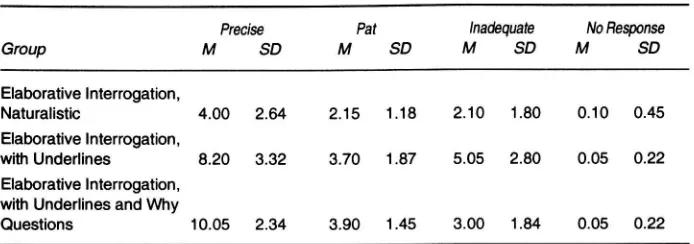
Each elaboration in the three elaborative interrogation groups was coded into one of four categories that reflected the quality of the response. The categories ranged from precise responses (i.e., a logical explanation that addresses why the fact would be true), to a no response categorization (i.e., failure to respond, answering "don't know," or providing an incomplete answer). The remaining two categories were pat (i.e., explanation was too general but d i d address the
why question), or inadequate (i.e., nonexplanatory elaboration that failed to clarify w h y the fact would be true). These categories are consistent with those used in prior research (Wood & Hewitt, 1993). T w o raters scored 27% of the responses with 89% agreement. Differences were resolved through discussion. The remainder of the material was scored by one of the raters. Table 4 provides the means and standard deviations of the categorizations given to the elabora-tions.
Three one-way analyses of variance compared the amount of precise, pat, and inadequate elaborations across the three elaborative interrogation groups. The "no response" category was not used due to extremely low numbers. Only elaborations matching the expert-identified main ideas were coded, so propor-tions were used. N o differences were found: F(2, 57)=2.67, p=.08 for precise; F(2,57)=1.13, p=.33 for pat and F(2, 57)=2.46, p=.10 for inadequate.
Conditional Probabilities
The quality of each elaboration was assessed to see whether subsequent perfor-mance on the multiple-choice test was affected by the adequacy of each re-sponse, that is, whether the quality of response generated at study had an impact on whether the student would remember the correct information at test. Three paired-samples t-tests compared precise elaborations with correct re-sponses versus pat elaborations with correct rere-sponses; precise elaborations with correct responses versus inadequate elaborations with correct responses; and pat elaborations with correct responses versus inadequate elaborations with correct responses for each of the three elaborative interrogation groups.
R.L. Boudreau, E. Wood, T. Willoughby, and J. Specht
Table 4
Means and Standard Deviations for the Quality of Elaborations.
Precise Pat Inadequate No Response
Group M SD M SD M SD M SD
Elaborative Interrogation,
Naturalistic 4.00 2.64 2.15 1.18 2.10 1.80 0.10 0.45
Elaborative Interrogation,
with Underlines 8.20 3.32 3.70 1.87 5.05 2.80 0.05 0.22
Elaborative Interrogation, with Underlines and Why
Questions 10.05 2.34 3.90 1.45 3.00 1.84 0.05 0.22
for the unsupported condition; £(19)=2.84, p-.Ol for the preunderlined condi-tion; and £(19)=7.21, p=.001 for the preunderlined plus structured why question group. The same pattern resulted when comparing precise elaborations to pat elaborations: £(19)=2.08, p=.05 for the unsupported group; £(19)=4.10, p=.001 for the preunderlined group; and f(18)=7.13, p=.001 for the preunderlined plus why question condition. However, when pat elaborations were compared with inadequate elaborations no differences emerged in any of the three elaborative interrogation groups.
Self-Study Behavior
Strategies were coded based on the responses that students wrote down during the study session and from the question presented at the end of testing. The study techniques were coded according to Wood and Hewitt (1993) with the addition of two categories. Wood and Hewitt categorized study strategies into four general groupings: verbal strategies (elaborations, questioning, rhymes, or mnemonics); imagery; prior knowledge; and repetition. The two additional categories, highlighting and a combination of repetition and summarizing, were added to incorporate the remaining student strategies.
In the present study, 95% (19 out of 20) of the participants highlighted ideas they felt were important in the passage, as per strategy instructions. Ninety-five percent (19 out of 20) performed at least one additional study technique. Seventy-four percent of these students (14 out of 19) used only repetition as their additional study technique. Of the remaining 26% (5 out of 19), one participant used repetition, prior knowledge, and imagery (5.3%), and the remaining four students (21.0%) used a strategy that combined elements of repetition with summarization.
Discussion
proportion of main ideas recalled was higher than secondary ideas, the overall ability to identify main ideas was poor for the students in the present study (the highest proportion was 44% for the self-study group). Although students were not identifying a majority of the correct main ideas, they still recalled a higher percentage of the main ideas than secondary ideas. This may indicate that, regardless of whether learners underline and study the appropriate main ideas, they still understand and "remember them. Brown and Smiley support this notion, stating, "We spontaneously abstract the main ideas even when no deliberate attempt to do so is instigated" (p. 7).
It was hypothesized that if the self-study group chose to use lower-order strategies, the elaborative interrogation group may have had an advantage in memory performance. However, although most students in the self-study con-dition used only highlighting and repetition, the posttest scores d i d not differ between these groups. The fact that undergraduates used these strategies was not surprising; in fact, this lends support to Garner's (1987) assertion that when left on their o w n to study, students who possess strategic knowledge often resort to lower-order strategies. Nonetheless, the lack of performance differen-ces between the two groups was unexpected.
One concern is that the students in the unsupported elaborative interroga-tion group experienced more difficulty identifying main ideas than students in the self-study condition. In fact, students in the self-study group identified a significantly higher percentage (44%) of the expert-identified main ideas than the unsupported elaborative interrogation group (29%). Such low levels of identification in the elaborative interrogation group suggest that the lack of performance differences may reflect a difference in focus between the two groups, which may be attributed to familiarity with the strategy used at study. That is, the self-study group may have had more time to focus on locating the main ideas than the elaborative interrogation group. This would be the result of the self-study group being more familiar and expedient in use of their study methods because these techniques are routine and executed automatically (and most require minimal effort). In contrast, the elaborative interrogation group was faced with a novel, and so less familiar, strategic activity (generating and responding to self-generated why questions) combined with the demands of locating information. In the context of a traditionally complex task, the novel strategic demands may have significantly increased the workload for these students. Whereas in previous research the simplified materials made the execution of elaborative interrogation the sole novel aspect, our manipulation may have introduced too many new demands simultaneously. It is important to remember that both groups had the same total amount of time to find and study the main ideas of the text. The issue is that students in the elaborative interrogation group, because they were using an unfamiliar strategy for a difficult passage, may have devoted more resources to executing the strategy and less time to identifying the main ideas.
R.L. Boudreau, E. Wood, T. Willoughby, and J. Specht
study strategies. Seifert (1993) proposed that the peripheral information, which qualifies and exemplifies the main idea in prose passages, may in fact provide elaborations to the main idea. Therefore, the paragraph surrounding the main idea could activate prior knowledge, which would normally not occur when using repetition-based strategies (Woloshyn, Pressley, & Schneider, 1992). It is possible, then, that the structure of the materials provided sufficient elabora-tion to enhance learning, even in groups where students were using lower-order strategies like repetition. Although Seifert reported enhanced performance for students instructed to use elaborative interrogation over those instructed simply to underline main ideas, he also reported smaller effect sizes for descriptive prose compared with lists of facts and paragraphs containing only main ideas.
That the elaborative interrogation group who received preunderlined main ideas d i d not perform better on free recall of main ideas than the unsupported elaborative interrogation group indicates that underlining main ideas alone may not be sufficient support for undergraduates studying expository text and using elaborative interrogation for the first time. The second support of struc-tured why questions, however, d i d enhance student performance over having no supports. This may indicate that structured why questions are required when undergraduates first use the elaborative interrogation strategy. Of inter-est is that the support(s) in the elaborative interrogation groups did not lead to differences in the number of precise elaborations generated. Moreover, there were no differences across the three groups in generating pat or inadequate elaborations. Therefore, the performance differences between elaborative inter-rogation groups were not an artifact of the support(s) influencing the adequacy of generated elaboration. The additional supports, however, may have pro-vided more time and opportunity for students to process information. It would appear that the most helpful scaffolding in expository text is the preidentifica-tion of main ideas accompanied by structured why quespreidentifica-tions.
However, although quality of elaborations d i d not differ between groups, it is important to note that multiple-choice performance was affected by the quality of elaborations provided at study. Students were more likely to answer a multiple-choice memory question correctly if the elaboration given at study for that item was precise rather than pat or inadequate. This is in agreement with previous studies that have indicated that, typically, elaboration quality affects subsequent performance (Willoughby et al., 1993; Wood et al., 1995). Therefore, two things are important for facilitating performance. First, students have to be able to locate main ideas, and then they have to create quality elaborations in order to maximize memory performance on the multiple-choice task.
comparison group with the elaborative interrogation group containing preunderlined main ideas (more scaffolding, therefore less laborious), thereby providing a comparison between the two groups where strategy instruction was the only difference between them.
Participants for this test group were 20 undergraduates enrolled in the same psychology courses as the first participants. The students read the same pas-sage and had the main ideas preunderlined. They were instructed in the same way as the previous repetition group, but in this case were instructed to write out the preunderlined main ideas. They were given the same multiple-choice test and free recall task as in the main study. A l l analyses paralleled the main study. For the multiple-choice task, a 2 (condition) x 2 (idea-type) repeated measures analysis of variance was performed to test the scores reflecting memory for main and secondary ideas between the two conditions. For the free recall task, a one-way analysis of variance was conducted for the total free recall score; and a 2 (condition) x 2 (idea-type) repeated measures analysis of variance was performed to assess recall for the main and secondary ideas.
In both the multiple-choice and free recall repeated measures analyses there was a main effect for idea type with more main ideas than secondary ideas being remembered. This finding was a replication of the main study. Unlike the main study, the interaction for the multiple-choice task yielded a trend in favor of the elaborative interrogation group over the repetition group for main ideas, ((38)=1.88, p=.068 (M=.83, S D = . l l and M=.75, SD=.15 respectively). Also con-trary to the main study, elaborative interrogation did not outperform repetition on the total free recall score, ((38)=.36, p=.721.
So when both conditions were given support for at least the main ideas, students in the elaborative interrogation condition lost their advantage in remembering the less important information in the text, but gained the ad-vantage in remembering the main ideas. In other words, when students in the elaborative interrogation condition were given even the basic support, they were better able to remember the critical content and were less distracted by peripheral information when compared with students who were also sup-ported but who used repetition. These findings are consistent with the pre-vious literature in elaborative interrogation, and they lend evidence to the suggestion that elaborative interrogation can promote learning over repetition, even with complex expository text.
R.L. Boudreau, E. Wood, T. Willoughby, and J. Specht
It is important to introduce students to a wide array of effective strategies. Indeed, the need to encourage students' development of strategic repertoires is a theme that has been evident in a wide body of literature for the past decade (Pressley, Borkowski, & Schneider, 1987; Wade, Trathen, & Schraw, 1990; Wood, Motz, & Willoughby, 1998). When students have a wide array of effec-tive strategies available to them, they are better able to select the procedure that will best match the task demands and their skills i n the area of study. To encourage students to engage in the use of effective and flexible strategy, it is first essential to ensure that they have access to, and successful experience with, a wide array of strategies. The body of literature on elaborative interrogation suggests that this strategy may be a useful addition to students' existing strategic repertoires.
Note
1. Categorization of main ideas was based on expert ratings of the reading material. Five experts were selected from faculty members at three universities who taught in both educational and developmental psychology. All experts read the material and highlighted main ideas. Agreement among four or more of the experts served as the criterion for recognition as a main idea.
Acknowledgment
Funding for this research was made possible through SSHRC grants provided to the second and third authors.
References
Brown, A.L., & Smiley, S.S. (1977). Rating the importance of structural units of prose passages: A problem of metacognitive development. Child Development, 48,1-8.
Garner, R. (1987). Strategies for reading and studying expository text. Educational Psychology, 54, 299-312.
Garner, R. (1990). When children and adults do not use learning strategies: Toward a theory of settings. Revieiv of Educational Research, 60,517-529.
Moore, D.W., & O'Driscoll, M.P. (1983). Strategies for studying text: A comparison of Papua New Guiñean and American research findings. Journal of Educational Psychology, 75,460-464. Pressley, M . , Borkowski, J., & Schneider, W. (1987). Cognitive strategies: Good strategy users
coordinate metacognition and knowledge. Annals of Child Development, 4,89-129. Pressley, M . , McDaniel, M.A., Turnure, J.E., Wood, E., & Ahmad, M . (1987). Generation and
precision of elaboration: Effects on intentional and incidental learning. Journal of Experimental Psychology: Learning, Memory and Cognition, 13,291-300.
Pressley, M . , Symons, S., McDaniel, M . A., Snyder, B.L., & Turnure, J.E. (1988). Elaborative interrogation facilitates acquisition of confusing facts. Journal of Educational Psychology, 80, 268-278.
Santrock, J., & Yussen, S. (1992). Child development (5th ed.). Dubuque, IA: William C. Brown. Seifert, T.L. (1993). Effects of elaborative interrogation with prose passages. Journal of Educational
Psychology, 85,642-651.
Wade, S., Trathen, W., & Schraw, G. (1990). An analysis of spontaneous study strategies. Reading Research Quarterly, 25(2),147-166.
Willoughby, T., Waller, T.G., Wood, E., & MacKinnon, G.E. (1993). The effect of prior knowledge on an immediate and delayed associative learning task following elaborative interrogation. Contemporary Educational Psychology, 18,36-46.
Willoughby, T., Wood, E., & Khan, M . (1994). Isolating variables that impact on or detract from the effectiveness of elaboration strategies. Journal of Educational Psychology, 86,279-289. Woloshyn, V.E., Willoughby, T., Wood, E., & Pressley, M . (1990). Elaborative interrogation
facilitates adults' learning of factual paragraphs. Journal of Educational Psychology, 82,513-524. Woloshyn, V.E., Pressley, M . , & Schneider, W. (1992). Elaborative interrogation and prior
knowledge effects on learning facts. Journal of Educational Psychology, 84,115-124. Wood, E., Fier, C , & Willoughby, T. (1992). Elaborative interrogation applied to small and large
Wood, E., & Hewitt, K.L. (1993). Assessing the impact of elaborative strategy instruction relative to spontaneous strategy use in high achievers. Exceptionality, 4(2), 65-79.
Wood, E., Motz, M . , & Willoughby, T. (1998). Examining students' retrospective memories of strategy development. Journal of Educational Psychology, 90,698-704.
Wood, E., Pressley, M . , & Winne, P.H. (1990). Elaborative interrogation effects on children's learning of factual content. Journal of Educational Psychology, 82,741-748.