Automated Software Testing Economics:
A White Paper
© 2012 Master Key Consulting 1 Propriety and Confidential Contents
Automated Software Testing Economics 1 Automated Software Testing Case Study 2 Benefits of Automated Software Testing 4 About Master Key Consulting 5
Automated Software Testing Economics
Abstract. Requirements traceability, life cycle verification and validation through testing are about software quality. Government agencies are increasingly challenged to reduce software release cycle time and deliver incremental releases in rapid succession. Incremental software development methodologies, such as spiral, agile, extreme programming or other continuous improvement software life cycle approaches are designed to deliver incremental value to customers. The need to iteratively combine one software release with the subsequent software release increases the size and complexity of the software testing effort. Each of the mentioned life cycle methodologies emphasizes the need to eliminate the propagation of systemic errors from one release to the next. Practically speaking, implementing automated software testing is essential to meeting today’s software delivery challenges. This paper focuses on the return on an investment in automated software testing procedures and tools to enable incremental delivery of quality software products within budget and schedule constraints.
Software Testing Methodology and Tools. Master Key Consulting (Master Key) initiated life cycle software testing with automated software testing tools in 2002. As our expertise in automated software testing matured, we adopted a software testing methodology in 2006 that defines test flows in terms of the business processes. This methodology isolates business sub-processes, accommodates logical business branching and lends itself to test case template development.
Working with business analysts, the test cycle time is reduced through pre-test cycle
development of test case templates. Then, using a data-driven approach, we can very quickly develop positive data, negative data and boundary data test cases from a single test case template. Isolating business sub-processes combined with a data-driven approach to test case development further facilities test case re-use for functional, integration, system, performance and regression testing.
In 2009, Master Key selected and adopted an object oriented automated software test tool suite that aligns with our software testing methodology. Moving away from record-and-playback techniques, the software test tool suite links business objects to data grids, greatly reducing the test script development time. Through the automated software test tool suite, functional requirements are linked to business processes which are linked to test cases, giving us requirements traceability from the initial software release across all subsequent software releases. Figure 1 shows our automated test cycle.
Figure 1. Automated Test Life Cycle
Automated Software Testing Case Study
Case Study Background. Master Key initiated life cycle software testing at the Department of Justice (DOJ) Office of Justice Programs (OJP) in 2002. Our defined software testing methodology was implemented at the Department of Homeland Security (DHS) Federal Emergency Management Agency (FEMA) Grants Management Division (GMD), beginning in 2006. The software applications that we supported were undergoing semi-annual planned maintenance releases with interim unscheduled short cycle releases to accommodate change and new functionality that could not wait for a planned release.
Case Study Challenge. The challenge was to accommodate shrinking Federal Budgets while supporting the DHS FEMA GMD commitments to grantees without sacrificing software quality.
Case Study Results. When we implemented the automated software testing tools in 2009, the reduced test cycle time enabled us to reduce our software testing team from 6 to 4 staff positions. Combining our software test methodology with the object oriented automated test tool suite, resulted in a rapid increase in test team productivity. Populating the test case library provided an increase in overall test case coverage and
improved requirements traceability.
Figure 2 on the following page shows the test team organizational change.
© 2012 Master Key Consulting 3 Propriety and Confidential
Figure 2. Test Team Organizational Change
As a value-add, one of the quarterly application updates involved a massive parameter data modification to the operational system, where each data element was manually input via a data entry screen. Using an automated test case template and a data table, we were able to reduce this particular activity from a 4-day task to a 4-hour task.
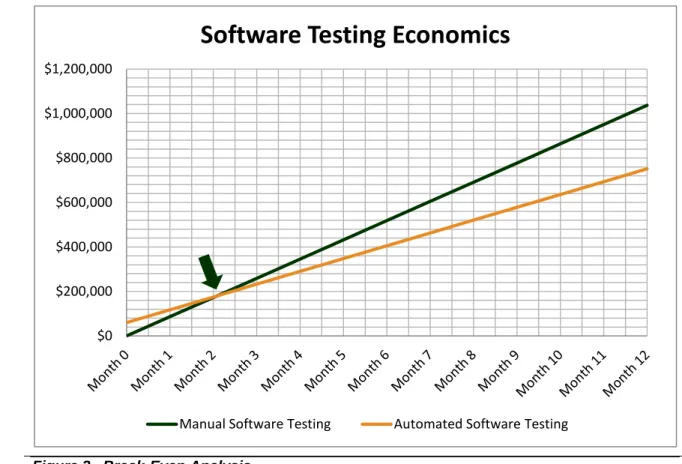
The decreased labor cost offset the automated software testing tool suite cost, yielding a break-even point at about the second month. In addition to the cost savings, each new release increased the size and complexity of the applications, the test-fix-test cycle was accelerated and test case coverage increased as the test case library expanded. The test case library enabled comprehensive
performance load testing and assessment of system performance from a user perspective. These quality process improvements were implemented without schedule impact. That is, we never missed a release schedule.
Figure 3 on the following page shows the break-even graphic depicting a cost savings of about $285,000 during the first year of operation.
Case Study Summary. We are proud of the fact that we never missed a release schedule and FEMA never experienced a work stoppage due to a software error during the five (5) years that we provided software testing services. Applying automated test tools to reduce cost and mitigate software quality risk, aligned our software test team with our customer’s mission and budget.
Figure 3. Break-Even Analysis
Benefits of Automated Software Testing
Master Key invested considerable resources in the development of a software testing methodology that promotes requirements traceability with automated software testing as its cornerstone. Our software testing methodology uses procedures that are easily tailored to accommodate a number of governance life cycles, such as spiral, agile, extreme programming or other continuous improvement software life cycle approaches. The demonstrated benefits of automated software testing revolve around quality and cost:
• Reduced Test Cycle Time. Regression test automation increases the speed of the testing process to reduce the test cycle
time. Automated test scripts execute faster than manual test scripts and can be executed both unattended and during off hours. • Increased Software Quality.
Building a regression case library increases test case coverage and facilitates the creation of test cases to check all aspects of an application within the time allocated to the release, independent of software size and complexity. Automated testing reduces dependency on individual tester capability and eliminates the possibility of human error to increases testing accuracy.
• Effective and Efficient Resource Allocation. Automated software testing promotes the integration of software testing staff at the
$0 $200,000 $400,000 $600,000 $800,000 $1,000,000 $1,200,000
Software Testing Economics
© 2012 Master Key Consulting 5 Propriety and Confidential beginning of the software life
cycle. While verifying the testability of each requirement, the software test tools are populated for requirements traceability and test case templates are developed from
business process models. Efficient use of resources makes
the software test team more effective, enabling attention to activities that may have been overlooked due to schedule constraints.
Our software testing methodology structures and streamlines the software testing process. In partnership with Master Key, our clients expect:
• Expert Software Test Engineers • Proven Software Testing Tools
and Techniques
• Close Communications
• Flexible Scheduling with On-Time Delivery
• Cost Effective Approach to Improved Quality
Practically speaking, implementing automated software testing is essential to meeting today’s software delivery challenges. Our life cycle approach to verification and validation promotes the reuse of testing artifacts for the development of training materials and operations manuals.
About Master Key Consulting Master Key Consulting is an Information Technology (IT) Professional Services company with core capabilities in IT Solutions/Services, IT Independent Verification and Validation (IV&V), Software System Testing, Program/Project Management, and
Grants Management and Training. Our ISO 9001:2008 certified Quality Management System (QMS) demonstrates our commitment to quality and customer satisfaction. Founded in 2001, Master Key is an SBA certified small disadvantaged business (SDB), headquartered in Bethesda MD. We currently employ more than 100 staff in nine (9) states and the District of Columbia.
Additional information is available at