DETECTING MALICIOUS USAGE OF ONLINE SOCIAL NETWORK APPLICATION PROGRAMMING INTERFACES FROM NETWORK FLOWS
by DAN LI
A THESIS
Presented to the Department of Computer and Information Science and the Graduate School of the University of Oregon
in partial fulfillment of the requirements for the degree of
Master of Science December 2019
ii
THESIS APPROVAL PAGE Student: Dan Li
Title: Detecting Malicious Usage of Online Social Network Application Programming Interfaces from Network Flows
This thesis has been accepted and approved in partial fulfillment of the requirements for the Master of Science degree in the Department of Computer and Information Science by:
Jun Li Chairperson
Reza Rejaie Member
Lei Jiao Member
and
Kate Mondloch Interim Vice Provost and Dean of the Graduate School Original approval signatures are on file with the University of Oregon Graduate School. Degree awarded December 2019
iii © 2019 Dan Li
This work is licensed under a Creative Commons
iv
THESIS ABSTRACT Dan Li
Master of Science
Department of Computer and Information Science December 2019
Title: Detecting Malicious Usage of Online Social Network Application Programming Interfaces from Network Flows
While online social networks (OSNs) provide application programming interfaces (APIs) to enable the development of OSN applications, some of these applications, unfortunately, can be malicious. They can be running on the devices for OSN users throughout the Internet, causing security, privacy, and liability concerns to the network service providers of these OSN users.
In this thesis, we study how a network service provider may inspect its network traffic to detect network flows from malicious API-based OSN applications. In particular, we devise a deep learning based methodology to detect network flows generated by malicious API-based OSN applications. We implement this methodology on a testbed, and show that our solution is effective and can accurately label 97.6% network flows from the malicious OSN applications, with only 1.6% false positives.
v
CURRICULUM VITAE NAME OF AUTHOR: Dan Li
GRADUATE AND UNDERGRADUATE SCHOOLS ATTENDED: University of Oregon, Eugene
Beijing University of Posts and Telecommunications, Beijing, China Hebei University of Technology, Tianjin, China
DEGREES AWARDED:
Master of Science, Computer and Information Science, 2019, University of Oregon
Master of Engineering, Computer Technology, 2016, Beijing University of Posts and Telecommunications, China
Bachelor of Engineering, Software Engineering, 2013, Hebei University of Technology, China
AREAS OF SPECIAL INTEREST: Network and Security Deep Learning Data Science
PROFESSIONAL EXPERIENCE:
UO Graduate Teaching/Research Assistant, Sep 15, 2016 – Jun 15, 2019 Software Development Engineer Intern, Amazon, Jun 17, 2019 – Sep 7, 2019
vi
ACKNOWLEDGMENTS
I would like to especially thank my advisor Prof. Jun Li, who is familiar with my research field and helped me identify research problems, figure out the research
methodology in this work, and evaluate this thesis. I would also like to thank my committee members, Prof. Reza Rejaie and Prof. Lei Jiao, for their helpful feedback and suggestions during the preparation of this thesis. Moreover, I thank Prof. Hank Childs and Prof. Boyana Norris who supported me to find my career goal.
Last but not least, I want to thank all my friends, family, faculty and staff at the University of Oregon who supported me in my past three years in Oregon.
vii
TABLE OF CONTENTS
Chapter Page
I. INTRODUCTION ... 01
II. BACKGROUND AND RELATED WORK ... 05
III. OVERVIEW ... 08
IV. PROBLEM SETTINGS AND DEFINITION ... 12
A. Network Flow ... 12
B. Project Framework ... 13
C. Malicious API-based Applications, Benign API-based Applications, Human OSN Behaviors ... 15
1) Malicious API-based Application Behaviors ... 15
2) Benign API-based Application Behaviors ... 17
3) Human OSN Behaviors ... 18
V. DATA PREPARATION ... 20
A. Data Preparation Platform ... 21
B. Synthesis of Malicious API-based Application Behaviors, Benign API-based Application Behaviors and Human OSN behaviors ... 22
1) Synthesis of Human OSN Behaviors ... 22
2) Synthesis of Benign API-based Applications Behaviors ... 24
3) Synthesis of Malicious API-based Applications Behaviors ... 26
C. Synthesis of Flows for Malicious API-based Applications, Benign API-based Applications and Human OSN Behaviors ... 29
viii
Chapter Page
2) Synthesis of Flows for Human OSN Behaviors ... 33
3) How We Control Flow Attributes When Generating Synthetic Flows ... 36
VI. DEEP LEARNING BASED APPROACH OF DETECTING FLOWS FROM MALICIOUS API-BASED APPLICATIONS ... 38
A. Model Selection ... 38
B. Ground Truth Labeling ... 38
C. Dataset Size ... 39
D. Flow Data Preprocessing ... 40
E. CNN Model Structure ... 42
VII. EVALUATION ... 45
A. Test Set Size and Evaluation Metrics ... 45
B. Overall Detection Performance for All Test Set ... 46
C. Detection Performance for Malicious API-based Applications with Different Post/Comment Frequencies ... 47
D. Detection Performance for Each Malicious API-based Applications with Different Post/Comment Frequencies ... 49
E. Detection Performance for Detecting Real World API-based benign Applications and Malicious Applications ... 52
VIII. DISCUSSION ... 55
A. Is A Single Timing Pattern Feature Enough to Detect Flows Generated by Malicious OSN Applications? ... 55
ix
Chapter Page
B. Can This Project Only Detect Flows from Malicious OSN Programs That Demonstrate a Similar Timing Pattern with Our Five Used Malicious Timing
Patterns? ... 61
IX. CONCLUSION... 64
X. FUTURE WORK ... 65
x
LIST OF FIGURES
Figure Page
1. Network flow traffic ... 13 2. Setting of a social network service provider (NSP) in detecting malicious OSN
network flows ... 14 3. Malicious OSN application controlled accounts’ behavioral time points show
five malicious patterns ... 16 4. Benign API-based application controlled OSN accounts’ behavioral time points
follow a benign pattern ... 18 5. Streamline of how different events switch to each other on WordPress ... 24 6. Simulation of 4 benign API-based applications by changing Poisson parameters
... 25 7. Four simulation results for the first malicious API-based applications ... 29 8. Converted images for human, malicious application and benign application
flows ... 42 9. CNN model structure ... 43 10. Detecting performance for predicting all test sets ... 47 11. Detecting performance for malicious API usage with different
posting/commenting times per day ... 48 12. Comparison for malicious API application #1posting/commenting 10 and 50
times, respectively ... 49 13. Detection result for each malicious API-based application posting/commenting
xi
Figure Page
14. Comparison for bad1 application and bad2 application for posting/commenting 10 times per day ... 51 15. Detecting results for flows generated by three real world malicious API-based
OSN applications ... 53 16. Detecting results for flows generated by three real world benign API-based
OSN applications ... 53 17. Detecting results for predicting the test set for the model with only the timing
xii
LIST OF TABLES
Table Page
1. Human operations on OSN ... 23 2. Aggregated flows number for each OSN behaviors ... 39 3. Aggregated flows number for applications with different malicious/benign
application patterns ... 40 4. Test set data size for each behavior ... 45 5. Detection accuracy result for different flows in each timing based model ... 57 6. Detection accuracy result for different flows in different feature based model .... 60 7. Detection accuracy result for different flows in each four-feature based model ... 61
1
CHAPTER I
INTRODUCTION
Online social networks (OSN) have become extremely popular with an ever-growing user base. At the time of writing this master thesis, Facebook, Twitter, and WeChat each has 2.2 billion, 0.4 billion, and 0.5 billion users, respectively. In particular, in order to further enrich and improve the user experience, OSNs have provided public Application Programming Interfaces (APIs) to enable the development of OSN
applications that can access OSN data and functions. However, the provision of these APIs can cause severe security concerns.
Whereas these public APIs make it easy and convenient for OSN applications to provide various legitimate OSN services, such as querying an OSN user’s profile information and friend lists, retweeting certain tweets, or making automated comments, they may also be abused or misused by malicious OSN applications. They can be running on the devices for OSN users throughout the Internet, causing security, privacy, and liability concerns to the network service providers of these OSN users. Very often, by using OSN APIs, a malicious OSN application may control bot accounts to post or reply with spam or fraudulent information, run a crawler to collect private and sensitive OSN user data, or act as a third-party application to obtain access to accounts of OSN users, followed by collecting the profiles of these users and even their friends. In a widely known case, Facebook was reported to leak data of up to 87 million users through a third-part psychology quiz application (NC Matthew, 2018).
2
While abusing OSN APIs, these malicious OSN applications particularly cause concerns to network service providers (NSPs) for OSN users. It could be an Internet service provider (ISP), an enterprise or campus network. If a malicious OSN application is running inside a network, it can imply that one or multiple machines in the network are compromised, the application can subvert the privacy of OSN users, and the network may have to be liable for the security and privacy violations.
However, an NSP is not at the same position as an OSN provider to deal with malicious OSN applications. An OSN provider can try to monitor API calls, obtain full knowledge of user profiles and posts, as well as access the entire OSN graph, in order to detect OSN spam accounts (X Zheng, 2015), (F Benevenuto, 2010), (A Almaatouq, 2016), (M Fazi, 2018), limit large-scale crawling activities (M Mondal. 2012), detect malicious third-party OSN applications (SH Ahmadinejad, 2013), and so on. On the other hand, an NSP only has limited knowledge of OSN data (such as user posts, profiles, social behaviors, OSN graphs). It can only access the traffic across its network, thus not able to leverage the aforementioned existing work toward detecting malicious OSN applications.
We therefore study how an NSP may monitor its traffic to detect traffic flows from malicious OSN applications. We make the following contributions:
1) We define a problem of detecting flows from malicious API-based OSN applications, whereas the flow data used do not include traffic payload. In another word, the problem assumes no knowledge of OSN topologies or specific user profiles and data.
3
2) We propose a solution to detect flows from malicious API-based OSN applications. First, we train a deep learning model for malicious OSN flow detection based on three types of OSN flows: flows from malicious API-based OSN applications, flows from benign API- based OSN applications, and flows from human user operations on the OSN. For each machine running inside an NSP, we extract, aggregate, normalize and visualize flows generated between the machine and an OSN, then apply our trained model to determine whether the normalized flows are generated by a malicious OSN application running on a machine inside the NSP.
3) We implement our proposed solution on a testbed, where we simulate and collect flows for various malicious OSN applications, benign OSN applications, and human user operations. The trained deep learning model is able to detect flows generated by malicious OSN applications with high accuracy and low false positive. In particular, the trained model is able to label flows from three real- world benign OSN applications and three real-world malicious OSN applications with high accuracy. Our research demonstrates that it is feasible to detect flows from malicious API-based applications on OSNs. What’s more, our proposed solution can apply to any other social networks. e.g. Facebook, Twitter.
The rest of this thesis is organized as follows. After Chapter II about related work, we first overview the problem and our solution in Chapter III, followed by a formal description of the problem in Chapter IV. We then generate flows on a test bed in Chapter V to implement our solution, describe our detailed solution in Chapter VI,
4
evaluate the performance of our solution in Chapter VII, discuss our work in Chapter VII, conclude our work in Chapter IX, and introduce our future work in Chapter X.
5
CHAPTER II
BACKGROUND AND RELATED WORK
While APIs released by OSNs are supposed to work for third-party developers to access OSN services, researchers have shown they can be easily misused by crawlers to crawl OSN data or by spammers to spread fraud or spam content ((AH Wang, 2010), (A Saroop, 2011) and (CM Zhang, 2011)). The work in (AH Wang, 2010) crawled a large amount of sensitive OSN data by using OSN APIs, and research in (A Saroop, 2011) even designed an API-based crawler that attackers can use to crawl a large amount of Twitter network structural information. At the same time, spam accounts controlled by malicious API applications are common on OSNs; as the research in (CM Zhang, 2011) points out that, many automated spam accounts on OSNs prefer to use API rather than a web browser to spread fraud or spam content.
There are certain proposed methods that detect malicious automated spam accounts on OSNs, including recent work in (X Zheng, 2015), (F Benevenuto, 2010), (A Almaatouq, 2016), and (M Fazi, 2018). Basically, they all analyze the post content, user profiles, or social behaviors of spam accounts and rely on these features to detect spam accounts. However, a network service provider that usually only collect network flow data can hardly have access to such features, thus not able to employ such a method to detect OSN spam accounts inside their network.
Methods are also proposed to prevent crawling activities on OSNs. Research in (J Herrera-Joancomartí, 2011) and (M Mondal, 2012) proposed countermeasures to prevent attackers from crawling sensitive OSN user data. Research in (J Herrera-Joancomartí,
6
2011) proposes an “Online Social Honey net” concept by deploying a set of users on network to attract and defend OSN crawler attackers, but it only proves the feasibility of using this concept to prevent crawlers, not about deploying it in the real world. Research in (M Mondal, 2012) proposes a Genie system which is deployed at OSN providers to thwart crawlers by detecting their different browsing patterns. This work analyzes user traces of visiting their friends and non-friends, which is sensitive and, again, not
accessible in network flow data, so their methodology is not usable by a network service provider to detect malicious OSN activities.
On the other hand, many methods have been proposed to analyze flow data to detect network attacks or anomalies. Research in (R Singh, 2012) uses campus traffic flows to detect anomaly broadcast traffic, while (J. François, 2011) extends the popular PageRank algorithm to detect botnet traffic. The work (A King, 2009) and (P Barfor, 2001) both detect network traffic flow anomalies by analyzing flow-level anomaly features. And research in (ZQ Wang, 2008), (H Rick, 2013), and (VDS Daniël, 2015) also proposes several real-time intrusion detection systems based on monitoring network flow traffic. These papers all follow a similar idea by detecting a specific attack based on the flow- level features of the attack. However, the specific attack features explored in these existing methods are different from the features of OSN attacks, making their feature-based detection methods basically ineffective in detecting OSN attacks.
In obtaining a better understanding how users use or interact with online social networks, research in (B Fabrício, 2012), (W Watcharee, 2012), (M Zoltán, 2011), (S Fabian, 2009) investigated how to use traffic analysis methods to study social networks. However, these methods analyze network traffic that includes packet payload in general,
7
which is different from our work that uses the network flow data that only carry aggregated packet header information.
8
CHAPTER III
OVERVIEW
The goal of this project is to detect flows from malicious API-based applications on OSNs. We assume that traffic flows of human OSN behaviors and benign API-based application behaviors share some normal flow-level features, while traffic flows of malicious API-based applications have some malicious flow-level features. We propose a solution to detect flows generated by malicious API-based applications. Our solution first aggregates flow for the above three category flows separately, normalizes each of the aggregated flows, then uses normalized flows as the input to train a deep learning model. The trained deep learning model can learn features effectively from high-dimensional network flows, and can label flows from malicious API-based applications. We implemented this solution on a test bed.
Since there is no available dataset providing flow data generated by malicious API-based applications and other benign OSN flows, we use emulation to generate those flows. We deploy a small social network, WordPress, as a test bed where users can browse and reply to each other’s posts. We then collect flows for human OSN behaviors, benign API- based applications, and malicious API-based applications on this small social network. We performed these three behaviors on a client which is installed with flow generation software and flow collection software. In this way, when we simulate three behaviors on this client, their corresponding flows will be collected on the client side by flow collection software.
9
To simulate a large amount of various human OSN behaviors, we write scripts to emulate various possible human behaviors on a social network website. These operations include login, post, comment, browsing behaviors, and so on. Human behaviors on social networks are driven by a series of click events. We use scripts to emulate those click events instead, and flows generated by script-controlled click events should be the same as flows generated by human-controlled click events. For benign API-based applications, OSN APIs should only be a tool used by human beings. Such tools will post content on social networks for human beings whenever people want to. Therefore, those benign API-based applications’ behavior time points should follow human post/comment/like timing patterns on OSN. Human behavior patterns can be modeled as different Poisson
processes (CM Zhang, 2011), so benign API-based application behavior time points can also be modeled as different Poisson processes. We simulate various benign API- based application behavior time points as different Poisson processes by changing Poisson distribution parameters. At each behavior time point, the benign OSN application will post some useful content. For malicious API-based applications, we write five known malicious application scripts, and their behavior time points are decided by these five known malicious API-based applications’ behavioral patterns (CM Zhang, 2011). Each application posts spam or malicious posts, comments following one of five known malicious timing patterns. We model each malicious API-based application behavioral timing pattern as a combination of different probability distributions, and simulate each malicious pattern by changing all related parameters. To collect flow data generated by benign or malicious API-based applications and human OSN behaviors, we collect corresponding flows when we simulate those three behaviors on the client side.
10
To save time generating data for human OSN behaviors, benign and malicious API-based applications, we synthesize flows for each of those three behaviors. When people or applications are active and perform various operations on OSNs, there are some flows generated. Otherwise, no flows are generated. To synthesize flows generated in a long period of time, we only need to combine flows generated when people or
applications are active on OSN together. First, we collect flows when applications or people are active on OSNs, then combine those flows together with proper intervals. Interval length indicates how long people or applications wait between two active sessions. In this way, we can synthesize flows generated in a long period of time for benign and malicious API-based applications, and human OSN behaviors.
We’ve generated flows for the above three behaviors. After that, we extracted all flows generated by the communication between the client and our small social network by extracting flows whose source IPs or destination IPs belong to our deployed OSN server. We’ve found that even a very single user operation behavior, such as a click behavior, can generate several flows, so a single flow data carries very little information about how users behave on an OSN. Therefore, we aggregate flows that occurred in a pre-defined time window together, and those aggregated flows can carry more
information about how a user behaves in the pre-defined time window. For each aggregated flow group, we transformed it into an image which carries the main
information of the aggregated flow group. Those transformed images act as the input to train the deep learning model, which can automatically find potential flow-level features for human OSN behaviors, benign and malicious API-based applications. After the model
11
is well-trained, it is able to detect these flows generated by malicious API-based applications with high accuracy, precision and recall scores.
The methodology described above enables NSPs to obtain a deep learning model with very good performance in detecting flows generated by malicious API-based applications. We built a small social network through the WordPress blog system as a testbed, and implemented our proposed solution to detect flows from malicious API-based applications on this testbed. Furthermore, our proposed methodology not only works on the deployed testbed, but can also be applied to other OSNs (Twitter, Facebook, Instagram) to detect flows from any malicious API-based applications for any NSPs.
12
CHAPTER IV
PROBLEM SETTINGS AND DEFINITION
Now that we have introduced the background and motivation for this project, and given an overview of our work in Chapter III, we can now provide a more specific problem formulation. In this chapter, we begin by introducing network flow data. After that, we explain how we define malicious API- based applications, benign API-based applications and human OSN behaviors. Our purpose in this project is to detect malicious API-based application behaviors based on network flows. Finally, we summarize the problem to be solved in this project.
A. Network Flow
Current network communication is based on packet switching. Traffic flow is a sequence of aggregated packet headers from a source computer to a destination computer. Flows are identified by a five-tuple key, including the IP protocol, source computer’s IP address and port number, and destination computer’s IP address and port number. There are several attributes used to describe a flow, and those attributes are extracted from packet headers, such as the flow start timestamp, end timestamp, source IP and port number, destination IP and port number, the IP protocol and the protocol’s attributes. If the TCP protocol is used, the flow may also include the TCP flag as its attribute. Flow attributes can also include statistical numbers for total bytes and total packets received by each flow. A flow data can have any attribute which can be read from packet headers. In this thesis, we use the widely used NetFlow (B Claise, 2004) format of network flow traffic. Figure 1 shows several examples of the NetFlow data.
13
Based on our description, the flow data can carry very limited sensitive social network user data, and it could be challenging to detect malicious social network flows for API-based applications. However, our research proves that it’s feasible to detect malicious API-based applications generated flows.
Figure 1. Network flow traffic
B. Project Framework
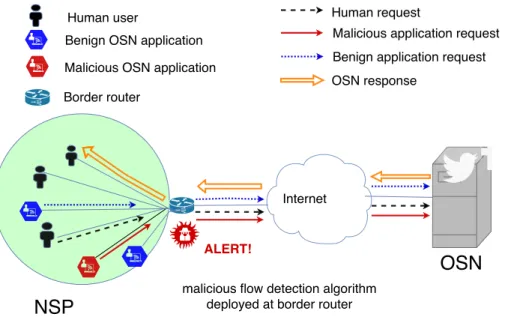
In this part, we will introduce the framework of this project and answer some basic questions, such as how malicious or benign OSN applications and humans within a NSP communicate with OSN servers, where OSN network flow data inside a NSP can be caught, and where our proposed malicious flows detection method should be deployed to detect malicious flows for a NSP.
Figure 2 shows the framework of this project. Our purpose is to detect flows generated by malicious OSN applications for NSPs. NSPs provide network services to their users, and a NSP could be part of an Internet Services Provider (ISP). For example, a company network is a NSP, because it can provide network services to all workers in its company.
14
Figure 2. Setting of a network service provider (NSP) in detectingmalicious OSN network flows
Human, benign OSN applications and malicious OSN applications in some NSPs can send requests to OSN severs. When OSN servers receive their requests, OSN servers will reply responses to the people or applications who sent requests in previous NSPs. Both requests from the NSP to OSN servers and responses from OSN servers to the NSP will go through the NSP’s border router. Therefore, the border router can collect flows generated between the application or human within its network and the OSN servers. Our malicious flow detection method can be deployed at the border router of the NSP. If there are some malicious flows detected at the border router, it can send some alerts to the NSP.
NSP
OSN
Internet Human user
Benign OSN application Malicious OSN application Border router
Human request
Malicious application request Benign application request OSN response
malicious flow detection algorithm deployed at border router
15
C. Malicious API-based Applications, Benign API-based Applications and Human OSN Behaviors
1) Malicious API-based Application Behaviors
Attackers usually run malicious API-based applications to frequently collect private OSN data or spread spam information on OSNs. Whether crawling behavior is benign or malicious can only be decided by how people use or analyze crawled data, and this is not our focus. In this project, we do not classify them as malicious only based on their crawling behaviors. This project mainly focus on detecting malicious API-based spammer applications on OSNs. The malicious behaviors to be detected are when malicious OSN API-based applications post or comment with spam content (post with malicious URLs for malwares, or spam advertisements) on OSNs. E.g. "Free Business Links For Chemical Suppliers at http://catalogs.indiamart.com/category/chemicals- fertilizers.html".
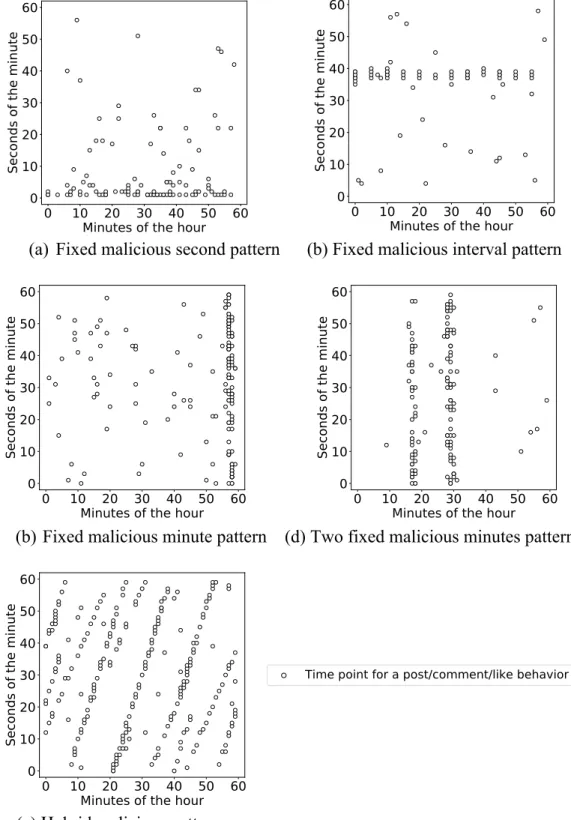
Malicious API-based spam applications behave with malicious purposes, so their controlled benign accounts’ behavioral patterns are probably different from benign accounts. There are five known malicious patterns for malicious API application-controlled spam/bot accounts on Twitter (CM Zhang, 2011). Those accounts’
post/retweet/like behavior time points on Twitter follow five malicious patterns in Figure 3. Therefore, corresponding malicious API-based applications’ post/retweet/like time points should also follow those five known malicious patterns. For those five malicious patterns in Figure 3, the x axis indicates minutes of the hour for an account’s
post/comment/like/retweet behavior time point, while the y axis indicates the seconds of the minute for this account’s post/comment/like/retweet behavior time point.
16
(a) Fixed malicious second pattern (b) Fixed malicious interval pattern
(b) Fixed malicious minute pattern (d) Two fixed malicious minutes pattern
(e) Hybrid malicious pattern
Figure 3. Malicious OSN application controlled accounts’ behavioral time points show five malicious patterns
Attackers usually use OSN APIs to spread spam information by posting and commenting. In this project, we mainly focus on detecting malicious OSN applications
17
injecting spam contents into the network. In this situation, we define the two most common malicious API-based behaviors:
(1) API-based post or comment with spam content for a single account. (2) API-based change accounts to post or comment with spam content. In this project, if any of those three API-based behaviors post spam posts or comments following any of five known malicious API usage patterns, we define it as a malicious API-based application behavior.
2) Benign API-based Application Behaviors
Some benign OSN API-based applications may use OSN-released APIs to provide people useful information, such as real-time weather warnings, earthquake information for a specific location, and news happening all around the world. In this project, we define benign OSN application behaviors are when OSN API-based applications post useful information to people.
When OSN-released APIs are used for a benign purpose, public APIs are
supposed to provide OSN services on those benign applications and work automatically for human beings with benign purposes whenever people need to post/comment/like. For example, "Flow" is a Microsoft application which integrates the Facebook API, Twitter API and Instagram API. It can help people post on Facebook, Twitter, Instagram at the same time when people want to publish their stories on multiple social networks. Since APIs are only tools for human beings to post and comment on OSNs, benign API usage behaviors should follow human beings’ post and comment patterns. It has been found that human post/comment/like time points on Twitter can be modeled as different Poisson Processes (CM Zhang, 2011). This benign pattern can be converted to the pattern in
18
Figure 4 which is drawn in a similar way to Figure 3’s depiction of five malicious
patterns based on humans’ post/comment/like/retweet time points. The benign API-based application’s behavioral time point patterns should also follow this benign human
post/comment pattern on OSNs.
Figure 4. Benign API-based application controlled OSN accounts’ behavioral time points follow a benign pattern
Therefore, in this project, if an API-based application posts benign
posts/comments following this benign Poisson pattern, we define it as a benign API-based application.
3) Human OSN Behaviors
Inmost cases, users visit social networks and perform some normal operations using browsers instead of APIs. Human beings usually access OSNs on browsers to do various operations, such as login, post, comment, browse and so on. Most OSN flows are generated by human operations on OSNs. In this project, we define various human-based browser operations on OSNs as normal behaviors, and define flow data generated by human operations as benign flows.
19
To summarize, we define three behaviors in Chapter IV: malicious API-based application behaviors, benign API-based application behaviors and human OSN behaviors. If APIs are used by applications to spread malicious information, then their behaviors follow five known bad timing patterns. If APIs are used by applications to spread benign information, then their behaviors follow the benign timing pattern.
Humans can perform various operations on OSNs, and we define all human behaviors as benign. Our purpose is to detect flows for malicious API-based application behaviors from flows generated by all three behaviors. We assume that traffic flows of human OSN behaviors and benign API-based application behaviors share some benign flow-level features, while traffic flows of malicious API-based applications have some malicious flow-level features. We aim to detect flows of malicious API-based applications by detecting flows with malicious features.
20
CHAPTER V
DATA PREPARATION
Since there is no existing and available data set providing flows for malicious API-based application behaviors or benign OSN behaviors, we need to generate those data by ourselves. As described in the problem formulation from Chapter IV, we define three OSN behaviors in this project: malicious API-based application behaviors, benign API-based application behaviors, and human OSN behaviors. We will generate flows for those three behaviors.
To generate flows for malicious API-based application behaviors, we have each malicious API-based OSN behavior simulate one of five malicious API usage timing patterns in posting malicious contents or malicious commenting contents by setting related parameters. To generate flows for benign API-based application behaviors, we have different API-based OSN behaviors simulate benign API usage timing patterns to post benign information by setting related parameters. In addition, we simulate all kinds of human operations on OSNs using browsers, and collect those generated flows as benign human OSN behavior flows.
In this chapter, we will start by introducing the data preparation platform, then simulate malicious API-based application behaviors, benign API-based application behaviors and human OSN behaviors. After that, we describe how we synthesize flows for three behaviors respectively.
21
A. Data Preparation Platform
As described in research method chapter, we deploy a small social network WordPress in order to replay our synthesized malicious API-based application behaviors, benign API-based behaviors and human OSN behaviors on this small social network.
The small social network is a blog WordPress, where people can post and reply to each other. It is deployed on a reserved server on DigitalOcean with a fixed IP address 165.227.20.24. The server is configured with 512 MB Memory, 20 GB Disk, and Ubuntu 16.04.3 x64 Operating System. The client is a Dell laptop configured with 8GB Memory, 128GB Disk, and Ubuntu 16.04 Operating System.
We simulate malicious API-based application behaviors, benign API-based behaviors and human OSN behaviors on the client. The client is installed with traffic flow generation software softflowd and flow collection software nfdump. When we are simulating malicious API-based application behaviors, benign API-based behaviors and human OSN behaviors on the client separately, the flow data generation software softflowd and collection software nfdump are running on this client and collecting corresponding flow data for each behavior. In flow data generation and collection process, we collect flows mainly based on the below three defaulted flow collection parameters.
(1) Maxlife value is set to 604800s. The value of this parameter is the maximum lifetime that a flow may exist for. The client and server may keep communicating to each other for a time longer than Maxlife. When the connection duration reaches to Maxlife, the current flow for the current connection will expire, and a new flow will be generated for describing this connection.
22
(2) Expint value is set to 60s. This parameter of Expin specifies the interval between expiry checks. This is to say, when the client and server are sending packets to each other, if the interval of two consecutive packets is within Expint time, they will be classified into the same flow. If the interval of two consecutive packets is larger than Expint time, they will be classified into different flows. (3) Flows have two directions: from source to destination, and from destination to source. If the traffic exceeds 2 Gib in either direction, then the corresponding flows will expire, and a new flow will be generated for continuous connections. Based on the above built testbed and its set up environment and parameters, we collect flows for malicious OSN API-based applications, benign OSN API-based applications and human behaviors.
B. Synthesis of Malicious API-based Application Behaviors, Benign API-based Behaviors and Human OSN behaviors
1) Synthesis of Human OSN Behaviors
Since most OSN flows are generated by normal human operations on OSNs, it is very important to synthesize normal human beings’ behaviors accurately. We can then collect human OSN behavior flows accurately as ground truth.
In order to simulate normal human beings’ behaviors comprehensively, we write scripts to simulate all kinds of human user behaviors on WordPress, e.g. login, browse, post, comment by browser. Table 1 shows all human basis operations on WordPress. Human beings’ operations on OSNs are driven by a series of click events on the browser. To simulate human behaviors accurately, the click event stream pattern in our scripts of
23
human operations on WordPress follows the click pattern summarized in a real Chinese social network RenRen (G Wang, 2017).
Table 1. Human operations on OSN Category Event type
Account Login
Browse View a post (go to the post webpage, then go back to previous page or main page)
Browser feeds (scroll mouse, may go next page, or view a post, then go back to previous page or main page)
Return to previous page Go to main page
Go to next page View a recent post View a recent comment
Comment Login in then comment, no login and comment as a stranger Post Login then post
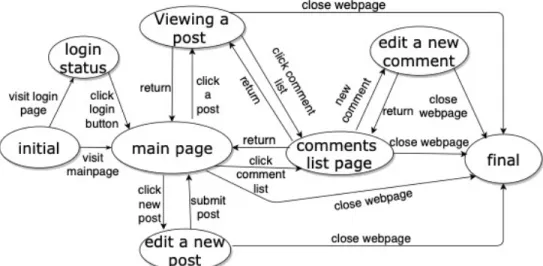
Human behaviors on OSN can be summarized as a series of events switching to each other. Figure 2 visualizes the logic of how different events switch to each other. We write scripts to simulate 27 streamlines of human behavior chains based on event
occurrence sequences, which cover almost all possible user operation streamlines on WordPress in the real world except infinite looping browsing posts.
For each streamline, we simulate various possible streamline implementations in the real world by changing parameters to simulate its operation logic. For example, one of the streamline is: login, then view page 0-10 separately. To simulate this streamline, after a user finishes the login step, he or she may browser page 0, pages 0 to 1, pages 0,1, 2,...., page 0,1,2 ...10 separately. In this way, we simulate nearly all possible
implementations for this streamline by changing page parameters. For all remaining streamlines, we simulate various implementations by changing related parameters, so our
24
simulation covers nearly all possible human behaviors on this small social network accurately and comprehensively.
Figure 5. Streamline of how different events switch to each other on WordPress 2) Synthesis of Benign API-based Application Behaviors
We will introduce how we synthesize benign OSN API-based application behaviors in this part. APIs provided by OSNs are supposed to be used for third party developers so they can integrate OSN services to their own developed software. Third party software are supposed to use API-provided OSN services to serve human beings automatically when people need their functions. Therefore, the benign API third party applications’ behavioral timing patterns should follow human post/comment/like patterns on OSN. It’s known that the timing pattern of how human post/comment/like on Twitter can be modeled as different Poisson Processes (CM Zhang, 2011), so benign API-based third party applications’ behavioral time points should follow these Poisson Processes. Besides API-based benign third party applications, there are some benign API-based bot applications on OSNs, and those bots could provide helpful weather warnings or
broadcast useful news to the general public. Benign bot applications will post content on a social network whenever there is news or a warning, and those news and warnings
25
occurrence patterns can also be modeled as various Poisson Processes, so benign API-based bot applications’ behavioral patterns can also be modeled as Poisson Processes. Thus, all benign API-based applications’ behaviors should follow the Poisson
Distribution.
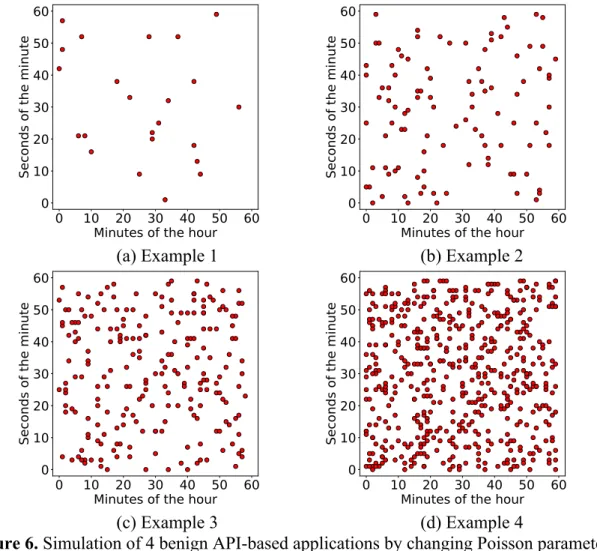
(a) Example 1 (b) Example 2
(c) Example 3 (d) Example 4
Figure 6. Simulation of 4 benign API-based applications by changing Poisson parameters If API-based applications post benign contents following this benign Poisson pattern in Figure 4, we define it as benign API usage behaviors. To simulate all possible benign API-based application behaviors, we crawl benign posts’ data from benign automatic accounts on Twitter, and simulate posting benign information behaviors. Their behavior time points follow various benign Poisson processes by changing different
26
parameters. Figure 6 shows four examples of our simulated benign API-based application behavioral timing patterns with four different Poisson parameters.
3) Synthesis of Malicious API-based Application Behaviors
Malicious OSN API-based applications behave with malicious purposes to post malicious data, and those applications’ behavior patterns are probably different from benign accounts. As we discussed in Chapter IV, there are five known malicious API-based application behavioral timing patterns. We have also defined two categories of the most common API-based behaviors as API-based post or comment with spam contents for a single account or API-based change accounts to post or comment with spam contents.
We download a Twitter dataset which provides malicious content that were posted or commented by malicious spam accounts. To simulate various malicious API-based application behaviors, we have the behavior time points for each API-API-based OSN behavior decided by five known malicious timing patterns. The application will post or comment malicious content at each behavior time point. We model each malicious timing pattern as combinations of different probability distributions, and simulate each malicious timing pattern by changing related parameters for corresponding probability distributions.
We take the first malicious API-based malicious pattern as an example. Based on observations, the probability density function of the first malicious timing pattern can be modeled as the combination of a uniform distribution (!0) and a group exponential distributions (l#$l%) with the same l value. Therefore, we can obtain the first malicious timing pattern probability density as formula 1. In formula 1, !0 is the possibility density for the uniform distribution, while l#$l(%$'(∗*$(+) indicates probability densities for
27
multiple exponential distributions. The parameter -0 can adjust the weight of all exponential distribution densities. ./ is the time step length between each two adjacent exponential distributions, while /0 is the initialized time step length for the first
exponential distribution. Parameters l can decide the shape for all exponential distributions.
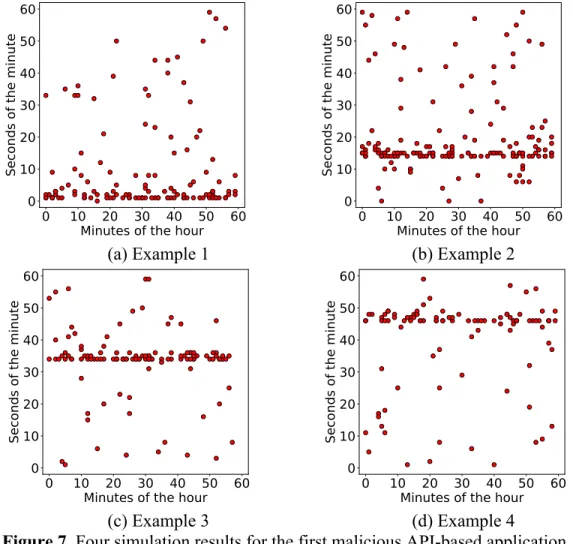
To simulate various implementations of the first malicious API usage timing patterns, we change parameters l, !0, -0, ./ and /0 in its density function, then use the density function with various changed parameters to simulate different first malicious API usage patterns. Figure 7 shows four simulation results for the first malicious API usage timing pattern with different parameters.
In a similar way, the probability density of the second malicious timing pattern can be modeled as a combination of a uniform distribution and a group normal
distributions with the same 1. The third malicious API usage timing pattern probability density is a combination of a uniform distribution and a group of Poisson distributions with the same 1. The fourth malicious API usage timing pattern can be modeled as a combination of a uniform distribution and two group Poisson distributions with parameters l1 and l2 separately, while the probability density for the fifth malicious timing pattern can be modeled as a combination of a uniform distribution and two group normal distributions with parameters 11 and 12 separately. All probability density functions for the five malicious API usage patterns are shown in formula 1, 2, 3, 4 and 5 respectively.
28 41 5,l = !0 + -0 8#$9 %$'(∗*$(+ *:; *:+ 1 f2 t, δ = P0 + M0 1 δ 2πe $C$DE∗F$E+HIG G F:J F:+ 2 f3 t,l = P0 + M0 e$LλC$DE∗F$E+ t − dT ∗ k − T0 ! F:J F:+ (3) f4 t,l1,l2 = P0 + M1 e $LTλ1C$DET∗F$ET t − dT1 ∗ k − T1 ! F:J F:+ + M2 e $LHλ1C$DEH∗F$EH t − dT2 ∗ k − T2 ! F:J F:+ 4 f5 t, δ1, δ2 = P0 + M1 1 δ1 2πe $C$DET∗F$ETHITG G F:J F:+ + M2 1 δ2 2πe $C$DEH∗F$EHHIHG G F:J F:+ 5
As we described above, there are two categories of the most common API-based malicious behaviors, each behavior’s post or comment contains malicious content, and their behavioral time points are decided by any of five malicious API usage timing patterns. To simulate each malicious timing pattern accurately, we build a probability function for it, and simulate various implementations for this malicious timing pattern by changing related parameters in its corresponding probability function. We have each API-based behavior’s time points follow five malicious patterns separately by changing corresponding probability function parameters for each malicious pattern. In this way, we can simulate various malicious API-based applications’ posts or comments of various malicious content with five known malicious patterns, and our simulation result is able to cover nearly all possible five known malicious API-based application behaviors.
29
(a) Example 1 (b) Example 2
(c) Example 3 (d) Example 4
Figure 7. Four simulation results for the first malicious API-based application
C. Synthesis of Flows for Malicious API-based Applications, Benign API-based Applications and Human OSN Behaviors
In the above Chapter V, we have introduced how we simulate malicious API-based applications, benign API-API-based applications and human OSN behaviors to generate corresponding flow-level data. In this part, we will describe how we synthesize flows for malicious API-based applications, benign API-based applications and human OSN behaviors. To begin with, we explain why it’s necessary to synthesize flows for those three behaviors. After that, we introduce more details about how to synthesize flows for these three behaviors.
30
To speed up ground truth generation time, we synthesize flows for malicious API-based applications, benign API-API-based applications and human OSN behaviors. We simulate users’ behaviors in both user active time and user waiting time. During user active time, users visit OSNs actively, and perform various operations on OSNs. During user waiting time, users don’t access OSNs and don’t do any operations on OSNs. To generate ground truth, we write scripts to simulate user behaviors both in their active time and in their waiting time. However, for both benign user accounts and malicious user accounts, the waiting time is much longer than the active time. Therefore, the speed of ground truth generation is very slow because a lot of time is wasted on simulating user waiting time.
However, during user waiting time, there are no corresponding flows generated because users don’t communicate with OSNs during waiting time. In addition, based on observations, we find that a single API or human behavior on OSN can generate several flows. Even if API or human behavior time points are very close, an identical API or human behavior occurring at different time points can generate different flows. Not only could flow numbers generated by the same behavior be different, but also the attribute values of each flow are different, such as flow start time, flow number, flow duration, TCP flag, packets number, bytes, and so on. Therefore, flows generated by a single behavior at different time are independent and different. Since there are no flows generated during waiting time, we can synthesize flows for malicious and benign behaviors by combining flows of different OSN behaviors together and only change flows’ generation time attributes.
31
The following paragraphs will discuss how to synthesize flows for long time malicious and benign API-based application behaviors, and human behaviors. 1) Synthesis of Flows for Malicious and Benign API-based Applications
Our methodology of how to synthesize flows for automated malicious and benign API usage behaviors in a long period of time follows the logic stated below.
(1) To begin, collect flows generated by a single post or comment API operation. Benign applications will post or comment with benign content, while malicious applications will post or comment with malicious content. Save those flows into a file, then each file will include all flows generated by this single API operation. (2) In a similar way, repeat multiple single API post or comment operations, and save those flows into multiple flow files.
(3) For each malicious and benign API behavior, we combine flow files generated by corresponding single API operations with different intervals separately into a large flow file by only changing each flow’s start and end time, while keep all other attributes the same. Time intervals are generated based on which malicious timing pattern and benign timing pattern the benign or malicious API-based application follows.
Based on the above method, the large generated flow file is the synthesized flows for malicious and benign API behaviors in a long period of time, and we can generate flows for each malicious and benign API-based application based on the time span we defined. We design Algorithm 1 to synthesize flows for OSN API based applications in a predefined time span. We first introduce the following definitions, and the Algorithm 1 is followed by those definitions.
32
(1) Flows set M: For each single benign or malicious OSN application post or comment behavior, we repeat those single behaviors for a large amount of times, then collect flows generated by each behavior into a separate file. The set M consists all those files, and each file includes all flows generated by a single OSN application behavior.
(2) Possibility density function F: For a malicious or a benign OSN application, its behave time points follow a particular timing pattern, and F is the
corresponding possibility density function for that timing pattern. (3) timeCount: This parameter indicates the time span of the flows we are
synthesizing for the application.
(4) Possibility[t]: The possibility density that an OSN application at time point t will do a post or comment behavior.
(5) Set R: all flows in set R are the synthesized flows for an OSN application in timeCount seconds.
33
Algorithm 1: Generation of flows for Malicious or Benign OSN applications 1: Input: flows set M, a random behavior possibility density function F 2: Initialize possibility density array Possibility[timeCount]
3: Initialize timeCount as 24*60*60 seconds 4: Initialize result set R as empty set
5: FOR t in timeCount DO 6: Possibility[t] := F(t) 7: END FOR
8: FOR t in timeCount DO
9: Generated a random number rand which range in (0,1) 10: IF rand < Possibility[t] THEN
11: Select flows S generated by a single OSN behavior in M 12: Record the start time of first flow in S as firstStart 13: FOR f in S DO
14: IF f is the first flow THEN 15: Compute f’s start time as t
16: Compute f’s end time as t + f’s end time - firstStart 17: ELSE
18: Compute f’s start time as t + f’s start time - firstStart 19: Compute f’s end time as t + f’s end time - firstStart 20: END IF
21: END FOR
22: Add those updated flows in S to result set R 23: END IF
24: END FOR
25: Output: flows set R is synthesized flows for a malicious OSN application
2) Synthesis of Flows for Human OSN Behaviors
The method of synthesizing human OSN flows is a little different from synthesizing flows for malicious and benign API applications. For API-based applications, their behaviors mainly consist of different API-based post or comment behaviors. However, human operations on social networks are much different, so we collect user follows based on a single user session instead of a single operation on social networks. A single user session includes all activities from a user opening an OSN webpage to closing it, and the user may perform various operations on OSNs at each user session, as discussed in Chapter V. The user session time duration distribution and click
34
event pattern follow the pattern summarized in the real Chinese social network RenRen (G Wang, 2017).
To generate flows for human behaviors in a long time period, we combine flows generated by different user sessions together, only changing each flow’s start and end time. Our methodology of how to synthesize flows for human behaviors in a long time period follows the steps below.
(1) First, collect flows generated by a single user session, then save those flows into a file. Each file includes all flows generated by this single user session. (2) In a similar way, save multiple flow files generated by multiple user sessions. (3) Combine flow files generated by each user session with different Poisson intervals into a large flow file by only changing each flow’s start and end time while keeping other attributes the same. Human beings’ use of social network intervals follow the Poisson distribution, so we use Poisson intervals here. In this way, the generated large flow file is the synthesis of flows for human behaviors in a long time period, and we can generate flows for human OSN behaviors based on our defined time span. Our methodology of how to synthesize flows for human behaviors in a long time period follows Algorithm 2. We first introduce the following definitions, and Algorithm 2 is followed by those definitions.
(1) Flows set H: Each human user behavior in a human user session is instructed by the finite state machine. We run the finite state machine a large amount of times, then collect flows for each human user session, store corresponding flows for each behavior into a separate file. The set H consists all those files, and each file includes all flows generated by a single human user session.
35
(2) Intervals[]: Two adjacent human user sessions may have various intervals, and those intervals can be modeled as various Poisson process, the Intervals[] stored the intervals generated by a Poisson process.
(3) timeCount: This parameter indicates the time span of the flows we are synthesizing for the human user.
(4) curTime: Current time of synthesizing flows compared with the whole time span.
(5) Set R: all flows in set R are the synthesized flows for a human user in timeCount seconds.
Algorithm 2: Generation of flows for OSN human behaviors
1: Input: flows set H, a random user session intervals array Intervals[] 2: Initialize curTime as 0, interval counter i as 0
3: Initialize timeCount as 24*60*60 seconds 4: Initialize result set R as empty set
5: WHILE curTime + Interval[i] < timeCount DO 6: Compute curTime as curTime + Interval[i]
7: Select flows S generated by a single OSN user session behavior in H 8: Record the start time of first flow in S as firstStart
9: FOR f in S DO
10: IF f is the first flow THEN
11: Compute f’s start time as curTime
12: Compute f’s end time as curTime + f’s end time - firstStart 13: ELSE
14: Compute f’s start time as curTime + f’s start time - firstStart 15: Compute f’s end time as curTime + f’s end time - firstStart 16: END IF
17: END FOR
18: Add those updated flows in S to result set R 19: Increase i as i + 1
20: END IF 21: END WHILE
36
3) How We Control Flow Attributes When Generating Synthetic Flows
Each flow includes several attributes, such as flow start time, flow end time, flow duration, source IP, source port, destination IP, destination port, TCP flag, and packets number in each flow. In this section, we will discuss what attributes of flow are
controlled in our synthesized flows, and how we control different attributes for synthesized flows.
For both benign and malicious OSN applications, their behavior can be defined from two aspects. The first is to decide when OSN applications do post or comment behaviors, the second is to decide what content they post or comment each time. For malicious OSN applications, their post or comment time points are decided by five malicious timing patterns by varying all possible parameters in our proposed malicious pattern formulations. The spam content (e.g. post with malicious URL) that they post/comment is downloaded from a Twitter spam dataset. The malicious OSN applications may use 1 or multiple accounts to post/comment spam information. For benign OSN applications, their post or comment time points are decided by a benign Poisson pattern by varying all possible parameters in Poisson distribution. The benign content (e.g. post for weather warnings) that they post is crawled from online benign bot-controlled Twitter accounts.
We have summarized how we simulate malicious and benign OSN application behaviors. Now we will answer the question of how we control flow attributes for benign and malicious OSN application behaviors. To begin, for malicious OSN applications, five malicious timing patterns decide flows’ start time and the behavior of "post or comment with spam content for 1 or multiple accounts" decides the flows’ other features. After
37
that, for benign OSN applications, 1 benign timing pattern decides the flows’ start time, and the behavior of "post or comment with benign content" decides the flows’ other features.
For human behaviors, we use 27 streamlines of human behavior chains based on different event occurrence sequences to simulate all possible operations during each user session. A user session includes all human activities, from a user opening an OSN webpage to closing it. In each user session, user behaviors are actually driven by a series of click events, and the click event interval distribution in a user session is decided by the click pattern summarized in the real Chinese social network RenRen (G Wang, 2017). Since a human user may visit a social network several times a day, a human user may generate several user sessions. The intervals between different user sessions follow the Poisson distribution.
For human behaviors, the timing pattern of "Poisson distribution for intervals between user sessions" and "click events’ distribution within a user session" work together to decide flows’ start time, and various human behavior streamlines decide flows’ other features.
To summarize, in Chapter V we introduce how we simulate benign API-based application behaviors, malicious API-based application behaviors and human behaviors. After that, to speed up data generation, we synthesize flows for long periods of time of benign and malicious API-based application behaviors and human OSN behaviors. We also analyze how we control flow-level features for different synthesized flows.
38
CHAPTER VI
DEEP LEARNING BASED APPROACH OF DETECTING
FLOWS FROM MALICIOUS API-BASED APPLICATIONS
We have discussed how to generate flows for malicious API-based applications, benign API-based applications and human OSN behaviors. Our purpose is to detect flows from malicious API-based applications. In this chapter, we will introduce how to use our generated ground truth to train a Convolutional Neural Network (CNN) model. This chapter also includes model selection, ground truth labeling, dataset size, data preprocessing and model structure.
A. Model Selection
Convolutional Neural Network (CNN) has been a very popular tool to finish various machine learning tasks in recent years. It is particularly powerful to learn hierarchical level features from complex high dimension data automatically, then finish classification task effectively. The aggregated flows in our project are actually high dimension data, so CNN is a good tool to classify malicious API flows and other benign flows. CNN needs uniform input size, but each of the aggregated flows in our project contains a different number of flows. Therefore, we normalize each of the aggregated flows by transforming each of the aggregated flows into an image. Each image still reserves the main useful information of each aggregated flow group, and then normalized images are used as the input to train the CNN model.
B. Ground Truth Labeling
There are three OSN behaviors defined in this thesis: malicious API-based application behaviors, benign API-based application and human OSN behaviors. Our
39
purpose is to detect flows of malicious API-based application behaviors separately from flows generated by all three behaviors. For flows generated by malicious API-based application behaviors, we label them as malicious flows. For flows generated by benign API-based application behaviors and human behaviors on social networks, we label them as benign flows.
C. Dataset Size
For flows generated by each malicious API-based application behaviors and benign behaviors, we aggregate their flows, and then convert each aggregated flow into an image, which can act as the normalized input of CNN model. We generate 40,000 aggregated flows for both benign behaviors and malicious API application behaviors. The data size of categorized aggregated flows for each behavior is shown in Table 2.
Table 2. Aggregated flows number for each OSN behaviors
Aggregated flow type # of aggregated flows
Aggregated malicious OSN application flows 15,000 Aggregated benign OSN application flows 15,000 Aggregated human user operations flows 10,000
As we talked about in the data generation chapter, there are five malicious API-based applications. They post or comment with spam contents, and behavior time points decided by five malicious timing patterns. We represent malicious applications with different malicious API usage timing patterns as bad1, bad2, bad3, bad4, and bad5, and represent the benign API- based applications with benign timing pattern as good1, while human behaviors are labeled as good0. Table 3 has shown generated aggregated flows’ size for each applications’ malicious timing patterns and benign timing patterns. The data set is split into a training set and a test set. The training set has 80% of all labeled
40
aggregated data, while the test set includes 20% of all labeled aggregated data. The 32,000 training set are used to train the CNN model, while we reserve 8,000 test data to evaluate the performance of the trained model.
Table 3. Aggregated flows number for applications with different malicious/benign application patterns
Aggregated flow pattern type # of aggregated flows Malicious application pattern bad1 3,000
Malicious application pattern bad2 3,000 Malicious application pattern bad3 3,000 Malicious application pattern bad4 3,000 Malicious application pattern bad5 3,000
Benign application pattern good0 15,000
Benign human user pattern good1 10,000
D. Flow Data Preprocessing
For flows generated by each application and human behaviors, we will preprocess flows first, then train a deep learning model using preprocessed flows instead of raw flows. The flow pre-processing process includes several steps: flow extraction,
aggregation, and normalizing aggregated flows into images. Normalized images will be act as the input of the deep learning model.
First, we need to extract the OSN-generated flows. When we visit the small social network WordPress on the client side, the client is actually communicating with the server of our deployed small social network, and this process can generate a lot of
network packets. The client is installed with flow data generation and collection software, so it can generate and collect flow data based on current incoming and outgoing packets on this client. However, when we simulate those three kinds of behavior on our client, the client is probably communicating with multiple network servers at the same time, so our collected flow data not only contains flows communicating with the WordPress server,
41
but also includes flows generated by other applications on the client. Therefore, we need to extract those flow data, which are generated by communication traffic between this client and the WordPress server. To collect those flows generated by our synthesized behaviors, we extract flows whose source IPs or destination IPs belong to the WordPress server. Our IP address matching method can also extract flows generated by other OSNs, such as Twitter and Facebook.
After extracting WordPress traffic flows on the client, we will aggregate flow data. A single simple behavior on WordPress and any other website can generate several traffic flows, so a single traffic flow can carry very little information about how users actually operate on an OSN. Therefore, we want to aggregate traffic flows that occur in a relatively long pre-specified time window. The aggregated traffic flows can then carry information of how a user behaves in the pre-specified time window. Aggregated flows only collect flows that occurred in a specific time slot, and still preserve each flow’s start time, end time and other attributes, so the timing and other features are still preserved in aggregated flows. If an API-based application is used with malicious purposes in this pre-specified time window, we can detect those aggregated traffic flows from this client.
Since aggregated flows have a different number of flows, and the CNN model needs uniform input size, we normalize the input of each aggregated flows by converting it to an image which carries the main useful information for the aggregated flows. Each aggregated flow group is converted into a scatter image, and each point in this scatter image carries the main information for a flow in this aggregated flow group. A flow is converted to a point in the image, so the image consists of all points converted by all flows in an aggregated flow group.
42
A point carries four main attributes information from the corresponding flow: flow start time, flow duration, packet number and TCP flag. Those four attributes information of a flow are converted to a point’s location and (R, G, B) color value in the image. To be more specific, flow start time attribute decides a point’s location (x, y) in this image: x axis is the flow’s generated minute, while y axis is the flow’s generated second. The flow duration attribute decides the point’s R value, the packet number attribute decides the point’s G value, while the TCP flag decides the point’s B value. In this way, the four main useful attributes of a single flow data are carried by the
corresponding point’s four features in the scatter image. Each converted image can carry information for all flows with their four attributes’ information in the aggregated flow group. In Figure 8, there are three examples of three converted images of aggregated flows from malicious API-based application behaviors, benign API-based application behaviors and human behaviors separately.
(a) Benign application flows (b) Human user flows (c) Malicious application flows Figure 8. Converted images for human, malicious application and benign application
flows
E. CNN Model Structure
By changing all related parameters and layers, the CNN model with structure in Figure 9 can achieve the best performance. Our trained CNN model consists of 10 layers. In the CNN model, the output of the previous layer is the input of the next layer, as seen
43
in Figure 9. The first layer is the input of the model, and the last layer is the prediction result of the model. The input layer of the model takes 128*128*3 dimension matrixes as input, which are read from images converted from aggregated flows. For each input data, the CNN model can predict it with label 0 or label 1 at the output layer. If it is predicted with 0, it indicates that the flows are generated by benign API-based application
behaviors or human behaviors on OSNs. If it’s predicted with 1, it indicates that the flows are generated by malicious API-based application behaviors.
Figure 9. CNN model structure conv2d_1_input: InputLayer conv2d_1: Conv2D max_pooling2d_2: MaxPooling2D conv2d_2: Conv2D max_pooling2d_1: MaxPooling2D conv2d_3: Conv2D max_pooling2d_3: MaxPooling2D flatten_1: Flatten dense_1: Dense dense_2: Dense
44
To summarize, in this chapter, we describe how to label data, the preprocessing of flows into images to train the CNN model, and the training of the CNN model structure.