Green Supply Chain Management
Organizational Performance
Obsatar Sinaga
#1, Yati Mulyati
#2, Anni Darrini
#3, Dulcenombre Madrid Galdeano
*4, Arus Reka Prasetya
#51
Padjadjaran University
2,3,5 Widyatama University 4*Gulf University, Bahrain [email protected]Abstract---The purpose of this study is to ensure the organizational performance through internal and external drivers along with the mediating role of green supply chain management on Indonesian manufacturing industry. 5point Likert scale is used to collect the data. Random sampling technique is used on the 300 respondents from Indonesian medical officers. PLS3 is used to analyze the data. The findings of this concluded that internal drivers and external drivers are strong motivators for “Small and Medium-Sized Enterprises (SMEs)” to practice. “Green supply chain management” practices such as management of internal environmental, cooperation and green purchasing with consumers are in practice in Indonesian “Small and Medium-Sized Enterprises (SMEs)”. SMEs that practicing “Green supply chain management” may expand company repute and consequence in higher loyalty with improved sales, and increased profit.
Keywords:Internal drivers, External drivers, Green supply chain management, Organizational performance
1.
Introduction
Maintainable or “green Supply Chain Management (SCM)” has been an ever progressively inquired about zone for a considerable length of time [1] and a key test for organizations and supply systems [2]. “Green Supply Chain Management (GSCM)”, which joins ecological reasoning into “Supply Chain Management (GSCM)” exercises, has picked up prevalence in the scholarly community [3] because of natural debasement, expanded CO2 emanations and environmental change undermining human presence and common occupants [4]. [5]referenced that these difficulties originate from worldwide ecological directions, green industrialism and environmental change. Associations are currently constrained to
reevaluate administrative conduct towards green practices including execution of ecological reviews, keeping up affirmations, for example, ISO 14001 and joint effort with partners [6]. In any case, associations will lean toward the alternatives which bode well for organizations.
A great part of the discussion on “Green Supply Chain Management (GSCM)” is to decide the drivers, inspirations, or pressures in attempted “Green Supply Chain Management (GSCM)” activities (2014) and its impacts on authoritative exhibitions [5]. There is additionally a developing examination in the job of “supply chain (SC)” cooperation on maintainability [7]. Be that as it may, there have been restricted investigations on “Supply Chain Management (GSCM)”practices of “Small and Medium-Sized Enterprises (SMEs)” [8] and just a couple of concentrates on “Green Supply Chain Management (GSCM)” practices of “Small and Medium-Sized Enterprises (SMEs)” [9], and irrelevant research is found on Indonesian food retail “Small and Medium-Sized Enterprises (SMEs)” that has a specific spotlight on “Green Supply Chain Management (GSCM)”. This mirrors a significant hole in the writing. This exploration endeavors to fill the hole by recognizing existing “Green Supply Chain Management (GSCM)” practices and their effects on the execution of Indonesian Food retail “Small and Medium-Sized Enterprises (SMEs)”.
1.1 Research Objectives
1. To investigate the impact of internal drivers on Green supply chain management
2. To investigate the impact of external drivers on Green supply chain management
______________________________________________________________ International Journal of Supply Chain Management IJSCM, ISSN: 2050-7399 (Online), 2051-3771 (Print)
3. To investigate the impact of Green supply chain management on organizational performance
4. To investigate the mediating role of green supply chain management among the relationship between internal drivers and organizational performance
5. To investigate the mediating role of green supply chain management among the relationship between external drivers and organizational performance
2. Literature review
2.1. “Green Supply Chain Management”
Various writing surveys on “Green Supply Chain Management (GSCM)” [10] and reasonable “supply chain management” exist today [11]. In an audit of meanings of “Green Supply Chain Management (GSCM)” and “sustain supply chain management (SSCM)”, [12] separated between both the phrasings. As indicated [12], the most referred to meaning of “Green Supply Chain Management (GSCM)” is "incorporating natural reasoning into “supply chain management”, including product structure, material sourcing and determination, fabricating forms, conveyance of the last product to the shoppers and also end-of-life management of the product after its helpful life" [13] and the most referred to meaning of “SSCM is the management of material, data and capital streams and collaboration among organizations along the supply chain while taking objectives from every one of the three components of supportable advancement, i.e., monetary natural and social, into record which are gotten from client and partner necessities" [14]. These definitions are essential as the majority of the current GSCM thinks about are depending on them two all the while [3]. Existing writing audits have concentrated on various parts of “Green Supply Chain Management (GSCM) and SSCM”. For example, in GSCM, uses of authoritative hypotheses [15], cutting edge survey [13], bibliometric examination [10], execution pointers in the agro business [16]and coordinating future research bearings [17]. SSCM audit considers cover issues like advancement of SSCM examines [11], execution measures, demonstrating procedures and calculated structure improvement [14]."Green Supply Chain Management (GSCM)” which mulls over ecological issues is the augmentation of conventional SCM. Slack et al. (2009) characterized Supply Chain (SC) as the connected tasks to source and give merchandise and enterprises to the end clients. “Green Supply Chain Management (GSCM)” pursues comparable exercises however in a way that is increasingly imaginative, beneficial, generally worthy, socially and naturally dependable [18]. The audited writing demonstrates that researchers have utilized distinctive wordings to understand “Green Supply Chain Management (GSCM)” over the timeframe, for example, cleaner “Supply Chain Management (GSCM)” [7], “Sustainable Supply Chain Management (SSCM)”[1], ecological SC [19], green practices of SC and socially mindful SC [20]. Numerous researchers have endeavored to characterize GSCM from different points of view. For instance, [21] grouped observing based and joint effort based “Green Supply Chain Management (GSCM)” practices, from three diverse vital viewpoints outlined “Green Supply Chain Management (GSCM)” as notoriety related, productivity related and advancement related while [22] prescribed “Green Supply Chain Management (GSCM)” practices as greening the supply procedure, product based practices, conveyance process and green practices through participating with providers and clients. Despite the fact that the perspectives are not indistinguishable, but rather the thoughts are comparative. Assessment of “Green Supply Chain Management (GSCM)” is authentic.
2.1.1 GSCM practices in SMEs
Albeit substantial worldwide endeavors (MNEs) are rapidly moving towards greening the SCs and some have begun to have positive social, ecological and financial effects, SMEs, because of restricted assets, absence of intrigue, or comprehension of long haul rewards, are falling behind essentially. Thusly, SMEs are losing upper hand for not rehearsing “Green Supply Chain Management (GSCM)” [14] , In request to accomplish upper hand, “Green Supply Chain Management (GSCM)” practices are getting to be unavoidable reality for SMEs [23]. In any case, it is contended that SMEs are experiencing issues in rehearsing “Green Supply Chain Management (GSCM)” as SMEs are in shy of learning, innovations, skill, budgetary and HR.
It is likewise a pugnacious theme in writing concerning whether “Green Supply Chain Management (GSCM)” fits with SMEs. [23]expressed that notwithstanding having considerable advantages of SCM, SMEs are not completely fit for saddling the benefit of SCM and face troubles while executing SCM activities particularly those for “Green Supply Chain Management (GSCM)”. SMEs in the UK are various and heterogeneous in nature (Hillary, 2004) which might be the deterrent to practice “Green Supply Chain Management (GSCM)” structured. In any case, so as to accomplish aggressive edge, gain buyer consideration, and keep supportable development, “Small and Medium-Sized Enterprises (SMEs)” should be expedited board and look for new chances and advancement in “Green Supply Chain Management (GSCM)”. GSCM practices can give great imaginative chances to “Small and Medium-Sized Enterprises (SMEs)” to upgrade production, lessen costs and limit ecological harm [24].
Some SMEs that pursue ISO 14001 have begun to create activities, for example, green plan, green production, green conveyance, and turn around coordination’s as the “Green Supply Chain Management (GSCM)” practices (Chen and Lee, 2010), and there are a couple of concentrates on SMEs' “Green Supply Chain Management (GSCM)” practices. [25] proposed proactive and receptive natural practices however inferred that SMEs don't have sufficient proactive ecological techniques, green mindfulness and natural controlling frameworks. [24] proposed a lot of practices in the examination on “Green Supply Chain Management (GSCM)”, including inner ecological management, green buying, venture recuperation, collaboration with clients and eco-plan.
2.2 "External Drivers and Pressures for
GSCM"
Associations practice “Green Supply Chain Management (GSCM)” proactively or responsively [25]. Those main impetuses can be from inside the association (inward) or from outside the association (outer). Numerous scientists (Lee et al., 2013) keep up the view that inside drivers and outer pressures initiate associations to practice “Green Supply Chain Management (GSCM)”. Nonetheless, [25] referenced receptive pressures and proactive drivers rather than inside drivers and outside pressures that drive firms
rehearsing “Green Supply Chain Management (GSCM)”. [21] recognized coercive (controls and natural measures) and non-coercive drivers for “Green Supply Chain Management (GSCM)” practices.
“A portion of the authoritative speculations, for example, assets based view, asset reliance hypothesis, and institutional hypothesis have been utilized to see how firms prevail with regards to executing certain tasks methodologies [25]” Different substances in GSCM act to satisfy business needs, client desires and authentic necessities. “Organizations get pressures from administrative bodies and expanded impact from clients for a cleaner, straightforward, socially and naturally capable supply chain [26].” In addition, a few examinations [15] have recognized institutional hypothesis as a key source in distinguishing affecting variables to practice “Green Supply Chain Management (GSCM)”. Henceforth, this examination is guided by the institutional hypothesis to comprehend the spurring elements of GSCM practices. In view of institutional hypothesis [15] featured three isomorphic drivers of “Green Supply Chain Management (GSCM)” to be specific Coercive pressures – governments, ecological intrigue gatherings, and mechanical affiliations; Normative pressures - social pressures, shopper desire, networks and more extensive partners [14], [43-44] and Mimetic - adapting the exercises of a fruitful association for example aggressive benchmarking. The higher the coercive weight is, the higher the propensity of the firm to practice GSCM. For example, so as to maintain a strategic distance from authoritative issues and to consent to current tenets and directions, firms acknowledge certain dimension of green practices in business tasks including decreased CO2 emanation, structure eco-accommodating products, and attempt to evade earth dangerous substances amid the acquisition and production process.
2.3 "Internal Drivers and Pressures for
GSCM"
The pressures may become from inside the association for example key inspiration [25]. Interior drivers are organization's responsibility from the best officials [25] in accordance with authoritative
qualities, bolster from mid-level supervisors and also senior workers and long haul vision for predictable business profits. [21], [43-47] who ordered “Green Supply Chain Management (GSCM)” practices as observing and cooperation based and uncovered that non-coercive drivers have positive effect on both of the “Green Supply Chain Management (GSCM)” approaches (checking and coordinated effort) while coercive drivers recommended diverse ramifications as having positive effect on observing based “Green Supply Chain Management (GSCM)” practices yet negative effect on joint effort based “Green Supply Chain Management (GSCM)” practices. Also, hierarchical desire to accomplish cost initiative (cost minimization) and separation (advancement) methodology and in addition to anchor certainty, trust and regard from partners all add to forming “Supply Chain Management (GSCM)” systems.
Inside Environmental Management (IEM): IEM is the practice of creating “Green Supply Chain Management (GSCM)” as a vital basic through duty and support of senior mid-level directors. Numerous scientists [27] bolster this view, saying that it is fundamental to have bolster from best management so as to make duty and support to accomplish corporate natural targets. In SMEs, for the most part the proprietor or the administrator is straightforwardly engaged with the tasks. Along these lines, the dedication and support are vital.
2.4 "Hierarchical execution (Operational
Efficiency, Profitability)"
Hierarchical execution is assessed by many scholastics utilizing different segments. For example, researched “Green Supply Chain Management (GSCM)” pressures, practices and execution in Chinese firms; [28] inspected ecological management and execution; [29] investigated “Green Supply Chain Management (GSCM)” practices and firm execution demonstrating positive affiliation utilizing parts as ecological, operational and monetary execution; However, as an association's supply chain winds up worldwide, its test increments for the firm to keep up assembling and appropriating units, remove and social decent variety which increment hazard, for example, stock control, product quality,
lead time and shared trust. For this reasons, numerous associations have attempted to unravel this kind of “Supply Chain Management (GSCM)” related key issues through between association's reliance. That is the reason Resource Dependence Theory (RDT) is a related hypothesis to support the examination on its connection between “Green Supply Chain Management (GSCM)” practices and exhibitions. RDT can depict the surroundings of an association and its area suggesting that singular firms can scarcely accomplish supportable development. In this manner, associations depend on a common relationship among the accomplices through SC cooperation.
[15] additionally featured that the achievement of executing “Green Supply Chain Management (GSCM)” depend on the interdependency of accomplices in the SC and in addition the synergistic methodology and nature of their relationship. In view of RDT, firms that don't have vital assets can develop association with different accomplices in the SC and acquire assets however SC joint effort. [30] upheld this by saying that organizations that can choose from a wide assortment of providers and use assets all through the firm can wipe out the ecological effects utilizing the “Green Supply Chain Management (GSCM)” practices [27]. Thusly, all accomplices included can decrease the negative effect on condition, as well as improve the business execution and assemble a more grounded client provider relationship [31].
2.5 Hypothesis
H1: Internal drivers have positive impact on practicing GSCM
H2: External pressures has a significant impact on practicing GSCM
H3: GSCM practices has a significant impact on organizational performance (operational efficiency and profitability)
H4: T GSM has a significant mediating role among the relationship between internal drivers and organizational performance
H5: GSM has a significant mediating role among the relationship between external drivers and
organizational performance
Model
3. Methodology
This is a cross-sectional study. Quantitative techniques were made to obtain the study objectives. Data were collected from the “Supply chain Management (SCM)” companies in Indonesia. Employees of these companies were selected as the respondents for this study. [32] presented sample in a series for inferential statistics. “Sample having less than 50 participants will observed to be a weaker sample; sample of 100 size will be weak; 200 will be adequate; sample of 300 will be considered as good; 500 very good whereas 1000 will be excellent”. Therefore, in the current study 200 sample size was selected. Survey questionnaire was used to collect the data from tourism management companies of Indonesia. Questionnaires were distributed by using simple random sampling [33, 34]. Hence, 300 questionnaires were distributed among the employees of manufacturing sectors of Indonesia. Moreover, 5-point Likert scale was used to analyze the data. Moreover, Smart PLS 3 was used to analyze the data.
4. Data Analysis
4.1 Measurement Model Assessment
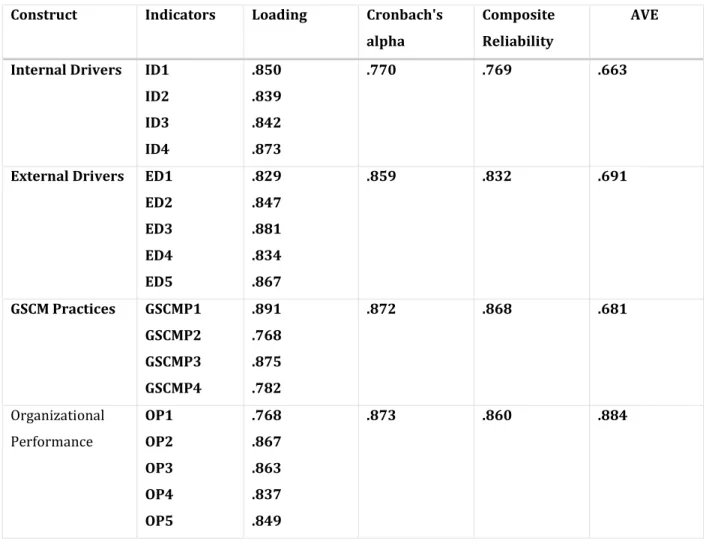
In this study, smartPLS3 is used to measure the model. Factor internal consistency process, CR, AVE and Cronbach's alpha have been measured. Fig. 2 shows the measurement model assessment. The results of measurement model assessment have been given in Table 2. The results show that all the items had a factor loading more than 0.70. No items having value in the factor loading below 0.70 but above 0.60. Internal consistency has been attained as the factor loading is more than 0.50 approving the convergent validity. AVE and Composite reliability have also been more than satisfactory range 0.70 and 0.50, respectively. The external consistency, furthermore, for the discriminant validity. Table 1 exhibits the results of discriminant validity.Table 1: Cronbach’s alpha Factor Loading, CR and AVE
Construct Indicators Loading Cronbach's
alpha
Composite Reliability
AVE Internal Drivers ID1
ID2 ID3 ID4 .850 .839 .842 .873 .770 .769 .663
External Drivers ED1 ED2 ED3 ED4 ED5 .829 .847 .881 .834 .867 .859 .832 .691 GSCM Practices GSCMP1 GSCMP2 GSCMP3 GSCMP4 .891 .768 .875 .782 .872 .868 .681 Organizational Performance OP1 OP2 OP3 OP4 OP5 .768 .867 .863 .837 .849 .873 .860 .884
Table 2: Discriminant Validity
ID EP GSCMP OP
ID .869
ED 0.862 0.839
GSCMP 0.849 0.745 0.823
4.2 Structural Model Assessment
In this analysis, table 3 makes the measurement model assessment puts direct effects. It comes to know that all the direct associations having t-value more than 1.96 at 0.05 level of significance. So, all the relations have been significant. Furthermore, β-value exhibits a positive association. Therefore, all the hypotheses (H-1, H-2 and H-3) have been
approved as shown in Table 4. Furthermore, Table 4 exhibits the size of effect (f2) internal drivers and “green supply chain management practices” having strong effect (f2). Further, external pressures and “green supply chain management practices”, “green supply chain management practices” and organizational performance all have strong effect [35, 36, 37, 38].
Table 3: Direct Result
Hypothesis
β-value
(STDEV) T Statistics P-Value f2 Decision
H1 ID->GSCMP 0.197 0.078 2.791 0.001 0.18 Accepted H2 EP->GSCMP 0.169 0.081 2.765 0.000 0.18 Accepted H3 GSCMP→OP 0.177 0.064 2.589 0.000 0.20 Accepted
Moreover, Table 4 exhibits that mediation effect has been significant with t-value 2.215 with positive β-value 0.261. Thus, “green supply chain management practices” a mediating variable between internal drivers and organizational performance [39]. Hence, H-4 is mediated. Similarly, mediating effect of
“green supply chain management practices” between external pressures and organizational performance β -value .296 and t--value is 2.286. Thus, “green supply chain management practices” a mediating variable between external pressures and organizational performance. Hence, H-5 is mediated.
Table 4: Mediation Result
Hypothesis
β-value
(STDEV) T Statistics P-Value Decision
H4 ID→GSCMP→OP H5 EP→GSCMP→OP 0.261 0.296 0.085 0.081 2.215 2.286 0.000 0.001 Mediation Mediation
5. Findings
In this study, the literature review determines that there have been several variables prompting Organizational Performance. “Though, the most conclusive variables, internal drivers, external drivers and green supply chain management practices”. The t-value is greater than the standard value of 1.96 at 0.05 significant level is acceptable [40]. Further, the path between internal drivers and “green supply chain management practices” (β=0.197, t-value=2.791, p<0.05), shows a positive significant relationship. Therefore, the current study found a significant positive relationship between delivery and GSCMP, supporting H1. It proves that increasing one variable would increase other variable towards the same direction. Similarly, the path between external drivers and “green supply chain management practices” (β=0.169 t-value=2.765, p<0.05), so, this study has found a significant positive relationship between external drivers and “green supply chain management practices”, supporting H2. Likewise, the path between “green supply chain management practices” and organizational performance (β=0.177 t-value=2.589, p<0.05), so, this study has found a significant positive relationship between “green supply chain management practices” and organizational performance, supporting H3. Similarly, the mediation role of “green supply chain management practices” between internal drivers and organizational performance (β=0.261, t-value=2.286, p<0.05). Hence H-4 is mediated. Similarly, the mediation role of “green supply chain management practices” between external pressure and organizational performance (β=0.296, t-value=2.218, p<0.05), values show a strong mediation role of “green supply chain management practices” between external pressure and organizational performance. Hence H-5 is mediated.
5.1 Conclusion
This segment abridges the discoveries of this examination, bringing up the impediments and the potential for future research around there. The key discoveries of this investigation include: (an) inward drivers and outer drivers are solid helpers for SMEs to practice, (b) “Green Supply Chain Management
(GSCM)” practices, for example, inside ecological management, green buying and participation with clients are in practice in Indonesian SMEs; (c) SMEs that rehearsing “Green Supply Chain Management (GSCM)” can enhance organization notoriety and result in higher dedication and enhanced deals, and thusly enlarged benefit. Accordingly, GSCM practices can help SMEs upgrade the general business execution while looking after product/benefit quality, sparing vitality, decreasing expenses and enhancing proficiency. This backing the results of past examinations that “Green Supply Chain Management (GSCM)” practices have positive effect on proficiency and benefit. Nonetheless, “Green Supply Chain Management (GSCM)” practices can be troublesome for SMEs because of the measure of their business, absence of mastery, money related requirements, etc. By and by, this investigation demonstrates that the SMEs that have executed “Green Supply Chain Management (GSCM)” practices in a single manner or the other will appreciate the execution benefits in longer term [41, 42,48-50].
References
[1] Touboulic, A., & Walker, H. (2016). A relational, transformative and engaged approach to sustainable supply chain management: The potential of action research. human relations, 69(2), 301-343.
[2] Kuei, C.-h., Madu, C. N., Chow, W. S., & Chen, Y. (2015). Determinants and associated performance improvement of green supply chain management in China. Journal of cleaner
production, 95, 163-173.
[3] Erin, O., Oduwole, F., Olojede, P., & Arumona, J. (2018). Does International Financial Reporting Standards (IFRS) Impact Profitability Ratios of Listed Banks in Nigeria?. Journal of Accounting, Business and Finance Research, 2(2), 79-90.. [4] Hoskin, P. (2011). Why business needs to green
the supply chain. University of Auckland Business
Review, 13(1), 16.
[5] Lee, S.-Y. (2015). The effects of green supply chain management on the supplier’s performance through social capital accumulation. Supply Chain
Management: An International Journal, 20(1),
[6] Edriss, A. K., & Chiunda, C. (2017). Interfaces Between Road Infrastructure and Poverty in Africa: The Case of Malawi, 1994-2013. Journal of Social Economics Research, 4(1), 9-21. [7] Gunasekaran, A., Subramanian, N., & Rahman, S.
(2015). Green supply chain collaboration and incentives: Current trends and future directions: Elsevier.
[8] Thakkar, J., Kanda, A., & Deshmukh, S. (2009). Supply chain management for SMEs: a research introduction. Management Research News, 32(10), 970-993.
[9] Huang, X., Tan, B. L., & Ding, X. (2015). An exploratory survey of green supply chain management in Chinese manufacturing small and medium-sized enterprises: Pressures and drivers.
Journal of Manufacturing Technology
Management, 26(1), 80-103.
[10] Fahimnia, B., Sarkis, J., & Davarzani, H. (2015). Green supply chain management: A review and bibliometric analysis. International journal of
production economics, 162, 101-114.
[11] Rajeev, A., Pati, R. K., Padhi, S. S., & Govindan, K. (2017). Evolution of sustainability in supply chain management: A literature review. Journal of
cleaner production, 162, 299-314.
[12] Ahi, P., & Searcy, C. (2013). A comparative literature analysis of definitions for green and sustainable supply chain management. Journal of
cleaner production, 52, 329-341.
[13] Srivastava, S. K. (2007). Green supply‐chain management: a state‐of‐the‐art literature review.
International journal of management reviews, 9(1), 53-80.
[14] Seuring, S., Sarkis, J., Müller, M., & Rao, P. (2008). Sustainability and supply chain management–an introduction to the special issue: Elsevier.
[15] Sarkis, J., Zhu, Q., & Lai, K.-h. (2011). An organizational theoretic review of green supply chain management literature. International journal
of production economics, 130(1), 1-15.
[16] Sharma, V. K., Chandna, P., & Bhardwaj, A. (2017). Green supply chain management related performance indicators in agro industry: A review.
Journal of cleaner production, 141, 1194-1208.
[17] Dubey, R., Gunasekaran, A., Papadopoulos, T., Childe, S. J., Shibin, K., & Wamba, S. F. (2017). Sustainable supply chain management: framework and further research directions. Journal of cleaner
production, 142, 1119-1130.
[18] Zhu, Q., Sarkis, J., & Lai, K.-h. (2012). Examining the effects of green supply chain management practices and their mediations on performance improvements. International journal
of production research, 50(5), 1377-1394.
[19] Jabbour, C. J. C., Jugend, D., de Sousa Jabbour, A. B. L., Gunasekaran, A., & Latan, H. (2015).
Green product development and performance of Brazilian firms: measuring the role of human and technical aspects. Journal of cleaner production, 87, 442-451.
[20] Hoejmose, S., Brammer, S., & Millington, A. (2013). An empirical examination of the relationship between business strategy and socially responsible supply chain management.
International Journal of Operations & Production
Management, 33(5), 589-621.
[21] Tachizawa, E. M., Gimenez, C., & Sierra, V. (2015). Green supply chain management approaches: drivers and performance implications.
International Journal of Operations & Production
Management, 35(11), 1546-1566.
[22] Azevedo, S. G., Carvalho, H., & Machado, V. C. (2011). The influence of green practices on supply chain performance: a case study approach.
Transportation research part E: logistics and
transportation review, 47(6), 850-871.
[23] Huang, X., Tan, B. L., & Ding, X. (2012). Green supply chain management practices: An investigation of manufacturing SMEs in China.
International Journal of Technology Management
& Sustainable Development, 11(2), 139-153.
[24] Zhu, Q., & Sarkis, J. (2007). The moderating effects of institutional pressures on emergent green supply chain practices and performance.
International journal of production research, 45(18-19), 4333-4355.
[25] Edeme, R. K. (2018). Revisiting the Economic Growth-Welfare Linkages: Empirical Evidence from Nigeria. Asian Themes in Social Sciences Research, 1(1), 28-33.
[26] Zailani, S., Jeyaraman, K., Vengadasan, G., & Premkumar, R. (2012). Sustainable supply chain management (SSCM) in Malaysia: A survey.
International journal of production economics, 140(1), 330-340.
[27] Tseng, M.-L., Lin, Y.-H., Tan, K., Chen, R.-H., & Chen, Y.-H. (2014). Using TODIM to evaluate green supply chain practices under uncertainty.
Applied Mathematical Modelling, 38(11-12),
2983-2995.
[28] De Giovanni, P., & Vinzi, V. E. (2012). Covariance versus component-based estimations of performance in green supply chain management. International journal of production
economics, 135(2), 907-916.
[29] Green Jr, K. W., Zelbst, P. J., Meacham, J., & Bhadauria, V. S. (2012). Green supply chain management practices: impact on performance.
Supply Chain Management: An International
Journal, 17(3), 290-305.
[30] Tseng, M.-L., Divinagracia, L., & Divinagracia, R. (2009). Evaluating firm’s sustainable production indicators in uncertainty. Computers &
[31] Devkota, N., & Phuyal, R. K. (2017). An analysis of nepalese youth understanding level on climate change. Asian Journal of Economic Modelling, 5(3), 342-353.
[32] Comrey, A., & Lee, H. (1992). Interpretation and application of factor analytic results. Comrey AL,
Lee HB. A first course in factor analysis, 2, 1992.
[33] Szegedi, Z., Gabriel, M., & Papp, I. (2017). Green supply chain awareness in the Hungarian automotive industry. Polish Journal of
Management Studies, 16 (1), 259 – 268.
[34] Kovacs, G. (2017). Global economic changes, optimization of Virtual Enterprises: software development. Polish Journal of Management
Studies, 15 (2), 115-131.
[35] Sinaga, O., Saudi, M.H.M., Roespinoedji, D., & Jabarullah, N.H. (2019) Environmental Impact of Biomass Energy Consumption on Sustainable Development: Evidence from ARDL Bound Testing Approach, Ekoloji, 28 (107), 443 – 452. [36] Saudi, M.H.M., Sinaga, O., Roespinoedji, D., &
Jabarullah, N.H. (2019) Industrial, Commercial and Agricultural Energy Consumption and Economic Growth Leading to Environmental Degradation, Ekoloji, 28 (107), 299 – 310. [37] Sinaga, O., Alaeddin, O., & Jabarullah, N.H.
(2019) The Impact of Hydropower Energy on the Environmental Kuznets Curve in Malaysia,
International Journal of Energy Economics and
Policy, 9(1), 308-315.
[38] Saudi, M.H.M, Sinaga, O., & Jabarullah, N.H. (2019) The Role of Renewable, Non-renewable Energy Consumption and Technology Innovation in Testing Environmental Kuznets Curve in Malaysia, International Journal of Energy
Economics and Policy, 9(1), 299-307.
[39] Hussain, H.I., Salem, M.A., Rashid, A.Z.A., & Kamarudin, F. (2019) Environmental Impact of Sectoral Energy Consumption on Economic Growth in Malaysia: Evidence from ARDL Bound Testing Approach, Ekoloji, 28 (107), 199 – 210. [40] Kamarudin, F., Sufian, F., Nassir, A. M., Anwar,
N. A. M., Ramli, N. A., Tan, K. M., & Hussain, H. I. (2018). Price efficiency on Islamic banks vs. conventional banks in Bahrain, UAE, Kuwait, Oman, Qatar and Saudi Arabia: impact of country governance. International Journal of Monetary
Economics and Finance, 11(4), 363-383.
[41] Abdullah, N., Safiah, N., Ghani, A. A., Maamor, S., Wahab, N. A., Razimi, A., ... & Elias, N. H. (2018). Examining Level of Spirituality
among Malaysian Youth. Indian Journal of Public
Health Research & Development, 9(11).
[42] Taib, C. A., Ashraf, M. S., & Razimi, M. S. B. A. (2018). Productivity Change in The Efficiency of The Insurance and Takaful Industry of Pakistan.
Academy of Accounting and Financial Studies
Journal.
[43] Ahmed, U., Abdul Majid, A. H., Mohd Zin, M. L., Phulpoto, W., & Umrani, W. A. (2016). Role and impact of reward and accountability on training transfer. Business and Economics Journal, 7(1).
[44] Ali, A., & Haseeb, M. (2019). Radio frequency identification (RFID) technology as a strategic tool towards higher performance of supply chain operations in textile and apparel industry of Malaysia. Uncertain Supply Chain Management, 7(2), 215-226.
[45] Suryanto, T., Haseeb, M., & Hartani, N. H. (2018). The Correlates of Developing Green Supply Chain Management Practices: Firms Level Analysis in Malaysia. International Journal of Supply Chain Management, 7(5), 316.
[46] Haseeb, M., Abidin, I. S. Z., Hye, Q. M. A., & Hartani, N. H. (2018). The Impact of Renewable Energy on Economic Well-Being of Malaysia: Fresh Evidence from Auto Regressive Distributed Lag Bound Testing Approach. International Journal of Energy Economics and Policy, 9(1), 269-275.
[47] Haseeb., H. Z., G. Hartani., N.H., Pahi., M.H. Nadeem., H. . (2019). Environmental Analysis of the Effect of Population Growth Rate on Supply Chain Performance and Economic Growth of Indonesia. Ekoloji, 28(107).
[48] Dhull, S., & Narwal, M. (2016). Drivers and barriers in green supply chain management adaptation: A state-of-art review. Uncertain Supply Chain Management, 4(1), 61-76.
[49] Samad, S. (2018). Examining the effects of environmental strategy and competitive advantage on business performance. Management Science Letters, 8(9), 891-902.
[50]Dahash, Q., & Al-Dirawi, A. (2018). Investment in intellectual capital and achievement of the
competitive advantage in hotel
sector. Management Science Letters, 8(7), 795-804.