Magic Quadrant for Web Conferencing
Gartner RAS Core Research Note G001669297, David Mario Smith, 29 July 2009, RA1 07302010
Demand from line of business units is forcing IT departments to
take a more strategic look at Web conferencing products and
services.
WHAT YOU NEED TO KNOW
This document was revised on 31 July 2009. For more information, see the Corrections page on gartner.com.
The demand for Web conferencing has increased due to economic pressures and recent enterprise concerns and mandates about reducing travel costs. Web conferencing tools are perhaps one of the easiest to measure from a return on investment (ROI) perspective. It is fairly easy to determine potential cost savings from travel reduction in replacing face-to-face meetings with Web conferencing. However, the benefits include more than just travel reduction. Web conferencing enables real-time interactive information sharing with use cases ranging from team collaboration to training and support. As the market continues to consolidate, with acquisitions such as InterCall’s purchase of Genesys in 2008, larger vendors will continue to grow their market share at the expense of the many smaller vendors which still crowd the enterprise market. Infrastructure vendors like IBM and Microsoft will position their own Web conferencing offerings as the “default” options for those who buy their respective unified communications and collaboration (UCC) platforms. It will cause an increase in on-premises deployments, leading to a hybrid model where we will see the on-premises product used for smaller internal meetings and the software-as-a-service (SaaS) offering for larger meetings or those with a mixture of internal and external participants. Enterprise decisions on Web conferencing have to align the types of meetings to be supported and the number of participants (internal, external or both) with the appropriate deployment option for specific meetings.
There will be a shift in the way online meetings are conducted in future, with things like virtual meeting that use human-controlled Avatars emerging. As economic pressures are leading companies to move some of their larger conferences and events to virtual events, we are seeing a growing interest in large conferencing event providers like InXpo, ON24, Accordent and Unisfair. The offerings from these vendors overlap with those from traditional Web conferencing vendors that are now offering support for larger events.
Strategic Planning Assumption(s)
By 2011, Web conferencing will be available to 75% of corporate users as a standard facility, alongside e-mail, presence, calendaring, IM and other collaborative facilities.
By 2011, 40% of all Web conferences will be operated using on-premises deployments. By 2011, 60% of companies using Web conferencing will acquire this capability as part of a larger suite of applications.
MAGIC QUADRANT
Market Overview
Web conferencing products are real-time collaboration tools that support interactions over a network between participants in multiple meeting formats. The primary justification for Web conferencing is the cost savings and benefits from business travel reductions. When meeting participants cannot travel because of security or other individual or environmental reasons, Web conferencing is used to facilitate important meetings that would not be possible in person. Increasing environmental concerns and initiatives for “green” IT are also leading organizations to Web conferencing. Some vendors provide green calculators to enable companies to track the amount by which travel was reduced and the carbon dioxide emissions prevented by not traveling. The market for Web conferencing, teaming and social software will grow at a compound annual growth rate of more than 20% through. Due to global economic challenges, interest in Web conferencing has been at an all time high as companies look to cut costs. While the benefits of Web conferencing are obvious, there is still a huge market opportunity to tap into a large portion of enterprise users who still have not used it. Penetration rates are increasing, though. There are various aspects and meeting types that fall under Web conferencing, including, webinars, online meetings, messaging and audio communications.
The following is the minimum set of functions that needs to be included in a Web conferencing product for inclusion in this report:
• Presentation delivery: All participants can see an online presentation (usually delivered by Microsoft PowerPoint), which is under the control of one participant designated as the presenter.
• Desktop or application sharing: All participants can see, but not directly interact with or modify, the presenter’s desktop or a specific application on the presenter’s system. Some Web conferencing products deliver presentations by sharing
a presentation application, rather than using embedded presentation facilities.
• Text chat: Participants can exchange real-time text messages with other participants or the presenter using an instant messaging (IM)-like interface.
• Shared whiteboard: A meeting participant can add annotations – that can be viewed by all – by typing or drawing on a specific whiteboard application, or on top of a presentation or shared application window.
The Magic Quadrant is copyrighted July 2009 by Gartner, Inc. and is reused with permission. The Magic Quadrant is a graphical representation of a marketplace at and for a specific time period. It depicts Gartner’s analysis of how certain vendors measure against criteria for that marketplace, as defined by Gartner. Gartner does not endorse any vendor, product or service depicted in the Magic Quadrant, and does not advise technology users to select only those vendors placed in the “Leaders” quadrant. The Magic Quadrant is intended solely as a research tool, and is not meant to be a specific guide to action. Gartner disclaims all warranties, express or implied, with respect to this research, including any warranties of merchantability or fitness for a particular purpose. © 2009 Gartner, Inc. and/or its Affiliates. All Rights Reserved. Reproduction and distribution of this publication in any form without prior written permission is forbidden. The information contained herein has been obtained from sources believed to be reliable. Gartner disclaims all warranties as to the accuracy, completeness or adequacy of such information. Although Gartner’s research may discuss legal issues related to the information technology business, Gartner does not provide legal advice or services and its research should not be construed or used as such. Gartner shall have no liability for errors, omissions or inadequacies in the information contained herein or for interpretations thereof. The opinions expressed herein are subject to change without notice.
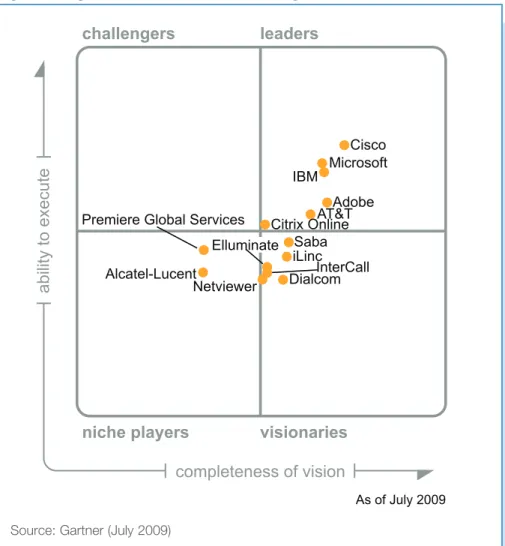
Figure 1. Magic Quadrant for Web Conferencing
Source: Gartner (July 2009)
challengers
leaders
niche players
visionaries
completeness of vision
ability to execute
As of July 2009 Cisco Microsoft IBM Adobe AT&T Citrix Online Saba Elluminate iLinc InterCall Dialcom Netviewer Alcatel-Lucent Premiere Global Services• Basic security: Encrypted data transfer and password-protected meetings.
• Remote control: Useful for technical support. It gives one participant control of applications or the desktop on another system.
Increasingly, Web-conferencing products are being augmented by more-advanced, optional features, such as:
• Integrated public switched telephone network audio: Users can dial into an audioconferencing bridge that is linked into the Web conference. Participants can “see” who is speaking and presenters can control individual phone connections (for example, they can mute them or give presenter rights).
• Integrated voice over Internet Protocol (VoIP) audio: To remove or reduce the need for telephone-based audio, some products can use a PC’s speaker and microphone (or a headset) to enable participants to listen to a presentation or – more rarely – to speak and listen.
• Videoconferencing: Some products can show live video feeds of participants or the presenter, which come from a desktop webcam or a dedicated video installation. Some vendors integrate these video streams into sessions running on dedicated videoconferencing equipment.
• File sharing: Participants can exchange files during the conference.
• Application/document sharing: Participants can write directly onto the presenter’s application or document.
• Advanced security: Extra features that are required for sensitive meetings. These features include: participant-level passwords to prevent sharing, forcing new passwords for every meeting; the ability to block anonymous users, limiting participants to those with specific IP addresses; and automatic purging of online documents after the meeting.
• Archiving: Audio and interactive portions of the conference can be recorded for later viewing. Participants can “sit in” on the conference if they were not able to attend in real time. Archiving mandated by regulatory audit trail requirements is on the rise.
• Feedback: Participants can indicate whether they want the speaker to slow down, speed up, answer a question and more.
• Polling: A quick survey of participants can be conducted to answer a specific question in real time.
• E-learning: Specific functionality to support online and blended learning scenarios, such as participant testing, instructor monitoring of student desktops and corporate learning system integration.
• Mobility: Specific support for mobile phones and PDAs, such as the iPhone and BlackBerry devices.
Users have three deployment options for these applications:
• SaaS model – Web conferencing software runs on the vendor’s (or a partner’s) systems on a multitenancy basis, and the user accesses the capabilities over the Internet (see Note 1).
• On-premises model – Installs software on systems owned and operated by the enterprise.
• Hybrid model – Combines the SaaS model and the on-premises model.
Typical internal everyday meetings can be run using on-premises facilities, and unusually large meetings or those with a mix of internal and external participants can be run using software running on external servers. The SaaS model has been the predominant model in the Web conferencing market and has led to the ease of entry of many smaller vendors into this space.
Market Definition/Description
Web conferencing products are predominantly sold into lines of business first, then they may be picked up by the IT department for more strategic deployments. With the two dominant e-mail and IM vendors, IBM and Microsoft, fully in the market, Web conferencing services are becoming a related additional requirement as organizations begin to evaluate UCC offerings. While UCC platforms now provide Web conferencing services, we believe this will result in an increase in on-premises deployments.
Typically, companies use a separate telephone bridge for audio in conjunction with Web conferences. Most of the vendors in this Magic Quadrant have their own VoIP capabilities, which eliminates the need for sending out separate bridge telephone numbers and IDs. But bandwidth is a concern and can affect audio quality. Other important concerns are difficulties provisioning PC accessories (such as headsets), configuring and maintaining them, and being able to bridge VoIP and plain old telephone service for the odd participant who doesn’t have a PC microphone. Increasingly, bandwidth concerns also apply to video. Although there is increased interest in video, usage is not very high. Most vendors support video via Universal Serial Bus (USB) webcams during Web conferences. Increasingly, some vendors are promoting adaptive bandwidth management features to flexibly control bandwidth consumption on the network.
It’s in the general market area of VoIP, video, flexible pricing options, integration with learning management systems and other business applications that vendors are looking to differentiate, as this market has matured quickly in the past two years. But the market’s maturity is leading to less differentiation, as newer or lesser-known players are just a version away from adding extra functionality. The major differentiation is the viability of the companies and the alignment of Web conferencing offerings with broader UCC suites.
This Magic Quadrant covers enterprise use of Web conferencing, so we will not address all consumer-based vendors, except to say that enterprise vendors do offer scaled-down versions of their Web conferencing services. Examples include IBM’s LotusLive and Adobe’s ConnectNow, with limits of two to three participants. Microsoft offers SharedView for the Windows Live consumer market and MeetingSpace on Vista for free. It’s an interesting strategy to “seed” the low end of the market and position the brand.
Smaller players are also getting interest from enterprises that are looking to reduce costs. As part of regular due diligence, vendors such as Zoho and Dimdim are coming up in the purchasing decision cycle. Dimdim interestingly enough offers free hosted Web conferencing for up to 20 participants. Novell, also has a Web conferencing offering via the SiteScape acquisition, branded Novell Conferencing.
Inclusion and Exclusion Criteria
For inclusion in this Magic Quadrant, we used the following criteria:
• The product provides at least the minimal functionality described in the Market Overview section.
• The product supports at least five participants. Products that support one-to-one interaction or small groups are generally aimed at the consumer or other specialized markets not covered by this Magic Quadrant.
• The vendor must market the Web conferencing product on a stand-alone basis, or as a component of a larger collaboration suite that may include presence and IM.
• The vendor must have at least $7 million in annual revenue from sales of Web conferencing products.
• Sales and marketing efforts connected with the product are not limited primarily to a particular vertical industry or horizontal process (such as training).
• The vendor must develop and market the primary Web conferencing product, not resell a “white label” product produced by another company in an OEM relationship. The product can also be the result of an acquisition.
The vendors of the following products are evaluated in this Magic Quadrant:
• Adobe Acrobat Connect Pro.
• Alcatel-Lucent OmniTouch My Teamwork.
• AT&T Connect.
• Cisco Unified MeetingPlace and WebEx Web Meeting applications (Meeting Center, Sales Center, Event Center, Training Center and Support Center).
• Citrix GoToMeeting and GoToWebinar.
• Dialcom Spontania Unified Collaboration.
• Elluminate Live.
• IBM Lotus Sametime Meetings and IBM LotusLive Meetings.
• iLinc Enterprise Suite (iLinc for Meetings, iLinc for Webinars, iLinc for Support, iLinc for Learning).
• InterCall Unified Meeting.
• Microsoft Office Live Meeting 2007 and Office Communications Server (OCS) 2007.
• Netviewer Meet, Netviewer Support, Netviewer Present.
• Premiere Global Services Netspoke Professional. • Saba Centra Suite.
Added
No new vendors have been added to this Magic Quadrant.
Dropped
We have dropped Genesys Conferencing from this Magic Quadrant because it was acquired by InterCall.
Evaluation Criteria
Ability to Execute
Several factors contribute to the vendors’ execution ratings. We evaluated the capabilities of the vendors’ products separately for basic and advanced functionality. Because this market includes many small vendors with uncertain futures, financial viability was an important factor. We evaluated pricing in terms of comparative price levels and vendors’ flexibility in supporting the kinds of pricing models that customers want (such as concurrent user, named user, per-minute and flat rate). We judged user experience by speaking with our customers who use the product or by calls with users supplied as references by the vendors.
Completeness of Vision
We evaluated the completeness of vision by looking at user requirements for use and purchasing and how the products align with those. To evaluate vendors’ marketing and product strategies, we looked at how they position their products and whether their products adequately address the chosen positioning. We rated flexibility to support SaaS and on-premises deployment more highly than a strategy of concentrating on one model only. We also evaluated vendors’ product innovation and ability to address trends we expect to see in the Web conferencing market.
Evaluation Criteria
Product/Service
Overall Viability (Business Unit, Financial, Strategy, Organization)
Sales Execution/Pricing
Market Responsiveness and Track Record Marketing Execution Customer Experience Operations Weighting high high standard low standard high low
Table 1. Ability to Execute Evaluation Criteria
Source: Gartner
Evaluation Criteria
Market Understanding Marketing Strategy Sales Strategy
Offering (Product) Strategy Business Model Vertical/Industry Strategy Innovation Geographic Strategy Weighting high high standard high standard low high low
Table 2. Completeness of Vision Evaluation Criteria
Source: Gartner
Leaders
Vendors in the Leaders quadrant have achieved significant market share while demonstrating their ability to respond to customers’ needs. Leaders have robust, scalable products with a wide range of features, a large installed base, acceptable financial performance and good distribution. Leaders do well today and are prepared for the future.
Challengers
There are no vendors in the Challengers quadrant this year. Vendors in this quadrant are characterized by operational excellence or a good standing in the market. But, compared with vendors in the Leaders and Visionaries quadrants, their products lack some features or they do not have long-term road maps.
Visionaries
Visionaries typically have an important, unique or well-developed technical capability and provide key elements of innovation that illustrate the future of the market. However, they have not yet developed sales and support capabilities to address or influence the complete market.
Niche Players
Niche Players may have good technology, but are limited by their size, product line breadth, market track record, vertical or horizontal focus, geographic niche or financial circumstances. Some have chosen a niche strategy (for example, regional vendors with a local focus or targeted functionality intended to run on top of, or with, other technologies).
Vendor Strengths and Cautions
Adobe
Although the Adobe Connect product has seen much use in training scenarios, we are seeing it being used more for sales and marketing presentations as a webinar tool. With that said, we do frequently see this offering in higher education. Based on Flash, Connect has good support for multimedia authoring. With the ubiquity of Flash, Adobe Connect does not have any major compatibility issues.
Strengths
• Adobe is positioning Adobe Connect as a secure platform for Web conferencing services, with strong wins in government and defense.
• Adobe Connect tells a good story in terms of bandwidth due to the underlying Flash Media Server that has been optimized for streaming video delivery without placing a heavy strain on the network.
• Adobe has an expanding market strategy and offers a better range of options for customers. Through acrobat.com, it offers a set of collaboration services, including Web conferencing, for free.
Cautions
• Adobe must ensure a continued focus on enterprise IT sales. Enterprise IT shops represent a buying center that Adobe has yet to fully penetrate consistently.
• The company has to communicate instant messaging and presence linkages based on assets acquired from the Antepo purchase, which has allowed integration with OCS IM and presence from Microsoft.
Alcatel-Lucent
Alcatel-Lucent is predominantly a unified communications company. Its Web conferencing capabilities are bundled within its UC platform. Although a scalable solution for service providers, the product is primarily only known to the Alcatel-Lucent UC customer base. This limits traction to the broader market looking for Web conferencing services.
Strengths
• Alcatel-Lucent offers a highly scalable solution for audioconferencing and Web conferencing.
• Its carrier-grade solution is used in service provider scenarios. It offers flexible pricing for small or midsize businesses (SMBs).
Cautions
• The offering does not support whiteboarding, mark up and editing, or facilities to edit recorded meetings.
• Web conferencing is not the main procurement reason for this offering, as the platform is a full communications bundle with strong traction in telephony and unified communications scenarios.
AT&T
Since acquiring Interwise, AT&T rebranded the offering AT&T Connect and has delivered three software releases. While AT&T still resells Cisco WebEx Web conferencing services as a service provider, it has had to focus heavily on the integration of the Interwise product into its portfolio. The AT&T Connect product has fully integrated Web, audio and video capabilities from the same platform.
Strengths
• AT&T offers converged conferencing capabilities, including VoIP, integrated audio bridge, video and PBX integration.
• As a service provider, AT&T has proven expertise in providing a scalable architecture for hosted services, including Web conferencing.
• Integration with content and storage management systems for archiving and compliance is provided.
• Integration with Microsoft and IBM UCC platforms is also provided.
Cautions
• Although AT&T has finished integrating its global audio and Interwise Web conferencing platform assets, it still has to ensure a continued focus on integrating AT&T Connect with AT&T UC and other IP services.
• AT&T lacks integration with room-based videoconferencing systems. This functionality is planned for inclusion in its products in 2010.
Cisco
As it moves into the UCC space, Cisco has been on an acquisition spree with one of its biggest purchases being WebEx. This gave Cisco the leading Web conferencing offering in terms of market share. While initially aimed at SMBs, Cisco’s plans entail positioning the enterprise edition of WebEx for broader enterprisewide
deployments tied into its overall UCC on-premises and SaaS-based offering. With modules for various types of meetings, including webinars and training, Cisco/WebEx is integrated with Microsoft Office and Lotus Sametime. Enterprises with existing Cisco unified communications (UC) assets can leverage that investment to transition over to the broader UCC offering, including the fully converged conferencing solution that can also be deployed as SaaS.
Strengths
• Cisco has multiple data centers globally supporting the WebEx Collaboration cloud and a leading position in the Web conferencing market.
• It offers a wide set of conferencing and collaborative applications to support specific business processes such as sales, marketing, support and training.
• The company is focused on delivering broader UCC capabilities, both in the cloud and on-premises.
• WebEx has support for mobility, so attendees can launch conference applications from an iPhone or BlackBerry device.
Cautions
• Cisco needs to integrate all of its acquired assets such as Jabber and Postpath to complete its full UCC suite of offerings. • The company has overlapping Web conferencing offerings
• We believe its WebEx hosted Web conferencing offering will replace the Web conferencing offering provided by the on-premises-based MeetingPlace.
Citrix Online
Citrix Online has been emerging in the Web conferencing space and improving its marketing and positioning. There will be a new training module to round out its conferencing portfolio as it competes aggressively against Cisco/WebEx. In the deals Citrix has won against competitors, clients site flexibility in pricing as one of the main reasons for its success. However, Citrix doesn’t offer some basic features like file transfer and persistent meetings, or some advanced features like video integration.
Strengths
• Citrix Online made improvements to its product offerings, including to its HiDef conferencing and testing capabilities, as well as to the GoToMeeting Web conferencing product.
• Pricing is attractive to smaller companies and has become a key driver in customer wins against competitors.
• The company is adding more functionality, such as a new learning-focused product that is in beta.
Cautions
• Support for multiple language versions is still missing.
• With its traditional focus on the SMB market, Citrix Online will face challenges in selling into an enterprise IT buying center.
Dialcom
Based in Madrid, Spain, Dialcom is a small collaboration company with sights on the broader UCC space. Its new version of
Spontania merges presence, instant messenger, multipoint audio, Web conferencing and videoconferencing in an on-premises offering which sits behind the corporate firewall. The on-premises deployment would fit a need for a secure conferencing platform controlled by internal IT resources.
Strengths
• Dialcom offers multidevice interoperability and supports
integration with multiple PBX vendors such as Cisco, Avaya and Nortel.
• There are integrations with Microsoft OCS and Lotus Sametime.
• An adaptive bandwidth management feature is available for video-quality optimization.
• Converged multipoint audio/video/Web conferencing is provided.
Cautions
• Dialcom needs to expand its market presence outside of Europe.
• It needs a stronger SaaS story, as on-premises is still the main business model.
Elluminate
Elluminate is another one of the Web conferencing vendors with a history in learning. Elluminate is based on Java and thus requires a download, which is not uncommon among other offerings. For online or virtual classrooms, Elluminate’s is an optimal offering. However, there have been issues raised by clients that not all webcams work with the product if there is a need for video.
Strengths
• Elluminate has good cross-platform support for Windows, Macintosh, Linux and Unix.
• Its core strength is in learning and training, with good rich media support for VoIP, live video and Flash playback.
Cautions
• Elluminate is primarily chosen for educational or learning scenarios, and not usually as a stand-alone Web conferencing tool for online meetings.
• Elluminate needs to increase its integration with the corporate learning systems vendors.
iLinc
Like many of the Web conferencing vendors in this report, iLinc has a good set of solutions for SMBs especially, but enterprises as well. Training is its primary use case, with roots in virtual classroom scenarios. With a customizable user interface, iLinc has a good set of modules which include learning, webinars, meetings and remote support. iLinc has also moved a lot of customers over to its named host licensing model, and has brought in some much needed pricing flexibility.
Strengths
• iLinc’s historical strength lies in learning and training use cases.
• Strategic integration with salesforce.com is improving its positioning for marketing and sales integration use cases. It also has integration with Microsoft Outlook
• The iLinc Green Meter helps show ROI and potential cost savings from using Web conferencing services.
Cautions
• iLinc did experience some revenue decline, as we predicted in last year’s Magic Quadrant. This is attributed to the divesture of its audio line of business and a transition to the SaaS model.
• It still lacks integration with Lotus Notes.
• It also lacks integration with enterprise IM and other UCC clients.
IBM
The Lotus Sametime product was IBM’s early offering for
on-premises instant messaging, presence and Web conferencing. The WebDialogs acquisition provided a SaaS-based Web conferencing product which gave IBM a new inroad into SMBs. Now branded LotusLive Meetings, the offering provides audio, Web, video integration and a zero download Web client. The on-premises Web conferencing offering is branded Sametime Meetings. IBM, like Microsoft, has the benefit of being an entrenched infrastructure component with Lotus Notes for e-mail. The e-mail provider typically gets the first chance to provide other collaboration services. In this case, where there are already IBM Lotus assets in house, receiving conferencing services from the same e-mail provider is an attractive offer. The Sametime offering can also be deployed stand-alone without dependence on the Lotus Notes infrastructure.
Strengths
• Since the acquisition of WebDialogs, IBM has offered a hybrid approach to Web conferencing for on-premises and hosted SaaS.
• The on-premises Sametime Meetings offering has direct integration with the rest of the IBM Lotus product portfolio and also Microsoft Office.
• A new range of client options from rich client to zero download browser access are now available.
Cautions
• IBM has to continue to communicate clearly the overall UCC value proposition of Web conferencing capabilities that come with Sametime Meetings on-premises.
• Previous versions of Sametime Meetings lacked ease of use. IBM has promised to improve this in the upcoming Sametime 8.5 release.
InterCall
InterCall went through a transition phase last year as it worked through the Genesys conferencing acquisition. It is one of the leading service providers that offers Web conferencing. Typically, customers look at InterCall when there is a strong audioconferencing driver. The Web conferencing component then gets bundled in.
Strengths
• InterCall acquired Genesys conferencing in 2008, and is now leading with that service, under the rebranded InterCall Unified Meeting name. This was the stronger offering compared to the Raindance Web conferencing assets, which will no longer be sold.
• No software download is needed for participants.
• A bundled voice, Web and video solution is offered, which can also be sold separately, similar to other audiconferencing providers.
Cautions
• There are multiple product lines to support (Raindance and reselling Cisco WebEx and Microsoft Live Meeting).
• There will be challenges, with a focus on selling and marketing its new offering from the Genesys acquisition.
Microsoft
As with IBM, Microsoft has the luxury of having one of the most widely used e-mail systems in enterprises. This will lead to a lot of its customers deciding on its on-premises Web conferencing offering in OCS. Microsoft’s Office Live Meeting Web conferencing service is one of the leading solutions in the market and comes in a professional and standard edition. However, changes in the licensing model in Office Live Meeting 2007 has caused some customer angst. Office Live Meeting is also positioned as one of the core services in Microsoft’s Business Productivity Online Suite (BPOS) SaaS offering.
Strengths
• The on-premises OCS 2007 Release 2 product and Office Live Meeting 2007 service have good synergy and allow meeting escalation from an OCS IM session to an OCS conference session via the Live Meeting console.
• There is a single interface/console for both OCS and Live Meeting.
• Web conferencing products are deeply integrated with the rest of the Office portfolio.
• An on-premises and cloud-based offering is provided.
Cautions
• The on-premises OCS version supports only the Windows server platform for Web conferencing, and in OCS Release 2, the server side runs on a 64 bit operating system (OS) only, which may mean a hardware upgrade is required.
• Live Meeting’s licensing model requires every meeting participant within the organization to have a license. Typically, Web conferencing vendors offer a named user/host or concurrent licensing options.
Netviewer
Netviewer is something of an unknown in North America, and its strong European base makes up much of its business. It has been competing very aggressively against Cisco/WebEx and Citrix Online in Europe. Netviewer, which has had a strong focus on remote support, is now downplaying that and positioning itself more strongly in the Web conferencing space. For European companies, there is support for integration with other European telecom providers.
Strengths
• Netviewer is focused on the European market for Web conferencing and has good traction. It accounts for over 95% of its business.
• Its Profiler Manager capability allows customers to define and provide functional profiles for users and user groups.
• There is integration with Microsoft Office (including Outlook) and Lotus Notes (via a plug-in), and support for Macintosh users.
Cautions
• The company still lacks support for external audioconference bridges.
• Netviewer has limited North American presence.
Premiere Global Services
With its Netspoke product, Premiere Global Services made some major upgrades in 2008, including a dial-out feature for meeting participants, personal meeting rooms and bandwidth controls for multipoint video. As a service provider, Premiere has seen a larger proportion of new customers coming in on the named host licensing model.
Strengths
• As a traditional audioconferencing provider, Premiere has bundled audio and Web pricing plans, so customers get just one invoice.
• Each Web conferencing host gets its own personal meeting room to streamline meeting setup.
• No software download is required for the Web conferencing service.
Cautions
• Limited multilanguage support is offered.
• The product currently lacks in-meeting testing and breakout room functionality.
Saba
Saba’s products are traditionally targeted at e-learning and talent management use cases. When it completed the acquisition of Centra in 2006, it moved over into the Web conferencing market. The Saba Centra product works with its e-learning assets and has several modules, including webinars, recording studios, virtual classrooms and e-meetings. There is an obvious fit here for enterprises already invested in Saba learning solutions that want deep integration with a Web conferencing offering.
Strengths
• Saba has strong learning and training expertise with deep integration into its own learning management system.
• Saba’s Web conferencing product provides integration with other learning management systems, such as those from SumTotal and Plateau.
• The company has an innovative people-centric vision for integrating Saba Centra (the Web conferencing product), Saba Social and Saba Learning. This supports rich profiles and enhanced search capabilities for expertise location.
Cautions
• Saba supports Jabber’s IM service, but it still does not support other enterprise IM or unified communications clients, such as Microsoft’s OCS 2007 and IBM’s Lotus Sametime. With its people-centric vision, support for the enterprise presence engine tied to the directory will add real-time efficiencies to enhance the user profiles capability.
• Customers typically look at Saba in terms of a training or learning use case.
Vendors Added or Dropped
We review and adjust our inclusion criteria for Magic Quadrants and MarketScopes as markets change. As a result of these adjustments, the mix of vendors in any Magic Quadrant or MarketScope may change over time. A vendor appearing in a Magic Quadrant or MarketScope one year and not the next does not necessarily indicate that we have changed our opinion of that vendor. This may be a reflection of a change in the market and, therefore, changed evaluation criteria, or a change of focus by a vendor.
Acronym Key and Glossary Terms
Note 1. Software-as-a-Service Definition IM instant messaging
IP Internet Protocol
OCS Office Communications Server
SaaS software as a service
SMB small or midsize business
TDM time division multiplexing
UC unified communications
USB Universal Serial Bus
VoIP voice over Internet Protocol
Gartner defines SaaS as “software that’s owned, delivered and managed remotely by one or more providers.” The provider delivers an application based on a single set of common code and data definitions. The application is consumed in a one-to-many model by all contracted customers at anytime on a pay-for-use basis, or as a subscription based on use metrics.
Evaluation Criteria Definitions
Ability to Execute
Product/Service: Core goods and services offered by the vendor that compete in/serve the defined market. This includes current product/service capabilities, quality, feature sets, skills, etc., whether offered natively or through OEM agreements/partnerships as defined in the market definition and detailed in the subcriteria.
Overall Viability (Business Unit, Financial, Strategy, Organization): Viability includes an assessment of the overall organization’s financial health, the financial and practical success of the business unit, and the likelihood of the individual business unit to continue investing in the product, to continue offering the product and to advance the state of the art within the organization’s portfolio of products.
Sales Execution/Pricing: The vendor’s capabilities in all pre-sales activities and the structure that supports them. This includes deal management, pricing and negotiation, pre-sales support and the overall effectiveness of the sales channel.
Market Responsiveness and Track Record: Ability to respond, change direction, be flexible and achieve competitive success as opportunities develop, competitors act, customer needs evolve and market dynamics change. This criterion also considers the vendor’s history of responsiveness.
Marketing Execution: The clarity, quality, creativity and efficacy of programs designed to deliver the organization’s message in order to influence the market, promote the brand and business, increase awareness of the products, and establish a positive identification with the product/brand and organization in the minds of buyers. This “mind share” can be driven by a combination of publicity, promotional, thought leadership, word-of-mouth and sales activities.
Customer Experience: Relationships, products and services/programs that enable clients to be successful with the products evaluated. Specifically, this includes the ways customers receive technical support or account support. This can also include ancillary tools, customer support programs (and the quality thereof), availability of user groups, service-level agreements, etc.
Operations: The ability of the organization to meet its goals and commitments. Factors include the quality of the organizational structure including skills, experiences, programs, systems and other vehicles that enable the organization to operate effectively and efficiently on an ongoing basis.
Completeness of Vision
Market Understanding: Ability of the vendor to understand buyers’ wants and needs and to translate those into products and services. Vendors that show the highest degree of vision listen and understand buyers’ wants and needs, and can shape or enhance those with their added vision.
Marketing Strategy: A clear, differentiated set of messages consistently communicated throughout the organization and externalized through the website, advertising, customer programs and positioning statements.
Sales Strategy: The strategy for selling product that uses the appropriate network of direct and indirect sales, marketing, service and communication affiliates that extend the scope and depth of market reach, skills, expertise, technologies, services and the customer base.
Offering (Product) Strategy: The vendor’s approach to product development and delivery that emphasizes differentiation, functionality, methodology and feature set as they map to current and future requirements.
Business Model: The soundness and logic of the vendor’s underlying business proposition.
Vertical/Industry Strategy: The vendor’s strategy to direct resources, skills and offerings to meet the specific needs of individual market segments, including verticals.
Innovation: Direct, related, complementary and synergistic layouts of resources, expertise or capital for investment, consolidation, defensive or pre-emptive purposes.
Geographic Strategy: The vendor’s strategy to direct resources, skills and offerings to meet the specific needs of geographies outside the “home” or native geography, either directly or through partners, channels and subsidiaries as appropriate for that geography and market.