1 | P a g e
RTP Awarded Grants Overview
The persistence of racial and gender disparities in school discipline and the severity of the
disproportionate impact of punitive disciplinary policies has led the Discipline Disparities
Research to Practice Collaborative (RTP) to support new research addressing disparities in
discipline by race/ethnicity, gender, and sexual orientation/gender nonconformity.
The Research to Practice Collaborative, through generous support from The Atlantic
Philanthropies, Open Society Foundation, and a host of anonymous donors has made funding
available to support new research addressing disparities in discipline by race/ethnicity,
gender, and sexual orientation/gender nonconformity. The purpose of the research is to
increase available knowledge concerning disciplinary disparities, especially in the area of
interventions for reducing or eliminating disparities. Since 2011, the Collaborative has funded
eleven studies, one of which has been completed. The projects below are currently in progress
and are at different stages of development. All funded projects will be completed no later than
fall 2014. The grants listed are organized by projects addressing student level disparities,
projects addressing implicit bias, and projects evaluating exemplary interventions that reduce
discipline disparities.
PROJECTS ADDRESSING STUDENT LEVEL DISPARITIES GLBTQ/Gender Expression Identification
“Sexual Orientation, Race, and Gender Disparities in Discipline”
Stephen Russell, Ph.D. University of Arizona
Shannon Snapp, Ph.D University of Arizona
In an effort to better understand the disciplinary disparities among sexual minority youth, the project proposes a qualitative study of LGBTQ youth and adult advocates: Research questions for this study include the following: What are their experiences of discipline (and perceptions of unfair discipline) at school? What are their perceptions of the reasons for LGBTQ disparities? Do they perceive
differential treatment at the intersections of LGBTQ with gender and race/ethnicity? And what do they believe can be done to address such disparities?
A growing body of evidence has documented a “school-to-prison pipeline”, the overuse of punitive punishment in schools which results in student involvement with the juvenile justice system (see Skiba, Shure, & Williams, 2011, for review). Despite similar rates of offending behaviors, African American and Latino youth experience exclusionary discipline at much higher rates than their White counterparts (Wallace, Goodkind, Wallace, & Bachman, 2008). Compared to disparities based on race/ethnicity, less is known about the discipline experiences of sexual minority youth (“sexual minority” is an umbrella term that is used to describe youth who have same-sex attractions, report same-sex behaviors, or students who are or are perceived to be lesbian, gay, bisexual, transgender, and queer or questioning (LGBTQ)). Although little is known, one recent study showed that LGBTQ youth are twice as likely as their heterosexual peers to be detained for nonviolent offenses such as running away, prostitution, and truancy (Garnette, Irvine, Reyes, & Wilber, 2011). Further, another study showed that sexual minority youth, particularly girls and youth of color, experience
disproportionate sanctions in school and the criminal justice system (Himmelstein & Bruckner, 2011). This emerging evidence points to the need to understand the school experiences of sexual minority
2 | P a g e students that may lead to disparities in punitive punishment, exclusionary discipline, or representation in juvenile justice systems.
“Quer(y)ing Discipline” Michelle Fine, Graduate Center CUNY Brett Stoudt, John Jay College & Graduate Center CUNY Kimberly Belmonte, Graduate Center CUNY Jennifer Chmielewski, Graduate Center CUNY
Maria Elena Torre, Public Science Project
CUNY
This is a multi-method research project initiated by the Graduate Center, CUNY researchers and community based partners, designed collaboratively to research the disproportionate rates and consequences of school discipline for LGBTQ youth of color, transgendered and gender non-conforming youth, and to study alternative strategies for school based recognition and justice at the intersection of race, gender and sexuality. By examining school structures, cultures and discipline practices, and individuals through an intersectional lens, the project will empirically document the landscape of school discipline practices on LGBTQ youth in middle and high-schools across NYC. The project will create a comprehensive scientific database of quantitative and qualitative evidence that assesses the academic, social, and mental health impact of these policies and practices on young people. The project will investigate the social psychological dynamics by which schools and
community based organizations facilitate alternatives to discipline. It will document and analyze practices that have been shown to reduce rates of bullying, harassment, and discipline, and those practices that develop a sense of authentic inclusion and participation. In addition to generating traditional research products for peer reviewed journals, the researchers in the project will host a roundtable of stakeholders, including researchers, youth, practitioners, and policy makers to share resources and generate public education strategies and, in collaboration with community based partners, develop an online “archive” of research results and alternative strategies for school discipline.
“LGBT Youth Discipline Disparities and Bias: An Empirical Model to Inform Practice” Paul Poteat, PhD
Counseling, Developmental, and Educational Psychology Department Boston College
Despite potential connections between minority stress and discipline disparities, there has been little attempt to bridge these fields. To address these limitations, the project will test several models of processes that contribute to these disparities. The researchers propose several hypotheses: (a) LGBT youth will be more likely than heterosexual youth to report juvenile justice system involvement and suspension; (b) higher victimization and greater alcohol use, weapon carriage, and truancy connected to victimization will partially mediate the juvenile justice and suspension disparities between LGBT and heterosexual youth; (c) the associations among these risk behaviors and juvenile justice
involvement and suspension will be stronger for LGBT than heterosexual youth, suggesting harsher punishment; and, (d) distinct patterns in these associations will emerge based on the intersectionality of sexual orientation, race, and gender.
3 | P a g e
“Transforming School Discipline: Understanding Race, Sexuality and Gender as Factors Impacting the Trajectories of Youth across the School to Prison Pipeline”
Sarah Schriber,
Health & Medicine Policy Research Group
Stacey Horn, The University of Illinois
Employing an intersectional approach, this project seeks to understand the relationships between sexuality, gender, race, and the over-use of exclusionary school discipline and its effects along the school to prison pipeline. An established body of research clearly documents that youth of color are punished in and pushed out of school more often than their white peers. Another body of research documents that LGBT students experience higher rates of harassment and violence in school, as well as higher rates of depression, suicide, substance abuse, disengagement and other negative outcomes than their heterosexual or gender conforming peers. A third body of research is beginning to emerge that documents that, as with youth of color, LGBT youth are punished in school more often and more harshly than their heterosexual or gender conforming peers and are overrepresented in juvenile detentions. Concurrently, while research on the school to prison pipeline continues to document that race and biological sex (often mislabeled as gender) are relevant and interrelated factors that
contribute to the movement of young people from schools to prisons, the research and interventions surrounding the school to prison pipeline have not typically included an analysis of gender (identity and expression) or sexuality, or their intersections with race. This project seeks to fill this gap.
Disparities among females
“Assessing Intersectional Factors Contributing to African American Girls’ Disproportionate Rates of Suspension and Expulsion”
Fatima Goss-Graves,
National Women’s Law Center The African American Policy Forum Kimberle Crenshaw, There is a dearth of quantitative and qualitative data that captures the narratives of Black girls and young women experiencing discipline in school. In order to assess the context and dynamics of the over-representation in discipline of Black females, the project will conduct quantitative analysis and use focus groups to gather crucial qualitative data not widely available in this field. The project will explore what conditions, opportunities or policies might have precuded girls’ separation from school, with particular focus on how disciplinary interventions, classroom management, and the availability of school-based wraparound services might be rethought.
The target population for the focus groups will be Black females over the age of 18 who have separated from school prior to graduation (focus in two regions, Midwest and South). The focus groups will explore areas that correspond with other research indicating specific intersectional vulnerabilities facing Black females with an emphasis on the effectiveness of disciplinary
interventions. In particular, the project will explore the gendered dimension of evidence that suggests that Black students are more likely to be disciplined for behaviors that rely largely upon subjective determinations of teachers and administrators.
4 | P a g e IMPLICIT BIAS REDUCTION PROGRAMS/TOOLS
“Research and Training to Mitigate the Effects of Implicit Stereotypes and Masculinity Threat on Authority Figures’ Interactions with Juveniles and Minorities” Kimberly Barsamian Kahn, PhD
Department of Psychology Portland State University
Phillip Atiba Goff, PhD
University of California, Los Angeles Consortium for Police Leadership in Equity
Jack Glaser, PhD
Goldman School of Public Policy University of
California, Berkeley
Through a school wide intervention, we aim to reduce racial disparities within the educational context. The proposed project will implement a program to reduce the impact of implicit racial stereotypes and insecure masculinity on authority figures’ interactions with juveniles and minorities in schools. The intervention will teach authority figures (teachers, school administrators, campus police) and juveniles how to both recognize and respond to implicit bias and insecure masculinity in themselves and in others.
“Screening Assessment Tool for Suspension/Expulsion” James Bell, Executive Director of W. Haywood Burns Institute
Angela Irvine, Director of Research for the National Council on Crime and Delinquency
In order to address classroom teacher discretion in imposing discipline the Burns Institute (BI) and the National Council on Crime and Delinquency (NCCD) propose to develop a tool for Oakland Unified School District teachers that guides decisions for disciplinary referrals and to conduct a feasibility study to determine whether the district should develop a risk and need assessments to be used by school administrators when considering suspensions and expulsions.
In the ground breaking study Breaking Schools’ Rules conducted by the National Council of State Governments, they found that only 3 percent of disciplinary actions were for conduct for which state law mandates suspensions and expulsions. In fact, the remainder of disciplinary actions were made at the discretion of school officials, primarily in response to violations of local schools’ conduct codes. This discretion resulted in a startling amount of suspensions and expulsions for students of color and those with special education needs.
EVALUATIONS OF PROMISING INTERVENTIONS
“From Punitive to Restorative: Evaluation of School Culture and Climate Programs that Impact Discipline Practices”
Marieka Schotland, PhD
Program Evaluation and Research Consultant,
Harriet MacLean, Ed.D.
5 | P a g e Morphonix, LLC
Project Advisors: Dr. Jean Phinney, Dr. Emily Ozer, Dr. Anne Gregory Davidson Middle School in San Rafael, California, has implemented a successful, multi-faceted approach to discipline issues resulting in a shift in the school culture and climate from punitive to restorative. In partnership with the school, this project provides a rich case study of this effort. The three programs that will be the focus of this project are: Restorative Circles, No Bully Solution Teams, and the Peer Courts Suspension Diversion. The goals of this project are to a) provide a process
oriented evaluation, b) explore sustainability and integration, and c) understand the impact on student relations around ethnicity. The process oriented evaluation will provide descriptive models of the programs including perspectives of the teachers and administrators. This evaluation will also assess the impact of these programs on both suspension reduction and students’ discipline experiences, specifically looking at ethnic and gender disparities. To explore sustainability and integration of the programs, various perspectives about the programs, and barriers to integration, will be elicited from the teachers, administrators and students. To adequately understand how much restorative practices and perspectives have been taken up by the larger school community, teacher and student reflections on school connection and overall school climate will be examined, with particularly attention paid to differences by gender and ethnicity. To understand how these programs impact students’ relations around ethnicity, data will be collected looking at both the support and sensitivity to cultural pluralism at the school. To answer the questions about these three programs, multiple perspectives and mixed methods data sources will be sought. Data collection will include interviews, program observations, archival records, and surveys. In addition, as a part of the growing commitment of the school community to these new practices, students from the existing mentoring program will be trained to conduct feedback interviews of their peers who have participated in the programs.
“Integrating School-Wide Positive Behavior Interventions and Supports (SWPBIS) and Restorative Discipline (RD)”
Jeffrey Sprague, Ph.D. University of Oregon John Inglish, J.D., University of Oregon Erik Girvan, Ph.D., J.D., University of Oregon Claudia Vincent, Ph.D., University of Oregon Driven by the (a) widely documented over-representation of non-White students in disciplinary
exclusions, (b) documented high truancy rates for students from LGBTQ backgrounds, (c) limited capacity of SWPBIS to reduce racial/ethnic discipline disparities, and (d) promising association of RD with reductions in racial/ethnic discipline disparities, our project focuses on developing School-wide Positive Restorative Discipline (SWPRD) to facilitate systemic use of RD in schools. SWPRD combines the structural or systemic components of SWPBIS with RD practices in order to create the mechanisms and the opportunity for students and teachers to establish positive relationships that promote understanding of cultural and individual variations in behaviors and their interpretations. SWPRD is intended to encourage shared responsibility for a positive school culture, give students a voice in disciplinary outcomes, and promote connections among school staff, peers, as well as students and teachers for greater understanding of cultural differences proactively as well as after a discipline incident has occurred. Our project will (a) develop professional materials for providing training in SWPRD, (b) develop a protocol to assess fidelity of SWPRD implementation, (c) deliver the professional development materials to 2 high schools, and (d) collect and analyze quantitative and qualitative data to assess changes in students’ perceptions of disciplinary fairness and school climate disaggregated by student race and sexual orientation, disciplinary outcomes, and feasibility and utility
6 | P a g e of SWPRD in authentic school contexts.
“Student Threat Assessment as an Intervention to Reduce Racial Disparities in School Suspensions”
Dewey Cornell, Ph.D., University of Virginia Angela Ciolfi, Legal Aid Justice Center This project examines the extent to which implementation of the Virginia Student Threat Assessment Guidelines in Virginia schools has led to decreased use of exclusionary school discipline practices and whether this effect has reduced racial disparities in short and long-term suspensions, especially for Black male students. Threat assessment is a violence prevention strategy that begins with an
evaluation of a student who has threatened to harm someone and is followed by interventions designed to reduce the risk of violence. A key aspect of threat assessment is its emphasis on considering the context and meaning of the student’s behavior and taking action that is proportionate to the seriousness of the student’s actions. This makes threat assessment the antithesis of zero tolerance, which ignores the context for the student’s behavior and applies uniformly severe punishment regardless of the seriousness of the offense. The project will examine disciplinary outcomes for approximately 1.2 million students in grades K-12 attending more than 1,800 Virginia public schools. In a preliminary study, we found that that Virginia schools using the Virginia Student Threat
Assessment Guidelines had 19% fewer long-term suspensions and 8% fewer short-term suspensions than other schools, and that longer use of the Guidelines was associated with greater reductions in suspensions (Cornell & Lovegrove, 2012). There were similar reductions in suspension across schools with differing proportions of Black students. An important limitation of this study, however, was that the state suspension data were limited to overall school rates and were not disaggregated by race or gender, making it impossible to demonstrate that use of threat assessment was associated with lower disparities in suspensions. With new access to statewide student-level data disaggregated by race and gender, the proposed study will be the first investigation of whether threat assessment can reduce racial disparities in school suspension.
Project Completed:
“Restoring community and achieving equity in secondary school classrooms” Researcher:Anne Gregory, Ph.D., Rutgers University
Study summary:
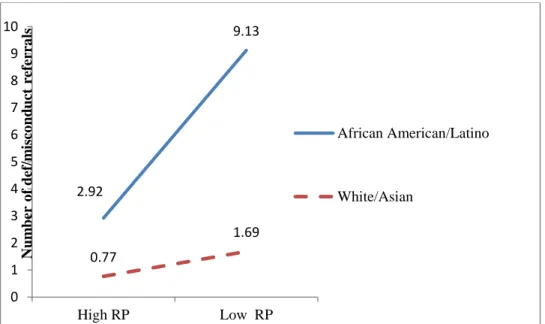
Restorative approaches to school discipline are increasingly being implemented throughout the United States in an attempt to reduce reliance on suspension and eradicate the racial discipline gap. Yet, little is known about the experience of students in classrooms utilizing restorative practices (RP). The current study draws on student surveys (N = 412) in 29 high school classrooms. Hierarchical linear modeling and regression analyses show that high RP-implementing teachers had more positive relationships with their diverse students. Students perceived them as more respectful and they issued fewer exclusionary discipline referrals, compared to low RP-implementers. In addition, the findings demonstrate some initial promise of well-implemented RP for narrowing the racial discipline gap. The study found that higher RP implementers issued fewer discipline referrals to Latino and African American students compared to lower RP implementers (see Figure 1 below). The study findings
7 | P a g e have implications for equity-focused consultation in schools that honor student experience of new programming.
Figure 1. Teachers above (n = 13) and below (n = 16) the mean on student-perceived RP implementation and number of misconduct/defiance referrals by race/ethnicity
Gregory A.,Clawson, K., Davis, A., & Gerewitz, J. (in press). The promise of restorative practices to transform teacher-student relationships and achieve equity in school discipline. For a special issue on Restorative Justice in the Journal of Educational and Psychological Consultation. (above figure reprinted by permission from Taylor & Francis, LLC.
http://www.tandfonline.com)
Corresponding author: Anne Gregory, Rutgers University, [email protected] 2.92 9.13 0.77 1.69 0 1 2 3 4 5 6 7 8 9 10 High RP Low RP Num ber o f def /m is co nd uct re fer ra ls African American/Latino White/Asian