FUEL
MANAGEMENT
GUIDE
S
Se
ec
cttiio
on
n 1
1
S
Su
ug
gg
ge
es
stte
ed
d
P
Prro
og
grra
am
mm
me
e
o
off W
Wo
orrk
k
THE GUIDE
This Guide contains information, advice and suggestions to improve the fuel performance of your vehicle fleet.
References to other Energy Efficiency Best Practice Programme (EEBPP) publications will be found in the suggested programme of work in Section 1 of the Guide.
To obtain copies of EEBPP publications, and for further information on any energy-related issue, including transport, you can contact the Environment and Energy Helpline on 0800 585794. All EEBPP publications are free of charge, as is the Helpline. You may also request ‘Site Specific Advice’ from the Helpline. This involves allocation of a short period of free consultancy. Allocation of Site Specific Advice is at the discretion of the EEBPP.
Wherever possible and appropriate, each section ends with a summary of action points. Examples are either included in the text or in an appendix at the end of the section.
At the end of most sections, there is a simple checklist of key points covering the main subjects discussed.
The Guide is available in electronic form from the Energy Efficiency Best Practice Programme web site: www.energy-efficiency.gov.uk/transport
From time to time, updates to the Guide will be posted on the site for you to review and download as you wish. Wherever possible, the sections are stand-alone, meaning that individual sections can be downloaded separately.
It is intended that further sections on specialist areas, such as aerodynamics, tyres, on-board computers, alternative fuels, maintenance, and fuel-saving interventions, will be issued at a later date. These will cover the subjects in a more detailed, comprehensive way.
I N T R O D U C T I O N
This Guide was prepared by Fuelwise Ltd, The Willows, Bridgewater Road, Dundry, Bristol BS41 8JP with assistance from:
Cheriton Technology Management Ltd Huddersfield University
David Wilcox ETSU for the EEBPP
IMPROVING MPG BY 5% COULD SAVE YOU AS MUCH AS £1,000 PER VEHICLE
According to an EEBPP survey carried out in 1998, the average large goods vehicle (LGV) in the UK travels 130,000 km (80,000 miles) each year and uses diesel costing £20,000 (1998 figures). Most fleets that embark on fuel management programmes show savings of at least 5%, meaning an average saving of £1,000 per vehicle per year.
Recently, the price of fuel has risen faster than general inflation. If this continues, the value of fuel savings will increase still further.
Remember that the impact of making a five per cent saving in costs is usually magnified in its effect on profit eg
If current total costs = £500,000 then if fuel represents 30% of costs = £150,000 and current profit (at say 5%) = £25,000 then 5% saving in fuel costs = £7,500 will increase profit by 30% to £32,500
Some operators will already have implemented a fuel improvement programme to varying degrees. Early on, you should assess where you are, and target the level of savings you will be trying to achieve.
WHO IS THE GUIDE AIMED AT
The guide is written for fleet operators with a variety of different levels of experience and knowledge.
If required, assistance in interpretation of the guidance is available from the Environment and Energy Helpline (0800 585794).
Using fuel more efficiently means: • lower costs;
• improved profit margins; • reduced emissions;
• improved environmental performance.
I N T R O D U C T I O N
ACKNOWLEDGEMENTS
Fuelwise Ltd would like to thank the many organisations and individuals who have helped and contributed to the Fuel Management Guide including:
- C.H. Jones
- Cheriton Technology Management Ltd - Continental Tyres Ltd
- Huddersfield University
- Institute of Road Transport Engineers - Leafield Engineering Ltd (VeMIS) - Logistics Purchasing Services Ltd (LPS) - Meggit Petroleum (TRISCAN)
- Michelin Tyres Ltd
- Robertson Research International Ltd - Rock Fuels
- Shell UK Ltd
- The Transport Engineer - UK PIA
- VDO Kienzle Ltd
- Volvo Truck and Bus Ltd - Warminster Systems Ltd
In addition we would like to thank all the organisations that have allowed us to quote them in the case studies/examples included in this Guide.
S E L F A U D I T
Environment and Energy Helpline on 0800 585794
SELF AUDIT
The following ‘Self Audit’ can be used to assess the status of fuel management in your organisation, and together with the suggested programme of work in the next section, can help you to identify the priorities for action and direct you to the right part of the Guide.
Section SELF AUDIT: Yes/No
3 Does the management of the organisation understand the importance of fuel management:
- What percentage of operating costs does it represent? - What is the potential to reduce fuel costs?
4 The Fuel Champion and their action plan
- Has a Fuel Champion been appointed and do they have the necessary authority?
- Is there a fuel management plan of action or programme in place?
7 How well are your fuel stocks managed? Do you review/have best practice in place for:
- Ordering systems? - Receiving bulk stocks?
- Controlling issues, stock movements and stock losses/gain?
- Are maintenance contracts in place for bulk fuel tanks, tank desludging, fuel pump calibration?
8 Does the organisation have good quality fuel performance information that is:
- Accurate, timely and relevant?
- Well communicated throughout the organisation? - Fed back to the drivers via notice boards, briefings etc? - Used by management to help make decisions? - Used by maintenance together with service records
to help identify poor driving habits and poorly performing vehicles?
S E L F A U D I T
Section SELF AUDIT: Yes/No
9 Are vehicles carefully specified to take into account:
- Whole life costs?
- Optimising vehicles to the requirements of the job? - Whether aerodynamic aids are appropriate?
10 Does maintenance of the vehicles take into account their fuel performance?
Are fuel performance figures available to those carrying out the maintenance of the vehicle?
Is there a good balance between minimising maintenance costs and optimising fuel performance?
Do maintenance monitor the vehicle for bad driving habits and report them back to the operational department?
11 Are the drivers in the organisation well motivated on fuel performance issues:
Does selection of new recruits include checking their knowledge and understanding of fuel-efficient driving techniques?
Does induction and general driver training include fuel efficient driving techniques?
Are driver disciplines well enforced, eg tank filling, daily checks, and have they been reviewed and updated to ensure they include fuel saving points?
CONTENTS
The Guide consists of the following sections:
Section 1 Suggested programme of work
Section 2 The role of management
2.1 Introduction
2.2 Senior management issues Appendix 2A Company car driver league table
Section 3 Financial aspects of fuel management
3.1 Introduction
3.2 Understanding your current costs 3.3 Price of fuel
3.4 Justifying the investment 3.5 Financial monitoring 3.6 Indirect benefits 3.7 Conclusion
Section 4 The Fuel Champion
4.1 Introduction
4.2 Roles and responsibilities 4.3 Training the Fuel Champion 4.4 Typical action plan
Section 5 Monitoring and Targeting
5.1 Introduction 5.2 Monitoring 5.3 Targeting
5.4 Application of Monitoring and Targeting
C O N T E N T S
Section 6 Factors affecting fuel consumption
6.1 Introduction 6.2 The vehicle 6.3 The driver 6.4 The load
6.5 Weather and seasonality 6.6 Route and traffic
6.7 Fuel
6.8 Understanding the effects of the fuel factors
Section 7 Fuel
7.1 Introduction
7.2 Fuel specification and quality
7.3 Ultra low sulphur diesel and ultra ultra low sulphur diesel 7.4 Temperature
7.5 Fuel purchasing 7.6 Fuel storage 7.7 Stock control
7.8 Fuel recording systems
Appendix 7A Fuel stocks/use reconciliation procedure
Section 8 Data collection
8.1 Introduction
8.2 Collecting data accurately 8.3 Cleansing data
8.4 Data analysis and reports 8.5 Using the data
8.6 Good and bad performers
8.7 Setting key performance indicators (KPIs) and targets Appendix 8A Suggested driver daily work report
Appendix 8B Examples of typical report forms Appendix 8C Effectiveness Analysis (EA)
Section 9 Specifying the vehicle
9.1 Introduction 9.2 The basics
9.3 Whole life costing 9.4 Driveline specification
9.5 Assessing a demonstrator vehicle 9.6 Bodywork and aerodynamics 9.7 Axles and tyres
Appendix 9A Aerodynamic aids
Section 10 Maintenance
10.1 Introduction 10.2 Record-keeping
10.3 Getting the priorities right 10.4 Turbochargers
10.5 Driver’s vehicle check 10.6 Smoke monitoring 10.7 Fuel injection system 10.8 Tyre checks
10.9 Axle alignment 10.10 Oil and lubrication
Section 11 The driver
11.1 Introduction
11.2 Recruiting fuel-efficient drivers 11.3 Induction and training
11.4 Communications programme 11.5 Provide feedback
11.6 Create league tables 11.7 Training plans 11.8 Develop the drivers
11.9 Driver disciplines and vehicle checklists 11.10 Sustainability
11.11 Fit all vehicles with speed limiters 11.12 Fit on-board computers
11.13 Encourage drivers to monitor their own performance
C O N T E N T S
11.14 One person responsible for figures 11.15 Tachograph analysis
11.16 Agency drivers Appendix 11A Sustainability
Appendix 11B Fuel-efficient driving: Drivers’ questionnaire Appendix 11C Example checklists for drivers and others Appendix 11D Communications
Appendix 11E Training the trainers
Appendix 1 Fuel management and conversion factors
1 Introduction
2 Some benchmark values 3 Conversion factors
Appendix 2 Fuel cards
1 Introduction 2 Options 3 Card features 4 Card costs
Appendix 3 On-board computers and telematics
1 Introduction
2 Some typical systems 3 The basic components 4 Input devices
5 The on-board computer 6 Communication devices 7 Driver identification device 8 Download mechanisms 9 Communications 10 Host computer 11 Database and reports
A P P R O A C H
Environment and Energy Helpline on 0800 585794
1
SUGGESTED PROGRAMME OF WORK
The following is one approach to developing and implementing a practical fuel management programme. It is of course up to you whether you follow it or develop your own programme. Further assistance and EEBPP publications can be obtained by ringing the Environment and Energy Helpline on 0800 585794.
Stage Action Reference Material – Energy Efficiency
Best Practice Programme
Gaining management Read Section 2 – Role of Management FL98020 Attitudes to fuel efficiency commitment Read Section 3 – Financial Implications ECG59 Fuel consumption in freight
Nominate/appoint the Fuel Champion haulage fleets
GPG251 Maintaining the momentum* ECG76 Benchmarking vehicle utilisation (Key Performance Indicators)
FEB20 Energy efficiency in road transport
Preparing the Fuel Champion Read Section 4 – The Fuel Champion GPG84 Managing and motivating staff Get the ‘Team’ on board Read Section 5 – Monitoring and Targeting to save energy *
Develop Action Plan Read Section 6 – Factors affecting Fuel GPG172 Marketing energy efficiency * Consumption GPG186 Developing an effective Find similar organisations to your own to energy policy *
network with GPG235 Managing people, managing Use Trade Organisations (FTA/RHA/SOE etc) energy *
Identify the key people in your organisation GPG213 Successful project
Get them on board management for energy efficiency * Start data Read Section 8 – Data Collection GPG112 Monitoring and Targeting in collection/analysis Estimate costs and savings large companies *
Fuel Read Section 7 – Fuel
Talk to pump hardware and software suppliers
Vehicles Read Section 9 – Vehicle Specification CAD 63/CAD 129 Aerodynamics Read Section 10 – Vehicle Maintenance
Talk to vehicle manufacturers
Drivers Read Section 11 – Driver GPCS311 Energy savings through Talk to vehicle manufacturers improved driver training
Talk to driver training organisations Video: Save It - the Road to Fuel Efficiency
Communicate Read Section 11D – Communications GPG213 Successful project
management for energy efficiency * Implement GPG213 Successful project
management for energy efficiency * Review Confirm costs and savings GPG213 Successful project
management for energy efficiency *
Note: All EEBPP publications are free. Those marked with an * are primarily aimed at energy management in buildings and industry, but the same principles apply to vehicles.
A P P R O A C H
Note: All EEBPP publications are free and may be ordered from the Environment and Energy Helpline – 0800 585794. Those marked with an * are primarily aimed at energy management in buildings and industry, but the same principles apply to vehicles
Further advice and information is being produced on an ongoing basis, for the latest information on any of the subjects please contact the Environment and Energy Helpline on 0800 585794.
Other Fuel-Related Specialist Areas
On-board computers Talk to manufacturers GPCS342 Fuel Management for See Appendix 3 Transport Operators (On-Board
Computers)
Thermie T164 Fuel management of goods vehicle fleets using on board electronic data logging equipment Alternative Fuels Talk to alternative fuel suppliers and CAD156 Diesel Truck converted to use
Powershift Tel 0845 602 1425 LPG reduces pollution
Aerodynamics Talk to vehicle manufacturers and GPG 308 Aerodynamics - provides specialist companies detailed technical and theoretical
explanation as well as giving the basic information.
Advanced statistics Agency drivers Tyres
Pumps & pump systems
Route planning Talk to software supplier CAD42 Route Planning Software GPG273 Computerised routing and scheduling for efficient logistics Testing fuel saving FCE Fuel consumption evaluation. interventions New guide on fuel saving devices to
be published in early 2001
Supply chain management GIL40 Freight distribution and logistics GIL47 Improving distribution efficiency through supply chain co-operation GPCS374 Efficient JIT supply chain management
GPCS364 Energy savings from integrated logistics management
S
Se
ec
cttiio
on
n 2
2
T
Th
he
e R
Ro
olle
e o
off
M
Ma
an
na
ag
ge
em
me
en
ntt
2.1
INTRODUCTION
When introducing a fuel management programme, you will almost certainly be changing some or all aspects of the culture of the organisation.
One of the main aims must be to develop the drivers and all those using company fuel so that they drive naturally and automatically in a fuel-efficient manner. So management must provide plenty of support and encouragement, making it clear that the organisation encourages safe and fuel-efficient driving as part of the company culture. In turn, management must recognise that fuel costs and usage are manageable and respond to exactly the same techniques and disciplines as any other management issue. If the fuel management programme is seen as just the flavour of the month, it will quickly lose its impact. Instead, it must become a permanent commitment - the benefits are always there and will accrue to everyone. It is good for the business, good for the environment and good for the drivers.
2.2
SENIOR MANAGEMENT ISSUES
2.2.1
Commitment
Implementing a fuel management programme may require senior management to make a clear and public decision giving practical fuel management the priority and commitment it requires.
Section 3 uses a simple model to demonstrate the costs and benefits that are involved in fuel management. Use this model to calculate the costs and benefits yourself to provide some financial justification that the target is worth achieving.
Once you are convinced that it makes sense, the backing for a fuel management programme should ideally come from many parts of the business, including the board. If you are unionised, make sure the trade union feels involved in the programme.
2.2.2
Responsible person - the Fuel Champion
T H E R O L E O F M A N A G E M E N T
The driver is invariably the key that unlocks any
transport operation’s true saving potential. A major part of the manager’s job in the fuel management
2.2.3
Approve and publicise the action plan
Development of the fuel management programme and its associated action plan is covered in Section 4.
Senior management will obviously want to approve the programme and its action plan, and having committed to it, must then play their part in communicating the programme upwards, downwards and sideways. That means to all levels of management and other departments as well as trade unions and drivers. The objective is to get everyone to buy into the programme so that it is not wrongly interpreted as just another pressure on drivers and other staff.
2.2.4
Demonstrate commitment
Success is more likely when drivers and those involved feel that the whole organisation is
committed to fuel efficiency in everything it does. So seek out other instances of good energy use elsewhere in the organisation and use them as examples.
This is particularly valuable if senior management and directors are directly involved. A half-day economy driving course for senior management company car drivers would send out a powerful message as well as paying for itself in fuel savings.
2.2.5
Include company cars and their drivers in
your programme
Another way of demonstrating real company-wide
commitment could be to set up a fuel performance league table for company cars. There is an example in the Appendix at the end of this section.
Make fuel efficiency a criterion in selecting company cars. If management is given a choice of car, encourage them to select fuel-efficient vehicles, then monitor the results both of the vehicles and the drivers.
2.2.6
Link to other ‘green’ initiatives
Most organisations will want to demonstrate that they care about the environment. Many will have environmental policies in existence already. The fuel management programme can be linked directly to that programme, since one obvious effect of reducing fuel consumption is to reduce the amount of harmful emissions.
‘Motorvate’, set up in 2000, is a Government-backed award scheme designed to help companies cut
their fleet costs and at the same time help the environment.
Although initially aimed at car and van fleets, heavy goods vehicle fleets are welcome to participate. Further details are available from the Helpline.
T H E R O L E O F M A N A G E M E N T
Environment and Energy Helpline on 0800 585794
To help demonstrate management commitment, why not set up a company car drivers’ league?
T H E R O L E O F M A N A G E M E N T
2.2.7
Discuss progress and support fuel-related initiatives
Talk regularly to drivers and management about their progress, and support transport managers in any initiative they take to improve fuel performance. The clear indication that fuel management is important to senior management will help to encourage everyone in the organisation to do their part.
2.2.8
Monitoring and Targeting
The basic principles of Monitoring and Targeting are described in Section 5, which explains the significance and importance of knowing what fuel performance currently is, and then understanding what performance should or could be.
It is worth taking time to review which Key Performance Indicators (KPIs) are most appropriate for the organisation - these need to be reviewed regularly to ensure that they do not become
counterproductive. (See the case study for an example.) Once the KPIs have been set up, reporting systems which mirror the needs of the organisation can be introduced to ensure that the appropriate people are getting the right amount of information and the right content (see Sections 7 and 8 for some ideas).
Finally, celebrate success. Give credit and encouragement whenever you can.
ARE KPIs ACHIEVING THE RIGHT OBJECTIVE?
A company operating a ‘bus-stop’ type delivery service, judged its performance on miles per gallon achieved by each depot.
Whilst this worked well in most depots and on most routes, on some routes this was counterproductive. For example, for some trips, there were two possible routes: - A motorway route, which was much longer, but resulted in a good mpg. - A more direct route, which was shorter, but resulted in a poorer mpg.
When the routes were analysed, it was found that, despite the mpg being worse, the shorter more direct route actually used less fuel.
CC
AA
SS
EE
SS
TT
UU
DD
YY
T H E R O L E O F M A N A G E M E N T
Environment and Energy Helpline on 0800 585794
APPENDIX 2A
COMPANY CAR DRIVER LEAGUE TABLE
Company car driver league table – August 2000
Position Name Distance Variance against (kms) target mpg (%) 1st J Brown 2,911 28.1 2nd F Smith 353 9.2 3rd P Stevens 304 1.5 4th R Williams 1,006 -6.9 5th J North 460 -15.9
Company cars are usually part of a remuneration package and so can be a sensitive issue. The key point is to bring home to all people that everyone’s fuel usage can and should be managed. It is therefore recommended that fuel performance relative to an agreed ‘baseline’ for each vehicle be used, rather than the absolute consumption figure, due to the huge variance in car fuel
performance.
Creating a baseline is in itself a sensitive issue - individual historical performance could be used to take into account regional, vehicle and driver variances.
In this particular example, a target mpg has been calculated for each driver based on his/her performance over the previous six months (seasonal variances have been ignored). The difference between the actual performance for each month achieved by each driver and his/her individual target is divided by the target and the result expressed as a percentage ie:
% variance against target mpg =
(
Actual mpg - target mpg)
x 100 Target mpgChecklist
Ref. Things to do In place Done Not appropriate
2.2.1 Get the backing of the board
❑
❑
❑
2.2.1 Allocate resources and give fuel management❑
❑
❑
high priority
2.2.2 Appoint responsible person/Fuel Champion
❑
❑
❑
2.2.3 Approve the action plan❑
❑
❑
2.2.3 Communicate
❑
❑
❑
2.2.4 Demonstrate commitment to the programme
❑
❑
❑
2.2.5 Consider setting up car driver league for company cars❑
❑
❑
2.2.6 Link to other green initiatives❑
❑
❑
2.2.6 Consider participating in the Motorvate scheme❑
❑
❑
2.2.7 Talk regularly to management and drivers about❑
❑
❑
progress
2.2.7 Support transport managers
❑
❑
❑
2.2.8 Set up reporting systems and Key Performance❑
❑
❑
Indicators
2.2.8 Monitor progress closely and report to board
❑
❑
❑
S
Se
ec
cttiio
on
n 3
3
F
Fiin
na
an
nc
ciia
all
A
As
sp
pe
ec
ctts
s o
off F
Fu
ue
ell
M
FINANCIAL ASPECTS OF FUEL MANAGEMENT
3.1
INTRODUCTION
This section looks at the financial implications of improving your fuel management and provides a model to help develop cost justifications and financial targets for your programme.
Although there are slight variations because of geographical location and the quantity purchased, transport operators pay broadly similar prices for fuel purchased in the UK. So better fuel
management will lead to increased competitiveness with other companies and improved financial performance.
Remember that a small improvement in fuel usage can generate a much larger improvement in profitability as described in the Introduction.
3.2
UNDERSTANDING YOUR CURRENT COSTS
Before you can calculate the potential benefits of better fuel management, you must understand your current costs. Trade magazines regularly publish cost tables giving you typical cost
breakdowns. Ideally, you should use your own cost figures, but if you are unsure of them, the published ones can be useful models.
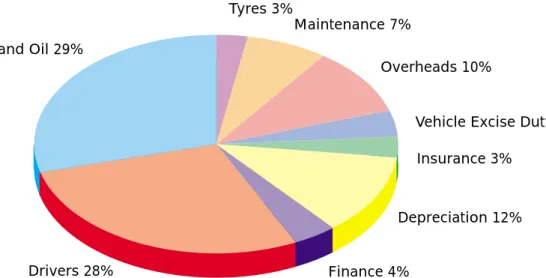
Fig 3.1 shows the breakdown of the annual operating costs of a typical 38-tonne articulated vehicle. The figures include one 4x2 tractive unit with two tri-axle curtain-sided trailers. This is because there are twice as many trailers as tractive units in the UK.
The diagram is based on the figures contained in the review of operating costs published in January Tyres 3%
Maintenance 7%
Overheads 10%
Vehicle Excise Duty 4% Insurance 3%
Depreciation 12%
Finance 4% Drivers 28%
Fuel and Oil 29%
Fuel price at time of chart 61.8p per litre excluding VAT (Jan 2000)
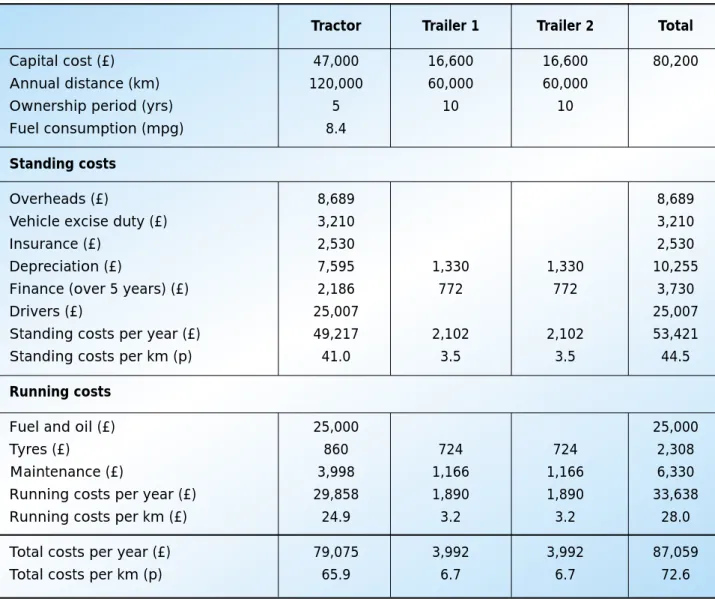
Table 3.1 shows the calculation in detail, and shows the various elements which need to be considered in calculating the costs of a vehicle.
Table 3.1 Typical cost of operating a 38-tonne gcw 4x2 tractive unit and two tri-axle curtain-sided trailers (January 2000)
The tractive unit averages 8.4 mpg and covers 120,000 km a year. The two trailers each cover 60,000 km a year. Fuel cost is 61.8p per litre
Tractor Trailer 1 Trailer 2 Total
Capital cost (£) 47,000 16,600 16,600 80,200 Annual distance (km) 120,000 60,000 60,000
Ownership period (yrs) 5 10 10 Fuel consumption (mpg) 8.4
Standing costs
Overheads (£) 8,689 8,689
Vehicle excise duty (£) 3,210 3,210
Insurance (£) 2,530 2,530
Depreciation (£) 7,595 1,330 1,330 10,255 Finance (over 5 years) (£) 2,186 772 772 3,730
Drivers (£) 25,007 25,007
Standing costs per year (£) 49,217 2,102 2,102 53,421 Standing costs per km (p) 41.0 3.5 3.5 44.5
Running costs
Fuel and oil (£) 25,000 25,000
Tyres (£) 860 724 724 2,308
Maintenance (£) 3,998 1,166 1,166 6,330 Running costs per year (£) 29,858 1,890 1,890 33,638 Running costs per km (£) 24.9 3.2 3.2 28.0 Total costs per year (£) 79,075 3,992 3,992 87,059 Total costs per km (p) 65.9 6.7 6.7 72.6
Transport Engineer’s figures indicate that fuel and oil account for 29% of a large truck’s total
operating costs, roughly the same as the driver costs. Other published cost tables (which may include only one trailer or assume a higher diesel price) put the proportion at closer to 33% with the Road Haulage Association survey of 1999 suggesting fuel as 36% of running costs and that of 2000 suggesting 42%.
For smaller and lighter vehicles that are more economical and usually cover less annual mileage, the fuel cost proportion is lower, typically around 20-25%.
Source: Transport Engineer
FINANCIAL ASPECTS OF FUEL MANAGEMENT
3.3
PRICE OF FUEL
It is impossible to forecast crude oil prices accurately because there are so many unpredictable factors at work. These include political instability, the level of world demand, and policy decisions on production volumes by the major oil-producing countries,
In 1999 for instance, crude oil prices rose from a 12-year low to a nine-year high, more than doubling in price in less than 12 months. In the period up to 1999, fuel excise duty increased each year by the rate of inflation plus six per cent. In 1999 it was announced that this automatic duty escalation policy would cease and that in future there would be a review of the fuel duty level each year.
The combination of the crude oil price and fuel excise duty has meant that fuel has consistently proved to be a fast-rising operating cost. This means that any investment in good fuel management now may well pay even greater dividends in the future. And those dividends drop straight down to the bottom line.
3.4
JUSTIFYING THE INVESTMENT
The achievement of fuel savings invariably requires an investment in time, effort or money - and often all three. Financial expenditure on such things as fuel monitoring equipment or better vehicles is easy to quantify, but do not forget hidden costs, such as investment in management, clerical and operative time, which may be more difficult to pin down.
If the fuel management programme has the effect of changing priorities, there may be a detrimental effect on another aspect of the business. In short, remember to consider the hidden costs as well as the obvious ones when calculating whether a fuel savings programme can be justified in terms of costs and payback. Doing this will help you establish targets and prove viability.
One simple approach to evaluating the costs and benefits is the ‘payback’ method, which looks at the costs and the time taken to generate savings to cover those costs. The case study shows a simple example.
FINANCIAL ASPECTS OF FUEL MANAGEMENT
Are you delivering results? The acid test of any sound business-driven fuel management programme has to be clear evidence of financial savings once all the costs and benefits have been considered.
Environment and Energy Helpline on 0800 585794
This is a very simple method which ignores factors such as inflation, cashflow, interest charges, changes in stock levels etc. Although it lacks detail and precision, it is a quick and easy way of assessing the broad viability of the project. Some companies are prepared to accept a longer payback period than others; a two-year period is often quoted as a rule of thumb to decide whether the project is viable.
It is beyond the scope of this Guide to look at more complex ways of evaluating projects, such as the use of discounted cash flows. These sophisticated financial techniques are more applicable if the financial investment is particularly large or the payback period is potentially quite long. An EEBPP publication (GPG 69 - Investment Appraisal for Industrial Energy Efficiency), available free of charge from the Helpline (0800 585794), gives some further guidance on this subject. However you will probably need to take advice from an accountant.
3.5
FINANCIAL MONITORING
Having set out to reduce future costs, it is essential to measure ongoing performance accurately. This will confirm that the investment in the fuel programme is paying off and that your expectations are being met. It will quickly show if targets are not being met and allow you to check the figures, revise the targets or maybe even suspend or increase expenditure on the programme.
The measurement of fuel efficiency should be part of the financial controls of any transport operation. This can be achieved through comparing actual costs with budget or standard costs in the same way that any other expenses are controlled. Variances between actual and budgeted expenditure can then be investigated and action taken quickly.
On the next page is an example of this important ‘actual versus budget’ check, showing how to resolve fuel cost variations that arise through a change in the mileage covered as well as a change in fuel performance.
Example of the use of Payback Period
A company decided to invest in aerodynamic equipment for one of its articulated vehicles. The capital cost per vehicle involved was £1,100 and the fuel used by the vehicle cost £50,000 per year. Tests showed an average saving of 3% on fuel through using the aerodynamic equipment.
Investment:
- Equipment £ 1,100 including fitting
Estimated fuel savings: £ 1,500 per year
Pay back period £1,100 / £1,500 per year = 9 months approximately
CC
AA
SS
EE
SS
TT
UU
DD
YY
FINANCIAL ASPECTS OF FUEL MANAGEMENT
In this example, therefore, although total fuel costs have risen by nearly £34 per vehicle per month, the increased mileage travelled would have cost an additional £101.11 (£1,365.34 - £1,264.23), had it not been for the improvement in fuel consumption.
Calculating Fuel Costs
A company operating a fleet of rigids budgeted for vehicles to perform at 14.5 mpg and to travel 10,000 km per 4 week period. Diesel for the vehicles cost 65 pence per litre. In fact, on average, the vehicles actually travelled 10,800 km (due to additional work) at 15.25 mpg following a programme of driver training.
The fuel cost of vehicle = miles divided by mpg multiplied by £ per gallon
Budget Actual Variance
Distance travelled 10,000 kms 10,800 kms 800 kms
Multiply by 0.6214 to convert to miles 6,214 miles 6,711 miles 497 miles
mpg 14.5 mpg 15.25 mpg 0.75 mpg
Fuel cost 65 p/litre 65 p/litre
Multiply by 4.546 to convert to £ per gallon £2.95 per gall £2.95 per gall
Comparing budgeted cost with actual cost:
Budget Cost = 6,214 miles ÷ 14.5 mpg x £2.95 per gall = £1,264.23 Actual Cost = 6,711 miles ÷ 15.25 mpg x £2.95 per gall = £1,298.19
Extra costs above budget = £ 33.96
Looking only at the costs, it would appear that there has been an increase. However, it is necessary to split out the effect of the increased distance travelled first. One way to do this is to compare budget with actual costs using actual distance travelled in both cases:
Budget Cost = 6,711 miles ÷ 14.5 mpg x £2.95 per gall = £1,365.34 Actual Cost = 6,711 miles ÷ 15.25 mpg x £2.95 per gall = £1,298.19
Saving from improved mpg = £ 67.15
(Calculating the effect can be done in several ways. The conversion factors used in this example are taken from the list in Appendix 1 - Fuel Measurement and Conversion Factors.)
EE
XX
AA
MM
PP
LLEE
3.6
INDIRECT BENEFITS
It is generally accepted that driving in a fuel-efficient manner can improve safety and benefit the vehicle’s driveline, brakes and tyres as well. So there could well be a reduction in the costs of accidents, maintenance, repairs and downtime.
Your insurance company may be prepared to
discount the insurance premium if it has evidence of a driver-training programme, so it is worth checking with the insurer first to see if it has an agreement with a particular training provider. It could be sensible to specify a driver training course that specifically combines fuel economy with defensive driving.
Some operators have even used the improvement in fuel economy as a commercial tool to emphasise the contribution they are making to the environment (see GPCS311 - Energy Savings Through Improved
Driver Training).
Thorough communication between drivers and management is part of a good fuel programme. If
handled well, there is a potential spin-off here, because it might lead to better understanding and some barriers being broken down. Some organisations have used fuel efficiency as a means of changing the driver culture.
3.7
CONCLUSION
It remains to be seen whether the historical trend of fuel costs rising at least in line with inflation continues into the future. In times when consumer prices are static or even declining, there may be pressure on transport operators to reduce their rates instead of increasing them to cover any increase in fuel costs. This only serves to make the principle of fuel efficiency even more important. Equally important is the need for reality to live up to the principle. This means monitoring actual performance against operational standards, and using strict financial measures that account for all the costs and benefits. Actual figures must always take precedence over theory, ambition and enthusiasm.
FINANCIAL ASPECTS OF FUEL MANAGEMENT
Environment and Energy Helpline on 0800 585794
Driver training that can encompass both fuel-efficient driving and defensive driving is likely to produce some useful results.
Checklist
Ref. Things to do In place Done Not appropriate
3.2 Understand your current costs and how much you
❑
❑
❑
spend on fuel3.4 Identify potential savings of the programme
❑
❑
❑
3.4 Identify potential costs including hidden costs of❑
❑
❑
the programme
3.4 Evaluate the financial viability of the programme
❑
❑
❑
3.5 Monitor costs/benefits before, during and after❑
❑
❑
the programme
3.6 Look for indirect benefits - insurance, maintenance etc
❑
❑
❑
3.6 Look for the commercial benefits from fuel❑
❑
❑
management
S
Se
ec
cttiio
on
n 4
4
T
Th
he
e F
Fu
ue
ell
C
Ch
ha
am
mp
piio
on
n
T H E F U E L C H A M P I O N
4.1
INTRODUCTION
The Fuel Champion is an important part of successfully managing your fuel performance. They must have sufficient authority and responsibility to ensure that the programme is successfully
implemented.
If you do not wish to appoint a formal Fuel Champion, you must ensure that the programme has sufficient impetus to be successful despite the absence of a single focal point. This will be much more difficult to ensure.
4.2
ROLES AND RESPONSIBILITIES
The Fuel Champion will be required to drive the programme and, among other things, will need to develop the plan, resource it and ensure it is properly implemented.
Even when other business priorities divert senior managers’ attention, the Fuel Champion will ensure that the business never loses sight of the programme’s objectives. This will inevitably involve balancing conflicting interests, such as operational needs and driver training.
The Fuel Champion is responsible for fuel performance figures being produced, and communicating them to the appropriate people. He or she will make sure that any data or
information circulated is relevant, correct, accurate and easily understandable by people who are not experts in the subject.
Depending on the size of the fleet, the Fuel Champion may be required to spend a significant amount of time on the project if it is to be
successful. On the other hand, the financial benefits which can accrue from a well organised and implemented fuel management programme should make it a very worthwhile use of
management time and energy.
Providing the right feedback to the appropriate people is essential in a good fuel management programme. Ensuring this happens is an important part of the Fuel Champion’s role.
T H E F U E L C H A M P I O N
Environment and Energy Helpline on 0800 585794
The Fuel Champion
The Fuel Champion must want to make the programme succeed and be committed to making savings - come what may
1
Aims and objectives of the Fuel Champion
• To get the best fuel performance out of the vehicle fleet.
• To understand all the factors associated with fuel efficiency, including, but not exclusively, obtaining accurate fuel data and driver training.
2
Specific requirements
• To understand how fuel consumption figures are generated, especially how errors occur in the capture of data, how to correct them and how to minimise their occurrence in future.
• To understand the importance of accurate and reliable figures and recognise when they are achieved.
• To understand the potential for improvement and ways to achieve that potential. • To understand the method of operation of any on-board fuel monitoring equipment. • To develop the strategies required with management and key staff members and put
together an action plan.
• To monitor the current situation and progress towards goals.
• To investigate and understand the factors which affect fuel consumption such as: - driver performance;
- load and route; - weather;
- vehicle condition; - traffic.
- and especially the impact of these factors on the company’s fleet and depots so that they can explain why there are differences between operations and sites, what causes the variances, whether the variances are manageable etc. It may be helpful for the senior executive who takes overall responsibility for fuel management to draw up a simple list of responsibilities and authorities to cover the role of the Fuel Champion.
T H E F U E L C H A M P I O N
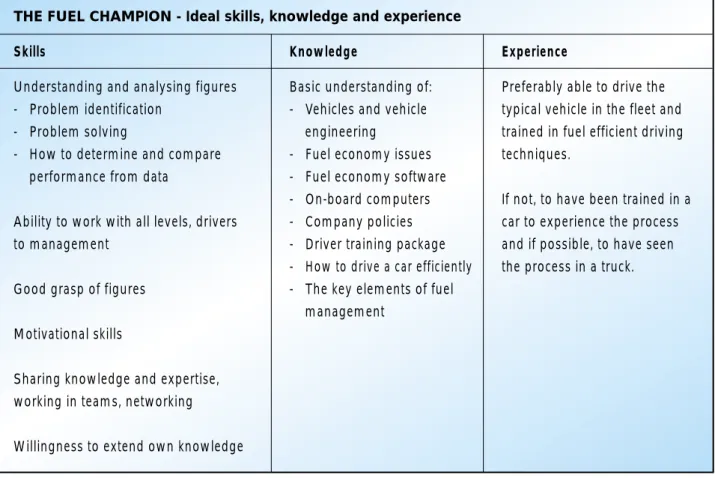
Table 4.1 Roles and responsibilities of the Fuel Champion
THE FUEL CHAMPION - Ideal skills, knowledge and experience
Skills Knowledge Experience
Understanding and analysing figures Basic understanding of: Preferably able to drive the - Problem identification - Vehicles and vehicle typical vehicle in the fleet and - Problem solving engineering trained in fuel efficient driving - How to determine and compare - Fuel economy issues techniques.
performance from data - Fuel economy software
- On-board computers If not, to have been trained in a Ability to work with all levels, drivers - Company policies car to experience the process to management - Driver training package and if possible, to have seen
- How to drive a car efficiently the process in a truck. Good grasp of figures - The key elements of fuel
management Motivational skills
Sharing knowledge and expertise, working in teams, networking
Willingness to extend own knowledge
4.3
TRAINING THE FUEL CHAMPION
Make sure that the Fuel Champion has all the skills and knowledge necessary to successfully carry out their job. If you have drawn up a list of roles and responsibilities for the Champion, check for any gaps in his/her skills and knowledge.
4.4
TYPICAL ACTION PLAN
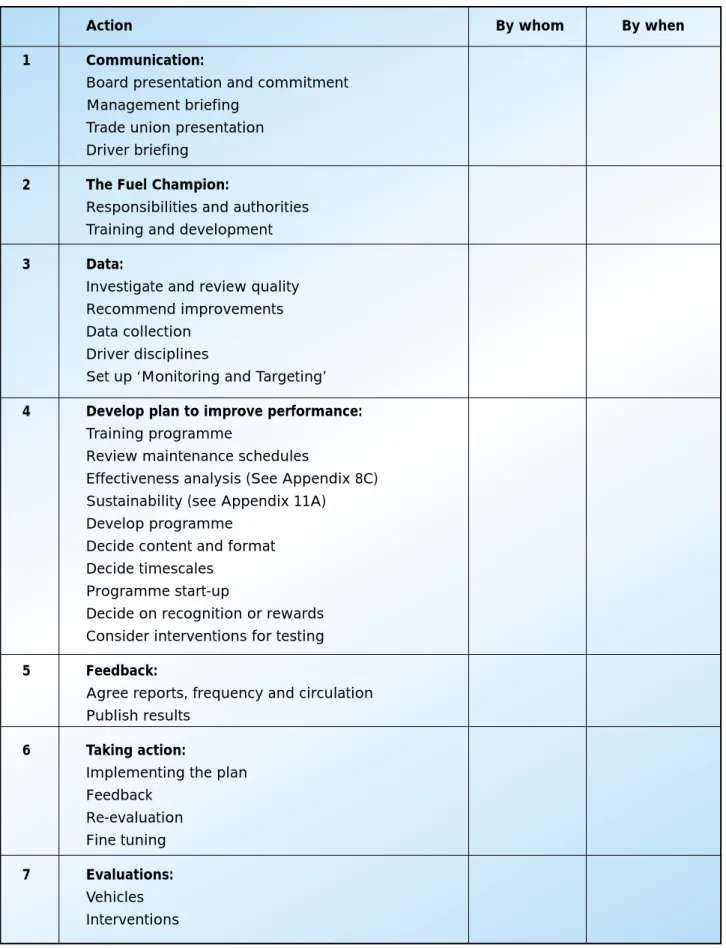
The first task for the Fuel Champion must be to draw up an action plan (such as the one in Fig 4.1), get it agreed by all, then ensure it is implemented properly.
T H E F U E L C H A M P I O N
Environment and Energy Helpline on 0800 585794
Fig 4.1 A typical action plan
Action By whom By when
1 Communication:
Board presentation and commitment Management briefing
Trade union presentation Driver briefing
2 The Fuel Champion:
Responsibilities and authorities Training and development
3 Data:
Investigate and review quality Recommend improvements Data collection
Driver disciplines
Set up ‘Monitoring and Targeting’
4 Develop plan to improve performance:
Training programme
Review maintenance schedules
Effectiveness analysis (See Appendix 8C) Sustainability (see Appendix 11A)
Develop programme Decide content and format Decide timescales
Programme start-up
Decide on recognition or rewards Consider interventions for testing
5 Feedback:
Agree reports, frequency and circulation Publish results
6 Taking action:
Implementing the plan Feedback Re-evaluation Fine tuning 7 Evaluations: Vehicles Interventions
Checklist
Ref. Things to do In place Done Not appropriate
4.1 Appoint one person as Fuel Champion if at all possible
❑
❑
❑
4.2 Identify key team members including the Fuel❑
❑
❑
Champion, Transport, Maintenance, Accounts, Training etc.
4.2 Define role and responsibilities of the Fuel Champion
❑
❑
❑
4.3 Train/develop the Fuel Champion❑
❑
❑
4.4 Create, agree and implement an action plan❑
❑
❑
S
Se
ec
cttiio
on
n 5
5
M
Mo
on
niitto
orriin
ng
g
a
an
nd
d T
Ta
arrg
ge
ettiin
ng
g
M O N I T O R I N G A N D TA R G E T I N G
5.1
INTRODUCTION
Not all energy conservation measures are equally cost-effective. Different measures will be better suited to different types of operation. It is, therefore, important that anyone wishing to reduce their fuel consumption should proceed in a systematic manner, rather than introduce new practices on a piecemeal basis.
A simple set of principles has evolved from previous work in the field of energy conservation, collectively known as ‘Monitoring and Targeting’, or ‘M&T’. By adopting M&T practices, organisations are able to identify problems and anomalies systematically.
The following is a simple explanation, which aims to give you an appreciation of the subject. It is recommended that you read up on this subject further – the EEBPP publications Monitoring and
Targeting in large companies (GPG112), and Monitoring and Targeting in small and medium sized companies (GPG125) are a good starting place. These are available free of charge through the
Environment and Energy Helpline.
5.2
MONITORING
There are five key elements in monitoring:
1
Measure consumption regularly
This will generally involve the production of regular (preferably weekly) records of the fuel consumption of each vehicle.
2
Relate consumption to output
Normally the distance travelled by the vehicle is related to the fuel used (eg miles per gallon), but this can be further refined. Other measures include fuel per tonne mile (ie fuel used to carry one tonne of payload a distance of one mile).
3
Identifying present standards
Analyse fuel consumption figures for similar vehicles undertaking similar types of work over a representative period of time. Arrive at an approximate fuel consumption standard for each vehicle. This would not constitute an ‘efficient’ standard but rather a base or actual figure.
4
Report performance to individuals responsible
Fuel consumption data should be reported regularly to people who have some influence on fuel consumption. These would normally include drivers, engineers and middle and senior management.
M O N I T O R I N G A N D TA R G E T I N G
Environment and Energy Helpline on 0800 585794
5
Take action to reduce
consumption
Taking a systematic overview of fuel use often generates ideas for reducing consumption. Comparing the fuel efficiencies of different vehicles is likely to reveal anomalies in their performance. Identifying the causes of these anomalies should enable good practice to be distinguished from bad, and allow steps to be taken to eliminate poor performance.
As good practice is applied more consistently, it may be necessary to revise the original standards that were set. Eventually it should be possible to establish a set of standards that accurately reflect the expected high levels of vehicle maintenance, driver behaviour and fleet management.
Tightening-up operating practices and vehicle maintenance in this way often leads to savings even without the introduction of specific fuel-saving measures.
Measure consumption regularly Relate to output Establish standards Report performance to those responsible Set targets
Take action to reduce consumption
Refine targets and continue action
Monitor and review targets
M O N I T O R I N G A N D TA R G E T I N G
5.3
TARGETING
Targeting involves:
• setting goals for the reduction of fuel consumption;
• introducing specific measures designed to achieve these goals; • reviewing progress and feedback; • repeating the process in response to
what has happened so far.
Frequently this will involve capital expense and/or significant changes to operating practices. These are best left until a good deal of data has been collected on the historical performance of the operation, so that the actions chosen are the most appropriate to the particular circumstances.
For example, targets could be set by measuring the actual performances of the best drivers on certain vehicles/routes etc. If any vehicles in the fleet are fitted with on-board computers connected to fuel flow meters, they can be used to help in setting these targets.
5.4
APPLICATION OF MONITORING AND TARGETING
The general principles of Monitoring and Targeting are transferable across many industries and circumstances. The process is simple in principle but can become very involved in practice eg taking into account variance in road conditions, weather conditions, type of road, traffic, load etc.
It is therefore recommended that you keep it simple initially, and develop the more complex processes over a period of time.
Fuel consumption should be related to a meaningful measure of output.
M O N I T O R I N G A N D TA R G E T I N G
Environment and Energy Helpline on 0800 585794
Checklist
Ref. Things to do In place Done Not appropriate
5.2 Understand what is meant by Monitoring and Targeting
❑
❑
❑
5.2 Compare with existing monitoring systems and❑
❑
❑
identify any weaknesses
5.2 Develop simple M&T systems for yourself
❑
❑
❑
8.7 Ensure Key Performance Indicators (KPIs) are❑
❑
❑
appropriate and review their relevance regularly
5.3 Consider use of on-board computers to help in
❑
❑
❑
setting targetsS
Se
ec
cttiio
on
n 6
6
F
Fa
ac
ctto
orrs
s
A
Affffe
ec
cttiin
ng
g F
Fu
ue
ell
C
6.1
INTRODUCTION
Some of the factors that influence fuel consumption - such as the weather - are outside our control, but it is helpful to understand their effects. Other factors in the list below - such as routing and scheduling - can be managed by our own choices and decisions, and will be discussed in Section 6.6.
6.2
THE VEHICLE
The vehicle is obviously one of the largest factors in determining the fuel performance. The following areas have to be taken into account:
• The make/model etc.
• The specification, such as gross vehicle weight, vehicle size, engine power and torque, and gearbox and final drive ratios.
• The age of the vehicle. The ‘Age Fuel’ curve, ie the relationship between mpg and age of vehicle may vary between different makes and models. The running-in period of new vehicles also varies. Some vehicles need more running in than others before they perform at their best.
• The condition of the vehicle, engine transmission, axles and tyres etc.
• Operational details such as the dimensional match between tractor and trailer.
• The equipment and products used eg lubricants, aerodynamics.
The sections on maintenance and specification of vehicles have more information on these points.
6.3
THE DRIVER
Apart from the vehicle itself, the way the driver drives the vehicle is considered to be the biggest single influence on fuel consumption. Issues concerning the driver start with recruitment and selection and continue through training, motivation and involvement.
FACTORS AFFECTING FUEL CONSUMPTION
Environment and Energy Helpline on 0800 585794
The vehicle is one of the most influential factors in fuel performance. This
includes how well the tractor and trailer are matched.
Apart from the vehicle itself, the driver is considered to have the greatest influence on fuel performance.
6.4
THE LOAD
The load being carried will naturally affect a vehicle’s fuel performance. Total weight is the critical factor, and this often changes during the journey as deliveries are made. Also, if the load is on a flat trailer, dropside body or tipper, its dimensions and outline profile will have an effect too. On these types of body, sheeting a load or an empty tipper body can save fuel because it reduces aerodynamic drag.
Some claim to have evidence that varying the load actually on each axle can also impact on fuel consumption, although others would dispute this.
In the case of high-volume trailers, there is a trade-off between increased payload
capacity and the effect on fuel consumption,
which, depending on the circumstances, may make them an attractive proposition.
6.5
WEATHER AND SEASONALITY
The weather is another factor influencing fuel consumption. This needs to be
remembered when comparing data gathered during different weather conditions. Wind, rain, sleet etc can all have a great impact on performance.
The season of the year also affects performance, with the best consumption figures in summer and the worst in winter. Cooler temperatures and the shorter days of winter can result in the greater use of auxiliary equipment and drivers idling the engine to keep their cab warm when parked.
The seasonal change in diesel fuel to ‘winter grade’ can be expected to contribute to a difference between summer and winter consumptions of the order of 3%. This is due to the difference in
FACTORS AFFECTING FUEL CONSUMPTION
The size, weight and shape of the load will affect the fuel consumption.
Weather and season can have a big impact on fuel performance.
Fig 6.1 Seasonality in a large fleet (Courtesy of the University of Huddersfield)
6.6
ROUTE AND TRAFFIC
The type of road will play its part, with narrow winding roads giving worse fuel consumption than straight dual
carriageways. Slow and tortuous routes through hilly terrain will drag down the fuel performance of even the best vehicles. As a rule of thumb, the more times a driver has to change gear, brake or accelerate, the worse will be the fuel consumption.
A busy, urban environment will also have an impact on fuel consumption because there is a lot of stopping and starting, with the vehicle losing its momentum. Because traffic congestion varies according to the time of day, the same route can throw up different fuel performances. This is normally most noticeable between day and night operations.
FACTORS AFFECTING FUEL CONSUMPTION
Environment and Energy Helpline on 0800 585794
9.50 9.25 9.00 8.75 8.50 8.25 Januar y Febraur y Mar ch April Ma y June July August SeptemberOctoberNo vember DecemberJan uary Febraur y Mar ch April Ma y June July August SeptemberOctoberNo vember December MPGHilly terrain and twisting roads will inevitably exact a toll on the overall average fuel consumption.
6.7
FUEL
The two main properties of fuel are the amount of energy it contains, which is highly dependent on the density of the fuel, and the ease with which it combusts, normally measured by the cetane index and number. Fuel additives (usually blended in by the oil companies) are used to improve
combustion. Section 7 examines the subject of fuel in more detail.
6.8
UNDERSTANDING THE EFFECTS OF THE FUEL FACTORS
Drivers should be encouraged to note any specific unusual event or condition on their daily duty sheet. This can then be captured during driver debriefing for later analysis as necessary and appropriate. Examples might include heavy traffic, road works, diversions off route and exceptionally poor weather. Appendix 8A contains a suggested driver daily worksheet.
As you become more advanced in the process of fuel management, each of the factors should be investigated and understood in detail for each section of the business.
This may be more easily achieved by those organisations, which have repetitive transport
schedules, eg some supermarket deliveries. Measurement of performance on each run over a period of time can give a clearer indication of the impact of the fuel factors such as load, different times of day and different types of trailer etc.
Once the factors are reasonably understood and predictable, targets can be fine tuned and made increasingly relevant.
This is particularly important when testing fuel-saving devices, as there is always a danger that benefits may be wrongly attributed or even hidden by the impact of completely unrelated factors. The subject of fuel-saving devices is currently being reviewed under the Energy Efficiency Best Practice Programme – advice to fleet operators will be published during 2001. It will cover the various categories of product on the market and how to evaluate any marketing material and test reports, as well as suggesting methods of running in-house fleet trials.
S
Se
ec
cttiio
on
n 7
7
F
F U E L
7.1
INTRODUCTION
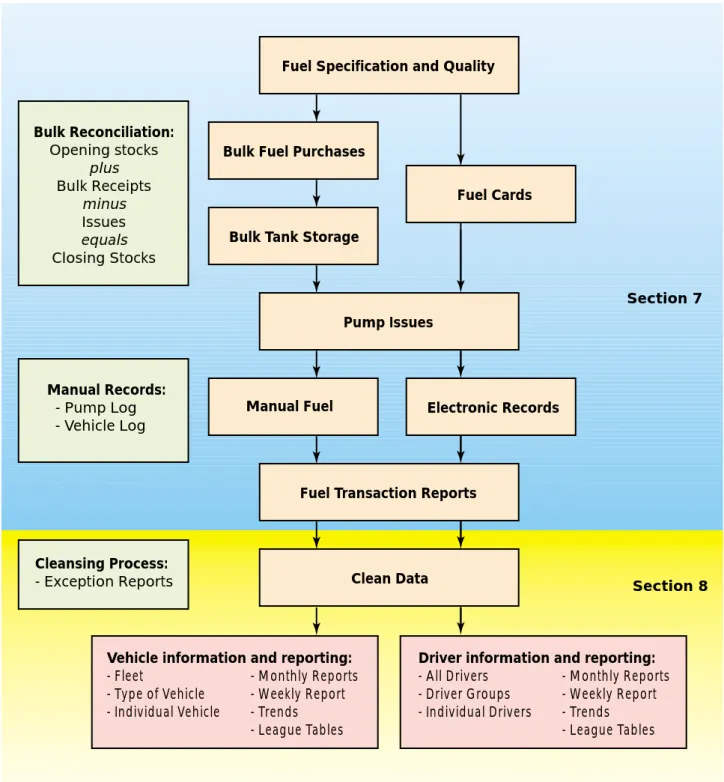
The next two sections cover fuel and the collection of data. Fig 7.1 shows how the contents are linked between the two sections.
Fig 7.1 Fuel and its associated subjects
Bulk Reconciliation: Opening stocks plus Bulk Receipts minus Issues equals Closing Stocks Manual Records: - Pump Log - Vehicle Log Cleansing Process: - Exception Reports
Fuel Specification and Quality
Bulk Fuel Purchases
Fuel Cards Bulk Tank Storage
Pump Issues
Manual Fuel Electronic Records
Fuel Transaction Reports
Clean Data
Section 7
Vehicle information and reporting:
- Fleet - Monthly Reports - Type of Vehicle - Weekly Report - Individual Vehicle - Trends
- League Tables
Driver information and reporting:
- All Drivers - Monthly Reports - Driver Groups - Weekly Report - Individual Drivers - Trends
- League Tables
F U E L
Environment and Energy Helpline on 0800 585794
7.2
FUEL SPECIFICATION AND QUALITY
The most important characteristic for fuel consumption is the density of the fuel, because in simple terms, the denser the fuel, the more energy it contains. Fuel density is usually measured in
kilograms per cubic metre (kg/m3).
The British Standard, BS EN 590, defines the standard for all types of diesel. Ultra Low Sulphur Diesel (ULSD) was defined in the 1998 Finance Act. Many fuel companies now produce a form of ULSD which has significantly lower levels of sulphur than those required by the standard defined in the 1998 Finance Act. All forms of ULSD sold in the UK conform to BS EN 590.
BS EN 590 (2000):
General Diesel Density 820 kg to 845 kg per cubic metre at 15°C Sulphur content Not more than 350 ppm
Cetane no Minimum level 51
1998 Finance Act:
ULSD density Not more than 835 kg per cubic metre Sulphur content Not more than 50 ppm
The fuel’s cetane index is a calculated measurement of ignition quality based on the distillation properties of the fuel. Its cetane number is established by experiment and is a further measure of ignition and combustion performance. The higher the cetane index and number, the more efficiently the fuel will ignite and release energy, which should help consumption and performance. Typical cetane numbers for diesel meeting BS EN 590 (200) are 51 to 56.
Diesel also contains additives to assist in combustion and cleaning. Anti-foaming additives are added to reduce diesel foaming, giving faster filling and less risk of spillage.
The fuel supplier will have a specification for the fuel you will be receiving at each of your sites. You should check these as there may be regional differences depending on the supplying depot. Ensure you are receiving the density specified and review whether any regional differences should be taken into account.
7.3
ULTRA LOW SULPHUR DIESEL AND ULTRA ULTRA LOW SULPHUR
DIESEL
Ultra low sulphur diesel (ULSD) has been introduced with the objective of reducing emissions. ULSD became virtually the standard diesel throughout the UK in 1999, encouraged by Government duty incentives.
The UK specification for ULSD demands that its sulphur content must be no more than 50 parts per million (ppm) by weight. Standard diesel, as supplied in most other parts of Europe, is allowed to have a sulphur content of up to 350 ppm. Although this is much more than ULSD, it is less than it used to be - before 2000 the sulphur limit for conventional diesel in Europe, including the UK, was 500 ppm.
F U E L
The move from conventional diesel to ULSD also had the effect of reducing the density of the fuel. Whereas conventional diesel used to have a typical density of 840-850 kg/m3, the density of ULSD is
typically close to 830 kg/m3, (and by UK law can be anywhere between 820-835 kg/m3), and
therefore contains less energy.
Many fuel companies now produce a form of ultra low sulphur diesel with an even lower sulphur content, typically 10-15 parts per million. This is sometimes known as ultra ultra low sulphur diesel. As a result of these density reductions, ULSD contains marginally less energy for a given volume of fuel than the previous traditional diesel. However, oil companies say that other factors such as cetane number adjustments and other additives can offset this density reduction.
During 1999, immediately after switching to ULSD, many operators reported a deterioration in fuel economy performance, especially as the lower viscosity (a third significant factor) of these fuels could make things worse. Other operators - and most oil companies - say there is no measurable difference. No good quality data are available on this subject, but since the density of fuel has been reduced by up to 3-4%, any reduction in performance should not exceed that level.
7.4
TEMPERATURE
Diesel fuel expands and contracts as its temperature varies. Consequently, the temperature at which it is measured affects the volume and energy contained in a given volume. Fuel delivered at a high temperature and dispensed at low temperatures will show a loss in volume (although the effect is relatively small - a change in temperature of 25°C will change volume by just under 2%).
A depot very close to a refinery may get deliveries at above average temperatures. Very large customers may be able to negotiate a correction factor back to 15°C, which is the standard temperature for fuel specifications.
7.5
FUEL PURCHASING
Many organisations will have purchasing departments that use sophisticated techniques for buying their fuel. This section contains some tips for those without access to such experts.
Purchasing options:
• Buying on the spot market - ringing several suppliers for a quote each time you need a fuel delivery - takes time and effort but can give you advantageous fuel prices.
F U E L
Environment and Energy Helpline on 0800 585794
• You can use fuel cards or outside bunkering facilities (Appendix 2). • You can set up an account, and negotiate prices at a local service station. • You can join a buying co-operative.
• You can use specialist internet sites.
If you are buying fuel for your own on-site storage tank, here are a few tips and issues to consider: • Buying full tanker loads (if your storage tank has the capacity) is usually cheaper than
buying part loads.
• Reducing your credit risk rating in the suppliers’ eyes may improve your purchasing power and ability to negotiate sharper prices.
• The ability to accept out-of-hours deliveries may save some money. • Paying fuel invoices promptly may help shave the price a little.
• Find out which is the nearest terminal to your site and establish which oil companies operate from it. Because of their proximity to you they should be able to offer the keenest prices.
• If buying from several suppliers, it is a good idea to demonstrate a degree of loyalty to at least one of them. If for some reason, supply becomes tight, it is comforting to know that you are viewed as an important customer. Continuity of supply is ultimately more important than shaving the price.
• Audit fuel purchasing procedures from time to time to ensure that the buying process is operating to the best advantage of the organisation.
7.6
FUEL STORAGE
7.6.1
Holding your own bulk
stocks
Deciding whether to hold your own bulk stocks, or to rely on fuel cards, bunkering facilities or an arrangement with a local service station is often a complicated decision.
Issues to be considered include the following: • convenience of home base filling; • supply availability;
• reliability and quality of supply;
Deciding whether to hold your own bulk fuel stocks is often a complicated decision.