MOVING THE SHARPS SAFETY AGENDA
1FORWARD IN THE UNITED STATES:
2CONSENSUS STATEMENT AND CALL TO ACTION
34
Note: This Consensus Statement and Call to Action was drafted by members of the steering committee* for
5
the conference “Tenth Anniversary of the Needlestick Safety and Prevention Act: Mapping Progress,
6
Charting a Future Path,” held in Charlottesville, Virginia, from November 4-6, 2010, and sponsored by the
7
International Healthcare Worker Safety Center at the University of Virginia. The conference was funded in
8
part by a grant from the National Institute for Occupational Safety and Health, Centers for Disease Control
9
and Prevention (1R13OH009924-01). These recommendations are based on the presentations, panels, and
10
informal discussions that took place at the conference. The speakers and participants represented a broad
11
range of stakeholders relevant to the issue of sharps safety, including clinicians, researchers, and healthcare
12
administrators, as well as representatives from government agencies (in particular NIOSH/CDC and
13
OSHA), professional associations, and the medical device industry. The conference also had global
14
participation, with speakers from Asia, Europe and Africa, in addition to both North and South
15
America. We are grateful for the contributions of all. [*See Appendix for list of steering committee
16 members.] 17 18 INTRODUCTION 19
Over the past two decades, the United States (U.S.) has been a global leader in 20
addressing risks to healthcare workers from occupational exposures to bloodborne 21
pathogens, including hepatitis B virus (HBV), hepatitis C virus (HCV) and human 22
immunodeficiency virus (HIV). Regulatory and legislative measures, such as the 23
Bloodborne Pathogen Standard (BPS) promulgated by the Occupational Safety and 24
Health Administration (OSHA) in 1991 and revised in 20011, and the Needlestick Safety 25
and Prevention Act (NSPA) of 20002, have been effective in significantly reducing 26
needlesticks and blood exposures, as well as the risk of infection from bloodborne viruses, 27
among healthcare workers.3 Areas covered by these regulations include sharps disposal 28
practices, evaluation and selection of safety-engineered sharp devices and personal 29
protective equipment, training, recordkeeping for needlestick injuries, HBV vaccination, 30
and post-exposure follow-up. Medical device manufacturers, in the U.S. and other 31
countries, have also played an important role in reducing sharps injury risks to U.S. 32
healthcare workers by developing innovative safety-engineered technology in a broad 33
range of product categories. 34
While substantial progress has been made, however, preventable sharps injuries 35
and blood exposures continue to occur in U.S. healthcare settings. In 2001-2002, 36
following passage of the NSPA and subsequent revisions to the BPS, a significant decline 37
in sharps injury rates occurred; since then, however, injury rates have leveled off—and in 38
some settings, such as surgery, gone up.4 In an increasingly complex and changing 39
healthcare environment, we need a renewed commitment to achieve further progress. 40
Data from two large, multihospital sharps injury surveillance networks provide a 41
picture of where we are today: the EPINet Sharps Injury Surveillance research group 42
(EPINet-SIS) coordinated by the International Healthcare Worker Safety Center at the 43
University of Virginia5, and the Massachusetts Sharps Injury Surveillance System 44
(MSISS), maintained by the Massachusetts Department of Public Health (MDPH).6 45
EPINet-SIS was established in 1993; most of the hospitals contributing data are part of a 46
state-wide network in South Carolina coordinated by Palmetto Hospital Trust Services. 47
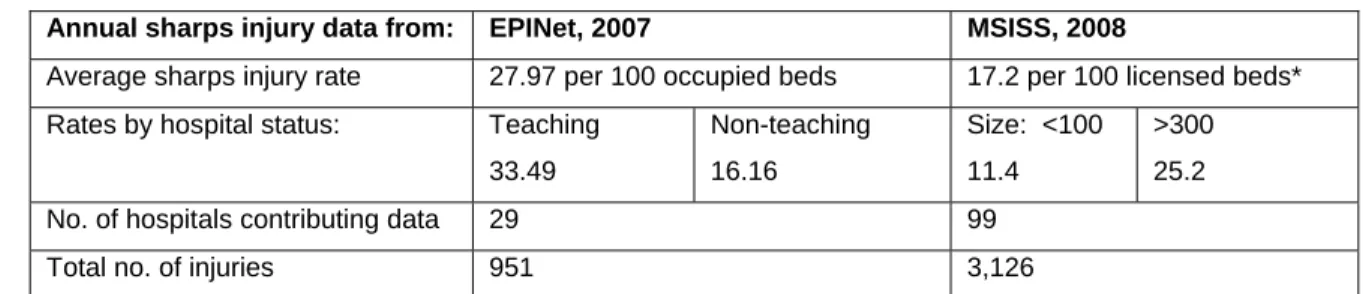
As shown in the table below, in 2007 a total of 29 hospitals (1 each from Nebraska, 48
Pennsylvania, and Virginia, the rest from South Carolina) contributed data, with an 49
aggregate of 951 sharps injuries (SIs) reported and an average injury rate of 28 SIs per 50
100 occupied beds.7 51
In Massachusetts, all hospitals are required to report sharps injury data to the 52
MDPH; this was mandated by a state law in 2001, and collection of data began in 2002. 53
For 2008, 99 hospitals contributed data, with a total of 3,126 SIs reported and an average 54
SI rate of 17.2 per 100 licensed beds.8 For both EPINet-SIS and MSISS, rates varied 55
according to teaching status and hospital size, with substantially higher rates typically 56
seen for teaching hospitals and hospitals over 300 beds (with the two being closely 57
correlated –i.e., teaching hospitals tend to be large hospitals). 58
59
Table 1. Comparison of annual sharps injury rates for EPINet and MSISS 60
Annual sharps injury data from: EPINet, 2007 MSISS, 2008
Average sharps injury rate 27.97 per 100 occupied beds 17.2 per 100 licensed beds* Rates by hospital status: Teaching
33.49 Non-teaching 16.16 Size: <100 11.4 >300 25.2 No. of hospitals contributing data 29 99
Total no. of injuries 951 3,126
* In Massachusetts number of licensed beds and occupancy rates are highly correlated; although EPINet 61
and MSISS use different denominators for calculating injury rates, they are comparable. 62
Nurses (RNs/LPNs) sustained the largest share of injuries in both EPINet and 64
MSISS data—34% and 38%, respectively. Sharps injuries occur most often in the 65
surgical setting (EPINet: 36%; MSISS: 32%) and patient rooms (EPINet: 23%; MSISS: 66
22%). It is important to note that a large proportion of injuries are sustained by workers 67
other than the original user of the device. In EPINet-SIS data from 2007, 30% of sharps 68
injuries were sustained by such workers, including clinicians, housekeepers, laundry and 69
waste management personnel, and even administrative staff. 70
Clearly, we still have much room for improvement. The data show that while the 71
U.S. has been successful in significantly reducing sharps injury risk to healthcare workers 72
in most hospital settings, challenges remain, particularly in surgical and non-hospital 73
settings. Healthcare is increasingly being provided outside of hospitals, such as 74
practitioners’ offices and clinics, patient homes, rehabilitation centers, and long-term care 75
facilities. This shift is expected to continue well into the future9; yet these are the very 76
settings in which enforcement of the BPS has been weakest and implementation of 77
safety-engineered devices, according to market data, has been lowest. 78
We believe that our healthcare workers represent a critical national resource, and 79
that we should do everything we can to protect them from harm while they care for others. 80
We also believe that healthcare worker safety is a crucial component of patient safety, 81
and of the overall safety and quality of the healthcare environment. 82
83
RECOMMENDATIONS
84
We have identified the following areas as key to making further progress in 85
reducing the risk of sharps injuries to healthcare workers. 86
87
I.IMPROVING SHARPS SAFETY IN SURGICAL SETTINGS
88
A study published in 2010 showed that despite the revised BPS and advances in 89
sharps safety technology, sharps injuries in surgical settings from 2001 to 2006 increased 90
by 6.5%, while injuries in all other hospital settings decreased by 31.6%.4 The study also 91
indicated that the majority of injuries in the surgical setting are caused by suture needles 92
and scalpel blades, with a significant proportion sustained during instrument passing and 93
after use. Injuries to nurses and surgical technicians were most often caused by devices 94
originally used by others (i.e., surgeons). Blunt suture needles, which can prevent injuries 95
during suturing of internal tissue and fascia—injuries which account for about a third of 96
suture needle injuries overall—are currently vastly underutilized by U.S. surgeons, 97
despite recommendations from the American College of Surgeons (ACS), the 98
Association of periOperative Registered Nurses (AORN), and other surgical professional 99
associations. 100
We recommend that: 101
1. Institutions adopt a site-specific sharps safety policy for the OR. Such a policy 102
should mandate the availability, training, and use of specific sharps safety 103
devices and implementation of risk mitigation strategies outlined by the ACS 104
and AORN. When available and reasonable, users should be able to choose 105
between several comparable and effective safety devices or personal 106
protective equipment (scalpels, gloves, goggles, etc.) to suit their individual 107
work practices, body sizes, and comfort. Sharps safety should not be an 108
individual choice, since many injuries are sustained by workers other than the 109
original users (and choosers) of devices. 110
2. Surgeons, OR nurses and other surgical personnel work cooperatively to 111
develop sharps safety standards and practices that are consistently 112
implemented and followed in all surgical environments. 113
3. Professional groups and manufacturers join forces to encourage the use of 114
blunt suture needles for appropriate applications. 115
4. OSHA place greater emphasis on BPS compliance in surgical settings by 116
evaluating overall adoption of safety devices to eliminate or minimize 117
exposure risks. For example, compliance officers should determine if a facility 118
encourages the use of blunt suture needles when clinically appropriate. 119
120
II.UNDERSTANDING AND REDUCING EXPOSURE RISKS IN NON-HOSPITAL SETTINGS
121
Healthcare workers in non-hospital settings account for about 65% of the U.S. 122
healthcare workforce.9 While safety-engineered devices are in widespread use in most 123
hospitals and clinical laboratories, market data show that their use in non-hospital settings 124
(home healthcare, long-term care, practitioners’ offices and clinics, etc.) has been much 125
less consistent. “Non-hospital” is a broad term that encompasses a wide range of care 126
settings; this makes generalizations about risk somewhat tenuous. Valid and reliable 127
sharps injury data from non-hospital settings is limited; a critical need exists for data that 128
specifically target these different environments, each of which has a unique risk profile. 129
Studies by two research groups, one examining exposure risks to home healthcare 130
workers and the other risks to paramedics, have begun to fill in the overall picture, but 131
more such setting-specific studies are needed.10-14 132
We recommend that: 133
5. Health and Human Services agencies such as CDC/NIOSH and other 134
government and non-governmental agencies and professional organizations 135
support epidemiological research that evaluates risks to workers in a wide 136
range of non-hospital settings. 137
6. OSHA promote regional emphasis programs that focus on enforcement of the 138
BPS in non-hospital settings; further, that other relevant groups, such as 139
accrediting and licensing bodies and healthcare and workers’ compensation 140
insurers enhance compliance incentives for non-hospital employers. 141
7. Professional organizations and medical product distributors for non-hospital 142
care settings collaborate to make sharps safety a priority and ensure that 143
appropriate devices and educational and training materials are available 144
which are targeted for workers in these settings. 145
146
III.INVOLVING FRONTLINE HEALTHCARE WORKERS IN THE SELECTION OF SAFETY
147
DEVICES
148
Anecdotal evidence suggests that frontline healthcare workers are not consistently 149
involved in the selection of safety devices. However, the BPS requires that workers— 150
those who will actually be using the devices—be included in annual device evaluations.15 151
Also, hospitals may be inclined to base decisions about safety devices on cost, but cost 152
alone cannot be the main criteria for selection. An OSHA Letter of Interpretation, issued 153
in 2002, explicitly states that “selecting a safer device based solely on the lowest cost is 154
not appropriate. Selection must be based on employee feedback and device 155
effectiveness.” 16 156
Employers should make input from workers a priority in selection criteria, and 157
need to weigh the relative efficacy of different safety devices for particular applications. 158
Which devices do workers prefer and why? Have improvements been made in device 159
technology? At a time when the pressure to reduce healthcare costs is intense, it is 160
important to keep these user-oriented questions at the forefront of device selection. 161
We recommend that: 162
8. Organizations representing healthcare workers educate members about the 163
legal obligation of employers to include frontline workers in the selection of 164
safety devices. Members need to be encouraged to participate in this process. 165
9. Hospital and healthcare employers consistently involve frontline healthcare 166
workers in the selection and evaluation of safety devices, as is their obligation 167
under the Bloodborne Pathogens Standard. Employers also need to enlist 168
frontline workers in regular and systematic assessment of the devices 169
currently in use in their institution, to ensure such devices are appropriate 170
and, in OSHA’s words, “eliminate or minimize employee exposure” to the 171
“lowest feasible extent.” 172
10.NIOSH or another government agency consider funding research to assess 173
whether and to what extent the requirement to include healthcare workers in 174
the device selection process is being met in facilities across the country, and 175
the ways in which this is being done. This research could provide the basis for 176
developing a model program for frontline worker participation in device 177
selection and evaluation. 178
179
IV.ADDRESSINGGAPSINSAFETYDEVICES:THENEEDFORCONTINUED 180
INNOVATION 181
Safety device technology has continued to evolve over the past decade; however, 182
unmet needs remain for many clinical procedures and these gaps need to be addressed.17 183
Care settings and device categories for which safety is lacking or choices are limited 184
include nuclear medicine; dentistry and home care; longer-length needles used for bone 185
marrow, bariatric, biopsy, spinal, epidural, and acupuncture procedures; needle extenders 186
for cervical injections; ophthalmic blades; and arterial-line catheters. 187
Greater innovation and more variety are needed, especially for surgical safety 188
devices given the high risk of exposure and relatively low adoption of safety devices in 189
this setting. We also need to encourage continued development of non-needle-based 190
solutions for the delivery of medications, which eliminate sharps injury risk altogether. 191
We recommend that: 192
11.Professional organizations partner with device manufacturers to assess and 193
prioritize device needs for specific clinical applications, to monitor progress 194
in closing existing gaps, and to identify future needs. 195
12.Manufacturers partner with surgeons and surgeon groups to develop suture 196
and scalpel safety designs that both reduce risk and are comfortable and 197
intuitive for surgeons to use. Also, companies that provide pre-packaged 198
surgical and procedure kits must ensure that devices included in these kits 199
comply with the BPS. 200
201
V.ENHANCING EDUCATION AND TRAINING
202
EPINet data from the past two decades have consistently shown that sharps injury 203
rates in teaching hospitals are significantly higher than those for non-teaching hospitals.18 204
Although the reasons for this are multifactorial, it does suggest the need to reevaluate and 205
expand training related to bloodborne pathogens and sharps injury prevention in medical 206
and nursing schools throughout the U.S. 207
Additionally, data from both EPINet and MSISS show that safety devices are a 208
significant source of sharps injuries (although at a much lower rate compared to non-209
safety devices). Again, the reasons for this can vary, but include not activating the safety 210
mechanism because of insufficient training on how to use the devices. Making training 211
accessible to all can be challenging, particularly when trying to reach shift workers or 212
those in non-hospital settings. Innovative educational tools using a variety of media and 213
settings, including hands-on device “labs” where users who feel the need for further 214
practice beyond initial training can do so on models, are needed to address the wide range 215
of settings in which healthcare is practiced and sharp devices are used. 216
We recommend that: 217
13.CDC/NIOSH, OSHA, and/or other appropriate government agencies partner 218
with medical, nursing, and allied health schools and accrediting bodies to 219
develop standardized curricula on bloodborne pathogen exposure prevention 220
and the selection and use of safety-engineered devices. Such training is an 221
essential part of the education of all healthcare professionals (both at the 222
beginning of and throughout their careers). 223
14.Healthcare employers provide instruction on an annual basis for all 224
potentially exposed clinicians and other workers (including service workers 225
and purchasing agents) on the appropriate use and disposal of safety devices 226
that are available in their facility, as mandated by OSHA. Such training 227
provides a forum for addressing questions and issues that arise as new 228
devices are introduced. 229
15.Employers, professional educators, manufacturers and employee 230
representatives collaborate to develop training strategies that can be widely 231
applied when new devices are introduced, so that frontline healthcare workers 232
know how to properly use and dispose of them. 233
234
As a result of the leadership of our partners in the federal government and a 235
variety of stakeholders, the U.S. has made tremendous progress in protecting healthcare 236
workers from exposure to bloodborne pathogens. Other countries look to the BPS and 237
NSPA as models for their efforts to address this critical component of occupational safety 238
in healthcare facilities. While we celebrate the progress we have made, we must 239
acknowledge the gaps that exist and redouble our efforts to ensure that all healthcare 240
workers, regardless of the setting in which they practice or the procedures they perform, 241
are offered the same level of protection from sharps injuries and exposures to bloodborne 242
pathogens. 243
REFERENCES
245
1. Occupational Safety and Health Administration. Occupational exposure to bloodborne 246
pathogens; needle-sticks and other sharps injuries; final rule (29 CFR Part 1910.1030). 247
Federal Register. 2001;66(12):5318-25. 248
2. Needlestick Safety and Prevention Act of 2000, Pub. L. No. 106-430, 114 Stat. 1901 249
(Nov. 6, 2000). 250
3. Jagger J, Perry J, Gomaa A, Phillips EK. The impact of U.S. policies to protect 251
healthcare workers from bloodborne pathogens: the critical role of safety-engineered 252
devices. Journal of Infection and Public Health. 2008;1:62-71. 253
4. Jagger J, Berguer R, Phillips EK, Parker G, Gomaa AE. Increase in sharps injuries in 254
surgical settings versus nonsurgical settings after passage of national needlestick 255
legislation. Journal of the American College of Surgeons. 2010 Apr;210(4):496-502. 256
5. Jagger J, Cohen M, Blackwell B. EPINet: A tool for surveillance and prevention of 257
blood exposures in health care settings. In: Charney W, editor. Essentials of Modern 258
Hospital Safety. Boca Raton, FL: CRC Press Inc; 1995. p. 223-39. 259
6. Massachusetts Department of Public Health Occupational Health Program. Sharps 260
Injuries among Employees of Acute Care Hospitals in Massachusetts, 2002-2007. 261
Infection Control and Hospital Epidemiology 2011;32(6):538-44. 262
7. Perry J, Parker G, Jagger J. EPINet report: 2007 percutaneous injury rates. Published 263
on-line August 2009; availabe at: http://healthsystem.virginia.edu/internet/epinet/EPINet-264
2007-rates.pdf. Accessed June 23, 2011. 265
8. Massachusetts Department of Public Health Occupational Health Program. Sharps 266
injuries among hospital workers in Massachusetts, 2008: Findings from the 267
Massachusetts Sharps Injury Surveillance System. Published on-line March 2010; 268
available at: 269
http://www.mass.gov/Eeohhs2/docs/dph/occupational_health/injuries_hospital_2008.pdf. 270
9. Bureau of Labor Statistics, U.S. Department of Labor. Career guide to industries 271
(2008—2009 edition): health care. Table 3: employment in health care by industry 272
segment (2006 and projected change, 2006—2016). Available at: 273
http://www.bls.gov/oco/cg/cgs035.htm. Accessed October 2, 2008. 274
10. Quinn MM, Markkanen PK, Galligan CJ et al. Sharps injuries and other blood and 275
body fluid exposures among home health care nurses and aides. American Journal of 276
Public Health. 2009; 99 Suppl 3:S710-17. 277
11. Chalupka SM, Markkanen P, Galligan C, Quinn M. Sharps injuries and bloodborne 278
pathogen exposures in home health care. AAOHN Journal. 2008; 56(1):15-29. 279
12. Markkanen P, Quinn M, Galligan C, Chalupka S, Davis L, Laramie A. There's no 280
place like home: a qualitative study of the working conditions of home health care 281
providers. Journal of Occupational and Environmental Medicine. 2007;49(3):327-37. 282
13. Boal WL, Leiss JK, Ratcliffe JM, Sousa S, Lyden JT, Li J, Jagger J. The national 283
study to prevent blood exposure in paramedics: rates of exposure to blood. International 284
Archives of Occupational and Environmental Health. 2010;83:191-9. 285
14. Mathews R, Leiss JK, Lyden JT, Sousa S, Ratcliffe JM, Jagger J. Provision and use 286
of personal protective equipment and safety devices in the National Study to Prevent 287
Blood Exposure in Paramedics. American Journal of Infection Control. 2008;36:743-9. 288
15. OSHA provides the following detailed explanation of the requirement pertaining to 289
inclusion of frontline healthcare workers in the device selection process in its Compliance 290
Directive for the Bloodborne Pathogens Standard: 291
Paragraph (c)(1)(v) requires the employer to solicit input from non-managerial 292
employees responsible for direct patient care in the identification, selection and 293
evaluation of effective engineering and work practice controls and document the 294
solicitation in the Exposure Control Plan. The employer must solicit employee 295
input in a manner appropriate to the circumstances in the workplace. Methods for 296
soliciting employee input may include joint labor-management safety committees; 297
involvement in informal problem-solving groups; participation in safety meetings 298
and audits, employee surveys, worksite inspections, or exposure incident 299
investigations; using a suggestion box or other effective methods for obtaining 300
written employee comments; and participation in the evaluation of devices 301
through pilot testing. The opportunities for employee input shall be effectively 302
communicated to employees. Input from employees covered by a collective 303
bargaining agreement may also be requested through their bargaining agent. 304
Employers are not required to request input from each and every exposed 305
employee; however, the employees selected must represent the range of exposure 306
situations encountered in the workplace (e.g., emergency department, pediatrics, 307
nuclear medicine). The employer must document the process by which the input 308
was requested and identify the employees or the positions of those employees 309
who were involved. (Enforcement Procedures for the Occupational Exposure to 310
Bloodborne Pathogens - directive number CPL 02-02-069; November 27, 2001) 311
16. Occupational Safety and Health Administration. Standard Interpretations: Safer 313
medical devices must be selected based on employee feedback and device effectiveness, 314
not Group Purchasing Organizations. [1910.1030 - 11/21/2002] Available at: 315
http://www.osha.gov/pls/oshaweb/owadisp.show_document?p_table=INTERPRETATIO 316
NS&p_id=24385. 317
17. Hogan A. Gaps and successes of safety device market conversion. Materials 318
Management in Health Care. 2005;14:33-4. 319
18. Jagger J, Perry J, eds. Preventing Occupational Exposure to Bloodborne Pathogens: 320
Articles from Advances in Exposure Prevention, 1994-2003. Charlottesville, VA: 321
International Healthcare Worker Safety Center, University of Virginia Health System, 322
2004. See pp. 87, 92, 94. 323
APPENDIX: Contributors
The consensus statement was developed by the staff of the International Healthcare Worker Safety Center at the University of Virginia, in conjunction with the Steering Committee for the conference “Tenth Anniversary of the Needlestick Safety and Prevention Act: Mapping Progress, Charting a Future Path,” held in Charlottesville, Virginia, in November 2010. Steering committee members provided valuable guidance and feedback in the development of the statement. We particularly acknowledge the contributions of conference co-chair Elise Handelman.
Staff of the International Healthcare Worker Safety Center, University of Virginia Janine Jagger, MPH, PhD - Director & Research Professor of Medicine Jane Perry, MA - Associate Director
Elayne Kornblatt Phillips, PhD, MPH, BSN - Director of Research and Assistant Professor
Ginger Parker, MBA - EPINet Program Coordinator
Steering Committee for the conference “10th Anniversary of the Needlestick Safety and Prevention Act: Mapping Progress, Charting a Future Path”
Chair: Janine Jagger, MPH, PhD
Co-chair: Elise Handelman, BSN, MEd, RN-COHN Members:
Ramon Berguer, MD, FACS, Clinical Professor of Surgery, UC Davis Renuka Gadde, Vice President, Global Health, BD
Ahmed E. Gomaa, MD, ScD, MSPH, Division of Surveillance Hazard Evaluation and Health Studies, National Institute for Occupational Safety and Health
June Fisher, MD, Associate Clinical Professor of Medicine, UC San Francisco; Director, TDICT Project
Amber Hogan Mitchell, MPH, Assistant Director, Occupational Health for Nurses Program, Southwest Center for Occupational and Environmental Health,
University of Texas School of Public Health
Gina Pugliese, RN, MS, Vice President, Premier Safety Institute
Andrew Rose, Vice President, Global Marketing Safety Solutions, Smiths Medical
Tom Sutton, Vice President of Vascular Access and IV Systems, B. Braun Medical
Susan Wilburn, MPH, RN, Technical Officer, Occupational and Environmental Health, World Health Organization
Dionne Williams, MPH, Senior Industrial Hygienist, Directorate of Enforcement Programs, Occupational Safety and Health Administration