INVESTIGATION OF THE NFC TECHNOLOGY FOR MOBILE
PAYMENTS AND THE DEVELOPMENT OF A PROTOTYPE
PAYMENT APPLICATION IN THE CONTEXT OF
MARGINALIZED RURAL AREAS
A Dissertation Submitted In Fulfillment Of The
Requirements for the Degree
Of
MASTER OF SCIENCE
IN
COMPUTER SCIENCE
By
Caroline Gurajena
Supervisor
Prof Mamello Thinyane
i
ABSTRACT
Both communication, and the methods and tools of commerce have evolved over time through the invention of new technologies. The latest of these technologies are mobile devices and electronic commerce respectively. The combination of these two technologies has resulted in the creation of electronic commerce which also enables mobile payments. Mobile payments (m-payments) are enabled by many technologies with Near Field Communication (NFC) being the most recent one. NFC is a wireless technology that enables mobile devices in close proximity to exchange data. The mobile device has already been enthusiastically accepted by the customers and they carry it with them wherever they go and this makes it a good device for providing a payment method alternative. This research looks at contactless mobile payment as a payment method. Customers in marginalized rural areas lack a payment alternative to cash hence in this research we are investigating and proposing the use of a NFC enabled mobile payment application for Marginalized Rural Areas. This research extensively evaluates and assesses the potential of using NFC enabled m-payments in Marginalized Rural Areas in South Africa by carrying out an investigation of the technology and its acceptance by customers. The investigation of the technology included implementation of a prototype application which was used to introduce the technology to the consumers. The customer acceptance of the NFC enabled mobile payments was evaluated using the Technology Acceptance model (TAM). The model was modified to suit the context of this study by adding more constructs. This research concluded that Near Field Communication enabled m-payments have great potential to be used
ii
DECLARATION
I, Caroline Gurajena, student number 200902544, do hereby declare that the work titled “INVESTIGATION OF THE NFC TECHNOLOGY FOR MOBILE PAYMENTS AND THE DEVELOPMENT OF A PROTOTYPE PAYMENT APPLICATION IN THE CONTEXT OF MARGINALIZED RURAL AREAS” is my own work and that, to the best of my knowledge, it contains no material previously published or written by another person nor material which to a substantial extent has been accepted for the award of any degree or diploma of the University or any other institution of higher learning except where due acknowledgement has been made in the text.
I hereby also declare that I am fully aware of the University of Fort Hare’s policy on plagiarism and research ethics, and I have taken every necessary measure to comply with the regulations. I have obtained an ethical clearance certificate from the University of Fort Hare’s Research Ethics Committee and the reference number is the following: THI021SGURO1
Signature... ……….. Caroline Gurajena Date
iii
ACKNOWLEDGEMENTS
Above all I would like to thank God Almighty, if it was not for him I would not be here.
My deepest gratitude goes to my supervisor Prof Mamello Thinyane, I have learned a lot from you and you made it possible for me to finish this research. Thank you so much for your
patience.
I am truly indebted and thankful to my parents Mr and Mrs N. A. Hahn, my sister Constance and my uncle Clemio Mushonga.
The financial assistance of the National Research Foundation (NRF) (UID: 90421) towards this research is hereby acknowledged. Opinions expressed and conclusions arrived at, are those of the
author and are not necessarily to be attributed to the NRF.
A special thank you goes to my friends Eddie, Daphy, Vongy, Wendy, Kudzie, Doiline, Munya, Vusi, Courage and Pride. You guys are the best; I always thank God for you.
This work is based on the research undertaken within the Telkom CoE in ICTD supported in part by Telkom SA, Tellabs, Saab Grintek Technologies, Easttel, Khula Holdings, THRIP and
National Research Foundation of South Africa (UID : 84006). The opinions, findings and conclusions or recommendations expressed here are those of the authors and none of the above
iv
DEDICATION
To the memory of my beloved, respected and greatly missed Grandmother Monica Nyashanu and uncle Collins Mushonga, thank you for your unconditional love and for believing in me.
v
Table of Contents
ABSTRACT ... i DECLARATION ... ii ACKNOWLEDGEMENTS ... iii DEDICATION ... iv ACRONYMS ... xv 1 INTRODUCTION ... 1 1.1 Introduction ... 11.2 Electronic Money and Mobile Money ... 3
1.3 Research Context ... 4
1.4 Research Motivation ... 5
1.5 Research Questions and Objectives ... 6
1.6 Organization of Dissertation ... 7
1.7 Conclusion ... 8
2 RESEARCH DESIGN AND METHODOLOGY ... 10
2.1 Introduction ... 10 2.2 Research Design... 10 2.3 Methodology ... 13 2.3.1 Phase 1 ... 14 2.3.2 Phase 2 ... 15 2.3.3 Phase 3 ... 16 2.3.4 Phase 4 ... 17 2.3.5 Methodology summary ... 17 2.4 Ethical Considerations ... 17
2.5 Conclusion ... Error! Bookmark not defined. 3 LITERATURE REVIEW ... 19
3.1 Introduction ... 19
3.2 Mobile Payments ... 19
3.2.1 Categories of Mobile Payments ... 20
vi
3.2.3 Contactless Payments... 24
3.2.4 Acceptance of M-Payments ... 24
3.2.5 Summary ... 25
3.3 Standards and Regulation for e-money in South Africa ... 26
3.4 Near Field Communication Overview ... 27
3.4.1 Coding and Modulation ... 31
3.4.2 NFC Service Categories ... 33 3.4.3 NFC Architecture ... 33 3.4.4 Advantages of NFC... 34 3.4.5 NFC Forum ... 35 3.4.6 Summary ... 35 3.5 NFC Mobile Payments ... 35
3.5.1 Examples of NFC Mobile Payments Applications in Use ... 37
3.5.2 NFC Payment Applications Adoption Challenges ... 39
3.5.3 Advantages of NFC mobile payment over traditional methods... 40
3.5.4 Summary ... 40
3.6 Related Work ... 41
3.6.1 NFC Technology: The Future Mobile Money Service for Kenya ... 41
3.6.2 Exploring Consumer Adoption of NFC-Enabled Mobile Payments in SA ... 42
3.6.3 Exploring consumer adoption of m-payments – a qualitative study... 43
3.6.4 Discussion of the findings of related work ... 44
3.7 Conclusion ... 45
4 SWOT ANALYSIS FOR NFC TECHNOLOGY... 47
4.1 Introduction ... 47 4.2 Strengths ... 47 4.3 Weaknesses ... 49 4.4 Opportunities... 50 4.4.1 Mobile Payment ... 50 4.4.2 Ticketing ... 51 4.4.3 Marketing ... 51
vii 4.5 Threats... 51 4.5.1 Security Threats ... 52 4.5.2 Information Security ... 55 4.5.3 NFC Security Standards ... 57 4.5.4 Secure Channel ... 57
4.5.5 NFC Specific Key Agreement ... 58
4.5.6 Information security requirements for e-money in South Africa... 59
4.5.7 Summary for Threat and Security Issues ... 59
4.6 Conclusion ... 59
5 NFC M-PAYMENT ECOSYSTEM AND THE SECURE ELEMENT ... 61
5.1 Introduction ... 61
5.2 NFC Technology Mobile Payment Ecosystem ... 61
5.2.1 Major Stakeholders ... 63
5.2.2 Stakeholders Requirements ... 66
5.2.3 Existing Business Models ... 67
5.2.4 Discussion ... 68
5.3 Secure Element (SE) ... 69
5.3.1 SE Alternatives ... 69
5.3.2 Summary ... 71
5.4 Conclusion ... 72
6 THEORETICAL MODELS FOR TECHNOLOGY ACCEPTANCE ... 73
6.1 Introduction ... 73
6.2 Literature Review for Theoretical Models for Technology Acceptance ... 73
6.2.1 The Diffusion of Innovation Theory ... 73
6.2.2 The TAM Theory ... 78
6.2.3 Discussion ... 79
6.2.4 Hypotheses ... 80
6.3 Conclusion ... 84
7 PROTOTYPE APPLICATION ANALYSIS, DESIGN AND IMPLEMENTATION ... 85
7.1 Introduction ... 85
viii
7.2.1 Requirements ... 87
7.2.2 System Design ... 89
7.3 Prototype Implementation ... 93
7.3.1 NFC Data transmission specifications ... 96
7.3.2 System components ... 98
7.4 M-payment application services ... 110
7.5 Conclusion ... 112
8 APPLICATION TESTING AND VALIDATION ... 114
8.1 Introduction ... 114
8.2 Functional Testing ... 114
8.3 Unit Testing: Button Testing ... 115
8.3.1 Hybrid device testing ... 116
8.4 Performance Testing ... 120
8.5 Installation Testing... 123
8.6 Compatibility Testing ... 124
8.7 Usability Testing ... 124
8.7.1 Efficiency measuring for Money Transfer ... 125
8.7.2 Efficiency measuring for m-payments ... 127
8.7.3 Usability measuring using the System Usability Scale (SUS)... 128
8.8 Conclusion ... 130
9 DATA ANALYSIS AND RESULTS FOR THE TAM ... 131
9.1 Introduction ... 131
9.2 Participants ... 131
9.3 Data Analysis and Results ... 131
9.3.1 Measurement Model and Structural Models ... 133
9.4 Findings... 137
9.5 Discussion ... 138
9.6 Limitations ... 141
10 CONCLUSION ... 142
10.1 Introduction ... 142
ix
10.2.1 Limitations of the Business Models ... 143
10.2.2 Proposed Model ... 143
10.2.3 Proposed Application Architecture ... 145
10.3 Recommendations ... 147
10.4 Summary of the handling and addressing of the research questions ... 148
10.5 Research Contribution ... 150
10.6 Future Work ... 150
10.7 Conclusion ... 151
REFERENCES ... 153
APPENDIX A - Latent Variables Measurements ... 164
APPENDIX B - The mean, standard deviation, Cronbach’s alpha and loadings of the measurements ... 167
APPENDIX C – Questionnaire ... 168
APPENDIX D – SOAP WSDL ... 173
x
List of Tables
Table 1: Research Questions and objectives ... 6
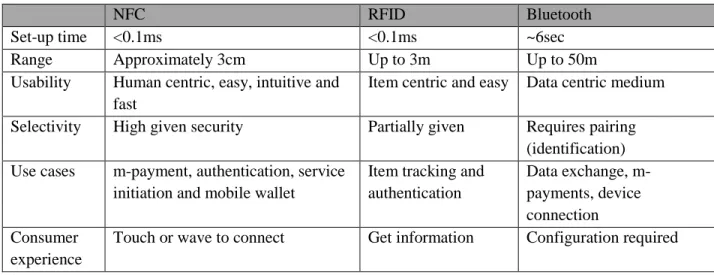
Table 2: Comparison of NFC with other existing technologies ... 28
Table 3: Mode of Communication and Data Rates Supported (A. Kumar, 2010) ... 32
Table 4: Comparison of m-payments technology ... 36
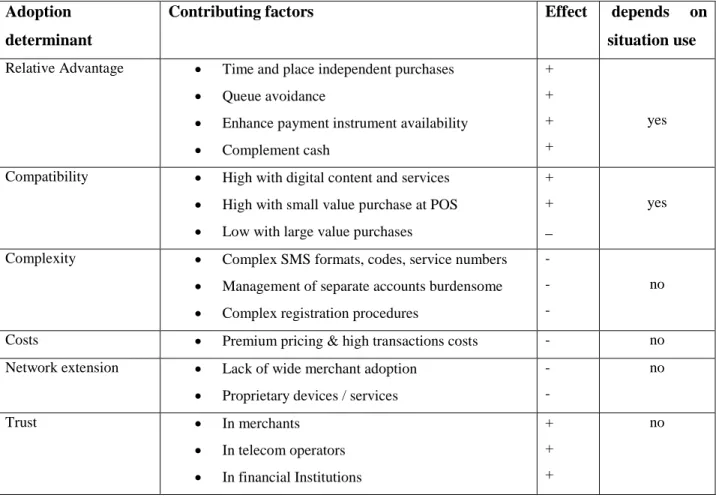
Table 5: Factors affecting consumer adoption of m-payments (Niina Mallat, 2007) ... 43
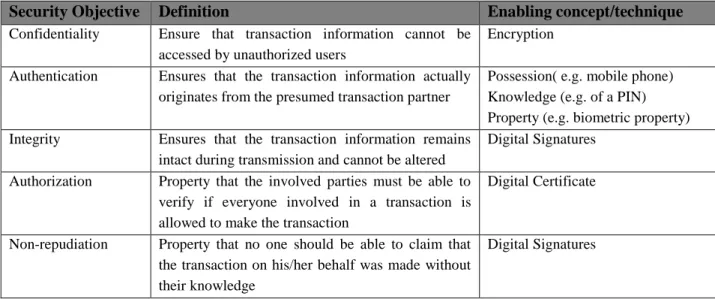
Table 6: Definitions of security objective (Linck et al., 2006) ... 55
Table 7: Make A Payment Use Case Description ... 91
Table 8: Peer-to-Peer Money Transfer Use Case Description ... 92
Table 9: Software ... 94
Table 10: Hardware... 95
Table 11: Classes in the android.nfc package ... 104
Table 12: Groups of participants ... 125
Table 13: Time taken by participants... 126
Table 14: SUS scoring for the participants ... 129
Table 15: SUS scores for each group ... 129
Table 16: Demographic attributes of participants ... 132
Table 17: Latent Variable names ... 132
Table 18: Outcomes of the hypotheses ... 135
Table 19: How research questions have been addressed and handled ... 149
Table 20: Measuring Attitude towards using NFC enabled m-payments ... 164
Table 21: Measurements for Intention to use NFC enabled m-payments ... 164
Table 22: Measurements for Perceived Usefulness ... 164
Table 23: Measurements for Perceived Ease of Use ... 165
Table 24: Measurements for Perceived Risk ... 165
Table 25: Measurements for Perceived Security ... 165
Table 26: Measurements for Trust ... 166
Table 27: Measurements for Cost ... 166
Table 28: Measurements for Prototype application ... 166
xi
List of Figures
Figure 2-1: Research Onion (Saunders et al 2009) ... 11
Figure 2-2: Research Process ... 13
Figure 3-1: Mobile Payment Differentiators (Smart Card Alliance, 2011) ... 21
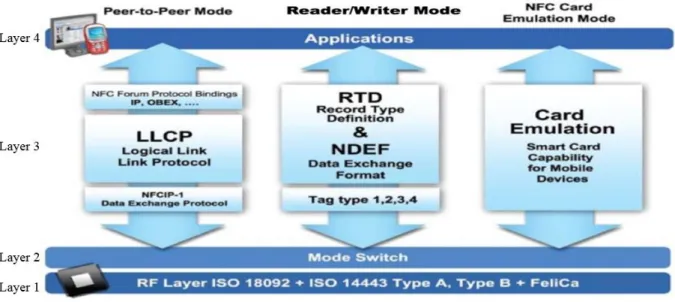
Figure 3-2: NFC Related Standard (Ailisto et al., 2007) ... 29
Figure 3-3: NFC Forum Specification Architecture (Keen, 2009) ... 30
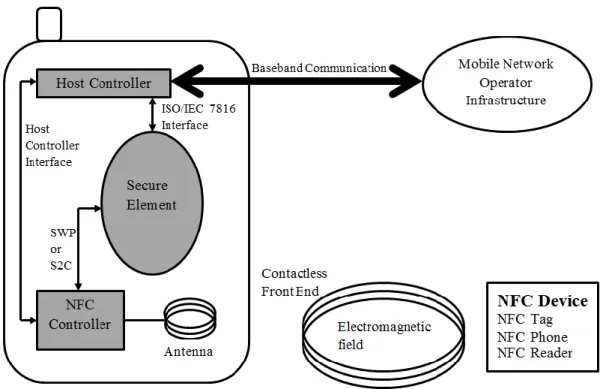
Figure 3-4: Architecture of NFC technology integrated in a mobile device ... 34
Figure 3-5: Google Wallet payment process ... 38
Figure 4-1: NFC-SEC Protocol Steps ... 57
Figure 5-1: NFC Ecosystem (Patel & Kothari, 2013)... 62
Figure 5-2: Potential NFC Ecosystem (Deloitte, 2011) ... 67
Figure 5-3: Possible SE locations ... 69
Figure 6-1: A Model of Five Stages in the Innovation-Decision Process (Rogers 2003) ... 75
Figure 6-2: Technology Acceptance Model (Davis 1986) ... 78
Figure 6-3: Consumer Acceptance Research Model ... 80
Figure 7-1: System Prototyping ... 85
Figure 7-2: Flowchart of the prototype m-payment ... 87
Figure 7-3: System Architecture ... 89
Figure 7-4: M-Payment Application Use Cases ... 90
Figure 7-5: ACR 122U-A9 Smart Card Reader ... 95
Figure 7-6: NFC Forum Specifications Protocol for ensuring interoperability ... 96
Figure 7-7: NFC Peer-to-Peer Mode... 97
Figure 7-8: Components of the M-Payment Application ... 99
Figure 7-9: Web Service Model ... 100
Figure 7-10: POS system user interface. ... 102
Figure 7-11: Activity Flow diagram for the peer-to-peer money transfer transaction ... 107
Figure 7-12: Activity Flow diagram for the m-payment transaction ... 108
Figure 7-13: First Screen ... 109
xii
Figure 7-15: Registration Screen ... 109
Figure 7-16: Main Screen ... 110
Figure 7-17: Error message for account... 110
Figure 7-18: Account creation ... 110
Figure 7-19: Error message for missing fields ... 111
Figure 7-20: Alert Dialog for creating a PIN ... 111
Figure 7-21: Incorrect PIN error message ... 111
Figure 7-22: Account creation confirmation... 111
Figure 7-23: M-payment information ... 111
Figure 7-24: Payment Confirmation ... 111
Figure 7-25: Money Transfer Screen ... 112
Figure 7-26: Money Transfer Confirmation ... 112
Figure 7-27: Receiver’s Confirmation request ... 112
Figure 8-1: Android application life cycle (Google, 2012) ... 115
Figure 8-2: Devices moved before message was received by the receiving device ... 118
Figure 8-3: Message displayed before installation begun ... 119
Figure 8-4: Message display after installation ... 119
Figure 8-5: Message displayed when the user opened the application ... 119
Figure 8-6: Network error message ... 119
Figure 8-7: Error message when a null or corrupted message is received during a beam ... 120
Figure 8-8: Request for acceptance of a payment when the battery was low ... 121
Figure 8-9: Payment confirmation when the battery was low ... 121
Figure 8-10: Battery usage when the m-payment was not in use ... 122
Figure 8-11: Battery Usage after performing a few transactions ... 122
Figure 8-12: Memory Usage Before the M-payment was launched sorted by name ... 123
Figure 8-13: Memory usage sorted by current memory usage after launching the application . 123 Figure 8-14: Memory usage sorted by name ... 123
Figure 8-15: Installation on NFC enabled device ... 123
Figure 8-16: Usability framework (Bevan, 1995) ... 125
Figure 8-17: Money Transfer Screens For Usability Testing ... 126
xiii
Figure 8-19: M-payment Service Screens for Usability Testing ... 128
Figure 9-1: Model fit and quality indices ... 133
Figure 9-2: Research Model with estimated values ... 134
Figure 9-3: Combined loadings and cross-loadings... 136
Figure 9-4: Combined loadings and cross-loadings continued... ... 136
Figure 9-5: Latent Variables Coefficients (for all correlations P<0.01) ... 137
Figure 9-6: Correlations of Latent Variables ... 137
xiv
Table of Listings
Listing 1: Simulated back-end banking system operations... 101
Listing 2: Class responsible for sending payment details to the reader ... 103
Listing 3: Creating NDEF Message that use TNF_WELL_KNOWN with RTD_TEXT ... 105
Listing 4: Beaming a message ... 105
Listing 5: OnResume() method ... 106
Listing 6: processIntent Method ... 106
Listing 7: Button testing... 116
xv
ACRONYMS
NFC Near Field CommunicationRFID Radio Frequency Identification MRA Marginalized Rural Area
SWOT Strength, Weaknesses, Opportunities and Threats TAM Technology Acceptance Model
POS Point of Sale
SMS Short Message Services
SE Secure Element
SEM Structure Equation Modelling PLS Partial Least Squares
USSD Unstructured Supplementary Service Data GPRS General Packet Radio Service
3G Third Generation
UICC Universal Integrated Circuit Card SCH Secure Channel Service
MNO Mobile Network Operator
RF Radio Frequency
PIN Personal Identification Number AES Advanced Encryption Standard SSE Shared Service Secret
GSM Global System for Mobile Communication TSM Trusted Service Manager
RTD Record Type Definition TNF Type Name Definition
LLCP Logical Link Control Protocol SNEP Simple NDEF Exchange Format NDEF NFC Data Exchange Format
1
1
INTRODUCTION
1.1 Introduction
Near Field Communication (NFC) is a wireless short range radio technology that enables communication between devices that either touch or are in close proximity of about 3 cm (ISO/IEC 18092, 2013). NFC was introduced in 2002 (ISO/IEC 18092, 2013). This technology evolved from existing contactless identification and interconnection technology called Radio Frequency Identification (RFID) (Aziza, 2010). This makes NFC to be compatible with RFID technology. The technology can be embedded in many different electronic devices including: smartphones, tablets and point of sale terminals. The NFC technology brings many advantages to mobile devices such as:
no initial configuration requirement
fast connection setup
reliable communication
improved user experience
convenience (Raina, Pandey, & Makkad, 2011)
security of contactless technology (Raina et al., 2011)
bidirectional communication
accessibility by third party applications installed on the mobile device
short communication distance to reduce security threats such as man in the middle attacks and eavesdropping
This technology is becoming more prominent and this is seen through the number of NFC enabled applications that are being developed and the increase in the number of NFC enabled devices that are being released into the market each year since its introduction. Many NFC applications have been proposed and some of these have been developed. The domains of deployment of these applications typically include mobile payments (m-payments), access control, data transfer between NFC units, access to digital information and ticketing.
2
The most important emerging area for NFC technology that is offering potential growth is NFC-supported m-payments. M-payments have been around for some time now but their adoption have been limited (Dahlberg, Mallat, Ondrus, & Zmijewska, 2008a). The concept of m-payments enabled by the NFC technology is relatively new in Africa but not in other continents such as Asia and Europe. According to Dahlberg et al (2008), m-payments “are payments for goods, services, and bills with a mobile device (such as a mobile phone, smart-phone, or personal digital assistants) by taking advantage of wireless technologies and other communication technologies”. Raina et al (2011) defined an m-payment as “the transfer of money from one party to another through the exchange of information”. An NFC m-payment application is also known as contactless mobile payment application. In this research, the terms NFC enabled m-payment application and contactless payment application will be used interchangeably. The term contactless payment was first used to refer to payments carried out using credit cards which used the RFID technology. These cards are commonly known as contactless cards.
NFC m-payment applications have been deployed successfully in many Asian countries for a few years now (Ondrus & Pigneur, 2007; Smart Card Alliance, 2007). Japan started using NFC enabled m-payments in 2005 and these payment applications have been very successful (National Retail Federation, 2011). As NFC enabled m-payments are continuing to gain popularity; we are anticipating that soon this technology could and might become the mainstream payment method in Africa, with tangible benefits for the marginalized African communities. In the research done by Muriira and Kibua (2012), they noted that half of the Kenyan population would greatly benefit from the NFC technology if implemented by banks and the telecom companies – in this research we are anticipating that similar benefits and impact would be realized in the context of South Africa.
In contactless mobile payment transactions, the NFC technology does not make the actual payment but it is responsible for transferring the details that are required in carrying out a payment transaction. Since NFC technology is compatible with RFID, it enables credit cards or debit cards to be emulated and stored in a virtual wallet on the mobile device. These virtual cards will then be used to make payments. This is one way of carrying out NFC enabled m-payments. The other ways include using a virtual account that is created by the stakeholder
3
offering the m-payment service and then use that virtual account for making payment transactions or by using an already existing bank account. In order to carry out an m-payment, the customer must have mobile money available in his/ her account. Mobile money is a form of electronic money. The next section covers mobile money and electronic money in detail.
1.2 Electronic Money and Mobile Money
M-payments can only be carried out using electronic money (e-money). E-money is defined in the National Payment System position paper published 2009 as monetary value that is stored electronically and represented by a claim on the issuer (South African Reserve Bank, 2009). E-money can either be issued out when the funds are received, accepted as payment of goods or services, redeemed as cash or deposited into a bank account. E-money leads us to the factor of mobile money (m-money). M-money is a form of e-money that enables both the banked and unbanked (i.e. people who do not have access to banking facilities) to deposit money into their mobile accounts and this is known as mobile banking. According to Jenkins (2008), m-money is monetary value that can be accessed and utilized via a mobile device (Jenkins, 2008).
Mobile banking is defined as “the use of a mobile device by a consumer to access and manage financial services provided by a bank, credit union, brokerage, or other financial services provider” (Smart Card Alliance, 2011). Mobile banking for the unbanked and underbanked (i.e. people who have limited access to banking services) has recently been on the increase in South Africa. The past few years have seen the introduction of mobile money transfer in Africa. This service insures the availability and accessibility of banking services both to the banked people (i.e. in terms of augmenting and supplementing the existing banking services) and also the unbanked (i.e. in terms of providing a new channel to banking services). M-money transfer is being offered by mobile network operators and banks. Examples of m-money transfer services in South Africa include cardless services for FNB and Standard Bank, M-PESA being offered by Vodacom in South Africa (Mas & Morawczynski, 2010) and MTN Mobile Money. M-money transfer service emerged from electronic payment and the banking industry.
M-money enables easy and cheap money transfer (mobile money transfers) among the mobile subscribers. M-money can also be used in m-payments or be converted back into cash by
4
withdrawing from the appropriate agents, branches or ATMs. Mobile money transfer is usually used for sending remittances. The purpose of m-money is typically to bring financial services to the unbanked and also to supplement the banking service offering to the already banked individuals. Mobile money transfer can be classified as either m-payment or mobile banking. Mobile money transfer is based on person to person remittance service.
This research focuses on m-payments enabled by NFC technology. M-money provides one form of monetary value used to carry out m-payment transactions. The other form of the monetary value used in m-payment includes: existing bank accounts through mobile banking, payments cards, prepaid value stored in the mobile device or can be added on the mobile bill. In this research we are proposing an m-payment system that is coupled with a mobile money transfer service or mobile banking. It should be noted that there is a difference between mobile banking service and mobile banking. Mobile banking services are the services that are based on the existing bank’s system of financial institution but mobile banking is a new method of banking created mainly to cater for the unbanked and the underbanked, by typically having the mobile operators providing a full-fledged banking service entirely focused around the use of cell phones (an example of this in the South African context is the MTN Mobile Money service).
1.3 Research Context
This research is framed under the domain of Information technology for Development (ICT4D) which seeks to improve the lives of people living in rural areas through technology. The majority of people staying in Marginalized Rural Areas (MRA) are either unbanked or underbanked. In 2013, a survey carried out by FinScope South Africa revealed that about 25 per cent of the South African adult population (16+) are unbanked most of whom are in rural areas (Ventures, 2013). Being unbanked includes the inadequacy of people to meet the bank’s criteria to open a bank account (Afful, 2013) or their inability to have access to banking facilities. Since these people lack banking facilities, they also lack payment alternatives and have to always resort to cash which is difficult for them because they have to travel long distances in order to reach banks. This situation is made worse by the fact that most of their purchases are micro-payments in “spaza” shops (tuck-shops) where they also need to use cash only currently. Therefore there is a need to provide them with a safe, convenient and secure alternative way of carrying out
5
monetary transactions which can be accepted by both formal and informal shops. One proposed way to provide the MRA with an alternative payment is to use an NFC enabled m-payment application - which is the focus of this research.
NFC is a relatively new technology in South Africa. As far as we are aware, its applicability in MRAs of South Africa has not been thoroughly and extensively evaluated. Therefore, this research seeks to investigate the applicability of using NFC enabled m-payments in the MRAs of South Africa by carrying out a thorough feasibility study of the technology. Usage of NFC enabled m-payments has mostly been covered only in theory (Zea, Lekse, Smith, & Holstein, 2012) and lacks standardization and universality (Linck, Pousttchi, & Wiedemann, 2006). This has contributed to the slow adoption of m-payments and the failure of some of the applications that were deployed due to lack of understanding and technical knowledge which requires further research (Mallat, 2007). These challenges will be met by the feasibility study using a Strength, Weaknesses, Opportunities and Threats (SWOT) analysis of the NFC technology, developing a prototype payment application and exploring user adoption of the technology. Both the SWOT and feasibility study will facilitate analysis of usability aspects, social challenges, technical issues and also the user perception of the NFC Technology. The research also seeks to provide an exhaustive pre-emptive ground work for the implementation of a payment application that can be used in marginalized rural communities.
1.4 Research Motivation
This research looks at m-payments in the context of MRA where most of the unbanked and underbanked people are staying (Gillis & Pillay, 2012). Most of rural South Africa has an income that is erratic and predominantly reliant on government grants and thus cannot support the banking packages that have been offered by banks such as internet banking and telephone banking (Makina, 2013; Mkhumbuza, 2013). A study carried out by Mobility showed that 18 per cent of South Africans send remittances to unbanked family and friends regularly (Anong & Kunovskaya, 2013). Such packages have charges that are unaffordable to rural bankers and that has slowed or hampered their adoption. As such, banks have lost valuable customers and the customers lost the opportunity to transact and save money. The introduction of mobile banking has given these people an opportunity to gain access to banking services. Over the last few years
6
South Africa has experienced high levels of mobile network penetration and this has given more people access to mobile banking. Research shows that there are more people with mobile devices than bank accounts (Anong & Kunovskaya, 2013; Bankole, Bankole, Brown, & Cloete, 2012) even though South African banking system is well established (Kupukile & Ncube, 2011).
Based on these reasons we want to propose an m-payment application that is coupled together with mobile banking that is suitable for both the banked and underbanked staying in the rural areas. Not only will this benefit customers but also the government because through m-payment they can channel in the money in the informal sector to the formal sector and this will help them in economic development. The MRAs constitutes the majority of the unbanked population in South Africa (Coetzee, 2009).
1.5 Research Questions and Objectives
Table 1 gives a summary of the research questions, the research objective associated with the questions and the methodology that will be used to answer the question. The overall research question is: Is it feasible to use a contactless mobile payment application in the marginalized rural areas of South Africa and will the consumers accept this kind of payment method?
Table 1: Research Questions and objectives Research
Questions Research Objectives Chapter Methodology
What are the strength, weaknesses, opportunities and threats of NFC enabled m-payments?
OBJ1 Undertake a SWOT analysis of the technology. 3, 4
Literature Review
What are the security issues of NFC as a payment technology?
OBJ2 Evaluate security issues 3, 4 Literature Review What are the
issues that affect the NFC mobile payment ecosystem and
7
the Secure Element What are the consumer requirements for NFC enabled m-payments?
OB3a Determine the knowledge of consumers on m-payments.
6, 8 Interviews
Questionnaires
OBJ3b
Determine user requirement for an NFC enabled m-payment application How feasible is it to implement an NFC enabled m-payment application? OBJ4
Determine the practicality of implementing an NFC enabled payment application
7, 8 System analysis, design and implementation
What are the factors that affect utilization of m-payments?
OBJ5
Deduce usability and user perception issues of m-payment applications
3 Literature Review
Interviews
Will the users accept an NFC enabled payment application?
OBJ6a
Determine factors that affect consumer adoption of NFC m-payments.
6, 9
Review literature of technology models that are used to test user acceptance of a technology and then select the appropriate model.
Draw factors that affect user acceptance of technology from the models suitable for mobile payment
Deduce hypotheses for factors that affect user acceptance and design a model to test user acceptance based on the hypotheses
Deduce the
measurement items for each factor
Evaluate and validate the model and analyse the data qualitatively
OBJ6b
Determine key determinants of the adoption of NFC enabled m-payment for MRA
What are the NFC technology deployment strategies that can be adverted for MRA?
OBJ7
Give recommendation on the sustainable implementation framework for NFC applications in South Africa’s marginalised rural communities.
10
Data analysis and Literature review
1.6 Organization of Dissertation
8
Chapter Two: Research Design – this chapter discusses the research design and the methodology used to conduct the research. The research design section outlines the techniques used. The methodology gives details of the methods used in the research.
Chapter Three: Literature Review – the chapter reviews literature on m-payments, NFC technology and some of the related work.
Chapter Four: SWOT Analysis – details the SWOT analysis and also looks at the security issues of the NFC technology.
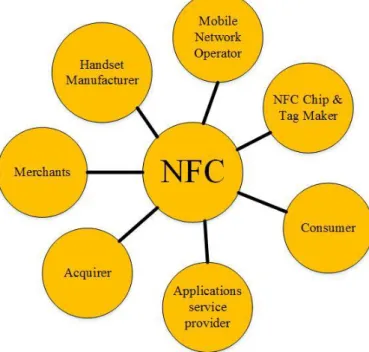
Chapter Five: NFC M-Payment Ecosystem and the Secure Element – discuss the NFC m-payment ecosystem and looks closely at major stakeholders. The Chapter also discusses the Secure Element used to store sensitive applications and data.
Chapter Six: Theoretical Models Review – this chapter reviews literature on the relevant user technology acceptance models. Form the reviewed literature, one model will be chosen and will be modified to suit our research and hypotheses will be derived based on this model.
Chapter Seven: System Analysis, Design and Implementation – this chapter looks at the analysis, design and implementation of the NFC payment application prototype.
Chapter Eight: System Testing and Validation – this chapter tests and validates the developed application prototype.
Chapter Nine: Data Analysis – the quantitative analysis will be used in the interpretation and analysis of the data collected for the technology acceptance model. To illustrate the results, tables, figures and graphs are used. Also, statistical analysis methods are used to test the relationship between the variables.
Chapter Ten: Conclusion and Recommendation - gives the conclusion, recommendations and makes suggestions for further research.
1.7 Conclusion
In this research we intent to explore the feasibility of using NFC enabled m-payments in the MRAs of South Africa by carrying out a feasibility study of the technology. Perceived security and trust issues are some of the major barriers of electronic and m-payment (Siau, Sheng, Nah, & Davis, 2004). These issues can be overcome by educating the consumers about m-payments and
9
the technology that the m-payment utilizes. Complexity of the mobile device has also hindered the adoption of m-payments (Laukkanen & Lauronen, 2005; Szmigig & Bourne, 1999). This has brought about usability problems and this makes the usability of mobile applications difficult to measure. This is one of the areas that will be greatly considered in this research and the main reason we are proposing the use of NFC technology. NFC enabled mobile payments offer consumers convenience and ease of use and also provide consumers with timely payments and convenience (Yang, Lu, Gupta, Cao, & Zhang, 2012). The relative advantages of m-payments include availability, remote purchases, time independence, place independence and queue avoidance (Mallat, 2007).
The acceptance of m-payments greatly depends on the following factors: interoperability, usability, simplicity, universality, security, privacy, cost and speed (Raina et al., 2011). These are some of the things that we will be discussed in this research. We also aim to assess and evaluate the potential of NFC enabled payments applications.
10
2
RESEARCH DESIGN AND METHODOLOGY
2.1 Introduction
Research design is the overall outline of the research work that connects the research problems to the empirical research. It defines the procedures that will be followed in order to answer the research questions. The research design links the design, data collection and the data analysis together in the research while ensuring that the research agenda is being addressed. The feasibility and validity of the research depends on the research design that was implemented. Feasibility in this context refers to whether the research design can be executed taking into consideration all the factors that are involved in undertaking the research: time and resources.
The credibility of the research validates the research. The research design must be modelled in such a way that it provides support for conclusions and desired recommendations and this will in turn provide the credibility of the research (Afanu, 2013). The research design needs to be usable. Usability of the research design ensures that all the research questions are answered. This chapter begins with broad assumptions that were made by the researchers and then moves on to more detailed methods about the prototype that was implemented and the methods that were used to collect and analyse data.
2.2 Research Design
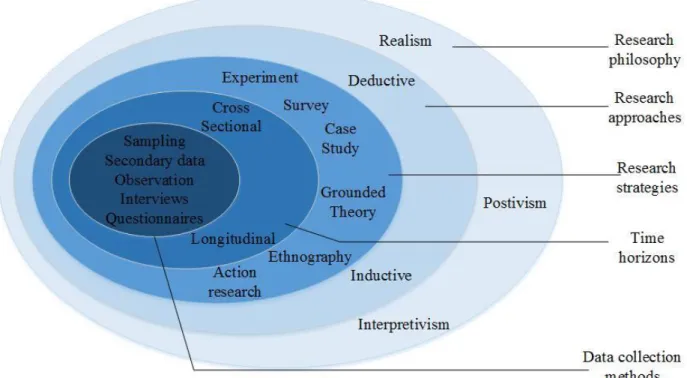
Research philosophies are very important especially when undertaking a Social Science research. Even though this research cannot be categorized as a Social Science research, it took into consideration humanistic elements as it aimed at investigating the user adoption of NFC enabled m-payments. The research design adopted for this research was based on the research onion shown in Figure 2-1.
11
Figure 2-1: Research Onion (Saunders et al 2009)
In 1995 March and Smith argued that both design science and natural science (physical, biological, social and behavioural domains) activities are required “to ensure that IT research is both relevant and effective” (March & Smith, 1995). As we were seeking to give recommendation at the end of the research, it was very important to ensure that our research was relevant. To ensure the relevance of our research, we went through various literature on past research philosophies and activities on IT, design science and natural science.
According to Smith (2006) Information System research that adopts the positivism philosophies and the interpretivism philosophies suffers form, “persistent theory-practice inconsistencies” within the researcher’s ontological assumptions and research practice (Smith, 2006) hence this research adopted the realism philosophy as its philosophical stance. Realism is a philosophical position that relates to scientific enquiry. The realism philosophy states that the results of the research will not be biased by the beliefs of the researcher since the researcher and the social reality exist independent of each other. Realism acknowledges that scientific methods are not perfect and that it is not possible to know for certain the reality without carrying out a research.
12
The realism philosophy enables the researcher to keep an open mind and explore new research methods.
There are two forms of realism: direct realism and critical realism. According to direct realism “what we experience through our senses portrays the world accurately” (Saunders, Lewis, & Thornhill, 2009). Critical realism is directly the opposite of direct realism; it argues that our sense deceive us. Of the two forms of realism the research adopted the critical realism. Critical realism asserts that the world is experienced through two steps. The first step consists of the object and the sensation it conveys and the second step is the mental processing that results when that sensation meets our senses. The first step is enough for direct realism.
Many business and management researchers agree with the views of critical research based on the argument that “as researchers we will only be able to understand what is going on in the social world if we understand the social structures that have given rise to the phenomena that we are trying to understand” (Saunders et al., 2009). In other words the knowledge of the researcher on reality which resulted from social conditioning is only understood through the social actors that take part in the derivation of the knowledge (Dobson, 2002; Saunders et al., 2009). Critical realism acknowledges that the world is always changing. A research carried out by Smith argues that critical realism, “through its novel ontological position, has the potential to advance information systems theory and research” (Smith, 2006). The major benefit of critical realism comes from reinterpretation of science activities (Smith, 2006). The reinterpretation of science activities helps to explain previous research (Smith, 2006).
The research was conducted using the deductive approach. Deductive simply means that the researcher initially has research questions which will then be answered by the research using the research design. This research conducted an exploratory, experimental, prediction, survey and evaluation of NFC enabled m-payment application for MRA. An exploratory study of previous research that has been done on m-payments was carried out throughout this research in order to gain understanding of the NFC technology and the adoption of m-payments. This was done with the aim to give recommendation on the implementation of m-payments for MRA which are supported by literature and practical experience of both the research participants and the
13
researchers. Therefore a prototype payment application was development and used as an experimental payment application. The residents of Dwesa community were actively involved in the implementation and testing of the prototype and a survey was carried out after the residents had tested and approved the prototype.
The research used mixed methods in both data collection and analysis in order to grasp all the complex phenomena of m-payments. The purpose of this research was to conduct an investigation on the applicability of using NFC enabled mobile payments in MRA through literature review and an experimental prototype application. The remainder of this chapter discusses the methodology that was used to carry out this research. The methodology includes the methods used, the data collected and the analysis of the data.
2.3 Methodology
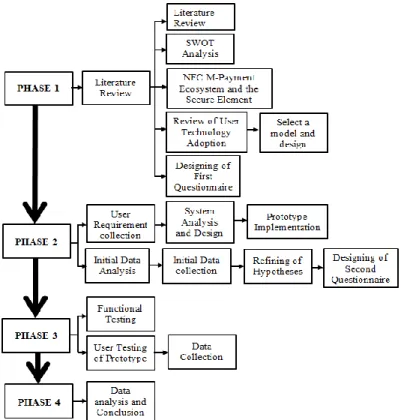
The research was carried out in four phases. The phases were adapted from a research done by Halaweh and the phases were modified to suit our research (Halaweh, 2012). Figure 2-2 shows the details of the four phases.
14 2.3.1 Phase 1
This phase focused on understanding the objectives of the research. The phase involved the review of related studies that have investigated the adoption of mobile payments in general and speculated the adoption of m-payments that are enabled by NFC in other countries in great detail. It also involved the study of literatures that explains and explores the NFC technology. This phase is the most important phase because it provides some of the expected results of the research and highlights the originality and contribution of the research.
2.3.1.1Literature Review
Since NFC is a new technology as far as South Africa is concerned, there was also a need to carry out an overview study of the technology. This was carried out through the review of journals and white papers, and also through the NFC Forum website (http://nfc-forum.org/). White papers were used because of the limited amount of published journals about the NFC technology and NFC m-payment application.
2.3.1.2SWOT Analysis
Apart from the review of m-payments, this phase also included a thorough SWOT (Strength, Weakness, Opportunity, Threats) analysis of the NFC technology in terms of m-payments. The SWOT analysis was based on the related literature and also on the prototype application.
2.3.1.3Review of User Technology Adoption Models
This phase also involved the review of different theoretical models that explains “the relationship between user attitudes, perceptions, beliefs, and eventual system use” (Amoako-Gyampah & Salam, 2004). After the review of the models, one model was chosen and modified to suit the research. A set of hypotheses were then drawn based on the relevant literature reviewed and the chosen model.
15 2.3.2 Phase 2
This phase involved the implementation of a prototype payment application. The first part of the phase involved gathering user requirement from the users and relevant journals and books. The implementation was done using software prototyping. The implementation included the implementation of the mobile phone payment application, the simulated back-end banking system and the payment terminal application. Once the prototype payment application had been finalized, the system was taken to Dwesa for the participants to test it for the last time. Due to the limited number of NFC enabled Android mobile phones among the users, the users were be presented with two NFC enabled mobile devices and a point of sale terminal to use in experimenting with the system.
2.3.2.1System Prototyping
Evolutionary prototyping was used to implement the application. Evolutionary prototyping is when the initial prototype undergoes a series of refinement. The evolutionary prototyping was the best choice for the m-payment application implementation because it enables each identified user issue to be covered and thoroughly tested.
2.3.2.2Questionnaire Design
This phase also included the design of the questionnaire. The questionnaire was developed for the TAM based on the hypotheses that were developed in Chapter 6. The responses to the survey questions were designed according the Five-point Likert-type scale with points from 1 to five as follows: 1 = Strongly Disagree, 2 = Disagree, 3 = Neutral, 4 = Agree and 5 = Strongly Agree. Besides the questions based on the hypotheses, the questionnaire also includes the participants’ profile information. The profile information did not include the participant’s name and surname. As mentioned earlier the population that was targeted was the residents of the Dwesa community which is a MRA in the Eastern Cape. Validity of the data was a major concern when it came to data collection. To ensure validity of the data that was going to be collected, the questionnaire underwent a series of refinement with the help of other academics.
16 2.3.3 Phase 3
This phase included the testing of the prototype application by the participants and also the testing and validation of the application. The initial part of this phase was to test the functionality of the application and to validate it. The second part was to allow the participants to play around with the application. Usability issues were tested through the prototype system after the users had tested the application. The phase also included carrying out interviews with the participants. The questions used in the interview included structured questions and open-ended questions.
2.3.3.1System Testing
System testing included user testing and functional testing. Functional testing tested the technological efficiency of NFC as an enabling technology for m-payment applications. User testing included usability testing. Due to lack of hardware security issues were not tested in great depth.
2.3.3.2Data Collection
Both questionnaire and interviews were used in collecting data. Data for the TAM was collected using the questionnaire. Data collected using the questionnaire was analysed qualitatively using a statistical tool.
Interviews
Besides questionnaires, interviews were also conducted. An interview is a method of gathering data through asking the participant a bunch of questions. These interviews enabled the researchers to understand the opinions of the consumers and have the consumers explain their answers in detail. Interviews were used to get the opinion of the merchants Dwesa. We decided to use unstructured interviews because they allow the interviewees to freely express themselves.
Interview consideration
The following factors were taken into consideration before the interviews were conducted:
17
Duration of interview
Types of interviews to be conducted
Language issues
2.3.4 Phase 4
This was the final phase. In this phase the report was compiled that included challenges, barriers and all the factors that affect the adoption and acceptance of the technology. Also the data that was collected in phase 4 was analysed in this phase. In the end recommendation / guidelines for subsequent implementations of mobile payment application for marginalized rural areas will be provided in this phase.
2.3.5 Methodology summary
The phases were designed in such was that each phase was to be completed before another one was begun. The data for the TAM theory was analysed qualitatively using the warpPLS4.0 statistical tool. The data analysis is covered in great depth in chapter 9. Since we were collecting data from people, we had to take ethical principles into consideration. The following Section covers the ethical principles that were taken into consideration for this research.
2.4 Ethical Considerations
An ethical clearance was obtained from the research committee before any data was collected (see APPENDIX E - Ethical Clearance). The following ethical principles were taken into consideration throughout this research: voluntary participation, no harm, informed consent and, confidentiality and anonymity. Data collection was confidential as no personal information about the participants was collected. The participants who were involved had no pressure to comply with that data collection. It was clearly emphasised to each participating individual that participation was voluntary and that they could pull out any time they felt they could not continue.
Both a verbal and written explanation of the research was given to the participants in person. The explanation provided information about the purpose of the project and the role of the participants
18
in it. The participants were also invited to ask questions on any aspect of either the research or their participation they didn’t understand. The participants were also proved with consent forms which clearly stated that their participation was voluntary.
The interviews were conducted in such a way that no participant felt embarrassed or uncomfortable during and after the interviews. The mobile devices that were used were devices that were already available on the market that supported NFC technology; hence no harm was foreseen emanating from mobile devices.
2.5 Summary
This research follows an objective research assumption, a realism approach and used both the quantitative and qualitative methods for data collection. Both questionnaire and interviews were used to collect data. The research design was based on the research onion and was modified to suit the research. The research combines both the social sciences methods and computer sciences methods to ensure validity of the adoption results obtained through the research. The Research was not only investigating the adoption of the NFC technology but was also aimed at testing the technical feasibility of the technology use through the development of the prototype.
19
3
LITERATURE REVIEW
3.1 Introduction
The journey towards a cashless society started with the introduction of credit and debit cards. Later on contactless cards were introduced. Now the focus is on m-payments. This chapter seeks to give an in-depth knowledge of m-payments and the NFC technology. The chapter is divided into five sections: Mobile Payments, NFC Technology Overview, NFC Mobile Payment Applications, Related works and Conclusion. The section on M-Payments focuses on the different types of mobile payments and their associated technologies. The remaining sections will focus on NFC as a payment technology and some of the related work that has been done by other researchers. Literature shows that a number of m-payments have failed (Mallat, 2007). It is important to understand what previous studies have discovered about these failed services and about the mobile market in general including all unanswered issues (Dahlberg et al., 2008a).
3.2 Mobile Payments
In the past few years there has been a great evolution of both the commerce and the communication industries and their associated technologies. The most recent technologies from these industries are e-commerce and mobile phones respectively. Over the past ten years, these technologies have been gaining attention especially among researchers. The researchers were focusing on combining these two technologies and this combination resulted in a new product called m-payments. M-payments have provided new capabilities of carrying out business. In simple terms an m-payment is when a mobile device is functionally used in executing and confirming payment for goods or services. Zang and Dodgson (2007) defined mobile payments as any type of payment that involves the convergence of a telecommunication network, a bank network and a credit card (Zang & Dodgson, 2007). Ever since their introduction, m-payments have been gaining popularity all over the world including in Africa. Kenya is one of the African countries that has the most success in terms of m-payments (Muriira & Kibua, 2012). According to a research done by Visa International; 89 per cent of consumers who tried m-payments found them to be more convenient compared to other payment methods (Innovision Research &
20
Technology, 2007). M-payments are not only limited to two parties exchanging financial value in return for goods or services but also includes the transfer of money through the exchange of information (Raina et al., 2011).
3.2.1 Categories of Mobile Payments
Mobile payments can be categorized using location, transaction size or transaction technology. When m-payments are categorized using location, the payments can either be remote payments or proximity payments. A remote payment is a payment that is made without interacting directly with the merchant’s point of sale (POS) (Smart Card Alliance, 2011). Remote payments can further be divided into two types: mobile money transfer transactions and purchase payment transactions. A proximity payment can be defined as a payment in which the mobile phone interacts in some way with a physical POS device to transfer the consumer’s payment information and perform the transaction (Smart Card Alliance, 2011).
In 2007 KPMG categorized m-payment based on transaction into five categories: business-to-business (B2B), business-to-business-to-consumer (C2B), consumer-to-consumer (C2C), person-to-person (P2P) and remittance (KPMG International, 2007). In this context the NFC enabled m-payment application we are proposing falls in the C2B category and the NFC enabled peer-to-peer money transfer is a P2P transaction.
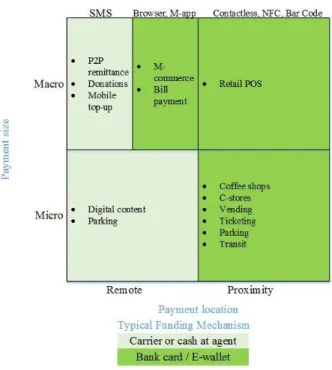
The m-payments can also be categorized into two categories based on transaction size: macro payments and micro payment. Micro payments are typically for paying small bills and they limit the amount of money that a customer can spend, in America a user who is using micro payment can spent a total amount of $25 and in UK the total amount is £20 (Smart Card Alliance, 2011). There is no limit to the amount of money that can be spent by a user who is using macro payments. Figure 3-1 shows the different types of mobile payments and some of the technologies that support them.
21
Figure 3-1: Mobile Payment Differentiators (Smart Card Alliance, 2011)
The sources of funds that are used in m-payments include traditional bank account, credit card, debit card, a prepaid card or the bill can be included in the mobile phone bill. Another option of getting funds for carrying out m-payments is by using an agent who will provide the user with a virtual account and the user will then load cash into that account.
3.2.1.1Remote Mobile Payments
The technologies that support remote payments include SMS, secure mobile browsers and mobile payment applications. Two types of remote mobile payments that will be looked at in this section are Peer-to-Peer or Person-to-Person (P2P) mobile payments and mobile commerce (m-commerce).
3.2.1.1.1 P2P Mobile Payments
This type of payment allows mobile device users to pay one another using a payment application provided by third parties or banks. This is also known as m-money transfer. P2P has become very popular in developing countries where the number of the unbanked and underbanked people is very high. It is based on the Short Message Services (SMS) feature of the mobile device. An example of a P2P money transfer application is M-PESA in Kenya and South Africa (Jack &
22
Suri, 2011). M-PESA enables consumers to make personal money transfers, ATM withdrawals, pay bills, make point-of-sale purchases and top-up their mobile phone account. M-PESA aims to reduce the costs of transferring money. P2P payment services are also used by business owners to carry out their own payment activities.
3.2.1.1.2 M-Commerce
M-commerce is the use of a mobile device to perform a commercial transaction (Smart Card Alliance, 2011). M-Commerce involves searching or paying for goods and services using a mobile device’s web browser.
3.2.1.2 Proximity Mobile Payments
Proximity payments are used when paying for goods or services in stores that are equipped with the appropriate POS or on vending machines. This type of payment usually relies on the financial industry payment infrastructure. Proximity payments can be implemented using NFC or Bar codes technologies. In Bar code-enabled proximity mobile payment, a two-dimensional (2D) barcode is displayed on a smartphone screen and read by an optical scanner at a retail POS, or the smartphone’s camera is used as an optical scanner to read a bar code displayed on a POS terminal (Smart Card Alliance, 2011).
3.2.2 Successful Mobile Payment Systems in South Africa
Technologies that support mobile payments can be grouped into three: message based technologies, mobile internet and contactless payments. This section will look at the mobile payment systems that are currently being used in South Africa.
3.2.2.1 Message based technologies
Short Message Services (SMS) and Unstructured Supplementary Service Data (USSD) are the two main message based technologies. Some applications make use of both of them to carry out transactions.
23 3.2.2.1.1 Short Message Services (SMS)
SMS messages are handled by an SMS service centre that is maintained by the Mobile Network Operator (MNO). The MNO provides its subscribers with a centre number that will be used in sending and receiving messages. Payments are initiated by sending a message from the mobile phone. In South Africa SMS mobile payments are commonly used to pay for digital content such data bundles, ringing tones or games. The services are charged by using premium SMS rates which are more expensive than standard rates. Some banks use SMSs to enable their customers to carry out financial transactions.
The SMS based mobile payments application are currently the most popular applications. SMS based application have the following disadvantages:
They can only support a limited number of characters
The messages are complicated and slow to key in (Amoroso & Magnier-Watanabe, 2012; Niina Mallat, 2007; Massoth & Bingel, 2009)
They are unreliable (Amoroso & Magnier-Watanabe, 2012)
There is a risk of making a mistake when typing
They lack encryption and authentication of users
Can be affected by viruses. In 2006 Bose and Shin discovered that the SMS services were susceptible to denial of service and malware (Bose & Shin, 2006)
3.2.2.1.2 Unstructured Supplementary Service Data (USSD)
The most popular m-payments in South Africa are based on USSD. USSD provides an additional channel for transmitting data and this is different from GSM networks (Chidembo, 2009). An example of a USSD string is *111*444#. USSD transactions are faster than SMS transactions because they are session based. A transaction is cancelled if the session runs out of time before the transaction is complete. USSD are linked to the MNO internal network and therefore they are usually provided the MNO. USSD are complicated to use because the user has to remember the USSD string that is related to the transaction they want to carry out.
24
3.2.2.2 Mobile internet
The mobile internet provides a way of accessing the internet and payments are made similar to transactions from a personal computer. The m-payments supported by the mobile internet make use of inbuilt internet connections such as General Packet Radio Service (GPRS), 3G (Third Generation) and EDGE. The mobile internet allows the users to enter their credit or debit card information in order to make a purchase. Most of the web based applications are supported by the Wireless Application Protocol (WAP). WAP defines standards for accessing data over a wireless network.
3.2.3 Contactless Payments
A Contactless Payment application is defined as a payment application residing in the Universal Integrated Circuit Card (UICC) or Secure Element (SE) of a mobile phone that employs NFC Technology. Contactless payments are carried out by bringing an NFC enabled mobile phone into close proximity with an NFC enabled terminal point. The transactions are carried out through radio frequencies.
3.2.4 Acceptance of M-Payments
The acceptance of m-payments are affected by (Tomi Dahlberg, Mallat, Ondrus, & Zmijewska, 2008b):
The technology and the standard
Regulation and legislation imposed by the government
Existing purchase and payments habits
The infrastructure of the national economy
Mobile payments have many unique features that make the more desirable than other payments methods. Some of the major features are (Pihlajamäki, 2004):
Ubiquity
Reachability
Localization
Personalization
25
The adoption of m-payments by consumers mainly depends on: security (Bamasak, 2011; Paul Gerhardt Schierz, Schilke, & Wirtz, 2010), cost (Lu, Yang, Chau, & Cao, 2011) and convenience (Kim, Mirusmonov, & Lee, 2010; Mobey Forum, 2011a).
Cost – the costs for carrying out transaction and for application usage should not be too high otherwise the consumers will be reluctant to use the application. Consumers adopt a new payment method if it is not more expensive than the current payment method.
Security – includes integrity, authentication and confidentiality. A payment application should also include non-repudiation of transactions. Customers prefer payment methods that offer security that is based on their own understanding and this makes authorization very important.
Convenience – This includes ease of use, portability, flexibility, speed, ease of setting up and learning to use the payment application. According to Chau (1996) ease of use directly affects the user attitude, intention, actual use and the usefulness of a technology (Chau, 1996). Davis (1993) defined ease of use as the degree to which an individual believes that the use of a system would be free of mental and physical effort (Davis, 1993).
3.2.5 Summary
Rather than replacing credit and debit cards, m-payments represent a transformative digital application that will benefit not only the banked and merchants but also the unbanked and underbanked. For example in Africa’s developing countries remote banking is being carried out using mobile phones through SMSs (Granelli, 2011).
Most of the literature that was reviewed in this section showed that the major barrier to adoption and usability of m-payments is due to the complexity of the m-payment application or the technology that supports the application. Companies and the stakeholders of m-payments are now adopting NFC technology as a new m-payment technology because it is easy to use (Ondrus & Pigneur, 2007). A survey done in USA and Canada in 2012 by Lightspeed research revealed that getting the consumers to use a technology for the first time was a biggest challenge (Lightspeed Research, 2012). The survey also revealed that most consumers were not using
26
mobile devices for payments because they were concerned about the security of the application and their privacy. Therefore it is very important to educate the consumers about the technology before launching its applications. Hence this research seeks to introduce NFC technology to the consumers. The next section discusses the standards and regulation for e-money in South Africa in order to understand the legal regulations and standards that govern m-payments in South Africa.
3.3 Standards and Regulation for e-money in South Africa
This section looks at the standards and regulation for e-money in South Africa in order for us to also consider them in our recommendations mainly based on literature findings. “A fundamental requirement for a stable and secure payment system is that it should operate in a well-defined legal environment, setting out the rights and obligations of each party involved in effecting a payment through the system” (Lawack-Davids, 2012). In South Africa the National Payment System (NPS) covers the whole payment process from the payer to the beneficiary. It also includes the settlement among banks. NPS defines e-money as electronically stored monetary value “represented by a claim on the issuer” (South African Reserve Bank, 2009). The NPS paper also states that e-money can be redeemed for physical cash or be deposited into a bank account. According to the NPS position paper (South African Reserve Bank, 2009) e-money includes internet banking, m-payments and mobile banking. The NPS is also concerned with the interoperability of money. If defines the interoperability of money as the integration of e-money systems using agreed standards and specifications. According to the NPS interoperable systems “lead to the development of large network externalities which will, in the longer term, reduce operational cost and complexity for all customers” (South African Reserve Bank, 2009). The Reserve Bank of South Africa welcomes new technological innovative developments and it takes the responsibility of familiarizing itself with any new innovation and investigates its effects on the economy. The Bank acknowledges that new e-money products might require intervention or adjustment that can arise due to the need to (Lawack-Davids, 2012):
Maintain the integrity, confidence and limit the risk in the NPS
Assist other regulatory authorities in providing consumers with adequate protection from unfair practices, fraud and financial loss