THE CORRELATION BETWEEN STUDENTS’ MASTERING OF IDIOMATIC EXPRESSION AND THEIR ACHIEVEMENT IN READING COMPREHENSION
AT MA LAB UIN-SU MEDAN
SKRIPSI
Submitted to Faculty of Tarbiyah and Teachers Training UIN -SU Medan as a Partial Fulfillment of the Requirement for S-1 Program
By:
ANISA ARLIA PUTRI NASUTION 34.14.3.084
DEPARTMENT OF ENGLISH EDUCATION
FACULTY OF TARBIYAH AND TEACHERS TRAINING STATE ISLAMIC UNIVERSITY OF NORTH SUMATERA
MEDAN 2018
THE CORRELATION BETWEEN STUDENTS’ MASTERING OF IDIOMATIC EXPRESSION AND THEIR ACHIEVEMENT IN READING COMPREHENSION
AT MA LAB UIN-SU MEDAN
SKRIPSI
Submitted to Faculty of Tarbiyah and Teachers Training UIN -SU Medan as a Partial Fulfillment of the Requirement for S-1 Program
By:
ANISA ARLIA PUTRI NASUTION 34.14.3.084
Advisor I Advisor II
Dr. Sholihatul Hamidah Daulay, S.Ag, M.Hum Utami Dewi, S.Pd, M.Hum
NIP. 19750622 200312 2 002 NIP. 19820227 200801 2 009
DEPARTMENT OF ENGLISH EDUCATION
FACULTY OF TARBIYAH AND TEACHERS TRAINING STATE ISLAMIC UNIVERSITY OF NORTH SUMATERA
MEDAN 2018
Medan. 07 June 2018
Nomor : Istimewa Kepada Yth :
Lamp : :- Bapak Dekan Fak.
Perihal : Skripsi Ilmu Tarbiyah dan
a.n. Anisa Arlia Putri Nasution Keguruan UIN-SU
di - Medan Assalamu‟alaikum Wr.Wb
Dengan Hormat,
Setelah membaca, meneliti dan memberi saran-saran perbaikan seperlunya, terhadap skripsi mahasiswa a.n. Anisa Arlia Putri Nasution yang berjudul: The Correlation Between Students’ Mastering of Idiomatic
Expression and Their Achievement in Reading Comprehension at MA LAB
UIN-SU Medan maka kami berpendapat bahwa skripsi ini sudah dapat diterima
untuk melengkapi syarat-syarat untuk mencapai gelar sarjana (S.Pd.) pada Fakultas Ilmu Tarbiyah dan Keguruan UIN-SU Medan.
Demikian surat ini kami sampaikan, atas perhatian saudara kami ucapkan terima kasih.
Advisor I Advisor II
Dr. Sholihatul Hamidah Daulay, S.Ag, M.Hum Utami Dewi, S.Pd, M.Hum
KEMENTERIAN AGAMA
UNIVERSITAS ISLAM NEGERI SUMATERA UTARA
FAKULTAS ILMU TARBIYAH DAN KEGURUAN
Jl. Williem Iskandar Psr. V Medan Estate 20371 Telp. 6622925, Fax. 6615683
SURAT PENGESAHAN
Skripsi yang berjudul : “The Correlation Between Students’ Mastering Of Idiomatic Expression And Their Achievement In Reading Comprehension At Ma Lab UIN-SU
Medan” oleh Anisa Arlia Putri Nasution, yang telah dimunaqasyahkan dalam sidang
munaqasyah Sarjana Strata Satu (S1) Fakultas Ilmu Tarbiyah dan Keguruan Universitas Islam Negeri Sumatera Utara Medan pada tanggal :
02 Juli 2018 M 18 Syawal 1439 H
dan telah diterima sebagai persyaratan untuk memperoleh gelar Sarjana Pendidikan (S.Pd) pada jurusan Pendidikan Bahasa Inggris Fakultas Ilmu Tarbiyah dan Keguruan Universitas Islam Negeri Sumatera Utara Medan.
Panitia Sidang Munaqasyah Skripsi
Fakultas Ilmu Tarbiyah dan Keguruan UIN SU Medan
Ketua Sekretaris
Dr. Sholihatul Hamidah Daulay, M.Hum Maryati Salmiah, S.Pd., M.Hum
NIP. 19750622 200312 2 002 NIP. 19820501 200901 2 012
Anggota Penguji
1. Dr. Sholihatul Hamidah Daulay, M.Hum 2. Utami Dewi, S.Pd, M.Hum
NIP. 19750622 200312 2 002 NIP. 19820227 200801 2 009
3. Dr. Farida Repelita Wati Br. Kembaren, M.Hum 4. Maryati Salmiah, S.Pd., M.Hum
NIP. 19690217 200701 2 002 NIP. 19820501 200901 2 012
Mengetahui
Dekan Fakultas Ilmu Tarbiyah dan Keguruan
Dr. Amiruddin Siahaan, M.Pd NIP. 19601006 199403 1 002
SURAT PERNYATAAN KEASLIAN SKRIPSI
Saya yang bertanda tangan di bawah ini
Nama : Anisa Arlia Putri Nasution
Nim : 34.14.3.084
Jur/Program Study : Pedidikan Bahasa Inggris/ S1
Judul skripsi : The Correlation Between Students’ Mastering of
Idiomatic Expression and Their Achievement in Reading Comprehension at MA LAB UIN-SU Medan
Menyatakan dengan sebenarnya bahwa skripsi yang saya serahkan ini benar-benar merupakan hasil karya sendiri. Kecuali kutipan-kutipan dari ringkasan-ringkasan yang semuanya telah saya jelaskan sumbernya. Apabila dikemudian hari saya terbukti atau dapat dibuktikan skripsi ini hasil jiplakan, maka gelar dan ijazah yangdiberikan oleh universitas batal saya terima.
Medan, 07 June 2017 Yang membuat pernyataan
Anisa Arlia Putri Nasution
i
ABSTRACT
AnisaArlia Putri Nasution : The Correlation Between Students’ Mastering of Idiomatic Expression and Their Achievement in Reading Comprehension at MA LAB UIN-SU Medan.
Key words : Correlation, Idiomatic Expression, Reading Comprehension
The aim of this study was to find out whether there is correlation between students‟ mastering of idiomatic expression and their achievement in reading comprehension. The kind of this study was quantitative research. Therefore the methodology of this study was correlational study. The population of this research was the Second Grade of MA LAB UIN-SU Medan and it was 108 students. The sample in this research is taken through simple random sampling technique and 36 students took as the sample. In collecting data, the writer used test as the instrument. The students were asked to answer the questions of two tests; those were idiom test and reading comprehension test. Therefore, the data were in the form of students‟ scores of both tests. Since the study was correlational study, the data were computed statistically by using Pearson Product Moment. The result of coefficient correlation (ro) was 0.699. Then, the result of „ro‟ was compared with r table, in which the value of r table was 0.329 of significance 5%. In addition, to know the meaning of correlation between variable X (idiomatic expression) and variable Y (reading comprehension) was obtained the result of „to‟ was 5.71 and the value of t table in significance 5 % was 2.02 by degree of freedom (df) 34. Because „ro‟ was higher than r-table, and „to‟ was also higher than t-table; therefore the correlation was positive and medium correlation. These mean the alternative hypothesis was accepted and null hypothesis was rejected. Since those results were computed, it indicated that idiom has medium contribution to reading comprehension. Therefore, there was significant correlation between students‟ mastering of idiomatic expression and their achievement in reading comprehension.
ii
ACKNOWLEDGEMENT
In the name of Allah, the Beneficent, the Merciful. Praise and Gratitude be to Allah for the health and strength that has given to the writer in writing this skripsi. Peace and blessing be upon the Prophet Muhammad Shallallaahu ‘alaihi wa salaam, his family, his relatives, and all his followers.
This skripsi is written to fulfill one of the requirements to obtain the Sarjana Pendidikan degree at the Department of English Education, Faculty of Tarbiyah and Teachers Training, State Islamic University of North Sumatera.
In this occasion I would like to express my great honor and deepest gratitude to my beloved parents: Mr. Uswarli Nasution and Mrs. Erny Supiyati. Who always give support, motivation, and moral encouragement to finish my study.
In addition, there are many people who contribute in finishing this skripsi, the writer would like to express her appreciation to:
1. Prof. Dr. Sadurrrahman, M.Ag as the Rector of State Islamic University of North Sumatera.
2. Dr. Amirruddin Siahaan, M.Pd as the dean of Faculty of Tarbiyah and Teacher Training State Islamic University of North Sumatera.
3. Dr. Sholihatul Hamidah Daulay, S.Ag, M.Hum as the Head of English Educational Department and also the first advisor who providing careful guidance, helpful corrections, great advice as well as suggestion and encouragement during the consultation.
4. Utami Dewi, S.Pd, M.Hum as the second advisor who patiently guided and helped the writer to finish this skripsi.
5. All lecturers in the English Department for teaching precious knowledge, sharing philosophy of life, and giving wonderful study experience.
6. The principal of Madrasah Aliyah Laboratorium Medan, English teacher and all students of XI IPA class who helped the writer during the research. 7. My beloved brothers and Sisters (Listya Gustina Nst and Iqbal Andika Adi
iii
8. All of my friends in PBI 2 nice to meet you, thanks for your prayer, kindness, support, and all of you given to me.
9. My beloved friends Atika Arfah Nst, Aida Saputri Nst, Sinta, Ainul Mardiah, Ade Mentari, Anggi Ramahdani, Beby Aulia Kesuma Wardani who always support each other, sharing the information, accompanied me, entertaining me, and be “crazy” with me until we can finish our final task together.
10. All people who cannot be mentioned one by one for the contribution in completing this skripsi.
May Allah protect and give the great blessing for them. Amiin.
The writer realizes that this skripsi is far of the perfect. Therefore, some critiques and suggestions are needed to make it better. Finally, might not be perfect in some parts. Therefore, I say sorry and expect some critics and suggestion to this skripsi. I hope this skripsi will be useful for the reader.
Medan, June 2018
Anisa Arlia Putri Nasution 34.14.3.021
iv TABLE OF CONTENT Page ABSTRACT ... i ACKNOWLEDGEMENT ... ii TABLE OF CONTENT ... iv
LIST OF TABLE ... vii
LIST OF APPENDICES ... viii
CHAPTER I INTRODUCTION ... 1
A. Background of the Study ... 1
B. Statement of the Problems ... 4
C. Research Question ... 4
D. Purpose of the Study ... 4
E. Significances of the Study ... 4
F. Limitations of the Study ... 5
CHAPTER II LITERATURE REVIEW ... 6
A. Theoretical Framework ... 6
A.1 Mastering of Idiomatic Expression ... 6
A.1.1 Definition of Idiomatic Expression ... 8
A.1.2 Types of Idiom ... 10
A.1.3 Forms of Idiom ... 15
A.2 Achievement in Reading Comprehension ... 17
v
A.2.2 Definition of Reading ... 17
A.2.3 Types of Reading... 19
A.2.4 Definition of Reading Comprehension... 21
B. Conceptual Framework ... 23
C. Hypothesis ... 25
CHAPTER III RESEARCH METHODOLOGY ... 26
A. Research Design ... 26
B. Population and Sample ... 27
C. Data Collections ... 28
D. Data Analysis ... 29
E. Research Procedures ... 34
CHAPTER VI FINDING AND DISCUSSION ... 36
A. Findings ... 36
A.1 The Description of Data ... 36
A.1.1 The Data of Students‟ Mastering of Idiomtic Expression .... 36
A.1.2 The Data of Students‟ Achievement in Reading Comprehension ... 40
A.2 Analysis Requirement Test ... 44
A.2.1 Validity Test ... 44
A.2.2 Reliability Test ... 44
A.2.3 Normality Test ... 44
A.2.4 Homogeneity Test ... 48
A.3 Hypothesis Test ... 49
vi CHAPTER V CLOSING ... 55 A. Conclusion ... 55 B. Recommendation... 56 C. Implications ... 57 BIBLIOGRAPHY ... 58 APPENDICES ... 61
vii
LIST OF TABLE
Table Title Page
I Distribution of Population ...27 II Items Validity of Multiple choice on Idiom Test ...29 III Items Validity of Multiple choice on Reading Comprehension
Test ...29 IV Pearson Correlation ...33 V Test Score of Students‟ Mastering of idiomatic Expression ...36 VI Worktable for Findings Mean, Variant, and Standard Deviation
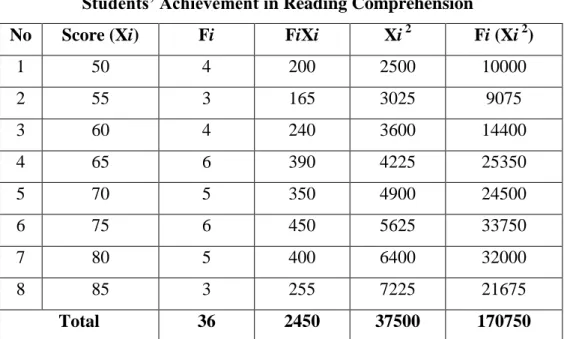
From the Data of Students‟ Mastering of Idiomatic Expression ...38 VII Test Score of Students‟ Achievement in Reading Comprehension ....40 VIII Worktable for Findings Mean, Variant, and Standard Deviation
From the Data of Students Achievement in Reading
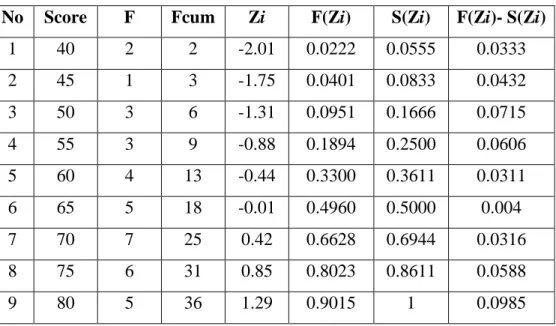
Comprehension ...42 IX The Data Normality Test of Students Mastering of Idiomatic
Expression ...45 X The Data Normality Test of Students‟ Achievement in Reading
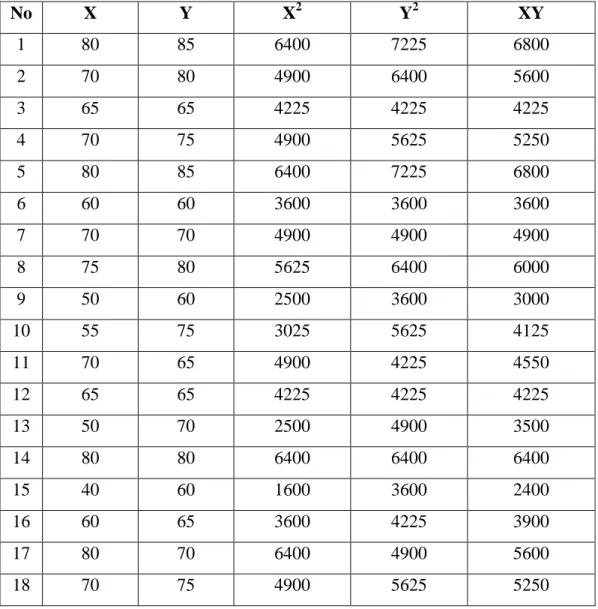
Comprehension ...46 XI Worktable of product Moment of the X Variable and the Y
Variable ...49 XII Pearson Correlation ...52
viii
LIST OF APPENDICES
Appendix Title Page
I List of Students ... 61
II Students’ Score ... 63
III Try Out of Idiom Test ... 65
IV Try Out of Reading Comprehension Test ... 69
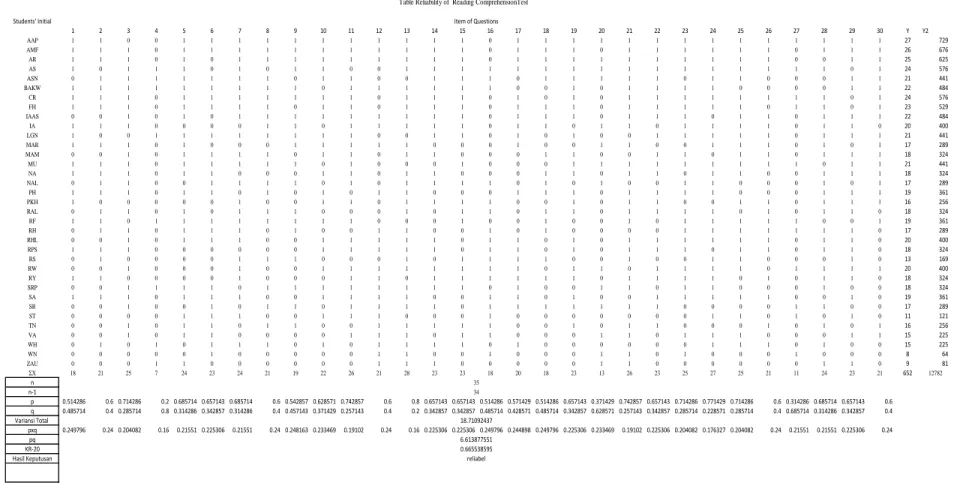
V Table Validity of Idiom Test ... 75
VI Table Reliability of Idiom Test ... 76
VII Table Validity of Reading Comprehension Test ... 77
VIII Table Reliability of Reading Comprehension ... 78
IX Idiom Test ... 79
X Reading Comprehension Test ... 82
XI Key Answer ... 87
XII The Critical Value of Liliefors Test ... 88
XIII Table Distribution Normal Baku 0-Z ... 89
XIV Table of F Distribution ... 90
XV Table of r Distribution ... 92
XVI Table of t Distribution ... 93
1
CHAPTER I INTRODUCTION
A. Background of the Study
It must be obvious that reading is one of the most important way of obtaining an education, especially for academic achievement. Hunter have identified a significant impact of reading on academic achievement. Reading can empower students with extensive vocabulary, syntax, and other language expertise that will enrich their use in the target language.1 In addition, the curriculum stated that out of the four skills, listening, speaking, reading, and writing, the main emphasis is on reading skill because it is believe that the acquisition of reading in a second or foreign language is a main priority.2
The goal of reading is comprehension. Without comprehension, reading is nothing more than tracking symbols on a page with eyes and sounding them out. More than it, to understand the written text, students must be able to decode the words on the page and extract the meaning. Reading can be useless when the students do not understand on what they read, because reading is an activity that requires the readers to understand on what they read. For that reason, comprehension becomes the most important factor to indicate how well the students read.
1
Siao-Cing Guo, “Using Authentic Materials for Extensive Reading to Promote English Proficiency”, English Language Teaching, Vol. 5 No. 8, (July, 2012), p. 196.
2
Irma Manda Negara, “Correlation Between Grammar Mastery And Reading Comprehension Of The Students In STIE Indonesia Pontianak”, (Pontianak: STBA Pontianak, 2017), p. 215.
Brown states that the aim of teaching reading is to enable students comprehend and react to what is written.3 In the curriculum, one of the indicators of reading is identifying the meaning of the text. Based on syllabus, the senior high school students are expected to master some simple English words. Learning the words is very important because knowing the words in the text that the students reading help them to understand the meaning.
Haris in Lidya Casteliana argues that approximately 6.7% of sentences in reading materials use idioms.4 An idiomatic expression is one of language aspects in learning English. Sridhar and Karunakaran state that idiom is “a group of two or more words which are chosen together in order to produce a specific meaning or effect in speech or writing”.5 In other words, an idiom is an expression, which is a term or a phrase whose meaning cannot be deduced from the literal definitions and the arrangement of its parts, but refers instead to a figurative meaning that is known only through common use. To understand idioms is difficult because the words in idioms cannot be figured out from the individual words. So, to avoid mistakes and understand the reading well, a reader should be able to develop his or her knowledge of idiomatic expression.
Based on the researcher observation, I found that students of Madrasah Aliyah Laboratorium UIN-SU Medan of the second year still have problems in understanding sentence or text that consist of idioms. They often do idiom
3
H. Douglas Brown, Teaching by Principles an Interactive Approach to Language Pedagogy, (USA: Prentice Hall. Inc, 2001), p. 278.
4
Lidya Casteliana, “Students Ability in Understanding Idiomatic Expression and Reading Comprehension”, (Riau: Universitas Islam Negeri Riau, 2011), p. 2.
5
Sridhar Maisa and Dr. T. Karunakaran, “Idioms and Importance of Teaching Idioms to ESL Students: A Study on Teacher Beliefs” Asian Journal of Humanities and Social Sciences (AJHSS) Vol 1 Issue 1, (May, 2013), p.111.
misunderstanding of reading materials. They interpret the meaning of idioms by translating word by word that has different meaning from the real meaning words. For example, keep in touch, hang out, down to earth, etc. This misunderstanding can bother their reading comprehension, because the complete comprehension can be reached when the students know and understand the meaning of sentences constructed from some words including idioms. Moreover, this case may happen when the students are not aware about the idioms that they read in the text. This thing emphasizes that idioms need to be noted in reading, because it also influences reading comprehension.
Discussing about those, it is interesting in observe the correlation on both variable, because the idiomatic expression is not a new thing in English language. Idioms are very common in both written and spoken language. Especially in written language, idioms commonly appear in magazines, novel, newspaper, etc. So, it requires the students to be able to master the idioms to comprehending the text. It can be said that students who master idioms well, they get better in reading comprehension. Then, students who lack of idiom mastery, they also lack of reading comprehension, because when students read a text and find idioms, they must know what the meaning of idioms itself, at least they guess the meaning of idioms by the context, to get a complete comprehension.
Based on the explanation above, the writer would be conducted a research entitled “The Correlation Between Students’ Mastering of Idiomatic
Expression and Their Achievement in Reading Comprehension at MA LAB
B. Statement of the Problems
Based on the background of study, the problems in this research could be formulated as follows:
1. The students have studied idiomatic expression, but the students still low in mastering idiomatic expression.
2. The students have studied idiomatic expression, but the students‟ achievement in reading comprehension still low.
3. The teacher has taught about idiomatic expression, but the students‟ achievement in reading still low.
4. The teacher has introduced about idiomatic expression, but the students‟ still low in mastering idiomatic expression.
C.Research Question
Based on the problems above, the research questions is:
1. Is there any significant correlation between students‟ mastering of idiomatic expressions and their achievement in reading comprehension at MA LAB UIN SU Medan?
D. Purpose of the Study
In these research problems, the objective of study would aim:
1. To find out the significant correlation between students‟ mastering of idiomatic expression and their achievement in reading comprehension at MA LAB UIN SU Medan.
E. Significances of the Study
As it is described in the aim of the study above, this study would also expect to have significant contribution and useful for:
1. For English teachers, the findings of the research will give more knowledge about idioms and train their student to master idioms expression.
2. For students, to determine the extent of students‟ ability to understand idioms as well as motivation to improve students‟ comprehension in reading.
3. For researcher hopes this research can be useful as one of the information which contains some aspect that appears in reading comprehension and one of them is idiom.
4. For other researcher to provide information for those who are interested in conducting a deep research related to this study.
F. Limitations of the Study
Based on the statements of the problem, the writer limit the study into two factors, they are mastering idiomatic expression and the students‟ achievement in reading comprehension.
6
CHAPTER II LITERATURE REVIEW
A. Theoretical Framework
In this chapter, the writer tried to give clear description of theoretical framework. The subs are Mastering of Idiomatic Expression that consisted of Definition of Idiomatic Expression, Types of Idiom, and followed by Achievement in Reading Comprehension that includes Definition of Achievement, Definition of Reading, Types of Reading, and Definition of Reading Comprehension.
A.1 Mastering of Idiomatic Expression
There is common assumption that the more words a learner knows, the larger the learner‟s vocabulary knowledge. However, there is another dimension to vocabulary knowledge that should be considered, namely how far a learner knows the combinatory possibilities of a word. Some linguists call them „lexical phrases‟ or „ lexical items‟, others prefer the term „multi- word chunks‟ or just „chunks‟ of language. It is the development of permanent sets of associative connections in long-term memory and the process which underlines the attainment of automaticity and fluency in language. Whatever the term, they are an important feature both in language use and language acquisition. These multi-word chunks or expressions are namely: idioms, proverbs, sayings, phrasal verbs and collocations.6
6
Sridhar Maisa and Dr. T. Karunakaran, “Idioms and Importance of Teaching Idioms to ESL Students: A Study on Teacher Beliefs” Asian Journal of Humanities and Social Sciences (AJHSS), Vol 1 Issue 1, (May, 2013), p. 111.
Ideally, vocabulary shouldn‟t be learned in a vacuum, and this is especially true for idioms. There are a variety of idiom dictionaries for those who wish to learn more about idioms. Newspapers and magazines, radio programs, television shows and films also sources of idioms. Role playing, writing and interactive activities such as matching the parts of idioms are some activities that can help foreign learners expand their knowledge and use of idioms.
Even though complete mastery of idioms may be nearly impossible, every language learner must be prepared to meet the challenge because idioms occur so frequently in spoken and written English such as textbooks, novels, and conversation. Researchers agree that the accuracy of idiom comprehension increases during late childhood and adolescence and improves in adulthood. Nippold claimed that idiom acquisition is a continuous process with no specific developmental point when idioms are completely mastered. Nippold and Martin and Prinz pointed out that the ability of idiom comprehension is still incomplete when learners are 18 years old. Brasseur and Jimenez indicated that 51% of their 18-21 year-old subjects could correctly interpret at least 13 out of 20 target idioms.7
Moreover, Liu Yongjin stated that the senior high school students are expected to be master about 300-400 phrases and idioms and 2500 words of
vocabulary. 8 This is useful for the reading requirements. Whereas they should
learn the author's purpose and the main idea of the text. So when they read
7
Sameer S. Aljabri, “EFL Students‟ Judgments of English Idiom Familiarity and Transparency”, Journal of Language Teaching and Research, Vol. 4, No. 4 (July 2013), p. 662.
8
Liu Yongjin, The Current Situation and Issues of the Teaching of English, Speech Culture Research, Vol. 21, No. 4 ( May 2012), p. 12.
something, they should understand why the author writes something or they should be able to grasp the main idea of some text. Also they are required to
make inferences according to the clues of the text.
Previous developmental research has focused on various factors affecting the students mastery and the comprehension of idioms such as context, idiom familiarity and idiom transparency.9 Context facilitates interpretation of idioms since it provides the necessary semantic information the learner needs. Familiarity and transparency are two important factors that have been used to describe characteristics of idioms. They may influence the difficulty a learner encounters in mastering an idiom. Familiarity has been defined as how frequently an individual encounters an idiom. For example, have a soft spot, is a high-familiarity idiom which is used very often in the English language, but take a powder is a low-familiarity idiom which is used rarely. Transparency is particularly concerned with the relatedness between the literal and figurative meanings of an idiom. In transparent idioms, the literal and figurative meanings are closely related. For example, in go by the book, the figurative meaning – to follow the directions exactly – is closely related to the literal meaning, whereas in keep your shirt on the figurative meaning –remain calm – is unrelated to the literal meaning –to continue wearing one‟s shirt.
A.1.1 Definition of Idiomatic Expression
Idiom (also called idiomatic expression) is an expression, word, or phrase that has a figurative meaning conventionally understood by native speakers. This
9
meaning is different from the literal meaning of the idiom's individual elements.10 In other words, idioms don't mean exactly as the words literal meaning. They have, however, hidden meaning.
According to Geines idiomatic expression give English its color and vitality. Idiomatic expressions are indispensable to the daily speech of the people and to the language of newspaper and books, televisions and movies.11 Mastering idioms requires a great deal of listening, studying, practice and usage. We cannot ignore this part of the language, idiomatic expressions and more formal grammar should be given equal time.
Moreover, Abbas and Nahid argue that an idiom is a phrase or sentence whose meaning is not clear from the meaning of individual words and which must be learnt as a whole unit.12 In other words, the meaning of an idiomatic expression is not the sum of the individual words. So to understand the meaning of idioms, the reader cannot translate or separate the words into a single part of semantic unit because the meaning of the idiom can be interpreted by interrelate of its words.
Idiom takes many different forms or structure. An idiom can have a regular structure, an irregular or even grammatically incorrect structure.13 These are the special features of some idioms, but the other idioms are completely regular and logic in their grammar and vocabulary. Because of the special features
10
Sondang Rumahorbo, The Students’ Mastery In Translating Indonesian Idiomatic Expression To English By Using Equivalence Translation, 2011, p. 10.
11
Barbara K. Geines, Idiomatic American English, (London: Kodansha International, 1986), p. vii.
12
Abbas Ali Zarei and Nahid Rahimi, Idioms: Etymology, Contextual Pragmatic Clues, and Lexical Knowledge in Focus, (Germany: LAP LAMBERT Academic Publishing, 2012), p. 9.
13
Jennifer Seidl, English Idioms and How to Use Them, (Oxford: Oxford University Press, 1978), p. 11.
of some idioms, learners have to learn the idiom as a whole and cannot change any part of it.
Many definitions about idioms mentioned above, they can be concluded that an idiom is an expression, phrase, or group of words that has different meaning from the individual word as part of it. It cannot be translated word by word, but the meaning of idiom is the meaning of a whole word. Idioms are sometimes irrational and ungrammatically, but another idioms are rational and fixed grammatical. It can be understood by guessing from the context.
A.1.2 Types of Idiom
Idioms have been classified from different points of view. According to Makkai as quoted Khofiana Mabruroh he divides idioms into six types. They are:14
1) Phrasal Verbs Idioms
A phrasal verb is a verb that contains of two kinds of words. The first word is a verb, and the second word is particle. Examples: take off, put off, get in, get on, look after, etc.
2) Tournures Idioms
Tournures idioms are the largest lexemic idioms, usually containing at least three words and mostly are verbs. A tournures idiom mostly falls into sentences. Based on its structure, tournures idioms are divided into:
o The form contains the compulsory definite and indefinite article.
14
Khofiana Mabruroh, “An Analysis Of Idioms And Their Problems Found In The Novel The Adventures Of Tom Sawyer By Mark Twain”, Journal of Literature, Linguistics and Cultural Studies, Vol. 4 No. 1, (Agustus, 2015), p. 3-4.
Example: to do a guy (to disappear secretly)
o The form contains an irreversible binomial introduced by a preposition. Example: to be at seven and eight (to be in a condition of confusion, at odds.)
o A direct object and further possible modifiers follow the primary verb. Example: to build castle in the air (to make impossible plans.)
o The leading verb is not followed by direct object but by preposition plus noun or nothing. Example: to dance on air (to get hanged)
3) Irreversible Binomial Idioms
Irreversible Binomial Idioms consist of two words, which are separated by conjunction. The words orders in this structure are fixed and cannot be reversed. Example: high and dry (without resources), Romeo and Juliet (institutionalized symbols of ideal love or symbol of true love).
4) Phrasal Compound Idioms
Phrasal Compound Idioms refers to nominal compounds which refer to a specific, generally known object, using common nouns. To make these kinds of compounds idiomatic, they first have to be institutionalized and widely recognized in their specific meanings. Example: black mail (any payment force by intimidation), bookworm (a person committed to reading or studying).
5) Incorporating Verbs Idioms
Incorporating Verbs Idioms have the forms are Noun-Verb, Adjective-Noun, Noun-Noun, and Adjective-Noun. Usually incorporating verb separated by (-).
o Sight-see means “visit the famous places in a city, country, etc.”
o Blackmail means “The crime of demanding money from a person by treating to tell somebody else a secret about them.”
o Bootleg means “Made and sold illegally.”
o Whitewash means “An attempt to hide unpleasant facts about somebody/something.”
6) Pseudo-Idioms
Pseudo-Idioms are also being able to mislead or misinform an unwary listener. Example: Cranberry (bright red acid berry produced by any plant of the genus oxycoccus), In the sentence “make a cranberry face”. It means the face become red. Another example is tic-tac-toe (special game).
McCharty and Odell give 4 specific individual types of idioms:15 1) Similes
Similes are expressions which compare two things; they always include the words as or like. Similes are used to make our spoken and written English more colorful and our comparisons more powerful. For example:
15
Michael McCarthy and Felicity O‟Dell, English Vocabulary in Use, (Cambridge: Cambridge University Press, 2000), p. 148-183
a) My brother is as thin as a rake. (extremely thin)
b) The baby‟s skin is as smooth as silk. (extremely smooth) c) Pilar is as bright as a button. (extremely clever)
d) George ran like the wind to get the message to Paula before she left. (ran extremely fast)
e) My new sweater fits like a glove. I‟m so pleased with it. (fits extremely well)
2) Binomials
Binomials are the type of idiom in which two words are joined by a conjunction (linking word), usually and. The order of two words is fixed. For example, we always say black and white, not white and black: Managing climate change isn’t a black and white issue. (separate and clear)
The words can be:
a) Synonym (words which mean the same): Sarah‟s work is always very neat and tidy.
b) Opposite: If you go for cheaper speakers, the sound quality may be a bit hit and miss.
c) The same word: They finished the race neck and neck. (equal)
d) Rhyming: Tables in the canteen take a lot of wear and tear. (damage through everyday use)
e) Alliterative: After the match, the players‟ legs were black and blue. (very bruised)
f) Joined by words other than and: The traffic was bumper to bumper all the way to the coast. (very heavy); Little by little, Vera gained the horse‟s confidence. (gradually); The house must be worth a quarter of a million, give or take a few thousand. (plus or minus “informal”)
3) Proverbs
Proverbs are short sentences which refer to something most people experienced which give advice and warnings. The forms are fixed, and it is not always possible to guess the meaning from looking at the individual words in the proverb. For example, better late than never, no pain no gain, first come first served, better safe than sorry. 4) Clichés
A cliché is a comment that is often used in certain common, everyday situations. It is a comment that most people are familiar with and is therefore not original. Clichés are often used in everyday conversation and they are also frequently played with in advertising slogans and newspaper headlines.
a) There are plenty more fish in the sea / pebbles on the beach. (there are plenty more people or possibilities). Often used to cheer up someone who has found one person or opportunity unsuccessful
b) Look on the bright side! (try to see something good in a bad situation. This is usually followed by an explanation of what the bright side might be)
c) It’s easy to be wise after the event or Hindsight is a wonderful thing. [when you know what happen next, it‟s easy to say what you or others should have done]
A.1.3 Forms of Idiom
Two forms of idim, they are short idiom and long idiom. The long idiom is one that consists of some combination of verb, preposition, adjective and noun.16 This form includes:
a. Idiom with phrasal verb
Phrasal verb is a complete verb that has a special meaning and the meaning itself different from the original verb. A phrasal verb consists of a verb and preposition or adverb. There are two kinds of idiom with phrasal verb; they are separable phrasal verb and inseparable verb. Separable phrasal verb is called because the phrasal verb always has objects. In English, certain idioms are separated by direct object or complement. For example:
1) We finally brought him around to our point of view. [convince] 2) Those flowers gave off a sweet smell. [produce, release]
b. Idiom with phrasal verb without object E.g. The meeting broke up at 10.30. [end] c. Idiom with verb-noun combination
E.g. I tried to make friends with John, but he didn‟t seem to like me. [try to have a friendship with someone]
16
J. Seidl and M. Mc Mordie, English Idioms and How to Use Them, (Jakarta: PT Intermasa, 1980), p. 5.
d. Idiom with preposition-noun combination
E.g. I cannot do this by myself. [alone and without help] e. Idiom with verb-noun-preposition
E.g. The composer gave birth to a new kind of music. [produce something]
f. Idiom with preposition-noun-preposition combination E.g. I‟m on the lookout for signs of a storm. [caution]
A short idiom is one consists of some combination of noun and adjective by its form. This form includes:
a. Idiom with adjective-noun combination
E.g. John is a dirty dog. [untrustworthy person] b. Idiom with noun phrase
E.g. Jane is a bird brained. [stupid] c. Idiom with adjective preposition
E.g. Bob really cares about Jane. [love and respect] d. Idiom with metaphors
E.g. I argued with my supervisor until I was blue in the face. [very angry and upset]
e. Idiom with metaphorical use of body parts
E.g. You are busy, you will need to keep an eye on the time [check something regularly]
f. Idiom with metaphorical use of colors
A.2 Achievement in Reading Comprehension A.2.1 Definition of Achievement
Achievement is the result of what an individual has learned from some education experience. 17Achievement is to reach something by effort in order to be well done. Additionally, achievement is the successfulness of the individual.18 It means that achievement is the result of reaching particular goal, standard, purposes, and aims by action or effort, skills, ability and etc. In reading achievement, students are able to achieve the goal in reading. Students‟ achievement in reading consider by teacher goals in teaching reading. The goal of teaching reading is to develop self-motivated reader.19
A.2.2 Definition of Reading
Reading is not only the process in which the reader reads the words, sentences or the text but also by reading the reader intends to get something from the reading materials. By having a good skill in reading, we can enlarge our knowledge and get lot of advantages from it.
Allah reveals in surah Al- Alaq verse 1-5 Holy Qur‟an:
17John Travers, Fundamentals of Educational Psychology, (Cranton Pensylvania : International Textbook Company, 1987), p. 44.
18
Stephen L. Yellon et al. Psychology In The Classroom. Tokyo: McGraw-Hill, Inc. p. 301.
19
Gary P. Moser and Timothy G Morrison. Incressing Students’ Achievement and Interens in Reding.Vol 38.Issue 4 Reading Horizons, (April, 1998), p. 234.
Meaning: “Proclaim! (Read! in the name of thy Lord and Cherisher, Who created. Created man, out of a (mere) clot of congealed blood. Proclaim! And thy Lord is Most Bountiful. He Who taught (the use of) pen. Taught man that which he knew not”. 20
Based on the explanation above, can be seen that the first word of these verses is Iqra‟ that means read. This has a big meaning for us as Allah creature. Reading is one of the important skill in English and Allah order human being to read how again the knowledge. Knowledge can get from read. Reading is understand what is written in the text book.
Tankersley state that reading is a complex process made up of several interlocking skills and process.21 It means that reading need many skills and understanding. One of them is adequate background skills. Without this reading is difficult and troublesome for them. Reading requires not only skillful readers but also high-level thinkers and processors of knowledge.
According to the National Council of Teachers of English (NCTE) said that reading was a complex, purposeful, social and cognitive process in which readers simultaneously used their knowledge of spoken and written language, their knowledge of the topic of the text, and their knowledge of their culture to construct meaning.22 It means that reading is not acquired with finality in the primary grades, and how we are exposed to various texts throughout our lives. A
20
Abdullah Yusuf Ali, The Holy Quran (Koran) English Translation of The Meanings, (King Fahd Holy Quran Printing Complex, 1987), p. 320.
21
Karen Tankersley, The Threads of Reading: Strategies for Literacy Development. (Alexandria: ASCD, 2003), p. 2.
22
Randi Stone, Best Practice for Teaching Reading: What Award Winning Classroom Teachers Do, (California: Corwin Press, 2009), p. 85.
reader‟s competence continues to grow through engagement with various types of texts and wide reading for various purposes over a lifetime.
In addition, Grabe stated that reading is an interaction between the reader and the writer.23 The text provides information that the author wants the reader to understand in certain ways. The reader also brings a wide range of background knowledge in reading, and she or he actively construct the meaning of the text by comprehending what the writer intends and interpreting it in terms of the background knowledge activated by the reader.
As the experts mentioned about the definition of reading above, it can be concluded that reading is not merely the process of reading words by words of a printed material but it is also a collaboration of a thinking process, and the capacity of acquired language faculty to interpret the writer‟s intention. In addition, reading can be also said as a process of delivering messages from the writer to the reader to understand the context and to get information.
A.2.3 Types of Reading
There are two kinds of reading according to Jeremy Harmer.24
1) Intensive Reading
According Patel and Jain, intensive reading is related to further process in language learning under the teacher‟s guidance. Intensive reading will provide a basis for explaining difficulties of structure and for extending
23
William Grabe, Reading in a Second Language: Moving from Theory to Practice, (New York: Cambridge University Press, 2009), p. 15.
24
Jeremy Harmer, How to Teach English, (Kuala Lumpur: Pearson Education, 2007), p. 99.
knowledge of vocabulary and idioms. 25 Intensive reading can be increase learners‟ knowledge of language feature and control their reading strategies. This activity is likely more emphasize the accuracy activity involving reading for detail. It is use to gaining a deep understanding of a text, which is important for the reader.
The classic procedure of intensive reading is the grammar-translation approach where the teacher uses the first language to explain the meaning of the text, sentence by sentence. The use of translation is to analyze the feature of language that they have learned, and to make sure the learners‟ comprehension.26
2) Extensive Reading
Brown explains that extensive reading is carried out to achieve a general understanding of they are reading.27 According Paten and Praveen the purpose of extensive reading is to ask the students to read directly and fluently in target language for enjoyment, without aid of teacher.28 It means that extensive reading does not need teacher‟s guidance. So, the teacher can be only a facilitator to care for them whether or not they understand. Extensive reading is always done for the comprehension, not for specific details.
Extensive reading can be source of enjoyment and a way of gaining knowledge of the world. Extensive reading is focused on the story not on
25
M. F. Patel and Praveen M. Jain, English Language Teaching; Methods, Tools, Strategie), (Jaipur: Sunrise Publishers & Distributors, 2008), p. 117.
26
I. S. P. Nation, Teaching ESL/EFL Reading and Writing, (New York: Routledge, 2009), p.25.
27
H. Douglas Brown, Teaching by Principles an Interactive Approach to Language Pedagogy, (New York: Wesley Longman Inc., 2001), p. 313.
28
items to learn.29 So it can be said that the aim of extensive reading is to read pleasure and get the general idea of the story or texts.
A.2.4 Definition of Reading Comprehension
Reading comprehension is the reader ability to comprehend the text that they read. To comprehend the text, the reader needs a lot of effort because every people have different background knowledge. There are some people would have a broader background knowledge while some others do not. It makes people have to glide over the text.
According to Kristen Lerns, reading comprehension is the ability to construct meaning from a given written text. Reading comprehension is not a static competency, it varies according o the purposes for reading and the text that is involved.30 It means that reading becomes an evolving interaction between the text and the background knowledge of the reader. This is accomplished through use of strategies, both cognitive and meta-cognitive.
Caldwell also stated that, “comprehension encompasses three components: an active process of comprehending; the skill, knowledge base, and motivation of the reader and the difficulty and characteristic of the text that is read, listened to, or watched.”31
It can be said that in comprehending the text, readers need some skill, strategies, and aptitude towards constructing the meaning from the text.
Reading comprehension is dependent on three factors. The first factor is that the reader has command of the linguistic structures of the text. The second factor is that the reader is able to exercise meta-cognitive control over the content
29
Nation, op.cit., p. 49-50.
30
Kristin Lems, Leah D.Miller, and Tenena M.Soro, Teaching Reading to English Language Learners, (New York: The Guildford Press, 2010), p. 170.
31
JoAnne S Caldwell, Comprehension Assessment, (New York: The Guilford Press, 2008), p. 4.
being read. This means that the reader is able to monitor and reflect on his or her own level of understanding while reading the material. The third and most important criterion influencing comprehension is that the reader has adequate background in the content and vocabulary being presented.32It means that a good readers should make connections between background knowledge and the new information in the text.
Those are some statements that assume reading comprehension. In other words, reading comprehension is a complex activity that includes many purposes such as reading to get the specific information and general idea of the text. Moreover, the reader has to read a lot and train his ability to get the idea of the text.
Furthermore Nuttal as cited in Irma Manda Negara states that there are five kinds reading skills that should be mastered by the reader to comprehend the text deeply, which is as follow33:
(1) Determining main idea. This is a skill to grasp and find the main point of the passage by summarizing the passage and look for repetition of ideas/words.
(2) Finding the specific information or part of text, or part of text means looking for the information that relevant to the goal in mind and ignores the irrelevant.
(3) Finding reference. Reference is the intentional use of one thing to indicate something else in which one provides the information
32
Tankersley, op.cit, p. 90. 33
necessary to interpret the other. Finding reference means interpreting and determining one linguistic expression to another.
(4) Finding inference. Inference is good guess or conclusion drawn based on the logic of passage. Finding inference means the reader imply the sentences or passages understand and conclude it logically.
(5) Understanding vocabulary, means comprehend what the words mean. When vocabulary mastery improves, comprehending will be deeper. Since comprehension is ultimate goal of reading, the reader cannot overestimate the importance of vocabulary development.
Based on the statement above, the writer assumes that to achieve reading comprehension the students have to know the reading skills such as determining main idea, finding the specific information, finding the reference, finding inference and understanding the vocabulary. But the more important is understanding the vocabulary. In this case idiomatic expression is a kind of vocabulary that should be understood because to know reading comprehension the students have to know the meaning of vocabulary itself, and after that the student can get the reading skill easily.
B. Conceptual Framework
Reading is considered as the skill that has to be learned firstly before the other skills. It is because in the actual life, the students may find the actual reading materials such as a newspaper, magazines, booklets, social media (Facebook, twitter, Youtube, etc.) and so on. On the cases of school subject, a written text is being used as a vehicle for the introduction of new vocabulary and structures.
Reading is not just read the words. It needs comprehension to understand what the writer wants to deliver to us. Reading needs skill to comprehend text. When students comprehend the text, students also analyze the structure, grammar, and word knowledge of the text. Words unite and form a sentence, sentence forms a paragraph, and paragraph forms a passage. There are many vocabularies in a passage. Some of them are multi words, namely idiom. Idiom consists of two or more words that have a new meaning. In reading, students frequently translate word by word to understand the text, but when they translate idiom, it differ from translate word by word. Idiom can be understood by translating as a whole word and by guessing from the context. To understand the text, idioms should be known their meaning to get a complete comprehension.
The more students getting know about idiom and master it, they also get better in reading comprehension. Because idioms almost appear in every English text, so students must be aware and familiar with idiom to help them in comprehending the text.
The researcher observed the students learning process (the reading subject) The researcher made the instrument that related to their subject
The researcher give the idiom test and reading comprehension test to know their competence.
Assessing the students‟ idiom test and reading comprehension test by collect from twenty multiple choice questions from each test.
Analyze the data by using Pearson product-moment formula to know the correlation between the two variables.
C. Hypothesis
Based on the theoretical and conceptual framework above, the following hypothesis are formulated by the writer:
1) Ha: There is significant correlation between students‟ mastering of idiomatic expression and their achievement in reading comprehension. 2) H0: There is no significant correlation between students‟ mastering of
26
CHAPTER III
RESEARCH METHODOLOGY
A. Research Design
The study would be conducted through quantitative research and the designed is correlational study. Correlational study focused on the relationship among variables that exist naturally. This research also investigated the question of whether there was systematic relationship between students‟ mastering of idiomatic expression and their achievement in reading comprehension. There were two variables in this study: independent variable and dependent variable. The independent variable or the variable that explained and affected another variable is “students‟ mastering of idiomatic expression” or usually known as X variable. For the dependent variable or the variable that being affected by the independent one that is “students‟ achievement in reading comprehension” or usually known as Y variable. The correlation between the two variables is shown in the following diagram:
Rxy (correlation between variable X and Y) Students‟ mastering of idiomatic expression Students‟ achievement in reading comprehension
B.Population and Sample
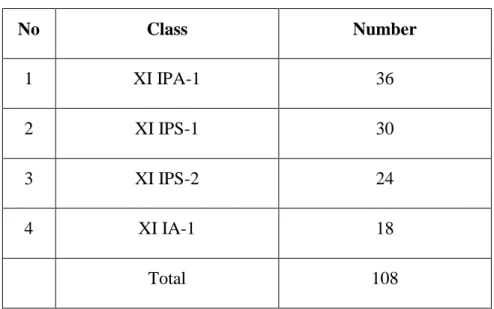
According to Syahrum and Salim “Populasi adalah keseluruhan objek yang akan/ingin diteliti. (“Population is the whole object that will be on the research.)34 The population of this research is 108 students of Second Grade in Madrasah Aliyah Laboratorium UIN-SU Medan.
Table I Distribution of Population No Class Number 1 XI IPA-1 36 2 XI IPS-1 30 3 XI IPS-2 24 4 XI IA-1 18 Total 108
Sample is any part of a population of individual information is obtained. Sample must be reflective with the true example in the field. The writer determined the sample by using simple random sampling technique, because every student in the population got the same opportunity to be chosen or to be sample of the research. The names of the classes were written on a piece of paper and were rolled up, mixed them, and the researcher chose one of them. The writer took class XI IPA-1 consisting of 36 students as the sample.
34
Syahrum and Salim, Metodologi Penelitian Kuantitatif, (Bandung: Citapustaka Media, 2011), p. 113.
C. Data Collections
The procedures of collecting data were such the following: 1. Idiom test
A test of idiom used to measure the students‟ idiom mastery. Types of idioms test were multiple choices, which consist of 20 items.
2. Reading comprehension test
There is 20 items for reading comprehension test. It were multiple choices consist of four passages and each passage contained five multiple-choice questions.
The assessment guidelines used in the tests was number of true are divided number of test and it is multiplied 100 :
The questions of idiom and reading that were compiled were about 30 questions each of them, so the total was 60 questions (Appendix 3 and 4). Before doing the research, those questions were tried out to other students that had the same level with the sample of the research in order to know the quality of the instruments such as validity and reliability. So that the instruments are appropriate for the sample of the research.
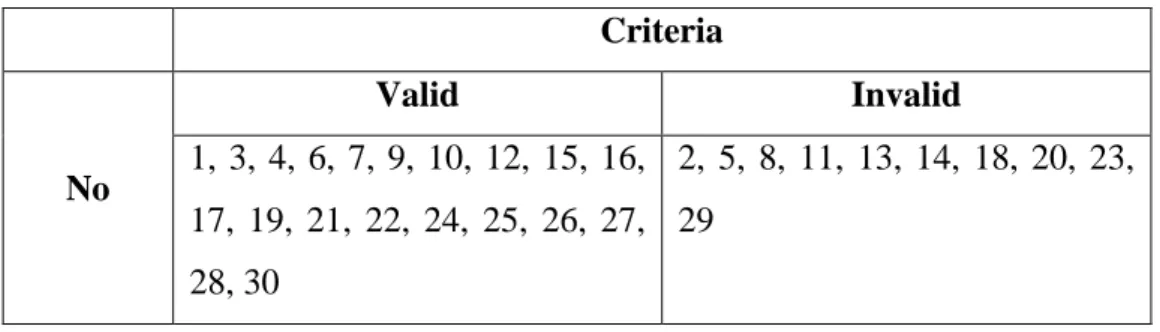
After conducting the try out, the writer found the result of vocabulary and reading score and put it into Excel application to count the quality of the questions. The result shown some questions of idiom and reading that were valid and invalid.
Table II
Items Validity of Multiple choice on Idiom Test Criteria No Valid Invalid 1, 3, 4, 6, 7, 9, 10, 12, 15, 16, 17, 19, 21, 22, 24, 25, 26, 27, 28, 30 2, 5, 8, 11, 13, 14, 18, 20, 23, 29 Table III
Items Validity of Multiple choice on Reading Comprehension Test Criteria No Valid Invalid 1, 2, 3, 5, 7, 8, 9, 10, 11, 14, 15, 17, 18, 19, 22, 23, 24, 25, 26, 30 4, 6, 2, 13, 16, 20, 21, 27, 28, 29
From that result of the quality of both tests, the writer did not use all questions to be tested for sample. The writer decided to take 20 questions for each test. The writer used only the valid questions.
D.Data Analysis
To find out the relationship between idioms mastery and reading comprehension, firstly the writer tested the data by testing normality and testing homogeneity. After that the writer used the correlation formula by Pearson Product Moment Correlation Formula to test the significant relationship between them.
The formula used as follows: 1. Validity
Validity is the ability the test to measure what is supposed to measure. In other word, validity indicates what the test precisely measures and how well the
test measure. For a test valid, it is expected that the content and condition are relevant.
The formula used as follows35:
∑ (∑ )(∑ )
√[ ∑ (∑ ) [ ∑ (∑ ) ]]
Where:
rxy = the coefficient correlation between instrument X and instrument Y N = Number of sample
X = variable X (instrument X) Y = variable Y (instrument Y)
If the coefficient is lower than ttable of correlation, it means that the items that have been provided are not given anymore. So, the items are not becomes as the instrument of collecting data.
2. Reliability
Reliability refers to the consistency of the measurement. The test is reliable when it can show stable outcome. The more reliable the test is, the more confidence the scores obtain from the administration of the test. So, to obtain the reliability of the test the writer used Kuder Richardson formula (KR-20).
35Muri Yusuf, Asesmen dan Evaluasi Pendidikan:Pilar Penyedia Informasi dan Kegiatan Pengendalian Mutu Pendidikan, (Jakarta: Prenadamedia Group, 2015), p. 65.
The formula as follow36: ( ∑ ) ) Where : n = Number of students p = Total of right answer q = Total of wrong answer
S2 = The square of the standard deviation of the test score 3. Normality test
Normality test was held to determine whether normal or abnormal research data or research variables.
a. The observation XI, X2, X3, … …, Xn are served raw numbers Z1, Z2, Z3, …, …, Zn using the formula. To count of raw numbers with the formulas :
̅
X = Average sample S = Standard deviation
b. For each of these raw numbers using standard normal distribution is calculated odds F (Zi) = P (Z ≤ Zi)
c. Furthermore, in calculating the proportion that expressed by S (Zi) then :
( )
d. Calculate F (Zi) – S (Zi) and define the absolute price Determine the largest price of the difference F (Zi) – S (Zi) as Lo.37
36
4. Homogeneity test
Homogeneity test is used to determine whether the sample variance has the same or homogeneous variance, test of homogeneity is used with the following formula38:
Criteria for testing H0 is rejected if F ≥ F0,05 (v1, v2) where F0,05 (v1, v2) obtained from the F distribution list with a chance of α = 0,05 and α = 0,01, whereas the v1 and v2 degrees of freedom each corresponding to df numerator and denominator of the formula above.
5. Finding the number of correlation using formula39:
∑ (∑ )(∑ )
√[ ∑ (∑ ) [ ∑ (∑ ) ]]
Where:
rxy = the Pearson product - moment correlation N = the number of sample
X = the student‟s score in idioms mastery
Y = the student‟s score in reading comprehension
37
Indra Jaya, Penerapan Statistik Untuk Pendidikan, (Bandung: Citapustaka Media Perintis, 2013), p. 253.
38
Sudjana, Metode Statistika, (Bandung: Tarsito Bandung, 2009), p. 14.
39
In the correlational study, the statistic hypothesis can be stated as follows: Ha: rcount > rtable
H0: rcount < rtable Where:
rcount = the result of Pearson product-moment rtable = r table (Pearson product-moment table)
Ha: The alternative hypothesis is accepted, means that there is correlation between students‟ mastery in vocabulary and their reading comprehension.
Ho: The null hypothesis is accepted, means that there is no correlation between students‟ mastery in vocabulary and their reading comprehension.
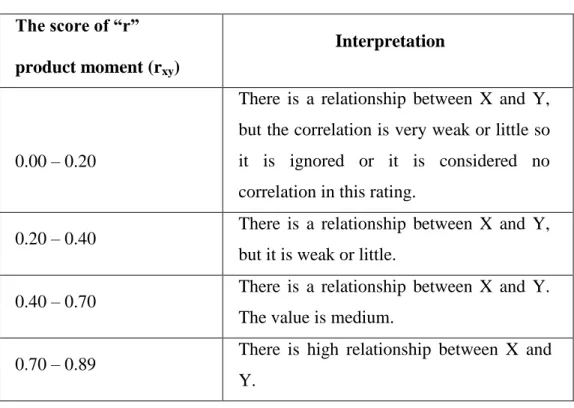
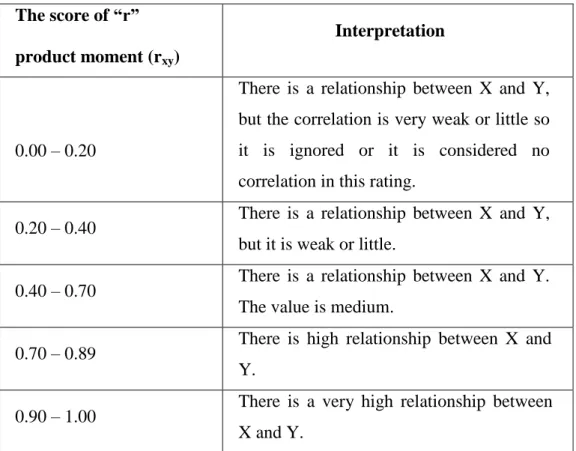
To interpret the index scores of “r” Pearson product-moment correlation, (rxy) usually used the interpretation such as bellow:40
Table IV Pearson Correlation The score of “r” product moment (rxy) Interpretation 0.00 – 0.20
There is a relationship between X and Y, but the correlation is very weak or little so it is ignored or it is considered no correlation in this rating.
0.20 – 0.40 There is a relationship between X and Y, but it is weak or little.
0.40 – 0.70 There is a relationship between X and Y. The value is medium.
0.70 – 0.89 There is high relationship between X and Y.
40
0.90 – 1.00 There is a very high relationship between X and Y.
6. Test the significance by using ttest formula as follow41:
√
√
Where:
to = t value
r = the result of correlation coefficient n = number of sample
E.Research Procedure
In conducted the research, there were some procedures that applied for taking the data :
1. Determined the problem
In order to determine the problem, the writer read the books that were related to the topic under discussion.
2. Determined the instrument
In this research, the writer used instrument in order to be able to be interpreted. The instruments are idiom test, consisting of 20 items, and reading comprehension test which consists of 20 items.
3. Found the sample
The sample of this research determined through simple random probably sampling. There were four class of the second grade of MA Lab UIN-SU
41
Agus Irianto, Statistik:Konsep Dasar, Aplikasi, dan Pengembangannya, (Jakarta: Prenadamedia Group, 2004), p. 81
Medan. However only class XI IPA-1 have a chance to become the sample of this research.
4. Try out the instrument
Before distributing the instruments, the writer distributed the try out test to them in order to guarantee the result to be more valid.
5. Distributed the instrument
Both of the instruments would be distributed on the different day. 6. Scoring the students‟ work
The writer scored the students‟ work in order to get data. 7. Analyzed the data
The writer analyzed the data whether there is correlation between students‟ mastering of idiomatic expression and their reading comprehension.
36
CHAPTER IV
FINDING AND DISCUSSION
A. Findings
A.1 The Description of Data
This study was conducted through correlational study.. There were two variables in this research, namely variable X (students‟ mastering of idiomatic expression) and variable Y (students‟ achievement in reading comprehension). experimental and control group. This research was applied idiom test and reading comprehension test which the total score is 100.
After conducting the research, the researcher got the data of students‟ scores in idiom test and reading comprehension test.
A.1.1 The Data of Students’ Mastering of Idiomatic Expression
The data of students‟ mastering of idiomatic expression were found from the tests which were given to 36 students of MA Lab UIN SU Medan who become the research respondents. The complete data about students‟ mastering of idiomatic expressions can be seen on the following table:
Table V
Test Score of Students’ Mastering of Idiomatic Expression
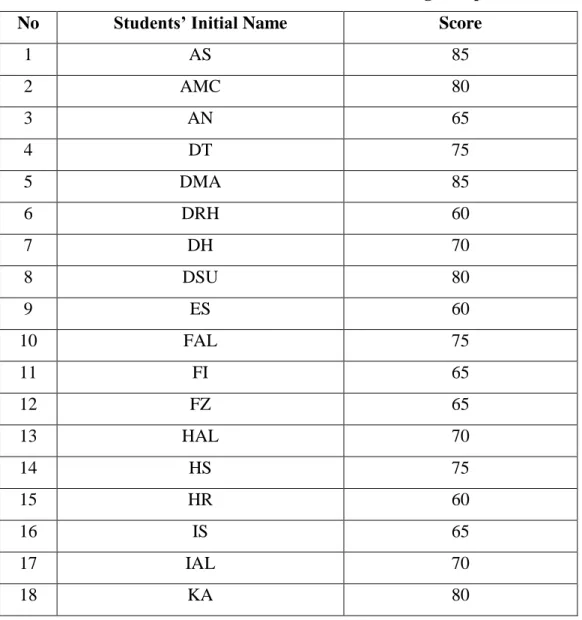
No Students’ Initial Name Score
1 AS 80 2 AMC 70 3 AN 65 4 DT 70 5 DMA 80 6 DRH 60
7 DH 70 8 DSU 75 9 ES 50 10 FAL 55 11 FI 70 12 FZ 65 13 HAL 50 14 HS 60 15 HR 40 16 IS 80 17 IAL 80 18 KA 70 19 MK 60 20 MIMB 75 21 MRS 75 22 MSRS 55 23 MSAR 75 24 MYR 65 25 NHT 40 26 NAAL 55 27 NH 80 28 NS 50 29 PAR 65 30 RAL 75 31 RAP 70 32 RP 45 33 RDA 65 34 RRRT 75 35 RSRA 70 36 SARH 60 N=36 ΣX = 2345
From the data above, it is known that the respondents were 36 students. The score was gotten by dividing the number of correct answers with the number of test and was multiplied by 100. The students who got score 40 were 2 students, score 45 was 1 student, score 50 and 60 were 4 students in orderly, score 60 were 4 students, score 65 were 5 students, score 70 were 7 students, score 75 were 6 students, and score 80 were 5 students. So, the highest score idiom test is 80 while the lowest score is 40.
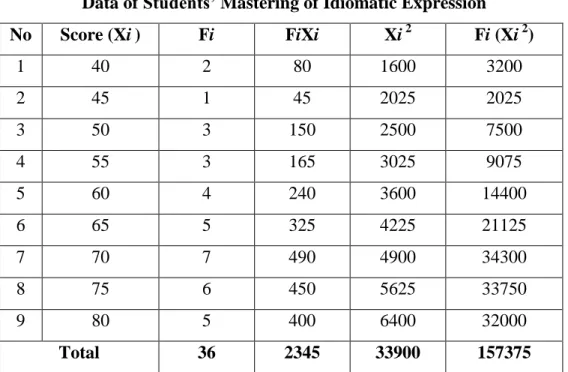
Then to know the average (mean), the variant and the standard deviation from the data of mastering of idiomatic expression can be seen on the following worktable:
Table VI
Worktable for Findings Mean, Variant, and Standard Deviation from the Data of Students’ Mastering of Idiomatic Expression
No Score (Xi) Fi FiXi Xi 2 Fi (Xi 2) 1 40 2 80 1600 3200 2 45 1 45 2025 2025 3 50 3 150 2500 7500 4 55 3 165 3025 9075 5 60 4 240 3600 14400 6 65 5 325 4225 21125 7 70 7 490 4900 34300 8 75 6 450 5625 33750 9 80 5 400 6400 32000 Total 36 2345 33900 157375
From the data above, the first column consist of the students‟ score that symbolized by (Xi) which begin from the lowest score (40) and the higher score (80). Then, the second column explained about the sum of the respondents which