Improving Students’ College Math Readiness:
A Review of the Evidence on
Postsecondary Interventions and Reforms
A CAPSEE Working Paper
Michelle Hodara
Community College Research Center Teachers College, Columbia University
July 2013
The author gratefully acknowledges the important feedback on an earlier draft of this paper from Uri Treisman of the University of Texas at Austin. Christina Chhin and Hiromi Ono of the Institute of Education Sciences and Shanna Smith Jaggars and Thomas Bailey of the Community College Research Center also provided helpful guidance and feedback throughout the project. The author also thanks Florence Ran of the Community College Research Center for assistance with Appendix B. The research reported here was supported by the Institute of Education Sciences, U.S. Department of Education, through Grant R305C110011 to Teachers College, Columbia University. The opinions expressed are those of the author and do not represent views of the Institute or the U.S. Department of Education.
The author is now a senior researcher at Education Northwest: [email protected] For more information about CAPSEE, visit capseecenter.org
Abstract
This paper reviews current research on the effectiveness of interventions and reforms that seek to improve the math preparedness and success of high school students entering college. Based on gaps in the research knowledge, it also provides recommendations for further inquiry in particular areas. The studies reviewed here are selected from research conducted by the Community College Research Center (CCRC) and the National Center for Postsecondary Research (NCPR), from searches of the Education Full Text database for peer-reviewed articles, and from searches of Google Scholar for high-quality reports. The two key criteria for inclusion in the review are that (1) the study in question focuses on (a) an early assessment program in math; (b) a math bridge, boot camp, or brush-up; (c) a reform of developmental math; or (d) improvements to math instruction; and that (2) at least one of the study’s outcomes is related to changes in math or college performance. To evaluate the evidence, I report on each study’s design and findings. I also calculate each intervention’s effect size and categorize the effect size to compare impacts across the studies under review.
Overall, the evidence is limited, but some of the interventions and reforms appear promising. The evidence on early assessment is minimal. The evidence on bridges, boot camps, and brush-ups suggests that short-term programs may only have short-term impacts. The
evidence on different models of developmental reform varies depending on the reform model. For dominant models, it is positive (for compression models), insignificant (for learning communities), or negative (for modularization). For less prevalent models, it is positive (for mainstreaming) or needs further research (for statistics pathways). In terms of innovations that are strictly pedagogical, the strongest positive evidence is found for using structured forms of student collaboration and for building conceptual understanding through the use of multiple representations when teaching and solving problems. The evidence on computer-mediated instruction in the developmental math classroom is very mixed, with some studies finding positive effects and others finding negative effects.
Table of Contents
1. Introduction 1
Four Strategies for Addressing Academic Underpreparedness in Math 3
Purpose and Method of This Review 4
2. Strategy One: Intervening During High School With Early Assessment 6
Overview of Early Assessment 6
Evidence on Early Assessment 6
Directions for Research on Early Assessment 9
3. Strategy Two: Intervening Pre-Matriculation With Bridges, Boot Camps, and
Brush-Ups 12
Overview of Bridges, Boot Camps, and Brush-Ups 12
Evidence on Bridges, Boot Camps, and Brush-Ups 13
Directions for Research on Bridges, Boot Camps, and Brush-Ups 16
4. Strategy Three: Reforming Developmental Math 18
Overview of Developmental Math Reforms 18
Evidence on Developmental Math Reforms 22
Directions for Research on Developmental Math Reforms 29
5. Strategy Four: Improving Math Instruction 31
Evidence on Improving Math Instruction 31
Directions for Research on Improving Math Instruction 35
6. Conclusion 38
References 40
Appendix A: Search Strategy and Inclusion Criteria 50
1
1. Introduction
A major challenge facing many of today’s students as they pursue a postsecondary degree is their lack of academic preparedness for college-level coursework and, in particular, for
college-level math. Nationally, almost half of the 2003–04 cohort who enrolled in college directly after graduating from high school took at least one remedial course in college, and remedial course-taking is much higher at two-year colleges than at four-year colleges (see Table 1). Examining referral to remediation at community colleges by subject, Bailey, Jeong, and Cho (2010) found higher remediation rates in math: 59 percent of the community college students in their sample were referred to developmental math, compared to 33 percent who were referred to developmental reading.1
Table 1. Number of Remedial Courses Taken Among Students Who Graduated From High School in 2003 and Enrolled in College in 2003–04, by College Type
Number of Remedial Courses Taken
College Type 0 (%) 1 (%) 2 (%) 3+ (%) Total (%)
Four-year 65.4 17.7 8.3 8.6 100
Two-year 32.1 20.7 16.0 31.2 100
Less-than-
two-year 57.5 10.6 9.9 22.0 100
Total 52.6 18.6 11.3 17.5 100
Source: Author generated NCES QuickStats table using U.S. Department of Education, National Center for Education Statistics, BPS:2009 Beginning Postsecondary Students data. BPS: 2009 is transcript-level data for the 2003–04 cohort, tracked to 2009.
Entering college underprepared in math has a number of consequences. First, it poses an obstacle to completing a college-level math course, which can be a struggle for beginning
postsecondary students, regardless of their initial course placement in college. Transcript data on the 2003–04 cohort reveal how students are faring in math across two-year and four-year
colleges (U.S. Department of Education, 2012). Over a six-year period, 21 percent of the
students who started at a four-year college never completed a college math course, either because they took no math or took only a remedial math course; 44 percent completed an introductory college math course as their highest math course; and 35 percent completed an advanced college math course (for example, pre-calculus). Among students who started at a two-year college, over a six-year period, 51 percent never completed a college math course, 40 percent completed an introductory college math course as their highest math course, and only 9 percent completed an
1 The data used for this study was from more than 250,000 first-time, credential seeking students who began their enrollment in fall 2003 to fall 2004 at one of 57 colleges participating in the Achieving the Dream initiative. The sample more closely represents an urban, low-income, and minority student population than do community colleges in the country as a whole (Bailey, Jeong, & Cho, 2010, p. 258).
2
advanced college math course. College math completion is particularly low among community college students assigned to remediation: Only about 20 percent of community college students referred to developmental math ever complete a college-level math course (Bailey et al., 2010). Furthermore, there is evidence that college math success varies by student background. At the California community colleges, Asian and White students have significantly higher pass rates in college math than African American and Latino students (EdSource, 2012).
Academic underpreparedness in math not only poses an obstacle to college math success but also can have an impact on an individual’s overall well-being if it hinders college
progression and completion. The gap in earnings between high school and college graduates has been rising since the 1970s, and beyond their economic returns, college degrees are connected to many other positive outcomes, including higher levels of civic participation, healthier lifestyles, greater job satisfaction, and economic, educational, and health benefits that are passed down to one’s children (Baum, Ma, & Payea, 2010). Leaving school without basic math skills can have far-reaching consequences: Quantitative literacy, which includes competency in the arithmetic and algebraic applications that are taught in high school or developmental math, has a strongly predictive relationship with a young adult’s probability of employment and can explain much of the wage gap between African American and White young adults (Rivera-Batiz, 1992).
Finally, math underpreparedness also impacts the number of college students who are able to pursue Science, Technology, Engineering, and Math (STEM) degree programs that require advanced college-level math. The Executive Office of the President (2012) has called for increasing the number of students majoring in a STEM field in order to strengthen U.S. science and technology industries. Yet every year, large numbers of STEM-bound students fail to persist in their program (U.S. Department of Education, 2012). Between 2003 and 2009, approximately 28 percent of four-year and 20 percent of two-year college students began college as STEM majors. Less than half of these students persisted in a STEM major: 20 percent of four-year and 37 percent of two-year college STEM majors left college, and 28 percent of four-year and 33 percent of two-year college STEM majors switched to a non-STEM major. An important factor related to STEM attrition is preparation for college math: STEM leavers tended to take no math or remedial math in their first year in college, while STEM completers tended to start in college-level math.
Improving the college math readiness of high school students entering college may contribute to decreased remediation rates and increased rates of college persistence and degree completion helping to improve individuals’ lifetime earnings and overall welfare. It may also bolster the quality of the workforce, particularly in science and technology fields—thereby helping to improve the nation’s economy.
3
Four Strategies for Addressing Academic Underpreparedness in Math
Students enter college underprepared in math for a number of reasons—some did not take enough math in high school; some did not take the math they need for their college degree
program; some did not master the math they took in high school; and/or some forgot the math they learned in high school (Fike & Fike, 2012). Additionally, students may feel frustrated or may struggle in their first math course in college because college placement exams are imperfect indicators of academic readiness; the exams misplace some students who are prepared for
college math coursework into math remediation and misplace others who need additional support with basic math concepts into college-level coursework (Scott-Clayton, Crosta, & Belfield, 2012).
The underlying reasons for high rates of math remediation and college math failure thus necessitate a variety of reforms and interventions for improving students’ readiness for college math as well as for measuring incoming college students’ math skills. This review focuses on the interventions and reforms that postsecondary institutions currently employ to address academic underpreparedness in math and to foster college math success. These interventions and reforms fall under one of four different strategies: the first two (early assessment; bridges, boot camps, and brush-ups) seek to help high school students avoid math remediation before they begin their first semester at college so that they may enter college prepared for the first math course in their degree program, the third encompasses reforms to developmental math, and the fourth comprises improvements to math instruction in developmental and college math classrooms. Below, I briefly introduce the four strategies, each of which will be discussed in more detail later in the paper.
Strategy One: Intervening During High School With Early Assessment
The first strategy is the early assessment of high school students using college placement tests. The purpose of early assessment is to provide students an early indication of their level of college readiness based on the entry-level standards at their local four-year or community college (Barnett & Hughes, 2010). High school students who place into remediation then have time to work on their reading, writing, and math skills in order to avoid remediation once they enroll at college.
Strategy Two: Intervening Pre-Matriculation With Bridges, Boot Camps, and Brush-Ups
A second strategy is to intervene after high school students graduate but before they matriculate by providing short-term interventions. These bridge programs, boot camps, and brush-ups are designed to improve incoming college students’ math skills and help them place into college-level math, usually college algebra or statistics, or, for STEM students, the first college math course in their program, usually pre-calculus or calculus (Kallison & Stader, 2012; Sherer & Grunow, 2010). The interventions typically take place on college campuses, occur during the summer, and are targeted at students who took the placement exam in high school or
4
at the start of the summer and who placed into remedial math (or into a math class below the college math required for their STEM degree program). Individuals then participate in an intensive course for a short amount of time before the start of the semester and then retest to attempt to place into college-level math (or the first college math course in their program).
Strategy Three: Reforming Developmental Math
A third strategy is to reform developmental math in an effort to improve the outcomes of students who enroll in these courses. The traditional developmental education system may have high rates of course failure and student attrition because of its long sequence structure and misalignment between developmental and college-level standards and curriculum (Jaggars & Hodara, 2013). Reforms to developmental math attempt to address these weaknesses by
shortening the sequence and/or aligning the curriculum to include the skills students need to be successful in the first college math course in their degree program.
Strategy Four: Improving Math Instruction
A fourth strategy is to focus on teaching and learning in the math classroom. This strategy overlaps in some ways with Strategy Three, given that some reforms of the
developmental math sequence structure and curriculum may result in changes to instruction or explicitly include instructional reform. However, this strategy focuses exclusively on changes to pedagogy inside the math classroom. I focus on math instruction in postsecondary math
classrooms in general (including both the developmental and college level), given that some students who enroll directly in college math are underprepared as well and also struggle to succeed.
Purpose and Method of This Review
The purpose of this review is twofold. First, it synthesizes the research on the effectiveness of interventions and reforms that seek to improve the math preparedness and success of high school students entering college. Second, it provides recommendations for future research and inquiry in this area. The studies reviewed here are selected from three main sources: research from the Community College Research Center (CCRC) and the National Center for Postsecondary Research (NCPR), searches of the Education Full Text database for peer-reviewed articles, and searches of Google Scholar for high-quality reports. The two key criteria for
inclusion in the review are that (1) the study focuses on (a) an early assessment program in math; (b) a math bridge, boot camp, or brush-up; (c) a reform of developmental math; or (d)
improvements to math instruction; and that (2) at least one of the study’s outcomes is related to changes in math or college performance (e.g., employs measures of math learning, college math enrollment, or course pass rates, but not self-reported measures such as student satisfaction or math anxiety). Appendix A includes more details on the inclusion criteria and search strategy. To evaluate the evidence, I report on each study’s design and findings. I classify studies according to three types of study methods indicated in Table 2. The strongest evidence is from
5
randomized control trial (RCT) and quasi-experimental design (QED) studies because of their use of a comparison group that can explain what would have happened if the treatment students had not received the intervention. Descriptive studies provide inconclusive evidence because it is not possible to attribute any observed outcomes to the intervention, as it is unknown if the
outcomes would have been similar, better, or worse in the absence of the treatment. In addition to identifying the design of the reviewed studies, I calculate their effect sizes and effect
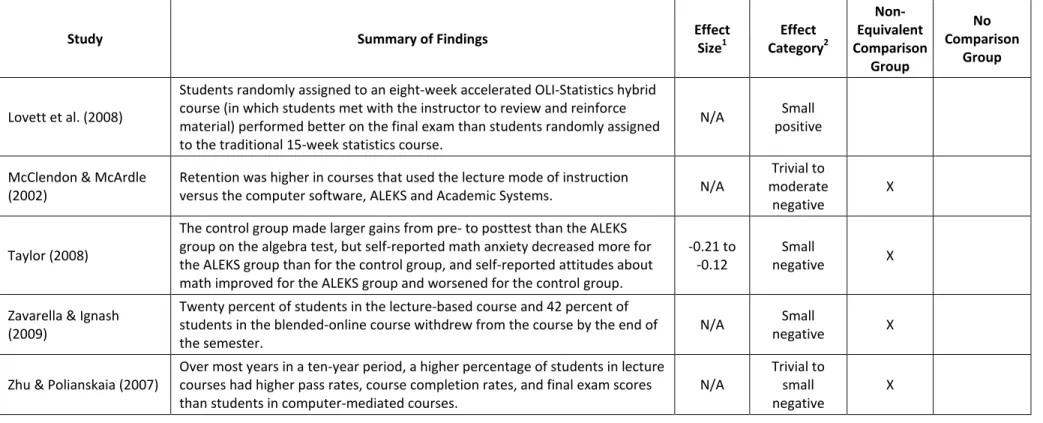
categories, which allows for standardized measures of impact and the size of the impact across different types of interventions. Most of the very rigorous studies reviewed here, the RCT and QED studies, find trivial to small positive effects of the intervention or reform on students’ academic outcomes.2 For details on all the studies in this review, see the table in Appendix B, which provides a summary of each study’s findings, the effect size and/or effect category of the findings, and indicates if the design used non-equivalent treatment and control groups or no comparison group.
Table 2: Study Type
Method Description
Randomized controlled trial (RCT) Participants are assigned to treatment and comparison groups entirely by chance.
Quasi-experimental design (QED) Participants are not assigned to treatment and
comparison groups by chance, but reasonable attempts are made to adjust for non-random assignment.
Descriptive Study uses no comparison group or uses a comparison group with no adjustment for student differences.
This review is organized as follows. For each strategy, I first describe typical
interventions and reforms, and provide some idea of the extent of their implementation across the nation; next, I summarize the extent and quality of the evidence on the effectiveness of the interventions and reforms; and finally, I outline directions for future research. A concluding section summarizes the gaps in the research and suggests questions for further exploration.
2 A trivial effect size is equivalent to a zero to 0.20 standard deviation difference in means or zero to 10 percentage point difference in means, and a small effect size is equivalent to a 0.20 to 0.60 standard deviation difference in means or 10 to 30 percentage point difference in means (Hopkins, 2009).
6
2. Strategy One: Intervening During High School
With Early Assessment
Overview of Early Assessment
Early assessment of high school students using college placement exams seems to be a fairly widespread practice across the United States (Hodara, Jaggars, & Karp, 2012). In most programs, colleges are minimally involved. While the colleges’ placement tests are used to signal high school students’ level of readiness for college-level coursework, high schools are left to decide what interventions, if any, to provide to students who are not deemed college-ready. For example, the University of Wisconsin has made a version of their placement exams available online for all Wisconsin high school students to take as sophomores, juniors, or seniors. The purpose of the early math placement tool program is twofold: to alert students to their level of readiness for college-level math in different degree programs at the University of Wisconsin, and to inform students about what kind of math they still need to take in high school to be college-ready in different degree programs (in order to encourage students to take more math in high school) (EMPT, n.d.).
It is less common for colleges and high schools to work together to design interventions for students who do not test as college-ready. Because early assessments are not typically paired with substantive academic interventions, Tierney and Garcia (2011), who have categorized college readiness efforts as “(a) academic, (b) information, and (c) motivational/social” (p. 107), regard early assessment as informational. However, some early assessment programs have an academic component as well. This section of the review discusses findings on the effectiveness of two well-regarded early assessment programs that have an academic component.
Evidence on Early Assessment
The evidence on the effectiveness of early assessment is minimal—only two studies report any quantitative findings. The first is a QED study of the California State University system’s Early Assessment Program (CSU’s EAP) (Howell, Kurlaender, & Grodsky, 2010), and the second is a descriptive study on a college readiness protocol in El Paso, Texas (Kerrigan & Slater, 2010). Both studies found that early assessment reduces the need for remediation, but impacts are trivial in size when standardized to allow for comparisons across studies (see Appendix B).
There are three components of CSU’s EAP (Venezia & Voloch, 2012). The first
component is early testing. CSU worked together with the California Department of Education and California State Board of Education to set standards of college readiness in reading, writing, and math. CSU and K-12 faculty then revised the California high school standardized test (CST) to include an optional section on the CST that assesses these standards, which are essentially CSU entrance standards. All juniors take the CST in English and, beginning in spring 2004, have
7
the option to participate in the EAP through early testing. Students who take the CST can choose to complete an optional writing sample and reading test items that assess their readiness for college English at CSU. Only students who have completed Algebra II are eligible for the math CST, and they can complete optional math test items that assess their readiness for college math at CSU. Students’ performance on the CSU-portion of the standardized test determines if they are prepared for college-level English and math at CSU. If they score above a college-ready cutoff, they can immediately enroll in college-level courses when they start at CSU. If they score below, they are directed to academic supports in their senior year, which encompass the second component of the EAP. CSU and high school faculty collaborated in the design of English courses, which cover both reading and writing skills, and math courses for students who need additional preparation, and CSU’s diagnostic writing and math tests help students identify specific areas of weakness they should focus on. A third component of the EAP is professional development for high school teachers focused on aligning content and standards with
postsecondary expectations. In 2008, EAP was expanded to students entering California
community colleges, and some community colleges use student performance on the CSU portion of the CST to determine course placements.
Howell et al. (2010) evaluated the impact of the first component of CSU’s EAP, early testing, focusing on a single campus, CSU-Sacramento, because it represents the average
characteristics of students in the CSU system. They employed a quasi-experimental design using data on high school juniors in the 2001–02 to 2004-05 academic years and estimated the impact of the availability of EAP beginning in the 2003–04 academic year. The 2001 and 2002 juniors served as the control group, and the 2003 and 2004 juniors served as the treatment group. Controlling for student and high school characteristics, Howell et al. found that being a junior in the years EAP was available decreased students’ probability of referral to remedial math at CSU by 3.7 percentage points. This estimate represents the intent-to-treat effect because participating in the EAP was optional. A second model estimated the treatment-on-treated effect, the impact of actual participation in the EAP, with a difference-in-differences design that interacts an indicator of being a junior in the years when the EAP was in effect with an indicator of participating in the EAP. Compared to students in previous years when EAP was not available and students in years when EAP was available who chose not to participate, the probability of being referred to remedial math at CSU for students who actually completed the optional test items on the CST decreased by 4.1 percentage points.3
These results are robust to alternative models that attempt to address potential confounding factors. One concern is that the model does not account for potential changing conditions for juniors from 2001 to 2004 that may be related to differences in their remediation rate. Howell et al. (2010) addressed this concern using propensity score matching to estimate the probability of referral to remediation of students who were juniors in the 2003 and 2004 years, when the EAP was available, who chose to participate in the EAP compared to similar juniors in
3 The intent-to-treat effect on reducing the English remediation rate is insignificant (i.e., no different from zero). Actual EAP participation reduces the probability of being referred to English remediation by 6.1 percentage points.
8
those same years who chose not to participate. This model indicated that participation in the EAP reduced the probability of being referred to remedial math by 4.1 percentage points. A second concern is that the treatment on the treated estimate is upward biased because of unobservable differences between students who chose to participate in the EAP versus those who did not in the years it was available. The authors addressed this concern by estimating the intent-to-treat effect of the EAP on the probability of referral to remediation of students who attended high schools where almost all students participated in the EAP when it was available compared to students at those same high schools in the years before the EAP was available. This model indicated that being a junior in the years the EAP was available reduced students’ probability of remediation by 3.9 percentage points.
The Howell et al. (2010) study provides suggestive evidence that the early testing component of CSU’s EAP reduces the need for remediation, at least for students who attended CSU-Sacramento and were eligible for EAP because they completed Algebra II. However, no other quasi-experimental or experimental studies have been conducted on this intervention; thus the overall effect of CSU’s EAP on California students’ college readiness is unknown.
In addition to the California study, descriptive findings from El Paso illustrate an association between early assessment and a small drop in remediation rates. Representatives from El Paso Community College (EPCC), University of Texas at El Paso (UTEP), and area high schools created a “college readiness protocol” in 2005 (Kerrigan & Slater, 2010). During their junior or senior year, high school students in El Paso participate in the protocol, which consists of completing the joint admissions application to EPCC and UTEP, preparing for the ACCUPLACER placement exam, taking the ACCUPLACER, reviewing their scores, and, if necessary, refreshing their skills and retaking the exam. Summer bridge programs are available for students who place into remediation upon retaking the exam.
Almost three-quarters of incoming EPCC freshmen in 2007 participated in the protocol in high school, and EPCC institutional research found that 5 percent placed into college-ready math compared to 3 percent of the 2005 class, who had not been exposed to the protocol in high school (Kerrigan & Slater, 2010). Additionally, compared to the 2005 cohort, a much greater proportion of the 2007 cohort placed into the highest developmental math course, and a lower proportion placed into the lower levels. These findings do not account for differences in student-level characteristics, time-varying confounds, and endogenous sorting. For example, perhaps the 2007 cohort had better math skills, on average, than the 2005 cohort; perhaps high schools improved over time; or perhaps only the most motivated students took part in the college readiness protocol, inflating the true impact of early assessment. As a result, the association between early assessment in El Paso and the 2 percentage point increase in the proportion of college-ready students from 2005 to 2007 may be entirely explained by other factors.
Furthermore, the fact that only 5 percent of incoming EPCC students placed into college math suggests that more far-reaching, systemic changes need to be considered to have a substantial impact on the college math readiness of El Paso high school students.
9 Directions for Research on Early Assessment
The two reviewed studies, as well as informal reports from other colleges that have conducted internal research on their remediation rates before and after implementation of early assessment (Hodara et al., 2012), suggest that early assessment may increase the number of high school students placing directly into college-level coursework. However, beyond this finding, we know little about early assessment and its impact on students. Therefore, rigorous research needs to be conducted to confirm if early assessment has a direct effect on reducing the remediation rate across different models, in different contexts, and with different types of students. A deeper look at the long-term impact of early assessment programs would also identify if they have more substantive benefits beyond reducing the remediation rate; in particular, in-depth studies might indicate whether programs enhance students’ performance in math courses, college progression, persistence, and degree attainment.
Future research in this area should also explore the mechanisms underlying the impact of early testing. Howell et al. (2010) suggested two potential reasons for the impact of early testing on lowering students’ probability of referral to remediation at CSU. One potential explanation is that high school juniors referred to remediation based on the CST were discouraged and, as a result, decided not to apply to CSU, thus lowering the remediation rate. However, Howell et al. found no evidence that students who did not test as college-ready on the CST were less likely to apply to CSU. Thus, Howell et al. inferred an alternative explanation: that juniors referred to remediation based on the CST took the necessary steps to improve their math skills, such as participating in an extra math class or academic support in their senior year, which helped them avoid remediation when they eventually enrolled at CSU.
Future research could also undertake an exploration of the role of early assessment in strengthening collaborations between secondary and postsecondary systems. One hypothesis is that early assessment programs have contributed to stronger relationships between secondary and postsecondary systems. Collaborative efforts between high school and college stakeholders working to implement early assessment programs have been documented in a number of states (California in Knudson, Zitzer-Comfort, Quirk, & Alexander, 2008; Spence, 2005; Spence, 2009; Venezia & Voloch, 2012; Florida in Bilsky, 2011; Burdman, 2011; Collins, 2009; New York in Venezia & Voloch, 2012; and Texas in Kerrigan & Slater, 2010).
For example, in 2007, after Florida joined the American Diploma Project, an initiative of Achieve, Inc. that works to help states raise academic standards, over 100 teachers and faculty from high schools, two-year colleges, and state universities from across the state met to discuss, decide on, and then draft entry-level college competencies in reading, writing, and math, called the Postsecondary Readiness Competencies (PRCs) (Bilsky, 2011). Then, in 2008, the Florida State Legislature passed legislation requiring all high school juniors to be assessed using a statewide college placement exam, and requiring high schools to provide students who place into remediation with remedial coursework prior to graduating from high school (Collins, 2009). The legislation prompted the faculty group who drafted the PRCs to reconvene and become heavily
10
involved in the development of the new placement exam (Bilsky, 2011). The faculty group reviewed test items submitted by test vendors to assess which were the most closely aligned with the PRCs in order to help choose a test vendor to develop the new placement test, eventually called the Postsecondary Education Readiness Test (PERT). The faculty group also developed sample test items based on the PRCs for the PERT, and when the Common Core State Standards were released, the faculty group worked to align the PRCs with these standards and develop and review new test items for the PERT. In 2010, Florida began assessing high school juniors using the PERT and offering transitional courses to seniors who placed into remediation based on their PERT performance.4
However, an alternative hypothesis is that comprehensive early assessment programs, like the one in Florida, that involve an informational and academic component and are related to or result in efforts to align high school graduation and college entry standards are rare. Instead, qualitative studies suggest that while early assessment efforts are common, there is a lack of deeper collaboration between secondary and postsecondary institutions across the country. In a study of assessment and placement practices across 38 two-year colleges in seven states, Hodara et al. (2012) found a large number of early assessment efforts, but at only one college were faculty working with local high school administrators and teachers to create remedial
interventions at the high school level for juniors who tested into remediation based on the college placement exam. Additionally, across the seven states, only Texas was involved in aligning high school graduation requirements with college-readiness standards (Hodara et al., 2012). In
Grubb’s (2013) study of 13 community colleges in California, only one college was found to be collaborating with a feeder high school to discuss ways to improve student readiness for college and to lower rates of remedial placement.
Partnerships between colleges and local high schools may become more common with the implementation of the Common Core State Standards (CCSS) (Barnett & Fay, 2013). For example, the implementation of the standards has spurred conversations in some postsecondary systems about aligning developmental education and/or introductory math and English curricula to the CCSS. In addition, early assessment may become more widespread. In the 2014–15 academic year, new assessments aligned with the Common Core States Standards will be administered to juniors to assess their level of college and career readiness in the 45 states that have adopted the standards. A cutoff score will be set that represents the minimum score to be considered college- and career-ready. If colleges honor this cutoff and allow students who score at or above it to enroll in college coursework without taking the college placement exams, then the administration of the new assessments will essentially represent a large-scale early
assessment program. The scale of implementation poses a motivation for studying if and how early assessment affects students and presents opportunities for future research in this area.
4 To date, there is no descriptive or quasi-experimental research on the impact of the administration of the Florida PERT and remedial interventions at the high school level on student outcomes.
11
To summarize, I recommend two general directions for research on early assessment:
1. Rigorous evidence on the effects of early assessment and the mechanisms underlying its effects. Research questions may include:
a. What is the causal effect of signaling to high school
students that they are not college-ready on their enrollment and performance in college math, and what are the long-term impacts on college outcomes, such as progression, persistence, and degree attainment?
b. How do the effects vary across different contexts and models of early assessment, for example, when early assessment takes place at the sophomore, junior, or senior level; for students with different levels of initial math preparation in high school; and when early assessment programs are purely informational versus when they have an academic component and/or a motivational/social component?
c. What is the effect of early assessment on participation in remedial interventions and other coursework choices at the high school level?
d. For students who do not place as college-ready based on early assessment measures, how effective are remedial interventions at the high school level in improving their college math readiness, measured by math placement exam performance and enrollment and performance in college math? What features of remedial interventions at the high school level make them more or less effective?
2. An understanding of the role early assessment plays in strengthening secondary and postsecondary partnerships.
Research questions may include:
a. Do early assessment initiatives lead to greater collaboration between secondary and postsecondary institutions? What is the nature of this collaboration? Does early assessment lead to more remedial interventions at the high school level? Revisions of placement exams? More testing at high schools?
12
b. How will the implementation of the Common Core State Standards assessments impact early assessment programs and secondary and postsecondary partnerships generally?
3. Strategy Two: Intervening Pre-Matriculation With
Bridges, Boot Camps, and Brush-Ups
Overview of Bridges, Boot Camps, and Brush-Ups
Bridges, boot camps, and brush-ups typically recruit high school students in their senior year who are on track for remediation or individuals who apply to college early and place into remediation. The programs consist of intensive basic skills courses that take place during the summer on college campuses (Sherer & Grunow, 2010). According to recent national scans of “math intensives” and developmental education innovations, bridges and boot camps are relatively common at colleges across the country (Edgecombe, Cormier, Bickerstaff, & Barragan, 2013; Sherer & Grunow, 2010). Community colleges also seem to be increasingly offering brush-up courses because they are low-cost and easy to scale up (Hodara et al., 2012).
Summer bridge programs have a long history in higher education (Strayhorn, 2011). Some bridge programs are for students who place into remediation while others are for students entering STEM programs who are not prepared for the first college math course in the STEM program, often pre-calculus or calculus. Many bridge programs are targeted to minorities and first-generation college students, and to individuals who have lower rates of persistence and completion than other college students and who are underrepresented in the STEM fields (Kallison & Stader, 2012; Lenaburg, Aguirre, Goodchild, & Kuhn, 2012; Stolle-McAllister, 2011; Walpole et al., 2008). Bridge programs are typically designed to improve students’ math skills, as well as orient them to college culture, build their study skills, and provide them with an important network of support prior to enrolling. In this way, bridge programs attempt to impact students’ college outcomes through multiple mechanisms: academic supports to help students start college in college-level coursework and non-academic supports intended to improve their persistence in college (Barnett et al., 2012).
Bridge programs and boot camps are very similar, and sometimes colleges use the term bridge program and boot camp interchangeably, but boot camps tend to be shorter in duration than bridge programs and primarily focus on building students’ math skills and improving their performance on placement tests (Sherer & Grunow, 2010).
13
In contrast to bridge programs and boot camps, brush-up courses tend to last only a few hours and focus exclusively on placement test preparation, either for students testing for the first time or for students who initially tested into remediation and want to retest (Hodara et al., 2012). These courses are not necessarily designed to improve math skills; rather, they are focused on improving the accuracy of the student’s test score and associated placement, by ensuring that the student is familiar with the exam and has the opportunity to refresh relevant pre-existing math knowledge. While bridge programs and some boot camps tend to have an informational,
academic, and motivational or social component, brush-ups only have an academic component. Evidence on Bridges, Boot Camps, and Brush-Ups
The evidence on bridges, boot camps, and brush-ups includes one RCT (Barnett et al., 2012) and a set of descriptive studies, many of which report institutional research (Gleason et al., 2010; Hodara et al., 2012; Kallison & Stader, 2012; Reisel, Jablonski, Hosseini, & Munson, 2012; Sherer & Grunow, 2010). Overall, these studies do not yield strong findings in favor of bridges, boot camps, and brush-ups: impacts are largely questionable given the lack of an equivalent comparison group and range in size and sign from trivially negative to moderately positive (see Appendix B).
Barnett et al. (2012) conducted a randomized experiment of developmental summer bridge programs offered to recent high school graduates at two open-admissions four-year colleges and six community colleges across the state of Texas. Students attended the summer bridge programs for three to six hours daily for four to five weeks. Although the programs at each college varied, they shared similar features: accelerated instruction in math, reading, and/or writing; academic support outside of class through individual tutoring and/or access to labs where tutors were available; a college knowledge component provided through advisors,
mentors, and financial aid staff through a college success course or more informal presentations and workshops; and a stipend of $150 delivered at the start of the program to improve
recruitment efforts and $250 delivered after completion of the program to encourage students to complete.
Study participants included those who placed into remediation, usually based on placement testing in their senior year in high school, and applied for admission to the summer bridge program in the summer of 2009 (Barnett et al., 2012). After agreeing to take part in the study, participants were randomly assigned to the summer bridge treatment group or the control group. Therefore, students in the treatment and control groups should be similar, on average, across observable characteristics, such as demographics and placement scores, and unobservable characteristics, such as motivation, and, therefore, any differences in their outcomes can be attributed to participation in the summer bridge program.
Students were followed for two years, and differences in outcomes reveal that the summer bridge programs had extremely modest impacts (Barnett et al., 2012). A higher
14
course through the fall 2010, but by the spring 2011 there was no significant difference in the proportion of treatment group students (46.5 percent) and control students (43 percent) who passed college math.5 Differences in persistence (i.e., total semesters registered over the two-year period), the number of college credits earned, and the number of college credits attempted of students in the treatment and control groups were also not statistically different from zero. The limitations of the study are that the researchers could not disentangle the effects of different components of the summer bridge program, and the results pertain to a specific group of students that placed into remediation but were motivated enough to sign up for a summer bridge program, and therefore the findings are not generalizable to all summer bridge programs and all types of students.
Importantly, Barnett et al. (2012) did not examine the program’s impact on the most common outcome across studies of early assessment, bridges, boot camps, and brush-ups: course placement after the intervention. Instead, the researchers focused on the longer-term outcome of eventual college math completion. The statistically similar college math pass rates of the
treatment and control groups signify that even if the Texas summer bridge program improved the college math placement of treatment students so that more treatment students placed into college math than control students, it had no impact on actually helping them pass college math. This suggests that programs that focus on improving placement test performance may not have a meaningful impact on improving students’ performance in college math or long-term outcomes, such as persistence and progression.
Kallison and Stader (2012) also conducted a study on the Texas developmental summer bridge programs, but their study was descriptive and has limited internal validity. They examined gains in placement test scores among summer bridge participants who took a pretest and posttest. Only four institutions collected math test score data, and at these colleges there was no statistical difference in the math placement exam performance of students before and after participating in the summer bridge program.
Two descriptive studies (Gleason et al., 2010; Reisel et al., 2012) report on the outcomes of students in bridge programs at University of Alabama and University of
Wisconsin-Milwaukee targeted to incoming STEM majors who placed below calculus; both universities identified an initial placement below calculus as a key predictor of STEM attrition. The bridge programs provided accelerated instruction in pre-calculus mathematical content, including college algebra and trigonometry, so that students did not delay enrollment in the calculus sequence. Both programs had similar features: they were residential (although in the first two years the University of Wisconsin program also allowed students to complete the program online from home); they lasted about one month; and students spent the mornings learning math content and the afternoons applying their math skills in real-world problem-solving activities. The
University of Alabama program was voluntary for students who scored in a certain range below
5 The same is true for treatment and control students referred to developmental reading: there were no significant differences in the proportion of students enrolling in college-level English.
15
the cutoff for placement into calculus, while the University of Wisconsin program was
mandatory for students whose math ACT, high school grades, and class rank matched the profile of engineering students with the lowest graduation rates.
Gleason et al. (2010) found that although the Alabama students who took part in the summer bridge program, from 2005 to 2007, significantly increased their math placement scores upon completion of the program, not all students were able to place into calculus in the fall. Program students who placed into calculus subjects performed significantly worse in pre-calculus courses than students with similar placement scores who placed directly into these courses, and there was no significant difference in the grades of program students who placed into calculus and control students who placed directly into calculus. The meaning of these results is unclear, because it is unknown how the program students would have fared in their first-semester math course in the absence of participating in the summer bridge program.6 In terms of retention, 92 percent of students in the pilot program were still in a STEM degree program three years later, compared to 63 percent of STEM students who entered in the same year with similar placement test scores. Although this difference in STEM retention is quite large, it could be due entirely to the higher motivation of students who chose to participate in the summer bridge program.
The Reisel et al. (2012) study of the University of Wisconsin program did not employ a comparison group, and its purpose was primarily to track the relationship between features of the program and gains in students’ math placement test scores upon completion of the program. Students in the residential program improved their math placement scores more than students in the online program (prompting the university to discontinue the online option in 2009); gains were trivial for students in the online program but of a moderate size for students in the
residential program. In addition, in the morning session, students worked through individualized, self-paced math content using ALEKS (Assessment and Learning in Knowledge Spaces), a computer-adaptive, online assessment and learning program, and students with more ALEKS time-on-task had greater improvements in their placement test scores.
The remaining findings on boot camps and brush-ups are all descriptive reports based on colleges’ internal research. Boot camps at EPCC in Texas, LaGuardia Community College in New York, Montgomery County Community College in Maryland, and Pasadena City College in California all report that a proportion of participants improved their placement exam
performance and placed into a higher developmental math level or college-level math (Sherer & Grunow, 2010). At EPCC, specifically, students participating in the PREP boot camp take a diagnostic test on A+ Advancer, an online resource aligned to the ACCPUPLACER placement exam that creates an individualized test prep course for each student that targets his or her own areas of weakness. Students complete the individualized course in a lab where there are tutors
6 For example, in the absence of the program, would program students fare even more poorly in calculus? If so, then the observed null result for calculus performance is in fact a positive result. On the other hand, if these students would have performed just as well in calculus without the program, then the null result indicates that the program was not helpful.
16
available. After they retake ACCUPLACER, they meet with a counselor to select courses and discuss their goals. From 2003 and 2008, between 52 to 66 percent of PREP participants placed at least one level higher in math (Sherer & Grunow, 2010). However, without a comparison group, it is unknown what the outcomes of these students would be in the absence of the treatment—for example, if the students had simply retested without participating in the boot camp.
Institutional research from a North Carolina college also finds a positive association between test preparation in a brush-up course and improvements in placement (Hodara et al., 2012). The North Carolina college created an online course for their reading, writing, and math placement exams, which students can access and complete from any computer at their
convenience. The online course opens with a video of a student explaining the importance of the placement exams and the content of the review. For each subject, the course includes
approximately one hour and twenty minutes of content: a diagnostic pretest, information on areas where the student is weak, instructional videos that cover the test content, a posttest, and
additional resources to help students prepare for the test, such as PowerPoint presentations created by faculty and links to ACT online practice materials. The college found that from fall 2010 to spring 2011, among all students who took the review course before re-testing, 35 percent of students tested at least one level higher in the developmental math sequence and had similar or higher pass rates in the courses they retested into, compared with their counterparts who placed directly into the course. Currently, the state is working with a new placement test vendor to create similar, online brush-up courses that will be offered to incoming community college students statewide.
Directions for Research on Bridges, Boot Camps, and Brush-Ups
There is only one extant rigorous study on the impact of a summer program that attempts to improve the math placement and college performance of high school students who are on track for remediation. Barnett et al. (2012) found that the Texas developmental summer bridges programs had only short-term impacts on passing introductory college math, suggesting that short-term interventions are not sufficient to impact the educational outcomes of students in a meaningful way. In other words, summer programs should be one small component of a larger support framework for high school students as they transition from high school to college; other components might include early assessment, remedial interventions at the high school level, and supports that continue throughout a students’ college career. Supporting students from their high school years into college could be an extremely resource-intensive, yet profoundly important endeavor. Therefore, understanding which program features have a long-term impact on students and are cost-effective is an important direction for research.
Some of this research is presently under way. Specifically, MDRC is conducting an evaluation of the “Getting Ready for Success” (GRS), a program in Tacoma, Washington, for low-income high school juniors, which builds on the lessons of the Texas developmental summer
17
bridges evaluation (Sepanik, 2012). GRS students participate in an academic enrichment program before their senior year, work with college advisors and mentors during their senior year, and if they still need remedial support, take part in a summer bridge program after
graduating from high school. During their first year in college, they continue to receive advising and mentoring, and receive incentives along the way that total to $3000 if they successfully complete all components of the program.
Another direction for future research is to better understand the causal effects of placement exam preparation, primarily offered through boot camps and brush-ups, on not only traditional indicators of placement test performance but also on math learning, as measured by grades in college math and perhaps a learning assessment, and subsequent college outcomes. Test preparation seems to help students who are underplaced and do not need remediation by allowing them to avoid unnecessary developmental coursework (Hodara et al., 2012). Test preparation may effectively prepare students for college math because it helps students refresh their math skills and/or relearn the math content. However, an alternative scenario is that
improvements in placement exam performance do not necessarily mean students are prepared for college-level math, because students may be learning how to perform better on the exam but not learning the underlying content. If so, then students may need additional supports to perform well in the higher level course they place into after successfully participating in a boot camp or brush up.
Improvements in placement exam performance may also be weakly related to
performance in college coursework because commercial placement exams comprise standardized content that is not necessarily aligned to the institution’s introductory college-level math and English curricula (Hodara et al, 2012). The challenge in developing placement exams that more accurately reflect incoming students’ readiness for introductory college coursework is creating an exam that directly tests the skills students need to be successful in their colleges’ introductory math and English courses. Creating a customized exam may be a particular challenge for
resource-constrained institutions and systems; commercial exams (for example, COMPASS and ACCUPLACER) are readily available and are perhaps less expensive than creating a customized exam. Yet, increasingly, higher education systems are addressing the misalignment between the content of the placement exam and introductory college English and math by developing their own customized exams that are aligned to the system’s standards for readiness in introductory college English and math.7 An interesting and useful research question would be to investigate if customized placement exams are more effective at predicting students’ readiness for college than commercial exams.
To summarize, I recommend two general directions for research on bridges, boot camps, and brush-ups:
7 These are some systems and states that have a customized exam or are developing one: University of
Wisconsin, City University of New York in English, Virginia Community College System, Florida, North Carolina Community College System (in development), and Texas (in development).
18
1. An exploration of cost-effective features and models of bridges and boot camps that lead to long-term benefits for students.
Research questions may include:
a. What academic and non-academic features of bridges and boot camps are most important in supporting students’ college persistence and degree attainment?
b. What is the optimal length of time that programs should support students as they transition from high school to college in order to yield cost-effective, long-term impacts? 2. Causal evidence on the effects of test preparation delivered
primarily through boot camps and brush-ups. Research questions may include:
a. What are the causal effects of test prep courses on enrollment and performance in college math courses as well as on performance on a math learning assessment? b. How do the effects differ if instruction is delivered
face-to-face versus self-paced/online? How do the effects differ if features of the intervention include non-academic resources and staff support? How do the effects differ for customized versus commercial placement exams?
4. Strategy Three: Reforming Developmental Math
Overview of Developmental Math ReformsThe Status Quo
Typically, developmental math encompasses a sequence of courses that students are placed into based solely on their placement exam performance (Hodara et al., 2012). Sequences range in length, and some colleges may require more remedial math for students entering a STEM field compared to a liberal arts field. In a three-course sequence, for example, the lowest math course might cover arithmetic, the next course introductory algebra concepts, and the highest level course intermediate algebra, intended to prepare students for their first college-level math course, often College Algebra or Statistics.
19
The majority of developmental math students never complete their remedial
requirements; some do not do so due to course failure, and others because they simply do not enroll in the next course in the sequence (Bailey et al., 2010). In general, these students have lower credit accrual, persistence, and graduation rates in comparison to their college-ready peers (Attewell et al., 2006; Jaggars & Hodara, 2011; Jenkins, Jaggars, Roksa, Zeidenberg, & Cho, 2009). Yet, it is difficult to infer if these poor outcomes are due to the ineffectiveness of developmental education or to the pre-existing characteristics of students who are in developmental education courses.
A growing body of rigorous research is attempting to identify the causal impact of developmental education on students’ outcomes by disentangling the impact of student-level characteristics from the impact of developmental education (Bettinger & Long, 2009; Boatman & Long, 2010; Calcagno & Long, 2008; Dadgar, 2012; Hodara, 2012; Martorell & McFarlin, 2011; Scott-Clayton & Rodriguez, 2012). This research primarily relies upon regression discontinuity (RD) to address the non-random sorting of students into developmental and college-level courses. RD is used when an arbitrary cutoff (in this case, a score on a college placement exam) determines if individuals are assigned to an intervention or not (in this case, developmental or college courses). The underlying assumption of RD is that while placement exam performance may be positively related to educational outcomes, this relationship should be smooth (Imbens & Lemieux, 2008). For example, as placement score performance increases, we might see a smooth trend upward in the proportion of students enrolling in and passing college math. Additionally, the relationship between placement exam performance and student
characteristics should be smooth. If these assumptions are met, then any discontinuity, or unnatural jump, in outcomes coincident with the score cutoff can be directly attributed to the only change that occurred at the cutoff—assignment to developmental or college math—rather than to student characteristics and other confounding factors, both observable and unobservable.
RD studies on developmental math at public four-year and community college systems across the county (Florida, New York, Virginia, and Texas) have largely found that
developmental math has an insignificant or negative effect on the educational outcomes of students (Calcagno & Long, 2008; Dadgar, 2012; Martorell & McFarlin, 2011; Scott-Clayton & Rodriguez, 2012). Similar findings have emerged from studies of students assigned to lower levels versus higher levels of developmental math: around lower cutoffs, students tend to not benefit from more semesters of developmental math (Boatman & Long, 2010; Dadgar, 2012).
The consistency of these findings provides compelling support for their internal validity, but ultimately they do not identify exactly what is wrong with developmental education. The findings may be the result of misplacement: If the cutoffs are set too high or the placement exams are not accurate measures of math readiness, then some students placed into remediation may not actually need it. Or, perhaps students’ developmental education placement is
appropriate, but the long sequence length decelerates their progress into college coursework and they never catch up; perhaps the curriculum is not tied to what students need to know and be able to do to be successful in the college math for their own degree programs; and/or perhaps the
20
courses’ pedagogy does not effectively promote students’ math learning and understanding. Across the country, colleges have sought to address each of these potential shortcomings of developmental education with a variety of reforms in an effort to improve students’
developmental and college math success (Edgecombe et al., 2013b). These reforms, as well as those under strategy four, are focused primarily on academics although many have an explicit motivational or social component as well.
Alternatives to the Status Quo
In a recent scan of developmental education innovations that changed the developmental curricula, course structure, and/or pedagogy, Edgecombe et al. (2013b) found 52 community colleges engaged in developmental reform, with 41 innovations focused on math, 21 focused on English (combined reading and writing) and/or reading, and 4 that focused on math and English.8 These reforms are aimed at changing the developmental course structure and/or curriculum, often in an effort to accelerate student progress through developmental education, and some attend to pedagogical changes as well. Edgecombe et al. identified how common each reform type was across the 52 colleges, and in the following subsections, I describe dominant and less prevalent models of reform and then present evidence on what is known about the effectiveness of these reforms.
Dominant models of developmental reform.Edgecombe et al. (2013b) found that the most common developmental innovations were compression (occurring at 17 colleges in their scan), modularization (occurring at 16 colleges), and linked courses or learning communities (occurring at 16 colleges). Compression and modularization are intended to accelerate student progress through developmental education by changing the traditional sequence structure and/or curriculum and offering only the content students need to succeed in college math (Edgecombe, 2011). Compression shortens the developmental sequence by combining two or more sequential developmental courses into a single semester. A compressed course does not require a change of curriculum if the number of contact hours remains the same, but if the number of contact hours decreases, then the content must be redesigned as well, often by eliminating redundancies in curriculum. Modularization divides the developmental curriculum into modules or single units that represent discrete math learning outcomes or competencies. Under this model, certain modules may be required for some degree programs but not others, and students may be allowed to move from one module to the next at their own pace using computer-mediated instruction. The course structure is not altered if the modules are offered within the existing semester-long
8 The sample of colleges resulted from a detailed scan of developmental innovations occurring across the country, but do not represent all colleges innovating across the country. Edgecombe et al. (2013b) identified developmental education innovations through: phone conversations with reform leaders; online searches of professional associations and networks, conference proceedings, the RP Group website, and the Getting Past Go blog; the list of previous winners of the League for Innovation in the Community College’s annual competition posted on their website; and recommendations from faculty, administrators, and other researchers familiar with developmental education reform landscape.
21
course, but it is substantially changed if colleges offer the modules as stand-alone, short courses, as the Virginia community colleges do under their developmental math redesign (Asera, 2011).
Linked courses or learning communities have a longer history at community colleges than models of acceleration. In a learning community, students enroll in two or more courses in the same semester together in order to create a supportive network of peers, shared learning experiences, and deeper connections to college (Tinto, 1997). The cohort experience is thought to improve student learning and persistence.
Less prevalent models of developmental reform.Less common developmental reforms include curricular redesign and mainstreaming (Edgecombe et al., 2013b). One curricular math reform that is growing in popularity revises the traditional algebra-based developmental math curriculum and shortens the sequence by creating a statistics-based developmental math sequence for non-STEM students. The Carnegie Foundation for the Advancement of Teaching set out to address the high rates of course failure and attrition among developmental math students by designing a developmental math pathway that is more closely aligned with the skills students need to be successful in college statistics, the college math course most liberal arts students take (Cullinane & Treisman, 2010). They first developed Statway, a year-long statistics pathway with one semester of developmental statistics and one semester of college statistics, that 30 community colleges across the country have adopted. More recently they developed a one-semester developmental quantitative literacy course, called Quantway, that eight community colleges have adopted.9 Both pathways focus on teaching mathematics content that can be
applied to solve everyday problems; this type of content lends itself to project-based learning and tends to be more closely aligned with the skills liberal arts students need to be successful in their degree programs and careers (Cullinane & Treisman, 2010; Merseth, 2011). The courses also seek to promote “productive persistence” (Merseth, 2011, p. 36), or non-academic behaviors associated with time management, motivation, and self-efficacy, through integrating college knowledge and other supports into the curriculum. In addition to the Carnegie Foundation– affiliated colleges, seven community colleges that are part of the California Acceleration Project have developed their own statistics pathways that are similar to Statway.10
Another acceleration model involves mainstreaming students who place into
developmental math into college-level math courses and providing them with a supplemental support course (Edgecombe, 2011). Mainstreaming is more common in English than in math, and overall, a much less common form of acceleration compared to compression and
modularization (Edgecombe et al., 2013b). Mainstreaming usually requires a change of placement test score policy to allow students who otherwise would have been required to take developmental education to enroll in college coursework. Additionally, faculty may develop or link a supplemental support course to their college-level courses designed specifically for
9 See description on the Carnegie Foundation website: http://www.carnegiefoundation.org/statway 10 See California Acceleration Project website: http://cap.3csn.org/developing-pilots/pre-statistics-courses/
22
students who would have been in developmental education but who are now in college coursework.
A second form of mainstreaming is integrating basic skills instruction into college-level courses (Perin, 2011). Examples of integration primarily come from certificate and associate occupational degree programs rather than liberal arts and sciences degree programs, and so usually involve integrating adult basic education curriculum into college-level occupational courses. For example, the Career Pathway Bridge programs at the Wisconsin technical colleges integrate different basic skills subjects into college-level courses for students seeking certificates in manufacturing, automotive fields, welding, baking, and nursing, as well as some associate degrees in similar fields (Valentine & Pagac, 2010).
Evidence on Developmental Math Reforms
Dominant Models of Developmental Reform
In this section, I summarize evidence from one RCT (Weissman, Butcher, Schneider, Teres, Collado, & Greenberg, 2011), three QED studies (Boatman, 2012; Edgecombe, Jaggars, Baker, & Bailey, 2013; Hodara & Jaggars, 2013), and three descriptive studies (Speckler, 2008; Squires, Faulkner, & Hite, 2009; Twigg, 2005). The research suggests promising, yet short-term impacts of compression, mild impacts of learning communities, and unclear impacts of
modularization; all effect sizes are in the trivial to small size range (see Appendix B).
Compression. I summarize two QED studies here. Although the first study is not about a compression reform, it examines the same underlying treatment: shorter versus longer
developmental math sequences. Hodara and Jaggars (2013) exploited a natural experiment in which community colleges in the same system, the City University of New York (CUNY) community college system, have the same standards of college readiness but different-length sequences, such that similar students are subject to longer or shorter sequences depending on where they attend college. At CUNY, during the time period of our study, all six community colleges referred students with a pre-algebra score below 27 to their lowest level of
developmental math; thus in the analysis, Hodara and Jaggars focused on students who received the lowest score of 17 to a score of 26. Five colleges had a two-course sequence, such that students scoring below 27 on the pre-algebra exam started two levels below college-level math. One college had a three-course sequence, such that students scoring in the same range started three levels below college-level math. According to course descriptions in the college catalogs, the two-course sequences consisted of an arithmetic and beginning algebra course, while the three-course sequence comprised an arithmetic course and two algebra courses. Colleges with the two-course sequence spent an equal or greater number of contact hours on arithmetic concepts (3 to 6 credits, versus 3 credits in the longer sequence), but fewer contact hours on algebra concepts (4 to 6 credits, versus 8 credits in the longer sequence). The course descriptions also suggest that the highest-level course in the three-course sequence covered slightly more advanced material than the algebra courses in the shorter sequences.