These guidelines
ensure the integrity
of the primary
vehicle capable of
systematically
recording and
evaluating the
financial integrity of
activities at BUMED.
G
ENERAL
F
INANCIAL
G
ENERAL
F
INANCIAL
G
UIDELINES
G
UIDELINES
6
6
C
HAPTER
C
HAPTER
6.0. General Financial Procedures.
6.1. Overview.
The procedures in this chapter are provided to familiarize individuals with the general financial procedures routinely performed at BUMED activities.
6.2. Accounting Systems.
An accounting system is usually comprised of one or more accounting subsystems. Each accounting subsystem uses a selected group of General Ledger Accounts (GLA) applicable to classifying and recording that subsystem’s specific transactions. Accounts are uniformly coded and defined to ensure that similar transactions are uniformly classified, accumulated, and reported throughout the Department of Defense (DoD).
6.2.1. Primary Accounting Systems.
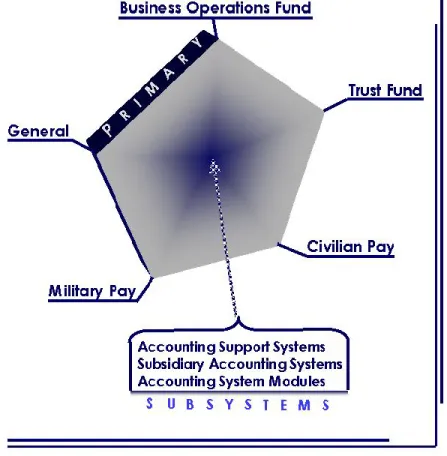
A primary accounting system provides for the aggregation and consummation of like financial management information aligned by major operational areas and summarized to support financial and management information needs. There are five Primary accounting systems made up of the single, standard integrated
Departmental accounting systems, which control all financial management information.
Figure 1. Primary Accounting Systems and Subsystems.
The Primary accounting
systems are General, Business Operations Fund (Stock Fund and Industrial Fund), Trust Fund, Civilian Pay, and Military Pay. These primary systems provide the macro level information, which is compiled and analyzed to facilitate decision-making and assessments of financial viability of activities. Greater levels of detail, such as audit trails, are embodied in the three accounting subsystems: Accounting Support Systems, Subsidiary Accounting
Systems, and Accounting System Modules. The detail of the subsystems ensures the integrity of standard
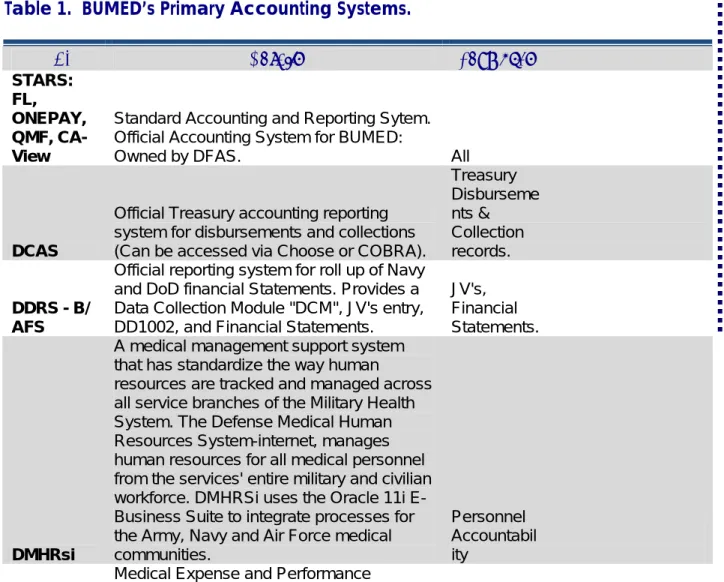
Table 1. BUMED’s Primary Accounting Systems.
ACRN Details Keywords
STARS: FL, ONEPAY, QMF, CA-View
Standard Accounting and Reporting Sytem. Official Accounting System for BUMED:
Owned by DFAS. All
DCAS
Official Treasury accounting reporting system for disbursements and collections (Can be accessed via Choose or COBRA).
Treasury Disburseme nts & Collection records. DDRS - B/ AFS
Official reporting system for roll up of Navy and DoD financial Statements. Provides a Data Collection Module "DCM", JV's entry, DD1002, and Financial Statements.
JV's, Financial Statements.
DMHRsi
A medical management support system that has standardize the way human
resources are tracked and managed across all service branches of the Military Health System. The Defense Medical Human Resources System-internet, manages human resources for all medical personnel from the services' entire military and civilian workforce. DMHRSi uses the Oracle 11i E-Business Suite to integrate processes for the Army, Navy and Air Force medical communities. Personnel Accountabil ity MEPRS/ EAS
Medical Expense and Performance Reporting System/ Expense Assignment System: standard cost accounting system for the Military Health System, containing Tri-Service financial, personnel and work CAD data from reporting medical and dental treatment facilities worldwide. (Fed by DMLSS, CHCS, DMHRSi, and STARS/ FASTDATA).
Data Quality
DMLSS
Defense Medical Logistics System : 90% of BUMED transaction are processed via DMLSS: Managed primarily by DMLSS Project Office, NAVMEDLOGCOM (End
User) & M842 Contract. Logistics
6.2.2. Administrative Accounting Systems.
Accounting Support Systems are the manual or automated programs, procedures, and processes that authorize, record, classify, analyze, and report on financial management information for one of the Primary accounting systems. Accounting support systems provide general ledger control and financial operations information for consolidation into the Primary accounting system.
Subsidiary Accounting Systems are the manual or automated programs, procedures, and processes for the various functional operations involved with revenues, expenses, assets, liabilities, and equity. The Subsidiary accounting systems form the foundation and audit trail for the Primary accounting systems and the
Accounting Support systems.
Table 2. BUMED’s Accounting Support Systems.
ACRN Details Keywords
FASTDATA Fund Administration and Standardized Document Automation (FASTDATA): Managed by M842 Contract. Core Capabilities: Document Generator, Initiations, Funds Control, External Interfaces, Status Reports, Paperwork reduction, Copy and paste capabilities, Excel spreadsheets
Cutting Doc's and Funds Control
DTS Defense Travel System Travel
WAWF Electronic Receipt and Acceptance System for Contractual vendor invoices to be processed and paid.
Contract Payments
Table 3. BUMED’s Subsidiary Accounting Systems.
ACRN Details Keywords
PBAS DoD appropriation's (TI # 97) Budget distribution system.
M83 is POC for BUMED.
FAD's/ Authority
PBIS Navy appropriation's (TI # 17) Budget distribution system.
M83 is POC for BUMED.
FAD's/ Authority
COBRA Provides access to DCAS, and various reports extracted
from STARS. On Contract via NAVSEA: BUMED has unlimited licenses.
DCAS, STARS Queries & Reconciliation.
DADMS Provides information on IT equipment authorized by DoD/
Navy
IT approval
i- tracker Provides status of BRAC actions. Managed by CNIC. Project status
BAERS Budget Analysis Evaluation Reporting System
Financial management planning tool utilized by Budget Departments. Commonly referred to as the “APF/BAPF”
Budget/ Planning
FUNDS STATUS REPORT
Utilized by budget to review status of BUMED obligation rates at the detailed level. M-842A programs the report based on our main accounting & budget systems.
ACRN Details Keywords
SMART Summarized Management Analysis Resource Tool
(SMART) : Developed by SPAWAR: To Plan, monitor, and track finacial and workload execution of Navy hospitals, dental centers, and clinics. Combines input from : STARS, AHLTA, CHCS, DMHRSi, DENCAS, BAERS, and FHCC.
Analysis
M-8 Portal &work c.
To include Financial Policy, Guidance, accounting tables and access to Tri-annual Review Reporting, FS Report and Command Level Testing Projects. Link to NKO SOP's and other relevant websites.
Communication
CAD Cost Accounting Dictionary (CAD): Managed by M842. Online Excel spreadsheet. Job Order and Coding Structure as it relates to Fastdata, STARS, Program, Labor/ Travel, OPTAR codes and all relevant BUMED accounting classifications/descriptions.
Accounting Classifications
SLDCADA Time & Attendance system for legal certification of T&A
and reconciliation to official Labor system "DCPS". DCPS then feeds to STARS-FL.
Recording &
Certification of Payroll.
EDA Electronic Document Access: Provides access to Contracts (Basic & Mods) along with vouchers.
Contract Analysis
CHCS Summary Workload & MEPRS Data. The Composite
Health Care System (CHCS) is a VMS-based medical informatics system designed by Science Applications International Corporation (SAIC) and used by all United States and OCONUS military health care centers. CHCS is module based: modules include RAD (radiology), LAB (Laboratory), PHR (Pharmacy), PAS (Patient Appointing & Scheduling), MCP (Managed Care Program; used to support TRICARE enrollees by enrolling them to Primary Care Managers), PAD (Patient Administration): MRT (Medical Records Tracking), MSA (Medical Service Accounting) medical billing, WAM (Workload Assignment Module), DTS (Dietetics), CLN (CLinical: Nursing, Physician, and Allied Health), DAA (Database
Administration), ADM (Ambulatory Data Module) Medical Coding of outpatient visits, and TOOLS (FileMan).
Data Quality
AHLTA Armed Forces Health Longitudinal Technology Application
(AHLTA). AHLTA is the clinical documentation engine for the Physicians to write their notes, put in orders, document procedures performed and provide the basis of medical coding information. This information is then sent into CHCS and its subsystems (ADM - ambulatory data module) provide the official repository of the medical coding information and handle the transmission of those encounters via the Comprehensive Ambulatory Patient Encounter Record (CAPER) interface. The clinical data is brought into the M2 DataMart for use in research,
operational metrics, trend analysis, and many other business intelligence processes/products.
6.2.3. Accounting Records.
Accounting records consist of all documents, forms, vouchers, ledgers, receipts, invoices, journals, and electronic media, which are evidence of, and the basis for, all transactions occurring which affect the general ledger accounts of an activity.
6.3. Accrual Accounting.
Accrual accounting is used to meet the specific needs of management and the Congress. Accrual accounting must recognize the accountable aspects of financial transactions or events as they occur. Transactions must be recorded in accounting records as they occur and, if required, adjusted at each month end.
Additionally, accrual accounting is a method of accounting whereby:
f Operating costs are accounted for in the fiscal (accounting) period during which the benefits are received (costs of resources consumed or applied);
f Costs for which the benefits are applicable to future periods are deferred and considered as assets;
f Liabilities for unpaid costs are recorded in the accounting records when goods or services are received; and
f Income for work or services performed on a funded
reimbursable order is recorded in the accounting records when reimbursable expenses are incurred.
6.4. Accounting Standards.
The following macro-level standards should be employed in conducting all accounting functions. The basic accounting standards shall be characterized by the following:
f Be complete, accurate, and timely.
f Cover receipts, disbursements, and fund balances.
f Comply with applicable laws and regulations.
f Disclose errors, losses, and gains.
f Receipts shall be recorded immediately upon collection, kept under control, and deposited intact as soon as possible.
f Cash collections shall not be held to cover cash disbursements.
f Disbursements shall be made only after evidence of
performance has been received or an advance payment has been authorized.
f Disbursements shall be recorded promptly in the applicable DoD accounting system.
f Accounting records shall be closed at the end of each
accounting period so that all cash transactions and only those transactions completed during that accounting period are included.
f Cash receipts and disbursements are to be reconciled with appropriate documents and accounting records, as applicable, within each accounting period.
f Foreign currency shall be accounted for in subsidiary accounts separate from U.S. currency. Foreign currencies must be reported at the U.S. dollar equivalent using the exchange rates prescribed by the Secretary of the Treasury. The fact that a foreign currency is not freely exchangeable shall be footnoted on reports. Accounting entities frequently prepare financial statements for their own use, which may or may not be in U.S. dollars. These lower level statements shall be translated into U.S. dollars when used to prepare departmental financial statements.
6.4.1. Minimum Documentation Requirements.
Each and every transaction must be based upon a valid activity requirement. All transactions must be supported by a properly executed and duly authorized source document such as a purchase order, travel order, invoice, receipt, or payment voucher. Documentary evidence of completed transactions is a fundamental requirement of accounting and the minimum evidential matter required for establishing an audit trail and the preparation of financial status reports.
6.4.2. Documentation Standardization.
The Standardized Accounting and Reporting System-Field Level (STARS-FL) requires documentation standardization. Prior to the implementation of STARS-FL, each Budget Submitting Office (BSO) utilized a variety of methods to execute their programs and to document accounting transactions. The benefits to be realized from standardization are the ability to compare the financial performance and mission accomplishment across service lines and to provide meaningful and accurate reports to Congress and higher authority.
6.4.2.1. Standard Document Numbers.
DFAS Cleveland has issued the Procedures and Guidance concerning the use of Standard Document Numbers (DFAS CL Inst. 7200.1). Relevant portions of this instruction are provided in the following sections.
6.4.2.1.1. Standard Document Number (SDN) Policy.
The standard document policy is provided in the following:
` Document numbers are to be assigned at the time documents are prepared manually or automatically. The document number will be inserted in the block or on the line currently used for that purpose before it has been approved, signed, and ready for release.
` When documents are prepared for submission to higher authority for approval and issuance in Program Fund Allocations, the approval/issuing authority will assign the document number.
` SDNs will be the primary means of identifying, updating, and recording accounting transactions in all present and future accounting/financial systems. All accounting transactions must be identified and recorded in accounting systems by SDN. Systems designers may continue to provide the capability to query by additional means. The query could consist of cost account number, functional account number, subactivity group code, etc. SDNs will be the primary means for accessing data bases and will be used to match disbursements and collections to obligations.
` The Procurement Instrument Identification Number (PIIN) is the proper SDN to cite when recording obligations applicable to contracts. The Supplementary Procurement Instrument Identification Number (SPIIN) is the call or order number used for Blanket Purchase Agreements, Indefinite Delivery Contracts, and Basic Ordering Agreements. This will be done regardless of the document number under which the related initiation, commitment, or consignment was recorded. This policy is applicable to all systems including STARS.
` All forms which are prepared by Navy fleet activities will contain an SDN. Detailed instructions for constructing the SDN are contained herein.
` When a contract is issued by a procurement activity citing various funds from other activities, each activity will reduce the initiation, commitment or consignment amount under their original SDN. The SDN can be established for the initiation, commitment or consignment using the Procurement Instrument Identification Number (PIIN) format (Table 4), or the Other Financial Related Documents format (Table 9).
` The original SDN established with the initiation, commitment, or consignment will remain in the system as a cross reference to the SDN assigned to the contract. Each activity will then
obligate under the Standard Document Number assigned to the contract.
For example:
Activities A, B, and C each issue a fund usage document. Each document contains one line of accounting data and cites Accounting Classification Reference Number (ACRN) "AA." Activities A, B, and C enter commitments in the accounting system prior to forwarding the hardcopy documents to activity D for procurement. The documents are:
Activity Requisition # Requisition ACRN
A N00019-95-RX-85716 AA
B N68098-95-AL-JC251 AA
C N007A1-95-RC-BS7QA AA
Activity D consolidates the requirements of the three activities into the same contract. Since ACRNs are not to be duplicated in the same procurement instrument, activity D assigns PIIN ACRNs "AA," "AB," and "AC" to the contract for these items. Activity D forwards a copy of the contract to activities A, B, and C for obligation recording and appropriate reduction in the previously recorded initiation, commitment or consignment. The documents associated with this transaction are now:
Activity Requisition # / ACRN PIIN # / ACRN
A N00019-95-RX-85716 AA N61339-95-C-0064 AA B N68098-95-AL-JC251 AA N61339-95-C-0064 AB C N007A1-95-RC-BS7QA AA N61339-95-C-0064 AC
STARS-FL allows creation of a SDN to establish a commitment. When the commitment is converted to an obligation, the PIIN and PIIN ACRN should be entered in order to cross-reference the requisition SDN and ACRN to the PIIN SDN and ACRN, and to maintain a complete audit trail of the originating commitment and subsequent obligation.
The implementation of Project 01-98-056 in STARS-FL allows for the obligation of more than one Procurement Instrument Identification Number (PIIN) per document number/ACRN and to track costs of each PIIN and its peripheral data elements, such as PIIN, PIIN ACRN, SPIIN, CLIN and SLIN (Sub-CLIN). The One Pay (OP) Financial Accounting Data Abstract (FADA) interface file was
modified to include the above mentioned data elements for pre-validations performed by the One Pay system.
Hierarchy: ` PIIN ` PIIN ACRN ` SPIIN ` CLIN ` SLIN
To prevent pre-validation problems with the funds
sufficiency check in One Pay, procedures should be followed in STARS-FL to post new obligations to include the correct PIIN level data (PIIN, PIIN ACRN, SPIIN), prior to invoices being processed in the One Pay system. Although the CLIN and SLIN are not used in the One Pay pre-validation process, the user should include them, if they know what the values are.
There are situations where a PIIN will change, for example, when a PIIN is issued to replace a request for Invitation for Bid:
BID REPLACED BY PIIN
N00019-95-B-0090 N00019-95-C-0095
The related Type Codes listed in Table 6 should be associated to a specific purpose, not to a particular form. Example: Type Code NS was assigned to order supplies or services. DD Form 1155 was associated with Type Code NS. Type Code NS should not be limited to just the DD Form 1155. Type Code NS should be assigned to whatever form is used to order supplies or services.
6.4.2.1.2. Standard Document Number Procedures. 6.4.2.1.2.1. Document Numbering for Procurement
Instruments.(Contracts).
The uniform Procurement Instrument Identification Number (PIIN) and Supplemental Procurement Instrument Identification Number (SPIIN) system prescribed in Part 204 or the current edition of the Defense FAR Supplement will be used by contract issuing activities for identifying procurement instruments. The PIIN document consists of 13 positions, and the SPIIN document consists of 4 positions as illustrated in Table 4.
Contracts must always be obligated under the PIIN and SPIIN. The following numbers will NOT be used for this purpose:
` 14/15-digit Military Standard Requisition and Issue Procedures/Military Standard Transaction Reporting and Accounting Procedures (MILSTRIP/MILSTRAP) document number, or;
` 15-digit document number associated with other financial related documents which initiated the procurement action.
` There is an exception to the Indefinite Delivery Contract requiring a SPIIN. You can pay without a SPIIN because an indefinite delivery IS a contract. A call or order could be issued against this contract. Example: A basic contract orders 100 items. The contracting officer issues a call for 40 items for which a SPIIN is assigned. The government is obligated to pay for the remaining 60 items on the basic contract. To do this, another call can be issued or the Indefinite Delivery Contract can be paid off.
6.4.2.1.2.2. Numbering for MILSTRIP/MILSTRAP Documents.
Documents covered by the provisions of MILSTRIP/ MILSTRAP will continue to be numbered according to NAVSUP Publication 437,
"Military Standard Requisition and Issue Procedures (MILSTRIP) and Military Standard Transaction Reporting and Accounting Procedures (MILSTRAP)”. The document number normally consists of 14 positions. (See exception and format in Table 7)
Forms:
` DoD Single Line Item Requisition System Document (Manual), DD Form 1348. This form is used by activities without
automated data entry capabilities.
` DoD Single Line Item Requisition System Document
(Mechanized), DD Form 1348m. This form is used by activities with automated data entry capabilities.
` DoD Single Line Item Requisition System Document (Manual - Long Form), DD Form 1348-6. This form is used in
requisitioning National Stock Number (NSN) items, part number items or other items for which the DD Form 1348m does not allow inclusion of sufficient pertinent identifying data.
` DoD Single Line Item Requisition System Document, DD Form 1348-1. This form is the single method of documentation for release of material by the supply source and the receipt document for the requisitioner. However, it is acceptable and preferred as a requisition when requesting property directly from a Defense Reutilization Management Office (DRMO).
6.4.2.1.2.3. Document Numbering for DoD Grants and Agreements.
DoD Components shall assign identifying numbers to all non-procurement instruments for grants and cooperative agreements. The
numbering system parallels the PIIN system specified in Part 204 or the current edition of the Defense FAR Supplement. The document consists of 13 positions and is
6.4.2.1.2.4. Numbering for Military Standard Transportation and Movement Procedures (MILSTAMP)
Transportation Control Number (TCN) Documents.
The MILSTAMP TCN is a 17-character data element assigned to control and manage every shipment unit throughout the transportation pipeline. The TCN for each shipment is unique and not duplicated. For shipments other than sea vans and personal property, the 17-digit TCN is essentially a four-part number composed of a DoDAAC, Julian date, serial number and suffix. The first three parts of the TCN for MILSTRIP shipments are normally the requisition number, found on such documents as the DD Form 1348-1, DD Form 1149, or a contract. For most other shipments, the TCN is constructed in the same standard four-part format. The sea van TCN differs from the standard by inclusion of a voyage number instead of a Julian date and by using the suffix to identify container service payment responsibility and the container type. The personal property TCN has a unique construction derived from the sponsoring member's Service, social security number, shipment pickup/turn-in date, and the type of personal property being shipped.
NOTE: Refer to Appendix C of DoD 4500.32-R, "Military Standard Transportation and Movement Procedures (MILSTAMP)”, Volume 1 for a complete description of the numbering requirements for the nine types of MILSTAMP shipment documents.
6.4.2.1.2.5. Numbering for All Other Financial Related Documents.
The following standard document numbering
system will be used for identifying all financial and financial related documents prepared which are not covered above. The document number consists of 15 positions as
illustrated in Table 9.
An exception to using the Unit Identification Code (UIC) of the issuing activity applies to travel orders.
The UIC to be cited in positions 2-6 of military and civilian travel orders will ALWAYS be that of the ACTIVITY WHOSE FUNDS ARE BEING CHARGED.
Positions 7-8 will always cite the last two digits of the fiscal year in which the travel is to COMMENCE or the effective or issue date in the case of civilian PCS orders.
When traveling for the benefit of another activity, with the cost of travel to be charged to the benefiting activity, Defense Travel System (DTS) is mandated and the following “X-Org” procedure should be utilized for DTS:
` The transaction will process through the funding organization’s financial accounting system. The X-organization funding feature allows any organization to provide a LOA to another
organization in DTS.
` The funding LOA Label and the budget remain that of the funding organization. The funding organization may remove the Funding LOA label from any other organization using it at anytime. The funding FDTA can: control the length of time the LOA is available for use, assign the LOA directly to a single traveler or a single sub-org control the routing list used to approve the authorization an dor voucher, and monitor the processing of the approvals via the use of the budget reports.
See DTA Manual, Chapter 8 for instructions on how to use the cross-organization funding feature.
` If the accounting or disbursing system responsible for the LOA cannot process transactions using DTS, the funding FDTA wll provide authority and the LOA details directly to the FDTA of the traveler’s organization. The traveler’s FDTA will create a local reimbursable LOA in their accounting system. After travel, the FDTA will ensure reimbursement by the funding organization.
Table 4. PIIN/SPIIN Document Number Structure.
Position 1 – 6 7 – 8 9 10 – 13 14 – 17 Example N00023 95 D 0001 0002
Identifies the
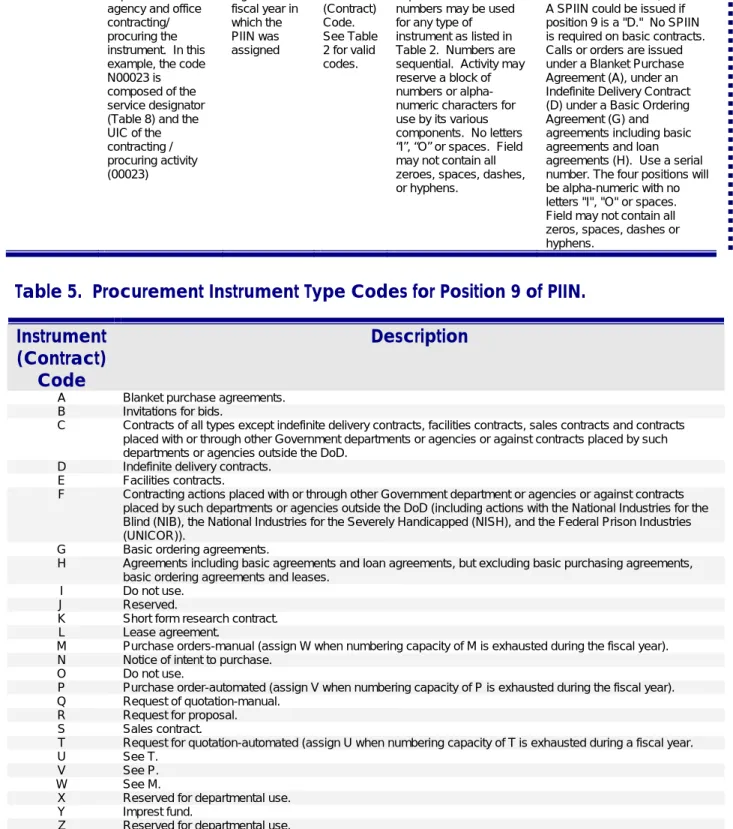
department / agency and office contracting/ procuring the instrument. In this example, the code N00023 is composed of the service designator (Table 8) and the UIC of the contracting / procuring activity (00023) Last two digits of the fiscal year in which the PIIN was assigned Type of Instrument (Contract) Code. See Table 2 for valid codes. Serial Number. A separate series of numbers may be used for any type of instrument as listed in Table 2. Numbers are sequential. Activity may reserve a block of numbers or alpha-numeric characters for use by its various components. No letters “I”, “O” or spaces. Field may not contain all zeroes, spaces, dashes, or hyphens.
A SPIIN will be used when Position 9 is coded A, G or H. A SPIIN could be issued if position 9 is a "D." No SPIIN is required on basic contracts. Calls or orders are issued under a Blanket Purchase Agreement (A), under an Indefinite Delivery Contract (D) under a Basic Ordering Agreement (G) and agreements including basic agreements and loan agreements (H). Use a serial number. The four positions will be alpha-numeric with no letters "I", "O" or spaces. Field may not contain all zeros, spaces, dashes or hyphens.
Table 5. Procurement Instrument Type Codes for Position 9 of PIIN. Instrument
(Contract) Code
Description
A Blanket purchase agreements.
B Invitations for bids.
C Contracts of all types except indefinite delivery contracts, facilities contracts, sales contracts and contracts
placed with or through other Government departments or agencies or against contracts placed by such departments or agencies outside the DoD.
D Indefinite delivery contracts.
E Facilities contracts.
F Contracting actions placed with or through other Government department or agencies or against contracts
placed by such departments or agencies outside the DoD (including actions with the National Industries for the Blind (NIB), the National Industries for the Severely Handicapped (NISH), and the Federal Prison Industries (UNICOR)).
G Basic ordering agreements.
H Agreements including basic agreements and loan agreements, but excluding basic purchasing agreements,
basic ordering agreements and leases.
I Do not use.
J Reserved.
K Short form research contract.
L Lease agreement.
M Purchase orders-manual (assign W when numbering capacity of M is exhausted during the fiscal year).
N Notice of intent to purchase.
O Do not use.
P Purchase order-automated (assign V when numbering capacity of P is exhausted during the fiscal year).
Q Request of quotation-manual.
R Request for proposal.
S Sales contract.
T Request for quotation-automated (assign U when numbering capacity of T is exhausted during a fiscal year.
U See T.
V See P.
W See M.
X Reserved for departmental use.
Y Imprest fund.
Table 6. MILSTRIP/MILSTRAP Document Number Structure. Position 1 2 – 6 7 8 – 10 11 – 14 15 Example N 00023 5 334 0125 R Service Designator Code. Table 8. Unit Identification Code (UIC) of the requisitioning/issuing activity. Refer to the most current version of DoD 4000.25-6 "Department of Defense Activity Address Directory” for a listing of valid codes. Last digit of the calendar year in which the document is being issued. The numeric consecutive day of the calendar year. Example: Nov 30, 1995 = 334.
Serial numbers are assigned at the discretion of the document originator. Serial numbers will not be duplicated on the same day. Position 11 may consist of alpha or numeric characters with the utilization of certain alphas limited as specified. See references (e), (j) and enclosure (8) for specific limitations on codes used as the first character of the serial number. Positions 12-14 may consist of alpha or numeric character or inter or intra-service/agency requisitions with exceptions of letters "I" or "O" on inter-service agency transactions. However, the entries in positions 12-14 will not be meaningful to the requisitioning service/agency, but will be used on documentation initiated as a result of requisition processing. The Demand/Suffix Code is optional. The field may be alpha or numeric. It has a dual purpose. For the requisitioner, this position is used to enter the demand code. For supply sources, this position is used for the suffix code when partial action is taken on a transaction. (e.g.: Demand Code "R" represents "Recurring Demand). Refer to NAVSUP Publication 437, "Military Standard Requisition and Issue Procedures (MILSTRIP) and Military Standard Transaction Reporting and Accounting Procedures (MILSTRAP) for valid codes.
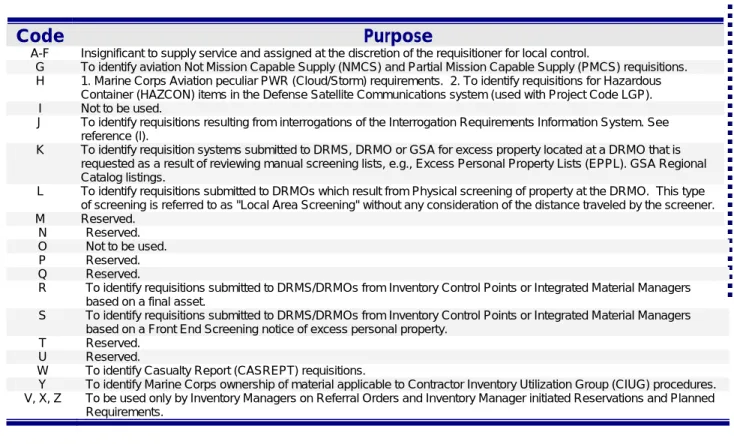
Table 7. Serial Number Codes for MILSTRIP/MILSTRAP (First Position Alpha Limitation).
Code Purpose
A-F Insignificant to supply service and assigned at the discretion of the requisitioner for local control.
G To identify aviation Not Mission Capable Supply (NMCS) and Partial Mission Capable Supply (PMCS) requisitions.
H 1. Marine Corps Aviation peculiar PWR (Cloud/Storm) requirements. 2. To identify requisitions for Hazardous
Container (HAZCON) items in the Defense Satellite Communications system (used with Project Code LGP).
I Not to be used.
J To identify requisitions resulting from interrogations of the Interrogation Requirements Information System. See
reference (l).
K To identify requisition systems submitted to DRMS, DRMO or GSA for excess property located at a DRMO that is
requested as a result of reviewing manual screening lists, e.g., Excess Personal Property Lists (EPPL). GSA Regional Catalog listings.
L To identify requisitions submitted to DRMOs which result from Physical screening of property at the DRMO. This type
of screening is referred to as "Local Area Screening" without any consideration of the distance traveled by the screener.
M Reserved.
N Reserved.
O Not to be used.
P Reserved.
Q Reserved.
R To identify requisitions submitted to DRMS/DRMOs from Inventory Control Points or Integrated Material Managers
based on a final asset.
S To identify requisitions submitted to DRMS/DRMOs from Inventory Control Points or Integrated Material Managers
based on a Front End Screening notice of excess personal property. T Reserved.
U Reserved.
W To identify Casualty Report (CASREPT) requisitions.
Y To identify Marine Corps ownership of material applicable to Contractor Inventory Utilization Group (CIUG) procedures.
V, X, Z To be used only by Inventory Managers on Referral Orders and Inventory Manager initiated Reservations and Planned
Requirements.
Table 8. Document Number Structure for DoD Grants and Agreements.
Position 1 – 6 7 – 8 9 10 – 13 Example N00023 95 1 0001
Identifies the department / agency and office contracting / procuring the instrument
Last two digits of the fiscal year in which the number was assigned. Type of Instrument Code: Grants = 1; Cooperative Agreements =2; Other NonProductive Agreements = 3. No Alpha Characters. Serial Number - A separate series of numbers may be used for any type of instrument as noted above. Numbers are sequential. Activity may reserve a block of numbers or alpha-numeric characters for use by its various components. No letters "I" or "O" or spaces. Field may not contain all zeros, spaces, dashes, or hyphens.
Table 9. Number Structure for All Other Financial Related Documents. Position 1 2 – 6 7 – 8 9 – 10 11 – 15 Example N 00023 95 RC 0125 Service Designator Code. Table 8.
Unit Identification Code (UIC) of the requisitioning/issuing activity, regardless of the activity to be charged. See paragraph E.5.b for exceptions. Refer to the most current revision of NAVSO P-1000-25, "Navy Comptroller Manual” Volume 2 Chapter 5, Unit Identification Codes” for a listing of valid UICs for Navy. Last two digits of the fiscal year in which the basic document is being (or was) issued. Fund usage Document Type Code. See Table 7.
Serial Number can be alpha and/or numeric. The positions can be all alpha or all numeric. Example: LABOR. Field may not contain all zeros, spaces, or hyphens. It is assigned at the discretion of the issuing activity. Numbers will not be duplicated within the same document type code, within the same fiscal year or within the same UIC.
Table10. Financial Documents and Related Type Codes.
Document Document Type Type Code
SECNAV FORMS
SECNAV 7132/1 Advice of Project Funds AF
SECNAV 7132/7 Project Directive PD
SECNAV 7133/1 Interim Below Threshold Reprogramming Actions BT
SECNAV 7300/1 Resource Authorization by Cost Account RA
SECNAV 7300/2 Reimbursable Order Data Sheet RO
SECNAV 7300/9 Procurement Request RC
NAVCOMPT FORMS
NC372 Allotment/Sub-Allotment Authorization AL
NC621 Correction Notice (Note 1) **
NC2035 Summary of Accounting Data (Note 1) **
NC2058 Budget Activity Allocation FA
NC2061 Utility-Invoice Certification (Note 4) UT
NC2168-1 Resource Authorization RA
NC2189-1 Approved Operating Budget (RDT&E Activities) OB
NC2201 Claims for Reimbursement for Round-Trip Transportation at Personal Expense from
Place of Overhaul to Home Port
RV
NC2202 Authority for Issuance of T/R or MTA for Round-Trip Transportation from Place of
Overhaul to Home Port
RV
NC2275 Order for Work and Services (Funded Reimbursable Work Estimate) WE
NC2275 Order for Work and Services (Project Order) PO
NC2275 Order for Work and Services (Economy Act Order) WR
NC2276 Request for Contractual Procurement RC
NC2276A Order for Work & Services Direct Citation (Note 2)
NC2277 Voucher for Disbursement and/or Collection (Note 1) **
DoD FORMS
DD282 Printing Requisitions/Order PT
DD410 Requisition for Telephone Service CA
Document Document Type Type Code
DD448 Military Interdepartmental Purchase Request (MIPR) (Sent to DoD Activity) MP
(Sent to Activity Outside DoD) IP
DD1105 Apportionment and Re-Apportionment Schedule AS
DD1131 Cash Collection Voucher (Note 3) MD
DD1149 Requisition and Invoice/Shipping Document (Mail Service - Note 6) MS
DD1155 Order for Supplies or Services
1) Utility Invoices (Note 4) 2) Mail Service (Note 6)
NS UT MS
DD1342 DoD Property Record (Note 1) **
DD1556 Request, Authorization, Agreement Certification of Training and Reimbursement TG
DD1610 Request and Authorization for TDY Travel of DoD Personnel TO
DD1614 Request and Authorization for DoD Civilian Permanent Duty Travel CS
DD2161 Referral for Civilian Medical Care CM
STANDARD FORMS
SF44 Purchase Order/Invoice Voucher (Utility Invoices - Note 4) UT
SF1034/1035 Public Voucher for Purchases and Services Other than Personal
1) Uniform or Clothing Allowance. Example: Police and Firemen, Work Shoes - (Note 5) 2) Legal Services
3) Mail Service (Note 6) 4) Utility Invoices (Note 4)
PV UA LS MS
SF1080 Voucher for Transfers Between Appropriations and/or Funds
SF1081 Voucher and Schedule of Withdrawals and Credits **
SF1151 Non-Expenditure Transfer Authorization TA
SF1164 Claims for Reimbursement for Expenditure on Official Business RV
MISCELLANEOUS FORMS
Government Purchase Card Bulk Obligation Document CC
GSA 2957 Reimbursable Work Authorization
NAVEDTRACOM NROTC Travel Orders
WA RT NAVPERS
1320/6
NAVPERS Other Related Travel Orders TO
NAVSO 4650/10 Invitational Travel Orders IT
NAVOCNR ONR Job Order
Government Orders (ONR) Letters Authorizing Funds
Miscellaneous Financial Documents (See Note 3)
Navy Real Property Acquisition Contracts (Not Covered By DFARS)
Written Agreement for Re-enlistment / Extension Bonus for Selection Reserve Incentive Program JO GO LT MD RP RN CHIEF OF NAVAL RESERVE
NAVRES 1571/5 1) CNAVRES Annual Training/Active Duty Training Orders
2) CNAVRES Inactive Duty Training Travel
3) CNAVRES Sea/Air Mariner and Officer Sea/Air Mariner 4) Mobilization Training 5) Schools 6) Specials RT RW SM MT SH SP
DD448 Military Interdepartmental Purchase Request (MIPR) Funded Reimbursable Program PM
Bonus Pay Authorizations Status Report 1) Enlistment Bonus 2) Affiliation Bonus 3) Re-enlistment Bonus
4) Bonus Program (Educational Assistance) Miscellaneous Financial Documents
Written Agreement for Re-enlistment/Extension Bonus for Selection Reserve Incentive Program EB AB RB EA DM RN NOTES
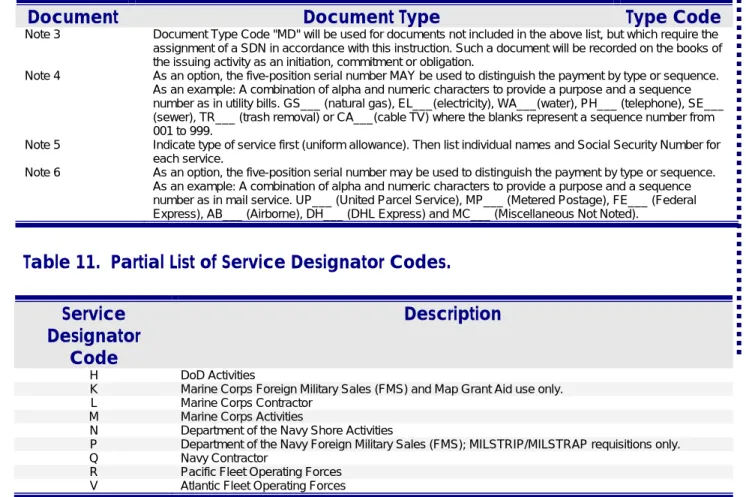
Note 1 Document Type Code "**" will use an SDN from another form. As an example, repayments of overdrawn
travel advances will cite the original travel order number. Cite only one contract document number per debit and credit for each form. Multiple adjustments per form are permitted as long as only one document is cited.
Note 2 The Standard Document Number of NAVCOMPT Form 2276A will be assigned by the requiring activity in
accordance with reference (m), except, the ninth and tenth positions of the Document Number which will be assigned as follows:
"WX" will be used when the form is issued solely as an Economy Act Order or as a combination of an Economy Act Order and a Direct Citation for contractual procurement.
"PX" will be used when the form is issued solely as a Project Order or as a combination of a Project Order and a Direct Citation for contractual procurement.
Document Document Type Type Code
Note 3 Document Type Code "MD" will be used for documents not included in the above list, but which require the
assignment of a SDN in accordance with this instruction. Such a document will be recorded on the books of the issuing activity as an initiation, commitment or obligation.
Note 4 As an option, the five-position serial number MAY be used to distinguish the payment by type or sequence.
As an example: A combination of alpha and numeric characters to provide a purpose and a sequence number as in utility bills. GS___ (natural gas), EL___(electricity), WA___(water), PH___ (telephone), SE___ (sewer), TR___ (trash removal) or CA___(cable TV) where the blanks represent a sequence number from 001 to 999.
Note 5 Indicate type of service first (uniform allowance). Then list individual names and Social Security Number for
each service.
Note 6 As an option, the five-position serial number may be used to distinguish the payment by type or sequence.
As an example: A combination of alpha and numeric characters to provide a purpose and a sequence number as in mail service. UP___ (United Parcel Service), MP___ (Metered Postage), FE___ (Federal Express), AB___ (Airborne), DH___ (DHL Express) and MC___ (Miscellaneous Not Noted).
Table 11. Partial List of Service Designator Codes. Service
Designator Code
Description
H DoD Activities
K Marine Corps Foreign Military Sales (FMS) and Map Grant Aid use only.
L Marine Corps Contractor
M Marine Corps Activities
N Department of the Navy Shore Activities
P Department of the Navy Foreign Military Sales (FMS); MILSTRIP/MILSTRAP requisitions only.
Q Navy Contractor
R Pacific Fleet Operating Forces
V Atlantic Fleet Operating Forces
6.4.2.1.2.6. Posting and Assignment of SDN on a Collection.
A collection is defined as the miscellaneous receipt of funds which cannot be applied to existing financial obligations. Collections will be processed on a DD Form 1131, Cash Collection Voucher. These collections could be for Jury Duty/Witness Fees, Fees under the Freedom of Information Act, Profits on the Sale of Scrap Material, Commission on Telephone Company Pay Stations, and
Miscellaneous Collections.
The assignment of a new SDN will follow the format used in Table 9 Other Financial Related Documents. Follow the format for Numbering of Other Financial Related Documents for position's 1-8. For the other positions, apply the following:
Jury Duty / Witness Fees:
Positions 9-10 Document Type: assign "MD"
Positions 11-15 Serial Number: assign "JURYD or WITNE" OTHER:
Positions 9-10 Document Type: assign "MD" Positions 11-15 Serial Number: assign "MISCE"
using the SDN assigned to the collection document.
` Once the obligation is established; process the collection document against the obligation, resulting in a negative unliquidated obligation (NULO).
` To reduce the NULO to zero, an adjustment for the difference must be processed against the obligation.
` Once an obligation has been established for the various activities, for this particular type collection, use the assigned SDN for the entire fiscal year.
6.4.2.1.2.7. Posting and Assignment of SDN on a Refund.
A refund is defined as a recoupment (collection) of payments made in error. This refund results in a reduction in the amount of
expenditures on an existing financial obligation.
Refunds will be processed on a SF 1034 Public Voucher for Purchases and Services Other than Personal or on a DD Form 1131; Cash Collection Voucher.
Refunds could be for an overpayment to a vendor, Civilian or Retirement Payment, repayment of an unliquidated travel advance, or overpayment on a traveler’s claim.
Use the SAME SDN as assigned on the original payment.
If a refund cannot be associated with the SDN for the original payment, assign a new SDN. For positions 1-8, follow the format for Numbering of Other Financial Related Documents (Table 7). For the other positions apply the following:
Payroll:
Positions 9-10 Document Type: assign "MD" Positions 11-15 Serial Number: assign "LABOR"
Other:
Positions 9-10 Document Type: assign "MD" Positions 11-15 Serial Number: assign "MISCE"
An obligation needs to be established in STARS-FL for one cent using the SDN assigned to the collection document.
Once the obligation is established, process the collection document against the obligation, resulting in a negative unliquidated
obligation (NULO).
To reduce the NULO to zero, an adjustment for the difference must be processed against the obligation.
Once an obligation has been established for the various activities, for this particular type collection, use the assigned SDN for the entire fiscal year.
6.4.2.2. Standard Job Order Numbers.
The use of Standard Job Order Numbers serves to support standardization, consistency, and uniformity. Standard Job Order Numbers can only be established by BUMED for non-reimbursable costs. A Job Order Number (JON) is an eleven-position data element that is used to accumulate costs in the STARS-FL
accounting system. It identifies costs to a specific type of service or function within an operating budget or allotment and is constructed as illustrated in Table 12.
Table 12. Standard Job Order Number Structure.
Position 1 – 5 6 7 – 10 11 Example 68094 8 A254 1 Operating Budget or Chargeable UIC Last Digit of Fiscal Year
Serial Number (Funds Administering Activity (FAA) assigns, except those specifically identified as mandatory for civilian system pay use)
Cost Type Code (these are synonymous with certain Expense Elements)
NOTE: For BUMED commands the serial number is the CAC as given in BUMED Supplemental Financial guidance.
The Job Order Input Subsystem (FASTPATH = JON) of STARS-FL (Figure 1) is used to enter and maintain the Job Order Dictionary. Because of the crucial role that Job Order Numbers play in cost accounting, it is imperative that JONs be established with the correct data elements. The JON dictionary drives ALL accounting reports; therefore, errors in JON data elements can cause an out-of-balance condition between reports. BUMED issues annual guidance that prescribes JON data elements, such as: AG/SAG, FC/SFC, CAC, and MEPRS codes. All data elements must be carefully reviewed before making changes or additions to a Job Order Number. Furthermore, some data elements cannot be changed after transactions have posted against the JON. To modify data elements in a JON after transactions have processed to it, ALL transactions must be removed to a temporary JON before critical data element corrections can be performed.
Table 3. Direct Job Order Data Elements.
Field Description Mandatory / Optional
Is comprised of the following three fields, which are passed to the screen from the JOB ORDER MENU. In Add mode this field may be typed over to allow you to enter a new Job Order using the PF4 (REPEAT FUNCTION).
OB_OD_ATY_UI C
Must be a valid UIC if the JON EDIT Indicator on the End Of Month Table is an “N”. If the JON EDIT Indicator is set to an “A” or “Y” on the End of Month table, then this UIC must be on the LOA Chargeable UIC table.
JOB_OD_FIS_YR Must be numeric and must match the fiscal year of the LOA.
JOB ORDER NR
JOB_OD_SER_N R
Alphanumeric
Mandatory
APPN Appropriation. Composed of the first two positions of the fiscal year and the
four-position appropriation symbol.
Mandatory
SBHD Subhead. Mandatory
OB Operating Budget. UIC of the OB holder. Mandatory
SX Suffix Mandatory
AAA UIC Authorized Accounting Activity (AAA) UIC. Obtained from the AAA. UIC in End of
Month Table. You may change this field. The AAA UIC must equal the AAA UIC, which was established for this LOA.
Mandatory
FAA UIC Funds Administering Activity (FAA) UIC. A protected field which is obtained from the
LOA and displayed on the screen for all the Actions except the Add.
Mandatory
CHG UIC Chargeable UIC. Mandatory for JOB ORDER creation. Defaults to the OB/BCN if
none is entered. Must be a valid CHARGEABLE UIC for the LOA entered
Mandatory
CC/SCC Cost Center / Sub-Cost Center / Local Management Code (LMC). Must not contain
blanks.
Mandatory Valid Codes are 1, 2, 3, 4, 5, 6, 7
The field is blank, if not entered. The program will set these defaults based on the Cost Account Code
CAC Default STARS LIM CD
3 1X10, 1X20, 1X30, 1X90 4 1R20. 1RH1, 1RH0, 1RJ0, 1RK0, 1RL0, 1RM0, 1RN0, 1RV0, 1RP0, 1R70, 1RD0, 1RR0, 1RR1, 1RR2, 1X50, 1X60 5 1R30 or –Xn STRS LIM CD 6 1R10 Optional
FC Functional Category. Paired with Sub Functional Category Code, this field must match
a valid FUNCTIONAL CATEGORY CODE. If the
MJ CLAIMANT Indicator is set to an “F” on the End of Month table, then this FSF must be on the Claimant FSF Group table for the SAG and Major Claimant used.
If the FUNCTIONAL CATEGORY CODE and SUB-FUNCTIONAL CATEGORY CODE combination = M1, M2, MZ, CB, R1, R2, or RZ then SAG (Sub Activity Group Code) must = DN, DP, FA, FB, GK, GJ, HH, HW or PL and Cost Account Number must = “9120” or the first position be a “7”.
Mandatory
SFC Sub Functional Category. This field cannot be a “Z” if Reimbursable Source Code is a
blank.
Mandatory
SAG Subactivity Group. Must be a valid SUBACTIVITY GROUP CODE, unless the MJ
CLAIMANT Indicator is set to an “S” on the End of Month table, then this SAG must be on the Claimant SAG Group table for the Major Claimant used.
Mandatory
LBR CLS CD If entered: then the LCC must equal “01” through “07” or “40” through “45” or “60”
through “66”. The Function/Subfunction Category Code must be M1, MZ, R1, RZ, L6, LZ, N1, NZ, P1, PZ, D1, DZ, DC, L7, M2, R2, LA or S1.
Mandatory, if TAB A/B or PUB WKS IND equals “Y” and TAB-A-B-RPT-IND of LOA table equals “Y”
MOBIS Program If entered must be on MOBIS program table Optional
MIC Management Information Code. May contain blanks Optional
Description Description. May contain blanks. Mandatory
MEPR Medical Expense and Performance Reporting Code
Default to blanks
You may enter a MEPR if the LOA was established for the MEPR Report.
Mandatory for all MTFs & DTFs
Field Description Mandatory / Optional
Must matched a valid Cost Account Number unless the MJ CLAIMANT Indicator is set to a “C” on the End of Month table, then this CAC must be on the Claimant FSF Group for the FSF, SAG and Major Claimant used.
If valid Cost Account Number is used with a Housing Code, then you may enter a “Y” in the HSG IND on this screen.
CY Must be blank for current fiscal year. Value should be numeric and equal the last digit
of a valid fiscal year.
Optional
SG Signal Code.
Valid codes are “Y”, “N” or blank:
If a “Y” is entered then the Reimbursable Source Code must be other than blank. Used for standard single fiscal year work request (such as housing) for which you want to activate the year end fiscal rollover process.
Optional
SEGT Segment.
If a SEGT already exists for this LOA, then all the JOB ORDERs must contain the same REIM_SRC_CD. If not, the REIM_SRC_CD which was already established for other JONs with the LOA and SEGT will be displayed on the screen with a message “PREVIOUSLY ESTABLISHED RSC”.
If no REIMBURSABLE SOURCE CODE is entered and you enter data, this data is assumed to be the DIRECT PROGRAM GROUP for this Job Order.
Optional, Unless a Reimbursable Source Code is entered, then it must contain a segment number.
PLT PROP IND Plant Property Indicator.
Defaults to “N”, if none entered. Valid codes are “Y” or Blank. If the LOA for this Job Order was established for the Plant Property Report, then you may enter a “Y” in the PLT PROP IND on this screen.
Optional
HSG IND Housing Indicator:
Defaults to “N”, if none entered Valid codes are “Y” or blank
If no indicator is entered, program will put a “N” in the field in the ROOT_JOB_OD If the LOA for this Job Order was established for the Housing Report, then you may enter a “Y” in the HSG IND on this screen.
Optional
FLY HRS IND Flying Hours Indicator
Defaults to “N”, if none entered Valid codes are “Y” or blank
If no indicator is entered, program will put a “N” in the field in the ROOT_JOB_OD If the LOA for this Job Order was established for the Flying Hours Report, then you may enter a “Y” in the FLY HRS IND on this screen.
Optional
SHP MNT IND Ship Maintenance Indicator. Defaults to “N”, if none entered. Valid codes are “Y” or
blank. If no indicator is entered, program will put a “N” in the ROOT_JOB_OD. If the LOA for this Job Order was established for SHIP MAINTENANCE REPORT, then you may enter “Y” in the SHP MNT IND
Optional
PUB WKS IND Public Works Indicator. Defaults to “N”, if none entered. Valid codes are “Y” or blank.
If no indicator is entered, program will put a “N” in the field in the ROOT_JOB_OD. If the LOA for this Job Order was established for the TAB A/B Report, then you may enter a “Y” in the PUB WKS IND on this screen.
Optional
TAB A/B IND Tab A/B Indicator. Defaults to “N”, if none entered. Valid codes are “Y”, “N” or blank.
If no indicator is entered, program will put a “N” in the field in the ROOT_JOB_OD. If the LOA for this Job Order was established for the TAB A/B Report, then you may enter a “Y” in the TAB A/B IND on this screen. Used for different reporting than the PUB WKS IND
Optional
APN_TYP Passed from the JOB ORDER INPUT MENU – LXJ1101. The APPROPRIATION
TYPE must match the APPROPRIATION TYPE that was established when the LOA was created.
Table 14. Reimbursable Job Order Data Elements. .
Field Description Mandatory / Optional
Cost Code Defaults to zero. The first 11 positions of the COST CODE will contain the Grantor's
Job Order Number. This JOB ORDER must be established in the ROOT_JOB_OD Table, if the Performer's and Grantor's AAA UIC are the same. If not a warning message will be displayed and the Performer's JON will be established.
Optional
OBJ CLS Object Class. Defaults to zero Optional
PAA Property Accounting Activity. Defaults to zero Optional
Trans Type May not be "3C", "00" (zero, zero), or "1K" Optional
WRK REQ/PRJ ORD
Defaults to zero Optional
ACRN Cannot be "II", "OO" (Alpha) or "00" (Numeric)
Defaults to "AA", if this is a Reimbursable Job Order and none was entered.
Mandatory
CARRY FWD Blank or "Y"
If a "Y" is entered, it is used in the generation of reverted authorization details for prior year records
Mandatory
FNDS EXP DT Must be entered with a date greater than current date if carry forward is "Y" Conditional
If the REIM_SRC_CD is a "6" or "#", then only the ACRN is mandatory. Reimbursable
Source Code
Description
1 Intra Appropriation (i.e. 0130 to 0130)
3 Other Defense Accounts (i.e. 1804 to 1806)
6 Non Federal Sources (i.e. State/Local Governments, Private
Companies, NEX, MWR)
8 Foreign Military Sales
A Military Assistance
D Off Budget Federal Agency (eg. Post Office)
E Other non-Defense accounts (eg. Coast Guard)
REIM SRC CD
# Cash Advances from Non-Federal Sources
Mandatory
Mail Code The user may position the cursor on the CHG UIC field and press the PF1 key to get a
list of the MAIL CODES available for the UIC.
If the grantor’s UIC does not display, check Subsystem 9, UIC/Address Menu Option or FP MUIC, to view addresses and mail codes already established. If your grantor’s address is not listed, forward copy of funding document to your DFAS technician for input prior to establishing the JON.
The following Grantor's LOA fields are Mandatory and must exist on the LOA Table, if the Performer's and the Grantor's AAA UIC are the same. If they are not the same and the DD CODE contains a "4" then the LOA must exist on the VLD LOA Table. If it does not exist, a message, "LOA NOT IN VALID LOA DATA --" will be displayed. If neither of these two conditions are met, then no validation is performed on the Grantor's LOA: GRNT APPN GRNT SBHD GRNT OB/BCN GRNT SX Mandatory GRANT AAA UIC
Grantor’s AAA UIC Mandatory
GRNT UIC Grantor’s UIC Mandatory
GRNT MAIL CODE
Grantor’s Mail Code Optional
GRNT DD CODE
Valid codes are 1 = Army 2 = Air Force 3 = DoD
4 = Navy (default will be displayed can modify) 5 = Coast Guard
6 = Civil Service
7 = Federal Emergency Management Funds 8 = National Ocean
Mandatory
BILLING FREQ CD
Billing Frequency Code. Valid codes are: C = Completion
Field Description Mandatory / Optional M = Monthly (Default) Q = Quarterly REPORT FREQ CD
Report Frequency Code. Valid codes are: C = Completion M = Monthly Q = Quarterly (Default) Optional HARDCOPY IND
Hardcopy Indicator. Valid codes are: "Y", "N" or blank. Defaults to a "N" unless the REIM SRC CD is "#" or "6"
For Mechanized reimbursable billings (where both the grantor and performer’s accounting is in STARS-FL) always set the HARDCOPY IND to “N”.
For Manual reimbursable billings (where the grantor’s accounting is NOT in STARS-FL) set the HARDCOPY IND to “Y”. For example: Pay by check customer
(Non-government agencies, MWR), Special instructions from grantor (i.e. grantor requires hardcopy in order to certify for payment, for example, DECA), Work Estimates, All other branches of the Service.
Optional
NOTE: If Grantor’s Funding Document has data for a specific field then it becomes mandatory.
6.4.3. General Transaction Requirements. 6.4.3.1. Commitments.
Commitments are administrative reservations of funds based on firm procurement directives, orders, requests, or equivalent instruments that
authorize the creation of obligations without further approval by the official responsible for certifying the availability of funds.
The effect of entering into a commitment is to reserve funds for future obligations. Issuing a commitment authorizing obligations in excess of a formal subdivision of funds could result in an Antideficiency Act violation of 31 U.S.C., Sections 1341 or 1517. A commitment is subject to cancellation by the approving authority, provided it has not been obligated. Commitment accounting is required for all appropriations, including expired appropriations. While commitment reporting may not be required, commitment accounting is required without exception.
Initiations are similar to commitments since they are an administrative reservation of funds based upon procurement directives, requests, or equivalent instruments. They allow for preliminary negotiation of procurement actions but require certification of fund availability before incurring commitments/obligations. Control of initiations must be maintained to help keep commitment actions within the available subdivision of funds.
Initiations are not part of the official accounting requirements. However, requiring initiation accounting will ensure that the procedures and practices are necessary and cost effective.
To ensure proper administration and control of the
commitment/obligation transaction cycle, financial management personnel shall take into consideration the following:
f The effect of commitments on over-obligation of funds and potential anti deficiency violations
f The rules for recording commitments
f Commitment documents
f The role of commitments in funds control
f Commitments for contingent liabilities
Resource managers are responsible for ensuring that each of the following is observed to preserve the integrity of the system:
f Reviews of commitment files are made on a regular basis, at least monthly.
f Commitments that are invalid or will not be obligated are reduced or canceled before the appropriation expiration.
6.4.3.1.1. Instructions for Recording Commitments.
The following procedures are to be followed when recording commitments:
f Commit funds for only those goods, supplies, or services that are required to meet bona fide needs of the period for which the funds were appropriated. Consider estimated current consumption, procurement lead times, and required stock levels.
f Commit funds for contingent liabilities when they are part of the original estimate. (Ensure that in-scope changes can be accommodated)
f Cancel outstanding commitments when the items for which they exist are obligated.
f Cancel outstanding commitments when funds expire for obligation purposes. Funds must be obligated prior to appropriation expiration.
f Keep detailed, auditable, and verifiable records of commitments (incurred and outstanding). Show the specific amounts for each contract or order
6.4.3.1.2. Instructions for Commitment Documents.
A commitment document is an order form used to ensure that funds are available prior to incurring an obligation. Commitments may be accomplished using DD Form 1149 (Requisition and Invoice/Shipping Document) or similar documents having the effect of a firm order or authorization to enter into an obligation. The purposes of the commitment document are:
f To serve as evidence of the first step in the procurement process and to provide all interested individuals a means for review before actual purchase negotiation;
f For use by the resource manager to approve and certify the availability of funds and the correctness of the accounting classification;
f To document the commitment of funds;
f To serve as a worksheet for recording technical requirements information that is necessary for procurement actions;
f To provide space for maintenance of an obligation record in case partial obligations are involved; and
f The initiating office should complete the document in as many copies as necessary to satisfy requirements.
The commitment document consists of the following information to ensure that funds are available and to provide an audit trail to the origination of the commitment:
f Requisition number and date;
f Explanation of the necessity for procurement;
f Description and quantity of items requested;
f Signature and title of initiating officer and authorized approving officer;
f Proper use and certification of fund availability;
f A record of obligations incurred to determine the balance of the obligation when partial obligations are involved;
f The amount of each purchase order, contract, or other obligation document related to the commitment;
f The unobligated balance of the commitment; and
f Any remarks necessary for administrative control of the transaction or activities in connection with the commitment.
NOTE: Reconcile all commitment records to automated accounting systems at least quarterly. Monthly reconciliation is recommended. Any unauthorized commitments identified during the reconciliation process require investigation to determine if the government should be held liable for the services or products received as a result of the unauthorized commitment. Written documentation of reconciliations is required.
6.4.3.2. Unauthorized Commitments.
On occasion, an individual without authority will enter into a commitment expecting the government to assume responsibility for the financial obligation. Rarely are such unauthorized commitments the product of a deliberate attempt to circumvent the procurement system. Rather, it is usually the result of not fully understanding the procurement procedures coupled with an honest effort to satisfy a legitimate requirement that leads to an unauthorized commitment (UC).
It is illegal for anyone other than a properly appointed Contracting Officer, ordering officer, or cardholder to make a purchase for the
government. Commitments by unauthorized employees violate federal regulations and may result in violations of law, including various acquisition statutes, Standards of Conduct, Joint Ethic Regulations, and the Anti-Deficiency Act. Such actions are called unauthorized commitments. An unauthorized commitment is an agreement that is not binding solely because the government representative who made it lacked the authority to enter into that agreement on behalf of the government. In terms of contracts, the only individual who can bind the government is a warranted contracting officer.
Personnel without procurement authority who order supplies or services, who attempt to change the terms of an existing purchase, or who commit the government to pay a vendor for anything received, may be subject to disciplinary action and may be responsible for payment. .
The best way to avoid unauthorized commitments is to plan ahead and initiate the procurement process on a timetable so that there is time to put the contract in place before the contractor starts work. Also, when talking to potential vendors, the requestor should not give the impression that he or she has the authority to negotiate on behalf of the government.
6.4.3.2.1. Examples of Unauthorized Commitments.
f An individual without proper procurement authority places an order. This includes someone other than the authorized Government Purchase Card (GPC) cardholder who uses the card or account number.
f A cardholder was requested to purchase items over $3,000.00 and the cardholder made the purchase exceeding his $3,000.00 authority.
f A vendor mistakes a request for information as an order, ships the order, and the Government accepts the order. To avoid a UC, make sure the vendor understands that you are conducting market research and he is NOT to ship any item. If the item is delivered, immediately notify your contracting officer and prepare to return the item to the vendor.
f Miscommunication between individuals or units; e.g., each thinks the paperwork for a service/supply is being processed by the other. To prevent a UC, communicate the responsibilities of each individual or organization and DO NOT authorize
performance of a service until the vendor has a contract signed by a Contracting Officer.
f A commitment authorizing service over and above the original scope or dollar amount of the contract. To help prevent UCs, DO NOT approve any contractor to perform additional work without notifying a Contracting Officer.
f A contractor continues to perform a service after the contract expiration date without a new purchase request being submitted to Contracting by the using activity. To help avoid a UC,
maintain expiration dates of contracts within your activity and submit timely purchase requests to the Contracting Office prior to the expiration.
f You have a maintenance service contract in place to service your office copier and printer. The contract requires a telephone call to the vendor when necessary. When the vendor gets to your office to make a repair, you notice that your FAX machine is not functioning properly. Not realizing it is not covered by the contract, you ask the repairman to fix it and he does.
f You are looking through a magazine or catalog at home on Saturday evening and notice some supplies you need and have been talking about getting for a long time. If you acquire them before close of business today, you could realize 50% savings over the normal cost. You buy the items and expect to be reimbursed later because you bought them for the office.
f You call a company and order supplies and have them delivered to the hospital. A few months later an invoice comes in and you send it to logistics. There is no purchase order in place or a contract in place.
f You have a supply contract for some type of material in place and it is for $100,000.00. You have exceeded the $ amount of the contract and continue to order supplies. Logistics has no way to pay because the contract $ have been all expended. This creates an unauthorized commitment.
f You have a contract in place for a base year with option years. You forget to send a funding document down to exercise the option year and the services continue. It is not discovered until 2 to 3 months later when invoices start coming in. The option year can be exercised but it CAN NOT be backed dated to cover the 2 to 3 months. Hence an unauthorized commitment.
6.4.3.2.2. Alternatives Available to Settle an Unauthorized Commitment.
f Nothing: The individual who committed the UC may be required to pay the vendor out of pocket, to include the contract price, appropriate collection fees and court costs.
6.4.3.2.3. Contract Modification.
If the unauthorized commitment is directly related to a contract issued by the Contracting Officer, the Contracting Officer may be able to process the action under the "Disputes" clause of the contract.
6.4.3.2.4. Ratification.
If the unauthorized commitment meets certain criteria (does not exceed the Contracting Officer’s dollar limit), the action may be approved for ratification by the Contracting Officer with the concurrence of the Staff Judge Advocate and the Commanding Officer in the chain of command.
f Ratification Criteria: In general, an unauthorized commitment must meet the following criteria to be eligible for ratification.
f Supplies or services have been provided to and accepted by the Government, or the Government otherwise has obtained or will obtain a benefit resulting from performance of the unauthorized commitment.
f The ratifying official has the authority to enter into a contractual commitment.
f The resulting contract would otherwise have been proper if made by an appropriate Contracting Officer.
f The Contracting Officer, upon reviewing the unauthorized commitment, determines the prices to be fair and