Treatment of Mild to Moderate Obesity with Laparoscopic Adjustable
Gastric Banding or an Intensive Medical Program
A Randomized Trial
Paul E. O’Brien, MD; John B. Dixon, MBBS, PhD; Cheryl Laurie, RN; Stewart Skinner, MBBS, PhD; Joe Proietto, MBBS, PhD;
John McNeil, MBBS, MSc, PhD; Boyd Strauss, MBBS, PhD; Sharon Marks, MBBS, PhD; Linda Schachter, MBBS; Leon Chapman, MBBS; and Margaret Anderson, BHIM
Background: Obesity is a major, growing health problem. Obser-vational studies suggest that bariatric surgery is more effective than nonsurgical therapy, but no randomized, controlled trials have con-firmed this.
Objective: To ascertain whether surgical therapy for obesity achieves better weight loss, health, and quality of life than nonsur-gical therapy.
Design:Randomized, controlled trial.
Setting: University departments of medicine and surgery and an affiliated private hospital.
Patients: 80 adults with mild to moderate obesity (body mass index, 30 kg/m2 to 35 kg/m2) from the general community. Interventions: Patients were assigned to a program of very-low-calorie diets, pharmacotherapy, and lifestyle change for 24 months (nonsurgical group) or to placement of a laparoscopic adjustable gastric band (LAP-BAND System, INAMED Health, Santa Barbara, California) (surgical group).
Measurements:Outcome measures were weight change, presence of the metabolic syndrome, and change in quality of life at 2 years.
Results: At 2 years, the surgical group had greater weight loss, with a mean of 21.6% (95% CI, 19.3% to 23.9%) of initial weight lost and 87.2% (CI, 77.7% to 96.6%) of excess weight lost, while the nonsurgical group had a loss of 5.5% (CI, 3.2% to 7.9%) of initial weight and 21.8% (CI, 11.9% to 31.6%) of excess weight (P⬍ 0.001). The metabolic syndrome was initially present in 15 (38%) patients in each group and was present in 8 (24%) non-surgical patients and 1 (3%) non-surgical patient at the completion of the study (P⬍0.002). Quality of life improved statistically signifi-cantly more in the surgical group (8 of 8 subscores of Short Form-36) than in the nonsurgical group (3 of 8 subscores).
Limitations:The study included mildly and moderately obese par-ticipants, was not powered for comparison of adverse events, and examined outcomes only for 24 months.
Conclusions:Surgical treatment using laparoscopic adjustable gas-tric banding was statistically significantly more effective than non-surgical therapy in reducing weight, resolving the metabolic syn-drome, and improving quality of life during a 24-month treatment program.
Ann Intern Med.2006;144:625-633. www.annals.org
For author affiliations, see end of text.
Australian Clinical Trials Registry no. 012605000113651.
T
he development of a safe and effective treatment for obesity is a leading challenge in health care today. Obe-sity is an increasing health problem across the world with a prevalence of more than 20% among the adult population in Western countries and more than 30% in the United States (1, 2). The increasing prevalence is associated with a parallel increase of several obesity-related diseases, in par-ticular, the diseases of the metabolic syndrome (3, 4), which include type 2 diabetes, hypertension, and dyslipi-demia, and are linked to nonalcoholic steatohepatitis, ob-structive sleep apnea, and the polycystic ovary syndrome.For obese individuals, the options are limited. Behav-ioral therapies of reduced energy intake, improved eating practices, and increased exercise and activity, supplemented by pharmacotherapy, generally achieve only modest and often transient effects (5, 6). Observational studies have shown that bariatric surgical therapies involving gastric re-striction by various forms of stapling with or without di-version of the gut to generate malabsorption of food are effective in achieving major weight loss and clinically sig-nificant improvements in health and quality of life (7–11). Strong direct evidence from randomized, controlled trials of the relative benefits of nonsurgical and surgical therapies is lacking. We are aware of only a single study,
performed in the 1980s, in which 60 morbidly obese pa-tients were randomly assigned, without informed consent, to diet plus an early form of gastric stapling or to diet alone (12). The maximum weight losses did not differ between the groups. However, the weight regain was greater in the diet-only group.
The advent of the laparoscopic adjustable gastric band has provided a new bariatric surgical option, which has proved to be safe, minimally invasive in its application, gentle in its use through its adjustability and easy revers-ibility, and similarly effective to the other bariatric proce-dures (10, 13, 14).Figure 1shows the LAP-BAND System
See also: Print
Editors’ Notes . . . 626 Editorial comment. . . 689 Summary for Patients. . . I-12
Web-Only
CME quiz
(INAMED Health, Santa Barbara, California) and demon-strates the key feature of adjustability of the area within the band through which it induces satiety (15). Patients re-quire no more than an overnight hospital stay, and the procedure has been shown to be markedly safer than gastric bypass surgery (13).
We hypothesized that surgical therapy would induce more weight loss, health benefit, and improvement in qual-ity of life than nonsurgical therapy and have conducted a randomized, controlled trial comparing the effectiveness of current nonsurgical therapy with laparoscopic adjustable gastric banding in a group of mildly to moderately obese adults (body mass index, 30 kg/m2to 35 kg/m2).
We did not study patients with a body mass index greater than 35 kg/m2 because current observational data suggest that outcomes after nonsurgical treatment were un-likely to be equal to those after surgical care for these pa-tients. The principal outcome measures were weight change, health, quality of life, and complications of therapy.
M
ETHODSPatient Recruitment
We recruited patients for the study through a newspa-per advertisement. All patient assessments and outpatient treatments were conducted at a community clinic dedi-cated to obesity management or in the clinics of a univer-sity department of surgery. Surgical procedures were con-ducted at a private community hospital experienced in the care of bariatric surgical patients. Patients in both groups did not pay any medical costs generated by the study. The
human ethics committees of The Alfred Hospital and The Avenue Hospital approved the study in accordance with the guidelines of the National Health and Medical Re-search Council (www.nhmrc.gov.au/publications/synopses /e35syn.htm) and with the Helsinki Declaration of 1975, as revised in 2000 (www.wma.net/e/ethicsunit/pdf/draft _historical_contemporary_perspectives.pdf).
Inclusion Criteria
We considered patients to be eligible if they were be-tween 20 and 50 years of age; had a body mass index of 30 kg/m2 to 35 kg/m2; had identifiable problems, including an obesity-related comorbid condition (such as hyperten-sion, dyslipidemia, diabetes, obstructive sleep apnea, or gastroesophageal reflux disease), severe physical limitations, or clinically significant psychosocial problems associated with their obesity; had attempted to reduce weight over at least the previous 5 years; could understand the options offered and the randomization process; and were willing to comply with the requirements of each program.
Exclusion Criteria
We excluded candidates with a history of bariatric sur-gery or medical problems that contraindicated treatment in either study group, such as impaired mental status, drug or alcohol addiction, or portal hypertension. In addition, we excluded participants if they had undergone an intensive, physician-supervised program that used very-low-calorie diets or pharmacotherapy or if they did not attend the 2 initial patient information visits.
Assessment
We provided detailed information about the problems of obesity and about the 2 study groups through at least 2 discussion periods and a patient information booklet. Ini-tial assessment included anthropometric measures; identi-fication of medical, physical, or psychosocial problems (both weight-related and other); and a discussion of previ-ous weight loss efforts. The assessment included a detailed dietary history by the trial dietitian and a review by a spe-cialist physician to determine the presence and severity of associated medical conditions. Initial investigations in-cluded measurements of fasting blood glucose level; serum insulin level; and a lipid profile, including HDL cholesterol and LDL cholesterol levels.
After initial assessment, we instituted a program of advice on appropriate eating patterns and exercise and fol-lowed each patient on a monthly basis for 3 months. Dur-ing this time, we assessed the patients’ fulfillment of tasks, such as completion of a food diary, and overall adherence to appointments.
Randomization Process
We randomly allocated eligible patients to receive a conventional, intensive, nonsurgical program or laparo-Context
Observational studies have shown sustained weight loss after surgery for extreme obesity. No randomized trial of contemporary surgical methods has been performed.
Contribution
The authors randomly assigned 80 mildly to moderately obese (body mass index, 30 to 35 kg/m2
) adults to lapa-roscopic placement of an adjustable gastric band or to an intensive nonsurgical weight loss program. After 2 years, the surgical group had lost 21.6% of initial weight, and the nonsurgical group had lost 5.5% of initial weight. Four patients required laparoscopic revision of the gastric band.
Cautions
The study was not designed to detect uncommon adverse events.
Implications
Laparoscopic gastric banding is effective treatment for mild to moderate obesity.
scopic adjustable gastric banding. A computer-derived ran-dom allocation sequence, without blocking or stratifica-tion, performed the randomization. This was prepared at the trial office. The trial coordinator enrolled participants and informed them of the trial allocation. After assessment had confirmed a participant’s suitability for randomization, the coordinator contacted the trial office by telephone for allocation. The study was not blinded.
Description of Nonsurgical and Surgical Interventions Common Program
We instructed and encouraged all patients to follow appropriate lifestyle behavior of good eating practices and increased exercise and activity. We also encouraged them to exercise for at least 200 minutes per week.
Nonsurgical Program
This program centered on the use of behavioral mod-ification, very-low-calorie diet, and pharmacotherapy with education and professional support on appropriate eating and exercise behavior. During the 2-year period, 3 trained physicians developed a program using all the available mo-dalities for each individual on the basis of guidelines pre-pared and continually reviewed by a panel of experienced bariatric physicians.
The program began with an intensive 6-month period of very-low-calorie diet (500 to 550 kcal/d) using 1 to 3 packets of Optifast (Novartis, Fremont, Michigan) daily for 12 weeks, followed by a transition phase over 4 weeks combining some very-low-calorie meals with 120 mg of orlistat before non–very-low-calorie diet meals, and then 120 mg of orlistat before all meals until the completion of the intensive phase. This intensive 6-month program was followed by further courses of very-low-calorie diets or or-listat as tolerated, as well as continual behavioral, dietary, and exercise advice to assist the participant in maintaining weight loss over a prolonged period. Sibutramine was not approved for use in Australia during the first 12 months of the study and, therefore, was not incorporated into the medical program. The management program for each in-dividual was designed to reflect good clinical practice. A physician saw each patient every 2 weeks during the very-low-calorie diet program and every 4 to 6 weeks during the rest of the study. All patients were seen at least every 6 weeks.
Surgical Program
Two experienced surgeons performed the laparoscopic adjustable gastric band (LAP-BAND System) procedure, by a standardized method (14), within 1 month of ran-domization. The band was placed along the perigastric pathway in all cases (16). The treating surgeon reviewed patient progress every 4 to 6 weeks during the study period and made adjustments to the volume of saline within the band in the office by using standard clinical criteria (17).
Adverse Events
All patients in the study were questioned about the occurrence of adverse events at each consultation, and phy-sicians recorded the results on the data sheets.
Figure 1.The laparoscopic adjustable gastric band (LAP-BAND System, INAMED Health, Santa Barbara, California) with no added fluid (top) and with 2 mL of fluid added (bottom).
The band is placed laparoscopically around the most proximal region of the stomach. When saline is added to the subcutaneous access port, the balloon expands, thereby generating an increased feeling of satiety before meals and earlier satiety after eating.
Primary and Secondary Outcomes
The primary end points of the study relate to weight change. We calculated preoperative excess weight as the amount in kg that weight exceeded a body mass index of 25 kg/m2. We expressed weight change as the change in absolute weight (kg), body mass index, percentage of initial weight lost and excess weight lost, and the percentage of patients who lost more than 50% of excess weight at 2 years. Secondary end points were health, quality of life, and side effects of treatment. We documented health status by clinical and laboratory assessment. We formally docu-mented each disease present at initial assessment with re-spect to disease activity and treatment status before ran-domization, and we reassessed these at 12 months and 24 months after randomization. We defined prevalence of the metabolic syndrome by the Adult Treatment Panel III (ATP III) criteria (18). We calculated insulin sensitivity indirectly by using the quantitative insulin sensitivity check index (QUICKI) (19). We measured quality of life at the
start of treatment and at 12 and 24 months by using the Medical Outcomes Trust 36-Item Short Form General Health Survey (SF-36) questionnaire (20, 21). Side effects of treatment were adverse drug reactions, protocol viola-tions, or the need for surgical treatments in the nonsurgical group and perioperative problems and need for revisional or other surgery in the surgical group. We classified pa-tients as lost to follow-up when they declined to attend appointments for further consultations or tests. Major complications were those that required hospitalization or major outpatient therapy. Minor complications were those requiring simple outpatient therapy.
Statistical Analysis Sample Size
We set the sample size on the basis of weight loss, expressed as percentage of excess weight lost, at 2 years after entry into the study. On the basis of our existing data, we expected that the mean excess weight lost for the
sur-Figure 2.Participant flow chart.
BMI⫽body mass index. *Longitudinal analysis was used for weight changes. †Case analysis was used for changes in comorbid conditions and quality of life.
gical program would be 54% (14). We determined that a difference of at least 20% (that is,⬍44% or⬎64%) would be clinically significant. To achieve 80% power of detect-ing such a difference (at a 2-sided significance level of 5%), 72 patients would need to be randomly assigned into the study. We planned for a total initial recruitment of 80 patients.
Data Analysis
We analyzed data according to the patients’ randomly assigned program (intention-to-treat analysis). We com-pared demographic data by using the chi-square test, inde-pendent samplet-test, or Mann–Whitney U test, as appro-priate. We analyzed comparative outcomes of follow-up data of anthropometry, blood pressure, biochemistry, and quality-of-life measures by using the chi-square test for cat-egorical data and thet-test for paired samples for continu-ous data. All tests were 2-sided. The laboratory and ques-tionnaire data presented are for only those patients who remained in the study for 2 years. All continuous variables were expressed as means (SDs). We used the SPSS statisti-cal software, version 12.01 (SPSS Inc, Chicago, Illinois), for statistical analysis. APvalue less than 0.05 was consid-ered significant.
We performed a longitudinal analysis by using SAS, version 8.2 (SAS Institute Inc., Cary, North Carolina), to estimate weight measures, allowing for missing data. We performed the analysis by using the PROC MIXED pro-cedure in SAS, with each patient treated as a random ef-fect. We fitted main fixed effects of the treatment and time to the model with changes over time determined by an interaction between treatment and time. To facilitate spe-cific comparisons, we treated time as a categorical variable. We considered age, sex, and baseline weight to be potential covariates, with baseline weight being the only variable that we found to be statistically significant. We considered all observed data for analysis, with the mixed-effects models assuming noninformative dropout such that the probabil-ity of dropout may depend on a patient’s observed previous response but not on current or future unobserved responses (22).
Role of the Funding Source
The study was funded by Monash University. The laparoscopic adjustable gastric bands (INAMED Health), laparoscopic ports (U.S. Surgical Corp.), and Optifast (Novartis) were provided by the manufacturers. These sources had no role in the design, conduct, analysis, or reporting of the study or in the decision to submit the manuscript for publication.
R
ESULTS Participant FlowFigure 2shows the participant flow. One patient who was randomly assigned to surgery withdrew from the study
on the evening before the scheduled operation and de-clined to be followed further. The remaining 39 (98%) treated surgical patients and 33 (83%) nonsurgical patients completed the 2-year follow-up program.
Table 1 shows the baseline characteristics of the groups. The demographic characteristics or the values that contributed to the study outcomes did not statistically sig-nificantly differ between the groups.
The recruitment for the study began in May 2000, and all patients had been randomly assigned by November 2001. Final patient follow-up at 2 years after entry was completed by November 2003.
Weight Loss
Table 2 shows weight loss estimates for both groups, using longitudinal analysis, as absolute weight loss, change in body mass index, and percentage of excess weight lost, and Figure 3 shows the percentage of initial weight lost. Both groups had identical weight loss at 6 months, with 13.8% of initial weight lost. The surgical group continued to lose weight at each study point during the follow-up period with means of 21.6% (95% CI, 19.3% to 23.9%) of initial weight lost and 87.2% (CI, 77.7% to 96.6%) of excess weight lost at 2 years. The nonsurgical group
Table 1. Baseline Characteristics of Participants*
Characteristic Nonsurgical Group (nⴝ40) Surgical Group (nⴝ40) Age,y 40.7 (7.0) 41.8 (6.4) Men,% 22.5 25 Hypertension,% 17.5 22.5 Metabolic syndrome,% 37.5 37.5
Coronary artery disease,% 0 0
BMI,kg/m2 33.5 (1.4) 33.7 (1.8) Weight,kg 93.6 (11.9) 96.1 (11.2) Waist circumference,cm 99.4 (9.4) 103.3 (10.0) Waist–hip ratio 0.85 (0.08) 0.86 (0.08) Neck circumference,cm 38.5 (3.5) 39.2 (3.6) Systolic BP,mm Hg 130.3 (13.5) 131.4 (14.0) Diastolic BP,mm Hg 81.0 (9.1) 83.2 (11.7) Plasma glucose level
mmol/L 5.0 (0.6) 5.3 (1.9)
mg/dL 90.1 (10.8) 95.4 (34.2)
Median plasma insulin level (IQR),pmol/L
75.7 (60.4–104.1) 61.1 (35.7–86.1) Total cholesterol level
mmol/L 5.56 (1.60) 5.40 (1.60) mg/dL 215.7 (62.8) 208.8 (62.7) Triglyceride level mmol/L 1.40 (0.90) 1.45 (0.85) mg/dL 123.9 (79.6) 128.3 (75.2) HDL cholesterol level mmol/L 1.40 (0.65) 1.30 (0.41) mg/dL 54.1 (25.9) 50.2 (15.8) LDL cholesterol level mmol/L 3.50 (1.70) 3.50 (1.35) mg/dL 135.1 (65.6) 135.1 (52.10) Total cholesterol–HDL cholesterol ratio 4.3 (1.5) 4.3 (1.3)
*Values are means (SDs), unless otherwise indicated. There were no statistically significant differences between the groups (Pvalues not shown). BMI⫽body mass index; BP⫽blood pressure; HDL⫽high-density lipoprotein; IQR⫽ interquar-tile range; LDL⫽low-density lipoprotein.
showed progressive weight regain after the 6-month point with means of 5.5% (CI, 3.2% to 7.9%) initial weight lost and 21.8% (CI, 11.9% to 31.6%) of excess weight lost at 2 years (P⬍ 0.001). Thirty-three of 39 (85%) surgical patients and 8 of 31 (26%) nonsurgical patients lost more than 50% of excess weight at 2 years (chi-square; P⬍
0.001). All 39 of the 40 (98%) surgical patients who actu-ally had surgery and 14 of the 40 (35%) nonsurgical pa-tients achieved satisfactory weight loss (⬎25% of excess weight lost) (P⬍0.001).
Health Outcomes
Table 3 shows the percentage change of a range of clinical and laboratory measures of health at 24 months. The resolution of the metabolic syndrome statistically sig-nificantly differed between the 2 groups. The surgical group had a statistically significantly greater improvement at 2 years for diastolic blood pressure, fasting plasma glu-cose level, insulin sensitivity index, and HDL cholesterol level. The metabolic syndrome, as defined by ATP III cri-teria, was present in 15 (37.5%) patients in each group before treatment and in 1 of 39 (2.7%) patients in the
surgical group and 8 of 33 (24%) patients in the medical group at 2 years (P⫽ 0.006). The reduction in the pro-portion of patients with the metabolic syndrome during the study period was significant for the surgical group (P⬍
0.001) but not for the nonsurgical group (P⫽0.22).
Changes in Quality of Life
The baseline SF-36 domain scores did not statistically significantly differ between the nonsurgical and surgical groups. At 2 years, the nonsurgical group had statistically significant improvements in 3 domain scores: physical function, vitality, and mental health. The surgical group had statistically significant improvements in all 8 domain scores (Figure 4). The change in domain scores between baseline and 2 years show a statistically significant greater improvement in 5 of the 8 domains in the surgical group than in the nonsurgical group.
Adverse Events
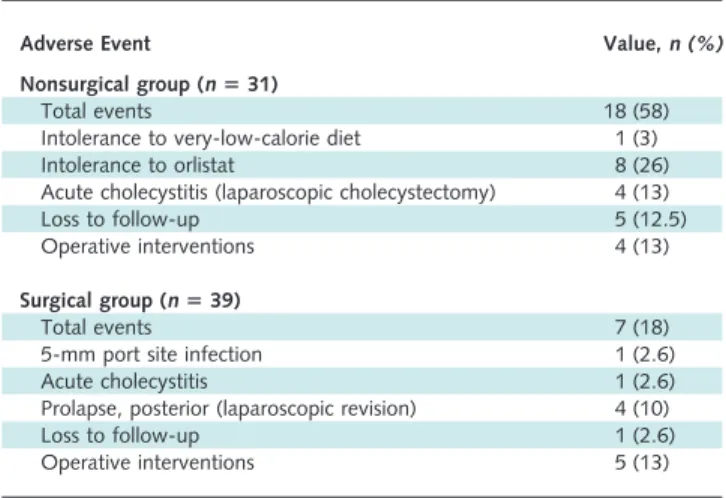
Table 4lists the adverse events that occurred in both groups. In the surgical group, 1 patient developed an in-fection of a 5-mm port site, which was treated by the patient’s general practitioner with antimicrobial agent ther-apy. Four patients developed prolapse of the posterior gas-tric wall through the band at 4, 10, 12, and 22 months after placement. The principal symptom in each case was the onset of gastroesophageal reflux, especially at night. All patients with this symptom were treated with laparoscopic revision. The length of hospital stay for each revisional procedure was less than 24 hours, and no perioperative complications occurred. One patient developed acute cho-lecystitis at 23 months and had an elective uncomplicated laparoscopic cholecystectomy.
In the nonsurgical group, 1 patient could not tolerate the very-low-calorie diet, 8 patients could not tolerate or-listat, and 3 others chose not to use orlistat. Four patients
Figure 3.Mean (±SE) percentage of initial weight lost with initial data carried forward for missing values.
Table 2. Estimated Weight, Body Mass Index, and Percentage of Excess Weight Loss at Baseline and at 6, 12, 18, and 24 Months on the Basis of Longitudinal Analysis*
Variable Time Point
Baseline 6 mo 12 mo 18 mo 24 mo Weight,kg Surgical group 95.0 (94.1–95.9) 81.6 (79.4–83.7) 76.3 (74.1–78.5) 75.2 (73.1–77.4) 74.5 (72.4–76.7) Medical group 94.8 (93.9–95.7) 81.6 (79.4–83.7) 85.3 (83.0–87.5) 87.7 (79.9–83.0) 89.5 (80.5–83.6) Pvalue 0.88 0.99 ⬍0.001 ⬍0.001 ⬍0.001 BMI,kg/m2 Surgical group 33.7 (32.9–34.4) 28.9 (28.1–29.7) 27.0 (26.2–27.8) 26.7 (25.9–27.5) 26.4 (25.6–27.2) Medical group 33.5 (32.7–34.3) 28.7 (27.9–29.6) 29.9 (29.1–30.8) 30.9 (30.0–31.8) 31.5 (30.6–32.4) Pvalue 0.71 0.73 ⬍0.001 ⬍0.001 ⬍0.001
Excess weight lost,%
Surgical group 57.2 (47.8–66.6) 78.6 (69.2–88.1) 83.6 (74.2–93.1) 87.2 (77.7–96.6)
Medical group 57.4 (47.6–66.4) 41.1 (31.2–50.9) 29.0 (19.0–38.9) 21.8 (11.9–31.6)
Pvalue 0.98 ⬍0.001 ⬍0.001 ⬍0.001
*Values are means (95% CI).Pvalues are for the differences between groups. A mixed-effects model was used for longitudinal analysis, with age, sex, and baseline weight as covariates. BMI⫽body mass index.
developed acute cholecystitis at 6, 7, 10, and 23 months and had uncomplicated laparoscopic cholecystectomy per-formed electively.
D
ISCUSSIONIn our randomized, controlled trial of surgical and nonsurgical intervention, both groups showed improve-ment in weight, health, and quality of life. Patients in the surgical group had statistically significantly better out-comes in each area than those in the nonsurgical group. The extent of weight loss was equal for the 2 groups at 6 months. The nonsurgical group regained weight at 2 years, whereas the surgical patients continued to lose weight. Therapy did not fail in any surgical patient, except for the patient who withdrew before surgery.
The adverse events that occurred are in line with the expectations of the 2 treatment programs. The surgical group had no clinically significant perioperative problems, but 4 patients required late revision of the band position because of posterior prolapse of the gastric wall through the band. This was corrected laparoscopically, and these pa-tients continued to have a good overall outcome. The peri-gastric pathway (16) was used for all of the surgical patients in our study. In a randomized, controlled trial subsequent to our study, we showed that posterior prolapse can be avoided by the pars flaccida pathway (23). Four patients in the nonsurgical group required cholecystectomy, which may be linked to the very-low-calorie diet.
Several limitations of our study need to be recognized. First, the weight range of body mass index that we chose for our study (30 kg/m2to 35 kg/m2) may seem inappro-priate for surgical treatment. We chose this weight category because it represents a “gray zone” between the generally accepted domains for nonsurgical and surgical treatment. We recognize that principal guidelines for bariatric surgery (24, 25) do not include criteria for this group of patients; however, inclusion of the group makes our study
impor-tant. Revision of those guidelines can only occur once data from this group are published. Furthermore, given the ex-tensive observational data on relative effectiveness of bari-atric surgery when the body mass index is greater than 35 kg/m2, we did not study severely obese patients.
Second, the experience of the surgical team may not reflect general community surgical competence in the care of patients with laparoscopic adjustable gastric bands. Both surgeons had performed several hundred of these proce-dures and were experienced in providing follow-up and adjustment. A systematic review showed inverse correlation
Figure 4.Mean (95% CI) Short Form-36 quality-of-life domain scores for the surgical and nonsurgical groups at baseline and at 2 years.
Mean age- and sex-matched general community domain scores are phys-ical function, 88 (SD, 17); physphys-ical role, 83 (SD, 32); pain, 75 (SD, 23); general health, 74 (SD, 19); energy, 59 (SD, 19); social function, 83 (SD, 23); emotional role, 81 (SD, 34); and mental health, 73 (SD, 17) (data from Ware et al. [20, 21]). *Statistically significantly greater im-provement in the surgical group at 2 years compared with the nonsurgi-cal group.
Table 3. Percentage Change in Variables Associated with the Metabolic Syndrome and Metabolic Risk*
Variable Nonsurgical Group
(nⴝ31) Surgical Group (nⴝ39) 95% CI of Between-Group Differences Weight loss 6.1 (8.5) 20.5 (6.4) –18.9 to –11.6 Waist circumference –1.4 (8.1) –15.2 (6.7) –18.2 to –10.3 Systolic BP –7.2 (9.7) –10.8 (10.8) –9.9 to 1.9 Diastolic BP –1.58 (11.2) –10.9 (12.5) –17.0 to –3.4
Plasma glucose level 0.35 (8.3) –7.3 (15.2) –13.0 to –0.7
Plasma insulin level –8.5 (22.4) –22.2 (26.8) –29.3 to 1.00
Insulin sensitivity† 6.2 (21.1) 26.3 (26.7) –25.7 to –4.7
Total cholesterol level –3.0 (17.0) –0.4 (18.1) –5.9 to 11.2
Triglyceride level –3.7 (39.4) –19.1 (35.7) –33.7 to 2.9
HDL cholesterol level 6.9 (18.9) 30.0 (28.9) 10.6 to 35.4
LDL cholesterol level –5.2 (21.6) –6.5 (19.0) –11.3 to 8.8
Total cholesterol–HDL cholesterol ratio –8.0 (15.7) –21.3 (15.0) –20.9 to –5.5
*Data are only for those who completed the study. Values are mean (SD) percentages for participants who remained in the study at the given time period.Pvalues were calculated by using independentt-test. BP⫽blood pressure; HDL⫽high-density lipoprotein; LDL⫽low-density lipoprotein.
between the experience of the surgical team and incidence of early and late complications after band placement (13). Third, the incidence of adverse events, including the need for surgical intervention, was similar in both groups. However, we cannot conclude that the 2 programs were equally safe because the study was not powered to validly compare the groups for this variable.
Laparoscopic adjustable gastric banding has been shown to be safe and effective in achieving weight loss, health benefits, and improved quality of life. A systematic review of literature published up to September 2001 on the safety and efficacy of this procedure showed a mortality rate of 0.05% (26). When compared with that of gastric stapling procedures, the mortality rate was 10 times greater for Roux-en-Y gastric bypass (0.5%) and 6 times greater for vertical banded gastroplasty (0.31%). The systematic review reported median percentages of 61%, 56%, and 54% of excess weight lost at 3, 4, and 5 years, respectively (26). Comparative figures for Roux-en-Y gastric bypass, as reported from the systematic review, were 69%, 58%, and 59%, respectively. The differences in effect between the 2 operations on weight loss at 5 years were not statistically significant. After laparoscopic adjustable gastric banding, major improvements have been described for type 2 diabe-tes, asthma, sleep apnea, hypertension, dyslipidemia, gas-troesophageal reflux, and depression, and durable improve-ment occurs in the quality of life (27).
Very few studies that compare nonsurgical and surgi-cal therapies are available. Although it did not involve ran-dom allocation, the Swedish Obese Subjects Study (28) is a major nonrandomized, comparative study in which 2000 matched patient pairs have been followed for 10 years. The ongoing study has already demonstrated better weight loss (20 kg vs. 0.7 kg at 8 years) and benefits to health and quality of life in the surgical group (28). However, the surgical group was treated by open gastric restrictive sta-pling operations because the laparoscopic approach and
adjustable forms of gastric banding were not available at the commencement of the study.
Our study demonstrates that surgical treatment with the laparoscopic adjustable gastric band provides greater benefits than nonsurgical therapy for mild to moderate obesity and supports the findings of current observational studies of more severely obese patients. The procedure has been shown to be safe and effective in morbidly obese (29, 30) and superobese (31) patients. A broader application of the approach for the serious and common problem of obe-sity warrants consideration.
From Monash University and University of Melbourne, Melbourne, Vic-toria, Australia.
Acknowledgment:The authors acknowledge the assistance of Dr. Mi-chael Bailey with the statistical analyses performed in the study. Grant Support:By the Department of Surgery, Monash University. IN-AMED Health, manufacturer of the LAP-BAND System; Novartis, manufacturer of Optifast; and U.S. Surgical Corp., manufacturer of dis-posable laparoscopic instruments, provided the equipment devices or products.
Potential Financial Conflicts of Interest: Consultancies: J.B. Dixon (INAMED Health, Novartis), S. Marks (Novartis);Grants received:P.E. O’Brien (INAMED Health, Novartis, U.S. Surgical Corp.), J.B. Dixon (INAMED Health, Novartis).
Requests for Single Reprints:Professor Paul O’Brien, MD, Centre for Obesity Research and Education, Monash University Medical School, The Alfred Hospital, Melbourne 3004, Australia; e-mail, paul.obrien @med.monash.edu.au.
Current author addresses and author contributions are available at www .annals.org.
References
1. Obesity: Preventing and Managing the Global Epidemic: Report of a WHO Consultation. Technical Report Series no. 894. Geneva: World Health Organi-zation; 2000.
2.Flegal KM, Carroll MD, Ogden CL, Johnson CL.Prevalence and trends in obesity among US adults, 1999-2000. JAMA. 2002;288:1723-7. [PMID: 12365955]
3.Mokdad AH, Ford ES, Bowman BA, Dietz WH, Vinicor F, Bales VS, et al. Prevalence of obesity, diabetes, and obesity-related health risk factors, 2001. JAMA. 2003;289:76-9. [PMID: 12503980]
4.Ford ES, Giles WH, Dietz WH. Prevalence of the metabolic syndrome among US adults: findings from the third National Health and Nutrition Exam-ination Survey. JAMA. 2002;287:356-9. [PMID: 11790215]
5.Avenell A, Brown TJ, McGee MA, Campbell MK, Grant AM, Broom J, et al.What interventions should we add to weight reducing diets in adults with obesity? A systematic review of randomized controlled trials of adding drug ther-apy, exercise, behaviour therapy or combinations of these interventions. J Hum Nutr Diet. 2004;17:293-316. [PMID: 15250841]
6.Avenell A, Brown TJ, McGee MA, Campbell MK, Grant AM, Broom J, et al.What are the long-term benefits of weight reducing diets in adults? A system-atic review of randomized controlled trials. J Hum Nutr Diet. 2004;17:317-35. [PMID: 15250842]
7.Pories WJ, Swanson MS, MacDonald KG, Long SB, Morris PG, Brown BM, et al.Who would have thought it? An operation proves to be the most effective therapy for adult-onset diabetes mellitus. Ann Surg. 1995;222:339-50; discussion 350-2. [PMID: 7677463]
Table 4. Adverse Events in the Surgical and Nonsurgical Groups
Adverse Event Value,n (%)
Nonsurgical group (nⴝ31)
Total events 18 (58)
Intolerance to very-low-calorie diet 1 (3)
Intolerance to orlistat 8 (26)
Acute cholecystitis (laparoscopic cholecystectomy) 4 (13)
Loss to follow-up 5 (12.5)
Operative interventions 4 (13)
Surgical group (nⴝ39)
Total events 7 (18)
5-mm port site infection 1 (2.6)
Acute cholecystitis 1 (2.6)
Prolapse, posterior (laparoscopic revision) 4 (10)
Loss to follow-up 1 (2.6)
8.Schauer PR, Ikramuddin S, Gourash W, Ramanathan R, Luketich J. Out-comes after laparoscopic Roux-en-Y gastric bypass for morbid obesity. Ann Surg. 2000;232:515-29. [PMID: 10998650]
9.Scopinaro N, Adami GF, Marinari GM, Gianetta E, Traverso E, Friedman D, et al.Biliopancreatic diversion. World J Surg. 1998;22:936-46. [PMID: 9717419]
10.Maggard MA, Shugarman LR, Suttorp M, Maglione M, Sugerman HJ, Sugarman HJ, et al.Meta-analysis: surgical treatment of obesity. Ann Intern Med. 2005;142:547-59. [PMID: 15809466]
11.Angrisani L, Favretti F, Furbetta F, Iuppa A, Doldi SB, Paganelli M, et al. Italian Group for Lap-Band System: results of multicenter study on patients with BMI⬍or⫽35 kg/m2. Obes Surg. 2004;14:415-8. [PMID: 15072665] 12.Andersen T, Backer OG, Stokholm KH, Quaade F.Randomized trial of diet and gastroplasty compared with diet alone in morbid obesity. N Engl J Med. 1984;310:352-6. [PMID: 6690963]
13.Chapman AE, Kiroff G, Game P, Foster B, O’Brien P, Ham J, et al. Laparoscopic adjustable gastric banding in the treatment of obesity: a systematic literature review. Surgery. 2004;135:326-51. [PMID: 14976485]
14.O’Brien PE, Dixon JB, Brown W, Schachter LM, Chapman L, Burn AJ, et al.The laparoscopic adjustable gastric band (Lap-Band): a prospective study of medium-term effects on weight, health and quality of life. Obes Surg. 2002;12: 652-60. [PMID: 12448387]
15.Dixon AF, Dixon JB, O’Brien PE.Laparoscopic adjustable gastric banding induces prolonged satiety: a randomized blind crossover study. J Clin Endocrinol Metab. 2005;90:813-9. [PMID: 15585553]
16.Belachew M, Legrand M, Vincenti V V, Deffechereux T, Jourdan JL, Monami B, et al.Laparoscopic placement of adjustable silicone gastric band in the treatment of morbid obesity: how to do it. Obes Surg. 1995;5:66-70. [PMID: 10733796]
17.Favretti F, O’Brien PE, Dixon JB.Patient management after LAP-BAND placement. Am J Surg. 2002;184:38S-41S. [PMID: 12527349]
18.Ford ES, Giles WH, Dietz WH.Prevalence of the metabolic syndrome among US adults: findings from the third National Health and Nutrition Exam-ination Survey. JAMA. 2002;287:356-9. [PMID: 11790215]
19.Katz A, Nambi SS, Mather K, Baron AD, Follmann DA, Sullivan G, et al. Quantitative insulin sensitivity check index: a simple, accurate method for assess-ing insulin sensitivity in humans. J Clin Endocrinol Metab. 2000;85:2402-10.
[PMID: 10902785]
20.Ware JE, Kosinski M, Keller S.SF-36 Physical and Mental Health Summary Scales: A User’s Manual. Boston: The Health Institute, New England Medical Center; 1994.
21.Ware JE, Snow KK, Kosinski MK, Gandek B.SF-36 Health Survey: Man-ual and Interpretation Guide. Boston: The Health Institute, New England Med-ical Center; 1997.
22.Diggle P, Kenward M.Informative dropout in longitudinal data analysis (with discussion). Applied Statistics. 1994;43:49-94.
23.O’Brien PE, Dixon JB, Laurie C, Anderson M.A prospective randomized trial of placement of the laparoscopic adjustable gastric band: comparison of the perigastric and pars flaccida pathways. Obes Surg. 2005;15:820-6. [PMID: 15978154]
24. Gastrointestinal surgery for severe obesity: National Institutes of Health Con-sensus Development Conference Statement. Am J Clin Nutr. 1992;55:615S-619S. [PMID: 1733140]
25.Snow V, Barry P, Fitterman N, Qaseem A, Weiss K.Pharmacologic and surgical management of obesity in primary care: a clinical practice guideline from the American College of Physicians. Ann Intern Med. 2005;142:525-31. [PMID: 15809464]
26.Chapman AE, Kiroff G, Game P, Foster B, O’Brien P, Ham J, et al. Laparoscopic adjustable gastric banding in the treatment of obesity: a systematic literature review. Surgery. 2004;135:326-51. [PMID: 14976485]
27.Dixon JB, O’Brien PE.Changes in comorbidities and improvements in quality of life after LAP-BAND placement. Am J Surg. 2002;184:51S-54S. [PMID: 12527352]
28.Sjo¨stro¨m L, Lindroos AK, Peltonen M, Torgerson J, Bouchard C, Carlsson B, et al.Lifestyle, diabetes, and cardiovascular risk factors 10 years after bariatric surgery. N Engl J Med. 2004;351:2683-93. [PMID: 15616203]
29.O’Brien PE, Dixon JB.Lap-band: outcomes and results. J Laparoendosc Adv Surg Tech A. 2003;13:265-70. [PMID: 14561255]
30.Ren CJ, Horgan S, Ponce J.US experience with the LAP-BAND system. Am J Surg. 2002;184:46S-50S. [PMID: 12527351]
31.Fielding GA.Laparoscopic adjustable gastric banding for massive superobe-sity (⬎60 body mass index kg/m2). Surg Endosc. 2003;17:1541-5. [PMID: 12915973]
Current Author Addresses: Drs. O’Brien, Dixon, Skinner, and Schachter and Ms. Laurie and Ms. Anderson: Centre for Obesity Re-search and Education, Monash University Medical School, The Alfred Hospital, Melbourne 3004, Australia.
Dr. Proietto: University of Melbourne Department of Medicine, Austin Hospital, Heidelberg, Victoria 3081, Australia.
Dr. McNeil: Monash University Department of Epidemiology and Pub-lic Health, The Alfred Hospital, Melbourne 3004, Australia.
Drs. Strauss and Marks: Monash University Department of Medicine, Monash Medical Centre, Clayton, Victoria 3168, Australia.
Dr. Chapman: International Diabetes Institute, 250 Kooyong Road, Caulfield, Victoria 3162, Australia.
Author Contributions: Conception and design: P.E. O’Brien, J.B. Dixon, J. Proietto, J. McNeil, B. Strauss, S. Marks, L. Chapman. Analysis and interpretation of the data: P.E. O’Brien, J.B. Dixon, S. Skinner, J. Proietto, J. McNeil, L. Schachter, L. Chapman.
Drafting of the article: P.E. O’Brien, S. Skinner, L. Schachter, L. Chapman.
Critical revision of the article for important intellectual content: J.B. Dixon, J. Proietto, J. McNeil, B. Strauss, S. Marks, L. Schachter, L. Chapman.
Final approval of the article: P.E. O’Brien, J.B. Dixon, J. Proietto, J. McNeil, L. Schachter, L. Chapman.
Provision of study materials or patients: P.E. O’Brien, J.B. Dixon, S. Skinner, B. Strauss, L. Schachter, L. Chapman.
Statistical expertise: J.B. Dixon.
Obtaining of funding: P.E. O’Brien, J.B. Dixon.
Administrative, technical, or logistic support: P.E. O’Brien, J.B. Dixon, C. Laurie, M. Anderson.
Collection and assembly of data: P.E. O’Brien, J.B. Dixon, C. Laurie, L. Chapman, M. Anderson.