Informati Respons Respons Respons Respons on Request se to Informa se to Informa se to Informa se to Informa 29 Res ation Reques ation Reques ation Reques ation Reques Informat sponse to In sts 29a sts 29b sts 29c sts 29d tion Reques nformation st 29 Request 299 29 29 29 29 29 9-1 9-3 9-10 9-12 9-14
29-1 IR 29 – Loss of Old Forest along the Transmission Line and its Impacts on
Species at Risk Habitat References:
EIS Guidelines, Section 2.7.2.7 EIS, Section 2.6.1.8, and 2.7.2.7
2009 EIS, Sections 5.3.1.5 and 5.3.1.6; Sections 6.3.7, 6.3.18, 6.3.14, 6.3.15, and 6.3.16
Related comments:
CEAR # 292 (Environment Canada) Rationale:
In Section 2.7.2.7 (p. 51), the EIS Guidelines require a “detailed assessment of baseline vegetative communities, species groups or ecosystems that have intrinsic ecological or social value, are representative of overall ecosystem condition and are sensitive to project activities”, including old forests.
This element of the Guidelines is relevant to the assessment of the environmental effects of the project because old forests play an essential role in the overall ecosystem, providing food and habitat for several species, including species at risk.
Section 2.7.2.7 (p. 1003) of the EIS indicates that project effects to old forest in the transmission line and access road are predicted to be the same as in the 2009 EIS, specifically Sections 5.3.1.5 and 5.3.1.6 in Volume 5.
These aforementioned sections outline potential effects to wildlife species, which includes a detailed assessment on six key indicator species listed on Schedule 1 of the Species at Risk Act—American badger (endangered), yellow-breasted chat (special concern), long-billed curlew (special concern), Lewis’s woodpecker (threatened), short-eared owl (special concern), and flammulated owl (special concern). Sections 5.3.1.5 and 5.3.1.6 contain analyses which are generally focused on potential effects to wildlife species associated with vegetation removal, ground disturbance, nesting habitat, pole placements and potential line strikes.
Environment Canada noted that the status of some species had changed since the previous review and also expressed concerns that an assessment along the
transmission line and access road had not been completed for newly designated species at risk (see IR 28 for the species identified).
Information Requested:
With regards to the effects related to the loss of old forest along the transmission line, the Panel requests that Taseko:
a. Provide additional information associated with the effects of potential habitat loss of species at risk.
29-2 b. Assess and indicate the habitat suitability (residences) for species at risk. c. Indicate which measures will be implemented specifically to mitigate or avoid
effects of habitat loss of species at risk.
d. Indicate any relevant recovery strategies or action plans and how they will be respected and/or administered.
29-3
Information Request #29a
With regards to the effects related to the loss of old forest along the transmission line, the Panel requests that Taseko:
Provide additional information associated with the effects of potential habitat loss of species at risk.
Response Summary
Natural and anthropogenic influences (e.g., forest harvesting, mountain pine beetle infestations) that have caused a loss of old forest habitat have been considered in the assessment of potential effects on species at risk.
The primary effects mechanism for loss or alteration of old forest habitat is the direct tree removal associated with construction of the transmission line ROW. The maximum amount of old forest habitat predicted to be lost for species at risk that depend on old forest habitat is 37 ha. Given their greater propensity for Douglas-fir rather than lodgepole pine, and the implementation of proposed mitigation measures, effects are predicted to be relatively small and not significant. The 80 m wide ROW has not been finalized within the 3 km wide RSA, and opportunities to minimize effects on species exist through avoidance.
Discussion
This response addresses the potential effects on wildlife species at risk due to the loss of old forest habitat along the transmission line, focusing specifically on species at risk which have had a change in conservation status since 2009. Of the eight species at risk identified as having a change in status since 2009, two species were identified as being potentially effected by transmission line construction: Lewis’s woodpecker and olive-sided flycatcher. Other species at risk dependent upon old forest habitat and which are likely to interact with the transmission line (e.g., flammulated owl), are discussed further in parts IR 29b, IR 29c, and IR 29d.
Since submission of the 2009 EIS/Application, loss of old forest along the transmission line due to forest harvesting and mountain pine beetle (MPB) has increased. The amount of old forest affected by forest harvesting and mountain pine beetle at baseline is summarized in Table 29A-1. The total area of intact old forest that will be cleared for the transmission line is 37 ha (Table 29A-1).
29-4
Table 29A-1. Old forest in the transmission line RSA
Leading Tree Species
BEC Unit
Updated RSA Baseline – 2011 (ha) Area Impacted within ROW Relative to Updated Baseline (ha)
Area Recently Harvesteda Area Severely Infected by MPBb Area Remaining (Intact in 2011) Area Recently Harvesteda Area Severely Infected by MPBb Change in Area Remaining Lodgepole pine ESSFxv2 157 348 0 10 12 0 IDFdk4 0 30 0 0 2 0 MSxv 613 2140 28 18 54 0 SBPSmk 47 49 1 0 0 0 SBPSxc 241 785 4 2 3 0 Spruce ESSFxv2 21 0 230 2 0 -12 MSxv 12 0 426 1 0 -7 SBPSxc 29 0 186 0 0 -12 Douglas fir IDFdk3 0 0 170 0 0 -5 IDFdk4 4 0 164 0 0 -1 IDFxm 0 0 5 0 0 0 SBPSmk 16 0 82 0 0 0 SBPSxc 0 0 22 0 0 0
Total Old Forest (All
Species) 1,140 3,352 1,318 -33 -100 -37
Total Old Forest
(Non-Pine) 81 0 1,286 -3 0 -37
NOTES:
a
Harvesting since 2009 EIS based on 2011 VRI dataset b
Greater than 50% attack from mountain pine beetle (MPB) based on Hawkins (2013); MPB only considered an effect to pine-leading stands
29-5 As identified by the Panel in IR 28, the conservation status of eight bird species at risk has changed since the March 2009 EIS/Application. Table 29A-2 lists these species, and summarizes their likelihood of occurrence along the transmission line and their requirement for old forest habitat. Eight species may interact with the transmission line, but of these, only two, the Lewis’s woodpecker and olive-sided flycatcher, use old forest habitat for key life history requirements.
Table 29A-2.Wildlife Species with Revised Federal Species at Risk Status since the March 2009 EIS/Application, which May Occur Along the Transmission Line and Depend Upon Old Forest
Species Likely to occur along
transmission line*
Uses old forest habitat for key life history requirements
Lewis’s woodpecker Yes Yes
Olive-sided flycatcher Yes Yes
Common nighthawk Yes No
Rusty blackbird Yes No
Barn swallow Yes No
Bobolink Yes No
Peregrine falcon Yes No
Short-eared owl Yes No
*Analysis of potential overlap of transmission line with species’ ranges used the following references: COSEWIC 2006, COSEWIC 2007a, COSEWIC 2007b, COSEWIC 2007c, COSEWIC 2008, COSEWIC 2010a, COSEWIC 2010b, COSEWIC 2011, BC CDC 2013, e-bird (Sullivan et al. 2009), BC Breeding Bird Atlas (Bird Studies Canada 2008), Campbell et al. 1997a, Campbell et al. 1997b and Campbell et al. 1997c.
The effect of the loss of old forest along the transmission line for Lewis’s woodpecker and olive-sided flycatcher are discussed below. As the Lewis’s woodpecker and Olive olive-sided flycatcher are the only species which were identified as using old forest habitat for key life history traits, the remaining species will not be discussed further.
Lewis’s Woodpecker
Lewis’s woodpecker, designated as Threatened, was added to Schedule 1 of SARA in 2012, occurs across southern British Columbia. The Project is located in the northern limit of the species’ range where densities are relatively low compared to southern British Columbia;
29-6 however breeding pairs have been observed within the Project area (Volume 5, Section 6.3.14.3 [2009 EIS]).
The species uses a variety of forest structural stages to meet life history requirements, but primarily it is associated with mature and old-growth stands comprised predominantly of ponderosa pine and black cottonwood with an open canopy (MWALP 2004). It also has an affinity for post-fire stands, but use varies with burn size, intensity, geographic region and time since fire (Tobalske 1997). It nests in a variety of large, dead or decaying trees, especially ponderosa pine and black cottonwood (Volume 5, Section 6.3.14.3 [2009 EIS]).
Clearing and removal of mature trees along the RoW is the primary mechanism for the loss of Lewis’s woodpecker nesting habitat. The effect will persist as long as the transmission line is in place and for many decades afterward, depending on rate of forest succession and potential future disturbances (e.g., fire regime). The predicted loss of old forest habitat is small (5 ha) and represents 2% of what is available in the transmission line RSA1. Douglas-fir is the preferred nest tree in the region of the transmission line (COSEWIC 2010a). Indirect sensory (noise) effects resulting from equipment associated with construction, operation and decommissioning is not predicted to have any additional effect on suitable adjacent habitat given the short duration and infrequent occurrence of these activities.
Given that the effect occurs in the northern limit of the species’ range where densities are relatively low compared to southern British Columbia, and given the implementation of proposed mitigation measures (see IR 29c), the residual loss of nesting habitat is predicted to be not significant with respect to sustainability of Lewis’s woodpecker in British Columbia. This conclusion is supported by the findings of the 2009 EIS with respect to the residual loss of effective nesting habitat in the transmission line RSA (Volume 5, Section 6.3.1.4.4 [2009 EIS]).
Olive-sided Flycatcher
Olive-sided flycatcher is associated primarily with old coniferous-leading forests, and also with young post-fire or cleared areas where some residual trees and/or snags persist (COSEWIC 2007a). Olive-sided flycatcher appears to prefer forest edges and openings where it is generally more abundant compared to similar forest habitats without edges or openings (COSEWIC 2007a).
Clearing and removal of mature trees along the RoW is the primary mechanism for the loss of olive-sided flycatcher habitat. The effect will persist as long as the transmission line is in place and for many decades afterward, depending on the rate of forest succession and potential future disturbances (e.g., fire regime). The predicted loss of old forest is small (37 ha) and represents 3% of what is available in the transmission line RSA. The actual effect of clearing may be less than the above value as not all old forest loss represents ideal breeding habitat for olive-sided
1
29-7 flycatcher. For example, pine-leading old forest appears to have limited value for breeding compared to Douglas-fir forests (e.g., COSEWIC 2007a; Altman and Sallabanks 2012).
The potential indirect effect of sensory disturbance during construction and decommissioning due to machinery (e.g., helicopter, vehicles) is not expected to have a marked effect on olive-sided flycatcher given the progression and relatively short duration of construction. Potential sensory disturbance during operations is expected to be restricted to maintenance activities and is expected to have minimal effect (see Mitigation Measures, Table 29C-1).
The residual loss of potential olive-sided flycatcher habitat is considered to be not significant in light of proposed mitigation measures (see IR 29c) and the relatively small area predicted to be lost. In addition, given the species propensity for forest edge habitat (COSEWIC 2007a; Altman and Sallabanks 2012), adverse residual effects may be tempered further.
29-8
References
Altman, B., and R. Sallabanks. 2012. Olive-sided Flycatcher (Contopus cooperi), The Birds of North America Online (A. Poole, Ed.). Cornell Lab of Ornithology, Ithaca, NY. Accessed: 24 February 2013. Available:
http://bna.birds.cornell.edu.bnaproxy.birds.cornell.edu/bna/species/502
B.C. Conservation Data Centre. 2013. BC Species and Ecosystems Explorer. B.C. Ministry of Environment. Victoria B.C. Accessed: February 2013. Available: http://a100.gov.bc.ca/pub/eswp/
BC Ministry of Water, Land and Air Protection (MWLAP). 2004. Lewis’s Woodpecker (Melanerpes lewis)] in Accounts and Measures for Managing Identified Wildlife – Accounts V. 2004. BC Ministry of Water, Land and Air Protection, Victoria, B.C.
Bird Studies Canada. 2008. British Columbia Breeding Bird Atlas. Accessed: February 16th, 2013. Available: http://www.birdatlas.bc.ca/english/index.jsp
Campbell, R.W., N.K. Dawe, I. McTaggart-Cowan, J. M. Cooper, G. W. Kaiser and M.C.E. McNall. 1997a. The Birds of British Columbia, Volume 2: Nonpasserines. UBCPress. Vancouver, B.C., 635 pp.
Campbell, R.W., N.K. Dawe, I. McTaggart-Cowan, J.M. Cooper, G.W. Kaiser, M.C.E. McNall and G.E.J. Smith. The Birds of British Columbia, Volume 3: Passerines. UBCPress. Vancouver, B.C., 693 pp.
Campbell, R.W., N.K. Dawe, I. McTaggart-Cowan, J.M. Cooper, G.W. Kaiser, A.C. Stewart and M.C.E. McNall. The Birds of British Columbia. Volume 4: Passerines. UBCPress. Vancouver, B.C., 739.
Committee of the Status of Endangered Wildlife in Canada (COSEWIC). 2006. COSEWIC assessment and status report on the Rusty Blackbird Euphagus carolinus in Canada. Ottawa, ON. vi + 28 pp.
Committee of the Status of Endangered Wildlife in Canada (COSEWIC). 2007a. COSEWIC assessment and status report on the Olive-sided Flycatcher Contopus cooperi in Canada. Ottawa, ON. vii + 25 pp.
Committee of the Status of Endangered Wildlife in Canada (COSEWIC). 2007b. COSEWIC assessment and status report on the Common Nighthawk Chordeiles minor in Canada. Ottawa, ON. v + 27 pp.
29-9 Committee of the Status of Endangered Wildlife in Canada (COSEWIC). 2007c. COSEWIC assessment and status report on the Peregrine Falcon Falco peregrinus in Canada. Ottawa, ON. vii + 45 pp.
Committee of the Status of Endangered Wildlife in Canada (COSEWIC). 2008. COSEWIC assessment and update status report on the Short-eared Owl Asio flammeus in Canada. Ottawa, ON. vi + 24 pp.
Committee of the Status of Endangered Wildlife in Canada (COSEWIC). 2010a. COSEWIC assessment and status report on the Lewis’s Woodpecker Melanerpes lewis in Canada. Ottawa, ON. x+ 23 pp.
Committee of the Status of Endangered Wildlife in Canada (COSEWIC). 2010b. COSEWIC assessment and status report on the Bobolink Dolichonyx oryzivorus in Canada. Ottawa, ON. vi + 42 pp.
Committee of the Status of Endangered Wildlife in Canada (COSEWIC). 2011. COSEWIC assessment and status report on the Barn Swallow Hirundo rustica in Canada. Ottawa, ON. ix + 37 pp
Sullivan, B.L., C.L. Wood, M.J. Iliff, R.E. Bonney, D. Fink, and S. Kelling. 2009. eBird: a citizen-based bird observation network in the biological sciences. Biological Conservation 142: 2282-2292.
Tobalske, B.W. 1997. Lewis's Woodpecker (Melanerpes lewis), The Birds of North America Online (A. Poole, Ed.). Cornell Lab of Ornithology, Ithaca, NY. Accessed 24 February 2013. Available: http://bna.birds.cornell.edu.bnaproxy.birds.cornell.edu/bna/species/284
29-10
Information Request #29b
With regards to the effects related to the loss of old forest along the transmission line, the Panel requests that Taseko:
Assess and indicate the habitat suitability (residences) for species at risk.
Response Summary
Habitat suitability for the transmission line was assessed for several key indicators in the 2009 EIS using models based on Sensitive Ecosystems Inventory (SEI), Vegetation Resources Inventory (VRI), Digital Elevation Models, and available winter range mapping from BC MOE. Since the 2009 EIS/Application, natural and anthropogenic factors including forest harvesting and mountain pine beetle infestation have had a nominal change in the habitat suitability and availability within the transmission line RSA. Subsequently, the change in the effect of the Project on old forest habitat, and to species at risk that use this habitat, remains relatively unchanged for the transmission line RSA since the 2009 EIS/Application, amounting to a change of less than 5% in the amount of effective habitat available in the transmission line RSA. This small reduction in effective nesting habitat is not expected to result in a change in reproducing potential for species at risk. The 80 m wide ROW has not been finalized within the 3 km wide RSA, and opportunities to minimize effects on species exist through avoidance.
Discussion
Habitat suitability modeling was used to predict the availability of suitable habitat within the Project area for a number of species, including some species at risk. The habitat suitability models were created for certain life requisites and/or seasons (e.g., year-round living, or growing season reproducing) for which a species of interest may be particularly vulnerable to adverse Project effects. The amount of “effective” habitat (i.e., rated as moderate or higher) affected by the Project through direct clearing, and indirect sensory effects, was used to estimate habitat change for each indicator.
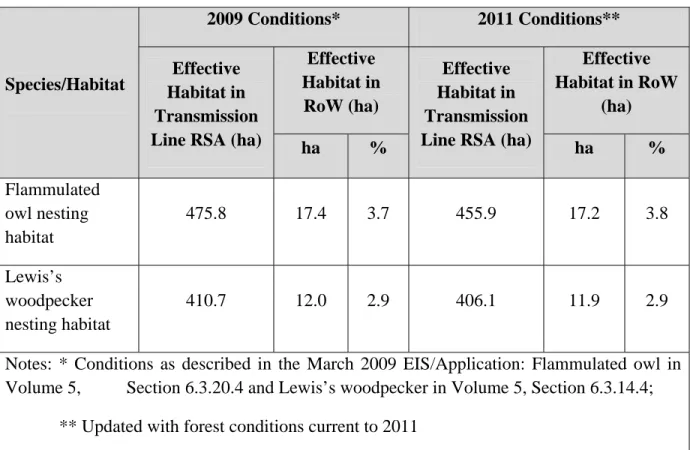
There are three species at risk that use old forest habitat for key life history requirements (e.g., reproducing) and are likely to interact with the transmission line: flammulated owl, Lewis’s woodpecker, and olive-sided flycatcher. Flammulated owl and Lewis’s woodpecker were assessed in detail as key indicators in the March 2009 EIS/Application. Habitat suitability models were developed for both these species, and the outputs of these models have been adjusted for recent forest harvesting and mountain pine beetle for discussion here (see Table 29B-1). Olive-sided flycatcher was not addressed as a key indicator in the March 2009 EIS/Application so does not have a habitat suitability model developed; however, the availability of old forest, discussed in IR29a, is considered to be representative of high value habitat for this species.
29-11 Table 29B-1 provides a comparison of the estimated change in effective habitat (i.e., habitat most likely to contain nesting trees) for flammulated owl and Lewis’s woodpecker between the 2009 EIS/Application and forest conditions updated to 2011. Since the 2009 EIS/Application was filed, the amount of effective habitat within the transmission line RSA for these species has decreased—by 19.9 ha for flammulated owl and 4.6 ha for Lewis’s woodpecker. However, predicted project effects have remained almost identical both in area (ha) and as a percentage of what is available in the RSA (see Table 29B-1).
As described in IR29a, the predicted loss of old forest habitat for olive-sided flycatcher is small (37 ha) and represents 3% of what is available in the transmission line RSA. However, not all old forest loss represents ideal breeding habitat for olive-sided flycatcher. For example, pine-leading old forest appears to have limited value for breeding compared to Douglas-fir forests (e.g., COSEWIC 2007a; Altman and Sallabanks 2012). Thus, reductions in available nesting habitat due to logging and mountain pine beetle are expected to have little effect on breeding efforts of species at risk within the transmission line RoW.
Table 29B-1. A Comparison of Potential Habitat Availability for Old-Forest Dependent Species between 2009 and 2011 within the Transmission Line RSA and Area Potentially Cleared within the ROW
Species/Habitat
2009 Conditions* 2011 Conditions** Effective
Habitat in Transmission Line RSA (ha)
Effective Habitat in RoW (ha) Effective Habitat in Transmission Line RSA (ha)
Effective Habitat in RoW (ha) ha % ha % Flammulated owl nesting habitat 475.8 17.4 3.7 455.9 17.2 3.8 Lewis’s woodpecker nesting habitat 410.7 12.0 2.9 406.1 11.9 2.9
Notes: * Conditions as described in the March 2009 EIS/Application: Flammulated owl in Volume 5, Section 6.3.20.4 and Lewis’s woodpecker in Volume 5, Section 6.3.14.4;
29-12
Information Request #29c
With regards to the effects related to the loss of old forest along the transmission line, the Panel requests that Taseko:
Indicate which measures will be implemented specifically to mitigate or avoid effects of habitat loss of species at risk.
Response Summary
Species-specific mitigation measures have been identified and proposed to retain and protect existing old and mature forest as well as various wildlife features. Taseko will liaise with First Nations, tenure holders (e.g. cattle ranchers), other stakeholders, and government agencies to achieve the desired mitigation measures.
Discussion
Table 29C-1 summarizes key mitigation measures by project effect mechanism and Project phase that will be implemented for species at risk dependent on old forest habitat. The mitigation measures are adopted from the 2009 EIS/Application (Section 5.3.1.4 and Table 6-68, Section 6.4.1) and from the 2012 New Prosperity EIS (Section 2-7). The primary mitigation measure, and the one that will have the greatest benefit, is avoidance. Where feasible, the alignment of the transmission line will be such that it parallels and/or makes use of existing cleared areas. Alignment to avoid old non-pine forest is also a key mitigation measure for reducing effects on old forest habitat. Other mitigation measures, such as retaining single old trees, small old forest patches and snags will also reduce Project effects on species at risk dependent on old forest habitat and associated structural elements.
Commitments pertaining to the construction of the transmission line, as per Taseko’s BCEAO certificate will also ensure effects due to habitat loss are mitigated or avoided:
15.1 Review transmission line final design details and proposed construction scheduling with MOE-ESD (Environmental Stewardship Division) before commencement of construction. 15.2 During construction, work with MOE-ESD and with other regulatory bodies as appropriate
to implement all appropriate mitigation strategies as detailed in Taseko’s “Transmission Line Corridor Mitigation Strategies” (IR6.2). This will include surveying the final
transmission line corridor to identify and mitigate impacts to wildlife features, rare plants, and other features of importance.
29-13
Table 29C-1. Summary of proposed mitigation measures for the transmission line.
Effect Mechanism Project Phase Mitigation Measures1
Loss or alteration of wildlife habitat in general through site clearing and ROW maintenance
Construction, operations and post-closure
Site clearing area required for transmission line construction (i.e., access and ROW clearing) will be minimized in three ways: 1) width of the cleared ROW to average 80 m, 2) width of new access roads will be minimized; and 3) ROW will coincide with existing cleared areas, wherever possible.
Site-specific routing of the transmission line to avoid non-pine forests of any age will be implemented wherever possible.
Routine line maintenance (i.e., vegetation clearing) and ROW maintenance (e.g., vegetation management activities) will be minimized; that is, trimming back vegetation re-growth will be conducted as required on a site-specific basis rather than as a regularly scheduled maintenance activity, also to occur outside of the breeding bird window whenever possible.
Taseko Mines Ltd. to work with local ranchers to prevent cattle disturbance in wetland or riparian areas that may become more accessible with the new ROW.
Sections of the Conceptual Reclamation and Decommissioning Plan that pertain to the reclamation of wildlife habitat (New Prosperity EIS, section 2.8.2).
Mitigation measures described for wildlife habitat features are also applicable.
Transmission line will be decommissioned (removed), and vegetation along the ROW will be allowed to regenerate naturally.
Temporary workspaces will be allowed to regenerate naturally
Loss or alteration of wildlife habitat features through site clearing and pole placement
Construction
Prior to and during ROW clearing, any wildlife habitat features (e.g., mineral licks, dens, nest trees) that are identified will be evaluated for potential mitigation measures (e.g., avoidance). The draft Wildlife Habitat Features: Summary of Management Guidelines–Northern Interior Forest Region (BCMWLAP 2004) provides guidance for assessing wildlife habitat features and applying appropriate mitigation measures
Retain actual or potential wildlife trees (i.e., dead or dying trees and snags, and living or dead deciduous trees) wherever possible and safe to do so (as per provincial guidelines).
Ground inspection of proposed pole placement locations will be conducted to determine whether any wildlife habitat features are present (e.g., badger dens [active or non-active], mineral licks, rock piles and outcrops, unique micro-sites [e.g., seeps]). Any identified wildlife habitat features will be avoided.
In grassland areas, tree removal will be specifically avoided (as trees are of limited availability in these habitats and may be important as perches for birds such as raptors.
Loss or alteration of old-growth to non-natural factors
Construction,
operations Wherever practical, existing non-pine old and mature forest will be protected.
Loss or alteration of old-growth due to insect outbreaks
Operations
Notify MOFR as quickly as possible of any outbreaks of mountain pine beetle and do not remove “green attack” trees from site except under MOFR direction.
In consultation with the MOFR, remove any green felled or wind-thrown spruce from the site to avoid build-up of spruce bark beetle populations.
Loss or alteration of wildlife habitat in general, through sensory disturbance Construction, operations, decommissioning
Construction and decommissioning (removal) activities will be short duration and localized day-to-day.
Vegetation management activities will be localized, short duration, and infrequent.
Construction, decommissioning and vegetation management activities will only occur during the day.
Helicopter use will be minimized during any maintenance activities. Loss or alteration of
Lewis’s woodpecker and flammulated owl nesting habitat through site clearing
Construction
Site-specific routing of the transmission line to avoid high value nesting habitat for Lewis’s woodpecker and flammulated owl identified in the assessment (in particular along Meason Creek) will be implemented where possible.
Loss or alteration of retained wildlife trees by actions of the public (e.g., firewood cutting)
Operations, decommissioning
In cooperation with the BC MoE, Taseko Mines Ltd. will post wildlife tree signs on any wildlife trees/snags they have purposely retained along the ROW in effort to minimize
removal/disturbance of these trees by the public.
Notes: 1
29-14
Information Request #29d
With regards to the effects related to the loss of old forest along the transmission line, the Panel requests that Taseko:
Indicate any relevant recovery strategies or action plans and how they will be respected and/or administered.
Response Summary
Through habitat suitability modeling and examination of provincial and federal recovery strategies and management plans, various species-specific mitigation measures have been proposed to reduce project effects on flammulated owl, Lewis’s woodpecker and olive-sided flycatcher within the transmission line ROW. These include, where applicable, avoidance of old forest, retention of key wildlife features, and avoiding or minimizing vegetation clearing and maintenance during the breeding season.
Discussion
Relevant recovery strategies or action plans were reviewed for species at risk dependent on old forest habitat and which are likely to occur along the transmission line. Table 29D-1 provides a summary of relevant mitigation measures from these plans that would potentially reduce project effects on species-at-risk dependent on old forest habitat.
A federal management plan has been developed for Lewis’s woodpecker and flammulated owl since the 2009 EIS/Application, and recommendations for recovery planning are provided. No recovery strategy or action plan currently exists for olive-sided flycatcher. Mitigation measures recommended by associated recovery strategies and action plans are summarized in Table 29D-1.
Mitigation measures for Lewis’s woodpecker, olive-sided flycatcher and flammulated owl are consistent with regulatory management plans. Species-specific measures include the retention of highly suitable nesting habitat and avoidance though site-specific routing of the transmission line. General wildlife mitigations also applicable are provided in response to IR 29c.
29-15
Table 29D-1. Summary of Provincial and Federal Strategies for Species at Risk and Applicable Recommendations Species at Risk Regulatory Management Information
Proposed Mitigations from Relevant Regulatory Documents Lewis’s woodpecker Environment Canada 2011, COSEWIC 2010
Management Plan confirms the importance of retaining breeding habitat including suitable nesting trees within matrix landscape that includes mature forest, grasslands and low shrub densities for insect foraging. Surveys and
retention of potential/suitable nest trees within ROW (i.e., early seral stage vegetation with nesting trees which mimics stand replacing fires) is applicable, as well as avoiding or minimizing disturbance around potential nest sites during the breeding season (May- August).
Olive-sided flycatcher None available, COSEWIC 2007 N/A Flammulated owl Environment Canada 2012, COSEWIC 2010
Management Plan confirms the importance of identifying, protecting and managing priority mature and old-growth, multi-canopied ponderosa pine and Douglas-fir nesting habitat through best management practices, stewardship, Forest Stewardship Plans. No specific mitigation measures are identified in the Management Plan for the flammulated owl.
29-16
References
BC Ministry of Water, Land and Air Protection (BCMWLAP). 2004. Flammulated Owl (Otus flammeolus). In Accounts and Measures for Managing Identified Wildlife—Account V. 2004. BC Ministry of Water, Land and Air Protection, Victoria, BC. Accessed: January 30th, 2013.
Available at: http://www.env.gov.bc.ca/wld/frpa/iwms/accounts.html.
COSEWIC. 2007. COSEWIC assessment and status report on the Olive-sided Flycatcher
Contopuscooperi in Canada. Committee on the Status of Endangered Wildlife in Canada. Ottawa. Accessed: February 3rd, 2013. Available at:
http://publications.gc.ca/collections/collection_2008/ec/CW69-14-536-2008E.pdf.
COSEWIC. 2010. COSEWIC assessment and status report on the Lewis’s Woodpecker
Melanerpes lewis in Canada. Committee on the Status of Endangered Wildlife in Canada. Ottawa.
Accessed February 21st, 2013. Available at:
http://www.sararegistry.gc.ca/virtual_sara/files/cosewic/sr_Lewis%27s%20Woodpecker_0810_e .pdf
COSEWIC 2010. COSEWIC assessment and status report on the Flammulated Owl Otus flammeolus in Canada. Committee on the Status of Endangered Wildlife in Canada. Ottawa. Accessed: February 15th, 2013. Available
at:http://sararegistry.gc.ca/virtual_sara/files/cosewic/sr_Flammulated%20Owl_0810_e.pdf
Environment Canada. 2011. Management Plan for the Lewis’s Woodpecker (Melanerpes lewis) in Canada [Proposed]. Species at Risk Act Management Plan Series. Environment Canada, Ottawa. Accessed: January 31st, 2013. Available at:
http://www.sararegistry.gc.ca/virtual_sara/files/plans/mp_lewis%27s_woodpecker_e.pdf.
Environment Canada. 2012. Management Plan for the Flammulated Owl (Otus flalleolus) in Canada, Proposed. Species at Risk Act Management Plan Series. Environment Canada, Ottawa. Accessed: February 15th, 2013. Available at: