International Journal of Advanced Research and Development
International Journal of Advanced Research and Development ISSN: 2455-4030, Impact Factor: RJIF 5.24
www.advancedjournal.com
Volume 2; Issue 1; January 2017; Page No. 26-30
Stomach disease
ITS
Suheir H AlmurshidiDepartment of Information Technology, Faculty of Engineering & Information Technology, Al-Azhar University, Gaza, Palestine
Abstract
This paper aims is to present the design and development of an intelligent tutoring system for teaching students about stomach diseases to help and give them a clear idea about stomach ulcer diseases. Furthermore, the researchers designed an intelligent tutoring system with a clear interface including 3D animation with Delphi that show how the ulcer appears in the stomach with more details about the disease, after that there are some questions researchers going to adopt from clinical books about the diseases that show the students how to diagnose the diseases. This system integrated Delphi programming with multimedia elements such as (voice, motion, text, photo, and interactive) to carry out the project. The idea of this paper is considering the intelligent tutoring system for students who are studying medicine to enhance their knowledge and deep understanding about the diseases.
Keywords: Intelligent Tutoring System, Stomach Disease, ITSB,3D Animation
1. Introduction
Intelligent Tutoring Systems (ITS) are gaining significance in the field of education. A lot of examinations were conducted to show and model student knowledge perfectly, design effective programs and improve instructional methods. The system that the researchers are introducing gives the student who studies medicine the opportunity to learn about stomach ulcer diseases in an effective way. The earlier and traditional assessments usually are time-consuming and have to be managed by the specialist; therefore researchers gathered the data related to diseases from specialists such as medicine doctor in the field of a stomach. Students will see the data in an attractive way by using Delphi programming and 3D design. Helicobacter pylori bacteria (H. pylori), is the utmost common reason of stomach ulcers diseases. This bacterium harms the mucus that defends ones stomach and minor intestine, permitting for stomach acid to burn through. A 35 percent of Americans get H. pylori approximately, as stated by the National Institute of Diabetes and Digestive and Kidney Diseases (NIDDK) [1, 2, 3, 4].
It is blurred how this bacterium spreads, patients who carry H. Pylorican likewise spread it over direct interaction. Many patients get this virus in their childhood, but it infrequently progresses into a peptic ulcer [4]. Formerly,
experts used to think that pressure and spiced foods produced ulcers. Nowadays, it is well known that stomach acids and other digestive solutions blister the lining of ones organs and produce ulcers [4]. Individuals, who use or depend on
nonsteroidal anti-inflammatory drugs (NSAIDs), such as ibuprofen, aspirin, and naproxen sodium, are probably to get peptic ulcers. NSAIDs can annoy and harm ones lining. Acetaminophen, or Tylenol, is not counted in this list. Despite the fact that doctors frequently endorse NSAIDs for health situations such as arthritis or joint inflammation, NSAIDs can rise ones threat for getting peptic ulcers.
Some of the other risk factors recognized to raise ones risk for getting gastric and duodenal ulcers includes [3, 4].
1) One's age greater then 70 years 2) Drinking alcohol
3) Has history of peptic ulcers 4) Smoking
5) Uncured stress
Spiced foods do not raise ones risk for ulcers but they can annoy ones stomach more. After food go in from esophagus, stomach starts to release enzymes that support in the digestive process. The pH here is two that deliver the best acidity setting for the take full advantage of action of pepsin, a protein-digesting enzyme. The stomach muscles contract and relax so as to physically mix the food very well with the released enzymes.
Usually food takes from two to five hours in the stomach. After it goes through full digestion, the chime leaves the stomach to go into the little intestine followed by ingress to the huge intestine. The passage of food in and out of the stomach is organized by two muscular valves. Food goes in the stomach from the esophagus in the course of the lower esophageal or cardiac sphincter. Alternatively, the passage of food from the stomach into the intestine takes place through the pyloric sphincter [4].
International Journal of Advanced Research and Development
Stomach Disease Intelligent Tutoring System was designed and developed using ITSB authoring tools [20].
2. Literature Review
There are a few ITS applications developed in field of educations and instructions. The authors in [1] built an
intelligent tutoring system for teaching FOL similarity to assist students in learning logic and helps students to study how to build equivalent formulas in first order logic, authors in [2] presented an Intelligent Tutoring System that mentors
diabetics, giving them the ability to develop the necessary capability, In [25] the authors built an Intelligent Tutoring
System for Learning Java Objects that will help students to study Java objects by present the area of Java objects and administers automatically generated problems for the students to work out and the system dynamically adopt at run time to the student's individual progress, design and development of diabetes ITS [27], ITS teaching grammar
English tenses [24], ITS for teaching advanced topics in
information security [16], development and evaluation of the
Oracle Intelligent Tutoring System (OITS) [17], ITS for
learning Computer Theory [18], e-learning system [8, 15, 24],
ADO-Tutor: Intelligent Tutoring System for leaning ADO.NET [33], an agent based ITS for Parameter Passing in
Java Programming [14], Java Expression Evaluation [10],
Linear Programming [7, 28], an Intelligent Tutoring System for
Entity Relationship Modeling [13], an Knowledge-based
Intelligent Tutoring System for Teaching Mongo Database
[19], Design and Development of an Intelligent Tutoring
System for C# Language [29], effectiveness of e-learning [23],
computer aided instruction [6], effectiveness of the CPP-Tutor [26], teaching AI searching algorithms [12], teaching database
to sophomore students in Gaza [9], and Predicting learners
performance using NT and ITS [5], ITS which called
CPP-Tutor for helping student to learn C++ Programming Language [11], a comparative study between Animated
Intelligent Tutoring Systems (AITS) and Video-based Intelligent Tutoring Systems (VITS) [21].
3. ITS Architecture
Figure 2 shows the architecture used in the current intelligent tutoring system for teaching students Stomach Disease. The architecture consists of four modules: the domain module, student module, pedagogical module and the interface module.
Fig 2: Intelligent Tutoring System architecture used in this research
3.1 Domain Model
The domain module contains the following material to be taught to the students:
Stomach Ache Stomach Disorders
Stomach Flu see Gastroenteritis
Stomach Stapling see Weight Loss Surgery Stomach Ulcer see Peptic Ulcer
Stool see Bowel Movement
Strabismus see Eye Movement Disorders Strep Throat see Streptococcal Infections Streptococcal Infections
3.2 Student Model
Every new student should have his/her own account or profile to be able to use the Intelligent Tutoring Systems such as the course materials, examples, exercise, and statistics. The student profile includes information about students such as student name, student number, date of last visit, current course and overall course, and other and student information. The current score represents score about students for each difficulty level in every lesson. The overall score represent student for all difficulty levels of a lesson.
3.3 Pedagogical Module
It works as a controller that manages the functionality of the system throughout this module; a student can answer questions starting from first difficulty level. If the student got 75% marks or higher in any level, he/she can move to next difficulty level. However, If the student marks below 75% and above 50 % the ITS system force him to repeat exercises of the same difficulty level again. In the case the student get score below 50%, the ITS system force the student to go back and study the related lesson then come back to answer the exercises.
3.4 User Interface Model
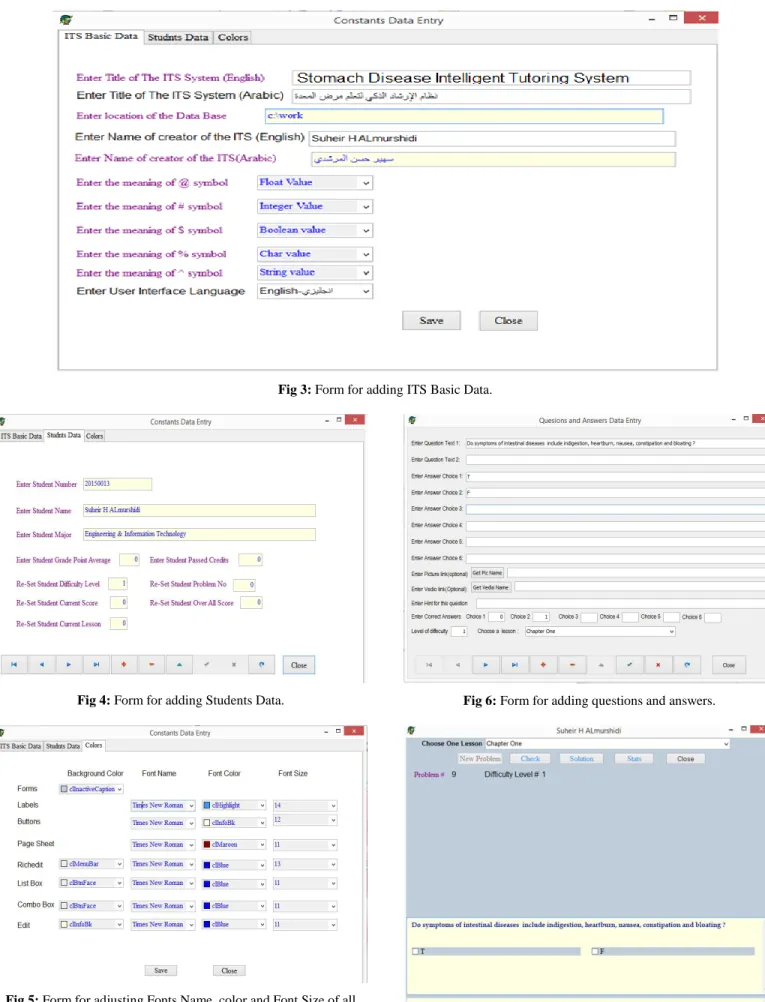
User interface was designed to be easy to use and very simple. Figure 2 to figure 7 show the different user interfaces of the intelligent tutoring system for teaching stomach diseases.
International Journal of Advanced Research and Development
Fig 3: Form for adding ITS Basic Data.
Fig 4: Form for adding Students Data.
Fig 5: Form for adjusting Fonts Name, color and Font Size of all screens of the system.
Fig 6: Form for adding questions and answers.
International Journal of Advanced Research and Development
29
4.ITS Evaluation
The evaluation of system was done by teachers, students, and doctors who are specialized in this area. They evaluated the system from their perspective. The evaluation was done in two stages. The stage was for the teachers and the second one was for the students. We took their advices and feedbacks after presenting the system for each group in order to analyze lessons, answers, examples, questions, the design, effectiveness and ease of use.
The results of each group were very acceptable. Their comments were involved in enhancing the material and adding more exorcises.
5.Conclusion
ITSs are viewed as future’s tutoring system and many studies accomplished in this area. When they are compared to traditional classroom atmosphere, ITSs are quite successful and relatively taking teachers' place, they take on supporting duty for students. In traditional teaching environment, students’ differences aren’t taken into account. In this paper, we have designed developed an intelligent tutoring system for students learning diabetes using ITSB authoring tool. The system was developed for students who want to study medicine or increase their knowledge in this field easily and smoothly. System architecture and requirements of students and teachers were taken in consideration of the design of the system. The evaluations of the system have been done by specialist doctors, teachers and students and the results were very acceptable.
References
1. Abu Hasanein, H. A. and S. S. Abu Naser (2017). "An intelligent tutoring system for cloud computing.". 2. Abu Naser, S. (2008). "An Agent Based Intelligent
Tutoring System For Parameter Passing In Java Programming." Journal of Theoretical & Applied Information Technology 4(7).
3. Abu Naser, S. S. (1999). "Big O Notation for Measuring Expert Systems complexity." Islamic University Journal Gaza 7(1): 57-70.
4. Abu Naser, S. S. (2001). "A comparative study between animated intelligent tutoring systems AITS and video-based intelligent tutoring systems VITS." Al-Aqsa Univ. J 5(1): 72-96.
5. Abu Naser, S. S. (2006). "Intelligent tutoring system for teaching database to sophomore students in Gaza and its effect on their performance." Information Technology Journal 5(5): 916-922.
6. Abu Naser, S. S. (2008). "Developing an intelligent tutoring system for students learning to program in C++." Information Technology Journal 7(7).
7. Abu Naser, S. S. (2008). "Developing visualization tool for teaching AI searching algorithms." Information Technology Journal, Scialert 7(2): 350-355.
8. Abu Naser, S. S. (2012). "A Qualitative Study of LP-ITS: Linear Programming Intelligent Tutoring System." International Journal of Computer Science & Information Technology 4(1): 209.
9. Abu Naser, S. S. and I. S. Zaqout (2016). "Knowledge-based systems that determine the appropriate students
major: In the faculty of engineering and information technology." World Wide Journal of Multidisciplinary Research and Development 2(10): 26-34.
10. Abu Naser, S. S. and S. H. ALmursheidi (2016). "A Knowledge Based System for Neck Pain Diagnosis." World Wide Journal of Multidisciplinary Research and Development (WWJMRD) 2(4): 12-18.
11. Abu Naser, S. S., et al. (2008). "A Proposed Expert System For Guiding Freshman Students In Selecting A Major In Al-Azhar University, Gaza." Journal of Theoretical & Applied Information Technology 4(9). 12. Abu Naser, S., et al. (2011). "Human Computer
Interaction Design of the LP-ITS: Linear Programming Intelligent Tutoring Systems." International Journal of Artificial Intelligence & Applications (IJAIA) 2(3). 13. AbuEloun, N. N. and S. S. Abu Naser (2017).
"Mathematics intelligent tutoring system." International Journal of Advanced Scientific Research 2(1).
14. AbuEl-Reesh, J. Y. and S. S. Abu-Naser (2018). "An Intelligent Tutoring System for Learning Classical Cryptography Algorithms (CCAITS)." International Journal of Academic and Applied Research (IJAAR). 15. Abu-Naser, S. S. (2008). "JEE-Tutor: An Intelligent
Tutoring System for Java Expression Evaluation." 16. Abu-Naser, S. S. (2016). "ITSB: An Intelligent Tutoring
System Authoring Tool." Journal of Scientific and Engineering Research 3(5): 63-71.
17. Abu-Naser, S., et al. (1995). "& Beattie, GA (2000)." Expert system methodologies and applications-a decade review from: 9-26.
18. Abu-Naser, S., et al. (2011). "An intelligent tutoring system for learning java objects." International Journal of Artificial Intelligence and Applications.
19. Akkila, A. N. and S. S. Abu Naser (2017). "Teaching the right letter pronunciation in reciting the holy Quran using intelligent tutoring system." International Journal of Advanced Research and Development 2(1): 64-68. 20. Alawar, M. W. and S. S. Abu Naser (2017).
"CSS-Tutor: An intelligent tutoring system for CSS and HTML." International Journal of Academic Research and Development 2(1): 94-98.
21. Al-Bastami, B. G. and S. S. Abu Naser (2017). "Design and Development of an Intelligent Tutoring System for C# Language." EUROPEAN ACADEMIC RESEARCH 6(10): 8795.
22. Albatish, I., et al. (2018). "ARDUINO Tutor: An Intelligent Tutoring System for Training on ARDUINO." International Journal of Engineering and Information Systems (IJEAIS) 2(1): 236-245.
23. Al-Bayed, M. H. and S. S. Abu Naser (2017). "An intelligent tutoring system for health problems related to addiction of video game playing." International Journal of Advanced Scientific Research 2(1): 4-10.
24. Al-Bayed, M. H. and S. S. Abu-Naser (2018). "Intelligent Multi-Language Plagiarism Detection System." International Journal of Academic Information Systems Research (IJAISR) 2(3): 19-34.
25. Aldahdooh, R. and S. S. Abu Naser (2017). "Development and Evaluation of the Oracle Intelligent Tutoring System (OITS)." EUROPEAN ACADEMIC
International Journal of Advanced Research and Development
30
RESEARCH 6(10): 8711-8721.
26. Alhabbash, M. I., et al. (2016). "An Intelligent Tutoring System for Teaching Grammar English Tenses." EUROPEAN ACADEMIC RESEARCH 6(9): 7743-7757.
27. Al-Hanjori, M. M., et al. (2017). "Learning computer networks using intelligent tutoring system." International Journal of Advanced Research and Development(2): 1.
28. Almurshidi, S. H. and S. S. Abu Naser (2017). "Design and Development of Diabetes Intelligent Tutoring System." EUROPEAN ACADEMIC RESEARCH 6(9): 8117-8128.
29. Almurshidi, S. H. and S. S. Abu Naser (2017). "Stomach disease intelligent tutoring system." International Journal of Advanced Research and Development 2(1): 26-30.
30. Al-Nakhal, M. A. and S. S. Abu Naser (2017). "Adaptive Intelligent Tutoring System for learning Computer Theory." EUROPEAN ACADEMIC RESEARCH 6(10): 8770-8782.
31. Anderson, J., et al. (2005). "Adaptation of Problem Presentation and Feedback in an Intelligent Mathematics Tutor." Information Technology Journal. 32. Azaab, S., et al. (2000). "A proposed expert system for
selecting exploratory factor analysis procedures." Journal of the College of Education 4(2): 9-26.
33. Baker, J., et al. "& Heller, R.(1996)." Information Visualization. Information Technology Journal 7(2). 34. Baker, J., et al. (1996). "Information Visualization."
Information Technology Journal 7(2): pp: 403-404. 35. Buhisi, N. I. and S. S. Abu Naser (2009). "Dynamic
programming as a tool of decision supporting." Journal of Applied Sciences Research.
36. Chen, R.-S., et al. (2008). "Evaluating structural equation models with unobservable variables and measurement error." Information Technology Journal. 37. El Agha, M. I., et al. (2018). "SQL Tutor for Novice
Students." International Journal of Academic Information Systems Research (IJAISR) 2(2): 1-7. 38. El Haddad, I. A. and S. S. Abu Naser (2017).
"ADO-Tutor: Intelligent Tutoring System for leaning ADO. NET." EUROPEAN ACADEMIC RESEARCH 6(10): 8810-8821.
39. Elnajjar, A. E. A. and S. S. Abu Naser (2017). "DES-Tutor: An Intelligent Tutoring System for Teaching DES Information Security Algorithm." International Journal of Advanced Research and Development 2(1): 69-73.
40. Hamed, M. A. and S. S. Abu Naser (2017). "An intelligent tutoring system for teaching the 7 characteristics for living things." International Journal of Advanced Research and Development 2(1): 31-45. 41. Hilles, M. M. and S. S. Abu Naser (2017).
"Knowledge-based Intelligent Tutoring System for Teaching Mongo Database." EUROPEAN ACADEMIC RESEARCH 6(10): 8783-8794.
42. Hissi, H. E.-., et al. (2008). "Medical Informatics: Computer Applications in Health Care and Biomedicine." Journal of Artificial Intelligence 3(4).
43. Li, L., et al. (2011). "Hybrid Quantum-inspired genetic algorithm for extracting association rule in data mining." Information Technology Journal 12(4). 44. Mahdi, A. O., et al. (2016). "An intelligent tutoring
system for teaching advanced topics in information security." World Wide Journal of Multidisciplinary Research and Development 2(12): 1-9.
45. Naser, S. (2009). "Evaluating the effectiveness of the CPP-Tutor an intelligent tutoring system for students learning to program in C++." Journal of Applied Sciences Research 5(1): 109-114.
46. Ng, S., et al. (2010). "Ad hoc networks based on rough set distance learning method." Information Technology Journal 10(9).
47. Owaied, H. H., et al. (2009). "Using rules to support case-based reasoning for harmonizing melodies." Journal of Applied Sciences 11(14): pp: 31-41.
48. Shaath, M. Z., et al. (2017). "Photoshop (CS6) intelligent tutoring system." International Journal of Academic Research and Development 2(1): 81-87. 49. Sulisel, O., et al. (2005). "Growth and Maturity of
Intelligent Tutoring Systems." Information Technology Journal 7(7): 9-37.
50. Khella, R. A. and S. S. Abu-Naser (2018). "An Intelligent Tutoring System for Teaching French." International Journal of Academic Multidisciplinary Research (IJAMR) 2(2): 9-13.
51. Marouf, A., et al. (2018). "An Intelligent Tutoring System for Learning Introduction to Computer Science." International Journal of Academic Multidisciplinary Research (IJAMR) 2(2): 1-8.
52. Mosa, M. J., et al. (2018). "ASP. NET-Tutor: Intelligent Tutoring System for leaning ASP. NET." International Journal of Academic Pedagogical Research (IJAPR) 2(2): 1-8.
53. Qwaider, S. R. and S. S. Abu-Naser (2018). "Excel Intelligent Tutoring System." International Journal of Academic Information Systems Research (IJAISR) 2(2): 8-18.
54. Akkila, A. E.-D. N. and S. S. Abu Naser (2018). ITS-Tutor for Teaching Rules of Tajweed the Holy Quran, Al-Azhar University, Gaza, Palestine.
55. Akkila, A. N. and S. S. Abu-Naser (2018). "Rules of Tajweed the Holy Quran Intelligent Tutoring System." International Journal of Academic Pedagogical Research (IJAPR) 2(3): 7-20.
56. Abu Ghali, M. J., et al. (2018). "An Intelligent Tutoring System for Teaching English Grammar."
![Fig 1: Stomach [4]](https://thumb-us.123doks.com/thumbv2/123dok_us/614413.2573646/1.918.476.851.880.1085/fig-stomach.webp)