Preface and acknowledgements
Oxford Research A/S presents Expat Study 2014, the fourth survey conducted among expats who live and work in Denmark1.
The study has been financed by a group of sponsors. The sponsors, in alphabetical order, are: Aarhus University
Confederation of Danish Industry Copenhagen Capacity
The Danish Agency for Labour Market and Recruitment (STAR) The Danish Society of Engineers, IDA
International Community
Lyngby-Taarbæk City of Knowledge & Urban Development The Ministry of Business and Growth
The Murmur
The Technical University of Denmark University of Copenhagen
A team of analysts from Oxford Research A/S have drafted the report. The team consists of head of depart-ment Nina Middelboe, senior analyst Derek Light, analyst Rikke Lynge Storgaard, analyst Christian Rebsdorf Sørensen, analyst Jakob Bom, researcher Rikke Bech Espersen and researcher Karen Yip Hornnes.
Oxford Research would like to thank the sponsors for their input and for contributing to this study.
Last but not least, we would like to thank all the expats who completed the survey and by doing so, have shared their views and perceptions about living and working in Denmark.
Content
PREFACE AND ACKNOWLEDGEMENTS 0
EXECUTIVE SUMMARY 4
INTRODUCTION TO THE EXPAT AGENDA 7
2.1 The competition for the highly skilled – a global trend 7
2.2 Developments in the expat field since 2010 9
2.3 Reading Guide to the Expat Study 2014 10
WHO HAS PARTICIPATED IN EXPAT STUDY 2014? 11
3.1 Gender, age, education and income level 11
3.2 Region and country of origin 13
3.3 Experience as an expat 14
WHERE DO THE EXPATS WORK? 16
4.1 Characteristics of the workplaces 16
COMING TO DENMARK 22
5.1 Important factors when choosing Denmark as the country to work in 22
5.2 Services from public authorities upon and after arrival in Denmark 25
5.3 Services and policies by the workplace 28
WORKING IN DENMARK 30
6.1 Career opportunities in Denmark 30
6.2 Work culture and work/life-balance in Denmark 34
6.3 Overall satisfaction with my job in Denmark 37
LIVING IN DENMARK 40
7.1 Family 40
7.2 The social life 43
7.3 Taxes and benefits 45
7.4 Expats enjoy living in Denmark 48
RETENTION OF EXPATS 49
8.1 The length of the stay 49
8.2 This could make me stay longer 52
METHODOLOGY OF THE EXPAT STUDY 2014 55
9.1 The population 55
9.2 Survey data in combination with data from registers 55
Executive summary
This executive summary presents the overall conclusions of the Expat Study 2014. The Expat Study 2014 has been carried out by Oxford Research using data from a questionnaire survey conducted among approximately 1,800 highly skilled expatriates2 who live and work in Denmark. The report thus follows in the footsteps of the
expat studies conducted by Oxford Research in 1998, 2006 and 20103.
The Expat Study 2014 explores the state of the expat agenda by examining how expats in Denmark perceive their lives here and why they do so. This allows the many stakeholders within the expat field to assess how the attraction and retention of highly skilled expats has progressed since the last study in 2010, and identify and address potential areas for improvements.
The Expat Study 2014 has been conducted differently, compared to the previous studies. In the last Expat Study from 2010, respondents were reached through different networks and workplaces and an overwhelming amount of respondents were researchers which may have influenced the results of the study. In the 2014-study, the data was drawn by Statistics Denmark and includes a random sample of expats, representing the entire population of expats in Denmark. This has made it possible to comment on assessments, satisfaction etc. among all types of expats both in relation to areas such as sectors, branches and geography.
It is however, important to notice that the findings cannot be seen as an objective measure of Denmark´s ability to attract expats. This would have required information from expats who have actively chosen not to come to Denmark and develop their careers here.
Rather, from this study, we gain the most solid knowledge to date on the expats who have actively chosen Denmark and as such are able to evaluate Denmark as a country to work and live in.
The Expat Study 2014 is financed by a group of sponsors. In alphabetical order, they are:
2 The survey has been financed and completed by the Danish Agency for Labour Market and Recruitment, STAR 3 http://www.oxfordresearch.dk/om-oxford/kernekompetencer/expat.aspx
Aarhus University
Confederation of Danish Industry Copenhagen Capacity
The Danish Agency for Labour Market and Recruitment (Ministry of Employment) The Danish Society of Engineers, IDA
International Community
Lyngby-Taarbæk City of Knowledge & Urban Development The Ministry of Business and Growth
The Murmur
The Technical University of Denmark University of Copenhagen
Professional possibilities is a key factor
The Expat Study 2014 confirms that the most important factor for expats when deciding to move to Denmark is related to their professional career. The study shows that the expats living in Denmark are satisfied with their job (84 %) as well as other aspects related to the job, which are crucial for coming to Denmark.
The study shows that there are three main reasons why the respondents have accepted a job in Denmark: 1. To improve their career
2. To have an interesting job
3. To have the opportunity to enjoy a good work/life balance.
When exploring further into these answers, we find some noteworthy differences e.g. in relation to age groups, where younger expats generally find career opportunities more important than older expats, who value having an interesting job and work/life balance. We find that the motivation to seek a job in Denmark differs among expats from different countries of origin. Expats from countries outside the EU and the Nordic countries find career opportunities and the possibility to work in a world-class company important, whereas expats from the Nordic countries value an interesting job to a higher extent and expats from the EU highlight work/life balance in their answers.
The finding that expats come especially to Denmark because of professional possibilities is noteworthy, as it shows that the expats perceive Denmark as a country where they can have an interesting job while improve their careers at the same time. Overall, the expats are satisfied with their jobs, which indicate that their expec-tations to a high degree are fulfilled. Furthermore, the opportunity to have good work/life balance is mentioned by two out of five expats as an important factor when accepting a job in Denmark, showing that this is a valued part of working in Denmark. In an increasingly globalised competition for skilled workers, this is important.
Social life is important for general satisfaction with life in Demark
Another main finding from the study is that expats generally enjoy living in Denmark (86% of the respondents). Factors such as social life and the family’s happiness are important issues to discuss, in order to understand the expats’ satisfaction with life in Denmark. Generally, satisfied expats are those who have an active social network outside of work, and who meet and socialise with others expats and Danes on a regular basis. This is affected by how good the possibilities to do so are at work. Expats who work in small companies find the possibilities to meet and socialise with Danes outside of work easier compared to those who work in large companies, who on the other hand, find that there are good possibilities to meet with other expats. Those working in medium sized companies were the least satisfied with their possibilities for social networking.
The expats who have a well-integrated partner in Danish society and who works or studies in Denmark, are also the most satisfied with life in Denmark. Finally, the study reveals that expats with family and children in Denmark are more satisfied with their lives here if they are also satisfied with the school and educational op-portunities for children. In general, 40 % of the expats prefer an international school for their children.
Public authorities are good in English in 2014 - and Danish language courses are in demand
The study also examined how satisfied the expats were with their arrival in Denmark. The reception of newly arrived expats play a crucial role in helping them settle into their new lives. The majority are satisfied (70 %) with the service of Danish authorities. International Citizen Services was especially highlighted positively. 90 % of the expats also state that the public authorities can communicate in English, which is essential for commu-nication with non-Danish speakers. Interestingly, the study indicates that more expats find the public authorities capable of communicating in English than in 2010.
When asking the expats what kind of help the work place should offer to assist them with in the beginning, the majority wished to be assisted with practical issues outside of work, such as housing and insurance. Further-more, Danish language courses are stressed as important. This aligns well with the findings from Expat Study
2010, which found that it is important to learn Danish to be able to feel integrated in Denmark and socialise with Danes. The language barrier is, in general, an essential factor for expats since it is often highlighted as a reason for leaving Denmark earlier and among the factors that can make the expats stay longer.
Reasons for leaving Denmark earlier than originally planned
The majority of the expats are happy with their jobs and lives in Denmark and 46 % of the respondents in the survey plan to stay longer than originally planned. We find that 6 % have decided to leave early and the rest will stay as originally planned.
Even though it is a relatively small group who will leave earlier than expected, the characteristics of and assess-ments from this group are highly relevant. The reason why they leave is an important piece of knowledge to gain if Denmark wishes to be even better in retaining expats.
Those who leave Denmark are unhappy with their jobs and lives, and some of them have partners and families who are also unhappy with life here. When exploring further into why these respondents are unhappy and decide to leave, we find some key factors that affect this.
The unsatisfied expats are characterised as coming to Denmark because they expected to work in a world-class company and to have work/life balance in their lives. They are less social i.e. only rarely or never socialise with other expats and Danes - and do not find the opportunities to do so very good. Amongst those who leave because the partner is unhappy, we find that their partners neither work nor study, which could indicate that they are not well integrated in Denmark. Finally, among expats with children, who leave Denmark earlier than planned because they are unhappy with their lives, there are an overrepresentation of expats, who have their children in a Danish school but wish to have them in an international school instead.
The retention of expats
Once expats have come to Denmark, the majority are happy with their lives and half of them want to stay here longer than they originally intended. The expats thus generally perceive Denmark as an attractive country to live and work in. Still, it is important to capture the targets for further improvement; therefore, we asked the expats what could make them stay longer.
The study identifies four main factors that influence whether the expats stay in Denmark: 1. Better career opportunities
2. A better social network 3. Lower income taxes
4. Better Danish language skills.
There are some noteworthy differences. Females highlight a social network as an important factor, compared to men who find lower income taxes more important. The younger expats wish to have a better social network, career opportunities and Danish skills, whereas the older expats focus on career opportunities for the partner and work life balance. Employees within research rate better career opportunities as more important than expats within other work fields. Expats within manufacturing & other industry find lower income taxes to be im-portant compared to employees in other work fields.
Introduction to the expat agenda
The Expat Study 2014 is the fourth survey on expats living and working in Denmark conducted by Oxford Research, and thus follows in the footsteps of the Expat Study’s conducted in 1998, 2006 and 2010. The aim of the present study is to gauge how expats living and working in Denmark perceive their professional as well as personal lives. In line with previous expat studies, the results from 2014 can be used by a multiplicity of stakeholders to improve and target their efforts in attracting and retaining expats in Denmark.
In this first chapter, we introduce the concept of an expat and the expat agenda in a Danish context. We briefly look into the development since the last expat study completed in 2010 and finish the chapter with a reading guide to the Expat Study 2014.
2.1
THE COMPETITION FOR THE HIGHLY SKILLED – A GLOBAL TREND
International migration is on the rise4 and mobility of people can be viewed as a specific dimension of
globali-sation. With Silicon Valley setting the pace in the late 1990s and continuing to accelerate, this phase of global-isation has increased the competition for specific skills in order to create innovation and growth.
Even though this theme of global professionals has been on the agenda for a while, challenges still exist in the recruitment and retention of highly skilled and qualified expats. This is highlighted by a recent report by the World Economic Forum, where Denmark ranked number 19 in attracting and retaining highly educated inter-nationals5.
Highly skilled and qualified expats – a sensible investment
The public debate has often, and especially in the aftermath of the financial crisis in 2008, focused on whether the attraction and retention of highly skilled workers is necessary. Several studies show however, that attracting and retaining highly skilled and qualified foreign workers has a positive effect on public finances as well as the productivity of individual firms.
The demographic developments in Denmark are also revealing that there will be fewer working age individuals in the future. Meaning that it will be more unlikely for companies to be able to hire employees with the necessary skillsets in the upcoming years. Immigration is then one option to ease the implications of the aging population, as well as sustaining companies and furthering their development and growth.
4 OECD Migration Outlook 2013
Definition of an expat
The word “expat” derives from “expatriate”, which the Oxford Dictionary defines as “a person who lives outside their native country”. In The Expat Study 2014, this broad definition is however, further narrowed, as the study only focuses on highly qualified and skilled foreign citizens who are working in Denmark (see chapter 3).
Number of foreign workers in Denmark
According to table 2.1, the number of foreign workers living and working in Denmark has increased rapidly since 2008 (www.jobindsats.dk).
Table 2.1
2008 2009 2010 2011 2012 2013
34,497 39,299 41,900 49,956 58,262 67,638 Basis of residence
Whether an expat needs a work permit in order to work in Denmark varies for Nordic citizens, EU/EES citizens and citizens from countries outside the Nordic countries or the EU/EAA. Nordic citizens are free to live and work in Denmark, and so are EU/EES citizens, though a registration at the State Administration is necessary for stays longer than three months.
Meanwhile, citizens from countries outside the Nordic countries or the EU/EAA require a permit in order to work in Denmark. There are special schemes designed to make it easier for highly qualified professionals to get a residence and work permit in Denmark.
The Greencard scheme: A residence and work permit under the Greencard scheme is issued on the basis of an individual evaluation using a point system. The points are given based on several criteria incl. language skills, education from international universities etc. From 1st January 2015 the du-ration of Greencards are changed from three to two years and the expat needs to earn at least DKK 315,000 the year before applying for an extension.
The Positive List: If the expat has been offered a job in a profession currently experiencing a shortage of qualified professionals, he or she has particular easy access to the Danish labour market. The minimum educational level required for a position on the Positive List is a Professional Bachelor's degree.
The Pay Limit scheme: If the expat has been offered a highly paid job, he or she has particularly easy access to the Danish labour market. There are no specific requirements with regards to education, profession, or the specific nature of the job. The expat must have a gross annual pay of no less than DKK 375,000.
The Corporate scheme (replaced by the Fast Track scheme by 2015): The corporate scheme makes it easier for companies with operations in Denmark to transfer employees with special abilities or qualifications from the company’s foreign departments to Denmark to work on a project or to carry out work that is innovative or educational in nature. It is only certified companies that can gain from the scheme and it is required that the expat must have a gross annual pay of no less than DKK 375,000.
A new reform regarding international recruitment is launched January 1st, 2015. The overall aim of the
reform is to achieve better opportunities for Danish companies, universities etc. to recruit and retain highly qualified labour and international students who have earned a master’s degree or PhD in Den-mark. Beside the schemes mentioned above, the reform will included new rules for self-employed (Start-up Denmark) and international graduates (Establishment Card).
Several publications have shown that highly skilled and qualified expats are a worthwhile investment for public finances as well as the individual companies hiring them. Jacobsen et al. have shown that the annual net con-tribution of an average highly skilled and qualified expat with a family to public finances is approximately 243.000 DKK, while the amount for an average highly skilled and qualified expat without a family is about 123.000 DKK. One possible explanation as to why the net contribution is higher for expats with families than for expats without families is that the partner also works. Additionally, single expats are generally younger and not as far in their careers as the expats with families, meaning their income is lower. Their higher net contribu-tion is due to that fact that expats use publicly funded services, including health care and daytime care for their children, far less than Danes6.
It is not only the public finances that benefits from the highly skilled and qualified expats. The Confederation of Danish Industry has calculated that one highly skilled and qualified expat creates value worth 1.5 million DKK yearly7. Furthermore, Malchow-Møller et al. has demonstrated that Danish companies who have
em-ployed foreign experts increase their productivity more than if they had emem-ployed Danish experts. These com-panies also increase their exports of goods and services, for instance as a result of the foreign experts’ knowledge about foreign markets8.
2.2
DEVELOPMENTS IN THE EXPAT FIELD SINCE 2010
The Expat Study 2010 showed that even in the shadow of the financial crisis, Danish companies require highly specialised international labour. However, the study discovered several issues, which conceivably made attrac-tion and retenattrac-tion of expats more difficult than it ought to be. For instance, 90 % of the expats found assistance with practical issues as essential when coming to Denmark, but only 32 % - the majority employed in private companies with more than 50 employees – was actually offered this assistance. Furthermore, while the general perception of the Danish bureaucracy was positive, there was a need for a coherent overview of relevant rules and regulations as well as the bureaucracy as a whole.
As such, it is worth noting that there has been a growing understanding of the importance in the reception of newly arrived expats in Denmark in order to retain them here. In the past four years, a stronger focus on the reception of expats from public authorities has resulted in a general upgrade of communication in English amongst public authorities. Furthermore, International Citizen Service centres in the four largest cities in Den-mark opened in 2011 based on the experiences with a One Stop Shop in Aarhus.
It also seems that private as well as public workplaces are paying more attention to their international employ-ees. A mapping carried out by Oxford Research on behalf of The Danish Agency for Labour Market and Recruitment indicated that many workplaces have increased their range of activities for their international em-ployees in the past few years, including practical help with relocation as well as professional and social integra-tion in the workplace9.
Besides the increased focus from public authorities and workplaces, a range of stakeholders have strengthened their activities in helping expats living and working in Denmark, for instance initiatives such as Copenhagen Talent Bridge10 and International Community.
Naturally, the agenda is constantly evolving. In 2014, the Danish government together with the Liberal Party of Denmark, the Socialist People's Party, The Danish People's Party, Liberal Alliance and The Conservative
6 Jacobsen, R. H., og J.R. Skaksen (2013): Fiscal Costs and Benefits of High Skilled Immigration to a Generous Welfare State. CEBR
7 Dansk Industri (2014): Velkommen, bienvenue, witamy.
8 Malchow-Møller, N., J. R. Munch og J.R. Skaksen (2011): Do Foreign Experts Increase the Productivity of Domestic Firms. IZA Discussion Paper no. 6001
9 See www.expatviden.dk (in Danish)
People's Party agreed on a reform of the regulation of international recruitment regarding e.g. smoother re-cruitment processes when obtaining work permits for expats, improved retention of both international students and international labour. The new reform is set to come into effect at the beginning of 2015.
2.3
READING GUIDE TO THE EXPAT STUDY 2014
The Expat Study 2014 is divided into eight chapters. The first chapter is the executive summary, presenting the key findings from the Expat Study 2014. After this introductory chapter, chapter 3 introduces and analyses the expats constituting the respondents of the survey in order to get a better understanding of their characteristics. Chapter 4 delves into where the expats actually work, looking in depth at the distribution of public and private employment as well as employment across industries, while also analysing the educational backgrounds of the expats and how they were recruited to their current job.
Chapter 5 examines how the expats perceived their reception from both public authorities and their employer when they arrived in Denmark. Further on the chapter analyses which factors played a part in the expat’s decision to come to Denmark.
Chapter 6 is dedicated to the many nuances related to how it is to work in Denmark, starting by examining the expats’ perception of their career opportunities in Denmark. The chapter then studies how the expats look at Danish work culture in general and work/life balance in particular. Finally, the chapter elaborates on the expats’ overall satisfaction with working in Denmark.
Chapter 7 then turns its attention towards how expats experience living in Denmark. This chapter focuses on whether the expats have partners and/or children, the employment opportunities for partners, the possibilities of being integrated into Danish society, as well as the perceived balance between taxation and its subsequent benefits.
Chapter 8 summarises the various findings from the other chapters in order to find out which factors play a key role in the expats’ decision to stay in Denmark either longer or shorter than they intended when they originally decided to move here.
Finally, Chapter 9 elaborates on the methodological approach of the Expat Study 2014 as well as the possibilities of generalising the key findings of the study to the total population of highly skilled and qualified expats living and working in Denmark.
Who has participated in Expat Study 2014?
This chapter aims to provide a general desciption of the characteristics of the 1,749 expats (respondents) who took part of the questionaire survey ‘The Expat Study 2014’.
The expats who were selected to participate in the survey were defined as highly qualified and skilled foreign citizens living and working in Denmark, and who have arrived within the last 5 years. The sample of expats were selected by Statistics Denmark based on the following criteria:
The questionnaire was posted by the Danish Agency for Labour Market and Recruitment via Statistics Denmark to 4,000 expats and 1,853 respondents answered the survey. In the data processing that followed, 104 respondents were deleted from the sample because they did not match the criteria. We ended up with a sample of 1,749 expats, who are representative of the entire population of highly skilled expats in Denmark11.
This chapter serves to give a description of the respondents based on age, gender, education level, country of origin, region of living and experience. In chapter 4 we describe where the respondents are working i.e. sector and branches etc. Both chapters provide background knowledge of the respondents in the survey, and in general gives an overall picture of what characterise highly skilled expats in Denmark.
3.1
GENDER, AGE, EDUCATION AND INCOME LEVEL
In this section, we describe the distribution of the expats by age, gender, education and income level, region of residence and country of origin.
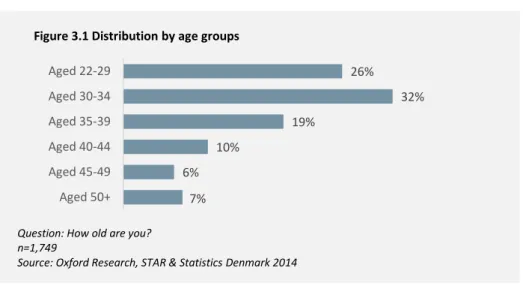
The majority of the respondents are men, making up approximately 64 % of the group. Furthermore, over half of the sample is under the age of 34 years old, whereas around 30 % are within 35-44 years old (fig. 3.1).
11 Statistics Denmark use two types of procedures to ensure the sample is representative; non-response analyses, followed up by a
telephone survey that aims to make those respondents who are in the minority of the survey answer the questionnaire. Foreign citizens
An average income level of minimum 25,000 DKK/month, the last five months
Minimum 22 years old
The educational distribution shows that the majority of the respondents are well educated, as 92 % have a least a Bachelor’s degree from the university (fig. 3.2). Since the aim of the survey is to examine highly qualified and skilled expats experince of Denmark as a host country it is a criteria, that the respondents in the survey is well educated. Additionally, 8 % of the respondents included in the survey have a shorter educational level, but holds highly responsible job functions fx manager and therefore are included in the survey.
The fields of education are mainly within three categories being engineering, manufacturing & construction (23 %), natural sciences, mathematics & statistics (20 %) and business, administration & law (18 %).
Drawing on data from Statistics Denmark, we find that the mean income level of the respondent is approxi-mately 50,000 DKK/month. Table 3.1 below show the income range by quartiles of the entire sample, thus excluding three outliers that have a substantial higher income level than the rest of the expats.
Quar-tiles
Income per month (DKK) 1 25,000-29,400 2 29,401-35,540 3 35,541-47,760 4 >47,760 7% 6% 10% 19% 32% 26% Aged 50+ Aged 45-49 Aged 40-44 Aged 35-39 Aged 30-34 Aged 22-29
Figure 3.1 Distribution by age groups
Question: How old are you? n=1,749
Source: Oxford Research, STAR & Statistics Denmark 2014
8 % 20% 23% 49% Shorter education Bachelors degree Ph.D Masters degree
Figure 3.2 Educational distribution
Question: What is the highest level of education you have completed? n=1,698
Note: Short education level includes: primary school, high school, vocational training, shorter tertiary education etc.
Source: Oxford Research, STAR & Statistics Denmark 2014
Table 3.1 Income range pr. month (DKK) by quar-tile
3.2
REGION AND COUNTRY OF ORIGIN
Figure 3.3 shows the distribution of the respondents by region of residence. As the figure illustrates, the ma-jority of expats live in the Capital Region of Denmark (60 %). Both the Central Denmark Region and the Region of Southern Denmark are the second most represented regions, with 13-15 %.
When exploring the respondents’ country of origin, we find that the expats are represented among 95 different countries. The map below illustrates which continents the respondents are from; 69 % of the expats come from Europe, 18 % are from Asia and 6% from North America. The rest of the expats are from South America, Africa, Oceania and the Middle East.
Note: Question: What is your nationality? n=1741, 8 have reported dual nationality. Source: Oxford Research, STAR & Statistics Denmark, 2014
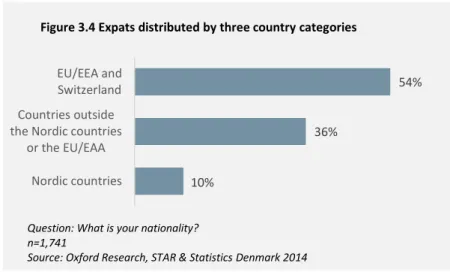
Figure 3.4 shows the distribution of the respondents by the Nordic countries, the EU/EEA12 countries and
countries outside the Nordic countries or the EU/EAA. We see that 54% of the expats are form an EU/EEA
12Switzerland is not a part of EEA, but have a series of agreement with EU including a free trade agreement. Therefore is Switzerland
a part of this category
6% 6% 13% 15% 60% Region Zealand The North Denmark Region Region of Southern Denmark The Central Denmark Region Capital region Of Denmark
Figure 3.3 Distribution by region of residence in Denmark
n=1,749
country or Switzerland. 36% are from a country outside the Nordic countries or the EU/EAA and 10 % of the expats comes from the Nordic countries.
3.3
EXPERIENCE AS AN EXPAT
The figure 3.5 shows whether or not the respondents are experienced as being an expat i.e. have either worked or studied in Denmark, or in other countries. It shows that 70 % have answered ‘yes’ to the question regarding whether they have been an expat before, with 30 % of the expats expressing that they have not had this expe-rience before. 10% 36% 54% Nordic countries Countries outside the Nordic countries
or the EU/EAA EU/EEA and Switzerland
Figure 3.4 Expats distributed by three country categories
Question: What is your nationality? n=1,741
Source: Oxford Research, STAR & Statistics Denmark 2014
30%
70 % No
Yes
Figure 3.5 Experience as an expat
Question: Have you previously worked or studied abroad? n=1,749.
When exploring how experienced the expats are according to years they have spent in the labour market before arriving in Denmark, we find that half of the respondents are fairly unexperienced, with less than 5 years of work experience (figure 3.6). A quarter of the expats have worked between 5-9 years, whereas the rest have been working more than 10 years.
50%
24%
19 %
7 %
< 5 years 5-9 years 10-20 years > 20 years Figure 3.6 Years of experience from the labour market
Question: How many years of labour market experience did you have before arriving in Denmark?
n=1,748
Where do the expats work?
The purpose of this chapter is to describe and analyse the workplaces in which the expats work as well as the job functions the expats have. As stated in the previous introductory chapter, foreign experts hold a potential for improving productivity as well as export activities for workplaces. Therefore it is interesting to analyse which workplaces the expats are employed in, in order to examine which workplaces actually utilise this potential. This includes an analysis of whether the workplaces are public or private, which branches they are in, as well as the size of the workplaces. The chapter then goes on to examine what the job functions of the expats are, in order to assess what they actually do in their jobs, i.e. whether they are managers or are doing work requiring knowledge of the highest level.
4.1
CHARACTERISTICS OF THE WORKPLACES
This section analyses the characteristics of the companies and organisations in which the expats are employed in.
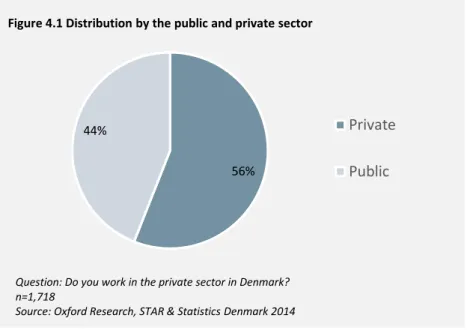
The diagram below shows the distribution between the public and private sector in regards to the employment of expats. As can be seen in the figure, 56 % are working within the private sector, including embassies, con-sulates and NGOs, while 44 % work in the public sector.
Hence there is a larger proportion of the expats in Expat Study 2014 study that work within the private sector than in Expat Study 201013.
There is a difference in whether the expats work in the private or the public sector depending on which region they live in (fig. 4.2). Thus expats living in the North Denmark Region, Central Denmark Region and the Capital Region of Denmark more often work in the private sector than expats living in Region Zealand and the Region of Southern Denmark.
13 Oxford Research and The Copenhagen Post (2010): The Expat Study 2010
56%
44% Private
Public
Figure 4.1 Distribution by the public and private sector
Question: Do you work in the private sector in Denmark? n=1,718
The figure below (fig. 4.3) shows the eight most common branches in which the expats are employed. The most common branch is research, followed by information & communications technology (ICT) and manu-facturing & other industry.
The remaining respondents work in several other branches, however in small numbers per branch. These branches include construction; wholesale & retail trade; agriculture, forestry & fishing and arts, entertainment & recreation activities.
The branches in figure 4.3 are generally regarded as knowledge intensive. Figure 4.4 below further analyses the educational background of the expats working in the respective branches.
49,1% 51,0% 56,0% 60,9% 64,1% 50,9% 49,0% 44,0% 39,1% 35,9% Region of Southern Denmark Region Zealand Capital Region of Denmark Central Denmark Region North Denmark Region
Private sector Public sector Figure 4.2 Private or public sector across the regions
Crosstabulation between "Do you work in the private sector in Denmark?" and "Region"
n=1.230
Source: Oxford Research & Statistic Denmark, 2014
4% 4% 5% 5% 7% 11% 13% 24%
Financial and insurance Pharmaceutical Electricity, gas, stream and air
conditioning supply Education and teaching Medical and dental practice activities & Other human health and social work
Manufacturing and other industry Information and communications
technology
Research
Figure 4.3 Distribution of expat employment by branch
Question: Within which field do you work? n=1,749
The figure shows that the level of education varies across the branches. Unsurprisingly, most expats holding a Ph.D. degree work in either research, education and teaching, in medical or dental practices and other human health and social work activities, or the pharmaceutical branch. This demonstrates that the expats are generally employed in branches corresponding to their level of competence.
An analysis of the geographical location of the workplaces within the selected branches shows that in the se-lected branches, the majority of the expats’ workplaces are located in the Capital Region of Denmark, as at least 50 % of the expats work in that geographic area. Furthermore, the Central Region of Denmark is generally the region with the second-largest number of workplaces. This corresponds with the general distribution of where the expats live, which indicates that there are no clusters of workplaces within one or more branches outside the Capital Region of Denmark.
Figure 4.5 shows that the expats are mainly employed in large companies or organisations with more than 500 employees (53 %). The rest of the expats are evenly distributed amongst workplaces with 1-500 employees. This is quite interesting, since the Danish business structure in general is characterised by a majority of small and medium sized companies, supplemented by some large companies.
3% 8% 8% 9% 26% 31% 39% 53% 52% 53% 51% 70% 50% 41% 41% 45% 35% 33% 26% 17% 17% 20% 18% 2% 10% 6% 15% 3% 7% 8% 2%
Financial and insurance Information and communication
technology
Manufacturing and other industry Electricity, gas, stream and air
conditioning supply Pharmaceutical Medical and dental practice activities & Other human health and social work
Education and teaching Research
PhD Masters degree Bachelors degree Shorter education Figure 4.4 Educational background distributed by branches
Crosstabulation between "Within which field do you work?" and "What is the highest level of education you have completed?"
n=1,230
Figure 4.6 shows that at least half of the expats in all but one of the selected branches work in large workplaces, and that four in five working in the pharmaceutical and electricity, gas, stream and air condition supply indus-tries work in large companies or organisations.
ICT as well as education and teaching are two of the selected branches with the highest amount of expats working in small and medium sized companies and organisations with 48 % and 54 % respectively.
9% 9% 8% 12% 8% 54% 1-20 employees 21-50 employees 51-100 employees 101-250 employees 251-500 employees 500+ employees Figure 4.5 The number of employees in the workplaces
Question: How many employees work at your current company in Denmark? n=1,735
Source: Oxford Research, STAR & Statistics Denmark 2014
7% 10% 13% 15% 19% 20% 21% 25% 11% 17% 17% 3% 28% 34% 11% 13% 82% 73% 70% 82% 52% 46% 68% 63% Pharmaceutical Research Manufacturing and other industry Electricity, gas, stream and air
conditioning supply Information and communication
technology
Education and teaching Medical and dental practice activities & Other human health and social work
Financial and insurance
1-50 employees 51-250 employees 251+ employees Figure 4.6 The size of workplace distributed by selected branches
Crosstabulation between "Within which field do you work?" and "How many epmloyees work at your current company/organisation in Denmark?"
n=1,258
Figure 4.7 shows whether the private companies and organisations that the expats work in are either Danish, partly Danish or international. The expats working in the public sector are not included in the figure.
Two thirds of the private workplaces are Danish, while another 15 % are partly Danish. 17 % of the private companies or organisations are international. Further analysis reveals that the international companies mainly are within ICT as well as manufacturing and other industry. It is thus often Danish companies that benefits from employing expats.
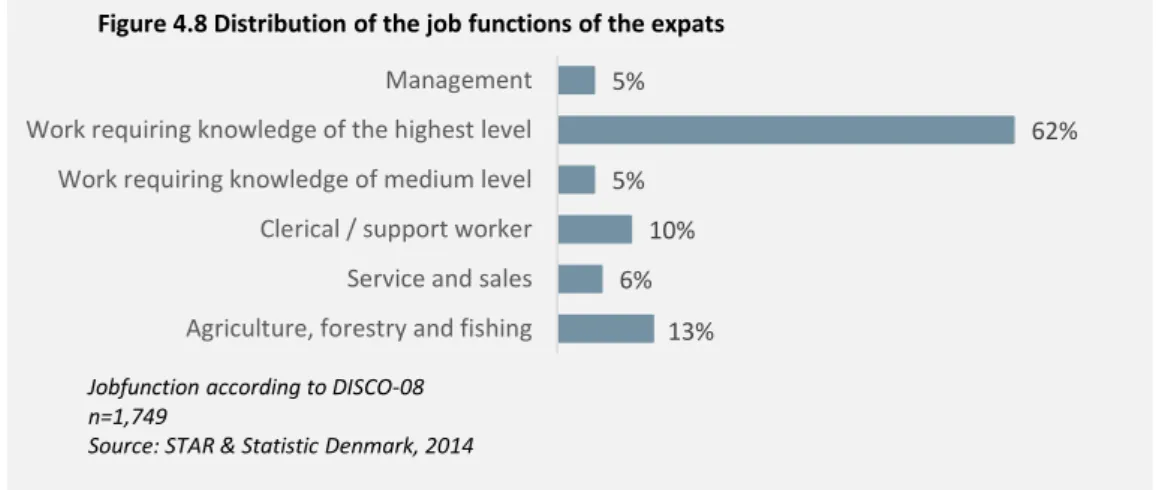
Figure 4.8 shows the job function that the expats have. The analysis is based upon the classifications in DISCO-08, which Statistics Denmark uses. The classification ranks the job functions according to the minimum level of competences employment in the respective job functions requires. The categories are taken from the regis-ters of Statistics Denmark and are thus not reported by the expats themselves14.
According to Figure 4.8, the majority of the expats has jobs requiring knowledge of the highest level within the respective field. This category includes knowledge intensive jobs, research, education and teaching. 13 % has a job function within agriculture, forestry and fishing, 10 % have a job function as a clerical or support worker, 14 See http://www.dst.dk/da/Statistik/dokumentation/Nomenklaturer/disco08.aspx. 67% 15% 17% Danish Partly Danish International Figure 4.7 The nationality of the private companies and organisations
Question: "Is the company/organisation in which you work Danish?" n=992
Source: Oxford Research, STAR & Statistics Denmark 2014
13% 6% 10% 5% 62% 5%
Agriculture, forestry and fishing Service and sales Clerical / support worker Work requiring knowledge of medium level Work requiring knowledge of the highest level Management
Figure 4.8 Distribution of the job functions of the expats
Jobfunction according to DISCO-08 n=1,749
6 % work in a service and sales function, while 5 % have a function requiring knowledge of a medium level. Finally, 5 % has a job function within management.
Further analysis discloses that the educational backgrounds of the expats are evenly distributed across the dif-ferent job functions. Furthermore, there are no significant differences between the job function of the expats and the size of the workplace in which they are employed. Thus the job position does not affect whether expats are employed in small or large companies or organisations.
Interestingly, while there is a small majority of expats working in the private sector, there is no statistical signif-icant difference between whether expats working in the respective job functions are privately or publicly em-ployed.
Summing up
The main findings from chapter 4 are that:
A small majority of the expats are employed in the private sector
The majority of expats are employed in large workplaces with more than 250 employees, and many in workplaces with more than 500 employees
A large proportion of the expats have job functions that require knowledge of the highest level
Two out of three got their job by applying for it themselves, while 14 % were head-hunted and 13% are in Denmark as a part of an internal transfer within the company.
Coming to Denmark
In this chapter it is analysed why the expats have decided to come to Denmark as well as how they perceived their reception by the Danish authorities and their employer when they moved here. The chapter starts by examining the factors that motivated the expats to accept a job in Denmark, which indicates why the expats decided to move to Denmark to work. This, in turn, offers insights in to how the expats perceive Denmark as a country to work and live in. The chapter thereafter looks in to how the expats are received in Denmark by the Danish authorities and their workplace, since this is essential for the expats’ ability to settle in Denmark as quick and easy as possible. First, how the expats perceive the services provided by the Danish authorities and if they are able to communicate in English is discussed. Following that, the services provided by the workplaces are analysed as well.
5.1
IMPORTANT FACTORS WHEN CHOOSING DENMARK AS THE COUNTRY
TO WORK IN
This section examines what motivated the expats to accept a job in Denmark. It is important to keep in mind that the respondents have already chosen to come and work in Denmark. As such, this chapter examines the motivations of these expats and not expats, who have actively decided not to move to Denmark.
The majority (64 %) of the expats applied for the job themselves, 14 % were head-hunted, and 13 % is in Denmark through an internal transfer in the company. 6 % of the expats obtained their job in other ways, either through their networks, friends, and partners for example. 3 % got the job through a research network or organisation, while 1 % is stationed in Denmark. Further analysis shows that there is an equal distribution of expats who apply for the job themselves in the public and private sector. Head-hunting and internal transfers are mainly used within the private industries.
Figure 5.1 reveals which factors were the most important when the expats accepted a job in Denmark.
6% 8% 12% 18% 18% 30% 33% 39% 41% 49%
To get to know more about Denmark High standard of facilities and laboratories Freedom to do research My spouse/partner worked in Denmark A higher income than in my home country To work for a world class company /university /
research team/ organisation
For the experience of going abroad and my personal development
Opportunity to have a good work/life balance To have an interesting job To improve my career
Figure 5.1 Important factors for accepting a job in Denmark
Question: "What factors were the most important to you when accepting your job in Denmark?" Note: Multiple, choose up to 3 categories
n=1.749
Half of the expats, 49%, accepted a job in Denmark to improve their careers. Around 40% find it important to have an interesting job or the opportunity to have good work/life balance. The importance of work/life balance will be further analysed in section 6.2 below. Approximately one third find the experience of going abroad and personal development important, while there is also one third who find it important to work for a world class company, university, research team or organisation. 18 % of the expats accepted a job in Denmark because they would earn a higher income than in their home country or that their spouse/partner worked in Denmark. 12 % value the freedom to do research, while 8 % find it important to have a high standard of facilities and laboratories. Only 6 % find it important to get to know more about Denmark.
Motivations vary according to age and country of origin
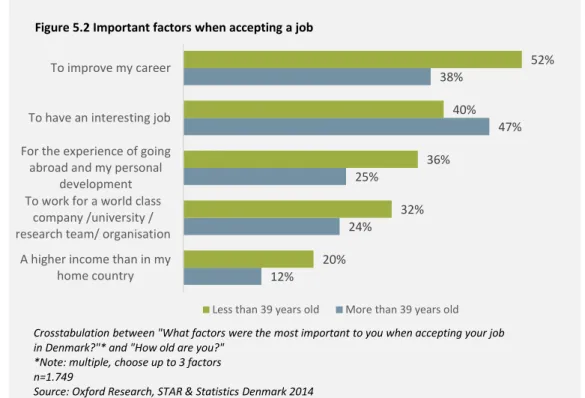
Figure 5.2 illustrates that the motivations for accepting a job in Denmark varies according to the age of the expats. There is a general tendency for expats aged 39 or younger to be focused on professional and personal development than other expats. Meanwhile, expats over 39 years old tend to be focused on the quality of their current job.
Almost half of the expats 39 years old or younger state that improving their career was important to them when they accepted their job in Denmark, while only 25 % of the expats over 50 found this factor important. It is also more important for respondents younger than 39 to work for a world class company, university, research team or organisation than for the respondents over 39 years old. Furthermore, personal development is valued highly by the younger expats, as witnessed by the stronger emphasis placed on the experience of going abroad and personal development by expats aged 39 or younger compared to expats older than 39.
12% 24% 25% 47% 38% 20% 32% 36% 40% 52%
A higher income than in my home country To work for a world class
company /university / research team/ organisation
For the experience of going abroad and my personal
development To have an interesting job
To improve my career
Less than 39 years old More than 39 years old
Figure 5.2 Important factors when accepting a job
Crosstabulation between "What factors were the most important to you when accepting your job in Denmark?"* and "How old are you?"
*Note: multiple, choose up to 3 factors n=1.749
As figure 5.3 shows, expats from different countries of origin have varying motivations for accepting a job in Denmark.
Expats from the Nordic countries were mostly motivated by an interesting job and to improve their careers. These factors also, albeit to a lesser degree, motivated expats from the other countries. Expats from the EU/EEA and Switzerland as well as countries outside the Nordic countries or the EU/EAA were more moti-vated by the experience of going abroad than expats from the Nordic countries. This is not surprising, as the cultural differences between Denmark and the country of origin are arguably larger in countries outside the other Nordic countries. Working for a world-class company plays a larger motivational role for accepting a job in Denmark for expats from countries outside of the Nordic and the EU/EEA and Switzerland. Finally, there are no differences between how the opportunity to have good work/life balance motivated expats from differ-ent countries of origin.
The importance of freedom to do research for researchers
The motivation for coming to Denmark varies according to the sector the expats are employed in. For example, the motivational factor “Freedom to do research” plays a pivotal role for respondents working within research as well as education and teaching when accepting a job in Denmark, which is not surprising. One third and one fifth of the respondents working in these fields identify this as an important factor for coming to Denmark. At the same time, freedom to do research only plays a marginal motivational role for the respondents within the other branches, as they seldom actually do research. This is emphasised by cross-referencing the educational background of the expats with their motivation for accepting a job in Denmark, where freedom to do research is highly important for expats having a Ph.D., somewhat important for expats having a Master’s degree, and not important for expats having either a Bachelor’s degree or shorter education. It also follows the trend from
15% 36% 36% 40% 54% 32% 22% 29% 34% 40% 47% 45% 11% 20% 22% 34% 47% 52%
A higher income than in my home country
To work for a world-class company / university / research team /
organisation
For the experience of going abroad Opportunity to have a good work/life
balance
To improve my career To have an interesting job
Nordic countries EU/EEA and Switzerland Countries outside the Nordic countries or the EU/EAA Figure 5.3 Important factors for accepting a job in Denmark distributed by country of origin
Crosstabulation between "What factors were the most important to you when accepting your job in Denmark?"* and "Within which field do you work?"
*Note: multiple, choose up to 3 factors n=1,740
the Expat Study 2010, where freedom to do research had a prominent motivational role for researchers to accept a researcher position in Denmark15.
High standards of facilities and laboratories is an important motivational factor for respondents working within research, indicating that the quality of facilities and laboratories of the Danish universities are perceived well by the respondents. Although to a lesser degree, the high standards also motivates respondents working within medical and dental practices, pharmaceuticals, as well as in education and teaching.
5.2
SERVICES FROM PUBLIC AUTHORITIES UPON AND AFTER ARRIVAL IN
DENMARK
This section analyses how the expats perceive the service of the public authorities when they arrive in Denmark, which plays a crucial role in helping them ease into their new lives in Denmark.
Figure 5.4 highlights how many of the expats have been in contact with one or more of the six authorities in Denmark mentioned below.
Most of the expats have come in contact with some of the mentioned authorities in figure 5.4; only 4 % of the expats have not had any contact with the mentioned authorities. 80 % of the expats have needed to contact their local municipality and 77 % have contacted The Danish Customs and Tax Administration. About one third, 36 %, have been in contact with the Danish Immigration Service, while 20 % have been in contact with The International Citizen Service. 17 % have come in contact with The State Administration and lastly, 9 % have needed to contact the Danish Agency for Labour Market and Recruitment.
Figure 5.5 shows whether or not expats from outside the EU16 have been satisfied with the service of Danish
authorities in the process of obtaining their residence and work permit.
15 Oxford Research and The Copenhagen Post (2010): The Expat Study 2010
16When referring to expats from outside EU, it refers to expats, who are not from an EU or EFTA country. EU and EFTA are called EEA (The
European Economic Area). Citizens from the EEA are not required to have a work permit in Denmark, and therefore they are not asked this question.
4% 9% 17% 20% 36% 77% 80%
I haven't been in contact with any of the above mentioned Danish Agency for Labour Market and Recruitment
The State Administration The International Citizen Service Danish Immigration Service The Danish Customs and Tax Administration The Municipality Figure 5.4 Contact to authorities upon arrival
Question: Which of the following authorities have you been in contact with upon arriavl? Note: Multiple, tick all relevant categories
n=1,749
70 % of the expats from outside the EU are very satisfied or satisfied with the service of the Danish authorities. 17 % are neither satisfied nor dissatisfied, while 13 % are dissatisfied or very dissatisfied with the service of the Danish authorities. This is comparable to the overall findings from 2010 regarding the quality of the public services. Meanwhile, when comparing the satisfaction with the specific task of obtaining a residence and work permit, it seems as though a larger proportion of the expats in 2014 are satisfied with the service of the public authorities. These findings indicate that the authorities have made this process easier.
Further analysis shows that expats, who have been in contact with the ICSs, are slightly more satisfied with the service than other expats are.
When looking deeper into the 13 % of expats who are dissatisfied or very dissatisfied with the service of the Danish authorities, we find that they speak Danish rather well and that expats who came here because of their partner who either got a job in Denmark or is Danish, are considerably less satisfied with the service. Further-more, expats who are cohabitating with a partner are significantly less satisfied with the service of the public authorities than both married and single expats are.
Figure 5.6 reveals that 89 % of expats strongly agree or agree with the statement that most of the public au-thorities they have been in contact with in Denmark can communicate in English. Only 5 % of the expats disagree or strongly disagree with this statement. Compared with the results from the Expat Study 2010, there are more expats today who find that the public authorities can communicate in English when the expats have been in contact with them.
5% 8% 17% 49% 21% Very dissatisfied Dissatisfied Neither satisfied nor dissatisfied Satisfied Very satisfied
Figure 5.5 Are expats from outside EU satisfied with the service of the Danish authorities
Question: How satisfied or dissatisfied are you with the service of the Danish authorities in the process of obtaining your residence and word permit?
n=616, only the expats from countries outside the EU were asked this question Source: Oxford Research, STAR & Statistics Denmark 2014
1% 4% 6% 46% 43% Strongly disagree Disagree Neither agree nor disagree Agree Strongly agree
Figure 5.6 Danish public authorities can communicate in English
Question: Most public authorities I have been in contact with in Denmark can communicate in English
n=1,683
The survey aims at uncovering whether the public authorities can communicate in English when the expats are in contact with them, and it thus targets the active interaction between expats and authorities. Whether all relevant material, such as informational leaflets and the home pages of public authorities, per se is in English, however, is not gauged in this question. Instead, the expats have had the opportunity to suggest improvements for the public authorities in a more open-ended question. Many of these answers suggest that there still exists difficulties regarding the availability of information from the authorities in English.
Upon arriving in Denmark, I was disappointed to find that the access to necessary information was NOT available in English. Usually the first page of public websites is in English but the rest of the site switches back to Danish or doesn’t work at all (Employed within wholesale and retail trade, Canadian)
Figure 5.7 shows the expats who have had contact with one of the six mentioned authorities upon arrival and if they agree or disagree with the statement that most public authorities can communicate in English. As such, more than 87 % of the expats find that the authorities can communicate in English.
Expats who have been in contact with the International Citizen Service (ICS) have found that the Danish authorities are able to communicate in English; with 93 % of them strongly agree or agreeing that ICS can communicate in English. This result paints a positive picture of the ICS, which was established in 2011 in Copenhagen, Aarhus, Aalborg and Odense following the positive experiences with a One Stop Shop in the Central Region of Denmark. The ICSs represents all the authorities expats typically need to have contact with in Denmark. By bringing these authorities together in the same building, expats have a one-stop entry to the Danish bureaucracy and eases their communication with the public administration upon arrival in Denmark. It is, however, worth noting that only 20 % of the expats have been in contact with the ICSs.
All in all it appears that the public authorities in Denmark are viewed as being rather adept at communicating in English. This plays a key role in the satisfaction with the service of the Danish authorities, as there seems to be a correlation between how satisfied or dissatisfied the expats from outside the EU are with the service of Danish authorities in the process of obtaining their residence and work permit and whether or not most of the
87% 88% 90% 91% 91% 93% 7% 6% 6% 3% 4% 4% 6% 6% 4% 6% 5% 3%
The Danish Customs and Tax Administration
The Municipality Danish Immigration Service Danish Agency for Labour Market
and Recruitment The State Administration The International Citizen Service
Agree Neither agree nor disagree Disagree Figure 5.7 Which public authorities can communicate in English
Crosstabulation between "Which of the following authorities have you been in contact with upon arrival?"* and "Most public authorities I have been in contact with in Denmark can communicate in English?" * Note: Multiple
n=1,682
public authorities they have been in contact with can communicate in English. Overall, it appears that expats from outside the EU are more satisfied with the service of the Danish authorities if the authorities can com-municate in English. This shows that it is important that the authorities in Denmark can comcom-municate in Eng-lish as it increases the expats satisfaction with the service.
5.3
SERVICES AND POLICIES BY THE WORKPLACE
The reception of expats to Denmark extends beyond encounters with Danish authorities. For instance, the Expat Study 2010 revealed that the majority of expats found practical assistance when settling in was important for their relocation. This is analysed in greater depth below.
Figure 5.8 shows in which areas the expats find it important that the workplace offers assistance.
67 % find it import that the workplace offers to assist with practical issues outside of work in areas such as housing, registering of their addresses and insurance. Furthermore, in the “other” category, some have men-tioned practical issues such as help with tax, information about schools for their children and help with under-standing Danish culture as important aspects.
Buddy systems are key to become integrated in the Danish society, which is very closed for expats (Employed within manufacturing and other industry, Swede)
61 % of the expats find it important that the workplace assists with Danish language courses for expats and 45 % of the expats find assistance with social networking/events and introductory programs, buddy programs, mentorships, etc. as important. 28 % of the expats would like for their workplaces to assist with finding em-ployment for their partner.
The open-ended question regarding services from workplaces to newly arrived expats emphasises the im-portance of having a policy regarding language. For example, several mentions that the corporate language is English, while a lot of the internal communication, however, is in Danish.
28%
45% 45%
61% 67%
Assists with finding employment for my partner Introductory programs, buddy programs,
mentorships etc. to expats Social networking/events Danish language course to expats Practical issues outside work, e.g. housing,
registering my address, insurance etc.
Figur 5.8 In which areas do expats find it important that the work place offers to assist
Question: In which area(s) do you find it important that your work place offers to assist expats? Note: Multiple, tick all relevant categories
n=1,749
Offers of free Danish language courses at the workplace would significantly improve the ability of em-ployed expats to attend language courses and improve their language skills. Buddy programmes with
Danish colleagues would also help in this respect (Management consultant, Bulgarian)
There is a correlation between which issues the expats find important that the workplace offers assistance in and the size of their workplace. It appears as if expats employed in workplaces with more than 250 employees, to a greater extent, find it important that the workplace offers assistance than expats who work at places with less than 250 employees. For example, 50 % of the expats who are employed at a workplace with more than 250 employees find it important that the workplace offers to assist expats with introductory programs, buddy programs, mentorships etc., while there are only 35 % who work at a small workplace, and 39 % who work at a medium sized workplace, who find this feature important. This finding may be explained by the fact that people who work in bigger companies are more likely to be offered more assistance from their workplace than employees in smaller workplaces and therefore know how important it is to receive this help.
All the expats, regardless of the size of their workplace, think that the work place should assist with social networking and events. This shows that the expats find social networking important and may be difficult on their own. This is analysed further in depth in chapter 7.2.
There are no correlations between which areas the expats find it important for the workplace to offer assistance, whether the expats are working in the private or public sector or across the different branches they work in.
Summing up
This chapter has analysed the expats motivations for accepting a job in Denmark, as well as how the expats experienced their reception from the public authorities and workplaces. The main findings are that:
The most important factors for accepting a job in Denmark for the expats are to improve their careers, to have an interesting job, the opportunity to have good work/life balance, the experience of going abroad, and to work for a world-class company/university/research team/organisation.
Expats under the age of 39 are more motivated by improving their career, to work at a world-class workplace, the experience of going abroad, as well as earn a higher income than in their home country, while expats aged 40 or older are more motivated by having an interesting job.
The freedom to do research as well as the high standards of facilities and laboratories are particularly important for researchers and employees within education and teaching.
Expats from the Nordic countries are particularly motivated by factors related to their work, while expats from the other countries also are motivated by the opportunity to have good work/life balance, a higher income than in their home country and the experience of going abroad.
The majority of the expats (89 %) state that the Danish authorities can communicate in English. This indicates a rather large improvement since 2010.
There are still, however, issues regarding the availability of information in English, e.g. on the home pages of public authorities.
70 % of the expats from countries outside the Nordic countries or the EU/EAA are satisfied with the service of the Danish authorities in the process of obtaining their residence and work permit.
The International Citizen Service centres are highlighted by the expats with regards to both communi-cation in English and general satisfaction.
The main areas for company services are practical issues outside work, e.g. housing and tax, as well as Danish language courses. Social networking and introductory programs are also important for the ex-pats.
Expats employed in large workplaces tend to find assistance from the workplace more important than expats employed in either medium sized or small workplaces.
Working in Denmark
For any expat, the experience of working in Denmark is a key component of life in Denmark. This chapter first analyses how the expats perceive their career opportunities in Denmark. The opportunity to learn and improve their careers is essential to match the professional ambitions that the expats come to Denmark with. Satisfaction with how it is to work in Denmark, however, are not defined by professional opportunities alone. As shown in chapter 5, many expats come to Denmark because of the opportunity to have good work/life balance. This is examined further in this chapter as is the general satisfaction with Danish work culture. Lastly, the chapter analyses whether the expats are satisfied with their jobs or not, and several factors that influence this is identified and discussed.
6.1
CAREER OPPORTUNITIES IN DENMARK
This section examines how expats perceive their career opportunities in Denmark. This is a key factor in re-taining international talent in Denmark as it is important for them to experience that it is possible to foster a career that goes beyond their current job, if they are to stay in Denmark. This is even more important given the increasing global competition for talents, as mentioned in chapter 2.
Thus, it is positive that 60 % either agrees or strongly agrees with the statement that there are good career opportunities in Denmark (fig. 6.1). 26 % neither agrees nor disagrees, while just 14 % either disagrees or strongly disagrees with there being good career opportunities in Denmark. Therefore, it is interesting to further analyse what characterises the expats who agree or disagree with the statement that their career opportunities in Denmark are good.
There are several factors which influences the expats views on their career opportunities in Denmark. One of these are whether the expat is employed in the private sector or in the public sector, as expats employed in the public sector are slightly more positive about their career opportunities than expats employed in the private sector. The differences are even larger across the selected branches.
3% 11% 26% 48% 12% Strongly disagree Disagree Neither agree nor disagree Agree Strongly agree
Figure 6.1 There are good career opportunities in Denmark
Question: There are good career opportunities in Denmark for expats
n=1,662
Expats employed within Pharmaceuticals, Research or Medical and dental practice activities & other human health and social work are more positive about their careers in Denmark than expats working within Electricity, gas, stream and air conditioning supply, ICT and Education and teaching are.
Furthermore, expats working in companies with more than 250 employees are the most positive about their future careers here, while expats working in medium sized workplaces are the least positive.
58% 61%
26% 27%
16%
12%
Private Public
Agree Neither agree or disagree Disagree Figure 6.2 Are there good career opportunities in Denmark distributed by sector
Crosstabulation between "There are good career opportunities in Denmark for expats" and "Do you work in the private sector in Denmark?"
n=1,633
Source: Oxford Research, STAR & Statistics Denmark 2014
57% 60% 64% 53% 59% 63% 52% 62% 33% 24% 17% 26% 25% 26% 24% 28% 11% 16% 19% 21% 16% 11% 25% 10% Pharmaceutical Manufacturing and other industry Electricity, gas, stream and air
conditioning supply ICT Financial and insurance Research Education and teaching Medical and dental practice activities & Other human health and social work
Strongly agree/agree Neither agree or disagree Disagree/strongly disagree
Figure 6.3 Are there good career opportunities in Denmark distributed by branches
Crosstabulation between "There are good career opportunities in Denmark for expats" and "Within which field do you work?"
n=1,201
The expats level of education also influences their perception of career opportunities as figure 6.4 illustrates.
Expats with a Bachelor’s degree are the least optimistic (18 % disagree), while expats with either a Ph.D. degree (10 % disagree) or shorter education (13 % disagree) are the most positive. This could be due to the Danish job markets focus on the perceived necessity of holding a Master’s degrees, whereas a Bachelor’s degrees would be perceived as sufficient in other countries. As such, an expat may find his or her Bachelor’s degree, which was deemed sufficient in his or her home country, to be seen as insufficient in Denmark, thus decreasing his or her career opportunities here.
Another factor influencing the attitude towards their career opportunities in Denmark is the age of the expats. 66 % of the expats between the ages of 22 and 29 believe they have good career opportunities in Denmark, while only 12 % disagree. Generally, the older the expats are, the more they disagree with their career opportu-nities in Denmark being good, though for all age groups at least nearly half of the expats are positive about their career opportunities here. This corresponds well with the findings in figure 6.6.
57% 55% 62%
28% 26% 26%
15% 19% 13%
1-50 employees 51-250 employees 251+ employees
Agree Neither agree or disagree Disagree
Figure 6.4 Are there good career opportunities in Denmark distributed by size of work place
Crosstabulation between "There are good career opportunities in Denmark for expats" and "How many employees work at your current company/organisation in Denmark?"
n=1,650
Source: Oxford Research, STAR & Statistics Denmark 2014
62% 57% 60% 62% 25% 25% 26% 29% 13% 18% 15% 10% Shorter education Bachelors degree Masters degree Ph.D.
Strongly agree/agree Neither agree or disagree Figure 6.5 Are there good career opportunities in Denmark distributed by education
Crosstabulation between "There are good career opportunities in Denmark for expats" and "What is the highest level of education tou have completed?"
n=1,614
There is a significant tendency for younger expats to feel more positive about their careers in Denmark than older expats. As such, the more work experience the expats have, the less they perceive their career opportuni-ties in Denmark as good,