Reflections on Business
Process Levelling
Sarina Viljoen
Specialist Consultant
Real IRM Solutions
Email:
[email protected]
Key takeaways
The purpose of this paper is to explore and provide guidance on the following:
Why do organisations define business processes?
Considerations for business appropriate process definition
o for the audience
o for the available tooling and
o based on the maturity
Guidance on process levelling
o Real IRM’s process levelling approach, detailing six levels of process
o Relating process levels to levels of abstraction – contextual, conceptual, logical, physical
Background
Business process modelling as a technique for capturing the complexities of industrial processes emerged in the early 20th century. It took on many different forms from flow diagrams and flow charts by the 1920’s to functional block diagrams and PERT in the 1950’s and eventually IDEF by 1970. The term “business process modelling” was however only coined in 1967 by S.Williams [1]. Process thinking took off with renewed energy in the 90’s driven by productivity requirements, and Michael Hammer’s article published in the Harvard Business Review in 1990 [2], started a wave focussed on business process re-engineering (BPR). Many other articles and books with BPR and other new business process concepts followed, including:
Business Process Improvement (Harrington, 1991),
Process Innovation: Reengineering work through information technology (Davenport, 1993)
Reengineering the Corporation: A Manifesto for Business Revolution (Hammer, Champy, 1993)
Automating Business Process Reengineering (Hansen, Gregory 1993)
As the thinking around business processes matured, digitising the business process for workflow or automation purposes forced the definition of a more disciplined approach and gave birth to the concept Business Process Management. Business Process Management initially focused on the automation of business processes with the
use of information technology but later expanded to include human centric processes. Business Process Management is defined
asthe definition, improvement and
management of a firm’s end-to-end
enterprise business processes - in order to achieve outcomes crucial to a performance-based, customer-driven firm.
Note: The BPM acronym used to denote Business Process Management is problematic, as it is also used in some literature to denote Business Process Modelling and in others Business Performance Management. In this white paper the complete concept name will therefore be used throughout.
The outcomes are defined as: 1) clarity on strategic direction, 2) alignment of the firm’s resources, and 3) increased discipline in daily operations. [3]
Business process modelling fits into the space of defining the enterprise’s business processes and is therefore a critical and fundamental component in the Business Process Management initiative or practice.
Defining Business Processes
The decision to define a business process is deliberate and aims to assist the organisation with making the process component of the business explicit. Organisations embark on this activity for a number of reasons:
- Responding to change: changing the way the business operates or delivers service to its clients
- Complying with regulations: the Sarbanes-Oxley act for example, requires the explicit documentation of certain processes
- Dealing with complexity: clarifying responsibility for activities and ensuring a common conversation within the organisation [4]
In addition, organisations embarking on this journey are also:
1) Turning individual tacit knowledge into organisational knowledge - ensuring the organisation rather than individuals respond to change, comply with regulation and deal with complexity, and
2) Building the intellectual capital of the organisation – ensuring the process definition as an intangible asset supports change and complexity.
The process definition as an intangible asset within the intellectual capital formula implies responsibility: responsibility for quality and value to stakeholders in the organisation.
Business appropriate process definition
Defining a business process is usually associated with the creation of a model. A model is useful for depicting the flow of process activities and the events that trigger the flow. Traditionally a process model, started with a START event, spanned the breadth of the room and ended with an END event. And although this level of process model is applicable to the stakeholders with an execution responsibility, it is mostly information overload to others. One process model therefore is not appropriate or deemed to be of value to all audiences.
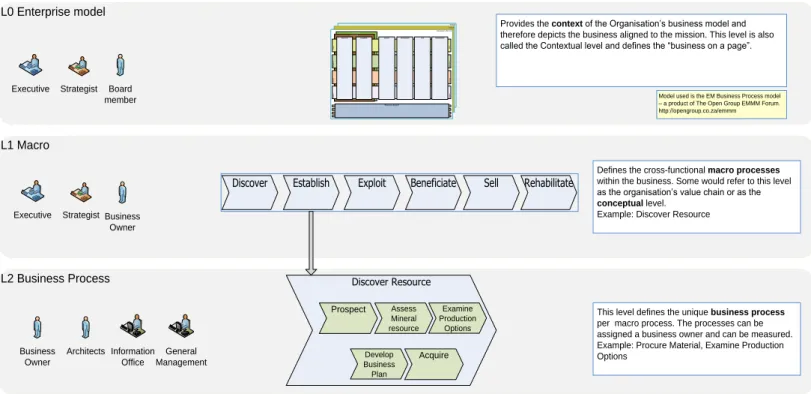
L0 Enterprise model
L1 Macro
L2 Business Process
Strategic Tactical Operational / Mine Site
P M C Green Fields Brown Fields Establish R Enterprise Support Exploit Beneficiate Sell Rehabilitate Discover Report Control Measure Plan Report Control Measure Plan
Discover Establish Exploit Beneficiate Sell Rehabilitate
Provides the context of the Organisation’s business model and therefore depicts the business aligned to the mission. This level is also called the Contextual level and defines the “business on a page”.
Defines the cross-functional macro processes
within the business. Some would refer to this level as the organisation’s value chain or as the
conceptual level. Example: Discover Resource
This level defines the unique business process
per macro process. The processes can be assigned a business owner and can be measured. Example: Procure Material, Examine Production Options Discover Resource Prospect Assess Mineral resource Examine Production Options Develop Business Plan Acquire
Model used is the EM Business Process model – a product of The Open Group EMMM Forum. http://opengroup.co.za/emmm
Executive Strategist Board member
Executive Strategist Business Owner Business Owner Architects Information Office General Management
Audience
Stakeholders in the organisation have various perspectives. The executive or strategist focusing on change is interested in the bigger picture of the organisation - understanding the context and scope of the activities the organisation engages in. Process levelling enables the creation of process groupings within which a particular activity resides and relates in a hierarchy to a child and/or parent process group. Within this hierarchy different levels of processes allow stakeholders with diverse perspectives to Macro processes (as a process grouping seen in the diagram on L1) enable scope questions, for example: “Do we need to acquire a license before we can start with the establishment
of the operation?”
The Enterprise process supports strategy questions for example: “Will this aspect be part of our core
business?”
Figure 1 provides a glimpse of the first levels within the proposed process levelling approach and identifies the type of stakeholder and example model befitting the L0 through L2 process.
Tooling
To define a business process, tooling is required. In general, the three most common types of tools are:
o Text-based: word processing, spread sheet or presentation software is used to create the necessary detail in order to document information about the process.
o Drawing tool: a graphic tool is used to create pictures or diagrams to represent the process flow. The picture is usually combined with some text containing more detail.
o Modelling tool: a modelling tool (usually within the Enterprise Architecture toolset space) allows the capability to create a model of the business process versus just a diagram (see Table 1: Model versus diagram). [4]
As organisations mature, they generally move from a text-based process definition approach to using a drawing tool, with a possibility of then using a modelling tool. This is due to the rigor, flexibility and quality that a modelling tool brings to the table. All modelling tools are not created equal and the amount of rigor enforced by a particular tool should be considered when procuring.
Maturity
Maturity of the organisation influences what is experienced as valuable. For an organisation with a low level of maturity, the value of one slide depicting the business value chain is immense – whereas possibly the activity model at level 4 has limited value. This is amplified when factors such as the cost and time involved in producing models at the lower level is considered.
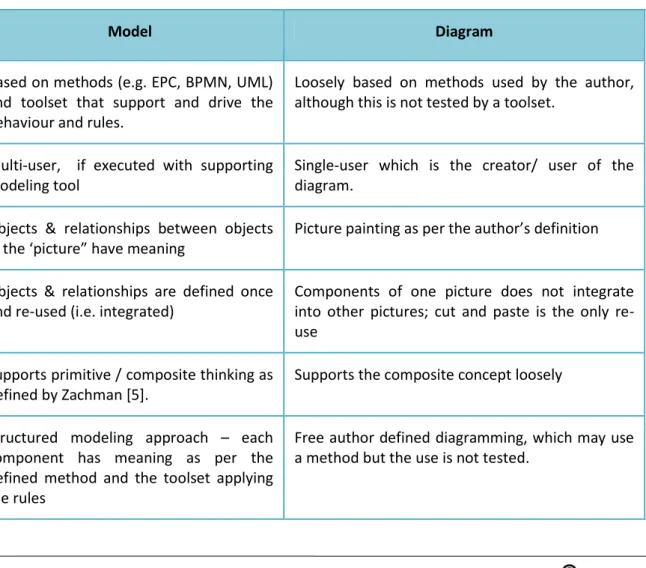
From a maturity perspective, the notion of a model and a diagram needs mentioning. These terms are often used as synonyms. There are however distinct differences to be aware of and this impact decisions on tooling and on business appropriateness. Consider some of the differences highlighted in the table below:
Table 1: Model versus diagram
Model Diagram
Based on methods (e.g. EPC, BPMN, UML) and toolset that support and drive the behaviour and rules.
Loosely based on methods used by the author, although this is not tested by a toolset.
Multi-user, if executed with supporting modeling tool
Single-user which is the creator/ user of the diagram.
Objects & relationships between objects in the ‘picture” have meaning
Picture painting as per the author’s definition
Objects & relationships are defined once and re-used (i.e. integrated)
Components of one picture does not integrate into other pictures; cut and paste is the only re-use
Supports primitive / composite thinking as defined by Zachman [5].
Supports the composite concept loosely
Structured modeling approach – each component has meaning as per the defined method and the toolset applying the rules
Free author defined diagramming, which may use a method but the use is not tested.
The main difference between a diagram and a model is with the diagram being specific to the author. There are no semantics (meaning) inherent in the way the diagram is depicted – the only way meaning is understood by others, is by the author explaining this. A model on the other hand uses a specific modelling technique to communicate meaning and the rules and behaviour expected, are supported by the rules inherent in the technique and the modelling tool that acts according to these rules. So this implies if text-based or drawing tools are used as process definition tooling, it is a diagram being produced and not a model.
Process levelling approach
The introduction into the process levelling approach focused on the audience as an influence on the appropriate process level. The example used showed the strategist and executive examining the top of the process hierarchy where process steps are gathered into cohesive groups. These process groups represent the business at an enterprise level. It focuses attention on the strategic “what” and “why”; providing context and enabling stakeholders with strategic management and scoping questions. It represents the “business on one page”. The Exploration and mining business reference
Exploration and Mining Business Reference Model
Copyright The Open Group Version 1.00 July 2010
EMMMv Members (on release date): Ajilon Australia Datamine SA Fortescue Metals Group GijimaAst Mining Solutions International (GMSI) Lonmin Real IRM Solutions Rio Tinto
Establish: All the activities necessary to create a mining environment. (The full infrastructure) At a Strategic level: Creating the mine, beneficiation plant, environment, supporting facilities & communities plus financing. At a Tactical level: Ensuring mid-term continuity & viability of the mining operation. Typically funded by capital expenditure e.g. sinking a new shaft, planning and building of extensions to an existing mine. At an operational level: The creation of further access to the ore body with all the associated supporting engineering infrastructure. Funded by operational fund (opex) Discover: The process by which an exploration target and/ or a mineral resource is articulated and defined for acquisition purposes. The process includes: evaluation of grade and tonnes, pre-feasibility phase, examining the production options and acquisition of the necessary rights. At a strategic level the exploration strategy and associated activities to find new deposits; tactical focuses on the evaluation of existing mineral deposits and operational the day to day enhancement of the level of confidence in the geological model.
Exploit: For a given mine type, rock type and mining method, this process includes the breaking and removal of 'rock'. Rock is a generic term to describe all types of mineral resource host material. It also includes the transport of the broken rock and waste from working place to plant and/or stockpile.
Beneficiate: The Beneficiate process focuses on the processing of ores for the purpose of: - Regulating the size of a desired product, removing unwanted constituents, and improving the quality, purity, or assay grade of a desired product.
- Concentration or other preparation of ores for smelting by for example drying, flotation, or magnetic separation and improvement of the grade of ores by milling, flotation, sintering, gravity concentration, or other processes. Sell: This process focuses on the dealing with customers in order to dispose of the product and attain revenue. This process also includes product marketing Rehabilitate: This process focuses on returning the mining site to a desired 'improved' state concurrently with or after the primary mining and associated activities. Planning for rehabilitation is now a key deliverable of any Exploration or Mining plan and must generally be approved before any Exploration or mining tasks can be undertaken.
Comments are welcome. Please contact [email protected] regarding membership and participation
http://www.opengroup.org/ emmmv The Open Group’s Platinum Members Strategic Tactical Operational / Mine Site
P M C Green Fields Brown Fields Establish R Enterprise Support
Exploit Beneficiate Sell Rehabilitate
Discover Prospect/ Explore
Examine Production Options
Acquire
Develop Business Plan
Assess Mineral Resource
Id Area of Interest Acquire Prospecting Rights Execute Sampling Process
Cleanse Data Produce Structural Analysis
Produce Grade Analysis
Produce Mining Layout Analysis Produce Engineering Infrastructure Analysis Produce Beneficiation Analysis Consider Economic Options/ Variables Produce Costing model
Examine Financial Alternatives Compile Business Analysis
Confirm Acquisition Scope Secure rights R e p o rt C o n tr o l M e a s u re P la n R e p o rt C o n tr o l M e a s u re P la n Manage Enterprise Strategy
Manage Finances Manage Information Technology Manage Human
Resources
Manage Assets Manage Risk
Handle Product Store Product Classify Product Blend Product Package Product Refine Material Smelt Material Refine Material Treat Material Prepare Material Concentrate Material Engage Customer Follow up Leads Manage Customer Relationship Handle Order Take Order Bill and Collect
Ship and Distribute
Manage Demand Process Financial Transaction Capture Data Handle Material Classify Material Blend Material Store Material Initiate Rehabilitation Prepare Rehabilitation Proposal Obtain Approvals for
Rehabilitation
Execute Rehabilitation
Obtain Stakeholder Acceptance Implement Costed Plan
Initiate Establishment
Approve the project Finance the project Resource the project
Commission
Run Pilot Operation Handover to Operations
Remove Rock
Classify Rock Move Rock Stockpile Ore or Waste
Break Rock
Create Access Mine Ore Body Extend Infrastructure
Manage Corporate
Affairs Manage Material Manage Health, Safety and Environment Design Rehabilitation Collect Rehabilitation Design Criteria Produce Final Rehabilitation
Designs Deliver Costed Plan
Manage Logistics
Construct
Develop Operational Capability Build Mineral Extraction
Capability Build Facilities Deploy Utilities Build Beneficiation Capability Engineering Design
Collect Engineering Design Criteria Produce Conceptual Engineering Designs Select Final Engineering
Designs
Plan Distribution Ship Order
Review & Approve Transaction
Support Product Marketing
Define Market Strategy and Policy Articulate Product Portfolio
Prepare Communications and Promotion Underground Hard Soft Tabular Coal Massive Solution Other Surface Hard Soft Open Pit Open Pit Glory Hole Placer
Engineer Environment
model [6] is an example of this level.
Each process group is broken down into the next level, until the required level of detail has been achieved. Each level modelled has a specific objective and type of stakeholder it is typically aimed at. As the hierarchy drills down into lower levels, the detail becomes more until we have eventually detailed a process at an individual task level. Note that not all process modelling exercises require the lowest level of detail.
Consider these guidelines when adopting a process levelling approach:
Maintain top-down traceability across the various process levels
A process defined at any level must be traceable to the highest level. For example, if an activity is defined on Level 4, it should be linked to a Sub-process on Level 3, which is part of a Level 2 process, that implements part of a Level 1 value chain that enables a Level 0 enterprise process.
Only model to the level of detail required
Although the process levels are specified to a very detailed level, models should only be developed at the more detailed levels if there is a defined business requirement. As a guideline we recommend that all processes be defined from Level 0 to Level 2 to provide the bigger picture for future process development, but that more detailed process models should only be developed if there is guaranteed business benefit.
Real IRM’s process levelling approach uses the Exploration and Mining model as an example to step through the applicable process levels. The example follows the EM Reference model provided in Figure 2 down to sub-process Level 3. As the reference model itself does not provide lower level detail, example models have been included to complete the hierarchy in Figure 3.
Generic role names have been included to indicate the typical audience interested in a process level. This may differ slightly within the individual organisation.
Figure 3: Real IRM's Process Levelling approach
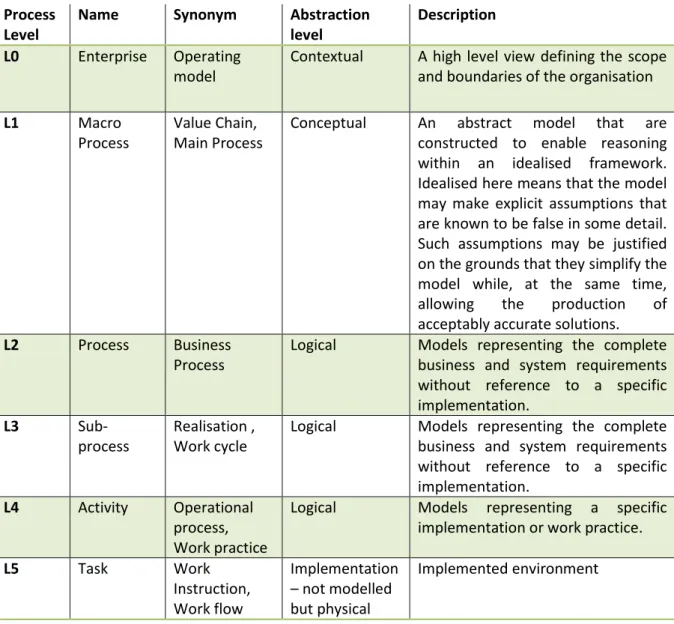
Process and abstraction levels
What remains is to relate process levels to the levels of abstraction used in architecture practices. The contextual, conceptual, logical and physical levels are recognised in most architecture methods and used in organisations to scope the problem space for a particular audience.
In mapping these levels of abstraction to the proposed process levels, the organisation need to make a decision on exactly what will be represented in the individual levels, based on the modelling toolset of choice. The levels could be different from what is proposed below, based on practical or
L3 Sub-Process Discover Resource
L4 Activity
L5 Task
Depicts the breakdown of the
business process into
sub-processes; the flow of the process with individual operational steps.
Defines the operational view of each sub-process, depicting the inputs, outputs and role accountability for each activity. This is the lowest level a process will be modelled at.
Depicts the procedure level of the process where a step by step guide is defined at task level for each activity. This level exists in documentation (training manuals, procedure guides) and in the implemented workflow but not is modelled usually.
Prospect
Identify Area of Interest Acquire Prospecting Rights Execute Sampling Process
L0 Enterprise model
L1 Macro
L2 Business Process
Strategic Tactical Operational / Mine Site
P M C Green Fields Brown Fields Establish R Enterprise Support Exploit Beneficiate Sell Rehabilitate Discover Report Control Measure Plan Report Control Measure Plan
Discover Establish Exploit Beneficiate Sell Rehabilitate
Provides the context of the Organisation’s business model and
therefore depicts the business aligned to the mission. This level is also called the Contextual level and defines the “business on a page”.
Defines the cross-functional macro processes
within the business. Some would refer to this level as the organisation’s value chain or as the
conceptual level. Example: Discover Resource
This level defines the unique business process
per macro process. The processes can be assigned a business owner and can be measured. Example: Procure Material, Examine Production Options Discover Resource Prospect Assess Mineral resource Examine Production Options Develop Business Plan Acquire
Model used is the EM Business Process model – a product of The Open Group EMMM Forum. http://opengroup.co.za/emmm
Executive Strategist Board
member
Executive Strategist Business
Owner Business Owner Architects Business Owner Architects Accountable Manager Trainer Business Analyst Information Office Responsible role General Management General Management Information Office User
Table 2: Process levels and levels of abstraction
Process Level
Name Synonym Abstraction
level
Description L0 Enterprise Operating
model
Contextual A high level view defining the scope and boundaries of the organisation
L1 Macro
Process
Value Chain, Main Process
Conceptual An abstract model that are constructed to enable reasoning within an idealised framework. Idealised here means that the model may make explicit assumptions that are known to be false in some detail. Such assumptions may be justified on the grounds that they simplify the model while, at the same time, allowing the production of acceptably accurate solutions.
L2 Process Business
Process
Logical Models representing the complete business and system requirements without reference to a specific implementation.
L3
Sub-process
Realisation , Work cycle
Logical Models representing the complete business and system requirements without reference to a specific implementation.
L4 Activity Operational process, Work practice
Logical Models representing a specific implementation or work practice.
L5 Task Work Instruction, Work flow Implementation – not modelled but physical Implemented environment
A process levelling approach is used in a number of industry best practice models. In the paper, The Open Group’s Exploration and Mining Business Reference model is used as an example. A number of other industry examples of process levelling are worth investigating:
NGOSS eTOM Process Hierarchy (within the Frameworx) [7]
Supply-Chain Operations Reference (SCOR) [8]
APQC’s Process Classification framework [9]
Conclusion
Process modelling is an accepted business practice used to improve productivity, retain the intellectual capital and support organisational change and complexity.
Process definitions, as intangible assets need to be aligned to their organisational impact. Process levelling as an approach, ensures that process models are aimed at particular stakeholders – focusing the value and impact to a given perspective. This is an approach used by a number of industry organisations and forums.
Real IRM recommends six process levels. These process levels are based on theory and best practices, and have been proven in practice at several clients. The organisation embarking on process modelling, should define its own process hierarchy using an approach such as the one presented as an example. Then define the relationship to the modelling tool of choice – specifically the models and objects that will be used to ensure consistency and quality in establishing this most important organisational asset.
Bibliography
[1] Wikipedia, “Business Process Modeling,” [Online]. Available: http://en.wikipedia.org/wiki/Business_process_modeling. [2] M. Hammar, “Reengineering Work: Don't Automate, Obliterate,” Harvard Business Review, July/August 1990.
[3] T. Dwyer, “Article: Strategic Adoption of BPM as a Management Discipline,” . [Online]. Available: http://www.bpminstitute.org/resources/strategic-adoption-bpm-management-discipline-0. [Accessed 19 Sept 2012]. [4] M. Fasbinder, “IBM developerWorks: Why model business processes?,” 2007. [Online]. Available:
http://www.ibm.com/developerworks/websphere/library/techarticles/0705_fasbinder/0705_fasbinder.html. [Accessed 2012].
[5] J. A. Zachman, “The Zachman Framework for Enterprise Architecture”.
[6] T. O. G. E. Forum, “The Exploration and Mining Business Reference model,” 2010. [7] TMForum, “Business Process Framework (eTOM)”.
[8] S. C. Council, “Supply Chain Operations Reference model,” [Online]. Available: http://supply-chain.org/. [9] APQC. [Online]. Available: http://www.apqc.org/portal/apqc/site/?path=/research/pcf/index.html.