SED1520/21
DOT MATRIX LCD DRIVER
S-MOS Systems, Inc.
October, 1996
–
S-MOS Systems, Inc. • 150 River Oaks Parkway • San Jose, CA 95134 • Tel: (408) 922-0200 • Fax: (408) 922-0238 371-1.0 2
Table of Contents
1.0 GENERAL DESCRIPTION . . . 5
1.1 Description . . . 5
1.2 Features . . . 5
1.3 SED1520 Family Specifications . . . 6
1.4 Model Classification . . . 6
2.0 BLOCK DIAGRAMS . . . 7
2.1 System Block Diagram . . . 7
2.2 Block Diagram . . . 8
2.3 Description of Circuit Blocks . . . 9
2.3.1 MPU Interface . . . 9
2.3.2 Busy Flag . . . 11
2.3.3 Display Start Line Register . . . 11
2.3.4 Column Address Counter . . . 11
2.3.5 Page Register . . . 11
2.3.6 Display Data RAM . . . 11
2.3.7 Common Timing Generator . . . 12
2.3.8 Display Data Latch Circuit . . . 12
2.3.9 LCDDriver Circuit . . . 14
2.3.10 Display Timing Generator . . . 14
2.3.11 Oscillation Circuit . . . 14 2.3.12 Reset Circuit . . . 16 3.0 PIN CONFIGURATION . . . 19 3.1 Pin Configuration . . . 19 3.2 Pin Description . . . 20 3.2.1 Power Signals . . . 20
3.2.2 System Bus Interface Signals . . . 20
3.2.3 LCDDrive Circuit Signals . . . 21
4.0 COMMANDS . . . 23
4.1 Display ON/OFF . . . 23
4.2 Display Start Line . . . 23
4.3 Set Page Address . . . 24
4.4 Column Address . . . 24
4.5 Read Status. . . 25
4.6 Write Display Data . . . 25
4.7 Read Display Data . . . 26
4.8 Select ADC . . . 26
4.9 Static Drive ON/OFF . . . 26
Table of Contents
S-MOS Systems, Inc. • 150 River Oaks Parkway • San Jose, CA 95134 • Tel: (408) 922-0200 • Fax: (408) 922-0238 371-1.0 4
4.11 Read Modify Write . . . 27
4.11.1 Cursor Blinking Sequence . . . 28
4.12 End . . . 28
4.12.1 End Timing . . . 28
4.13 Reset . . . 29
4.14 Save Power (Combined Command) . . . 29
4.14.1 External Resistor Division Circuit . . . 29
5.0 ELECTRICAL CHARACTERISTICS . . . 31
5.1 Absolute Maximum Ratings . . . 31
5.2 DCCharacteristics . . . 32
5.3 Timing Characteristics . . . 35
5.3.1 System Bus Read/Write I (80 Family MPU) . . . 35
5.3.2 System Bus Read/Write II (68 Family MPU) . . . 36
5.3.3 Display Control Timing. . . 37
6.0 MPU INTERFACE . . . 39 6.1 80 Family MPU . . . 39 6.2 68 Family MPU . . . 40 7.0 LCD DRIVER INTERCONNECTIONS . . . 41 7.1 SED1520FOA - SED1520FOA . . . 41 7.2 SED1520FAA - SED1520FAA . . . 41 7.3 SED1520FOA - SED1521FOA *1 . . . 41 7.4 SED1520FAA - SED1521FAA . . . 42 7.5 HD44103CH - SED1521FAA . . . 42
8.0 TYPICAL CONNECTIONS WITH LCD PANEL . . . 43
8.1 Duty 1/16, 10 characters x 2 lines . . . 43
8.2 Duty 1/16, 23 characters x 2 lines . . . 43
8.3 Duty 1/32, 33 characters x 4 lines . . . 44
8.4 Duty 1/32, 20 kanji characters x 2 lines . . . 44
8.5 Duty 1/32, 2–screen display, 20 kanji characters x 4 lines. . . 45
9.0 PACKAGE DIMENSIONS . . . 47
9.1 Plastic QFP 5-100 Pin . . . 47
10.0 PAD LAYOUT . . . 49
10.1 Pad Layout (SED1520D/SED1521D) . . . 49
10.1.1 Al Pad . . . 50
10.1.2 Au Bump Pad . . . 50
1.0 General Description
1.0 – 1.2
1.0
GENERAL DESCRIPTION
1.1
DESCRIPTION
The SED1520 is a dot matrix LCD driver LSI intended for display of characters and graphics. The bit-addressable display data, which is sent from a microcomputer, is stored in a built-in display data RAM and generates the LCD drive signal.
The SED1520 incorporates innovative circuit design strategies to assure very low current dissipa-tion and a wide range of operating voltages. With these features, the SED1520 permits the user to implement high-performance handy systems operating from a miniature battery.
In order for the user to adaptively configure his system, the SED1520 family offers two application
forms. One form allows an LCD display of 12 characters × 2 lines with an indicator with a single
chip. The other is dedicated to driving a total of 80 segments, enabling a medium-size display to be achieved by using a minimum number of drivers.
1.2
FEATURES
• Low-power CMOS technology
• Fast CPU 8-bit data interface (80xx, 68xx)
• Segment output . . . 61 outputs
• Common output . . . 16 outputs
• Duty cycle . . SED1520 . . . 1/16 to 1/32
SED1521 . . . 1/8 to 1/32
• Built-in display data RAM . . . 2560 bits
• Rich display command setting
• On-chip CR oscillation circuit
• Recommended expansion segment driver: 80 bit
• Master/slave operation is supported
• Low power consumption . . . 30µW
• LCD voltage . . . 3.5 to 13V
• Single power supply . . . 2.4 to 7.0V
• Package . . . QFP5-100 pin (FOA, FAA)
QFP15-100 pin (FOC, FAC)
Al pad (DOA, DAA)
Au bump (DOB, DAB)
1.3 – 1.4
1.0 General Description
S-MOS Systems, Inc. • 150 River Oaks Parkway • San Jose, CA 95134 • Tel: (408) 922-0200 • Fax: (408) 922-0238 371-1.0 6
1.3
SED1520 FAMILY SPECIFICATIONS
1.4
MODEL CLASSIFICATION
Product Name Clock Frequency Applicable Driver No. of SEG Drivers No. of COM Drivers On Chip External SED1520FOA 18kHz 18kHz SED1520FOA, SED1521FOA 61 16 SED1521FOA — 18kHz 80 0 SED1520FAA — 2kHz SED1520FAA, SED1521FAA, HD44103CH 61 16 SED1521FAA — 2kHz 80 0 Model Name Operating Clock
Connectable Drivers SEG Driver COM Driver Internal oscillator External clock
SED1520FO* 18KHz 18KHz SED1520FO*, SED1521FO* 61 ports 16 ports
2.0 Block Diagrams
2.0 – 2.1
2.0
BLOCK DIAGRAMS
2.1
SYSTEM BLOCK DIAGRAM
SEG0~SEG60
28 CHAR
×
2 LINES
CPU (68xx, 80xx)
SED1521
SED1520
SEG0~SEG79 DATA CONTROL FR Ck M/S M/S GND VDD COM0~COM152.2 – 2.2
2.0 Block Diagrams
S-MOS Systems, Inc. • 150 River Oaks Parkway • San Jose, CA 95134 • Tel: (408) 922-0200 • Fax: (408) 922-0238 371-1.0 8
2.2
BLOCK DIAGRAM
LINE ADDRESS DECODER
DISPLAY DATA RAM 2560 BITS I/O BUFFER INTERNAL BUS LOW ADDRESS REGISTER BUS HOLDER LINE COUNTER DISPLAY TIMING GENERATOR
DISPLAY START LINE REGISTER
FR COMMAND
DECODER
COLUMN ADDRESS REGISTER STATUS
MPU INTERFACE
COLUMN ADDRESS COUNTER
COLUMN ADDRESS DECODER
DISPLAY DATA LATCH CIRCUIT
LCD DRIVER CIRCUIT COMMON COUNTER CL (OSC2) D 0 D A E , R/W (OSC1) RES (RD)(WR) 0 , CS 7 ∼ ∼ V DD V SS V , V , M/S 1 23V , V , V 5 (SG SG ) 77 79 ∼ (SG SG ) 61 76 ∼ SG SG 06 0 ∼ CM CM 01 5 4
2.0 Block Diagrams
2.3 – 2.3.1.3
2.3
DESCRIPTION OF CIRCUIT BLOCKS
2.3.1 MPU Interface
2.3.1.1
Selection of Interface Type
The SED1520 Series uses 8 bits of bi-directional data bus (D0–D7) to transfer data. The reset pin is capable of selecting MPU interface; setting the polarity of RES to either “H” or “L” can provide direct interface of the SED1520 with a 68 or 80 family MPU (see Table 1 below).
With CS at high level, the SED1520 is independent from the MPU bus and stays in standby mode. In this mode, however, the reset signal is input independently of the internal status.
Table 1
2.3.1.2
Identification of Data Bus Signals
The SED1520 uses a combination of A0, E, R/W, (RD, WR) to identify a data bus signal. Table 2
2.3.1.3
Access to Display Data RAM and Internal Register
In order to make matching of operating frequencies between the MPU and the display data RAM or internal register, the SED1520 performs a sort of LSI–LSI pipelining via the bus holder attached to the internal data bus.
Consider the case where the MPU reads the content of the display data RAM. In the first data read cycle (dummy), the data is stored on the bus holder. In the next data read cycle, the data is read from the bus holder to the system bus.
Also, consider the case where the MPU writes data to the display data RAM. In the first data write cycle, the data is held on the bus holder. The data is written to the display data RAM before the next data write cycle begins.
Polarity of RES Type A0 E R/W CS D0–D7
“L” active 68 MPU ↑ ↑ ↑ ↑ ↑
“H” active 80 MPU ↑ RD WR ↑ ↑
Common 68 MPU 80 MPU
Function
A0 R/W RD WR
1 1 0 1 Read display data
1 0 1 0 Write display data
0 1 0 1 Read status
2.3.1.4 – 2.3.1.5
2.0 Block Diagrams
S-MOS Systems, Inc. • 150 River Oaks Parkway • San Jose, CA 95134 • Tel: (408) 922-0200 • Fax: (408) 922-0238 371-1.0 10
Therefore, MPU’s access to the SED1520 is affected not by display data RAM access time (tACC,
tDS) but by cycle time (tCYC). This leads to faster transfer of data to and from the MPU. If the cycle
time requirement is not met, the MPU has only to execute the NOP instruction and this is appar-ently equivalent to execution of a waiting operation. However, there is a restriction on the read sequence of the display data RAM; when an address is set, its data is output not to the first read instruction (immediately following the address setting operation) but to the second read instruction. Thus, one dummy read cycle is necessary after an address set or write cycle. This relation is shown in Figures 2.3.1.4 and 2.3.1.5.
2.3.1.4
Write Timing Diagram
2.3.1.5
Read Timing Diagram
WR DATA MPU Bus Holder WR N N + 1 N + 2 N + 3 N + 2 N + 1 N N + 3 Internal Timing WR DATA MPU Bus Holder Column Address WR RD RD N Address Set at N
Dummy Read Data Read at N Data Read at N+1 N n n+1 n + 1 n N n + 2 N + 2 N + 1 N Internal Timing
2.0 Block Diagrams
2.3.2 – 2.3.6
2.3.2 Busy Flag
Busy flag being “1” means that the SED1520 is performing its internal operation and any instruction other than Read Status is disabled. The busy flag is output to pin D7 by a Read Status instruction.
As long as the cycle time (tCYC) requirement is met, the flag need not be checked before each
com-mand and this dramatically improves the MPU performance.
2.3.3 Display Start Line Register
This register is a pointer which determines the start line corresponding to COM0 (normally, the up-permost line of display) for display of data in the display data RAM. It is used for scrolling the dis-play or changing the page from one to another. Executing the Set Disdis-play Start Line command sets 5 bits of display start address in this register. Its content is preset in the line counter at each timing the FR signal changes. The line counter is incremented synchronously to a CL input, thus generating a line address for sequential reading of 80 bits of data from the display data RAM to the LCD driver circuit.
2.3.4 Column Address Counter
The column address counter is a 7–bit presettable counter which gives column addresses of the display data RAM as shown in Fig. 2.3.8.1. When a Read/Write Display Data command comes in, the counter is incremented by 1. For any nonexisting address over 50H, the counter is locked and not incremented.
The column address counter is independent from the page register.
2.3.5 Page Register
This register gives a page address of the display data RAM as shown in Fig. 2.3.8.1. The Set Page Address command permits the MPU to access a new page of the display data RAM.
2.3.6 Display Data RAM
Dot data for display is stored in this RAM. Since the MPU and LCDdriver circuit operate
indepen-dently of each other, data can be changed asynchronously without adverse effect on the display. One bit of the display data RAM is assigned to one bit of LCD:
LCD on = “1” LCD off = “0”
The ADC command inverts the assignment relationship between a display data RAM column ad-dress and a segment output (see Fig. 2.3.8.1).
2.3.7 – 2.3.8
2.0 Block Diagrams
S-MOS Systems, Inc. • 150 River Oaks Parkway • San Jose, CA 95134 • Tel: (408) 922-0200 • Fax: (408) 922-0238 371-1.0 12
2.3.7 Common Timing Generator
This circuit generates common timing and frame (FR) signals from the basic clock (CL). The Se-lect Duty command seSe-lects a duty of 1/16 or 1/32. The 1/32 duty is achieved by a two-chip (master and slave) configuration (common multi-chip system).
2.3.7.1
Common Timing Diagram
2.3.8 Display Data Latch Circuit
The display data latch circuit temporarily stores the data which will be output from the display
data RAM to the LCDdriver circuit at one-common intervals. The display ON/OFF and Static
Driver ON/OFF commands control the latched data so that the data in the display data RAM remains unchanged. 0 1 2 14 15 0 1 15 16 17 30 31 16 17 31 FR (Master Output) Master Common Slave Common
2.0 Block Diagrams
2.3.8.1 – 2.3.8.1
2.3.8.1
Relationship between Display Data RAM Locations and Addresses (Display Start
Line: 08)
Page Address D 1 ,D 2 =0,0 0,1 1,0 1,1 COM 0 1 2 3 4 5 6 7 8 9 10 11 12 13 14 15 16 17 18 19 20 21 22 23 24 25 26 27 28 29 30 31 DATA D 0 D 1 D 2 D 3 D 4 D 5 D 6 D 7 D 0 D 1 D 2 D 3 D 4 D 5 D 6 D 7 D 0 D 1 D 2 D 3 D 4 D 5 D 6 D 7 D 0 D 1 D 2 D 3 D 4 D 5 D 6 D 7Page 0 Page 1 Page 2 Page 3
(In this example, the display start line is set at address 08.)
Start 1/16
Line address
Associated Line (ex.)
Assignment Common Output 00 H 01 02 03 04 05 06 07 08 09 0A 0B 0C 0D 0E 0F 10 11 12 13 14 15 16 17 18 19 1A 1B 1C 1D 1E 1F Column Address ADC Display Area SEG Pin SEG 0 1 2 3 4 5 6 7 D 0 =“I” 4F H 4E 4D 4C 4B 4A 49 48 D 0 =“O” 00 H 01 02 03 04 05 06 07 77 78 79 02 01 00 4D 4E 4F
2.3.9 – 2.3.11
2.0 Block Diagrams
S-MOS Systems, Inc. • 150 River Oaks Parkway • San Jose, CA 95134 • Tel: (408) 922-0200 • Fax: (408) 922-0238 371-1.0 14
2.3.9 LCD
Driver Circuit
This circuit generates 80 sets of multiplexer that generate quartet levels for LCD driving. Display data in the display data latch, common timing generator output and FR signal are combined to out-put an LCD driving waveform.
2.3.10 Display Timing Generator
This circuit generates an internal display timing signal from the basic clock (CL) and frame signal (FR).
The frame signal FR makes the LCDdriver circuit generate a dual frame AC driving waveform
(type B) to drive LCD, while making both the line counter and common timing generator synchro-nized to the FR signal output LSI (dedicated common driver or the SED1520 master LSI). To achieve these functions, the FR signal must be a clock with a duty of 50% which is synchronized to the frame period.
The clock CL is a clock used to operate the line counter. For a system in which both the SED1520 and SED1521F coexist, they should be of LSI types having the same clock frequency to be applied to pin CL.
2.3.11 Oscillation Circuit
This circuit is a low-power CR oscillator which uses an oscillation resistor Rf alone to adjust the oscillation frequency. It generates display timing signals. The SED1520 is available in two LSI types if classified by oscillation: one LSI type contains an oscillation circuit and the other uses an externally provided clock.
The oscillation resistor Rf is connected as shown below. Where an LSI containing an oscillation circuit is operated with an external clock, it is necessary to input the clock with the same phase as OSC2 of the master LSI to OSC2 of the slave LSI.
2.0 Block Diagrams
2.3.11.1 – 2.3.11.2
2.3.11.1 LSI
Containing Oscillator
* As the parasitic capacitance in this portion increases, the oscillation frequency will shift to a lower level. The Rf must have a smaller value than the specification.
* For a system having two or more slave LSIs, a CMOSbuffer is necessary.
2.3.11.2 LSI Operating with External Clock
Master LSI (CS) OSC1 M/S VDD VSS (CL) OSC2 Rf *1 *2( )
Slave LSI (CS) OSC1 Open M/S (CL) OSC2Y-Driver
CL2
SED1521F
AACL
2.3.12 – 2.3.12
2.0 Block Diagrams
S-MOS Systems, Inc. • 150 River Oaks Parkway • San Jose, CA 95134 • Tel: (408) 922-0200 • Fax: (408) 922-0238 371-1.0 16
2.3.12 Reset Circuit
This circuit senses the leading edge or trailing edge of RES and initializes the system when its power is switched on.
Initialization: (a) Display off
(b) Display start line register: First line (c) Static drive off
(d) Column address counter: Address 0 (e) Page address register: Page 0 (f) Select duty: 1/32
(g) Select ADC: Forward (ADC command D0 = “0”, ADC status flag = “1”) (h) Read modify write off
The input at pin RES is level-sensed to select an MPU interface mode as shown in Table 1. For interfacing with an 80 family MPU, an “H” active reset signal is input to pin RES. For interfacing with a 68 family MPU, an “L” active reset signal is input to the pin. (See Fig. 7.)?????
As exemplified in section 6 “MPU Interface”, pin RES is connected to the MPU reset pin. Thus the SED1520 and the MPU are initialized at the same time. If system is initialized by pin RES at power-on, it may no longer be reset.
2.0 Block Diagrams
2.3.12.1 – 2.3.12.1
2.3.12.1 Example of LCD
Driving Waveform
8 9 10 11 12 13 14 15 COM 0 1 2 3 4 5 6 7 FR VDD VSS VDD V 1 V 2 V 3 V 4 V 5 VDD V 1 V 2 V 3 V 4 V 5 VDD V 1 V 2 V 3 V 4 V 5 VDD V 1 V 2 V 3 V 4 V 5 VDD V 1 V 2 V 3 V 4 V 5 V 5 V 4 V 3 V 2 V 1 VDD –V 1 –V 2 –V 3 –V 4 –V 5 V 5 V 4 V 3 V 2 V 1 VDD –V 1 –V 2 –V 3 –V 4 –V 5 COM0 COM1 COM2 SEG0 SEG1 COM0~SEG0 COM0~SEG1 SEG 0 1 2 3 4 0 1 2 3 31 0 1 2 3 31 0 1/6 bias, 1/32 duty 1/5 bias, 1/16 duty 1 2 3 15 0 1 2 3 15
2.3.12.1 – 2.3.12.1
2.0 Block Diagrams
S-MOS Systems, Inc. • 150 River Oaks Parkway • San Jose, CA 95134 • Tel: (408) 922-0200 • Fax: (408) 922-0238 371-1.0 18
3.0 Pin Configuration
3.0 – 3.1
3.0
PIN CONFIGURATION
3.1
PIN CONFIGURATION
Index 80 SEG22 SEG23 SEG24 SEG25 SEG26 SEG27 SEG28 SEG29 SEG30 SEG31 SEG32 SEG33 SEG34 SEG35 SEG36 SEG37 SEG38 SEG39 SEG40 SEG41 1 100 DB2 DB3 DB4 DB5 DB6 DB7 VDD RES FR V5 V3 V2 M/5 V4 V1 COM0 COM1 COM2 COM3 COM4COM5 COM6 COM7 COM8 COM9
COM10 COM11 COM12 COM13 COM14 COM15 SEG60 SEG59 SEG58 SEG57 SEG56 SEG55 SEG54 SEG53 SEG52 SEG51 SEG50 SEG49 SEG48 SEG47 SEG46 SEG45 SEG44 SEG43 SEG42 DB1 DB0 VSS R/W(WR) E(RD) CL(OSC2) CS(OSC1) AO SEG0 SEG1 SEG2 SEG3 SEG4 SEG5 SEG6 SEG7 SEG8 SEG9 SEG10 SEG11 SEG12 SEG13 SEG14 SEG15 SEG16 SEG17 SEG18 SEG19 SEG20 SEG21
70 60 50 40 30 10 20 90
SED1520/SED1521
75 5 65 15 55 25 85 45 95 353.2 – 3.2.2
3.0 Pin Configuration
S-MOS Systems, Inc. • 150 River Oaks Parkway • San Jose, CA 95134 • Tel: (408) 922-0200 • Fax: (408) 922-0238 371-1.0 20
3.2
PIN DESCRIPTION
* Master LSI common outputs COM0–COM15 correspond to slave LSI outputs COM31–COM16.
3.2.1 Power Signals
VDD Connected to +5V power. Common to MPU power pin VCC.
VSS 0V, connected to system GND.
V1–V5 Multi-level power used to drive LCDs. Voltage specified to each LCD cell is divided by
resistors or impedance-converted by an operational amplifier before being applied. Each
voltage to be applied must be based on VDD, while fulfilling the following conditions:
VDD≥ V1≥ V2≥ V3≥ V4≥ V5
3.2.2 System Bus Interface Signals
D7–D0 8–bit, tri-state, bi-directional I/O bus. Normally, connected to the data bus of an 8–/16–
bit standard microcomputer.
A0 Input pin. Normally, the LSB of the MPU address bus is connected to this input pin to
provide data/command selection.
0: Display control data on D7–D0
1: Display data on D7–D0
RES Input pin. The SED1520 can be reset or initialized by setting RES to low level (if it is
interfaced with a 68 family MPU) or high level (if with an 80 family MPU). This reset op-eration occurs when an edge of the RES signal is sensed. The level input selects the type of interface with the 68 or 80 family MPU:
High level: Interface with 68 family MPU
Low level: Interface with 80 family MPU
Product name Pin No.
74 75 96~100, 1~11 93 94 95
SED1520FOA OSC1 OSC2 COM0~COM15* M/S V4 V1
SED1521FOA CS CL SEG76~SEG61 SEG79 SEG78 SEG77
SED1520FAA CS CL COM0~COM15* M/S V4 V1
3.0 Pin Configuration
3.2.3 – 3.2.3
CS Chip Select input signal which is normally obtained by decoding an address bus
sig-nal. Effective with “L” active and a chip operating with external clocks. For a chip con-taining an oscillator, CS works as an oscillation amplifier input pin to which an oscillation resistor (Rf) is connected. In this case, RD, WR and E must be a signal ANDed with CS.
E(RD) Chip interfaced with 68 family MPU:
Enable Clock signal input for the 68 family MPU. Chip interfaced with 80 family MPU:
“L” Active input pin to which the 80 family MPU RD signal is connected. With this signal held at “L”, the SED1520 data bus works as output.
R/W (WR) Chip interface with 68 family MPU:
Read/Write control signal input pin. R/W = “H” : Read
R/W = “L” : Write
Chip interfaced with 80 family MPU:
“L” Active input pin to which the 80 family WR is connected. The signal on the data bus is fetched by the leading edge of WR.
3.2.3 LCD
Drive Circuit Signals
CL Input signal effective with a chip using external clocks. This display data latch signal
increments the line counter (at the trailing edge) or the common counter (at the lead-ing edge). CL is connected to CL2 of the common driver. For a chip containlead-ing an oscillator, this pin works as the oscillation amplifier output pin to which an oscillation resistor (Rf) is connected.
FR LCD AC signal I/O pin. Connected to pin M of the common driver.
I/O selection:
Chip containing commons M/S = 1 : Output
M/S = 0 : Input
3.2.3.1 – 3.2.3.2
3.0 Pin Configuration
S-MOS Systems, Inc. • 150 River Oaks Parkway • San Jose, CA 95134 • Tel: (408) 922-0200 • Fax: (408) 922-0238 371-1.0 22
SEG0– LCD column (segment) driving output. One of the VDD, V2, V3 and V5 levels is
SEG79 selected by a combination of the content of display RAM and the FR signal.
3.2.3.1
LCD Column (Segment) Driving Output Timing
COM0– LCDcommon (row) driving output. One of the VDD, V1, V4 and V5 levels is
COM15 selected by a combination of the output of the common counter and the FR
(COM31– signal. The common (row) scanning order for the slave LSI is reverse to that for
COM16) the master LSI.
3.2.3.2
LCD
common (row) driving output
M/S Input signal which selects the master or slave LSI. Connected to VDD or VSS.
(SEG79)
M/S = VDD: Master
M/S = VSS : Slave
M/S selection changes the function of pins FR, COM0–COM15, OSC1 (CS) and OSC2 (CL):
The common scanning order for the slave driver is reverse to that for master.
M/S FR COMoutput OSC1 OSC2
VDD Output COM0–COM15 Input Output
VSS Input COM31–COM16 NC Input
FR
DATA
1
1
V
DDV
2V
5V
30
0
1
0
Output Level
FR
Counter Output
1
1
V
SV
1V
DDV
40
0
1
0
Output Level
4.0 Commands
4.0 – 4.2
4.0
COMMANDS
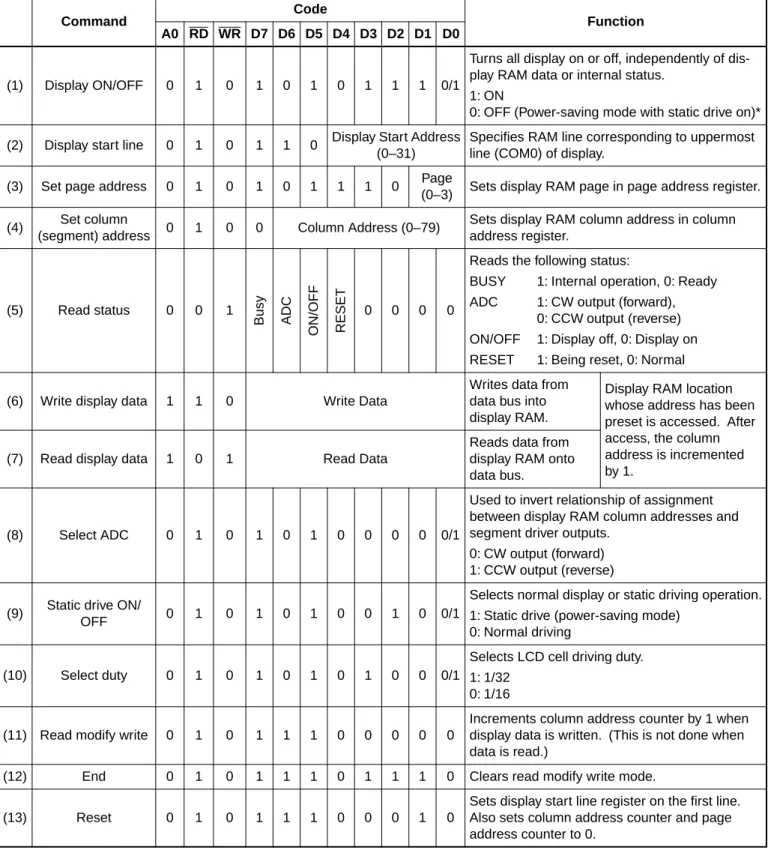
Table 3 lists the commands used with the SED1520. This LSI uses a combination of A0, R/W (RD, WR) to identify a data bus signal. Interpretation and execution of a command depends not on ex-ternal clock but on inex-ternal timing alone. Therefore, a command can be executed so fast that no busy check is needed.
A detailed description of commands follows.
4.1
DISPLAY ON/OFF
This command forces all display to turn on or off.
D 0 = Display OFF 1 = Display ON
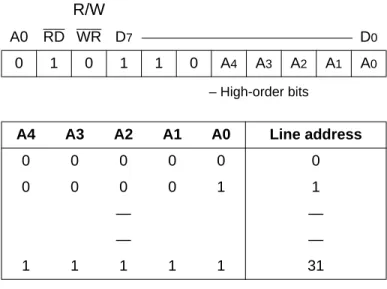
4.2
DISPLAY START LINE
This command specifies a line address (shown in Fig. 2.3.8.1) thus marking the display line that
corresponds to COM0. Display begins with the specified line address and covers as many lines as match the display duty in address ascending order. Dynamic line address change with the Display Start Line command enables column-wise scrolling or page change.
– High-order bits R/W A0 RD WR D7 D0 0 1 0 1 0 1 0 1 1 1 D R/W A0 RD WR D7 D0 0 1 0 1 1 0 A4 A3 A2 A1 A0 A4 A3 A2 A1 A0 Line address 0 0 0 0 0 0 0 0 0 0 1 1 — — — — 1 1 1 1 1 31
4.3 – 4.4
4.0 Commands
S-MOS Systems, Inc. • 150 River Oaks Parkway • San Jose, CA 95134 • Tel: (408) 922-0200 • Fax: (408) 922-0238 371-1.0 24
4.3
SET PAGE ADDRESS
This command is used to specify a page address equivalent to a row address for MPU access to the display data RAM. A required bit of the display data RAM can be accessed by specifying its page address and column address. Changing the page address causes no change in display.
4.4
COLUMN ADDRESS
This command specifies a display data RAM column address. The column address is incremented by 1 each time the MPU accesses from the set address to the display data RAM. Thus, it is pos-sible for the MPU to gain continuous access to only the data. This incrementing stops with address 80; the page address is not continuously changed.
R/W A0 RD WR D7 D0 0 1 0 1 0 1 1 1 0 A1 A0 A1 A0 Page 0 0 0 0 1 1 1 0 2 1 1 3 R/W A0 RD WR D7 D0 0 1 0 0 A6 A5 A4 A3 A2 A1 A0 A6 A5 A4 A3 A2 A1 A0 Column address 0 0 0 0 0 0 0 0 0 0 0 0 0 0 1 1 — — — — 1 0 0 1 1 1 1 79
4.0 Commands
4.5 – 4.6
4.5
READ STATUS
BUSY: BUSY being “1” means that system is performing an internal operation or is reset. No
command is accepted before BUSY = “0”. As long as the cycle time requirement is met, no BUSY check is needed.
ADC: Indicates assignment of column addresses to segment drivers.
0: Inverted (column address 79-n ↔ segment driver n)
1: Forward (column address n ↔ segment driver n)
ON/OFF: Indicates display on or off. 0: Display on
1: Display off
This bit has polarity reverse to the Display ON/OFF command.
RESET: Indicates that system is being initialized by the RES signal or the Reset command.
0: Display mode 1: Being reset
4.6
WRITE DISPLAY DATA
This command allows the MPU to write 8 bits of data into the display data RAM. Once the data is written, the column address is automatically incremented by 1; this enables the MPU to write multi-word data continuously.
R/W
A0 RD WR D7 D0
0 0 1 Busy ADC ON/
OFF Reset 0 0 0 0
R/W
A0 RD WR D7 D0
4.7 – 4.9
4.0 Commands
S-MOS Systems, Inc. • 150 River Oaks Parkway • San Jose, CA 95134 • Tel: (408) 922-0200 • Fax: (408) 922-0238 371-1.0 26
4.7
READ DISPLAY DATA
This command allows the MPU to read 8 bits of data from the display data RAM location specified by a column address and a page address. Once the data is read, the column address is automat-ically incremented by 1; this enables the MPU to read multi-word data continuously.
A dummy read is needed immediately after the column address is set. For details, see 3. (1)–(c).
??
4.8
SELECT ADC
This command inverts the relation of assignment between display data RAM column addresses and segment driver outputs. In other words, the Select ADC command can software-invert the or-der of segment driver output pins, reducing the restrictions on the configuration of ICs at LCD mod-ule assembly. For details, see Fig. 2.3.8.1.
Incrementing the column address by 1, which takes place after the MPU writing or reading display data, follows the sequence of column addresses specified in Fig. 2.3.8.1.
D = 0: Clockwise output (forward)
D = 1: Counterclockwise output (reverse)
4.9
STATIC DRIVE ON/OFF
This command forces all display to be on and, at the same time, all common output to be selected.
D = 0: Static drive off
D = 1: Static drive on R/W A0 RD WR D7 D0 1 0 1 Read data A0 RD WR D7 D0 0 1 0 1 0 1 0 0 0 0 D R/W A0 RD WR D7 D0 0 1 0 1 0 1 0 0 1 0 D
4.0 Commands
4.10 – 4.11
4.10
SELECT DUTY
This command is used to select the duty (degree of multiplexity) of LCD driving. It is valid for the SED1520F (actively operating LSI) only, not valid for the SED1521F (passively operating LSI). The SED1521F operates with any duty determined by the FR signal.
D = 0: Duty 1/16
D = 1: Duty 1/32
If the system contains both SED1520FOA (internal oscillation) and the SED1521FOA LSIs, they must have the same duty.
4.11
READ MODIFY WRITE
This command is used with the End command in a pair. Once it has been entered, the column address will be incremented not by the Read Display Data command but by the Write Display Data command only. This mode will stay until the End command is entered.
Entry of the End command causes the column address to return to the address which was valid when the Read Modify Write command was entered. This function lessens the load of the MPU when the data in a specific display area are repeatedly updated (as blinking cursor).
Even in the Read Modify Write mode, any command other than Read/Write Data and Set Column Address may be used.
R/W A0 RD WR D7 D0 0 1 0 1 0 1 0 1 0 0 D R/W A0 RD WR D7 D0 0 1 0 1 1 1 0 0 0 0 0
4.11.1 – 4.12.1
4.0 Commands
S-MOS Systems, Inc. • 150 River Oaks Parkway • San Jose, CA 95134 • Tel: (408) 922-0200 • Fax: (408) 922-0238 371-1.0 28
4.11.1 Cursor Blinking Sequence
4.12
END
This command cancels the Read Modify Write command, returning the column address to the ini-tial mode address.
4.12.1 End Timing
R/WA0 RD WR D7 D0
0 1 0 1 1 1 0 1 1 1 0
Page Address Set Column Address Set
Read Modify Write Dummy Read Data Read Data Write No End Modify Ended? N + 1 N N + 2 N + m N Column Address
Read Modify Write Mode Set End
4.0 Commands
4.13 – 4.14.1
4.13
RESET
This command initializes the display start line register, column address counter, and page address counter without any effect on the display data RAM. For details, see section 2.3.12.
The reset operation follows entry of the Reset command.
Initialization at power-on is performed not by the Reset command but by a reset signal applied to the RES pin.
4.14
SAVE POWER (COMBINED COMMAND)
Static drive going on with display off invokes power-saving mode, reducing current consumption to nearly static current level. During this mode, the SED1520 holds the following conditions: (a) It stops driving the LCD; the segment and common driver outputs are at VDD level. (b) Oscillation and external clock input are disabled; OSC2 is in floating condition. (c) The display data and operational mode are held.
The power-saving mode is cancelled by display on or static drive off.
If an external resistor division circuit is used to give LCD driving voltage level, the current flowing into the resistors must be cut off by the power-save signal.
4.14.1 External Resistor Division Circuit
R/W A0 RD WR D7 D0 0 1 0 1 1 1 0 0 0 1 0 VDD Power Save Signal VSSH VDD V1 V2 V3 V4 V5SED1520
– •4.14.1 – 4.14.1
4.0 Commands
S-MOS Systems, Inc. • 150 River Oaks Parkway • San Jose, CA 95134 • Tel: (408) 922-0200 • Fax: (408) 922-0238 371-1.0 30
Table 3 Commands
* With display off (command (1)), static drive going on (9) invokes power-saving mode.
Command Code Function
A0 RD WR D7 D6 D5 D4 D3 D2 D1 D0
(1) Display ON/OFF 0 1 0 1 0 1 0 1 1 1 0/1
Turns all display on or off, independently of dis-play RAM data or internal status.
1: ON
0: OFF(Power-saving mode with static drive on)* (2) Display start line 0 1 0 1 1 0 Display Start Address
(0–31)
Specifies RAM line corresponding to uppermost line (COM0) of display.
(3) Set page address 0 1 0 1 0 1 1 1 0 Page
(0–3) Sets display RAM page in page address register. (4) Set column
(segment) address 0 1 0 0 Column Address (0–79)
Sets display RAM column address in column address register.
(5) Read status 0 0 1
Busy ADC
ON/OFF RESET
0 0 0 0
Reads the following status:
BUSY 1: Internal operation, 0: Ready ADC 1: CW output (forward),
0: CCWoutput (reverse) ON/OFF 1: Display off, 0: Display on RESET 1: Being reset, 0: Normal (6) Write display data 1 1 0 Write Data
Writes data from data bus into display RAM.
Display RAM location whose address has been preset is accessed. After access, the column address is incremented by 1.
(7) Read display data 1 0 1 Read Data
Reads data from display RAM onto data bus.
(8) Select ADC 0 1 0 1 0 1 0 0 0 0 0/1
Used to invert relationship of assignment between display RAM column addresses and segment driver outputs.
0: CW output (forward) 1: CCW output (reverse) (9) Static drive ON/
OFF 0 1 0 1 0 1 0 0 1 0 0/1
Selects normal display or static driving operation. 1: Static drive (power-saving mode)
0: Normal driving (10) Select duty 0 1 0 1 0 1 0 1 0 0 0/1
Selects LCD cell driving duty. 1: 1/32
0: 1/16 (11) Read modify write 0 1 0 1 1 1 0 0 0 0 0
Increments column address counter by 1 when display data is written. (This is not done when data is read.)
(12) End 0 1 0 1 1 1 0 1 1 1 0 Clears read modify write mode.
(13) Reset 0 1 0 1 1 1 0 0 0 1 0
Sets display start line register on the first line. Also sets column address counter and page address counter to 0.
5.0 Electrical Characteristics
5.0 – 5.1
5.0
ELECTRICAL CHARACTERISTICS
5.1
ABSOLUTE MAXIMUM RATINGS
Notes:
1. All voltages are based on VDD = 0V.
2. The following condition must always hold true with voltages V1, V2, V3, V4 and V5: VDD≥ V1≥ V2≥ V3≥ V4≥ V5
3. The LSI may be permanently damaged if used with any value in excess of the absolute maximum ratings. During normal operation, the LSI should preferably be used within the specified electrical characteristics. Failure to meet them can cause the LSI to malfunction or lose its reliability.
4. Generally, flat package LSIs may have moisture resistance lowered when solder dipped. In mounting LSIs on a board, it is recommended to use a method which is least unlikely to give thermal stress on the package resin.
Parameter Symbol Standard Unit
Supply voltage (1) VSS –8.0 ~ +0.3 V Supply voltage (2) V5 –16.5 ~ +0.3 V Supply voltage (3) V1, V4 V2, V3 V5 ~ +0.3 V Input voltage VIN VSS – 0.3 ~ +0.3 V Output voltage VO VSS – 0.3 ~ +0.3 V Allowable loss PD 250 mW
Operating temperature TOPR –30 ~ +85 °C
Storage temperature TSTG –65 ~ +150 °C
5.2 – 5.2
5.0 Electrical Characteristics
S-MOS Systems, Inc. • 150 River Oaks Parkway • San Jose, CA 95134 • Tel: (408) 922-0200 • Fax: (408) 922-0238 371-1.0 32
5.2
DC
CHARACTERISTICS
VDD = 0V, Ta = –20 ~ 75°C
Parameter Symbol Condition Min. Typ. Max. Unit Applicable pin Operating voltage (1)*1 Recommended VSS –5.5 –5.0 –4.5 V VSS Allowable –7.0 –2.4 Operating voltage (2) Recommended V5 –13.0 –3.5 V V5 *10 Allowable –13.0 Allowable V1, V2 0.6 × V5 VDD V V1, V2 Allowable V3, V4 V5 0.4 × V5 V V3, V4
High level input voltage VIHT
VSS +
2.0 VDD V *2
*3
VIHC 0.2 × VSS VDD
Low level input voltage VILT VSS VSS + 0.8 V *2
*3
VILC VSS 0.8 × VSS
High level output voltage
VOHT IOH = –3.0mA VSS + 2.4 V *4 *5 OSC2 VOHC1 IOH = –2.0mA VSS + 2.4 VOHC2 IOH = –120µA 0.2 × VSS
Low level output voltage
VOLT IOL = 3.0mA VSS + 0.4 V *4 *5 OSC2 VOLC1 IOL = 2.0mA VSS + 0.4 VOLC2 IOL = 120µA 0.8 × VSS
Input leakage current ILI –1.0 1.0 µA *6
Output leakage current ILO –3.0 3.0 µA *7
LCD driver ON resistor RON Ta = 25°C V5 = –5.0V 5.0 7.5 KΩ SEG 0 ~ 79 *11 COM 0~ 15 V5 = –3.5V 10.0 50.0
Static current dissipation IDDQ CS = CL = VDD 0.05 1.0 µA VDD
Dynamic current dissipation
IDD (1) During display V5 = –5.0V fCL = 2KHz 2.0 5.0 µA VDD *12 *13 *14 Rf = 1MΩ 9.5 15.0 fCL = 18KHz 5.0 10.0 IDD (2) During access tCYC = 200KHz 300 500 µA *8
Input pin capacitance CIN Ta = 25°C
f = 1MHz 5.0 8.0 pF
All input pins
5.0 Electrical Characteristics
5.2 – 5.2
Notes:
*1. Operation over a wide range of voltages is guaranteed except where a sudden voltage
change occurs during access.
*2. Pins A0, D0–D7, E(RD), R/W (WR) and CS
*3. Pins CL, FR, M/S and RES
*4. Pins D0–D7
*5. Pin FR
*6. Pins A0, E (RD), R/W(WR), CS, CL and RES
*7. Applicable when pins D0–D7 and FR are at high impedance.
*8. This value is current consumption when a vertical stripe pattern is written at tCYC. Current
consumption during access is nearly proportionate to access frequency (tCYC). Only TDD (1)
is consumed while no access is made.
*9. Relationship between oscillation frequency, frame and Rf (SED1520FOA)
Oscillation frequency fOSC
Rf = 1.0MΩ ± 2%
VSS = –5.0V 15 18 21
KHz *9
Rf = 1.0MΩ ± 2%
VSS = –3.0V 11 16 21
Reset time tR 1.0 1000 µs RES
(Continued) VDD = 0V, Ta = –20 ~ 75°C
Parameter Symbol Condition Min. Typ. Max. Unit Applicable pin 40 30 20 10 0 f OSC (kHz) Rf (MΩ) 0.5 1.0 1.5 2.0 2.5 Ta = 25°C VSS = –5V 200 100 0 Frame (Hz) Rf (MΩ) 0.5 1.0 1.5 2.0 2.5 Ta = 25°C VSS = –5V Duty 1/16, 1/32
5.2 – 5.2
5.0 Electrical Characteristics
S-MOS Systems, Inc. • 150 River Oaks Parkway • San Jose, CA 95134 • Tel: (408) 922-0200 • Fax: (408) 922-0238 371-1.0 34
Notes (continued):
Relationship between external clock (fCL) and frame (SED1520FAA)
*10. Operating voltage ranges of VSS and V5
*11. Resistance with a voltage of 0.1V applied between the output pin (SEG, COM) and each
pow-er pin (V1, V2, V3, V4). It is specified within the operating voltage range.
*12, 13, 14. Current consumed by each discrete IC, not including LCD panel and wiring capaci-tances.
*12. Applicable to SED1520FAA and SED1521FAA
*13. Applicable to SED1520FOA *14. Applicable to SED1521FOA 200 100 0 1/32 1/16 Frame (Hz) fCL (kHz) 3 2 1 –15 –10 –5 0 V5 (V) VSS (V) –2 –4 –6 –8 Operating Voltage Range
5.0 Electrical Characteristics
5.3 – 5.3.1
5.3
TIMING CHARACTERISTICS
5.3.1 System Bus Read/Write I (80 Family MPU)
*1. Each of the values where VSS = –3.0V is about 200% of that where VSS = –5.0V (i.e., the listed value). *2. The rise or fall time of input signals should be less than 15 ns.
Ta = –20 to 75°C, VSS= –5.0V ± 10%, Unit: ns
Signal Symbol Parameter Min. Max. Condition
A0, CS t AH8
t AW8
Address hold time Address setup time
10 20
WR, RD t CYC8
t CC
System cycle time Control pulse width
1000 200
D0–D7
t DS8 Data setup time 80
t DH8 Data hold time 10
t ACC8 RD access time 90 CL = 100pF
t OH8 Output disable time 10 60
A0, CS WR, RD D0 ~ D7 D0 ~ D7 (WRITE) tAH8 (READ) tCYC8 tAW8 tDS8 tDH8 tOH8 tACC8 tCC
5.3.2 – 5.3.2
5.0 Electrical Characteristics
S-MOS Systems, Inc. • 150 River Oaks Parkway • San Jose, CA 95134 • Tel: (408) 922-0200 • Fax: (408) 922-0238 371-1.0 36
5.3.2 System Bus Read/Write II (68 Family MPU)
*1. t CYC6 indicates the cycle time during which CS•E = “H”. It does not mean the cycle time of signal E. *2. Each of the values where VSS = –3.0V is about 200% of that where VSS = –5.0V (i.e., the listed value). *3. The rise or fall time of input signals should be less than 15 ns.
Ta = –20 to 75°C, VSS= –5.0V ± 10%, Unit: ns
Signal Symbol Parameter Min. Max. Condition
A0, CS R/W
t CYC6*1
tAW6
t AH6
System cycle time Address setup time Address hold time
1000 20 10
D0–D7 t DS6 Data setup time 80
t DH6 Data hold time 10
tOH6 Output disable time 10 60 CL = 100pF
t ACC6 Access time 90
E t EW Enable pulse width Read 100
Write 80 E R/W A0, CS D0 ~ D7 D0 ~ D7 (WRITE) tCYC6 tAW6 tEW tAH6 tDH6 tDS6 tACC6 tOH6 (READ)
5.0 Electrical Characteristics
5.3.3 – 5.3.3.2
5.3.3 Display Control Timing
5.3.3.1
Input Timing
5.3.3.2
Output Timing
*1. The listed FR input delay time applies to the SED1521 and SED1520 (slave). The listed FR output delay time applies to the SED1520 (master).
*2. Each of the values where VSS = –3.0V is about 200% of that where VSS = –5.0V (i.e., the listed value).
Ta = –20 to 75°C, VSS= –5.0V ± 10%
Unit: µs (tWLCL, tWHCL, tDFR), ns (tr, tf)
Signal Symbol Parameter Min. Typ. Max. Condition
CL tWLCL Low level pulse width 35
tWHCL High level pulse width 35
tr Rise time 30 150
tf Fall time 30 150
FR tDFR FR delay time –2.0 0.2 2.0
Ta = –20 to 75°C, VSS= –5.0V ± 10%, Unit: µs
Signal Symbol Parameter Min. Typ. Max. Condition
FR tDFR FR delay time 0.2 0.4 CL = 100pF
CL
FR
tWLCL tWHCL tDFR tf tr5.3.3.2 – 5.3.3.2
5.0 Electrical Characteristics
S-MOS Systems, Inc. • 150 River Oaks Parkway • San Jose, CA 95134 • Tel: (408) 922-0200 • Fax: (408) 922-0238 371-1.0 38
6.0 MPU Interface
6.0 – 6.1
6.0
MPU INTERFACE
6.1
80 FAMILY MPU
VCC VCC A0 A IORQ 7 A2 ∼ D RD WR RES GND 7 D0∼ RESET A A CS 0 D RD WR RES 7 D0∼MPU
SED1520
Decoder
VSS VS VDD6.2 – 6.2
6.0 MPU Interface
S-MOS Systems, Inc. • 150 River Oaks Parkway • San Jose, CA 95134 • Tel: (408) 922-0200 • Fax: (408) 922-0238 371-1.0 40
6.2
68 FAMILY MPU
* These examples also apply to the SED1521FOA/SED1521FAA.
* The SED1520 (containing an oscillator) does not have pin CS. The output ORed with CS must be applied to pins A0, RD (E) and WR (R/W). VCC VCC A0 A VMA 13 A0 ∼ D R/W E RES GND 7 D0∼ RESET A A CS 0 D E R/W RES 7 D0∼
MPU
SED1520
Decoder
VSS VS VDD CS A0 RD(E) WR(R/W) D0~D7 Decoder RESSED1520F
OA7.0 LCD Driver Interconnections
7.0 – 7.3
7.0
LCD DRIVER INTERCONNECTIONS
7.1
SED1520F
OA- SED1520F
OA7.2
SED1520F
AA- SED1520F
AA7.3
SED1520F
OA- SED1521F
OA*1
COM To LCD To LCD COM VSS To LCD SEG M/S Rf OSC1 OSC2 FR VDD SED1520FOA Master To LCD SEG OSC1 OSC2 FR SED1520FOA Slave M/S COM To LCD To LCD COM VSS To LCD SEG M/S CL FR VDD SED1520FAA Master To LCD SEG CL FR SED1520FAA Slave External Clock M/S COM To LCD To LCD SEG M/S Rf *2 OSC1 OSC2 FR VDD SED1520FOA To LCD SEG OSC1 OSC2 FR SED1521FOA ( )7.4 – 7.5
7.0 LCD Driver Interconnections
S-MOS Systems, Inc. • 150 River Oaks Parkway • San Jose, CA 95134 • Tel: (408) 922-0200 • Fax: (408) 922-0238 371-1.0 42
7.4
SED1520F
AA- SED1521F
AA7.5
HD44103CH - SED1521F
AA*1. In this connection, the duty of the SED1521FOA must be the same as that of the SED1520FOA. *2. A CMOSbuffer is needed for a system having two or more slave LSIs.
COM To LCD To LCD SEG M/S CL FR VDD SED1520FAA To LCD SEG CL FR SED1521FAA External Clock To LCD COM HD44103CH Common Driver To LCD SEG CL FR CL M SED1521FAA Segment Driver
8.0 Typical Connections with LCD Panel
8.0 – 8.2
8.0
TYPICAL CONNECTIONS WITH LCD PANEL
8.1
DUTY 1/16, 10 CHARACTERS X 2 LINES
(Full dot LCD panel: 1 character = 6 × 8 dots)
8.2
DUTY 1/16, 23 CHARACTERS X 2 LINES
(Full dot LCD panel: 1 character = 6 × 8 dots)
SEG SED1520
LCD 16
×
61
1 16 1 61 COM SEG SED1520LCD 16
×
141
1 16 1 61 SEG SED1521 62 141 COM8.3 – 8.4
8.0 Typical Connections with LCD Panel
S-MOS Systems, Inc. • 150 River Oaks Parkway • San Jose, CA 95134 • Tel: (408) 922-0200 • Fax: (408) 922-0238 371-1.0 44
8.3
DUTY 1/32, 33 CHARACTERS X 4 LINES
(Full dot LCD panel: 1 character = 6 × 8 dots)
* SED1521F may be omitted. If it is not used, the panel consists of 32 × 122 dots.
Note: Type AA (using external clock) and type 0A (containing an oscillator) cannot coexist for the same panel.
8.4
DUTY 1/32, 20 KANJI CHARACTERS X 2 LINES
(Kanji – Character 16 x 16 dots)SEG SED1520 Master
LCD 32
×
202
1 16 1 61 17 32 SEG SED1521 62 141 COM COM SEG SED1520 Slave 142 202 HD44103CH SED1521FAA (1) SEG SED1521FAA (2) SEG SED1521FAA (3) SEG SED1521FAA (4) SEG COM 1 32 1 80 81 160LCD 32
×
320
161 240 241 3208.0 Typical Connections with LCD Panel
8.5 – 8.5
8.5
DUTY 1/32, 2–SCREEN DISPLAY, 20 KANJI CHARACTERS X 4 LINES
HD44103CH SED1521FAA (1) SEG SED1521FAA (2) SEG SED1521FAA (3) SEG SED1521FAA (4) SED1521FAA (5) SED1521FAA (6) SED1521FAA (7) SED1521FAA (8) SEG SEG SEG SEG SEG
COM COM 33 64 1 80 1 32 81 160
LCD 64
×
320
161 240 241 3208.5 – 8.5
8.0 Typical Connections with LCD Panel
S-MOS Systems, Inc. • 150 River Oaks Parkway • San Jose, CA 95134 • Tel: (408) 922-0200 • Fax: (408) 922-0238 371-1.0 46
9.0 Package Dimensions
9.0 – 9.1
9.0
PACKAGE DIMENSIONS
9.1
PLASTIC QFP 5-100 PIN
19.6 ± 0.4 Index 81 100 50 31 1 30 80 51 25.6 ±0.4 20 ±0.1 0.65 ±0.1 0.30 ±0.1 14 ± 0.1 1.5 ±0.3 0.15 ± 0.05 2.7 ± 0.1 0 ~12° 2.89.1 – 9.1
9.0 Package Dimensions
S-MOS Systems, Inc. • 150 River Oaks Parkway • San Jose, CA 95134 • Tel: (408) 922-0200 • Fax: (408) 922-0238 371-1.0 48
10.0 Pad Layout
10.0 – 10.1
10.0
PAD LAYOUT
10.1
PAD LAYOUT (SED1520D/SED1521D)
1100 95 90 85 35 40 45 50 5 10 Y X SED1520DAA 15 20 25 30 80 75 70 65 60 55 7.04 mm 4.80 mm
10.1.1 – 10.1.2
10.0 Pad Layout
S-MOS Systems, Inc. • 150 River Oaks Parkway • San Jose, CA 95134 • Tel: (408) 922-0200 • Fax: (408) 922-0238 371-1.0 50
10.1.1 Al Pad
10.1.2 Au Bump Pad
Chip Specification Dimensions (mm)
Chip size 7.04 × 4.80
Chip thickness 0.400 ± 0.025
Pad size 0.10 × 0.10
Chip Specification Dimensions (mm)
Chip size 7.04 × 4.80
Chip thickness 0.525 ± 0.025
Pad size 0.132 × 0.111
Pad pitch 0.199 min
10.0 Pad Layout
10.2 – 10.2
10.2
PAD COORDINATES (SED1520D
AB)
Pad X Y Pad X Y Pad X Y
No. Name No. Name No. Name
1 COM5 159 6507 35 SEG37 1302 159 69 SEG3 4641 4148
2 COM6 159 6308 36 SEG36 1502 159 70 SEG2 4641 4347
3 COM7 159 6108 37 SEG35 1701 159 71 SEG1 4641 4547
4 COM8 159 5909 38 SEG34 1901 159 72 SEG0 4641 4789
5 COM9 159 5709 39 SEG33 2100 159 73 A0 4641 5048
6 COM10 159 5510 40 SEG32 2300 159 74 CS 4641 5247
7 COM11 159 5310 41 SEG31 2499 159 75 CL 4641 5447
8 COM12 159 5111 42 SEG30 2699 159 76 E(RD) 4641 5646
9 COM13 159 4911 43 SEG29 2898 159 77 R/W (WR) 4641 5846 10 COM14 159 4712 44 SEG28 3098 159 78 VSS 4641 6107 11 COM15 159 4512 45 SEG27 3297 159 79 DB0 4641 6307 12 SEG60 159 4169 46 SEG26 3497 159 80 DB1 4641 6506 13 SEG59 159 3969 47 SEG25 2696 159 81 DB2 4295 6884 14 SEG58 159 3770 48 SEG24 3896 159 82 DB3 4095 6884 15 SEG57 159 3570 49 SEG23 4095 159 83 DB4 3896 6884 16 SEG56 159 3371 50 SEG22 4295 159 84 DB5 3696 6884 17 SEG55 159 3075 51 SEG21 4641 482 85 DB6 3497 6884 18 SEG54 159 2876 52 SEG20 4641 681 86 DB7 3297 6884 19 SEG53 159 2676 53 SEG19 4641 881 87 VDD 3098 6884
20 SEG52 159 2477 54 SEG18 4641 1080 88 RES 2898 6884
21 SEG51 159 2277 55 SEG17 4641 1280 89 FR 2699 6884 22 SEG50 159 2078 56 SEG16 4641 1479 90 V5 2699 6884 23 SEG49 159 1878 57 SEG15 4641 1679 91 V3 2300 6884 24 SEG48 159 1679 58 SEG14 4641 1878 92 V2 2100 6884 25 SEG47 159 1479 59 SEG13 4641 2078 93 M/S 1901 6884 26 SEG46 159 1280 60 SEG12 4641 2277 94 V4 1701 6884 27 SEG45 159 1080 61 SEG11 4641 2477 95 V1 1502 6884
28 SEG44 159 881 62 SEG10 4641 2676 96 COM0 1302 6884
29 SEG43 159 681 63 SEG9 4641 2876 97 COM1 1103 6884
30 SEG42 159 482 64 SEG8 4641 3075 98 COM2 903 6884
31 SEG41 504 159 65 SEG7 4641 3275 99 COM3 704 6884
32 SEG40 704 159 66 SEG6 4641 3474 100 COM4 504 6884
33 SEG39 903 159 67 SEG5 4641 3674
10.2 – 10.2
10.0 Pad Layout
S-MOS Systems, Inc. • 150 River Oaks Parkway • San Jose, CA 95134 • Tel: (408) 922-0200 • Fax: (408) 922-0238 371-1.0 52
S-MOS assumes no responsibility or liability for (1) any errors or inaccuracies contained in the information herein and (2) the use of the information or a portion thereof in any application, in-cluding any claim for (a) copyright or patent infringement or (b) direct, indirect, special or con-sequential damages. There are no warranties extended or granted by this document. The information herein is subject to change without notice from S-MOS.