Physician Practice Variation in Electronic Health Record Documentation by
Genna R. Cohen
A dissertation submitted in partial fulfillment of the requirements for the degree of
Doctor of Philosophy
(Health Services Organization and Policy) in The University of Michigan
2016
Doctoral Committee:
Associate Professor Julia Adler-Milstein, Co-Chair
Professor Christy Harris Lemak, University of Alabama at Birmingham, Co-Chair Professor Charles P. Friedman
Associate Professor Andrew Ryan Associate Professor Kai Zheng
ii
DEDICATION
Dedicated to my father, Mark L. Cohen, whose experiences delivering healthcare inspired and continually enriched this dissertation. Thank you for always making my work your priority.
You’re my big damn hero, sir.
iii ACKNOWLEDGEMENTS
I am indebted to innumerable individuals and institutions for supporting me over the years. Without their encouragement, I would never have had the courage to begin this work or the commitment to complete it. First and foremost, I am grateful beyond measure for my family. My mother, father, sister, and brother shared in every joy and frustration I experienced in pursuing this doctorate. They read and edited drafts, celebrated my successes, consoled me during my failures, visited in winter, and provided safe haven when I needed physical or emotional escape.
Thank you to my committee co-chairs and mentors, Julia Adler-Milstein and Christy Lemak, for reading countless drafts, responding to countless emails, and helping me see the forest when I was lost in the trees. Thank you to my committee members, Chuck Friedman, Andy Ryan, and Kai Zheng, for their perspective, edits, encouragement, and humor.
Thank you to the Agency for Healthcare Research and Quality (1R36HS023719-01A1), the Rackham Graduate School, and the University of Michigan School of Public Health Department of Health Management and Policy for their generous funding.
iv
Thank you to Luke Bruneaux, Matt Nix, Jasmine Gee, and others at the EHR vendor. Your data and support literally made this project possible. I am likewise thankful to Anya Day, Brittany Henderson, Cynthia Swihart, and others at MCEITA for their help recruiting respondents and their insight into how EHRs are actually used.
Thank you to the amazing scholars at the University of Michigan School of Public Health, School of Information, and Ross School of Business. I’m indebted Mindy Niehaus-Fukuda, Rich Hirth, Daniel Eisenberg, Peter Jacobson, Edward Norton, and others in Health Services
Organization and Policy for building a supportive environment in which to work. I’m especially grateful for Sayeh Nikpay, Joel Segel, Nate Carroll, and Zoe McLaren’s willingness to provide statistics and Stata consults, for Jordan Everson, Dori Cross, and Sunny Lin’s willingness to provide HIT consults, and for Caroline Richardson, Alicia Cohen, Renu Tipirneni, and Jack Iwashyna’s willingness to provide clinical consults.
Thanks as well to the mentors I have had outside Michigan, including Mike Wolf, Joy Grossman, Paul Ginsburg, Ha Tu, and Ann O’Malley, whose contributions to and enthusiasm for health policy continue to inspire me.
Thanks to Kirsten Herold and Harriet Litzky for teaching me how to write, and to Tory Harper Hogan for helping me dissertate.
v
Jessie, Kate, Sarah, Grace, Bibi, Dori – you’re my found-family. Thank you for laughs, hugs, chocolate, and tissues.
Thanks to Carson, Dave, Jenny, Jessie, Jill, Joe, Louis, Marian, Mike, Shanan, and Shane for good catches and talks in between climbs; to Carly, Emily, Jaci, and Lauren for pigeon pose variations; and to my dog Bruce for making sure I leave my apartment while ensuring I’m not the only one in it.
And a final thanks to my panic monster, for waking up in time to scare away that damn monkey.
vi TABLE OF CONTENTS
DEDICATION ... ii
ACKNOWLEDGEMENTS ... iii
LIST OF TABLES ... vii
LIST OF FIGURES ... viii
ABSTRACT ... ix
INTRODUCTION ... 1
CHAPTER ONE: A CONCEPTUAL FRAMEWORK TO GUIDE UNDERSTANDING OF VARIATION IN EHR DOCUMENTATION ... 6
CHAPTER TWO: MEASURING VARIATION IN EHR DOCUMENTATION ACROSS PRIMARY CARE PROVIDERS ... 33
CHAPTER THREE: PRIMARY CARE PRACTICES’ EXPERIENCES OF VARIATION IN DOCUMENTATION ... 55
LIST OF TABLES
Table 1: Categories of Drivers of Variation in EHR Documentation ... 15
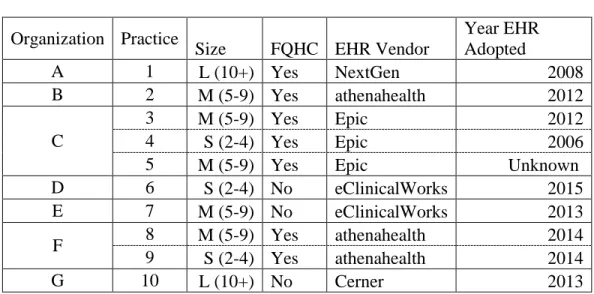
Table 2: Descriptive Characteristics of the Sample ... 42
Table 3: Provider Variation in Each Clinical Documentation Category ... 44
Table 4: Variation Explained at Different Levels ... 45
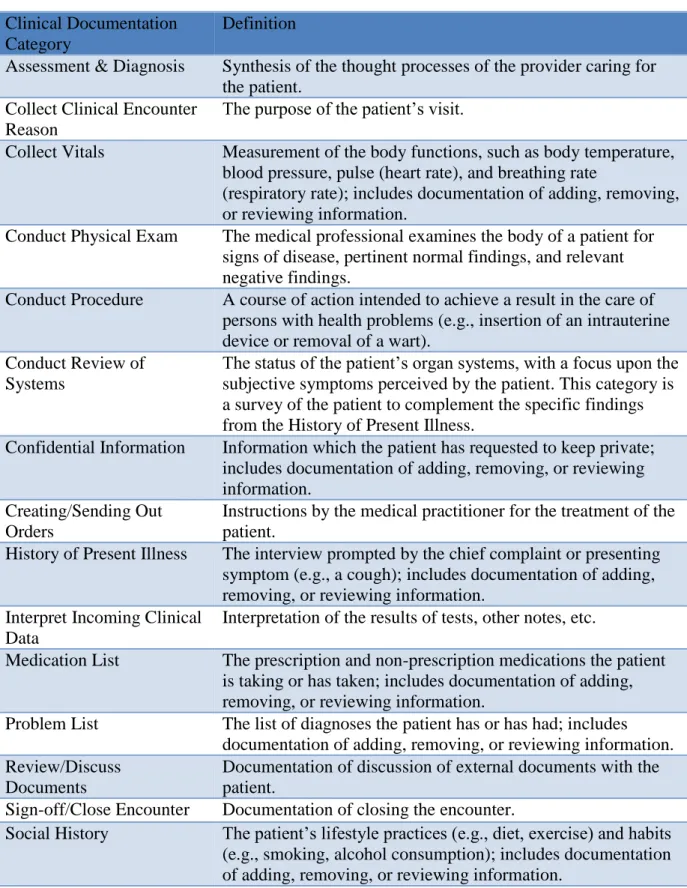
Table 5: Description of Clinical Documentation Categories ... 54
Table 6: Practice Characteristics ... 58
viii LIST OF FIGURES
Figure 1: Three Studies of Variation in EHR Documentation ... 4
Figure 2: General Framework of Variation in EHR Documentation ... 8
Figure 3: Levels of Variation in EHR Documentation ... 13
Figure 4: Detailed Framework of Variation in EHR Documentation ... 22
ix ABSTRACT
Adoption of electronic health records (EHRs) was motivated by the expectation that they would improve quality and decrease costs of care. EHRs’ value, however, depends on how they are used, which likely explains the heterogeneous benefits observed in the literature. This
dissertation uses mixed methods to explore a critical component of EHR use in primary care: variation in EHR documentation, defined as differences in how users record or remove information.
The first chapter delineates a conceptual framework of variation in EHR documentation that includes five different forms of variation and five levels where the forms may materialize. This chapter focuses on potentially harmful variation by detailing how non-patient factors foster variation that interferes with clinical decision support, care coordination, and population health management, jeopardizing the efficient delivery of high-quality healthcare.
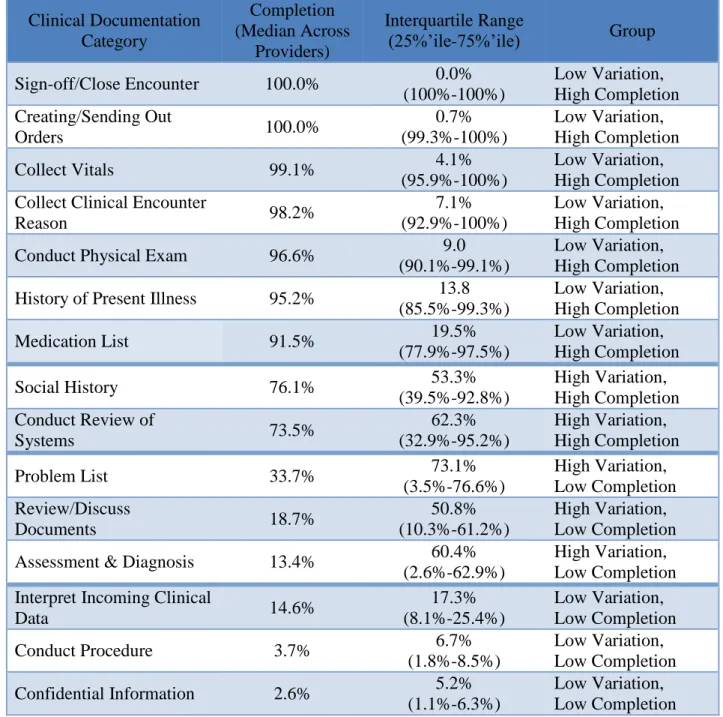
The second chapter measures variation in one form of variation, completion of documentation, in a national sample of primary care practices. Using data from a major EHR vendor, this chapter finds differences in how variably providers complete fifteen different clinical documentation categories and identifies patient’s problems, the provider’s assessment and diagnosis, the social history, the review of systems, and communication about lab and test results as the most varied. The majority of variation exists across providers in the same practice,
x
suggesting providers are making different decisions about documentation for comparable patients.
The final chapter explores the context of this variation with semi-structured interviews, finding that variation in EHR documentation is perceived as a commonplace phenomenon resulting from a flexible EHR design that allows users to develop different documentation styles. Variation reportedly introduced inefficiencies into care delivery and created patient safety and care quality risks from missed or misinterpreted information. Respondents identified additional training, ongoing meetings, and improvements in EHR design as effective strategies to prevent harm.
Widespread variation in EHR documentation can interfere with care delivery by obscuring the location and meaning of patient information. In order to realize gains from adopting EHRs, practices, vendors, and policymakers must collaboratively develop better interfaces and clearer guidelines to support their effective use.
1 INTRODUCTION
Billions of public and private dollars are being invested to increase the adoption of electronic health records (EHRs) in the U.S. [1]. The investment is motivated by the expectation that moving to digital records will lead to higher-quality, lower-cost care [2, 3]. However, EHRs are only tools that support care delivery—they do not directly alter states of disease or health. As such, the potential gains from EHRs depend on how they are used. While federally-defined meaningful use criteria [1] and proposed Advancing Care Information measures under the Medicare Access and CHIP Reauthorization Act of 2015 (MACRA) [4] specify some key ways in which EHRs should be used, the criteria give providers substantial latitude to decide how to document and manage care in their EHR. These decisions undoubtedly impact the extent to which EHRs enable, or impede, improvements in care delivery.
Practice- and individual-level decisions about how to capture data within EHRs impacts the ability of EHR data to support key activities that will result in performance gains like care coordination and population health management. Although users need flexibility to adapt EHR use to different patient health needs, variation in EHR documentation could result in a
disorganized record and encumber the delivery of efficient and high-quality care. Documentation is an essential building block of effective EHR use; if information is captured inaccurately or inconsistently, all future uses of the information (i.e., retrieval, review, and analysis) are
2
compromised [5]. Yet, there is limited prior research that examines this phenomenon to create a comprehensive picture of how documentation can vary in an EHR, what causes such variation, when and how such variation may be harmful, and what strategies may help mitigate these risks.
My dissertation uses mixed methods to help fill this gap in our understanding of variation in EHR documentation. I define variation in EHR documentation as differences in the content, structure, or location of comparable information in the EHR (“clinical documentation
categories”) that result from differences in how users record or remove that information. In order to focus on potentially harmful variation in EHR documentation, I further define variation in documentation as any differences in documentation that are not wholly driven by patient factors. Finally, the term “users” refers to any individual who completes documentation in the EHR, including independent health care providers such as doctors and nurse practitioners, clinical support staff such as nurses and medical assistants, and administrative staff such as office managers and clinic directors. However, much of my dissertation focuses on actions taken by providers because they complete the majority of documentation [6] and are ultimately
responsible for documenting the care that was delivered to the patient.
Specifically, the first chapter of my dissertation introduces a conceptual model of variation in EHR documentation to frame this understudied phenomenon. It identifies the five forms of variation (e.g., variation in who completes documentation, variation in what
information is documented in the EHR) as well as five levels of variation (e.g., variation across an individual’s encounters, variation across practices that belong to the same overarching umbrella organization). This chapter also draws on a broad body of literature in health services research, information studies, organization studies, and implementation science to outline the types of drivers not wholly related to patient health that might cause variation in EHR
3
documentation, as well as how this variation in EHR documentation might interfere with three key activities that contribute to EHR value realization: the use of clinical decision support, care coordination, and population health management to improve healthcare delivery.
The second chapter of my dissertation focuses on measuring the prevalence of one form of variation identified in my conceptual framework: variation in what information is documented in an EHR. Using a dataset provided by a commercial EHR vendor, this chapter finds differences in how variably providers complete fifteen different clinical documentation categories and identifies that five clinical documentation categories in a national sample of primary care
practices can be classified as “High Variation”: (1) documentation of the patient’s problems; (2) the social history; (3) the review of systems; (4) the provider’s assessment and diagnosis; and (5) communication about lab and test results. Differences in the amount of variation observed across clinical documentation categories suggest that some of the identified variation may be driven by provider decisions about documentation, and not patient need. Furthermore, the critical nature of the High Variation clinical documentation categories suggests that some of the identified
variation may be potentially harmful. Multilevel modeling demonstrates that the majority of variation in these clinical documentation categories exists across providers within a practice, and not across practices, umbrella provider organizations, or states. Because variation at this level is not likely driven by patient factors, it further suggests that the variation may be potentially harmful.
The third chapter of my dissertation builds on this work to explore the five High
Variation clinical documentation categories in greater depth. Semi-structured interviews with 40 primary care providers and clinical and office staff in southern Michigan focused on variation not wholly driven by patient health needs, and revealed that variation in EHR documentation
4
across users within a practice was perceived as a commonplace phenomenon that resulted from different user preferences as well as EHR design. This study found that most forms of variation created inefficiencies in documentation, either due to users documenting some information in multiple places or due to users conducting prolonged searches for information. Respondents further believed that variation in documentation created patient safety and quality risks from missing or misinterpreting information, particularly regarding documentation of patient problems and provider’s assessments and diagnoses. This chapter concludes that additional training,
ongoing meetings, and improvements in EHR design may be useful strategies to prevent potentially harmful variation.
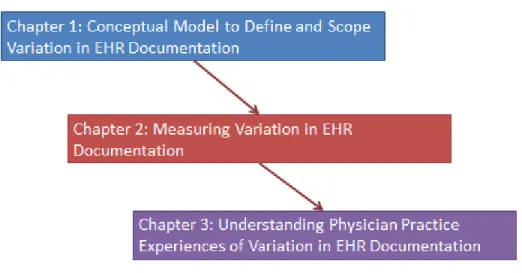
Taken together, this sequential, explanatory, mixed-methods dissertation creates a multi-faceted picture of the causes, manifestations, and effects of potentially harmful variation in EHR documentation to help primary care practices, EHR vendors, and policymakers better leverage EHRs in ways that improve care delivery (See Figure 1).
Figure 1: Three Studies of Variation in EHR Documentation
5 References
1. Blumenthal, D. and M. Tavenner, The “Meaningful Use” Regulation for Electronic
Health Records. New England Journal of Medicine, 2010. 363(6): p. 501-504.
2. Schoen, C., et al., Access, Affordability, and Insurance Complexity are Often Worse in the United States Compared to Ten Other Countries. Health Affairs, 2013. 32(12): p. 2205-2215.
3. Hartman, M., et al., National Health Spending in 2011: Overall Growth Remains Low, but Some Payers and Services Show Signs of Acceleration. Health Affairs, 2013. 32(1): p. 87-99.
4. Wynne, B., K. Pahner, and D. Zatorski, Breaking Down the MACRA Proposed Rule, in
Health Affairs Blog. 2016, Project HOPE: Bethesda, MD.
5. Logan, J.R., P.N. Gorman, and B. Middleton. Measuring the quality of medical records: a method for comparing completeness and correctness of clinical encounter data. in
Proceedings of the AMIA Symposium. 2001: American Medical Informatics Association. 6. Adler-Milstein, J. and R.S. Huckman, The Impact of Electronic Health Record Use on
Physician Productivity. The American Journal of Managed Care, 2013. 19: p. SP345-SP352.
6
CHAPTER ONE: A CONCEPTUAL FRAMEWORK TO GUIDE
UNDERSTANDING OF VARIATION IN EHR DOCUMENTATION
Introduction
With widespread adoption of electronic health records (EHRs), scholars are beginning to understand differences in EHR use in clinical practice, and the implications of those differences [1, 2]. The documentation of care delivery, or providers’, clinical support staff, and
administrative staff’s entry and removal of information in the EHR, is a critical component of use. Documentation can vary greatly because of the opportunities users have to differently record or remove information in the EHR, both within and across practice settings, even among those using the same EHR product [3-6]. This variation exists because EHRs offer many options for how to approach documentation; as a result, care for even an identical patient may be
documented in different ways [1, 2]. Empirical evidence on such variation is beginning to
emerge. A study of 18 sites within a New York Federally Qualified Health Center network found high variation in EHR documentation across 112 physicians, all using the Epic platform: the annual average proportion of encounters in which problem lists were updated ranged from 5% to 60% per physician [2]. At Intermountain Healthcare, a study of EHR use revealed high variation in the extent to which their 4,127 physicians completed seven categories of EHR documentation,
7
ranging from 75% of physicians documenting notes/medications to 11% documenting problems/allergies [1].
Better understanding variation in EHR documentation is critical because it can have dramatic consequences for EHRs’ support of better individual and population-level outcomes. To illustrate, one choice providers face when completing documentation is whether to use structured fields, such as drop-down menus or radio boxes, or unstructured fields, such as comment boxes [7]. Numerous articles have identified tradeoffs between the analytic value of structured
documentation and the expressivity of dictation [8-11], the former of which is a target of substantial financial incentives through the federal Meaningful Use program [12] and proposed Advancing Care Information measures under the Medicare Access and CHIP Reauthorization Act of 2015 (MACRA) [13]. If a provider typically uses drop-down menus to document patient problems but switches to free-text fields on a busy day because it is quicker in-the-moment, that variation produces a record that is more difficult to use effectively. When that provider or others in the practice attempt to find the patient’s problems, they may fail to find the correct
information or have to spend extra time locating it because it is not stored in a consistent and predictable format, encumbering the delivery of efficient and high-quality care [14, 15].
These examples reflect situations in which physician preferences drive variation. This raises the important distinction between variation in EHR documentation wholly driven by patient factors (“patient factors”) and those driven, at least in part, by factors beyond the patient. In an ideal world, patient factors alone would drive the variation in documentation outlined above. For example, it is likely desirable for there to be variation in documentation of patient vitals based on patient conditions (e.g., documenting HbA1c for patients with diabetes but not for healthy patients). However, it is potentially problematic if other factors, such as users’ daily
8
schedule or computer literacy, drive the decision about whether or not to document vitals because it could impede the quality and efficiency of care. As described above, if it takes providers or other practice staff extra time to search for information, this results in avoidable inefficiencies. If providers or other practice staff see a subset of correct information (i.e., they only see information in the structured fields and not in free-text fields), this could have implications for the quality and safety of clinical decisions.
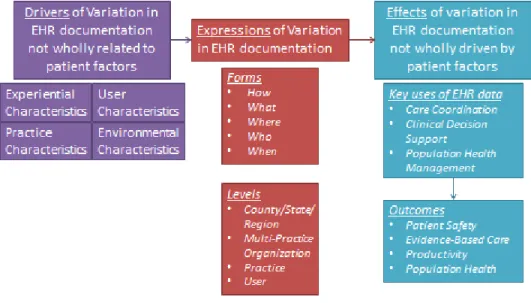
While there is a small empirical literature base that documents instances of variation in EHR documentation [2, 16-18], there is no literature that systematically maps the different expressions of variation, and then identifies the drivers of variation that do not wholly stem from patient factors. It is also important to begin to understand the ways in which variation in EHR documentation not wholly driven by patient factors could impede the delivery of high-quality care. To address this gap, I develop a conceptual framework that identifies the different possible
expressions of variation in EHR documentation, including both the forms that variation may take and the levels at which it may materialize. I then hypothesize about key upstream drivers of variation not wholly driven by patient factors and key downstream effects, focusing on the consequences for key care processes and associated outcomes. Figure 2 displays the temporal relationship between these three components:
9
I focus on the primary care context because documentation of core clinical data in this setting creates an overall picture of patient health status that lays the foundation for encounters in other settings. This framework will help create a common understanding of this critically
important but understudied dimension of EHR use. Defining key ideas related to variation in EHR documentation and mapping their relationships will also help identify high-impact areas of future research.
Approach
To develop this framework, I first sought to separate the expressions of variation in EHR documentation (forms and levels) into their mutually exclusive and collectively exhaustive components. I drew on the example of a primary care provider collecting and documenting a patient’s smoking history. Because of the limited treatment of variation in prior research, it was not possible to conduct a systematic review to identify upstream drivers and downstream effects of variation in EHR documentation not wholly driven by patient factors. Instead, I drew on a related body of literature, geographic variation in the provision of care, to identify factors that might similarly cause providers to make different decisions when faced with the care, and in this case documentation of care, of a seemingly-identical patient [19]. In order to more accurately apply these factors to the topic of EHR documentation, I incorporated additional literature from health services research, organization studies, information studies, and implementation science when possible.
10
I define variation in EHR documentation as differences in the content, structure, or location of comparable information in the EHR that result from differences in how users record or remove that information. The term “users” refers to any individual who completes documentation in the EHR, including health care providers such as doctors and nurse practitioners, clinical support staff such as nurses and medical assistants, and administrative staff such as office managers and clinic directors. In order to focus on potentially harmful variation in EHR documentation, I further define variation in documentation as any differences in documentation that are not wholly driven by patient factors.
I present examples of variation in EHR documentation that relate to delivering primary care to an individual patient. This paper does not examine variation in retrieving or reviewing information [4, 20-22] because of the foundational nature of documentation: if information is captured inaccurately or inconsistently, all future uses of the information are compromised [3-6]. Second, the examples assume that users are completing all documentation in the EHR, excluding scenarios when practices employ a combination of electronic and paper-based documentation. Third, the examples assume that all EHRs have the functionalities of a basic EHR, including computerized prescription order entry, laboratory and imaging results, and the ability to record clinical notes, structured patient demographics, medications, allergies, and problem lists [23], although these functionalities may not all be active in a given implementation [e.g., 24, 25].
Illustrative Example: Smoking History
A core component of primary care includes preventive care and health maintenance [26], such as smoking cessation interventions. Guidelines call for primary care providers to collect their
11
patients’ smoking status at every visit and advise smokers on how to quit [27, 28]. In the context of a primary care visit, patients are likely to be asked about their smoking history as part of a broader conversation about their social history. This information, along with any resultant advice about smoking cessation, then needs to be documented in the EHR, creating the opportunity for variation in each form outlined below.
Expressions of Variation in EHR Documentation
Forms of Variation in EHR Documentation
When documenting an encounter with an individual patient in the primary care setting, there are five key forms in which EHR documentation might materialize. The forms are: (1) how users document information in the EHR; (2) what users document in the EHR; (3) where in the EHR users complete documentation; (4) who completes EHR documentation; and (5) when users complete EHR documentation.
What: A user must decide how much information to record in the EHR. If a patient reports smoking during a visit, a user could choose to record their status as a smoker, details of how often and how much they smoke, or could choose not to record this information.
Where: There are multiple areas in an EHR where information about smoking would be relevant, such as in the social history, in the problem list, or in a designated smoking tab.
Depending on the structure of the EHR, the information in these different areas may be isolated, producing variation even if information is documented in the same way (e.g., structured vs. unstructured).
12
How: A user could vary in the method and format they use to complete documentation. In the case of a patient’s smoking history, a user could use choose to enter structured information about smoking (e.g., units smoked per day) or could choose to enter information about smoking as narrative text (e.g., “patient smokes at lunch”).
Who: Either a billing provider (e.g., physician, nurse practitioner) or clinical support staff (e.g., medical assistant) could collect and record information about the patient’s smoking status in the EHR. This type of variation is common because patients typically interact with multiple clinical and administrative staff during their visit, creating the opportunity for variation in who completes EHR documentation. Variation in who completes documentation is particularly likely as care models begin to emphasize team-based care [29-31] and when scribes are used [32-35], changing the burden of documentation for different types of providers and staff.
When: Information about a patient’s smoking status could be documented before, during, or after the patient’s visit. It could be collected during intake and recorded prior to the
physician’s exam, or could be collected by the physician during the exam and recorded immediately or sometime later in the day, as there is no standard workflow for information collection during primary care visits [36].
While some types of variation outlined above may be implausible for certain information (e.g., orders are typically entered by a provider, constraining variation in who completes
documentation), it is clear EHR users have discretion along a number of dimensions when completing documentation.
13
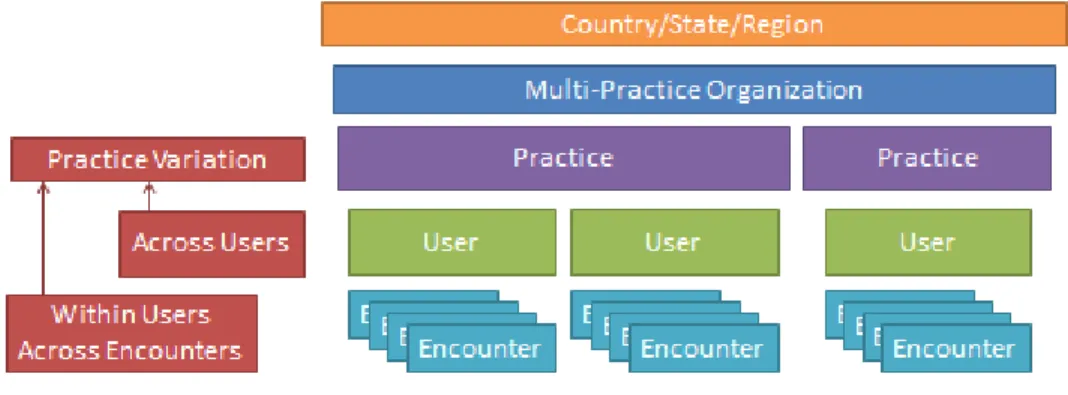
Each form of variation in EHR documentation can occur at multiple levels due to the nesting of patient encounters within providers within practices within multi-practice organizations within regions (see Figure 3).
First, a provider may vary in how s/he documents information across their encounters, producing variation within her- or himself: a provider could record smoking history for only a subset of their patients if they selectively chose to skip documentation for patients who were not active smokers. Second, providers may have little variation across their encounters but vary from each other, creating variation across individuals within practices: one provider could record all of his or her patient’s smoking history while a colleague only records when a patient is an active smoker. Third, practices may have little variation within or across providers, but exhibit variation in documentation patterns compared to other practices: one practice could more strongly
emphasize documenting smoking history than another practice, resulting in little variation within practices but significant variation across practices. Finally, a comparable pattern could exist when comparing documentation patterns across practices within counties, across counties within states, and across states within regions due to insurer requirements or local policies.
14 Drivers of Variation in EHR Documentation
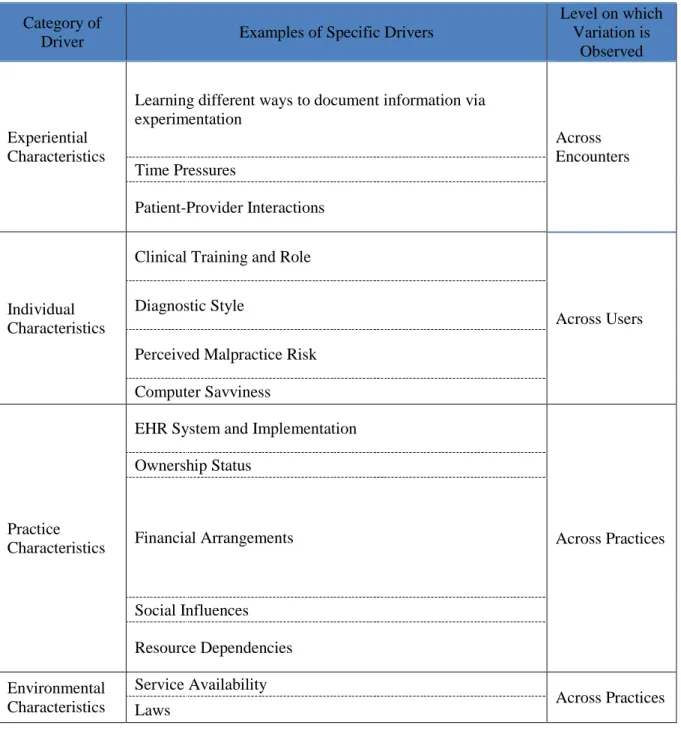
Many potential factors beyond those related to the patient could drive documentation decisions along any of the five forms of variation. While providers and other EHR users must ultimately determine what falls under the definition of a “patient factor,” I help frame this discussion by identifying categories of drivers that are either wholly or partially distinct from patient factors. These categories are experiential, user, practice, or environmental characteristics, and within each, I give an example as well as report the level on which the variation would be observed. (Table 1)
15
Table 1: Categories of Drivers of Variation in EHR Documentation Category of
Driver Examples of Specific Drivers
Level on which Variation is
Observed
Experiential Characteristics
Learning different ways to document information via experimentation Across Encounters Time Pressures Patient-Provider Interactions Individual Characteristics
Clinical Training and Role
Across Users Diagnostic Style
Perceived Malpractice Risk Computer Savviness
Practice Characteristics
EHR System and Implementation
Across Practices Ownership Status Financial Arrangements Social Influences Resource Dependencies Environmental Characteristics Service Availability Across Practices Laws
16 Drivers of Variation Across Encounters
Experiential characteristics could drive variation within users across encounters. This reflects the general finding that any intervention is likely to evolve over the implementation process [37]. Likewise, EHR use is likely to vary as users learn how to use the system. For example, a user may begin to use a template for the patient’s review of systems rather than a free-text note after discovering the capability a week into using a new EHR. This would introduce variation within individuals across encounters over time in how or where information is documented, particularly during an initial implementation period.
Second, time pressures could affect documentation decisions, as the time-consuming nature of EHR documentation is a source of user-dissatisfaction [38, 39]. The amount of time available to complete documentation could produce variation within users in a practice in how or what they document, such that on a busier day users may document a lower volume of
information or may make quick free-text notes rather than searching for the appropriate
structured option. This driver could also lead to variation in who completes documentation, if a busier provider delegates documentation to another member of practice staff, or when
documentation is completed, if there is a backlog of records to complete.
Third, the interaction between patients and EHR users could cause variation within users over time in when they complete documentation if certain patients are uncomfortable with computer use during the exam. Challenges communicating with certain patients could also take time during the visit, leaving less opportunity for documentation and creating variation in what is documented within individuals across encounters. While this category of driver includes patient factors, these factors are not wholly clinical.
17 Drivers of Variation across Users
At the next level of variation, user characteristics could drive differences in documentation across users in a practice. First, a robust literature demonstrates that medical school, internship, residency and fellowship affect provider treatment patterns, [19, 40] and these factors may similarly affect documentation patterns. Clinical training and role would likely suppress variation within users over time and could drive variation across individuals with different backgrounds and orientations. For example, providers may become accustomed to certain templates during their training and structure their documentation in accordance with this design throughout their career, leading to variation in how or where information is documented. In a cross-sectional study of outpatient physician visit notes at a single institution, providers exhibited different reliance on templates, free-text and dictation according to specialty [41]. This is also consistent with the literature on technological frames, which notes that individuals within organizations often view the nature and value of technology differently based on their role [42].
Second, differing abilities to diagnose may cause providers to recommend different treatment [19]. Likewise, providers differing abilities to diagnose could lead providers to document care differently, believing different details to be important and worth recording, leading to variation in what is documented. This would drive variation in what information is documented across individuals.
Third, a users’ perceived malpractice risk affects service provision by encouraging providers to order additional tests and services (defensive medicine) [19]. There could be an analogous practice, defensive documentation, which causes variation in documentation volume and quality. This would likely suppress variation in documentation within users over time, and
18
could drive variation across users if they have different perceptions of malpractice risks or consequences. For example, users who perceive a lower risk of malpractice may delegate more documentation to clinical assistants rather than completing it themselves, leading to variation in who completes documentation.
Fourth, just as users’ comfort with technology affects their satisfaction with EHRs post-implementation [43], computer savviness may also affect the way individuals use the EHR once it has been implemented. Quick typists could be prone to to select free-text documentation where other users who struggle with typing may prefer more point-and-click documentation, causing variation in how documentation is completed. Quick typists may also choose to document during the patient visit, where slower typists may need time at the end of the day to complete
documentation, causing variation in when documentation is completed.
Drivers of Variation across Practices and Organizations
At the next level of variation, characteristics of the practice (i.e., office) could drive differences in documentation in a community. First, differences in practices’ EHR systems and
implementation could drive differences in documentation based on the unique capabilities and constraints of different EHR interfaces. There are a number of EHR vendors whose design features such as data entry forms and templates, information displays, prompts, and hard stops (i.e., when users cannot proceed with the desired action) guide documentation of different types of information [44, 45]. Furthermore, practices and their parent organizations often customize these features, increasing the differences between products. Designating certain fields as mandatory (e.g., a hard stop) would minimize variation across users in that practice, but could
19
lead to variation across practices. Analysis of an intervention at an academic medical center identified the dramatic influence information display can have clinical behavior [46], which would likely extend to documentation behavior and cause variation in how information is documented, what information is documented, and where information is documented.
Second, differing ownership status of primary care practices could also drive differences in documentation. Whether an organization is for-profit, not-for-profit, or government-operated status affects service provision when for-profit organizations focus more on profitability [19]. This practice characteristic would likely suppress variation in documentation within and across users by fostering shared expectations regarding the types of information that are important to record for billing purposes, and could lead to variation across practices in what information is documented.
Third, different financial incentives drive providers to deliver certain services over others [19], and may likewise drive documentation of services once provided. Because these
relationships largely vary at the practice- and organization-level, they are only likely to produce variation across practices or at higher levels of aggregation (e.g., organization, county, state, or region). For example, a practice may be more likely to encourage documentation of the results of a patient’s smoking history if their practice is participating in a pay-for-performance program that distributes rewards based on the percent of active smokers receiving smoking cessation counseling, leading to variation in what is documented across practices. Payment method may also affect documentation, although the relative effect is less clear. While physicians tend to provide more services when they are paid using fee-for-service, it could be that capitated providers document more because they have longer visits, or it could be that providers paid
20
under a fee-for-service system document more information because it allows them to bill for more services.
Fourth, social influences such as peer pressure and mimicry are two mechanisms that can create consistency within, and variation across, groups [47]. Organizational norms about the best way to document complex conditions or whether it is appropriate to bring a computer tablet into the exam room could suppress variation in documentation within and foster variation across physician practices in when documentation is completed. Culture may contribute to the significance of this effect; a group culture that emphasizes cohesiveness and participation or a hierarchical culture that privileges stability may minimize variation in EHR use across
individuals within an organization. In contrast, a developmental or rational culture may foster variation across individuals within an organization by privileging innovation or competitive advantage [48]. Organizational climate has similarly proven to predict the effectiveness of newly implemented technology, including how much it is used [49].
Fifth, the presence of different relationships between practices might drive users to document information differently based on their referral network just as resource dependencies drive variation in healthcare service provision by introducing different incentives to different organizations [50]. For example, providers in a practice that use their EHR to access a hospital’s records might document care differently than a provider in a practice without such ties based on different perceptions of what information would be valuable for subsequent EHR users, leading to variation in what information is documented in EHRs across organizations.
21
Drivers of Variation across Counties, States, and Regions
The factors that are likely to influence documentation patterns at higher levels of aggregation are rarer, and relate to environmental characteristics. First, service availability, such as the presence of different specialists, local emergency response, and other types of providers in the market would likely foster shared expectations regarding what different types of information would be valuable for referrals, which in turn could create variation in what is documented across counties. Second, laws could influence documentation practices by creating geographic pressures for certain types of documentation. For example, state regulations of nurse staffing ratios could affect which types of users are likely to complete documentation, creating variation in who completes documentation across different states. Disease reporting requirements, which could be created by state or county health departments, could also affect variation in documentation by creating different pressures to document information at those levels, leading to variation in what is documented. Third, disease-specific registries could foster documentation of particular
information, creating variation in what information is documented across different states or regions.
Effects of Variation in EHR Documentation
As shown in Figure 4, variation in EHR documentation that is not wholly due to patient factors can have far-reaching implications because it compromises all future uses of EHR data.
However, there are three key domains in which variation in EHR documentation that is not wholly due to patient factors is most likely to be detrimental: (1) care coordination; (2) clinical
22
decision support (CDS); and (3) population health management. In turn, this compromises the safety, quality, and efficiency of patient care.
Variation in documentation not wholly due to patient factors may impede care
coordination by making it difficult for physicians and practice staff to find and interpret needed information. For example, if there is variation in how often users document the end-date for a medication in the medication list, future users seeking that information will not know how to interpret a medication that is typically prescribed for a limited course of treatment. Similarly, if users vary in the information they document on the problem list, subsequent users will not know how to evaluate available information. Participants in a recent qualitative study reported that care coordination was undermined in a pediatric practice when one physician documented both
chronic and acute problems on the problem list, while her peer documented only chronic
problems. When the former saw a child with an ear infection, she interpreted the lack of evidence of prior ear infections in the EHR as indicating no history when, in fact, the child had previously
23
been seen by the second physician who did not consider ear infections to be a chronic condition [51]. These issues are magnified in the increasing number of practices in which multiple
physicians and other clinical staff care for the same patient [29, 30]. When physicians are not aware of the scope of their patients’ conditions, medications, or other treatment plans, this leads to adverse events, failure to deliver evidence-based care, and avoidable visits and
hospitalizations [52-54]. If providers document problems in varied locations in the record, subsequent users seeking this information must search all possible locations, hampering efficiency by increasing the time spent retrieving information in visits which are already time-pressured [e.g., 55, 56].
Second, variation in documentation may impede clinical decision support (CDS). CDS systems are designed to aid providers’ decision-making during the patient visit through
identification of errors, such as interactions between drugs and conditions, as well as through identification of opportunities to provide additional evidence-based care, such as overdue preventive services [57, 58]. CDS algorithms rely on complete information entered in a
structured format [59]. Variation in what information is documented, when it is documented, and how it is documented, would create an insufficient and unreliable information base for these reminders or alerts. CDS would thus fail to identify harmful interactions or opportunities for evidence-based care during a patient visit [60]. For example, if one provider in a practice documents short-term medications but her or his partner does not, the absence of an alert may create a false sense of security when the former provider writes a prescription for the latter provider’s patient.
Finally, variation in EHR documentation may impede population health management, an essential component of new care delivery models like Patient-Centered Medical Homes and
24
Accountable Care Organizations [61, 62]. Like CDS, variation in what is documented or how it is documented may interfere with generating reports that capture accurate population-level snapshots of patients’ health needs outside of the context of a patient visit [57, 58]. Reports are essential for identifying opportunities for performance improvement across panels of patients, such as generating lists of patients with overdue colonoscopies or identifying all diabetic patients to notify them about an upcoming group visit [63, 64]. Electronic reports can also provide
important efficiency gains to practices, relative to paper tickler files.
Discussion
This paper identifies different expressions of variation in EHR documentation across multiple levels in the US healthcare system. Variation in EHR documentation can materialize in five different forms (what, where, how, when, and who) at multiple levels (across encounters, across users, across practices, and across regions). While documentation of patient information must vary to reflect patients’ different clinical needs, there are additional factors that can drive variation in EHR documentation, spanning experiential, user, practice, and environmental factors. Variation in EHR documentation which is not wholly driven by patient factors has the potential to interfere with high-quality and efficient healthcare delivery through its effects on care coordination, CDS, and population health management.
Several studies have begun to address variation in EHR documentation, but have defined the phenomenon narrowly, looking most often at volume of documentation. Understanding the amount of documentation is valuable, but limited [44, 45]. For example, a qualitative study of six physician practices using the same EHR conceptualized standardized use of EHRs as uniformly
25
high use of at least two specific EHR functions across all users within a practice. In this framing of standardization as high use, there is no distinction between users who consistently perform a limited number of tasks and those who inconsistently perform a broader set of tasks [17]. These styles of practice may have different implications as users search for information in the EHR and try to make sense of what they find, creating predictability on the one hand and potential
confusion on the other.
Future research should investigate both the prevalence of variation in EHR documentation and its relationship with care coordination, CDS, and population health
management to better characterize expressions of variation as appropriate or inappropriate. For example, there may be areas of documentation where variation not wholly driven by patient factors is benign, either because it does not feed into automated reports or because it is rarely used for ongoing care management. Further exploring the relationship between different drivers of variation would also be valuable to identify influential factors that either magnify or suppress other drivers, both within and across levels. For example, it is unclear if a practice’s ownership status would exert more influence in suppressing variation across users than differences in clinical training and role would exert in driving variation across users.
At present, there are limitations to studying these issues using existing national data sources that characterize EHR adoption. These surveys focus on the availability of specific functionality, overlooking the difference between software deployment and providers’ effective use [e.g., 65, 66]. Furthermore, these surveys use individuals to represent their practice as a whole [e.g., 67, 68]. Conclusions about individual-level trends likewise draw from surveys of disaggregated physicians who are not linked to their practice in the data [e.g,. 66, 69]. These sampling methods fail to capture important variation within organizations [47]. There are a
26
number of different ways to address these limitations. First, chart auditing and other secondary analysis of recorded EHR data should take a more comprehensive view of variation to
understand which forms are more or less common. Second, surveys should explicitly include questions about variation to better measure perceptions of prevalence and the potential drivers and effects. Surveys that have the ability to sample multiple individuals in an organization should further include measures of organizational affiliation to facilitate comparison of EHR documentation patterns within organizations and empirically assess variation. Future researchers can also employ qualitative interview and observation methodologies to better develop an understanding of the mechanisms by which practices manage variation in EHR documentation, either by suppressing its prevalence or working to ameliorate its potentially deleterious effects. A robust research program would incorporate each of these methods, which reach different
audiences with different depth. Ultimately, this research can guide policymakers, EHR vendors and healthcare organizations to reduce variation in EHR documentation not wholly driven by patient factors through training, staffing, or design.
Limitations
This conceptual framework introduces healthcare providers, EHR vendors, policymakers, and scholars to a novel and understudied topic: variation in documentation not wholly driven by patient factors. While it seeks to comprehensively describe different potential expressions of variation, it was not possible to catalog the drivers and effects of variation systematically because so few studies focus on this topic directly and so many studies have the potential to reference it peripherally. As a result, some relevant elements were likely excluded, and this
27
should not be considered an exhaustive list of all potential factors relevant to the broader domain of variation in EHR documentation.
Conclusion
This article proposes a framework for understanding variation in EHR documentation in primary care practices, an understudied but important topic. This article maps the relationship between factors that drive variation in EHR documentation outside of clinical patient factors and the different forms and levels at which variation in EHR documentation may manifest. It also identifies how variation in EHR documentation may jeopardize care coordination, clinical decision support, and population health management, and therefore interfere with the quality, safety, and efficiency of healthcare delivery. In doing so, this article establishes an agenda for future research to improve EHR use in primary care.
28 References
1. Wilcox, A., et al. Physician Use of Outpatient Electronic Health Records to Improve Care. in American Medical Informatics Association Annual Symposium. 2008. Washington, DC.
2. Ancker, J.S., et al., How is the Electronic Health Record Being Used? Use of EHR Data to Assess Physician-Level Variability in Technology Use. Journal of the American Medical Informatics Association, 2014.
3. Bohnsack, K.J., D.P. Parker, and K. Zheng. Quantifying Temporal Documentation Patterns in Clinician Use of AHLTA—the DoD’s Ambulatory Electronic Health Record. in American Medical Informatics Association Annual Symposium 2009: Biomedical and Health Informatics: From Foundations to Applications to Policy. 2009. San Francisco, CA.
4. Hripcsak, G., et al., Use of electronic clinical documentation: time spent and team interactions. Journal of the American Medical Informatics Association, 2011. 5. Schiff, G.D. and D.W. Bates, Can electronic clinical documentation help prevent
diagnostic errors? New England Journal of Medicine, 2010. 362(12): p. 1066-1069. 6. Logan, J.R., P.N. Gorman, and B. Middleton. Measuring the quality of medical records:
a method for comparing completeness and correctness of clinical encounter data. in
Proceedings of the AMIA Symposium. 2001: American Medical Informatics Association. 7. Resnik, P., et al., Communication of clinically relevant information in electronic health
records: a comparison between structured data and unrestricted physician language.
Perspectives in Health Information Management, 2008.
8. Pollard, S.E., et al., How physicians document outpatient visit notes in an electronic health record. International Journal of Medical Informatics, 2013. 82(1): p. 39-46. 9. Rosenbloom, S.T., et al., Data from clinical notes: a perspective on the tension between
structure and flexible documentation. Journal of the American Medical Informatics Association, 2011. 18(2): p. 181-6.
10. Linder, J.A., J.L. Schnipper, and B. Middleton, Method of electronic health record documentation and quality of primary care. Journal of the American Medical Informatics Association, 2012.
11. Bossen, C. Representations at Work: A National Standard for Electronic Health Records. in Proceedings of the 2006 20th anniversary conference on Computer supported
cooperative work. 2006: ACM.
12. Blumenthal, D. and M. Tavenner, The “Meaningful Use” Regulation for Electronic
Health Records. New England Journal of Medicine, 2010. 363(6): p. 501-504.
13. Wynne, B., K. Pahner, and D. Zatorski, Breaking Down the MACRA Proposed Rule, in
Health Affairs Blog. 2016, Project HOPE: Bethesda, MD.
14. Koopman, R.J., et al., A Diabetes Dashboard and Physician Efficiency and Accuracy in Accessing Data Needed for High-Quality Diabetes Care. The Annals of Family
Medicine, 2011. 9(5): p. 398-405.
15. Veinot, T.C., et al., Using electronic health record systems in diabetes care: emerging practices, in Proceedings of the 1st ACM International Health Informatics Symposium. 2010, ACM: Arlington, Virginia, USA. p. 240-249.
16. Lanham, H.J., et al., Understanding Differences in Electronic Health Record (EHR) Use: Linking Individual Physicians’ Perceptions of Uncertainty and EHR Use Patterns in
29
Ambulatory Care. Journal of the American Medical Informatics Association, 2014. 21(1): p. 73-81.
17. Lanham, H.J., L.K. Leykum, and R.R.J. McDaniel (2012) Same Organization, Same Electronic Health Records (EHRs) System, Different Use: Exploring the Linkage between Practice Member Communication Patterns and EHR Use Patterns in an Ambulatory Care Setting. Journal of the American Medical Informatics Association 19, 382-91 DOI: 10.1136/amiajnl-2011-000263.
18. Redd, T.K., et al. Variability among specialty and primary care physicians in their methods of using and perceptions of electronic health records. in AMIA 2015 Annual Symposium. 2015. San francisco, CA: American Medical Informatics Association.
19. Manning, W.G., E.C. Norton, and A.S. Wilk, Explaining Geographic Variation in Health Care Spending, Use and Quality, and Associated Methodological Challenges. 2012, Institute of Medicine.
20. Goodhue, D.L., Development and Measurement Validity of a Task‐Technology Fit Instrument for User Evaluations of Information System. Decision Sciences, 1998. 29(1): p. 105-138.
21. Bhargava, H.K. and A. Mishra, Electronic Medical Records and Physician Productivity: Evidence from Panel Data Analysis 2011.
22. Aral, S., E. Brynjolfsson, and M.V. Alstyne, Information, Technology and Information Worker Productivity: Task Level Evidence. 2007, National Bureau of Economic Research Working Paper Series.
23. Hsiao, C.-J. and E. Hing, Use and Characteristics of Electronic Health Record Systems Among Office-Based Physician Practices, United States, 2001-2012. 2012: US
Department of Health and Human Services, Centers for Disease Control and Prevention, National Center for Health Statistics.
24. Miliard, M. (2015) How one hospital tweaks its EHR to fight alert fatigue. Healthcare IT News.
25. Shah, N.R., et al., Improving Acceptance of Computerized Prescribing Alerts in Ambulatory Care. Journal of the American Medical Informatics Association : JAMIA, 2006. 13(1): p. 5-11.
26. Freundlich, N. and staff of The Commonwealth Fund, Primary Care: Our First Line of Defense. 2013, The Commonwealth Fund: New York, NY.
27. Fiore, M.C., et al., Treating tobacco use and dependence: clinical practice guideline.
Rockville, MD: US Department of Health and Human Services, 2000: p. 00-0032. 28. Anczak, J.D. and R.A. Nogler, Tobacco cessation in primary care: maximizing
intervention strategies. Clinical Medicine & Research, 2003. 1(3): p. 201-216. 29. McDonald, K.M., et al., Closing the quality gap: a critical analysis of quality
improvement strategies (Vol. 7: Care Coordination), in AHRQ Technical Reviews and Summaries. 2007, Agency for Healthcare Research and Quality: Rockville, MD.
30. Graetz, I., et al., The Association between EHRs and Care Coordination Varies by Team Cohesion. Health services research, 2014. 49(1pt2): p. 438-452.
31. Richardson, J.E., et al., A needs assessment of health information technology for
improving care coordination in three leading patient-centered medical homes. Journal of the American Medical Informatics Association, 2015: p. ocu039.
32. ACEP Emergency Medicine Practice Committee, Use of Scribes. 2011, American College of Emergency Physicians: Dallas, TX.
30
33. Arya, R., et al., Impact of Scribes on Performance Indicators in the Emergency Department. Academic Emergency Medicine, 2010. 17(5): p. 490-494.
34. Brady, K. and A. Shariff, Virtual medical scribes: making electronic medical records work for you. The Journal of medical practice management: MPM, 2012. 29(2): p. 133-136.
35. Scheck, A., The next big thing: medical scribes: Scribes push emergency medicine closer to adoption of electronic medical records. Emergency Medicine News, 2009. 31(2): p. 13-16.
36. Holman, G.T., et al., The myth of standardized workflow in primary care. Journal of the American Medical Informatics Association, 2016. 23(1): p. 29-37.
37. Mendel, P., et al., Interventions in Organizational and Community Context: A Framework for Building Evidence on Dissemination and Implementation in Health Services Research. Administration and Policy in Mental Health and Mental Health Services Research, 2008. 35(1-2): p. 21-37.
38. Krist, A.H., et al., Electronic health record functionality needed to better support primary care. Journal of the American Medical Informatics Association, 2014: p. amiajnl-2013-002229.
39. Shanafelt, T.D., et al., Relationship Between Clerical Burden and Characteristics of the Electronic Environment With Physician Burnout and Professional Satisfaction. Mayo Clinic Proceedings, 2016. 91(7): p. 836-848.
40. Sirovich, B.E., et al., The association between residency training and internists’ ability to
practice conservatively. JAMA internal medicine, 2014. 174(10): p. 1640-1648. 41. Edwards, S.T., et al., Association of note quality and quality of care: a cross-sectional
study. BMJ Quality & Safety, 2013.
42. Orlikowski, W.J. and D.C. Gash, Technological frames: making sense of information technology in organizations. ACM Transactions on Information Systems (TOIS), 1994. 12(2): p. 174-207.
43. Boonstra, A. and M. Broekhuis, Barriers to the acceptance of electronic medical records by physicians from systematic review to taxonomy and interventions. BMC Health
Services Research, 2010. 10(1).
44. DeLone, W.H. and E.R. McLean, Information systems success: the quest for the dependent variable. Information systems research, 1992. 3(1): p. 60-95.
45. Delone, W.H. and E.R. McLean, The DeLone and McLean model of information systems success: a ten-year update. Journal of management information systems, 2003. 19(4): p. 9-30.
46. Tannenbaum, D., et al., Nudging physician prescription decisions by partitioning the order set: results of a vignette-based study. Journal of General Internal Medicine, 2015. 30(3): p. 298-304.
47. Klein, K.J., F. Dansereau, and R.J. Hall, Levels issues in theory development, data collection, and analysis. Academy of Management Review, 1994. 19(2): p. 195-229. 48. Zazzali, J.L., et al., Organizational Culture and Physician Satisfaction with Dimensions
of Group Practice. Health Services Research, 2007. 42(3p1): p. 1150-1176.
49. Holahan, P.J., et al., Implementing computer technology: A multiorganizational test of Klein and Sorra’s model. Journal of Engineering and Technology Management, 2004. 21(1): p. 31-50.
31
50. Scott, W.R. and G.F. Davis, Organizations and Organizing: Rational, Natural, and Open Systems Perspectives. 2007, Upper Saddle River, NJ: Prentice-Hall.
51. Adler-Milstein, J., et al., Assessing Readiness, Achievement & Impact of Stage 3 Care Coordination Criteria: Summary of Key Findings and Preliminary Recommendations. 2014, The University of Michigan and the Altarum Institute: Ann Arbor, MI.
52. Smith, P.C., et al., MIssing clinical information during primary care visits. JAMA, 2005. 293(5): p. 565-571.
53. Brown, R.S., et al., Six features of Medicare coordinated care demonstration programs that cut hospital admissions of high-risk patients. Health Affairs, 2012. 31(6): p. 1156-1166.
54. Craig, C., D. Eby, and J. Whittington, Care coordination model: Better care at lower cost for people with multiple health and social needs. 2011: Institute for Healthcare
Improvement.
55. Christensen, R.E., M.D. Fetters, and L.A. Green, Opening the Black Box: Cognitive Strategies in Family Practice. The Annals of Family Medicine, 2005. 3(2): p. 144-150. 56. Tai-Seale, M., T.G. McGuire, and W. Zhang, Time Allocation in Primary Care Office
Visits. Health Services Research, 2007. 42(5): p. 1871-1894.
57. Berner, E.S., Clinical Decision Support Systems: State of the Art. 2009, Agency for Healthcare Research and Quality: Rockville, MD.
58. McLeod, W., R. Eidus, and E. Stewart, Clinical decision support: using technology to identify patients' unmet needs. Family practice management, 2011. 19(2): p. 22-28. 59. Sittig, D.F. and H. Singh, Electronic Health Records and National Patient-Safety Goals.
New England Journal of Medicine, 2012. 367(19): p. 1854-1860.
60. Schriefer, S.P., et al., Effect of a computerized body mass index prompt on diagnosis and treatment of adult obesity. Fam Med, 2009. 41(7): p. 502-7.
61. Bates, D.W. and A. Bitton, The Future Of Health Information Technology In The Patient-Centered Medical Home. Health Aff, 2010. 29(4): p. 614-621.
62. DeVore, S. and R.W. Champion, Driving Population Health Through Accountable Care Organizations. Health Affairs, 2011. 30(1): p. 41-50.
63. Silow-Carroll, S., J.N. Edwards, and D. Rodin, Using Electronic Health Records to Improve Quality and Efficiency: The Experiences of Leading Hospitals. 2012, Commonwealth Fund. p. 1-40.
64. Baron, R.J., Quality Improvement with an Electronic Health Record: Achievable, but Not Automatic. Annals of Internal Medicine, 2007. 147(8): p. 549-552.
65. Casalino, L., et al., External incentives, information technology, and organized processes to improve health care quality for patients with chronic diseases. Journal of the American Medical Association, 2003. 289: p. 434 - 441.
66. DesRoches, C.M., et al., Electronic Health Records in Ambulatory Care — A National Survey of Physicians. New England Journal of Medicine, 2008. 359(1): p. 50-60. 67. Rittenhouse, D.R., et al., Measuring the Medical Home Infrastructure in Large Medical
Groups. Health Affairs, 2008. 27(5): p. 1246-1258.
68. Rittenhouse, D.R., et al., Small and Medium-Size Physician Practices Use Few Patient-Centered Medical Home Processes. Health Affairs, 2011. 30(8): p. 1575-1584.
69. Hsiao, C.-J., et al., Electronic Medical Record/Electronic Health Record Systems of Office-Based Physicians: United States, 2009 and Preliminary 2010 State Estimates.
32
2010, Centers for Disease Control and Prevention National Center for Health Statistics: Atlanta, GA.
33
CHAPTER TWO: MEASURING VARIATION IN EHR
DOCUMENTATION ACROSS PRIMARY CARE PROVIDERS
Introduction
Substantial public and private funding has been invested to increase the adoption of electronic health records (EHRs) in the U.S. healthcare delivery system [1], motivated by the expectation that use of EHRs will lead to higher-quality, lower-cost care [2, 3]. EHRs do not, however, directly alter states of disease or health [4]. Their value depends on how they are used, and EHRs typically offer substantial flexibility in how to use them. This means that little documentation is forced, and users often have multiple choices for how to document the same type of information. While federally-defined meaningful use criteria and proposed Advancing Care Information measures under the Medicare Access and CHIP Reauthorization Act of 2015 (MACRA) specify some key ways in which EHRs should be used [1, 5], the criteria give physicians, and the organizations in which they work, substantial latitude in how they document in their EHR. The subsequent decisions about documentation undoubtedly impact the extent to which EHRs enable (or impede) improvements in healthcare delivery.
One key dimension of the quality of documentation in the EHR is variation, defined as differences in the content, structure, or location of comparable information in the EHR (“clinical documentation categories”) that result from differences in how users (providers, clinical support
34
staff, or administrative staff) record or remove that information [6]. Even for basic information, such as drug allergies and smoking status, studies from individual provider organizations reveal substantial variation in what documentation physicians complete in their EHR [7-9]. For
example, an audit of EHR use at Intermountain Healthcare found significant variation in the extent to which their 4,127 physicians completed seven categories of EHR documentation in outpatient settings, ranging from 75% of physicians who documented notes and/or medications to 11% who documented problems and/or allergies [10]. A study of 18 sites within a New York federally-qualified health center network examined variation in EHR documentation across 112 physicians, all using the Epic EHR platform. Physician-level variation was high; for example, the annual average proportion of encounters in which the problem list field was updated ranged from 5% to 60% across physicians [11].
When there is little variation in how information is documented in the EHR, it is easier for users to find and act on relevant details of the patient’s history. It also allows for tools that are designed to automatically extract information from the patient chart, such as clinical decision support functionality that alerts users to best practice management of medical conditions as well as reports to manage patient populations. Indeed, providers seem increasingly cognizant of the adverse consequences of variation in EHR documentation [12-14]. For example, in a qualitative study of how EHRs are used to support care coordination, respondents noted significant
challenges in understanding patient history that arose from physicians using different documentation practices for short-term acute health issues, such as ear infections [15].
Furthermore, a survey of providers at three healthcare organizations in Oregon found that user inconsistencies in recording information was the most severe barrier to accessing information in the EHR [14]. These issues are magnified by the increasing number of practices in which
35
multiple physicians and other clinical staff provide and document care for the same patient [16, 17].
Some variation in EHR documentation is likely “appropriate” if it is driven by factors that relate to patients’ clinical needs, but variation is likely to be harmful if it is driven by “inappropriate” factors that are not wholly related to the patients’ conditions. For example, variation within physicians across encounters is most likely to be appropriate since it should be primarily driven by patient characteristics: it may not be necessary to document a “History of Present Illness” for a healthy patient seeking routine preventive care, in contrast to a patient who is seeking treatment for an acute illness. Variation is also likely to be mostly appropriate across practices within geographic regions, and across regions. For example, variation in EHR
documentation across practices within regions could reflect differences in payer mix and associated documentation requirements, and variation across regions could reflect different regulatory requirements. The remaining variation, variation across providers within practices, is therefore the most likely to be inappropriate, reflecting a lack of consensus about how best to document within an EHR [18]. It is therefore critical to home in on variation at this level, and examine the extent to which observed variation is likely driven by provider choice about how to document information, instead of patient factors. I utilize data from a national, commercial EHR vendor to answer the following research questions:
(1) Are there clinical documentation categories for which providers variably complete documentation?
![Table 4: Variation Explained at Different Levels Clinical Documentation Category % Explained by State % Explained by Provider Organization % Explained by Practice % Unexplained Review/Discuss Documents 7.1% 5% 9.9% 78.1%** [0.03] [0.04]](https://thumb-us.123doks.com/thumbv2/123dok_us/89693.2510211/55.918.107.814.682.1079/variation-explained-different-documentation-explained-explained-organization-unexplained.webp)