Report No. CDOT-2008-3
Final Report
FREIGHT DATA SYNTHESIS
Dike Ahanotu and Akshay Mani
April 2008
The contents of this report reflect the views of the
authors, who are responsible for the facts and
accuracy of the data presented herein. The contents
do not necessarily reflect the official views of the
Colorado Department of Transportation or the
Federal Highway Administration. This report does
not constitute a standard, specification, or regulation.
Technical Report Documentation Page
1. Report No.
CDOT-2008-3
2. Government Accession No. 3. Recipient's Catalog No.
5. Report Date
April 2008
4. Title and Subtitle
FREIGHT DATA SYNTHESIS
6. Performing Organization Code
7. Author(s)
Dike Ahanotu and Akshay Mani
8. Performing Organization Report No.
CDOT-2008-3
10. Work Unit No. (TRAIS) 9. Performing Organization Name and Address
Cambridge Systematics, Inc. 730 Peachtree St. #1050 Atlanta, GA 30308
11. Contract or Grant No. 66.20
13. Type of Report and Period Covered 12. Sponsoring Agency Name and Address
Colorado Department of Transportation - Research 4201 E. Arkansas Ave.
Denver, CO 80222
14. Sponsoring Agency Code 15. Supplementary Notes
Prepared in cooperation with the US Department of Transportation, Federal Highway Administration
16. Abstract
The research in this report was designed to collect information on the freight data needed to support transportation planning in Colorado. There were three steps involved in the research for this study. First, the freight-related transportation planning efforts in the State were reviewed. The second step was to research freight planning efforts in other states to document the types of freight data that were used and needed for these studies. This step represents the core of the research effort. The third step was to develop
recommendations for freight data collection for studies planned in Colorado based on the types of data that were successfully used in other states on similar studies. The primary finding of this research is that there are freight data needs in the State that would
significantly improve freight transportation planning. The primary freight data need is improved origin-destination data collected through roadside truck origin-destination surveys on interstates and key freight-intensive state highways in Colorado. This type of data would be beneficial for several types of studies, including corridor studies, truck-rail diversion studies, safety studies, and economic development studies. The research in this study also indicated that there were several freight-related studies that would be beneficial for the State including a freight-focused vehicle classification count program, a truck safety analysis, and a freight-focused economic analysis. This research also identified a freight data collection program for Colorado that includes the development of rough cost estimates for each freight data collection effort that is recommended along with examples of how the freight data can be utilized.
Implementation:
This study recommends that transportation agencies in Colorado implement the following four types of freight-related data programs: 1. Roadside truck origin-destination data program;
2. Freight-focused vehicle classification data program; 3. Truck safety data analysis; and
4. Economic data analysis.
The Colorado DOT would be the responsible agency for the truck origin-destination program, the truck safety data program, and the economic data analysis. The freight-focused vehicle data collection program would best be jointly handled by CDOT to fill in large- scale truck count gaps and at the MPO/TPR level where local jurisdictions can determine the most important local freight facilities and conduct classification counts according to local needs. A truck safety data analysis would include parsing through the existing statewide accident database to determine the number, type and severity of accidents on each interstate and state highway in the State. Also, accident mitigation measures at each of the high-accident hot spots can be developed. An economic data analysis would include a review of the industries that rely on freight transportation, a description of the number and types of jobs in each industry, and a review of the logistics chains of key industries in the State and identification of the location of bottlenecks in the State that likely impact these industries.
17. Keywords
truck origin-destination surveys, establishment surveys, truck safety, economic analysis, goods movement, traffic data, vehicle
classification, transportation planning data
18. Distribution Statement
No restrictions. This document is available to the public through the National Technical Information Service Springfield, VA 22161; www.ntis.gov
19. Security Classif. (of this report)
Unclassified
20. Security Classif. (of this page)
Unclassified
21. No. of Pages
117
FREIGHT DATA SYNTHESIS
Dike Ahanotu, Ph. D., Senior Associate
Akshay Mani, Transportation Analyst
Report No. CDOT-2008-3
Cambridge Systematics
730 Peachtree St. Ste. #1050
Atlanta, GA 30308
Sponsored by the
Colorado Department of Transportation
In Cooperation with the
U.S. Department of Transportation
Federal Highway Administration
April 2008
Colorado Department of Transportation
Research Branch
4201 E. Arkansas Avenue
Denver, CO 80222
ACKNOWLEDGMENTS
Cambridge Systematics thanks the Colorado Department of Transportation for the opportunity to
perform this research. Study panel members for this research effort included:
•
Richard Sarche
t (S
t
udy Manager)
;
•
Mehdi Baziar;
•
Tim Baker;
•
Jason Wallis; and
•
John Coil.
EXECUTIVE SUMMARY
The research in this report was designed to collect information on the freight data needed to
support transportation planning in Colorado. Improved freight data are needed to enhance the
accuracy of forecasting transportation needs in the State. Improved freight data also are needed
to incorporate freight into transportation models. According to the Colorado Department of
Transportation, urban truck vehicle miles traveled (VMT) daily increased 65 percent from 1997
to 2006 to an estimated 3.2 million VMT. This is much higher than the 44 percent increase in
urban daily VMT for all vehicles. To efficiently address transportation issues such as
congestion, safety, and emissions, the role of freight transportation needs to be better understood.
Additionally, an efficient freight transportation system is needed to retain, attract, and grow
goods-intensive companies to Colorado.
There were three steps involved in the research for this study. First, the freight-related
transportation planning efforts in the State were reviewed. The second step was to research
freight planning efforts in other states to document the types of freight data that were used and
needed for these studies. This step represents the core of the research effort. The third step was
to develop recommendations for freight data collection for studies planned in Colorado based on
the types of data that were successfully used in other states on similar studies.
The primary finding of this research is that there are freight data needs in the State that would
significantly improve freight transportation planning. First and foremost was the need for
improved origin-destination data. CDOT has purchased the Global Insight TRANSEARCH
database. However, this database includes only freight flows between regions without direct
correlation to the road and rail infrastructure in the State. Several assumptions and calculations
are needed to estimate the impact of freight on the State’s infrastructure from the
TRANSEARCH data. To complement this database, this research recommends that roadside
truck origin-destination data be collected on the interstates and key freight-intensive state
highways in Colorado. This type of data was found to be significantly beneficial for several
studies in other regions, including corridor studies, truck-rail diversion studies, safety studies,
and economic development studies. The benefit of these data for corridor studies is particularly
relevant for Colorado due to the corridor-based planning methodology that is practiced for
long-range transportation planning in the State.
The research in this study also indicated that there were several other freight-related studies that
would be beneficial to be undertaken in Colorado. These include a freight-focused vehicle
classification count program, a truck safety analysis, and a freight-focused economic analysis.
These types of studies were found to be both important in other regions and topics of interest for
freight transportation planners in the State.
The results of this research were fairly comparable to the expectation of the research. In 2005,
CDOT completed the Freight Data Assessment which also found that roadside truck
origin-destination surveys were the most pressing freight data need in the State. Therefore, it is not
surprising that this research effort also found this to be the most significant data need as well.
Additionally, the 2005 study also found that economic data were important for the State. The
two new freight data elements identified through this study were the truck safety data and the
freight-focused vehicle classification program needs. This research can be used to develop a
freight data collection program for Colorado. This includes the development of rough cost
estimates for each freight data collection effort that is recommended along with examples of how
the freight data can be utilized.
Implementation Statement
This study recommends that transportation agencies in Colorado implement the following four
types of freight-related data programs:
1.
Roadside truck origin-destination data program;
2.
Freight-focused vehicle classification data program;
3.
Truck safety data analysis; and
4.
Economic data analysis.
The Colorado DOT would be the responsible agency for the truck origin-destination program,
the truck safety data program, and the economic data analysis. Each of these items would be
most effective if conducted on a statewide basis rather than by regions. However, the
freight-focused vehicle data collection program would best be jointly handled by CDOT to fill in large-
scale truck count gaps and at the MPO/TPR level where local jurisdictions can determine the
most important local freight facilities and conduct classification counts according to local needs.
The specific implementation strategy would begin by conducting a roadside truck
origin-destination program. This was found to be the most pressing need. This program would start by
developing a survey instrument based on the freight data needs of transportation planners in the
region. This survey instrument would be tested at a small number of locations in the State and
then based on the success of these locations, the survey can be undertaken on key interstates and
state highways around the State. Ideally, these surveys would occur every 5 to 10 years to
ensure that the origin-destination data are current.
The second step would be to identify gaps in the current truck count data and to develop a
freight-focused vehicle classification data program to fill these gaps. At the state level, CDOT
would identify gaps on the interstates and state highways based on the current count program.
Counts at these locations would occur once every three years to ensure that the count data at
these locations are current. For MPOs and rural TPRs, similar processes can be undertaken to
determine the location of truck counts for other types of facilities. A truck safety data analysis
would include parsing through the existing statewide accident database to determine the number,
type and severity of accidents on each interstate and state highway in the State. Secondarily,
accident mitigation measures at each of the high-accident hot spots can be developed. An
economic data analysis would include a review of the industries that rely on freight
transportation along with a description of the number and types of jobs in each industry. The
economic analysis also would include a review of the logistics chains of key industries in the
State and identification of the location of bottlenecks in the State that likely impact these
industries along with a description of the impact of these bottlenecks on the larger supply chains.
The specific implementation of each of these four data collection programs depends on available
resources within the State, but it is clear that priority should be given to the roadside truck
origin-destination data program. The beneficiaries of these recommended data collection programs
would primarily be transportation planners in the State. This information could be used in the
development of a freight transportation plan for the State. The economic data could be used to
justify the need for freight transportation projects and projects on freight-intensive corridor. The
data also could be used in the development of freight travel demand models, truck-rail diversion
analyses, and rail relocation studies.
TABLE OF CONTENTS
1. Introduction... 1
2. Study
Summary...
3
Conclusion and Recommendations...
8
Conclusion ...
8
Recommendations………...
11
Appendix A – Review and Update of Colorado Freight Planning Studies...
A-1
Appendix B – National, State, and Regional Freight Data and Freight Planning Efforts ...
B-1
Appendix C – Recommendations on Data Collection and Analysis Practices...
C-1
Appendix D – CDOT Scope of Work...
D-1
LIST OF TABLES
A.
Rating of Freight Data Elements by Colorado Freight Stakeholders ...
3
B.
Studies Included in Scan of Freight Data and Freight Planning Efforts...
5
1. INTRODUCTION
The Colorado DOT (CDOT) is in the process of investing significant resources and time towards
understanding the movement of goods and freight activities within the State. In 2001, CDOT
conducted the Eastern Colorado Mobility Study that included a forecast of goods movement in
the eastern portion of the State. In 2005, CDOT conducted the Freight Data Assessment Study to
characterize the freight data needs in the State and develop a plan to address the needs. CDOT
also has purchased the TRANSEARCH freight flow database for Colorado which includes
commodity, volume, and origin-destination data at the county level for the entire State.
However, freight flow data have not been fully incorporated into the CDOT and MPO
project-level programming and planning efforts. This research effort was designed to provide a useful
synthesis of practice for using freight data in transportation planning. The synthesis was
designed to answer the following questions:
•
What have other MPOs and DOTs done relative to freight data that specifically aided in
developing long-range transportation plans?
•
What is the value and weakness of the Freight Analysis Framework for use in statewide
freight planning, Regional/MPO planning or county-to-county data?
•
How effectively has freight data been used in completing transportation plans in Colorado?
•
What DOTs or MPOs are leaders in the use of freight data for transportation planning and
what are their practices?
•
What models are available for factoring freight data into transportation planning?
•
What assistance is available at the Federal level?
•
What is the recommended approach for CDOT and Colorado MPOs?
The approach to this study was to focus the resources on complementing the previous freight
work that already has been done in the State by dividing the work into the following four tasks:
•
Task 1 – Review and Update Previous Colorado Freight Planning Studies;
•
Task 2 – Scan State of the Art in National, State, and Regional Freight Data and Freight
Planning Efforts;
•
Task 3 – Develop Recommended Data Collection and Analysis Practices for Colorado; and
•
Task 4 – Write Draft and Final Research Report.
The first task was used to summarize and update the Freight Data Assessment Study and other
freight-related activities conducted by CDOT and other agencies since that study was completed.
The second task was the core of the study and consisted of a focused scan of DOTs and MPOs
around the country to examine how freight data have been used in other regions. It also
reviewed research performed at the national level that is applicable to freight planning efforts in
Colorado. The third task integrates the information collected from Tasks 1 and 2 into a cohesive
set of recommended actions for CDOT. This document represents the deliverable for the fourth
task of the study which is to develop a study report summarizing the methodology, results, and
recommendations of the research.
2. STUDY SUMMARY
As mentioned previously, the work in this study was divided into four tasks. The goal of Task 1
was to review and update the state of the practice of transportation planning in Colorado and to
identify how freight planning has been incorporated into these processes. The primary work in
this task was to review freight data needs as described in the Colorado DOT Freight Data
Assessment Final Report which was developed in July 2005. This information was updated by
interviewing key transportation planning staff in Colorado and by reviewing documents
developed for recent and current studies in Colorado.
The Freight Data Assessment Final Report included a review of the CDOT organizational
freight-related goals and objectives, the identification of three broad categories of freight needs,
and interviews of transportation planners which included asking interviewees to rate various
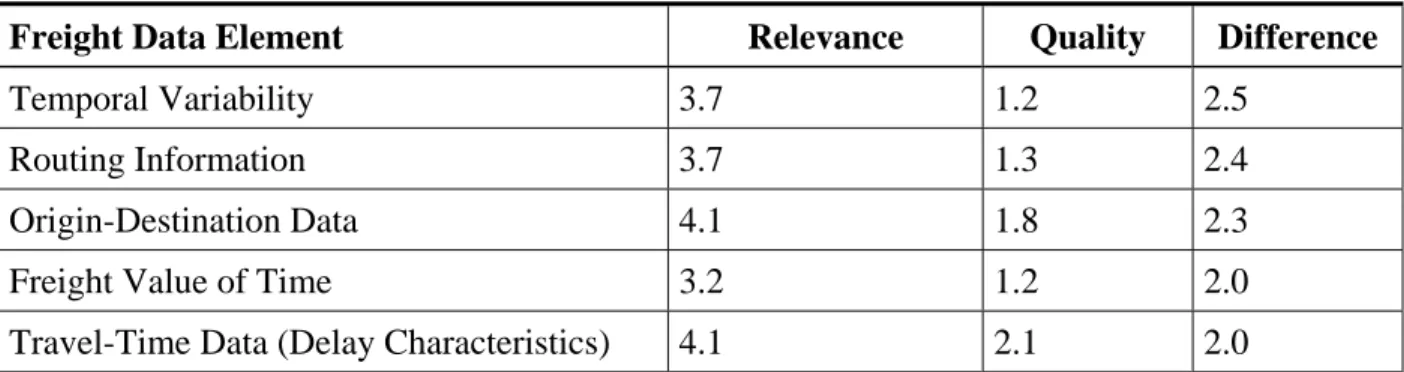
freight data elements in terms of relevance and quality. The five freight data elements with the
highest relevance rating and low-quality rating are shown below in Table A.
Table A. Rating of Freight Data Elements by Colorado Freight Stakeholders
Freight Data Element
Relevance
Quality
Difference
Temporal Variability
3.7
1.2
2.5
Routing Information
3.7
1.3
2.4
Origin-Destination Data
4.1
1.8
2.3
Freight Value of Time
3.2
1.2
2.0
Travel-Time Data (Delay Characteristics)
4.1
2.1
2.0
Task 1 of this study also included phone interviews and e-mail queries for information from 11
Colorado transportation planners to update the information contained in the Freight Data
Assessment in regards to recent, ongoing and planned freight-related transportation planning
efforts. A total of 21 studies were identified during this interview process. The final step for
reviewed based on information and reports provided on the CDOT web site. Overall, this task
illustrated that there is a significant amount of freight-related planning at CDOT and a significant
amount of freight-related data that are available to support these activities. However, based on
the specific applications of freight data to these studies, there are several freight data needs for
performing freight transportation planning in the State. The full activities and findings of Task 1
were described in a technical memorandum which is provided as Appendix A to this report.
Task 2 of this study was designed to scan a broad range of national, state, and regional projects
to begin to identify a set of potential freight planning and data collection practices for
consideration in Colorado. The projects reviewed in this task were divided into five categories:
1.
Multimodal freight studies and plans;
2.
Freight data collection and development programs;
3.
Freight models;
4.
Corridor studies; and
5.
Economic issues in freight planning.
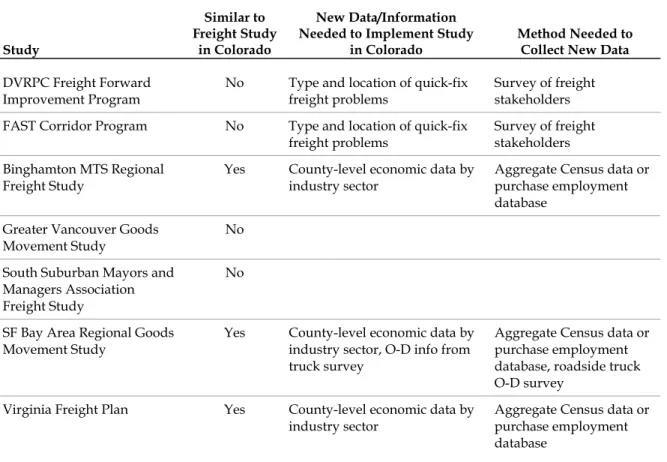
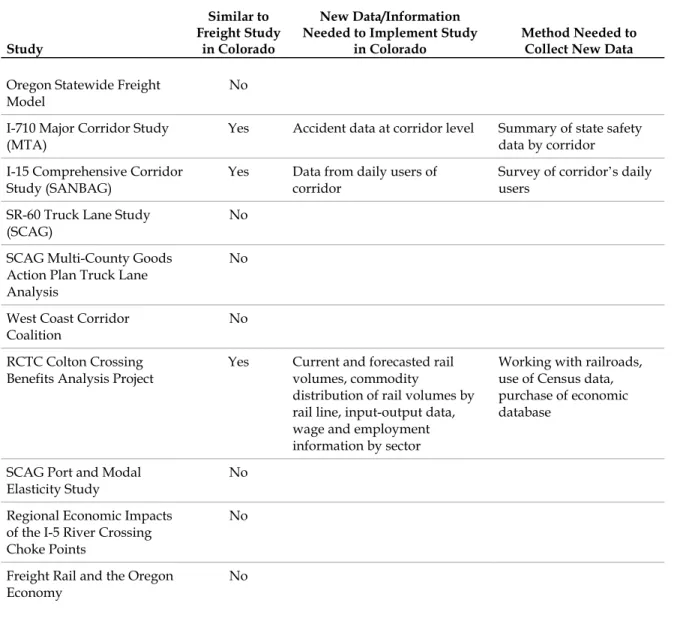
Thirty-two projects were reviewed in total. These projects are shown by category and
jurisdiction type in Table B. Each review consisted of a description of the overall study with an
emphasis on the types of data that were utilized in the study. The review concludes with a
section describing the relevance of the project (or group of projects) for the Colorado DOT and
MPOs in Colorado. Additionally, each section includes a description of the types of data that
would be needed to implement a similar type of study in Colorado based on the existing data in
the State. The reviews of each of the projects is provided in Appendix B. Appendix B is the
technical memorandum for Task 2 of this study.
Table B. Studies Included in Scan of Freight Data
and Freight Planning Efforts
MPO State
National and/or
Multijurisdictional
Delaware Valley Regional
Planning Commission
Freight Forward
Improvement Program
Virginia Freight Plan
American
Association of
Railroads National
Rail Freight
Infrastructure
Capacity and
Investment Study
Freight Action STrategy
Corridor Program
New Mexico Freight Plan
Binghamton Metropolitan
Transportation Study
Regional Freight Study
Florida Freight Network
and Statewide Freight
Plan
Greater Vancouver Goods
Movement Study
NYSDOT Trade
Overview Study
South Suburban Mayors
and Managers Association
Freight Study
Washington Statewide
Rail Capacity and System
Needs Study
Multimodal
Freight Studies
and Plans
San Francisco Bay Area
Regional Goods
Table B. Studies Included in Scan of Freight Data
and Freight Planning Efforts (continued)
MPO State
National and/or
Multijurisdictional
Southern California
Association of
Governments (SCAG)
Goods Movement Truck
Count and Survey Study
Oregon Commodity Flow
Database
Federal Highway
Administration
Freight Analysis
Framework
Portland Freight Data
Collection Program
(Portland Metro, Port of
Portland, Oregon DOT)
Intermodal Transportation
Management System
(California)
Freight Data
Collection and
Development
Programs
California
Statewide
Truck Survey
Portland Metro Truck
Model
Oregon Statewide Freight
Model
SCAG Truck Model
Freight Models
San Joaquin Valley Truck
Model
I-710 Major Corridor
Study
Georgia Statewide Truck
Lane Needs Study
West Coast Corridor
Coalition
I-15 Comprehensive
Corridor Study
SR 60 Truck Lane Study
Corridor
Studies
SCAG Multicounty
Goods Action Plan Truck
Lane Analysis
Colton Crossing Benefits
Analysis Project
Freight Rail and the
Oregon Economy
SCAG Port and Modal
Elasticity Study
Economic
Issues in
Freight
Planning
Regional Economic
Impacts of the I-5
Columbia River Crossing
Chokepoints (Oregon
DOT)
The objective of Task 3 was to develop a set of data collection and analysis practices to support
freight transportation planning. This was accomplished by comparing the freight-related projects
underway or planned in Colorado with studies that have been done in other regions. The freight
data utilized in similar projects in other regions was compared to the freight data that is available
and in use in Colorado. Data not available in Colorado was considered freight data needed for
the State. Recommendations were developed based on these freight data needs and based on the
need to maintain frequently used freight data in the State. Additionally, a review was conducted
of the freight data needs identified and implied from the interviews done as part of Task 1 of this
study and the 2005 Freight Data Assessment Report. The final recommendations incorporated
the needs that were identified through these techniques as well. The full activities and findings
from this task are shown in Appendix C, which is the technical report for Task 3.
CONCLUSION AND RECOMMENDATIONS
Conclusion
As discussed in the Task 3 Technical Memorandum, the overwhelming conclusion from the
freight data studies, surveys, and interviews is that roadside truck origin-destination surveys
would be the best next step for the freight data collection program under development in
Colorado. Roadside truck origin-destination surveys were found to be utilized in several studies
across the country. They are considered to be more accurate and reliable in terms of providing
corridor-specific information than TRANSEARCH data. The major hurdles to conducting these
surveys are the identification of suitable data collection sites and gaining permission from
necessary operators of these sites to conduct the surveys. If these hurdles are cleared, then this
data collection type will provide cost-effective information on truck activity throughout the
State. Typically, the best locations for these surveys are weigh stations and select rest areas.
Therefore, the types of truck trips intercepted for surveying tend to be intercity truck trips that
tend to cross the jurisdiction of multiple MPOs and rural areas. Based on this trip pattern, it
makes sense for these surveys to be conducted by the state DOT rather than an MPO or other
type of regional agency. In addition to the typical questions (e.g., origin, destination, commodity
carried, and facility type at origin and destination), the surveys should consider querying truck
drivers for information on truck parking deficiencies throughout the State.
Establishment surveys are the second most important data collection activity. These surveys
provide valuable information, but are very difficult to implement successfully. The cost per
completed survey is relatively high compared to roadside truck origin-destination surveys.
Additionally, it is often difficult to expand establishment surveys to a “universe” of truck trips to
enable full use of the data. The most effective use of establishment surveys is the collection of
qualitative information on freight infrastructure deficiencies from the perspective of the private
sector freight stakeholders. This can be used to develop freight improvement projects and is
particularly effective in developing near-term projects that both improve freight flow and garner
the support of the freight community towards long-term freight planning coordination.
Establishment surveys conducted in Colorado should also incorporate information on temporal
variability in truck activity, routing information, freight value of time, and travel-time (delay)
characteristics. These were mentioned as key freight data elements that were lacking in the 2005
CDOT Freight Data Assessment. Based on the typically local nature of the information collected
from establishment surveys, it may make sense for MPOs to be responsible for conducting these
surveys and managing the collected data. However, as discussed in Task 1, the private sector
freight community often does not understand what an MPO is. Therefore, having establishment
surveys cosponsored by the Colorado DOT may improve the response rate.
Economic data related to goods movement is growing in importance in the region and around the
country. It is often used to justify freight projects. It also is becoming increasingly common to
prioritize projects based on some level of economic comparison between projects. It would be
beneficial for CDOT to assemble the free public sector information on the relationship between
goods movement and the state and local economies. Based on this review of the existing and
free sources, a decision can be made on the extra value gained from purchasing one of the
proprietary databases such as the Regional Economic Modeling, Inc. software system or the
Transportation Economic Development Impact System that tend to have more detailed
information by geography and industry sector. It is recommended that this analysis be
performed by CDOT because much of the benefits of freight accrue across multiple MPO
jurisdictions and a CDOT-led analysis will ensure consistency in methodologies for estimating
freight-related economic benefits across the State.
Safety data is similar to economic data in that it is becoming increasingly important for project-
and system-level analysis. In many instances, the economic benefits of safety improvements are
estimated. Therefore, these analyses can be thought of as complementary. It would be beneficial
for CDOT to conduct a statewide freight-related analysis to identify the accident rates and
number of accidents related to truck and rail, where these accidents tend to occur, what the
impacts of the accidents are, and what potential accident reduction projects can be considered.
interviews of regional engineers to corroborate high-accident locations and problematic road
segments in the State. Related to the safety analysis is an analysis of truck parking throughout
the State. Inadequate truck parking causes safety issues as overflow trucks tend to park on
medians and ramps creating road hazards. It is a recommendation of this study that as part of the
interview of region engineers that CDOT also inquire about truck parking deficiencies in the
State and follow-up with site studies of problematic locations.
Recommendations
This research agrees with the recommendations of the 2005 CDOT Freight Data Assessment
Study. The 2005 study recommends commencing with one of the data collection techniques
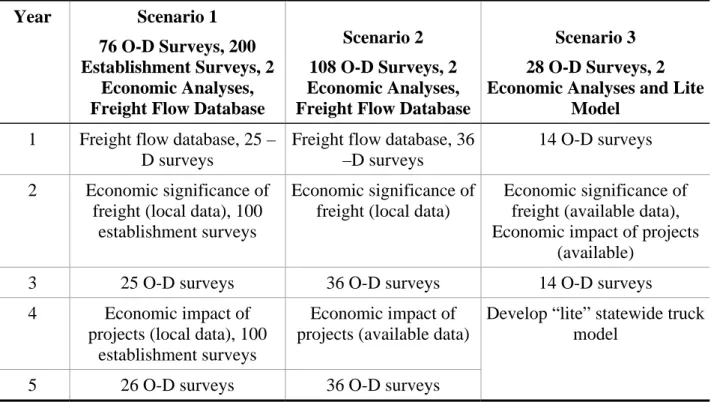
shown in Table C. Based on the five-year budget utilized in the Freight Data Assessment Study,
CDOT should conduct 76 roadside origin-destination surveys, 200 establishment surveys, 1
economic analysis and 1 safety analysis with the specific survey inclusions mentioned earlier in
this section. It should be noted that one of the recommendations of the Freight Data Assessment
has been completed. This was the purchase of the TRANSEARCH commodity flow database for
the state of Colorado.
Table C. CDOT Freight Data Program – High Funding Options
Year Scenario
1
76 O-D Surveys, 200
Establishment Surveys, 2
Economic Analyses,
Freight Flow Database
Scenario 2
108 O-D Surveys, 2
Economic Analyses,
Freight Flow Database
Scenario 3
28 O-D Surveys, 2
Economic Analyses and Lite
Model
1
Freight flow database, 25 –
D surveys
Freight flow database, 36
–D surveys
14 O-D surveys
2
Economic significance of
freight (local data), 100
establishment surveys
Economic significance of
freight (local data)
Economic significance of
freight (available data),
Economic impact of projects
(available)
3
25 O-D surveys
36 O-D surveys
14 O-D surveys
4
Economic impact of
projects (local data), 100
establishment surveys
Economic impact of
projects (available data)
5
26 O-D surveys
36 O-D surveys
Develop “lite” statewide truck
model
REPORT PUBLICATIONS LIST
Colorado Department of Transportation, Freight Data Assessment Study, 2005
Colorado Department of Transportation, Eastern Colorado Mobility Study, 2002
Appendix A - Task 1 Technical Report
Review and Update of Colorado Freight Planning Studies
The goal of Task 1 was to review and update the state of the practice of transportation planning in Colorado and to identify how freight planning has been incorporated into these processes. The primary work in this task was to review freight data needs as described in the Colorado DOT Freight Data Assessment Final Report which was developed in July 2005. This information was updated by interviewing key transportation planning staff in Colorado and by reviewing documents developed for recent and current studies in Colorado.
R
EVIEW OF
F
REIGHT
D
ATA
A
SSESSMENT
R
EPORT
CDOT Freight Data Goals and Objectives
In 2005, the Colorado Department of Transportation completed the Freight Data Assessment Study. This study covered several topics including the development of a set of recommended freight goals and objectives which seem to remain applicable to this current freight data effort. The goals and objectives are as follows:
• Track activity for the two most significant freight modes in the State: truck and rail;
• Enable statewide, corridor-focused planning;
• Track the performance of the transportation system in meeting the needs of the freight community;
• Enable decision-makers to understand the relationship between freight and the economy;
• Determine the impact of freight activity on the other users of the transportation system;
• Allow for the incorporation of freight interests in the project-selection process;
• Incorporate freight data related to rural access to the interstate and national rail infrastructure;
• Focus on multijurisdictional freight data elements that are most effectively managed at the state level; and
• Develop a fiscally constrained freight data program that considers resources available to CDOT and the long-term costs of collecting, analyzing, storing, and disseminating data throughout CDOT and partner agencies in the State.
These goals will be used to measure the effectiveness of the current freight data available in Colorado. It will also be used as a standard to describe the improvements that would be enabled based on recommendations that are generated by this current study effort.
Identified Freight Data Needs
The 2005 Colorado Freight Data Assessment Study also included interviews of over 40 freight stakeholders including Colorado DOT planning staff, Colorado MPO planning staff, economic development officials, and private sector freight interests around the State. The interviews identified three broad categories of freight data needs within the State as follows:
1. Corridor-level freight data needs; 2. Economic analysis data needs; and 3. Rail data needs.
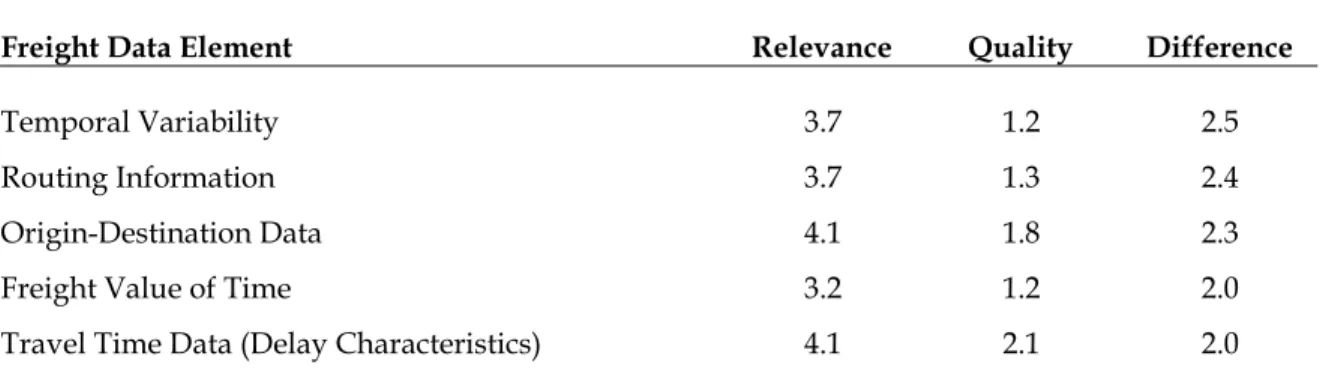
The interviews included surveys of the relevance and quality of 18 specific freight data elements. To identify the greatest freight data needs in the state, freight data elements with high “relevance” and low “quality” were identified based on the average difference
between these two characteristics by the survey respondents. This difference was calculated for each freight data element with the conclusion that the top five freight data elements needed in the state are: temporal variability, routing information, origin-destination data, freight value of time and travel time data (Table 1). These findings are consistent with the identified needs for corridor-level freight data and economic data as freight data needs for the state. Rail data was not a specific element included in the survey.
Table 1. Rating of Freight Data Elements by Colorado Freight Stakeholders
Freight Data Element Relevance Quality Difference
Temporal Variability 3.7 1.2 2.5
Routing Information 3.7 1.3 2.4
Origin-Destination Data 4.1 1.8 2.3
Freight Value of Time 3.2 1.2 2.0
S
UMMARY OF
D
ISCUSSIONS WITH
C
OLORADO
F
REIGHT
S
TAKEHOLDERS
The information compiled in the Freight Data Assessment Study was updated by interviewing key transportation planners in Colorado. These planners included the following:
• Jason Wallis, Colorado DOT;
• Mehdi Baziar, Colorado DOT;
• Tim Baker, Colorado DOT;
• Irene Merrifield, Colorado DOT, ; and
• John Coil, Denver Regional Council of Governments.
E-mail requests for information were also sent to Colorado DOT ITS staff and representatives of the other four MPOs in the State including:
• Bruce Coltharp, Colorado DOT ITS Planning Manager;
• Ken Simms, Grand Valley Area MPO;
• Suzette Mallett, North Front Range MPO;
• Craig Caspar, Pikes Peak Area Council of Governments; and
• Bill Moore, Pueblo Area Council of Governments.
Responses were not received from all of the MPOs. Also, no response was received from the President of the Colorado Motor Carriers Association (CMCA).
Discussions with the freight stakeholders were used to identify several recent, ongoing, and upcoming freight-related projects and activities. The freight-related projects are described below along with associated freight data used and implied freight data needs. The list also includes freight planning activities and issues that were noted through the discussions:
• CDOT Purchase of Global Insight TRANSEARCH Data – This data include county-level freight flow tonnages for the truck and air modes with both base year and forecast data. CDOT is sharing this database with the State’s MPOs. However,
multiple MPO-level staff felt that this database would be much more useful if it was available on a corridor level and had better accounting for local truck trips as well. A potential freight analytical tool to bridge this gap would be a valuable resource to freight transportation planning efforts in Colorado.
well as FHWA’s Freight Analysis Framework (FAF) to help describe freight activity in
the State. The previous statewide transportation plan also included a technical report on freight. Data used in this report included freight data from the Federal Highway Administration Freight Analysis Framework database and the Census Bureau Commodity Flow Survey. The report also included economic information from the Colorado International Trade office. Additionally, general information was collected on air cargo, pipelines, intermodal rail facilities, and intermodal highway connectors in the State.
• Public Benefits and Costs Study of Rail Relocation – This study analyzed the costs and benefits of alternative routings for a rail line that runs through the Denver metro-politan area. Project benefit categories included: reductions in auto and truck travel time, increased safety, increased air quality, increased property values, improved quality of life, increased job opportunities, increased tax revenues, and additional profit for the railroads. This project also estimated the costs of three alternative align-ment scenarios and compared them to a no-build scenario.
• Phase II of Rail Relocation Study – The purpose of this study is to determine what steps will have to be carried out to form a public/private partnership. This study will define and finalize the project scope and costs. Additionally, it will determine how costs should be shared based on both public and private benefits. This study also included more detail in terms of the alignment of the rail relocation, the benefits associated with the rail relocation and the costs as well. Additionally, this study will review potential funding sources for the rail relocation.
• Statewide Rail Database – This database includes the number of trains for each rail line in the State. This database is also linked to CDOT’s roadway inventory database. • CDOT Classification Count Data Review – This study is reviewing the number and
location of truck counts in the State and determining whether they are adequate to serve the State’s freight planning needs.
• Colorado Strategic Plan for Improving Roadway Safety – This is a three-year plan-ning document that integrates safety planplan-ning efforts of all safety stakeholders into one document that serves as a tool for future planning efforts across the State. The plan is constituted of 18 focus areas of which “Large Trucks” and “Railroad Crossings” are
two of the focus areas. The trucking data in this report included the number of fatalities, injury crashes and property damage only crashes that occurred in Colorado from 2001 to 2005. The same data were provided for crashes involving railroads.
• Upcoming Front Range Travel Survey – This survey will include both personal and commercial vehicles. On the commercial side, it will be conducted as an establishment survey where respondents will be identified based on their establishment. The study area for this survey will be from Pueblo, CO to Cheyenne, Wyoming. The commercial vehicles component will include both short-range local truck trips and long-haul truck trips as well. This is an update of a similar survey performed roughly 10 years ago.
• Upcoming Statewide Freight Roadmap – CDOT plans on developing a freight roadmap that covers the entire State. The goal of this study is to provide information regarding big picture freight policies and concepts such as describing current conditions, developing a freight vision and goals, collecting and synthesizing information into the roadmap, identifying institutional requirements to implement the roadmap, and development of the roadmap document itself. Check with Jason for more deail.
• Upcoming Truck Origin-Destination Pilot and Survey – This study will be done in two stages. First, will be the development of the survey methodology along with a pilot study which will serve as a proof of concept. The second stage will be the full implementation of the survey. The second stage has no funding earmarked at this time.
• Western Colorado Mobility Plan – This study was under consideration and would ideally be used to complement the Eastern Colorado Mobility Study that was done several years back. Performing this study was considered, but is unlikely at this time due to the eastern study being slightly outdated.
• Tracking of Oil, Gas, and Ethanol Shipments – The recent and rapid increase in the price of oil has caused significant changes in the energy supply chain including the increased use of alternative fuels. An emerging issue for the State is to be able to esti-mate the location and quantity of the oil, gas, and ethanol that is shipped from, to and through the State of Colorado. Freight data needs for this study could include origin-destination surveys on interstates that are likely used for these shipments. This could also be included as part of the Front Range Travel Survey by including oil, gas and ethanol as part of the establishments that are surveyed.
• Chain-Up Station Usage – The location and quantity of chain-up stations has been noted as deficient causing non-ideal locations to be used creating safety hazards.
• Ports-to-Plains Rest Stop Study – This study estimated the current number of truck parking spaces in the Ports-to-Plains corridor and it also estimated the number of truck parking spaces needed by 2030. Freight data likely used in this study were forecasts of truck VMT into 2030, perhaps specifically for long-haul truck trips, ideally for truck trips with origin-destination patterns similar to those identified through truck driver interviews. The traffic model that was developed as part of the 2004 Corridor Development and Management Plan for Ports to Plains was used for this study.
• Truck Parking Issues at Interstate Rest Areas in Colorado – This study was designed to identify locations at or near Colorado Interstate Rest Areas where illegal or unsafe truck parking is occurring and then identifying potential alternative truck parking locations. The main task of this study was to coordinate with CDOT Maintenance forces, the Colorado State Patrol, and members of the private trucking industry to collect parking information at interstate rest areas and document other locations where trucks are stopping illegally on the interstate system. The study also identified potential public and/or private partnering opportunities for additional safe truck
parking locations and developed recommendations for alternative approaches for addressing the truck parking issue.
• Potential Additional Rest Area Efforts – CDOT applied for a Federal grant under SAFETEA-LU for actual construction/improvements of two rest areas in the state. However, neither of these grants were accepted.
• North Front Range Freight Survey – In conjunction with economic development groups and the local chamber of commerce, the North Front Range MPO conducted a survey of the top freight companies in its jurisdiction. The purpose of the survey was to collect information on their transportation needs. The response rate for this survey was relatively low and the answers were very general.
• North Front Range Classification Counts – The North Front Range MPO conducted classification counts of all of the regionally significant corridors. There was also an attempt to capture truck O-D information in the travel demand model.
• Economic Data Needs – One CDOT staff member mentioned the need for better eco-nomic data related to freight movement and freight projects. Ideally, the benefit of freight to local economies would be readily available.
• Rail Data Needs – One CDOT staff member mentioned the need for better rail data in Colorado. Much of the information from the FRA is updated only once every 3 or 10 years and more annualized data are needed. Specifically, information on the timing and length of trains along with vehicle speeds at at-grade crossings would be relevant.
• Freight Data Collection Responsibilities – One of the MPO representatives mentioned that freight data should be one of the responsibilities of CDOT, since many of the freight companies operate on a statewide or multiregional level and it didn’t make
sense to have all 15 of the Transportation Planning Regions in the State talking to the same stakeholders. Additionally, CDOT is already a recognized regulating agency and is likely to receive a greater response than an MPO which freight companies generally do not understand.
R
EVIEW OF
P
ROJECT
L
IST FROM
CDOT
W
EB
S
ITE
The project list on the CDOT web site was also reviewed to further examine the role of freight in the CDOT planning process. Projects which are either on an interstate or are multiregional in nature were reviewed to determine the extent that freight planning was incorporated or needed on the study. The freight data used and needed for these studies was also noted.
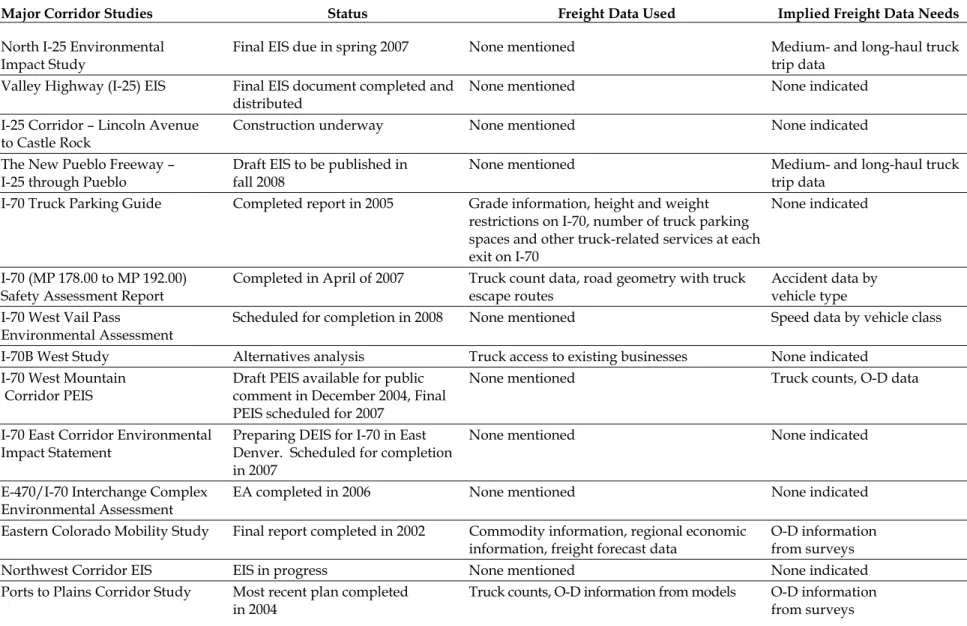
There were 15 projects on the list that were found to be relevant in terms of freight as shown in Table 2. However, only five of these projects incorporated freight data in to their analysis. The types of freight-related data that were used included truck counts, road geometry information, limited origin-destination information and information from a previous TRANSEARCH purchase by the CDOT. However, several other studies did not
include a significant amount of freight data in the analysis. This included some corridor studies which occurred on I-25 and I-70 which have a significant amount of freight. In these cases, the freight data that would have been the most valuable appears to be corri-dor-specific, origin-destination data particularly for medium and long-haul trucks. Addi-tionally, accident data by vehicle class would have been helpful for the I-70 Safety Study. The vehicle class accident data are available as evidenced by the Statewide Report on Improving Roadway Safety, but not explicitly mentioned on the I-70 Study. The I-70 West Mountain Corridor PEIS would have benefited from analyzing speed data separately for trucks and autos to better illustrate the need for climbing lanes.
Table 2 Select Major Corridor Studies from CDOT Web Site
Major Corridor Studies Status Freight Data Used Implied Freight Data Needs
North I-25 Environmental Impact Study
Final EIS due in spring 2007 None mentioned Medium- and long-haul truck trip data
Valley Highway (I-25) EIS Final EIS document completed and distributed
None mentioned None indicated I-25 Corridor – Lincoln Avenue
to Castle Rock
Construction underway None mentioned None indicated The New Pueblo Freeway –
I-25 through Pueblo Draft EIS to be published in fall 2008 None mentioned Medium- and long-haul truck trip data I-70 Truck Parking Guide Completed report in 2005 Grade information, height and weight
restrictions on I-70, number of truck parking spaces and other truck-related services at each exit on I-70
None indicated
I-70 (MP 178.00 to MP 192.00) Safety Assessment Report
Completed in April of 2007 Truck count data, road geometry with truck escape routes
Accident data by vehicle type I-70 West Vail Pass
Environmental Assessment Scheduled for completion in 2008 None mentioned Speed data by vehicle class I-70B West Study Alternatives analysis Truck access to existing businesses None indicated
I-70 West Mountain Corridor PEIS
Draft PEIS available for public comment in December 2004, Final PEIS scheduled for 2007
None mentioned Truck counts, O-D data
I-70 East Corridor Environmental Impact Statement
Preparing DEIS for I-70 in East Denver. Scheduled for completion in 2007
None mentioned None indicated
E-470/I-70 Interchange Complex Environmental Assessment
EA completed in 2006 None mentioned None indicated Eastern Colorado Mobility Study Final report completed in 2002 Commodity information, regional economic
information, freight forecast data
O-D information from surveys Northwest Corridor EIS EIS in progress None mentioned None indicated Ports to Plains Corridor Study Most recent plan completed
S
UMMARY OF
F
REIGHT
P
LANNING
R
EVIEW
This task has illustrated that there is a significant amount of freight data that are available to support planning activities for the state. However, as noted in the interviews from the 2005 freight data study, the recent discussions with Colorado freight stakeholders and the review of the project list on the CDOT website, there are several freight data needs which still remain. These include the collection of new freight data within Colorado and the dissemination of freight data from existing sources. Task 2 of this study will review and compare freight planning and data in Colorado with other states. This information will be used to develop a comprehensive set of recommendations in Task 3 regarding future Colorado freight data activities.
Appendix A-1 Discussion Notes
C
OLORADO
D
EPARTMENT OF
T
RANSPORTATION
F
REIGHT
D
ATA
S
YNTHESIS
D
ISCUSSION
N
OTES
,
J
ULY
16,
2007
I
RENE
M
ERRIFIELD
,
C
OLORADO
DOT
• Irene is currently managing a truck parking study in which they developed an inven-tory of truck parking spaces at rest areas on the interstates in Colorado and are consid-ering developing a similar inventory for truck stops on the interstate.
• Irene recommended that I look at the studies listed on the CDOT web site under the tab “Major Corridor Studies” and determine which of those studies are freight-related.
Specific studies that should be included are: Heartland Express, Front Range RR Study.
• Irene mentioned that there was an ITS study on I-70 with information on truck activity that should be of note. CDOT has requested Federal funding to continue this effort.
• Colorado developed a Strategic Plan for Roadway Safety which has a page on truck safety which she will send to me for reference.
Irene provided the following names of additional people to talk to:
• Bruce Coltharp, CDOT ITS, (303) 512-5807;
• Ken Simms, Grand Valley Area MPO, (970) 244-1830;
• Suzette Mallett, North Front Range MPO, (970) 416-2257;
• Craig Caspar, PPACG, (719) 471-7000; and
C
OLORADO
D
EPARTMENT OF
T
RANSPORTATION
F
REIGHT
D
ATA
S
YNTHESIS
F
INAL
D
ISCUSSION
N
OTES
,
J
ULY
13,
2007
J
ASON
W
ALLIS
,
C
OLORADO
DOT
• Jason has been with CDOT for one and a half years and can comment on freight plan-ning activities during that time period.
• Jason developed a rail database for the State.
• Jason also sits on the 2035 Long-Range Plan Technical Committee and serves as a liai-son for freight issues and planning.
• Tammy Lang, Information Management Branch Manager, is working on a rail relocation study to relocate rail lines from the Front Range to a point to the east:
− The project is currently at the stage of high-level discussions with the operating railroads;
− The goal is for this study to be a public-private venture;
− This is Phase II of the study. The first phase was an economic feasibility (benefit/ cost) study; and
− Jason recommends that I speak to Tammy for more information on this project.
• Jason is also working on a project studying CDOT count data. He is polling truck counts and attempting to determine if there is sufficient data being collected to meet the Department’s planning and operational needs. This study will also consider
alter-natives for the method and amount of vehicle classification data being collected by CDOT.
• There are two upcoming studies at CDOT that are related to freight data:
1. Colorado Statewide Freight Roadmap – No information about details of this roadmap are currently available, but this project is likely to begin in early 2008; and
2. Pilot Truck Origin-Destination Survey – This will be done in two phases. The first phase is a proof of concept to develop the methodology for the survey. The second phase will implement the methodology.
• DRCOG is interested in freight data, particularly origin-destination data. They have an ongoing freight study that Dike should inquire about as part of this interview process.
• The CDOT 2035 Statewide Transportation Plan is currently underway. This plan includes a freight section that will include a very general description of statewide freight movements. Some truck counts will be used. However, more and better data are desired for the 2040 Plan.
• There is a truck parking/rest area study underway. This study involves updating the list of rest areas around the State and documenting the number of truck parking spots at each rest area along the interstates. Lack of truck parking is seen as an issue statewide.
• Jason is also interested in the economic impacts of freight activity. While this has not been a strong interest organizationally, Jason would like to be able to say what the financial benefits are of freight for a local community. The current Long Range Transportation Plan has some minimal information on economic impacts.
• Jason mentioned that there is a need for significantly more rail data. Currently, CDOT retrieves information from the Federal Railroad Administration, but these data are updated every 3 or every 10 years depending on the data item. More local rail data is needed such as information on rail-highway grade crossings (number of trains and vehicles, speeds of trains). Also, more information on truck-rail diversion is needed.
C
OLORADO
D
EPARTMENT OF
T
RANSPORTATION
F
REIGHT
D
ATA
S
YNTHESIS
F
INAL
D
ISCUSSION
N
OTES
,
J
ULY
13,
2007
M
EHDI
B
AZIAR
,
C
OLORADO
DOT
• CDOT purchased Global Insight TRANSEARCH data recently. This database includes county-level information on freight flows for both a recent base year and a forecast year. The modes included in the database include truck and possibly air. There are no rail data included. CDOT is sharing this data with MPOs in Colorado. I believe there is limited rail data in TRANSEARCH
• The TRANSEARCH data are being used to update the CDOT Statewide Transportation Plan with a summary of the data included in the Technical Appendix of the document. This appendix is scheduled to be finalized by the end of July.
• As part of the Corridor Funding Management Program, the Ports-to-Plains study was conducted. This study included a significant amount of freight (primarily truck) data in the analytical section. There are no additional projects currently slated to come out of this program.
• DRCOG is leading an effort to perform a Front Range Travel Survey. The survey area runs from Pueblo, Colorado to Cheyenne, Wyoming. This is still in the early stages of development, but collecting information on trucks will be part of this study.
• Phase II of the rail relocation study is underway. Discussions have begun with BNSF and UP and Tammy Lang regarding this project.
Potential Upcoming Freight Data/Projects
• CDOT hopes to do a truck O-D survey later this year.• An emerging freight data issue is the tracking of oil, gas, and ethanol shipments. Many of these production facilities are relatively new and not included in existing freight databases. Specifically, truck volume data from these facilities is important. CDOT staff is currently working on collecting this information.
• CDOT may at some point perform a Western Colorado Mobility Study, similar in methodology as the Eastern Colorado Mobility Study that was performed several years ago.
• As part of SAFETEA-LU, CDOT submitted a rest area improvement application to, but CDOT has not yet heard back from the Federal government whether or not this was approved.
C
OLORADO
D
EPARTMENT OF
T
RANSPORTATION
F
REIGHT
D
ATA
S
YNTHESIS
F
INAL
D
ISCUSSION
N
OTES
,
J
ULY
16,
2007
T
IM
B
AKER
,
C
OLORADO
DOT
• Tim was able to confirm the ongoing and planned freight-related projects that were mentioned in my discussions with Jason and Mehdi including (new information received in discussion with Tim is also described):
− CDOT’s purchase of Global Insight TRANSEARCH data based on the
recommen-dations of the Freight Data Assessment Study;
− TRANSEARCH data are being used to update the CDOT Statewide Transportation Plan;
− Ports-to-Plains study virtually complete. However, the Ports-to-Plains Coalition continues to meet on a regular basis;
− DRCOG is leading an effort to perform a Front Range Travel Survey to update the Travel behavior Index that they developed 10 years ago. This survey needs to be integrated with the upcoming CDOT truck O-D survey;
− Phase II of the rail relocation study;
− Upcoming CDOT truck O-D survey;
− Upcoming statewide freight strategic plan – more strategic than analytical;
− Rail database being developed for the State. Matching FRA rail lines with CDOT road inventory to identify all grade crossings;
− CDOT classification count data review;
− Truck parking/rest area study underway – currently led by Irene Merrifield. Contact her for more information; and
− There are no major corridor studies underway at this time. Additional items mentioned during discussion:
• Western Colorado Mobility Study would be a mismatch with the Eastern Colorado Mobility Study, since the eastern study was completed over five years ago; and
• There is a statewide AVO study that may include trucks, but is unlikely to include much valuable information.
Other people/organizations to talk to or consider mentioned by Tim:
• Irene Merrifield – to discuss freight planning in general and the truck parking/rest area study in particular;
• Freight Coordinating Committee – meets once a month. CDOT staff only; and Public Utilities staff
• Freight Advisory Council – meets three times a year, mostly private sector;
• Tammy Lang – rail relocation study;
• John Coil – DRCOG activities and identify other MPOs (e.g., PPACOG) that may be interested in freight data; and
Appendix B - Task 2
Scan of National, State, and Regional
Freight Data and Freight Planning Efforts
TABLE OF CONTENTS
- APPENDIX B
1.0 Introduction ...1-1 2.0 Multimodal Freight Studies and Plans...2-1
2.1 DVRPC Freight Forward Improvement Program...2-1 Relevance for Colorado DOT and Colorado MPOs...2-2 Data/Information Needed to Implement Program...2-2 2.2 FAST Corridor Program ...2-3 Relevance for Colorado DOT and Colorado MPOs...2-5 Data/Information Needed to Implement Program...2-6 2.3 Binghamton Metropolitan Transportation Study Regional
Freight Study...2-6 Relevance for Colorado DOT and Colorado MPOs...2-7 Data/Information Needed to Implement Program...2-7 2.4 Greater Vancouver Goods Movement Study ...2-7 Relevance for Colorado DOT and Colorado MPOs...2-9 Data/Information Needed to Implement Program...2-9 2.5 South Suburban Mayors and Managers Association (SSMMA)
Freight Study...2-9 Relevance for Colorado DOT and Colorado MPOs...2-11 Data/Information Needed to Implement Program...2-11 2.6 Regional Goods Movement Study for the San Francisco Bay Area...2-12 Relevance for Colorado DOT and Colorado MPOs...2-13 Data/Information Needed to Implement Program...2-14 2.7 Virginia Department of Transportation Freight Plan – Phase I ...2-14 Relevance for Colorado DOT and Colorado MPOs...2-16 Data/Information Needed to Implement Program...2-16 2.8 New Mexico Freight Plan ...2-16 Relevance for Colorado DOT and Colorado MPOs...2-17 Data/Information Needed to Implement Program...2-18 2.9 Florida Freight Network and Statewide Freight Plan ...2-18 Relevance for Colorado DOT and Colorado MPOs...2-20 Data/Information Needed to Implement Program...2-20 2.10 NYSDOT Trade Overview Study ...2-21 Relevance for Colorado DOT and Colorado MPOs...2-22 Data/Information Needed to Implement Program...2-23
Relevance for Colorado DOT and Colorado MPOs...2-24 Data/Information Needed to Implement Program...2-24 2.12 AAR National Rail Freight Capacity Study ...2-24 Relevance for Colorado DOT and Colorado MPOs...2-25 Data/Information Needed to Implement Program...2-25
3.0 Freight Data Collection and Development Programs...3-1
3.1 SCAG Goods Movement Truck Count and Survey Study ...3-1 Relevance for Colorado DOT and Colorado MPOs...3-2 Data/Information Needed to Implement Program...3-3 3.2 Portland Freight Data Collection Program ...3-3 Relevance for Colorado DOT and Colorado MPOs...3-4 Data/Information Needed to Implement Program...3-5 3.3 Oregon Commodity Flow Database ...3-5 Relevance for Colorado DOT and Colorado MPOs...3-6 Data/Information Needed to Implement Program...3-6 3.4 California Heavy Duty Truck Travel Survey ...3-6 Relevance for Colorado DOT and Colorado MPOs...3-7 Data/Information Needed to Implement Program...3-7 3.5 FHWA Freight Analysis Framework (FAF) and FAF2...3-7 Relevance for Colorado DOT and Colorado MPOs...3-12 Data/Information Needed to Implement Program...3-12
4.0 Freight Models ...4-1
4.1 Portland Metro Truck Model ...4-2 Relevance for Colorado DOT and Colorado MPOs...4-5 Data/Information Needed to Implement Program...4-5 4.2 SCAG HDT Model...4-5 Relevance for Colorado DOT and Colorado MPOs...4-7 Data/Information Needed to Implement Program...4-7 4.3 San Joaquin Valley Truck Model...4-7 Relevance for Colorado DOT and Colorado MPOs...4-9 Data/Information Needed to Implement Program...4-9 4.4 Oregon Statewide Freight Model ...4-9 Relevance for Colorado DOT and Colorado MPOs...4-10 Data/Information Needed to Implement Program...4-10
5.0 Freight Corridor Studies...5-1
5.1 I-710 Major Corridor Study ...5-2 5.2 I-15 Comprehensive Corridor Study...5-3
5.3 SR 60 Truck Lane Feasibility Study...5-4 5.4 Southern California Dedicated Truck Lane Strategy for the
Multicounty Goods Movement Action Plan (MCGMAP) ...5-5 Recurrent Delay ...5-6 5.5 West Coast Corridor Coalition (WCCC) West Coast Trade
Systems Analysis ...5-8 5.6 Relevance for Colorado DOT and Colorado MPOs...5-9 5.7 Data/Information Needed to Implement Program...5-9
6.0 Economic Issues in Freight Planning...6-1
6.1 Riverside County Transportation Commission (RCTC) Colton
Crossing Benefits Analysis Project...6-1 6.2 SCAG Port and Modal Elasticity Study...6-3 6.3 Regional Economic Impacts of the I-5 Columbia River Crossing
Chokepoints...6-4 6.4 Freight Rail and the Oregon Economy ...6-5 6.5 Relevance for Colorado DOT and Colorado MPOs...6-6 6.6 Data/Information Needed to Implement Program...6-6
LIST OF TABLES
- APPENDIX B
Table 1.1 Studies Included in Scan of Freight Data and Freight Planning
Efforts...1-2 Table 2.1 FAST Corridor Partner Agencies and Private Stakeholders ...2-3 Table 5.1 Truck-Related Accidents on State Roads ...5-7 Table 5.2 Truck-Related Accidents on Interstate Facilities...5-7 Table 5.3 Average Buffer Time Savings from Truck Lane Strategies
between Ports and Warehouse Districts ...5-8
LIST OF FIGURES
- APPENDIX B
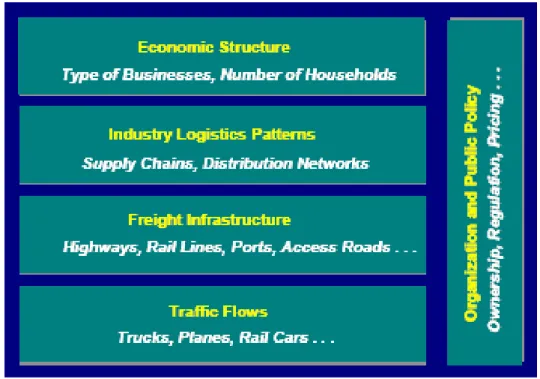
Figure 2.1 Freight Transportation System Data and Trends ...2-14 Figure 2.2 Truck Highway Volumes in Florida, AADTT...2-20 Figure 5.1 Delay Reduction from Truck Lane Alternatives...5-6