Analysis of Asynchronous Online Discussion Forums for
Collaborative Learning
Jemal Abawajy
School of Information Technology
Deakin University, Melbourne, Australia
[email protected]
Abstract
Online discussion forums are well suited for collaborative learning systems. Much of the currently available research indicates that effectively designed collaborative learning systems motivate and enhance learning experiences of the participants which in turn lead to enhanced learning outcomes. This paper develops taxonomy of the asynchronous online discussion forums with the aims of increasing the understanding and awareness of various types of asynchronous discussion forums. The taxonomy is framed by constructivist pedagogical principles of asynchronous online discussion forum. The key attributes of online discussions and the factors influencing the discussion forum’s design are identified. The taxonomy will help increase the online course designers’ ability to design more effective learning experiences for student success and satisfaction. It will also help researchers to understand the various features of the asynchronous discussion forums. The article concludes with implications for pedagogy and suggestions for the direction of future theoretical and empirical research.
Keywords: Asynchronous discussion forums, Taxonomy, On-line learning, Constructivist view.
1.
Introduction
Collaborative learning is based on the idea that learning is a naturally social act in which the learners discuss among themselves and learn from each other. Since the online discussion forums provide the opportunity for students to interact with instructors and each other, the online forums are well suited for collaborative learning. There has been a proliferation of asynchronous online discussion forums in tertiary education. Asynchronous online discussion forums have opened up the possibilities for learners to exchange ideas for the purpose of discussing a topic related to the objective of the course. This pedagogical method of the learning provides many possibilities. In addition to allowing the learners to have learning experiences beyond the physical classroom settings, asynchronous online discussion forums provide the learners with a new perspective, giving them more time to think formulate response to the topics. Through collaboration and social negotiation in an asynchronous online environment, individuals are able to construct knowledge and relate what they learn to their prior knowledge [6].
Discussion is usually considered a powerful tool for the development of pedagogical skills such as critical thinking, collaboration and reflection. Rourke and Anderson [34] argue that discussion is an excellent activity for supporting the construction of knowledge, since explaining, elaborating, and defending one’s position to others ‘‘forces learners to integrate and elaborate knowledge in ways that facilitate higher-order learning’’. As a result, online asynchronous discussion forums have become an integral part of teaching and learning in in
higher education. However, there are considerable challenges involved in designing discussion forum for learning and teaching arrangements that can support desired learning outcomes.
Simply establishing an asynchronous discussion forum, providing the technology, and a question or topic of discussion is not enough to ensure success in an asynchronous discussion [7]. Although the lecturers and learners are increasingly comfortable with the use of information technology for communication, they are still grappling with strategies to ensure their effective use and achievement of quality learning outcomes. Without appropriate asynchronous discussion forums, only lower levels of cognitive engagement will occur and the learners may end up feel a sense of isolation.
This paper reviews the exiting literature and develops taxonomy of the asynchronous discussion forums with the aims of increasing the understanding and awareness of various types of asynchronous discussion forums. A variety of criteria will be used for differentiating online discussion forums. The core basis for this research study was that understanding the various classes of online discussion forums is a key to create an online learning environment that will achieve high levels of learning. The taxonomy will help increase the online course designers’ ability to design more effective learning experiences for student success and satisfaction. It will also help researchers to understand the features of the various asynchronous discussion forums as well associated strengths and shortcomings.
2.
Literature Review
Social constructivism assumes that knowledge is actively constructed by the learner [33]. Gilbert and Dabbagh [35] claim that ‘‘an important instructional benefit of asynchronous discussion is its potential to support the construction of knowledge’. The use of discussion as a teaching strategy is one way of developing knowledge in a collective environment [40]. Asynchronous online discussion forums have changed the way students have traditionally engaged with course content, with teachers and other students. In asynchronous online discussion based learning environments, students can work together, achieve shared understanding, and collaboratively solve problems [36].
Students can participate in the asynchronous online discussion any time and from any place, giving them more time to think about the issues and/or problems before responding to them [8]. Moreover, they allow learners to express their thoughts and ideas with more freedom and ease as well as increasing their own reflection and interactions with others [8]. By collaboration and social negotiation in an asynchronous online forum, the learners will be able to create knowledge and connect of what they learn to their prior knowledge [6]. Social knowledge construction is thus seen as a collaborative process where meaning is negotiated from multiple perspectives [54].
There is a growing body of literature that discusses the effectiveness of online discussion forums. For example, Webb et al. [19] finds that as participation in the asynchronous discussion forums increases so does the measured grades for the learners. One of the main advantages of asynchronous discussion forums is that there is a record of nearly everything that occurs in that environment. All materials can be electronically archived and accessible to students at any time and from anywhere. However, simply establishing an asynchronous discussion forum does not necessarily bring about effective interaction or collaborative learning. Therefore, if one is truly concerned about the generation of knowledge in learners, developing a successful asynchronous discussion forum is probably the most important aspect for an instructor to consider [31]. Although there are various types of asynchronous discussion forums, creating a successful asynchronous discussion is probably the most important aspect for an instructor to consider [1]. In order to create appropriate and relevant
online discussion forums, the various types of asynchronous discussion forums must be specifically analysed with the aim to select the discussion forum that is effective and appropriate to the objectives of the course in question.
3.
Features of Online Discussion Forums
The ultimate goal of developing an asynchronous discussion forum is to create an online learning environment that will achieve high levels of learning. In the following subsections, we present some of the main features that can influence and differentiate different types of the online discussion forums.
A. Degree of Interaction
The importance of interaction to student learning has long been recognized [48]. In fact, it is suggested that the success or failure of asynchronous online discussions has to do with the quality of the predominantly student-student interactions and the depth of learning that occurs within the discussions [45]. Interaction could mostly be between learners as well as learner-to-instructor. The instructor should establish expectations regarding interaction, such as response time and frequency of participation; model effective interaction by being responsive but should generally get out of the way and let the students do the work [49]. Also, interaction can be encouraged by assessing discussion forums [50]. The instructor should also establish expectations regarding interaction, such as response time and frequency of participation [49].
B. Participation Requirements
Participation in online discussion forums provides the learners opportunities for active learning through reading others comments, post their own questions, provide feedbacks to others posting, and provide answers. The extent of participation by both the students and the lecturer depends on the aim of the discussion forum. Generally, student participation in the discussion forum could be compulsory or non-compulsory. In the former case, participation is generally assessed while in the latter case it is not.
C. Volume and Frequency of Posts
Asynchronous discussions provide for student reflection time and allow students to share their own perspectives and analyse others’ views. The quantity of messages generated in the discussion is very important factor in making discussion forum attractive and manageable. As the message numbers increases, it can get difficult to manage effectively in order to assist student learning. It can also lead to problems in identifying relevant content, digest and provide feedback. This can present the learner with the difficult task of sorting through often irrelevant and disorderly postings [44].
D. Discussion Activity
Discussion topic or activity factor is related to the design of the online discussion activity itself, such as whether student contribution is a mandatory requirement, the awarding of grades for contribution, as well as the discussion topics, such as whether the topics are interesting and relevant. Asynchronous online discussions can be structured with defined topics and procedures or unstructured allowing students to make free expressions of issues and ideas. Learning can be instructor-led learning, blended learning or student-led learning. It may be open, self-directed and unstructured. Alternately, it could be a single topic decided by the lecturer and semi-structure or highly structured.
E. Feedback
The common characteristics of all discussion forums are that the participants post messages to a permanent location where they are preserved for others to read and comment at their convenience. Instructor posting in the form of feedback is found to be important in motivating students to contribute to the discussion [46]. In particular, timely and substantive instructor feedback achieved greater student contribution [47]. Conversely, delayed corrective feedback, infrequent feedback, non-existent feedback, irrelevant or negative feedback can render an online discussion useless [39]. This can also impede effective learning. Moreover, students may cease contributing if they receive no immediate response or comments from other participants.
4.
Taxonomy of Online Discussion Forums
Based on the above characteristics, the online discussion forums can be generally classified into three predominant models, namely auxiliary forum, hybrid forum and embedded forum.
A. Auxiliary Discussion Forum
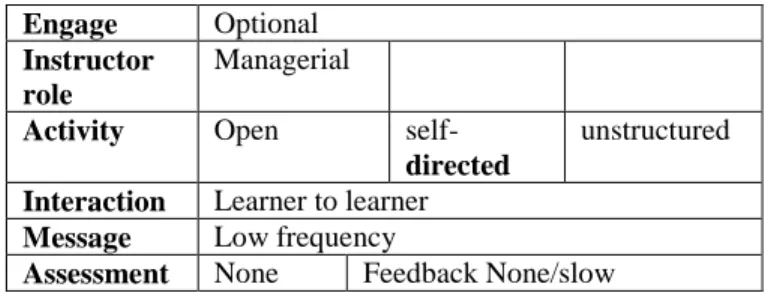
The simplest model is what we call auxiliary discussion forum in which asynchronous discussion forum is provided to the students as supplement to the traditional face-to-face delivery model. The model is based on recognition that knowledge is an individual construct that is developed through interaction with other group members. Self-directed and open discussions with peers about content facilitate not only knowledge construction but also awareness due to multiple perspectives. Thus, the model is mainly focused on the learner-to-learner interaction for the students to support one another.
Students will engage in the learning out of their own interest. The students have the freedom to choose to contribute to the online discussion and if they do, the students clarify their own understanding of key concepts, and further develop their communication skills by answering each other’s questions.
Rather than seeking to take on the role of a disseminator of knowledge, the instructors sparingly respond to the student queries so that they tend not to be scholastic, but supportive. Students can feed off each other's knowledge and limited social presence of the instructors. Research revealed certain limitations toward the content and behaviour of students’ discussion without teachers’ guidance. The instructor needs to intervene only in order to keep the discussion on track and to motivate the discussion, guide, moderate, scaffold and support the learners as they transition from prior knowledge and understanding towards construction of new learning.
Table 1. Auxiliary Discussion Forum Characteristics
Engage Optional
Instructor role
Managerial
Activity Open
self-directed
unstructured
Interaction Learner to learner
Message Low frequency
Assessment None Feedback None/slow
This type of asynchronous discussion forum is characterised by different levels of participation. The main issue with this type of the forum is that, without explicit requirements
for participation, students may elect not to engage in the discussion for various reasons such as time management, passivity, interest, and disregard. Since participation is not compulsory, a small vocal group may naturally emerge as discussion leaders and consistently contribute. A second small group may be moderately active, while the remaining students will participate less frequently. One way to ameliorate this situation is for the instructors to encourage discussion by responding to posts in a timely manner to show that student comments are being read while at the same time making sure that the comments don't inhibit further student responses. In addition, unlike in face-to-face discussion where learners can have responses to their queries impromptu, the learners may have to wait for responses on some ideas that they wished to clarify urgently. The feedback or response may not come either. This may lead to the participant frustration and subsequently discourage participation. While online discussion can facilitate deep learning that it does not happen spontaneously, and may require careful instructor mediation and support in order to develop [41].
B. Hybrid Discussion Forum
The hybrid discussion forum is the most widely used online discussion forum. For example, Bassett [12] explored postgraduate business students' perceptions of the value of hybrid asynchronous online discussion forum. Similarly, Naranjo et. al. [15] analysed the relationships between participation in an online discussion forum and the cognitive quality of the contributions made.
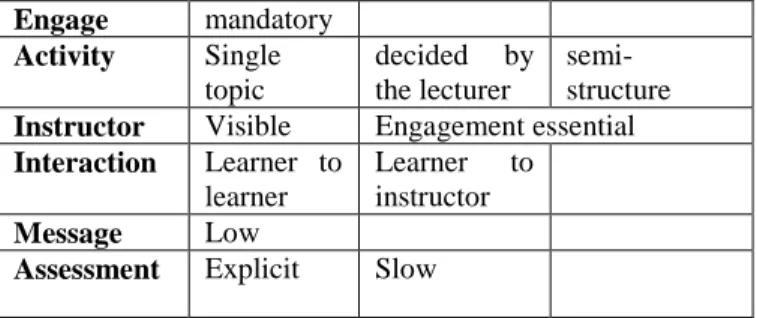
In the hybrid model, online discussion forum is considered as a major component of the face-to-face classroom learning. The discussion forum is designed to enhance the learning experience of students by providing an opportunity to work in groups to collaborate on assessable tasks such as term projects. Each group may have a student facilitator who would be in charge of leading the discussion. Empirical research indicates that the structure of groups has an impact on the quality of the online discussions in terms of the relative responsiveness of individuals. When discussion groups are relatively small (6-8 people), high-quality sharing are more common [2] whereas larger groups are likely to cause student frustration and a feeling of discussion ‘overload’ [11].
Table 2. Hybrid Discussion Forum Characteristics
Engage mandatory Activity Single topic decided by the lecturer semi-structure
Instructor Visible Engagement essential
Interaction Learner to
learner
Learner to instructor
Message Low
Assessment Explicit Slow
Lecturers act as facilitator and provide explicit assessment activities for student engagements. Discussion activity is often based on a single topic developed by the lecturer. Requirements for participation such as length or quantity of posts, expectations for content (e.g., relevance and quality), are also provided by the lecturers. Moreover, each topic will have a specific deadline and students must contribute before the deadline expires. In a sense, the learners will not necessarily engage in the discussion forum out of their own interest. The forum may generate large amounts of text which can make grading for participation extremely time consuming. Also, the quality and quantity of student discussion may vary widely. Moreover, when discussion topics were specific and related to a concept or idea
within the course readings, the discussions were more successful in generating complex interaction between learners than those discussions that were begun with open-ended and broad questions [5]. In addition, class attendance may be affected as most of the course materials are provided online. Another concern is that some students may be less enthusiastic in mandatory participation, as they may find that the online engagement to an unnecessary burden given they attend lectures, have active discussions in class and can talk to the lecturer [2].
C. Embedded Discussion Forum
The embedded model is fast becoming the dominant online discussion forum. This is because, in the embedded model, the course is wholly online and learners rely solely on online communication methods to interact with their lecturers as well as the classmates. In ‘wholly online’ delivery mode, all teaching is occurred online and it requires students to be actively involved with and take more responsibility for their own learning. Also, all communication and interactions between instructors and students are integrated and delivered online. Many people have investigated the relationships between the online participation level and academic performance of students in course that was taught wholly online [4].
Collaborative learning is created through the discussion forum, where students engaged in open dialogue with the instructor and each other about the topical questions. Within the wholly-online course, the asynchronous discussion forum replaces the face-to-face interaction of the traditional classroom [1]. The loss of face-to-face contact renders the relationship between the instructor and the learner to be changed. Similarly, instructors needed to find new ways to express emotion, or passion for the subject matter, when communicating ideas to the learners. Picciano [21] found that students perceived greater quality and quantity of learning as a result of participating in the online discussions.
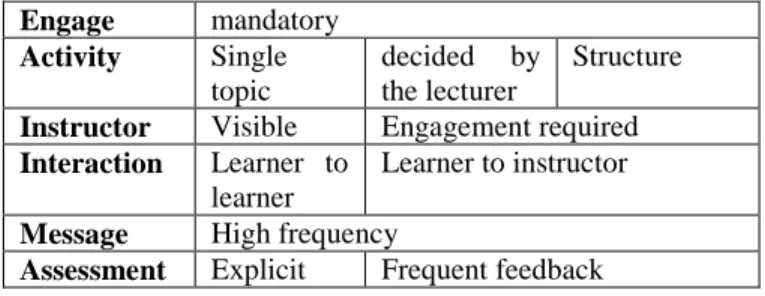
Table 3. Embedded Discussion Forum Characteristics
Engage mandatory Activity Single topic decided by the lecturer Structure
Instructor Visible Engagement required
Interaction Learner to
learner
Learner to instructor
Message High frequency
Assessment Explicit Frequent feedback
As in the hybrid model, the instructor posts threaded discussion topics and each topic will have a specific deadline and students must contribute before the deadline expires. The threaded discussions represent class participation, which usually is evaluated based upon the quality and quantity of each student’s postings. The forum requires explicit and clear articulation of guidelines in order to promote participation and quality postings for online discussions. A wide range of weighting for participation is used in the literature. Usually, a ten percent was chosen for discussion participation. Gilbert and Dabbagh [6] developed a rubric that awarded a point value to excellent, good, average and poor postings. Chang [3] developed a five-point grading scale to examine the quality of online discussions. The evaluation form focused on four aspects: depth, appropriateness, correctness, completeness, and usefulness.
The instructors must be aware that the number of possible responses to a particular topic depends on the nature of the question and the number of the learners enrolled in the course. Thus, required regular discussions with a large class can result in long conversations, perhaps
too long to maintain interest or focus. Also, usually, students have other commitments and may be very busy with other course modules. Thus, instructors must take into account the limited amount of time the learners have in using the asynchronous online discussion in order to minimize student discouragement from fully participating in the discussion. Similar to the hybrid model, student participation in the online discussion was made ‘mandatory’ in the sense that marks were assigned to participation.
Another possible problem is that students may feel like "everything has already been said" by the time it's their turn to post. This could possibly be handled by ensuring that when students enter the forum, they cannot see any other posts until they make a new post of their own. This way everyone is forced to post an original thought, even if it has already been generated in the discussion.
5.
Discussion
The online discussion forum can be used in a range of ways, from being primarily for optional student-to-student communication only, through to being a formally assessable element of the unit. The realization that an educationally-viable environment requires students to interact with content and with each other has led to the widespread use of asynchronous online discussion forums. In this paper, we discussed the opportunities, the constraints and the values of asynchronous online discussion forums. We also developed taxonomy of the online discussion forums. The learning experience has been shown to be enhanced through the regular participation in discussions regardless of where (i.e., in a classroom or through online forums) these discussions take place. Specifically, the amounts of time students spend reading postings on the forum and engaged in virtual conversation with their classmates have positive influences on their achievement of course objectives [22]. However, compared to face-to-face discussion, the asynchronous discussion forum affords time to participate and contribute to a discussion. Moreover, a transcript of the discussion is archived and accessible at anytime and from anywhere. Regardless of how the discussion forum is used in a course, it is important that it be actively managed. This includes ensuring that initial information that explains the purpose of the forum is made available to the students. Also, the role of the instructors and the extent to which the instructors will be contributing to the discussion must be made available to the learners. All is said, it is important to ensure that the content of the discussion to be regularly monitored to ensure that it is not being inappropriately used by students.
Regardless of the type of the asynchronous discussion forum types, they all provide the participants an alternative way to interact with one another. Within the wholly-online course, the asynchronous discussion forum replaces the face-to-face interaction of the traditional classroom. Both quality and quantity of interaction with the instructor and peers are much more crucial to the success of online courses and student satisfaction than to success and satisfaction in traditional courses and successful students in the online course were generally active participants in discussion forum. The design of online discussion activities imposes great influence on the quality of online discussion, message quantity and others [17]. Equally important in the design of the asynchronous discussion forums is the role of the instructors.
Regardless of the type of the asynchronous discussion forum types, the role of the instructor greatly differs from the conventional classroom. The instructor is required to constantly moderate discussions, provide netiquette guidelines, provide timely feedback, ensure appropriate usage behaviour and deal appropriately with unacceptable behaviour. A lecturer must at least monitor discussion forms in order to answer questions and correct misunderstandings in a timely manner [50].
Generally, there are learners who actively engage in the discussion forum. Passive learners restrict their activities to reading the messages and rarely, if at all, contribute to the discussion.
Although full participation in the online discussion can facilitate deep learning, some learners may be reluctant to fully participate. Even if this happens, it is possible for some learning to informally and silently achieve [43]. Participation can be encouraged by assessing discussion forums. When assessment is part of the discussion, it is important to be sensitive to the impact of the unique context of each learner, including cognitive structure and understandings differences on discussion forum participation [50]. Also, email should be used to personalise individual communication [52], including to address poor participation [53].
When participation is assessed, the quantity of the messages is higher than the case when participation is optional. Even when the participation is mandatory, some will only contribute to meet the minimum requirements. Conversely, in the absence of assessment, very few posts and follow-ups are contributed to the discussion resulting in minimal interaction. Many students will not post any messages during the entire semester but do check and read the postings of other students. Also, when the participation is not assessed, it can result in very few follow-ups and therefore minimal interaction. One way to assess the quality of interactions and the quality of the learning experiences is through the analysis of asynchronous discussion transcripts [51]. Posts can be generally classified as basic or substantive. Basic messages show little or no thought whereas substantive messages indicate at least some level of thought, reflection, research or engagement in debate.
Although course designers and educators recognise the value of online discussions, keeping the discussion threads lively and informative is a challenge. In the embedded model, the quantity of the message can overwhelm the learners to navigate through [8]. Also, the use of ‘threaded’ discussions increases the amount of time students spend on course objectives and on reflection [14]. Proponents of threaded discussions view it as an integral part of the learning process, where students seek knowledge and express understanding. Consequently, they deem it essential to assess participation.
Timely feedback that would allow participants to improve their contributions through their study is crucial. There is an ongoing debate about the value and utility of grading discussions to ensure and assess full participation in the online classroom. Palmer, et. al., [16] recommend an approach that include both quantitative (i.e., number of postings, length of posting, number of messages read, etc.) and qualitative terms (i.e., does the posting exhibit cognitive/social/teaching presence). Their implementation indicates that assessing online discussions positively impacted students’ participation and final grades. Similarly, Levenburg and Major [22] suggest that assessing participation recognises students’ workload and time commitment with respect to online discussions and encourages students to participate in required learning activities associated with the discussions. However, as noted in Houghton [23], some students’ tend to “structure their learning activities to optimise their assessment performance. This means, some learners will not participate while others, once they had, may not follow up their arguments because they felt they had already posted enough to get their marks.
Although both the embedded and hybrid model are becoming pervasive, establishing effective opportunities for peer learning in online environments requires care in creating groups, structuring learning activities, and facilitating group interactions. The question initiating each of the online discussions influenced the level of the responses from students. Unless care is taken, the lecturer-led selection of the topic for discussion may restrict innovative discussion and fewer interactions of discussion behaviours may occur. One way to address this problem for the lecturers is to draft only the scope of topics for students’ questions and allowed the students to raise questions and perform problem-solving discussions themselves [10]. Moreover, successful discussion topics must be related to the
learning objectives with clarity in due dates, expectations, and the weighting of grades so that learning objectives may become learning outcomes [7, 13].
With proper design, the auxiliary discussion forum can furnish the learners with more conducive and productive way of learning. This is because student will engage in the learning out of their own interest without feeling threatened. Apart from cursory involvements of the lecturer, the learners have total freedom to discuss what they want. However, in general, learners may experience bottlenecks, such as insufficient information or inadequate deduction. When this occurs, lecturer participation will be needed. In fact, Swan and Shih [18] find that the perceived presence of an instructor is more important than the perceived presence of peers in student satisfaction. Therefore, unless proper balance is made, the instructor can decrease learner – learner interaction because the learners begin to rely on the instructor to answer questions [7].
6.
conclusions
Discussion is usually considered a powerful tool for the development of pedagogical skills such as critical thinking, collaboration and reflection. Due to its perceived benefits, asynchronous discussion forums have become progressively popular in tertiary education. The asynchronous online discussion forum offer many pedagogical advantages such as encouraging reflection, analysis and high order thinking. It is one of the effective tools for realizing collaborative learning activities that can enrich student’s learning experience in many ways. A well-designed online discussion forum can encourage students’ activity, motivation, and other social-constructivist attributes of their learning. In this paper, the key attributes of online discussions and the factors influencing the discussion forum’s design are identified. Taxonomy of the asynchronous online discussion forums based on constructivist pedagogical principles is presented. We believe that the taxonomy will help increase the online course designers’ ability to design more effective learning experiences for student success and satisfaction. It will also help researchers to understand the various features of the asynchronous discussion forums. The article concludes with implications for pedagogy and suggestions for the direction of future theoretical and empirical research.
Acknowledgments
This paper will not have been possible without the help of Maliha Omar.
References
[1] M. A. Andresen, “Asynchronous discussion forums: success factors, outcomes, assessments, and limitations”, Educational Technology & Society, vol. 12, no. 1, (2009), pp. 249–257.
[2] E. A. Beckmann and P. Kilby, “On-line, Off-campus but in the Flow: Learning from Peers in Development Studies”, Journal of Peer Learning, vol. 1, no. 1, (2008) pp. 61-69.
[3] C. Chang, “A case study on the relationships between participation in online discussion and achievement of project work”, Journal of Educational Multimedia and Hypermedia, vol. 17, no. 4, (2008), pp. 477-509. [4] J. Coldwell, A. Craig, T. Paterson and J. Mustard, “Online Students: Relationships between Participation,
Demographics and Academic Performance”, The Electronic Journal of e-Learning, vol. 6, Issue 1, (2008), pp. 19 - 30.
[5] Y. H. Fung, “Collaborative online learning: Interaction patterns and limiting factors”, Open Learning, vol. 19, no. 2, (2004), pp. 136–149.
[6] P. K. Gilbert and N. Dabbagh, “How to structure online discussions for meaningful discourse: A case study”, British Journal of Educational Technology, vol. 36, no. 1, (2005), pp. 5-18.
[7] K. Guldberg and R. M. Pilkington, “Tutor roles in facilitating reflection on practice through online discussion”, Educational Technology & Society, vol. 10, no. 1, (2007), pp. 61 – 72.
[8] K. F. Hew and W. S. Cheung, “An exploratory study on the use of asynchronous online discussion in hypermedia design”, Journal of Instructional Science& Technology, vol. 6, no. 1, (2003).
[9] D. Holley, "Which room is the virtual seminar in please?", Education and Training, vol. 44, Issue 3, (2002), pp. 112-121.
[10]H. -T. Hou, K. -E. Chang and Y. -T. Sung, “Analysis of problem-solving-based online asynchronous discussion pattern”, Educational Technology & Society, vol. 11, no. 1, (2008), pp. 17-28.
[11]L. Kimball, “Managing distance learning: new challenges for faculty”, In R. Hazemi, S. Hailes and S. Wilbur (Eds.). The digital university: building a learning community, London: Springer, (2001), pp. 27-40.
[12]P. Bassett, “How Do Students View Asynchronous Online Discussions As A Learning Experience?”, Interdisciplinary Journal of E-Learning and Learning Objects, vol. 7, (2011).
[13]R. Majeski and M. Stover, “Theoretically based pedagogical strategies leading to deep learning in asynchronous online gerontology courses”, Educational Gerontology, vol. 33, no. 3, (2007), pp. 171 – 185. [14]K. A. Meyer, “Face-to-face versus threaded discussions: the role of time and higher-order thinking”, Journal
of Asynchronous Learning Networks, vol. 7, no. 3, (2003), pp. 55-65.
[15]M. Naranjo, J. Onrubia and M. Teresa, “Participation and cognitive quality profiles in an online discussion forum”, British Journal of Educational Technology, (2011).
[16]S. Palmer, D. Holt and S. Bray, “Does the discussion help? the impact of a formally assessed online discussion on final student results”, British Journal of Educational Technology, vol. 39, no. 5, (2008), pp. 847–858.
[17]K. G. Patricia and N. Dabbagh, “How to structure online discussions for meaningful discourse: a case study”, British Journal of Educational Technology, vol. 36, no. 1, (2005), pp. 5-18.
[18]K. Swan and L. F. Shih, “On the nature and development of social presence in online course discussions”, Journal of Asynchronous Learning Networks, vol. 9, no. 3, (2005), pp. 115-136.
[19]E. Webb, A. Jones, P. Barker and P. van Schaik, “Using e-learning dialogues in higher education”, Innovations in Education and Teaching International, vol. 41, no. 1, (2004), pp. 93-103.
[20]E. Wood, “A dilemma beyond discussion – increasing student interaction in external study modes”, In A. Bunker & G. Swan (Eds.). Focussing on the student. Mount Lawley, Western Australia: Edith Cowan University, (2002), pp. 153-157.
[21]A. G. Picciano, “Beyond student perceptions: Issues of interaction, presence, and performance in an online course”, Journal of Asynchronous Learning Networks, vol. 6, no. 1, (2002), pp. 21-40.
[22]N. Levenburg and H. Major, “Motivating the online learner: The effect of frequency of online postings and time spent online on achievement of learning goals and objectives”, (2000).
[23]W. Houghton, “Constructive Alignment—why it is important to the learning process”, Engineering Subject Centre Guide: Learning and Teaching Theory for Engineering Academics, (2004).
[24]K. B. Lee and R. Salman, “The Design and Development of Mobile Collaborative Learning Application Using Android”, Journal of Information Technology and Application in Education, vol. 1, no. 1, (2012), pp. 1-8.
[25]J. Abawajy and T.-h. Kim, “Online Learning Environment: Taxonomy of Asynchronous Online Discussion Forums”, In: T.-h. Kim, et. al., (Eds.): Software Engineering, Business Continuity, and Education, CCIS 257. Berlin Heidelberg: Springer-Verlag, (2011), pp. 706–714.
[26]G. Gill, “Asynchronous Discussion Groups: A Use-based Taxonomy with Examples”, in Journal of Information Systems Education, (2006).
[27]K. Holmes, “Analysis of Asynchronous Online Discussion Using the SOLO Taxonomy”, Australian Journal of Educational Developmental Psychology, (2005).
[28]D. S. Knowlton, “A taxonomy of learning through asynchronous discussion”, Journal Of Interactive Learning Research, vol. 16, Issue 2, (2005), pp. 155-177.
[29]J. McDonald, “Is “As Good As Face to Face” as Good as it Gets?”, Journal of Asynchronous Learning Networks, vol. 6, no. 2, (2002), pp. 10-23.
[30]J. Whittle, M. Morgan and J. Maltby, “Higher Learning Online: Using Constructivist Principles to Design Effective Asynchronous Discussion”, Paper presented at the North American Web Conference, Canada, (2000).
[31]M. A. Andresen, “Asynchronous discussion forums: success factors, outcomes, assessments, and limitations”, Educational Technology & Society, vol. 12, no. 1, (2009), pp. 249–257.
[32]P. A. Kirschner, “Using integrated electronic environments for collaborative teaching/learning”, Research Dialogue in Learning and Instruction, vol. 2, (2001), pp. 1e9.
[33]T. M. Duffy and D. J. Cunningham, “Constructivism: implications for the design and delivery of instruction”, In D. H. Jonassen (Ed.), Handbook of research for educational communications and technology. London: Prentice Hall International, (1996), pp. 170e198.
[34]L. Rourke and T. Anderson, “Using peer teams to lead online discussions”, Journal of Interactive Media in Education, vol. 1, (2002), pp. 1e21.
[35]P. K. Gilbert and N. Dabbagh, “How to structure online discussions for meaningful discourse: a case study”, British Journal of Educational Technology, vol. 36, (2005), pp. 5e18.
[36]D. Cecez-Kecmanovic and C. Webb, “Towards a communicative model of collaborative web-mediated learning”, Australian Journal of Educational Technology, vol. 16, (2000), pp. 73e85.
[37]A. Weinberger, M. Reiserer, B. Ertl, F. Fischer and H. Mandl, “Facilitating collaborative knowledge construction in computer-mediated learning environments with cooperation scripts”, In R. Bromme, F. W. Hesse, & H. Spada (Eds.), Barriers and biases in computer-mediated knowledge communication, (2005), pp. 15e38, Boston: Kluwer.
[38]P. Dillenbourg, “Over-scripting CSCL: the risks of blending collaborative learning with instructional design”, In P. A. Kirschner (Ed.), Three worlds of CSCL: Can we support CSCL, (2002), pp. 61e91. Heerlen, The Netherlands: Open Universiteit Nederland.
[39]J. Whittle, M. Morgan and J. Maltby, “Higher Learning Online: Using Constructivist Principles to Design Effective Asynchronous Discussion”, Paper presented at the North American Web Conference, Canada, (2000).
[40]R. Killen, “Effective Teaching Strategies: Lessons from Research and Practice”, 3rd Ed. Social Science Press, Australia, (2003).
[41]F. Slack, M. Beer, G. Armitt and S. Green, “Assessment and Learning Outcomes: The Evaluation of Deep Learning in an On-line course”, Journal of Information Technology Education, vol. 2, (2003).
[42]K. Meyer, “Evaluating Online Discussions: Four Different Frames of Analysis”, Journal of Asynchronous Learning Networks, vol. 8, no. 2, (2004).
[43]S. Gulati, “Constructivism and Emerging Online Pedagogy: A discussion for formal to acknowledge and promote the informal”, Paper presented at the Universities Association for Continuing Education conference, London, (2004) April.
[44]S. Schwan, D. Straub and F. Hess, “Information Management and Learning in Computer Conferences: Coping with Irrelevant and Unconnected Messages”, Instructional Science, vol. 30, (2002), pp. 269-289. [45]M. Mazzolini and S. Maddison, “Sage, guide or ghost? The effect of instructor intervention on student
participation in online discussion forums”, Computers and Education, vol. 40, (2003), pp. 237-253.
[46]I. Jung, S. Choi, C. Lim and J. Leem, “Effects of different types of interaction on learning achievement, satisfaction and participation in Web-based instruction”, Innovations in Education and Teaching International, vol. 39, no. 2, (2002), pp. 153-162.
[47]V. P. Dennen, “From message posting to learning dialogues: Factors affecting learner participation in asynchronous discussion”, Distance Education, vol. 26, no. 1, (2005), pp. 127-148.
[48]T. Barnett-Queen, R. Blair and M. Merrick, “Student perspectives on online discussions: Strengths and weaknesses”, Journal of Technology in Human Services, vol. 23, no. 3/4, (2005), pp. 229-244.
[49]R. Heckman and H. Annabi, “Cultivating voluntary online learning communities in blended environments”, Journal of Asynchronous Learning Networks, vol. 10, no. 4, (2006), pp. 51-66.
[50]T. Anderson and F. Elloumi, (Eds.), “Theory and practice of online learning”, Athabasca, Canada: Athabasca University, (2004).
[51]C. N. Gunawardena and R. Zittle, “An examination of teaching and learning processes in distance education and implications for designing instruction”, In M. Beaudoin (Ed.), Distance education symposium 3: Instruction, ACSDE Research Monograph, no. 12, (1996), pp. 51-63.
[52]E. Hassini, “Student–instructor communication: The role of email”, Computers & education, vol. 47, no. 1, (2006), pp. 29-40.
[53]Z. L. Berge, “The role of the online instructor/facilitator”, Educational Technology, vol. 35, no. 1, (1995), pp. 22-30.
[54]M. D. Merrill, “Constructivism and Instructional Design”, In Duffy, T.M. & Jonassen, D.H. (Eds.), Constructivism and the Technology of Instruction: A Conversation, Hillsdale: Lawrence Erlbaum, (1992), pp. 99-114.
[55]J. Abawajy and T. -h. Kim, “Engaging and effective asynchronous online discussion forums”, (2011), pp. 695-705, Springer-Verlag, Berlin, Germany.