Ensemble Feature Learning-Based Event Classification for
Cyber-Physical Security of the Smart Grid
Chengming Hu
A Thesis in
Concordia Institute for Information Systems Engineering
Presented in Partial Fulfillment of the Requirements for the Degree of
Master of Applied Science (Quality System Engineering) at Concordia University
Montr´eal, Qu´ebec, Canada
September 2019
c
C
ONCORDIAU
NIVERSITY School of Graduate StudiesThis is to certify that the thesis prepared
By: Chengming Hu
Entitled: Ensemble Feature Learning-Based Event Classification for Cyber-Physical Security of the Smart Grid
and submitted in partial fulfillment of the requirements for the degree of Master of Applied Science (Quality System Engineering)
complies with the regulations of this University and meets the accepted standards with respect to originality and quality.
Signed by the Final Examining Committee:
Chair Dr. Fereshteh Mafakheri External Examiner Dr. Chunyan Lai Examiner Dr. Amr Youssef Supervisor Dr. Chun Wang Co-supervisor Dr. Jun Yan Approved by
Abdessamad Ben Hamza, Director
Department of Concordia Institute for Information Systems Engi-neering
August 2019
Amir Asif, Dean
Abstract
Ensemble Feature Learning-Based Event Classification for Cyber-Physical Security of the Smart Grid
Chengming Hu
The power grids are transforming into the cyber-physical smart grid with increasing two-way communications and abundant data flows. Despite the efficiency and reliability promised by this transformation, the growing threats and incidences of cyber attacks targeting the physical power systems have exposed severe vulnerabilities. To tackle such vulnerabilities, intrusion detection systems (IDS) are proposed to monitor threats for the cyber-physical security of electrical power and energy systems in the smart grid with increasing machine-to-machine communication. However, the multi-sourced, correlated, and often noise-contained data, which record various concurring cyber and physical events, are posing significant challenges to the accurate distinction by IDS among events of inadvertent and malignant natures. Hence, in this research, an ensemble learning-based feature learning and classification for cyber-physical smart grid are designed and implemented. The contribution of this research are(i)the design, implementation and evaluation of an ensemble learning-based attack classifier using extreme gradient boosting (XGBoost) to effectively detect and identify attack threats from the heterogeneous cyber-physical information in the smart grid;(ii)the design, implementation and evaluation of stacked denoising autoencoder (SDAE) to extract highly-representative feature space that allow reconstruction of a noise-free input from noise-corrupted perturbations; (iii)the design, implementation and evaluation of a novel ensemble learning-based feature extractors that combine multiple autoencoder (AE) feature extractors and random forest base classifiers, so as to enable accurate reconstruction of each feature and reliable classification against malicious events. The simulation results validate the usefulness of ensemble learning approach in detecting malicious events in the cyber-physical smart grid.
Acknowledgments
I express my gratitude to all those that have contributed towards my thesis and to those who have supported my progression towards its completion.
I am grateful to my supervisors, Dr. Jun Yan and Dr. Chun Wang from Concordia Institute for Information Systems Engineering, for the time and commitment they have invested in my re-search. Their vast experience and insight within the domain of my research has truly expanded my understanding and appreciation of the field, both from a theoretical and practical perspective. I also extend my gratitude to Dr. Fereshteh Mafakheri, Dr. Chunyan Lai, and Dr. Amr Youssef for being part of the examination committee for my thesis.
In addition, I would like to thank Concordia Institute for Information Systems Engineering for the wonderful hardware facilities as well as the courses that prepared me for this research. This work is also supported by the Natural Sciences and Engineering Research Council of Canada (NSERC) under grants RGPIN-2018-06724 and RGPIN-2016-06691, and by the Fonds de Recherche du Qu´ebec - Nature et Technologies (FRQNT) under grant 2019-NC-254971.
I would like to acknowledge all my teammates: Moshfeka Rahman, Luyang Hou and Yongyuan Zhang for all the hours of fun and hard working that we have shared. Finally, I am deeply grateful to my family for their immense support and company throughout my academic studies. My parents have shown me vast amounts of encouragements as I progressed through my studies. For this I am truly thankful, and I love you all dearly.
Contents
List of Figures viii
List of Tables ix
1 Introduction 1
1.1 Background . . . 1
1.1.1 Smart Grid . . . 1
1.1.2 Cyber-Physical Systems (CPS). . . 2
1.1.3 CPS in the Smart Grid and Security Challenges . . . 4
1.2 Problem Statement . . . 6
1.3 Structure of the Thesis . . . 8
2 Literature Review 10 2.1 Cyber-Physical Security in the Smart Grid . . . 10
2.1.1 Physical Security in the Smart Grid . . . 10
2.1.2 Cyber Security in the Smart Grid. . . 13
2.2 Intrusion Detection against Cyber-Physical Attacks in the Smart Grid . . . 16
2.2.1 Intrusion Detection Techniques . . . 16
2.2.2 Learning-Based Intrusion Detection . . . 18
3 Ensemble Learning-Based Classifiers against Smart Grid Attacks 19 3.1 Problem Statement . . . 19
3.2.1 Bagging . . . 22
3.2.2 Boosting . . . 23
3.2.3 Stacking . . . 23
3.3 Extreme Gradient Boosting (XGBoost). . . 25
3.3.1 Base Learner . . . 26
3.3.2 Objective Function . . . 26
3.3.3 Addictive Training . . . 27
3.3.4 Optimal Tree Structure Selection. . . 28
3.4 Cyber-Physical Attack Dataset in the Power System Benchmark . . . 28
3.5 Simulations and Results. . . 31
3.5.1 Experiment Setup and Data Preprocessing . . . 31
3.5.2 Simulation Results . . . 32
3.6 Discussions . . . 33
4 Robust Feature Extraction for Smart Grid Attack Classification 36 4.1 Problem Statement . . . 36
4.2 Robust Feature Learning . . . 37
4.2.1 Feature Selection . . . 38
4.2.2 Feature Extraction . . . 39
4.3 Deep Networks for Feature Extraction . . . 39
4.3.1 Autoencoder (AE) . . . 39
4.3.2 Stacked Denoising Autoencoder (SDAE) . . . 41
4.4 Simulation Results . . . 42
4.4.1 Experiment Setup. . . 42
4.4.2 Simulation Results . . . 44
4.5 Discussions . . . 45
5 Boosting Feature Extractors for Smart Grid Attack Classification 48 5.1 Problem Statement . . . 48
5.2.1 Adaptive Feature Boosting . . . 50
5.2.2 AE-Based Feature Extraction . . . 52
5.2.3 Ensemble Learning Classification . . . 53
5.3 Simulations and Results. . . 54
5.3.1 Experiment Setup. . . 54
5.3.2 Simulation Results . . . 55
5.4 Discussions . . . 56
6 Conclusion and Future Work 59 6.1 Conclusion . . . 59
6.2 Future Work . . . 61
List of Figures
Figure 1.1 The connection network of smart grid components [1]. . . 3
Figure 1.2 The cyber-physical architecture of a smart transmission grid [2]. . . 5
Figure 1.3 Overall structure of the thesis . . . 8
Figure 3.1 Architecture of ensemble learning algorithms. . . 21
Figure 3.2 The bagging algorithm. [3] . . . 22
Figure 3.3 The boosting algorithm. [4] . . . 24
Figure 3.4 The stacking algorithm. [5] . . . 25
Figure 3.5 The power system benchmark [6]. . . 30
Figure 3.6 Classification performance of the oversampled dataset. . . 33
Figure 3.7 Classification performance of the extended dataset. . . 34
Figure 4.1 The architecture of AE for feature extraction. . . 40
Figure 4.2 The overall architecture and training process of SDAE. . . 43
Figure 4.3 Classification accuracy without and with SDAE feature extraction. . . 46
Figure 4.4 Reconstruction errors of the stacked DAE layers in SDAE. . . 46
Figure 5.1 The overall boosting architecture of feature extractors and base classifiers. . 55
Figure 5.2 Selected feature information at each feature sampling . . . 57
List of Tables
Table 3.1 The Cyber-Physical Attack Dataset . . . 30
Table 3.2 Features of the Cyber-Physical Attack Dataset. . . 31
Table 3.3 Confusion Matrix of Testing Performances . . . 35
Table 4.1 Testing Performance Comparison (per Class and Overall). . . 45
Table 4.2 Comparison of Accuracy for Different SDAE Architectures . . . 47
Table 5.1 Sample Number of Non-oversampled and Oversampled dataset . . . 56
Table 5.2 Confusion Matrix of Testing Performances . . . 56
Chapter 1
Introduction
1.1
Background
1.1.1 Smart Grid
Since the creation of electricity over several centuries ago, the power grid has been evolved into one of the largest networks in the human history. The power grid, a massive interconnected physical network, is the infrastructure backbone for electric power generation, transmission and distribution to the customers. As the demand and variety of consumption increases, more new technologies have been integrated into the power grid, such as renewable energy generation, the electric vehicle (EV) charging system, smart meters, etc., which all may contribute to the communication complexity in the power grid. The ever increasing reliance on electricity and request of power quality have been constantly calling for better power delivery, more flexible pricing, faster power restoration, among others.
In response to the above challenges, smart grid is a new paradigm which aims to intelligently conduct and control the devices in the system for energy supply, delivery and use [1]. The essen-tial idea of smart grid is to integrate intelligent devices with the large-scale power network, for the purpose of enabling energy generation, transmission and distribution to be more effective, efficient, secure and economical [1]; however, the term smart grid has various definitions and meanings in
different countries. U.S. Department of Energy in 2014 [7] explained smart grid that is the transfor-mation of the electric industry from a centralized, producer-controlled network to one that is more consumer interactive. In Europe, Bambergeret al.[8] described that smart grid refers to broad so-ciety participation and integration of all European countries. In China 2009, Xiao [9] proposed that smart grid is a highly coordinated intelligent power grid with extreme high voltage, so as to achieve the more reliable, responsive and economical energy supply in an environmentally-sustainable man-ner.
Fig. 1.1 shows the connection of various components in the large-scale smart grid [1]. The power could be generated by conventional power plants and renewable energy, such as hydro power and wind power, among others. From the generation domain, the power is transmitted along the several substations and long-distance transmission lines, and is finally distributed to the industry and resident for different applications. In order to maintain the flexibility, portability, and security of such large-scale smart grid, there is great necessary to achieve the effective cooperation and in-teraction between power infrastructures and intelligent devices. To meet this call, cyber-physical systems (CPS) can implement the effective integration and communication between each compo-nents in smart grid. In the following sections, we will first introduce cyber-physical systems, and then describe the application in smart grid.
1.1.2 Cyber-Physical Systems (CPS)
CPS are the integration of communication and computation (cyber domain) with physical de-vices and processes (physical domain) [10]. Embedded computers and systems monitor and control the physical processes, usually with feedback loops where physical processes affect computations and vice versa [10]. Similar with the various definitions of smart grid, there are also some dif-ferent interpretations of CPS in difdif-ferent countries. The U.S. vision of CPS is more concentrated on connection between the embedded system and the physical world, while the European version highlights interaction with the cloud/cyberspace and human factors [11]. In China, CPS refer to a large-scale, embedded, hybrid complex system focusing on integration of sensing, processing, intelligence, and control as a whole [1]. As a multi-discipline research area, CPS has attracted ex-tensive interests and efforts from different research communities. For example, system science and
Figure 1.1: The connection network of smart grid components [1].
engineering focuses on temporal information to analysis system performance and synthesis [12], such as sensing and controlling. Computer science and engineering aims to implement real-time computation, visualization, embedded design, and model formulation by dealing with large-scale spatial information [12]. CPS bring different fields together to effectively tackle modern industrial problems which are related to high-dimensional and complex data flow and time-critical responses. As mentioned in the last subsection, smart grid consists of many components from generation to transmission and distribution, such as power plants, smart meters and control centers, etc. The increasing communication of such components poses the requirement to design smart grid from CPS perspective. Such cyber-physical smart grid involves several devices that can interact through complex, highly interconnected physical environments. In the following, we will discuss the devel-opment of cyber-physical smart grid.
1.1.3 CPS in the Smart Grid and Security Challenges
The recent efforts in grid modernization is leading towards a cyber-physical smart grid to im-prove the system reliability, flexibility and efficiency. Cyber-physical smart grid regards the power network infrastructure as physical system and integrate all sensing, processing and controlling as cyber system, and some significant characteristics can be found as follows [13].
• The information from the physical system, such as voltage measurement, are dynamically changing and reported in real-time to control centers in the cyber system. The control centers can analyze such information and perform the corresponding actions to control the perfor-mance of physical system in the future times;
• The real-time interactions and computation can be achieved between components in both physical and cyber system through a two-way communication network, which helps to deliver timely decisions for smart grid operations across generation, transmission, and distribution layers through the CPS;
• Cyber-physical smart grid can respond to faults, attacks, and emergencies in the self-adaption, self-organization and self-learning ways, to maintain the system resilience, safety and great efficiency.
With the incorporation of communication and computer networks to empower the traditional power delivery, the cyber-physical smart grid is already an emerging gigantic intelligent network system in which power flows are regulated by highly automatic systems like the Supervisory Con-trol and Data Acquisition (SCADA) system. SCADA is a conCon-trol system that gather and analyze real-time data to monitor and control equipment and processes [14]. The core of SCADA system is the supervisory computers in the control centers, which are responsible for analyzing collected information from sensors, and sending control commands to the actuators. Compared with a Wide Area Monitoring, Protection and Control (WAMPC) system [15,16], which mainly utilizes phasor data from phasor measurement units (PMU) to protect the transmission networks, SCADA system could collect data from different sources. For the transmission grid as shown in Fig.1.2, the modern-izing grid infrastructure encompasses a complex cyber-physical environment of intelligent sensors
Figure 1.2: The cyber-physical architecture of a smart transmission grid [2].
and controllers, wide-area networks, secured gateways, and high-performance servers to improve the flexibility, efficiency, and reliability of power transmission [2].
However, the cyber-physical smart grid yields not only a boost of economic benefits but also a growing number of potential vulnerabilities. For example, The Aurora attack is conducted to destroy the primary controller of automatic generation control (AGC), which can desynchronise the power generator and lead to a short-term power outage even a long-term generation deficiency [17,18]. Meanwhile, the transmission network is becoming more vulnerable to interception or unauthorized modification, which can be utilized to either cheat the meters for an unfair price or disrupt power system operations. Besides, the knowledge of the cyber-physical smart grid can be learned by the attackers, and attackers have the ability to conduct some illegal operations in the system, such as false data injection attack, etc. Hence, it becomes crucial to realize and react to the potential attacks in the cyber-physical smart grids.
In the cyber-physical smart grid, the intrusion detection systems (IDS) are main security tools to monitor and report various types of attacks. There are several basic types of detection, includ-ing the signature-based IDS, the anomaly-based IDS and the hybrid-based IDS [19], which mainly
leverage knowledge of known attacks and rule-based technique to detect any suspicious and un-known attacks. However, considering the multi-sourced, correlated and heterogeneous data in the fast-expanding, interwoven cyber-physical smart grids, such data stream are posing challenges to an effective attack distinction in the traditional IDS, since the analysis process is complex and time-consuming. Such inefficient attack detection can lead to false negatives or positives in the IDS, resulting in possibly severe impacts from undetected false commands and data, misled tripping or dispatch, equipment damage or attrition, among others. Besides, the practical system topology and behaviors can be dynamically changing in real time while the existing IDS approaches have several limitations in fully protecting the cyber-physical smart grid from increasingly sophisticated attacks like Stuxnet [20]. For instance, in 2013 Iran, Stuxnet worm impaired the nuclear-enrich capacity by compromising Siemens programmable logic controllers for nuclear centrifuges and exploiting zero-day vulnerabilities [20]. Specifically, Stuxnet could obtain control of the centrifuges and provide false feedback to the controllers, which ensured that Stuxnet continuously led the centrifuges to spin themselves to failure until the controllers observed such Stuxnet worm. Hence, the severity of such challenges is calling for machine learning algorithms to improve detection rates and efficiency in the cyber-physical smart grid. Some advanced event detectors and classifiers, such as decision tree, neural network, and ensemble learning, among others, can be introduced to better distinguish among normal operations, inadvertent faults and adversarial attacks in the complicated real-time system. Meanwhile, considering the multi-sourced nature of data that contain phasor measurement unit (PMU) measurements and system logs, some robust feature learning approaches, such as fea-ture selection and feafea-ture extraction, are also essential to be introduced which can generate more discriminative features for malicious event classification.
1.2
Problem Statement
The objective of this research is to design, implement and evaluate the advanced machine learn-ing for intrusion detection to identify various types of events. In the smart grids, there are often the cyber-physical, multi-sourced, correlated and noise-contained data. For example, the dataset [6] contains various concurring cyber and physical events, which could record the relay logs of the four
relays, the binary control panel logs and the digital PMU measurement data. There would be some multi-sourced features in the cyber-physical dataset [6]; for instance, the value of voltage magni-tude could be over 100,000, while the maximal value of frequency is around 66 [6]. Some features could be correlated as well, such as the correlations between the current and voltage measurement data, and the correlations between the frequency and frequency delta, among others. In addition, the measurement data might contain noises that could be generated by electronic devices in the power system. Thermal noise could be generated by Brownian Motion of the electrons inside electrical de-vices [21], and communication delays could be also regarded as one type of noise in the power sys-tem [22]. Such cyber-physical, multi-sourced, correlated and noise-contained data could cover the useful knowledge and hidden patterns in the intrusion detection process. Hence, we propose stack denoising autoencoder (SDAE) [23] as the feature extractor to capture significant features from the dataset [6]. The unsupervised learning-based SDAE can automatically learn highly-representative feature sets by reconstruction of noise-free inputs from noise-contained data, and the algorithm will be discussed in the following Chapter4. Such SDAE-extracted features will be adopted as the input for the event classification. Besides, to obtain the accurate intrusion detection for diverse events, the ensemble learning-based extreme gradient boosting (XGBoost) [24] that combines multiple Classi-fication and Regression Tree (CART) [25] is determined as our event classifier. Combining the two preliminary studies, we additionally introduce a novel ensemble learning-based feature extractors, which will combine multiple autoencoder (AE) feature extractors to eliminate the potential biased results in the feature learning, so that more robust extracted features can lead to reliable intrusion detection process.
The major contributions of this research are as follows:
• Based on SDAE feature extraction that will be implemented and evaluated in Chapter 4, new relatively low-dimensional features are learnt from the heterogeneous, correlated and noise-contained data in the cyber-physical smart grids. Such low-dimensional discriminative features can represent the original information on various events and lead to effective intrusion detection process;
ensemble learning-based XGBoost classifiers. Compared with the other existing works that will be described in Section 3.1, XGBoost classifier has an effective improvement over the existing works achieving less than 95% [26,27,28,29].
• In the novel feature ensemble learning framework that will be introduced in Chapter5, multi-ple specific AE feature extractors are developed and boosted to learn discriminative features. Each feature extractor has a specific input which is determined based on feature resampling with replacement. After implementing multiple feature extractors, their learnt discriminative features will be used as the input of random forest classifiers, and can lead to an effective and reliable intrusion detection.
Figure 1.3: Overall structure of the thesis
1.3
Structure of the Thesis
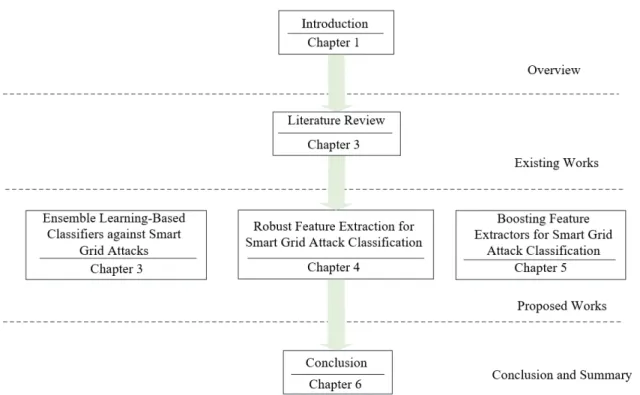
The thesis is organized into 6 chapters with an overall structure illustrated in Figure 1.3. Fol-lowing Chapter 1 of introduction, Chapter 2 will first provide the literature review of cyber-physical
security in the smart grid, from the two perspectives of physical and cyber security, respectively. IDS against attacks is also discussed in Chapter 2. Chapter 3 describes an overview of ensemble learning, and implements and evaluates an ensemble-learning classifier based on the extreme gra-dient boosting (XGBoost) algorithm. In Chapter 4, the overview of feature learning techniques, such as feature selection and extraction, is first given, and then the description of autoencoder (AE) and stacked denoising autoencoder (SDAE) is given as well. SDAE feature extractor and XGBoost classifier will be implemented and evaluated on our benchmark dataset [6]. Chapter 5 will introduce a new ensemble learning-based feature extractor. This novel model can boost multiple AE feature extractors to obtain critical feature information, after randomly feature resampling and selection, which will be followed by multiple Random Forest classifiers. The conclusion and future work are with Chapter 6.
Chapter 2
Literature Review
2.1
Cyber-Physical Security in the Smart Grid
With the increasing communication and data streams in the smart grid, some security challenges have been risen in both physical and cyber systems [30] [31]. On one hand, the inherent physical vulnerabilities in the physical space could lead to severe blackouts [32], such as the 2003 Northeast blackout in Canada and U.S [33]. On the other hand, attackers could remotely launch intrigue, simultaneous, and coordinated attacks as tremendous threats from the cyber space [2], such as the cyber attacks on the Ukraine power grid in 2015 [34]. In this section, we will briefly discuss the physical and cyber security in the smart grid.
2.1.1 Physical Security in the Smart Grid
Due to several physical attacks, such as equipment failures, extreme weathers and human de-struction, among others [35], the physical system has been exposing certain vulnerabilities in the smart grid. For instance, the 2012 transmission line overload in India lasted 15-hour blackout and affected 620 million people [36,37,38]. The 2005 extreme Hurricane Katrina affected over one million customers and 9,000 MW lost load in Southeastern U.S. [39]. In 2015, the transmission
lines damaged in Pakistan caused the lost load of 11,160 MW and lasted over 5 hours [40]. Be-sides, cyber attacks could compromise the physical security in the smart grid as well. The syn-chronized and coordinated cyber-attack compromised three Ukrainian regional electric power dis-tribution companies, resulting in power outages affecting over 225,000 customers for several hours in 2015 [34,41,42]. The interdiction attack refers to the tripping of generations, buses, transmis-sion lines and substations, which could cause disconnection with the smart grid [2]. The system would suffer a severe blackout when substation attackers have just launched attacks on a few trans-mission substations [2], since the attackers could completely obtain the control of substations after penetrating firewalls and password protections [43].
Considering the above security problems, a security defence mechanism has been established to secure the smart grid, which mainly contains three procedures: prevention, detection and mi-gration. The prevention against attacks mainly aims to enable the secure communication, the al-leviation of exposed vulnerabilities and the protection of information. Thanks to the efforts in the studies [44,45,46,47], innovative systems, protocols and technologies have been developed for improving the protection of smart grid security [48], and the secure communication can meanwhile be achieved in the smart grid. Meanwhile, the prevention can be implemented to eliminate certain attacks. For the effective reduction of false data injection (FDIA), since the stealthiness is dependent on the number of measurements being compromised, the prevention could be achieved by instal-lation of secured or encrypted devices on critical locations [2]. Hence, the critical measurement information would be protected in such way, which are immune to the potential injections. Be-sides, the prevention against FDIA can also be achieved through the preservation or rearrangement of crucial information in the system. Covert power network topological information can improve the security of state estimation, when a subset of the line attackers reactance has been preserved from the knowledge [49]. Reconfiguration of the topological information in the cyber space can also eliminate the risk of FDIA in large-scale distribution systems [50]. For advanced meter in-frastructures, secure management and distribution mechanisms have been developed as the most effective prevention against unauthorised accesses to smart meters [51,52,53]. In addition, game-theoretic approach for the optimal deployment of encrypted smart meters with limited budget [54] and Markov decision process (MDP)-based preventative maintenance strategy [55] have both been
developed for the protection of smart meters.
In case of protection failures, IDSs are employed as the major defence mechanisms at the sec-ond stage. Signature and anomaly-based IDSs have been developed against known and unknown attacks, respectively, which are deployed at various layers and locations to detect the traces of im-minent attacks. These early warnings allow system operators to react with proper countermeasures and/or emergency plans so the attack impacts can be minimised. A model-based IDS has been developed against the input attacks on the AGC system [56]. The IDS utilises RT load forecast to predict the ACEs over time, and their performances are compared with that of the actual ACEs obtained. With statistical and temporal characterisations of these performance, anomaly detection in the IDS is able to detect scaled and ramped inputs before they are sent into the AGC system. Interdiction in the transmission system maybe observed by effective online contingency screen-ing [57]. The nature of these tripping can be further examined by IDSs deployed at substations. A standard-specific IDS for automated substations has been proposed in [58]. A dedicated IDS has been developed to identify temporal anomalies induced by multi-substation attacks [59]. Host-based and network-Host-based IDSs have been integrated in an innovative strategy against simultaneous multi-substation intrusions [60]. Detection mechanisms have also been developed against both ma-nipulation and spoofing attacks on phasor measurement unit (PMU). Innovative IDSs have been proposed against generic manipulations of PMU data based on whitelist/behaviour [61], network topology [62, 63], and data mining [64]. Detection mechanisms against the FDIA schemes have been developed along multiple directions. An integrative Kalman filter-based detector against both bad data and false data has been developed in [65]. High-performance FDIA detectors have been proposed based on adaptive cumulative sum detection [66] and quickest detection [67]. An online anomaly detection considering load forecasts, generation schedules, and synchrophasors has also been developed in [68]. Furthermore, machine learning approaches have been proposed to identify the false data based on statistic information. Both supervised distributed SVM based on alternating direction method of multipliers and semi-supervised anomaly detection based on PCA have been developed recently to classify the false data from the normal data even with incomplete measure-ments [69]. A variety of supervised and semi-supervised classifiers have also been evaluated in [70], which have displayed robust performances in both online and offline scenarios. Using historic data,
generalised likelihood ratio detector can provide the optimal detection against weak FDIA schemes when the attacker could not compromise the minimal required number of measurement to construct undetectable FDIA schemes [71].
Mitigation efforts are made by the system operator to minimize the potential disruptions and damages. If attacks have been cleared from the system, existing mitigation and restoration mecha-nisms can effectively resume the secure and reliable power system operations. However, if attacks have not been resolved, the operator needs to consider persisting malicious attempts in the system. In such interactive scenarios, mitigation strategies are commonly modelled and solved by bi-level optimisation or game-theoretic approaches. For mitigation against interdiction, an optimisation scheme has been developed, which introduces countermeasures of the defender in a third-level min-imisation into the problem [72]. Alternatively, line switching has been proposed as an effective strategy to mitigate the interdiction, which is directly introduced in the lower-level of the optimisa-tion. The solutions with the minimal cost of the operator can be obtained by genetic algorithm [73] and Benders decomposition [74]. In addition, MDP has also been integrated to model the attack-defence interaction in a substation intrusion [75]. By modelling a successful intrusion as a proba-bilistic event, the investigation has formulated a competition to gain access of multiple substations between attackers and operators. The optimal solution is obtained with consideration of system parameters, the attackers resources, and the operators budgets. Acoordinated mitigation framework for the mitigation against FDIA has been developed in [76]. Security metrics have been proposed within the framework to evaluate the importance of substations and measurements. Strategies in both the network and the application layers have been developed to mitigate the attacks.
2.1.2 Cyber Security in the Smart Grid
The cyber security has been identified as a major element in the smart grid security [77]. In the following, we will describe three high-level requirements in the cyber security, availability, integrity and confidentiality.
• Availability: Ensuring timely and reliable access to and use of information is the most critical objectives in the smart grid. This is because a loss of availability is the disruption of access
to or use of information, which may further undermine the real-time decision making, the criticality based on time latency and the normal power delivery.
• Integrity: Guarding against improper information modification or destruction is to ensure the information non-repudiation and authenticity. Data cannot be modified without authorization, and the timestamp, source and quality of data are known and authenticated. A loss of integrity is the unauthorized modification or destruction of information and can further induce incorrect decision regarding power management.
• Confidentiality: Preserving authorized restrictions on information access and disclosure is mainly to protect personal privacy and proprietary information. Such objective aims to pre-vent unauthorized disclosure of information that is not open to the public and individuals. Confidentiality is the least critical requirement for system security; however, it has become more important, particularly in systems involving interactions with customers, such as de-mand response and AMI networks.
Considering that availability is the primary security requirement of smart grid, we first discuss attacks targeting availability. Denial-of-Service (DoS) attacks attempt to delay, block or corrupt the communication in the smart grid, which can severely degrade the communication performance and further impair the operation of electronic devices. There would be catastrophic for power infras-tructures, when DoS attackers intentionally delay the transmission of some time-critical messages to violate the timing requirement. For instance, an attacker can cause severe damages to power equipments if it successfully delays the transmission of a protection message in the case of trip protection in substations [78].
Attacks targeting integrity attempt to modify data without authorization, in order to corrupt critical information communication in the smart grid. The false data injection attack (FDIA) that was discovered and designed in [79], have drawn increasing attention in the research community. FDIA attackers can compromise certain sensors to inject falsified data and manipulate the measurements, such as voltage, current, and frequency, etc. The state estimation of the system could be maliciously changed, and meanwhile pass the data integrity check used in current state estimation process. For instance, FDIA has been extended to the electric market to deliberately manipulate the market price
information [80], which could result in significant financial losses to the social welfare. The load redistribution attack [81] is one type of realistic FDIA to limit the access to specific meters, in which the load bus injection measurements and line power flow measurements are vulnerable.
Compared with attackers targeting integrity, attackers targeting confidentiality have no intent to modify information transmitted over power networks. They eavesdrop on communication channels in power networks to acquire desired information, such as a customers personal information and electricity usage. From the information theory perspective, the work in [82] theoretically studied the communication capacity in a dynamic power system under an eavesdropper targeting confidentiality. The concept of competitive privacy and information-theoretic approach [83] was proposed for the intriguing privacy issues in the smart grid information and communication infrastructures.
Most components are not designed with sufficient security scheme against malignant events, particularly from the cyber system. The lack of such sufficient protection would be catastrophic, as illustrated in the cyber attacks on a Ukraine regional grid [84]. Thanks to the efforts in the cyber-physical smart grid security [2,85,86], intrusion detection systems (IDSs) and firewalls have been applied to prevent the smart grid from attack intrusions. Secure protocols aim to protect the two-way communications between control centers, substations, actuators and sensors, among others. Secured wired and wireless networks have also provided trustworthy communications for the emerging PMU and AMI systems [2].
It is notable that the anomaly and signature-based IDSs need to accommodate diverse patterns in the smart grid to effectively identify the malicious events. Besides, the cyber security in the smart grid also needs to consider physical properties, requirements and dependencies of the system [2]. For example, while the access could mostly be rejected after many failed log-in attempts, it is seldom allowed in the control systems. Attackers may utilise the mechanism to lock operators out of the system that will result in disastrous consequences.
2.2
Intrusion Detection against Cyber-Physical Attacks in the Smart
Grid
From the perspective of cybersecurity, the smart transmission grid exposes various access points, physical vulnerabilities, and potential benefits to exploit. Based on such challenges in the smart grid, intrusion detection systems (IDS) [87] are proposed as the advanced security systems. IDS can monitor computer systems and network traffic, and analyzes that traffic for possible hostile attacks originating from outside the organization and also for system misuse or attacks originating from inside the organization [87].
2.2.1 Intrusion Detection Techniques
Thanks to the efforts in power system and cyber-physical attack studies [2,85,86,88], IDS can be categorized based on the detection techniques: knowledge-based intrusion detection, anomaly-based intrusion detection and hybrid intrusion detection.
Knowledge-Based Intrusion Detection
Knowledge-based intrusion-detection techniques apply the knowledge accumulated about spe-cific attacks and system vulnerabilities. The knowledge-based IDS contains information about these vulnerabilities, and compares the known vulnerabilities with the patterns of actions. If an action matches one of such vulnerabilities, an alarm would be raised and this action will be recognized as attack, whereas the actions is considered acceptable. In terms of techniques, knowledge-based in-trusion detection approaches were first implemented using first order logic and expert systems [89]. Commercial products mostly used a signature approach [90] and other additional techniques, such as Petri nets [91] and state-transition analysis [92], have been proposed as well.
One advantage of the knowledge-based approaches is low false-alarm rates and only react to known bad actions The contextual analysis proposed by the intrusion-detection system is detailed, making it easier for the security officer using this intrusion-detection system to understand the prob-lem and to take preventive or corrective action [19]. The major drawback is that the knowledge-based technique relies on known incidences and cannot respond well to new variants or zero-day
threats. The dictionary of IDS needs to gather the required information on the known attacks and update with new vulnerabilities and environments in real time. Besides, maintenance of the dictio-nary of IDS requires careful analysis of each vulnerability and is therefore a time-consuming task. Knowledge-based approaches also have to face the generalization issue. Knowledge about attacks is very focused, dependent on the operating system, version, platform, and application. The result-ing intrusion-detection system is therefore closely tied to a given environment. Also, detection of insider attacks involving an abuse of privileges is deemed more difficult because no vulnerability is actually exploited by the attacker.
Anomaly-Based Intrusion Detection
Anomaly-based intrusion detection assumes that an intrusion can be detected by observing a deviation from the normal or expected behavior of the system or the users. Anomaly-based intru-sion detection is based on the observations of system behaviors, and would compare current user activities with predefined behavior profiles that record normal or valid system behaviors. An alarm would be generated, when the deviation is observed. In the other words, any current activities that could not correspond to predefined behaviors, would be considered as intrusions.
One advantage of anomaly-based intrusion detection is to effectively detect against unknown attacks or zero-day attacks. Anomaly-based intrusion detection could contribute to the automatic discovery of new unknown attacks, and are also less dependent on operating-system-specific mech-anisms [19]. However, anomaly-based intrusion detection might cause the drawback of the high false alarm rate [93,94]. The behavior profiles are needed to be updated periodically, since the sys-tem behaviors are changing over time; otherwise, the unavailability of intrusion detection syssys-tem and additional false alarms might be found [19].
Hybrid Intrusion Detection
In order to overcome the disadvantages and integrate the advantages of the above knowledge-based and anomaly-knowledge-based intrusion detection, hybrid intrusion detection [88] has been proposed in the system. Hybrid intrusion detection could apply both the knowledge about system attacks, and the predefined behavior profiles to detect potential hostile attacks in the system.
2.2.2 Learning-Based Intrusion Detection
Learning-based intrusion detection is the other perspective of the observation of intrusion detec-tion. Many researchers proposed machine learning algorithm for intrusion detection to reduce the false alarm rates and produce the accurate IDS. In this section, we will show some existing studies that apply machine learning algorithms for intrusion detection against attacks.
Ferhat et al.[95] applied cluster machine learning technique on KDD Cup 99 dataset, which used k-Means method to determine whether the network traffic is an attack or a normal one. Penget al.[96] proposed a clustering method for IDS based on Mini Batch K-means combined with princi-pal component analysis (PCA) [97], using full KDD Cup 99 dataset as the training and testing set. The pre-processing procedure is considered to figure the strings and normalization the data to ensure the data quality in [98]. After data pre-processing, the authors introduced decision tree classification for IDS and compared this method with KNN and Na¨ıve Bayes methods [98]. The experimental results showed that the decision tree classifier is effective and precise on KDD CUP 99 dataset. Also, Manzoor and Morgan [99] proposed real-time intrusion detection system based on libSVM and C-SVM classification. The proposed approach was trained and evaluated on KDD 99 dataset. In the proposed work [100], Canonical Correlation Analysis (CCA) and Linear Discriminant Analysis (LDA) algorithms were used as the feature learning techniques, and seven classification algorithms (Na¨ıve Bayes, REP TREE, Random Tree, Random Forest, Random Committee, Bagging and Ran-domizable Filtered) were trained and evaluated on the two sets of UNSW-NB15 dataset [101]. The experimental result of the proposed work found the combination of LDA and Random Tree is more accurate, whose AUROC is 99.1 and 97.4 for two datasets, respectively.
Chapter 3
Ensemble Learning-Based Classifiers
against Smart Grid Attacks
3.1
Problem Statement
As mentioned in Section 2.2, the traditional knowledge-based detection can not effectively tackle the heterogeneous data in the fast-expanding cyber-physical smart grid, so that many re-searchers applied machine learning techniques to produce accurate intrusion detection. In recent decades, intrusion detection and other classification problems can benefit from the combination of multiple classifiers, known as ensemble classifier, which often outperforms single-classifier based approaches. The advantages are particularly evident in the field of intrusion detection, since there are various types of attacks in the system, and multiple classifiers should be considered to identify attacks [102]. Specifically, the other classifiers could adjust the misclassified results, if one classifier fails to identify an attack [103]. With the dataset [6] that will be discussed in Section3.4, the Oak Ridge National Laboratory randomly sampled the dataset at 1% to reduce the size and conducted a comparative study among different classifiers [29], including OneR, Nearest Neighbor, Random Forest, Support Vector Machine, Na¨ıve Bayes, JRip, Adaboost. The best accuracy was around 95% achieved by Adaboost classifier, an ensemble learning algorithm [104]. Belouchet al.[105] conducted four classifiers; SVM, Na¨ıve Bayes, C4.5 Decision Tree and Random Forest on UNSW-NB15 dataset [101]. Their results showed that Random Forest classifier performed better than all
the remaining single classifiers in terms of accuracy and sensitivity, with 97.49% and 97.75%, re-spectively. An ensemble method Greedy-Boost was introduced in [106], and the authors performed the comparative experiment among C4.5 Decision Tree and Greedy-Boost, for the classification of the KDD99 dataset. Reported results indicated that Greedy-Boost had the better precision of the prediction of all classes, varying between 88% and 100%; however, the algorithm were not tested on the unseen (new) attacks. In another work for the classification of NSL-KDD dataset, Syarif et al.[107] implemented Bagging, Boosting and Stacking ensemble methods which all considered Na¨ıve Bayes, J48 Decision Tree, JRip and IBK Nearest Neighbor as base classifiers. Compared to single classifiers, the Stacking ensemble approach could effectively improve the accuracy and reduce the false positive by 11.34% and 97.17%, respectively, at the detection of known attacks; un-fortunately, both Bagging and Boosting methods were unable to significantly improve the accuracy, and three ensemble approaches could not tackle the detection of novel attacks.
In this chapter, we propose an extreme gradient boosting (XGBoost) [24] based solution that ensembles multiple Classification and Regression Tree (CART) classifiers [25] for attack classifica-tion. As an effective and efficient tree boosting algorithm, XGBoost has been adopted in problems such as load forecasting [108] and attack detection [109]. The algorithm will be detailedly explained in the later Section3.3, and some following benefits can be achieved in our research [110]:
• The optimization is performed at building each new tree, which can allow to reduce false alarms and generate the accurate intrusion detection;
• Regularization is an essential factor to measure model complexity in the XGBoost algorithm, since it aims to avoid data overfitting problems in the system;
• The ability of parallel computation can help to effectively tackle bulk smart grid with hetero-geneous and multi-sourced data stream.
3.2
Ensemble Learning
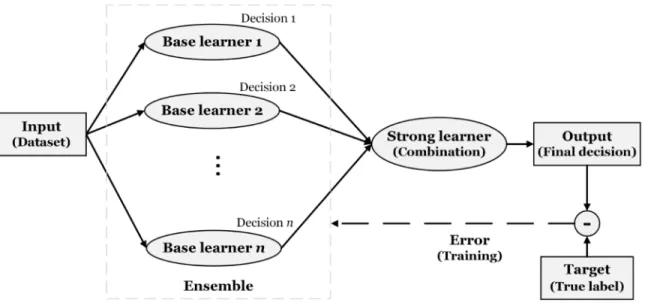
Ensemble learning is a machine learning algorithm where multiple learners are trained and combined to solve the same classification, regression, detection, or other learning tasks. Fig. 3.1
Figure 3.1: Architecture of ensemble learning algorithms.
shows the common ensemble learning architecture. Compared with traditional machine learning which aims to train one single “learner” to make the best learned decision for the task, ensemble learning methods train multiple learners and combine their decisions into a single one at the end.
An ensemble contains a number of learners called the “base learner,” and the combination of base learners can form a strong learner or classifier for the ultimate task. The base learner could be implemented with only one (the homogeneous ensemble) or multiple (the heterogeneous ensem-ble) types of base learners. The popular choice for base learners includes Decision Trees, Neural Networks, and Support Vector Machines, among others, making ensemble learning one of the most versatile and adaptive machine learning algorithms. By combining the base learners systematically such as majority voting, an ensemble classifier can integrate the strengths and diversities among base learners while minimizing the disadvantages and misclassifications, so that the performance of individual learners can be boosted in the final decision. In the following sections, we discuss three different ensemble learning techniques, called bagging, boosting and stacking. Generally speak-ing, there is no one ensemble method which absolutely outperforms the other ensemble methods consistently.
3.2.1 Bagging
Bagging [3] trains several base learners based on different bootstrap samples. Fig.3.2 shows the pseudo-code of bagging algorithm, whereT is the number of learning iterations that is equal to the number base learners. At each learning iteration, the bootstrap sample is generated by sampling the original training set with replacement, where the size of such bootstrap sample is same as that of the training set. Thus, in a bootstrap sample, there might be some duplicated training samples while some may not repeatedly appear. After training all base learners from the bootstrap samples, Bagging will combine all base learners to make the final decision. Bagging can be applied with many classification algorithms such as SVM, Na¨ıve Bayes, Decision Tree and Nearest Neighbour, among others. In the real-world applications. such as intrusion detection, Bagging could tackle the classification of the high-dimensional data, where it is hard to find a perfect single learner to work, due to the the complex and large-scale system [107].
Input:
DatasetD={(x1, y1),(x2, y2), ...,(xm, ym)};
Base learning algorithmL; Number of learning iterationsT; Process:
fort= 1, ..., T:
Dt=Bootstrap(D); % Generate a bootstrap sample fromD ht=L(Dt) % Train a base learnerhtfrom the bootstrap sample
end. Output:
H(x) =argmaxyPTt=1l(y=ht(x)) % the value ofl(a)is1ifaistrueand0otherwise
3.2.2 Boosting
Boosting, which was introduced by Schapire et al. [111], is a common ensemble learning method for boosting the performance of several base learners into a strong leaner, typically for classification and regression tasks. Boosting is capable of sequential learning of the base learners, and the subsequent base learners are dependent on the the performance of previous learners. Fig.3.3
shows the pseudo-code of boosting algorithm, whereT is the number of learning iterations that is equal to the number base learners. The first learner is trained based on the whole dataset with origi-nal weight distribution. After obtaining the performance of each base learner, the weight distribution would be accordingly updated. Specifically, the weights of incorrectly predicted samples would be increased, which aims to focus on such incorrectly predicted samples in the subsequent learning. Hence, the subsequent base learners could be adjusted in favor of those samples incorrectly learnt by the previous learners. The strong learner would be generated through a weighted combination of these base learners. It results in different machines being specialized in predicting different areas of the dataset [112]. Among the recent efforts in the intrusion detection studies [106,107,113], some variants of boosting, such as Adaboost [104], Greedy-Boost [107] and XGBoost [24], have been effectively applied to classify various events in the smart grid.
In this research, we determine to design and implement the XGBoost algorithm [24], which is one of the most widely used boosting techniques for constructing a strong classifier. The impact of XGBoost algorithm has been widely recognized in a number of machine learning and data mining challenges. For example, there are around the 29 challenge wining solutions during 2015, and 17 solutions used XGBoost [24]. The success of XGBoost algorithm was also witnessed in KDDCup 2015, where XGBoost was used by every winning team in the top10. Details of the XGBoost algorithm will be discussed in Section 3.3.
3.2.3 Stacking
Stacking [5] is the other approach in the ensemble learning, which generally combines multiple types of base learners, such as Decision Tree, Neural Network and SVM, among others, to form the heterogeneous ensemble. As shown in the pseudo-code of Fig.3.4, stacking consists of two levels
Input:
DatasetD={(x1, y1),(x2, y2), ...,(xm, ym)};
Base learning algorithmL; Number of learning iterationsT; Process:
D1 = m1; % Initialize the weight distribution of samples
fort= 1, ..., T:
ht=L(D, Dt) % Train a base learnerhtfromDusing distributionDt
t=P r[ht(xi)6=yi] % Measure the error of base learnerht
Determine the base learner weightαtusing the errort
Construct the new weight distributionDt+1using the errort
end. Output:
H(x) =sign(PT
t=1αtht)
Figure 3.3: The boosting algorithm. [4]
which are several base learners as the first-level learning algorithms and stacking model learner as the second-level learning algorithm. In the first level, all base learners are trained from the original dataset based on different machine learning algorithms. The predicted results of all first-level base learners are combined with the target value of each sample, and such combination will be used as the input of second-level learner. The output of second-level learner would be our final result [112]. For instance, we design and implement three base classifiers in the first level, Decision Tree, Na¨ıve Bayes and Neural Network, and then the predicted labels of three first-level base classifiers will be integrated with the true labels of all samples. The second-level classifier Nearest Neighbour will be built to make the final decision based on such new combination.
Input:
DatasetD={(x1, y1),(x2, y2), ...,(xm, ym)};
First-level learning algorithmsL1, ...,LT
Second-level learning algorithmL Process:
fort= 1, ..., T:
ht=Lt(D) % Train a first-level individual learnerhton the original datasetD
end;
D0 =∅; % Generate a new empty dataset fori= 1, ..., m:
fort= 1, ..., T:
zit =ht(xi) % Usehtto classify the training samplexi
end;
D0 =D0S{((
zi1, zi2, ..., ziT), yi)}
end;
h0 =L(D0) % Train the second-level learnerh0 on the new datasetD0
Output:
H(x) =h0(h1(x), ..., hT(x))
Figure 3.4: The stacking algorithm. [5]
3.3
Extreme Gradient Boosting (XGBoost)
XGBoost is one of the latest ensemble learning algorithms that witness an increasing adoption in real-world applications [24]. Compared to the stochastic gradient descent commonly used in machine learning, XGBoost leverages gradient boosting to find the optimal objective values towards the best decision. A brief overview of XGBoost as follows.
3.3.1 Base Learner
In this work, we choose the Classification and Regression Tree (CART) [25] as the base learner for boosting based on a few considerations: first, CART can simultaneously learn from both discrete and continuous feature values; this allows the discovery of patterns across both continuous analog measurements and discrete status signals. The decision tree-based approach also provides more interpretability and transparency of decisions made by CART, which is essential in security-related analysis. The binary tree structure of CART and its ability to handle sparse data and instance weights efficiently reduces the computational costs significantly compared with traditional decision trees and neural networks [114]. Finally, CART is also relatively friendly to parallel and distributed implementation [115,116], which allows it to be trained faster in bulk power grids, paving the way for real-time monitoring and analysis against prominent threats.
3.3.2 Objective Function
For a datasetD={(xi, yi)}withnsamples andmfeatures, XGBoost integratestCART base
learners to obtain a strong learner that makes the ultimate classification decision. The objective function of XGBoost is:
obj(θ) = n X i=1 l(ˆyi, yi) + t X k=1 Ω(fk), fk∈ F (1)
whereΩ(ft) =γT +21λ||w||2is the complexity of each CART.T is the number of leafs in a CART
so that thek-th base learnerfkrepresents a tree structure qwith the leaf valuew. γ andλare the
coefficients of the regularization terms that are determined automatically. F ={f(x) = wq(x)}is called the CART space, wherew∈RT andq :
Rm→ Tis the tree structure that maps a sample to
a leaf node in that tree.
The objective function includes the loss functionl(ˆyi, yi), which represents the difference
be-tween the predicted label yˆi and the targetyi. It is notable that the XGBoost objective function
traditional decision trees, this term removes the need to prune a tree after it is created, which re-duces model complexity to avoiding over-fitting and the computational cost in implementation.
3.3.3 Addictive Training
XGBoost model is trained in an addictive way which means that the optimization is performed at each iteration rather than after whole training. ft(xi)means the predicted result ofi-th sample
at thet-th iteration andyˆ(it)is the combination offt(xi) until thet-th iteration. Letyˆi(0) = 0, the
addictive training process is to update:
ˆ yi(t)= t X k=1 fk(xi) = ˆy(t −1) i +ft(xi) (2)
In other words, at thet-th iteration, we need to find the optimized tree structureftthat minimizes
the objective. Here, if we choose square loss forl(ˆyi, yi)and take Taylor expansion ofobj(θ), then:
obj(t)= n X i=1 l(ˆyi(t−1)+ft(xi), yi) + Ω(ft) +C ' n X i=1 [l(ˆyi(t−1), yi) +gift(xi) + 1 2hif 2 t(xi)] + Ω(ft) +C (3)
wheregi= 2(ˆy(t−1)−yi),hi = 2, andCis a constant that can be removed to obtain the simplified
objective function at thet-th iteration below:
obj(t)= n X i=1 [gift(xi) + 1 2hif 2 t(xi)] + Ω(ft) (4)
Let the sample set of leaf jbeIj ={i|q(xi) = j}and regroup the objective function of each
obj(t)= n X i=1 [giwq(xi)+ 1 2hiw 2 q(xi)] +γT + 1 2λ T X j=1 w2j = T X j=1 [Gjwj + 1 2(Hj+λ)w 2 j] +γT (5) whereGj =PiIjgiandHj = P
iIjhi. For a fixed tree structureq(x), the optimal weight in each
leaf and the resulting ultimate objective value could be calculated by substitutingwj∗=− Gj
Hj+λ: obj=−1 2 T X j=1 G2j Hj+λ +γT (6)
3.3.4 Optimal Tree Structure Selection
A decision tree may have an infinite number of structures, so to find the best one in decision making, the scoring function below is used.
Gain= 1 2[ G2L HL+λ + G 2 R HR+λ − (GL+GR) 2 HL+HR+λ ]−γ (7) where G2L HL+λ and G2 R
HR+λ are scores of the left child and the right child after splitting a node on the
tree, respectively; (GL+GR)2
HL+HR+λ is the score without splitting. The tree structure with the maximal gain
is chosen to determine the optimal tree structure for the decision, i.e., if a sample belongs to the class of normal, fault, or attack events.
3.4
Cyber-Physical Attack Dataset in the Power System Benchmark
The power system benchmark and configuration are shown in Fig. 3.5, which was built by the Center for Cybersecurity Research and Engineering (CCRE) at the University of Alabama in Huntsville [6]. This is a three-bus two-machine system with four circuit breakers; each breaker is controlled by an Intelligent Electronic Device (IED) that applies a distance protection scheme to trip each breaker whenever faults are detected. Operators can also issue commands to the IEDs R1 through R4 to manually trip the breakers BR1 through BR4. These IEDs information back through a substation switch through a router back to the SCADA. The dataset used to validate thiswork includes 2 non-attack contingency scenarios, 3 types of cyber-attacks, and a normal operation scenario listed below.
(1) Data injection: In data injection attacks [79], we suppose that malicious attackers have the full knowledge of system, and also are capable of manipulating some measurements in the system. An attacker aims to manipulate the sensor measurements to induce an arbitrary change in the estimated value of state variables without being detected by the bad measure-ment detection algorithm of the state estimator. Hence, this attack could blind the operator and causes a blackout by changing values to parameters such as current, voltage, and frequency, among others. In our benchmark power system, the SLG fault replay attacks, from scenario 7 to 12, attempt to emulate a valid fault by altering system measurements followed by sending an illicit trip command to relays at the certain locations of the transmission line [27]. This attack may lead to confusion and potentially cause an operator to take invalid control actions. (2) Remote tripping command injection: In our benchmark power system, the attack scenarios 15 to 20 represent the remote tripping command injection against each single relay, or two relays on the same line (R1 and R2, or R3 and R4 respectively). Attackers remotely send unexpected relay trip commands to closely mimic the line maintenance scenarios. The ma-licious trip command originates from another node on the communications network with a spoofed legitimate IP address. Such malicious attacks would cause breakers to unpredictable open, and attackers could appear as penetrating outsides defenses.
(3) Relay setting change: The disabled relay attacks (including 16 scenarios) mimic the effects of insiders taking illicit control actions or malware taking control of software systems to manipulate control devices [27]. Such disabled relay attacks overlap fault and maintenance events. Relays are configured with a distance protection scheme, and attackers could conduct a script that accesses a relays internal registers via Modbus/TCP commands sent from the attackers computer; as result the relays will not trip for a valid fault or a valid command. A dataset of 37 scenarios has been generated on this system and made available online. These data belong to three classes labeled as No Events, Natural Events, and Attack Events, as shown in Table3.1.
Figure 3.5: The power system benchmark [6].
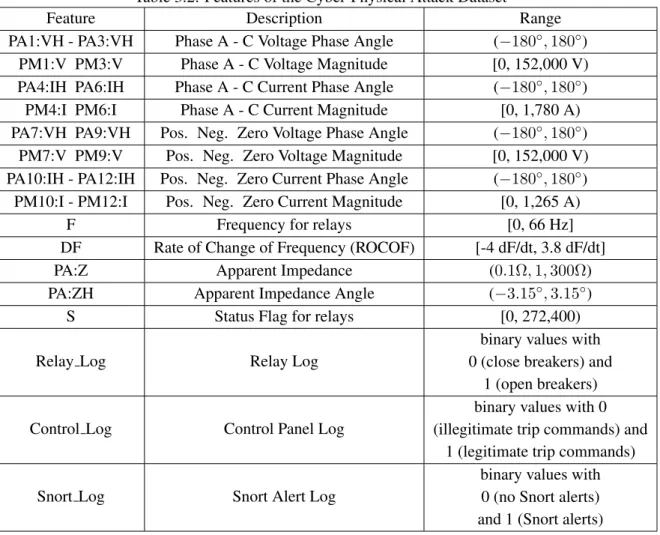
Each sample in this dataset contains 128 features: 116 of them are from four phasor measure-ment units (PMUs); another 12 features are collected from the relay logs of the four PMUs, the control panel logs, and the Snort alert [6]. Table 3.2 gives the feature description of such cyber-physical attack dataset.
Table 3.1: The Cyber-Physical Attack Dataset
Class Description Scenarios Scenario IDs
0 No Event Normal operation with load demand variation
41 1 Natural Event Single line-to-ground faults (SLG)
and line maintenance
1–6,13,14 2 Attack Event Data injection, remote tripping,
command injection, relay settings change
7–12,15–30, 35– 40
Table 3.2: Features of the Cyber-Physical Attack Dataset
Feature Description Range
PA1:VH - PA3:VH Phase A - C Voltage Phase Angle (−180◦,180◦) PM1:V PM3:V Phase A - C Voltage Magnitude [0, 152,000 V) PA4:IH PA6:IH Phase A - C Current Phase Angle (−180◦,180◦) PM4:I PM6:I Phase A - C Current Magnitude [0, 1,780 A) PA7:VH PA9:VH Pos. Neg. Zero Voltage Phase Angle (−180◦,180◦)
PM7:V PM9:V Pos. Neg. Zero Voltage Magnitude [0, 152,000 V) PA10:IH - PA12:IH Pos. Neg. Zero Current Phase Angle (−180◦,180◦) PM10:I - PM12:I Pos. Neg. Zero Current Magnitude [0, 1,265 A)
F Frequency for relays [0, 66 Hz]
DF Rate of Change of Frequency (ROCOF) [-4 dF/dt, 3.8 dF/dt]
PA:Z Apparent Impedance (0.1Ω,1,300Ω)
PA:ZH Apparent Impedance Angle (−3.15◦,3.15◦)
S Status Flag for relays [0, 272,400)
Relay Log Relay Log
binary values with 0 (close breakers) and
1 (open breakers) Control Log Control Panel Log
binary values with 0 (illegitimate trip commands) and
1 (legitimate trip commands) Snort Log Snort Alert Log
binary values with 0 (no Snort alerts) and 1 (Snort alerts)
3.5
Simulations and Results
3.5.1 Experiment Setup and Data Preprocessing
The original dataset from [6] is imbalanced, where the number of samples of in Classes 0, 1, and 2 are 174, 927, and 3,865, respectively. In this case, a classifier that flags every sample as an attack can achieve approximately 76% accuracy, which would be unacceptable. To re-balance the data and make a fair comparison with the literature, we first oversample the original dataset to re-balance the data without changing the distribution in each class. The original dataset contains 4,946 samples in total, out of which 80% of each class are chosen for training samples and the remaining 20% for testing. The 139 No Event samples and the 741 Natural Event samples in the training set are over-sampled to 3,095, i.e., the number of Attack Event samples in the training set. We refer to this
new dataset as an oversampled dataset of the original data, and it is notable that the testing data are not oversampled.
Additionally, we noted that the original dataset constitutes very limited normal operating points but extensive attack samples. Such distribution is unlikely to be observed in practice as we will observe an extensive number of scenarios in normal operations but much fewer attack samples due to the rarity of such events. Based on these considerations, we also consider a different pre-processing by introducing additional No Event and Natural Events samples from other datasets in [117]. We also select 80% for training and 20% for testing. This new dataset is referred to as the extended dataset. After data pre-processing, a five-fold cross-validation is used to select the best classifier from training and the average of 100 independent experiments will be reported as the classification performance.
3.5.2 Simulation Results
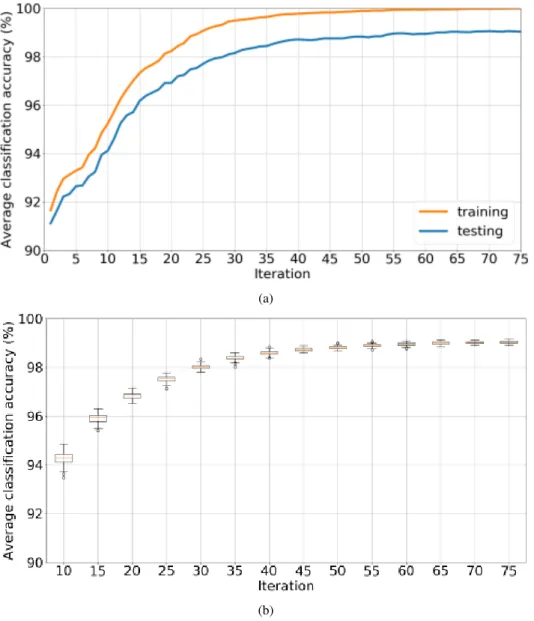
The average classification performance of the oversampled dataset is shown in Fig. 3.6. The initial training and testing accuracy of the training and testing are both around 91% in Fig.3.6a, and both errors are dropping with the increase of iterations. The maximal testing accuracy was 99.07% after 70 iterations, after which over-fitting was observed with the performance decreased to 99.04%. The boxplot of classification accuracy at every 5 iterations is shown in Fig.3.6b. The boxplot reveals that as the XGBoost classifier learns from the oversampled data, not only the accuracy increases over time, but the robustness against outliers has also improved. Compare with the state-of-the-art, the proposed XGBoost classifier has reached an effective improvement over 4%.
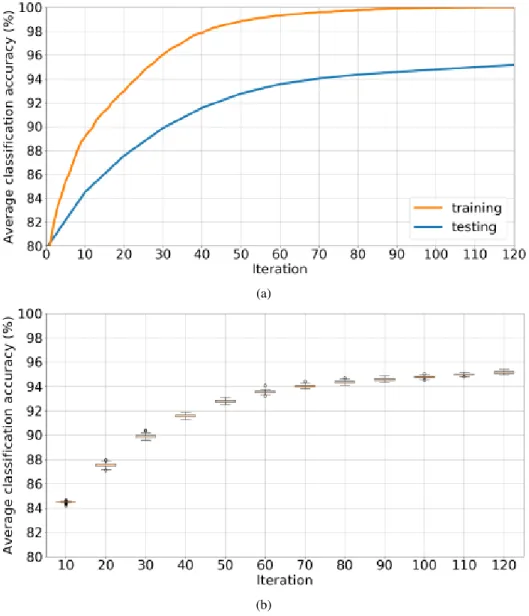
The classification performance of the more challenging extended dataset is shown in Fig.3.7. In Fig.3.7a, as the training accuracy improves from 89.15% to 100% after 120 iterations, the testing accuracy increases from 84.51% to 95.18%. The robustness has also improved over time, with the variation and number of outliers decreasing as shown in Fig.3.7b. Considering that the extended dataset adds a large variety of No Event and Natural Event samples without the counterpart of Attack Event samples, it is considerably more difficult then the ones tested with original dataset, e.g.,[117][118], but the performance of XGBoost still remains competitive to their 95% accuracy.
(a)
(b)
Figure 3.6: Classification performance of the oversampled dataset.
3.6
Discussions
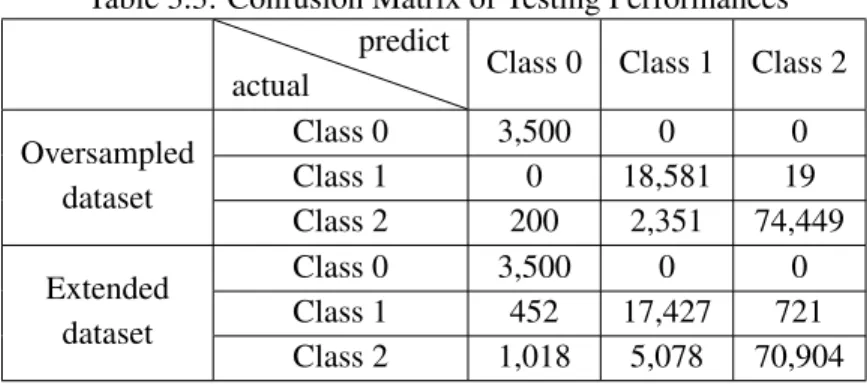
While the testing accuracy above seem satisfactory, it is important to note that smart grid is a critical infrastructure where a single misclassification can have a potentially disastrous impact. The errors, despite being a small percentage, shall be carefully investigated and eliminated. To analyze the extend and severity of the errors in the reported performance, the confusion matrix of the three classes is shown in Table3.3. It can be found that Class 0 (No Event) could be fully classified correctly in both the oversampled and the extended datasets. There is also no Class 1 (Natural Event) samples misclassified as Class 0 in the less-challenging oversampled dataset. The testing
(a)
(b)
Figure 3.7: Classification performance of the extended dataset.
accuracy over the two datasets is 99.89% and 93.69% for Class 1 , respectively, and 96.69% and 92.08%, for Class 2 (Attack Event), respectively.
A closer look at the misclassified samples and attack locations revealed interesting observations. Among attacks sending false remote tripping commands to the relays, the XGBoost classifier trained on oversampled data reported over 98% average testing accuracy on Relays R2 and R3; the perfor-mance dropped to 93.67% on R1 and 89.53% on R4. Similar cases are observed on the extended data, where the accuracy is 90.55%, 98.48%, 96.25%, and 91.74% for attacks on R1 to R4, respec-tively. By taking a second look at the benchmark topology, attacks on R2 and R3 of the load bus are both easier to classify than those on R1 and R4 protecting the generation buses. Studies on the
Table 3.3: Confusion Matrix of Testing Performances actual
predict
Class 0 Class 1 Class 2
Oversampled Class 0 3,500 0 0 dataset Class 1 0 18,581 19 Class 2 200 2,351 74,449 Extended Class 0 3,500 0 0 dataset Class 1 452 17,427 721 Class 2 1,018 5,078 70,904
relations of these performance with the grid topology and generator/load bus locations may further reveal the reasons behind so the performance can be improved toward real-world deployment.
Chapter 4
Robust Feature Extraction for Smart
Grid Attack Classification
4.1
Problem Statement
In the last chapter, we introduced XGBoost ensemble classifier for effective cyber-physical at-tack classification. Although the accuracy seem satisfactory, it is important to note that the multi-sourced, correlated, and often noise-contained data, which record various concurring cyber and physical events, are still posing significant challenges to the accurate distinction by IDS among events of inadvertent and malignant natures. These redundant information covers the useful knowl-edge and hidden patterns in the distinction by IDS. To tackle such challenges, not only advanced classification model, but also robust feature learning needs to be considered, such as feature ex-traction. Feature extraction can learn new relatively low-dimensional feature space that represents original feature information, and such new feature set is often used for some supervised learning-based tasks, such as classification or regression. Hebaet al.[119] implemented principal component analysis (PCA) for feature extraction approach, and then applied 23 extracted features as the input of SVM classifier for NSL-KDD dataset classification. While the accuracy was improved in some types of attacks (DoS and Probe), the overall classification accuracy decreased, compared to the classification using dataset with full 41 features. In the other combination of deep brief network (DBN) and SVM working on the NSL-KDD dataset [120], DBN was adopted to learn new features
![Figure 1.1: The connection network of smart grid components [1].](https://thumb-us.123doks.com/thumbv2/123dok_us/1359264.2681873/12.918.166.808.126.548/figure-connection-network-smart-grid-components.webp)
![Figure 1.2: The cyber-physical architecture of a smart transmission grid [2].](https://thumb-us.123doks.com/thumbv2/123dok_us/1359264.2681873/14.918.168.807.130.462/figure-cyber-physical-architecture-smart-transmission-grid.webp)
![Figure 3.4: The stacking algorithm. [5]](https://thumb-us.123doks.com/thumbv2/123dok_us/1359264.2681873/34.918.155.805.161.711/figure-the-stacking-algorithm.webp)
![Figure 3.5: The power system benchmark [6].](https://thumb-us.123doks.com/thumbv2/123dok_us/1359264.2681873/39.918.165.809.127.561/figure-the-power-system-benchmark.webp)