Small-World Datacenters
Ji-Yong Shin
†Bernard Wong
‡Emin Gün Sirer
† †Dept. of Computer Science
‡David R. Cheriton School of
Cornell University
Computer Science
{jyshin, egs}@cs.cornell.edu
University of Waterloo
ABSTRACT
In this paper, we propose an unorthodox topology for dat-acenters that eliminates all hierarchical switches in favor of connecting nodes at random according to a small-world-inspired distribution. Specifically, we examine topologies where the underlying nodes are connected at the small scale in a regular pattern, such as a ring, torus or cube, such that every node can route efficiently to nodes in its immedi-ate vicinity, and amended by the addition of random links to nodes throughout the datacenter, such that a greedy al-gorithm can route packets to far away locations efficiently. Coupled with geographical address assignment, the result-ing network can provide content routresult-ing in addition to tra-ditional routing, and thus efficiently implement key-value stores. The irregular but self-similar nature of the net-work facilitates constructing large netnet-works easily using pre-wired, commodity racks. We show that Small-World Dat-acenters can achieve higher bandwidth and fault tolerance compared to both conventional hierarchical datacenters as well as the recently proposed CamCube topology. Coupled with hardware acceleration for packet switching, small-world datacenters can achieve an order of magnitude higher band-width than a conventional datacenter, depending on the net-work traffic.
Categories and Subject Descriptors
C.2.1 [Network Architecture and Design]: Metrics— Network topology
General Terms
Design, Management, Performance
Keywords
Datacenter network, Network topology, Small-world network
Permission to make digital or hard copies of all or part of this work for personal or classroom use is granted without fee provided that copies are not made or distributed for profit or commercial advantage and that copies bear this notice and the full citation on the first page. To copy otherwise, to republish, to post on servers or to redistribute to lists, requires prior specific permission and/or a fee.
SOCC’11, October 27–28, 2011, Cascais, Portugal. Copyright 2011 ACM 978-1-4503-0976-9/11/10 ...$10.00.
1.
INTRODUCTION
Network topology is one of the key determinants of appli-cation performance in datacenters. Traditional datacenters are built around a hierarchical topology using multiple layers of switches [8]. While such hierarchical topologies are mod-ular, composable, and easy to set up, they suffer from per-formance bottlenecks due to oversubscription at the higher layers of the hierarchy. High-bandwidth connection tech-nologies at the upper layers of the tree can mitigate over-subscription, but often entail high costs.
Consequently, much recent research has focused on alter-native datacenter topologies to achieve high bisection band-width, improve failure resiliency, and provide low latency. For instance, DCell [14], BCube [13], and CamCube [1] pro-vide richer topologies with higher performance. In these systems, costly network switches are replaced, and the rout-ing functionality is shifted to the datacenter nodes, often equipped with additional NICs. Such a shift in functional-ity can improve bisection bandwidth and provide new func-tionality, such as content addressing, that might be a better fit for common datacenter applications such as key-value stores. Yet these past approaches have their own shortcom-ings; namely, they rely critically on a rigid connection pat-tern that is not easy to set up, they incur high latencies, and, while they provide higher bandwidth, they may still fall short of what is practically achievable.
In this paper, we propose a novel, and unorthodox, topol-ogy for datacenters. Like previous work, we eschew hier-archical switches in favor of a rich topology in which the datacenter nodes aid in routing. But unlike prior work, we propose that the datacenter network be wired, essentially, at random. Specifically, we propose networks based on a locally-regular foundation that is easy to wire, such as a ring, grid, cube or torus, and amend this regular structure with a number of network links placed throughout the dat-acenter. These links in the latter category follow a small-world-inspired [39] pattern, such that nodes have a relatively large number of links to the nearby nodes around them so as to be authoritative in their region, and possess sufficient links of the right lengths such that they can cover large dis-tances when needed. The result is a datacenter topology with low stretch and high bandwidth that is very easy to provision.
This random topology can greatly simplify the construc-tion of high performance datacenter networks. We envision that a Small-World Datacenter (SWDC) can be constructed
simply by pre-cutting cabling ahead of time according to the appropriate distribution. A larger number of short ca-bles provide the regular grid structure, which ensures that the network is not partitioned and that all nodes are reach-able. The instructions for the provisioning team consist of implementing a grid followed by establishing connections at random.
Small-world networks lend themselves naturally to scal-able construction from pre-wired rack components. We de-scribe designs where each rack comes pre-wired with the reg-ular links. It can be dropped into a network of any size, and fully integrated into the fabric simply by connecting links at random through a patch panel.
The random links in SWDCs have the potential to re-duce network latency and improve bandwidth, especially in comparison to previous work that limits all routes to a regu-lar, rigid pattern. Furthermore, the combination of random and regular links enables a simple greedy algorithm to ef-fectively route packets within the datacenter. SWDCs also enable content addressable networks, just as with the state of the art datacenter topologies such as CamCube [1].
SWDCs rely on a collection of NICs in each node to pro-vide the rich topology that achieves low latency and high bandwidth. To fairly compare to past work, we investigate topologies based on 6 NICs per node. In an ideal scenario, the NICs would be integrated onto the same daughter board or coupled with hardware accelerators such as GPUs and NetFPGA [17, 27, 32] in order to avoid store-and-forward delays when a node is routing from NIC to NIC. We inves-tigate systems based both on unintegrated, commodity NIC hardware, as well as systems with such optimizations.
Overall, this paper makes three contributions. First, we propose a novel topology based on small-world networks, and show that the judicious use of random wiring can yield competitive datacenter networks. Second, we investigate dif-ferent small-world network topologies based on a ring, 2-D torus, and 3-D hexagonal torus and quantify their bene-fits. Finally, we provide a detailed evaluation of SWDCs, including comparisons with conventional datacenter topolo-gies as well as CamCube. Our evaluation shows that SWDC can outperform CamCube on both bandwidth and latency, while providing the same functionality benefits stemming from content addressing. In addition, SWDC can provide up to 16 times higher bandwidth than conventional hierar-chical datacenters, and can preserve over 90% of network flows among live nodes even if up to 50% of nodes fail.
The remainder of this paper explores the design of SWDCs, and evaluates and compares it with other datacenter designs. Section 2 provides background information on small-world networks. Section 3 presents the proposed SWDC designs, including different small-world topologies and physical dat-acenter packaging. Section 4 discusses suitable applications for SWDC, and the evaluation of SWDC is presented in Section 5. Related work is provided in Section 6 and finally, Section 7 concludes our work.
2.
SMALL-WORLD NETWORKS
Small-world networks were initially inspired by the phe-nomena observed in Milgram’s experiments [30, 35] in hu-man social networks. Watts and Strogatz proposed the name and a mathematical simplification and formalization for such networks [39]. Examples of small-world networks are shown in Figure 1. In general, small-world networks exhibit an
average pairwise distance that is proportional to the log-arithm of the nodes in the network. Kleinberg examined small-world networks based on ad-dimensional lattice cou-pled with additional random links at each node, and showed that the network can route efficiently when the random links are chosen with probability that is proportional to the dth power of distance between two nodes, where d is the di-mension of the lattice network [21, 22]. The lattice network connects the nodes to their nearest neighbors, in effect ren-dering them authoritative for hosts in their region, while the random links provide short cut-through paths across the net-work. Hereafter, we refer to links forming the lattice network regularlinks, while the randomly assigned links are known asrandomlinks.
For SWDCs, we adopt Kleinberg’s small-world model. This network configuration guarantees that all nodes are reachable, that the network scales well, and, with high prob-ability, the path length between any two nodes is O(logn) [24, 23].
3.
SMALL-WORLD DATACENTER DESIGN
This section describes the topologies, address manage-ment, routing methods, and packaging issues regarding the design and implementation of SWDCs.
3.1
Network Topologies
The SWDC network topology admits many different in-stantiations. The dimension of the underlying lattice, the number of random links, degree of each node and so on can vary depending on the configuration. In this paper, for pur-poses of realistic deployment, low-cost, and fair comparison to past work, we limit the degree of each node to 6 and construct the following small-world networks for SWDCs:
• Small-World Ring (SW-Ring): 2 links form a ring
topology and 4 links connect each node to 4 random nodes.
• Small-World 2-D Tours (SW-2DTorus): 4 links
form a 2-D torus topology and 2 links connect each node to 2 random nodes.
• Small-World 3-D Hexagonal Torus
(SW-3DHex-Torus): 5 links form a 3-D hexagon torus and 1 link connects each node to a random node.
Figure 1 illustrates the topology of each of these networks. For clarity, the figure shows only one of the random links per node and omits links in the third dimension for the SW 3-D hexagonal torus.
The split between the number of regular versus random links has the potential to yield significantly different proper-ties for these topologies. A topology such as SW-Ring, with a relatively high number of random links and a smaller num-ber of regular ones, can render the topology better suited for data-center-wide search, while the opposite weighting, as in the case of SW-3DHexTorus, can yield better perfor-mance when searching local nodes. In essence, this break-down represents the tradeoff between local expertise versus better global knowledge. We show in Section 5 that hav-ing strong local connections yields better results when ushav-ing greedy routing, while shortest path routing algorithm works well with a larger number of random links.
(a) SW Ring (b) SW 2-D Torus (c) SW 3-D Hexagonal Torus Figure 1: Small-world datacenter topologies. Solid lines indicate regular links while dotted lines represent random links. Only one random link per node is drawn and links in the 3rd dimension in SW-3DHexTorus are omitted for simplicity.
Port # SW-Ring SW-2DTorus SW-3DHexTorus
1 right (2) east (2) top (2)
2 left (1) west (1) bottom (1)
3 random (3) north (4) east (4)
4 random (4) south (3) west (3)
5 random (5) random (5) north or south (5)
6 random (6) random (6) random (6)
Table 1: Examples of port assignments for SWDC topolo-gies. Table entries describe the relative server location and the destination port for each source port.
3.2
Physical Structure
Since routing in SWDCs is performed by the server nodes that comprise the network, there is no need for any addi-tional expensive switch hardware. The funcaddi-tionality of top-of-rack, access, aggregation and core switches, which often require expensive interconnect technologies and/or pose bot-tlenecks due to oversubscription, are effectively distributed throughout the servers. Because of this redistribution of costs, SWDCs require every node to possess multiple net-work cards.
To provide a direct comparison to past work, this paper focuses on SWDC topologies with degree 6. We name ports from 1 to 6 in each server and consistently use the port with same number to connect servers in the same relative direc-tion in the network. Since connecdirec-tions are bidirecdirec-tional, both ends of a link always connect the predefined ports. For example, link from port 1 of a server always connects to port 2 of the adjacent server on the right in the lattice network of SW-Ring and vice versa. Table 1 describes examples of port assignments for each SWDC topology. This static assign-ment of ports simplifies the assignassign-ment of logical addresses, which we explain in the next subsection.
3.3
Geographical Identity and Address
Assign-ment
Because small-world networks are built on top of a lattice, the network lends itself easily to address assignment based on topology. We call this new addressgk of a server k its
geographical identity. For a SW-Ring, a single index corre-sponds to the position of the server on a ring; for a SW-2DTorus, two indexes corresponding to x and y coordinates of a server in 2-D torus; and for a SW-3DHexTorus, three indexes corresponding to x, y, and z coordinates of a server
in the 3-D hexagonal torus network form the geographical identity.
When the network port connections on all servers con-sistently conform to the wiring configuration described in Table 1, the servers can autonomously determine their geo-graphical identities with minimal human intervention. The network administrator needs to only define the geograph-ical identity of a single landmark server. The rest of the servers can determine their geographical identities through the regular links, by simply determining which, if any, of their neighbors have an address assigned, and over which regular link they are connected to the neighbor with the as-signed address. This process can also discover and identify wiring errors through simple sanity checks. Once all the ge-ographical identities are set in a wave over the regular links, the servers can easily figure out which servers they can di-rectly reach through the random links.
The regular lattice structure that underlies SWDC lends itself naturally to efficient automated tools for monitoring the network and detecting failures. Miswirings are easy to detect through a simple lattice consistency checker at construction time, and efficient failure detectors can be em-ployed on the lattice throughout production use.
Note that it is not strictly necessary to use geographi-cal identities in a small-world network; the topology pro-vides benefits even if the address assignment is performed using opaque, de facto MAC addresses. However, the regular structure of the network, coupled with geographical identi-ties, enables SWDCs to facilitate more efficient datacenter applications. Specifically, geographical routing and address-ing APIs, proposed in CamCube [1], can enable datacenter applications, such as key-value stores, map/reduce opera-tions and coordination protocols, to be implemented more efficiently.
3.4
Routing Methods
Since the geographical identities assigned in the previous phase identify the rack location of each of the servers, they enable a range of efficient routing strategies to be used in SWDCs. Two interesting choices for geographical routing in a datacenter are to (1) find the optimal shortest paths for all destinations, or (2) route the packets through a less-expensive greedy approach. We discuss these design options in turn and identify their benefits and inherent costs.
3.4.1
Optimal Shortest Path Routing
One possible choice of a routing scheme in a SWDC is for all nodes to compute the shortest optimal path to every destination. A node may use a well-established protocol, such as OSPF [29], to discover the shortest path to all des-tinations. Precomputing shortest paths will minimize the path stretch that is possible with a given topology, reduce congestion, and thus increase bandwidth.
There are a few potential downsides to computing the optimal shortest routing table. First, every node needs to maintain a routing table whose size is linear to the size of the datacenter. Given the size of typical datacenters (in the 100,000s of machines, or fewer), and the amount of mem-ory typically found on server nodes, these requirements (at 1MB for 10K servers) are quite modest. Second, running OSPF may incur a bandwidth cost, but given the relatively low rates of mobility and failure in the datacenter and the high bandwidth interconnect, these overheads are miniscule. Finally, the primary cost of precomputing an optimal rout-ing table is the TCAM cost of storrout-ing that table on the daughterboard that holds multiple NICs. While the regu-lar structure of a SWDC can significantly reduce the size and cost of the TCAM required, these costs can potentially be high. For this reason, we investigate a simpler, greedy alternative for the routing layer.
3.4.2
Greedy Geographical Routing
Greedy geographical routing determines the next hop for a packet based solely on the packet’s current location and its destination. Assume that a distance is the minimum network hop count between the two server nodes, the des-tination server node of a packet isdst, the server currently holding the packet iscurr, and the set of all next hop neigh-bors ofcurrisN(curr). The regular network pattern in the small-world network always enables the routing algorithm to find a servern∈N(curr) that has smaller distance from
nto dstcompared to that from currto dst. This ensures that the greedy routing in small-world network guarantees packet delivery. The random links help reduce the distance more dramatically in a single step.
This geographical routing method only requires each server to keep track of the identities of its directly reachable servers. The computation for the routing consists solely of numerical address comparisons, which can be efficiently implemented in hardware. However, to maximize the use of potential shortcuts to the destination, we propose a slightly modified approach wherein every node discovers the identities of its neighbors up tok hops away. This enables every node to make effective use of the random links of its neighbors to degreek. Our experiments show that fork = 3, which re-quires maintainingP3
i=16
i
= 258 identities per server, this scheme yields short routing path lengths. Because greedy routing, when coupled with this enhancement, requires only a small, fixed number of computation and comparisons, this approach lends itself well to a hardware implementation.
3.4.3
Routing with Failures
The large scale of a modern datacenter guarantees that there will be failed nodes somewhere in the network at all times. Geographical routing in the presence of failures is a well-studied topic, and due to space constraints, we do not discuss potential remedies in detail except to note that the regular structure of the underlying grid greatly
simpli-fies routing around failed nodes. Techniques such as face routing [20] are well-established for routing around failures. Compared to a conventional datacenter, the high intercon-nectivity and in-degree make it far less likely for an SWDC to be partitioned.
3.4.4
Interaction with Other Network Protocols
Throughout this paper, we assume that we use determin-istic single-path routing to avoid packet reordering and to provide compatibility with other network protocols such as TCP. However, SWDCs have multiple paths with the same length that connect the same node pairs. Therefore, a mul-tipath routing protocol that takes advantage of the presence of alternative paths can further improve the performance of SWDC.
3.5
Composability and Scaling
Wiring up a datacenter is a costly undertaking. Intricate topologies based on complex connection patterns can require extensive human effort. In contrast, SWDCs are based on relatively simple blueprints. The underlying grid topology requires a very regular, mostly localized wiring pattern. We focus this discussion on the wiring of the random links, which are responsible for the unique properties of SWDCs.
Random point-to-point links are feasible even for rela-tively large datacenters. Our discussion above alluded to point-to-point wiring without repeaters. Such deployments are feasible with commercial off-the-shelf technology. Giga-bit ethernet links can be 100 meters long. Consider a data-center with 10K servers in standard 42U Racks. Usually the width, depth and height of the rack are 0.6, 1, and 2 me-ters respectively [19]. Thus, even if we locate 10K server in racks of 16 by 16 grid with 1.5 meters distance in-between, a 100 meter link can connect any servers in the datacenter through the ceiling or the floor. For installations above these dimensions, one can employ repeaters on long paths.
The resilience of the small-world network tolerates many kinds of errors in the construction of the datacenter. The crew can simply be provided with wires of appropriate lengths and instructions to extend the wires completely and pick a random port. Small-scale, one-off errors will have negligi-ble impact on the performance of the resulting network. If wires cannot be precut, the construction crew can be sent with spools and a handheld random number generator ap-plication, in lieu of strict blueprints, to wire up a datacenter. Adding new nodes in an SWDC requires some care to ensure that the resulting random graph has good routing properties. Establishing the new regular links is straightfor-ward, as they simply need to be wired to establish a ring or torus. Once the regular links are handled, we run the ran-dom algorithm to determine the ranran-dom link destinations for the new nodes. To connect the random links while pre-serving the small-world characteristics, a pair of new nodes should work together in each step. First, we unplug the ex-isting random links from the destination pairs and connect the random links from the new node pairs to the unplugged ports. Now there are two nodes that were connected to the destination pairs and have unconnected random ports. We simply connect the ports of these two nodes. Algorithm 1 describes the process of connecting the random links.
The self-similarity of small-world networks provides many opportunities for scaling datacenters easily. A compelling scenario is to construct datacenters from pre-fabricated
small-Algorithm 1Random link construction when adding new node pairs to SWDC.
Require: Functions
P ort(S, n): returnsnth port of serverS.
EP ort(S, n): returns other end of the link connected to
P ort(S, n).
Disconnect(P): disconnects wires from all portp∈P.
Connect(p1, p2): connects wires between portsp1 andp2.
RandSel(S): returns random server which is selected with de-caying probability in thedth power of distance from serverS, wheredis the dimension of the lattice network.
Variables
N ewP airs: set of new server node pairs to add to SWDC.
RandP ortN um: set of port numbers connecting random nodes.
Ensure: Add random links to new nodes in small-world data-center
for allp∈N ewP airsdo S1=p.f irst
S2=p.second
for allr∈RandP ortN umdo D1=RandSel(S1) D2=RandSel(S2) sp1=P ort(S1, r) sp2=P ort(S2, r) dp1=P ort(D1, r) dp2=P ort(D2, r) ep1=EP ort(D1, r) ep2=EP ort(D2, r)
Disconnect({dp1, dp2, ep1, ep2})
Connect(sp1, dp1)
Connect(sp2, dp2)
Connect(ep1, ep2)
end for end for
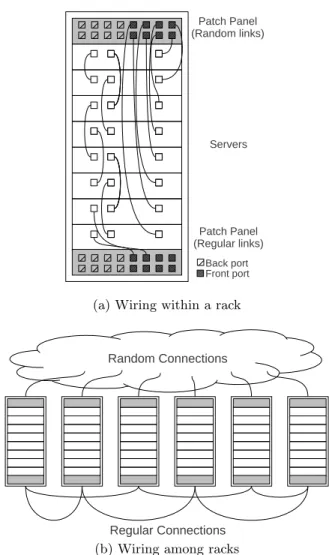
world racks. In such a scenario, each rack would have the regular lattice framework pre-wired. One way to perform this wiring easily, without the need to resort to long wires that span across the full length of the datacenter, is to con-nect each host not to the physically adjacent host, but to alternate and double back at the edge of the network. Thus, instead of wiring five nodes in a 1-2-3-4-5-1 pattern, where the 5-1 connection would have to be very long, the nodes can be wired in a 1-3-5-4-2-1 pattern, where every wire that is part of the regular lattice is approximately the same length, and no wires cross the datacenter. It is possible to create highly scalable, reusable, componentized racks with the aid of patch panels placed in each rack. One edge of the regular lattice would connect to the patch panel, enabling multiple racks to be easily patched into a string, and the random links emanating from each rack to other racks would be routed to the patch panel as well. Random and regular links can use different patch panels for ease of maintenance. Once racks are internally wired, datacenter administrators can wire the back ports of patch panels among racks to complete the con-struction of the network. Figure 2 illustrates a simplified example based on the SW-Ring structure.
Connecting a SWDC to the outside world can be per-formed with the aid of switches. The full connectivity pro-vided by the SWDC enable any number of switches to be connected to any location within the datacenter. However, in the rest of this paper, we focus exclusively on the network connection and traffic inside datacenters, since the traffic in-ternal to datacenters accounts for more than 80% of the total traffic even in client-facing web clouds [12].
(a) Wiring within a rack
(b) Wiring among racks
Figure 2: Wiring SW-Ring using patch panels.
4.
CONTENT ROUTING IN THE
SMALL-WORLD
One of the strengths of SWDC is that the physical net-work structure can correspond to the logical netnet-work struc-tures of the applications. This enables efficient content ad-dressing, and enables applications such as distributed hash tables (DHTs) [16, 11], multicast, aggregation and many others. Conventional hierarchical networks are not a good substrate for content addressing. Consider the case of de-ploying CAN [34] in the datacenter. Every communication would be subject to layers of processing through the stan-dard communication stack. All packets would have to go through multiple layers of switches to get to their destina-tion because the physical locadestina-tion and connecdestina-tion of nodes would not correspond to the logical structure of the sys-tem. Thus, adjacent nodes in the virtual space can require packets to travel through the whole hierarchy of switches for data exchange. Although the switches provide fast forward-ing of packets to far nodes, the top level switches can pose bottlenecks to the overall bandwidth.
In contrast, the physical topology of SWDCs can mirror the logical structure of a multidimensional space, simplify-ing namsimplify-ing and routsimplify-ing. Nodes can be addressed not by an opaque IP address, but by an assigned geographical
iden-Topology # Nodes Switching Delay Links per server Note
SW-Ring 10.24K 64B Pkt: 4.3 (15.8)µs 1 GigE×6 NetFPGAs are used as default.
SW-2DTorus 1KB Pkt: 11.7 (150.0)µs Numbers in parentheses are
SW-3DHexTorus for cases without NetFPGA
CamCube (3D Torus) support.
CDC (2,5,1) 10.24K TOR: 6µs, AS: 3.2µs, CS: 5µs 1 GigE×1 Delays are independent of
CDC (1,7,1) packet sizes. 10 GigE links
CDC (1,5,1) are used among switches.
Table 2: Base configurations for SWDC, CamCube, and CDC. SWDCs and CamCube have 6 1GigE ports on each server and NetFPGA accelerates the switching performance. 3 level switches with different oversubscription rates connect CDC nodes.
tity or other customized addressing scheme that captures their location. Since this location corresponds to the node’s logical position, this enables data-addressing: a key-value pair can be routed to the responsible home node by key, for example. Content routing in the datacenter was proposed and examined in depth by CamCube, from which we derive our motivation and the API for content addressing. Unlike CamCube, which relies solely on a rigid torus structure for its routing, the additional random links in a SWDC provide significant shortcuts that can greatly improve performance and distribute load.
5.
EVALUATION
In this section, we further explore and evaluate the char-acteristics of SWDCs including network hop counts, latency and bandwidth, load distribution, and fault tolerance in comparison to CamCube and conventional hierarchical dat-acenter (CDC) models.
5.1
Test Environment
We evaluate the performance characteristics of SWDCs through simulations of realistically-sized datacenters. We use a fine-grained packet-level simulator that considers de-lays in links, servers, and switches, reflects link and buffer capacities, and models topology and routing protocols. The simulator can measure evaluation metrics such as packet de-livery latency, network bandwidth, and network hop count. We compare SWDCs to conventional datacenters (CDCs) as well as CamCube, targeting datacenters with 10,240 servers. CDCs may have different oversubscription rates in each level of switches. The oversubscription ratexrepresents the band-width ratiox: 1 between the lower and upper level switches. We consider three levels of switches that connect 10,240 servers, and we use three numbers to indicate the oversub-scription rate in each level: top of rack switch, aggregation switch, and core switch. For example CDC (2,5,1) indicates that the oversubscription rates in top of rack, aggregation, and core switches are 2, 5, and 1, respectively.
Table 2 summarizes the base configurations we use for each topology. For SWDCs and CamCube, we use NetFP-GAs to accelerate the switching performance. SWDCs and CamCube servers have limited parallelism to serve multiple ports, but switches in CDCs are capable of serving all ports simultaneously as long as there is no contention within the internal switching logic. The delays in the table are based on [9, 2, 6, 5, 7]. Unless otherwise stated, we use greedy rout-ing in SWDCs. We briefly compare the performance with other combinations of hardware settings and routing meth-ods in a later subsection. We do not tackle cost issues in this paper because semiconductor costs are highly dependent on
economies of scale and tend to fall rapidly, sometimes expo-nentially, over time. A hypothetical cost discussion would necessitate market analysis, a topic beyond our expertise, though we do note that the cost of the central component, the NetFPGA, went down four-fold during the period that this paper was under review.
In keeping with prior work in the area, we use three syn-thetic benchmarks and employ different packet sizes for eval-uation:
• Uniform random: Source nodes select random
des-tination nodes in datacenters with uniform random probability. This resembles the shuffle phase of a MapRe-duce task with uniform distribution.
• Local random: Source nodes select random
destina-tion nodes within a cluster with uniform random prob-ability. A cluster in SWDCs and CamCube consists of 640 server nodes that are neighbors in the lattice net-work. For CDCs, a cluster is the server nodes under same aggregation switches (2nd level). In comparison to the uniform random workload, this workload bet-ter characbet-terizes a real datacenbet-ter application because most of the applications generate traffic that travels short distance from the source [3, 25]
• MapReduce: (1) A source node sends messages to
the nodes in the same row of its rack. (2) The nodes that receive the messages send messages to the nodes in the same columns of their racks. (3) All the nodes that receive the messages exchange data with the servers in the same cluster and outside the cluster with 50% probability each. This benchmark resembles the MapRe-duce application used in Octant [38], where server nodes compute and exchange information with other nodes during the reduce phase.
5.2
Path Length Analysis
Before evaluating the performance of running applications in SWDCs, we first evaluate the network path length, a key factor that influences network latency and bandwidth.
5.2.1
Dijkstra Path Length
To characterize shortest possible path lengths under dif-ferent datacenter topologies, we first determine the shortest paths from each node to the others using Dijkstra’s algo-rithm [10], and take the average of this metric across all nodes. Since CDCs only have paths of length 2, 4, and 6, where the paths involve climbing up and down up to three levels of switching hierarchy, the discussion below focuses on SWDCs and CamCube.
0 5 10 15 20 25
SW Ring SW 2DTor SW 3DHexTor CamCube
Path Length
Data Center Topology Average of Optimum Shortest Path Length
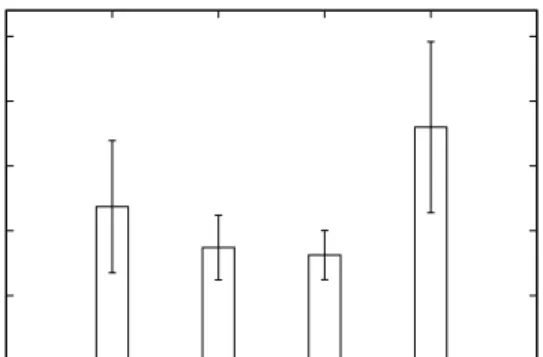
Figure 3: Dijkstra path length. Topologies with larger num-ber of random links have shorter path length.
Figure 3 compares the Dijkstra path lengths achieved by small-world networks to CamCube. The Dijkstra path lengths in SWDCs are 2 to 3 times shorter, on average, than Cam-Cube. Among SWDCs, the topologies with larger number of random links achieve shorter path lengths. Surprisingly, path lengths in SWDCs are comparable to conventional dat-acenters. This implies that, depending on the performance of the switching logic, SWDC can provide comparable or better network service than CDCs.
5.2.2
Greedy Path Length
To evaluate the realistic path lengths that SWDCs would achieve when employing the cheaper greedy routing tech-nique, we measure the path length between all nodes when using greedy routing with uniform random traffic on each topology. Each node using the greedy routing method is aware of the geographical identities of its three hop neigh-bors.
Figure 4 shows the resulting greedy path length. Cam-Cube achieves almost identical results as the Dijkstra path length experiment since greedy routing leads to the shortest path in a 3D torus. However, all SWDCs topologies achieve shorter greedy path lengths than CamCube.
Since each SWDC nodes use a small amount of informa-tion for routing, the path length increases compared to the optimal Dijkstra path lengths which are determined using global information. Whereas topologies with larger num-ber of random links achieve shorter Dijkstra path lengths, this trend is reversed for greedy paths. SW-Ring’s greedy path length is significantly higher than its Dijkstra path length, because greedy routing is unable to fully take advan-tage of random links with limited local information. On the other hand, SW-3DHexTorus’s greedy path lengths are only moderately longer than its Dijkstra path length because the higher dimension lattice network provides relatively shorter paths when random links are unavailable.
5.3
Packet Delivery Latency
Because the average path lengths of SWDCs exceed that of CDCs, one can expect the latency of a SWDC to be larger than CDCs. Figure 5 shows the average packet delivery la-tencies for comparable SWDC, CDC and CamCube configu-rations. Each server in this evaluation generates 300 packets
0 5 10 15 20 25
SW Ring SW 2DTor SW 3DHexTor CamCube
Path Length
Data Center Topology
Average of Path Length When Using Greedy Routing
Figure 4: Greedy path length. SWDC topologies based on lattices of larger dimensions achieve shorter path lengths.
per second and MapReduce traffic launches multiple jobs si-multaneously to fulfill the packet rate.
The measured packet delivery latencies reflect the trends of the path lengths discussed in the previous subsection. The path length partially accounts for the higher latency of SWDCs, but the performance of the switching logic also plays a significant role.
While the packet switching latency in SWDC varies de-pending on the packet sizes, datacenter switches in CDCs have short constant latencies due to cut-through routing and can process multiple packets at the same time. Therefore, the latency gap between SWDCs and CDCs becomes larger when using 1KB packets compared to using 64B packets. When using uniform random 1KB packets in SW-3DHex-Torus, the average latency is 5.3 times greater than the la-tency of CDC(1,5,1).
Interestingly, SWDCs achieve lower latencies than CDCs for certain benchmarks. In the MapReduce benchmark with 64B packets, the benchmark generates packets for each phase of MapReduce in a short time interval and these packets are subject to queuing. CDC servers have one network port per server whereas SWDC servers have six ports. Therefore, the wide bisection bandwidth helps SWDC to minimize the queuing delays and outperform conventional datacenters for this benchmark.
SWDCs generally exhibit lower latencies than CamCube. The only cases that CamCube outperforms SWDCs – only for SW-Ring and SW-2DTorus – are when using local ran-dom benchmark. This is because the packets from the bench-mark travels short distance and SW-Ring and SW-2DTorus have lower dimension lattice than CamCube.
To summarize, SWDC outperforms CamCube for most cases. Due to longer path lengths and increased switching delays, SWDCs typically show larger latencies than CDCs.
5.4
Maximum Aggregate Bandwidth
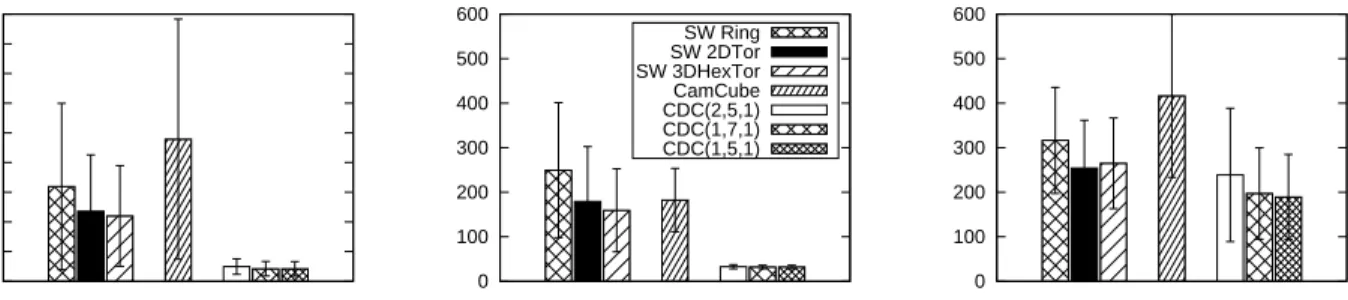
To measure the maximum aggregate bandwidth, we mea-sure the aggregate bandwidth of the network when every node pair is sending a burst of 500 packets. The results for the different benchmarks are collated in Figure 6.
Although the packet latencies of SWDCs were larger than CDCs for most cases, SWDCs achieve higher or comparable maximum aggregate bandwidth than CDCs. For the 64B packet workloads (Figure 6(a)), SWDC outperforms CDC
0 20 40 60 80 100 120 140 Latency (us)
Uniform Random (64B Packet)
0 10 20 30 40 50 60 70 80 90 100
Local Random (64B Packet)
0 50 100 150 200 250 300 MapReduce (64B Packet)
(a) Using 64B packets. SW-3DHexTorus always outperforms CamCube and CDCs suffers from queuing delay for MapReduce.
0 100 200 300 400 500 600 700 800 900 Latency (us)
Uniform Random (1KB Packet)
0 100 200 300 400 500 600
Local Random (1KB Packet)
SW Ring SW 2DTor SW 3DHexTor CamCube CDC(2,5,1) CDC(1,7,1) CDC(1,5,1) 0 100 200 300 400 500 600 MapReduce (1KB Packet)
(b) Using 1KB packets. Absence of physical switches in SWDCs makes larger latency gaps between SWDC and CDCs. Figure 5: Average packet delivery latency. While relatively longer path lengths and larger switching delays pose problems for SWDCs compared to conventional datacenters, they achieve comparable delays for the MapReduce benchmark.
0 50 100 150 200 250 300 350 400 Bandwidth (Gbps)
Uniform Random (64B Packet)
SW Ring SW 2DTor SW 3DHexTor CamCube CDC(2,5,1) CDC(1,7,1) CDC(1,5,1) 60 80 100 120 140 160 180 200 220 240 260
Local Random (64B Packet)
20 40 60 80 100 120 140 160 180 200 MapReduce (64B Packet)
(a) Using 64B packets. SW-2DTorus and SW 3DHexTorus outperforms CamCube and CDCs for all cases.
0 500 1000 1500 2000 2500 Bandwidth (Gbps)
Uniform Random (1KB Packet)
600 700 800 900 1000 1100 1200 1300 1400 1500
Local Random (1KB Packet)
400 500 600 700 800 900 1000 1100 1200 MapReduce (1KB Packet)
(b) Using 1KB packets. SW-3DHexTorus shows 1.5% less bandwidth for MapReduce than CDC, but outperforms for all cases. Figure 6: Maximum aggregate bandwidth. SWDCs achieve high bandwidth due to the additional, mostly-disjoint paths provided by the random links.
for almost all configurations. There are several reasons for this: the SWDC overhead for switching small packets is small; the number of network ports per server in SWDC is greater than CDC; and the bandwidth of CDC is bounded by the top level switches. The bandwidth of SW-3DHexTorus is, at its maximum, 1600% greater than CDC(1,5,1) for the uniform random benchmark. The more the benchmark lim-its the packet travel distance, the smaller the bandwidth gap between SWDC and CDC becomes. This is because SWDC is effective at transferring packets to far away nodes and CDC is suitable for sending packets locally without going up and down the oversubscribed network hierarchy.
SW-2DTorus and SW-3DHexTorus outperform CamCube for all cases due to their shorter path length. The band-width of 3DHexTorus is 312% larger than that of CamCube for the uniform random benchmark while SW-Ring achieves comparable performance.
For large packet workloads (Figure 6(b)), CDCs provides comparable bandwidth to SWDCs for local random and MapReduce benchmarks. This is due to the minimal uti-lization of random shortcuts in SWDCs and limited usage of the top level switches in CDC. However, SW-3DHex-Torus demonstrates bandwidth that is higher than or com-parable to CDCs for both benchmarks and higher band-width for uniform random benchmarks: SW-3DHexTorus shows 1.5% lower bandwidth for MapReduce benchmark, but 637% higher bandwidth for uniform random benchmark than CDC(1,5,1). CamCube generally shows lower band-width than SW-2DTorus and SW-3DHexTorus: SW-3DHex-Torus operates at maximum 314% greater bandwidth than CamCube. CDC(2,5,1) performs the worst for all cases due to oversubscription in two levels of switches, namely, top of rack and aggregation switches.
Overall, SWDCs generally provide higher bandwidth than CamCube. They also provide bandwidth that is higher than or comparable to CDCs. Similar to the latency results, high dimension lattice networks such as SW-3DHexTorus lead to higher bandwidth. Although the packet latencies are greater than CDCs, SWDC is appealing to applications where com-munication across datacenter is frequent and requires high bandwidth.
5.5
Hardware Acceleration
In this subsection, we briefly compare the performance of SWDCs and CamCube with different hardware and rout-ing configurations. We compare the latency and bandwidth of our base case using NetFPGA and greedy routing with the cases of using shortest path routing with and without NetFPGAs. Although we only show the cases for the uni-form random benchmark with 1KB packets in this paper, the performance of other SWDC configurations shows qual-itatively similar results.
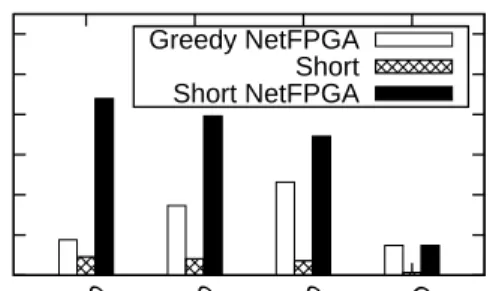
Figure 7 illustrates the latency of SWDCs with and with-out hardware assistance for inter-NIC rwith-outing. The forward-ing latencies are at least three times larger without hardware acceleration. In CamCube, the effect of switching delay is more obvious since the packets travel through larger number of hops. Routing purely in software effectively transforms the node into a store-and-forward platform, where the for-warding can take effect only when the packet has been re-ceived in full, and thus the switching delay is highly
0 500 1000 1500 2000 2500 3000 3500
SW Ring SW 2DTorSW 3DHexTorCamCube
Latency (us)
Packet Delivery Latency (uniform random 1KB packets) Greedy NetFPGA
Short Short NetFPGA
Figure 7: Latency of SWDC and CamCube with different hardware and routing configurations.
0 1000 2000 3000 4000 5000 6000
SW Ring SW 2DTorSW 3DHexTorCamCube
Bandwidth (Gbps)
Maximum Aggregate Bandwidth (uniform random 1KB packets)
Greedy NetFPGA Short Short NetFPGA
Figure 8: Aggregate bandwidth of SWDC and CamCube with different hardware and routing configurations. dent on the packet size [2]. Hardware accelerators such as NetFPGAs or GPUs provide a performance boost by miti-gating this effect. If shortest path routing is used in SWDCs in conjunction with NetFPGA assistance, we can achieve significantly lower latencies.
Figure 8 shows that bandwidth measurements show simi-lar trends. Our base case with hardware acceleration enables SWDC to achieve 1.9 to 6.5 time higher bandwidth than shortest path routing without NetFPGAs. Again, shortest path routing and NetFPGA combinations yield the best re-sults. SW-Ring performs the best for this case since the Dijkstra path length is the shortest as shown in Figure 3.
Both the latency and bandwidth comparisons demonstrate the need for hardware acceleration. Further, in environ-ments with abundant CPU resources, the use of shortest path routing will lead to further latency and bandwidth im-provements.
5.6
Load Distribution
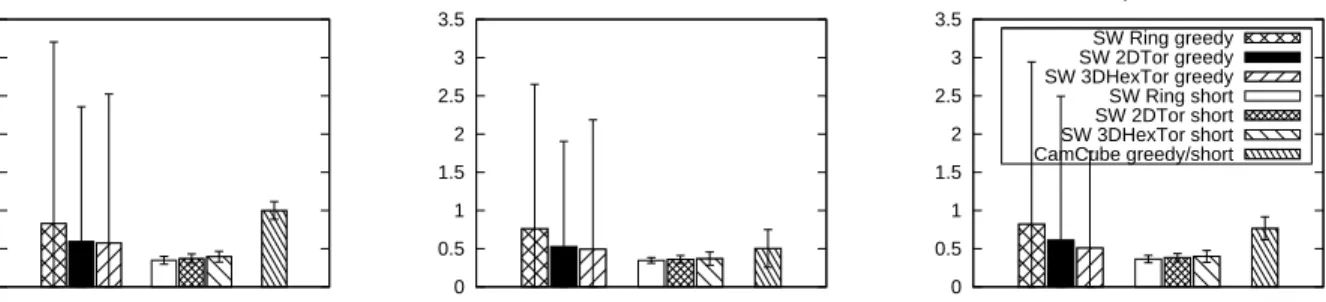
Compared to CamCube and CDC, SWDC utilizes ran-dom links as shortcuts. Thus, packets may overload certain links or servers. Thus, we analyze the traffic load on each server under different benchmarks for SWDC and CamCube to measure the amount of average packet load per server and the load distribution. Figure 9 illustrates the average
0 0.5 1 1.5 2 2.5 3 3.5
Packet load per server normalized to CamCube of uniform random
Uniform Random 0 0.5 1 1.5 2 2.5 3 3.5 Local Random 0 0.5 1 1.5 2 2.5 3 3.5 MapReduce SW Ring greedy SW 2DTor greedy SW 3DHexTor greedy SW Ring short SW 2DTor short SW 3DHexTor short CamCube greedy/short
Figure 9: Packet load distribution. SWDC with greedy routing imposes less overall load than CamCube.
and the standard deviations of the numbers of packets each server processes. We normalize the bars to CamCube with the uniform random benchmark. We also include the results of using shortest path routing for comparison.
The average number of packets processed per server fol-lows the trends of path length. The longer the path that a packet travels, the larger the number of servers that pro-cesses the packet. Therefore, for all benchmarks, SW-3DHex-Torus processes the same job with the least amount of work among all others – excluding the shortest path routing cases – and CamCube shows better performance than SW-Ring for local random benchmarks.
However, greedy routing in SWDCs can lead to load im-balance under certain circumstances. Because greedy rout-ing maintains no global state and picks only locally opti-mal routes, it may end up favoring sopti-mall number of random links. On the contrary, an optimal routing algorithm will select the random links with the balanced random distribu-tion, similar to how random links were built, based on the global information of the network. This explains the rela-tively high standard deviation bars in Figure 9. This im-balance represents a tradeoff between performance and the simplicity of the routing algorithm. SWDCs still complete the benchmarks with less total overhead than CamCube in most cases.
The experiment also shows how much a better routing algorithm can improve the load balance and performance of a small-world network. As shown in the second set of bars, both the amount of load and its distribution are all better when shortest-path routing is employed. There are other techniques, such as pseudo-randomization when mak-ing greedy decisions and routmak-ing packets adaptively based on link load counters, that can be employed to improve the performance of greedy routing.
5.7
Fault Tolerance
The failure characteristics of SWDC and CamCube are different from CDCs. Switch failures can disconnect many nodes in CDCs, while SWDC and CamCube, which are not dependent on a switch fabric, exhibit tremendous failure re-silience. Since each server node acts as a switch in SWDC and CamCube, node and link failures can cause path disrup-tion, but the abundance of alternative paths often provide alternative paths for flows. To evaluate the fault tolerance characteristics, we simulate random node failures and mea-sure the path lengths and connectivity among live nodes.
0 10 20 30 40 50 0 10 20 30 40 50 60 70 Path Length
Percentage of Failed Node
Optimum Shortest Path Length Under Random Node Failure
SW Ring SW 2DTor SW 3DHexTor CamCube
Figure 10: Path length under failure. The increase in path length under failure is moderate.
0 20 40 60 80 100 0 10 20 30 40 50 60 70 80 90
Percentage of Preserved Path
Percentage of Failed Node
Percentage of Preserved Path between Live Nodes Under Random Failure
SW Ring SW 2DTor SW 3DHexTor CamCube
Figure 11: Connectivity under failure. SWDCs can maintain strong connectivity in the presence of many failures.
Figure 10 shows the average path length to connect all live node pairs. For both SWDC topologies and CamCube, the path stretch increases gradually as the percentage of failed node increases. Because SWDC and CamCube topologies are degree 6 graphs, where servers can easily forward pack-ets through alternative routes, random node failure does not greatly affect network performance. The amount of increase
in path stretch is greater for the topologies with fewer num-ber of random links.
The percentage of preserved connections under failure also shows similar trends (Figure 11). All topologies maintain over 90% of connections until 50% of nodes fail. SWDCs maintain more connections than CamCube, while SW-Ring, which has the largest number of random links, keeps the greatest number of connections under equivalent failure con-ditions.
5.8
Summary
The summaries of the findings throughout this section are as follows:
• Path length: Average path lengths in SWDCs can
be less than half of CamCube. The random links in the topology contribute to the reduction of the shortest path lengths, while the regular links impact the greedy path lengths.
• Latency: Average packet delivery latencies of SWDCs
is less than CamCube but greater than CDC. Depend-ing on the benchmark, SWDCs can achieve smaller latencies than CDC by taking advantage of multiple network ports.
• Bandwidth: Depending on the application and packet
sizes, SWDCs’ maximum aggregate bandwidth can be 6 to 16 times greater than CDC and 3 times greater than CamCube.
• Hardware support: Hardware acceleration is
crit-ical to providing low latency and high bandwidth in SWDCs.
• Load distribution: Greedy routing can cause uneven
distribution of load in SWDC. The load to process the same job on SWDCs is typically less than in CamCube.
• Fault tolerance: SWDCs can maintain over 90% of
connectivity among nodes until 50% of total nodes fail. The random links contribute to stronger connectivity and node failures degrades the path length between node pairs very moderately.
The simulations in this paper use a fixed number and de-gree of nodes, which reflect realistic hardware constraints. Past work on mathematical models of small-world networks [18, 33, 26] provides insights on how SWDCs can scale and per-form when these fixed parameters are changed.
6.
RELATED WORK
Small-world phenomena and networks have been studied since 1960s. Kleinberg provides extensive theoretical analy-sis and a survey of past work on small-world networks [21, 22]. The theoretical aspects of SWDCs build on this work.
Small-world networks provide the foundation for certain distributed hash tables and peer-to-peer systems. Freenet [40] and Symphony [31] provide mechanisms to achieve small-world properties in wide-area networks. Viceroy [28], a peer-to-peer DHT, builds a butterfly network inspired by small-world networks. The Meridian [37] and Cubit [36] systems create lightweight overlays in wide-area networks where each node is an expert for other nodes and data in its own region, and possesses just the right number of outgoing links to far
regions to perform efficient routing. Our design differs from this work in that we propose to use small-worlds for the ac-tual physical topology of a datacenter, as opposed to the structure of an overlay.
More recently, a large body of work has emerged on how to improve bisection bandwidth, failure resilience, and la-tency of datacenter networks through innovative topologies. VL2 [12] uses flat addressing to separate names and loca-tions of servers and performs load balancing and flexible routing to provide each server with the illusion of a large level 2 switch over the entire datacenter. This structure en-ables VL2 to support efficient content-addressing. Unlike SWDC, VL2 depends on an expensive switched fabric. Fur-ther, since the physical location of addresses are hidden from application programmers and the network is complex, the costs of data access are nonuniform and opaque to applica-tion programmers. BCube [13] and DCell [14] are similarly novel datacenter topologies that are based on a hierarchi-cal cell organization. Both approaches aim to reduce path length while improving bisection bandwidth through a rich inter-cell connection network. They require a complex reg-ular network pattern, and depend on numerous commodity switches. SWDC requires a relatively simple regular, switch-free point-to-point network and random links can be wired with some imprecision. Scafida [15] is another datacen-ter network architecture inspired by scale-free networks [4]. Similar to SWDC, it uses randomness to connect nodes. However, due to lack of regularity in the network, Scafida cannot efficiently support content-based and greedy routing. Perhaps the closest work to ours is CamCube [1], a content-addressable network based on a 3D torus. Simple regular connections and APIs that expose the topology enable plication programmers to program content-addressable ap-plications. However, the torus topology suffers from large network hop counts as we have shown in this paper. SWDC can provide the same APIs as CamCube while improving performance through its random links.
The software switching techniques used in SWDCs are similar to those in RouteBricks [9] and the Linux software router [2] in a small scale. PacketShader [17] and Server-Switch [27] accelerate software switches and routers using hardware such as GPUs and NetFPGAs. These techniques are applicable to SWDCs as well.
7.
CONCLUSIONS
In this paper, we introduced small-world datacenters, a datacenter topology based on small-world networks com-prised of a regular short-distance lattice amended with longer-range random links. Such a topology is easy to wire, com-poses and scales well to large datacenters, supports content addressing, and achieves higher or comparable performance compared to both conventional and recently proposed net-work designs. SW-2DTorus and SW-3DHexTorus outper-form CamCube for most of the evaluation metrics due to random links that provide efficient cut-through routes across the datacenter. Although SWDCs exhibit higher latencies than conventional datacenters, they achieve roughly an or-der of magnitude higher bandwidth. The latency gap be-tween SWDCs and CDC stems from the packet process-ing efficiency in servers versus in switches. As software routing technology advances, we expect SWDC to become more competitive on the latency front while providing higher
bandwidth, greater failure resiliency and a more flexible ad-dressing framework.
Acknowledgments
We would like to thank the anonymous reviewers for their feedback, and Anthony Rowstron for insightful discussions on efficient wiring in datacenters. This material is based upon work supported by the National Science Foundation under Grant No. 0546568.
8.
REFERENCES
[1] H. Abu-Libdeh, P. Costa, A. Rowstron, G. O’Shea, and A. Donnelly. Symbiotic Routing in Future Data Centers. InProceedings of the ACM SIGCOMM Conference on Data Communication, pages 51-62, New Delhi, India, August 2010.
[2] R. Bolla and R. Bruschi. Linux Software Router: Data Plane Optimization and Performance Evaluation. In Journal of Networks, 2(3):6–17, June 2007.
[3] T. Benson, A. Akella, and D. A. Maltz. Network Traffic Characteristics of Data Centers in the Wild. In Proceedings of the Conference on Internet
Measurement, pages 267-280, Melbourne, Australia, November 2010.
[4] A. L. Barabasi and R. Albert. Emergence of Scaling in Random Networks. InScience, 286(5439):509–512, October 1999.
[5] Cisco. Cisco Nexus 5000 Series Architecture: The Building Blocks of the Unified Fabric.
http://www.cisco.com/en/US/prod/collateral/switches/ ps9441/ps9670/white paper c11-462176.pdf, 2009. [6] Cisco. Cisco Catalyst 4948 Switch.
http://www.cisco.com/en/US/prod/collateral/switches/ ps5718/ps6021/product data sheet0900aecd8017a72e.pdf, 2010.
[7] Cisco. Cisco Nexus 7000 F-Series Modules.
http://www.cisco.com/en/US/prod/collateral/switches/ ps9441/ps9402/at a glance c25-612979.pdf, 2010. [8] Cisco. Cisco Data Center Infrastructure 2.5 Design
Guide.
http://www.cisco.com/en/US/docs/solutions/Enterprise/ Data Center/DC Infra2 5/DCI SRND 2 5 book.html, March 2010.
[9] M. Dobrescu, N. Egi, K. Argyraki, B.-G. Chun, K. Fall, G. Iannaccone, A. Knies, M. Manesh, and S. Ratnasamy. RouteBricks: Exploiting Parallelism to Scale Software Routers. InProceedings of the ACM Symposium on Operating Systems Principles, pages 15–28, Big Sky, MT, USA, October 2009.
[10] E. W. Dijkstra. A Note on Two Problems in
Connexion with Graphs. InNumerische Mathematik, 1:269–271, 1959.
[11] B. Fitzpatrick. Distributed Caching with Memcached. InLinux Journal, 124, August 2004.
[12] A. Greenberg, J. R. Hamilton, N. Jain, S. Kandula, C. Kim, P. Lahiri, D. A. Maltz, P. Patel, and S.
Sengupta. VL2: A Scalable and Flexible Data Center Network. InProceedings of the ACM SIGCOMM Conference on Data Communication, pages 51-62, Barcelona, Spain, August 2009.
[13] C. Guo, G. Lu, D. Li, H. Wu, X. Zhang, Y. Shi, C. Tian, Y. Zhang, and S. Lu. BCube: A High
Performance, Server-Centric Network Architecture for Modular Data Centers. InProceedings of the ACM SIGCOMM Conference on Data Communication, pages 63–74, Barcelona, Spain, August 2009.
[14] C. Guo, H. Wu, K. Tan, L. Shi, Y. Zhang, and S. Lu. DCell: A Scalable and Fault-Tolerant Network Structure for Data Centers. InProceedings of the ACM SIGCOMM Conference on Data Communication, pages 75–86, Seattle, WA, USA, August 2008. [15] L. Gyarmati and T. A. Trinh. Scafida: A Scale-Free
Network Inspired Data Center Architecture. In SIGCOMM Compututer Communication Review, 40(5):5–12, October 2010.
[16] S. D. Gribble. A Design Framework and a Scalable Storage Platform to Simplify Internet Service Construction. InPh.D. Thesis, U.C. Berkeley, September 2000.
[17] S. Han, K. Jang, K. Park, and S. Moon.
PacketShader: A GPU-Accelerated Software Router. InProceedings of the ACM SIGCOMM Conference on Data Communication, pages 195–206, New Delhi, India, August 2010.
[18] M. D. Humphries and K. Gurney. Network ’Small-World-Ness’: A Quantitative Method for Determining Canonical Network Equivalence. InPLoS ONE, 3(4):1–10, April 2008.
[19] HP. HP Rack 10000 G2 Series Quick Spec, DA12402. http://h18004.www1.hp.com/products/quickspecs/ 12402i na/12402 na.pdf, 2011.
[20] E. Kranakis, H. Singh, and J. Urrutia. Compass Routing on Geometric Networks. InProceedings of the Canadian Conference on Computational Geometry, pages 51-54, Vancouver, British Columbia, Canada, August 1999.
[21] J. Kleinberg. The Small-World Phenomenon: An Algorithmic Perspective. InProceedings of the ACM Symposium on Theory of Computing, pages 163–170, Portland, OR, USA, May 2000.
[22] J. Kleinberg. Small-World Phenomena and the Dynamics of Information. InProceedings of the Conference on Neural Information Processing Systems, pages 431–438, Vancouver, BC, Canada, December 2001.
[23] J. Kleinberg. The Small-World Phenomenon and Decentralized Search. InSIAM News, 37(3), April 2004.
[24] J. Kleinberg. Complex Networks and Decentralized Search Algorithms. InProceedings of the International Congress of Mathematicians, pages 1019–1044, Madrid, Spain, August 2006.
[25] S. Kandula, S. Sengupta, A. Greenberg, P. Patel, and R. Chaiken. The Nature of Data Center Traffic: Measurements & Analysis. InProceedings of the Conference on Internet Measurement, pages 202-208, Chicago, IL, USA, November 2009.
[26] R. V. Kulkarni, E. Almaas, and D. Stroud. Exact Results and Scaling Properties of Small-World Networks. InPhysical Review Letters,
61(4):4268–4271, April 2000.
Xiong, R. Gao, and Y. Zhang. ServerSwitch: A Programmable and High Performance Platform for Data Center Networks. InProceedings of the Symposium on Networked System Design and Implementation, Boston, MA, USA, March 2011. [28] D. Malkhi, M. Naor, and D. Ratajczak. Viceroy: A
Scalable and Dynamic Emulation of the Butterfly. In Proceedings of the Symposium on PRinciples of Distributed Computing, pages 183–192, Monterey, CA, USA, July 2002.
[29] J. Moy. OSPF Version 2. RFC i2328. April 1998. [30] S. Milgram. The Small World Problem. InPsychology
Today, 2:60–67, 1967.
[31] G. S. Manku, M. Bawa, and P. Raghavan. Symphony: Distributed Hashing in a Small World. InProceedings of the USENIX Symposium on Internet Technologies and Systems, pages 127–140, Seattle, WA, USA, March 2003.
[32] J. Naous, G. Gibb, S. Bolouki, and N. McKeown. NetFPGA: Reusable Router Architecture for Experimental Research. InProceedings of the ACM workshop on Programmable Routers for Extensible Services of Tomorrow, pages 1–7, Seattle, WA, USA, August 2008.
[33] M.E.J. Newman, C. Moore, and D.J. Watts. Mean-Field Solution of the Small-World Network Model. InPhysical Review Letters, 84(14):3201–3204, April 2000.
[34] S. Ratnasamy, P. Francis, M. Handley, R. Karp, and S. Shenker. A Scalable Content-Addressable Network. InProceedings of the ACM SIGCOMM Conference on Data Communication, pages 161–172, San Diego, CA, USA, August 2001.
[35] J. Travers and S. Milgram. An Experimental Study of the Small World Problem. InSociometry,
32(4):425–443, 1969.
[36] B. Wong and E. G. Sirer. Approximate Matching for Peer-to-Peer Overlays with Cubit. InComputing and Information Science Technical Report, Cornell University, December 2008.
[37] B. Wong, A. Slivkins, and E. G. Sirer. Meridian: A Lightweight Network Location Service Without Virtual Coordinates. InProceedings of the ACM SIGCOMM Conference on Data Communication, pages 85–96, Philadelphia, PA, USA, August 2005. [38] B. Wong, I. Stoyanov, and E. G. Sirer. Octant: A
Comprehensive Framework for the Geolocalization of Internet Hosts. InProceedings of the Symposium on Networked System Design and Implementation, pages 313–326, Cambridge, MA, USA, April 2007.
[39] D. J. Watts and S. H. Strogatz. Collective Dynamics of ‘Small-World’ Networks. InNature, 393:440–442, June 1998.
[40] H. Zhang, A. Goel, and R. Govindan. Using the Small-World Model to Improve Freenet Performance. InProceedings of the IEEE International Conference on Computer Communications, pages 1228–1237, New York, NY, USA, June 2002.