Pattern recognition using multilayer
neural-genetic algorithm
Yas Abbas Alsultanny
∗, Musbah M. Aqel
Computer Science Department, College of Computer and Information Technology,Applied Science University, P.O. Box17, Amman 11931, Jordan
Received 2 July 2001; accepted 8 May 2002
Abstract
The genetic algorithm implemented with neural network to determine automatically the suitable network architecture and the set of parameters from a restricted region of space. The multilayer neural-genetic algorithm was applied in image processing for pattern recognition, and to deter-mine the object orientation. The library to cover the views of object was build from real images of (10×10) pixels. Which is the smallest image size can be used in this algorithm to recognize the type of aircraft with its direction
The multilayer perecptron neural network integrated with the genetic algorithm, the result showed good optimization, by reducing the number of hidden nodes required to train the neural network (the number of epoch’s reduced to less than 50%). One of the important results of the implemented algorithm is the reduction in the time required to train the neural network.
c
2002 Elsevier Science B.V. All rights reserved.
Keywords:Neural network; Genetic algorithm; Image processing; Pattern recognition
1. Introduction
Computer imaging separated into two >elds: • Computer vision.
• Image processing.
Computer vision is computer imaging where the application does not involve a hu-man being in the visual loop. Image analysis involves the examination of the image
∗Corresponding author. Fax: 5232899.
E-mail address:[email protected] (Y.A. Alsultanny).
0925-2312/03/$ - see front matter c2002 Elsevier Science B.V. All rights reserved. PII: S0925-2312(02)00619-7
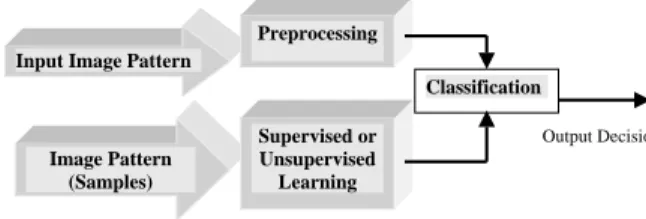
Input Image Pattern
Preprocessing Image Pattern (Samples) Supervised or Unsupervised Learning Classification Output Decision
Fig. 1. Block diagram of decision-theoretical pattern recognition system.
data to facilitate solving a vision problem. The image analysis process involves two other topics:feature extraction is the process of acquiring higher-level image informa-tion, such as shape or color informainforma-tion, and pattern classi>cation is the act of taking this higher-level information identifying objects within image. The block diagram of decision-theoretical pattern recognition shown in Fig. 1 represented by three primary stages [11,6]:
• Preprocessing • Learning • Classi8cation
Preprocessing is used to remove noise and eliminate irrelevant, visually unneces-sary information. Learning stage involves either supervised or unsupervised learning. Classi8cation stage classi>ed the pattern, which is preprocessed in the >rst stage, by computing the output and considering the maximum output is the more similar image in database library to the unknown input pattern image.
2. Multilayer perecptron neural network (MLP)
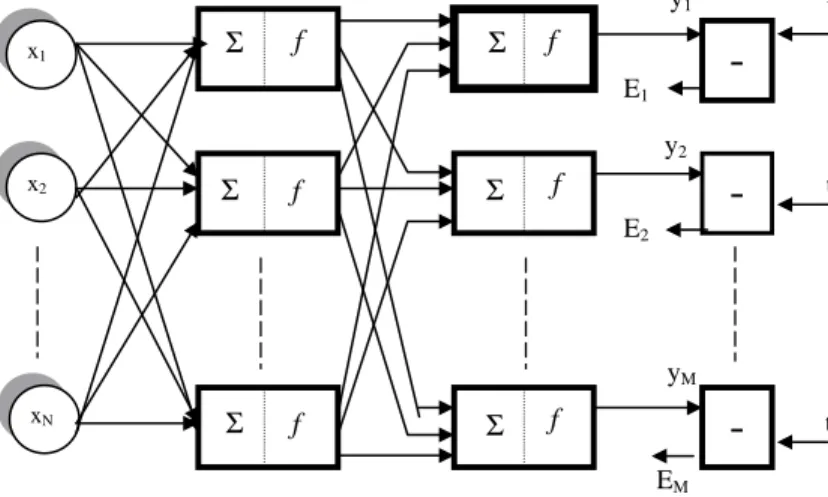
The three layers network with sigmoid activation function is capable to produce a decision function with enough hidden units is shown in Fig. 2.
Theinput layercontains the input nodes interacts with the outside environment. The input units are only buGer units that pass the signal without changing it.
The hidden layer size is left to the appreciation of the user that will estimate the number of hidden nodes by his experience or by trial and error. This number must not be too large to avoid waste of computations and slow convergence process and not too low to make the network capable to absorb the set of training pixels.
The output layer represent the number of nodes, which is equal to the number of classes, each output node representing a class [12,7,4,8].
3. Genetic algorithm(GA)
The parameters which needs to be searched by GA in the training are the range of initial weights (R), initial values of learning rate and momentum rate, and the network architecture. The initial weights are generated using a uniform random number generator
y1 t1 y2 t2 yM tM EM
Input layer hidden layer output layer error target
xN x1 x2
-E2 E1 Σ Σ Σ Σ Σ Σ f f f f f fFig. 2. Multilayer neural network architecture x1; x2; : : : ; xN= input nodes, y1; y2; : : : ; yM = output nodes,
E1; E2; : : : ; EM= error,t1; t2; : : : ; tM= target. Population (Chromosomes) Mating pool (Parent) Sub-population (Offspring) Objective Function Selection Genetic Operation Fitness Phenotype Phenotype Fitness Replacement
Fig. 3. Cycle of GA.
in the range [−R; R]. The network architectures described by the number of hidden layer (h), the number of nodes in each layer (ni; i= 0;1; : : : ; h). The GA proposed
as searching process based on the laws of the natural selection and genetics. This algorithm which is used >rstly to obtain the optimal values of the hidden nodes and the initial values of learning rate (R) and momentum top-level description of a simple GA is shown below [5,3]:
1. Randomly generate an initial population P0= (a0
Start
Initialize a population of chromosomes as current
generation
Calculate the fitness (objective) function for
each chromosome
Apply the crossover and mutation operators to the parent chromosomes and produced a new generation
Replace the new generation as current generation
Initialize weight using the chromosome with the smallest fitness function
Feed forward step of MLP neural net using sigmoid
activation function
Calculate the total sum squared error between
actual and desired output
Update the weight using back-propagation algorithm Stop End Stop the first learning No Yes Yes No First stage Genetic Algorithm Second stage MLP algorithm
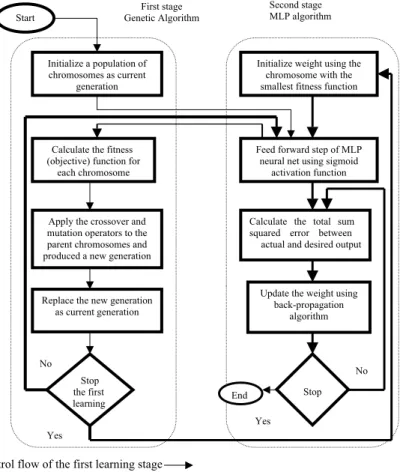
The control flow of the second learning stage The control flow of the first learning stage
Fig. 4. The neural-genetic learning algorithm.
2. Compute the >tness f(at
i) of each chromosome ati in the current population Pt.
3. Create new chromosome Pt of mating current chromosomes, applying mutation and
recombination as the parent chromosomes mate.
4. Delete numbers of the population to make room for new chromosomes. 5. Compute the >tness of f(at
i), and insert these into population.
6. Increment number of generation, if not (end-test) go to step 3, or else stop return the best chromosome.
The GA cycle is shown in Fig. 3. From which the phenotype represents the coding which is used to represent the chromosomes. The mating pool represents the sum-ming of chromosomes that represents the solution of the problem. OGspring represents new chromosomes result by mutation and crossover operation. Lastly, the objective function represents the function that measured the performance of the origin function [10,9,1].
4. Neural-genetic network learning algorithm
The proposed learning algorithm using genetic algorithm with multilayer neural net-works for pattern recognition is presented in Fig. 4. It consists of two learning stages. The >rst learning using genetic algorithm with the feed-forward step uses stage to accelerate the whole learning process. The genetic algorithm performs global search and seeks near-optimal initial point (weight vector) for the second stage. Where, each chromosome is used to encode the weights of neural network. The >tness (objective) function for genetic algorithm is de>ned as the total sum squared system error (TSSE) of the corresponding neural network. Therefore, it becomes an unconstrained optimiza-tion problem to >nd a set of decision variables by minimizing the objective funcoptimiza-tion. The best >tness function value in a population is de>ned as smallest value of the objective in the current population. Let us consider the neural-genetic algorithm as follows:
=* First learning stage *=
Initialize the chromosomes randomly as current generation, initialize working parameters, and set the >rst chromosome as the best chromosome.
a-For i= 0 to population size, do concurrently:
-Initialize sub total 8tness to zero and sub best chromosome as null. b-For j= 1 to Length of chromosomes, do sequentially:
-Perform feed-forward procedure of the MLP (using sigmoid activation function).
-Calculate the objective function (system error for the neural network). Next j
-Calculate the total 8tness by accumulating sub total 8tness. c-Store the best chromsome as sub best chromosome.
Next i
Guarded section 1-entry
d-Compare the sub best chromsome with each other and set the best sub best chromosome as the best chromosome.
Guarded section 1-end
Do
e-For i= 0 to (population size=2), do concurrently:
-Initialize sub total 8tness to zero and sub best chromosome as null. -For j= 1 to length of chromosome, do sequentially:
∗ Select parent using roulette wheel parent selection.
∗ Apply two-point, multipoint, or uniform crossover and mutation to the parents.
-For k= 1 to length of chromosome, do sequentially:
∗ Perform feed-forward procedure of the MLP to parent chromosomes. ∗ Calculate the objective function (system error for the neural network) for parent chromosomes.
Next k
-Calculate the sub total 8tness by accumulating objective of each chromosome.
-Store the best chromosomeas sub best chromosome. Next j
g-Replace the old generation by the new generation WHILE (stopping criteria). =* Second learning stage *=
-Set the best chromosome as the initial weight vector, set up the topologic structure of neural network.
-Compute the actual output of the feed-forward MLP neural network. -Compute the error between desired output and actual.
-Updates the weight using back-propagation algorithm. END
5. Implementation and results
Multilayer neural networks are trained to (12) images of sizes 10×10 pixels, which represents the smallest image size required for the aircraft recognition, where we can recognize the aircraft with their direction. The initial values such as the number of hidden nodes, learning techniques, and input coding in addition to initialization weight have been de>ned. To test the ability of net to pattern recognition in recall or testing phase, the failure rate proposed as the measurement to the sensitivity of neural network is de>ned as
Failure rate (FR)
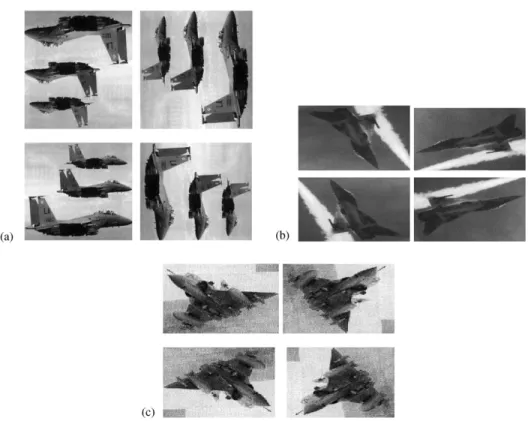
=Total No: of tested imagesTotal number of test image−No:of classi>ed images×100%: Fig. 5 shows the images of 256 gray levels used to test the proposed algorithm.
Test 1: MLP network Training parameters: Image size = 10×10 pixels Number of images = 12 Desired Accuracy = 90% Hidden nodes = 60
Fig. 5. Groups of images of 256 gray level used in testing of the neural-genetic algorithm. (a) Four images to four directions of the same groups of aircraft; (b) Four images to four directions of the same aircraft with missile; (c) Four images to four directions of the same aircraft.
Learning rate = 0:6 Momentum = 0:06 Training result are:
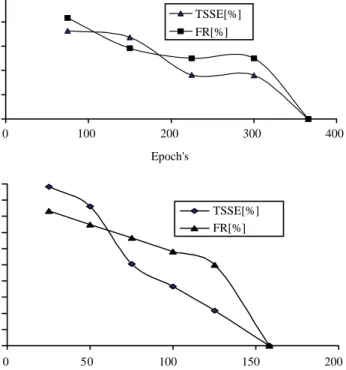
Epoch’s 75 150 225 300 366
Failure rate 83.33% 58.33% 50% 50% 0.00%
TSSE 0.7252 0.6747 0.3647 0.3613 5:7×10⁻⁵
Test 2: Neural-genetic network learning algorithm
The neural-genetic network learning algorithm applied to the same images. A three-layer neural network with one hidden three-layer was used to learn this problem. The total number of links in these three-layer neural networks is 6600.
Training parameters: Population size = 12 Mutation rate = 0:05 Crossover rate = 0:46
Real coding to the chromosomes Length of chromosomes = 6600 Number of generation = 8 Desired accuracy = 90% Training results are:
No. of generation 2 4 6 8
Total Fitness 6.5653 6.4254 5.9028 5.6283
Training results are:
Epoch’s 25 50 75 100 125 158
Failure rate 83.33% 75% 66.67% 58.33% 50% 0.00%
TSSE 0.9831 0.8616 0.5054 0.3651 0.216 0.0008
The system error on the >rst test by using the MLP learning neural network algorithm was 5:73×10−5 after 366 iteration. After 8 generations, the >rst learning stage of
neural-genetic network learning algorithm met stopping criteria. The best average >tness function has value of about 5.6283. The result of the >rst learning stages is used as an initial weight vector for the second learning stage. After 158 iterations, the system error in the neural-genetic neural network learning algorithm converges to a value of less than 0.0008 and the algorithm achieves 100% to train all the images. The performance of hybrid neural-genetic networks and MLP neural net are shown in Fig. 6.
6. Conclusions
The neural network depends on the training conditions (hidden node number, learn-ing rate, momentum, and initial weight). The minimum size used to recognize the type of aircraft and its direction is (10×10) pixels. This technique can be used to detect the stealth aircraft, which cannot be detected by the radar signal. The learning time depends strongly on the resolution of image, hidden nodes and training pixels. The proposed genetic algorithm presented to >nd suitable network, which was able to perform well within the speci>ed tolerance e.g. zero failure rate for MLP net. As
0 20 40 60 80 100 0 100 200 300 400 Epoch's Epoch's TSSE & FR[%] TSSE & FR[%] TSSE[%] FR[%] 0 10 20 30 40 50 60 70 80 90 100 0 50 100 150 200 TSSE[%] FR[%] (a) (b)
Fig. 6. (a) Performance of MLP neural net. (b) Performance of neural-genetic learning algorithm.
far as training procedures are concerned, we have identi>ed some important learning phenomenon e.g. the eGect caused by learning rate, number of hidden units, training of under units, training sets, etc. Thus, the ratio of reduction on the number of epoch’s is least or equal to 50% if we used the genetic algorithm. Integrating the genetic algorithm with MLP network, the following observations are the conclusions can be drawn:
• The results of neural network learning are sensitive to the initial value of the weight vector. A genetic algorithm is employed to perform global search and to seek a good starting weight vector for subsequent neural network learning algorithm. The result is an improvement in the convergence speed of the algorithm.
• The problem of entrapment in a local minimum is encountered in gradient-based neural network learning algorithm. In the neural-genetic learning algorithm pre-sented, this problem is circumvented using a genetic algorithm, which is guided by the >tness function of population rather than gradient direction. After several iterations of the global search, the >rst learning stage returns a near-global op-timum point that is used as the initial weight vector for the second learning stage.
7. For further reading
The following reference may also be of interest to the reader: [2].
Acknowledgements
The authors are very grateful to the useful comments given by anonymous reviewers, which helped greatly in revising this work.
References
[1] D. Anthony, E. Hines, The use of genetic algorithms to learn the most appropriate inputs to neural network, Application of the International Association of Science and Technology for Development-IASTED, June, 1990, 223–226.
[2] T.N. Bui, B.R. Moon, Genetic algorithms and graph partitioning, IEEE Trans. comput. 45 (7) (1996) 841–855.
[3] L. Davis, Hand book of Genetic Algorithms, Van Nostrand Reinhold, New York, 1991.
[4] L. Fauselt, Fundamentals of Neural Networks, Prentice-Hall, International Inc., Englewood CliGs, NJ, 1994.
[5] D.E. Goldberg, Genetic Algorithms in Search, Optimization, and Machine Learning, Addison-Wesley Pub. Comp. Inc., Reading, MA, 1989.
[6] R. Gonzalez, P. Wintz, Digital Image Processing, Addison-Wesley Pub. Comp. Inc., Reading, MA, 1992.
[7] R.L. Harvey, Neural Networks Principles, Prentice-Hall, Englewood CliGs, NJ, 1994.
[8] R.P. Lippmann, Introduction to computing with neural nets, IEEE Trans. Acoust. Speech Signal Process. 4 (87) (1987) 3–22.
[9] M. Mitchill, An introduction to genetic algorithms, Massachusetts Institute of Technology, England, 1996.
[10] S.c. Ng, S.H. Leung, C.Y. Chung, A. Luk, W.H. Lau, The genetic search approach, IEEE Signal process. Mag. 13 (6) (1996) 38–46.
[11] S.E. Umbaugh, Computer Vision and Image Processing A practical approach using CVIP tools, Prentice-Hall PTR, Englewood CliGs, NJ, 1998.
[12] J.M. Zurada, Introduction to Arti>cial Neural Systems, Jaico Pub. House, Bombay, India, 1997.
Yas Abbas K. Alsultannyreceived the B.S. degree from the Technology University, Control and Systems Engineering Department, Iraq in 1982, the M.S. degree, in Computer Engineering from the Technology University, Iraq 1991, and the Ph.D. degree, in image processing from Baghdad University, Iraq, in 1997. From 1997 to 2000, he was an assistant professor at the Computer Engineering Department in Baghdad, and a member in the scienti>c research council in Baghdad. He supervised 13, M.S. thesis. From 2000 he was an assistant professor at the computer Science department, in the Computer Science and Information Technology Department in the Applied Science University, in Jordan, he has been a plenary speaker at various conferences. His research interested, include, image processing, pattern recognition, fuzzy set, neural network, wavelet, and GIS.
Musbah M. Aqelwas born in Hebron=West Bank, in 1959, He received the B.E. degree in electronics & Communication from regional engineering college, Univer-sity of Kashmir, India, in 1987, and the M.Tech. and Ph.D. Degrees in Computer Science from School of Computer and Systems Sciences, Jawaharal Nehru Uni-versity, New Delhi, India, in 1989 and 1993, respectively. From 1994 to 1999 he was an Assistant Professor at the Department of Computer Science and Information Systems, Faculty of Basic Science at Applied Science University, Amman, Jordan, From 1999 to 2001 was a chairman of Computer Science and Information sys-tems Department. He is a member of organization steering, and technical Commit-tees of many national and international conferences, the advisory Board of Jordan Journal of Applied Science, Jordan Engineering Association, and Jordan Computer Society. He is Currently Dean of the Faculty of Computer Science and Information Technology and Associate Professor with the Department of Computer Science at Applied Science University, Amman, Jordan. His research interests include Algorithms Design and Analysis, Database Systems, Simulation and Modeling, Pattern Recognition, and Image Processing.