Detection of Imperative and Declarative Question-Answer Pairs
in Email Conversations
Helen Kwong
Stanford University, USA
[email protected]
Neil Yorke-Smith
SRI International, USA
[email protected]
Abstract
Question-answer pairs extracted from email threads can help construct summaries of the thread, as well as inform semantic-based assistance with email. Previous work dedicated to email threads extracts only questions in interrogative form. We extend the scope of question and answer detection and pair-ing to encompass also questions in imperative and declarative forms, and to operate at sentence-level fidelity. Building on prior work, our methods are based on learned models over a set of features that include the content, context, and structure of email threads. For two large email corpora, we show that our methods balance precision and recall in ex-tracting question-answer pairs, while maintaining a modest computation time.
1
Introduction
Studies of email overload show that the “tyranny of email” negatively impacts work performance and tangibly weighs upon organizations and even national economies [Dabbish and Kraut, 2006]. Various software tools have been devel-oped to ameliorate email overload. At one extreme, some refactor the role and workflow of email (e.g., interweaving it with explicit task management [Belotti et al., 2005], se-mantically understanding actions pertaining to a message and assisting the user to perform them [Freedet al., 2008]). Oth-ers seek to improve email client software with nuggets of AI (e.g., auto-filing messages into folders, detecting missing at-tachments, summarizing email threads) [Dredzeet al., 2008]. One reason for the ubiquity of email is its nature as asyn-chronous, unstructured, written, multi-party communication. Research has sought to automatically derive summaries of email threads and embed them in email clients [Ulrichet al., 2008]. Summaries can beextractive, i.e., selected fragments of the thread, orgenerative, ranging from as sophisticated as a high-level synopsis to as simple as a table of respondent frequencies. One potent form of generative summarization is identification of the questions (explicit or implicit) present in the thread and the answers to them, if any.
We consider the related problems of identifying questions in an email thread (possibly between multiple parties), and linking them to possible answers later in the thread. Our work
is part of an effort to endow an email client with a range of usable smart features by means of AI technology.
Prior work that studies the problems of question identifi-cation and question-answer pairing in email threads has fo-cused on interrogative questions, such as “Which movies do you like?” However, questions are often expressed in non-interrogative forms: declarative questions such as “I was wondering if you are free today”, and imperative questions such as “Tell me the cost of the tickets”. Our sampling from the well-known Enron email corpus finds about one in five questions are non-interrogative in form. Further, previous work for email threads has operated at the paragraph level, thus potentially missing more fine-grained conversation.
We propose an approach to extract question-answer pairs that includes imperative and declarative questions. Our main contributions are: (1) analysis of prior question-answer (Q-A) pairing algorithms on more diverse email corpora (e.g., En-ron), (2) an improved non-learning method for question de-tection, (3) extension of both learning and non-learning meth-ods for answer detection to include non-interrogative ques-tions and to operate at sentence-level fidelity, and (4) analysis of performance with more stringent metrics.
2
Related Work
Shrestha and McKeown [2004] describe an approach for de-tecting question-answer pairs in email threads for the
pur-pose of summarization. For question detection, Shrestha
and McKeown (henceforth S&M) learn a classification model based on parts-of-speech (POS) features, training it on a tran-scribed telephone speech corpus. The focus is on detecting questions in interrogative form only.
For question-answer linkage, S&M work at the paragraph level. They learn a classification model based on features
over original (i.e., non-quoted) paragraphs. The features
include standard informational retrieval measures, such as stop words, cosine similarity, and euclidean distance, features from thread structure, such as the number of interleaved mes-sages, and features based on the set of candidate answer para-graphs, such as the number of candidates. The classifier is trained and tested on an ACM student corpus annotated by two human annotators.
Conget al.[2008] examine question and answer detection and pairing for online forums. These forums bear many simi-larities to email threads, as well as several key distinguishing
characteristics. For instance, over 90% of forum threads con-tain Q-A knowledge (more than for email), the number of participants is often higher, multiple questions and answers are often highly interleaved, quoting is used in different ways, and message reply relationships are usually unavailable.
The approach of Conget al.(henceforth CWLSS) for ques-tion detecques-tion is based on characterizing quesques-tions and non-questions by extracting labelled sequence patterns (LSPs)— as opposed to POS analysis only—and using the discovered patterns as features to learn a classification model for question detection. For online forums, they find the LSP-based clas-sifier outperforms the S&M POS-based clasclas-sifier. CWLSS develop a graph-based propagation method for question-answer linkage, leveraging the linkage structure within fo-rum threads, and combine it with syntactic and classification-based methods for answer identification.
Besides email threads and online forums, there also has been work on extracting question-answer pairs in multi-party dialogue [Kathol and Tur, 2008]. While extraction of ques-tions in meeting transcripts could be similar to that in email text, the structure of email threads is very different from that of meeting speech. For example, while question detection is relatively more simple in email than in speech, the asyn-chronous nature of email and its rich context (e.g., quoting) makes question-answer pairing relatively more difficult.
Harder still than automated answer detection is automated question answering. While question-answering systems serve purposes very different from ours, ideas from the literature on question answering can be of benefit.
3
Algorithms
The starting point for our work is an email thread. Given a set of messages, thread reassembly is the task of extracting the individual threads [Yeh and Harnly, 2006]; we assume this procedure has been performed.
3.1
Question Detection
Question detection serves the greater purpose for us of question-answer linkage. We consider three algorithms for question detection that work at the sentence level, i.e., the algorithms look at each sentence in an email thread and clas-sify each as either a question or not. To serve question-answer linkage, we seek an algorithm that exhibits a sufficiently high
F1score (the geometric mean of precision and recall) on real
data, coupled with a low running cost.
Na¨ıve A baseline question detection algorithm had been
implemented in our email assistant. Algorithm Na¨ıve
em-ploys regular expressions to classify sentences that end with a question mark as questions, except for sentences that fit the pattern of a URL. A common extension is to detect 5W-1H question words (Who, What, Where, When, Why, or How).
S&M The state-of-the-art in question detection in email threads is the work of Shrestha and McKeown [2004]. Algo-rithmS&Muses Ripper [Cohen, 1996] to learn a model that classifies each sentence as a question or a non-question, based on parts-of-speech features. The scope of theS&Malgorithm is detection of questions in interrogative form only.
There are two broad possibilities to create a more general question detector: a method based on learning, asS&M, or not, asNa¨ıve. We chose to examine whether the performance a simpler, non-learning, method would suffice.
Regex Like theNa¨ıvequestion detector, algorithm Regex
is also based entirely on regular expressions. A sentence is detected as a question if it fulfills any of the following:
• It ends with a question mark, and is not a URL.
• It contains a phrase that begins with words that fit an in-terrogative question pattern. This is a generalization of 5W-1H question words. For example, the second phrase of “When you are free, can you give me a call” is a strong indicator that the sentence is a question.1 This condition is designed to catch sentences that should end with a question mark but were not typed with one.
• It fits the pattern of common questions that are not in the interrogative form. For instance, “Let me know when you will be free” is one such question.
Our hand-crafted database contains approximately 50 pat-terns; it was assembled rapidly. The alternative approach is to learn patterns; CWLSS take this approach, and present a generalized learned classification model to acquire patterns.
3.2
Answer Detection and Q-A Pairing
Traditional document retrieval methods can be applied to email threads, by treating each message or each candidate an-swer as a separate document. However, as has been observed in the direct application of information retrieval literature for extractive email summarization, these methods, such as co-sine similarity, query likelihood language models, and KL-divergence language models, do not on their own exploit the content, context, and structural features of email threads.
We again consider three algorithms: one initially imple-mented in our email assistant, one identified as state-of-the-art in the literature (S&M), and a new heuristic-based algo-rithm of our construction that builds upon the literature.
Na¨ıve Q-A We again regard the Na¨ıve question-answer pairing algorithm as a baseline method. It is based on detect-ing answer types, and subsequent simple matchdetect-ing of ques-tion and answer sentences by type. Given an email thread, the algorithm iterates through each original (i.e., unquoted) sentence2 and determines whether it is a question using the
Na¨ıvequestion detector described above. For each detected question, it guesses the expected answer type based on reg-ular expression patterns. For example, Na¨ıvecategorizes a question that begins with “Are you” as a yes/no question. For each question, the algorithm looks at each original sentence in every subsequent email in the thread for a sentence that fits the expected answer type. For example, the sentence “I think so” fits a yes/no question. The first sentence that fits the ex-pected answer type of a detected question is na¨ıvely paired as the answer to that question (i.e., a sentence is paired as the an-swer to at most one question). The underlying heuristic is that
1
There is an improvement toS&M, discussed below, that breaks a sentence into comma-delimited phrases, in an effort to catch such cases.
2
While quoted material is used in email to respond to segments of earlier messages, the usage of this practice varies; it is much more common in online forums.
earlier questions are answered earlier than later questions; the asynchronous nature of conversations in email threads means the assumption does not hold in general.
The classification of question types is: yes/no, essay (why and how questions), what, when, where, who, number, and choice (e.g., “Is it a house or a flat?”). However, when the
Na¨ıvealgorithm looks for an answer to a question, the only types of answers captured are yes/no, essay, and what.
S&MQ-A For answer detection and question-answer pair-ing, S&M again use Ripper to learn a classification model. They work at the paragraph level. For training purposes, a paragraph is considered a question segment if it contains a sentence marked by the human annotator as a question, and a paragraph is considered an answer segment to a question paragraph if it contains at least one sentence marked by the human annotator as an answer to the question. The candi-date answer paragraphs of a question paragraph are all the original paragraphs in the thread subsequent to the message containing the question paragraph. Candidate answer para-graphs that do not contain sentences marked as an answer by the annotator are used as negative examples.
As noted earlier, the features that theS&Malgorithm uses include standard textual analysis features from information retrieval, features derived from the thread structure, and fea-tures based on comparison with other candidate paragraphs.
Heuristic Q-A We present a portfolio of heuristic algo-rithms that operate atthe sentence level. The algorithms use a common set of features that extends those considered by S&M. The first algorithm variant uses hand-picked parame-ter values, the second (likeS&M) learns a classification model (also using Ripper), while the third algorithm learns a linear regression model. We examine for questions each content sentence, i.e., each original sentence that is not classified as a greeting or signature line. (Culling greetings and signatures improves performance by as much as 25%.) Any question de-tector could be used; we use theRegexalgorithm described earlier. For each question, we obtain a set of candidate swers according to the following heuristic. A candidate an-swer is a content sentence in a subsequent message in the thread that is: (1) not from the sender of the question email, and (2) an individual’s first reply to the question email, (3) not one of the detected question sentences.
Our heuristic algorithms score each of the candidate an-swers based on a weighted set of features. In variants that employ learning, we use the same set of features (described below) to train answer detectors, and to train Q-A pairing classifiers that assign each candidate answer a probability that it is the answer to a given question. We attribute the highest-scoring or most probable candidate (appropriately) as the an-swer to a given question, assuming that the score or proba-bility is above a minimum threshold (default 0.5). Finally, we limit the number of questions to which an answer can be assigned; for the experiments reported, we use a limit of two. The set of features we use for answer detection and question-answer pairing is a combination of textual features, structural features, entity tags, and expected answer types.
LetQ be a question in messagemQ andA be a candidate
answer found in messagemA. The features are as follows.
1. Number of non stop words inQandA(S&Mfeature a) 2. Cosine similarity betweenQandA(part ofS&Mfeat. b) 3. Cosine similarity betweenQandA, after named entity
tagging, stemming, and removal of stop words
4. Number of intermediate messages betweenmQandmA
(S&Mfeature c)
5. Ratio of the number of messages in the thread prior to
mQ to the total number of messages, and similarly for mA(S&Mfeature d)
6. Number of candidate answers that come beforeA
(sim-ilar to part ofS&Mfeature f)
7. Ratio of the number of candidate answers that come be-foreA to the total number of candidate answers (S&M
feature g)
8. WhethermAis the first reply tomQ
9. WhetherQis a question addressed to the sender ofmA: for example, “Bill, can you clarify?” is addressed to a user whose name or address includes “bill”
10. Semantic similarity between the sentencesQandA
11. WhetherAmatches the expected answer type ofQ
We thus include most of the features found to be use-ful inS&M. We omitS&Mfeature e, since it is superseded by our feature 8, and S&M feature h, since it relies on
In-Reply-Toheader information which is surprisingly of-ten not available [Yeh and Harnly, 2006] (for instance, it is not available in the Enron corpus), and moreover since the intent of this feature is superseded by taking the best-scoring match inHeuristic.
Computation of the features is mostly straightforward. We find that cosine similarity suffices and do not use also eu-clidean distance (unlikeS&Mfeature b). We compute seman-tic similarity between question and candidate answers based on WordNet relations [Pirr`o and Seco, 2008].
The most difficult feature to capture is the last: expected
answer type. The algorithmNa¨ıve detects answer type by
the crude means of regular expressions. This suffices for yes/no questions. We built a named entity recognizer that identifies and classifies proper names, places, temporal ex-pressions, currency, and numbers, among other entities. The recognizer tags phrases in message bodies. Thus, for awhen
question, a match occurs if any phrases in the candidate an-swer are tagged as times or dates. We do not attempt to detect by type essay, what, and choice answers.
4
Empirical Analysis
We undertook experiments to assess the behaviour of the al-gorithms described in the previous section. The alal-gorithms were implemented in Java 1.6, and the experiments were per-formed on an Intel Core 2 Duo 2.20GHz machine with 2GB memory, running Windows Vista.
4.1
Methodology and Datasets
What makes a segment of text a question or not, and what constitutes an answer to a question, are both subjective judg-ments. We follow prior works in information retrieval to train (where relevant) and test algorithms in our experiments on human-annotated datasets.
Algorithm Precision Recall F1-score Time (ms) Na¨ıve 0.956 0.918 0.936 0.0254
S&M 0.623 0.865 0.724 48.30 Regex 0.954 0.964 0.959 0.243
Table 1:Question detection, interrogative questions only Algorithm Precision Recall F1-score Time (ms) Na¨ıve 0.958 0.786 0.863 0.0286
S&M 0.662 0.823 0.734 45.90 Regex 0.959 0.860 0.907 0.227
Table 2:Question detection, including non-interrogative questions
In contrast to email summarization, where standardized datasets now exist [Ulrich et al., 2008], there are unfortu-nately no annotated email corpora available for
question-answer pairing. The ACM student corpus used by S&M
and the annotations upon it are not available for reasons of privacy. This state of affairs differs to online forums, also, in many of which the community rate the posts to a thread, thus providing ready and large datasets [Conget al., 2008]. However, while not annotated with questions—or at least not with sufficient fidelity on question types—nor with question-answer pairings, extensive email corpora are avail-able. We used the widely-studied Enron corpus [Klimt and Yang, 2004] and the Cspace corpus [Minkovet al., 2005].
4.2
Question Detection
Data and Metrics To evaluate the question detection algo-rithms Na¨ıve, S&M, and Regex (Section 3.1), we created a test dataset of sentences as follows. We randomly selected 10,000 sentences from emails from the Enron corpus and the Cspace corpus. A human annotator looked at each sentence and marked all questions until 350 questions were marked. For each question the annotator also marked its sentence form as interrogative, declarative, imperative, or other. Out of the 350 questions, about 80% were marked as interrogative, 11% as imperative, 5% as declarative, and 4% as other. In addi-tion to these 350 quesaddi-tion sentences, we randomly selected 350 sentences out of those that had been passed over as non-questions to obtain a collection of 700 sentences in total.3
We measured the precision, recall, andF1-score for each of the three algorithms, on a restricted set with only the in-terrogative questions and the 350 non-questions, and on the
complete set of 700 sentences. TheNa¨ıveandRegex
algo-rithms do not require training, while theS&Malgorithm had been previously trained on the transcribed telephone speech
corpus [Shrestha and McKeown, 2004].4 Thus all 700
sen-tences were used for testing purposes.
3
We chose a 50-50 distribution in order to perform a similar evaluation as S&M; a more natural distribution would have many more non-questions. Increasing the number of non-questions can be expected to leave recall unchanged, since it depends more on non-interrogativequestionsthan non-questions. By contrast, precision can be expected to fall across the algorithms, supposing each question-detection algorithm mis-classifies a fixed fraction of non-questions as false positives.
4
We maintain the same training as the original so to directly compare results. If trained on email data, the precision ofS&Mcan be expected to improve. However, its training requires POS-tagged data; we were not aware of POS-tagged email corpora. Further, available trained POS taggers are mostly trained on traditional text, whereas email data has been described as more similar to speech.
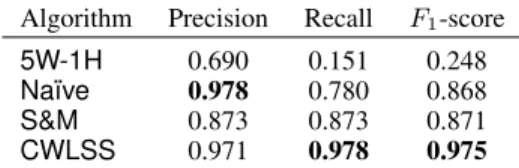
Algorithm Precision Recall F1-score 5W-1H 0.690 0.151 0.248 Na¨ıve 0.978 0.780 0.868 S&M 0.873 0.873 0.871 CWLSS 0.971 0.978 0.975
Table 3: Question detection on online forums, including non-interrogative questions [Cong et al., 2008]
Results The results are shown in Tables 1 and 2. We can see thatS&Mperforms relatively less well than the other two al-gorithms on both datasets. The fact that its precision is so low is at first surprising, because it is reported that theS&M algo-rithm achieves high precision [Shrestha and McKeown, 2004; Conget al., 2008]. The difference may be understood in that S&M tested only on questions in interrogative form and state-ments in declarative form, whereas we tested on questions in any form and questions in any form. Examples of non-questions that are not in declarative form, thatS&M incor-rectly detected as questions, are “Brian, just get here as soon as you can” and “Let’s gear up for the game”.5
The results for the two regular expression algorithms are more expected. Both perform very well on interrogative ques-tions only, emphasizing that question detection is not so chal-lenging a task. Both have lower recall scores on the over-all set, since non-interrogative questions are harder to detect. SinceS&Mdoes not consider declarative or imperative ques-tions, its performance is essentially the same on both datasets.
As expected, Regex achieves higher recall than Na¨ıve
be-cause of its greater sophistication. Although the runtime in-creases by one order of magnitude, the absolute runtime re-mains modest. The tables report the mean runtimes of the algorithms in milliseconds per sentence. The median time per sentence for bothRegex and Na¨ıveis essentially zero; for S&M it is 18.5ms. POS tagging is the main reason for the considerable extra time taken by S&M. The variance of
Regexis greater thanNa¨ıve: 8.61 and 0.185ms respectively (full dataset, including non-interrogative questions).S&M ex-hibits considerable variance of 1750ms.
Table 3 reports results from Conget al. [2008]. Although these results are on a different dataset and for online forums rather than email threads, we give them for comparison. It can be seen thatNa¨ıvebased on 5W-1H words performs very poorly, whileNa¨ıvebased on question marks (as ourNa¨ıve) has similar performance as to our experiments. The notable difference isS&M, which exhibits the higher precision also reported by S&M. However,Na¨ıvecontinues to perform as well asS&Min these reported experiments.
The LSP-based classifier learned by CWLSS—algorithm
CWLSS—detects interrogative and non-interrogative ques-tions. It is found to outperformNa¨ıveandS&M, and, albeit on different datasets, has higher scores thanRegex. However, and again comparing unfairly across datasets,Regexstill has scores better thanS&M, particularly precision. The use of
CWLSSfor email threads is to be explored.
5
The precision reported in CWLSS may be understood because they trained their
S&Mquestion detector on the same kind of online forum data as they were testing, instead of phone speech data as S&M and ourselves. As noted above, trainingS&Mon email corpora was infeasible without POS tagging.
Algorithm Abbreviation
S&M original SMQA
S&M withRegex SMQA-regex
S&M withRegexand highest prob. SMQA-highest
Na¨ıve type matching Na¨ıve
Heuristichand-tuned, random selection Random Heuristichand-tuned Heuristic Heuristicby classifier Heuristic-C Heuristicby linear regression Heuristic-LR
Table 4:Question-answer pairing methods
LCS SM
Algorithm Precision Recall F1-score Precision Recall F1-score
SMQA 0.0138 0.0829 0.0232 0.0761 0.4782 0.1297 SMQA-regex 0.1157 0.1144 0.1145 0.4358 0.4922 0.4609 SMQA-highest 0.2861 0.2817 0.2835 0.4981 0.5142 0.5048 Na¨ıve 0.1690 0.0452 0.0708 0.5045 0.1276 0.1998 Random 0.2797 0.2695 0.2735 0.4738 0.4896 0.4799 Heuristic 0.4618 0.4408 0.4538 0.5818 0.5710 0.5749 Heuristic-C 0.4545 0.4373 0.4439 0.5747 0.5750 0.5715 Heuristic-LR 0.4534 0.4280 0.4379 0.5711 0.5642 0.5647
Table 5:Question-answer pairing, Annotator 1
Altogether, we find that theF1-score ofRegexof above 0.9 over all question types to be sufficient to move to consider the more challenging task of question-answer pairing.
4.3
Answer Detection and Q-A Pairing
We now turn to our primary focus, answer detection and question-answer pairing for both interrogative and non-interrogative questions in email threads.
Data and Metrics We again randomly drew email threads from the Enron and Cspace corpora. Four human annotators marked the questions and corresponding answers (if any) in a set of email threads. Two of the annotators (whom we refer to as Annotators 1 and 2) each annotated about 90 threads con-taining question and answer pairs; two annotated significantly fewer. There were 23 Q-A threads that every annotator anno-tated (the intersection set). The Fleiss kappa statistic for iden-tifying question paragraphs was 0.69, and the kappa statistic for linking answer paragraphs with question paragraphs was 0.77. These numbers are close to the numbers reported in prior studies and indicate decent inter-annotator agreement.6
We used two metrics to evaluate the quality of the
question-answering pairing. The first metric we employed is the
paragraph-based metric used by Shrestha and McKeown [2004] (which we will callSM). This metric is fitting only if we segment messages at the paragraph level. Thus we devel-oped a more stringent metric (which we will callLCS) based on the longest common substring of words. Two text
seg-ments are considered the same under LCS if the length of
their longest common substring is greater than half the length of the longer segment. We consider two Q-A pairs to be the same if their question segments are the same byLCSand their answer segments are also the same byLCS. We measure pre-cision, recall, andF1score by bothSMandLCSmetrics.
6
Between Annotators 1 and 2, kappa for question detection and Q-A pairing were 0.74 and 0.83 respectively; there were 61 Q-A threads they both annotated.
LCS SM
Algorithm Precision Recall F1-score Precision Recall F1-score
SMQA 0.0506 0.2568 0.0842 0.0934 0.4213 0.1519 SMQA-regex 0.2101 0.2245 0.2166 0.3832 0.3693 0.3756 SMQA-highest 0.1979 0.1665 0.1805 0.4429 0.3068 0.3582 Na¨ıve 0.2615 0.0473 0.0779 0.4544 0.0909 0.1482 Random 0.1117 0.1013 0.1059 0.4187 0.3120 0.3521 Heuristic 0.2444 0.2012 0.2195 0.5376 0.3655 0.4259 Heuristic-C 0.2058 0.1717 0.1854 0.5238 0.3621 0.4202 Heuristic-LR 0.2396 0.1814 0.2039 0.5335 0.3459 0.4113
Table 6:Question-answer pairing, Annotator 2
Methods Table 4 summarizes the nine algorithms we stud-ied. The first three algorithms evaluated are variants onS&M:
SMQArepresents the original, unimproved S&M algorithm described in Section 3.2 (i.e., S&M question detection, and S&M’s learned classifier), SMQA-regex replaces the S&M
question detector with our better-performingRegexquestion
detector, andSMQA-highestmakes the further refinement of
taking the most probable answer paragraph instead of any candidate answer paragraph that has over 0.5 probability.
Algorithms Na¨ıve and Heuristic were described in
Sec-tion 3.2. The three variants ofHeuristicemploy hand-tuned weights over the features, a learned classifier, and a linear regression model, respectively. Finally, the question-answer pairing algorithmRandomretrieves the list of candidate an-swer sentences as hand-tunedHeuristic. However, it then
sim-ply picks a random candidate answer. ThusRandomallows
us to determine the merits of our three pairing strategies.
Results We took the data from Annotators 1 and 2 and per-formed 5-fold cross validation for each annotator’s dataset. Tables 5 and 6 give the precision and recall results. It can be seen that the three variants of ourHeuristicalgorithm per-form significantly better than theS&MandNa¨ıvealgorithms
on the two annotators’ individual data. However,SMQA
ex-hibits superior recall on Annotator 2’s data, whileNa¨ıvehas slightly winning precision underLCS. There is little differ-ence between the threeHeuristicvariants. The relative
perfor-mances ofSMQA-highestandHeuristic-Cis understood from
the primary differences between them: the feature sets, and the operation of the latter at the sentence level rather than
the paragraph level. The much lower LCS scores that our
algorithms have for Annotator 2 can be explained in that An-notator 1 tended to mark short, single-sentence question and answer segments, whereas Annotator 2 tended to mark longer segments; our algorithms extract only sentences as questions and answers, not longer pieces of text. Thus both metrics have value in assessing the algorithms.
We experimented with permutations ofHeuristic’s method-ology. Removing its second condition, i.e., to consider only the first reply from each individual, provides improvement in some cases, at the cost of significantly larger runtime. Vary-ing the heuristic on the number of questions to which an an-swer may pertain can modestly increaseF1-score; the best overall setting on our dataset is 3. ForHeuristic-LR, taking the best answer with probability over 0.8 is better than our default threshold of 0.5. As expected, takingallanswers with probability over 0.5 (rather than the best), as S&M, does not improve the performance of anyHeuristicvariant.
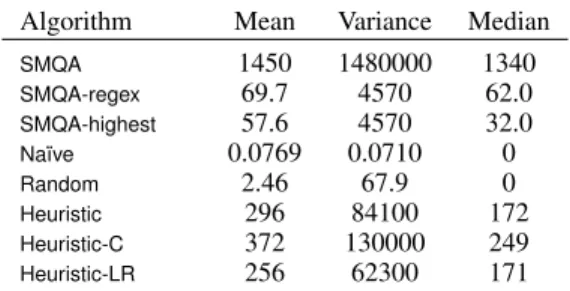
Algorithm Mean Variance Median SMQA 1450 1480000 1340 SMQA-regex 69.7 4570 62.0 SMQA-highest 57.6 4570 32.0 Na¨ıve 0.0769 0.0710 0 Random 2.46 67.9 0 Heuristic 296 84100 172 Heuristic-C 372 130000 249 Heuristic-LR 256 62300 171
Table 7:Question-answer pairing computation times (ms)
in terms of number of milliseconds per thread. Mean thread length is 5.2 email messages; mean sentences per message is 13.9. We can see that the median amount of time taken by all the algorithms, except forSMQA, is extremely low, but that our Heuristicvariants take an order of magnitude more time than ourSMQAvariants, but an order of magnitude less than the original S&M. This relatively higher runtime, and variance, is at the gain of the higher precision and recall.
Heuristic-Cis the slowest of the three variants. The bulk of the time forS&Mis taken by question detection; forHeuristic, it is finding semantic similarity (feature 10). Feature compu-tation is reflected in the runtime ofNa¨ıveversusHeuristic.
Learning and Features Learning curves (not shown for reasons of space) show that, under bothSMandLCSmetrics, bothHeuristic-CandHeuristic-LRconverge with a training set of approximately 30 threads. The comparable-or-better per-formance of hand-tunedHeuristic, after only modest effort in tuning the feature weights, suggests that it is identification of appropriate features that is more significant in this prob-lem than the values of the weights. The similar performance of the two learning variants, despite their different models, lends support to this. However, automated acquisition of fea-ture weights, since training is straightforward, does offer the flexibility of adaption to characteristics of particular datasets. A factor analysis of the relative benefit of features indi-cates, on our benchmark corpora, the features that give great-est benefit are numbers 2–7. Features 1 (stop words) and 9– 11 are also beneficial, but feature 8 (whethermAis the first reply tomQ) has surprisingly little contribution. Although visual inspection reveals that answers are frequently seen in the first reply tomQ, we hypothesize that this occurrence is accounted for by feature 4.
5
Conclusion and Future Work
Question-answer identification and pairing provides a gener-ative summary of an email thread. For question detection, on threads drawn from the Enron and Cspace corpora, we find that the learning algorithm of Shrestha and McKeown [2004] suffers from poor precision when exposed to non-interrogative questions. A generalized expression matching algorithm performs adequately with very low runtime. Future work is to investigate the promise of the question detection method of Conget al.[2008] to email conversations.
For answer detection and question-answer pairing, we pre-sented a generalization of Shrestha and McKeown’s feature-based algorithm, and found that our heuristic-feature-based method
balances precision and recall, while maintaining a modest computation time. Future work is to (1) examine further the interplay of sentence-level and paragraph-level features, (2) more fully exploit named entity extraction, and (3) consider explicitly thread structure by means of the induced graph of message relationships, together with quoted material (com-pare [Careniniet al., 2007]).
Acknowledgments We thank with appreciation the volunteers who annotated the thread corpora. This material is based upon work supported by DARPA under Contract No. FA8750-07-D-0185. Any opinions, findings, and conclusions or recommendations expressed in this material are those of the author(s).
References
[Belottiet al., 2005] V. Belotti, N. Ducheneaut, M. Howard, I. Smith, and R. Grinter. Quality vs. quantity: Email-centric task management and its relations with overload. Human-Computer Interaction, 20(2/3):89–138, 2005.
[Careniniet al., 2007] G. Carenini, R. T. Ng, and X. Zhou. Summa-rizing email conversations with clue words. InProc. of WWW’07, pages 91–100, 2007.
[Cohen, 1996] W. Cohen. Learning trees and rules with setvalued features. InProc. of AAAI-96, pages 709–716, 1996.
[Conget al., 2008] G. Cong, L. Wang, C.-Y. Lin, Y.-I. Song, and Y. Sun. Finding question-answer pairs from online forums. In
Proc. of SIGIR’08, pages 467–474, 2008.
[Dabbish and Kraut, 2006] L. Dabbish and R. Kraut. Email over-load at work: An analysis of factors associated with email strain. InProc. of CSCW’06, pages 431–440, 2006.
[Dredzeet al., 2008] M. Dredze, V. R. Carvalho, and T. Lau, edi-tors. Enhanced Messaging: Papers from the 2008 AAAI Work-shop, Menlo Park, CA, 2008. AAAI Press.
[Freedet al., 2008] M. Freed, J. Carbonell, G. Gordon, J. Hayes, B. Myers, D. Siewiorek, S. Smith, A. Steinfeld, and A. Toma-sic. RADAR: A personal assistant that learns to reduce email overload. InProc. of AAAI-08, pages 1287–1293, 2008. [Kathol and Tur, 2008] A. Kathol and G. Tur. Extracting
ques-tion/answer pairs in multi-party meetings. InProc. of ICASSP’08, pages 5053–5056, 2008.
[Klimt and Yang, 2004] B. Klimt and Y. Yang. The Enron cor-pus: A new dataset for email classification research. InProc. of ECML’04, pages 217–226, 2004.
[Minkovet al., 2005] E. Minkov, R. Wang, and W. Cohen. Extract-ing personal names from emails: ApplyExtract-ing named entity recog-nition to informal text. InProc. of HLT-EMNLP’05, 2005. [Pirr`o and Seco, 2008] G. Pirr`o and N. Seco. Design,
implementa-tion and evaluaimplementa-tion of a new similarity metric combining feature and intrinsic information content. InProc. of ODBASE’08, 2008. [Shrestha and McKeown, 2004] L. Shrestha and K. McKeown. De-tection of question-answer pairs in email conversations. InProc. of COLING’04, pages 542–550, 2004.
[Ulrichet al., 2008] J. Ulrich, G. Murray, and G. Carenini. A pub-licly available annotated corpus for supervised email summariza-tion. InProc. of AAAI’08 Workshop on Enhanced Messaging, pages 77–81, 2008.
[Yeh and Harnly, 2006] J.-Y. Yeh and A. Harnly. Email thread re-assembly using similarity matching. InProc. of CEAS’06, 2006.