A cloud-based, predictive and
context-aware system for
Ambient Assisted Living
A thesis submitted in fulfilment of the requirements for
the degree of Doctor of Philosophy (Computer Science)
Abdur Rahim Mohammad Forkan
B.Sc. Computer Science and Engineering(CSE)
Bangladesh University of Engineering and Technology (BUET)
School of Computer Science and Information Technology
College of Science, Engineering, and Health
RMIT University
Melbourne, Australia.
Declaration
I certify that except where due acknowledgement has been made, the work is that of the author alone; the work has not been submitted previously, in whole or in part, to qualify for any other academic award; the content of the thesis is the result of work which has been carried out since the official commencement date of the approved research program; and, any editorial work, paid or unpaid, carried out by a third party is acknowledged; and, ethics procedures and guidelines have been followed.
Abdur Rahim Mohammad Forkan 20th June, 2016
Acknowledgement
All the praises and thanks be to God who gave me the opportunity and endurance to reach this endeavour. I would like to express my sincere gratitude and appreciation to a group of people for their kind support, guidance, advice and inspiration. This work would not have been possible without their cooperation.
First and foremost, I would like to thank my senior supervisor, A/Prof. Ibrahim Khalil, who guided me to accomplish my research goals. His effective supervision, constructive criticism, endless encouragement and continuous support has always kept me motivated and ensured a smooth candidacy for completion of this research. I would like to thank him for his patience and sincerity in helping me reach the finishing line of my PhD journey. I would also like to thank my associate supervisor, Prof. Zahir Tari, for his advice and support.
I would also like to thank my family. To my father, A. H. M. Shahjahan and my mother, Ferdousi Akhter, who always provided me mental strength and courage while being thousands of kilometres away. I am grateful for the sacrifice they made for me. Their prayers always helped me a lot. A special thanks to my beloved wife, Tasnim Nasrin, who has been all time companion on this journey. Thanks for the support, encouragement, patient, unwavering love and care that I continuously receive. I would like to thank my elder sisters for their inspiration and to my in-laws for their appreciation and prayers throughout my entire life.
I am thankful to my colleagues, Dr. Heshan, Dr. Ayman, Dr. Mahathir, Dr. Azami and Dr. Naimah, who helped me with suggestions and materials during my research. I appreciate the support of RMIT CS&IT for providing a good research environment. I would like to express my gratitude to all my friends in and outside of RMIT that directly or indirectly supported me throughout this time.
Last but not least, I would like to thank my scholarship provider, National ICT Australia (NICTA) and RMIT CS&IT for giving me the opportunity to do PhD study and develop my career. I hope this piece of work would benefit the research community in my area.
Credits
Portions of the material in this thesis have previously appeared in the following publications:
• A. Forkan, I. Khalil, and Z. Tari, “CoCaMAAL: A cloud-oriented context-aware mid-dleware in ambient assisted living”, Future Generation Computer Systems, Volume: 35, Pages 114-127, June 2014. (ERA Rank A)- Chapter 2.
• A. R. M. Forkan, I. Khalil, Z. Tari, S. Foufou, and A. Bouras, “A context-aware approach for long-term behavioural change detection and abnormality prediction in ambient as-sisted living”, Pattern Recognition, Volume 48, Issue 3, Pages 628-641, March 2015. (ERA Rank A*) -Chapter 4.
• A. R. M. Forkan, I. Khalil, A. Ibaida and Z. Tari, “BDCaM: Big Data for Context-aware Monitoring - A Personalized Knowledge Discovery Framework for Assisted Healthcare”,
IEEE Transactions on Cloud Computing, DOI: 10.1109/TCC.2015.2440269, June 2015.
- Chapter 3.
• A. R. M. Forkan and I. Khalil, “A Probabilistic model for early prediction of abnormal clinical events using vital sign correlations in home-based monitoring”, In proceedings of 2016 IEEE International Conference on Pervasive and Mobile Computing (PerCom), Pages 1-9, DOI:10.1109/PERCOM.2016.7456519, March, 2016. (CORE Rank A*) -Chapter 6
• A. Forkan, I. Khalil, and Z. Tari, “Context-aware cardiac monitoring for early detection of heart diseases”,Computing in Cardiology Conference (CinC), 2013, Pages 277-280. (ERA Rank A).
• A. R. M. Forkan and I. Khalil, “A clinical decision-making mechanism for context-aware and patient-specific remote monitoring systems using the correlations of multiple vital
v
signs”,Computer Methods and Programs in Biomedicine, DOI: 10.1016/j.cmpb.2016.10.018, October 2016. (ERA Rank A*)- Chapter 5
• “ViSiBiD: A learning model for early discovery and real-time prediction of severe clinical events using Vital Signs as Big Data”, Computer Networks, Provisionally accepted with a minor revision, October, 2016. -Chapter 6
• “PEACE-Home: Probabilistic Estimation of Abnormal Clinical Events using vital sign correlations for reliable Home-based monitoring”,Pervasive and Mobile Computing, Sub-mitted, April 2016. -Chapter 6
• “Patient clustering using entropy-driven dynamic partitioning on correlated vital signs”,
IEEE Transactions on Knowledge and Data Engineering, Submitted, June 2016.
Contents
Declaration ii
Acknowledgement iii
Credits iv
Contents vi
List of Figures xiii
List of Tables xix
Abstract 1
1 Introduction 4
1.1 Background and Motivations . . . 5
1.2 Preliminaries . . . 7
1.3 Research Challenges . . . 11
1.4 Research Questions . . . 14
1.5 Limitations of Existing Solution . . . 17
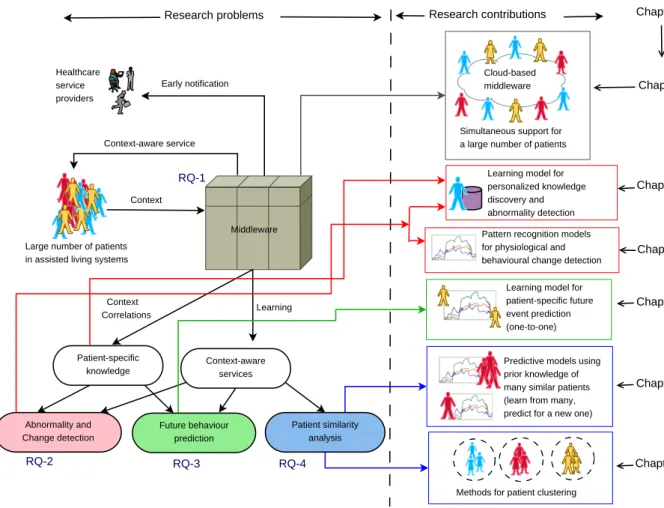
1.6 Research Contributions . . . 19
1.7 Thesis Organization . . . 24
2 A Cloud-oriented Context-aware Middleware for Assisted Living 26 2.1 Motivations and Contributions . . . 27
2.1.1 Motivations . . . 27
2.1.2 Contributions . . . 28
2.2 Related Work . . . 29
CONTENTS vii
2.3 CoCaMAAL System Overview . . . 31
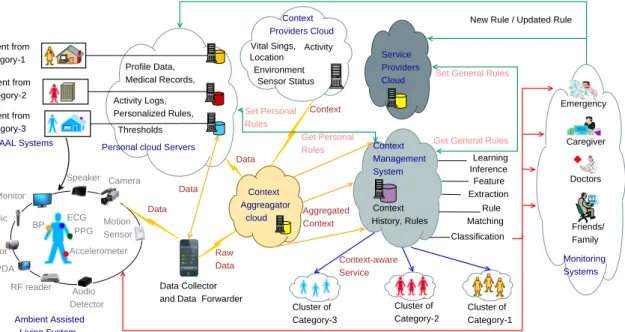
2.4 System Description . . . 33
2.4.1 AAL System . . . 33
2.4.2 Context Providers and Aggregator Cloud . . . 36
2.4.2.1 Context Providers . . . 36
2.4.2.2 Context Aggregator . . . 37
2.4.2.3 Context Modeling . . . 38
2.4.3 Service Providers Cloud . . . 39
2.4.4 Context-aware Middleware (CaM) . . . 40
2.4.4.1 Context Management System (CMS) . . . 41
2.4.4.2 Context Storing . . . 42 2.4.4.3 Context Retrieval . . . 42 2.4.4.4 Context Manipulation . . . 43 2.4.4.5 Service Mapping . . . 43 2.4.4.6 Self-adaptation . . . 46 2.4.4.7 Service Discovery . . . 47 2.4.4.8 Security Service . . . 47
2.4.5 Monitoring and Data Visualization Service . . . 47
2.5 Case Study . . . 47
2.6 Experimental Results . . . 51
2.7 Conclusion . . . 55
2.8 Epilogue . . . 55
3 A Personalized Knowledge Discovery Framework 56 3.1 Motivations and Contributions . . . 57
3.1.1 Motivations . . . 57
3.1.2 Contributions . . . 58
3.2 Related Work . . . 58
3.3 Architecture . . . 59
3.3.1 Ambient Assisted Living (AAL) Systems . . . 60
3.3.2 Personal Cloud Servers (PCS) . . . 60
3.3.3 Data Collector and Forwarder (DCF) . . . 62
3.3.4 Context Aggregator (CA) . . . 62
CONTENTS viii
3.3.6 Context Management System (CMS) . . . 63
3.3.7 Service Providers (SP) . . . 63
3.3.8 Remote Monitoring Systems (RMS) . . . 63
3.4 Definitions and Concepts . . . 64
3.5 System Functionalities . . . 65
3.5.1 Context Conversion . . . 65
3.5.2 Context Aggregation . . . 66
3.5.3 Trend Analysis . . . 67
3.5.4 Correlations Learning and Association Rule Mining . . . 68
3.5.5 Learning using the Association Rules . . . 71
3.5.6 Data Mining . . . 71
3.5.7 Context-aware Decision Support . . . 71
3.6 Use case Implementation . . . 72
3.6.1 Description of use case . . . 72
3.6.2 Synthetic data generation . . . 73
3.6.3 Cloud evaluation . . . 74
3.6.4 Implementation . . . 75
3.7 Results and Discussion . . . 77
3.8 Conclusion . . . 80
3.9 Epilogue . . . 80
4 Long-term Change Detection and Abnormality Prediction 81 4.1 Motivations and Contributions . . . 82
4.1.1 Motivations . . . 82 4.1.2 Contributions . . . 83 4.2 Related Works . . . 84 4.3 Methodology . . . 84 4.3.1 System Description . . . 85 4.3.1.1 Background . . . 85 4.3.1.2 A motivating scenario . . . 86
4.3.1.3 Proposed fusion-based architecture . . . 86
4.3.2 Change detection in activity and location patterns using HMM . . . 87
4.3.2.1 Data description . . . 88
CONTENTS ix
4.3.2.3 Modelling Hidden Markov Model . . . 89
4.3.2.4 Abnormality prediction using HMM . . . 91
4.3.3 Change detection in lifestyle pattern and routine behaviour . . . 92
4.3.3.1 Routine behaviour discovery . . . 92
4.3.3.2 Statistical model design . . . 93
4.3.3.3 Abnormality classification . . . 94
4.3.4 Physiological change detection in different vital signs . . . 94
4.3.4.1 Vital signs and related disease identification . . . 95
4.3.4.2 Forecasting model development . . . 95
4.3.5 Information fusion and decision making using fuzzy rules . . . 97
4.4 Experimental Results . . . 99
4.4.1 Case study description . . . 99
4.4.2 Implementation and validation of proposed HMM . . . 100
4.4.3 Implementation and validation of routine behaviour change detection method . . . 103
4.4.4 Implementation and validation of trend detection in vital signs . . . 104
4.4.5 Implementation of fuzzy rule-based model and wellness detection . . . . 105
4.5 Conclusion . . . 108
4.6 Epilogue . . . 108
5 Patient-specific Future Clinical Event Prediction 109 5.1 Motivations and Contributions . . . 111
5.1.1 Motivations . . . 111
5.1.2 Contributions . . . 111
5.2 Related work . . . 112
5.3 The framework for clinical decision support system (CDSS) . . . 113
5.3.1 Patient data collection . . . 113
5.3.2 Correlations of vital signs for clinical inference . . . 113
5.3.3 Data preprocessing and feature generation . . . 115
5.3.4 Multi-label classification (MLC) and evaluation . . . 116
5.3.5 Knowledge adaptation . . . 116
5.3.6 Clinical decision support . . . 117
5.4 Research methodology and implementation . . . 117
CONTENTS x
5.4.2 Data cleaning and preprocessing . . . 118
5.4.3 Segmentation . . . 118
5.4.4 Feature extractions and class labelling . . . 118
5.4.5 Multi-label classification . . . 119
5.4.5.1 Binary relevance(BR) . . . 120
5.4.5.2 Classifier chain(CC) . . . 120
5.4.5.3 Pruned Sets (PS) . . . 121
5.4.5.4 Fourclass Pairwise (FW) and Ranking + Threshold (RT) . . . 121
5.4.5.5 Algorithm Adaptation method . . . 122
5.4.5.6 Evaluation Measure . . . 122
5.4.6 Abnormality prediction . . . 122
5.4.7 Incremental and patient-specific learning . . . 123
5.5 Experimental evaluations and results . . . 123
5.5.1 Selection of window size . . . 123
5.5.2 Selection of forecast period . . . 124
5.5.3 Classifier performance evaluation . . . 125
5.5.3.1 Performance for a single patient . . . 125
5.5.3.2 Performance for multiple patients . . . 127
5.5.3.3 Performance in terms of model building time . . . 128
5.5.4 Performance for using correlations . . . 128
5.5.5 Discussions . . . 130
5.6 Conclusion . . . 130
5.7 Epilogue . . . 131
6 Early Prediction of Abnormal Clinical Events Using Known Knowledge 132 6.1 Motivations and Contributions . . . 133
6.1.1 Motivations . . . 133
6.1.2 Contributions . . . 134
6.2 Related work . . . 135
6.3 Preliminary analysis . . . 136
6.3.1 Vital sign correlations . . . 136
6.3.2 Clinical events . . . 138
6.3.3 Principle Component Analysis (PCA) . . . 139
CONTENTS xi
6.4.1 Model description . . . 140
6.4.2 Dataset description . . . 141
6.4.3 Data formulation . . . 142
6.4.4 Analysis using PCA . . . 143
6.4.5 Training and Learning . . . 144
6.4.6 Learning in the cloud . . . 144
6.4.7 Real-time and personalised monitoring . . . 145
6.5 The PEACE-Home model . . . 146
6.5.1 Mapping bio-signals to observations . . . 147
6.5.2 Parameters of HMM . . . 147
6.5.3 Estimation of model parameters - Training . . . 148
6.5.4 Validation, classification and probabilistic prediction . . . 149
6.6 The ViSiBiD model . . . 150
6.6.1 Segmentation . . . 150
6.6.2 Feature Extraction . . . 150
6.6.2.1 Correlation coefficients . . . 151
6.6.2.2 Wavelet coefficients . . . 151
6.6.2.3 Statistical features . . . 152
6.6.3 Training and Learning . . . 153
6.6.4 Feature selection . . . 153
6.6.5 Classification . . . 154
6.7 Experimental results and discussions . . . 154
6.7.1 The PEACE-Home model . . . 154
6.7.1.1 HMM modelling . . . 154
6.7.1.2 Prediction performance . . . 155
6.7.1.3 Probability Prediction in real-time monitoring . . . 156
6.7.1.4 Evaluation using cloud frameworks . . . 157
6.7.1.5 Comparison with other models . . . 158
6.7.2 The ViSiBiD model . . . 159
6.7.2.1 Training and learning . . . 159
6.7.2.2 Clinical event prediction result . . . 160
6.7.2.3 Analysis of accuracy with data size . . . 161
6.7.2.4 Analysis of model building time . . . 161
CONTENTS xii
6.7.2.6 Model performance using selected features . . . 163
6.7.2.7 Prediction in continuous monitoring . . . 164
6.7.2.8 Performance comparison . . . 165
6.8 Conclusion . . . 166
6.9 Epilogue . . . 166
7 Patient Clustering by Dynamically Partitioning Patient States 167 7.1 Motivations and Contributions . . . 169
7.1.1 Motivations . . . 169
7.1.2 Contributions . . . 169
7.2 Related work . . . 170
7.3 The patient clustering method . . . 172
7.3.1 Data normalization . . . 173
7.3.2 Outlier detection . . . 174
7.3.3 Unsupervised pattern discovery . . . 175
7.3.3.1 Similarity measure . . . 175
7.3.3.2 Transform multi-dimensional observation into single-dimensional vector . . . 176
7.3.3.3 Dynamic partitioning . . . 177
7.3.3.4 Cluster analysis . . . 179
7.3.4 State feature extraction . . . 179
7.3.5 Identify similar subgroups . . . 179
7.4 Experimental results . . . 181
7.4.1 Data Sets . . . 182
7.4.2 Outlier detections . . . 183
7.4.3 Dynamic pattern discovery . . . 183
7.4.4 Cluster Analysis . . . 184
7.4.5 Patient classification . . . 188
7.5 Conclusion . . . 191
8 Conclusion 193
List of Figures
1.1 (a) A demonstration of wearable sensors on a human body. (b) A conceptual BSN architecture of the proposed AAL system. (c) An example of wearable textile sensors. 8 1.2 There are different types of ambient device and white goods installed in AAL
system including body sensors. Some sample devices are illustrated in here. . . . 9 1.3 The concept of context in our model. . . 10 1.4 The workflow of real-time monitoring, classification, predictions and clinical
deci-sion support. . . 11 1.5 A scalable, predictive and protective context-aware system and related research
problems. . . 15 1.6 A summary of research questions, thesis contributions and chapter organizations. 19
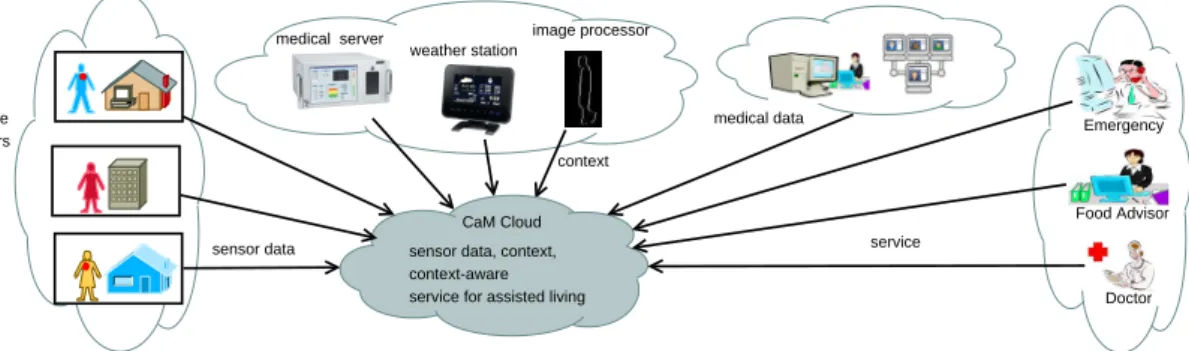
2.1 The Generic architecture of CoCaMAAL model showing 5 major distributed cloud-based components of the proposed system. . . 31 2.2 Data Acquisition The raw sensor data produced by body sensors and other
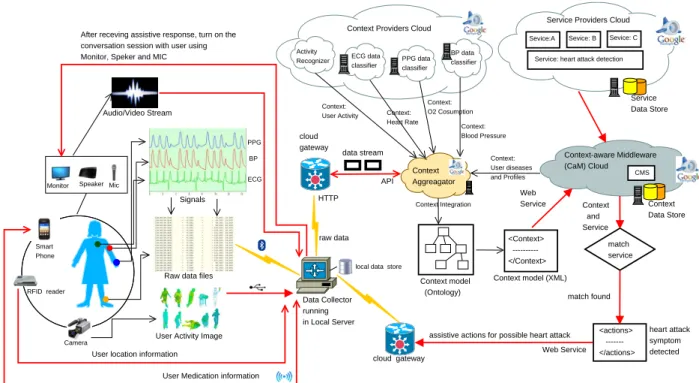
devices are transmitted to a local workstation using a connected medium. The Local workstation then forwards the data to the cloud server using a cloud gateway. 35 2.3 Data flow in a single AAL: Raw data from the AAL system is converted to
context by the aggregator cloud. The service provider cloud contains the cloud storage for service rules. The context-aware middleware cloud manages incoming context and finds assistive actions. Then it responds back to the AAL system as a context-aware service. . . 35 2.4 Flow diagram of Context Classifier: All the context providers perform this
generic classification process to extract the high-level features. The method inside each of the square blocks can be different based on input and output data. . . 36
LIST OF FIGURES xiv
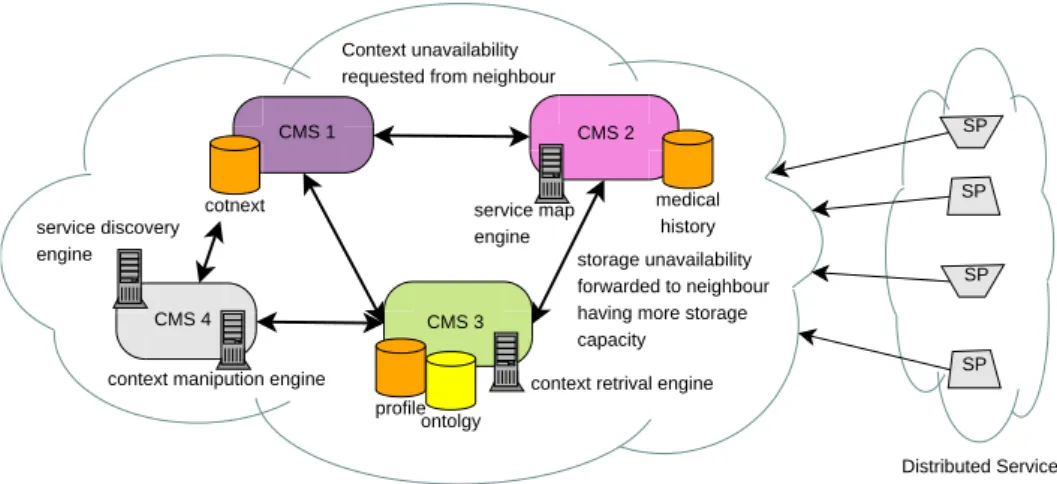
2.5 Context Model using OWLEach context entity has some attributes to describe some basic properties of the entity. Some context entities are part of parent entity such as characteristics, diseases, preference, social and health ontologies are part of person ontology. Each of those entities has some more children to describe them. The relation among different entities is also shown here. . . 38 2.6 Dynamic scalability of distributed CMS: A snapshot of how the CMS of
CoCaMAAL works. . . 42 2.7 Context Tree: Every context sample and service of our system is converted to
such a context tree to find the service mapping. . . 43 2.8 Evaluation: The experimental setup of simulated model for evaluating the case
studies described in this section. . . 48
2.9 The M/G/1 queuing system of the CoCaMAAL model . . . 53
2.10 (a) Using the lower value of the request arrival rate (λ). (b) λ is high. That is, requests are arriving in high volume from a massive number of AAL systems. For both (a) and (b) the average response time (W) increases with the increase of request arrivals. The response time is still very fast (only 0.11 sec) even with a high request arrival rate(λ= 60). . . 54 2.11 The average response time(W) varies with the distribution of service time in
different processing nodes for different observations. Using only a single ultra-fast server with k processing slots, the average response time (using the same arrival rate) is very low for each observation. For k ≥ 5, the response time of each observation is very similar. . . 54
3.1 The complete architecture of BDCaM model showing all the cloud-based compo-nents of the system. . . 60 3.2 Data flow between cloud components of BDCaM model. . . 61 3.3 Big data case for context-awareness in AAL . . . 61 3.4 Modules of system functionalities of the BDCaM model. Data collection and
context-aware actions happen inside AAL system and personal cloud. Context processing, knowledge acquisition, data mining etc. are performed in distributed cloud components. . . 66 3.5 The change in no of rules with minSupp value . . . 76 3.6 Classification time for different classifiers using 1000 to 34000 context states for
LIST OF FIGURES xv
4.1 The complete architecture of context-aware change detection model. . . 87 4.2 Markov process for activity sequences. . . 89 4.3 Observable Markov process . . . 89 4.4 Different regions and related parameters to identify abnormality in routine
be-haviour. The distribution is Gaussian. Normal pattern shown in solid line and a behavioural shift shown in dashed line. . . 93 4.5 Time-series graph of 2 vital signs(HR,BP) with 96 observations for 3 users . . . . 96 4.6 Estimation of body temperature value for detecting fever symptoms. Here, the
forecast is for 10 periods. We can see that the forecast graph follow a liner trend. 97 4.7 Model performance improves when the number of hidden states increase. But
gain is low after hidden states reaches 40. So the model with 40 hidden states is considered the optimized model and that is selected as standard model for classification. . . 101 4.8 The Hidden Markov Model for detecting abnormal activity . . . 101 4.9 Observed value of LogP(O|λ) for 20 normal and 20 abnormal samples. The line
indicates the cluster boundary to distinguish between the two classes. . . 102
5.1 Strong correlations between a pair of vital signs. (a)-(e) examples of positive correlation (f) example of negative correlation. Here SBP, DBP and MBP refers to Systolic, Diastolic and Mean blood pressure respectively. . . 110 5.2 A framework of a clinical decision support system (CDSS) based on multi-label
classification (MLC) using the correlations of multiple vital signs . . . 114 5.3 Observation, lead and prediction window time . . . 115 5.4 Selection of optimal window size for calculating features. Three evaluation
mea-sures from 30 days monitoring data of patient a40493n using different window sizes. Here the multi-label classifier is BR and learning algorithm is Random Tree. Window size 10 achieved best hamming score, accuracy and F1 value in compare to other window sizes. . . 124 5.5 Performance for single patient for different lead time using w=10. Three
evalu-ation measures from 30 days monitoring data of patient a40493n using l 1 to 7. Here the multi-label classifier is BR and learning algorithm is Random Tree. For all 7 cases the classification has good hamming score value (≥85%) . . . 125 5.6 Hamming score of 85 patients separately using the statistics from 24 classifier
LIST OF FIGURES xvi
5.7 Performance measure of different classifier combination using random 24 hours data of patient a42141n . . . 127 5.8 Average performance of different combination of multi-label classifiers and learning
algorithms in terms of hamming score. These average values are calculated from random 24 hours data of each 85 patients using w=10 and l=7. Here, for most cases hamming score is above 90%. The performance of Random Tree and SMO is better than J48. . . 127 5.9 Hamming score of 24 different classifier combinations using the statistics of 85
patients . . . 128 5.10 Average building time for different classifier using random 24 hours data of 85
patients. PS-Random Tree is the fastest process. SMO takes more time than Random Tree and J48. FW has very high building time. . . 129
6.1 High correlation between HR and BP. The top 2 plots show the time-series, changes in HR, Systolic BP (SBP), Diastolic BP (DBP) and mean BP (MBP) with time (in minutes). The bottom 2 plots show the correlation between HR and MBP from corresponding upper plots. Here strong (a) positive and (b) negative correlation is shown between HR and MBP. . . 137 6.2 Scatter plot of correlations between HR-SBP and HR-MBP pairs after combing
data of many similar patients. Warmer color indicate higher density. . . 137 6.3 Correlations among HR, MBP and RR in a single patient. Low value in colour
bar indicate all vitals have high value and vice versa. Depending on correlations among 3 vitals patients can be in different clinical states. . . 138 6.4 Validation of clinical event separation from a large number of patients using PCA 140 6.5 The scenario of the developed system showing its components. . . 141 6.6 Separation of 5 clinical events by PCA method . . . 143 6.7 Separation of 5 clinical events using observed data before that event by PCA method144 6.8 The model learning process using multiple vital sign data from several group of
patients (normal and with different clinical conditions). The learning phases are performed in the cloud. The output of this learning process is multiple HMMs and these learned models are stored in the cloud storage. . . 145
LIST OF FIGURES xvii
6.9 Real-time clinical abnormality prediction for a patient with unknown clinical con-dition using multiple vital sign data. Here CE means a clinical event. The current observations are matched with stored HMMs and the probabilities of matching are continuously estimated. . . 146 6.10 The conversion process from bio-signals to observation sequence along with HMM
model parameters. The observation sequence is extracted from 1 hour observed data of the actual clinical event. . . 148 6.11 The process of segmentation to compute the features from observation window
and class from target window . . . 150 6.12 Discrete wavelet transform and decompositions . . . 152 6.13 (a) Change of logP(O|λ) value, (b) model building time (in minutes) with the
change of number of hidden states for 5 HMM models. In (a) Lighter colours indicate higher value inlogP(O|λ) and vice versa. In (b) Darker colours indicate lower value in model building time. The goal is to number of states which have highlogP(O|λ) and low model building time in all 5 models. . . 155 6.14 The upper plot shows the continuous monitoring values of 6 bio-signals of a patient
for 1000 minutes. The lower plot depicts continuouslogP(O|λ) values in a heat-map table obtained for 5 HMMs. The warmer colours indicate higher likelihood probability value. . . 157 6.15 Training time and prediction accuracy for J48 and RF with the change in training
data size. . . 161 6.16 Model building time (in seconds) in different EC2 instances using J48 and RF
classifiers. . . 162 6.17 The change in model building time (in seconds) and accuracy (%) with the change
in number of datanodes in a Hadoop cluster. . . 162
7.1 The workflow of the proposed patient clustering method. First, different states of multiple patients with unknown medical conditions are identified dynamically in parallel from their multiple vital signs using similarity analysis based on entropy values. Then, a hierarchical clustering is used on features of different patient’s states to identify subgroups of similar patients. . . 173 7.2 The distribution of 12 clinical classes in 35 patients of Dataset-1 used in our
LIST OF FIGURES xviii
7.3 Outlier detection using average relative density measure. The top plot shows the time-series of six vital signs of a patient for 185 minutes. In the middle plot, the detected outliers are shown in vertical lines. The bottom plot shows the changes in the density measure over time computed from six vital sign values of the top plot. . . 184 7.4 Dynamic pattern discovery from six correlated vital signs. The plots in the left side
show the time-series of six correlated bio-signals for 3 patients having CHF/Pul-monary Edema in first 24 hours. The plots in the right side show the patterns of states identified using an entropy-driven clustering method on 3 principal compo-nent axes. We can observe that the number of discovered states are different in 3 patients. . . 185 7.5 Visualization of state distributions for patient 4 in (a) 3D and (b) 2D using PCA.
Here PC-1, PC-2 and PC-3 are first 3 principal components computed from score matrix of original data. . . 186 7.6 Number of discovered dynamic states of all patient samples for two experimental
datasets. . . 187 7.7 Cluster analysis for 9 patients of Dataset-1. From the labelled information we
know that 3 of these patients (6,7 and 9) belongs to the same clinical class and others are in different classes. . . 187 7.8 Transition of states in 24 hours data for a single patient. . . 188 7.9 Consistency validation of dynamic partitioning method using Silhouette plots of
12 patients in Dataset-1. . . 188 7.10 Correlation map among all patients for 2 experimental datasets. . . 189 7.11 Hierarchical cluster tree for Dataset-1 containing 35 patients along X-axis. The
original distribution of patients are shown at top and identified subgroups are shown at bottom in different colours. . . 190 7.12 Hierarchical cluster tree and similarity matrix for Dataset-2 containing 34 patients
along X-axis. The identified subgroups are shown at bottom in different colours. 191 7.13 Clustering result for Dataset-1 using k-means clustering . . . 191
List of Tables
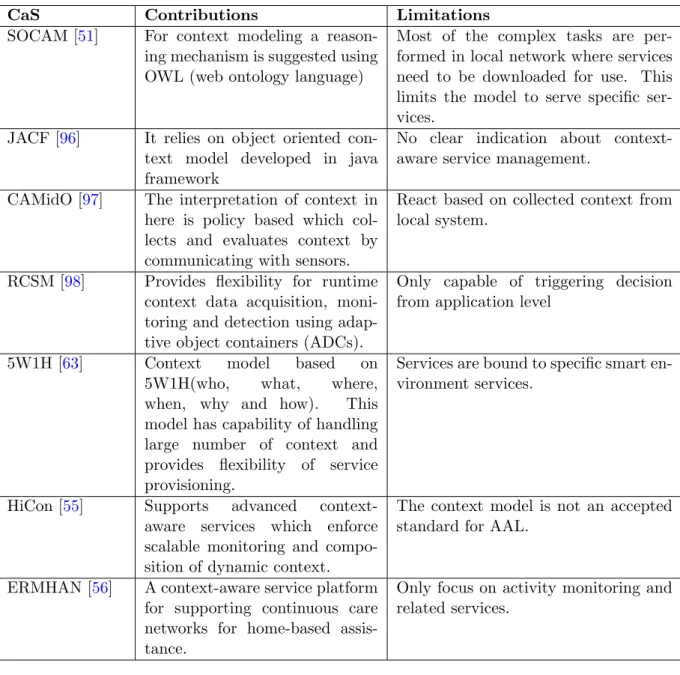
2.1 Some mentionable research works describing the framework of a Context-aware
System (CaS) . . . 30
2.2 Examples of some typical body sensors and their use in AAL . . . 34
2.3 Service rules of detecting possible heart attack . . . 40
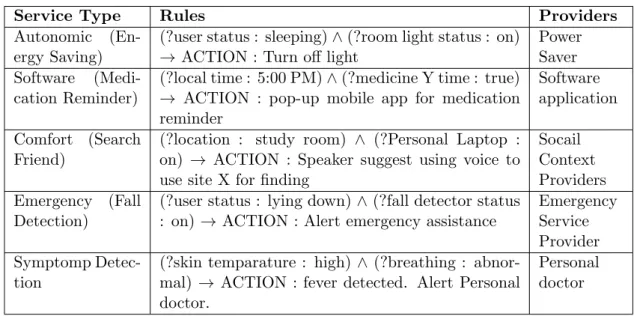
2.4 Example of some assistive services, their rules and the provider of the service . . 41
2.5 The components considered in the experimental setup of the simulated prototype. 48 2.6 Aggregated high-level context samples . . . 49
2.7 Components developed for simulated prototype . . . 50
2.8 Average Service Response Time for different Context, Service Provider (SPs), and service load. **Note that in the 2nd column of item 2,1 and Activity refers toActivity, Location and Time including Physical parameters of row 1and so on for other rows of row column . . . 52
2.9 General distribution of Service Time of five different sets for k=10 andλ= 2 sec 53 3.1 General medical rules to identify different diseases related to the variation in BP and HR . . . 73
3.2 Different patient categories considered in the experiment and their average values of vital signs . . . 74
3.3 Domains and context attributes used in the experiment . . . 75
3.4 Symptoms that are considered in the experiment . . . 76
3.5 Sample aggregated data of Patient P1 for rule mining . . . 76
3.6 Class attributes used for situation classification . . . 77
3.7 Comparison of BDCaM model generated rule-based classifications with generic rule-based classification . . . 78
3.8 Comparison of association rule generation time using single and multi-core pro-cessing on same machine . . . 78
LIST OF TABLES xx
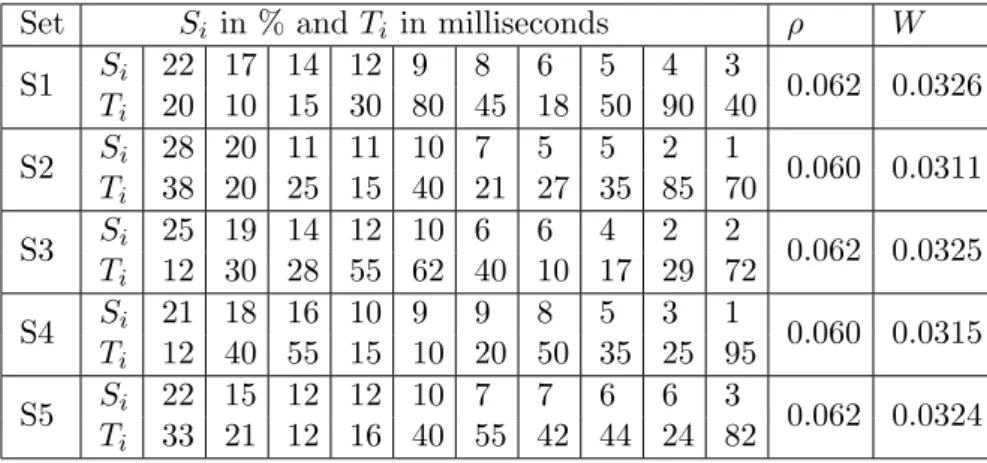
3.9 Anomaly detection accuracy and false positive rate for 3 different types of patient
over 1 year data . . . 79
4.1 Illustration of patient logs for our system . . . 85
4.2 Daily activity log. Where each x(tj) ∈ X, X = {x1, x2, ...xN}, N is the number of activities considered in the design. tk-t0 = 24 hours . . . 88
4.3 Example of activity and location sequences . . . 91
4.4 Normal routine behaviour of the user. Distribution is Gaussian. Mean in start time, SD in minutes. Min and Max duration is in minutes . . . 93
4.5 Normal range of vital signs . . . 95
4.6 Different diseases for the change in vital signs . . . 96
4.7 Estimation of heart rate value using Holt’s method for Tachycardia prediction . . 97
4.8 Daily activities and location logs . . . 100
4.9 Vital sign logs . . . 100
4.10 Hidden state sequence using Viterbi algorithm . . . 102
4.11 Activity sequence classification accuracy using different HMM for 10 users . . . . 103
4.12 Classification for routine behaviours . . . 104
4.13 More than 1 anomalous behaviour cases . . . 104
4.14 Trend detection result in different vital signs . . . 105
4.15 Decision using fuzzy rules from detected abnormalities in different domains . . . 106
4.16 Type of decisions from fuzzy rule model . . . 107
4.17 Type of abnormalities for different context domains . . . 107
4.18 Detailed accuracy by class . . . 107
4.19 Comparison of our model with some context-aware models . . . 107
5.1 The six vital signs and their acronym used in this study . . . 114
5.2 Normalized class value for different ranges of six vital signs . . . 116
5.3 Performance of different multi-label classifier using the features of random 24 hours data of patient a40215n. Herew=10 and l=7 . . . 125
5.4 A comparison of prediction accuracies for 6 vital signs as individual using 3 classi-fication algorithms. This is using same dataset and settings as in Table 5.3. Here, WCF means with all correlated features of all vitals, OF means using Only fea-tures of corresponding vital and SF using subset of feafea-tures selected by a feature selection algorithm from all features. . . 129
LIST OF TABLES xxi
6.1 Threshold values of various clinical condition (CC) . . . 138 6.2 The occurrence of our targeted clinical events for evaluation, their acronyms and
class labels. . . 139 6.3 The confusion matrix after performing the classification using validation set of 5
classes. Here 96.6% accuracy is obtained . . . 156 6.4 HMM training time (TT) for case NNNN in different Amazon EC2 instances . . 158 6.5 Comparison of our model with the results and features obtained in similar works 158 6.6 Classification results for different classifiers using different forecast horizons on
cloud environment in terms of F-measure, Accuracy, Mean Square Error (MSE), model building and validation times. For all types of forecast horizons, the best result is obtained for Random Forest classifier which is highlighted here. . . 160 6.7 Accuracy and model building time for the best 3 classifiers using different selected
feature sets. The optimum model in terms of accuracy, building time and features is highlighted in the table. . . 164 6.8 Weighted Average of FP and TP for 5 different classes using level 4 wavelet
coef-ficients and correlation coefcoef-ficients as features, Random Forest classifier, 2 hours forecast gap and 1000 minutes continuous data of 6 bio-signals for 10 different patients. . . 165 6.9 Comparison of ViSiBiD model with similar methods in literature . . . 165
7.1 The occurrence of clinical event targeted for the evaluation and their sample size and index number . . . 183
Abstract
Ambient assisted living (AAL) technology provides the opportunity for people with disabilities or chronic medical conditions to lead independent lives in their home, relying on wearable sensors and intelligent processing services for the care of their health. The concept of context-awareness is used in AAL to identify current medical conditions and potential abnormalities of a user (patient or elderly). It facilitates the decision-making tasks of health professionals in real-time through remote monitoring, thereby protecting a user from possible health-related risks. The accurate detection of user-specific anomalies, prediction of future events and real-time decision support require intelligent analysis on large biomedical data gathered from many AAL users. This necessitates the need of a scalable system with large storage and high processing capability to support multiple AAL systems simultaneously with individualized context-aware services. The work herein seeks to address such issues and develop a cloud-based context-aware system for AAL that also solves problems regarding clinical abnormalities detections and predictions by discovering personalized knowledge through using context correlations and different data mining techniques.
Chronically ill patients die of various diseases from the lack of an efficient automated system having predictive ability. Traditional healthcare solutions are limited to some specific services. While learning models have been developed, they are based on generalized observations and suffer high false alert rates when uncertainties in data increase. Considering these drawbacks this research realizes the need for a self-care, predictive and protective assisted living sys-tem where a patient’s personalized knowledge is developed by learning from large amounts of historical and contextual data.
In an AAL system, a patient is monitored using wearable sensors. These biomedical sensors lack the processing power to perform monitoring, analysis and data-aggregation tasks, neces-sitating data transmission and computation at central locations. The resource-constrained nature of typical wearable sensors is factored into this research, with cloud computing features
2
utilized to provide a real-time service. Moreover, this study focuses on the development of learning techniques to transform large biomedical data into useful knowledge using a cloud-based framework. This research is intended to explore the machine-learning methods that suit large scale data analyses and exhibit high accuracy and efficiency.
We begin by designing a cloud-oriented context-aware middleware (“CoCaMAAL”) which has the ability to support patients of multiple AAL systems in parallel and independently. Here we introduce how different tasks such as data processing, learning, and context aggregation can be distributed in multiple cloud components by efficiently utilizing cloud resources. We then extend the capability of the model to capture individualized knowledge from big data. We realize that context-aware data of AAL systems satisfy the characteristics of big data (i.e. volume, variety and velocity) and develop a learning model using MapReduce Apriori to discover personalized knowledge by relying on historical big data and context correlations of a patient. The model is further used to find patient-specific abnormalities in the current context, acknowledging that the level of abnormality varies among individuals and in different situations. However, this model lacks the capability of predicting future changes. Therefore in the next step, we build pattern recognition models for predicting health-related changes and behavioural trends in a patient. The proposed techniques are evaluated for different patient scenarios.
Moving beyond the feature of future abnormality estimation, we limited our focus only to some clinical event predictions based on the correlations of multiple vital signs (e.g. heart rate, blood pressure) considering the context as an interrelation among vital signs. We target to solve two types of problem: firstly, prediction of patient’s future clinical behaviour using only his/her own data, and secondly, prediction of different clinical events of a patient using available known knowledge involving many similar patients. We aim to build these learning models with continuous prediction capability. We have used patient data from publicly available database. All the experiments are conducted using cloud platforms.
The purpose of the first problem is to predict the clinical behaviour of a patient in the near future by continuously developing the knowledge from that individual’s recent past data. This problem is addressed by developing a learning engine using multi-label classification. The model is patient-specific, adaptive and continuous; it can achieve multiple targets simultaneously. To resolve the second problem, given that a large number of labelled samples from many patients are available beforehand, we developed a probabilistic model using Hidden Markov Model and a static predictor model using data mining algorithms. The probabilistic model predicts approaching clinical events of a patient using temporal behaviour of six bio-signals. This
3
model does not have any forecast margin and uses a few samples for model development. The static predictor model uses a large number of samples for training, varieties of features (e.g. wavelets, correlation coefficients and short-term statistics) and a long forecast gap. However, the prior knowledge about similar clinical conditions may not be always available. Therefore, we developed a new patient clustering method to identify similar patients based on the correlations in clinical data. We developed an unsupervised patient-specific pattern discovery method where multiple vital signs are characterized to a number of dynamic states using entropy criteria. A similarity analysis is then performed over features extracted from dynamic states of multiple patients using hierarchical clustering which can estimate similar patient subgroups. The experimental results indicate that the proposed algorithm can identify different patient subgroups with high accuracy.
In a nutshell, this thesis contains problem-specific efficient learning algorithms that can be employed for context-aware sensing in an AAL system by utilizing cloud platforms. This research mostly utilized existing data mining models to solve problems on abnormality detec-tion, prediction and knowledge discovery. The solutions addressed the scalability issues and can work on big biomedical data effectively and accurately. Therefore, the research contri-butions in this thesis present a scalable model to provide versatile and reliable context-aware services using proper machine-learning models. We believe that this research is a big step towards building a generic model for the AAL community and the results can inspire and be used for the development of efficient learning models for home-based monitoring.
Chapter 1
Introduction
Together with an explosive growth of body sensors [1, 2], smart devices, mobile applications, and the emergence of the cloud computing technologies [3, 4], context-aware systems [5, 6,
7] for ambient assisted living (AAL) [8, 9, 10] have been introduced as providing potential technology for remote healthcare [11,12]. Context-aware monitoring [13] is the key to an AAL system, as it should comprehend the situational context of the collected data and provide real-time personalized healthcare services tailored to meet user needs [14]. Moreover, it is a rich application area of modern big data analytics [15,16,17].
Prediction of future abnormalities using long-term medical data of a patient through context-aware monitoring is also becoming a prominent technology to detect progressive changes in human health and behavioural patterns [18, 19]. A failure to detect symptoms early can cause severe disease or even death. Strong correlations exist among different contexts and biomedical data gathered from a patient of an AAL system. By utilizing such individualized correlations and data mining techniques [20,21], it is possible to learn the behavioural, health-related and clinical changes of a patient which further used to predict future abnormalities. The early detection of anomalous situations can avoid potential health-related risks for a pa-tient and simplify the jobs of healthcare professionals by reducing unnecessary false alerts to the monitoring systems.
The physiological data of a patient varies with different activities and medical conditions. The dynamism in readings, collected over varying periods of time, results in massive spaces for AAL systems. Applications need a complete knowledge and must remain context-sensitive in order to satisfy different behaviour profiles based on an individual’s specialized needs. The amount of context that can be gathered from a personalized assisted living system
Background and Motivations 5
is so massive that it is almost impossible to store and manipulate them in a local server or mobile device. Furthermore, the growing number of chronic diseases and rise in elderly population is increasing the demand of a common platform which is capable of handling these big data challenges. The need for a large computing space, and ready availability of cloud services, has led us to envision and develop a cloud-based, predictive and context-aware system.
1.1
Background and Motivations
Throughout the world, aging populations and higher disability rates have intensified the pres-sure on already burdened healthcare infrastructures. Coupled with higher occurrences of chronic lifelong diseases such as cardiovascular-related illness and diabetes, this phenomenon has resulted in urgent interest in AAL research. Chronic diseases [22] are major illnesses espe-cially in older adults, and is increasingly becoming a part of life. These diseases are the main cause of many deaths in Australia and other western countries. The main reasons for chronic illness include are: lifestyle, improper diet, and congenital genetic problems [23]. According to US Centers of Disease Control (CDC) [24] as of 2012, 117 million people (about half of the adults) have one or more chronic health conditions. Seven of top 10 causes of death in 2010 were chronic illness [25]. Only heart disease and cancer together accounted for nearly 48% of all deaths [24]. Moreover irregular lifestyle and diet cause about 78 million people obese in 2010. Many people are also suffering diabetes which is a leading cause of kidney failure and blindness. The expenditure for treating these diseases in hospital is also very high. In 2010, the total costs of heart disease and stroke were estimated to be $315.4 billion and of this amount $193.4 billion was for direct medical expenses, not including costs of hospital [24].
The challenge of providing comprehensive care to an aging population is also a global concern where we are now seeing the effect of declining fertility rates combined with the aging and the retirement of the baby boomer generation. In 1901, the average life expectancy in Australia was 47 years (Inter-generational Report 2010). By 2025 it will be over 80 years. At present 2.8 million Australians (13% of the population) are aged over 65 years and this is predicted to almost triple in the next 30 years (6.4 million) which will represent 30% of the total population. With the rapid population aging that is currently occurring throughout Australia and across the world, the need for aged and health care services will increase. Given that Australia has comparatively small population of 22 million, in near future there will be huge lack of human and institutional resource to support this large population. Another issue is the economic cost to strained healthcare systems, with increasing numbers of people requiring
Background and Motivations 6
extended stays in hospitals and other nursing facilities. This places a burden on the government and more importantly, the families of the patients, who must bear the emotional and economic cost. Therefore, smart technology-based healthcare services are needed to be adopted.
Traditional hospital-focused model of care neglects monitoring and treating diseases at home that could prevent and minimize risk. Unfortunately, recent reports indicate that hospi-tals are getting overcrowded and are having difficulties in treating the patient even in emergency situation due to increasing population. A recent news shows that, patients (including elderly people aged over 80) in Western Sydney hospitals waited more than two days in the emer-gency department and had to leave without treatment [26]. According to that report, there was up to 40 hours waiting time on average to be admitted to the hospital. The capacity in hospitals is inadequate to make place for all patients. Moreover, if chronically ill patients wait long for their next hospital visit, which is eventually a costly procedure, then a constant threat of uncertainty can make the chronic conditions even intense. The situation will become worse for the patients as well as for the healthcare providers unless a personalized, scalable, real-time, prognostic, context-aware system is adopted. If patients are monitored real-time in home with early prediction capability, then they would have peace of mind and a higher chance of avoiding next chronic episode. Thus, a proactive prevention system is the challenge of modern healthcare technology.
An AAL system consists of heterogeneous sensors and devices which generate huge amounts of patient-specific unstructured raw data everyday [27, 28]. Due to diversity of sensors and devices, the captured data also have wide variations. A data element can be a few bytes of numerical value (e.g. HR = 72 bpm) to several gigabytes of video stream [29]. For example, if we assume a single AAL system generates 100 kilobytes data every second on average then it will become 2.93 terabytes in one year. If any system targets to support say, 5 million patients, then the data amount will be 14 exabytes per year 1. Even if a healthcare system targets
to analyse only continuous ECG of cardiac patients in real-time inside the cloud environment [30,31], then it will produce around 7 PetaBytes data everyday from 3.5 million patients [32]
2. The advance in wearable sensors technology has also made it possible to monitor multiple
vital signs of a patient anytime, anywhere. When multiple vital signs from large number of patients are accumulated they evolve also into big data, which is an essential part of daily monitoring and disease prevention. Vital signs such as heart rate (HR), blood pressure (BP),
1100×24×60×60×365×5×106= 14 Exabytes 2
If we consider a 12-lead ECG signal from a single patient that have 1024 samples per second with 16 bits resolution, then the amount of data in a day will be, 12×1024×16×24×60×60 = 1.98 GB. So, for 3.5 million cardiac patients the daily amount of data will be, 3.5×106×2.1 GigaBytes = nearly 7 PetaBytes.
Preliminaries 7
respiratory rate (RR), oxygen saturation (SPO2) and body temperature are crucial part of
big medical data [33]. If we assume the numerical value of each vital sign contains 4 bytes and the frequency of data collection is 1 minute, then for 6 vital signs total 24 bytes data gathered per minute, which is equivalent to 33.75 KB per day, or 12 MB per year 3. If such data are gathered from 5 million patients, then the data amount will be 57.3 PB per year 4. This statistic is only for 6 vital signs data. Including these dynamically generated continuous monitoring data, there are also huge amount of persistent data such as patient profile, medical records and disease histories. If we want to store all these data and patient histories to predict any future abnormality accurately, then the representation of data will be in zetabytes in a few years. Such concerns motivated us to the development of a cloud-based assisted healthcare infrastructure [34].
Context-aware AAL system has gained significance in recent years, combining aspects of intelligent platform design, assisted living solutions and ambient intelligence technologies [35] into a coherent system. This drives numerous research efforts dealing with biomedical data analysis, health-related abnormality detection, future clinical event predictions and patient clustering methods. The idea here is to build a personalized AAL system that features sit-uational awareness and real-time decision-making capabilities [36], with adequate flexibility at the architectural, algorithmic, and human-interface level. To maintain quality healthcare services [37], it is essential to have an intelligent, highly resourced AAL system that is efficient, responsive, and most importantly, adequately secures patient health. Therefore, our main objective of this study is to develop a scalable context-aware system for assisted living with intelligent decision support capability that satisfies the strategic objective of global research.
1.2
Preliminaries
Before proceeding to the technical details of our analysis, this section affords the reader a basic familiarity with underlying concepts, terminologies, building blocks and workflow of our research.
Ambient Assisted Living (AAL) is a technology-based approach from information and com-munication technology (ICT) to support patient or elderly people at home. The goal of AAL is to secure the health of its users so they can live independent in their own home. It simplifies the activities of daily living with home automation and monitor and care for the user with
324×60× ×24×365 = 12 Megabytes 4
Preliminaries 8
intelligent solutions. Assisted living technologies available at present age range from very sim-ple medication reminder to high-tech solutions such as remote monitoring system with early prediction capability. This technology is economical and saves medical resources.
In an AAL system, a typical architecture involves body sensor network (BSN), ambient and smart sensors, wireless networks, ubiquitous devices, actuators and software services that collect data from a target user who lives alone and has some kind of disability (e.g. elderly person of patient) [27]. Wearable and implantable data collection devices [27] (e.g. Shimmer), available in market at a very low cost, can provide real-time physical and medical information of the user. These sensors have some key configurations and infrastructure that make them easily implantable or wearable on the human body (as shown in Figure 1.1). Some sensors can be implanted in the garment of the user; these are known as wearable textile sensors. These sensors have low power, are capable of communicating wirelessly, and monitor the health status (e.g. vital signs, ECG) and activity of the target user. Likewise, knowledge pertaining to the environment is obtained from environmental devices, ambient sensors, smart sensors, and other communication devices (as shown in Figure 1.2) that focus on ambient readings (e.g. temperature, humidity ). Along with a local processing point where data are initially transmitted (e.g. a workstation, smart phone or tablet), all these sensors and devices form the overall data-collection components of an AAL system.
PPG Sensor ECG Sensor Motion Sensor Blood Pressure Sensor Temparature Sensor Activity Sensor EMG PPG Insulin Pump EEG Sensor Motoin Sensor BP ECG Acce-lerometer Inertial sensor EEG Sensor Temparature Sensor Gyro-scopes RFID Antena Small Head phone BG sensor Fall Detector (a) (b) (c)
Figure 1.1: (a) A demonstration of wearable sensors on a human body. (b) A conceptual BSN architecture of the proposed AAL system. (c) An example of wearable textile sensors.
Preliminaries 9 BSN Camera Light Sensor Motion Sensor Fire alarm Monitor Speaker Mic PDA RFID reader Smell detector Outdoor Camera White Goods Audio Detector Temparature Sensor Reminder System Smoke Detector Smart Phone
Figure 1.2: There are different types of ambient device and white goods installed in AAL system including body sensors. Some sample devices are illustrated in here.
The data of an AAL system are collected continuously during different times of the day and also in some cases on a demand basis. The data can be physiological (e.g. heart rate, blood pressure, ECG), environmental conditions (e.g. humidity, room temperature) that affects a patient’s health condition and activities related to a patient’s behaviour (e.g. sleeping, eating, toileting) [38] that can be inferred by processing data from sensors, cameras, RFIDs etc. Some data can be captured from persistence storage such as a patient profile (e.g. the patient has heart disease), recognized patterns (e.g. patient wakes up between 7-7:30 a.m., smokes 5 times per day on average), historical (e.g. patient had a heart attack 2 years ago) and medical records (e.g. last tested white blood cell count 7746).
The terminology ‘context’ varies according to the purpose of application domain. Normally context is any information that can be used to characterize the situation of an entity [39]. The concept of context-awareness is widely used in mobile and ubiquitous computing to infer the user’s objective and relevant environmental feature. In our research, context means any high level user-specific information obtained directly or inferred from raw sensor data (as shown in Figure 1.3).
Preliminaries 10
User in AAL
Figure 1.3: The concept of context in our model.
Generally, from AAL systems the aggregated contexts are sent to a remote monitoring centre (e.g. doctor, nurse, hospital) for decision-making about patient’s condition. In our vi-sion, we take this one step further by incorporating patient-specific intelligence that constantly learns from collected data and interprets new incoming data using that gained knowledge just as a medical expert would. This also allows doctors to make decisions with greater knowledge, to monitor chronic deterioration in a patient’s condition, or to assess the patient’s response to a treatment. The prior identification of a patient’s abnormal condition can warn the patient by activating a local device (e.g. medication reminder), or send an emergency message to the monitoring centre.
In modern remote healthcare monitoring, the data from different biological signals of a patient are obtained continuously using wearable sensors and analysed in the cloud. The wireless communication (bluetooth, wifi, zigbee) ability of wearable sensors simplify the data transmission process to the cloud repositories via a mobile device having a high speed internet connection. The cloud has large distributed storage and high processing capability. The distributed resources of the cloud simplify the knowledge build up process from large biomedical data using computationally intensive machine learning methods [20]. The flexibility of using low-cost cloud platforms such as Amazon web service (AWS) [40], Windows Azure [41] and
Research Challenges 11
Google cloud [42] has added greater advantage to learn abnormal situations and future events of a patient by storing and analysing every past and current events. For example, by applying data mining techniques inside the cloud environment over continuous batches of collected data of multiple vital signs it is possible to induce logical models which can infer the future values of those parameters. The predicted values of these vital signs and their interactions are used to advise a patient about the medical consequences or to recommend patient’s doctors for subsequent clinical decisions. This is also known as context-aware actions by the system. Such a workflow is presented in Figure 1.4.
Classifier Discovered knowledge for patient Patient with wearable sensors
Multiple vital signs acquired through mobile device in real-time
Doctor at remote monitoring center Data formulated and
classified using machine learning techniques inside cloud environment
Predicted outcomes of all vital signs
Recommendations using predicted values
Final clinical decision
Figure 1.4: The workflow of real-time monitoring, classification, predictions and clinical deci-sion support.
Overall, this research opens up a new branch of knowledge by combining the concept of some key technologies such as assisted living, context-awareness, cloud computing, big data, remote health monitoring, knowledge discovery, data mining, decision support system, anomaly detection and clinical event predictions. We believe that, this work will encourage healthcare service providers to use cloud-based solutions.
1.3
Research Challenges
We aim to design a model where data analysis and context processing related tasks can be distributed in different cloud components. The model should have capability to support pa-tients of multiple AAL systems in parallel and independently. With the myriad of distributed AAL systems at play, each with unique requirements and eccentricities, the challenge lies in the need to service these disparate systems with a middleware layer that is both coherent and flexible. There is significant complexity in the management of sensor data and the derivation of contextual information, as well as in the monitoring of user health and activities and in locating appropriate situational services.
Research Challenges 12
AAL systems typically consist of multitudes of sensors that generate large amounts of con-texts in terms of physiological data, activities, locations, environmental conditions, disease histories etc. Due to the diversity in such low-level sensors and patient’s situations, the range of data observed from AAL systems can vary widely. Accordingly, the conversion of the data to structured interchangeable formats and subsequent aggregation and management represents a significant challenge. Successful implementations rely not only on solid hardware and software foundations, but also on remote computing facilities [43]. Thus, the adoption of cloud com-puting paradigms will play a vital role here. Efficient processing of large volume of data using computational power of cloud infrastructure, extraction of right context information [44], find-ing the correlations among different contexts for inferrfind-ing knowledge, and prediction of a state using those inferred observations to deliver proper situation-aware services, are some primary challenges in the development of context-aware monitoring applications.
An essential context-aware service of an AAL system is to identify the abnormal conditions of a patient accurately and to send appropriate alerts to the care givers. The system should have capability of distinguishing abnormal situations from normal ones. Proper context affords a keener understanding of the state of patients, places, or objects and how they relate to the interaction between users and the system. A patient’s physiological data vary with different activities (e.g., pulse during resting versus exercising) and indeed at different locations (e.g., body heat when running outside vs running on a treadmill at home). The data also changes as the patient ages and quite obviously, varies with the individual. Therefore, it is an extremely important issue to capture such individualized nature using proper learning scheme.
Prediction of future abnormalities is another crucial feature in the field of healthcare mon-itoring [45,46] and smart-home technology [47]. The availability of a system capable of auto-matically detecting future behaviour or abnormality is remarkably attractive for many applica-tions. The long-term historical information of human physical activities [48], daily behaviours and physiological data are valuable for long-term assessment of behaviour and health. Failing to detect symptoms early can result in severe disease or even death. The early anticipation of anomalies also can improve the rate of disease prevention. Existing solutions only detect ab-normalities in a current context but ignore prior prognosis to alert patients about future risks. Considering huge diversity in context information, a major challenge to such context-aware technology is to convert this huge amount of information into a knowledge base using appro-priate machine learning models so that the system becomes competent enough to accurately sense eventual change.
Research Challenges 13
It is not possible to manually analyse data of every patient. Moreover, the amount of data that is accumulated per patient is enormous and growing. Such data are not only massive in size but also heterogeneous in nature due to the clinical essence and medical history of the patient. In such a hostile situation, it is extremely difficult for clinicians to estimate the likelihood of a particular clinical event with bare-eye analysis even with sufficient amount of time. Some health data such as multi-parameter clinical time series contain interesting patterns for various clinical events. To ensure correct diagnosis the proper characterization of such patterns is extremely vital.
The change of patient’s context is also observed only within vital signs [49]. The trends in different vital parameters are highly correlated and patient-specific. For example, the mean blood pressure (MBP) value is always high for a hypertensive patient (i.e. patient with high blood pressure). The MBP value does not contain any anomaly for this patient as a single vital sign unless it raises above a specific threshold. For a normal patient, the threshold of abnormality is different i.e. the same MBP value can be abnormal for a normal patient but deemed as normal for a hypertensive patient. Thus for many health parameters, normal is actually a relative value for the patient. Many factors can affect changes in one or more vi-tal parameters such as age, patient’s activity, medications, stress and surrounding conditions such as environmental temperature. The progressions of many diseases are reason of abnormal changes in multiple vitals. Certain patterns of irregularity develop through a strong correla-tions among various vital signs. Therefore, each vital sign and related interaccorrela-tions must be interpreted in the context of a patient. Hence, this necessitates the demand of a personalized model for clinical decision support that can independently discover patient-specific anomalies by employing a common learning technique.
Identifying similar patients from the patterns of their historical data is another crucial challenge of remote health monitoring. Grouping similar patients in a single category can enable better treatment and more efficient care. Moreover, an unknown patient can be categorized easily based on the prior knowledge about the representatives of similar cases. Generally, doctors use their years of experience and knowledge to find identical patterns in patients. However, such process is extremely difficult and costly for a large number of patients. Thus, a long standing goal in the area of health informatics is to automate this process by developing an unsupervised technique of similar pattern discovery in patients.
Therefore, considering the above challenges in context-aware system for assisted healthcare we can summarize the following core challenges.
Research Questions 14
• Summarization of large data from heterogeneous sources to a meaningful knowledge by utilizing scalable resources.
• Reliable and patient-specific context-aware services depend on proper personalized knowl-edge discovery from long-term histories.
• Protecting patients from future risks require the capability of detecting long-term changes and future abnormalities.
• The correlations among clinical data are important for appropriate estimations of abnor-malities and future values.
• The continuous context-aware support with quality services demands an adaptive and real-time system.
• The complexity of gathering similar patient information and lack of availability requiring an unsupervised patient clustering process.
1.4
Research Questions
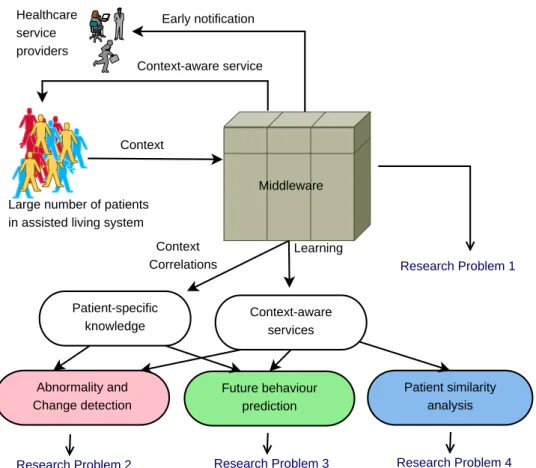
The main research objective of this thesis is to develop a scalable context-aware model for AAL that also solves problems regarding clinical abnormalities detections and predictions from large biomedical data by discovering user-specific knowledge using context correlations and different machine-learning techniques. To achieve this goal according to the background study and motivations the main research problems of this thesis are summarized in Figure 1.5.
In order to overcome the aforementioned research challenges the following research questions are defined with the aim of achieving a scalable, predictive and protective context-aware system for AAL.
The model
RQ-1. How to support large number of patients by user-specific context-aware services using a common model? How to manage, process and convert large biomedical data from heteroge-neous sources of many patients to useful knowledge using that model?
Research Questions 15
Middleware Context
Large number of patients in assisted living system
Context-aware services Abnormality and Change detection Future behaviour prediction Patient similarity analysis Patient-specific knowledge Research Problem 1 Research Problem 2 Healthcare service providers Early notification Context-aware service Context Correlations Learning
Research Problem 3 Research Problem 4
Figure 1.5: A scalable, predictive and protective context-aware system and related research problems.
middleware. The significance of addressing this issue is primarily to ensure that we can sup-port a large number of patients in parallel through context-aware services by using a common framework.
Knowledge discovery, abnormality and change detection
RQ-2. How to detect health-related abnormalities in a current situation and long-term behavioural changes in a patient by discovering personalized knowledge and correlating the changes in different contextual information?
From the solution of the first research question, we have a framework to process big data generated from patients of many assisted living systems. In the second research question we have utilized this framework to develop learning models for personalized knowledge discovery
Research Questions 16
and, using that knowledge, detect physiological abnormalities and future changes in a patient. The interrelations between various contexts are utilized for these models’ development. The solutions ensure that abnormalities and changes are detected accurately and patients can be supported by user-specific context-aware services.
Future behaviour prediction
RQ-3. How to predict patient-specific future abnormalities continuously by utilizing the cor-relations of his/her present and past biomedical data as the context for providing intelligent decision support?
This research question addresses the issues regarding prediction of future states. The same model that is developed as a solution to the first research question is utilized to learn from patient-specific past data for predicting future values. This is a ‘one-to-one’ solution where the system learned from contextual data of a patient and predicts only for him/her using that learned information. This continuous learning solution enables continuous decision support for a patient.
Patient similarity
RQ-4. How to predict clinical abnormalities and future behaviours of an unknown patient using the prior knowledge from a large group of similar patients? How to identify those similar patients?
Using the cloud-based model developed for Research Question 1, this research question ad-dresses the issues regarding similarity in patients’ context. This provides a ‘many-to-one’ solution where learning models are developed from the past data of many patients which are then used for real-time prediction for a new patient. This research question also solves the issue relating to clustering similar patients. The solutions provide an unsupervised approach in identifying similar patients and early prediction capability of abnormal clinical situations of new patients using prior knowledge of those similar patients.
Limitations of Existing Solution 17
1.5
Limitations of Existing Solution
A wide range of context-aware middleware solutions exist for AAL technology where research focus is restricted to specific services such as activity monitoring [50, 51, 52], fall detection [53], caregiver management [54,55,56] and emergency monitoring [57]. Most of these systems proposed different context modelling approach according to their problem domains. No precise standard is found in literature for context modelling specially for home-based assistive care.
Existing systems for personalized AAL systems depend on standalone applications that run on a local server or a mobile device. These applications are developed to provide limited services [58]. However, the volume of data that is gathered from each personalized AAL system is so large that it is impossible to store and process them for knowledge-discovery in small memory of a hand-held device. Moreover, the physiological data of a patient varies with different activities, locations, medical histories and for many other reasons. Therefore, performing resource-hungry operations such as context data processing and learning on this big data with large diversity from centralized middleware servers would result in rigid, failure-prone, and non-scalable systems.
Conventional context management solutions are incapable of handling good number of AAL systems in parallel. Most of the system target to serve a specific patient category (e.g. cardiac disease) [18]. As they are based on centralized hospital server, it is impossible to serve a large number of patients with various chronic diseases using such centralized management facilities. There is a huge lack in the coordination between patients and healthcare professionals when the number of patients increases.
In traditional systems, patient situations are classified by generalized medical rules [59] or fuzzy rules [60] which are not always applicable for every kind of patient. These systems cannot sense the future at an early stage. In some monitoring systems, when a patient feels unwell he/she needs to press a wearable panic button to notify a response centre about the emergency. Some systems try to understand patient’s discomfort level and the seriousness of the condition by asking automated sets of questions [61]. Such systems can generate many false alarms to the monitoring centres; which is not desirable.
Existing home-based context-aware remote monitoring systems use different techniques such as rule-based reasoning [13,62,63], probabilistic model [64], data mining [65,66], sensor-network based decision support [67] and video-based monitoring [68] which can detect abnor-malities only when they occur in an ongoing situation. There is no option to store and reuse context histories which can be utilized for modelling each user state individually and predict