Volume :6, Issue:3-4, Year:2016, pp. 86-104
86
HOW DOES THE CORPORATE CULTURE AFFECT THE IMPLEMENTATION OF IFRS?
Emin YÜREKLİ* Abstract
Research revealed that the corporate cultures and their dimensions adopted by the companies have different impact on their accounting frameworks used. Prior researches place focus on the link between the country’s culture and the adoption of IFRSs. Thus, the specific corporate culture as a determining factor for the use of IFRSs is not widely considered. This study is developed to assess whether the corporate culture and its dimensions affect the implementation of IFRS. This research was made due to the fact that IFRS is one of the most common frameworks used worldwide. The results of this study is based on seven hypotheses and they confirmed that the cultural dimensions such as goal oriented company, externally oriented companies, and those which follow easy-going working practice have adopted IFRS so far.
Keywords: Financial Reporting, IFRS, Cultural Values.
JEL Codes: M41, M48
1. Introduction
The global economy nowadays is characterized by the sharing of economic influences and results between the countries. The process of globalization is characterized by the fact that the companies are no longer national but multinational with working operations in many countries. The increase of the international trade, the companies’ operations in many countries, the free movement of the capital, goods and services are the lead factors for the need of consistency among the economies and companies worldwide. The differences between the countries related to different cultures and attitudes, and different regulations, had eventually led to the need for many types of harmonization in the global economy. On the other hand, the global market requirements for the presentation of consistent financial results for the companies’ performance has increased
* Assistant Professor, Faculty of Administrative Sciences and Management, Kyrgyz-Turkish Manas University, Kyrgyzstan, [email protected]
87
as the process of globalization had become more intensive. The capital investors have huge requirements for financial information which need to be comparable and summarized in the financial statements.
The companies must assess the way and the level of influence of the cultural values over the working environment. On the other hand, the company’s management must assess if those values are affected by the culture itself. According to Hofstede, six dimensions of national culture are identified: Low power distance versus high power distance, the individualism versus collectivism, masculinity versus femininity, high uncertainty avoidance and vice versa, long term versus short term orientation and indulgence (Hofstede, 1994). This framework is widely used by companies’ management due to the fact that it provides information about the influence of the national culture on companies’ operations and individuals’ performances as well. In the context of relationship between accounting and cultural differences, the development of the IFRS has enabled the companies to present financial information in a more consistent way. But it is still questionable whether the national culture and the corporate culture itself emphasize the adoption and implementation of IFRS. On the other hand, there are doubts whether the size of a company determines the use of generally accepted accounting frameworks such as IFRS. Moreover, it should be reviewed whether the country legal enforcement for use of particular accounting framework is the main factor which determines the use of IFRS or other generally accepted accounting framework.
This study will investigate and analyze the cultural dimensions identified in companies’ surroundings which impact the adoption of IFRSs by companies. The study is based on an examination of 13 countries and three companies chosen from each country. The companies selected are randomly chosen on the basis of success reviews from each country. In the below section, a brief review on these points is provided. The results of the research and the conclusion reached are provided in the final section with brief recommendations.
2. Literature Review
2.1. The cultural dimensions
The culture can be defined as a collective programming of people’s mind which is different for each member of the group (Hofstede, 1994).Moreover, according to Gray (1988),the culture of societies is expected to have an impact on the accounting systems used in
88
countries (Sale,2002, p.162). The accounting can be analyzed in each cultural surrounding as a manifestation of unconscious processes (Belkaoui, 2002, p.88). One of the most significant dimensions is the power distance which reflects the level of acceptance of the hierarchy and the level differences between the employees within the companies. In other words, it can be assumed that if the society is characterized by a high level of power distance, the individuals will tend to respect the authorities and will not confront with the management decisions. Opposite to this stance is the low level of power distance by which the hierarchy is not accepted. Another dimension defined by Hofstede is the uncertainty avoidance, which is a measure of the aversion of people towards the unknown (Toomey, 1999, p.71). It means that people with a strong level of uncertainty avoidance have a low level of sense for flexibility or innovation. The individualism as a cultural dimension is a relationship between the individual and the group (Hofstede, 1994). In the individualistic environments the independence is a common practice for the individuals. On the other hand, the collectivism is characterized by the collaboration between the employees (Hofstede, 1994). Masculine societies and companies as well are identified with people that are much more oriented towards success and they emphasize gender differences (Nobes, 2004, p.58) . In the feminine surroundings the social welfare and care for each other is of great importance (Hofstede, 1994).
A strong interaction is identified in the literature between the national culture and the scope of the organizational culture within companies. Even more, there is considerable evidence which highlights the influence of the ethnic culture on the professional accountants’ attitude (Chand and Patel, 2011). Thus, this study is based on the assumption that the national culture itself determines the corporate cultures in companies. Even more, the four basic types of corporate cultures which depend on the flexibility offered in a company and the level of control imposed by the management have similarity with the types of national cultures (Chanegrih, 2008). Rykrsmith (2014) argues that a company’s culture is a system of values, beliefs, norms, languages, symbols and habits. These are significantly determined by the overall culture applicable for the country (Schneider, 1998). As Hofstede’s definition of the overall culture dimensions, their influence can be replicated into the six dimensions relevant for the corporate culture (The Hofstede centre, n.d.). The corporate culture dimensions suggested by Schneider (1998) are: means vs. goal oriented, internally vs. externally driven, easy-going vs. strict work discipline, local vs. professional, open
89
vs. closed system and employee vs. work centered. For example, the means oriented organizational structure places emphasis on risk avoidance and it is correlated with the dimension for uncertainty avoidance. It is focused on “the way” the work should be done, as compared to the “goal” oriented corporate cultures where the employees are focused primary on the goals and achievement on the tasks set by the management.
When adoption of IFRS is analyzed, the cultures which are means oriented tend to adopt this framework due to the fact that it provides a decreased level of risks in terms of companies’ failures and prudent presentation of companies’ performance. The second organizational dimension is the internally vs. externally driven structure and it is related to the individualism and the collectivism dimensions applicable for the country (Schein, 2009, p.78). According to this dimension, the externally oriented companies will adopt IFRSs, due to the fact that these standards provide comparability between companies. Even more, the companies which accepted IFRS are much more exposed to the foreign markets and cooperate with numerous stakeholders. When analyzing the easy-going vs. strict work discipline as a corporate culture dimension it is more than obvious that this dimension is identified, to a large extent, by the power distance dimension applicable for the national culture (Rykrsmith, 2014). Due to the fact that IFRSs are based on principles and not on rules, they are much more adopted by companies which have an easy-going corporate practice.
In addition, as each country has its own language which enables fluent communication among people, the accounting is the language used by the companies and the investors. In this regard, the accounting framework and the adaption of IFRS is briefly reviewed in the following section.
2.2. Accounting Framework and the adoption of IFRS
The accounting systems of the countries are considerably determined by the social, political, economic and cultural factors. According to Mueller (cited in Roberts, Weetman and Gordon, 2008), there are four groups of accounting systems among countries. The first type is an accounting system that functions within a macroeconomic framework which is based on national economic policies. This type is focused on the equitation with the tax regulation of the country and it is based on the principle of social responsibility. The second type of
90
accounting system is based on a microeconomic approach and it is a common practice for the market oriented economies. It is focused on a real, true and fair measurement of the company’s performance. Within these systems the accounting rules are flexible and sophisticated and adapted to the market requirements and developments. The third type of accounting system is characterized by its independent development. It is called “ex post” due to the fact that the accounting solutions are developed after the problem is identified. These systems are based on “generally accepted accounting principles”. The final type of accounting system is the “uniform” system and is common for countries where the government wants to use accounting as a control mechanism. Its goal is to measure the company’s performance, to control the prices, allocate the funds and so forth (Mueller, 1967 as cited in Nobes and Parker, 2008).
Table 1: Cultural dimensions of the countries
Power
distance Individualism Masculinity
Uncertainty avoidance Long term orientation Indulgence Australia 36 90 61 51 21 71 Canada 39 80 52 48 36 68 Germany 35 67 66 65 83 40 New Zealand 22 79 58 49 33 75 France 68 71 43 86 63 48 Sweden 31 71 5 29 53 78 Italy 50 76 70 75 61 30 Turkey 66 37 45 85 46 49 Switzerland 34 68 70 58 74 66 USA 40 91 62 46 26 68 United Kingdom 35 89 66 35 51 69 Russia 93 39 36 95 81 20 Netherlands 38 80 14 53 67 68
Source: Adapted from Geert Hofstede Centre, n.d.
The financial performance of the entity is measured with accounting. It provides companies, investors, regulators and other stakeholders with information about the financial results and the company’s performances. The use of rules or principles for preparation of the financial statements provides standardization across companies and markets as well. When analyzing IFRS, standards represent a single
91
set of accounting standards which can be used globally by all countries. The adoption of these standards enables the investors and all other users of financial statements to compare the financial performance between the companies (IFRS, n.d.)
The idea of IFRS started in the middle of 1960s when the listed companies were required to present their financial statements in accordance with the international standards. Those days a special body was founded: The Accountants International Study Group (AISG). Nowadays, the International Accounting Standards Board (IASB) has the responsibility of releasing the International Accounting Standards (IAS) and the International Financial Reporting Standards (IFRS). They represent guidance for the recording of the economic transactions within the companies (ICAEW, 2013). The Board’s main objective is to develop a single set of high quality, globally accepted financial standards which will be understandable and enforceable as well. IFRS are currently mandated by more than 100 countries (IFRS, 2015).
3. Methodology
On the basis of the above review of the theory, we anticipate that the country’s cultural dimensions significantly influence the culture adopted by the companies and eventually these dimensions affect the use of the IFRSs. Thus, for the purpose of this research, the scores of the countries selected for the following dimensions were taken in consideration: power distance, individualism, masculinity, uncertainty avoidance, long term orientation and indulgence. Furthermore, the geographical approach is used as well; for example the EU countries are analyzed as one single economy regarding their practice for use of IFRSs. The legal enforcements set in the countries are also taken in consideration due to the fact that this variable will determine the acceptance or decline of the IFRSs. And finally, the market capitalization of the economies may determine the type of financial reporting framework which will be accepted and recommended in the country.
Due to the difficulty to cover all countries, the sample used for this study is restricted with 13 countries, three companies (See Table 1) being chosen (See Appendix) from each country. The countries selected are from different continents and different cultural surroundings in terms of different cultural values such as language, religion and economic development levels. The companies which are selected for this study are
92
randomly chosen reviewing the top 100 in their country of origin based on the official local stock exchange listings.
Table 2: Legal enforcement Country Legal enforcement values
Australia 9.30 Canada 9.58 Germany 9.37 New Zealand 9.80 France 8.97 Sweden 9.80 Italy 7.95 Turkey 7.19 Switzerland 9.99 USA 9.52 United Kingdom 9.40 Russia n/a Netherlands 9.87
Source: Adapted from La Porta et al., 1998.
The financial reporting framework used by the companies is noted in the companies’ annual reports or in their financial statements. The annual reports and financial statements are obtained from the companies’ websites. It would be much more appropriate if the period examined was longer, but due to the resource limitation, the relevant period for this study is the period between 2013 and 2015. Furthermore, the fact that only 13 countries were selected for the analysis limits the generalizability of the findings to the entire population. The audited financial statements of 39 companies selected along with the annual reports are the main sources used for the research.
4. Hypothesis
Based on the methodology presented above, the analysis regarding the relations between the corporate culture and the adoption of IFRS could be hypothesized as such:
H 1: The EU Countries adopted IFRS and the other countries use local regulation for financial reporting purposes
The first criteria used when assessing the impact of the corporate culture on the implementation of IFRS by the companies is the accounting and reporting framework used.
93
Results: This research confirms the assumption that most of the European companies adopted IFRS so far for the preparation of their financial statements. The EU countries have been using IFRS since 2005 or some of them even for longer (Tarca, 2012). Based on the annual reports of the chosen companies, the companies from the USA and Canada have adopted the US Generally Accepted Accounting Principles (US-GAAP) as the financial reporting framework. Thus they did not use the IFRS and adopted a more rigorous accounting regulation. On the other hand, several companies used the local regulation of the country for the purpose of preparation of their accounts. These companies originate from Australia, New Zealand, Turkey and Russian Federation. The results of this criterion are presented in the Appendix.
H 2: Low power distance in the organizational culture has a positive relation with the adoption of IFRS
Taking into consideration the brief literature review presented above, the corporate cultures which have a higher level of power distance and tend towards strict work discipline will tend to adopt more rigorous reporting frameworks, such as local accounting regulations or principles. The openness towards the hierarchy differences and the ability to accept instructions are in direct correlation with the use of legal requirements and laws applicable in the country.
Results: This study has confirmed that the countries which have higher coefficients of power distance have an indirect correlation with the use of IFRS. More exactly, the companies coming from the countries with high power distance levels do not accept the use of IFRS and comply with the local accounting requirements. This study also confirms that the companies selected in the sample originating from Turkey and Russia do not use IFRS but the local regulations. On the other hand, the companies coming from low levels of power distance economies and tend to be market oriented have adopted IFRS (See Table 1).
H 3: The collectivism or the externally oriented company as the corporate culture dimension tends towards the adoption of IFRS
The other dimension of “individualism vs. collectivism” relevant for societies and consequently reflected in the corporate cultures as “internally or externally” driven companies have an implication on the use of the accounting frameworks as well. The higher level of individualism and internal focus is expected to influence the use of local regulations and not the accounting framework which is widely used.
94
Results: When analyzing the sample of the companies selected, this hypothesis is confirmed by the fact that the companies coming from high individual score’s countries adopted the local requirements and do not follow the generally accepted standards for financial reporting purposes (See Table 1).
H 4: The higher levels of masculinity correlate with use of local financial reporting regulations
The 3rd dimension of masculinity in the society has direct correlation with the acceptance and adoption of IFRS. This means that the corporate culture within the company in which the masculinity is at a low level will tend to prepare its financial statements in accordance with the generally accepted financial standards or IFRS, and will be open to comply with the world’s economy standards.
Results: In this study the companies coming from low level masculinity societies such as Sweden and Netherlands have adopted IFRS so far (See Table 1).
H 5: The uncertainty avoidance or the strict work discipline within the company emphasize the use of local financial reporting regulations
A higher level of uncertainty avoidance of a particular company and adaptation of means oriented culture within the company will tend towards the use of the financial reporting framework which is more robust. Moreover, this type of corporate culture can assure an accounting system which is predictable and consistent during the years.
Results: When analyzing this sample, it was confirmed that the companies coming from Turkey and Russia anticipate high uncertainty levels and they both use local regulations (See Table 1).
H 6: Direct correlation between the legal enforcement variables and IFRS
This study uses the legal enforcement variables for the assessment of IFRS adoption by the companies. More exactly, the legal enforcement in the society is measured by the following variables: efficiency of the judicial system, rule of law, corruption, risk of appropriation and risk of contract repudiation.
Results: The countries which have higher scores tend to be more
developed and consequently will use frameworks which are generally accepted and emphasize improvements in the financial reporting. Even more, these companies are often multinational and tend to be listed on the official markets, thus they must comply with generally accepted
95
standards. Based on the study performed, the highest scores have Switzerland and Netherlands, and the companies coming from these countries have both adopted IFRS in the prior periods (See Appendix).
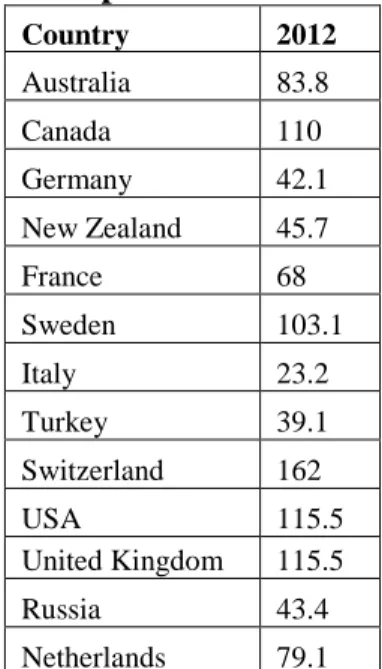
H 7: Market capitalization and the company’s size affect the implementation of IFRS
The market capitalization index represents the level of market development. In other words, the high developed economies have a higher market capitalization index and eventually more successful companies. The level of success of the economy and the company itself is directly correlated to the need for a consistent and more sophisticated financial reporting system. Furthermore, some economies which are very well developed had created their own financial reporting principles and standards. Those economies are USA, which developed GAAP, Europe, which as a single economy places focus on IFRS, and Australia and New Zealand have their own regulations.
Table 3: Market capitalization index as % of GDP
Country 2012 Australia 83.8 Canada 110 Germany 42.1 New Zealand 45.7 France 68 Sweden 103.1 Italy 23.2 Turkey 39.1 Switzerland 162 USA 115.5 United Kingdom 115.5 Russia 43.4 Netherlands 79.1 Source: The World Bank, 2015
Results: This assumption is confirmed by the research performed. When the size of the company is taken into consideration it can be assumed that the bigger the size of a company, the more market oriented corporate culture is to be followed. Furthermore, it is a common practice
96
that the bigger companies perform operations in different countries, meaning that they are globally oriented and thus, they will adopt generally accepted standards. Since this study covers companies which take part in the top 100 in their country of origin, based on the official local stock exchange listings, most of them adopted IFRS as a widely accepted financial reporting framework (See Table 3).
5. Conclusion
This study investigates the correlation between the corporate culture and the adoption of IFRS. It is based on the use of the cultural dimensions for the society and corporate culture dimensions established by Hofstede in order to assess the impact of the corporate culture on the implementation of the IFRS by the companies worldwide. The research performed for this study is based on the assessment of 13 countries and three companies representing each country. The results of this study confirmed the assumption that the cultural dimensions such as “means oriented”, externally oriented companies, those which follow easy-going working practice and tend to be open to the market surroundings have adopted IFRS so far. Companies which have lower power distance approach prefer the principle approach for their reporting purposes, compared to the companies with higher levels of power distance which have much rigorous systems based on rules. This dimension is very common with the uncertainty avoidance dimension and confirms the thesis that companies which have lower level of this score tend to use IFRSs. Moreover, the size of the companies is in direct correlation with the adoption of the IFRS. On the other hand, the economies which have a higher score of market capitalization tend to adopt IFRS as a common reporting framework. Finally, the legal enforcements within the countries significantly determine the reporting framework widely used by companies.
There are limitations to make more general assumptions based on this study. Since this study is based on the information presented in the financial statements for a period of three years, and covers 39 companies, a more extended research is recommended so that the results can be much more representative. It will be more beneficial if the research could cover companies of different sizes and that originate from different countries. The research performed in this way will be much more representative and conclusive as well.
97
REFERENCES
Belkaoui R. A. (2002).Behavioral Management Accounting. London: Quorum.
Chand, P. & Patel, C. (2011).Achieving Global Convergence of Financial Reporting Standards: Implications from the South Pacific Region. London: Emerald.
Chanegrih, T. (2008).The Effects of National Culture on Changes in Management Accounting Systems. Asia-Pacific Journal of Management Research and Innovation, 11(1), pp. 16-28.
Cocco, K. &Asare, K. (2012). An investigation into the factors that lead to career success in accounting: are great accounts born or made? The Honors Program, Senior Capstone Project April 2012. Available at: http://digitalcommons.bryant.edu/cgi/viewcontent.cgi?article=1006&cont ext=honors_accounting (Accessed November 30, 2015)
Hofstede, G. (1994). The Business of International Business is Culture.
International Business Review, 3(1), pp. 1-14.
ICAEW.(2013).Knowledge guide to International Accounting Standards. Available at: http://www.icaew.com/en/library/subject-
gateways/accounting-standards/knowledge-guide-to-international-accounting-standards#sthash.VSKtrDW7.dpuf (Accessed November 20, 2015)
IFRS.(n.d.). What are IFRS? Available at: http://www.ifrs.org/About-us/Pages/What-are-IFRS.aspx (Accessed November 20, 2015)
IFRS.(2015). Who we are and what we do. Available at:
http://www.ifrs.org/The-organisation/Documents/2015/WhoWeAre_ENGLISH_July%202015.pdf (Accessed November 20, 2015)
La Porta, R. et al. (1998). Law and Finance.The Journal of Political Economy, 106(6), pp. 1113-1155.
Nobes, C. & Parker, H.R. (2008).Comparative International Accounting. 10th ed. Essex: Pearson.
Nobes C. (2004).Developments in International Accounting p.58.Cheltenham: Edward Elgar.
Roberts, B.R., Weetman, P. & Gordon, P. (2008).International Corporate Reporting: A comparative approach. 3rd ed. Essex: Pearson. Rykrsmith, E. (2014). 6 Dimensions of Organizational Culture – Which
One is Right for You? Available at:
http://quickbase.intuit.com/blog/2014/02/25/6-dimensions-of-98
organizational-culture-which-one-is-right-for-you/#sthash.OoXV6dZW.dpuf (Accessed November 25, 2015) Sale, J.T. (2002). Advances in international accounting. UK: Oxford. Schein, H.E. (2009).The Corporate Culture Survival Guide.San Francisco: John Wiley.
Tarca, A. (2012).The Case for Global Accounting Standards: Arguments and Evidence. Available at: http://www.ifrs.org/use-around-the- world/documents/case-for-global-accounting-standards-arguments-and-evidence.pdf (Accessed November 20, 2015)
The Hofstede Centre.(n.d.).National Culture. Available at: http://geert-hofstede.com/national-culture.html (Accessed November 20, 2015) The World Bank.(2015). World Development Indicators. Available at: http://wdi.worldbank.org/table/5.4 (Accessed November 20, 2015) Toomey T.S. (1999).Communicating Across Cultures.New York and London: The Guilford Press.
Schneider, S.C. (1998). National vs. Corporate Culture: Implications for Human Resource management. Human Resource Management, 27(2), pp. 231-246.
Annual Reports of Chosen Companies:
https://www.aaco.com.au/media/147765/2014-15_aaco_fy14_ annual_report.pdf http://www.woodside.com.au/Investors-Media/announcements/ Documents/17.02.2016%202015%20Annual%20Report.PDF https://www.telstra.com.au/content/dam/tcom/about-us/investors/pdf%20D/2015-ANNUAL-REPORT.pdf http://us.blackberry.com/content/dam/bbCompany/Desktop/Global/PDF/I nvestors/Governance/Q4_FY15_filing.pdf https://www.rogers.com/cms/investors/pdf/annual-reports/Rogers-2014-Annual-Report.pdf http://www.cisco.com/c/dam/assets/about/ar/pdf/2015-cisco-annual-report.pdf http://investors.johnsoncontrols.com/~/media/Files/J/Johnson-Controls- IR/annual-reports-and-proxy-stmts/Revised%20FY2015%2010-K%20All-In%20FINAL.pdf http://ar15.imperial-tobacco.com/pdfs/full-annual-report-2015.pdf http://www.magna.com/investors/financial-reports-public-filings http://www.volkswagenag.com/content/vwcorp/content/en/misc/pdf-dummies.bin.html/downloadfilelist/downloadfile/downloadfile_30/file/Y _2014_e.pdf
99 http://www.henkel.com/blob/638606/7fa5a815caec9fef3c8097c211558c6 0/data/2015-annual-report.pdf http://www.annualreport.telekom.com/site0216/fileadmin/15_AR/PDF_E N/DTAG_AR15_complete.pdf http://www.foodstuffs.co.nz/media/131770/fssi_ar_2014_summary.pdf http://www.airnewzealand.co.nz/assets/PDFs/2015-Annual-Financial-Results_web-1.pdf https://www2.fonterra.com/files/financial-docs/FSF+2014+Annual+Report.pdf http://www.sanofi.com/Images/38473_Sanofi_20-F_2014.pdf https://cdn.axa.com/www-axa-com%2F73719a96-c3b1-456b-abaf-63b80c06968c_axa_reference_document_2015.pdf http://interactivedocument.labrador-company.com/Labrador/EN/Technicolor/RegistrationDocument2015/ http://www.scania.com/Images/Annual-Report-2014_tcm40-465261.pdf http://www3.volvo.com/investors/finrep/ar15/ar_2015_eng.pdf http://www.electroluxgroup.com/en/wp-content/uploads/sites/2/2016/03/Electrolux-Annual-Report-2015.pdf http://www.pradagroup.com/uploads/prada/document/document/44/e-Annual_Report_2014.pdf http://www.telecomitalia.com/content/dam/telecomitalia/en/archive/docu ments/investors/Annual_Reports/2014/Annual-report2014.pdf http://integrated.terna-reports.it/2014/sites/default/files/doc-toolbox/Consolidated_financial_statements_Annual_Report_2014_Terna _Spa.pdf http://en.karsan.com.tr/images/pdf/2014_faaliyet_raporu.pdf https://www.otokar.com.tr/en- us/investorrelations/financialresults/AnnualReports/2014-ye-annual-report.pdf http://www.koc.com.tr/en-us/investor-relations/financial-statements-and-statistics/Annual%20Reports/Annual%20Report%202015.pdf https://www.nestle.com/asset- library/documents/library/documents/annual_reports/2014-annual-report-en.pdf http://www.roche.com/gb15e.pdf https://www.novartis.com/sites/www.novartis.com/files/novartis-annual-report-2015-en.pdf
100
http://www.intc.com/intel-annual-report/2014/files/Intel_2014_Annual_Report.pdf
British Airways Plc. web site (downloadable version available)
http://www.bat.com/group/sites/uk__9d9kcy.nsf/vwPagesWebLive/DO9 DCL3B/$FILE/medMDA87PVT.pdf?openelement http://www.lukoil.com/materials/doc/AGSM_2015/LUKOIL_AR_eng_2 014.pdf http://www.gazprom.com/f/posts/55/477129/gazprom-annual-report-2014-en.pdf http://www.tatneft.ru/storage/block_editor/files/65ec680d699efb97b9495 e44f8bd49c2cd80989e.pdf http://www.cnhindustrial.com/it/investor_relations/financial_information /annual_reports/FiatDocuments/CNHIndustrial_Annual_Report_2014.pd f http://www.theheinekencompany.com/investors/governance/agm http://www.philips.com/b-dam/corporate/about- philips/investors/financial-results/annual-reports/PhilipsFullAnnualReport2014_English.pdf
101
Appendix:
Financial statements reporting framework used
Country Company FY Reporting regulation
used by the company
Australia
Australian Agricultural Company Limited
Woodside Petroleum Limited Telstra Corporation Limited
2013 2015 2015 Australian Accounting Standards and Corporations act Australian Accounting Standards and Corporations act and IFRS Australian Accounting Standards and Corporations act Canada BlackBerry Limited
Rogers Communications Inc. Cisco Systems, Inc
2015 2014 2015
United States generally accepted accounting principles
IFRS
United States generally accepted accounting principles Germany VW Henkel Deutsche Telekom 2014 2015 2015
IFRS for EU and German commercial law
IFRS for EU and German commercial law
IFRS for EU and German commercial law
New Zealand
Foodstuffs North Island Limited Air New Zealand
Fonterra Co-operative Group Limited 2015 2015 2014 Generally accepted accounting practice in New Zealand Generally accepted accounting practice in New Zealand Generally accepted accounting practice in New Zealand and IFRS France Sanofi AXA Technicolor 2014 2015 2015 IFRS IFRS as adopted by EU IFRS as adopted by EU
102 Sweden Scania Volvo Group Electrolux 2014 2015 2015
Annual Accounts Act and IFRS
Annual Accounts Act and IFRS
Annual Accounts Act and IFRS Italy Prada Telecom Italia TernaS.p.A. 2014 2014 2014 International Financial Reporting Standards as adopted by the European Union (EUIFRS) and Local regulations
International Financial Reporting Standards as adopted by the European Union (EUIFRS) and Local regulations
International Financial Reporting Standards as adopted by the European Union (EUIFRS) and Local regulations Turkey KarsanOtomotivSanayiiveTicaret A.Ş. Otokar Koc 2014 2014 2015 Article 514 of the Turkish Commercial Code No. 6102 TCC provisions of the “Communiqué No. II-14.1 of the Capital Markets Board (“CMB”) on the Principles of Financial Reporting in Capital Markets Article 514 of the Turkish Commercial Code No. 6102 TCC provisions of the “Communiqué No. II-14.1 of the Capital Markets Board (“CMB”) on the Principles of Financial Reporting in Capital Markets Article 397 of the TCC and the Communiqué
103 Switzerland Nestle Group Roche Holding AG Novartis 2014 2015 2015
IFRS and Swiss law IFRS and Swiss law IFRS and Swiss law USA
Intel
Johnson Controls, Inc Magna International Inc
2014 2015 2015 US GAAP US GAAP US GAAP United Kingdom British Airways Plc British American Tobacco Imperial Tobacco
2014 2015 2015
IFRSs as adopted by the European Union and Companies Act 2006
IFRSs as adopted by the European Union and Companies Act 2006
IFRSs as adopted by the European Union and Companies Act 2006 Russia Lukoil Gazprom Tatneft 2014 2014 2014 Russian Accounting Standards (RAS) and subsidiaries under US GAAP
IFRS
Russian Accounting Standards (RAS) and subsidiaries under US GAAP
104 Netherlands CNH Industrial N.V. Heineken N.V. Philips 2014 2015 2014 International Financial Reporting Standards as adopted by the European Union (EUIFRS) and Local regulations
International Financial Reporting Standards as adopted by the European Union (EUIFRS) and Local regulations and Dutch Law
International Financial Reporting Standards as adopted by the European Union (EUIFRS) and Local regulations and Dutch Law