A Different Way to Solve Quadratics – Bluma’s Method*
Abstract
In this article, we introduce an approach to finding the solutions of a quadratic equation and provide two proofs of its correctness. This method involves transforming a given, arbitrary quadratic into one whose coefficient of the squared term is 1 and whose solutions are related to the solutions of the original.
Introduction
One skill taught in an algebra class is the ability to find the roots of a quadratic equation. Factoring the quadratic and applying the Zero Product Property is one of the methods typically introduced to solve this problem. For many students, factoring is routine until they are asked to factor a quadratic equation whose coefficient of the quadratic term is not 1. In this article, we introduce a method (Bluma’s Method) for solving a quadratic equation by first transforming it into a quadratic with lead coefficient 1, then solving the new polynomial and relating its solutions to those of the original problem. We will then give two proofs of the method (one algebraic and the other more geometric in nature) and discuss its merits for classroom use.
Bluma’s Method – The Procedure
We learned of this method from Bluma, an eighth grade student in a large, suburban middle school in the Washington, D.C., metro area. The method was introduced to her by her teacher in the following manner.
Step 1: Starting with the equation: 5x2
move the coefficient of x2 to the constant term by multiplying the two. This gives x2 - 27x + 50 = 0.
Step 2: Solve equation (1) by factoring it into
(x - 25)(x - 2) = 0, which gives solutions of x = 25 and x = 2.
Step 3: The solutions of the original equation are obtained by dividing the answers from Step 2 by five, the coefficient of x2 in (1). Thus, the solutions to (1) are x = 5 and
x = 2/5.
First, we should check to ensure that these are, in fact, the solutions of the original equation. This is easy to see, as we can just substitute 5 and 2/5 into the first equation to verify that these are roots. More than this, though, we want to know whether or not the method always works and why.
Bluma’s Method – A First Proof
The simplest way to show that this method is correct is to appeal to the quadratic formula. Let f(x) = ax2 + bx + c and g(x) = x2 + bx + ac. We know
that the solutions to f(x) = 0 are
while the solutions to g(x) = 0 are
Therefore, we can get the solutions of f(x) = 0 by taking the solutions of g(x) = 0 and dividing by a as we expected. This proves that Bluma’s Method is correct, not only for a certain type of quadratic, but for every quadratic. This proof has the advantage of begin accessible to any student who has a basic understanding of the quadratic formula.
(1) (2) x = -b ± √b 2 - 4ac 2a x = -b ± √b 2 - 4ac. 2
Bluma’s Method – A Second Proof
By noting how similar equations (1) and (2) are, it is natural to wonder if there is some way to translate easily from one to the other. Of course, they are not equivalent equations (meaning they do not have the same solution set), but they can be related by a transformation of variables, as we now see.
Let f(x) = ax2 + bx + c and g(z) = z2 + bz + ac. Consider the
substitution z = ax (or x = z/a). We get
In other words, f(z/a) is zero if and only if g(z) is zero. Said more formally, let z = T(x) = ax define a transformation from the x-axis to the z-axis. Then
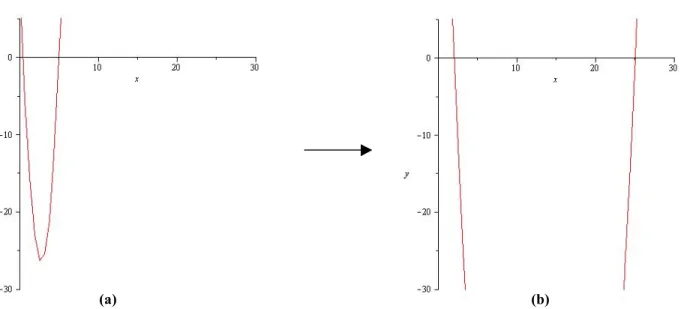
We can interpret this transformation geometrically as stretching (if a>1) or contracting (if a<1) the x-axis in the graph of the original equation (see Figure 1). This proof is instructive because it introduces the idea of a change of variables, which is pivotal in later math courses. f(z/a) = a(z/a)2 + b(z/a) + c = z2 + bz + c a a a = z2 + bz + ac a = g(z). af(x) = (ax)2 + bax + ac = T(x)2 + bT(x) + ac = g(T(x)).
Generalizations of Bluma’s Method
Bluma’s method can very naturally introduce what is called a “mathematical habit of the mind,” (MHM). Given a technique that works for quadratics, it is very reasonable to wonder if it extends to higher degree polynomials. In fact, the approach does, and is motivated by the second proof given above. The argument for polynomials of arbitrary degree can be clearly seen by looking at degree three. Therefore, we consider only the arbitrary cubic polynomial f(x) = ax3 + bx2 + cx + d and again make the
substitution z = ax. We get
This tells us that in order to solve f(x) = 0, we could first solve f(z/a) = a(z/a)3 + b(z/a)2 + c(z/a) + d = z3 + bz2 + acz + a2 d. a2 (a) (b)
Figure 1: We have the graph of (a) y=5x2-27x+10 and (b) y=x2-27x+50. We can see how the transformation stretches the x-axis by five.
g(x) = z3
+ bz + acz + a2d = 0 and then divide these solutions by a. It is
important to note that solving a cubic equation with 1 in front of the cubic term is, in general, not any easier than solving the original equation, as factoring a2d can be tedious.
However, asking the question about generalizations is called a “mathematical habit” for a reason. It is something that most mathematicians will do and can be very helpful in extending the conceptual understanding of a particular technique. This also gives students an example of good questions to ask. For more information on the important concept of MHM, see (Cuoco, 2001), (Cuoco, Goldenberg, and Mark, 1996), (Long, DeTemple, Millman, 2008), or (Millman and Jacobbe, 2008).
Bluma’s Method and Factoring
As stated, Bluma’s method seems well suited only to find the solutions of quadratic equations. However, it can be used to factor as well. Again, we must use the change of variables idea. We can illustrate this with an example. In order to factor the expression 8x2 - 2x - 15, we first make the change of variable z = 8x. Thus, we
get
This is the factoring technique commonly referred to as the AC method.
Bluma’s Method in the Classroom
8x2 – 2x – 15 = (1/8)(z2 - 2z - 120)
= (1/8)(z - 12)(z + 10) = (1/8)(8x - 12)(8x + 10) = (1/8)*4(2x - 3)*2(4x + 5) = (2x - 3)(4x + 5).
We should first note that Bluma’s Method is not a magical technique. That is, if the original quadratic does not factor nicely, the transformed quadratic will not either. However, this fact alone does not make it less interesting. Right away, we can see that this could simply be another tool for students to use while trying to solve a quadratic equation. However, we feel that the true benefit of Bluma’s Method comes less from the method itself as from the discussion it almost always seems to generate.
Any time we have presented this method (whether to high school students, teachers, or college faculty), we are almost always asked whether the method is correct. As a teacher, hearing a question like this from a student is wonderful. After the question is asked, the class could spend some time investigating it. In attempting to decide if the method always works, many students will simply try to work as many examples as possible. This is a perfect opportunity to explain to students that working examples is a powerful tool to understand a method or even to convince oneself that something is true but that, ultimately, it is not good enough. One cannot simply work every possible example. It is at this point that one or both of the above proofs can be demonstrated to the class. Thus, high school or even middle school students are introduced to the proof concept – something that many have not experienced to this point.
Thirdly, as we have briefly mentioned, those classes which are able to work through the change of variable proof will be introduced to a concept that is very useful throughout mathematics. Making a change of variable can lead to great insights into a problem and can even lead to solutions that otherwise are impossible to see. For instance, those students going on to calculus will use a change of variables extensively for integration problems.
One last benefit comes from the fact that most everyone with whom we share the method likes it. This includes both high school and middle school students and their teachers. Any bit of mathematics that piques the curiosity of a student and can even lead them to think about some conceptual aspects of math should be highly sought after.
Our Experience in the Classroom
We have had the opportunity to present Bluma’s Method to several teachers from a high school in rural Kentucky. One afternoon, one of the teachers shared it with her college-bound Algebra II class. These students had recently learned both factoring and the quadratic formula. They immediately latched onto the technique and thought it was neat. After struggling with factoring tricky quadratics for a few days, they were thrilled with any sort of “trick.” What was amazing, though, was how they immediately wanted to know if and why the method worked. They were so insistent that the teacher sought us out (we were in a different classroom at the time) and asked us to present a proof. That type of response is almost unheard of! The students easily followed the quadratic formula proof and seemed impressed that, with just a little bit of work, we could show something was true about an infinite number of things. We also found it amusing that, upon hearing that the method was, at least to our knowledge, not well known, one student even claimed he wanted to write and submit a paper about it before we did!
Closing Remarks
This method is not well known but is also not new. We want to thank one of the referees for pointing out (Jones, 1951), which refers to an article from the Colorado Engineer published in 1924 by William J. Hazard. We do not know of other articles about this method. It also is not universally useful, as it only works well when the
transformed equation factors nicely. However, it has shown itself to be a valuable asset in solving quadratics that have rational solutions and engaging students in active
mathematical discussion and exploration. That being said, we would only advocate its use in the classroom as long as there is enough time for teachers to adequately develop a proof (or provide other reasons for why it works).
Additionally, the academic standards of some states explicitly say that students should, at first, only work with quadratics with a 1 in front of the quadratic term, the so-called monic polynomials. More complicated quadratics are then handled at the next level algebra class. Bluma’s method could be used as an intermediate step when transitioning from easier to more difficult problems. The newly introduced Georgia Performance Standards, MM1A3 and MM2A4, are examples of this approach and can be found on the Georgia Department of Education website, http://www.doe.k12.ga.us/.
And for those who are wondering, Bluma is a real person. She is the granddaughter of one of the authors!
References
Cuoco, Al. “Mathematics for Teaching.” Notices of the American Mathematical Society
21 (2001): 1169-72.
Cuoco, Al, E. P. Goldenberg and J. Mark. “Habits of Mind: An Organizing Principle for Mathematics Curricula.” Journal of Mathematic Behaviour 15 (1996) 375-402. Jones, Phillip, ed. “Mathematical Miscellanea.” Mathematics Teacher 44 (1951):193-94. Long, Calvin, D. DeTemple and R. Millman. Mathematical Reasoning for Elementary
Teachers. 5th ed. Boston: Pearson/Addison-Wesley, 2008.
Mathematical Habits of the Mind.” Paper presented at the 11th International Congress on Mathematical Education, Monterrey, Mexico, July 6-13, 2008.
* The work is supported by Grant 0538465 of the National Science Foundation at the University of Kentucky. Responsibility of the correctness of this article is that of the authors, not the NSF.
E. Clark, Department of Mathematics, University of Kentucky, Lexington, KY 40506, [email protected]
R. Millman, Center for Education Integrating Science, Mathematics, and Computing (CEISMC), Georgia Institute of Technology, Atlanta, GA 30332,