projects: arenas, knowledge processes
and time
Jonas So¨derlund
School of Management, SE-58183, Linko¨ping University, Sweden [email protected]
The literature on project management has been dominated by techniques and methods for separating activities and making thought out plans. Closely related to this research stream is the research on product development, which seems to advocate somewhat of a different strategy where managing projects is a matter of enabling the crossing of functions and knowledge bases. This paper attempts to integrate these two lines of research.
The paper is based on two in-depth case studies of project management in product development contexts. The projects under study were highly complex and consisted of multiple interrelated parts, which called for ‘tightly coupled’ organizational solutions. From our point of view, much effort by the project management teams was put into establishing a project that was responsive and where participating local units were oriented toward various ‘global’ measures.
In our conception, the overall deadline seemed to have played an important role for promoting communal and interactive problem solving. Furthermore, the deadline emphasized the need for global arenas where the interactive problem solving could take place. It is argued that time-based controls set a global time for the project. The paper also demonstrates the importance of various global arenas, such as testing activities and project management forums, in order to keep track of time limits and to trigger global knowledge processes. Furthermore, based on the notion of ‘separation’ and ‘coupling’ of sub-systems and project phases, the paper suggests a model identifying four types of project organizations. The paper contributes to the knowledge on project management in complex product development.
Introduction
T
he increasing ‘projectification’ of industries has led to some fundamental changes in the way firms organize product and process development (Midler, 1995). For several reasons, projects have become important vehicles and mechanisms in many firms’ operative and strategic business activities. A product and system development project is a typical example. Due to a number of reasons, such as time-based competition and fast technological progress, managing such a project poses a multitude of challenges. For instance, in the automotive and telecommunicationsindustries, a project is a complex endeavour involving hundreds of engineers and a great number of sub-projects. The requirements of both meeting the overall deadline and integrating the various knowledge bases involved stands at the fore of project management.
In recent years the complexity of product develop-ment efforts has escalated paired with pressures on rapid product development (Clark and Fujimoto, 1991; Imai et al., 1985; Stalk and Hout, 1990). Empirical studies, for instance Gersick (1988, 1989) and Eisenhardt and Tabrizi (1995), suggest that milestones and time limits are important issues for organizing such projects and also for speeding up
product development. In our opinion, time-based control mechanisms should be focused in order to understand important aspects of project organization. Our argument is also that time-based controls have not been researched thoroughly enough in previous research. Although several authors acknowledge the importance of ‘lead time’ (see e.g. Clark and Fujimoto, 1991; Nonaka and Takeuchi, 1995), the significance and function of the deadline as such and the milestones along the way have been given scant attention. This paper builds on the argument that time-based controls have to be considered a key ingredient in the organization of product development. Time should consequently also be considered to be one of the main focuses of studies of project management.
The project management literature generally focuses on planning activities, introducing work breakdown structures, Gantt-schedules, etc., very much in line with a rational view of organizational processes (Burke, 1994; Cleland and King, 1968; Kerzner, 1995). Such a view, however, presupposes that a project is highly analyzable (Lindkvist et al., 1998). Hence, given that many projects are devices to facilitate and manage integration in firms, more sophisticated solutions are required. Integration is thus not handled through the exclusive use of advanced plans but on principles that are characterized by a higher degree of coupling due to the reciprocal interdependence inherent in most complex product development projects (cf. Mintzberg, 1983; Thompson, 1967). A key problem in project management research is also that every project is treated similarly (see e.g. Shenhar, 1993). A basic assumption underlying the studies reported in the present paper is that project management research is in need of a clearer ‘con-tingency approach’ and theoretical concepts in order to analyze the differences between projects. In this paper, therefore, a model identifying different project organi-zations will be suggested.
In several engineering-intensive industries, products tend to form complex systems (Hobday, 1998). Different authors have suggested alternatives for resolving the organizational problem caused by such complexities. As argued above, scholars in project management advocate a planning-oriented approach (e.g. Burke, 1994). Some researchers in product development advocate ‘modularization’ as a strategy for handling such complexity (Sanchez and Mahoney, 1996), whereas others acknowledge the limitations related to extensive modularization in product devel-opment (Hobday, 1998). An alternative approach would be the use of methods such as design structure matrixes, stand-alone cross-functional teams, etc. in order to decompose the complex system into separable tasks and teams (Ulrich and Eppinger, 1995). Not-withstanding the efforts of sucha prioriefforts to solve the complexity problem, the role of project manage-ment during the course of the project is considered to
be of great importance (see e.g. Wheelwright and Clark, 1992). In order to understand the role and work of project management, we need more explicitly focus on the problems that face project management and how the problems are handled and solved. As put by Shenhar and Dvir (1996, p. 607), the ‘wide deployment of projects in organizations today, has not been accompanied ... by a parallel development in project management theory’ and ‘as an organizational con-cept, project management is quite new and probably not well-understood’. We argue that in-depth studies are required to improve our knowledge about project management in complex product development. In-depth studies of project management have also been called for by several researchers within the field of project management (see e.g. Lundin and So¨derholm, 1995; Midler, 1995; Packendorff, 1995).
Our case-study firms, Ericsson and Volvo are typical examples of firms relying heavily on project management in complex settings. These and similar firms have to acquire, nurture and integrate a wide range of technological competencies in order to compete (Granstrand, 1998). Ericsson’s activities include the development, production and installation of complete mobile telephone systems consisting of radio-base stations, switches, etc. In the Japanese project, illustrated below, Ericsson was challenged with a very complex product development task, which involved coordination of the work of hundreds of participants. The development activities covered the generation of new knowledge, but also to a large extent the exploitation and ‘re-combination’ of exist-ing knowledge bases. The situation was similar in the Volvo case, also illustrated below. The development of the new car model – The Volvo S70 – involved hundreds of engineers and a large number of local units and knowledge bases. The case studies indicate that to understand these projects we should adopt a perspective that enlightens both knowledge and time aspects. Specifically, we suggest, studies need to emphasize activities related to the global level con-cerning system-wide error detection and time syn-chronization to balance knowledge processes with global time limits.
The paper points to the importance of different types of arenas for handling the integration of distributed knowledge processes into a well-functioning whole. Moreover, the paper focuses on how project manage-ment uses these arenas as mechanisms for early error detection between local units and local knowledge processes. In our conception, project organization is an important arrangement to manage the dispersed time orientations and local knowledge processes within a firm. Further, to better our understanding of project management as an organizational concept, we suggest a focus on issues related to how time orientation and knowledge processes are handled. In the analysis section, we will therefore make use of the
knowledge-based theory of the firm (Spender, 1996; Grant, 1996) and theories of time orientation in organizations (Ancona and Chong, 1996) in order to improve the knowledge of project management in complex product development.
The coupling logic: a point of departure
In previous research we have elaborated on a contingency framework of complex product develop-ment projects (Lindkvistet al., 1998). In doing so we relied on a two-dimensional reasoning in order to highlight important task aspects of projects. The first dimension distinguishes between development pro-cesses that are ‘systemic’ from those that are ‘analyz-able’. In this conception, systemic processes refer to situations where work activities and causal relations and sequences between them are difficult or impos-sible to specify in advance. The main reason is the existence of severe and unforeseeable technical inter-dependencies. For analyzable processes, on the other hand, such specifications are relatively easy to settle. The dimension of complexity used here is similar to the writings of other organization theorists (see e.g. Perrow, 1970).
The second dimension was built around the distinc-tion between ‘error detecdistinc-tion’ and ‘error diagnostics’ developed by Levinthal and March (1993). In error detection situations, a low degree of technical knowl-edge generation is required in order to handle each individual error. A key problematic is, instead, to achieve a global, or system-wide, search for errors. Error diagnostics, on the other hand, illuminates project contexts that involve more fundamental technological problems, where the detection of errors is of less concern. The error problematics dimension thus differentiates between project contexts that require less knowledge generation from those where deep or specialized knowledge generation is essential. Relying on March (1991), we would expect error detection to be a common feature of projects that are related to knowledge exploitation, while error diag-nostics would typically be paramount in projects that are related to the exploration of new possibilities.
We assume that a large number of product and system development projects involve processes that are systemic. Similar assumptions have been made by scholars on product development (Clark and Fujimo-to, 1991) and Complex Product Systems (Hobday, 1998). The systemic character of such projects means inter alia that it is difficult to make clear inferences about the relationships between the contributing parts and sub-projects. Furthermore, it would also be assumed that complex development projects aim at exploiting and integrating the distributed knowledge bases in a firm. This standpoint is, of course, more controversial. However, much previous research on
development projects have pointed to the core problem being the integration of existing (technological) knowl-edge bases (e.g. Baba, 1990).
The assumptions above suggest that the manage-ment and organization of many developmanage-ment projects is a matter of following a ‘coupling logic’. The coupling logic stresses the need for a high degree of ‘inter-functional responsiveness’ and downplays ‘inter-functional autonomy and separation of activities. Organizing in order to achieve responsiveness and error detection stresses the need for frequent or continuous commu-nication between the various sub-projects and the need for setting up arenas where such formal and informal interaction may take place. It also stresses a different role of project management in facilitating these processes. As it seems, organizing according to a coupling logic is very different from the logic typically advocated in much project management writing.
This article is an investigation into the management and organization of coupled projects. The idea is to draw on case studies of two quite different projects in order to illustrate the role and function of project management in such contexts. Our aim is also to elaborate on a conceptual framework for the analysis of different types of project organizations in order to understand the various roles and functions played by project management. This will be done by (a) identify-ing and analyzidentify-ing different types of project organiza-tions, and (b) suggesting an analysis of complex development project inspired by the literature on the knowledge-based theory of the firm and time in organization.
Methodology and research setting
This paper is based on case studies of two development projects in different Swedish firms; Ericsson Radio and Volvo Car Corporation respectively. Both projects were of high strategic importance and were perhaps the two most important development projects carried out in the two firms respectively during the 1990s. The first case study is about the breakthrough in Japan for Ericsson Radio. In 1992 Ericsson succeeded in winning a prestigious contract with Tokyo Digital Phone to develop and install a cellular telephone system in the Tokyo metropolitan area. The system was to be fully operative in 1994. The project forced management to reconsider their traditional way of working with projects and to implement a new one instead – labelled ‘the fountain model’ – with greater reliance on concurrent work and inter-functional coordination and interaction. As a result they managed to shorten development time quite considerably and deliver the system on time. Important issues for the management of the project was the use of deadlines and milestones along with increased overlap and interaction between different functional units.
The second case study is about the development of the car model Volvo S70, which was launched early in 1997. The project was a great challenge to the project management team in terms of meeting the overall deadline and handling the fast production ramp-up according to the high quality standards. The project led management to try new forms of integration of functional units.
The two cases are different in many aspects, for instance, in industry context, in customer base, in technologies applied, etc. However, they are also similar in several respects, for instance, both projects were considered to be highly successful, both projects had a high strategic importance and the projects show significant resemblance in terms of how they were organized and managed.
Generally, our studies were guided by an ambition to combine the ideas of grounded theory (Glaser and Strauss, 1967) with the ideas of reflexive interpretation as discussed by Alvesson and Sko¨ldberg (2000). The studies started as single case studies where we focused on describing the project process chronologically. We wanted to obtain a ‘rich story’ about the context, background and organization process of both projects. Because of this, the case descriptions below contain a number of quotes from the project participants. The key informants in each of the case studies were the project managers. In the Ericsson case we interviewed the division manager, two other members of the division management team, five functional line man-agers, the project office manager, three project managers and four sub-project managers. In total we conducted 32 interviews, averaging two hours each. In the Volvo case we did 16 interviews, averaging three hours. In the Volvo case we interviewed two members of the top management team, three line managers, two project managers, four sub-project managers, one technical specialist and two team leaders. Every interview was tape recorded and transcribed by the principal researcher. Details about the projects are reported elsewhere (see Lindkvist and So¨derlund, 1996; So¨derlund, 1998).
The chronological description of each of the cases was condensed into a document of about 50 pages respectively. The documents were produced by the principal researcher in collaboration with one of the participants in the research team. The documents were read by three people in each of the projects (in both cases the main project managers and in the Ericsson case also the division manager). This made it possible for us to correct any misunderstandings and further develop our knowledge about the projects. We also discussed our tentative conclusions and ‘within-case’ issues with the company representatives. This process of starting with a ‘within-case’ analysis followed the advice provided by Eisenhardt (1989).
In the subsequent phase of our research, we did a cross-case analysis aimed at identifying the important
empirical patterns concerning the way the projects were executed (see also Eisenhardt, 1989). The focus of the analysis was thus on these similarities, similarities that we believe might be fruitful for further theoretical conjectures on the viable organization of development projects. These empirical patterns will be discussed in a separate section following the case descriptions. The final step of our analysis was to draw further on the general insights generated from the case studies. These general insights should then be connected to theoretical frameworks and concepts that might be utilized and further developed in order to explain our case-study projects. One such general insight is a model identify-ing four types of project organization. Another one is an analysis of knowledge and time dimensions in complex development projects.
The Ericsson case
The project was carried out under severe time constraints, which forced management to reconsider their traditional way of working. They went from a ‘waterfall model’ to a ‘fountain model’, downplaying entry-criteria in order to start work with different phases as early as possible and to integrate the knowledge from downstream activities with upstream activities.
The project model used in the project just terminated before the start of the Japan project – the GSM project – was called the ‘waterfall model’, a label also found in much project management literature (e.g. Brooks, 1995). In this model the different activities and parts of the project were sequentially ordered and sharply separated from each other by well-defined exit and entry criteria. As a result later stages or down-stream activities did not start until the exit conditions of earlier ones had been fulfilled. When such a decision was taken, the next (functional) unit assumed the responsibility. This particular procedure is well illu-strated by the frequently used metaphor of ‘throwing things over the wall’.
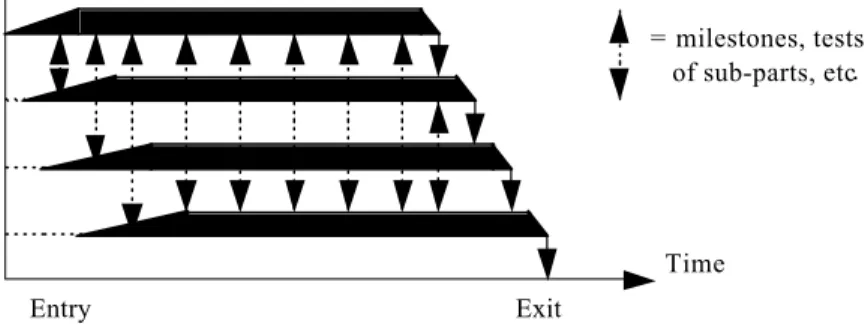
The new model was labelled the ‘fountain model’. Unlike the ‘waterfall’ with water flowing sequentially, the image of the fountain was one of water streaming simultaneously from many sources. Generally such a model may be conceived of as one relying on work in a more concurrent fashion. As applied within Ericsson, the main difference between the models was in the way downstream teams were involved early in the project process. In fact, a basic idea behind the fountain model was to have much of the development and design work driven by downstream phases. In order to have all parts of the project start early, entry criteria were heavily downplayed. Another notable trait was the emphasis on feedback information, generated by frequent milestones and practical tests of sub-parts on a system-level. The various tests were not only
frequent but also carried out in quite public settings. As a consequence, it was made more obvious how delays in one part of the project would affect the work in other parts or the pace of the entire project. Whereas in the waterfall model, delays and mistakes in one functional unit or development stage could be treated largely as their internal responsibility, the fountain model promoted communal responsibilities and a new way to combine knowledge from different local units. Figure 1 is a stylized version of the one used in the project. The bars in the figure indicate the work process of a specific unit in the project.
For several units in the Japan project this meant that, as the figure indicates, they had to be involved over a longer period than would have been the case if the waterfall model had been applied. This did not, however, imply that these local units were exposed to fewer milestones, tests and controls during the process preceding the final, nearly simultaneous ‘exit’. Indeed, as indicated above, rather the contrary was true. It was also underlined that the fountain model would require a more ‘network-like’ organization, based on inter-functional integration and continuous dialogue.
The traditional ‘waterfall model’ for the design work cannot be followed. In order to shorten development time the various tests within the objects must be overlapping. This requires tight communication between the sub-parts concerned within each object. Production preparation must, for example, be initiated at the same time as product design. Normally such an activity starts 10 – 18 months after design has started. The parallel design approach also requires that the integration and verification phases must begin as soon as possible. Normally such an activity begins 18 – 24 months after start of product design.
(Excerpt from Internal Document) The fountain model implied that the way failures were viewed had to be different. For example, one of the project leaders expressed it in the following way.
It is most important to realize that it is all a matter of doing right the first time. But it is just as important to realize that it will not work at once.
What you need is the courage to fail, and never give up.
While the responsibility for many project activities and sub-parts of the product was clearly allocated to separate functional teams, the relations between the parts and the teams could not be specified entirely in advance. What kind of problems that would show up when integrating the pieces could not be anticipated. As a way of handling this problem, the metaphor of ‘practicing the processes’ was used as an important guide.
You have to find out what is easy and what is difficult. Therefore you have to start with the parts that are difficult and test and practice the organiza-tion. In one case we did some parts several times over and over again. The people who are supposed to receive what has been designed in an earlier step must understand what they have received. For this reason we made some parts run through the chain just to check they were working. It is all a matter of practicing the processes early. You never hit the target the first time. We had to use very concrete models, work very close to the processes of the organization – that’s what I call active leadership
(Project Manager). The integration of different parts of the projects and the activities of local units required arenas where information could flow between the phases of the project. Management invented integrating mechanisms such as the ‘systems emergency ward’, which was a forum for problem solving and discussions of all kinds of issues in the project. In these meetings, in some periods held almost on a daily basis, every member of the project could put a question on the agenda whenever necessary.
To be able to handle this new way of working, managers and members of the project were certainly busy establishing communication channels and work models that cut across the organization. One of the project leaders formulated the philosophy in the following terms:
You have to get people to understand other parts than their own. As an example the designer wants
Time
= milestones, tests of sub-parts, etc.
Exit Entry
functionality, whereas the production engineer wants a product suitable for production. The test engineer, on his part, wants a product that is easy to test. It is all about getting these people to work together and getting a product that fits everybody. The project management team saw it as one of its most important tasks to inform the organization about the mission of getting Ericsson to Japan. A great number of efforts were thus put into information activities in the project. Also at technical levels, information had to flow rapidly.
There was a constant need for information through-out the different phases of the project. For us in the project management team it was a matter of organizing the information flow to create a fast and flexible project. For example, we used video and telephone conferences, project newsletters and short meetings, which were often held daily. Moreover, the systems emergency ward was a forum where trouble reports were dealt with. In this forum we had some of the most competent Ericsson people within this area. We could therefore respond very quickly and make fast decisions
(Project Leader). However, the project managers realized that infor-mation flows of various kinds would not be enough. They talked about ‘practicing the organization’ in order to ‘get people to understand other parts than their own’. They also realized the need for face-to-face gatherings with a practical and concrete focus. When the first radio base stations were manufactured, the project management team organized a ‘quality demon-stration’, which is a typical example of how processes were practiced.
We ordered a radio base station from the warehouse. Everybody thought that it was destined for shipment to Japan. However, we arranged a quality demon-stration in Stockholm and invited top management, quality managers, designers, etc. When we did this demonstration, it turned out that the product did not work. There were all kinds of problems, such as mechanical problems, packaging problems, things were missing – that created an enormous attention. I think this was the first time that the designers had seen a complete radio base station
(Project Leader). During the Japan project the deadline was very definitive and unambiguous. This provided the orga-nization as a whole with a very clear goal – a fully operative system by 1 April 1994. The core of the project management team was the project manager, who had experience from the GSM project, and two very experienced project leaders. An important task for the project leaders was to create a strong focus on the final deadline and the milestones along the way.
If we said that it was to be ready by Friday, we did not accept anything else. If it did not work we hunted the person responsible for the delivery no matter where he was. You have to get people to understand that next week is too late. Trying hard is not enough. It is only success that counts – nothing else
(Project Leader). The Japan project was finalized successfully. The system was put into operation on 1 April and the organization has received recognition for the way the project was managed and the successful outcome. The project has also led to several new organizational practices, which have been adopted and applied in other divisions within Ericsson.
The Volvo case
In 1991, the Volvo 850 was launched and the company entered an extensive cooperation with Renault. How-ever, the cooperation was abruptly terminated in late 1993 because the shareholders and employees of Volvo did not approve of the merger plans that the top management of the two companies had worked out. This led Volvo into a rather complicated situation because joint-development activities were terminated and the company was in urgent need of a new car model. Management discussed several options and decided to prolong the life of the Volvo 850, launching it as an almost new car under a new label, the Volvo S70. The car had to be improved in a multitude of aspects and both interior and exterior designs had to be changed and renewed. A development project was initiated in mid 1994 to develop a car that was ready for market launch in the beginning of 1997. The project forced management to reconsider several of its old ideas of working and organizing. For example, a tight overall deadline and a fast production ramp-up were considerable challenges facing the people in charge of the S70 project. The project was considered to be of great strategic importance for the company and a learning opportunity for future activities, for instance, in terms of production ramp-up and project organiza-tion. The company was during this period of time under much pressure following the failed merger with Renault. Management had to prove that the company could stand on its own feet and develop a car model that was a sign of the company’s future ability to develop cars on its own.
There were a lot of difficult things about this project. We were to terminate the production of the Volvo 850 and only a couple of days later start full production of the Volvo S70. If we wouldn’t make it we’d read about it in the papers and hear about it on the TV news. Such a fast production start has never taken place in this company
Due to these reasons, management attention was very high during the course of the project. The project management team also worked intensely with commu-nicating the importance of the overall deadline and the importance of the production start. They wanted a shared view on the project, to develop a project culture, a sense of urgency and improved shared responsibility.
As a project manager, it’s important to understand that a shared vision and view is key. We’ve got to solve this project. We need to help each other. We need to talk to each other. We need to establish contacts between different parts of the project. For example, it’s not sufficient that the manufacturing people do a good job in order for this project to be successful. Everyone has a part in it, and to get people to understand that was our main responsi-bility
(Project Manager, Purchasing). Focus had to be put on the overall deadline and the milestones along the way.
Again, and again, it’s this thing with the time plan and to get people to understand that the final deadline was December 10, 1996. It was the Big Bang! At that time everything had to work. All the tests had to be made before that, and all details had to be verified. The final deadline was non-negoti-able. It was a fact!
(Project Manager, Purchasing). In the S70 project, much effort was put into information sharing by establishing various channels of information. Furthermore, the project management team knew that the design of a certain detail was not the complicated issue, instead, they emphasized, ‘the difficult thing was to know what to do’.
In a project like this, the network of contacts was very important, if not the most important thing. The pure design issues were not very complicated, what was important was to know what to design, and to understand how it would work in the system – those were the tricky issues
(Technical Project Manager). Throughout the whole project, the project managers tried to establish a well functioning cooperation between the participating units within the project. Emphasis was put on the so-called design review meetings and to get well-functioning communication channels on lower levels within the project where manufacturing and design were integrated.
We had morning prayers every Monday. A one-hour kick-off for the week. It was really good, relaxed and informal without official records. We answered questions like: what was ahead this week? All the sub-project managers participated. But we also had
project meetings once a week, and technical meetings each week. We had more frequent meetings than is usual and we tried to keep them on a practical level (Technical Project Manager). Moreover, the role of project management as creators of tension was emphasized by everyone involved in the project.
It’s important that manufacturing call for informa-tion and acinforma-tion in early stages of the project. That creates a kind of tension, which is extremely important in order to get something to happen and for us to try new ways of working
(Project Manager, Geometry). The Volvo case points to interesting issues concern-ing the work of project management and the impor-tance of time limits. One important question for the project managers was to achieve an appropriate target level for the different designers and engineers involved. The technical project manager expressed this particular problem in the following way.
Designers have the tendency to search for the perfect solution and not always for the solution suitable for the system. They never finish. It’s in the nature of a designer not to complete but instead to keep on working and developing the piece. The role of project management is to set the limits of what is good enough.
Moreover, during the project process there was a constant dialogue between the different sub-projects and sub-parts of the project and the project manage-ment unit. Much attention was directed towards communication and to get upstream units to see the whole picture. As explained by one of the sub-project managers.
It’s all about organization and communication and to get people see what’s happening in production. Designers are good at many things but not on aspects related to the production process. Everyone thinks their part is working well but it’s all about verification. This means that we need to constantly discuss possible alternatives of action. For instance, which parts to change is dependent on the lead-time of each part. Whether a certain part is considered verified is thus very much a question of what other teams have done
(Sub-project Manager 3). Furthermore, the project leaders emphasized the need and function of such meeting and testing places throughout the life of the project. One of the project leaders describes the philosophy in the following way. The overall testing activities are excellent opportu-nities to bring together the various functions, determine the degree of progress and analyze how alternative solutions might interrelate at a certain
point in time. These activities are important devices for cross-functional discussion and problem solving. The project management team that uses these activities forcefully will make a better car
(Sub-project Manager 2). The Volvo S70 project was completed on time and was considered a successful project. The project forced the company to adopt a number of important new ways of organizing its projects. The general reason for the good result was, according to the project manage-ment team, the many try-outs and test activities carried out and the way production and design were inte-grated. In the interviews the project managers pointed to the public settings and ‘practical gatherings’ in moving the project forward. They also pointed to the importance of meeting face-to-face and solve practical problems. One project manager expressed the general idea in the following way:
Public settings are very important. It is important to feel that you’re part of an organization and why this project is important. Then it is important because you see the consequences of what you do. We had so-called ‘supplier gatherings’ where we invited the key engineers and key suppliers and worked on a very practical level. We checked and tested if the things were working. This gave attention and was very good for the motivation spirit of the project.
(Sub-project Manager 1).
Emerging empirical patterns
The projects presented above are similar in some respect, but also very different. They are different in terms of industrial context, in terms of products and technologies integrated, but they show some interesting similarities in project management logic and important project management mechanisms. In this section we will point to the empirical patterns found in the case studies.
First, it seems appropriate to describe both projects as carried out in a systemic complex situation. Second, the main question for the projects was not a search for entirely new knowledge, but more of integrating already existing knowledge bases. The projects would thus benefit from the coupling logic discussed earlier.
It seems plausible to suggest that both projects described above were heavily influenced by tight time constraints. The strategic importance and the time constraints seem to have led to some profound organizational changes and rethinking. This was, for sure, facilitated by management commitment, top management attention and good leadership performed by the project managers. However, in both cases, the project managers acknowledge the immense impor-tance of tight deadlines in order to make things happen and to be able to try out new solutions. In the Ericsson
case this led to a totally new development model, the fountain model. In the Volvo case, this led to a new strategy in terms of production ramp-up and use of testing activities, such as tryouts. We would argue that the focus on time-based controls and deadlines is necessary in order to understand the types of projects studied in this paper. As mentioned earlier, much project management and product development re-search has only given limited attention to time as an independent variable for understanding organization.
Furthermore, the tight deadline and the organiza-tional innovations seem to have led to an increased use of different types of ‘global arenas’. This was, for instance, important in the Ericsson project where project management relied heavily on the work carried out within the systems emergency ward and different types of quality demonstrations. In the Volvo case, management relied, not only on several types of meetings, but also on practical tests such as try-outs and supplier gatherings. Interestingly, in both cases, the interviewees declare the most difficult thing as finding out what needs to be done, not doing the thing itself. An additional salient feature was the playing of entry criteria in order to involve down-stream units as early as possible. This was not only done for speeding up the process, but for combining different specialists’ knowledge early on in the project process. We would argue that these arenas represent important project management mechanisms which must be explored in order to improve our knowledge of project management in complex product develop-ment. Below we will further the theoretical interpreta-tion of project management in such a context.
A further analysis of the coupling logic
Analyzing the specific forms of project organization they represent different but similar departures from a traditional functional-sequential logic. Both examples seem to be inspired by ideas of concurrent engineering and are as such organizational solutions that elimi-nated buffers between functional units in order to speed up signals of emerging problems. In the classic sequential ‘waterfall model’, on the other hand, feed-back and learning are locked-in and separated stage-wise or limited to the transitional stages of exit-entry. The fountain model, for instance, seems to have produced feedback that was more ‘global’. In essence the model represented an effort to make the project process more tightly coupled.
One important challenge facing the project manage-ment teams in the cases, seems to be to handle the complexity stemming from the great number of units and individuals participating in the projects. What seems to be important here is to get all the components, such as hardware and software, interior and exterior, to function well together, and to be
manufacturable and reliable. As the interviewees in both case studies declared, in such complex situations ‘doing things right the first time’ is probably not possible. It was likely that dealing with many types of errors would be unavoidable because of the difficulties associated witha priorispecifying the outcomes of the complex interactions involved. Errors showed up at functional interfaces, when parts from different units were combined and integrated. However, while these errors were both numerous and hard to foresee, most of them were rather easily taken care of by the participating units. In such situations, communal problem-solving activities as frequent testing of com-posite parts or whole systems, several tryouts and ‘practicing organization’, became important project management events. These events also represent important aspects of the knowledge processes taking form during the course of a project.
Projects and knowledge processes
As indicated previously, error detection versus error diagnostics is probably a fundamental distinction of knowledge processes in project contexts. By focusing on knowledge processes in project settings we might rely on parts of the literature on the knowledge-based theory of the firm (Spender and Grant, 1996). According to Spender (1996), a knowledge-based theory of the firm can be seen as a platform for a new view of the firm as a dynamic, evolving, quasi-autonomous system of both the production and application of knowledge. Moreover, Grant (1996) emphasizes that the fundamental task of organization is to coordinate the efforts of many specialists. The knowledge-based theory of the firm identifies the firm’s primary role as integrating the specialist knowledge of individuals into viable outcomes, such as goods and services. The prime role of management in such a perspective would involve the facilitation for this knowledge combination, e.g. by establishing and opening up arenas and creating channels for informa-tion and knowledge sharing.
Viewing the project management’s primary task as integrating the specialized knowledge of multiple individuals suggests that, even with goal congruence, achieving effective coordination is problematic for organizations. Furthermore, a knowledge-based view of projects suggests a perspective on interdependencies as an element of organizational design and subjected to managerial discretion rather than ‘exogenously’ driven by given task characteristics. A key problem here is thus to device mechanisms for the combination of local units’ or individuals’ specialized knowledge. Conse-quently, an important issue is to realize that ‘process technology’ defines the technical aspects of production and the types of specialized knowledge required for the process, whereas the task division between individuals
and local units and the specification of the interfaces between them is a matter of organizational design.
In organization theory it has generally been assumed that certain tasks require more personal and commu-nication-intensive forms of integration. For instance, Galbraith (1973) and Perrow (1967) stress that high-interaction, non-standardized coordination mechan-isms increase with task complexity and task uncer-tainty. It has also been shown that groups in situations of crisis switch from a ‘routine-mode’ to ‘group problem-solving’ (Hutchins, 1991). However, knowl-edge-based literature also emphasizes that redundancy is an important issue related to every knowledge process. This implies sharing information that goes beyond the ‘operational requirements’ of participants. In turn such redundancy creates opportunities for individuals to ‘invade one another’s functional bound-aries’ (Grant, 1996, p. 115). In understanding project management in complex development projects, we must acknowledge its role for the organization and facilitation of such knowledge processes.
A typology of project organizations in complex
product development
In previous sections, we discussed important technol-ogy aspects of development projects and illustrated the coupling logic with our two cases. In the projects under study, there were several aspects that triggered the coupling of local units. For instance, the tough time limits paired with conscious managerial efforts to promote not only the overall deadline but also frequent, public milestones (e.g. arenas and manage-ment attention) along the way. These efforts seem to increase complexity of the project process as they force entry-criteria to be downplayed. Hence, several ‘new’ parts of the projects had to be integrated and taken into account. These parts also seemed to have altered the calculations and activities of earlier phases and thus created increased and necessary ‘tension’ within the projects. The arenas functioned as a way to integrate project phases by bringing downstream and upstream activities closer together early in the project. This would imply a device for achieving a type of coupling by combining the knowledge from ‘later’ phases with knowledge from ‘earlier’ phases of the project. Such coupling we therefore label ‘coupling of project phases’.
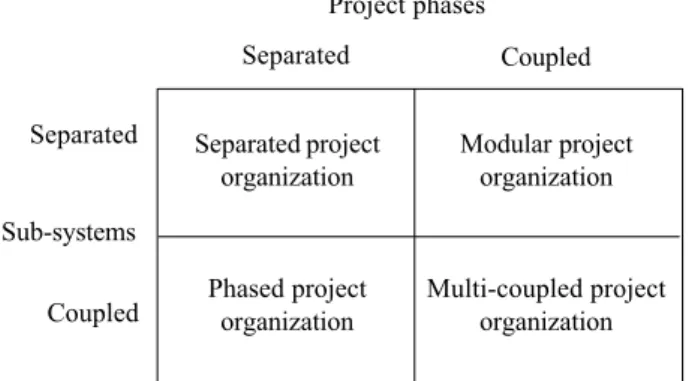
Another coupling feature is the combination and integration of different sub-systems. This would imply, for instance, the combination of knowledge and interaction of engineers from different ‘design packages’ in a project, such as interior and exterior teams in an automotive project, and base-station engineers and switching engineers in a mobile phone system. Such combination of structural coupling, we label ‘coupling of sub-systems.’ Based on this
coupling-separation analysis, we are able to suggest the following model identifying four types of project organization.
The different types of project organization could be related to different types of project management problem and project management logic. In our case-study projects, much attention was directed towards integrating design and production as in the situation labelled ‘phased project organization’. A typical example of a phased project organization would be a project where the interface between design and manufacturing is relatively clear and well defined, or where interaction between these units is downplayed for other reasons, such as local knowledge require-ments and priority. As emphasized by, for example, Wheelwright and Clark (1992), effective product and process integration is difficult in most circumstances, and particularly challenging in large, mature firms with strong functional groups, extensive specialization and large numbers of people.
In situations where the different sub-systems are fairly separated, but the relationship between, for instance, design and production is tightly coupled, we might consider a ‘modular project organization’. A typical example of a modular project organization would be a project where the interface between the sub-systems is well specified, or the need for coordination between the sub-systems is limited for other reasons. Further, as argued by Hobday (1998, p. 706), despite the trends of modularization, project management skills remain at the heart of many companies, due to the many difficulties in task specification and sub-system partitioning.
The projects in the present study, however, were fairly tightly coupled in both dimensions, i.e. a simultaneous tight coupling between sub-system teams and project-phase teams was observed. In such a situation we might consider a project organization that is ‘multi-coupled’. Project management thus had to deal with several interface problems and system-wide problems that concerned both the relationship between sub-systems and the relationship between downstream and upstream activities. The typology presented would
increase our understanding of different types of project organizations and the various roles played by project management.
Projects and time orientations
In the above section, we discussed project coordination from a ‘knowledge perspective’. From our point of view, in order to understand the project management problem, we need to understand issues related to timing and rhythm. In this paper, we argue that, not only system-wide knowledge processes have to be emphasized, but also the importance of time aspects. There are several reasons for this. First, many development projects are carried out under the light of an overall ‘non-negotiable’ deadline. Second, projects often are complex involving several knowledge bases and a plethora of engineers with different time orientations whose activities need to be synchronized. A fruitful lens to gain such an understanding is the one provided by the concept of ‘entrainment’. En-trainment is, to use the writings of Ancona and Chong (1996, p. 251) ‘the adjustment of the pace or cycle of one activity to match or synchronize with that of another’. The concept hence focuses on the dominant macro cycles that ‘capture’ the pace and cycle of organizational activities. The cycles of, for example, local units within a project are captured by a pacer so they get the same phase, periodicity, or magnitude. A pacer is in our case played by project management that utilizes other sources in order to increase its power (e.g. gaining top management attention, and pointing to the bad effects of a missed deadline). The pacer sets a dominant ‘temporal order’ or macro-cycle that serves as a powerful mechanism for coordination of that specific unit or function. This was clearly pointed out by the project managers in Volvo and Ericsson. The (enforced) overall deadline, in these cases, seems to function as an overall pacer for the local units involved.
As pointed out in the cases, the overall deadline together with various public milestones and ‘system-wide arenas’ not only provided the projects with an essential medium for information and interaction, but were also mechanisms for pacing the whole project. Broadly speaking, we might view the overall deadlines and milestones as a pacer that are enforced by the use of these global arenas. Obviously, the pacer is also important for the synchronization and adjustment of ‘local times’ (Lawrence and Lorsch, 1967). The overall deadlines were considered to be non-negotiable, thus, as our previous illustrations indicated, they implemen-ted a ‘global time’ (cf. Ancona and Chong, 1996). The system-wide arenas also seem to be of importance for the overall (global) knowledge processes that evolved and developed during the lifecycle of the projects. The argument brought forward here is thus that the global
Separated project organization Modular project organization Phased project organization Multi-coupled project organization Sub-systems Separated Coupled Project phases Separated Coupled
level within a project has to be emphasized in order to understand project organization in these contexts, and, additionally, that knowledge processes and time aspects are intimately related and central to such an analysis.
As discussed above, time limits are of the utmost importance for project management in general and for researchers that set out to understand the logics of project organization. As stated, there are two primary aspects of time that are important for the under-standing of complex development. The first one is the overall deadline, the other is the synchronization of activities within a project. Concerning the first issue, we mainly treat deadlines as important control mechanisms that alter the calculations of actors and function as a trigger for action and rethinking. For instance, in our case studies, time limits were so tight that a separated project organization could not be applied. In both of the cases the compressed time schedules provided opportunities to introduce new ways of organizing which improved the collaborative spirit of the projects.
Apart from this overall project deadline and various milestones related to it, there was also a great number of regular meetings and arenas where specialists from different functional units met. Many of these, such as the quality demonstrations, supplier gatherings and various ‘practical tests’, functioned not only as arenas for solving problems of a communal character, but also played an important role in pacing the project within the given time constraints. As shown in the case studies, the use of publicly stated promises and shared responsibilities for producing technical solutions en-couraged extensive communication among the various functional specialists. Instead of having each func-tional unit work separately, they were forced into ‘global thinking’ and discussions about what was efficient from a system-wide perspective.
Concluding discussion
Our studies have indicated that the coupling logic is important for several reasons. By eliminating buffers, downplaying entry-criteria, knowledge is combined and time-limits are enforced. Instead of functional buffers, system-wide arenas seem to be vital for the coupling logic to function, for deadlines to be met, and for ‘global knowledge’ to be developed. Hence, from a knowledge perspective these project management mechanisms not only function as simple synchroniza-tion devices but also as ways to justify what is ‘true’ and to absorb the knowledge from each local unit. Coupled projects are thus interpreted as means to combine knowledge under situations characterized by systemic complexity where error detection is the key problem. Important features of such coupled projects, we suggest, are the concepts of global time, global
knowledge processes and global arenas. Global time refers to the effects and role of overall deadlines and milestones, whereas global knowledge processes refer to the combination of local knowledge and the system-wide error detection processes. The global knowledge here is thus the understanding of the interrelationships between the different parts in the system. A key project management mechanism to handle the differences in rates of time and the global knowledge processes, seems to be the active use of different types of global arenas. As suggested in this paper, we need, in order to further our understanding of project management in complex development, put greater emphasis on the following aspects:
* Global arenas for enforcing deadlines and
mile-stones, and facilitating channels for global knowl-edge processes.
* Global time, such as deadlines and milestones for
pacing the entire project.
* Global knowledge processes for combining
distrib-uted local knowledge processes and for justifying local knowledge.
Our case studies have pointed to the importance of relatively sophisticated principles of organizing knowl-edge combination in complex development projects. As a result, for instance, we interpreted the fountain model as representing a coupling logic suitable for error detection in a systemic context. Furthermore, we stretched the coupling logic by looking at projects as consisting of different knowledge bases. Subsequently, a model identifying four types of project organizations was suggested based on the separation-coupling analysis. We argue that this typology contributes to the knowledge of management and organization in different types of complex development projects.
Based on our case study observations, we submit that the use of deadlines, milestones and other time-based controls, not only helps pacing the entire project in relation to its overall time limits, but also supports parallel project work by encouraging inter-functional communication and reflection. Hence, to understand knowledge combination within complex development projects we need an understanding of the impact of time-based control mechanism. It has further suggested that deadlines, and other time-based control mechan-isms, function as globalizing mechanisms. This type of process is generally associated with knowledge and time aspects of organization. Our studies indicate that knowledge processes are in several respects dependent on time. For instance, knowledge is justified by other local knowledge processes and thus dependent on the synchronization of their activities. Further, what might have been justified given certain preconditions depends on the lead-time for the adjustment and co-adaptation of other parts. Here we see that it is not so much what local units have done in isolation and whether their output is in line with predetermined standards, but
rather ‘right’ against overall efficiency criteria at a certain point in time.
References
Alvesson, M. and Sko¨ldberg, K. (2000)Reflexive methodol-ogy. London: Sage.
Ancona, D. and Chong, C. (1996) Entrainment: pace, cycle and rhythm in organizational behavior. Research in Organizational Behavior,18, 251 – 284.
Baba, M.L. (1990) Local knowledge systems in advanced technology organizations. In L. Gomez-Meija and M. Lawless (eds.), Organizational Issues in High Technology Management. Greenwich: JAI Press.
Brooks, F.P. (1995)The Mythical Man-Month. Reading MA: Addison-Wesley.
Burke, R. (1994)Project Management: Planning and Control. Chichester: Wiley.
Cleland, D.I. and King, W.R. (1968) Systems Analysis and Project Management. New York: McGraw-Hill.
Clark, K.B. and Fujimoto, T. (1991) Product Development Performance: Strategy, Organization, and Management in the World Auto Industry. Boston MA: Harvard Business School.
Eisenhardt, K.M. (1989) Building theories from case study research.Academy of Management Review,14, 532 – 550. Eisenhardt, K.M. and Tabrizi, B.N. (1995) Accelerating
adaptive processes: product innovation in the global computer industry. Administrative Science Quarterly, 40, 1, 84 – 110.
Galbraith, J.R. (1973) Designing Complex Organizations. Reading MA: Addison-Wesley.
Gersick, C.J.G. (1988) Time and transition in work teams: toward a new model of group development. Academy of Management Journal,31, 1, 9 – 41.
Gersick, C.J.G. (1989) Marking time: predictable transitions in work groups. Academy of Management Journal,32, 2, 274 – 309.
Glaser, B. and Strauss, A. (1967)The Discovery of Grounded Theory: Strategies for Qualitative Research. New York: Aldine de Gruyter.
Granstrand, O. (1998) Towards a theory of the technology-based firm.Research Policy,27, 465 – 489.
Grant, R.M. (1996) Toward a knowledge-based theory of the firm. Strategic Management Journal, 17, Special Issue, 109 – 122.
Hobday, M. (1998) Product complexity, innovation and industrial organisation.Research Policy, 26, 689 – 710. Hutchins, E. (1991) Organizing work by adjustment.
Organization Science,2, 1, 14 – 39.
Imai, K., Nonaka, I. and Takeuchi, H. (1985) Managing the new product development process: how Japanese compa-nies learn and unlearn. In K.B. Clark, R.H. Hayes and C. Lorenz (eds.),The Uneasy Alliance: Managing the Produc-tivity-Technology Dilemma. Boston MA: Harvard Business School Press.
Kerzner, H. (1995)Project Management: a Systems Approach
to Planning, Scheduling and Controlling, fourth edition. New York: Van Nostrand.
Lawrence, P.R. and Lorsch, J.W. (1967) Organization and Environment. Homewood IL: Irwin.
Levinthal, D.A. and March, J.G. (1993) The myopia of learning.Strategic Management Journal,14, Special Issue, 95 – 112.
Lindkvist, L. and So¨derlund, J. (1996) It’s only success that counts! Department of Management and Economics, Linko¨ping University (in Swedish).
Lindkvist, L., So¨derlund, J. and Tell, F. (1998) Managing product development projects – on the significance of fountains and deadlines.Organization Studies,19, 6, 931 – 951.
Lundin, R.A. and So¨derholm, A. (1995) A theory of the temporary organization.Scandinavian Journal of Manage-ment,11, 4, 437 – 455.
March, J.G. (1991) Exploration and exploitation in organi-zational learning.Organization Science,2, 2, 71 – 87. Midler, C. (1995) ‘Projectification’ of the firm: the Renault
case.Scandinavian Journal of Management,11, 4, 363 – 376. Mintzberg, H. (1983)Structure in Fives. New York: Prentice
Hall.
Nonaka, I. and Takeuchi, H. (1995)The Knowledge-Creating Company. New York: Oxford University Press.
Packendorff, J. (1995) Inquiring into the temporary organi-zation: new directions for project management research. Scandinavian Journal of Management,11, 4, 319 – 334. Perrow, C. (1970) Organizational Analysis: a Sociological
Review. Belmont CA: Wadsworth.
Perrow, C. (1967) A framework for the comparative analysis of organizations.American Sociological Review,32, 194 – 208.
Sanchez, R. and Mahoney, T.J. (1996) Modularity, flexibility and knowledge management in product and organization design. Strategic Management Journal,17, Special Issue, 63 – 76.
Shenhar, A. (1993) From low to high-tech project manage-ment.R&D Management,23, 1, 32 – 37.
Shenhar, A.J. and Dvir, D. (1996) Toward a typological theory of project management.Research Policy,25, 607 – 632.
So¨derlund, J. (1998) Global times: on deadlines and knowl-edge integration in complex development projects, IMTE, Linko¨ping University (in Swedish).
Spender, J-C. (1996) Making knowledge the basis of a dynamic theory of the firm. Strategic Management Journal,
17, Special Issue, 45 – 62.
Spender, J-C. and Grant, R. (1996) Knowledge and the firm: overview.Strategic Management Journal,17, Special issue, 5 – 10.
Stalk, G. and Hout, T.M. (1990) Competing Against Time. New York: Free Press.
Thompson, J.D. (1967)Organizations in Action. New York: McGraw Hill.
Ulrich, D. and Eppinger, S. (1995) Product Design and Development. New York: McGraw Hill.
Wheelwright, S.C. and Clark, K.B. (1992) Revolutionizing Product Development. New York: Free Press.