industries to the sustainable
development goals
by
Joubert Spies
Thesis presented in fullment of the requirements for the degree of Master of Engineering (Engineering Management) in the Faculty of Engineering at Stellenbosch University
The nancial assistance of the National Research Foundation (NRF) towards this research is hereby acknowledged. Opinions expressed and conclusions arrived at, are
those of the author and are not necessarily to be attributed to the NRF.
Supervisor: Ms IH de Kock Co-supervisor: Prof AC Brent
Declaration
By submitting this thesis electronically, I declare that the entirety of the work con-tained therein is my own, original work, that I am the sole author thereof (save to the extent explicitly otherwise stated), that reproduction and publication thereof by Stellenbosch University will not infringe any third party rights and that I have not previously in its entirety or in part submitted it for obtaining any qualication.
. . . .
Signature Date
Copyright c2019 University of Stellenbosch All rights reserved
Abstract
It is acknowledged that South Africa, and the rest of the world, faces sustainability chal-lenges. Ideally, and in order to contribute towards sustainability, industries should continuously improve their activities through technological innovation and advancements. However, not all technological advancements contribute positively towards sustainability. Technology and tech-nological innovation are seen by many as a major factor that can contribute towards sustainable development and the Sustainable Development Goals (SDGs). It is thus argued that sustainable development could be signicantly inuenced by technological innovation, and it is evident in lit-erature that society and technology co-evolve and exert inuence on one another. Therefore, one can infer that by aligning the objectives of industries with those of the technologies by means of SDGs, industries can positively inuence the SDGs, and therefore also sustainable development, with the help of technology.
The present study investigates the role of technology (existing and emerging) in fostering sustainable development, and aims to highlight how sustainable development and SDGs are fostered within South Africa. The study further investigates how current frameworks guide industries towards choosing technologies within the context of sustainable development and to evaluate the applicability of such frameworks to the aim of aligning the objectives of industries with those of the technology by means of SDGs. Ultimately, the key objective of this study is to developed and eective framework to decision makers within industries that will ultimately provide guidance in choosing between technologies; the aim being to select technologies that contributes towards SDGs.
A systematic literature review is conducted to identify technologies that are used to support sustainable development within a South African context. Several technologies are identied, and emerging technologies, that holds potential to contribute towards sustainable developments, are identied and discussed.
There are various bodies in existence exist within South Africa that aim to ensure that positive progress is being made regarding planning and implementation of sustainable development, and given the focus of this research, the processes, focus areas and actions relating to how sustainable development is fostered in South Africa is identied as well as the challenges associated with achieving sustainability. Challenges include, for example, a lack of progress reporting on SDGs within South Africa. Further, the current status of South Africa is discussed in terms of SDGs and the various technologies could improve and/or contribute to the SDGs are highlighted.
Existing frameworks and their guidance towards choosing technologies are investigated, wheafter a short list of attributes are identied. These frameworks' applicability to the design
re-quirement is determined and reveals that there is no existing framework that connects an industry and technology through the means of SDGs.
Guided by the eight phases of Jabareen's Conceptual Framework Analysis, the framework is iteratively developed. The validation process is completed through a series of interviews with Subject Matter Experts (SMEs) and the application of a case study, where after the incorporation of the validation ndings are integrated into the rened framework.
The unique contribution that this study makes is the connection between industry and tech-nologies through the means of SDGs. The framework guides the decision maker in choosing between technologies for implementation that foster similar SDGs to those of the industry. The validation results indicate a positive response; however, further studies on implementation, track-ing the framework's performance through its implementation and the critical issues that arise from this are required.
Opsomming
Dit word erken dat Suid-Afrika en die res van die wêreld uitdagings vir volhoubaarheid ervaar. Ideaal gesproke, en om sodoende by te dra tot volhoubaarheid, moet nywerhede hul aktiwiteite voortdurend verbeter deur tegnologiese innovasie en vooruitgang. Nie alle tegnologiese vooruitgang dra egter positief by tot volhoubaarheid nie. Tegnologie en tegnologiese innovasie word deur baie gesien as 'n belangrike faktor wat kan bydra tot volhoubare ontwikkeling en die volhoubare ontwikkelingsdoelstellings. Daar word dus aangevoer dat volhoubare ontwikkeling aansienlik beïnvloed kan word deur tegnologiese innovasie, en dit blyk duidelik uit die literatuur dat die samelewing en tegnologie saam ontwikkel en invloed op mekaar uitoefen. Dit kan dus afgelei word dat die nywerhede die volhoubare ontwikkelingsdoelstellings, en dus ook volhoubare ontwikkeling, met behulp van tegnologie, positief kan beïnvloed deur die doelwitte van nywerhede met dié van die tegnologieë te bepaal deur middel van volhoubare ontwikkelingsdoelstellings.
Hierdie studie ondersoek die rol van tegnologie (bestaande en opkomende) in die bevordering van volhoubare ontwikkeling, en beoog om te beklemtoon hoe volhoubare ontwikkeling en vol-houbare ontwikkelingsdoelstellings binne Suid-Afrika bevorder word. Die studie ondersoek verder hoe die huidige raamwerke industrieë lei om tegnologie te kies binne die konteks van volhoubare ontwikkeling en om die toepaslikheid van die soort raamwerke te evalueer ten einde die doelwitte van nywerhede met dié van die tegnologie deur middel van volhoubare ontwikkelingsdoelstellings te koördineer. Die hoofdoelstelling van hierdie studie is om 'n raamwerk op te stel wat eektief leiding gee aan besluitnemers binne nywerhede om n keuse te maak tussen tegnologieë; Die doel is om tegnologieë te kies wat bydra tot volhoubare ontwikkelingsdoelstellings.
'N Sistematiese literatuuroorsig word gedoen om tegnologieë wat gebruik word om volhoubare ontwikkeling, binne 'n Suid-Afrikaanse konteks, te identiseer. Verskeie tegnologieë is geïdenti-seer, terwyl opkomende tegnologieë, wat potensiaal het om tot volhoubare ontwikkelings by te dra, geïdentiseer en bespreek is.
Daar is verskeie liggame wat binne Suid-Afrika bestaan, wat daarop gemik is om te verseker dat positiewe vordering gemaak word met betrekking tot die beplanning en implementering van volhoubare ontwikkeling. Met betrekking tot die navorsing, die prosesse, fokusareas en aksies wat verband hou met hoe volhoubare ontwikkeling bevorder word binne Suid-Afrika, sowel as die identisisering van die uitdagings wat geassosieer word met die behaal van volhoubaarheid. Uitdagings sluit byvoorbeeld 'n gebrek aan vorderingsverslagdoening oor volhoubare ontwikkel-ingsdoelstellings in Suid-Afrika in. Verder word die huidige status van Suid-Afrika in terme van volhoubare ontwikkelingsdoelstellings bespreek en hoe die verskillende tegnologieë kan bydra tot die volhoubare ontwikkelingsdoelstellings.
Bestaande raamwerke en hul leiding ten opsigte van die keuse van tegnologie is ondersoek waarna 'n kort lys van eienskappe geïdentiseer is. Hierdie raamwerk se toepaslikheid op die ontwerpvereiste is vasgestel en gevind dat daar geen bestaande raamwerk bestaan wat 'n bedryf en tegnologie deur middel van volhoubare ontwikkelingsdoelstellings verbind nie.
Gelei deur die agt fases van Jabareen se Konseptuele Raamwerk Analise, word die raamwerk iteratief ontwikkel. Die bekragtigingsproses is voltooi deur middel van 'n reeks onderhoude met vakkundiges en die toepassing van 'n gevallestudie, waarna die inwerkingstelling van die validering bevindinge in die verfynde raamwerk geïntegreer is.
Die unieke bydrae wat hierdie studie bied, is die verband tussen industrie en tegnologie deur middel van volhoubare ontwikkelingsdoelstellings. Die raamwerk lei die besluitnemer na die keuse tussen tegnologie vir implementering wat soortgelyke volhoubare ontwikkelingsdoelstellings aan dié van die bedryf bevorder. Die validasie resultate het 'n positiewe reaksie aangedui; egter, verdere studie is nodig met implementering, die opsporing van die raamwerk se prestasie deur die implementering daarvan en die kritiese probleme wat hieruit ontstaan.
Acknowledgements
I would like to thank all of my family and friends that supported me throughout the past two years. Thank you for all the motivation, messages and inspiration, I would not have been able to do it without you.
I would like to acknowledge the dedicated support and guidance of my supervisors, Imke de Kock and Prof Alan Brents. Thank you for your continuous support through-out my Masters studies and for sharing your accumulated wealth of experience with me. Thank you for allowing me to pursue a study that I am passionate about and for providing me with the space to not only develop as an engineer but to grow as an individual. Your encouragement, insightful comments and dicult questions inspired me to keep going.
To the National Research Foundation (NRF), thank you for partially funding this research project. The funds were greatly appreciated.
I am nothing without my heavenly Father who renewed my energy when I had none and who provided me with the perseverance to complete this project.
Contents
Abstract ii
Opsomming iv
Acknowledgement vi
List of Figures xiii
List of Tables xv
Nomenclature xv
1 Introduction 1
1.1 Background of the study . . . 1
1.2 Problem statement . . . 3
1.3 Research aim and objectives . . . 4
1.4 Research approach . . . 5
1.5 Limitations and assumptions of the study . . . 6
1.6 Content of document . . . 6
1.7 Chapter 1: Conclusion . . . 8
2 Methodology 9 2.1 The Grounded Theory Methodology . . . 9
2.2 Conceptual Framework Analysis . . . 9
2.2.1 Features of conceptual frameworks . . . 10
2.2.2 Advantages of a conceptual framework . . . 10
2.2.3 Phases of a Conceptual Framework Analysis . . . 10
2.3 Research design . . . 11
2.3.1 Part 1 . . . 12
2.3.2 Part 2 . . . 14
2.4 Chapter 2: Conclusion . . . 14
3 The role of technology in South Africa 16 3.1 Technology usage put into perspective . . . 16
3.2 Justication for systematic review . . . 18
3.2.1 Advantages and disadvantages . . . 19
3.3 Conducting the systematic review . . . 19
3.3.1 Step 1 . . . 19
3.3.2 Step 2 . . . 20
3.3.3 Step 3 . . . 21
3.4 Technology in the South African Socio-Technical system . . . 21
3.4.1 Primary sector . . . 22
3.4.2 Secondary sector . . . 24
3.4.3 Tertiary sector . . . 25
3.4.4 Results . . . 27
3.5 Chapter 3: Conclusion . . . 28
4 The unused, new and emerging technology to foster sustainable Socio-Technical systems 29 4.1 Technologies that foster Sustainable Development . . . 29
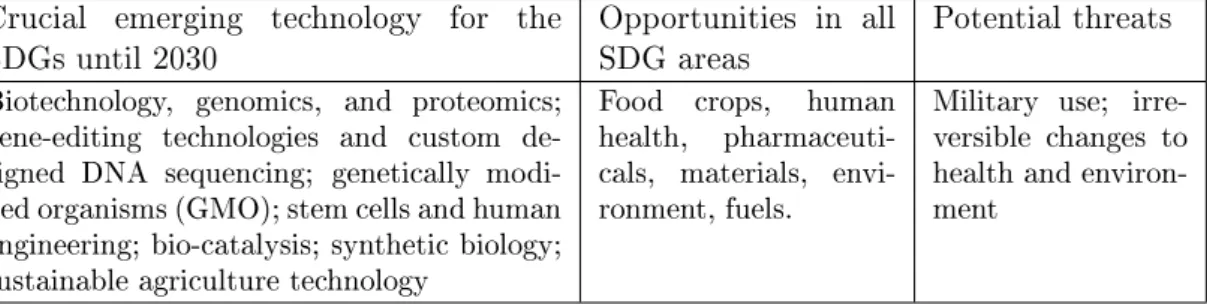
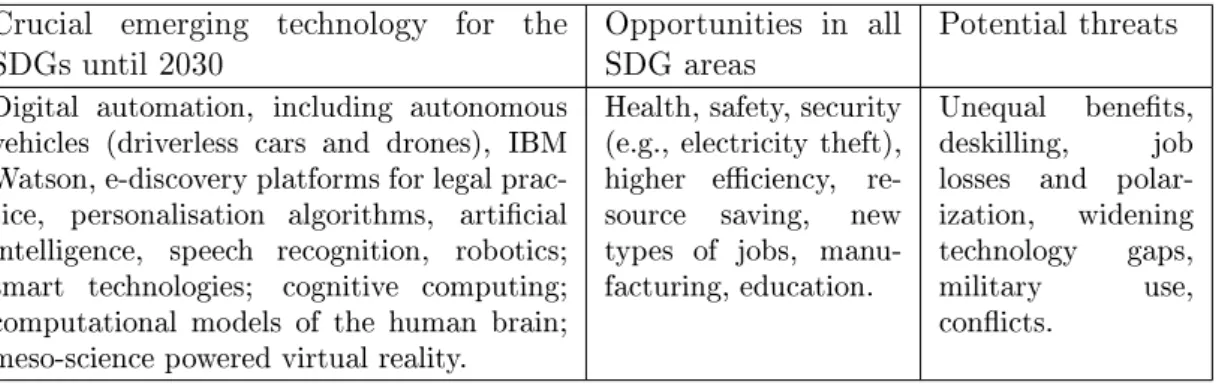
4.1.1 Biotechnology . . . 30 4.1.2 Digital technology . . . 30 4.1.3 Nanotechnology . . . 31 4.1.4 Neurotechnology . . . 32 4.1.5 Green technology . . . 33 4.1.6 Other technologies . . . 34
4.2 Technologies that can help South Africa foster Sustainable Development . . . 35
4.3 Chapter 4: Conclusion . . . 38
5 Sustainable Development, Sustainable Development Goals and identifying South Africa's SDG areas of improvement 39 5.1 Fostering Sustainable Development in South Africa . . . 39
5.1.1 Sustainable Development challenges within South Africa . . . 40
5.1.2 Sustainable Development areas of focus within South Africa . . . 43
5.2 Sustainable Development Goals . . . 45
5.2.1 South Africa's current status on the SDGs . . . 46
5.3 South African areas that can be improved through technological advancements . 52 5.4 Chapter 5: Conclusion . . . 55
6 Existing frameworks, approaches and models 56
6.1 Multi-Level Perspective (MLP) . . . 58
6.1.1 Analytical levels of the MLP . . . 58
6.1.2 Pathways of technological transitions . . . 59
6.1.3 Advantages and disadvantages of the MLP . . . 61
6.2 Strategic Niche Management (SNM) . . . 61
6.2.1 Advantages and disadvantages of SNM . . . 62
6.3 Transition Management (TM) . . . 62
6.3.1 Execution of TM . . . 63
6.3.2 TM criticisms and advantages . . . 63
6.4 Innovation Systems . . . 64
6.4.1 Criticism of Innovation System . . . 65
6.5 Evolutionary systems . . . 65
6.6 Technology Adoption theories, models and approaches . . . 65
6.6.1 Innovation Diusion Theory . . . 65
6.6.2 Technology Acceptance Model . . . 66
6.6.3 Unied Theory of Acceptance and Use of Technology . . . 67
6.6.4 Aective and Persuasive Design . . . 67
6.7 Conceptual framework outline . . . 68
6.7.1 Design requirements . . . 68
6.7.2 Comparing existing frameworks, approaches and models with design re-quirements . . . 69
6.8 Chapter 6: Conclusion . . . 72
7 Industry and technology alignment with SDGs framework 73 7.1 SDGs, industries and technology . . . 74
7.1.1 Focus on SDGs . . . 74
7.1.2 The link between industry and SDGs . . . 75
7.1.3 The link between technology and SDGs . . . 76
7.1.4 Linking the industry to technology . . . 77
7.2 The rened framework . . . 78
7.2.1 The cornerstone SDGs . . . 78
7.2.2 Direct SDGs . . . 80
7.2.3 Indirect SDGs . . . 80
7.2.4 Framework summary . . . 81
7.3 The usage of the Industry and technology alignment with SDGs framework . . . 81
7.3.2 Step 1: Linking of the industry to SDGs . . . 82
7.3.3 Step 2: Linking technology to SDGs . . . 85
7.3.4 Step 3: Linking industry to technology through the outcomes of previous steps . . . 88
7.3.5 The output . . . 88
7.4 Validation of the framework . . . 88
7.4.1 Towards a validation approach . . . 88
7.4.2 Validation methodology and guidelines . . . 89
7.4.3 Results and discussion . . . 90
7.4.3.1 Design requirements . . . 90
7.4.3.2 Strategic decision management . . . 91
7.4.3.3 Framework design and framework input . . . 92
7.4.3.4 Process . . . 94
7.4.3.5 Output . . . 95
7.4.3.6 Overall review . . . 95
7.5 Chapter 7: Conclusion . . . 98
8 A case study of industry and technology alignment with SDGs within the South African energy sector 99 8.1 Introduction . . . 99
8.2 Application of the framework . . . 100
8.2.1 The input . . . 100
8.2.2 Step 1: Linking industry to SDGs . . . 100
8.2.3 Step 2: Linking technologies to SDGs . . . 105
8.2.4 Step 3 . . . 119
8.2.5 The output . . . 121
8.3 Case study discussion . . . 121
8.3.1 Design requirements . . . 121
8.3.2 Strategic decision management . . . 122
8.3.3 Framework input, steps and output . . . 122
8.4 Chapter 8: Conclusion . . . 123
9 Conclusions and recommendations 124 9.1 Research summary . . . 124
9.2 Summary of research objective . . . 125
9.2.1 Conclusions: Objective 1 . . . 126
9.2.2 Conclusions: Objective 2 . . . 126
9.2.4 Conclusions: Objective 4 . . . 127
9.3 Study limitations . . . 128
9.4 Future study recommendations . . . 128
9.5 Chapter 9: Conclusion . . . 129
References 130
A Validation workshop document A-1
List of Figures
2.1 Conceptual Framework Analysis phases. . . 11
2.2 Overview of research design . . . 12
5.1 Responsibility matrix (Adapted fromDEA, (2011)). . . 40
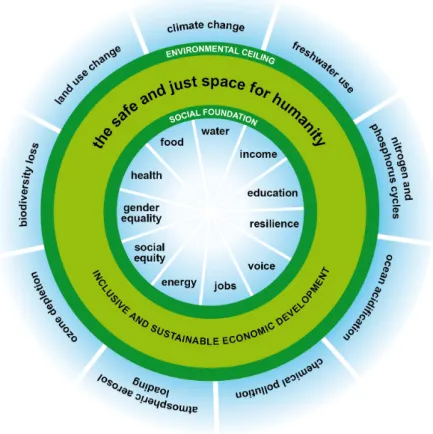
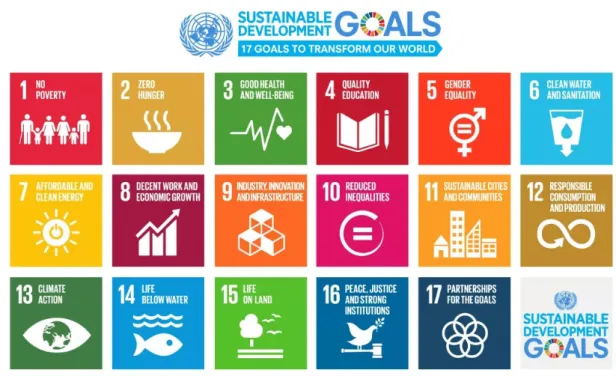
5.2 A safe and just space for humanity to thrive in: a rst illustration (Raworth,2012). 43 5.3 SDGs (UN,2016b). . . 46
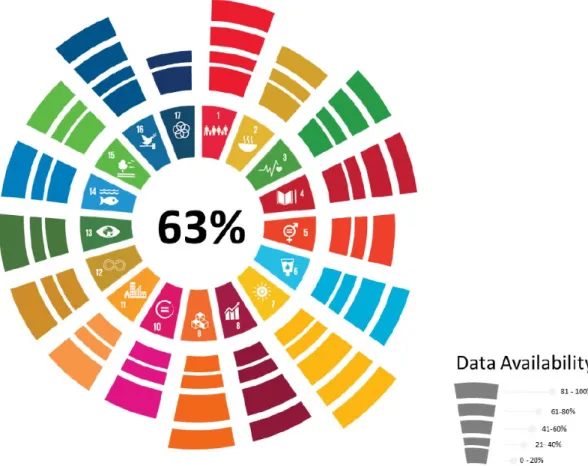
5.4 Data on SDGs availability within South Africa (Statistics SA,2017). . . 47
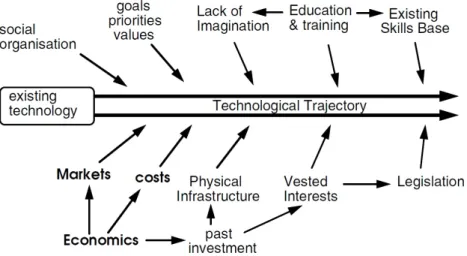
6.1 Factors that constrain the direction of a technological trajectory (Beder,1994). . 57
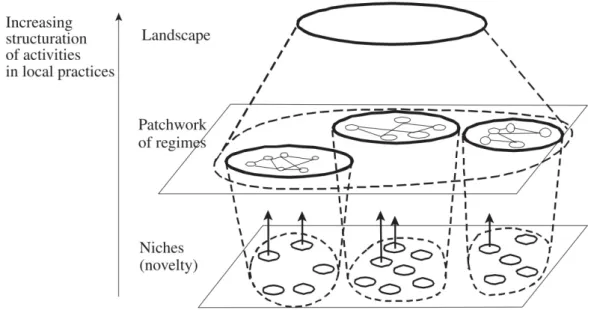
6.2 Multiple levels as a nested hierarchy (Geels,2002). . . 58
6.3 Multi-level perspective on transitions (Geels,2004). . . 60
6.4 From niche dynamics to regimes shift (Schot and Geels,2008). . . 62
6.5 Transition arena as alternative circuit enabling SD (Rotmans,2005). . . 63
6.6 Regular policy versus TM process (Loorbach,2007). . . 64
6.7 Extension of the Technology Acceptance Model (Adapted from Venkatesh and Davis, (2000)). . . 66
6.8 The revised TAM: Accounting for accessibility of technology (Adapted fromMusa, (2006)). . . 67
7.1 Rened Conceptual Framework. . . 74
7.2 Schematic representation of plans in various levels of government (Adapted from Musango et al., (2015)). . . 74
7.3 Industry and technology alignment with SDGs framework . . . 79
7.4 Industry and technology alignment with SDGs framework process . . . 82
7.5 SDGs ow diagram . . . 88
8.1 Industry desired impact on SDGs. . . 119
8.2 Outlook of coal technology impact on SDGs. . . 120
8.3 Outlook of nuclear technology impact on SDGs. . . 120
List of Tables
1.1 Thesis outline . . . 7
2.1 Industry type search terms (DRI,2017) . . . 13
3.1 Industries divided into three sectors . . . 18
3.2 Scopus search . . . 20
3.3 Google Scholar search . . . 21
4.1 Crucial Biotechnology emerging for the SDGs until 2030(UN,2016a) . . . 30
4.2 Emerging digital technologies for the SDGs until 2030 (UN,2016a) . . . 31
4.3 Emerging nanotechnologies for the SDGs until 2030 (UN,2016a) . . . 32
4.4 Emerging neurotechnologies for the SDGs until 2030 (UN,2016a) . . . 33
4.5 Emerging green technologies for the SDGs until 2030 (UN,2016a) . . . 34
6.1 Existing frameworks, approaches and models meeting the new design requirements 70 6.2 Important transition and technology adoption characteristics . . . 71
7.1 Industry assessment on SDGs in circle 1 . . . 83
7.2 Industry assessment on SDGs in circle 2 . . . 83
7.3 Industry assessment on SDGs in circle 3 . . . 84
7.4 Industry assessment on SDGs in circle 4 . . . 84
7.5 Technology assessment on SDGs in circle 1 . . . 85
7.6 Technology assessment on SDGs in circle 2 . . . 85
7.7 Technology assessment on SDGs in circle 3 . . . 87
7.8 Technology assessment on SDGs in circle 4 . . . 87
7.9 Professional interviewees . . . 90
7.10 Design requirements validation results . . . 92
7.11 Strategic decision management validation results . . . 93
7.12 Framework design validation results . . . 93
7.14 Process validation results . . . 96
7.15 Output validation results . . . 96
7.16 Validation results of overall review . . . 97
8.1 Circle 1 - Energy industry . . . 102
8.2 Circle 2 - Energy industry . . . 102
8.3 Circle 3 - Energy industry . . . 103
8.4 Circle 4 - Energy industry . . . 104
8.5 Circle 1 - Coal Technology . . . 107
8.6 Circle 2 - Coal Technology . . . 107
8.7 Circle 3 - Coal Technology . . . 108
8.8 Circle 4 - Coal Technology . . . 109
8.9 Circle 1 - Nuclear Technology . . . 110
8.10 Circle 2 - Nuclear Technology . . . 110
8.11 Circle 3 - Nuclear Technology . . . 111
8.12 Circle 4 - Nuclear Technology . . . 112
8.13 Circle 1 - Gas Technology . . . 113
8.14 Circle 2 - Gas Technology . . . 113
8.15 Circle 3 - Gas Technology . . . 114
8.16 Circle 4 - Gas Technology . . . 115
8.17 Circle 1 - Renewable Technology . . . 116
8.18 Circle 2 - Renewable Technology . . . 116
8.19 Circle 3 - Renewable Technology . . . 117
8.20 Circle 4 - Renewable Technology . . . 118
Nomenclature
Acronyms
AU African Union
DEA Department of Environmental Aairs
ICT Information and Communication Technology IoT Internet of Things
IRP Integrated Resource Plan M LP Multi-Level Perspective
N CSD National Committee on Sustainable Development N F SD National Framework for Sustainable Development N GOs Non-Governmental Organizations
N SSD National Strategy on Sustainable Development SBAS Satellite-Based Augmentations System
SD Sustainable Development SDGs Sustainable Development Goals SM Es Subject Matter Experts
SN M Strategic Niche Management ST Socio-Technical
T A Technology Acceptance T AM Technology Acceptance Model
T M Transition Management U N United Nations
Chapter 1
Introduction
1.1 Background of the study
The world faces unprecedented and fundamental sustainability challenges across a number of do-mains. These challenges are aggravated by path-dependencies and technological lock-ins, result-ing in the established, incumbent Socio-Technical (ST) systems undergoresult-ing incremental changes, rather than the radical change that is necessary to eectively address sustainability challenges (Loorbach,2010;Markard et al.,2012).
A ST system is dened by Geels (2004) as the linkages between elements necessary to full societal functions (p. 900). ST systems theory has come a long way and around 60 years of development and application internationally by both researchers and practitioners has been performed (Baxter and Sommerville,2011;Carayon,2006;Cherns,1976;Clegg,2000;Davis et al., 2014;Eason,2007,2014;Mumford,2006;Pasmore and King,1978;Trist and Bamforth,1951). The impact of these theories has had a signicant impact on the social aspects of organisational design (the design of jobs and means of organising work). The re-design of ST systems in line with ST theory has helped improve work experience and generate more eective systems (Davis et al., 2014). ST systems theory incorporates the idea of design incompletion; the continuing need to review and revise our designs (Cherns,1976).
Sustainable Development (SD) was dened as development that meets the needs of the present without compromising the ability of future generations to meet their own needs (p. 9682) (Anadon et al., 2016; WCED, 1987) in 1987 through commissions and summits led by the United Nations. Since then, subsequent work has broadened the original framing to dene development as sustainable when inclusive well-being does not decline with time (Anadon
et al., 2016). From the perspective of SD, a number of ST systems (i.e. the energy sector,
transportation system, etc.) are deemed unsustainable. It is argued that in order to transition from current (unsustainable) ST systems to sustainable ST systems, large-scale technological and social innovation diusion is required (Bibri and Krogstie,2017). When looking at solutions to
sustainability challenges, it is evident that the solution is neither social, nor technically exclusive (Brundtland and Khalid,1987).
Sustainability challenge engineers to ensure social, ecological and economic issues are incor-porated into their work. Engineers are pushed towards considering cross-generational costs and benets of their work, the rights of diverse social groups to resources, and the shaping of con-sumer needs to t environmental limits (Bell et al., 2011). The mainstream discourse in SD argues for an eco-eciency approach in which a technology push strategy boosts eciency levels by a factor 10 and more in industrialised and developing countries (Paredis,2011).
According to Le Blanc (2015), there is a lack of integration within ST systems in terms of strategies and policies, which remains one of the main pitfalls of previous approaches. The current lack of trade-o initiatives and interaction within ST systems results in muddled policies, unfavourable impact on SD policies, and nally a separation of outcomes and trends for SD (Le Blanc,2015).
SD is controlled by technological innovation. Technology includes the full range of devices, methods, processes, and practices that can be used to full certain human purposes in a speci-able and reproducible way (p. 9683) (Anadon et al.,2016;Brooks,1980). Technology innovation evolves over time and changes according to changes in the market. Therefore, existence of feed-back loops connecting activities in dierent innovation stages implies that overcoming barriers (Bergek et al.,2008) to innovation in any one stage often requires looking beyond that particular stage (Anadon et al.,2016).
It is commonly acknowledged that technology, in itself, has no power (Geels, 2002). Only when technology is eectively integrated with, and used and accepted by society, institutions, governing bodies and organisations, can technology full its function (Brent, 2015). Addition-ally, organisations are profoundly aected by technological advancements and require a exible customised change model to t the social network of the industries and/or organisations into which technology is being introduced (Appelbaum,1997).
Feenburg (1999) has stated that society and technology co-evolve and mutually inuence each other. Johnson and Wetmore (2009) state that if one wants to inuence the direction of technology and society, one must rst understand their relationship (p. 95) and understanding how values are entwined in ST systems is crucial to steering technology to a future we want (p. 205).
For developing countries to foster economic development, organisations purchase new tech-nologies and innovation to broaden their manufacturing base (Blohmke,2014). Developing coun-tries understand access to technology as key for economic development, thus they see the chance to gain stronger technology ownership and reduce their technological dependency on the de-veloped countries through technological innovation. Developing countries have been expressed
through the right to SD in the context of clean technology innovation (Blohmke,2014).
Developing countries face barriers along the entire value chain, from nancing of the technol-ogy manufacturing to operation and maintenance during the technoltechnol-ogy lifetime. The assessment of complexity can be understood as a framework for potential prot- and technology-sharing agreements between developing countries on the one hand, and high-income, technology export-ing countries on the other hand (Blohmke,2014). According to Paredis (2011), the transfer of technologies between social contexts - e.g. from industrialised countries to developing countries - is not a major problem and only inhibited by cost.
One of the main learning points for sustainable technology policies is that they should not focus on individual products and processes, but on ST systems and relations between dierent levels. In ST systems, traditional technology push strategies are not adequate, since they neglect co-evolutionary dynamics (Schot and Geels,2008).
Making technological innovation work for SD requires making fundamental changes to the rules (Anadon et al.,2016). There has been tremendous research done in the eld of ST systems and how technology changes it. With the constant change in technology and innovation, this eld presents an opportunity for developing countries to establish how technology is implemented, managed and continuously improved. These changes to such systems can result in signicant and cascading impacts to the assets that comprise the productivity base of a society (Blohmke, 2014).
It is clear that the current SDGs and the supporting policy framework does not completely reect the multi-dimensional connections within the SDGs framework. Therefore, in practice, the implementation of technology within a ST system will be limited to certain SDGs, which could have reached multiple SDGs indirectly with guidance towards multi-dimensional connections (Le Blanc,2015). According to Le Blanc (2015) there is an absence of important links that reect the SDGs network as a whole and that have not yet reached the international political arena.
Understanding the dynamics and complexities surrounding the interactions between technol-ogy and ST systems with regard to SDGs is the focus of this research project.
1.2 Problem statement
The key to unlocking the potential capacity of using technology to contribute toward and/or improve SDGs is assisting the industries with a framework that provides the connection between a specic industry and technology. Currently, a lack of integration exists within the ST systems
(Le Blanc, 2015) and through the re-designing of a ST system, eectiveness of the system may
be improved (Davis et al., 2014). This is evident in the scientic literature, where it has been stated that society and technology co-evolve and inuence each other (Feenburg,1999).
There is a need to establish the connection between industries and technologies relevance towards the SDGs within the context of developing countries. The present study aims to un-derstand the importance of context, specically with regard to developing countries (and more specically South Africa) when ST systems (and more specically, industries) are considering the adoption of technology within respective industries.
Currently, there is a gap in the literature regarding the connection between industries and the various technologies. This remains a challenging landscape for a number of reasons, and more specically their applicability to the South African context. The applicability of these technologies to assist industries in realising the potential of the technologies toward fostering sustainable futures remains unknown. In addition to the questions of context, when technology implementation is considered, within South Africa and new innovative technologies are being developed that holds potential to contribute towards sustainable futures. However, the existing frameworks, approaches and models to study ST systems and understand how technology im-plementation takes place have not been investigated. It is unknown how these frameworks can contribute to understanding the eect of these technologies on SDGs.
1.3 Research aim and objectives
The aim of this research study is contributing towards facilitating a process whereby industries can identify and select the most applicable/relevant/suitable technologies that will enable them to, in-turn, contribute towards the SDGs through the development of a framework to guide ST systems towards SDGs with use of technology in ST systems. For the purpose of this study, such ST systems, and thus the level of analysis, are industries. An eective approach to study, under-stand and explain the role of technology in industries, that holds potential to contribute towards the SDGs in South Africa and that will, ultimately contributing towards the greater promise of SD, as well as to the bodies of knowledge pertaining to SD and technology management.
The above stated aim are supported by the following objectives:
1. Investigate the role of technology in SD, as well as the factors that enabling and/or limit technology in contributing towards transitioning to sustainable systems. In addition, the role of technology in SD in South Africa is investigated. The focus will primarily be to:
(a) Investigate what technologies are currently being employed in South Africa to support the aim of SD. And to develop a clear understanding of the extent of use of technology in South Africa in the process of fostering SD; and
(b) Gain an understanding of available or emerging technologies that could potentially have a signicant impact in South Africa in terms of SD.
2. Gain an understanding of how SD is fostered within South Africa and the current challenges faced in terms of moving towards sustainability. In addition, the study will investigate South Africa's current state on SDGs and areas of improvements through technological advancements.
3. Determine the applicability of the developed frameworks, approaches and models to the design requirements set out to guide decision makers when choosing a technology(ies) when implementing within an industry to improve and/or contribute towards SDGs.
(a) Investigate how the existing frameworks, approaches and models guide decision makers when choosing between technologies for SD and more specically towards SDGs. (b) Determining the applicability of the existing frameworks, approaches and models in
relation with the design requirements to eectively support the process of implement-ing technology to contribute and/or improve SDGs.
4. Develop and validate an framework that will support the guidance towards choosing a technology(ies) for implementation within an industry to contribute and/or improve SDGs. In addition, perform a case study to exploit the practical use of the conceptual framework. (a) To develop a conceptual framework that can of support and guide decision makers, within industries, towards technology(ies) for implementation to contribute and/or improve SDGs.
(b) Validate the conceptual framework by engaging with Subject Matter Experts (SMEs) in the eld.
(c) Perform a case study to explore and discuss the practical application of the use of the conceptual framework.
Ultimately, the success of this research project will lie in the ability of the developed frame-work to provide an eective way to provide guidance for decision makers within industries when choosing between various technologies to foster SDGs.
1.4 Research approach
This approach adopted in the current study exists of an amalgamation of theory development, framework building and validation. Chapter one articulates the problem landscape and acts as a framework for the study. The systematic review (refer to section 3) was conducted to gain and synthesise knowledge and gain a better understanding of concepts. The development of a
framework was based on the guidance of Jabareen's Conceptual Framework Analysis, based on the Grounded Theory (Jabareen,2009).
The developed framework was validated (refer to section7.4) through a series of interviews conducted with Subject Matter Experts (SMEs). In order to provide a more realistic and useful framework, the necessary adaptations to the framework were made, including the feedback from the SMEs. A case study was performed to expose the framework to inspection and explore the practical application of the framework (Robert,2014).
Chapter two outlines the research methodology and an overview of the theory used in this study, namely Grounded Theory and Conceptual Framework Analysis. The justication for the use of these theories is described, followed by the steps employed.
1.5 Limitations and assumptions of the study
This study includes some limitations and assumptions that should be noted. The systematic review methodology is advantageous as it reduces bias in the review process, but has limitations that should be noted and is further discussed in section2.3.1.
Data collection was performed through the means of interviews with Subject Matter Experts (SMEs), where the SMEs was selected based upon their relevance towards the implementation/-management of technology for sustainability and research elds such as SD, technologies and knowledge of various industries. This is however a limitation to this study, as it could be of greater value to include various SMEs of all industries. There are various role players within each industry and acts as a limitation when identifying SMEs. The chosen SMEs is acceptable for this study as the SMEs have knowledge and expertise in a vast number of elds.
The framework, developed in this thesis, is limited to the three entities illustrated in Figure
7.1, namely technology, industry and SDGs. The framework does not include any other factors that does and/or may have an aect on the decision-making process. These limitations is also further address in section 9.3, where in section 9.4 future studies is identied to address these limitations.
1.6 Content of document
Table 1.1summarises the outline of this thesis which ows in logical order based on the research approach outlined in section 1.4. The chapters in this thesis are structured as follows:
Table 1.1: Thesis outline Chapter 1 - Introduction
Chapter 1 provides the background of the study and provides the problem statement, followed by the research aim, objectives and limitations of the study.
Chapter 2 - Methodology
This chapter presents and discusses the research methodology, including a description of the Grounded Theory methodology and Conceptual Framework Analysis applied to this research.
Chapter 3 - The role of technology in South Africa
This chapter presents a systematic review that was performed in order to identify the technology used in the socio-technical system within South Africa and further explains how the technology is used.
Chapter 4 - The unused, new and emerging technologies to foster sustainable Socio-Technical systems
Chapter 4 provides information regarding the available technologies that foster sus-tainable development and how these can change the South African environment in terms of sustainable development.
Chapter 5 - Sustainable Development, Sustainable Development Goals and identi-fying South Africa's SDG areas of improvement
This chapter discusses how sustainable developments are fostered in South Africa and identies current challenges and focus areas. This chapter further provides in-formation regarding the current state of South Africa's performance on the SDG's set out and discusses which areas can be improved through technological advancements, and how these can change the current state.
Chapter 6 - Existing frameworks, approaches and models
Chapter 6 presents and discusses the existing frameworks, approaches and models in the eld of technology transitions and technology adoption. This chapter includes the design requirements of the developed conceptual framework and discusses the shortfalls of the current existing frameworks, approaches and models.
Chapter 7 - Industry and technology alignment with SDGs framework
In this chapter an overview of the theory is discussed where the relationship between the SDGs, industries and technology is explained. The chapter further developed a framework and describes the rened framework. Chapter 7 further explain how the rened framework can be used within practise. The last section of this chapter in-cludes the rst phase of the validation process. This chapter describes the validation process, discusses the validation results and provides solutions to areas that have been identied.
Table 1.1 continued from previous page
Chapter 8 - A case study of industry and technology alignment with SDGs within the South African energy sector
Chapter 8 presents and discusses how the framework can be applied to the energy sector. This chapter presents a case study of the framework on the energy sector within South Africa.
Chapter 9 - Conclusions and recommendation
The nal chapter concludes the study with a compact summary of the research conducted, the conclusions of the study and recommendations for future work is discussed.
1.7 Chapter 1: Conclusion
To summarise, Chapter1provides an introduction to this study by rst discussing the background of the study. The research aim and objectives dened to address this problem are listed and the research approach identied. The identication of this study's limitations is discussed, thereafter, the chapter concludes with a brief outline of the thesis. The following chapter discusses the research methodology used to achieve the objectives set out in this chapter.
Chapter 2
Methodology
Chapter 2 provides an overview of the methodology and theory used in this study, namely the Grounded Theory and Conceptual Framework Analysis. The benets and features of Conceptual Framework Analysis is explained, hereafter the framework of steps performed in order to achieve the objectives is discussed.
2.1 The Grounded Theory Methodology
Grounded Theory has been dened as a theory that is derived from data, systematically gath-ered and analysed through the research process (Corbin and Strauss,1990). Grounded Theory has specic tools that will contribute to the developing of a framework in the thesis. However, grounded theory still has limitations and has been criticised to some extent (Bryman and Bell, 2014). Grounded Theory utilises qualitative data or combines qualitative and quantitative data (Strauss and Corbin,1994). According to Charmaz (2008), the main principles of the Grounded Theory include: minimising preconceived ideas about the research problem and data, using simultaneous data collection and analysis to inform each other, remaining open to varied expla-nations and/ or understandings of the data, and focusing data analysis to construct middle-range theories. Conceptual Framework Analysis, which is described below, oers a strategy to build a framework analysis based on Grounded Theory (Jabareen,2009).
2.2 Conceptual Framework Analysis
According to Jabareen (2009), the use of a conceptual framework and theoretical framework are vague and imprecise however, he denes a conceptual framework as a network, or 'a plane,' of interlinked concepts that together provide a comprehensive understanding of a phenomenon or phenomena. Grounded theory is adequate for conceptual framework building due its primary characteristics and thus, the Conceptual Framework Analysis, as he refers to, aims to generate,
identify, and trace a phenomenon's major concepts, which together constitute its theoretical framework (Jabareen, 2009). The texts selected for Conceptual Framework Analysis should eectively represent the relevant social, cultural, political, and environmental phenomenon or social behaviour, and the multidisciplinary literature that focuses on the phenomenon under study.
2.2.1 Features of conceptual frameworks
The main features of conceptual frameworks are as follows (Jabareen,2009):
i. A conceptual framework is a construction of concepts, where each concept plays an integral role (Miles and Huberman,1994);
ii. A conceptual framework provides an interpretative approach to social reality; iii. Conceptual frameworks provide understanding; and
iv. Conceptual frameworks are indeterminist in nature and therefore do not enable us to predict an outcome. (Levering,2002).
2.2.2 Advantages of a conceptual framework
The main advantages of conceptual frameworks are as follows (Jabareen,2009):
i. Flexibility - Conceptual frameworks are based on exible conceptual terms rather than rigid theoretical variables and causal relations;
ii. Capacity for modication - Conceptual frameworks can be re-conceptualised and modied accordingly. This is consistent with the basic premise that social phenomena are evolutionary and not static; and
iii. Understanding - Conceptual frameworks aim to help us understand phenomena rather than predict them.
2.2.3 Phases of a Conceptual Framework Analysis
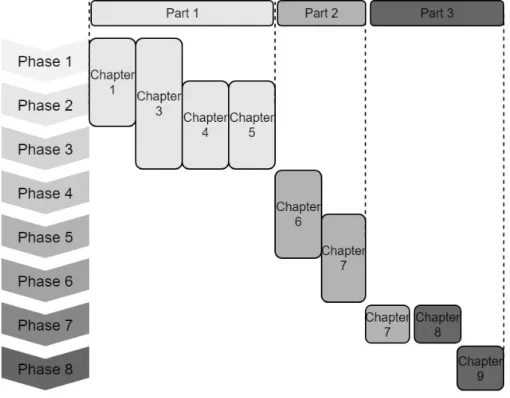
The proposed methodology is composed of eight phases (Jabareen,2009), which are summarised below and depicted in Figure2.1.
The rst phase of the Conceptual Framework Analysis is the mapping of selected data sources. This phase include identifying the need to review literature, the identifying the gap and data sources. This information is subsequently used to identify the search terms and execute an extensive review of the literature.
Phase two consists of extensive reading and categorising of the selected data, this includes extensive reading of identied data sources to gain better understanding and categorising data.
Phase three identies and names the concepts. The information is then further developed through rened reading and identifying of core processes.
Phase four is conducted by deconstructing each concept according to its attributes, characteristics, assumptions and limitations. This phase concludes with the categorising of the concepts to their distinct perspectives. The next phase, phase ve, is then com-pleted by integrating the concepts through grouping of similar concepts to form new concepts based on similarities.
Phase six revolves around the development of the conceptual framework, which is done through an iterative process building on integrated concepts. Phase six includes synthesis, re-synthesis, and making sense of the ndings.
Validation of the conceptual framework is executed in phase seven and is an integral part of quality assurance of the framework. This phase includes questions around the proposed framework, conducting eldwork and thorough feedback, which all determine whether the proposed framework and its concepts make sense.
Phase eight, rethinking the conceptual framework, consists of making the neces-sary changes according to the outcomes of phase seven. This phase may also revise the proposed framework according to new insights, comments and literature.
Figure 2.1: Conceptual Framework Analysis phases.
2.3 Research design
A overview of research design is represented in Figure 2.2 and consists of 3 parts. This section explains how the phases depicted in Figure 2.1were utilised to complete the present study. The
rst part comprises phases one, two and three of the Conceptual Framework Analysis methodol-ogy. Phases four, ve, six and the rst section of phase 7 of the Conceptual Framework Analysis methodology are explained in part two. The last part, part three, concludes the study and includes the second section of phase seven and phase eight.
Figure 2.2: Overview of research design 2.3.1 Part 1
Before commencing with data collection, it is important to rst clearly dene the research prob-lem and identify the primary objectives of the study. Chapter 1 clearly denes the probprob-lem, study objectives and provides background on the problem. The data sources identied within this study are industries, technology and sustainable development. Chapter 3 provides further insight into the problem and presents results of the systematic review.
A systematic review involves three key activities, namely: identifying and describing previ-ously published relevant research, critically appraising the research methods and bringing to-gether the aggregated ndings into synthesis ndings (ten Ham-Baloyi and Jordan,2015). The systematic literature review was conducted using Scopus1 and Google Scholar2 as search
plat-forms.
1https://www.scopus.com/ 2https://scholar.google.co.za/
Systematic review limitations
The systematic literature review methodology has limitations that should be noted regarding the specic questions asked in the search. This study only included studies published in English, excluding several earlier studies conducted. Specic words were identied that return specically to the search terms. Due to the lack of accessibility to certain studies across the world, only those accessible through Stellenbosch University were included.
Step 1: Identifying and describing previously published relevant research
By using the above mentioned search platforms, appropriate search terms were identied in order to retrieve the necessary literature. The search terms used in the systematic literature review were technology, South Africa, Sustainable Development and industry type. Industry type can be seen in Table2.1and is presented one by one. The variety of industries found within the South African environment can be classied into three dierent sectors, namely primary, secondary and tertiary sectors (Clark,1940;Fisher,1939;Fourasti'e and Lutz,1954).
Table 2.1: Industry type search terms (DRI,2017) Real estate service Agriculture Electricity Water
Government service Construction Fishing Mining
Community service Manufacturing Transport Gas
Financial service Accommodation Forestry Trade
Business service Communication Catering Storage
Personal service Social service Step 2: Critically appraising the research methods
Step 2 was carefully executed by assessing the resulting publications for their applicability and quality. The quality of the research was checked using the amount of citations each publication had and the citations in the publication. This was executed by retrieving the publications, reading the abstract and conclusions, and checking the relevance of the publications.
Step 3: Synthesising the research ndings
The nal key activity of the systematic literature review included data extraction and synthesis. The extracted data describes the technology currently in use within South African industries.
Chapter 4 provides the current available, new and emerging technologies that foster SD. It is further classied into separate technological categories, which technologies exist in each category and the opportunities they provide to improve and/or contribute towards SD and SDGs. Chapter 4 concludes with a discussion of how some technologies within certain categories may aect the South African environment in terms of SD and SDGs.
Part 1 of the research design concludes with the SD and SDGs, discussed in Chapter 5. This chapter provides an understanding of how SD is fostered and explains the SDGs with relevant agendas to the SDGs. Chapter 5 further describes the current state of South Africa in terms of SDGs and identies current challenges and focus areas within South Africa.
2.3.2 Part 2
Chapter 6 evaluates the existing frameworks, approaches and models which exist within the eld of technology transitioning and adoption. These evaluations created a deeper understanding of the existing frameworks, approaches and models and provided requirements for the developed framework. The design requirements are presented in chapter 6, and in chapter 7, the framework was developed and described. Based on part one of this study and the evaluations in chapter 6, a new framework was developed in chapter 7, namely Industry and technology alignment with SDGs framework.
Part 2 includes the rst phase of the validation process that was based on qualitative data that was gathered from eld experts through semi-structured, open-ended interviews. The validation method was based on the subject matter expert process with an in-depth review of the framework and literature. Interviews were set up with eld experts who received an explanation of the framework. Thereafter, a short questionnaire, using open-ended questions was administered to capture feedback from the experts.
2.3.3 Part 3
Chapter 8 entails the second phase of the validation process. The second phase of the validation process consisted of a case study that represents the research used to develop the framework and aims to present the reader with a theoretical argument.
The nal chapter, chapter 9, concludes the study with a compact summary of the research conducted, the conclusions of the study, limitations experienced during the study and identifying future work recommendations.
2.4 Chapter 2: Conclusion
This chapter provided a short overview of the Grounded Theory and Conceptual Framework Analysis used in the present study. The Conceptual Framework Analysis method was further described and included the advantages of this method and how it was utilised to execute the research study. The research design consists of three parts, with part one comprised of phases one, two and three of the Conceptual Framework Analysis method. Phases four, ve and six of the Conceptual Framework Analysis method is described in part two. The last part of the
research design, part three, concludes the study with a validation process, recommendations and the conclusion of the study. Part 3 includes phases seven and eight of the Conceptual Framework Analysis.
Chapter 3
The role of technology in South Africa
This chapter presents a overview of the systematic review. It further presenst the systematic review that was performed in order to identify the technology used in the Socio-Technical system within South Africa and further explains how the technology is used.
Technology plays an undisputed role in modern society and is a key driver for innovation and sustainable business growth (Dolata, 2013). Technology also contributes (both positively and negatively) towards the (un)sustainability of modern-day production and consumption patterns (Smith and Stirling,2008). However, it is commonly acknowledged that technology, in itself, has no power (Geels,2002). Only when technology is eectively integrated with social systems, will it be able to fulll its function within such a Socio-Technical (ST) system (Brent,2015). This section of the study seeks to gather and analyse publications focused on the use of technology to facilitate Sustainable Development (SD), specically in the South African context.
Key issues facing managers include understanding the link between technology and corpo-rate stcorpo-rategy, technology diversication, and technology acquisition. Ultimately, managers are appointed to determine the most eective and ecient methods for meeting the technology de-velopment challenges necessary to survive in their respective industries (Jones et al.,2001).
3.1 Technology usage put into perspective
Research has shown how technology inuences and ultimately changes ST systems (Blohmke, 2014). However, data concerning the role of technology in shaping and transforming ST systems in developing countries are insucient. Changes in, and transitions of, ST systems can (and do) have a signicant impact on the economic, social and environmental development of countries. Given the backdrop of the quest for SD and the role of technology when aiming to transition towards sustainability, questions such as 'how is technology implemented, managed and continu-ously improved within the context of SD in developing or emerging economies?' (Blohmke,2014) arise.
According to Schot & Geels (2008), one of the key learning points for the use of technology to foster SD is that focus should not be on individual products and processes, but rather on ST systems and relations between the dierent levels that exist within such ST systems. A ST systems is a physical manifestation of the processes of development, which result from investment of capital, use of technical knowledge, application of human expertise, labour and operation of governing institutions (Walker et al.,2008).
The actors, institutions, organisations, and resources shape who reaps the benets and who bears the costs and risks of these systems (Siddiqi and Collins, 2017). Additionally, operation optimisation has moved from focusing on a specic facility or organisation to the entire supply chain. This produces good service, maximum value and lowest cost (Schot and Geels,2008). It means that shifting the focus to supply chains is contributing towards SD (Linton et al.,2007). The main debate in SD argues for an eco-ecient approach in all countries in which technology-push strategies raise the level of eciency by a factor 10 (Paredis, 2011). Due to the current unsustainability of production and consumption patterns, it is argued that future sustainability of ST systems is heavily dependent on technological innovation, which includes all devices, meth-ods, processes, and practices. All of which can be used to provide the desired living standard without compromising the needs of future generations (Anadon et al.,2016;Brooks,1980). How-ever, according to Ahmadian (2008), experience of limitations in the diusion of technological innovations is not limited to science and technology. These limitations are hard to overcome and are mostly found within the immobility of organisational, social and institutional systems incorporated with the technological systems (Ahmadian,2008).
SD started to gain prominence when the International Union for the Conservation of Nature and Natural Resources presented the World Conservation Strategy (WCS) in 1980 with the overall aim of achieving SD through the conservation of living resources (IUCN, 1980). Since then, subsequent work has broadened to dene SD as something that does not allow inclusive well-being to decline over time (Anadon et al.,2016).
Although man denitions of SD exist, the most frequently used denition of SD, namely SD is development that meets the needs of the present without compromising the ability of future generations to meet their own needs from Our Common Future, also known as the Brundtland Report (Brundtland and Khalid,1987). Nevertheless, the concept of sustainability continues to challenge us to consider future costs, implications and the benets of our actions, the rights to resources and the shaping of consumer needs given environmental limits (Bell et al.,2011).
Organisations today have used technology to improve the logistics of products, services, sta retention, empowerment (Iwu and Benedict, 2013) and much more. The success of applying technologies to organisations depends on the co-ordination of technology and the alignment to
incorporate goals and capabilities, with the purpose of achieving competitive advantage ( Hip-kin and Bennett,2003;Leonard-Barton and Deschamps,1988;Martinsons and Schindler,1995). Various technologies have been successfully implemented into dierent business sectors. How-ever, a small margin of technologies are successful in their respective elds. Information and Communication Technologies (ICT) remain the bedrock for the development of various sectors
(Akinyede and Adepoju, 2010), while organisations implement internet technology in order to
remain competitive (Iwu and Benedict,2013).
In order for this study to provide meaningful results, it focusses on industries within the South African environment. Three types of sectors identied by Fourasti'e & Lutz (1954), Fisher (1939) and Clark (1940) are the primary (business concerned with obtaining or providing natural raw materials), secondary (converts raw materials into products) and tertiary (providing a service) sectors. These sectors consist of multiple industries as shown in Table 3.1.
Within these three sectors of South Africa the following industries are found: agri-culture, forestry and shing; mining; manufacturing; construction; electricity, gas and water; transport, storage and communication; trade, catering and accommodation; nance and business services; community, social and personal services (DRI,2017). Each industry comprises its own technolo-gies and challenges regarding new technology to foster SD.
Table 3.1: Industries divided into three sectors
Sector Industry
Primary sector Agriculture; forestry; shing; mining; gas Secondary sector Manufacturing; construction; electricity
Tertiary sector Water; trade; accommodation; catering; transport; storage; communication; nancial, business and real estate service; community, social, personal and government service
Research only recently started to nd evidence of a more balanced approach for SD. Research on ST sustainability transitions revealed that the focus has shifted to the co-evolution of tech-nology and society (Paredis, 2011). According to Paredis (2011) SD can be achieved without making fundamental changes within the present structures of society.
Brundtland & Khalid (1987) oer the objectives for SD policies. These include policies that focus on reviving growth, reorienting technology and managing risks within the context of SD (Brundtland and Khalid,1987).
3.2 Justication for systematic review
The methodology used in this study is based on the systematic literature review as described in Chapter 2. A systematic review is dened as a review of a clearly formulated question that
uses systematic and explicit methods to identify, select, and critically appraise relevant research, collect and analyse data from the studies that are included in the review (ten Ham-Baloyi and
Jordan, 2015). A systematic review diers from a conventional review through the use of a
research protocol. Readers can assess its rigour, completeness and replicability. A systematic review reduces the eects of chance and increases the legitimacy and authority of the evidence found (Traneld et al.,2003).
3.2.1 Advantages and disadvantages
Advantages (Jackson,2004;ten Ham-Baloyi and Jordan,2015;Traneld et al.,2003): i. The systematic review can be replicated;
ii. Clear and precise methods are used to identify relevant studies; iii. Systematic review is a rigorous method; and
iv. Systematic review shows transparency in the methods used to generate conclusions. Disadvantages (Jackson,2004;ten Ham-Baloyi and Jordan,2015;Traneld et al.,2003):
i. The process is time consuming;
ii. Infrastructure and access constraint occur if there is limited availability to electronic database(s);
iii. A large amount of literature can lead to endless possibilities; and
iv. Insucient amounts of studies can restrict or limit the process of synthesising the literature.
3.3 Conducting the systematic review
Systematic review involves three key activities: identifying and describing previously published relevant research, critically appraising the research methods and synthesising the aggregated ndings (ten Ham-Baloyi and Jordan,2015).
3.3.1 Step 1
The rst key activity of the systematic review was conducted using Scopus1 and Google Scholar2
as search engines. The results of each individual search is represented in Table 3.2 and Table
3.3. Due to the ease of using of Scopus, there were three searches (S-1, S-2 and S-3), whereas only two searches (G-1 and G-2) using Google Scholar was performed. Each column presents an in-depth result of the previous column, with the initial search found in Column S-1. The initial
1https://www.scopus.com/ 2https://scholar.google.co.za/
Table 3.2: Scopus search
Search terms S-1 S-2 S-3
Agriculture AND Technology AND South Africa 128 70 23
Forestry AND Technology AND South Africa 44 11 2
Fishing AND Technology AND South Africa 9 2 2
Mining AND Technology AND South Africa 311 39 16
Manufacturing AND Technology AND South Africa 212 32 12
Construction AND Technology AND South Africa 260 37 10
Electricity AND Technology AND South Africa 308 101 29
Gas AND Technology AND South Africa 360 70 10
Water AND Technology AND South Africa 617 141 25
Trade AND Technology AND South Africa 208 36 9
Accommodation AND Technology AND South Africa 12 3 0
Catering AND Technology AND South Africa 10 1 0
Transport AND Technology AND South Africa 153 30 8
Storage AND Technology AND South Africa 154 21 0
Communication AND Technology AND South Africa 763 107 25
Financial service AND Technology AND South Africa 17 3 2
Business service AND Technology AND South Africa 6 1 0
Real estate service AND Technology AND South Africa 2 0 0
Community service AND Technology AND South Africa 6 3 2
Social service AND Technology AND South Africa 3 0 0
Personal Service AND Technology AND South Africa 0 0 0
Government service AND Technology AND South Africa 18 5 3
search was executed by searching for the search terms within the title, abstract and key words of articles. The code was as follows: TITLE-ABS-KEY(Search Terms).
The Scopus search engine was then used to search for the search terms, Sustainability OR SD, within the title, abstract and key words of publications. The results can be found in column S-2 and the code for each search was as follows: (TITLE-ABS-KEY(Search Terms)) AND (Sustainability OR SD). The second platform, Google Scholar, was used to expand the search for publications. The initial search G-1 was conducted using the search terms in column one of Table 3.3.
3.3.2 Step 2
The second key activity was carefully executed by assessing the results for their applicability and quality. In the last columns of Table3.2and3.3are the number of publications that were found to be useful, applicable and of acceptable quality. The quality of the research was ascertained by checking the amount of citations each publication had and the references cited within the publication itself. This was executed by retrieving the publications, reading the abstract and conclusions, and checking for relevance. After completion of this activity, 178 publications were
Table 3.3: Google Scholar search
Search terms G-1 G-2
Agriculture Technology South Africa 4 3
Forestry Technology South Africa 2 1
Fishing Technology South Africa 0 0
Mining Technology South Africa 4 3
Manufacturing Technology South Africa 3 2
Construction Technology South Africa 3 2
Electricity Technology South Africa 0 0
Gas Technology South Africa 1 0
Water Technology South Africa 6 3
Trade Technology South Africa 15 10
Accommodation Technology South Africa 0 0
Catering Technology South Africa 0 0
Transport Technology South Africa 2 1
Storage Technology South Africa 1 1
Communication Technology South Africa 82 17
Financial service Technology South Africa 1 1
Business service Technology South Africa 0 0
Real estate service Technology South Africa 0 0 Community service Technology South Africa 0 0
Social service Technology South Africa 0 0
Personal Service Technology South Africa 0 0
Government service Technology South Africa 10 5
found using Scopus and 49 publications using Google Scholar were sourced, respectively. 3.3.3 Step 3
The nal key activity of this systematic review included data extraction and synthesis which is presented in the next section. The next section describes the technology currently in usage within the South African industry. The following section is divided into three sub-sections, describing the three business sectors highlighted earlier in this Chapter.
3.4 Technology in the South African Socio-Technical system
This section discusses the use of technology in dierent industries to facilitate SD in the South African context. The systematic review revealed that there is currently no single technology which ts all industries, nor is there any technology in the right position to plug-and-play into all industries. However, ICT consist of an extended list of components that are, or can be, implemented in South Africa to facilitate SDs. ICT is currently being used in all business sectors. However, manufacturing, transport, and, services within the nancial and business sectors have been showing the most implementation of these technologies.
ICT include the use of internet, wireless networks, mobile phones, and other communication mediums. It entails a list of technologies that continue to grow (Christensen,1997;Rouse,2017). ICT can be dened as a combination of manufacturing and service industries, which capture, transmit and display data and information by means of electronic transfer (Aldemir and Gülcan, 2004). An ICT system consists of six components, namely data, hardware, software, information, procedures and people (Rouse,2017).
In order for organisations, governments and countries to implement ICT successfully, the Technology Acceptance Model (TAM) can be used across all levels in order to achieve successful adoption of technologies. TAM is used to explain and predict the individual's acceptance of tech-nology. A number of studies used the TAM to explain and predict the adoption of technologies in the ST systems successfully (Bruner and Kumar,2005;Igbaria and Tan,1997;Luarn and Lin, 2005;Moon and Kim,2001;Taylor and Todd,1995;Venkatesh and Morris,2000;Wentzel et al., 2013;Wu and Wang,2005).
3.4.1 Primary sector
The agri-culture sector in South Africa plays a critical role in employment creation and poverty reduction. Thus, the correct technologies must be implemented in order to facilitate reductions in poverty and increase employment (Taruvinga et al., 2017). The present review revealed that there are currently only a small number of technologies used in agriculture. Currently, the use of ICT is applied in this sector to support the supply chain in ensuring constant ow of information. One challenge facing many farmers is uneducated workers. There is a small variety of technology that can be implemented to assist the uneducated workforce. While small-holding farmers (small plots of land for producing crops for personal and local use) still struggle to connect with technology, these farmers have been innovative by implementing agri-logistics that minimise the transportation of products to and from their farms. Most of these innovative strategies implemented by smallholding farmers are unsustainable and could easily be achieved through the use of other strategies (Perret and Stevens, 2006). However, such innovative ideas and implementation strategies on a small scale could provide solutions and testing results for current situations.
ICT systems provide organisations with the ability to connect and manage uneducated workers which exist mostly in the primary sector. One such example of ICT is logistics, whereby multiple farmers are connected to one system, enabling each farmer to transport the same load for less. Alternatively, farmers make use of service providers in the transport sector. By connecting people through the ICT system, farmers have the potential to eliminate the middleman. As a result, they receive higher prot margins, resulting in providing the customer with the same product for less. ICT improve the marketplace both locally and internationally, while also
providing them with the opportunity to sell products at lower market prices. Through such systems and technology to connect farmers with customers, services become easy and hassle free. Large scale farmers make use of other technologies such as Participatory Technology Devel-opment and Satellite-Based Augmentation System (SBAS). Participatory Technology Develop-ment is used to develop more sustainable farming systems (van Veldhuizen et al., 1997). SBAS provides management of information related to their assets and provides management with op-timised logistics (SBAS Africa,2017).
Both technologies could reduce cost and facilitate SD in South Africa if correctly imple-mented and managed. However, this is costly and skills in management of these technologies need to be transferred to users. The SBAS technology provides the forestry industry with similar abilities, resulting in management making more informed decisions. SBAS also provides logistics in the form of optimal routes for transportation and route optimisation for assets in operation which could help smallholding farmers.
Agroforestry involves the integration of trees into farming systems in ways that create an agroecosystem succession, similar to that in natural systems (MEA (Millennium Ecosystem As-sessment),2005). At the same time, agroforestry is a promising land-use practice to maintain or increase agricultural productivity while preserving and improving agricultural land fertility ( Zer-ihun et al.,2014). Agroforestry technologies have been shown to have the potential for improving productivity and the livelihoods of rural farmers (Garrity,2006;Zerihun et al.,2014). However, very little eort has been made to promote agroforestry technologies in South Africa irrespective of their vast potential in the country. Despite the increasing realisation of agroforestry as an environmentally and economically suitable land-use practice, the adoption of agroforestry tech-nologies has been very slow across all sub-Saharan African countries (Franzel and Scherr, 2002; Mafongoya et al.,2006;Zerihun et al.,2014).
Fishing technology has evolved from simple harpoons and hooks to industrial trawlers. After decades of assuming that seafood resources are inexhaustible, recent raised that advanced shing technologies may have a detrimental impact on stocks and ecosystems have been raised. The last century has seen advances in shing technology targeted as a major contributor to current over-exploitation of sh stock and as such, this form of technology has been suggested to be highly unsustainable (Kennelly and Broadhurst,2002).
Technology has changed the mining industry and the way in which large mining sites operate. The mining industry has had a signicant increase in the degree of automation, providing larger and more ecient equipment, furnaces and beneciary plants (Bartos,2007;Filippou and King, 2011; Paton et al., 2016). According to Leeuw & Mtegha (2016) there are multiple categories of technology available to the mining industry. There are 12 nodes of input mining technology (various forms of mining-related technology). The dierent forms of technology in each class
and in which category they fall (Artefact, Machine, Software and Mining Service Technology Category) is classied by Leeuw & Mtegha (201