1
Using a birth ball in the latent phase of labour to reduce
pain perception; a randomised controlled trial
Dominique Constance McKenzie Mylod
Submitted in partial fulfilment of the requirements for
the award of Doctor of Philosophy (PhD)
Bournemouth University
2
This copy of the thesis has been supplied on
condition that anyone who consults it is understood
to recognise that its copyright rests with its author
and due acknowledgement must always be made of
the use of any material contained in, or derived from,
this thesis.
3 Dominique Constance McKenzie Mylod
Using a birth ball in the latent phase of labour to reduce pain perception; a randomised controlled trial
Hospital admission in the latent phase of labour is associated with higher rates of obstetric intervention, with increased maternal and fetal morbidity. Women sent home from hospital in the latent phase to 'await events' feel anxious and cite pain as their main drive to seeking hospital admission.
Using a birth ball to assume upright positions and remain mobile in the latent phase of labour in hospital is associated with less pain and anxiety. However, no research has examined the effect of using birth balls at home in the latent phase on pain perception, hospital admission or obstetric intervention. An animated infomercial was developed to promote birth ball use at home in the latent phase of labour to enhance women's self-efficacy, in order to reduce their pain perception.
As a pragmatic randomised controlled single centre trial, 294 low risk women were randomly allocated to two groups. At 36 weeks’ gestation the Intervention Arm accessed the infomercial online and completed a modified Childbirth Self-Efficacy Inventory before and after viewing. They were also offered the loan of a birth ball to use at home. The Control Arm received standard care. On admission to hospital in spontaneous labour, all participants were asked to provide a Visual Analogue Scale score. Both groups were followed up six weeks postpartum with an online questionnaire. Data were analysed on an Intention To Treat basis.
A significant increase was found in Outcome Expectancy and Self-efficacy Expectancy after accessing the infomercial and Intervention Arm participants were more likely to be admitted in active labour. No significant differences were found between the VAS scores, or intervention rates. Most respondents (89.2%) described the birth ball as helpful and reported high satisfaction, with comfort, empowerment and progress.
The birth ball is a promising intervention to support women in the latent phase. Further research should consider a randomised cluster design.
4 Contents
Contents ... 4
Acknowledgements ... 12
1.0 Introduction ... 14
1.1 Defining the latent phase ... 16
1.2 ‘Paracetamol, a bath, mobilise and keep hydrated’ ... 17
1.3 Thesis presentation ... 18
2.0 Background ... 20
2.1 Latent phase research and initiatives to date ... 20
2.2 Latent phase pain ... 22
2.3 Anxiety and self-efficacy in the latent phase ... 24
2.4 Birth balls ... 26
2.5 Conclusion ... 27
3.0 Literature review ... 29
3.1 Literature review aims and objectives ... 29
3.2 Guiding search question ... 30
3.3 Search strategy ... 30
3.3.1 Search planning form ... 33
3.4 Inclusion and exclusion criteria ... 35
3.5 Literature review findings ... 36
3.5.1 Studies identified ... 45
3.6 Discussion of literature review ... 46
3.7 Implications of literature review ... 47
3.8 Conclusions from literature review ... 48
4.0 Methodology ... 49
4.1 A complex intervention ... 49
4.1.1 Feasibility and piloting ... 51
4.1.2 Development... 51
4.1.3 Evaluation ... 51
4.1.5 The birth ball ... 52
4.1.6 The infomercial ... 53
4.1.4 Patient and Public Interaction activity ... 55
4.2 Rationale for an RCT design ... 56
5
4.2.2. Study area and population ... 65
4.2.3 Baseline data ... 65
4.3 Summary ... 68
5.0 Method ... 69
5.1 Hypotheses ... 69
5.1.1 Primary and null hypothesis ... 69
5.1.2 Secondary hypotheses ... 69
5.2 Primary outcome ... 69
5.2.1 Primary outcome measurement ... 70
5.3 Secondary outcomes ... 72
5.3.1 Secondary outcome measurement ... 72
5.3.1.1. The Childbirth Self-Efficacy Inventory© (CBSEI) (Lowe 1991) ... 72
5.3.1.2 Postnatal questionnaire ... 73
5.4 Operational definitions ... 74
5.5 Recruitment ... 76
5.5.1 Power calculation ... 77
5.5.2 Recruitment strategies ... 78
5.5.3 Enablers to trial recruitment ... 80
5.5.4 Barriers to recruitment ... 80
5.5.5 Sample ... 81
5.5.6 Blinding and allocation ... 82
5.6 Data collection ... 84 5.6.1 Control Arm ... 84 5.6.2 Intervention Arm ... 84 5.7 Adherence to protocol ... 85 5.8 Safety ... 87 5.9 Indemnity ... 87 5.10 Data integrity ... 88 5.11 Data management ... 89
5.12 Quantitative data analysis ... 89
5.13 Qualitative data analysis ... 92
5.14 Ethical considerations ... 94
5.15 Trial registration ... 96
6
6.0 Findings ... 98
6.1 Demographics of the sample ... 99
6.2 Pain perception by VAS score on admission ... 102
6.3 Cervical dilatation on admission ... 103
6.4 Labour interventions ... 107
6.4.1 Continuous Electronic Fetal Monitoring ... 108
6.4.2 Amniotomy ... 109 6.4.3 Synthetic oxytocin ... 110 6.4.4 Regional anaesthesia ... 111 6.5 Birth outcomes ... 112 6.5.1 Birth mode ... 113 6.5.2 Induction of Labour ... 113 6.5.3 Neonatal outcomes ... 114 6.6 Adverse events ... 115 6.7 Infomercial effect ... 115
6.8 Birth ball use ... 119
6.8.1 Previous experience of using the birth ball ... 119
6.8.2 Birth ball use at home in the latent phase ... 120
6.8.3 Time spent on the ball ... 121
6.8.4 Activities on the ball ... 122
6.8.5 Home support ... 123
6.8.6 Decision for hospital admission ... 124
6.8.7 Reasons for hospital admission ... 125
6.8.8 Time at home ... 126
6.8.9 Maternal satisfaction and acceptability ... 128
6.9 Postnatal questionnaire ... 129
6.9.1 Previous experience of the birth ball ... 129
6.9.2 Rhythm and movement ... 131
6.9.3 Freedom ... 131 6.9.4 Upright positions ... 132 6.9.5 Support ... 132 6.9.6 Comfort ... 133 6.9.7 Empowerment ... 133 6.9.8 Focus ... 134
7
6.9.9 Drug-free pain relief ... 134
6.9.10 Maternal recommendations ... 135
6.9.11 Negative responses ... 135
6.9.12 Trial participation... 136
6.10 Conclusion ... 137
7.0 Discussion ... 138
7.1 Context in the wider literature ... 138
7.2 Primary outcome ... 139 7.3 Secondary outcomes ... 142 7.3.1 CBSEI© outcomes ... 142 7.3.2 Induction of Labour ... 143 7.3.3 Labour admission ... 144 7.3.4. Obstetric interventions ... 145 7.3.5 Birth mode ... 146
7.3.6 Maternal satisfaction, acceptability and experience ... 147
7.3.6.1 Thematic map ... 150
7.3.7 An unexpected finding ... 152
7.4 Strengths of the BALL Trial ... 153
7.5 Limitations of the BALL Trial ... 154
7.6 Challenges and learning ... 156
7.7 Impact... 158
7.8 Implications for maternity care research ... 159
7.9 Conclusion and contribution to knowledge ... 160
References... 162
Appendices ... 188
Appendix 1 The BALL Trial design on the Pragmatic-Explanatory continuum (Loudon et al. 2015) ... 188
Appendix 2 Infomercial storyboard and aesthetic ... 189
Appendix 3 Infomercial PPI feedback ... 195
Appendix 4 Childbirth Self-Efficacy Inventory Part 1 ... 197
Appendix 5 Postnatal questionnaire ... 200
Appendix 6 Midwives’ pathway ... 206
Appendix 7 Demographic Details Form ... 207
Appendix 8 Participant Information Sheet ... 209
8
Appendix 10 Participant Instructions ... 217
Appendix 11 GP / CMW Letter ... 220
Appendix 12 Participant Sticker ... 222
Appendix 13 Safety Advice ... 223
Appendix 14 VAS proforma ... 225
Appendix 15 The BALL Trial Management Committee Report ... 226
Appendix 16 Data Management Plan (Digital Curation Centre 2019) ... 230
Appendix 17 Thematic analysis of questionnaire free test responses ... 236
Appendix 18 Criteria for excellent qualitative research (adapted from Tracey 2010) ... 270
Appendix 19 Distribution histograms ... 272
Appendix 20 Infographic ... 274
Glossary ... 275
9 Boxes
Box 3.1 Guiding search question ... 30
Box 3.2 Databases searched through EBSCO Host ... 32
Box 5.1 The null hypothesis ... 69
Box Appendix 17.1 Themes identified in responses to Q.6a. ... 238
Box Appendix 17.2 Themes identified in responses to Q.6b. ... 240
Box Appendix 17.3 Themes identified in responses Q.10a., Q.11a, Q.12 and Q.17 ... 268
Figures Figure 3.1 PRISMA flow diagram (adapted) ... 42
Figure 4.1 Complex Intervention Development Iterative Model ... 51
Figure 5.1 The VAS ... 71
Figure 5.2 Phases of thematic analysis ... 92
Figure 6.1 Recruitment and allocation ... 99
Figure 6.2 Cervical dilatation by trial arm ... 102
Figure 6.3 Latent / active phase admission by trial arm (NICE 2017) ... 104
Figure 6.4 Latent / phase admission by trial arm (WHO 2018) ... 104
Figure 6.5 CEFM by trial arm ... 107
Figure 6.6 Amniotomy by trial arm ... 108
Figure 6.7 Synthetic oxytocin by trial arm ... 109
Figure 6.8 Regional anaesthesia by trial arm ... 110
Figure 6.9 Box plots of Outcome Expectancy and Self-efficacy Expectancy Before / After scores ... 115
Figure 7.1 Phases of thematic analysis ... 149
Tables Table 3.1 PICO search terms ... 33
Table 3.2 Search limits ... 34
Table 3.3 Key to search term wildcard and truncation symbols for EBSCO Host ... 34
Table 3.4 Literature search inclusion criteria ... 35
Table 3.5 Search results from EBSCO Host 2015 / 2017 ... 36
10
Table 3.6 Search results from level 2 / 3 recommended resources 2015 and
2017 ... 37
Table 3.7 Summary of eligible studies identified from literature search ... 43
Table 3.8 Summary of study outcome data ... 44
Table 4.1 Criteria for a causal relationship (adapted from Chambliss and Schutt 2016) ... 60
Table 4.2 PRECIS–2 evaluation of the BALL Trial (adapted from Loudon et al. 2015) ... 63
Table 4.3 Host Trust labour and birth admissions and interventions October 2015 ... 66
Table 5.1 Operational definitions ... 74
Table 5.2 Inclusion and exclusion criteria ... 75
Table 5.3 Reasons for not participating in the BALL Trial ... 81
Table 5.4 Participant allocation by randomisation ... 82
Table 5.5 Participant study timeline ... 85
Table 5.6 Quantitative analysis of trial outcomes ... 89
Table 6.1 Comparison of demographic details by trial arm ... 100
Table 6.2 Mean VAS scores by trial arm... 101
Table 6.3 Mean cervical dilatation on admission ... 103
Table 6.4 Latent versus active phase admission ... 105
Table 6.5 Obstetric interventions by trial arm ... 106
Table 6.6 Birth outcomes by trial arm ... 111
Table 6.7 Reasons for IOL by trial arm ... 112
Table 6.8 Paired samples t-test Outcome Expectancy and Self-efficacy Expectancy ... 117
Table 6.9 Postnatal questionnaire respondents ... 118
Table 6.10 Birth ball use at home in the latent phase ... 119
Table 6.11 Time spent on the ball at home ... 120
11
Table 6.13 Home support ... 122
Table 6.14 Decision for hospital admission ... 123
Table 6.15 Reasons for hospital admission ... 124
Table 6.16 Time at home in the latent phase ... 125
Table 6.17 Maternal satisfaction with the birth ball ... 127
Table Appendix 18.1 Criteria for excellent qualitative research (adapted from Tracey 2010) ... 270
12 Acknowledgements
It takes a village to undertake doctorate research; my Research Village could populate Bournemouth.
I am entirely indebted to my doctoral supervisors Professor Vanora Hundley, Professor Sue Way and Dr. Carol Clark for their infinite wisdom, guidance, forbearance and kindness.
My sincerest thanks to Bournemouth University, the Faculty of Health and Social Sciences and the Doctoral College for offering me the doctorate opportunity. My special thanks to Louise Bryant for organising me, ‘Saints’ Steve Smith and Chris Pitt at IT Skills, the IT Helpline and the library staff. I am also most grateful to Dr. Zoe Sheppard for her statistics expertise, Laura Purandare for getting me through a Research Ethics Committee and Suzy Wignall for her ethical and EDGE support.
My appreciation and thanks to the Faculty of Media and Communication, particularly Dr. Chris Green, Pete Truckel, Tracey Ricketts and the superlatively talented Claire Larkin for creating and producing Having A Ball in Early Labour on a shoestring. Sarah Barton from the Portsmouth Maternity Services Liaison Committee kindly introduced me to a group of generous women and their babies who shaped the infomercial with their comments and experiences. Alice Girling, Korinne Meldrum and Amy Bisson braved the rain to lend their voices to the soundtrack.
Professor Nancy Lowe graciously allowed me to use the Childbirth Self-Efficacy Inventory.
I also thank the NIHR for supporting the trial on their portfolio, their expertise and the unalloyed blessing of Dr. Elinor Jenkins, who drove miles to recruit, diligently cleaned birth balls and imposed order on the Site File. The Federation of the Women’s Institutes of the Isle of Wight and Birthease donated birth balls, which was deeply appreciated. The Iolanthe Midwifery Trust financed the purchase of 28 birth balls; their award made me one of the proudest midwives of 2017.
I would like to thank the Isle of Wight NHS Trust for their generous support, especially Dr. Mark Pugh and Tracey Tidbury from the Research and
13
Development department. I would especially like to acknowledge the expertise of Lara Watson, physiotherapist extraordinaire and thank her for blowing my mind and feeding me tea.
Above and beyond, I thank my colleagues and friends in the Isle of Wight midwifery team for their unstinting commitment, effort and goodwill. It could not have been done without all of you and how you put up with me, I’ll never know. 295 families volunteered to participate in the trial and added sharing their personal data and experiences to everything else they accomplished. I cannot thank you enough and wish you and your babies health and happiness.
Lastly, to my partner Adrian, our daughter Francesca (a generous and patient IT consultant), my father Mike, my dear friends Fran, Heather and Pilar and everyone who provided emotional rescue, tea and wine, rather than the kick up the behind I deserved, thank you.
This thesis is dedicated to the memory of my mother, Jean McIntosh Service McKenzie Mylod and to Leo, a BALL Trial baby born sleeping.
14 1.0 Introduction
In twenty-first century maternity care, obstetric intervention, culminating in caesarean section (CS) births has increased exponentially. 106 out of 169 countries have CS rates above the 10% to 15% of births thought to be optimal in reducing perinatal mortality whilst minimising iatrogenic complications (World Health Organization (WHO) 2015). In at least 15 countries the CS rate exceeds 40%, including the Dominican Republic (58.1%), Brazil (55.5%), Egypt (55.5%), and Turkey (53.1%) (Boema et al. 2018). In the United Kingdom (UK), CS births had increased from 19.7% of births in 2000 to 26.2% by 2015 (Wise 2018). The continued rising trend in obstetric intervention in high-income countries such as the UK and the United States of America (USA) (Wise 2018), is not matched by improvements in maternal-fetal outcomes, family psychosocial wellbeing and public health (Lobel and DeLuca 2007; Sandall et al. 2018; WHO 2018). There has been considerable speculation as to the reasons for this increase in intervention, but an area that has received more attention recently is hospital admission in the latent phase of labour.
Most births in high-income countries occur in hospital (UNICEF 2018). However, the timing of admission can affect the outcome of labour. Hospital admission in the latent phase of labour is associated with higher rates of obstetric intervention, including amniotomy (Lundgren et al. 2013), Continuous Electronic Fetal Monitoring (CEFM) and synthetic oxytocin augmentation (Klein et al. 2004), epidural anaesthesia and CS, (Davey et al. 2013; Lundgren et al. 2013; Yang et al. 2013; Mikolajczyk et al. 2016; Rota et al. 2017), with the potential for increased maternal and fetal morbidity in the short and long terms (Sandall et al. 2018).
Latent phase admissions to labour wards in high-income countries may be as high as 47% of all labour admissions (Rota et al. 2017). With the associated increased obstetric interventions, a reduction in latent phase admissions would appear to be a key component of reducing interventions for women with straightforward pregnancies who plan hospital-based births. The potential benefits from such an initiative are considerable, in terms of reduced costs to maternity care systems and a reduced burden of intervention and complications in labours and births for women and their families.
15
This introductory chapter outlines the current definitions and understanding of the latent phase of labour and considers to what degree this is reflected in contemporary maternity care practice in high-income countries. The experiences, perspectives and needs of women and their families from research are also considered.
16 1.1 Defining the latent phase
Although undefined and unexplored until relatively recently, the concept of the latent phase of labour (‘early’ or ‘prodromal’ labour’) marks the transition from pregnancy to active labour (Friedman 1954; McIntosh 2013; Eri et al. 2015; Hanley et al. 2016). The latent phase is considered to occur with maternal perception of the start of labour accompanied by contractions until the cervix effaces and is 3 – 5 centimetres (cm) dilated, depending on the country and the locality. Thus, definitions vary from 3 – 5cm dilated (Friedman 1954; Neal et al. 2010) to the recent USA recommendation that active labour care should be delayed until 6cm dilatation to reduce the CS rate (Zhang et al. 2010). The most recent recommendation proposes 5cm dilatation as the optimal point to implement intrapartum care pathways (WHO 2018). The UK National Institute for Health and Care Excellence (NICE) offers the following definition:
‘…….. a period of time, not necessarily continuous, when:
there are painful contractions and
there is some cervical change, including effacement and dilatation up to 4cm’
(2017, p.24).
There is a continued disparity in beliefs and practice as to when and how the latent phase ends and active labour begins and there are grounds for doubt as to whether the labour / birth continuum should be delineated by cervico-centric measurements at all (Hanley et al. 2016; Hundley et al. 2017). Current definitions rarely resonate with women’s experiences (Gröss et al. 2010; Dixon et al. 2013) and the labour onset and progression of contemporary women indicate slower cervical dilatation than those of the 1950s cohort on which current care parameters rely (Albers 2007; Oladapo et al. 2018). Contemporary maternal populations are older, with larger body sizes and subject to greater ‘routine’ obstetric intervention, such as amniotomy and CEFM, which are themselves associated with delays in labour progression (Zhang et al. 2010; Humphrey 2014). Given that the diagnosis of latent or active labour is central to women’s labour experience and the degree of intrapartum intervention they experience, present parameters are inadequate (Hanley et al. 2016).
17
1.2 ‘Paracetamol, a bath, mobilise and keep hydrated’
Although many women who plan a hospital-based labour and birth state that they wish to remain at home until their active labour establishes, the standard advice of ‘paracetamol, a bath, mobilise and keep hydrated’ for women in the latent phase is perceived as a professional, generic response rather than personalised care which meets their needs and expectations (Nolan and Smith 2010; Spiby et al. 2014). Women sent home from hospital in the latent phase to ‘await events’, frequently feel anxious and unsupported (Spiby et al. 2006; Cheyne et al. 2007; Barnett et al. 2008; Cliffe 2017). They cite the need for reassurance in the face of uncertainty (Cheyne et al. 2007; Eri et al. 2015; Edmonds et al. 2018), with anxiety (theirs and their families’) being a key factor in their decision to seek admission (Barnett et al. 2008; Edmonds et al. 2018). Above all, women cite pain as their primary driver in seeking latent phase admission and care, whether in its manifestation at the time of admission or in anticipation of its increase in intensity and frequency (Barnett et al. 2008; Carlsson et al. 2009).
In the absence of non-reassuring indications such as vaginal bleeding or meconium stained liquor, current UK guidelines advise that women do not require hospital admission in the latent phase and should be encouraged to remain at home until active labour ensues (NICE 2017). However, women report midwives gatekeeping and coercing them into returning home (Nyman et al 2011; Shallow 2016). Whilst it might seem logical for midwives to postpone hospital admission and discourage it while it is safe to do so (Hundley 2013; Marowitz 2014), UK maternity services have attracted negative feedback for the perceived dearth of latent phase support (Care Quality Commission 2015). In a research agenda setting project, Scottish mothers identified the latent phase as a priority research topic (McCourt et al. 2013). There is growing awareness that leaving women and their families to manage the latent phase with minimal guidance and support adversely affects their labour and birth outcomes (Beake et al. 2018).
18 1.3 Thesis presentation
Having established the issue of latent phase admission, its association with increased obstetric intervention and the dearth of personalised latent phase care to support women and their families in this introductory chapter, Chapter 2.0 presents a critique of latent phase intervention research to date. This is utilised to present the case for a woman-centred, evidence-based intervention for the latent phase of labour, which directly addresses the needs and concerns of women and their families.
The underpinning neurophysiology of the latent phase is then considered in relation to intrapartum pain, anxiety and self-efficacy, with a rationale for promoting upright positioning and mobilisation in labour. This is accompanied by a critique of supporting evidence and the identification of the birth ball as a potential means of achieving this. Having justified the need for the literature review, the chapter concludes with an explanation of the study’s potential for an original contribution to knowledge in reproductive health.
Chapter 3.0 details the structure and findings of a literature review which identifies and synthesises the extant literature in order to establish the gap in knowledge which the study will address.
Chapter 4.0 details the methods employed for the creation of a complex intervention and provides the rationale for the methodological approach of a pragmatic randomised controlled trial, whilst Chapter 5.0 details the research setting, ethical approval, recruitment, data collection and management.
The quantitative findings from the BALL trial are presented in tabular and graphic formats in Chapter 6.0, by a direct comparison of the experimental arm characteristics, followed by the outcomes for the primary and secondary aims of the research, including those of the postnatal questionnaire. These are followed by a qualitative thematic analysis of the free text questionnaire responses. Lastly, Chapter 7.0 critically examines the trial outcomes and discusses whether the null hypothesis can be accepted or rejected. The meaning, importance and relevance of the trial outcomes are considered within the context of the wider literature, current knowledge and understanding. The thematic analysis of participants’ experience is summarised in a thematic map. The trial is critically
19
discussed in terms of its strengths, weaknesses and original contribution to knowledge. Finally, implications for maternity practice and research are considered.
20 2.0 Background
In order to understand the impact of latent phase admission and its attendant complications in maternity care, it is necessary to critically examine the research, knowledge and approaches to date. The conclusions are then used to justify the need for a systematic review of the evidence and the research as a whole.
2.1 Latent phase research and initiatives to date
Midwifery-led research has explored a range of interventions. An algorithm to formalise the diagnosis of active labour reduced latent phase admission; however, women returned to the maternity unit more frequently following discharge home in a ‘revolving door’ effect (Cheyne et. al 2008). Two UK based service improvement evaluations of telephone triage suggested a reduction in CS and increased uptake of midwifery-led facilities as a birth location (Weavers and Nash 2012; Mackenzie 2014), but more robust evidence has yet to be forthcoming. With the development of more affordable and reliable technology, a recent paper has concluded that, with caveats of women’s perspectives and ensuring privacy, midwives are open to the prospect of video-call based early labour triage on the grounds that it offers more contextual and non-verbal cues (Spiby et al. 2019). This strategy is attractive in that it has the potential for reducing uncomfortable and stressful journeys to maternity units and subsequent admission interventions such as vaginal examinations. However, telephone triage is not appropriate for women who have language or communication challenges or those who are scared or anxious (Henderson and Redshaw 2017).
A trial which compared women’s labour experience of home assessment versus telephone triage unsurprisingly found that home assessment improved women’s labour experience (Janssen and Desmarais 2013). Spiby et al. (2008) also found an improvement in women’s experience from home assessment compared to standard care, even though the visits were restricted to 08:00 – 21:00. Home assessment is unlikely to attract further investment from maternity care commissioning bodies unless it can be definitively demonstrated to improve maternal-fetal outcomes, which was not realised in either study.
21
Nevertheless, this evidence reinforces women’s stated wish to remain at home until their labour establishes.
In the UK, an ‘early labour suite’ is reported to offer on-site ‘hands-off early labour care’, although there is currently no evaluation data available (Herron 2014). A similar arrangement in Australia did not reduce obstetric intervention or improve birth outcomes (Williams et al. 2019), although it is notable that the duration of women’s stay in the early labour suite was restricted to four hours, which in itself may have increased psychological pressure on women. By contrast, Breman et al. (2019) also report using an early labour lounge facility in the USA, offering information, activities and support to low risk primiparous women; the reported emergency CS rate of 7.1% was well below the national rate of 32% (Centers for Disease Control and Prevention 2017), even allowing for additional planned CS. Whilst this is promising, the sample cohort of 67 women was small and the report is based on a postnatal questionnaire prior to discharge rather than a prospective trial.
The lack of proven efficacy for all of these initiatives may be because in essence, these latent phase interventions centre on service-led appropriation and allocation of human, institutional and financial resources rather than on woman-centred care to enhance physical and psychosocial wellbeing and address women’s priorities. A Cochrane review has concluded that to date, latent phase interventions have not wholly demonstrated a reduction in obstetric interventions, nor succeeded in offering women evidence-based strategies to postpone hospital admission until the active phase of labour (Kobayashi et al. 2017). Moreover, the standard advice of oral paracetamol in the latent phase is at best ineffective and at worst may be instrumental in prolonging the latent phase by the suppression of the prostaglandins which mediate it (The Undercover Midwife 2015). An alternative perspective is required to consider the evidence-base of current care and how it impacts on women’s principal concern in the latent phase: that of their pain experience.
22 2.2 Latent phase pain
The International Association for the Study of Pain (IASP) offers the following definition of pain:
‘An unpleasant sensory and emotional experience associated with actual or potential tissue damage, or described in terms of such damage’
(2014, p.1).
Latent labour involves the sensitisation of cervical afferent nerves and a localised inflammatory process in the cervix immediately prior to and during labour onset, combined with intermittent ischaemic nociception from uterine contractions (Eisenach 2010). However, the pathway through which latent phase nociception is perceived as pain involves affective, cognitive and behavioural components as a variable and individual experience (Whitburn 2013; Gibson 2014). These factors include beliefs, knowledge, social and family context, media and culture (Moseley 2013) and possibly genetics (Porter and Reddi 2015). This complexity is compatible with the diffuse activation of brain activity in the pain experience matrix (Cervero 2012).
The concept of pain in labour and birth is paradoxical in that pain’s association with suffering, fear and harm is at odds with the construct of birth and the transition to family life as joyful, transformational experiences (Lowe 2002). However, much of twentieth century research was conceptualised and undertaken in a context of women undergoing medicalised and obstetrically managed labours (Murphy-Lawless 2012). For example, Niven (1985) noted that more than half of her study’s respondents were undergoing synthetic oxytocin induction of labour or augmentation and / or were pharmacologically sedated, which cannot be considered as features of normal labour. Nevertheless, labouring women in Melzack’s study (1975) rejected the McGill Pain Questionnaire pain descriptors on the grounds that the positive experience of giving birth prevented them from using language with negative connotations. In short, labour pain was experienced as severe in intensity, but not negatively affective.
23
Rather than attempting to impose a pathophysiological paradigm, where labour pain is compared with that of cancer or arthritis (Melzack 1975), it seems apposite to accept labour pain as a fundamental component of normal labour in its commonality of women’s experience (Gould 2002; Van der Gucht and Lewis 2015). Within the midwifery construct of ‘working with pain’, pain is viewed as a transformative force in the transition to motherhood (Leap and Anderson 2008). Pain drives normal labour, summons social support and engages complex neuro-hormonal cascades as interactions which are crucial to facilitate birth, lactation, parental bonding, social integration and survival (Leap and Anderson 2008; Moberg 2011; Dixon et al. 2013b).
Pharmacological pain relief is not always associated with increased maternal satisfaction (Green 1993; Dickenson et al. 2003); nor does it necessarily reduce psychological suffering or improve outcomes (Royal College of Midwives Advisory Group 2012). A Cochrane review concluded that regional anaesthesia options can be administered in the latent phase without increasing CS rates (Sng et al. 2014), however this may be offset by hospital admission exerting the opposite effect (Yang et al. 2013; Rahnama et al. 2014). Moreover, latent phase regional anaesthesia still presents the established complications of regional anaesthesia, including prolongation of the second stage of labour and the attendant increase in assisted births (Anim-Somuah et al. 2018). Given the potential for fetal and maternal morbidities associated with the consequences of regional anaesthesia (Anim-Souah et al. 2018), there is considerable scope for disagreement with IASP’s assertion that regional anaesthesia represents the gold standard of intrapartum pain relief in terms of technique and effectiveness (Landau and Ciliberto 2011).
Pharmacological pain relief techniques, therefore, have yet to evolve to the point where they can provide analgesia without significant negative impacts on the physiology and psychosocial outcomes of labour, in addition to a burden on the resources and costs of health economies. What appears to be of greater importance for women in the latent phase of labour is their anxiety and need for reassurance.
24
2.3 Anxiety and self-efficacy in the latent phase
Heightened anxiety in the latent phase correlates with increased pain perception (Floris and Irion 2015). Conversely, an inverse relationship exists between confidence in ability to labour and pain perception (Lowe 1989). Women reporting greater self-efficacy as a self-perception of agency (Bandura 1997) experienced less fear, stress and anxiety during labour (Beebe et al. 2007; Nierop et al. 2008). Self-efficacy and confidence are associated with reduced obstetric intervention and epidural use (Beebe et al. 2007; Carlsson 2012; Carlsson et al. 2015). Evidence-based strategies to empower women and their birth supporters and to educate and de-medicalise their pain experience are needed to reduce latent phase admissions and their attendant obstetric intervention (Eri et al. 2015). This is not only a means of reducing the burden of maternal and neonatal morbidity associated with iatrogenic intervention. A cost-effectiveness analysis of latent versus active labour admission for low risk women in term labour concludes that the large reduction in interventions such as CS and epidural anaesthesia which are apparent in active labour admission is matched by equally sizable reductions in costs to individuals, care settings and health systems (Tilden et al. 2015).
One approach to de-medicalising labour pain and enhancing women’s confidence may be through enabling mobility and upright positioning. When a woman adopts upright positions and remains mobile in the latent phase, she uses gravity to apply the fetal presenting part to her cervix, which increases oxytocin release (Lawrence et al. 2013). Oxytocin and endogenous opioids modulate her pain perception through an intrinsic pain modulation pathway (Viero et al. 2010; Yang et al. 2011). Oxytocin and prostaglandins promote uterine contractions and cervical effacement to allow her to establish active labour (Buckley 2015). However, since the primary biosocial function of the brain is to ensure survival, there is a developing understanding of its flexible response to contextual cues. The bright lights, unfamiliar environment and lack of privacy which women encounter on admission to hospital often reduce contraction strength and frequency (Hodnett et al. 2013), because anxiety or fear engender the release of the cathecholamines that inhibit oxytocin release (Lederman et al. 1985; Enkin 2006; Dixon et al. 2013b; Buckley 2015), whether harm is perceived as an actual or potential threat. The increase in circulating
25
catecholamines exerts an antagonistic effect on her oxytocin production and reduces her contraction frequency and efficiency (Buckley 2015). This disrupted physiological pathway leads to longer labours, greater pain perception and obstetric intervention.
Women who have freedom of movement and upright positions are less likely to use epidural anaesthesia in active labour (Lawrence et al. 2013) and are consequently less likely to experience assisted births and their attendant complications (Anim-Somuah et al. 2018). Escott et al. (2004) suggest that labouring women engage with a wide range of innate and acquired affective and cognitive strategies to work with their pain and manage their anxieties instead of resorting to taught skills and techniques. This contrasts with the deficit model that portrays women as under-prepared, unrealistic and ill-equipped for labour Lally (2011). Fostering parental confidence and understanding of women’s intrinsic physiological pathways as a ‘tool kit’, rather than the ‘pain relief menu’ of pharmacological analgesia may be the key to effective care in the latent phase of labour (Eri et al. 2015).
An antenatal evidence-based intervention to promote and facilitate upright positions at home in the latent phase of labour may prove effective in enhancing women’s self-efficacy and reducing their anxiety. The consequential reduction in catecholamines should engage and maintain the pain modulation pathway and encourage women to postpone hospital admission until active labour is established.
26 2.4 Birth balls
Having established the need for an intervention which could facilitate upright positions at home in the latent phase of labour, a viable and cost-effective means had to be identified. Whilst Kitzinger (2011) maintains that women are more likely to adapt their familiar home environment to support and facilitate upright positioning and movement, offering a tangible physical prop seemed more likely to engage the interest of women and their families. However, equipment such as the Combitrac ® and birth ropes may be costly, require structural installation or are unsuitable for smaller dwellings. Birth couches, seats and peanut balls, on the other hand, support static sitting or lateral positions, rather than enabling mobility. The one prop which potentially offered support for upright positioning, combined with mobility, portability and affordability was a birth ball. Vinyl physical therapy balls (‘Swiss’, ‘Pezzi’ or ‘birth’ balls) are not a new concept in maternity care. They are inexpensive, widely available to purchase and easy to clean. As a key feature of ‘functional kinetics’ in rehabilitation therapy, they provide an unstable surface which engages multiple deep muscle groups (Klein-Vogelbach 1990; Carriére 1998). They are frequently used in antenatal education programmes to promote and facilitate upright or kneeling positions and rocking movements (National Childbirth Trust 2015). Rocking, circling, making figure-of-eight movements and bouncing whilst seated on the ball alleviate pressure on the skin and promote neutral positioning of the spine and pelvis at rest (Perez 2000). Sitting on the ball may alleviate pressure on the nerve filaments over the sacro-iliac area and reduce lumbar pain (Taavoni et al. 2011).
Trials from countries where hospital-based medicalised labours are a norm have reported reduced pain perception, particularly in back pain in active labour (Gau et al. 2011; Taavoni et al. 2011) and improved labour progress in terms of fetal descent and cervical dilatation (Zaky 2016). Two systematic literature reviews of using birth balls in active labour concluded that women reported less pain, but also concluded that the trials were small, at high risk of bias and the heterogeneity of outcomes and low grade evidence impeded firm conclusions (Makvandi et al. 2015; Delgado et al. 2019). Nevertheless, birth balls are widely accepted and indeed, recommended for pain management in active labour, including by the National Health Service (NHS) (2019).
27
Birth balls also stimulate a psycho-affective response to offer support, comfort and interest by activating other parts of the brain as a distraction (Perez 2000). Using the birth ball may enhance women’s self-efficacy, providing a sense of mastery, confidence and well-being, rather than passive compliance (Gau et al. 2011; Makvandi et al. 2015). This was reported as the case for the 12 respondents of a qualitative study in South Africa, which explored the experience of multiparous women who had used the birth ball in labour (James and Hudek 2017). Although the authors acknowledged that limiting the study to multiparous respondents restricted transferability, the women described relief from back pain and feelings of calm, empowerment and even enjoyment, which may be a further key component to improving labour outcomes and experience for families (James and Hudek 2017).
On these grounds, using the birth ball was identified as a potential strategy to support women at home in the latent phase in order to assume upright positions, reduce their pain perception and thereby postpone their admission to hospital until their labour had established. The prevalence of birth ball use in antenatal education and the modest body of evidence cited for its use in active labour suggested that other research regarding the latent phase might be available. This made it imperative to undertake a literature review in order to identify and synthesise extant literature and identify gaps in knowledge (Sylvester et al. 2013). In doing so, the literature review stood to confirm birth ball use in the latent phase as a research problem or justify it as a contribution to new knowledge (Paré and Kitsiou 2017).
2.5 Conclusion
This introductory chapter has considered the evidence regarding the impact of the latent phase of labour on labour and birth outcomes and how this this is reflected in contemporary maternity care practice in high-income countries. A critique of supporting evidence has demonstrated that women and their families cite pain and anxiety as their principal drivers for seeking hospital admission in the latent phase and consider that their needs and concerns are largely disregarded at this time. Latent phase intervention research has yet to demonstrate convincing improvements in labour and birth outcomes. A
woman-28
centred, evidence-based antenatal intervention is needed to address these issues.
Birth balls have been identified as a potential means of facilitating upright positions to optimise contraction strength and frequency and also to engage and enhance the pain modulation pathway as well as reduce anxiety and promote calm and self-efficacy in the active phase of labour. These findings may also be significant for the latent phase and have the potential to improve labour and birth outcomes as well as contribute to new knowledge. Accordingly, a systematic literature search was undertaken with the aim of identifying primary research which could inform and underpin using a birth ball in the latent phase of labour. This will be detailed and reported in Chapter 3.0.
29 3.0 Literature review
Systematic literature reviews aim to identify, evaluate and summarise the findings of all relevant individual studies using explicit and reproducible methods; they can establish what is known about an intervention, but just as importantly, what is not known (Centre for Reviews and Dissemination 2009). This chapter details the systematic literature review that was undertaken to inform the study, and prevent any duplication with previous research (Centre for Reviews and Dissemination 2009), commencing with its purpose, aims and objectives in relation to the guiding search question. The formulation of the search strategy within the Population-Intervention-Comparison-Outcome (PICO) framework (O’Connor et al. 2011) will be defined, including search limitations, inclusion and exclusion criteria and the electronic databases accessed. Literature identified as relevant to the research question is summarised and critically examined.
Search findings are presented in tabular form and the identification of relevant literature is demonstrated by means of a Preferred Reporting Items for Systematic Reviews and Meta-Analyses (PRISMA) flow chart (Moher et al. 2009). The retrieved studies are then critiqued. The findings are considered in the current context of maternity care in high-income countries and gaps in the evidence are identified to determine the primary and secondary outcomes of the present research.
3.1 Literature review aims and objectives
The aim of the literature review was to systematically and comprehensively search for, identify, critique and synthesise evidence related to the search question.
The following objectives were set:
1. To comprehensively review the literature regarding using pelvic positioning AND / OR a birth ball in the latent phase of labour.
2. To examine the effect of pelvic positioning AND / OR a birth ball on pain, normal vaginal birth and latent phase hospital admission.
30 3.2 Guiding search question
The guiding search question had to balance a comprehensive summary of the evidence with manageability and specificity (O’Connor et al. 2011). For example, it was anticipated that any search into the ‘latent phase’ would generate a large and broad volume of results, whereas ‘birth ball’ was anticipated to generate a small volume of results. The search question was devised as shown in Box 3.1.
Box 3.1 Guiding search question
3.3 Search strategy
A systematic search strategy was planned and applied in order to identify all the literature pertinent to the search question (Aveyard 2014).
No similar trials or reviews were identified on the Database of Abstracts of Reviews and Effects (DARE) – (1994 – 2015).
The Cochrane Database of Systematic Reviews identified one search protocol (Hanada et al. 2015) to review all trials of early labour educational psychosocial interventions. By the updated search in 2017, Kobayashi et al. (2017) had published their review of assessment and support during the latent phase in order to improve birth outcomes (Section 1.3).
The search question was framed within a PICO framework (O’Connor et al. 2011).
Population – women in the latent phase of labour or (‘early labour’). Although the NICE guideline (2017) underpinned the study, some flexibility was allowed to enable international studies to be included.
Intervention – pelvic positioning and / or use of a birth ball (as previously defined)
What is the effect of pelvic positioning AND / OR a birth ball in the latent phase of labour on pain, normal vaginal birth and latent phase hospital admission?
31 Comparison – standard care
Outcome – the search was specifically concerned with three outcomes (pain, mode of birth and latent phase hospital admission); other studies were planned to be included if other obstetric interventions were outcomes.
Having identified the key concepts, these were compiled as Search Terms and put through the following databases in Box 3.2 as a Search Strategy.
32
The following databases were accessed via MySearch on the Bournemouth University portal hosted by the Elton B. Stephens Company (EBSCO):
Box 3.2 Databases searched through EBSCO Host
BIOSIS (via Web of Science – 2008 only)
British Nursing Index (BNI)
Bournemouth University Research Online (BURO)
Cumulative Index of Nursing and Allied Health Literature (CINAHL)
British Library E-Theses Online Service (EThOS)
Global Health Intermid (1996 - present) Internurse Journals@Ovid Medline complete MyiLibrary OAIster
Open System for Information on Grey Literature (OpenSIGLE)
PsychINFO
Sage Journals Online
Sage Reference Online
ScienceDirect
Scientific WebPlus
Scopus
UK PubMed Central
Web of Science (incorporating Conference Proceedings Citation Index 1990 – present)
World Health Organization (WHO) Reproductive Health Library
Wiley Online Library
WorldWideScience.org
33 3.3.1 Search planning form
A standardised search planning form was used to construct the search strategy (Thames Valley and Wessex Healthcare Librarians 2013; Thames Valley and Wessex Healthcare Librarians 2016) for both searches.
Date search started: 27th November 2015 / 24th January 2017 Table 3.1 PICO search terms
Patient / Population / Problem
Intervention / Exposure
Comparison / Control Outcome
early labour early lab*r pelvic positioning pelvi* position* undefined admission normal birth Alternative terms latent phase childbirth wom#n female maternal parturient
34 Table 3.2 Search limits
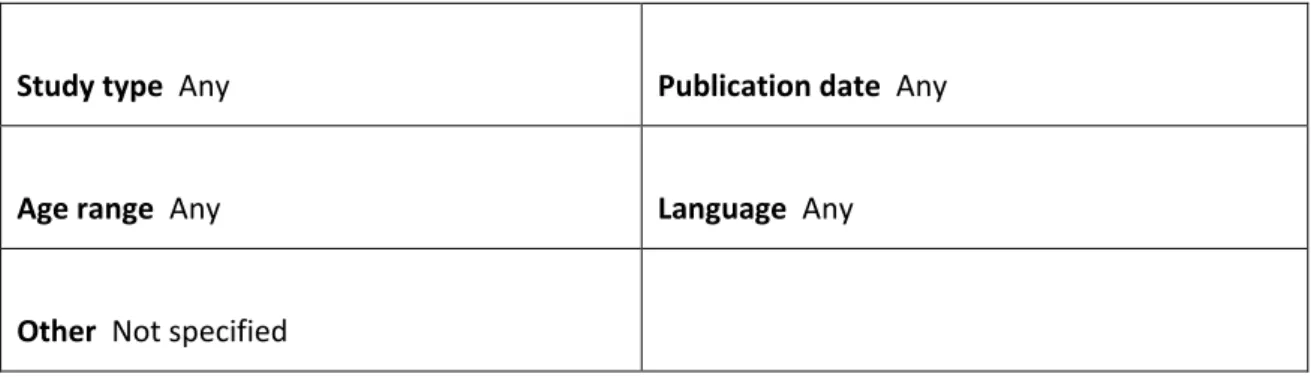
Study type Any Publication date Any
Age range Any Language Any
Other Not specified
Table 3.3 Key to search term wildcard and truncation symbols for EBSCO Host
Symbol Meaning Examples
# denotes alternative spelling for geographical or plural variation
labour (UK) / labor (USA); woman / women
* denotes two or more alternative letters truncation for alternative word endings
labour / labouring maternal / maternity pelvis / pelvic position / positioning birth / births / birthing
35 3.4 Inclusion and exclusion criteria
Inclusion criteria were applied to the literature search to restrict confounding factors on labour and birth outcomes. Table 3.4 demonstrates these criteria and the rationale for their application.
Table 3.4 Literature search inclusion criteria
Criterion Rationale for application
No dates exclusions were applied To widen search Languages included on the basis of researcher
linguistic competence to read and interpret the text. English, French, Portuguese and Italian included. For results beyond the researcher’s linguistic competence, English abstracts were acceptable to determine relevance
To widen search and minimise language bias (Sterne et al. 2011)
Planned hospital based labour and vaginal birth Research targeted at population planning hospital based labour and vaginal birth. To exclude planned home birth and elective CS Singleton, term (> 37 weeks’ gestation), cephalic
pregnancies
Pregnancies at low risk of developing obstetric complications (NICE 2017)
Peer-reviewed original research relating to women’s use of the birth ball in the latent phase of labour
To identify research literature specifically focused on the latent phase rather than antenatally or the active phase
Qualitative and quantitative full-text articles To exclude meta-analyses, literature reviews, secondary analyses, including guidelines Studies exploring the effect of maternal pelvic
positioning / upright posture / postural aids including birth ball
To include pelvic positioning / upright posture or postural aids
Women without previous CS or uterine surgery No antenatally diagnosed fetal abnormality or intrauterine death
No maternal co-morbidity e.g. diabetes mellitus No maternal obstetric complications
To exclude pregnancies at higher risk of
36 3.5 Literature review findings
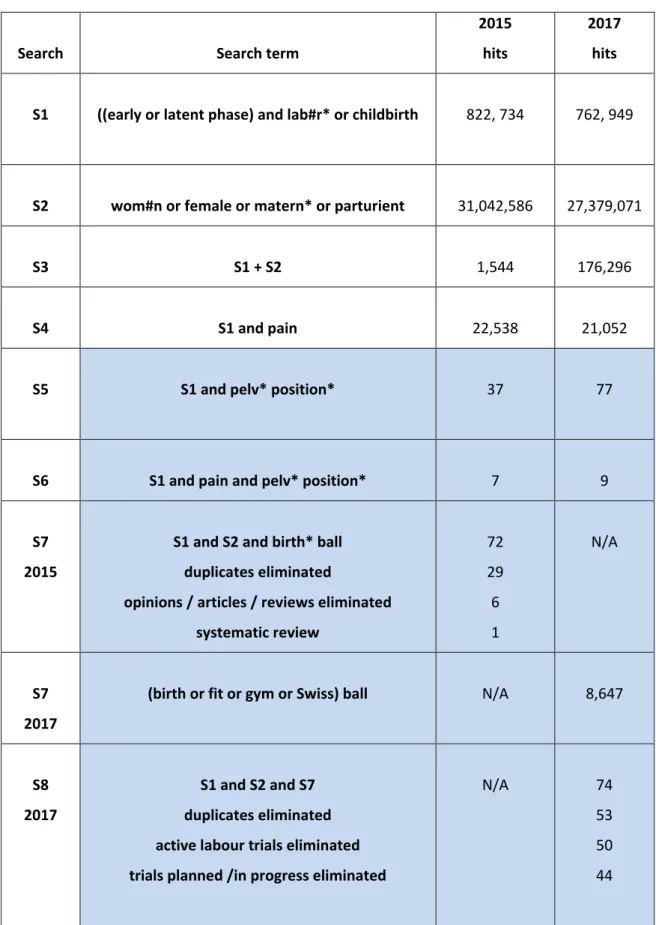
The findings from the literature search are detailed in Tables 3.5 and 3.6. Table 3.5 Search results from EBSCO Host 2015 / 2017
Search Search term
2015 hits
2017 hits
S1 ((early or latent phase) and lab#r* or childbirth 822, 734 762, 949
S2 wom#n or female or matern* or parturient 31,042,586 27,379,071
S3 S1 + S2 1,544 176,296
S4 S1 and pain 22,538 21,052
S5 S1 and pelv* position* 37 77
S6 S1 and pain and pelv* position* 7 9
S7 2015
S1 and S2 and birth* ball duplicates eliminated
opinions / articles / reviews eliminated systematic review 72 29 6 1 N/A S7 2017
(birth or fit or gym or Swiss) ball N/A 8,647
S8 2017
S1 and S2 and S7 duplicates eliminated active labour trials eliminated trials planned /in progress eliminated
N/A 74
53 50 44
37
Table 3.6 Search results from level 2 / 3 recommended resources 2015 and 2017
(Thames Valley and Wessex Health Care Librarians 2013; Thames Valley and Wessex Health Care Librarians 2016)
Database 2015 hits 2015 Comments 2017 Hits 2017 Comments
The Campbell Collaboration N/A N/A 0 None relevant
CasesDatabase
Journal of Medical Case Reports
0 Closed 2014. Replaced by Journal of Medical Case Reports
0 None relevant
ClinicalTrials.gov 3 None relevant 179 Schnaider NCT03105839 did not meet
criteria 178 irrelevant
Cochrane Trials Register 27 None relevant 1 Kobayashi et al. 2017
DART-Europe e-theses portal 6 None relevant 8 None relevant
British Library EThOS 7 None relevant 280 None relevant
Health Management Information Consortium Unavailable Combined
Unavailable
Kings Fund Library Database 0 None relevant
Latin American and Caribbean Health Sciences Literature(LILACS)
38
metaRegister of Controlled Trials (mRCT) 0 Under review from April 2015 - present Still under review
NHS Networks Commissioning Zone N/A N/A 0 None relevant
National Institute for Health and Care Excellence 1 NICE (2017) identified: guideline, not a study 3 Royal College of Midwives (RCM) (2012) & NICE (2017) identified as guidelines
Hodnett et al. (2008) (duplicate)
National Institute for Health Research Journals Library
18 None relevant 38 None relevant
Networked Digital Library of Theses and Dissertations
Search engine Global Electronic Dissertation and Theses (ETD)
1046 Refined : Health/Women/Childbirth/Care 1046 hits
Eliminated (8) Swedish (2) Chinese and (1) German study (no English abstract)
1044 irrelevant
Silva (2010) and Giaxa (2009) did not meet criteria
1391 Eliminated (1) Catalan (2) Swedish (no English abstract) Chang (2007) Giaxa (2009) Mota et al. (2011) Silva (2010) Silva et al. (2011) Tien (2010) Fournier (2014)
39
did not meet criteria 1282 irrelevant Open System for Information on Grey Literature
in Europe (OpenSIGLE)
3 2 irrelevant
Lally (2011) did not meet criteria
14
None relevant
Proquest
(incorporating Conference Papers Index)
297, 630 Formerly Index to Theses Morson (2013) identified
367
Morson (2013) did not meet criteria 366 irrelevant
Prospero
(International Prospective Register of Systematic Reviews)
3 1 irrelevant
1 duplicate; Hanada et. al (2015) Beake et al. (2014) did not meet criteria
3 1 irrelevant
1 duplicate; (Hanada et. al 2015) Beake et al. (2014) did not meet criteria Quality Innovation Productivity & Prevention
(2010 – 2015)
N/A N/A 0 None relevant
UK Clinical Trials Gateway (NIHR)
combining ClinicalTrials.gov and ISRCTN
17 1 duplicate; (Spiby et al. 2006) 16 irrelevant
9 1 duplicate (Spiby et al. 2006) None relevant
UK Database of Uncertainties about the Effects of Treatments (UK DUETS)
(archived 2008)
40
World Health Organisation Clinical Trials Registry Platform
14 13 irrelevant
Davey et al. (2013); project awaiting funding (Davey 2015)
14 5 trials
Davey et al. (2013); project awaiting funding (Davey 2015) Shirazi IRCT2016120631238N2
Parvin IRCT201208053081N2 Mirzakhani IRCT2014012816392N1 Akbary & Taavoni IRCT201611042172N20
did not meet criteria 9 irrelevant
The York Research Database N/A N/A 0 None relevant
41
In the interval between the 2015 / 2017 searches, the following databases had been amalgamated:
Health Management Information Consortium and the Kings Fund; currently unavailable.
The following databases had been archived or suspended:
mRCT
UK DUETS
Quality Innovation Productivity and Prevention
The following databases had become available:
The Campbell Collaboration
The NHS Commissioning Zone
Quality Innovation Productivity and Prevention
The York Research Database
The updated findings from the 2017 search are summarised below in Figure 3.1 as a PRISMA flow diagram (Moher et al. 2009).
43 Table 3.7 Summary of eligible studies identified from literature search
Article Country Research design Sample
Hau et al. 2012 Hong Kong observational study
birth ball for women choosing it as first choice of pain relief
217 primiparous women > 1cm dilated
Leung et al. 2013 Hong Kong case series with before-after effects 30 min. group sessions on Labour Ward
physiotherapy led
203 women
(181 contracting, 22 not contracting) <4cm dilated
44 Table 3.8 Summary of study outcome data
Study Key findings Comments
Hau et. al (2012)
↓pain at initiation, after 1 hour & on starting 2nd pain relief (p<0.001) ↓1st stage duration (p<0.03)
↓epidural uptake (p<0.01)
95% intervention group would use the birth ball again
no random allocation; women opted for birth ball use not known how many women in latent or active labour
high rates of IOL and synthetic oxytocin augmentation, confounding reduced duration of 1st stage
not designed or powered to detect changes in obstetric intervention rates
Relative Risk not given
no details or analysis of questionnaire for women’s experience Leung et al. (2013)
↓pain (p<0.001) ↓back pain (p<0.001)
↓stress / anxiety (p<0.001) ↑satisfaction (p<0.001) no change in pethidine uptake ↓CS (9% v. 22%)
↓IOL / augmentation (5% v. 27%)
intervention specifically targeted at latent phase
not designed or powered to detect changes in obstetric intervention rates
case series design unable to provide risk ratios measurements of stress / anxiety / satisfaction by VAS
outcomes only compared against background rates in unit – no p values
45 3.5.1 Studies identified
Hau et al. (2012) recruited 217 women labouring at term across three hospitals. The study concluded that women using the birth ball experienced significantly shorter first stages of active labour and reported significantly less pain perception and anxiety on Visual Analogue Scale (VAS) scores. There was no difference between the study and control groups in terms of second stage duration, birth mode or episiotomy.
Leung et al. al (2013) concluded that 203 women offered 30 minute group sessions to teach birth ball use while in the latent phase reported reduced back pain, stress, anxiety and abdominal pressure. There appeared to be a significant reduction in CS, and induction of labour (IOL) / augmentation results when compared against background rates in the research setting.
Both studies reported high rates of maternal satisfaction.
Both studies were undertaken in public hospitals in Hong Kong, which restricts the generalisability of findings since they focus on a particular care model. Moreover, the observational nature of both studies places them at higher risk of bias and confounding factors (Sackett 2000). However, both studies state that recumbent medicalised labours are the norm in the research setting, which is evidenced by high rates of IOL and synthetic oxytocin augmentation. It is also a cultural norm that in public hospitals, women are admitted in latent labour to a public ward without their birth partners (Chilcott 2016). This differs to practice in other high income countries such as the UK (RCM 2012; NICE 2017).
The other immediate issue with both studies is that, as previously mentioned, there is no consensus as to when the latent phase ends and active labour begins (Hanley et al. 2016). Hau et al. (2012) included primiparous women who were at least 1cm dilated, but the lack of maximum criteria suggests that some participants might have been in more advanced active labour and therefore the cohort may have been more heterogenous.
46
Neither study specifically states whether participants were at high or low risk of obstetric intervention, although both evidenced high rates of IOL / synthetic oxytocin augmentation.
It can be argued that as a pragmatic observational study, the purpose was merely to evaluate the effect of exposure to the birth ball. Moreover, creating a homogenous participant group without clear parameters as to what constitutes latent labour in the first place is unrealistic. The lack of clarity regarding participants’ obstetric risk also presents a confounding factor because it is not possible to evaluate whether the sample is representative of the general population (Jepson et al. 2004).
Neither study was designed or powered to detect changes in obstetric interventions, although raw data suggests that using the birth ball may reduce intervention. However, it is possible that participants in Leung et al. (2013) gained as much from the companionship and professional support from the group sessions on the birth ball as they did from the intervention itself. Hau et al. (2012) had participants who elected to use the birth ball and may have been women who were more likely to opt for non-pharmacological options and assume more upright positions.
3.6 Discussion of literature review
Current evidence from a meta-analysis indicated that using a birth ball in active labour reduces pain perception (Makvandi et al. 2015), however only two observational studies (Hau et al. 2012; Leung et al. 2013) had considered evaluating birth ball use in the latent phase. Apart from the methodological limitations associated with observational studies, both were undertaken in an environment where latent phase hospital admission was a sociocultural norm. This hinders generalisability to other care contexts where emerging evidence suggests that implementation of intrapartum care pathways should be postponed.
By association, women will be encouraged to postpone hospital admission until their labour has established and there is a clear need to offer strategies and support to meet their needs and address their concerns during the latent phase. For many high-income countries, this means considering strategies which may be adopted whilst at home. The high levels of maternal satisfaction and the
47
reductions in pain perception reported by participants in both studies suggested that using birth balls warranted further research.
3.7 Implications of literature review
Both studies suggested that using a birth ball in early labour, if not a concisely defined latent phase, might be an inexpensive, simple and effective means of promoting upright positions, facilitating labour progress and engaging the intrinsic pain modulation pathway of childbirth. This is significant because a recent Cochrane review concluded that to date, early labour interventions may have reduced epidural uptake and improved maternal satisfaction, but had otherwise had little impact on labour and birth outcomes (Kobayashi et al. 2017); more research and alternative approaches to latent phase care are needed.
In particular, the literature search highlighted that there is no current evidence base regarding the use of the birth ball while at home in the latent phase, even though it is widely recommended and publicised in many maternity care contexts. It is also of interest to explore the most acceptable and cost-effective means to deliver information and advice about using the birth ball, such as one-to-one or group instruction by midwives, physiotherapists or antenatal educators, written or media-based information.
It may be that strategies for latent phase labour have been under-researched because the home environment and women’s behaviour there are not seen to be observable, responsive to encouragement or quantifiable. It is certainly impracticable and potentially harmful to require labouring women to assume defined postures for fixed periods of time, since the artificial imposition of maternal positioning is not responsive to fetal positioning and corresponding maternal sensation. Research should ensure that women are free to assume positions according to their wishes and the fluctuating dynamics of their labour. Testing whether the birth ball might be an effective intervention in the latent phase had the potential to inform and strengthen the current evidence base. A randomised controlled trial (RCT) was the objective study design of choice to determine whether a causative relationship existed by minimising bias and confounding factors (Davidoff et al. 1995; Cluett 2006). Nevertheless, as the above points illustrated, a pragmatic research design needed to incorporate the
48
birth ball as part of a complex intervention (Medical Research Council (MRC) 2006) to ensure that participants were orientated to using a birth ball. Additionally, the design needed to allow participants to use the birth ball at home in latent labour as their needs and wishes dictated, rather than complying with a strict protocol. These and similar design features would ensure that the study tested the clinical effectiveness of the birth ball in the latent phase under ‘real life’ conditions (Loudon et al. 2015) as the Ball Assisted Latent Labour (BALL) Trial.
3.8 Conclusions from literature review
The literature review established that the current evidence base for using a birth ball in the latent phase of labour consisted of two observational trials and that no research had been undertaken to evaluate using a birth ball at home in the latent phase prior to hospital based labour and birth, thereby identifying a gap in the evidence.
It also established that further research would have to be based on a pragmatic and multi-faceted design to incorporate orientation to the birth ball and encouragement to use it whilst at home in the latent phase of labour. Moreover, in order to strengthen the evidence base, a pragmatic randomised controlled trial would provide a more robust experimental model to test the impact of birth ball use in the latent phase on pain perception, labour and birth outcomes and women’s experience of the latent phase.
Chapter 4.0 details the development of the birth ball within a complex intervention and justifies the methodological approach and design for the trial in order to address the research question.