Middlesex University Research Repository
An open access repository of
Middlesex University research
http://eprints.mdx.ac.uk
Kaliva, Athena K (2002) The application of VAT and indirect “cascade” taxes on financial services: the case of Greece, a comparative evaluation with Spain and Portugal. PhD thesis, Middlesex University.
Available from Middlesex University’s Research Repository at http://eprints.mdx.ac.uk/13508/
Copyright:
Middlesex University Research Repository makes the University’s research available electronically.
Copyright and moral rights to this thesis/research project are retained by the author and/or other copyright owners. The work is supplied on the understanding that any use for
commercial gain is strictly forbidden. A copy may be downloaded for personal,
non-commercial, research or study without prior permission and without charge. Any use of the thesis/research project for private study or research must be properly acknowledged with reference to the work’s full bibliographic details.
This thesis/research project may not be reproduced in any format or medium, or extensive quotations taken from it, or its content changed in any way, without first obtaining permission in writing from the copyright holder(s).
If you believe that any material held in the repository infringes copyright law, please contact the Repository Team at Middlesex University via the following email address:
Middlesex University Research Repository:
an open access repository of
Middlesex University research
http://eprints.mdx.ac.uk
Kaliva, Athena K, 2002.
The application of VAT and indirect “cascade” taxes on financial services: the case of Greece, a comparative evaluation with Spain.
Available from Middlesex University’s Research Repository.
Copyright:
Middlesex University Research Repository makes the University’s research available electronically. Copyright and moral rights to this thesis/research project are retained by the author and/or other copyright owners. The work is supplied on the understanding that any use for commercial gain is strictly forbidden. A copy may be downloaded for personal, non-commercial, research or study without prior permission and without charge. Any use of the thesis/research project for private study or research must be properly acknowledged with reference to the work’s full bibliographic details. This thesis/research project may not be reproduced in any format or medium, or extensive quotations taken from it, or its content changed in any way, without first obtaining permission in writing from the copyright holder(s).
If you believe that any material held in the repository infringes copyright law, please contact the Repository Team at Middlesex University via the following email address:
The application of VAT and indirect "cascade"
taxes on financial services: The case of Greece,
a comparative evaluation with Spain and Portugal.
Athena K. KALIV A
Thesis submitted in part fulfillment of the
Degree of
Doctor of Philosophy
Middlesex University
PAGE
NUMBERING
ABSTRACT
This thesis aimed to investigate:
a) the distortions arising from the existing system of indirect taxation of financial services in Greece and the EU Member States;
b) the economic effects of taxing financial services under the V AT system in Greece including the estimation of the fiscal revenue loss under the currently applied financial exemptions;
c) the economic effects on total tax revenues, expenditures and growth of the existing indirect financial taxes in Greece, Spain and Portugal.
The research design included a review and synthesis of the academic literature and was based on: a) comparative study of the relevant legislation b) construction of input-output/economic tables for financial sectors and c) analysis of time-series data, employing mainly the Johansen methodology to test for cointegration among the variables. The analytical research yielded:
a) a detailed profile, through the study of legislation, of VAT treatment of financial services in Greece and the other EU Member States, identifying similarities and differences as well as potential sources for distortions of competition;
b) estimation of the economic effects of taxing financial services under the Greek V AT system, using the input-output/economic tables;
c) a detailed profile of the indirect tax structure in Greece, Spain and Portugal, estimating the marginal productivity and elasticity of indirect taxes (i.e. VAT, consumption and indirect financial taxes) as well as the average effective tax rates on consumption; d) identification of the impact of consumption and indirect financial taxes on total
revenues, expenditures and growth (employing the Johansen methodology to test for cointegration).
These findings enabled us to draw conclusions about: a) the economic implications of taxing financial services under the VAT system in Greece. We obtained an estimate of 5.51% of VAT revenues over the period 1989-1998 for the fiscal re\,enue loss of exempting financial sectors from V AT in Greece; b) the economic effects of consumption taxes (i.e. taxes that fall only on final consumption) and indirect financial taxes (i.e. taxes
that may fall on intermediate and investment goods) identifying similarities and differences in Greece, Spain and Portugal. We found that consumption taxes (including
VAT) may affect permanently the level of real output. This effect could be either negatiye or positive depending on the whole tax structure in each country. On the other hand, although indirect financial taxes may have a positive impact on total tax rate, their effects on growth are minor and negative. However, indirect financial taxes are important for spending decisions in Spain and Portugal. In addition, the thesis enabled the deyelopment of guidelines and of a transitional operational model for the indirect taxation of financial services. Finally, the limitations of this thesis are outlined in the conclusions and concrete avenues for future research are provided.
Some of the findings of this thesis have been published in four articles in Academic Journals as follows: Smyth, D and Kaliva, A (2002) "VAT and indirect taxes on financial services in Greece and Ee" The Hellenic Banks Association Re\'lew A' Quarter pp 79-92 (Chapter five of the present thesis) [1\'H'1I'. hba.grl7pllbllindex7. deltio. htm]
Kaliva, A (2002) " The economic performance of VAT in Greece: Comparisons with Spain and Portugal" Tax Journal No 638 pp 617-22 (From chapter sewn of the present thesis)
Kaliva, A (2001) "The impact on Reyenues from Taxing Financial Seryices under the V AT System in Greece" The Hellenic Banks Association Review D' Quarter pp 64-71 (Chapter six of the present thesis) [1\'1\'1\'. hba.grI7publlindex7.deltio. htlll]
Kaliva, A (2001) "Average effective rates on consumption in Greece: Comparisons with Spain and Portugal" Tax Journal No 632 pp 1785-1791 (From chapter seven of the present thesis)
ACKNOWLEDGEMENTS
I wish to express my gratitude to the Greek Ministry of Finance, and especially to the General Secretary and the Director General of Taxation, for giving me the opportunity to undertake this research, releasing me for three years from my duties in the Ministry of Finance during a very demanding period. I hope that the fruits of my research will be useful to the Ministry which will recoup its investment by making full use of the findings and recommendations.
My greatest thanks also go to my supervisors Professor David Smyth and Professor Paul Dunne for their guidance. Their profound knowledge and extensive research experience proved invaluable in mapping and signposting my enquires throughout the duration of my research.
I am also grateful to staff at Middlesex University Business School, in particular Frida Attrams and Maria Lane who provided an efficient support structure.
Finally, the emotional support of my family and of my husband Pierre Berthelot proved clucial in meeting the challenge of undertaking doctoral studies after twelve years of work at the V A T Directorate of the Greek Ministry of Finance. I therefore wish to thank them heartily for their unreserved support. Now it is all done, I hope that they enjoy the sense of completion of my research as much as I do.
INTRODUCTION TO THE THESIS
The taxation of financial services in the global Market and trade is of economic as well of political significance. The financial services industry accounts for a significant portion of GDP in EU Member States affecting levels of employment and income, the balance of payments, economic growth and valuable inward foreign investment. In addition, the financial system is the medium through which most of the transactions of a market economy are conducted. Banks especially play a major role in the transmission of monetary policy to the economy; they are also expected to provide safe assets to small depositors for whom monitoring and scrutinising financial institutions is costly, and they make loans to borrowers who are less visible in capital markets, such as SMEs that require credit to carryon their regular business. It has been also argued (Dobson and Jacquet, 1998) that the development of the whole financial system affects the long term growth and development of the economy.
Few industries have experienced such rapid change in the past three decades as have banking and insurance, the principal industries in the financial services sector. Rapid innovation and advances in telecommunications and computer technology have facilitated the movement of money, domestically and across borders, at faster rates and in ever-greater volumes. As new financial services have proliferated, additional competitors, such as asset management companies, credit card suppliers, and security analysts, now challenge the traditional service providers and accelerate the rate of change. Many governments have also fanned the winds of competition by removing past regulations on ownership, operations, foreign entry etc. In fact financial services are one of three majors sectors, along with telecommunications services and information technology products, where multilateral liberalisation agreements were reached in the WTO during the 90s. The expected total welfare gain from these reforms by 2010 for the EU area according to Dobson and Jacquet (op.cit), amounts to 0.69% of the EU GDP. Subsequently, any measure (including taxation) that affects this industry and its future operation IS very
One of the most difficult areas in the taxation and in the operation of V AT systems has been the treatment of financial services. A workable method of taxing such services has eluded tax authorities for decades. As a consequence, almost all countries employing a V AT have opted to exempt financial services rendered to residents of their countries and to apply, other than V AT, indirect "cascade" taxes (e.g. gross sales tax. transaction tax etc.). Although the exemption approach has been widely used, there have been significant problems in its operation. The resulting tax cascading creates numerous economic distortions and adversely affects the competitive position of domestic institutions in international markets, while the definitions and allocations needed to operate the system have proven to be very complex (Poddar and English, 1997).
This thesis aims to investigate the application of indirect taxes on financial services by taking Greece as a focus. The practices of the indirect taxes on financial services in Greece are examined in order to determine whether or not and to what extent V AT on financial services is operational. In addition, the practices of the V AT treatment of financial services in the EU Member States in the field of legislation are also examined. Finally, the thesis clarifies the way in which indirect financial taxes contribute to the total tax revenues, expenditures and economic growth.
Analytically, the basic aim of our research, subsequent to a better understanding of the current system of taxing financial services, is to design new VAT structures including financial services within the framework and in the light of the EU Member States experience. In addition, by establishing empirical relationships, using time series data, between V AT revenues, V AT base (exemptions) and VAT rates as well as by assessing the economic effect of indirect financial taxes on tax rate, expenditures and growth, we hope to give a clear indication of the areas that need special probing and where the risk for the revenues and for the whole economy lies when taxing financial services under a consumption type VAT. To this end we hope to set out the long run relationship between the variables of interest (e.g. consumption and indirect financial taxes and growth) and how they interact in a system. Our research will focus on the case of Greece but we will compare and evaluate our results with those derived for selected EU countries (Spain and Portugal).
The special features of its indirect taxation of financial services motiYate the choice of Greece. Specifically, Greece continues to apply cascade indirect taxes on banking ser;ices and a turnover tax on insurance services. In addition, the whole tax system in Greece is dominated by indirect taxes other than VAT. During the period 1965-1998 for \\"hich data are available (OECD, 2001) indirect taxes are the most important category, constituting for the whole period 47% of total taxation (14.8% of GDP). No other EU State depends to the same extent on indirect taxation to finance its expenses. Moreover the tax system in Greece seems to be rather complicated and inefficient. The level of aggregate taxation in Greece for the period 1965-1998 was 25.7% of GDP, quite below the international (OECD) and European (EU) standards. It is hypothesised that the existing "cascade" indirect financial taxes contribute to this inefficiency.
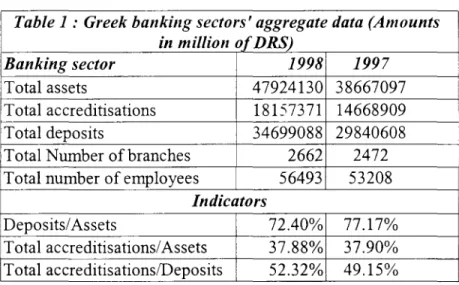
Apart from the specific structure of the Greek tax system the financial sector is very significant for the Greek economy. Banking and insurance accounted for 3.6 percent of Greece's GDP in year 1997 (16.5% annual rate of change) and contributed with 2.4% to the total employment in the same year (1.2% annual rate of change) (Greek Ministry of National economy, 1998). In addition banks have traditionally dominated the financial sector in Greece. As we can see from table 1 the Greek banking sector appears to be economically strong and efficient. Moreover, despite the above-mentioned characteristics, Greece has not attracted any interest in this field from researchers. Therefore, the subject of taxation of financial services is indeed a very interesting one and very challenging, especially for the tax authority.
Table 1 : Greek banking sectors' aggregate data (Amounts in million of DRS)
Banking sector 1998 1997 !
Total assets 47924130 38667097 Total accreditisations 18157371 14668909 Total deposits 34699088 29840608 Total Number of branches 2662 2472 Total number of employees 56493 53208
Indicators
I Deposits/Assets 72.40% 77.17% Total accreditisations/ Assets 37.88% 37.90% Total accreditisationslDeposits 52.32% 49.15% Data source: Hellenic Bank Association [\\\yw.hba.grl
On the other hand the European Union has developed several policies for promoting economic and social cohesion. Greece, Portugal and Spain are of particular interest because those countries benefit from the programmes. Although, Creedy (2001) examined for the case of Australia the question whether the different categories of indirect taxes should be uniform, there is almost no research on these taxes (i.e. indirect financial taxes) and their economic implications for European countries. Furthermore, although the Maastricht criteria do not allow for great intervention, fiscal policy is still operative at the national level. Some researchers discuss the different fiscal policy effects for OECD and EU countries (i.e. Viren, 2000). The results support the view that fiscal policy differs considerably between EU Member States. These differences need to be investigated in more detail for specific Member States (e.g. Greece, Spain and Portugal) and for current tax problems such as the relationship between indirect financial taxation and growth.
In particular our research seeks to provide empirical evidence on the three mam objectives/aims of this study, which are:
1. to identify the distortions arising from the existing system of financial exemptions in Greece and EU (through study of the Greek and EU VAT legislation)
2. to estimate the economic effects of taxing financial services under the Greek V AT system including the estimation of the fiscal revenue loss of the current applied financial exemptions in Greece
3. to investigate the economic effects on total revenues, expenditures and growth of the existing indirect financial taxes in Greece, Spain and Portugal.
Principal contribution
The principal contribution of this thesis lies in extending our understanding of the taxation of financial services, especially of the indirect taxes such as V AT and the currently applied financial taxes. Empirical research has so far concentrated on direct taxes on financial services rather than indirect taxes. The theory on the other hand pays less attention to indirect taxes and the economic effects of VAT on financial services. This thesis demonstrates the significance of the above-mentioned taxes on financial sen-ices in structuring tax policies and possible tax reforms_
.-V11
Theoretical contribution
Firstly this thesis, in the case of Greece, confinns the argument (Bo\'enmberg, 1987; Gottfried and Wiegard, 1991) that indirect tax on intennediate or investment goods cannot be neglected in fonnulating fiscal policy. The economic effects of this part of tax are closely linked to the exemptions applied in V A T systems. In our study these economic effects have been illustrated with the use of numerical input-output/economic tables for the financial sector over the period 1988-1998. Secondly this thesis demonstrates link between the average total tax rate of the economy and consumption and indirect financial taxes as well as between expenditures and the aforementioned taxes in the case of Greece, Spain and Portugal. Our results show that, although a long run relationship exists between consumption or indirect financial taxes and the average total tax rate of the economy, bi-directional relationships are difficult to establish. The direction of causality is from the different indirect taxes towards the total average tax rate. In addition we found that indirect financial taxes are important for spending decisions for Spain and Portugal where a long run relationship has been identified. On the other hand for Greece the decision to spend Granger causes consumption taxes while these taxes are important for spending decisions in Portugal. The findings for Greece are consistent with the findings of Anderson (1986) that government expenditures Granger causes taxes, while the findings for Spain and Portugal confinn the argument of Owoye (1995) that taxes and spending decisions are jointly made.
Finally, we find that indirect financial taxes (i.e. taxes that might fall on intennediate and investment goods) they could only affect negatively the level of the real output. This finding contributes to the argument (e.g. King and Rebello, 1990; Slennod, 1995; Karras, 1999) that taxes (as a percentage of GDP) do not have strong economic effects on growth (if any, this is minor and negative). On the other hand consumption taxes (including VAT) (i.e. taxes that fall only on final consumption) could affect pennanently the level of the real output, through their impact on the main components of growth namely labour force supply and/or investment. However, this effect could be either negative or positive depending on the whole tax structure. Lastly, the findings suggest that refonns in indirect tax systems of the three countries is unlikely to have any direct long run effect on total tax rate, expenditures or growth, but rather short run effects on the amount of revenues accnling to the tax administration from the relevant taxes (i.e. consumption taxes).
Methodological contribution
Difficulties with research methodology as were experienced in this study are recognised in the literature. In applying the National Accounts approach in order to estimate the impact on total tax revenues of taxing financial services under the V AT system in Greece, modifications had to be introduced to capture the dispersions of VAT rates in financial sector's V AT base and inputs. This is because the National accounts data refer to final expenditure of the economy. These modifications were made by using the ayerage weighted V AT rate on VAT base, instead of the statutory V AT rate, and with the breakdown of financial sector's inputs in different applied V AT rates. Howeyer \\'c
recognise that this method does not capture general equilibrium effects, which is beyond of the scope of this thesis. Finally, another methodological contribution of this thesis is that the Johansen technique is used to assess the impact of the indirect financial taxes on the average total tax rate of the economy, expenditures and growth.
Contribution to the VAT application
The practical contributions to the V AT application are as follows:
• a detailed profile of the VAT treatment of financial services in Greece and other EU Member States
• the identification of distortions arising of the above differences between Greece and the other ED Member States
• the identification of specific differences between Greece, Spain and Portugal
• a detailed analysis of practices used to tax insurance services across the EU Member States, an area totally neglected in the academic literature.
The above work contributes to the argument that in the field of indirect taxation of financial services (including insurance services) we are far away from achieving the goal of tax harmonisation, which does not serve the aims of Single Market. In addition, for fiscal policy issues we confirm that a reform of the indirect taxation of financial services (e.g. abolishing of financial exemptions and applying VAT on financial services) could contribute to total tax revenues. The final outcome here is a proposed transitional special regime for taxing financial services under the VAT system, applicable and worthy for further study.
Thesis outline
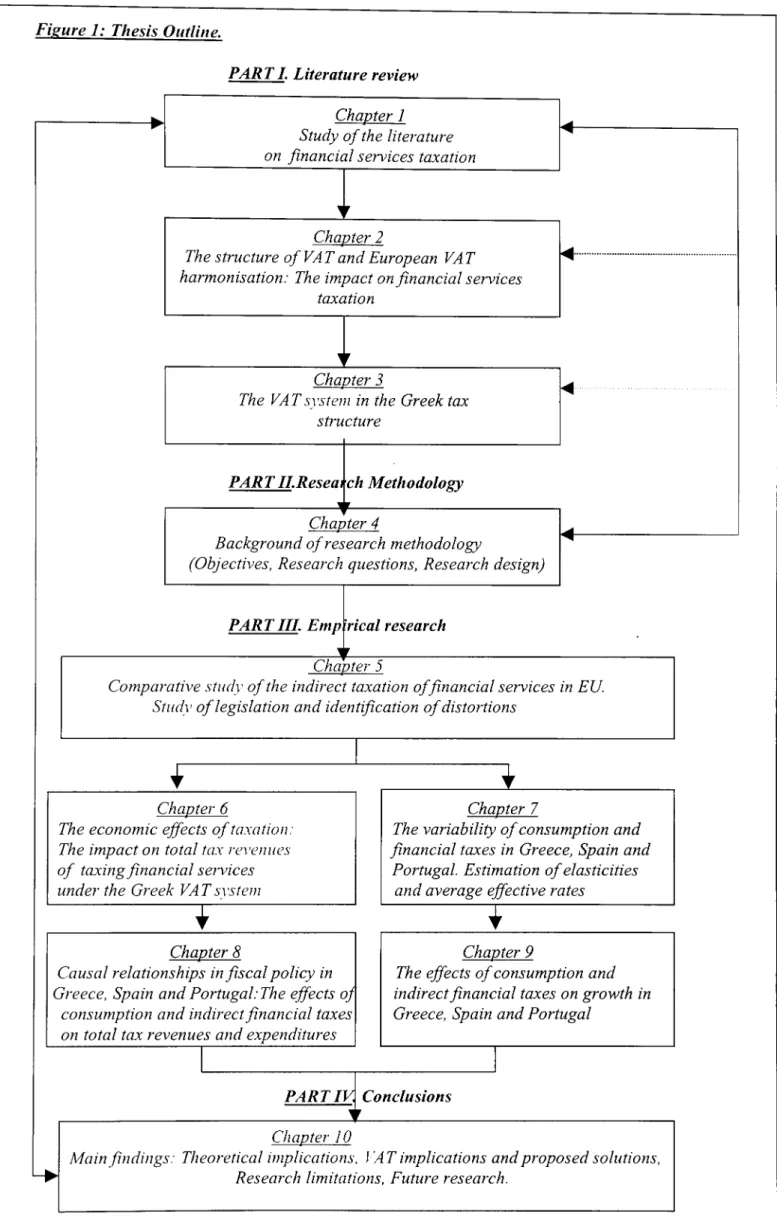
A brief outline of the structure of the thesis is sho\YI1 in the Figure 1. The thesis is divided in four sections with ten chapters. The first section deals with the concept of VA T and the indirect taxation of financial services by reviewing the existing literature (both theoretical and empirical); the second section with the research methodology and research design; the third with the empirical research and data analysis, while the fourth section includes the conclusions and recommendations. An overview of chapters 1 to 10 is presented next.
Figure 1: Thesis Outline.
PART L Literature review
... Chapter 1 ...
...
Study of the literature "" on financial services taxation
~r Chapter 2
The structure of VAT and European VAT ... harmonisation: The impact on financial services
taxation
,r
Chapter 3
....
The VAT system in the Greek tax structure
PART ILResea ch Methodology
Chapter 4 ...
Background of research methodology "" (Objectives, Research questions, Research design)
PARTIILEmp rical research
,Ir
Chapter 5
Comparative study of the indirect taxation of financial services in EU. Stud" of legislation and identification of distortions
..
..
Chapter 6 Chapter 7
The economic effects of taxation: The variability of consumption and The impact on total tax revenues financial taxes in Greece, Spain and of taxing financial services Portugal. Estimation of elasticities under the Greek VAT S1'stellZ and average effective rates
..
..
Chapter 8 Chapter 9
Causal relationships in fiscal policy in The effects of consumption and Greece, Spain and Portugal: The effects oj indirect financial taxes on growth in
consumption and indirect financial taxes Greece, Spain and Portugal on total tax revenues and expenditures
I
I
PART IV Conclusions
~, Chapter 10
~
Main findings: Theoretical implications, I AT implications and proposed solutions, Research limitations, Future research.
Overview of the chapters
Chapter 1: Study of the literature on taxation offinancial sen'ices
This chapter addresses the significance and problems of financial ser;ices' taxation. It provides the theoretical background to the study based on the academic literature. In addition, the importance of the V A T treatment of financial services is also examined as well as the practical problems of the application of V AT on financial services. A critical review of these theoretical and empirical studies contribute to the formulation of research questions and guide the research methodology.
Chapter 2: The structure of VAT and European VAT harmonisation: The impact on financial services taxation
In this chapter we identify the principles of the VAT system applied in ED Member States, and the methods of computation including the new approaches developed. Our aim here is to explain relevant developments in the ED VAT systems and the need for V AT harmonisation in the Single Market. This allows us to investigate at a later stage the implication of VAT harmonisation on the taxation of financial services.
Chapter 3: The VAT system in the Greek tax structure
This chapter provides the necessary background to understand the main features of the Greek tax system. It begins with the special characteristics and components (categories of taxes) of the Greek tax system justifying the choice of Greece as a focus in our research as well. Then the chapter describes briefly the taxes applied in Spain and Portugal in order to facilitate our comparisons by identifying the similarities in their indirect tax system. Finally we describe the functional structure of taxation in Greece, with a preliminary review of the data (relation between direct and indirect taxes, evolution and recent developments etc.).
Chapter 4: Research methodology
This chapter presents the methodological considerations to be taken into account for this research. It depicts the most appropriate methods of data collection and analysis as being the National Accounts method, econometric analysis and secondary research for the study' of the applied legislation in Greece and ED. Finally this chapter states the research focus, objectives, research questions and theoretical concepts of this study .
Chapter 5: Comparative study of the indirect taxation offinancial services in EU. Studt' of legislation and identification ofdistortioJZs
In this chapter we study the applied legislation in order to e\'aluate the current indirect tax system used to tax a wide range of financial services (including insurance services) in Greece and to compare it with those used in other Member States (including Spain and Portugal). Our aim in this part of the study is to identify the main differences between the Greek and other ED tax systems as well as the major distortions within and across those systems. The data have been "content" analysed in order to study the selected areas such as the scope and the liability of taxation of financial services (including insurance) and instruments.
Chapter 6: The economic effects of taxation: The impact on total tax revenues of taxing financial services under the Greek VAT system
This chapter analyses the total revenue effect of removing the financial exemptions in the Greek VAT system. The analysis of the data has been carried out by using an input-output method ("National Accounts approach") modified as necessary to reflect the special characteristics of the Greek VAT system and data availability. Our aim in this chapter is to compare the present V AT exemption of financial services with a hypothetical benchmark case of taxing them as well as the estimation of the total fiscal revenue loss, including the estimation of the inputs of financial institutions in Greece.
Chapter 7: The variability of consumption and financial taxes 1lI Greece, Spain and Portugal. Estimation of elasticities and average effective rates
Our focus in this chapter is to empirically examine with special reference to Greece, but comparing the results with those derived in the case of Spain and Portugal, the revenue productiveness and the elasticity of VAT, consumption and indirect financial taxes on Net National Income. In addition our results have been enriched with the calculation of the average effective rates of consumption and indirect financial taxes as well. The period of estimation is from 1965 to 1998 for consumption and indirect financial taxes and from
1986 to 1998 for VAT. Finally, the key features of VAT (VAT base and VAT rates) and the impact of exemptions have also been examined. The main method for data analysis in this chapter is the use of econometrics (time-series analysis by using the OLS technique).
Chapter 8: Causal relationships in fiscal policy in Greece, Spain and Portugal: TIle
effects of consumption and indirect financial taxes on total tax revenues and expenditures
In this chapter we examine the impact on total tax revenues and expenditures of indirect taxes applied in Greece over the period 1965-1998 and over 1965-1999 for Spain and Portugal. We examine the causal relationships among the average total tax rate of the economy, and consumption and financial taxes as well as between expenditures and the aforementioned taxes and how they interact in a system. We employ a multivariate time-series methodology (Johansen methodology) to test for long run trends and causality between the above variables. Finally we investigate the long run stability of the indirect tax system by examining the impact of the introduction of V AT in the tax systems of the above mentioned countries.
Chapter 9: The effects of consumption and indirect financial taxes on growth ill Greece,
Spain and Portugal
In this chapter we provide empirical evidence on the relationship between indirect taxes (consumption and indirect financial taxes) and economic growth over the period 1965-1999 in Greece, Spain and Portugal (for Greece over the 1965-1998 period) in order to assess not only the validity of previous conclusions but also to investigate the direction of causality between indirect taxes and growth. Our approach here is to consider, in a cointegrating V AR framework, the effects of these taxes on growth and its micro-components such as investment and employment.
Chapter 10: Conclusions and recommendations
The concluding chapter 10 brings together the issues, concepts, and findings of chapters 1 to 9. The findings are linked to the already existing knowledge, which allows conclusions to be formulated on the indirect taxation of financial services as well as implications for the existing tax system. It proposes a new special regime for taxing financial services under the VAT system in Greece and provides recommendations for the existing implications on competition from the indirect financial taxes. Finally, this chapter also outlines the limitations of this thesis and suggests further concrete steps for future research.
CONTENTS
Abstract ... i
Acknowledgements ... iii
Introduction to the thesis ... iy Principal contribution ... vii
Theoretical contribution ... viii
Methodological contribution ... .ix
Contribution to the V AT application ... ix
Thesis outline ... x
Overview of the chapters ... xii
Chapter 1: Literature review Page 1.1 Introduction ... 1
1.2 The optimal commodity taxation ... 1
1.2.1 The basic framework ... 1
1.2.2 Taxing income versus taxing consumption in optimal tax theory ... 3
l.2.3 The economic effects of consumption taxes ... 5
1.3 The theoretical justification of the tax on value added ... 9
1.4 The general theory of VAT application and the concept of financial services ... 11
l.5 The economics of applying VAT on financial services ... 13
1.6 The theory of incidence and the impact of VAT exemptions ... 16
1.7 Distortions created by exempting financial institutions from VAT ... 20
1.7.1 Economic effects ... 21
1.7.2 Definition of financial services ... 24
1.7.3 International competition ... 26
1.8 The existing international evidence of the VAT treatment of financial services ... 27
1.9 The empirical work on indirect taxation of financial services ... 30
l.9.1 Empirical evidence on the feasibility of taxation ... 30
1.9.2 Empirical work on modelling and measuring the economic effects of financial exemptions ... 34
1.10 Conclusions from the literature study ... .40
Chapter 2: The structure of VAT and European VAT harmonisation: The impact on financial services taxation 2.1 Introduction ... 43
2.2 Types of VAT ... 43
2.3 Methods of computation ... 45
2.3.1 The tax credit method ... 46
2.3.2 The "Accounts" method ... 49
2.3.3 New Approaches ... 51
2.4 The Evolution of the EU VAT harmonisation and the Single Market ... 53
Chapter 3: The VAT system in the Greek tax structure: The functional form of Taxation
3.1 Introduction ... 63
3.2 The Direct taxes applied in Greece ... 63
3.2.1 Income taxes on Corporations ... 63
3.2.2 Income taxes on individuals (Personal Income Tax-PIT) ... 6-+
3.2.3 Income taxes on non-residents ... 66
3.2.4 Other significant direct taxes ... 67
3.3 Indirect Taxes applied in Greece ... 69
3.3.1 Value-added Tax (VAT) ... 69
3.3.2 Other indirect taxes ... 74
3.4 The functional structure of taxation in Greece (1965-1998) ... 79
3.5 The evolution of the functional structure of taxation in 1990·s ... 83
3.6 Recent Fiscal Developments ... 85
3.7 Conclusions ... 86
Chapter 4: Methodology and data analysis 4.1 Introduction ... 88
4.2 Research focus and research questions ... 88
4.3 Methodology and Research Design ... 91
4.4 Data collection ... 96
4.5 Data analysis ... 98
4.6 Concluding remarks ... 102
Chapter 5: Study of the legislation on indirect taxation of financial services applied in Greece and the other EU Member States 5.1 Introduction ... 103
5.2 Data and methodology ... 104
5.3 The current applied VAT legislation on financial services in Greece ... 106
5.3.1 The financial exemptions in Greece ... 106
5.3.2 The right for deductions, article 23 of the Greek VAT Law (Nr. 1642/86) .... 106
5.3.3 The place of supply (taxation) of financial services ... 1 07 5.4 The sixth council VAT directive-77/388IEEC ... 107
5.4.1 Article 13 B (d) 1-6 ... 107
5.4.2 Article 13 B (a) ... 109
5.4.3 Article 13 C. Option to tax ... 109
5.4.4 The place of supply (taxation) of financial services. Article 9(2)( e) ... 109
5.4.5 Origin and scope of the right to deduct. Article 17(1) (3) (c), and 19 ... 109
5.5 Indirect tax treatment of financial services in Greece and other Member ... 110
5.6 Differences in the VAT treatment of financial services in Greece and other EU Member States ... 118
5.6.1 The main differences in Greece ... 118
5.6.2 Differences and potential distortions between the EU Member States ... 120
5.6.3 Differences in taxing financial services under the VAT system in Greece, Spain and PortugaL ... 123
5.8 Indirect taxation on insurance services in Greece and other EC
Member States ... 126
5.9 The recoverable VAT by financial institutions ... 131
5.10 Concluding remarks ... '" ... 134
Chapter 6: The economic effects of taxation: The impact on revenues of taxing financial services under the Greek VAT system. 6.1 Introduction ... 137
6.2 The taxation of financial services under consumption type VAT. The specific problems in Greece ... 138
6.3 Data and methodology ... 140
6.4 Empirical findings ... 144
8.8 Concluding remarks ... 151
Chapter 7: The variability of indirect financial taxes and VAT in Greece. Empirical evidence and comparisons with Spain and Portugal 7.1 Introduction ... '" ... 152
7.2 Methodology and data ... 153
7.2.1 Methodology for the estimation of elasticities ... 153
7.2.2 Methodology and Model for VAT revenues' performance ... 156
7.2.3 Methodology for the calculation of the average effective tax rates on consumption ... 158
7.3 Findings ... 160
7.3.1 The elasticity of the Greek VAT system (Estimation period 1987-1998) ... 160
7.3.2 Elasticities of the Spanish and Portuguese VAT system ... 162
7.3.3 The elasticities of consumption taxes in Greece, Spain and Portugal. (Estimation period 1965-1998) ... 165
7.3.4 The elasticities of the cascade (indirect) taxes on financial services in Greece, Spain and Portugal. (Estimation period 1965-1998) ... 168
7.3.5 Findings on VAT revenues' performance for Greece, Spain and Portugal. ... 170
7.3.6 Estimates of the Average effective rates ... 172
8.8 Concluding remarks ... 175
Chapter 8: Causal relationships in fiscal policy in Greece, Spain and Portugal: The effects of indirect financial taxes on total tax revenues and expenditures 8.1 Introduction ... 177
8.2 The data ... 178
8.3 Empirical methodology ... 180
8.3.1 Testing for stationarity ... 180
8.3.2 Cointegration ... 181
8.3.3 The Johansen methodology ... 182
8.3.4 The long run equations ... 183
8.4 Cointegration analysis of the average total tax rate and different indirect taxes relationship ... 184
8.4.1 Greece ... 184
8.4.3 Portugal ... 198 8.5 Granger type causality tests for Greece, Spain and Portugal for the
average total tax rate and indirect taxes relationship ... 204 8.6 Cointegration analysis of the expenditures and the different indirect
taxes relationship ... 205 8.6.1 Greece ... 205 8.6.2 Spain ... 209 8.6.3 Portugal ... 213 8.7 Granger type causality tests for Greece, Spain and Portugal for the
expenditures and indirect taxes relationship ... 218 8.8 Conclusions ... 218 Chapter 9: Economic growth and indirect taxes (consumption and indirect
financial taxes) in a cointegrating V AR framework: Empirical evidence from Greece, Spain and Portugal
9.1 Introduction ... 221 9.2 Theoretical and empirical work on the taxation-growth relationship ... 222 9.3 Empirical methodology ... 225 9.3.1 Introduction to the modeL ... 225 9.3.2 Time series properties of variables ... 226 9 A Empirical results from the cointegration analysis of growth and indirect
taxes relationship ... 230 9.4.1 Greece ... 230 9.4.2 Spain ... 235 9.4.3 Portugal ... 239 9.5 Granger type causality tests for Greece, Spain and Portugal ... 245 9.6 Conclusions ... 245 Chapter 10: Conclusions and recommendations
10.1 Introduction ... , ... 248 10.2 Main findings and conclusions ... 248 10.2.1 Differences in the VAT treatment of financial services between Greece
10.2.2 10.2.3 10.2A 10.2.5 10.3 10.3.1 10.3.2 lOA 10.5 10.5.1 10.5.2 10.6
and the EU Member States ... 248 Differences and potential distortions between the EU Member States ... 249 The impact on total tax revenues of taxing financial services under the
VAT system in Greece ... 250 The variability of VAT, consumption and indirect financial taxes in
Greece, Spain and Portugal over the period 1965-1998 ... 251 The impact of indirect financial taxes on the average total tax rate
of the economy, expenditures and growth in Greece, Spain and PortugaL .. 252 Implications of the study ... 255 Tax implications ... 255 Economic implications ... 256 Recommendations ... 257 Limitations of the study ... 261 General limitations ... 261 Limitations of Methodological approach ... 261 Contribution to knowledge ... 262
10.7 Suggested avenues for future research ... ... ... 263
Appendices ... 265 Bibliography/References ... , ... . 291
List of tables Chapter 1: Literature review
Table 1.1: Contemporary research on economic effects of VAT exemptions
(impact on VAT base) ... 39 Chapter 2: The structure of VAT and the European VAT harmonisation:
The impact on financial services taxation
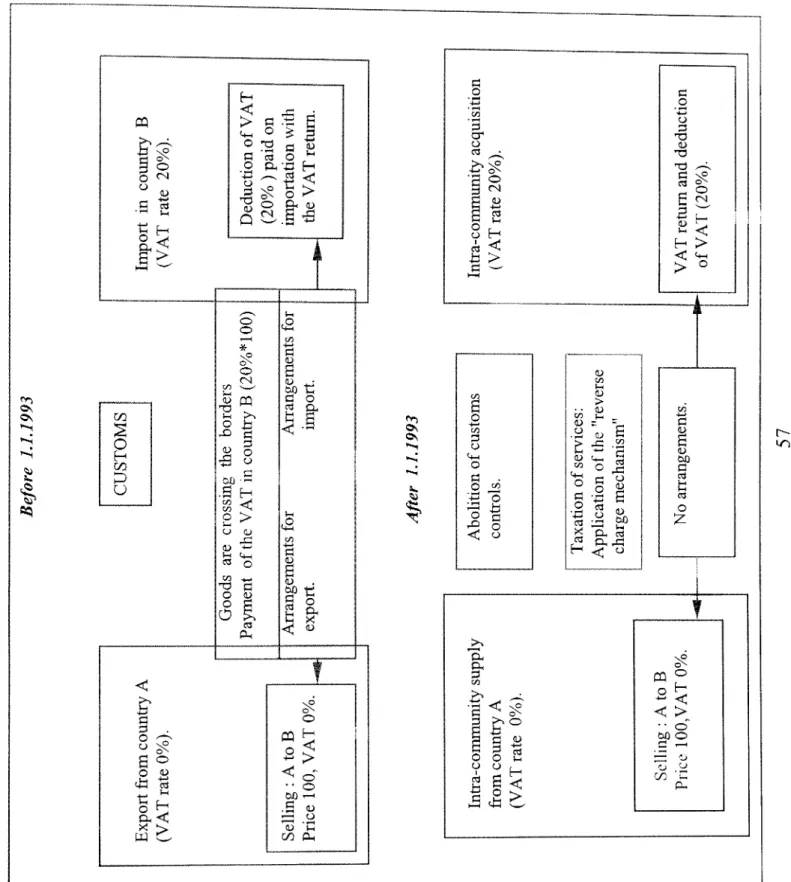
Table 2.1: The function of the European VAT system for intra-community
Transactions ... 57 Chapter 3: The VAT system in the Greek tax structure: The functional form of Taxation
Table 3.1: Taxes applied in Greece, Spain, Portugal. ... 78 Table 3.2: Taxes linked to imports and production (indirect taxes) as a percentage
ofGDP ... 80 Table 3.3: VAT Revenues as percentage ofGDP and Total Tax Revenues ... 82 Chapter 4: Methodology and data analysis
Table 4.1: Customized Research design: Methodology and Data production ... 100 Chapter 5: Study of the legislation on indirect taxation of financial services
applied in Greece and the other ED Member States
Table 5.1: Comparison of taxes applied on financial services in ED Member
States ... 111 Table 5.2: VAT treatment of financial services in Greece and in the other ED
Member States ... 114 Table 5.3: VAT treatment (place of taxation) of financial services in Greece ... 119 Table 5.4: Differences in taxing financial services under the V AT system in
Greece, Spain and Portugal. ... 124 Table 5.5: Summary of indirect taxation on insurance services in ED ... 128 Table 5.6: Percentage of the deducted input VAT by financial institutions ... 133 Chapter 6: The impact on revenues of taxing financial services under the Greek
VAT system: The economic effects of taxation
Table 6.1 : VAT base and yield from taxing financial services under the V AT
system in Greece ... 145 Table 6.2: VAT revenues from financial services as a percentage ofGDP, Total
tax revenues and VAT revenues ... 145 Table 6.3: Net revenue effects ... 146 Table 6.4: Calculation of financial institutions' inputs under the exemption
system ... 148 Table 6.5: Efficiency of V AT collection of the exempted financial sectors ... 150
Chapter 7: The variability of indirect financial taxes and VAT in Greece. Empirical evidence and comparisons with Spain and Portugal
Table 7.1: Variability of the Greek VAT system (1987-1998) ... 162 Table 7.2: (OLS) Regressions for Greece. Estimation period (1987-1998) ... 162 Table 7.3: Variability of the Spanish VAT system (1986-1998) ... 16-+ Table 7.4: (OLS) Regressions for Spain. Estimation period (1986-1998) ... 164 Table 7.5: Variability of the Portuguese VAT system (1986-1998) ... 164 Table 7.6: (OLS) Regressions for Portugal. Estimation period (1986-1998) ... 165 Table 7.7: Summary statistics for growth rate of Consumption taxes ... 166 Table 7.8: Variability of the Consumption taxes in Greece (1965-1998) ... 167 Table 7.9: Variability of the Consumption taxes in Spain (1965-1998) ... 168 Table 7.10: Variability of the Consumption taxes in Portugal (1965-1998) ... 168 Table 7.11: Summary statistics for the growth rate of indirect financial taxes ... 169 Table 7.12: Variability of the indirect financial taxes in Greece, Spain and
Portugal (1965-1998) ... 170 Table 7.13: Regressions for the VAT revenues' performance. Estimated period
1986-1998 ... 172 Table 7.14: Average effective tax rates (AETR) ... 173 Table 7.15: Summary Statistics for Average effective tax rates
(Period 1965-1998) .... , ... 173 Table 7.16: Influence of the business cycle on AETRs ... 174 Chapter 8: Causal relationships in fiscal policy in Greece, Spain and Portugal:
The effects of indirect financial taxes on total tax revenues and expenditures
Table 8.1: Dickey-Fuller unit root tests results (Greece) ... 185 Table 8.2: Determining the order ofVAR (Greece) ... 187 Table 8.3: Cointegration Tests: VAR (3) with Dummy (Greece) ... 187 Table 8.4: Estimates of ECMs for ~lntr, ~lnct and ~lnfl, 1965-1998 for Greece .... 188 Table 8.5: Estimates ofECMs for ~lntr, ~lnct and ~lnfl, 1965-1998 for Greece .... 189 Table 8.6: Dickey-Fuller unit root tests results (Spain) ... 193 Table 8.7: Determining the order ofVAR (Spain) ... 193 Table 8.8: Cointegration Tests: VAR (2) with Dummy (Spain) ... 194 Table 8.9: Estimates of ECMs for ~lntr, ~lnct and ~lnfl,
1965-1999 for Spain ... 195 Table 8.10: Dickey-Fuller unit root tests results (Portugal) ... 198 Table 8.11: Determining the order ofVAR (Portugal) ... 199 Table 8.12: Cointegration Tests: VAR (2) with Dummy (Portugal) ... 199 Table 8.13: Estimates ofECMs for ~lntr, ~lnct and ~lnfl,
1965-1999 for Portugal ... 200 Table 8.14: Estimates of ECMs for ~lntr, ~lnct and ~Infl,
1965-1999 for Portugal ... 201 Table 8.15: Granger type tests based on OLS equation for Greece, Spain and
Portugal (tax rate and indirect taxes relationship) ... 204 Table 8.16: Summary statistics of the growth of expenditures (1965-1999) ... 205 Table 8.17: Dickey-Fuller unit root tests results (Greece) ... 206 Table 8.18: Determining the order ofVAR (Greece) ... 206 Table 8.19: Cointegration Tests: VAR (1) with Dummy (Greece) ... 207
Table 8.20: Estimates ofECMs for i1lnex, i11nct and i11nfl,
1965-1998 for Greece ... 208 Table 8.21: Dickey-Fuller unit root tests results (Spain) ... 209 Table 8.22: Determining the order ofVAR (Spain) ... 210 Table 8.23: Cointegration Tests: VAR (1) with Dummy (Spain) ... 210 Table 8.24: Estimates ofECMs for i1lnex, i1lnct and i1hyt,
1965-1998 for Spain ... 211 Table 8.25: Estimates ofECMs for i1lnex, i1lnct and i1lnfl,
1965-1998 for Spain ... 212 Table 8.26: Dickey-Fuller unit root tests results (Portugal) ... 214 Table 8.27: Determining the order ofVAR (Portugal) ... 214 Table 8.28: Cointegration Tests: VAR (1) with Dummy (Portugal) ... 215 Table 8.29: Estimates of ECMs for i1lnex, i11nct and i1lnfl, 1965-1998 for
Portugal ... 216 Table 8.30: Granger type tests based on OLS equation for Greece, Spain and
Portugal (expenditures and indirect taxes relationship) ... 218 Chapter 9: Economic growth and indirect taxes (consumption and indirect
financial taxes) in a cointegrating V AR framework: Empirical evidence from Greece, Spain and Portugal
Table 9.1: Summary statistics for rate of growth over the period 1965-1999 ... 228 Table 9.2: Dickey-Fuller Unit root tests results (Greece) ... 229 Table 9.3: Dickey-Fuller Unit root tests results (Spain) ... 229 Table 9.4: Dickey-Fuller Unit root tests results (Portugal) ... 229 Table 9.5: Determining the order ofVAR, Greece (1965-1998) ... 230 Table 9.6: Johansen and Juselious cointegration tests among lngdp,
lni, lnl, lnctlgdp, lnfllgdp, 1965-1998 (Greece) ... 231 Table 9.7: Estimates of ECMs for i1lngdp, i1lni, i1lnl, i1lnctlgdp and
i1lnfllgdp, 1965-1998 for Greece ... 232 Table 9.8: Estimates ofECMs for i1lngdp, i1lni, i1lnl, i1lnctlgdp and i1lnfllgdp,
1965-1998 for Greece ... 233 Table 9.9: Determining the order ofVAR, Spain (1965-1999) ... 235 Table 9.10: Johansen and Juselious cointegration tests among Ingdp, Ini, lnl,
lnctlgdp, Infllgdp, 1965-1999(Spain) ... 236 Table 9.11: Estimates ofECMs for i1lngdp, i1lni, i1lnl, i1lnctlgdp and i1lnfllgdp,
1965-1999 for Spain ... 237 Table 9.12: Determining the order ofVAR, Portugal (1965-1999) ... 239 Table 9.13: Johansen and Juselious cointegration tests among lngdp, Ini, lnl,
lnctlgdp, lnfllgdp, 1965-1999 (Portugal) ... 240 Table 9.14: Estimates of ECMs for i1lngdp, i1lni, i1lnl, i1lnctlgdp and
i1lnfllgdp, for Portugal (1965-1999) ... 241 Table 9.15: Estimates of ECMs for i1lngdp, i1lni, i1lnl, i1lnctlgdp and i1lnfllgdp,
for Portugal (1965-1999) ... , ... 242 Table 9.16: Granger type tests based on OLS equation for Greece, Spain and
Chapter 10: Conclusions and recommendations
Table 10.1: Different options for harmonisation of indirect taxation of
financial services ... 256
List of Figures Chapter 1: Literature review
Figure 1.1: Aspects of the Optimal Tax Theory ... 20 Figure 1.2: Emerging areas from the literature review for further research ... 41 Chapter 3: The V AT system in the Greek tax structure: The functional form of Taxation
Figure 3.1: Tax revenues as a percentage to gdp (Greece) ... 79 Figure 3.2-3.11: Plot of direct and indirect tax revenues in Greece, EU and
OECD ... 80 Figure 3.12-3.15: Plot of VAT revenues and Excise duties as percentage of total
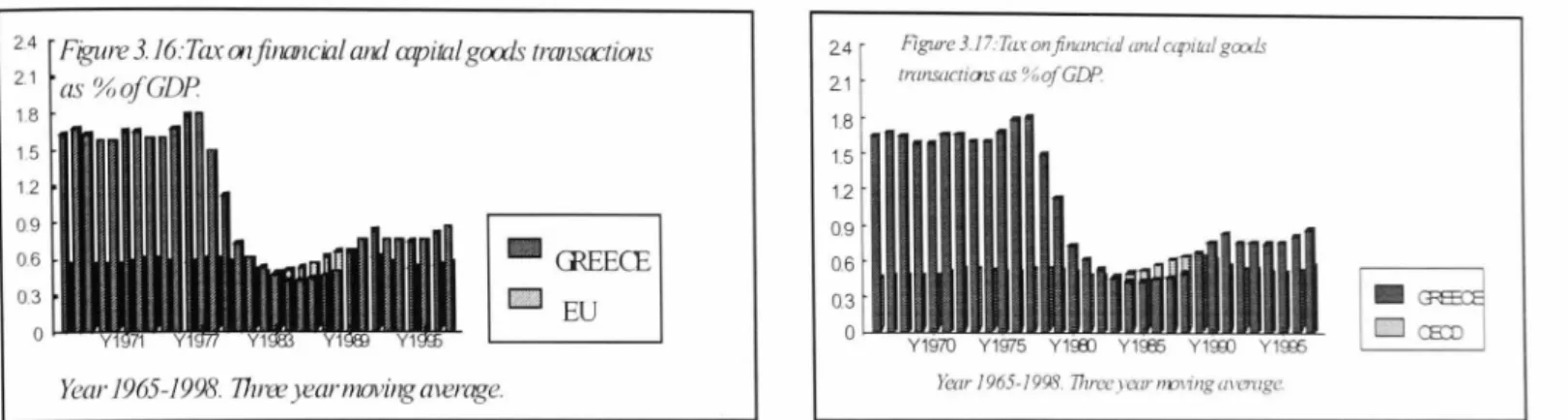
tax revenues in Greece, ED and OECD ... 82 Figure 3.16-3.1 7: Plot of financial and capital goods transactions tax in Greece,
ED and OECD ... 83 Figure 3.18-3.19: Plot of taxes on labour in Greece, ED and OECD ... 84 Chapter 4: Methodology and data analysis
Figure 4.1: Research aims and questions ... 91 Figure 4.2: Overview of Research process ... 99 Chapter 7: The variability of indirect financial taxes and VAT in Greece
Figure 7.1: National Income.Greece, Spain and PortugaL ... 163 Figure 7.2: VAT revenues. Greece, Spain and PortugaL ... 163 Figure 7.3: VAT revenues as percentage ofGDP ... 163 Figure 7.4: VAT as percentage of total taxation ... 163 Figure 7.5: Consumption taxes. Greece, Spain and PortugaL ... 165 Figure 7.6: Consumption taxes as percentage ofGDP ... 166 Figure 7.7: Consumption taxes as percentage of total tax revenues ... 166 Figure 7.8: The tax burden in Greece ... 167 Figure 7.9: The tax burden in Spain ... 167 Figure 7.10: The tax burden in PortugaL ... 167 Figure 7.11: Indirect financial taxes. Greece, Spain and Portugal. ... 168 Figure 7.12: Indirect financial taxes as percentage ofGDP ... 168 Figure 7.13: Indirect financial taxes as percentage of
total taxation ... 168 Figure 7.14: AETR on Consumption taxes (per-cent) ... 173 Figure 7.15: AETR attributed to indirect financial taxes (per-cent) ... 173
Chapter 8: Causal relationships in fiscal policy in Greece, Spain and Portugal: The effects of indirect financial taxes on total tax revenues and expenditures
Figure 8.1: Persistence Profile of the effect of a system shock to CV (Greece) ... 190 Figure 8.2: Generalized Impulse Response(s) to one S.E. shock in the equation
for ift) (Greece) ... 191 Figure 8.3: Generalized Impulse Response(s) to one S.E. shock in the equation
for (tr) (Greece) ... 191 Figure 8.4: Persistence Profile of the effect of a system-wide shock to CV
(Spain) ... 196 Figure 8.5: Generalized Impulse Response(s) to one S.E. shock in the equation
for consumption taxes to CV, Spain ... 196 Figure 8.6: Generalized Impulse Response(s) to one S.E. shock in the equation
for financial taxes to CV, Spain ... 196 Figure 8.7: Generalized Impulse Response(s) to one S.E. shock in the equation
for consumption taxes, Spain ... 197 Figure 8.8: Generalized Impulse Response(s) to one S.E. shock in the equation
for financial taxes, Spain ... 197 Figure 8.9: Persistence Profile of the effect of a system-wide shock to CV
(Portugal) ... 202 Figure 8.10: Generalized Impulse Response(s) to one S.E. shock in the
equation for consumption taxes to CV (Portugal) ... 202 Figure 8.11: Generalized Impulse Response(s) to one S.E. shock in the equation
for financial taxes to CV (Portugal) ... 202 Figure 8.12: Generalized Impulse Response(s) to one S.E. shock in the equation
for consumption taxes (Portugal) ... 203 Figure 8.13: Persistence Profile of the effect ofa system shock to CV (Greece) ... 209 Figure 8.14: Impulse Response to one S.E. shock in the equation for lnex
(Greece) ... 209 Figure 8.15: Persistence Profile of the effect of a system shock to CV (Spain) ... 213 Figure 8.16: Impulse Response to one S.E. shock in the equation for Inft
(Spain) ... 213 Figure 8.17: Persistence Profile of the effect of a system shock to CV
(Portugal) ... 217 Figure 8.18: Impulse Response to shock in the equation for lnft (Portugal) ... 217 Chapter 9: Economic growth and indirect taxes (consumption and indirect
financial taxes) in a cointegrating V AR framework: Empirical evidence from Greece, Spain and Portugal
Figure 9.1: Persistence Profile of the effect of a system-wide shock to CV
(Greece) ... 234 Figure 9.2: Impulse Response(s) to one S.E. shock in the equation for Inl
(Greece) ... 234 Figure 9.3: Persistence Profile of the effect ofa system-wide shock to CV
(Spain) ... 238 Figure 9.4: Impulse Response(s) to one S.E. shock in the equation for lni
(Spain) ... 238 Figure 9.5: Persistence Profile of the effect of a system-wide shock to CV
Figure 9.6: Impulse Response(s) to one S.E. shock in the equation for lnet
(Portugal) ... 2..j...j. Chapter 10: Conclusions and recommendations
Figure 10.1: Economic effects and long-run relationships of consumption
and indirect financial taxes in Greece, Spain and Portugal ... 254 Figure 10.2: Operational model for a flat-rate scheme of taxing financial
services under the VAT system ... 260
Boxes
Chapter 6: The impact on revenues of taxing financial services under the Greek V AT system: The economic effects of taxation
Box 6.1: Calculation and breakdown of inputs. Year 1995 ... 149 Chapter 9: Economic growth and indirect taxes (consumption and indirect
financial taxes) in a cointegrating V AR framework: Empirical evidence from Greece, Spain and Portugal
Box 9.1: Summary of the theoretical work on the taxation-growth relationship ... 222 Box 9.2: Summary of the empirical work on the taxation-growth relationship ... 224
List of Appendices
Appendix 1: Calculation of VAT base of financial institutions
and of the average weighted statutory VAT rates (1989-1998) ... 265 Appendix 2a: The functional form of taxation in Spain and PortugaL ... 271
" 2b: Equations of computation of elasticities (Consumption, total
and indirect financial taxes) for Greece, Spain and PortugaL ... 273 " 2c: VAT rates applied in Greece, Spain and PortugaL ... 275 Appendix 3: Design of a flat rate scheme of taxing financial services ... .2 7 6
CHAPTER 1: LITERATURE STUDY ON THE TOPIC.
1.1 Introduction
A logical starting point in looking at the issue of VAT and financial services is to consider first the reasons for and the merits of a value-added tax (V AT) and then to identify and describe the nature of financial services' taxation issues.
This chapter considers some of the approaches used and the conclusions reached in the literature (empirical and theoretical) on this topic. We start with a general overview of the theories on optimal taxation and VAT justification, and then we look at the specific issues of financial services taxation isolating the relevant problems. This will help us to prepare the ground for the empirical analysis, which will follow.
1.2 The optimal commodity taxation
1.2.1 The basic framework
The research on optimal taxation is based on some basic ideas that deal mainly with the criteria for optimality, the specification for social welfare, the modelling of disincentives and the problems of application. However the level of abstraction of much of the research together with the extensive use of mathematical models cast many doubts on its practical value (Heady, 1993).
Many economists since the time of Adam Smith have discussed the effects of taxation on the economy. They often tried to describe and define what they regarded as desirable characteristics of a tax system. Smith (1776) mentioned four qualities with regard to taxes in general:
• Equality: Peoples' tax payments should be in proportion to their income • Certainty: Tax liabilities should be clear and certain rather than arbitrary
• Convenience of payment: Taxes should be collected at a time and in a mamler that is convenient for the tax payer, and
•
Economy in collection: Those taxes should not be expenSl\'e to collect from the administrative point of view, and should not discourage business by creating disadvantages and distortions.In the economic literature the first and and last assumptions have absorbed the mam attention of the researchers. However Smith's criteria of equality was the basis of a history of differing views of what constitutes a fair and equal distribution of tax burden (Musgrave, 1959).
In general the taxation proposals in the literature have been analysed in terms of the following criteria:
• the need for taxes to be fair (although fairness is interpreted differently by different researchers)
• the need to minimise the administrative and compliance cost and • the need to minimise disincentive effects (Heady, 1993).
The approach of the optimal taxation literature is to use economic analysis to combine the above criteria into one, implicitly deriving the relative weights that should be applied to each criterion. Diamond and Mirrless, (1971) have done this by using the concepts of individual utility and social welfare (which depends on individual utility). It is typically assumed that social welfare decreases as inequality of utility increases. By this, the concept of social welfare reflects one idea of fairness in the tax system. This means that taxes are fair if they reduce the degree of inequality. All of the above-mentioned criteria have been incorporated in optimal taxation literature because they affect peoples' utility, and hence social welfare, and so the policy that should be chosen is the one that gives the highest level of social welfare. Therefore, researchers have been trying to determine the tax system that will provide the best compromise between equality and efficiency. However they neglect to discuss the administrative costs of tax systems (second criterion above) which is recognised as a major shortcoming of much of the literature on taxation (Heady, 1993).
The optimal tax system is seen in the literature as the one in which there are no possible reforms that will increase welfare (Ahmad and Stern, 1991; Kay. 1990).
In other words the optimal tax system will be the one where it is impossible to increase social welfare without reducing overall tax revenues.
The requirement to raise a specific amount of tax revenues is obviously fundamental. This has implications. First it means that the solution to the optimal tax problem will depend on the size of the revenue requirement. Second it means that all tax reforms should be neutral. The importance of this point is that the optimal taxation literature divides the effect of a tax change into an "income effect" (after tax income) and a "substitution effect" (change in marginal return to work). These two effects go in opposite directions regarding the labour supply. The majority of authors in the optimal taxation literature discuss the optimal income taxation (linear and non-linear) (Diamond and Mirrless, 1971). However, there is less interest in optimal commodity taxation (indirect taxation) in the literature which, is mainly concerned with the design of final sales taxes, such as value-added tax and excise duties, as well as the taxation of intermediate goods (Kay, 1990).
1.2.2 Taxing income versus taxing consumption in optimal tax theory
It is conventional to distinguish direct from indirect taxation. The Oxford English Dictionary defines an indirect tax as "one which is not levied directly on the person on whom it ultimately falls". In common usage, the distinction between direct and indirect taxes reflects two different aspects of tax structures, which, though related, are themselves distinct. These are the choice between taxes on income and taxes on consumption. The first analysis of an optimal sales tax was undertaken by Ramsey (1927). Ramsey analysed the problem of designing sales taxes to raise a given amount of revenue at the least possible distortionary cost to the economy. Ramsey showed that when only a very small amount of revenues had to be raised, the taxes should produce equal proportional reductions in the consumption of each good. Thus, the change in the income compensated demand for each commodity should be such that if the derivatives of these compensated demand functions were constant, the proportionate reductions in demand would be the same for all commodities (Kay, 1990). This has been formulated as an inverse elasticity rule: impose higher taxes on goods for which the own-price elasticity of demand is low. Ramsey's analysis illustrates that if there were no distribution issues for the goven1ment, it would be appropriate to raise taxes principally by direct methods, and it is
largely because there are such distributional questions that the need for commodity taxation arises. Diamond and Mirrless, (1971) suggested that in two-goods case, optimal commodity taxation involve the imposing of a heavier tax on the good that is most complementary to leisure. In addition this showed that the introduction of distributional considerations alters the equal proportion reductions substantially. The goods which are consumed particularly by the low-income groups should face a lower than average proportional reduction. In the case of independent demands Diamond and Mirrless, (1971) suggested that the optimal tax rate on a good should depend not only on the inverse of its price elasticity of demand but also on its income elasticity, which indicates how the budget share of a good changes as the income rises.
In addition introducing distributional considerations into the theory of optimal commodity taxation, Diamond and Mirrless (1971) demonstrated an important result about the desirability of production efficiency. They showed that even considerations of income distribution might justify the use of distortionary taxes on the supply of factors of production or the consumption of final goods. However, they did not justify any distortion to the way in which production is organised. It follows from this that the case against indirect taxes on intermediate goods (other than those implied on externality or other market failure considerations) is strong, and that commodity taxes should, as far as possible, fall only on final consumption.
Indirect taxes, whether imposed on particular commodities or on consumption in general, may be implemented in various ways. Broad commodity categories may be taxed at either wholesale or retail level. But as traditional patterns of distribution have broken down and services have come to take a larger share of consumer expenditure, wholesale taxes have encountered increasing problems of administration (they do not satisfy the second criterion laid down by the optimal taxation literature). Retail sales taxes have always proved more difficult to operate than those collected at earlier stages of the production process. Thus an invoice based VAT seems to be in accordance to the general principles of the optimal commodity taxation (taxing the final consumption and not the intermediate goods), having a positive impact on the efficiency of tax system (expressed as a direct function of total tax revenues), (Nava, 1996). HO\\,ever, Dayis and Kay, (1997) measuring the impact of taxation on income distribution, showed that what matters is not
the progressivity of each individual tax, but the progressivity of the tax system taken as a whole. They suggested that the contribution of VAT to the overall progressiyity is small relative to that of income tax. This observation is often used to support the argument that a shift from direct to indirect taxes is regressive. However according to their study the correct inference is not that income tax is to be preferred to V AT, but that income tax is a more effective means of achieving progressivity than VAT (more effective in pursuing distributional goals). Finally they have shown that an extension of the VAT base combined with substantial increases in the income tax threshold and in social security benefits, would actually achieve the distributional goals in accordance to the optimal commodity taxation more effectively.
In conclusion, the above arguments do not question the basic principles of optimal commodity tax theory; an invoice credit VAT still satisfies the above principles by tn:ring final consumption and not intermediate or investment goods.
1.2.3 The economic effects of consumption taxes
We can summarise the economic effects of consumption taxes in the following four broad categories:
• The effects on prices and inflation
According to the proponents of consumption taxes, the conventional doctrine is that a general ad volorem tax on sales, and hence the VAT, is assured to be shifted forward to the ultimate consumer through a rise in prices of consumption goods (Sullivan, 1966). Assuming full employment and the collection of the tax by the government, the procedure of financing government expenditures through such taxation is apparently supposed to operate in the following manner: under a purely competitive economic system, the tax will raise the marginal costs of businesses making some production unprofitable at current prices. To restore profits, the businesses reduce output thus freeing resources for government use. Given the employment of these resources by the government and, therefore, probably the same aggregate demand for consumer's goods despite a smaller output, the average price level of consumer's goods will rise by the amount of the tax. Under imperfect competition, similar results are achieved through direct action by taxable