90
http://jurnal.unpad.ac.id/jaab – ISSN: 2614-3844
The Effect
of Budget Participation on Local Government
Performance with Organizational Commitment as Moderating
Variable
Arvindya Rivito
Faculty of Economics and Business Universitas Padjadjaran
Sri Mulyani
Faculty of Economics and Business Universitas Padjadjaran
Abstract: Since 2003, a performance-based budgeting process has been implemented in local
governments in Indonesia. This budgeting process requires participation from organizational members in submitting budget proposals. Commitments from members of the organization are also needed. With this performance-based budgeting, governance is expected to be efficient and effective. The performance of local governments in Indonesia has also increased in recent years. This study aims to analyze the effect of budget participation and organizational commitment on the performance of local governments. The research was conducted in the City Government of Bandung. The method used in this research is descriptive-analytical. In this study, organizational commitment became a moderating variable, so that data analysis used moderating regression analysis. The sample in this research is all work units (Satuan Kerja Perangkat Daerah) in the Bandung City Government. The results showed that budgetary participation had a positive effect on the performance of local governments, while organizational commitment strengthens the positive influence of budget participation on the performance of local governments.
Keywords: Budget Participation, Organizational Commitment, Local Government Performance.
Introduction
Indonesian government organizations consist of the central government, the provincial government, and district/city government. M. Kusnardi (1980) argues that the government carries out the affairs of the country to advance its country and the welfare of the people, and to carry out executive, legislative, and judicial duties. Regional progress and people's welfare are
the main indicators of government performance, both at the central and regional levels. Organizing government services requires funds. Provision of funds for government services is carried out through the budgeting process. The budget is a quantitative plan for one period compiled based on an approved program. The budget is the funds needed to carry out the government work plan, both short, medium, and long term. However, in general, the budget is
91
http://jurnal.unpad.ac.id/jaab – ISSN: 2614-3844
prepared to fund a short-term work plan, which is for the next year.
A budget is a management tool in achieving goals. Planning and budgeting are a crucial and routine activity that is always carried out by the company at the beginning of each fiscal year or before a project are implemented (Nafarin, 2007). Because the budgeting process is an essential and complex activity, it is likely to have a functional and dysfunctional impact on the attitudes and behavior of organizational members (Nor, 2007). To prevent the dysfunctional impact of the budget, subordinates are allowed to participate in budgeting.
Participation in budgeting is closely related to the performance of local governments because government performance is seen based on government participation in preparing budgets (Mahoney in Leach-Lopez et al., 2007). Budget participation is needed so that the budget can be more in line with the reality in the field. Participation is a process of making decisions together by two parts or more parties where the decision will have a future impact on those who make it. In other words, lower-level employees and managers have a voice in the management process. Lack of participation can cause side effects in the form of various dysfunctional behaviors. One of the benefits of participation is that it can increase morale and encourage higher initiatives, and increase a sense of unity at all levels of management.
Some studies related to budgeting participation with the performance of local governments show inconsistent results; Brownell and Mc.Innes (1986); and Indriantoro (1993) found a positive and significant relationship between budgetary participation and regional government performance. Thus results are different from the research conducted by Milani (1975); Brownell and Hirst (1986) in Sukardi (2002),
who found an insignificant result between participation in drafting budgets and the performance of local governments. It can happen because budgetary participation with local government performance depends on situational factors (contingency variables), which this variable provides an overview of the current situation.
The performance of the local government is a description of the level of achievement of goals or objectives as a description of the vision, mission, and strategy of local government agencies that indicate the level of success or failure in the implementation of activities following the government's main tasks and functions (Gusmal, 2007). Government performance is a reflection of the success of a government in running its government in a certain period.
Local government performance can also be measured by achieving the realization of revenue and expenditure budget. The phenomenon that occurred in the Bandung City Government from 2013 to 2016 shows that the realization of the revenue and expenditure budget in the Bandung city government can be said to be still not optimal, where the budget has not been absorbed 100%.
Factors that can influence performance include organizational commitment, organizational culture, accountability, job satisfaction, and leadership (Siagian, 2002). Organizational commitment is an encouragement from the individual to do something in order to support the success of the organization following the goals and prioritize the interests of the organization compared to its interests (Weiner, 1982). The high and low commitment of employees to the organizations they work in determines the performance to be achieved by the organization. The bottom manager who has a high organizational commitment will provide accurate information on the proposed budget,
92
http://jurnal.unpad.ac.id/jaab – ISSN: 2614-3844
implement, and take responsibility for achieving the organization's goals. Organizational commitment can be realized if individuals in the organization carry out their rights and obligations following their respective duties and functions in the organization because the achievement of organizational goals is the work’s result of all members of the organization.
Organizational commitment becomes an indicator of to which local governments favor employees to maintain membership in an organization. Providing jobs to employees whose values are not in harmony with the values in the existing organization, will tend to produce employees who lack motivation and commitment, not satisfied by their work and by the organization (Sumarno, 2005). In addition to influencing the local government to work hard in achieving the determined goals, high commitment can also make individuals more concerned with the organization than their interests and strive to form a good organization as expected.
Research conducted by Daft (2003) concluded that there were two attitudes related to budget participation and managerial performance, namely one's work satisfaction and organizational commitment. According to Nofi Fidiyanti (2009), every organization has a goal to achieve optimal performance. To achieve optimal performance is inseparable from the professionalism of government employees in the task and implementation of predetermined policies.
There are still differences in the results of research on the relationship between budgetary participation and organizational performance and the phenomenon of not achieving optimal performance in local governments in Indonesia, so in this study we will examine the effect of budget participation on local government performance, and the influence of organizational commitment in the
relationship between budgetary participation and performance local government.
Literature review and Hypothesis
Development
Concept and Budget Objectives
Budget in the general sense is a plan that is presented quantitatively and usually expressed in units, for a certain period (Anthony and Dearden, 1998). Atkinson and Kaplan; 1995, argues that the budget is a statement about what will be expected, planned, or expected to occur in a certain period in the future. Whereas Gibson (2000) reinforces the notion of budgeting as a comprehensive and coordinated plan expressed in financial terms, for operations and organizational resources in a special period in the future.
The concept of the budget stated above has a broad meaning and is not limited to the scope of a particular organization. However, according to Atkinson and Kaplan (1995), the state budget is a statement of expenditures and receipts that are expected to occur in a period in the future, which includes information on revenues and expenditures that occur in the present and the past.
The purpose of budgeting
From the various points of view stated above, the role is aside from being a budget planning tool, and the budget is also a tool for managers to control, coordinate, communicate, evaluate performance, and motivate their subordinates. For that, the importance of the budget in an organization will be seen from the role and purpose of the budget. The main purpose of budgeting, according to Anthony et all. (1995), are as
93
http://jurnal.unpad.ac.id/jaab – ISSN: 2614-3844
follows: 1) improve the organization's strategic plan, 2) coordinate the activities of various parts of the organization, 3) submit responsibility to the manager, authorize the amount of fees that may be incurred, and provide feedback to managers for their performance, 4) as an agreement or commitment that becomes the basis for evaluating manager's performance.
The budget has the possibility of a functional or dysfunctional impact on the attitudes and behavior of the organization’s member. To overcome this, it is necessary to provide opportunities to subordinates who want to participate in the budgeting process so that the objectives to be achieved by the company will be more acceptable to members of the organization by being involved in determining the steps to achieve the desired goals.
Contingency Theory and Agency Theory Contingency theory is a behavioral theory that claims that there is no one best way to design an organizational structure. The best way to manage a company, however, depends on the internal and external situation of the company. This theory can be used to analyze design and management accounting systems to provide information that companies can use for various purposes (Otley, 1980).
Agency theory explains principal and agent relations, one of which is rooted in economic theory, decision theory, sociology, and organizational theory. The principal-agent theory analyzes contractual arrangements between two or more individuals, groups, or organizations. One of the parties (principal) makes a contract both implicitly and explicitly with another party (agent) so that the agent will do the work as desired by the principal (in this case there is the delegation of authority). With these contracts, problems that often occur with
agents will be minimized (Jensen and Meckling, 1976).
Budget Preparation Participation
According to Mahoney (2007), budget participation is very closely related to the performance of local governments because government performance is seen based on government participation in preparing budgets. The existence of budget participation in an organization has a positive influence on employees and leaders. Middle and lower level opinions and views are valued so that they tend to be encouraged to achieve what has been set in the budget. Besides, employees and leaders are responsible for the budget that has been prepared, so that they cannot argue that the budget is not reasonable to achieve.
Organizational Commitment
Organizational commitment is a dimension of positive employee attitudes that can be associated with performance (Manogran, 1997 in Ahmad and Fatima, 2008). Organizational commitment is defined as the level of attachment of feelings and trust in the organization where they work (George and Jones, 1999 in Ahmad and Fatima, 2008). According to Mathieu and Zajac, (1990) in Supriyono, (2004), organizational commitment is a link between individuals and organizations so that individuals "feel they have" an organization they work in. According to Allen and Meyer (1993), there are three components in organizational commitment: Affective commitment, normative commitment, and continuance commitment.
94
http://jurnal.unpad.ac.id/jaab – ISSN: 2614-3844
Managerial Performance
Performance is the quality and quantity of work that an employee achieves in carrying out his duties according to the responsibilities given to him. Employees can learn how much they perform through means of information such as good comments from work partners. Managerial performance is how far managers carry out management functions. Managerial performance is measured using indicators, namely planning, investigation, coordination, evaluation, supervision, staffing, negotiation, and representation.
Planning is the process of determining policy and a set of activities to be carried out, taking into account the current and future conditions. Planning aims to provide guidelines and procedures for implementing objectives, which can be in the form of policies, procedures, budgeting, and work programs so that they are carried out following the targets set. The investigation is an activity to carry out checks through the collection and delivery of information as material for recording, preparing reports, making it easier to carry out measurement results and analysis of the work that has been done. Coordination is an alignment of actions that include the exchange of information with people in the organization, in order to be able to relate and adjust the program to be run.
Evaluation is an assessment conducted by the leader of the achievement of the plans that have been made and is intended to assess employees and records of their work so that the necessary decisions can be made. Supervision is an assessment of a proposed performance that is observed and reported. Staffing is maintaining subordinates in a work unit, selecting new jobs, placing and promoting the work in the unit or other work units. Negotiation is an effort to obtain an agreement in terms of purchases, sales, or contracts for goods and
services. Representation is conveying information about the vision, mission, and activities of the organization by attending business group meetings and consulting with other offices (Mahoney et al., 1963)
Regional Government Performance
According to Hamzah (2008), performance is the achievement of what has been planned, both personally and organizationally. Whereas in Government Regulation No. 58 of 2005 explained that performance is the output or outcome of an activity or program that has been or will be achieved by using a budget with measurable quantity and quality. Bastian (2006: 274) describes the notion of performance as an illustration of the level of an activity or program or policy achievement in realizing the goals, objectives, mission, and vision of the organization contained in the formulation of strategic planning of an organization. In general, performance is an achievement that can be achieved by an organization in a certain period. So performance is the result or achievement of programs and activities that have been budgeted by individuals and organizations in a certain period.
According to Santoso (2008), there are numbers of factors that are thought to cause the low level of performance of local governments because the weak of the financial management system, which is consist of the planning and budgeting process, the implementation of the budgets, accountability, and supervision. Delaying in ratifying the budget, many programs and activities that have been compiled cannot be implemented on time, thus hampering the development of the region. For that, a performance must be measured in order to know the success or failure of the work. Government performance is a reflection of the success of a government in running its function for a certain period. Based on the
95
http://jurnal.unpad.ac.id/jaab – ISSN: 2614-3844
above theories, for this study, the research hypothesis is:
Hypothesis 1: Budget participation
positively affects the performance of local governments.
Hypothesis 2: Organizational commitment
strengthens the positive influence of budget participation on local government
performance.
Research method
This research was conducted at the Regional Work Unit (SKPD) in the city of Bandung. The research method used in this study is descriptive-analytical. The performance of the local government in this study was measured using managerial performance indicators proposed by Mahoney (1963), namely planning, investigation, coordination, evaluation,
supervision, staffing, negotiation, and representation. The reason for using the indicators, because if the managerial performance of an organization is good, then the organization as a whole is good. The type of data used in this study is primary data with a survey approach, using questionnaires. Hypothesis testing uses simple regression analysis, moderating regression analysis, and test coefficient of determination (R2).
Research result
Normality test
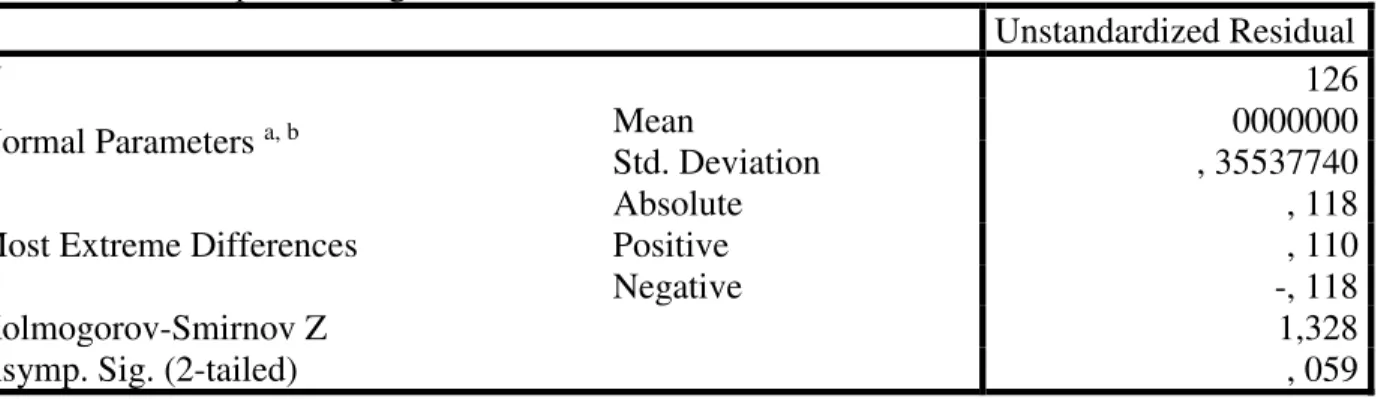
Normality test used the Kolmogorov-Smirnov test, which requires the value of Asymp. Sig above the maximum error limit of 0.05, so that the curve is normal. As for the regression analysis, which is tested for normality is a residual or random stochastic disturbance variable. From the results of the normality test above, research data can be used because the residual variables are normally distributed.
Table 1. One-Sample Kolmogorov-Smirnov Test
Unstandardized Residual
N 126
Normal Parameters a, b Mean 0000000
Std. Deviation , 35537740
Most Extreme Differences
Absolute , 118
Positive , 110
Negative -, 118
Kolmogorov-Smirnov Z 1,328
Asymp. Sig. (2-tailed) , 059
Heteroscedasticity Test
Heteroscedasticity test aims to test whether in the regression model, there is an inequality of variance from the residual one
observation to another observation. If the residual variance from one observation to another observation remains, it is called homoskedasticity. With the help of SPSS 21 software, the following results are obtained:
96
http://jurnal.unpad.ac.id/jaab – ISSN: 2614-3844
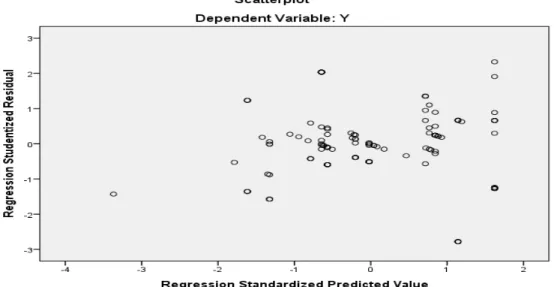
Image 1. Heteroscedasticity test
From the scatterplot above, it can be seen that the points spread and did not form a specific pattern. So it can be concluded that there is no problem with homoskedasticity.
Multicollinearity Test
Multicollinearity occurs when several or all independent variables are highly correlated. To detect the presence or absence of multicollinearity used Variance Inflation Factors (VIF). With the help of SPSS 21 software the following results are obtained: Table 2. Multicollinearity test
Model Collinearity Statistics
Tolerance VIF
1 X 1,000 1,000
From the above output, it can be seen that the VIF value is less than 10, so it can be concluded that there is no multicollinearity in the data.
Regression Analysis
From the SPSS 21 software output above the regression model is obtained as follows: Y =
1,638 + 0,454 X . Constant values a means
that when Budget Participation (X) is zero or Managerial Performance (Y) is not
influenced by Budget Participation, then the Managerial Performance average is 1.638. While the regression coefficient b means that if the Budget Participation variable (X) increases by one unit, then Managerial Performance (Y) will increase by 0.454 units. The regression coefficient is positive, which means that Budget Participation has a positive influence on Managerial Performance (increasingly High/strong Budget Participation, Managerial Performance has increased.
97
http://jurnal.unpad.ac.id/jaab – ISSN: 2614-3844
Model Unstandardized Coefficients Standardized Coefficients
t Sig.
B Std. Error Beta
1 (Constant) 1,638 , 173 9,480 .000
X , 454 , 053 , 608 8,537 .000
Based on the calculation above, it can be obtained the value of t arithmetic of 8.537. Because the value of t count (8.537)> t table (1.979), then Ho is rejected. That is, budget participation has a positive effect on the performance of local governments.
The results of this study are consistent with those described by Lewin (1997) that the budget is used as a control system to measure the performance of local governments. It is also in line with what was stated by Agyris (1952) that in order to prevent functional or dysfunctional impacts, attitudes and behavior of organizational members in budgeting, organizations need to involve subordinates in the preparation of budgets. So that budget participation can be used as an approach for local governments to be able to improve organizational performance. The participation in the preparation of the budget is expected to be able to improve the performance of local government agencies following the targets set.
Results research on this corresponding with those described by Lewin (197) that budget used as a control system for measuring the performance of local governments. Too in line with what was stated Agyris (1952) that to prevent functional or dysfunctional impacts, attitudes, and behavior of organizational members in budgeting, organizations need to involve subordinates within preparation budget. So that budget participation can be
made as an approach to local governments to be able to improve organizational performance. A is participation in budgeting. It is expected that regional government agencies can improve their performance following the targets set.
Results of Moderation Regression Analysis From the SPSS 21 software output above the regression model is obtained as follows: Y = 1,608 + 0,029 X + 0,206 Z + 0,082 X * Z . From the table above, it can be seen that the significant value on the moderating variable X * Z is 0.043, meaning that the moderation regression model is feasible to use in this study.
The results of the statistical test above show that organizational commitment strengthens the relationship between budget participation and organizational performance. From previous statistical tests, budget participation has a positive effect on the budget. Organizational commitment further strengthens the positive influence of budget participation on local government performance. High commitment makes individuals more concerned with the organization than personal interests and strives to make the organization better. Low organizational commitment will make individuals do for their interests.
Table 5. Moderation regression result
Model Unstandardized Coefficients Standardized Coefficients
98 http://jurnal.unpad.ac.id/jaab – ISSN: 2614-3844 B Std. Error Beta 1 (Constant) 1,608 , 455 3,537 , 001 X , 029 , 154 , 039 , 191 , 039 Z , 206 , 152 , 281 1,351 , 009 XZ , 082 , 050 , 554 1,642 , 043
The results of this study are in line with what was stated by Nouri and Parker (1996), that organizational commitment can be a psychological tool in running its organization to achieve expected performance, also in line with that stated by Randall (1990) in Nouri and Parker (1996), that high organizational commitment will encourage high performance as well.
Discussion
Budget Participation and Performance of Local Government
Based on the results of the data analysis above, budget participation has a significant positive effect on the performance of local governments in the Bandung City Government. It shows that budget participation has a significant role in realizing good performance in the local government system. As Mahoney said in Leach-Lopez et al. (2007) that budgetary participation is closely related to the performance of local governments because government performance is seen based on government participation in preparing budgets. Budget participation in an organization in the form of respecting opinions, suggestions, and views of the middle and lower levels in the budgeting process, so that they motivated to achieve the budget. The results of this study are in line with the research results of Siagian (2002) that the factors that can influence performance include organizational commitment, organizational culture, accountability, job satisfaction, and leadership. This result is also in line with the
research conducted by Bambang Sarjito and Osmad Mutaher (2008); Andrias Bangun (2009); and Solikhun Arifin (2012). Budget Participation, Performance
Organization, and Commitment Organization
Based on the results of the data analysis described earlier, the moderating variable (Organizational Commitment) can strengthen the positive influence between the variable X (Budget Participation) on the Y variable (Local Government Performance). Organizational commitment is a situational factor. Nouri and Parker (1996) stated that high commitment makes individual care about the fate of the organization and tries to make the organization a better direction.
Budget participation opens opportunities for subordinates to create a budget for their interests if the commitment to the organization is low and vice versa. High organizational commitment will encourage organizational members to participate in preparing a budget that will improve organizational performance. Organizational commitment can also be viewed from the side of the organization's desire to fulfill the welfare of its members. If the organization strives to fulfill the welfare of its members, then members of the organization will develop a budget that will improve organizational performance. This result is in line with previous research conducted by Bambang Sarjito and Osmad Mutaher (2008) and Solikhun Arifin (2012).
99
http://jurnal.unpad.ac.id/jaab – ISSN: 2614-3844
Conclusion
Budget Participation does not have a negative effect on the performance of local governments, especially in the Local Government Work Unit in the Bandung City Government. This means that the budgeting process involving the participation of organizational members of the local government work unit will improve the performance of the local government work unit. The results of this study support the theory that Mahoney argues that the participation of organizational members in budgeting is related to organizational performance. Also, in line with the results of research by Brownell and Mc.Innes (1986); and Indriantoro (1993) found a positive and significant relationship between budgetary participation and regional government performance.
Organizational commitment further strengthens the positive influence of budget participation on local government performance. The Local Government Work Unit that has high organizational commitment can strengthen the positive influence of budget participation on the performance of the regional government work unit. The results of this study are in line with the results of Manogran, 1997 in Ahmad and Fatima (2008) that organizational dimensions of positive employee attitudes that can be associated with the performance of the organization. It is also in line with the results of Siagian's (2002) research that Factors that can influence performance include organizational commitment, organizational culture, accountability, job satisfaction, and leadership.
This study has limitations related to the sample that is only in 1 local government, even though the work unit is examined. Also, not all factors that affect the performance of local governments are examined. Besides, the data used for the independent variables in this
study are from the results of the questionnaire. The possibility of the respondent's answer is that bias is very likely to occur.
The results of this study provide several implications that can be followed up for related parties. For local governments, it is better for local governments to provide space for members of their organizations to be involved in budgeting. Local government also needs to increase the commitment of its member organizations, so that members of the organization are tied to their organization strongly. One way to increase organizational commitment is to provide rewards for the performance of members of the organization. For further researchers, further research can add other independent variables such as the quality of human resources, the effectiveness of internal control, and utilization of information technology, to be seen by its influence on the performance of local governments.
Refferences
Allen, NJ., Meyer PJ. And Smith CA. 1993. Commitment to Organizations and Occupations: Extension and Test of a Three-Component Conceptualization, Journal of Applied Psychology, Vol. 78, No. 4.
Andarias, B. 2009. The Effect of Budgeting Participation, Clarity of Budget Objectives and Decentralization Structure on SKPD Performance with Internal Control as Moderating Variables. (case study in Deli Serdang Local Government), Thesis. Not Published.
Anthony, Robert N. and Vijay Govindarajan. 2011. Management Control System, Twelve editions., Karisma Publishing Group, Jakarta.
100
http://jurnal.unpad.ac.id/jaab – ISSN: 2614-3844
Arfan, I. and Ishak, M. 2005. Akuntansi Perilaku, Salemba Empat, Jakarta. Argyris. 1952. Organizational Leadership
and Participation management. The Journal of Business. Vol. XXVII. January.
Arifin, S. and Rohman, A. 2012. The Effect of Budget Participation on the Performance of Local Government Officials: Organizational Commitment, Organizational Culture and Leadership Style as Moderating Variables. Thesis Undergraduate Program of the Faculty of Economics and Business UNDIP: Semarang. Atkinson, Anthony A, Rajiv D Banker,
Robert, S. Kaplan, S. Mark Young. 1995. Management Accounting, Prentice-Hall, New Jersey.
Bastian, I. 2006. Akuntansi Sektor Publik : Sebuah Pengantar. Erlangga Publisher. Jakarta.
Becker, BE, Randall, DM and Riegel, CD 1995. The Multidimensional View of Commitment and the Theory of Reasoned Action: A Comparative Evaluation, Journal of Management Brownell, P. & M. McInnes. 1986. Budgetary
Participation, Motivation, and Managerial Performance. The Accounting Review. Vol. LXI (4). October.
Brownell, P. & Hirst, M. 1986. Reliance Accounting Information, Budgetary Participation, and Task Uncertainty: Three-Way Interaction Test. Journal of Accounting Research (Autumn 1986).
B. Uno, H. 2008.Teori Motivasi Dan Pengukurannya, Jakarta: Earth Literacy.
Coryanata, I. 2004. Delegation of Authority and Organizational Commitment in the Relationship between Participation in Budgeting and
Managerial Performance. National Accounting Symposium (SNA) VII. Denpasar, December 2-3, 2004. Daft, R. 2006. Organization Theory and
Design, Vanderbilt University. Fadel, M. 2009. Reinventing Government .
PT. Elex Media Komputindo. Jakarta. Fidiyanti, N. 2009. Effect of Leadership on
Citizenship Behavior of Job Satisfaction and Organizational
Commitment. Thesis,
Muhammadiyah University, Surakarta.
Ghozali, I. 2013. Aplikasi Analisis Multivariat dengan Program IBM SPSS 21. Edisi 7, Penerbit Universitas Diponegoro, Semarang. Glynn JJ. 1993. Public Sector Financial
Control and Accounting, 2 nd Edition, Oxford Blackwill.
Gibson, James, L. 2000. Organization, Behavior, Structure and Process. 5th edition. Penerbit Erlangga, Jakarta. Gusmal. 2007. Lakip Solok District
Government 2007. Solok.
Handoko, TH 1996. Manajemen Sumber Daya Manusia, Yogyakarta: BPFE. Hansen, Don R and Maryanne M. Mowen.
1999. Management of Accounting, Fifth Edition. South-Western Publishing Company, USA.
Harun. 2009. Reformasi Akuntansi dan Manajemen Sektor Publik di Indonesia. Jakarta: Salemba Empat. https://daerah.sindonews.com/read/814870/2 1/18-skpd-di-kota-bandung-masuk-zona-merah-1386577119 http://data.bandung.go.id/dataset/data- kepegawaian-skpd-kota-bandung- berdangkalan-golongan-dan-eselonering
Indriantoro, N. 1993. The Effect of Participatory Budgets on Job
101
http://jurnal.unpad.ac.id/jaab – ISSN: 2614-3844
Performance and Job Satisfaction With Locus of Control and Cultural Dimension as Moderating Variables. Journal of Economics and Business, Volume 15. January.
Indriantoro, N. and Supomo, B. 2011, Metodologi Penelitian Bisnis Untuk Akuntansi Dan Manajemen, First Edition. BPFE, Yogyakarta
Jensen & Meckling. 1976. The Theory of The Firm: Managerial Behavior Agency Cost, and Ownership Structure, Journal of Financial and Economics, 3: 305-360.
Kriyantono, Rachmat. 2010. Teknik praktis riset komunikasi: disertai contoh praktis riset media, public relation, advertising, komunikasi organisasi, komunikasi pemasaran. Jakarta: Kencana.
Kusnardi, M. 1980. Susunan Pembagian Kekuasaan Negara, Jakarta: Gramedia.
Leach-Lopez, MA, WW Stammerjohan, FM McNair. 2007. Differences in Role of Job-Relevance Information in the Budget Participation Performance Relationships among US and Mexican Managers: A Question of Culture or Communication. Journal of Management Accounting Research. Vol. 19.
Lututh, Fred. 1998. Organizational Behavior, Eighth Edition, McGraw-Hill International Book Company, New York.
Mahoney. 1963. Development of Managerial Performance: A Research Approach. Cincinnati: South-Western Publishing.
Mardiana, Tri. 2004. Pengaruh Karakteristik Individu, Karakteristik dan Pengalaman Kerja terhadap komitmen Organisasi. Telaah Bisnis, Volume 5, No 2, December 2004.
Mardiasmo. 2002. Akuntansi Sektor Publik. Andi Publisher. Yogyakarta.
Milani, K. 1975. The Relationship of Participation in Budget Setting to Industrial Supervisor Performance and Attitudes: A. Field Study. The Accounting Review. April.
Munandar, M. 2000. Budgeting: Perencanaan Kerja, Pengkoordinasian Kerja, Pengawasan Kerja. Cetakan Ketigabelas, Yogyakarta: BPFE. Nafarin, M. 2007.Penganggaran Perusahaan.
Jakarta: Salemba Empat.
Nazir, M. 2005. Metode Penelitian. Jakarta: Ghalia Indonesia.
Nor, W.2007. Desentralisasi dan Gaya Kepemimpinan sebagai variabel Moderating dalam Hubungan antara Partisipasi Penyusunan Anggaran dan Kinerja Manajerial. SNA X Makassar.
Nouri, H. and RJ Parker. 1996. The Effect of Organizational Commitment and Relations between Budgetary Participation and Budgetary Slack. Behavior Research in Accounting, Volume 8.
Nur, SA 2009. Pengaruh Partisipasi Penyusunan Anggaran terhadap Kinerja Pemerintah Daerah: Budaya Organisasi dan Komitmen Organisasi sebagai Variabel Moderating (Survey pada pemerintah daerah Se-Eks Karisidenan Surakarta), Universitas Muhammadiyah, Surakarta.
Otley, DT 1980. The Contingency Theory of
Management Accounting
Achievement and Prognosis. Accounting, Organizations And Society, Vol. 5 No.4 Hal. 413-428. Robbins, S, P. 2003. Organizational
Behavior. Index. Jakarta.
Robert N, A., John, D, and Northron M, B.1998. Management Control
102
http://jurnal.unpad.ac.id/jaab – ISSN: 2614-3844
System, Six editions. Homewood Illinois: Richard D, Irwin inc.
Sardjito, B. and Osmad Mutaher. 2007. Pengaruh Partisipasi Penyusunan Anggaran Terhadap Kinerja Aparat Pemerintah Daerah: Budaya Organisasi dan Komitmen Organisasi Sebagai Variabel Moderating. SNA. Santoso, P. 2008. Administrasi Publik Teori
dan Aplikasi Good Governance, Refika Aditama, Bandung.
Schiff, M. and AW Lewin. 1970. The Impact of People on Budgets. The Accounting Review. Vol. 45.
Sekaran, Uma and Bougie, R. 2010. Issue 5, Research Method For Business: A Skill Building Approach. John Wiley @ Sons, New York.
Siagian, PS 2002. Organizational Leadership & Administrative Behavior, Jakarta: Publishers of Mount Agung.
Siegel and Marconi. 1989. Behavioral Accounting. South-Western Publishing Company.
Sinaga, Ekha Yunora and Narumonrang Siregar.2009. Pengaruh Partisipasi Anggaran dan Komitmen Organisasi terhadap Kinerja Manajerial pada PT. Perkebunan Nusantara III SEI Sikambing Medan, Journal of Accounting, Faculty of Economics, North Sumatra.
Sugiyono. 2013. Metode Penelitian Kuantitatif, Kualitatif dan R&D . Bandung: Alfabeta.CV.
Sumarno, J. 2005. Pengaruh Komitmen Organisasi dan Gaya Kepemimpinan terhadap Hubungan antara Partisipasi Anggaran dan Kinerja Manajerial. Jurnal Bisnis Strategi, Vol. 14, no. 2, Desember 2005.
Supriyono, RA 2004. Pengaruh Variabel intervening Kecukupan Anggaran dan Komitmen Organisasi terhadap Hubungan Antara Partisipasi
Anggaran dan Kinerja Manajer di Indonesia. Jurnal Ekonomi dan Bisnis Indonesia, Vol.19, No. 3.
Syahputra, Zubir 2014. Budget Participation on Managerial Performance: Related Factors that are influenced by the Government's Employee. (Study of Indonesian Local Government). Journal of Economics and Sustainable Development, Vol. 5, No.12.
Weiner, Y. 1982. Commitment in Organization: A Normative View, Academy of Management Review 7. Wulandari, N, E. 2011. Pengaruh Partisipasi
dalam Penyusunan Anggaran terhadap Kinerja Aparat Pemerintah Daerah: Kepuasan Kerja dan Komitmen Organisasi Sebagai Variabel Moderating (Studi Empiris Pada Pemerintah Daerah Kabupaten Demak). Universitas Diponegoro Yahya, M. Nor, Nik Nazli Nik Ahmad and
Abdul Fatima. 2008. Budgetary Participation and Performance: some Malaysian Evidence. International Journal of Public Sector Management, Vol. 21, No. 6.
Yuwono, SR, Wirjoatmodjo, K., and Supriyanto, S. 2004. Evaluasi Kinerja dengan Rerangka Balanced Scorecard sebagai Bahan Penyusunan Rencana Kegiatan Peningkatan Pemanfaatan Rawat Inap Paviliun RSU Dr. Sutomo, J. Adm. Kebijakan. Kesehatan., 2(1).