Dissertation
Zur Erlangung des akademischen Grades Doktor rerum naturalium (Dr. rer. nat.)
genehmigte Dissertationsschrift in englischer Sprache von MSc. Emmanouil Vasilomanolakis
aus Darmstadt
geboren in Cholargos, Griechenland
Erstreferent: Prof. Dr. Max Mühlhäuser Korreferent: Prof. Dr. Simin Nadjm-Tehrani
Tag der Einreichung:10. May2016 Tag der Prüfung:11. July2016
Fachgebiet Telekooperation Fachbereich Informatik Technische Universität Darmstadt
Hochschulkennziffer D-17 Darmstadt,2016
C
yber-attacks have nowadays become more frightening thanever before. The growing dependency of our society on net-worked systems aggravates these threats; from interconnected corporate networks and Industrial Control Systems (ICSs) to smart households, the attack surface for the adversaries is increasing. At the same time, it is becoming evident that the utilization of classic fields of security research alone, e.g., cryptography, or the usage of isolated traditional defense mechanisms, e.g., firewalls and Intrusion Detection Systems (IDSs), is not enough to cope with the imminent security challenges.
To move beyond monolithic approaches and concepts that follow a “cat and mouse” paradigm between the defender and the attacker, cyber-security research requires novel schemes. One such promis-ing approach is collaborative intrusion detection. Driven by the lessons learned from cyber-security research over the years, the aforesaid no-tion attempts to connect two instinctive quesno-tions: “if we acknowl-edge the fact that no security mechanism can detect all attacks, can we beneficially combine multiple approaches to operate together?” and “as the adversaries increasingly collaborate (e.g., Distributed Denial of Service (DDoS) attacks from whichever larger botnets) to achieve their goals, can the defenders beneficially collude too?”. Collabora-tive intrusion detection attempts to address the emerging security challenges by providing methods for IDSs and other security mech-anisms (e.g., firewalls and honeypots) to combine their knowledge towards generating a more holistic view of the monitored network.
This thesis improves the state of the art in collaborative intrusion detection in several areas. In particular, the dissertation proposes methods for the detection of complex attacks and the generation of the corresponding intrusion detection signatures. Moreover, a novel approach for the generation of alert datasets is given, which can assist researchers in evaluating intrusion detection algorithms and systems. Furthermore, a method for the construction of communities of collab-orative monitoring sensors is given, along with a domain-awareness approach that incorporates an efficient data correlation mechanism. With regard to attacks and countermeasures, a detailed methodology is presented that is focusing on sensor-disclosure attacks in the con-text of collaborative intrusion detection.
c o n t r i b u t i o n s The scientific contributions can be structured into
the following categories:
data generation in a twofold manner: first it presents novel approaches for detecting complex attacks towards generating alert signatures for
IDSs; second a method for the synthetic generation of alert data is
pro-posed. In particular, a novel security mechanism for mobile devices is proposed that is able to support users in assessing the security status of their networks. The system can detect sophisticated attacks and generate signatures to be utilized by IDSs. The dissertation also touches the topic of synthetic, yet realistic, dataset generation for the evaluation of intrusion detection algorithms and systems; it proposes a novel dynamic dataset generation concept that overcomes the short-comings of the related work.
c o l l a b o r at i v e i n t r u s i o n d e t e c t i o n As a first step, the
the-sis proposes a novel taxonomy for collaborative intrusion detection ac-companied with building blocks for Collaborative IDSs (CIDSs). More-over, the dissertation deals with the topics of (alert) data correlation and aggregation in the context of CIDSs. For this, a number of novel methods are proposed that aim at improving the clustering of mon-itoring sensors that exhibit similar traffic patterns. Furthermore, a novel alert correlation approach is presented that can minimize the messaging overhead of aCIDS.
at ta c k s o n c i d ss It is common for research on cyber-defense to
switch its perspective, taking on the viewpoint of attackers, trying to anticipate their remedies against novel defense approaches. The the-sis follows such an approach by focusing on a certain class of attacks on CIDSsthat aim at identifying the network location of the monitor-ing sensors. In particular, the state of the art is advanced by proposmonitor-ing a novel scheme for the improvement of such attacks. Furthermore, the dissertation proposes novel mitigation techniques to overcome both the state of art and the proposed improved attacks.
e va l uat i o n All the proposals and methods introduced in the
dis-sertation were evaluated qualitatively, quantitatively and empirically. A comprehensive study of the state of the art in collaborative intru-sion detection was conducted via a qualitative approach, identifying research gaps and surveying the related work. To study the effective-ness of the proposed algorithms and systems extensive simulations were utilized. Moreover, the applicability and usability of some of the contributions in the area of alert data generation was additionally supported via Proof of Concepts (PoCs) and prototypes.
The majority of the contributions were published in peer-reviewed journal articles, in book chapters, and in the proceedings of interna-tional conferences and workshops.
C
yberangriffeentwickeln sich zu immer ausgeklügelterenPro-zessen mit zunehmend schwerwiegenderen Folgen für die Angegriffenen. Gleichzeitig sind immer mehr Aspekte un-seres Lebens durch Cyber-Systeme verbunden, werden über diese gesteuert und von diesen beeinflusst – von großen Industrieanalagen über Firmennetzwerke bis hin zu privaten Häusern und Endgeräten. Diese beiden Veränderungen beeinflussen sich gegenseitig und stellen die Forschung an Schutzmaßnahmen vor stets neue Herausforderun-gen. Klassische Forschungsfelder der Cybersicherheit, wie z.B. die Kryptografie, sowie monolithische und isoliert betriebene Schutzsys-teme, wie z.B. Firewalls und Eindringlingserkennungssysteme (intru-sion detection systems, IDS), sind in der heutigen Form nicht mehr ausreichend, um mit den neuen Herausforderungen angemessen um-zugehen.
Die Arbeit im Feld der Cybersicherheit benötigt neue Ansätze, um bisherige monolithische Schutzsysteme und das weiter beschleuni-gende Rennen zwischen Angreifern und Verteidigern zu gewinnen. Der Einsatz von kollaborativen Eindringlingserkennungssystemen (col-laborative intrusion detection systems, CIDS) ist ein solcher, vielver-sprechender Ansatz. Die Methodik hinter CIDS fußt auf zwei Grun-dannahmen:1. Einzelne Schutzsysteme können niemals alle Angriffe
erkennen, daher werden verschiedene Schutzsysteme miteinander kom-biniert.2. Da Angreifer zunehmend kollaborieren (wie beispielsweise
bei DDoS-Angriffen oder der Nutzung von Botnets), müssen dies auch Schutzsysteme tun. CIDS begegnen den o.g. neuen Herausfor-derungen mit neuen Methoden für IDS und für andere Schutzmech-anismen (z.B. Firewalls und Honeypots); dabei ist es das Ziel, das Wissen dieser Systeme zu einer umfassenderen Sicht auf das zu über-wachende Netzwerk zusammenzufassen.
Diese Dissertation erweitert den Stand der Wissenschaft in der kol-laborativen Angriffserkennung in mehreren Bereichen. Insbesondere werden Methoden zur Erkennung komplexer Angriffe sowie die Erzeu-gung der dazu passenden Angriffs-Signaturen vorgeschlagen. Weiter-hin wird auch ein neuartiger Ansatz zur Erstellung von Warn-Daten-sätzen vorgestellt, welcher Wissenschaftler bei der Evaluierung von zukünftigen IDS-Algorithmen und Systemen unterstützten kann. In Bezug auf Angriffs- und Schutzmechanismen wird eine detaillierte Methodik zur Angriffserkennung mittels Sensoren im Kontext von kollaborativer Angriffserkennung vorgestellt.
sich wie folgt kategorisieren:
a g g r e g at i o n v o n wa r n u n g e n Die Herausforderung der
Ag-gregation von Warnungen wird hier in zwei Schritten bearbeitet: Er-stens werden neuartige Ansätze zur Erkennung von komplexen An-griffen einschließlich der Generierung von Signaturen für IDSs vorge-stellt. Zweitens wird eine Methode zur Erzeugung von synthetischen Warnungen vorgestellt. Im Detail wird ein neuer Sicherheitsmecha-nismus für mobile Geräte vorgeschlagen, welcher Benutzer bei der Beurteilung der Sicherheit von Netzwerken unterstützt. Diese Meth-ode kann ausgefeilte Angriffe erkennen und daraus Signaturen erzeu-gen, welche dann von IDSs verwendet werden können. Diese Disser-tation betrachtet auch die Erzeugung von synthetischen, aber den-noch realistischen Datensätzen, welche die Evaluierung von IDS-Al-gorithmen und Systeme unterstützen. Dazu wird ein neues Konzept zur dynamischen Generierung von Datensätzen verwendet, welches die Einschränkungen der verwandten Arbeiten löst.
k o l l a b o r at i v e a n g r i f f s e r k e n n u n g In einem ersten Schritt
wird eine neuartige Taxonomie zusammen mit Bausteinen für kollab-orative IDSs (CIDSs) vorgestellt. Weiterhin behandelt diese Disserta-tion die Themen der KorrelaDisserta-tion von Warnmeldungen bzw. Daten, sowie deren Aggregation im Kontext von CIDSs. Dafür wird eine Reihe von neuen Methoden vorgeschlagen, die auf eine Verbesserung der Gruppierung (engl. clustering) von Sensoren abzielen, welche ähnliche Muster im Netzwerkverkehr aufweisen. Weiterhin wird ein neuer Ansatz zur Korrelation von Warnungen vorgestellt, welcher den Nachrichten-Overhead von CIDSs verringert.
a n g r i f f e au f c i d ss Für die Forschung in der Cyber-Sicherheit
ist es typisch, einen Perspektivwechsel vorzunehmen, um aus der Sicht der Angreifer die Reaktion auf neue Schutz-Mechanismen zu bestimmen. Diese Dissertation folgt diesem Ansatz und fokussiert dabei auf Klassen von Angriffen gegen CIDSs, die darauf abzielen, die Position von Sensoren im Netzwerk zu bestimmen. Hier wird der Stand der Wissenschaft durch eine Verbesserung dieser Positions-bestimmung erweitert. Weiterhin werden neue Schutzmechanismen vorgestellt, um Angriffe nach dem Stand der Wissenschaft als auch deren Verbesserungen zu unterbinden.
e va l u i e r u n g Alle vorgestellten Methoden wurden sowohl
qual-itativ als auch quantqual-itativ und empirisch evaluiert. Mit dem qualita-tiven Ansatz wurde eine umfassende Studie über den Stand der Wis-senschaft in kollaborativen Angriffserkennungs-Systemen angefertigt, um Forschungsfragen zu identifizieren und verwandte Arbeiten zu
Weiterhin wurden die Beiträge im Bereich der Korrelation von War-nungen auf ihre Anwendbarkeit und Benutzbarkeit anhand von Proof of Concepts (PoCs) sowie Prototypen überprüft.
Die meisten hier vorgestellten Beiträge wurden im Peer-Review-Verfahren von Wissenschaftlern geprüft und in Journalen, Buchkapiteln und Tagungsbänden internationaler Konferenzen und Workshops ver-öffentlicht.
First, I would like to express me warmest thanks to Prof. Dr. Max Mühlhäuser. Max trusted me, gave me the freedom to discover my research interests and always provided excellent and to-the-point ad-vice whenever I felt lost.
Likewise, I would like to thank Prof. Dr. Simin Nadjm-Tehrani for her interest in my research work, her helpful comments and for agreeing in (co-)supervising my dissertation.
Similarly, my work and this thesis would not have come to place with-out the assistance of Mathias Fischer.
In addition, this thesis would not be the same without the support and encouragement of a great number of TK (and ex-TK) members. I find it hard to imagine a better working environment: Jörg Daubert, Shankar Karuppayah, Carlos Garcia Cordero, Tim Grube, Siavash Valipour, Florian Volk, Sheikh Mahbub Habib, Sascha Hauke, Fábio Borges, and Stefan Schiffner. In the same context, my gratitude to sev-eral TK people whose work supported me over the years: Elke Halla, Nina Jäger, Silke Romero, Denny Fuchs, Karin Tillack, Fabian Her-rlich, Elke Reimund, and all other wonderful TK members.
Moreover, a big thanks goes toAGT Internationalfor their full support during my research. In fact, without this support, I would not be able to neither start or finish my studies. Many thanks to Joachim Schaper, Panayotis Kikiras, Alexander Wiesmaier, and all the people I had the honor to work with in AGT.
Furthermore, a very special thanks goes to Katerina Stourna, Ioannis Bouziannis, Panos Protopapas, Michalis Kiparisis (and many others!) for their support and understanding during the last three years of my life. Last, and definitely not least, I want to thank my family for their unconditional love and support.
i p r e f a c e 1
1 i n t r o d u c t i o n 3
1.1 Problem Statement . . . 4
1.2 Thesis contributions . . . 6
1.2.1 Taxonomy and Survey ofCIDSs . . . 7
1.2.2 Alert Data Generation . . . 7
1.2.3 Collaborative Intrusion Detection . . . 8
1.3 Publications . . . 9
1.4 Thesis Outline . . . 11
2 b a c k g r o u n d 13 2.1 Intrusion Detection Systems (IDSs) . . . 14
2.1.1 Classifications and definitions . . . 14
2.1.2 Passive and active monitoring . . . 15
2.2 Honeypots . . . 16
2.2.1 Mobile Honeypots . . . 17
2.2.2 Honeypots for ICSs . . . 18
2.2.3 Summary . . . 18
2.3 Evaluating IDSs . . . 18
2.3.1 IDS-Specific Datasets . . . 18
2.3.2 Dynamic Creation of Datasets . . . 19
2.3.3 Summary . . . 20 2.4 Conclusion . . . 20 3 c o l l a b o r at i v e i n t r u s i o n d e t e c t i o n 21 3.1 Introduction . . . 22 3.2 Requirements . . . 23 3.3 Attacks on CIDSs . . . 25 3.3.1 External attacks . . . 26 3.3.2 Internal attacks . . . 29 3.3.3 Discussion . . . 31 4 ta x o n o m y a n d s tat e-o f-t h e-a r t 33 4.1 Taxonomy of Collaborative Intrusion Detection . . . . 34
4.1.1 Local monitoring . . . 35
4.1.2 Membership management . . . 36
4.1.3 Correlation and aggregation . . . 37
4.1.4 Data dissemination . . . 39 4.1.5 Global Monitoring . . . 39 4.2 State-of-the-Art . . . 40 4.2.1 Centralized CIDSs . . . 40 4.2.2 HierarchicalCIDSs. . . 44 4.2.3 DistributedCIDSs . . . 48 4.2.4 Qualitative Comparison . . . 57 xiii
4.3 Summary . . . 62 ii a l e r t d ata c r e at i o n 65 5 h o s ta g e m o b i l e h o n e y p o t 67 5.1 Introduction . . . 68 5.2 System Overview . . . 69 5.2.1 Architecture . . . 69
5.2.2 Graphical User Interface . . . 71
5.2.3 Protocols Emulation . . . 73
5.2.4 Formal Model . . . 76
5.2.5 Detection Mechanisms inHosTaGe . . . 77
5.3 Evaluation . . . 79 5.3.1 Honeypot Comparison . . . 79 5.3.2 Multi-Stage attacks . . . 81 5.3.3 Honeypot Evasion . . . 82 5.3.4 Signature Generation . . . 82 5.4 Summary . . . 83 6 t r a c i n g c y b e r i n c i d e n t m o n i t o r 85 6.1 Introduction . . . 86 6.2 Architecture of TraCINg . . . 87 6.2.1 TraCINg Core . . . 87 6.2.2 GUI . . . 88 6.2.3 Sensors . . . 88 6.2.4 Alerts . . . 90
6.3 Alert data analysis . . . 91
6.3.1 System Setup . . . 92 6.3.2 Data analysis . . . 92 6.3.3 Correlation of attacks . . . 94 6.4 Summary . . . 98 7 i d 2 t: a n i n t r u s i o n d e t e c t i o n d ata s e t c r e at i o n t o o l k i t 99 7.1 Introduction . . . 100 7.2 Requirements . . . 100 7.2.1 Functional Requirements . . . 101 7.2.2 Non-Functional Requirements . . . 102 7.3 ID2T . . . 103 7.3.1 Architecture . . . 103 7.3.2 Attack Generation . . . 104
7.3.3 Intrusion Detection Dataset Toolkit (ID2T) Proof of concept . . . 105 7.4 Evaluation . . . 106 7.4.1 Performance Evaluation . . . 107 7.4.2 Artifacts Avoidance . . . 108 7.5 Discussion . . . 111 7.6 Summary . . . 112
iii c o l l a b o r at i v e i n t r u s i o n d e t e c t i o n s y s t e m s 113
8 c o m m u n i t y-b a s e d c o l l a b o r at i v e i n t r u s i o n d e t e c
-t i o n 115
8.1 Introduction . . . 116
8.2 Community-based Collaborative Intrusion Detection . 117 8.2.1 Basic Concept . . . 117
8.2.2 Formal Model . . . 118
8.2.3 Parameters for Building Communities . . . 118
8.2.4 Community Formation . . . 120
8.2.5 Community-based Intrusion Detection . . . 123
8.3 Evaluation . . . 123
8.3.1 The DARPA Dataset . . . 124
8.3.2 The LERAD Integration . . . 125
8.3.3 Experimental Setup . . . 126 8.3.4 Results . . . 127 8.4 Summary . . . 131 9 s k i p m o n: a d o m a i n-awa r e c o l l a b o r at i v e i n t r u -s i o n d e t e c t i o n -s y -s t e m 133 9.1 Introduction . . . 134
9.2 SkipMon System Architecture . . . 135
9.2.1 Local Monitoring . . . 135 9.2.2 SkipNet Overlay . . . 136 9.2.3 Alert Dissemination . . . 136 9.2.4 Alert Correlation . . . 138 9.2.5 Community Formation . . . 141 9.3 Implementation . . . 141 9.4 Evaluation . . . 141 9.4.1 Dataset Description . . . 142 9.4.2 Evaluation Setup . . . 143 9.4.3 Results . . . 144 9.5 Summary . . . 148 10 p r o b e-r e s p o n s e at ta c k s 149 10.1 Introduction . . . 150 10.2 PREPARE . . . 151 10.2.1 System Overview . . . 151
10.2.2 Improving Probe Response Attacks (PRAs) . . . 152
10.2.3 Attack Detection and Mitigation . . . 156
10.3 Evaluation . . . 159 10.3.1 Simulation Setup . . . 159 10.3.2 Simulation Results . . . 160 10.3.3 Real-World Experiments . . . 164 10.4 Summary . . . 165 iv e p i l o g u e 167 11 c o n c l u s i o n a n d o u t l o o k 169 11.1 Conclusion . . . 170
11.1.1 Alert Data Generation . . . 170
11.1.2 Collaborative Intrusion Detection . . . 171
11.2 Outlook . . . 172
11.2.1 Alert Data Generation . . . 172
11.2.2 Collaborative Intrusion Detection . . . 174
v a p p e n d i x 177 a a p p e n d i x a - h o s ta g e f u r t h e r e va l uat i o n 179 a.1 Malware detection in HosTaGe . . . 179
a.2 Battery consumption . . . 180
b a p p e n d i x b - s k i p n e t b a c k g r o u n d 183 b.1 SkipNet . . . 183
c a p p e n d i x c - s k i p m o n e va l uat i o n 185 c.1 SkipMon Further Evaluation . . . 185
Figure1 Amount of monetary damage caused by
re-ported cyber crime from 2001 to 2014(in
mil-lion U.S. dollars). Data taken from the Internet Crime Complain Center (IC3) and Statista. . . 4
Figure2 Size of the global Internet of Things (IoT)
mar-ket from 2009 to 2019(in billion U.S. dollars).
A star (*) indicates an estimated value. Data taken from HKExnews and Statista. . . 5
Figure3 Thesis overview and contributions. . . 7
Figure4 Overview of centralized, decentralized, and
dis-tributedIDSarchitectures that consist of moni-tors (M) and analysis units (A). . . 23
Figure5 Possible network positions of attackers.M
rep-resents the differentmonitoring pointsof theCIDS. 25
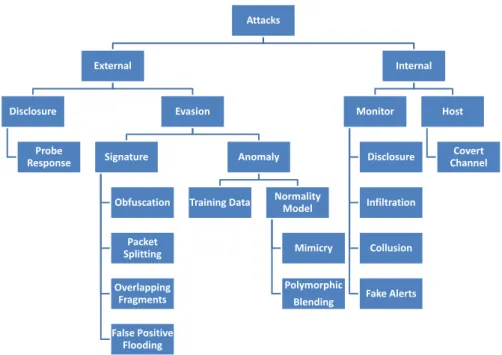
Figure6 Overview of different attacks forCIDSs. . . 26
Figure7 Building blocks forCIDSs. . . 34
Figure8 Taxonomy ofCIDSs. . . 36
Figure9 Overview of the Chapter and key contributions. 67
Figure10 Attack surfaces and collaborative capabilities
of HosTaGe. . . 68
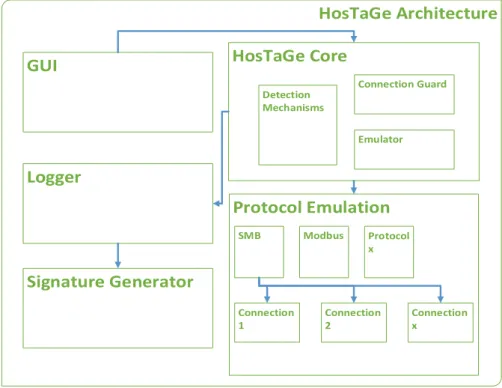
Figure11 High level architectural view of HosTaGe. . . . 70
Figure12 Graphical User Interface ofHosTaGe. . . 71
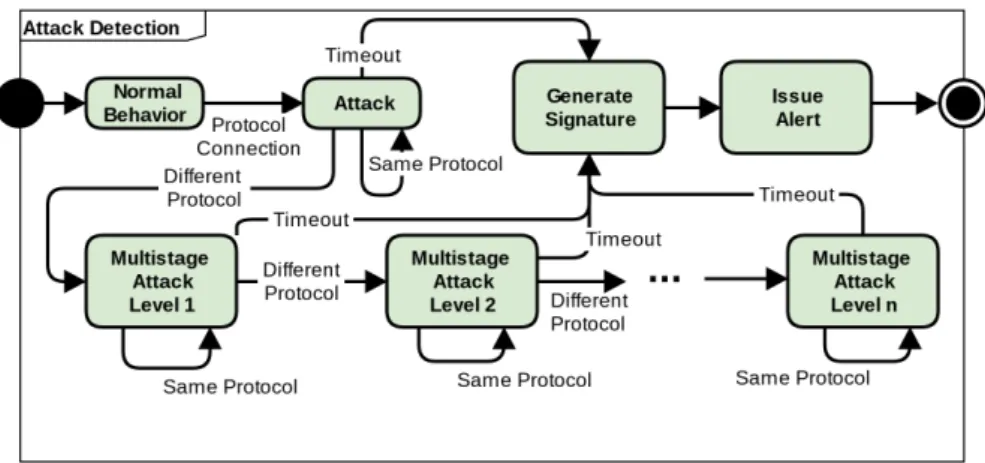
Figure13 EFSM of the attack detection and signature
gen-eration mechanism. . . 76
Figure14 EFSM for Payload Level Detection (PLD) in the
case of Stuxnet propagation. . . 78
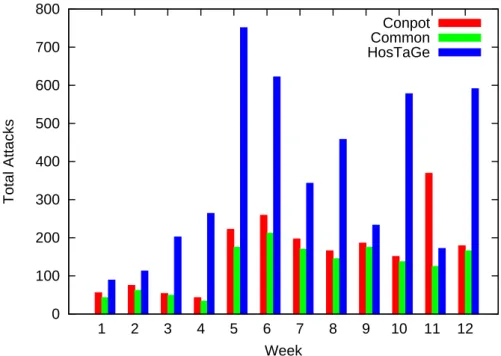
Figure15 Comparison of detected attacks onHosTaGeand
Conpot for Hypertext Transfer Protocol (HTTP), Modbus,S7and Telnet. Note, that Conpot does not support the Telnet protocol. . . 80
Figure16 Comparison of unique and common malicious
IP addresses targetingHosTaGeand Conpot . . 81
Figure17 Overview of the Chapter and key contributions. 85
Figure18 High level architectural view of TraCINg. . . . 87
Figure19 GUI examples of TraCINg. . . 89
Figure20 Graph representation of the alert data:
attack-ers clustered close to their main targets and single-dimensional correlation (cf. Section6.3.3.1)
seen as edges connecting to neighbor clusters. 94
Figure21 Ratio of unique attackers targeting multiple
sen-sors inTraCINg. . . 96
Figure22 Unique attackers in TraCINg within a sliding
window of one hour and with measurements
taken every30minutes. . . 97
Figure23 Overview of the Chapter and key contributions. 99 Figure24 High level overview of theID2Tconcept. . . 101
Figure25 A high level view of the ID2T Architecture. . . 103
Figure26 GUI view of the ID2T prototype. . . 106
Figure27 Performance of the statistics module for differ-ent dataset sizes. . . 107
Figure28 Attack generation time with respect to the num-ber of generated packets. . . 108
Figure29 Time To Live (TTL) distribution comparison of the MAWI dataset and ID2T. . . 109
Figure30 Modeling time between two consecutive pack-ets with a10p/s rate. . . 109
Figure31 Modeling time between two consecutive pack-ets with a100p/s rate. . . 110
Figure32 Overview of the Chapter and key contributions. 115 Figure33 Example cases of two communities (left), three communities (center), and four communities (right), with sensors s and community heads s?. . . 119
Figure34 Modifications made to the1999DARPA Dataset.125 Figure35 Detection accuracy and precision at different FAs when communities are built using Algo-rithm1. . . 129
Figure36 Accuracy when the communities are built us-ing Algorithm2. . . 130
Figure37 Overview of the Chapter and key contributions. 133 Figure38 High level architecture ofSkipMon. . . 136
Figure39 Messages inSkipMon. . . 139
Figure40 Domain awareness example inSkipMon. . . 140
Figure41 SkipMonimplementation overview. . . 142
Figure42 Proposed communities bySkipMon(with flood-ing) compared to a centralized system. . . 145
Figure43 Proposed communities bySkipMon (with gos-siping) compared to a centralized system. . . . 145
Figure44 False positives and false negatives (flooding). . 146
Figure45 False positives and false negatives (gossiping). 146 Figure46 Strict domain awareness in SkipMon. . . 147
Figure47 Partial domain awareness in SkipMon. . . 147
Figure48 Overview of the Chapter and key contributions. 149 Figure49 Probe Response Attack (PRA) example [175]. . 151
Figure50 Probe REsPonse Attack fRamEwork (PREPARE) attack framework’s high-level overview. . . 152
Figure52 Generic Marker Encoding Methodology (GMEM)
flow overview example. . . 154
Figure53 Ratiora utilization example for DShield data. 157
Figure54 Destination port frequency for different
time-windows in DShield. . . 158
Figure55 Destination port frequency in DShield. . . 158
Figure56 Attack duration with respect to marker values
and checksum bits. . . 160
Figure57 Amount of required probes with respect to marker
values and checksum bit. . . 161
Figure58 False positives for various encoding
configura-tions. . . 161
Figure59 PRA comparison: time required for the
com-plete enumeration of sensors. . . 162
Figure60 Attacks/Monitors ratio (ra) development
un-der aPRA. . . 163
Figure61 Development of non-attacked destination ports
under aPRA. . . 163
Figure62 Top 10 Ports after the execution of a PRA as
generated by DShield. . . 164
Figure63 Attack Testbed Architecture. . . 180
Figure64 Power consumption of HosTaGe in
compari-son to other applications. . . 181
Figure65 Power consumption of HosTaGe for various
set-tings. . . 182
Figure66 SkipNet routing infrastructure example [67] . 183
Figure67 Proposed communities by SkipMon(with
gos-siping and k between 5 and 6) compared to a
centralized system. . . 185
Figure68 Proposed communities by SkipMon(with
gos-siping and k between 7 and 8) compared to a
Table1 Relationship between Attacks onCIDSsand
Re-quirements: Check marks3indicate a relation between an individual requirement andIDS at-tacks, while checkmark symbols in brackets [3] an indirect relation. Finally, x marks 7 show the absence of any relationship. . . 32
Table2 Centralized CIDSs and their Building Blocks.
The x marks7indicate that the respective building block is not available. . . 44
Table3 Hierarchical CIDSs and their Building Blocks.
A question mark ? symbol indicates unknown cases. . . 48
Table4 DistributedCIDSsand their Building Blocks.The
x marks7indicate that the respective building block is not available, while a question mark ? symbol in-dicates unknown cases. . . 57
Table5 CIDSs and their Building Blocks. The x marks
7 indicate that the respective building block is not available, while a question mark ? symbol indicates unknown cases. . . 58
Table6 CIDSs and the proposed requirements.
Check-marks 3 indicate the fulfillment of the individual requirement, x marks7their non-fulfillment, aver-age symbols Ø their partial match and a question mark ? symbol indicates unknown cases.. . . 59
Table7 Sensor description and geographical
informa-tion in TraCINg. . . 92
Table8 Most popular attack types and the
correspond-ing number of occurrences in a5month period
ofTraCINgdeployment. . . 93
Table9 Top10attacked ports and protocols in a5month
period ofTraCINgdeployment. . . 93
Table10 Overall merging performance of ID2T for
var-ious datasets and attacks. . . 108
Table11 Example of similarity scores for noden3. . . . 141
Table12 DShield dataset example . . . 142
Table13 Communication overhead comparison . . . 144
Table14 Malware Deployed In The Testbed. . . 180
Listing 1 Modbus attack signature generated byHosTaGe. 79
ASL Attack Specification Language CDDHT Cyber Disease DHT
DHT Distributed Hash Table
DIDMA Distributed Intrusion Detection system using Mobile Agents DOMINO Distributed Overlay for Monitoring Internet Outbreaks DoS Denial of Service
DDoS Distributed Denial of Service IDS Intrusion Detection System
INDRA Intrusion Detection and Rapid Action LarSID Large Scale Intrusion Detection MA Mobile Agent
MAD Mobile Agents Dispatcher PKI Public Key Infrastructure SA Static Agent
SPoF Single Point of Failure TTP Trusted Third Party VPN Virtual Private Network P2P Peer-to-Peer
CRIM Cooperative Intrusion Detection Framework CIDS Collaborative IDS
AIDS Anomaly IDS
ANIDS Anomaly Network IDS
PII Personally Identifiable Information DIDS Distributed Intrusion Detection System APT Advanced Persistent Threat
IDMEF Intrusion Detection Message Exchange Format
DNS Domain Name System URI Uniform Resource Identifier CLB Constrained Load Balancing LGPL Lesser General Public License PRA Probe Response Attack
PREPARE Probe REsPonse Attack fRamEwork UI User Interface
GMEM Generic Marker Encoding Methodology GrIDS Graph Based Intrusion Detection System AAFID Autonomous Agents For Intrusion Detection
EMERALD Event Monitoring Enabling Responses to Anomalous Disturbances
HIDE Hierarchical Intrusion Detection IDA Intrusion Detection Agent AA Alerting Agents
PHAD Packet Header Anomaly Detector LERAD Learning Rules for Anomaly Detection FA False Alarm
VM Virtual Machine CA Certificate Authority
EFSM Extended Finite State Machine FSM Finite State Machine
R/W Read/Write
ICS Industrial Control System PLC Programmable Logic Controller RTU Remote Terminal Unit
SPLD Single-Protocol Level Detection PLD Payload Level Detection
IoT Internet of Things
ID2T Intrusion Detection Dataset Toolkit FLAME Flow-Level Anomaly Modeling Engine PoD Ping of Death
OS Operating System TTL Time To Live
GUI Graphical User Interface VOIP Voice Over IP
IPS Intrusion Prevention System PCI Protocol Control Information PoC Proof of Concept
SNMP Simple Network Management Protocol SMB Server Message Block
SMTP Simple Mail Transfer Protocol SSH Secure Shell
FTP File Transfer Protocol
HTTP Hypertext Transfer Protocol
HTTPS Hypertext Transfer Protocol Secure SIP Session Initiation Protocol
P R E FA C E
The first part of the thesis aims at introducing the reader to the topic and supporting her by discussing the required background knowledge and definitions that will be used in the course of the thesis. Chapter 1 serves as an intro-duction to the motivation of the thesis as well as to its structure. Chapter2provides the reader with background knowledge of various topics that are fundamental for the understanding of the remainder of the thesis. Chapter 3 touches the topic of collaborative intrusion detection and respective terms that will be utilized in the thesis. Lastly, Chapter4proposes a novel taxonomy for collaborative in-trusion detection and conducts a detailed survey of the related work.
1
I N T R O D U C T I O N
The only truly secure system is one that is powered off, cast in a block of concrete and sealed in a lead-lined room with armed guards. — Gene Spafford
R
esearch in the area of cyber-security has increasedsignifi-cantly over the last years. This fact however is neither ran-dom nor unforeseen; rather it is highly connected to the mas-sive increase in the number and sophistication of cyber-attacks. Re-searchers nowadays have realized that existing and future infrastruc-tures, designed by humans, cannot be perfectly secure. In this context, research towards novel cyber-security systems is fundamental for the protection and the resilience of networks. In addition, regardless of the specifics of a newly proposed security mechanism, researchers are obliged to evaluate their ideas in a scientific, transparent and broadly acceptable manner. However, as it will become evident in the course of this thesis, this evaluation procedure is not at all trivial; in fact it raises several additional research challenges.
This Ph.D. thesis contributes in the field of cyber-security. In partic-ular, the dissertation significantly improves the state of the art in the areas of alert data generation and intrusion detection with a twofold vision. First, itimproves the techniques for generating alert data and hence evaluating security mechanisms and second it significantly advances the field of collaborative intrusion detection.
This introductory chapter is structured as follows. Section 1.1
de-scribes the motivation, the setting and the research questions that this thesis is addressing. Afterwards, Section 1.2 gives the reader a
sum-mary of the contributions, while Section1.3tabulates the
correspond-ing publications that have been made as a result of the conducted research. Lastly, the structure of the thesis is given in Section 1.4.
p r o b l e m s tat e m e n t
The dependency of our society on networked computers has become frightening: In the economy, all-digital networks have turned from facilitators to drivers; as cyber-physical systems are coming of age, computer networks are now becoming the central nervous systems of our physical world – even of highly critical infrastructures such as the power grid. At the same time, the 24/7 availability and correct
functioning of networked computers has become much more threat-ened: The number of sophisticated and highly tailored attacks on IT systems has significantly increased [148]. The monetary damage of such attacks is also substantial (see Figure1).
Figure1: Amount of monetary damage caused by reported cyber crime from 2001 to 2014 (in million U.S. dollars). Data taken from the Internet Crime Complain Center (IC3) and Statista.
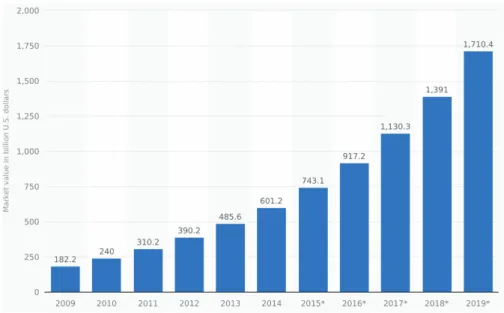
Furthermore, emerging technology trends such as the concept of the IoT [61] and/or the ongoing convergence of ICSs with the Inter-net, further highlight the challenges that need to be tackled from a security perspective. In fact, the author’s preliminary work towards a security analysis of existing or proposed IoTarchitectures suggests that the topics of security and privacy are yet to be achieved [60,170]. As the size of theIoT market (see Figure2) is planned to grow
expo-nentially, it is to be expected that the total number of cyber attacks will further increase.
Intrusion Detection Systems (IDSs) are a key component of the cor-responding defense measures nowadays; they have been extensively studied and utilized in the past [87,49]. However, since conventional
IDSs are not scalable to big company networks and beyond, nor to massively parallel attacks, Collaborative IDSs (CIDSs) have emerged [21,196]. Such systems consist of several monitoring components that
Figure2: Size of the global IoT market from 2009 to 2019 (in billion U.S. dollars). A star (*) indicates an estimated value. Data taken from HKExnews and Statista.
collect and exchange data. Depending on the specific CIDS architec-ture, central or distributed analysis components mine the gathered data to identify attacks. Resulting alerts are correlated among multi-ple monitors in order to create a holistic view of the network moni-tored.
The novel character of theCIDSarea results to many research ques-tions and gaps [196, 172, 107] that will be in-depth discussed in this dissertation. At a glance, the field combines research from many dif-ferent areas of computer science that include but are not limited to: intrusion detection algorithms (e.g., novel anomaly-based detection algorithms [25]), distributed architectures (e.g., Peer-to-Peer (P2P)
sys-tems [96]), data correlation and aggregation (e.g., similarity-based alert correlation algorithms [110]), mechanisms for data dissemina-tion (e.g., gossiping in distributed environments [76]), etc.
With respect to the core areas of CIDSs this thesis is attempting to answer the following research questions:
• How can the collaboration part of aCIDSbe practically realized and which parameters influence such a process?
• How effective is the exchange of data on the detection, rather than the alert level, in the context of collaborative anomaly-based detection?
• How can a CIDS be practically realized in large networks that enforce (security policy) restrictions to the flow of data on dif-ferent sub-networks?
• What kind of novel and efficient correlation mechanisms can be designed for minimizing the communication overhead of a
CIDS?
• What is the impact ofCIDSdisclosure attacks, and how can their design, execution and mitigation be realistically improved? Apart from the aforementioned research questions, the author’s work in the area of CIDSs revealed the need for additional work to-wards holistically approaching the collaborative intrusion detection field. First, there is a need for novel detection mechanisms, that are able to enhance the state of the art, in the area of ICSs. Furthermore, the problem of creating datasets, that are realistic enough to be uti-lized for the evaluation of intrusion detection systems and algorithms, has not be tackled so far in the related work. In this sense, the second part of the dissertation is emphasizing in the following correspond-ing research questions. As the reader may notice, these are highly connected to the topics of alert data generation and evaluation mech-anisms for intrusion detection systems and algorithms.
• How can novel and previously unknown attacks that target crit-ical infrastructure, e.g.,ICSs, be modeled and identified?
• Can the knowledge gained from the previous research question be utilized to support existingIDSs’ infrastructure?
• Is it possible for a security mechanism, such as a honeypot, to detect complex attacks that involve multiple adversarial steps?
• How likely is it for an adversary to evade such a security mech-anism?
• Which are the parameters in a synthetically generated dataset, intended for intrusion detection, that can reveal its artificial na-ture?
t h e s i s c o n t r i b u t i o n s
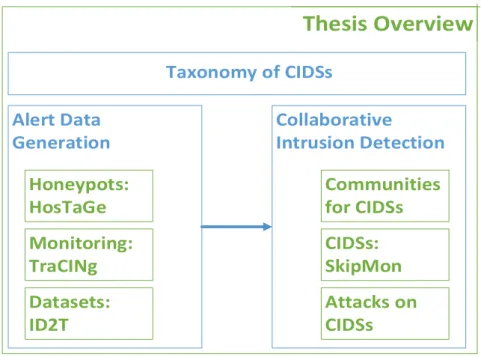
This thesis contributes in several key areas of collaborative intrusion detection and alert data generation. An overview of the structure of the dissertation along with the different contributions is depicted in Figure 3. This section briefly summarizes the various contributions
per chapter along with the respective scientific publications. After-wards, Section 1.3 provides the reader a detailed overview of the
Figure3: Thesis overview and contributions.
Taxonomy and Survey ofCIDSs
The first contribution of this thesis is given in Chapter 4, in which a
novel taxonomy for CIDSs is proposed, accompanied by a
compre-hensive survey and qualitative comparison of the state of the art [172, 167]. To the best of the knowledge of the author, this is the most holistic and up to date study of CIDSs. In addition, this chapter serves as additional motivation for the thesis, in the sense that none of the existing systems can neither fulfill all the requirements pro-posed in Chapter3, nor depict an architecture that is suitable for the
protection of large network infrastructures. Furthermore, the study of the related work highlights the need for more efficient, realistic and broadly acceptable means for the evaluation of such systems.
Alert Data Generation
The second part of this dissertation copes with the topic of alert data generation. In more details, this subject and the challenge of creat-ing mechanisms that are able to detect attacks, correlate events and produce usable alert data and datasets is firstly touched in Chap-ter 5. Here, the thesis introduces a security tool for mobile devices,
namely HosTaGe, which is able to detect malicious behavior, study the adversaries’ techniques, correlate attacks, and generate respective signatures for the identified attacks [168,169,174,177]. Furthermore,
the proposed system deals with attacks related to the IoT and ICSs
[152]1.
Chapter 6 presents TraCINg, a cyber incident monitor that takes
as input data generated by monitoring sensors [171]. Among others, TraCINgmakes use ofHosTaGehoneypots, hence creating a collabora-tive platform that is able to aggregate the results of sensors from all over the world. Moreover, the chapter presents a long-term study of deployment of the cyber incident monitor to examine current attack trends and analyze the adversarial behavior. The study also empha-sizes in identifying correlated attacks that target more than one of the utilized sensors within a certain time window.
Lastly, Chapter7proposes a toolkit for the generation of synthetic,
yet realistic, datasets for the evaluation of intrusion detection sys-tems and algorithms [29,176][108]1. First, a study of the related work highlights the challenges for the design of such a system and the parameters and properties which can introduce artifacts in a gen-erated dataset. The proposed system, namely the Intrusion Detec-tion Dataset Toolkit (ID2T), exhibits a flexible architecture offering
a methodological approach for injecting network files with cyber-attacks to generate labeled datasets.
Collaborative Intrusion Detection
The third part of the dissertation copes with the core area of collabo-rative intrusion detection. In Chapter8, the thesis presents the idea of
communitiesof sensors that collaborate by exchanging features of work traffic to towards creating holistic models of the monitored net-works [30]. This way it is possible to generate normality models to be used by anomaly-based detection algorithms. The proposedCIDS con-cept of this chapter is also the first one that shifts from the alert level exchange to the detection level. To practically realize this concept two stochastic algorithms are developed for grouping monitoring sensors to communities.
Chapter9builds on top of the communities idea, presented in the
previous chapter. That is, a novel fully distributedCIDS, namely Skip-Mon, is proposed [173] [84]1. SkipMon improves the related work in a multitude of ways. The system is the first one to fulfill the do-main awareness requirement, i.e., the ability to dynamically constrain alert dissemination with respect to security policies. Second, a novel similarity-based correlation mechanism is proposed that can effec-tively correlate large amounts of alert data. The latter, works on the basis of bloom filters which can also be beneficial in terms of the pri-vacy of the alert data. By making use of such a correlation mechanism the system is able to identify and connect sensors that experience sim-ilar traffic patterns.
Finally, Chapter 10 introduces contributions in the area of
disclo-sure attacks to CIDSs. Specifically, the chapter deals with a particular class of attacks, called Probe Response Attacks (PRAs), which can be utilized for identifying the network location of monitoring sensors. The thesis proposes an open-source framework that enables the de-velopment, improvement, execution and detection ofPRAs[175][154]1. In addition, a novel technique is proposed for the design of such at-tacks that enables the execution of PRAswith a significantly less time required. Lastly, a multitude of techniques that focus on the detection and mitigation of the attacks are proposed and examined.
p u b l i c at i o n s
Some parts of this thesis have been published in international peer-reviewed journals, book chapters, conferences and workshops. The following is a detailed list of these publications for each of the main chapters of the thesis.
c h a p t e r 1 (General overview and motivation)
• Shankar Karuppayah, Emmanouil Vasilomanolakis, Steffen Haas, Max Mühlhäuser, Mathias Fischer: BoobyTrap: On Autonomously Detecting and Characterizing Crawlers in P2P Botnets. CISS@ICC 2016, IEEE [75]
• Emmanouil Vasilomanolakis, Jörg Daubert, Manisha Luthra, Van-gelis Gazis, Alexander Wiesmaier, Panagiotis Kikiras: On the security and privacy of Internet of Things architectures and sys-tems. SIoT@ESORICS2015[170]
• Vangelis Gazis, Manuel Görtz, Marco Huber, Alessandro Leonardi, Kostas Mathioudakis, Alexander Wiesmaier, Florian Zeiger, Em-manouil Vasilomanolakis: A survey of technologies for the Inter-net of things. IWCMC2015:1090-1095[61]
• Vangelis Gazis, Carlos Garcia Cordero,Emmanouil Vasilomanolakis, Panayotis Kikiras, Alex Wiesmaier: Security Perspectives for Col-laborative Data Acquisition in the Internet of Things. SaSeIoT
2014, Springer LNCS151:271-282[60]
c h a p t e r 4
• Emmanouil Vasilomanolakis, Shankar Karuppayah, Max Mühlhäuser, Mathias Fischer: Taxonomy and Survey of Collaborative Intru-sion Detection. ACM Comput. Surv. 47(4):55(2015) [172]
• Emmanouil Vasilomanolakis, Mathias Fischer, Max Mühlhäuser, Peter Ebinger, Panayotis Kikiras, Sebastian Schmerl: Collabora-tive Intrusion Detection in Smart Energy Grids. ICS-CSR 2013: 97-100[167]
c h a p t e r 5
• Emmanouil Vasilomanolakis, Shreyas Srinivasa, Carlos Garcia Cordero, Max Mühlhäuser: Multi-stage Attack Detection and Signature Generation with ICS Honeypots. IEEE/IFIP DISSECT2016[177]
• Emmanouil Vasilomanolakis, Shreyas Srinivasa, Max Mühlhäuser: Did you really hack a nuclear power plant? An industrial con-trol mobile honeypot. IEEE CNS2015:729-730[174]
• Emmanouil Vasilomanolakis, Shankar Karuppayah, Max Mühlhäuser, Mathias Fischer: HosTaGe: a Mobile Honeypot for Collaborative Defense. ACM SIN2014:330-334[169]
• Emmanouil Vasilomanolakis, Shankar Karuppayah, Mathias Fis-cher, Max Mühlhäuser, Mihai Plasoianu, Lars Pandikow, Wulf Pfeiffer: This network is infected: HosTaGe - a low-interaction honeypot for mobile devices. SPSM@CCS2013:43-48[168]
c h a p t e r 6
• Emmanouil Vasilomanolakis, Shankar Karuppayah, Panayotis Kiki-ras, Max Mühlhäuser: A honeypot-driven cyber incident mon-itor: lessons learned and steps ahead. ACM SIN 2015: 158-164
[171]
c h a p t e r 7
• Emmanouil Vasilomanolakis, Carlos Garcia Cordero, Nikolay Mi-lanov, Max Mühlhäuser: Towards the creation of synthetic, yet realistic, intrusion detection datasets. IEEE/IFIP DISSECT 2016
[176] (Best paper award)
• Carlos Garcia Cordero, Emmanouil Vasilomanolakis, Nikolay Mi-lanov, Christian Koch, David Hausheer, Max Mühlhäuser: ID2T:
A DIY dataset creation toolkit for Intrusion Detection Systems. IEEE CNS2015:739-740[29]
c h a p t e r 8
• Carlos Garcia Cordero,Emmanouil Vasilomanolakis, Max Mühlhäuser, Mathias Fischer: Community-based Collaborative Intrusion De-tection. ATCS@SecureComm2015:665-681[30]
c h a p t e r 9
• Emmanouil Vasilomanolakis, Matthias Kruegl, Carlos Garcia Cordero, Max Mühlhäuser, Mathias Fischer: SkipMon: a Locality-Aware Collaborative Intrusion Detection System. IEEE IPCCC2015[173]
c h a p t e r 1 0
• Emmanouil Vasilomanolakis, Michael Stahn, Carlos Garcia Cordero, Max Mühlhäuser: Probe-response attacks on collaborative in-trusion detection systems: Effectiveness and countermeasures. IEEE CNS2015:699-700[175]
• Emmanouil Vasilomanolakis, Michael Stahn, Carlos Garcia Cordero, Max Mühlhäuser: On Probe-Response Attacks in Collaborative Intrusion Detection Systems. IEEE CNS2016(to appear) [178]
t h e s i s o u t l i n e
The thesis consists of a total ofeleven chaptersand is logically split into four parts, namely thepreface, thealert data generation, thecollaborative intrusion detection and lastly the epilogue. A detailed overview of the structure of the dissertation is given in the following.
• First, Chapter 2 provides the reader with the necessary
back-ground in the areas ofIDSs, honeypots and on the existing
eval-uation techniques forIDSs.
• Similarly, Chapter3acts as an introduction into the topic of
col-laborative intrusion detection as well as on the available attacks on CIDSs.
• In Chapter 4, the thesis proposes a novel taxonomy for CIDSs
and subsequently discusses the state of the art in a comprehen-sive manner.
• With Chapter 5, the dissertation enters its second part that is
related to alert data generation techniques and mechanisms. In particular, the chapter introduces HosTaGea novel mobile hon-eypot that emphasizes on the detection of sophisticated attacks in a plethora of scenarios.
• Moreover, Chapter6discussesTraCINga cyber incident monitor
that makes use of sensors, e.g.,HosTaGe honeypots, along with a discussion of the results of a long period of deployment.
• In Chapter 7, the thesis discusses in more detail the topic of
intrusion detection systems and algorithms evaluation. For this it proposes ID2T a toolkit for the generation of synthetic, yet
realist, intrusion detection datasets.
• With Chapter8, the dissertation enters the core topics of
collab-orative intrusion detection. In particular the chapter proposes the concept of communitiesof collaborative sensors and respec-tive algorithms for their creation.
• Furthermore, Chapter9, builds on the basis of the communities
concept and introduces SkipMon a fully distributed CIDS that offers novel properties in the field of collaborative intrusion de-tection.
• Chapter10deals with the topic of Probe Response Attacks (PRAs)
and provides several contributions in their development, detec-tion and mitigadetec-tion.
• Finally, Chapter 11concludes this dissertation and provides
in-sights of possible future work in the areas of alert data genera-tion and collaborative intrusion detecgenera-tion.
Readers that are familiar with the topics ofIDSs and/orCIDSs can choose to skip Chapters 2 and 3 respectively. Nevertheless, the
au-thor encourages the study of Chapter 4 as the various introduced
terms and concepts are utilized throughout the whole thesis. The two parts of the dissertation, namely alert data creation and collabo-rative intrusion detection, are mostly autonomous and self-contained. In this sense readers that are specifically interested in only one of these can skip directly to the corresponding part. However, intercon-nections between chapters of different parts do exist; for instance, the introduction of TraCINgin Chapter 6might assist the reader to fully
2
B A C K G R O U N D
This chapter is intended for providing the reader with an introduc-tion and background knowledge of various topics that will be further discussed in the rest of the thesis. Section 2.1discusses Intrusion
De-tection Systems (IDSs), a central topic of this thesis, along with some initial classifications and definitions with regard to them. Section2.2
deals with honeypots, i.e., an additional detection mechanism that can significantly improve existing intrusion detection mechanisms. Lastly, Section2.3deals with the topic of evaluatingIDSswith an
em-phasis on corresponding datasets as well as on tools and mechanisms for creating such datasets. As it will become evident in the course of this thesis, the latter topic ofIDS-specific evaluation methods remains a big challenge in the respective research field.
i n t r u s i o n d e t e c t i o n s y s t e m s (i d ss)
B
esides implementing software and designing hardware to beas secure as possible, it is inevitable that IT systems must be continuously monitored, to ensure their correct functioning, for any kind of anomalies or for signs of intrusions and attacks. Thus, the monitoring process provides an additional line of defense for any kind of (critical) network infrastructure and IT system. Such a task is usually taken over by Intrusion Detection Systems (IDSs) [112,9]. Classifications and definitions
An IDSmonitors a host or a network and analyzes it for signs of in-trusions manifesting malicious behavior or security policy violations. Thus, its goal is the detection of any attempt to compromise the con-fidentiality, integrity, availability of information, or simply to bypass the security mechanisms of a computer or network [12]. The follow-ing section presents the most common classifications and definitions for IDSs and briefly summarizes the related work in anomaly detec-tion algorithms.
Deployment position
In regard to the position of their deployment, IDSs can be divided into either host-based ornetwork-based IDSs [72, 87]. Host-based IDSs analyze events and the behavior of users on the granularity of single devices. This allows collecting detailed information, but introduces additional computational overhead that can affect the overall perfor-mance of the monitored system. Moreover, this requires a deployment of IDSson all devices to be protected. In contrast, network-basedIDSs
can protect several devices or even entire networks at once, as they monitor only network traffic. More recent work in IDSs also intro-duced systems that move beyond the aforementioned binary classi-fication. Such work includes proposals towards wireless-based IDSs
[20], network behavior analysis, mixed IDSs[89,156] and even cloud-based approaches [114].
Detection mechanisms
IDSs can be further categorized according to their deployed detec-tion mechanisms intosignature-based (or misuse-based) and anomaly-based1
.
s i g nat u r e-b a s e d d e t e c t i o n Signature-based IDSs search for
signatures of known attacks and detect their occurrence in the
net-1 Additional classes, e.g., stateful protocol analysis [89], can be considered part of the anomaly class.
work. Such a detection mechanism, however, implies the existence of signatures and therefore is not suitable for identifying novel adversar-ial behavior. Nevertheless, such IDSs are very commonly utilized for the monitoring of small to medium sized operational networks due to their high precision. Well known examples of such signature-based
IDSsinclude Snort [135] and Suricata [3].
a n o m a ly-b a s e d d e t e c t i o n Anomaly-basedIDSsattempt to
ini-tially learn the normal system state and afterwards define any devi-ating behavior as an intrusion [9,25]. In contrast to a signature-based detection, an anomaly-based detection can also detect unknown at-tacks. However, usually this comes at the cost of a high false positive rate, while a signature-based detection usually results in more false negatives. The following description of related work with an empha-sis on anomaly-based detection in categorical data and rule deduction techniques serves as an introduction towards the work described in Chapter8.
Discovering anomalies in categorical data is of particular interest to anomaly-basedIDSsas they heavily rely on the analysis of categorical attributes [25]. For example, IP addresses are normally represented as categorical rather than numerical attributes. This is an important issue to take into account as not every machine learning technique is able to work well with network data. There are, however, many machine learning algorithms that are well suited for this task.
Mahoney and Chan published the Packet Header Anomaly Detec-tor (PHAD) algorithm [103]. It focuses on finding rules describing the normal appearance of the Ethernet, IP, TCP, UDP, and ICMP protocols. Detection of anomalies in this context is limited to packets not adher-ing to one of the learned protocols. The algorithm evolved, by takadher-ing into account the application layer of the OSI model, into [100], which uses features extracted from TCP streams to model user defined con-ditional rules. Learning Rules for Anomaly Detection (LERAD) [103], finds rules on its own through a stochastic sampling algorithm. In-stead of modeling hand picked rules, LERAD is capable of finding a subset of effective conditional rules that describe normal network data. Due to its latter property, LERADwill be utilized as a detection engine in one of the proposed collaborative intrusion detection con-cepts in the course of this thesis (see Chapter8.3.2).
Passive and active monitoring
Traditionally,IDSsare considered as passive monitoring. Even though there are cases, e.g., systems that also act as Intrusion Prevention Sys-tems (IPSs), on whichIDSdo not have a completely passive operation, overall the detection process is based on passive components. Never-theless, the process of monitoring of networks can additionally
em-ploy more active components such as honeypots (see following sec-tion). This thesis will be utilizing both passive (e.g., in Chapter8) and
active (e.g., in Chapter5) components for the monitoring process.
h o n e y p o t s
Honeypots are systems, whose value lies in being probed, attacked, or compromised [151], and they can provide a more active line of defense compared to passive intrusion detection. As honeypots do not have any production value, any interaction with them, i.e., any incoming communication, is by definition considered an attack [150]. As such, they exhibit a low false positive ratio and their usage can assist in increasing the overall detection accuracy of aIDS[72]. In ad-dition, many honeypots exhibit the ability of automatically capturing the payload of an attack. Hence, they are able to provide additional knowledge regarding recent malware techniques and trends. Further-more, the utilization of honeypots can assist in reducing the overall attack surface of a network and can additionally serve as the basis for studying the behavior of the adversaries.
This section provides the reader with a brief description of the most common classification with regard to honeypots (i.e., the interaction level). Moreover, a discussion of the state of the art in honeypots is given that serves as a basis for the comprehension of the thesis’ pro-posals in Chapter5.
i n t e r a c t i o n l e v e l Honeypots can be classified with respect to
the level of interaction that is offered to the attacker, into low and highinteraction2
. On the one hand, a high-interaction honeypot is es-sentially a full functional system that exhibits certain vulnerabilities and is closely monitored. Hence, such honeypots need to be carefully safeguarded to avoid a full compromise, which results in an over-whelming effort from the defenders’ perspective. On the other hand, a low-interaction honeypot only simulates network operations, usu-ally at the TCP/IP stack. This thesis focuses solely on low-interaction honeypots for a number of reasons. First, they require low resources which makes them suitable for the deployment into constrained de-vices, e.g., mobile phones. Moreover, this class of honeypots can be efficiently designed such that it is possible to subsequently include emulation support for new protocols. In this context, the reader may refer to Chapter5, which presents contributions in both the areas of
mobile honeypots and ICSs, towards the detection of attacks and the generation of alert data.
2 This thesis considers the so-calledmediuminteraction class as a sub-class of the
low-interaction since by definition honeypots that claim to be part of this category, e.g., Kippo, still emulate protocols.
a l e r t s i g nat u r e g e n e r at i o n Recently, there have been
vari-ous proposals in the area of alert signature generation that make use of honeypots (e.g., [80, 162, 78]). For instance, HoneyComb [80] is a system that makes use of thehoneyd honeypot [127] to generate alert signatures. It has the advantage of only using honeypot network traf-fic and thus reducing false positives. However, as a result of utilizing honeyd, only high level TCP or UDP information can be examined, making it unsuitable for payload-level analysis.
u s a b i l i t y o f h o n e y p o t s Most honeypot proposals are strictly
focused on implementing novel detection methods. Hence,user-centric solutions are not the primary focus and as such the main intended user class is security professionals and not ordinary users. However, the idea and the benefits of creating more user-friendly honeypots is getting more attention lately. In [5,6] the "Honey@home" is proposed, where organizations and individuals can participate by deploying a honeypot that reports to a large-scale centralized honeypot monitor-ing system. Nevertheless, this approach does not include mobile de-vices and there are no clear benefits for the end-user to participate.
With regard to further related work, honeypots have been stud-ied extensively over the recent years [151]. In particular, the low-interaction class exhibits a variety of proposals and implementations, e.g., [10, 127, 140, 123, 63]. In the following, this chapter briefly dis-cusses related work in low-interaction honeypots with a focus on mo-bile systems. In addition, an introduction to honeypots that empha-size on ICSsprotocols is given. This discussion serves as background for the work described in Chapter5.
Mobile Honeypots
Early work that considered honeypots in the context of mobile de-vices focused only on Bluetooth communications [56, 198]. However, the recent advances on mobile devices, their interconnectivity as well as their popularity created a whole new ecosystem for honeypot re-searchers. Existing work in this direction, e.g., [116,185,90,186], usu-ally focuses on the detection of mobile-specific malware. Specificusu-ally, Mulliner et al. were the first to discuss the idea of a honeypot for smartphones, by providing initial ideas, challenges and an architec-ture for their proposed system [116]. Moreover, in [185,186] Wahlisch et al. provided insights from the deployment of a honeypot on a mobile network. However, their honeypot is not specifically crafted for mobile devices, but rather deployed existing Linux-based desktop honeypots in mobile networks. Furthermore, in [90] the idea of no-madic honeypots has been introduced. The authors focus on mobile-specific attacks and also require their system to collect a large amount of personal information.
Honeypots for ICSs
In their recent work, Minn et al. [109] proposed IoTPOT, a honeypot that emphasizes onIoTdevices by emulating the Telnet protocol. Their
results show an increase of attacks on Telnet that target IoT devices, which, as discussed in Chapter 6, also corresponds to our findings
[171]. However, their focus is limited only into Telnet-based attacks (and different CPU architectures). Conpot [134] is another low inter-action honeypot that focuses on emulating server side ICSs. Conpot was one of the first honeypots detecting ICS network attacks and is
considered the state-of-the-art in this area. Conpot has a few disad-vantages however; first, it does not support the emulation of Telnet, and the information that is logged, e.g., for Modbus attacks, is not always sufficient for an in-depth analysis of an attack.
Summary
There are many research challenges and gaps in the area of mo-bile honeypots and in systems that aim to monitor ICS networks. Furthermore, honeypots are not intended as a stand alone security mechanism, but rather as a complementary approach to improveIDSs. Hence, research in the topic of honeypot-based signature generation (that can be afterwards utilized by IDSs) is required. Chapter 5 will
introduce a novel mobile low-interaction honeypot that combines the field of alert signature generation with the ability to monitor ICS net-works.
e va l uat i n g i d ss
The evaluation of intrusion detection algorithms and systems is a topic that exhibits, as it will be shown later in this section, a plethora of challenges for the scientific community. To evaluate their work, re-searchers can make use of existing datasets, develop their own or uti-lize speciauti-lized tools that are able to generate corresponding datasets. This section discusses the state of the art in this area. In this sense the current section additionally acts as motivation for the second part of this dissertation; the problems and research gaps described in the following suggest the need for novel mechanisms for generating real world alert data (cf. Chapters5and6) as well as for tools that are able
to generate realistic datasets forIDSs(cf. Chapter7).
IDS-Specific Datasets
A number of synthetic and non-synthetic datasets have been pub-lished over the years with the purpose of being utilized for the eval-uation of intrusion detection algorithms and systems [92,52,139,79].
However, there are two major problems with most existing datasets. First, many of them have been created over a decade ago and thus do not exhibit realistic network traffic nor contain up to date cyber-attacks. Furthermore, as a result of the synthetic creation of the datasets, the majority of these include undesired artifacts that can significantly reduce their usability.
The DARPA1999dataset [92] is an illustrative example of both the aforementioned problems. Being generated more than15years ago, it contains network traffic and attacks that are antiquated. Moreover, a lot of criticism has been made with regard to undesired artifacts dur-ing the generation of the attacks [106]. For instance, Mahoney and Chan [101] discovered inconsistencies in theTTLvalues of malicious and non-malicious traffic. Due to such inconsistencies the evaluation results of various anomaly-based detection algorithms might be mis-interpreted as a result of them identifying the artifacts, rather than the actual attacks, that are present in a dataset. Nevertheless, it should be noted that the dataset is still being utilized for the evaluation of vari-ous recent ensemble-based approaches (e.g., [121,16]).
Other examples of datasets include [1,31, 161] and [52]. Neverthe-less, all of these datasets exhibit problems such as the absence of flow data and ground truth knowledge, availability issues, etc. [79]. For instance, the MAWI dataset [52] consists of a very large number of modern network captures and can be, indeed, particularly useful for various research purposes but it does not contain any ground truth nor packet payloads.
Dynamic Creation of Datasets
Beyond single, static datasets, research has been conducted in the area of generating datasets dynamically, e.g., [144, 17]. For instance, Shiravi et al. [144] proposed a systematic approach for generating datasets by making use of profiles. Even though this work seems promising, the results are only available on-demand. Moreover, the authors do not distribute their toolkit but rather a dataset as an ex-ample output of their approach.
The Flow-Level Anomaly Modeling Engine (FLAME) [17] tool is a promising work in this area. It works by taking as an input serial streams of flows and injecting hand-crafted network anomalies. As the name implies, this tool manipulates network flows. While this is useful in many circumstances, it also comes with a number of restric-tions. First, datasets generated by FLAME cannot be utilized for eval-uating intrusion detection algorithms in an agnostic manner; rather, they are limited to algorithms that use network flows. Lastly,FLAME, due to the fact that it is only working with network flows, is limited to the injection of attacks with flow footprints.
Summary
The topic of evaluating intrusion detection systems and algorithms exhibits various research gaps. Existing datasets are unable to pro-vide a commonly accepted evaluation method due to their aforemen-tioned disadvantages; they either contain undesired artifacts or they do not provide an holistic and up to date cover of cyber-attacks. Sim-ilarly, the related work for dynamically generating datasets has not been able to provide an holistic approach for such a task. Chapter 7
touches the topic of generating synthetic, yet realistic, intrusion detec-tion datasets and attempts to address some of the problems identified in this section.
c o n c l u s i o n
This chapter introduced the reader to a number of fundamental terms, definitions and related work. In more details, the introduction to
IDSsserved as background for the understanding of the next chapter, which tackles the topic of collaborative intrusion detection. Section’s
2.2introduction to honeypots, motivated their utilization both for the
detection of attacks but also as an additional mechanism for alert data generation (see Partiiof the dissertation). Moreover, this section served as a discussion of the state of the art on honeypots with a focus on the ones intended for mobile systems and ICSenvironments. The identified research gaps are the basis on which Chapter 5 will built
upon. The last part of this chapter discussed the topic of evaluating intrusion detection algorithms and systems. This topic is of high im-portance for any relevant future research, as no commonly accepted, generic and publicly available evaluation method exists. Chapter 7
copes with these challenges by proposing an approach for generat-ing synthetic intrusion detection datasets. In a glance, the thesis at hand contributes in the fields of alert data generation and dataset cre-ation in a threefold manner as depicted in Part iiand specifically in Chapters5,6,7.
3
C O L L A B O R AT I V E I N T R U S I O N D E T E C T I O N
This chapter is intended as an introduction to Collaborative IDSs (CIDSs) and to corresponding attacks on them. On the basis of the knowledge gained from the previous chapter it is now possible to dive into the topic of collaborative intrusion detection. First, Section
3.1 provides the reader with the basic background knowledge and
motivation with regard to CIDSs. Section 3.2 proposes a number of
functional and non-functional requirements towards the creation of a CIDS. These will be the basis for the evaluation of the state of the art (see Chapter4) and for the development of the proposedCIDSin
Chapter9. Lastly, Section3.3discusses all aspects of attacks onCIDSs
and concludes by connecting them with the aforementioned require-ments. The thesis deals with such attacks onCIDSsin Chapter10.
i n t r o d u c t i o n
T
hefirstIDSshave been mostly isolated single instances formon-itoring a single system or a single network by carrying out local analysis for attacks. Hence, in between instances of such a stand-alone IDS, no communication and interaction takes place. Ob-viously, such a solution will not detect sophisticated and highly dis-tributed attacks. That is, isolated IDSs will not be able to establish connections between malicious events occurring at different network places at the same time. Nowadays, with the increase in the size of corporate networks, malicious entities may attempt to spread their attacks so that their overall behavior can remain undetected. On the contrary, when collaboration of different IDSswould have been
feasi-ble, it would also be possible to perform alert data correlation and aggregation to detect adversaries that distribute their attacks all over the network.
Thus, for the protection of large networks and large IT ecosystems, Collaborative IDSs (CIDSs) emerged. CIDSs consist of several monitors that act as sensors and collect data.CIDSscan also assist to balance the load of IDSs in the cases of large-scale networks; isolated IDSsmight not be able to efficiently monitor a big network due to the amount of traffic they would have to oversee. A CIDS can balance this task by distributing the effort to its monitors. Essentially, CIDSs enforce cooperation among different monitors and therefore they are more scalable than stand-aloneIDSs. Besides improving the scalability and the detection accuracy of a monitored network, CIDSscan also signifi-cantly reduce the complex tasks of security administrators [65].
CIDSsusually contain one or several analysis units carrying out the actual intrusion detection on the data obtained from the monitors. Depending on the specifics of aCIDS, monitors and analysis units can be also co-located. If not indicated otherwise and for the remainder of this thesis, it is assumed that the termmonitoring sensor1
encompasses both a monitor and analysis unit.
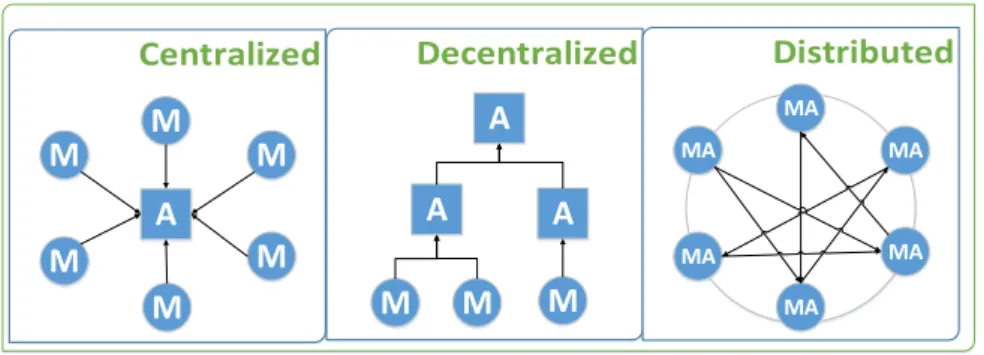
CIDS can be roughly classified according to their communication architecture, as shown in Figure4, into centralized, decentralized, and
distributedCIDS:
• CentralizedCIDSsconsist of several monitors that observe the be-havior of their respective host or the network traffic passing by. These monitors share their data with a central analysis unit. This data can be either alerts as a result of a local detection or extracted data from the local network traffic. Hence, the anal-ysis unit is either applying alert correlation algorithms on top of received alerts or standard detection algorithms on top of the received network traffic data. CentralizedCIDSsdo not scale
1 Note that, for the sake of clarity, this thesis will be using the terms,monitoring sensor