Construction work
code of practice
Safe Work Australia is an Australian Government statutory agency established in 2009.
Safe Work Australia consists of representatives of the Commonwealth, state and territory governments, the Australian Council of Trade Unions, the Australian Chamber of Commerce and Industry and the Australian Industry Group. Safe Work Australia works with the Commonwealth, state and territory governments to improve work health and safety and workers’ compensation arrangements. Safe Work Australia is a national policy body, not a regulator of work health and safety. The Commonwealth, states and territories have responsibility for regulating and enforcing work health and safety laws in their jurisdiction.
NSW note: This code of practice has been approved under section 274 of the Work Health and Safety Act 2011. Notice of that approval was published in the NSW Government Gazette referring to this code of practice as
Construction work code of practice on Friday, 18 July 2014. This code of practice commenced on Friday, 18 July 2014. ISBN 978-0-642-33361-2 [PDF]
ISBN 978-0-642-33362-9 [RTF]
Creative Commons
Except for the Safe Work Australia logo, this copyright work is licensed under a Creative Commons Attribution –
Noncommercial 3.0 Australia licence. To view a copy of this licence, visit
http://creativecommons.org/licenses/by-nc/3.0/au/
In essence, you are free to copy, communicate and adapt the work for non commercial purposes, as long as you attribute the work to Safe Work Australia and abide by the other licence terms..
Contact information Safe Work Australia Phone: +61 2 6121 5317
Email: [email protected] Website: safeworkaustralia.gov.au
Western Australia
SAFE
Contents
Foreword 3
Scope and application
4
1. Introduction
5
1.1 What is ‘construction work’? 5
1.2 What is not ‘construction work’? 6
1.3 What is a ‘structure’? 6
1.4 What is ‘high risk construction work’? 7
1.5 What is a ‘construction project’? 7
1.6 Other terms used in this code 8
1.7 Who has health and safety duties relating to construction work? 9
1.8 What is required to manage risks in construction work? 10
2. Specific duties relating to construction work
14
2.1 Persons conducting a business or undertaking 14
2.2 Officers 16
2.3 Workers 17
2.4 Other persons 17
3. Managing risks with construction work
18
3.1 Identifying hazards 18
3.2 Assessing the risks 18
3.3 Controlling the risks 19
3.4 Reviewing control measures 21
4. Safe work method statements
22
4.1 What is a safe work method statement? 22
4.2 Preparing a safe work method statement 23
4.3 Implementing a safe work method statement 24
4.4 Reviewing a safe work method statement 25
5. Work health and safety management plans for construction projects
26
5.1 What is a work health and safety management plan? 26
5.2 What must the work health and safety management plan contain? 26
5.3 How to prepare a work health and safety management plan 26
5.4 Informing people about the work health and safety management plan 27
5.5 Reviewing and revising a work health and safety management plan 27
6.3 Other training 30
6.4 Supervision 30
7. General workplace management arrangements
31
Appendix A – examples of construction work
32
Appendix B – examples of high risk construction work
35
Appendix C – design duties
37
Appendix D – safe work method statement template
41
Appendix E – safe work method statement example
44
Appendix F – preparing a work health and safety management plan
47
Appendix G – work health and safety management plan template
49
Appendix H – sample completed work health and safety management plan
51
Appendix I – housing construction workplace management arrangements
53
Foreword
This Code of Practice for construction work is an approved code of practice under section 274 of the Work Health and Safety Act (the WHS Act).
An approved code of practice is a practical guide to achieving the standards of health, safety and welfare required under the WHS Act and the Work Health and Safety Regulations (the WHS Regulations).
A code of practice applies to anyone who has a duty of care in the circumstances described in the code. In most cases, following an approved code of practice would achieve compliance with the health and safety duties in the WHS Act, in relation to the subject matter of the code. Like regulations, codes of practice deal with particular issues and do not cover all hazards or risks that may arise. The health and safety duties require duty holders to consider all risks associated with work, not only those for which regulations and codes of practice exist.
Codes of practice are admissible in court proceedings under the WHS Act and Regulations. Courts may regard a code of practice as evidence of what is known about a hazard, risk or control and may rely on the code in determining what is reasonably practicable in the circumstances to which the code relates.
Compliance with the WHS Act and Regulations may be achieved by following another method, such as a technical or an industry standard, if it provides an equivalent or higher standard of work health and safety than the code.
An inspector may refer to an approved code of practice when issuing an improvement or prohibition notice. This Code of Practice has been developed by Safe Work Australia as a model code of practice under the Council of Australian Governments’ Inter-Governmental Agreement for Regulatory and Operational Reform in Occupational Health and Safety for adoption by the Commonwealth, state and territory governments.
Scope and application
This Code provides guidance to principal contractors and other persons conducting a business or undertaking who carry out construction work on how to meet the health and safety requirements under the WHS Act and Regulations relating to construction work.
Housing construction work
While the information and guidance contained in this code is relevant to all types of construction work, additional
guidance marked with this symbol is provided for businesses working within the housing construction sector.
Relationship with other codes
This Code should be read in conjunction with other codes of practice on specific hazards and control measures relevant to the construction industry including:
•
Demolition work•
Excavation work•
Managing the risk of falls at workplaces•
Managing noise and preventing hearing loss at work•
Preventing falls in housing construction•
Confined spaces•
Hazardous manual tasks•
Safe design of structures•
Managing the work environment and facilities•
Managing electrical risks in the workplace•
How to manage and control asbestos in the workplace•
How to safely remove asbestos.How to use this Code of Practice
In providing guidance, the word ‘should’ is used in this Code to indicate a recommended course of action, while ‘may’ is used to indicate an optional course of action.
This Code also includes various references to sections of the WHS Act and Regulations which set out the legal requirements. These references are not exhaustive. The words ‘must’, ‘requires’ or ‘mandatory’ indicate that a legal requirement exists and must be complied with.
1. Introduction
This Chapter describes a number of key terms used in the WHS Act and Regulations and within this Code to help duty holders understand what type of construction work is covered by the legislation and what the related duties are.
1.1 What is ‘construction work’?
Regulation 289
Construction work is defined as any work carried out in connection with the construction, alteration, conversion, fitting-out, commissioning, renovation, repair, maintenance, refurbishment, demolition, decommissioning or dismantling of a structure. Construction work can be commercial, civil or housing construction and includes the following:
•
any installation or testing carried out in connection with an activity referred to in the above definition•
the removal from the workplace of any product or waste resulting from demolition•
the prefabrication or testing of elements, at a place specifically established for the construction work, for use inconstruction work
•
the assembly of prefabricated elements to form a structure, or the disassembly of prefabricated elementsforming part of a structure
•
the installation, testing or maintenance of an essential service in relation to a structure•
any work connected with an excavation•
any work connected with any preparatory work or site preparation (including landscaping as part of sitepreparation) carried out in connection with an activity referred to in the above definition
•
an activity referred to in the above definition that is carried out on, under or near water, including work onbuoys and obstructions to navigation.
‘In connection with’ means related to or associated with construction work. Contracts covering a project are a good guide to what activities are done in connection with construction. Examples include:
•
work by architects or engineers in on-site offices or conducting on-site inspections, but not architects orengineers working in offices away from the construction site
•
work by a mechanic on an excavator on-site and not in an isolated service area•
delivering building materials to different points on the site, but not making deliveries to a single designateddelivery area
•
excavating for a basement garage•
testing fire equipment on the construction site•
supervisors and manager moving around the site to monitor work•
surveying a site after construction has started, but not surveying a Greenfield site before construction hasstarted
•
traffic control on a construction site.‘In connection with’ does not include planning and design activities that might have been carried out prior to commencing the construction work.
For the purposes of this Code, housing construction work involves construction work relating to the following:
•
detached houses•
attached dwellings, separated from each other by a fire resisting wall, such as terrace, row or town houses•
villa-homes, strata or company title home units or residential flats•
boarding and guest houses, hostels or similar with a floor area <300m², and•
ancillary buildings to the above, such as private garages, gazeboes and carports.The above are based on classes 1, 2 and 10 of the Building code of Australia. Work on multi-storey buildings, ie above three habitable storeys, is not considered housing construction work for the purposes of this Code.
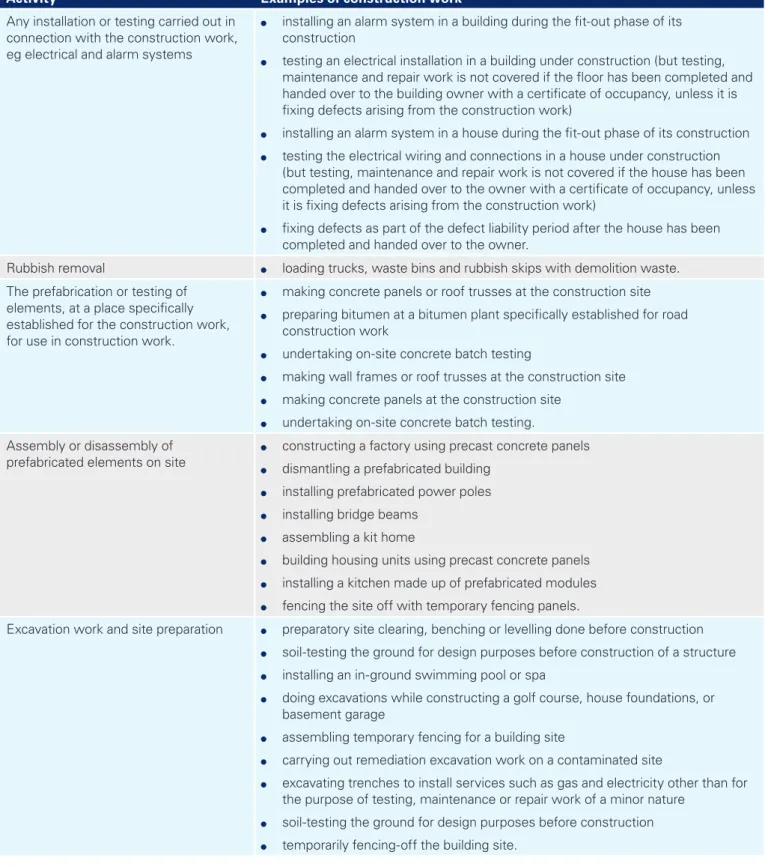
Examples of construction work are provided in Table 1 at Appendix A.
1.2 What is not ‘construction work’?
Construction work does not include any of the following:
•
the manufacture of plant•
the prefabrication of elements, other than at a place specifically established for the construction work for usein the construction work
•
the construction or assembly of a structure that, once constructed or assembled, is intended to be transportedto another place
•
testing, maintenance or repair work of a minor nature carried out in connection with a structure•
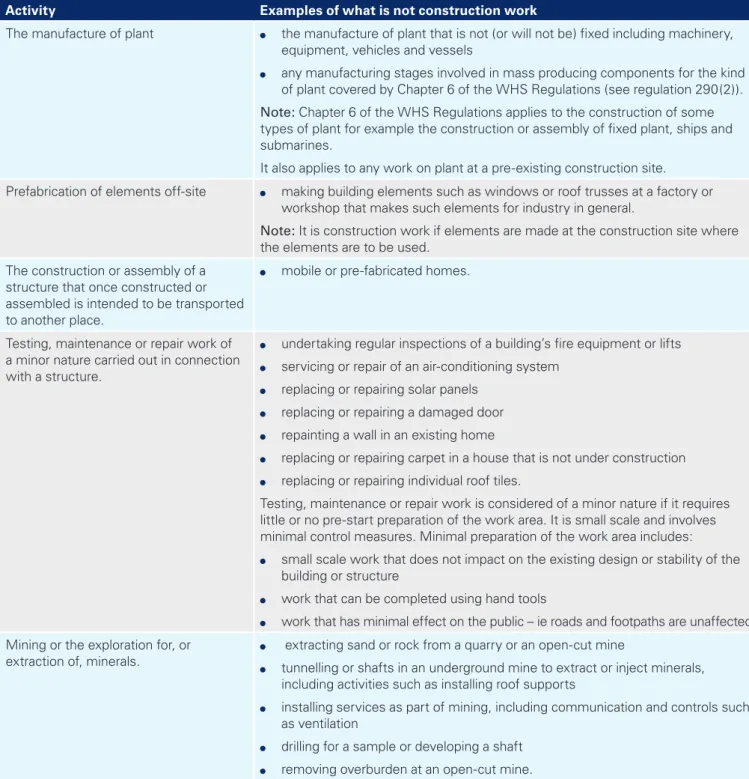
mining or the exploration for or extraction of minerals.Examples of what is not construction work are provided in Table 2 at Appendix A.
1.3 What is a ‘structure’?
The WHS Act defines a structure as anything that is constructed, whether fixed or moveable, temporary or permanent. A structure includes:
•
buildings, masts, towers, framework, pipelines, transport infrastructure and underground works (shafts ortunnels), for example noise reduction barriers on a freeway, communications masts or towers, electricity transmission towers and associated cables, flying cables and supports, guyed towers such as a ski-lift tower
•
any component of a structure•
part of a structure.Examples of a structure include the following:
•
a roadway or pathway•
a ship1 or submarine•
foundations, earth retention works and other earthworks, including river works and sea defence works•
formwork, falsework or any other structure designed or used to provide support, access or containment duringconstruction work, for example a prop or formwork system
•
an airfield1 A vessel is considered to be a ‘ship’ to which the WHS Regulations would apply if: • the vessel is registrable as a ‘ship’ under a state, territory or Commonwealth law
• the construction or assembly of the vessel involves traditional construction methods, for example use of scaffolding or mobile cranes, or • multiple contractors will be required to carry out the work.
•
a dock, harbour, channel, bridge, viaduct, lagoon or dam•
a sewer or sewerage or drainage works, for example storm water drains, sheet piling to divert the course ofa river or to build a cofferdam, underground storage tanks for an irrigation system, road tunnels, ventilation or access shaft for underground services.
Examples of structures relating to housing construction work may include:
•
carport, pergola, tool shed, tennis court, shade sails, awnings•
an in-ground swimming pool•
foundations, earth retention works and other earthworks•
a structure designed or used to provide support, access or containment during construction work,– eg a prop or formwork system
•
a sewer, a septic tank, or storm water drain.Chapter 6 of the WHS Regulations (ie the Construction Work chapter) does not apply to plant unless:
•
the plant is:a ship or submarine a pipe or pipeline an underground tank
designed or used to provide support, access or containment during work in connection with construction work, for example fall prevention devices, work position systems, formwork, personnel or material hoists where these are used in connection with construction work.
•
work on the plant relates to work that is carried out in connection with construction work•
the plant is fixed plant on which outage work or overhaul work that involves or may involve work being carriedout by five or more persons conducting businesses or undertakings at any point in time.
1.4 What is ‘high risk construction work’?
Regulation 291 provides a list of construction work that is considered to be high risk for the purposes of the WHS Regulations. It is construction work for which a safe work method statement (SWMS) is required. Chapter 4 of this Code provides more detail on SWMS.
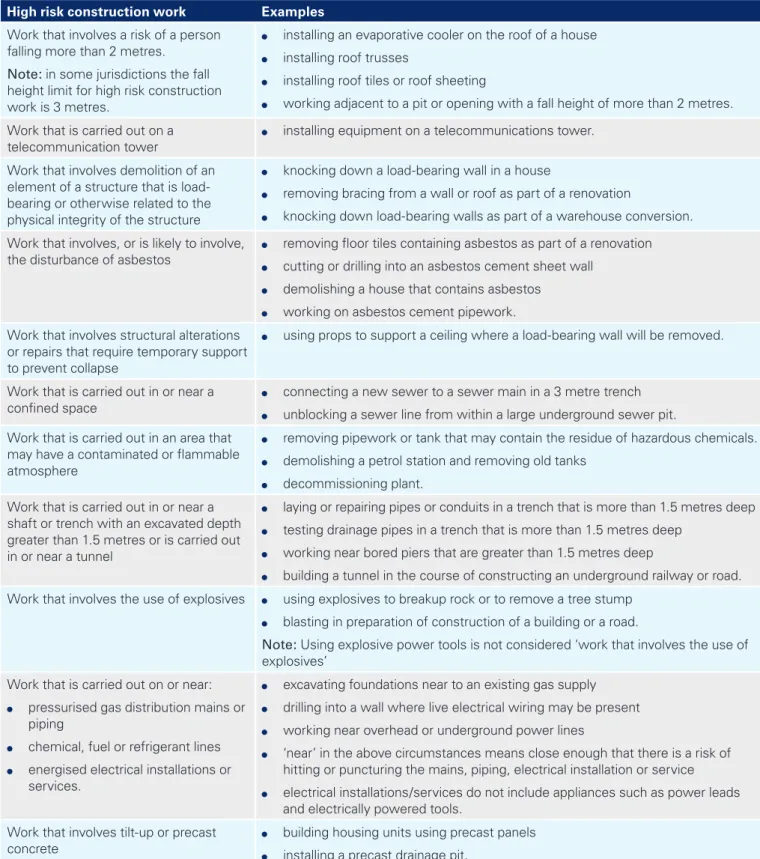
Examples of high risk construction work are provided in Appendix B.
1.5 What is a ‘construction project’?
Regulation 292
A construction project is a project that involves construction work where the cost of the construction work is $250,000 or more. A construction project covers all the activities involved in the construction work up to the point that the construction project is handed over to the person who commissioned it. The handover usually takes place at the practical completion of the project when, for example, a house is considered habitable and the buyer or owner takes possession.
Valuing construction work
•
any taxes, levies or charges (other than GST) paid or payable in connection with the work by or under any law. The cost of the construction work would not include:•
the cost of the land on which the development is to be carried out, including the civil engineering, utility andother land development cost involved in a land subdivision.
•
the costs associated with marketing or financing the development (including interest on any loans)•
the costs associated with legal work carried out or to be carried out in connection with the development.Principal contractor
Under the WHS Regulations, each ‘construction project’ must have a ‘principal contractor’. There can only be one principal contractor for a construction project at any one time. A principal contractor is a person conducting a business or undertaking (PCBU).
The person conducting a business or undertaking that commissions a construction project is the principal contractor, unless the person appoints another person conducting a business or undertaking to be the principal contractor and authorises the person to have management or control of the workplace and discharge the duties of the principal contractor.
A principal contractor can be a sole trader of a business or undertaking, a company or a partnership. In the case of a company, the company has the duties of the principal contractor rather than the individual managers who are employed by the company. In the case of a partnership, each partner is responsible for the duties of the principal contractor.
1.6 Other terms used in this code
Builder
This is a PCBU that commissions the construction work and is authorised to manage, control and coordinate the construction work at the workplace. For construction projects they are referred to as the ‘principal contractor’.
Subcontractor
This is a PCBU that enters into a contract with a builder or principal contractor to undertake specified construction work. They are also ‘workers’.
Owner-builder
Generally, a person who builds their own home will have been issued with an owner-builder permit, license or
certificate2 and will be considered to be a PCBU. Owner-builders have management or control of the workplace and
take on the responsibility and liability that would normally fall on the principal contractor. Owner-builders must ensure, so far as is reasonably practicable, the health and safety of any workers they engage such as electricians, plumbers and gasfitters. Building laws may also impose certain requirements.
A person is not considered to be an owner-builder or a PCBU if they:
•
are a home buyer, owner or occupier commissioning work on their home, or•
are an individual undertaking maintenance, refurbishment or minor renovations of their own home orhelping a friend.
Designer
A designer is a person conducting a business or undertaking that designs a structure that is to be used or could reasonably be expected to be used, as or at, a workplace, including during construction, maintenance, renovation or demolition of the structure.
1.7 Who has health and safety duties relating to construction work?
Everyone involved in construction work has health and safety duties when carrying out the work.
The primary duty under the WHS Act requires a person conducting a business or undertaking to ensure, so far as is reasonably practicable, that workers and other persons are not exposed to health and safety risks arising from the business or undertaking.
Multiple duties
The nature of construction work means that there are various businesses or undertakings with duties relating to construction work. It can involve a person conducting a business or undertaking who:
•
carries out construction work•
designs the building or structure•
commissions the construction work (except for a home-owner where they are not a PCBU)•
is a principal contractor•
has management or control of a workplace at which construction work is carried out•
carries out high risk construction work.Other duty holders that have responsibilities under the WHS Act and Regulations are:
•
officers – eg company directors•
workers•
other persons – eg visitors to construction sites.It is common in the construction industry for a person to fall into more than one duty holder category. For example, a principal contractor will have the duties of a principal contractor as well as other duties of a PCBU. A subcontractor is a PCBU and can also be a worker when working at a construction workplace.
Shared duties
More than one person can have the same duty. Where two or more people have the same duty, each person must comply with that duty, even if another duty holder has the same duty. This is, however, qualified by the extent to which:
•
the person has the capacity to influence and control the matter, or•
would have had that capacity but for an agreement or arrangement purporting to limit or remove that capacity.This means that a person cannot contract out of their health and safety duties, but can make arrangements with other PCBUs to do the things that will meet the duties on their behalf.
For example a principal contractor and a subcontractor, as PCBUs, will have the same duty to ensure access to first aid facilities at a workplace. It may not be practical or necessary for both PCBUs to provide the first aid facilities, so they may arrange for only one of them to provide the facilities. In doing this and confirming the facilities are in place and accessible to workers, each PCBU has ‘ensured access to first aid facilities’ and therefore complied with their duty.
Determining which person or persons have the capacity to influence and control the work depends on the circumstances at the time.
For example at a housing construction site subcontractors have the capacity to directly manage the risks associated with their own work and the activities of any worker they engage to carry out the work. The principal
Although a principal contractor or builder may not be present on site at all times, they must still ensure the work is being carried out safely. The principal contractor or builder should check the subcontractor’s work procedures and any SWMS (if relevant) to ensure risks associated with the work are addressed and then visit the site as necessary to verify the work is being carried out safely.
In all cases, people are expected to take reasonable care for their own safety and the safety of others.
1.8 What is required to manage risks in construction work?
Regulation 297
A person conducting a business or undertaking must manage risks associated with the carrying out of construction work.
Regulation 32–38
In order to manage risk under the WHS Regulations, a duty holder must:
• identify reasonably foreseeable hazards that could give rise to the risk
• eliminate the risk, so far as is reasonably practicable
• if it is not reasonably practicable to eliminate the risk, minimise the risk so far as is reasonably practicable by implementing
control measures
• maintain the control measure so that it remains effective, and
• review, and if necessary revise, control measures so as to maintain, so far as is reasonably practicable, a work
environment that is without risks to health and safety.
Chapter 3 of this Code provides guidance on managing the risks associated with construction work by following a systematic process that involves:
•
identifying hazards•
if necessary, assessing the risks associated with these hazards•
implementing control measures•
maintaining and reviewing the effectiveness of control measures.Guidance on the risk management process is available in the Code of practice: how to manage work health and safety risks.
In addition to the duties covered in this Code, there are other requirements under the WHS Regulations that may apply to construction work – eg:
•
prevention of falls•
noise•
hazardous manual tasks•
confined spaces•
demolition work•
electrical safety and electrical work•
plant and structures•
high risk work (licensing and registrations)•
hazardous chemicals, asbestos and leadConsulting, cooperating and coordinating activities with other duty holders
Consultation is a legal requirement and an essential part of managing health and safety when carrying out construction work.
A safe workplace is more easily achieved when everyone involved in the work communicates with each other to identify hazards and risks, talks about any health and safety concerns, and works together to find solutions. This includes cooperation between the people who manage or control the work and those who carry out the work or who are affected by the work.
Section 46
A person conducting a business or undertaking must consult, cooperate and coordinate activities with all other persons who have a work health or safety duty in relation to the same matter, so far as is reasonably practicable.
Since various contractors and subcontractors work on the same construction site, their activities are likely to overlap and interact with each other. They each have a duty to protect the health and safety of workers and other persons at the workplace and must therefore consult, cooperate and coordinate activities to ensure each person is made aware of what the others are doing, to identify the hazards and risks and decide who is best placed to take action to control the risks.
Principal contractors for a construction project have specific duties under the WHS Regulations to include
arrangements in their WHS management plan that outline how persons conducting a business or undertaking at the workplace will consult, cooperate and coordinate activities between each other.
One of the ways in which PCBUs should do this is by discussing WHS arrangements with other duty holders, including other subcontractors, prior to commencing work – eg by visiting the site or by phone, fax or email. Subcontractors working on the same site should also discuss their activities with each other directly.
Examples of consultation, cooperation and coordination on construction workplaces Example 1:
As part of work for a builder, a roof tile subcontractor installs a roof perimeter guardrail system to minimise the risk of falls. The builder reaches an agreement with the roof tiler that the guardrail will remain in place until solar panels are installed by another subcontractor. The roof tiler contacts both the builder and the panel installer when the tiling is complete, and the panel installer checks to make sure the guardrail is properly installed before commencing work. The panel installer then lets the builder know when the panels are finished, and arrangements are then made to dismantle the guardrail. The builder also checks the progress of the work regularly and ensures that the relevant fall protection information is included in each subcontractor’s SWMS and is properly installed on site.
Example 2:
An electrician needs to isolate the electricity supply so that they can work safely. At the same time, a carpenter requires electricity for powered equipment. If the electrician doesn’t communicate with the carpenter about the electricity shut off, and if the carpenter reconnects the supply, this increases the risk of injury to them both. The electrician should speak with both the carpenter and the builder to advise that the electricity supply will be shut off and negotiate the time during which electricity will be unavailable. The carpenter should check with the electrician to make sure it is safe to use the electricity supply.
Example 3:
A plumber’s work on one site is delayed, so he decides to continue work on another job. On the way to the second site, the plumber telephones the builder of the home and leaves a message that the plumber will be
Consulting workers
Section 47
The WHS Act requires the PCBU to consult, so far as is reasonably practicable, with workers who carry out work for them who are (or are likely to be) directly affected by a work health and safety matter.
Section 48
If the workers are represented by a health and safety representative, the consultation must involve that representative. The broad definition of a ‘worker’ under the WHS Act means that a PCBU must consult with their employees and anyone else who carries out work for their business or undertaking, including contractors, apprentices, subcontractors and their employees. The builder and subcontractors, as PCBUs, share this duty.
‘Consultation’ includes
•
sharing information with workers•
giving them a reasonable opportunity to express their views and raise issues•
giving them a reasonable opportunity to contribute to the decision-making process•
considering the views of the workers•
advising workers of the outcome of the consultation.Some of the matters that should be discussed with workers include
•
identifying risks to work safety at the workplace•
measures to be taken to manage risks, such as permit to work systems, SWMS, WHS management plans•
adequacy of facilities•
proposing changes that may directly affect work safety•
policies and procedures, such as site safety rules and incident notification.In many cases, decisions about construction work and construction projects are made prior to engaging workers. In that case, it may not be possible to fully consult with workers in these early stages. However, it is important to consult with them as the construction work progresses.
At its most basic level, consultation should involve talking to each other about work health and safety. Consultation can occur by holding discussions with workers face-to-face or by phone, fax, email or other networks. Where workers are culturally or linguistically diverse or are inexperienced then face-to-face consultation may be more effective.
For example, the builder or principal contractor can communicate with subcontractors via face-to-face meetings, email, phone or fax, and request that information is passed on to the subcontractor’s workers. It is important that the builder follows up with the workers and the subcontractors to check the information has been passed on, and that any feedback is provided to the builder. This may take place when the builder or his representative is on site. Other options include conducting toolbox talks; sending out information on-line and requesting feedback; or using telephone hook-ups.
Consultation may also occur through the builder talking to subcontractors and asking them to share information with the subcontractor‘s workers and pass any feedback back to the builder.
Toolbox talks or pre-start meetings can be used by both the builder and subcontractors to provide information to and receive feedback from workers as well as assist in raising the awareness of how construction work can be carried out in a safe and healthy manner.
At a toolbox talk, the PCBU can provide updates on any upcoming issues which may have an effect on health and safety, for example:
•
new high risk construction activities•
changes in access and site security•
changes which may affect members of the public.When using toolbox talks it is considered best practice to:
•
keep a record of the topic covered, attendees and any feedback received•
organise a program of toolbox talks to give workers sufficient opportunity to provide input into how risksshould be controlled
•
monitor the effectiveness of toolbox talks through safety outcomes (for example, control measuresimplemented and near misses).
Further guidance on consultation is available in the Code of practice: work health and safety consultation, cooperation and coordination.
2. Specific duties relating to construction work
2.1 Persons conducting a business or undertaking
Designers
PCBUs who design a structure that is to be used, or could reasonably be expected to be used as, or at, a workplace have specific WHS duties.
There may be multiple designers who are involved in the design of a structure and have the same duties, for example draftspersons, building designers, architects and engineers. A builder could be a designer if they design a structure themselves or are involved in altering the design for a building, even after construction work has commenced. In relation to construction work, a designer of a structure or any part of a structure that is to be constructed must give a written report to the PCBU who commissioned the design. The report must specify, so far as the designer is reasonably aware, the hazards relating to the design that create a risks to the health and safety of persons who will carry out construction work on the structure and that are specific to the particular design.
In addition the designer can provide information to anyone who is issued with the design on how they have designed the structure to be without risk to health and safety throughout its lifecycle when it is used as a workplace if they request it. This includes during construction, maintenance, use and demolition. This information may also be included in the designers’ safety report.
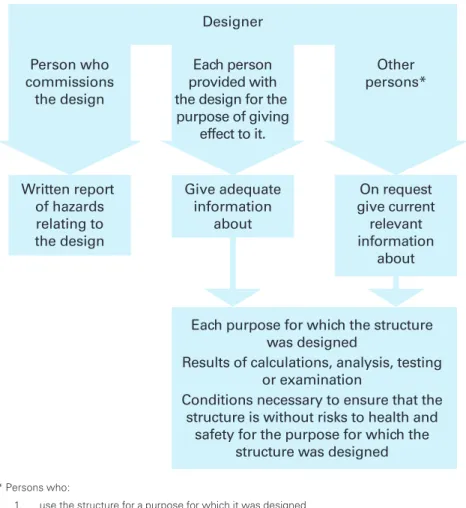
Further information is provided in Appendix C. For detailed guidance on designers’ duties refer to the Code of practice: safe design of structures.
Person that commissions construction work
The WHS Regulations require a person conducting a business or undertaking that commissions construction work to:
•
consult, so far as is reasonably practicable, with the designer of the whole or any part of the structureabout how to ensure that risks to health and safety arising from the design during the construction work are eliminated, so far as is reasonably practicable, or if it is not reasonably practicable to eliminate the risks, minimised so far as is reasonably practicable. Such consultation must include giving the designer any information that the person has in relation to the hazards and risks at the workplace where the construction work is to be carried out
•
take all reasonable steps to obtain a copy of the designer’s safety report if they did not themselvescommission the design of the construction project
•
give the principal contractor any information they have in relation to hazards and risks at or in the vicinity of theworkplace where the construction project is to be carried out.
While there may be persons who represent the person that commissions the construction work or a construction project and coordinate the commissioning (e.g. project managers, construction managers, architects or engineers), the person that actually commissions the work will remain the duty holder.
Examples of persons that commission construction work include:
•
a builder engaging a designer to design a large spanning roof truss system for a home•
property developers, clients, owner-buildersPrincipal contractor3
Under the WHS Regulations a principal contractor for a construction project must:
•
ensure signs are installed that:show the principal contractor‘s name and telephone contact numbers (including an out of hours telephone number)
show the location of the site office for the project, if there is one
are clearly visible from outside the workplace, or the work area of the workplace, where the construction project is being undertaken.
•
prepare and review the WHS management plan for the workplace, ensuring, so far as is reasonably practicable,that each person who is to carry out the construction work is made aware of the plan, their right to inspect it and ensuring that a copy of the WHS management plan is accessible for the appropriate amount of time.
•
obtain the SWMS before high risk construction work on the construction project commences.•
make arrangements for ensuring compliance with the requirements for general workplace management inPart 3.2 of the WHS Regulations.
•
manage the specific risks to health and safety associated with:the storage, movement and disposal of construction materials and waste at the workplace the storage of plant that is not in use
traffic in the vicinity of the workplace that may be affected by construction work carried out in connection with the construction
essential services at the workplace.
More detail on the WHS management plan is in Chapter 5 of this Code. Information on the role of the principal contractor in general workplace management arrangements is in Chapter 7 of this Code.
Persons who have management or control of a construction workplace
A person with management or control of a workplace at which construction work is carried out must:
•
ensure, so far as is reasonably practicable, that the workplace is secured from unauthorised access, havingregard to all relevant matters, including risks to health and safety arising from unauthorised access to the workplace, the likelihood of unauthorised access occurring and, to the extent to which it cannot be prevented, how to isolate hazards within the workplace
•
obtain essential services information when excavation work is to be carried out and provide it to any personengaged to carry out the excavation work.
Depending on the circumstances, both the builder and subcontractors may have these duties in relation to the part of the workplace over which they have management or control.
For example, the person with management or control of the workplace must take all reasonable steps to ensure underground essential services information is obtained prior to directing or allowing excavation work to commence. Both the builder and excavation subcontractor must consult with each other to decide who will obtain the required information before the work starts. If the builder obtains the information, the information must be provided to the excavation subcontractor and the excavation subcontractor must provide it to the workers engaged to carry out the work. The excavation contractor can also ask for this information to ensure they carry out their work safely.
Both the builder and subcontractors would also have a duty to ensure, so far as is reasonably practicable, that subcontractors’ work areas are secured against unauthorised access prior to leaving the site if hazards are present. For example, both duty holders must ensure that the risk of anyone falling into open excavations after hours is eliminated or minimised so far as is reasonably practicable. The duty holders should consult to reach an agreement as to who should actually secure the site. The excavation subcontractor might undertake to barricade the excavation area in an agreed way and the builder might undertake to fence off the construction site to prevent unauthorised persons entering the site.
Bricklaying subcontractors working on site by themselves should secure their scaffolds, for example by removing access ladders prior to leaving the site. As the builder also has a duty to ensure health and safety in relation to scaffolds at the workplace, they should consult, cooperate and coordinate with the bricklaying subcontractor to determine how any risks will be managed (ie the way in which the scaffold will be secured). This might be as simple as having a discussion and agreeing that the subcontractor will secure the scaffold in a way that is determined to be safe.
Persons carrying out high risk construction work
The WHS Regulations place obligations on persons conducting a business or undertaking that includes the carrying out of high risk construction work to:
•
ensure that a SWMS is prepared before the proposed work commences•
make arrangements to ensure that the high risk construction work is carried out in accordance with the SWMS•
ensure that a copy of the SWMS is given to the principal contractor before the work commences•
ensure that the SWMS is reviewed and revised if necessary•
keep a copy of the SWMS until the high risk construction work is completed, or if a notifiable incident occurs inconnection with the high risk construction work, for at least two years after the incident occurs
•
ensure that for the period the SWMS must be kept it is readily accessible to any worker engaged to carry outthe high risk construction work and for inspection under the Act (eg by an inspector).
Other duties
Apart from the specific duties outlined above, a person conducting a business or undertaking must:
•
manage risks to health and safety when excavation work is being carried out and comply with therequirements of the WHS Regulations regarding the excavation of trenches
•
comply with the requirements of the WHS Regulations in relation to general construction induction training.2.2 Officers
Officers, for example company directors, have a duty under the WHS Act to exercise due diligence to ensure that the person conducting the business or undertaking complies with its duties and obligations under the WHS laws. Exercising ‘due diligence’ includes taking reasonable steps to:
•
have up-to-date knowledge of work health and safety matters•
gain an understanding of the organisation’s operations, including its hazards and risks•
ensure that the PCBU has available for use, and uses, appropriate resources and processes to eliminate orminimise risks to health and safety that arise from the construction work
•
ensure that the PCBU has appropriate processes for receiving, considering and responding to informationabout hazards, risks and incidents
•
ensure that the PCBU has, and implements, processes for complying with its work health and safety duties2.3 Workers
A worker is any person who carries out work in any capacity for a business or undertaking. Workers include direct employees, subcontractors and employees of subcontractors, employees of labour hire companies and apprentices. Workers must always:
•
take reasonable care for their own health and safety•
take reasonable care that their acts or omissions do not adversely affect the health and safety of otherpersons, and
•
comply with any reasonable instruction and cooperate with any reasonable policy or procedure relating tohealth and safety at the workplace. In relation to construction work, workers must:
•
keep their general construction induction training card available for inspection, or•
if awaiting a decision on their application for a general construction induction training card – keep their generalinduction training certification available for inspection.
Subcontractors must comply with both the duties of workers and of PCBUs. Self-employed PCBUs are also workers for their own business or undertaking.
2.4 Other persons
Other persons at the workplace, for example inspectors and visitors to construction sites (including home owners and potential buyers), have a duty to:
•
take reasonable care for their own health and safety•
take reasonable care that their acts or omissions do not adversely affect the health and safety of other persons3. Managing risks with construction work
3.1 Identifying hazards
The first step in the risk management process is to identify the hazards associated with construction work. Examples of hazards include:
•
the construction workplace itself, including its location, layout, condition and accessibility•
the use of ladders, incorrectly erected equipment, unguarded holes, penetrations and voids, unguardedexcavations, trenches, shafts and lift wells, unstable structures such as incomplete scaffolding or mobile platforms, fragile and brittle surfaces such as cement sheet roofs, fibreglass roofs, skylights and unprotected formwork decks
•
falling objects, for example tools, debris and equipment•
collapse of trenches•
structural collapse•
the handling, use, storage, and transport or disposal of hazardous chemicals•
the presence of asbestos and asbestos-containing materials•
welding fumes, gases and arcs•
hazardous manual tasks•
the interface with other works or trade activities•
the physical working environment, for example the potential for electric shock, immersion or engulfment, fireor explosion, slips, trips and falls, people being struck by moving plant, exposure to noise, heat, cold, vibration, radiation (including solar UV radiation), static electricity or a contaminated atmosphere, and the presence of a confined space.
3.2 Assessing the risks
Assessing the risk includes considering:
•
the severity of any injury or illness that could occur, for example is it a small isolated hazard that could result ina very minor injury or is it a significant hazard that could have wide ranging and severe affects
•
the likelihood or chance that someone will suffer an illness or injury, for example consider the number ofpeople exposed to the hazard.
Under the WHS Regulations, a risk assessment is not mandatory for construction work however it is required for specific situations, for example when working with asbestos. In many circumstances a risk assessment will assist in determining the control measures that should be implemented.
It will help to:
•
identify which workers are at risk of exposure•
determine what sources and processes are causing that risk•
identify if and what kind of control measures should be implemented•
check the effectiveness of existing control measures.3.3 Controlling the risks
The WHS Regulation may require specific control measures to be implemented in certain circumstances. For example, the risk of collapse of trenches 1.5 metres or more in depth must be controlled with shoring, benching or battering. Where specific controls are prescribed, these must be implemented before work proceeds.
The hierarchy of control measures
Some control measures are more effective than others. Control measures can be ranked from the highest level of protection and reliability to the lowest. This ranking is known as the hierarchy of control. The higher order controls must always be considered first.
Eliminating the risk
This means removing the hazard or hazardous work practice from the workplace. This is the most effective control measure and must always be considered before anything else – eg eliminate the risk of a fall from a height by doing the work at ground level.
If elimination of the risk is not reasonably practicable, you must consider using substitution, isolation or engineering controls, or a combination of these control measures, to minimise the risk.
Minimising the risk by using one of the following control measures
Substitution
Minimise the risk by substituting or replacing a hazard or hazardous work practice with a less hazardous one – eg:
•
Substituting a two-part epoxy substance with a water-based acrylic waterproofing system will minimiseexposure to a hazardous substance;
•
Substituting an ordinary brick-cutting saw blade with a noise-reduced saw blade will minimise exposure tohazardous noise; and
•
Using a water-based paint rather than a solvent-based paint.Isolation
Minimise the risk by isolating or separating the hazard or hazardous work practice from people – eg:
•
Isolating a mobile plant work zone from workers and/or the public with physical barriers to minimise the riskof contact occurring between a person and the mobile plant.
Engineering Controls
Engineering controls are physical control measures to minimise risk – eg:
•
Carrying tools from one level to another with a material hoist or craning material will minimise the risk ofworkers developing a musculoskeletal disorder.
•
Benching, battering or shoring the sides of the excavation will minimise the risk of a person being trapped andprevent the excavation from collapsing.
•
Enclosing an open cab excavator, for example using a falling object protective structure (FOPS) or a roll-overprotective structure (ROPS), will minimise the risk of an operator being struck by a falling object or being crushed if the excavator rolls over.
Minimising the risk using administrative controls
Administrative controls should only be considered when other higher order control measures are not practicable, or to increase protection from the hazard. These are work methods or procedures designed to minimise the exposure to a hazard, such as ensuring there is no unauthorised entry of a person to a work area – eg:
•
using a ‘keep out’ sign and a person to secure an exclusion zone when dismantling scaffolding to minimise therisk of people entering the work area and being struck by a falling object.
•
scheduling tasks so they are completed outside peak UV radiation times to reduce exposure to UV radiation.•
implementing a training program to show workers how to use new equipment.•
implementing a job rotation system.•
using permit systems to prevent unauthorised persons from entering a confined space.Minimising the risk using personal protective equipment
Personal protective equipment (PPE) is the lowest order control measure in the hierarchy of controls. PPE should also only be considered when other higher order control measures are not reasonably practicable or to increase protection from the hazard.
PPE relies on the proper fit and use of the PPE and does nothing to change the hazard itself. It therefore requires thorough training and effective supervision to ensure compliance and effectiveness. Examples of PPE include:
•
wide brimmed hats that shade face, head, neck and ears (where hard hats are required then it should be a hardhat brim or neck flap), sunglasses and broad spectrum SPF 30 or higher sunscreen to minimise the exposure to ultraviolet (UV) radiation.
•
high visibility reflective clothing or vests.•
ear plugs or ear muffs to minimise the risk of exposure to excessive noise when operating noisy machineryand power tools.
Combination of control measures
In many cases a combination of control measures may be implemented to control a risk. When selecting and implementing a combination of control measures it is important to consider whether any new risks might be introduced as a result and, if so, whether the combination of the control measures should be reviewed.
Example 1
To manage the risk of a fall when a worker is removing old roofing on a building under demolition, control measures may include the following:
•
determine whether the roof can be demolished from the ground (elimination)•
if this is not reasonably practicable, minimise the risk of a fall by working off scissor lifts and/or elevating workplatforms (engineering control)
•
provide training on site rules and SWMS about work at heights (administrative control).Example 2
To manage the risk of persons working in the same area from being struck by mobile plant, control measures may include:
•
using traffic lights instead of a traffic controller to control traffic at road works (elimination)•
replacing an item of mobile plant which has a restricted field of vision to one that has a clear field of vision(substitution)
•
using zero tail swing excavators rather than conventional tail swing excavators (substitution)•
installing collision avoidance technology (in accordance with manufacturer’s instructions) when the vehicle is reversing (engineering)•
developing and implementing a traffic management plan for any traffic control being carried out(administrative)
•
requiring all workers to wear high visibility reflective clothing or vests (PPE).Regulation 37
Implemented control measures must be maintained to ensure they are fit for purpose, suitable for the nature and duration of the work, and are installed, set up and used correctly.
3.4 Reviewing control measures
The control measures that are put in place to protect health and safety should be regularly reviewed to make sure they are effective. A review should occur on a regular basis and can be done by using the same methods as the initial hazard identification process. Common methods include workplace inspection, consultation, testing and analysing records and data. Reviewing the control measures also involves considering whether a higher order control measure is now reasonably practicable.
Regulation 38
You must review your control measures and, if necessary, revise them:
• when the control measure is not effective in controlling the risk
• before a change at the workplace that is likely to give rise to a new or different health and safety risk that the control
measure may not effectively control
• if a new relevant hazard or risk is identified
• if the results of consultation indicate that a review is necessary, or
• if a health and safety representative requests a review.
When reviewing control measures, the SWMS must also be reviewed and revised where necessary.
If problems are found, go back through the risk management steps, review your information and make further decisions about control measures.
A change at the workplace includes:
•
a change to the workplace itself or any aspect of the work environment•
a change to a system of work, a process or a procedure.Where a SWMS has been developed for high risk construction work or a WHS management plan has been
developed for a construction project, these documents must also be reviewed and revised (where necessary) when control measures have been reviewed.
4. Safe work method statements
4.1 What is a safe work method statement?
A safe work method statements (SWMS) is required for the 18 high risk construction work activities defined in the WHS Regulations. Examples of high risk construction work are provided in Appendix B.
A SWMS is a written document that sets out the high risk construction work activities to be carried out at a
workplace, the hazards and risks arising from these activities and the measures to be put in place to control the risks. Its primary purpose is to help supervisors and workers implement and monitor the control measures established at the workplace to ensure high risk construction work is carried out safely.
For all other construction activities a SWMS is not required. However, a person conducting a business or undertaking must manage risks to health and safety by eliminating or minimising risks so far as is reasonably practicable.
Who is responsible for preparing a safe work method statement?
A person conducting a business or undertaking must prepare a SWMS – or ensure a SWMS has been prepared – before high risk construction work starts.
The person responsible for carrying out the high risk construction work is best placed to prepare the SWMS in consultation with workers who will be directly engaged in the high risk construction work. This person understands the work being carried out, is responsible for providing training, instruction and supervision to the workers
undertaking the work and can ensure the SWMS is implemented, monitored and reviewed correctly. If more than one person has the duty to ensure a SWMS is or has been prepared, they must consult with each other to co-ordinate who will be responsible for actually preparing it.
There may be situations where there are different types of high risk construction work occurring at the same time at the same workplace, for example if work is being carried out:
•
where there is a risk of a person falling more than 2 metres•
near a trench with an excavated depth greater than 1.5 metres.In these cases one SWMS may be prepared to cover all high risk construction work activities being carried out at the workplace. Alternatively, a separate SWMS can be prepared for each type of high risk construction work. If separate SWMS are prepared, consider how the different work activities may impact on each other and whether this may lead to inconsistencies between control measures.
Example
A subcontractor, such as a roof plumber, is engaged to install roof sheeting on a structure that is higher than 2 metres. A second subcontractor is engaged to use a crane to lift the roof sheeting so the first subcontractor can install it. Both subcontractors are required to prepare a SWMS for the high risk construction work being carried out – that is for the work where there is a risk of falling more than 2 metres and for the work involving powered mobile plant.
In this case, the subcontractors may decide to prepare one SWMS to cover both types of high risk construction work or they may decide to prepare two separate SWMS. If separate SWMS are being prepared, the subcontractors must consult, co-operate and co-ordinate to ensure the work will be carried out safely. The builder or principal contractor must be provided with the SWMS and monitor their activities.
4.2 Preparing a safe work method statement
Safe work method statement content
Regulation 299(2)
A safe work method statement must:
• identify the work that is high risk construction work, and
• specify hazards relating to the high risk construction work and risks to health and safety associated with those hazards, and
• describe the measures to be implemented to control the risks, and
• describe how the control measures are to be implemented, monitored and reviewed.
A template SWMS is at Appendix D. This template outlines the information which must be included in a SWMS and other information which should be included, for example the details of the person responsible for ensuring compliance with the SWMS.
The content of a SWMS should provide clear direction on the control measures to be implemented. There should be no statements that require a decision to be made by supervisors or workers. For example, the statement ‘use appropriate PPE’ does not detail the control measures. The control measures should be clearly specified.
An example of the information to be included in a SWMS is at Appendix E.
Workplace specific focus
A SWMS must take into account the circumstances at the workplace that may affect the way in which the high risk construction work is carried out – that is the site where the high risk construction work is being carried out, the work environment and the workers carrying out the work.
A generic SWMS may be prepared and used for high risk construction work activities that are carried out on a regular basis. However, a generic SWMS must be reviewed to take into account the hazards and risks for the specific workplace and be revised as necessary.
Consultation
Workers and their health and safety representatives (if any) should be consulted in the preparation of the SWMS. If there are no workers engaged at the planning stage, consultation should occur with workers when the SWMS is first made available to workers, for example during workplace-specific training or a toolbox talk. Workers should also be consulted when a SWMS is reviewed.
A SWMS may include details of workers who have been consulted on the content of the SWMS, the date the consultation occurred and the signature of each worker acknowledging their participation in developing the SWMS.
Construction projects
If high risk construction work is being carried out in connection with a construction project, a SWMS must take into account the WHS management plan prepared by the principal contractor.
A person conducting a business or undertaking must provide the principal contractor with a copy of the SWMS before high risk construction work starts.
The principal contractor also has a duty to take all reasonable steps to obtain the SWMS before high risk construction work starts, for example by:
For a construction project the SWMS may also include:
•
the name of the principal contractor•
the address where the high risk construction work will be carried out•
the date the SWMS was prepared and the date it was provided to the principal contractor•
the review date (if any).4.3 Implementing a safe work method statement
Complying with a safe work method statement
Regulation 300
A person conducting a business or undertaking that includes the carrying out of high risk construction work must put in place arrangements for ensuring that high risk construction work is carried out in accordance with the SWMS for the work.
All persons conducting a business or undertaking who are involved in high risk construction work must develop and implement arrangements to ensure the work is carried out in accordance with the SWMS. The person conducting a business or undertaking who directly engages the workers that will be performing the high risk construction work is best placed to implement the SWMS and to ensure compliance.
Arrangements may include a system of routine or random workplace inspections, for example observing workers and supervisors to see if the control measures outlined in the SWMS are being implemented.
The responsibility to implement, monitor and review the control measures may be allocated to a person supervising the work such as a work crew’s leading hand or supervisor. However, the duties of the person conducting a business or undertaking are not transferrable. The person conducting a business or undertaking must be satisfied the control measures are implemented, monitored and reviewed to ensure the health and safety of the workers.
A builder must have a system in place to monitor compliance with the SWMS. This system may include checking that the control measures detailed in the SWMS are being used when the builder or the builder’s representative attends the site. If the work is not being carried out in accordance with the SWMS then the work must stop immediately or as soon as it is safe to do so. Work must not resume until the work can be carried out in accordance with the SWMS. If work is stopped, the work and the SWMS should be reviewed to identify non-compliance and ensure that the method in the SWMS is the most practical and safest way of doing the task. If another method is identified as being a reasonably practicable option, the SWMS should be revised to take this change into account before re-commencing work.
Providing information and instruction
All workers who will be involved in high risk construction work must be provided with information and instruction so they:
•
understand the hazards and risks arising from the work•
understand and implement the risk controls in a SWMS•
know what to do if the work is not being conducted in accordance with the SWMS.This information and instruction may be provided during general construction induction training, workplace-specific training or during a toolbox talk by the principal contractor, contractor or subcontractor.
Keeping the safe work method statement and making it available
The SWMS must be kept and made available to any person engaged to carry out the high risk construction work and for inspection until the high risk construction work to which it relates is completed or for at least two years following the occurrence of a notifiable incident.
The SWMS should be kept at the workplace where the high risk construction work will be carried out. If this is not possible, then a SWMS should be kept at a location where it can be delivered to the workplace quickly. A SWMS can also be kept electronically.
If a SWMS is revised, all versions should be kept.
4.4 Reviewing a safe work method statement
Section 3.4 of this Code provides information on when control measures must be reviewed. If the control measures detailed in a SWMS are revised the SWMS must be reviewed and revised as necessary.
The review process should be carried out in consultation with workers including contractors and subcontractors who may be affected by the operation of the SWMS and their health and safety representatives (if any).
When a SWMS has been revised the person conducting a business or undertaking should ensure:
•
people involved with the high risk construction work are advised that a revision has been made and how theycan access the revised SWMS. For a construction project, the principal contractor must be given a copy of the revised SWMS
•
people who will need to change a work procedure or system as a result of the review are advised of thechanges in a way that will enable them to implement their duties consistently with the revised SWMS
•
workers that will be involved in the high risk construction work are provided with the relevant information and5. Work health and safety management plans for construction projects
Regulation 309
All construction projects (i.e. construction work costing $250,000 or more) must have a written WHS management plan prepared by the principal contractor before work on the construction project commences.
5.1 What is a work health and safety management plan?
A WHS management plan is a written plan that sets out the arrangements for managing some site health and safety matters. The intention of a WHS management plan is to ensure the required processes are in place to manage the risks associated with a complex construction project, as there are usually many contractors and subcontractors involved and circumstances can change quickly from day to day.
The WHS management plan must be in writing and must be prepared by the principal contractor before a project commences. It should be easily understood by workers (including contractors and subcontractors). It may not be necessary to communicate the entire WHS management plan to all workers; however, they must be made aware of the parts that are applicable to the work they are carrying out.
5.2 What must the work health and safety management plan contain?
The WHS Management Plan must contain:
•
names of persons at the workplace whose positions or roles involve specific health and safety responsibilities,for example site supervisors, project managers, first aid officers
•
arrangements for consultation, cooperation and coordination•
arrangements for managing incidents•
site-specific health and safety rules and how people will be informed of the rules•
arrangements to collect and assess, monitor and review SWMS.It may also include information on:
•
the provision and maintenance of a hazardous chemicals register, safety data sheets and hazardous chemicalsstorage
•
the safe use and storage of plant•
the development of a construction project traffic management plan•
obtaining and providing essential services information•
workplace security and public safety•
ensuring workers have appropriate licences and training to undertake the construction work.5.3 How to prepare a work health and safety management plan
While a WHS management plan is required for every construction project, a principal contractor may prepare a generic WHS management plan that applies to several construction projects, if the arrangements to manage work health and safety are the same for each construction project. However the principal contractor must review and revise the plan to ensure it addresses the risks of the actual workplace.
Appendix F provides further advice on preparing WHS management plans. Appendix G provides a template for a WHS management plan.
5.4 Informing people about the work health and safety management plan
Regulation 310
The principal contractor must ensure, so far as is reasonably practicable, that all persons who are to carry out construction work on the construction project are made aware of the content of the WHS management plan in respect to their work and their right to inspect the plan.
The principal contractor may do this by:
•
giving subcontractors a copy of the plan with a requirement to make their workers aware of the contents of theplan that are applicable to their work, prior to commencing work on site, and checking to make sure this is done
•
displaying the plan on site on a sign or a sticker•
giving each worker a copy of the plan directly.5.5 Reviewing and revising a work health and safety management plan
Regulation 311
The principal contractor must review and, as necessary, revise the WHS management plan to ensure it remains up-to-date and relevant for the construction project.
Situations where a WHS management plan may be reviewed include where there are significant changes to site conditions that result in changes to the contents such as site safety rules, or persons with responsibility for health and safety.
Following the revision of the WHS management plan, if a process has changed, the principal contractor must ensure, so far as is reasonably practicable, that each person carrying out construction work in connection with the construction project is made aware of the revisions to the WHS management plan. This may be achieved in the same manner as detailed in section 5.4.
5.6 Keeping the work health and safety management plan
The WHS management plan (including any revisions to it) must be kept and made available to any person engaged to carry out the construction work, and for inspection until the construction project is completed and for at least two years after a notifiable incident occurs.
6. Information, training, instruction and supervision
All PCBUs, including builders, subcontractors and self-employed persons (eg sole traders) must provide relevant information, training, instruction and supervision to protect all persons from risks to their health and safety arising from construction work carried out.
Regulation 39
A person conducting a business or undertaking must ensure that information, training and instruction provided to a worker is suitable and adequate, having regard to:
• the nature of the work carried out by the worker
• the nature of the risks associated with the work at the time of the information, training and instruction, and
• the control measures implemented.
The training provided must be readily understandable by any person to whom it is provided.
A range of activities can assist in ensuring people have the necessary knowledge and skills to complete the work safely, including general construction induction training and other training that may be specific to the workplace or the task the person is performing.
Information that might be provided includes workplace health and safety arrangements and procedures, such as for emergency evacuations. Information can be provid