Draft
CODE OF PRACTICE
Draft for Public Comment
This draft model Code of Practice for Managing Risks in Stevedoring supports the model Work Health and Safety (WHS) Act and Regulations developed by Safe Work Australia under the Intergovernmental Agreement for Regulatory and Operational Reform in Occupational Health and Safety.
The model WHS laws have been adopted in all jurisdictions other than Western Australia and Victoria.
This model Code of Practiceaims toprovide practical guidance to persons conducting a business or undertaking on how to manage health and safety risks in stevedoring. It aims to reflect current industry standards and safety practices.
Comment sought
Comment is sought on whether the guidance in this Code:
• is helpful and easy to understand
• reflects current safety standards in relation to managing risks in stevedoring
• has an appropriate level of information
• requires additional examples to provide clarification. If so, please provide relevant examples that you think should be included.
Feedback is also sought on the following specific issues: 1. Code of Practice or Guide
Both codes of practice and guides offer practical advice on achieving the standard of health and safety required under the WHS Act and Regulations. However, a code of practice approved under the WHS Act in a jurisdiction has a special status because it is automatically admissible in court proceedings as evidence of what is known about a hazard, risk or control. Courts may rely on the code in determining what is reasonably practicable in the circumstances to which the code relates.
Other types of guidance documents also help duty holders comply with the law, but they allow duty holders wider discretion to choose the options that best suit their circumstances. Guidance material contributes to the overall state of knowledge regarding hazards, risks and controls and may be tendered as evidence in court proceedings but they are not automatically admissible. Safe Work Australia may determine that a document is suitable as a code of practice if the majority of the following criteria are met:
• Guidance is a necessary part of enabling compliance with the duties contained in the WHS Act or Regulations, particularly to support legislative provisions that are outcome focussed or do not provide much detail.
• There is clear evidence of a significant risk or widespread work health and safety problem where evidentiary status of a code will elevate the importance of the issue.
• There are certain preferred or recommended methods to be used (or standards to be met) to achieve compliance.
• The information on the hazard, risks and control measures is well-established, reflects the state of knowledge and therefore will not require frequent updating.
Specific comment is sought on whether the measures proposed to manage risks in stevedoring should be addressed in a Code of Practice or in guidance material.
2. Interaction with Marine Orders
Stevedores work on shore and on board ships and are therefore subject to both the WHS Act and Regulations and to Marine Orders under the Navigation Act 2012. Although the draft model Code
Managing Risks in Stevedoring – May 2013 Page 3 of Practice is focussed on compliance under WHS laws, it also includes references to relevant Marine Orders and recognises that in some circumstances the WHS laws and Marine Orders operate concurrently. Feedback is sought on how this interaction can be further clarified in the draft model Code of Practice if necessary.
3. Guidance on mooring and unmooring
Section 8 of the draft model Code of Practice provides guidance on mooring and unmooring, a high risk activity which may on some occasions be carried out by stevedores. Comments are sought on:
• whether additional guidance is needed and if so, what the guidance should include, and
• whether the section should be provided separately in a guide to support the Code of Practice.
How do you make a submission?
You can provide your comments as an individual or you may wish to contribute to a joint
submission through your employer or union organisation, professional association or community forum. Where possible, you should include evidence and examples to support your views on the Code.
A Public Comment Submission Cover Sheet and the Public Comment Response Form are provided for making written submissions. These are available on the Safe Work Australia website at www.safeworkaustralia.gov.au.
It is preferred that submissions are typed and submitted electronically to the following email address: [email protected]. If you are unable to email your submission, you can post it to:
Safe Work Australia
Attn: Stevedoring Public Comment GPO Box 641
Canberra ACT 2601
When a submission is received by Safe Work Australia via email, an automatic response will be sent to confirm receipt. We do not send individual responses to submissions received by mail. All submissions will be made accessible to the public on the Safe Work Australia website, unless marked ‘IN CONFIDENCE’. However, legal requirements such as those imposed by the Freedom of Information Act 1982 may affect the confidentiality of public submissions.
The closing date for making a submission is Friday 19 July 2013. What happens after the public comment period closes?
Safe Work Australia will analyse all written submissions that are received during the public comment period. Safe Work Australia will review and as necessary revise the Code.
The revised Code will then be considered by the Ministerial Council for adoption as a model Code of Practice.
Managing Risks in Stevedoring – May 2013 Page 4
Table of Contents
FOREWORD ... 5
SCOPE AND APPLICATION ... 5
1.
INTRODUCTION ... 7
2.
RISK MANAGEMENT ... 10
2.1 Identifying the hazards ... 10
2.2 Assessing the risks ... 11
2.3 Controlling the risks ... 11
2.4 Maintaining and reviewing control measures ... 12
3.
PLANNING ... 14
3.1 Pre-arrival planning ... 14
3.2 Emergency Planning ... 14
3.3 Traffic management... 15
3.4 Information, training, instruction and supervision ... 18
4.
INSPECTIONS ... 22
4.1 Vessel inspections ... 22
4.2 Plant inspections ... 22
5.
THE WORKING ENVIRONMENT ... 23
5.1 Access and egress ... 23
5.2 Housekeeping ... 23
5.3 Lighting ... 24
5.4 Air quality ... 24
5.5 Weather conditions ... 24
5.6 Managing the risk of falls and falling objects ... 25
5.7 Noise ... 26
5.8 Managing Fatigue ... 26
6.
HANDLING LOADS AND CARGO ... 27
6.1 Suspended loads ... 27
6.2 Lashing and unlashing ... 28
6.3 Working in ships’ holds ... 30
6.4 Types of Cargo ... 31
6.5 Storage and stowage ... 32
7.
PLANT AND EQUIPMENT ... 34
7.1 Powered mobile plant ... 34
7.2 Cranes and work boxes ... 34
7.3 Other lifting Equipment ... 37
7.4 Personal protective equipment ... 38
8.
MOORING AND UNMOORING ... 39
8.1 Prior to mooring ... 39
8.2 Mooring ... 39
8.3 Unmooring ... 40
APPENDIX A: Example of managing risks in Stevedoring ... 41
APPENDIX B: Example Checklist – Vessel Inspection – Container Operations ... 43
APPENDIX C: Example Checklist – Vessel Inspection – Bulk and General
Operations ... 45
Managing Risks in Stevedoring – May 2013 Page 5
FOREWORD
This Code of Practice on managing health and safety risks in stevedoring is an approved code of practice under section 274 of the Work Health and Safety Act (the WHS Act).
An approved code of practice is a practical guide to achieving the standards of health, safety and welfare required under the WHS Actand the Work Health and Safety Regulations (the WHS Regulations).
A code of practice applies to anyone who has a duty of care in the circumstances described in the code. In most cases, following an approved code of practice would achieve compliance with the health and safety duties in the WHS Act, in relation to the subject matter of the code. Like regulations, codes of practice deal with particular issues and do not cover all hazards or risks which may arise. The health and safety duties require duty holders to consider all risks associated with work, not only those for which regulations and codes of practice exist.
Codes of practice are admissible in court proceedings under the WHS Act and Regulations. Courts may regard a code of practice as evidence of what is known about a hazard, risk or control and may rely on the code in determining what is reasonably practicable in the circumstances to which the code relates.
Compliance with the WHS Act and Regulations may be achieved by following another method, such as a technical or an industry standard, if it provides an equivalent or higher standard of work health and safety than the code.
An inspector may refer to an approved code of practice when issuing an improvement or prohibition notice.
This Code of Practice has been developed by Safe Work Australia as a model code of practice under the Council of Australian Governments’ Inter-Governmental Agreement for Regulatory and Operational Reform in Occupational Health and Safety for adoption by the Commonwealth, state and territory governments.
SCOPE AND APPLICATION
This Code provides practical guidance for persons conducting a business or undertaking on how to manage health and safety risks associated with stevedoring. This Code has been developed to support the WHS Act and Regulations and applies to all workplaces where stevedoring activities are carried out. This Code covers the loading and unloading of vessel cargo, stacking and storing on the wharf, as well as receival and delivery of cargo within a terminal or facility.
Stevedores work on shore and on board ships and are therefore subject to both the WHS Act and Regulations and to Marine Orders under the Navigation Act 20121. In some circumstances these laws will operate concurrently, for example when a stevedore operates a ship-mounted crane. Marine Order 32 (Cargo handling equipment) regulates the use of material handling equipment, whether ship or shore equipment, when it is used for loading or unloading ships. It will apply to the safety of the ship-mounted crane, whereas the WHS Act will apply to the systems of work
associated with the stevedore operating the ship-mounted crane.
Therefore this Code should be used in conjunction with relevant Marine Orders, including Marine Order 42 (Cargo stowage and securing), Marine Order 44 (Safe containers)and any relevant port specific regulation (harbour master’s direction).
This Code should be read in conjunction with other codes of practice on specific hazards and control measures relevant to the stevedoring industry including but not limited to:
• How to Manage Work Health and Safety Risks
• Work Health and Safety Consultation, Cooperation and Coordination
1
The Navigation Act 1912 regulated loading and unloading of ships covered by the Act docked in Australian wharves by way of Marine Orders (these allow for the concurrent operation of state and territory WHS laws); arrangements under the new Navigation Act 2012 (administered by the Australian Maritime Safety Authority) are still to be settled.
Managing Risks in Stevedoring – May 2013 Page 6
• Hazardous Manual Tasks
• Managing the Risk of Falls at Workplaces
• Managing Noise and Preventing Hearing Loss at Work
• Managing the Work Environment and Facilities
• First Aid in the Workplace
• Managing Risks of Plant in the Workplace
• Managing Risks of Hazardous Chemicals in the Workplace
• Managing electrical risks at the workplace
• Cranes
• Industrial Lift Trucks. How to use this code of practice
In providing guidance, the word ‘should’ is used in this Code to indicate a recommended course of action, while ‘may’ is used to indicate an optional course of action.
This Code also includes various references to provisions of the WHS Act and Regulations to provide context with legal requirements. These references are not exhaustive. The words ‘must’, ‘requires’ or ‘mandatory’ indicate legal requirements exist which must be complied with.
Managing Risks in Stevedoring – May 2013 Page 7
1.
INTRODUCTION
1.1 What is stevedoring?
Stevedoring involves all activities that are directly connected with:
• loading or unloading of vessel cargo
• stacking and storing on the wharf, and
• receiving and delivering cargo within the terminal or facility.
Stevedoring operations are diverse, comprising container terminals, bulk and general stevedoring facilities.
Facility means a workplace where stevedoring activities are undertaken, this includes common user sites.
Terminal means a maritime container terminal where containerised cargo is moved between different transport mediums for onward transportation. A typical container terminal consists of the water-side berth for docking the ships, a large paved yard for the short-term storage of containers, specialized cranes, tractors and other equipment for handling the containers and a secured gatehouse to control entry and exit of containers.
The following table provides examples of the different type of stevedoring operations: Stevedoring operations Details
Containers Loading and unloading of container cargo.
Roll on roll off (RoRo) Loading and unloading of cargo via ramp to vessel (e.g. cars, bulldozers). Pure car carriers (PCC) Loading and unloading of cars only.
Break bulk Loading and unloading of non-containerised cargo transported as individual pieces due to it being oversized and overweight, e.g. construction equipment, oil and gas equipment, wind towers, steel
Bulk Any product that is not separately packaged, but rather is loaded in bulk onto a ship, e.g. grain, liquids, iron ore, coal.
Passenger vessels Primary function is to carry passengers
1.2 Who has health and safety duties in relation to stevedoring?
Everyone involved in stevedoring activities has health and safety duties when carrying out the work.
A person conducting a business or undertaking has the primary duty under the WHS Act to ensure, so far as is reasonably practicable, that workers and other people are not exposed to health and safety risks arising from the business or undertaking. This duty includes providing and maintaining a work environment that is without risks to health and safety. In stevedoring this duty means that a person conducting a business or undertaking must eliminate risks arising from stevedoring, or if that is not reasonably practicable, minimise the risks so far as is reasonably practicable.
In addition to the primary duty of care, the WHS Regulations include specific requirements to manage risks in areas relevant to stevedoring activities including noise, hazardous manual tasks, falls, hazardous chemicals, and plant.
Duty holders include those who operate a business involved in stevedoring activities and those who have management or control of a workplace where stevedoring activities are carried out, for example ship owners and port authorities.
Designers, manufacturers, importers, suppliers and installers of plant or structures used in stevedoring activities must ensure, so far as is reasonably practicable, that the plant or structure is designed, manufactured, imported, supplied or installed without risks to health and safety. Further guidance is available in the Code of Practice: Safe design, Manufacture, Import and Supply of Plant.
Managing Risks in Stevedoring – May 2013 Page 8 Officers, including company directors, have a duty to exercise due diligence to ensure that the business or undertaking complies with the WHS Act and Regulations. This includes taking
reasonable steps to ensure that the business or undertaking has and uses appropriate resources and processes to eliminate or minimise risks that arise from stevedoring activities.
Workers have a duty to take reasonable care for their own health and safety and must not adversely affect the health and safety of other people. Workers must comply with any reasonable instruction and cooperate with any reasonable policy or procedure relating to health and safety at the workplace. If personal protective equipment (PPE) is provided by the business or undertaking, the worker must use it in accordance with the information, instruction and training provided. Other people at the workplace including visitors must take reasonable care for their own health and safety and must not adversely affect the health and safety of other people. They must comply, so far as they are reasonably able, with any reasonable instruction given by the person conducting a business or undertaking to allow that person to comply with the WHS Act.
1.3 What is required to manage risks associated with stevedoring activities?
The WHS Regulations require a person conducting a business or undertaking to ‘manage risks’ associated with specific hazards, including noise, hazardous chemicals, confined spaces, plant and electricity.
Regulation 34-38: In order to manage risk under the WHS Regulations, a duty holder must:
• identify reasonably foreseeable hazards that could give rise to the risk
• eliminate the risk so far as is reasonably practicable
• if it is not reasonably practicable to eliminate the risk, minimise the risk so far as is reasonably practicable by implementing control measures in accordance with the hierarchy of control
• maintain the implemented control measure so that it remains effective, and
• review, and if necessary revise, risk control measures so as to maintain, so far as is reasonably practicable, a work environment that is without risks to health and safety. Chapter 2 of this Code provides guidance on how to manage the risks associated with stevedoring activities by following a systematic process that involves:
• identifying hazards
• if necessary, assessing the risks associated with these hazards
• implementing and maintaining risk control measures, and
• reviewing risk control measures.
Further guidance on the general risk management process is available in the Code of Practice: How to Manage Work Health and Safety Risks.
Consulting your workers
Section 47: A person conducting a business or undertaking must consult, so far as is reasonably practicable, with workers who carry out work for them who are (or are likely to be) directly affected by a work health and safety matter.
Section 48: If workers are represented by a health and safety representative, the consultation must involve that representative.
Consultation involves sharing of information, giving workers a reasonable opportunity to express views and taking those views into account before making decisions on health and safety matters. Workers are entitled to take part in consultation arrangements and to be represented in relation to work health and safety by a health and safety representative who has been elected to represent their work group.
Managing Risks in Stevedoring – May 2013 Page 9 In deciding how to control risks, you must consult with your workers who will be affected by this decision, either directly or through their health and safety representative. Their experience may help you identify hazards and choose practical and effective control measures.
Consultation may occur through:
• general or workplace induction processes
• toolbox talks
• WHS committee meetings
• participative risk assessment processes
• phone, email or fax
• sessions or events called for a specific purpose.
Toolbox talks can be used to provide information to and receive feedback from your workers as well as assist in raising the awareness of how stevedoring work can be carried out in a safe and healthy manner. For example, toolbox talks may include discussions on:
• any changes to the work environment that may impact on health and safety
• safe working instructions for particular tasks
• any recent incidents or ‘near misses’ and ways to prevent them When using toolbox talks it is good practice to:
• keep a written record of the topic covered, attendees and any feedback received
• organise a program of toolbox talks to ensure workers are given sufficient opportunity to provide input into how risks should be controlled
• review the effectiveness of toolbox talks and the level of worker understanding in the discussions.
Consulting, co-operating and co-ordinating activities with other duty holders
Section 46: The WHS Act requires that where more than one person has a duty in relation to the same matter, each person with the duty must, so far as is reasonably practicable, consult,
cooperate and coordinate activities with all other persons who have a work health and safety duty in relation to the same matter.
Stevedoring activities can involve more than one business or undertaking, each with health and safety duties. Duty holders are required to consult, cooperate and coordinate activities with each other. Duty holders should exchange information on planned activities and consider who is best placed to minimise or eliminate the risks.
The outcome of consulting, cooperating and coordinating activities with other duty holders is that each duty holder understands how their activities may impact on health and safety and that the actions they each take to control risks are complementary.
For example when a vessel arrives at a terminal or facility, pre planning is completed prior to vessel arrival. The stevedoring company may provide information such as safe work procedures and vessel inspection checklists to the ship prior to undertaking stevedoring activities. This gives the vessel master an opportunity to cooperate with the stevedoring company to ensure the vessel is safe for the stevedores to work on. The stevedoring company conducts a vessel inspection upon the ship’s arrival. Any safety problems are communicated to the vessel master / officer in charge and local agent. In the case of any outstanding issues, the stevedoring company may meet and work with the vessel master to try and resolve the issue. If the issues remain unresolved, then the stevedoring company contacts the shipping line or local agent to try and resolve the issue.
Further guidance on consultation is available in the Code of Practice: Work Health and Safety Consultation, Co-operation and Co-ordination.
Managing Risks in Stevedoring – May 2013 Page 10
2.
RISK MANAGEMENT
Risk management is a key process to eliminate or minimise the potential for harm to people. The steps to manage workplace risks are:
1. Identify the hazard 2. Assess the risk 3. Control the risk
4. Maintain and review the control measures.
An example of the risk management process is at Appendix A.
2.1 Identifying the hazards
The first step in managing stevedoring risks is to find out what could potentially cause harm to people by collecting information about systems of work and work practices. This may be done by:
• inspecting the working environment and talking to workers about how work is carried out
• inspecting equipment and materials used during stevedoring
• reading product labels and manufacturer’s instruction manuals
• talking to manufacturers, suppliers, industry associations and health and safety specialists
• reviewing reports of incidents, injuries and dangerous occurrences.
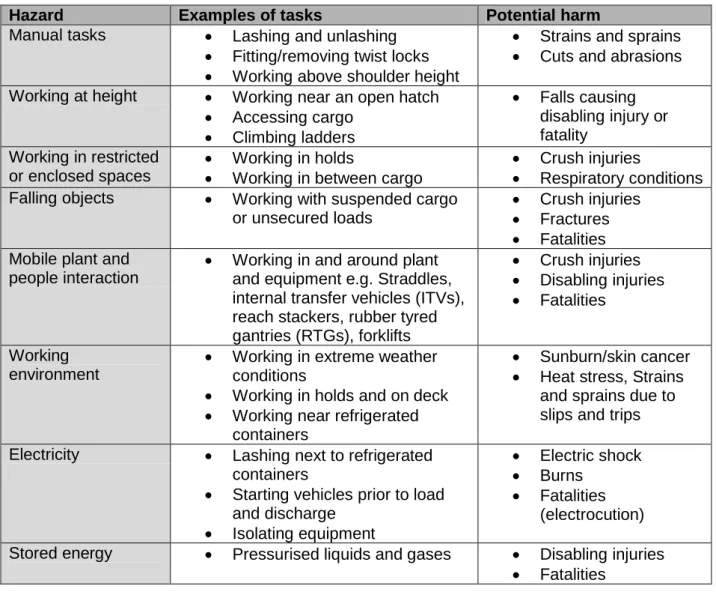
Table 1 lists common hazards found in stevedoring workplaces, examples of when they could occur and the potential harm they can cause.
Table 1: Hazards associated with stevedoring activities
Hazard Examples of tasks Potential harm
Manual tasks • Lashing and unlashing
• Fitting/removing twist locks
• Working above shoulder height
• Strains and sprains
• Cuts and abrasions Working at height • Working near an open hatch
• Accessing cargo • Climbing ladders • Falls causing disabling injury or fatality Working in restricted or enclosed spaces • Working in holds
• Working in between cargo
• Crush injuries
• Respiratory conditions Falling objects • Working with suspended cargo
or unsecured loads
• Crush injuries
• Fractures
• Fatalities Mobile plant and
people interaction
• Working in and around plant and equipment e.g. Straddles, internal transfer vehicles (ITVs), reach stackers, rubber tyred gantries (RTGs), forklifts • Crush injuries • Disabling injuries • Fatalities Working environment
• Working in extreme weather conditions
• Working in holds and on deck
• Working near refrigerated containers
• Sunburn/skin cancer
• Heat stress, Strains and sprains due to slips and trips Electricity • Lashing next to refrigerated
containers
• Starting vehicles prior to load and discharge • Isolating equipment • Electric shock • Burns • Fatalities (electrocution) Stored energy • Pressurised liquids and gases • Disabling injuries
Managing Risks in Stevedoring – May 2013 Page 11 Noise • Using noisy machinery or power
tools
• Hearing loss Hazardous
chemicals
• Loading and unloading hazardous cargo
• Exposure to chemicals used to fumigate ship’s holds
• Respiratory conditions
• Burns
• Skin conditions Fire • Hot works e.g. Welding or
oxy-cutting
• Handling combustible cargo
• Burns
• Fatalities (explosion) A number of controls may be needed to manage various hazards that co-exist in the workplace, for example, stevedoring activities may involve being near dangerous moving parts and
performing strenuous manual tasks in the presence of excessive noise.
Hazards may arise from systems of work, working environments and work practices including:
• blocked entries and exits to work sites preventing escape in emergencies
• damaged or poorly maintained equipment such as damaged ladders, electrical cables, ropes, stretched chains, defective hooks
• inadequate communication, including a failure to report unsafe situations
• safety procedures not being followed, for example using lifting gear without checking service history or verifying safe working limits.
2.2 Assessing the risks
A risk assessment involves considering what could happen if someone was exposed to a hazard (the consequence) and the likelihood of this happening. A risk assessment can help you
determine:
• if there is further action you should take to control the risk
• how urgently the action needs to be taken.
If you already know the risk and how to control it effectively, a risk assessment may be unnecessary. However, if circumstances or conditions change then the risk needs to be re-assessed.
Factors to consider when assessing risks arising from stevedoring activities include:
• the type of work being performed
• how many people are exposed
• communication methods and effectiveness
• the suitability of vehicles and equipment for the activity, for example ropes and lifting gear
• time of day and hours of work
• the training, experience and competence of workers
• the work environment
• fatigue management.
2.3 Controlling the risks
The ways of controlling stevedoring risks are ranked from the highest level of protection and reliability to the lowest. This ranking is known as the hierarchy of risk control. You must always aim to eliminate a hazard, which is the most effective control. If this is not reasonably practicable, you must minimise the risk by working through the other alternatives in the
hierarchy.
The hierarchy of control measures
Elimination – the most effective control measure is to remove the hazard or hazardous work practice. For example, eliminate the need for workers to carry out work at heights by replacing manual twist locks with automatic twist locks.
Managing Risks in Stevedoring – May 2013 Page 12 If elimination is not reasonably practicable, you must minimise the risk by the control measures along the hierarchy below.
Substitution – substitute the work practice or equipment with something safer. For example substitute a hazardous chemical with a less hazardous chemical.
Isolation – physically separate the source of harm from people by distance or by using barriers. For example, use physical barriers to separate pedestrians from mobile plant.
Engineering controls – are physical control measures including mechanical devices or processes. For example, install guards on conveyor systems or speed limiters on forklifts.
Administrative controls – if a risk remains, it must be minimised with administrative controls such as training workers to use safe work procedures, using warning signs or arranging work to minimise the time spent near noisy machinery.
Personal protective equipment (PPE) – any remaining risk must be minimised with suitable PPE, for example by providing workers with high visibility clothing, gloves, non-slip footwear and hearing and eye protection.
Administrative control measures and PPE do not control the hazard at the source. They rely on human behaviour and supervision and used on their own tend to be the least effective control measures to minimise risks.
In many cases a combination of control measures provides the best solution.
When selecting and implementing a combination of control measures it is important to consider whether any new risks might be introduced as a result and, if so, whether the combination of the control measures should be reviewed.
2.4
Maintaining and reviewing control measuresRegulation 37: Control measures must be maintained so that they continue to protect workers and other people from the hazards associated with plant. The control measures must be:
• fit for purpose
• suitable for the nature and duration of the work
• installed, set up and used correctly.
Regulation 38: A person conducting a business or undertaking must review and as any necessary revise control measures:
• when the control measure is not effective in controlling the risk
• before a change at the workplace that is likely to give rise to a new or different health and safety risk that the control measure may not effectively control
• if a new hazard or risk is identified
• if the results of consultation indicate that a review is necessary
• if a health and safety representative requests a review.
Reviewing the hazard and the risk controls is an important part of the risk management process. The aim is to ensure:
• that the implemented controls are effective and working
• there are no further risks previously not identified
• circumstances or practises have not changed that have introduced other hazards
Managing Risks in Stevedoring – May 2013 Page 13 A review can be done by using the same methods as the initial hazard identification process. Common methods include workplace inspection, consultation, testing and analysing records and data. Reviewing the control measures also involves considering whether a higher order control measure is now reasonably practicable.
You should consult your workers and any health and safety representatives as part of the review process and consider the following questions:
• Are all foreseeable hazards being identified?
• Are the control measures working effectively in both their design and operation?
• Have the control measures introduced new problems?
• Has instruction and training provided to workers been successful?
• Is the frequency and severity of health and safety incidents reducing over time?
• If new legislation or new information has become available, does it indicate the current controls may no longer be the most effective?
• Have any changes occurred that affect health and safety, for example has new plant or equipment been introduced? Are new procedures required?
If areas are identified for a change or improvement, review your information and make further decisions about risk control.
Managing Risks in Stevedoring – May 2013 Page 14
3.
PLANNING
3.1 Pre-arrival planning
Stevedoring activities should be planned before the cargo arrives to identify potential hazards, assess risks and determine appropriate control measures in consultation with relevant parties. This may include the port authority, shipping agents/companies, transport companies and other duty holders in the supply chain.
In the planning stage the person(s) conducting the business or undertaking should consider:
• load and discharge sequences (the order of work)
• pre-work inspections
• vessel type, cargo type (heavy lifts) and presentation
• the length of time required to do the work
• allocation of resources (e.g. people, plant, skills)
• weather conditions, time of day, tide levels and surge impact.
3.2
Emergency PlanningEmergency plans
Regulation 43: A person conducting a business or undertaking must ensure that an emergency plan is prepared for the workplace that provides for:
a) emergency procedures, including:
• an effective response to an emergency
• evacuation procedures
• notification of emergency services at the earliest opportunity
• medical treatment and assistance; and
• effective communication between the person authorised by the person conducting the business or undertaking to coordinate the emergency response and all persons at the workplace.
b) testing of the emergency procedures, including how often they should be tested c) information, training and instruction to relevant workers in relation to implementing the emergency procedures.
Emergency plans should be site-specific and should be covered in induction training, and made known to visitors. Regular refresher training should be provided to workers and procedures established and maintained to ensure there is effective communication between ship and shore (stevedores and the person in charge of the vessel).
The emergency plan should include information on:
• allocation of roles and responsibilities for specific actions in an emergency to persons with appropriate skills, for example appointment of area wardens
• access and egress for retrieval and escape including a contingency plan for alternative access and egress
• safe and timely evacuation procedures. This may include an evacuation checklist and procedures for assisting injured people
• warning systems and what to do when they activate
• shutting down of equipment (e.g. cranes)
• planning for drills (e.g. to ensure alarms are audible to everyone)
• fire risks and provision of fire fighting and rescue equipment at appropriate locations
• the establishment of a reliable means of communication between all workers to ensure effective evacuation of danger areas, including a backup communication system in case of a failure of the primary system
Managing Risks in Stevedoring – May 2013 Page 15
• a readily accessible communication system to contact any necessary emergency services
• the display of evacuation procedures in appropriate location(s).
• access for emergency services (such as ambulances)
Further guidance on emergency plans is available in the Code of Practice: Managing the Work Environment and Facilities.
First aid arrangements
Regulation 42: A person conducting a business or undertaking must:
• provide first aid equipment and ensure each worker at the workplace has access to the equipment
• ensure access to facilities for the administration of first aid, and
• ensure that an adequate number of workers are trained to administer first aid at the workplace or that workers have access to an adequate number of other people who have been trained to administer first aid.
First aid kits must be accessible at the workplace.
Further guidance on providing first aid and the contents of first aid kits is available in the Code of Practice:First Aid in the Workplace.
3.3 Traffic management
There is a risk of death and injury in workplaces where vehicles, mobile plant and people share the same work areas.
Regulation 215: Persons with management or control of powered mobile plant must ensure that the risk of powered mobile plant colliding with pedestrians or other plant is controlled, so far as is reasonably practicable. If there is a possibility of collision, the powered mobile plant must have a warning device that will warn persons who may be at risk from the movement of the powered mobile plant and measures must be taken to eliminate or minimise the risk.
Vessel and Landside
Wherever possible, the work environment should be designed so that vehicles and powered mobile plant are separated from pedestrians.
When managing traffic risks in ports consider:
• vehicle and pedestrian movements o on the wharf
o on and off ships
o on decks and in cargo storage, receival and delivery areas within the terminal or facility o during truck loading and unloading, reversing, queuing and parking activities
• controlling contractor and visitor movement at the site
• the condition of travel surfaces. Traffic management plans
The development of a traffic management plan assists in managing risks and communicating information about control measures.
A traffic management plan should be developed in consultation with workers. It can provide details about:
• the desired flow of pedestrian and vehicle movements
• the expected frequency of interaction of mobile plant, vehicles and pedestrians
• traffic controls for each expected interaction, including illustrations of the layout of barriers, walkways, signs and general arrangements to warn and guide traffic around, past, or through a work site or temporary hazard
Managing Risks in Stevedoring – May 2013 Page 16
• exclusion zones
• roles and responsibilities of persons in the workplace for traffic management
• instructions or procedures associated with the control of traffic, including in an emergency.
Traffic management plans should be updated to address any changes in traffic movements. More information about how to manage traffic at a workplace is available in the Code of Practice: Traffic Management in Workplaces.
Common user facilities
In managing port and terminal activities, particularly when more than one business or undertaking may be working in the same area, traffic routes for neighbouring operations should be considered, ensuring that different activities can safely be conducted without increasing the risk.
The common user operator should develop a traffic management plan in consultation with the relevant stakeholders working onsite. Each stevedoring company should develop its own traffic management plan.
Roll on roll off (RoRo) and pure car carriers (PCC)
A traffic management plan should be implemented to control vehicle and pedestrian movements for each entrance and exit ramp and for ramps within the vessel. Where the ramp design prevents physical separation other control measures should be used to prevent the simultaneous use of the ramp by vehicles and pedestrians.
All workers involved in the operations should be kept informed of this plan and of any changes to it.
In preparing a traffic management plan for RoRo or PCC consider:
• traffic configurations
• speed limits
• co-ordination of ro-ro activities across multiple decks
• management of pedestrian movement including separating them from vehicles on ramps by using separate walkways, or separate access times
• management of multi-use roadways
Before the start of roll-on/roll-off (ro-ro) operations, any hazardous routes or areas that could be mistaken for normal drive-on/drive-off routes should be identified. These routes should then be clearly marked and barricaded. Suitable warning notices should be posted or ramp. A nominated person (a competent signaller/guide) should direct all vehicles being reversed or manoeuvred into stowage positions on deck.
Consider using exclusion or ‘no go’ zones to separate people and plant. Workers entering or exiting a vessel using external or internal ramps should observe traffic movement and only enter or exit the ramp when it is safe to do so.
A safe system of work should be implemented to manage the movement of vehicles on decks. This should consider vehicle speeds, restricted driver visibility, safe stowage or positioning and whether any other activities are being carried out at the same time.
A person guiding a vehicle into a final position on the vessel should ensure they are always visible to the driver, either directly or via vehicle mirrors and by wearing high visibility clothing. Where this is not possible they must position themselves clear of the vehicle and trailer movement and away from the risk of being trapped or crushed. Before signalling a driver to proceed they must ensure it is safe to do so.
Signals for guiding drivers should be agreed and understood prior to work starting, such as using a hand signal to indicate an emergency stop. Only authorised people should be on deck while loading or discharging operations are being conducted and everyone should be provided with high visibility clothing.
Managing Risks in Stevedoring – May 2013 Page 17 Traffic movement within a terminal or facility
Truck routes and loading/unloading points should be marked out or otherwise indicated.
Loading and unloading areas should be clear of other traffic, pedestrians and people not involved in the activity.
Trucks should not be loaded/unloaded in any other position without permission of the supervisor or foreman. Truck ranking should not be allowed inside the loading/unloading areas and the vehicle twist locks should be released before entry and locked after exit.
Truck drivers should follow site safety rules and traffic management plans, including being aware of exclusion or no-go zones when loading/unloading. Traffic management includes designating safe zones for the driver to exit the cab to allow for the release of twist locks. If there are no site rules, a risk assessment should be undertaken to determine the safest location for the driver and other workers.
Movement of vehicles in cargo storage areas
Where vehicles are used to handle cargo, the area should be kept separate from all pedestrians and other operations, where practicable. Barriers should be used for permanent stacking areas that are adjacent to a pedestrian route. Signs should be displayed warning that unauthorised entry to the area is prohibited.
Reversing vehicles
Where practicable design the flow of traffic to avoid reversing. Where it is necessary to reverse vehicles (e.g. in RoRo activities) control measures may include:
• mirrors, reversing cameras, sensors and alarms that can help drivers detect movement
• all around the vehicle
• visual (flashing lights) warning devices
• high-visibility markings for powered mobile plant
• effective communication systems (e.g. between signallers and drivers and between plant operators including straddles and trucks).
Vehicles queuing and parking
Work areas should have clearly visible speed limit signs and lines showing truck queuing and vehicle parking areas. In order to control unexpected truck queuing and congestion, a truck marshalling area can be used.
Private vehicle parking should be allowed only in designated areas. Landside - straddle carriers
Straddle carriers often operate in proximity to other vehicles and pedestrians. Where straddles are used the person conducting a business or undertaking should ensure:
• a straddle grid is maintained for the safe movement of vehicles and loading/unloading operations
• safe areas are designated within the grid to allow safe manoeuvring of straddles, other vehicles and movement of workers
A safe system of work for the loading and unloading of trucks should be part of your traffic management plan.
Grids
Loading and unloading of containers from road vehicles should be carried out on identified
straddle carrier exchange grids. Grids provided where straddle carriers are used to load or unload containers from road vehicles should be clearly marked and not used as general waiting areas for road vehicles.
Managing Risks in Stevedoring – May 2013 Page 18 Where possible, a straddle carrier should:
• approach a road vehicle from the rear during loading or unloading and then leave the vehicle by moving away from the vehicle’s rear
• approach a grid slot from the opposite direction of road vehicles
Provide ample space for road vehicles to reverse into a slot on a grid safely if this manoeuvre is necessary. Any oversize container or problem container that cannot be handled safely at the grid should be moved to a suitable designated area where it can then be handled.
Safe areas – vehicle drivers
A designated safe area where drivers of road vehicles can stand while containers are being lifted onto or off their vehicles should be provided and clearly marked. The safe area should be located so people in it are clearly visible to drivers of straddle carriers as they approach. If the area is located between slots, the size of the area should be determined in relation to the grid layout, the width of the straddle carriers and other relevant operational factors.
When loading or unloading a road vehicle, the driver should leave the cab of the vehicle and stand in a clearly marked area before the approach of a straddle carrier. This area should be forward of the cab of the vehicle, a safe distance from the vehicle and visible to the straddle carrier operator. The driver should remain in the marked area throughout the loading or unloading operation and not return to the cab until the straddle carrier has left the grid. The straddle carrier operator should not approach the grid if the driver of the truck cannot be seen.
3.4 Information, training, instruction and supervision
Section 19: The WHS Act requires a person conducting a business or undertaking to provide relevant information, instruction, training and supervision necessary to protect all persons from risks to their health and safety arising from work carried out.
Regulation 39: A person conducting a business or undertaking must ensure that information, training and instruction provided to a worker is suitable and adequate having regard to:
• the nature of the work carried out by the worker
• the nature of the risks associated with the work at the time of the information, training and instruction, and
• the control measures implemented.
The training provided must be readily understandable by any person to whom it is provided. Provision of information to workers
The information provided to workers, including contractors, undertaking stevedoring activities should include:
• results of any relevant risk assessment
• information on relevant safe work procedures
• manufacturer’s instructions on the safe use of plant and equipment where available. Procedures should be in place so all workers (including contractors and sub-contractors) are informed of the hazards and risks involved in the activities they are about to undertake, in particular, at the change of shift.
Licenses
Some work activities, such as dogging, rigging, the operation of reach stackers, forklifts and some types of cranes, require workers to hold a relevant high risk work licence under the WHS
Managing Risks in Stevedoring – May 2013 Page 19 Regulation 85: A person conducting a business or undertaking must not direct or allow a worker to carry out high risk work for which a licence is required unless the person sees written evidence provided by the worker that the worker has the relevant licence for that work, or is undertaking a course of training for the licence, or has applied for the relevant licence and is awaiting a decision on that application.
Training
Training in work health and safety equips workers with the knowledge and skills to recognise hazardous situations and take steps to ensure they and others are not placed at risk.
Training Needs Analysis
A needs analysis can help identify knowledge and skill requirements. These can be considered at the:
• organisational level - what workplace hazards, control measures and other arrangements should all workers be familiar with?
• job or task level - what duties and responsibilities are part of the job or task and what knowledge and skills are required to competently carry out the duties and responsibilities safely and without risk to health?
• individual level:
o are workers aware of their duties under legislation to take reasonable care of their own and others’ health and safety and cooperate with measures put in place by the person conducting a business or undertaking?
o what knowledge and skills do they have?
o are there specific requirements for particular people in the workforce, for example:
supervisors, foremen or those with particular responsibility for others
workers required to operate particular plant or equipment with legal requirements for licensing
new starters requiring general awareness and task specific training
casual workers or workers who work infrequently or who have had a long period of absence from the workplace, or
workers with limited reading and writing skills
workers from culturally and linguistically diverse backgrounds. Who should receive training?
Training at the workplace should be provided to:
• workers engaged by a stevedoring business or undertaking, who participate in activities which have the potential to expose them to risk of injury or work-related illness
• managers and supervisors of workers carrying out stevedoring activities considered at risk of injury or work-related illness and/or who have responsibility for implementing safe work procedures
• staff responsible for purchasing plant or PPE, and for designing, scheduling and organising work activities.
Training delivery plan
Consultation with workers is required when making decisions about the procedures for providing information and training for workers.
A training plan should address the training required, who is to be trained, how the training will be delivered, particular competencies that need to be attained by workers, and the measures used to ensure workers have developed the necessary skills or competencies.
Managing Risks in Stevedoring – May 2013 Page 20 The content and methods of presenting training material should be tailored to meet the specific needs of each group. Training should be provided by a competent person.
Training topics
Stevedoring specific training should cover the following where relevant to the work being undertaken:
• the work health and safety duties of everyone involved in stevedoring activities
• the nature and extent of stevedoring hazards and risks, including the risk associated with the dynamic nature of the work
• hazard and incident reporting systems
• systems for reporting defects in plant or equipment used for stevedoring activities
• consultation arrangements
• safety documents, policies, procedures and plans
• safe work procedures, including instruction on: o specific cargo management
o use of communication systems
o operation of vehicles, other types of plant and associated equipment o emergency and first aid procedures
o when and how to use PPE including the selection, fitting, proper care and maintenance of PPE, and
o other control measures.
• accessing health and safety information
• access, egress and security
Workplace specific training may be delivered in a variety of ways, including:
• toolbox talks
• pre-start meetings
• on-the-job training
• one-off sessions or events for a specific purpose
• training courses Training records
Training records should be kept to assist a person conducting a business or undertaking check what training has been provided, what extra training is needed, and to demonstrate compliance with WHS legislative requirements.
Training records may include training needs analysis documents, training plans, workers who have successfully completed training programs and the dates of completion, details of any
competency-based training completed, and copies of licenses, certificates, or other qualifications. Review of training
All training should be reviewed and where necessary, updated to reflect any changes associated with the nature of hazards and risks, changes to work practices or risk control measures.
Reviewing training is important in stevedoring where the workforce may change frequently and may only be employed for short periods or intermittently.
Supervision
In addition to ensuring workers receive appropriate training, adequate supervision must also be provided to ensure workers, including contractors, can carry out their tasks safely. The
supervision requirements will depend on the workplace hazards, the level of exposure, the experience and competence of workers and the effectiveness of existing risk control measures. High-risk or complex activities may have greater supervision requirements.
Managing Risks in Stevedoring – May 2013 Page 21 A person who is gaining experience in stevedoring activities should be under the direct
supervision of a person with appropriate skills and experience until they demonstrate they have the skills to perform work safely.
Supervisors should have the information, training and authority to competently direct and control their team’s work and ensure work is done safely at all times.
New starters or others with special needs may require more direct supervision and ongoing instructions than more experienced workers.
Contractors have particular supervisory requirements. Often the safety of contractors is at greater risk due to their lack of familiarity with the working environment, organisational policies and work procedures (particularly relevant in stevedoring where people often work for different
organisations). An effective induction and training program can assist.
To determine the level of supervision required, shift and scheduling arrangements (e.g. the time of day, length of shift, or number and skills of available workers) should also be considered.
Managing Risks in Stevedoring – May 2013 Page 22
4.
INSPECTIONS
4.1 Vessel inspections
The vessel type and condition of its equipment and gear may impact on safety. Before working on-board, the condition of the work area should be assessed by the person in charge or the designated responsible person prior to work starting, throughout the discharge process as required, and as working conditions change.
A system of inspections and the use of checklists can assist in identifying hazards. Examples of checklists for container operations and bulk and general operations are provided at
Appendix B and C.
The person in charge may delegate vessel inspections to be conducted by the designated responsible person who may be a supervisor or foreman. Inspections should not be ‘one-off ‘activities (e.g. at the start of a shift) but occur regularly throughout the process. This may identify any new hazards and assess the suitability of work processes and control measures. Health and safety representatives may participate in vessel inspections.
Section 68(2)(a): A health and safety representative may inspect the workplace or any area where work is carried out by a worker in the work group
• at any time after giving reasonable notice to the person conducting the business or undertaking
• at any time without notice in the event of an incident or any situation involving a serious risk to health or safety emanating from an immediate or imminent exposure to a hazard. Depending on the circumstances, other personnel such as the ship’s master, a member of the crew or a person with particular skills should be invited to participate in the inspection process. Work procedures should support the implementation of inspections, and ensure relevant follow-up actions are taken. There should be a process for dealing with unresolved issues.
When conducting a vessel inspection, some points to consider are:
• working environment, including access and egress
• cargo presentation
• condition of the ship’s lifting equipment if it will be used during the work. Cargo presentation
Working conditions and circumstances may change significantly during transit. The inspection should check that cargo has not moved during the voyage and that lashing is secure for cargo not being discharged adjacent to the work area. Any identified changes in the condition of cargo should be communicated to other relevant ports.
For further information on vessel inspections refer to Marine Orders.
4.2 Plant inspections
There are specific requirements under the WHS Regulations in relation to the inspection of plant. Regulation 213: A person with management or control of plant at a workplace must ensure that maintenance, inspection, and if necessary testing, of plant is carried out by a competent person in accordance with manufacturer’s recommendations, or if those aren’t available, in accordance with recommendations of a competent person. If it is not reasonably practicable to comply with the manufacturer’s recommendations or the recommendations of a competent person, the inspection and testing must occur annually.
Managing Risks in Stevedoring – May 2013 Page 23
5.
THE WORKING ENVIRONMENT
Regulation 40: A person conducting a business or undertaking must ensure, so far as is reasonably practicable, that:
• the layout of the workplace allows, and is maintained to allow, persons to enter and exit the workplace and move within it safely, both under normal working conditions and in an emergency
• work areas have space for work to be carried out safely
• floors and other surfaces are designed, installed and maintained to allow work to be carried out safely
• lighting enables each worker to carry out work safely, persons to move around safely and safe evacuation in an emergency
• ventilation enables workers to carry out their work without risk to their health and safety
• workers exposed to extremes of heat or cold are able to carry out work without risk to their health and safety
• work in relation to or near essential services (such as gas, electricity, water, sewerage and telecommunications) do not affect the health and safety of persons at the workplace.
5.1 Access and egress
The means of entry (access) and exit (egress) to a workplace must be safe. Some matters that should be checked include:
• gangways, walkways and hand rails are in good condition, free from obstructions and residue build-up
• gangways remain rigged
• hinged and pontoon hatch covers are secured to prevent them from accidentally closing during access
• there is sufficient space between containers to accommodate work processes, gear and safe access and egress
• where work is in a cargo compartment, that there are two means of access.2
Requirements relating to safe access and egress on vessels are contained in Marine Orders. Guidance on safe access and egress for landside operations is available in the Code of Practice: Managing the Work Environment and Facilities.
5.2 Housekeeping
The work environment landside and on vessels should be maintained in a safe condition. The vessel inspection should check housekeeping practices on the vessel, including that:
• suitable storage areas for tools and equipment including lashing bars are identified and used
• loose items that may create a hazard from potential vessel movement are secured
• walkways in use have sufficient clear space to allow workers to move about safely
• reefer cables have been secured prior to unloading to ensure no snagging of loose hanging cables.
Housekeeping on landside includes providing designated storage areas for loose items (e.g. provide twist lock bins) and ensuring these are correctly stored.
Goods and materials not in containers or vehicles should be kept in stable and orderly stacks or piles on firm and level surfaces.
2
Marine Order 32, issue 3 - Cargo handling equipment (Schedule 2 Clause 7) sets out the requirement for two means of access for each cargo compartment in ships built on or after 1 August 1998 (except ships used exclusively as bulk carriers or as cellular container ships).
Managing Risks in Stevedoring – May 2013 Page 24 The Code of Practice: Managing the Work Environment and Facilities provides more information about housekeeping procedures on landside.
5.3 Lighting
Adequate lighting must be provided and maintained landside and on vessels to ensure stevedoring activities can be carried out safely. Examples of lighting include external lighting towers, portable lights and crane lights.
• Before carrying out stevedoring activities on vessels ensure there is suitable deck and under-deck lighting provided for the task being undertaken, particularly for:
• access routes, including access to lifting equipment
• ladders providing access to the ship
• working areas on board and adjacent to the ship.
Lighting levels should provide sufficient light for night time operations as well as enabling good visibility in cargo holds, taking into account glare, reflections or shadows. If portable lighting is used on vessels, electrical cables should be protected from accidental damage.
Marine Orders Part 32 provides information about lighting requirements.
5.4 Air quality
Emissions from plant and the atmosphere in ships’ holds and storage areas may create
hazardous atmospheres. Where there is a likelihood of reduced air quality that may affect health and safety (for example, contaminated, oxygen-deficient or explosive atmospheres) a risk
assessment should be carried out and relevant control measures implemented. Control measures may include:
• providing measures for detecting hazardous atmospheres
• providing natural or mechanical ventilation to prevent accumulation of harmful concentrations of gases, fumes and vapours, fumigants
• eliminating use of combustion-powered plant or equipment in poorly ventilated spaces, for example by using flame-proof forklift trucks
• managing the length of time plant is used (switching off engines when not in use or limiting the number of vehicles allowed to run at any one time)
• access to Safety Data Sheets (SDS) for hazardous chemicals
• training workers in emergency response related to hazardous atmospheres
• providing appropriate PPE such as respiratory equipment and ensuring these are worn and properly maintained.
Where fumigation has been carried out, control measures include checking that workers do not enter fumigated areas until these areas have been ventilated and are assessed as safe to enter. The Code of Practice: Managing the risks of Hazardous Chemicalsin the Workplace provides further guidance on managing the risks associated with contaminated or oxygen-deficient atmosphere.
5.5 Weather conditions
A risk assessment should consider how changes in weather may impact safe working practices, for example:
• when operating in proximity to reefers in wet conditions
• operating cranes in high winds or when lightning is present
• stability of container stacks in high winds
• when conditions create poor visibility
• in periods of extreme low or high temperatures. Control measures may include:
Managing Risks in Stevedoring – May 2013 Page 25
• using wind speed measuring devices (for example, anemometers) on plant such as cranes and ceasing activities when these exceed safe levels
• stacking containers so that they are stable
• providing hydration such as water in extreme heat and appropriate breaks and shelter
• providing appropriate PPE such as wet weather gear.
Information about managing cranes in adverse weather conditions is in Section 7.2 Crane operations - weather conditions.
The Code of Practice: Managing the Work Environment and Facilities provides further information about managing the risks associated with working in extremes of heat and cold.
5.6 Managing the risk of falls and falling objects
Working at height, including accessing the hold of a ship or working on top of containers, all involve the risk of a fall.
Regulation 78: A person conducting a business or undertaking must manage the risk of a fall from one level to another that is reasonably likely to cause injury to the person or another person. Wherever reasonably practicable, the risk of a fall must be eliminated by working on the ground or on a solid construction. In this case ensure the area has:
• a surface structurally capable of supporting people, material and any other loads on it
• barriers erected around any open penetrations
• an even and readily negotiable surface and gradient
• a safe means of access and egress.
If it is not reasonably practicable to work on the ground or on solid construction, a safe system of work must be provided using the following control measures in order of priority:
• fall prevention devices (for example, temporary work platforms and guard railing)
• using a work positioning system that ensures workers work within a safe area
• implementing fall arrest/restraint systems to minimise any distance of a fall (e.g. within hold of vessel or when securing tops of containers)
Stevedoring activities where control measures for fall prevention are required include when:
• accessing the ship’s decks, hatchways and holds
• using ladders, stairs, ramps, landing stages or gangways
• working in the vicinity of holes or cavities on board ship (e.g. near hatchways or on top of cargo where voids are created during discharge/ loading)
• working on top of containers
• working on any equipment at an elevated height
• accessing crane cabins.
For example, if it is necessary to access the top of a container, safe means of access including a mobile elevating work platform or an access cage should be provided. If this equipment is not available, fall arrest equipment must be worn.
Ship movement and ramps
Pontoons supporting shore ramps or passenger walkways should be as steady as practicable in all weather and tide conditions and should be capable of withstanding the maximum forces to which they may be subjected during mooring. This should include likely ramp movement resulting from the local tidal movements, and ranging and drifting of the ship or pontoon at its moorings. Walkways should be designed to tolerate forces in all three planes and torsional forces.
Transitional flaps at their ends should be included if necessary.
More information about how to manage the risks of working at heights is available in the Code of Practice: Managing the Risk of Falls at Workplaces.