Evaluation of Segmentation Techniques for Inventory
Management in Large Scale Multi-Item Inventory Systems
1Manuel D. Rossetti
2, Ph. D., P. E.
Department of Industrial EngineeringUniversity of Arkansas 4207 Bell Engineering Center
Fayetteville, AR 72701
Ashish V. Achlerkar, M.S.
MCA Solutions, Inc.
2 Penn Center Plaza (1500 JFK Blvd.) Suite 700
Philadelphia, PA 19102
Abstract
This paper presents and evaluates methodologies for the segmentation or grouping of items and the subsequent setting of their inventory policies in a large-scale multi-item inventory system. Conventional inventory segmentation techniques such as ABC analysis are often limited to using demand and cost when segmenting the inventory into groups for easier management. Other attributes may be of functional and operational importance when deciding inventory control policies. Considering other attributes while forming item-groups may ensure group policies that achieve the desired performance metrics for a given inventory system while respecting cost considerations. Two segmentation methodologies, (Multi-Item Group Policies (MIGP) and Grouped Multi-Item Individual Policies (GMIIP), that use statistical clustering algorithms were developed and compared to the conventional ABC analysis technique. An empirical evaluation of these techniques via a set of experiments was performed. The analysis indicates that these new techniques can improve inventory management for large-scales systems when compared to ABC analysis.
Keywords: multi echelon inventory, inventory segmentation, clustering.
1 Accepted for publication in the International Journal of Logistics Systems Management
Biographical Notes
Manuel D. Rossetti, Ph.D., P.E., has published over 70 refereed articles in the areas of transportation, logistics, manufacturing, health care, and simulation and obtained over $3.4 million in funding from, among others, the National Science Foundation, Air Force Research Lab, the U. S. Navy, and Wal-Mart Stores, Inc. He was selected as a Lilly Teaching Fellow in 1997/98 and won the IE Department Outstanding Teacher Award in 2001-02 and 2007-08. He has served as co-editor for the 2004 and 2009 Winter Simulation Conference and is the author of the textbook, Simulation Modeling and Arena
published by John Wiley & Sons.
Ashish V. Achlerkar is a senior consultant for MCA Solutions Inc. He has over 6 years of experience providing supply chain solutions to customers from Aerospace/Defense and commercial industries. He has served in MCA’s Product Management service during which he successfully led several product development efforts. He has also performed research in the area of multi-echelon, multi-indenture inventory optimization. Prior to joining MCA, he worked for Bajaj Auto Ltd, an Asian automobile giant. He holds a Bachelors in Engineering degree from the College of Engineering Pune (COEP), India and a Masters of Science degree from the University of Arkansas, Fayetteville.
Acknowledgements
Thanks to the anonymous reviewers for their suggestions to improve the article. This material is based upon work supported by the National Science Foundation under Grant No. 0437408. Any opinions, findings, and conclusions or recommendations expressed in this material are those of the author(s) and do not necessarily reflect the views of the National Science Foundation.
Evaluation of Segmentation Techniques for Inventory
Management in Large Scale Multi-Item Inventory Systems
Abstract
This paper presents and evaluates methodologies for the segmentation or grouping of items and the subsequent setting of their inventory policies in a large-scale multi-item inventory system. Conventional inventory segmentation techniques such as ABC analysis are often limited to using demand and cost when segmenting the inventory into groups for easier management. Other attributes may be of functional and operational importance when deciding inventory control policies. Considering other attributes while forming item-groups may ensure group policies that achieve the desired performance metrics for a given inventory system while respecting cost considerations. Two segmentation methodologies, (Multi-Item Group Policies (MIGP) and Grouped Multi-Item Individual Policies (GMIIP), that use statistical clustering algorithms were developed and compared to the conventional ABC analysis technique. An empirical evaluation of these techniques via a set of experiments was performed. The analysis indicates that these new techniques can improve inventory management for large-scales systems when compared to ABC analysis.
1 Introduction
Williams and Tokar (2008) provide a review of inventory management issues that have appeared in the literature. They classify the literature into the inventory models, collaboration control, stock out assumptions, and demand assumptions. An important issue that has been missing in the literature is the modeling of large-scale inventory systems. Large-scale inventory systems have as their primary characteristic a significant number of SKUs. A SKU is an individually managed item type, for which a quantity of inventory is stored and managed at a particular location. Only 17 years ago, Moore and Cox (1992) considered issues in forecasting for large-scale inventory systems, with examples that ranged between only 250 and 80,000 SKUs. Today, many inventory systems easily have hundreds of thousands of SKUs. For example, Lowe’s Companies, Inc. was recently given a Voluntary Interindustry Commerce Solutions (VICS)
achievement award for being able to “forecast demand for more than 42 million store/SKUs, creating a time-phased, flexible approach to adjusting to changing consumer demand, and sharing the data with suppliers” (Margulis (2009)).
In very large inventory systems, it may not be feasible to set stock levels and service control guidelines for each individual item. Inventory management resources may be better utilized by managing the “significant few” and not the “trivial many”. Such an approach to inventory management may be achieved by the classification and grouping of inventory items and subsequent assignment of inventory policies according to the characteristics of a group. Classification systems serve to prioritize inventory items by certain criteria and allow expenditure of management resources in proportion to an item’s value in the system.
The characteristics of the groups of items formed depend upon the type and number of attributes considered while forming the groups. Conventional grouping techniques like ABC analysis give importance to the cost and demand volume attributes of items during grouping. Techniques such as group technology give importance to the physical attributes of items during grouping so as to achieve convenience during manufacturing operations, not necessarily for inventory policy determination. There are several other attributes of items in inventory systems that are critical in deciding inventory policies. These attributes are of operational significance when it comes to meeting strategic and operational objectives. In order to obtain balanced, practical, and operationally useful groups of items in an inventory system, it is important to consider item-attributes that contribute to inventory management goals.
Clustering is a technique that is used to classify objects into groups based on their attributes. Different clustering techniques are defined depending on the mathematical algorithms used to classify objects into groups. The basic objective of clustering algorithms is to form groups of objects that exhibit minimum within-group variability and maximum between-group variability. The concept of clustering can be applied to the inventory segmentation problem to form groups of items that have similar inventory policy parameters. Selecting appropriate item attributes to be used in the clustering algorithm is important to obtain groups of items that show high homogeneity between items in a given group. Once such groups of items are formed, common inventory policies for all the items in a group may be applied. This may enhance managerial convenience for overall system control since it is necessary to determine policies and manage only a small number of “groups of items” instead of managing every item individually.
On the other hand, because group policies are used instead of individual policies while managing inventory items, there is a loss of identity for the items. This loss of identity suggests a penalty cost that has to be incurred as a result of using group policies instead of individual policies. Also, there might be an undesired change in the values of several performance metrics if the penalty cost is minimized. It is important that the groups resulting from the application of segmentation or clustering techniques still meet the cost and performance goals. The managerial convenience obtained by grouping items has to be traded-off with the penalty cost and performance metric values associated with the system. This is a challenge for inventory managers and strategic planners.
From this paper, the reader should develop a better understanding of the issues and trade-offs involved in inventory segmentation for large-scale inventory systems. In addition to explaining and illustrating many of the issues, this paper develops and compares methodologies for segmenting inventory for multi-item single echelon large-scale inventory systems. Two new segmentation methodologies (Multi-item Group Policies, MIGP and Grouped Multi-item Individual Policies, GMIIP) that use statistical clustering algorithms are compared to the conventional ABC analysis technique. The examination of a multi-item single echelon large-scale inventory system allows an analysis without the complications of having to set policies in a multi-echelon setting and provides a foundation for addressing large-scale multi-item, multi-echelon systems.
The paper is organized as follows. In the next section, background on the inventory segmentation problem is presented by reviewing relevant literature. Section 3 describes the methods (MIGP and GMIIP) for segmenting and assigning the inventory policies. Section 4, presents the experimental procedures and discusses the results. Finally, Section 5 summarizes the findings and discusses the possibilities for future research.
2 Background and Literature Review
In large supply networks (e.g. Wal-Mart, US-Navy, etc.) hundreds of thousands of items are stocked at a single location or echelon within a larger supply chain. These types of inventory systems (e.g. multi-echelon, multi-item) with millions of items throughout the network are considered large-scale inventory systems. Calculating the optimal inventory policy parameters for large-scale inventory systems is a computational burden that necessitates the need for efficient policy setting techniques that reduce the computational
time, and at the same time improve the ability of inventory managers to more effectively manage the supply chain. Because of these challenges extensive research has been performed on how to optimally set inventory policy parameters within these contexts. The purpose here is not to review that body of work. The reader interested in that topic can refer to Deuermeyer and Schwarz, (1981), Svoronos and Zipkin (1988), Zipkin (2002), Cohen et al. (1990), Hopp et al. (1999), Caglar et al., (2004), Al-Rifai and Rossetti (2006), and Muckstadt (2005) and the references therein, for a basic introduction and overview of this area. See also Gümüs and Güneri (2007) for a recent review with 92 references.
In this background section, the discussion is focused on two papers that are directly relevant to this paper: Hopp et al. (1997) and Cohen and Ernst (1986). Hopp et al. (1997) and subsequently Hopp and Spearman (2001) serve as the basis for the policy setting methodology used in this paper in order to test the effectiveness of the inventory segmentation techniques.
Research on grouping methods within inventory systems dates at least back to 1981 where Chakravarty (1981) examined classifying SKUs into a few manageable groups that have a common order cycle or common order quantity. The approach involves finding a common policy parameter given a pre-specified number of items in each group. The grouping problem was formulated as a non-linear program and solved via dynamic programming. The results confirm the common notions of ABC classification found in industry. Leonard and Roy (1995) call for the gap between inventory theory and practice to be reduced by having “items grouped into coherent families using a structure of attributes which are both theoretical and practical” and then
building “an aggregate item representative of the different items of the family in order for the practitioner to take his decisions”. Partovi and Anandarajan (2002) used neural networks to classify stock keeping units within the pharmaceutical industry into A, B, and C type items. Other work in this area has focused primarily on multi-attribute classification (Ramakrishnan (2006), Zhou and Fan (2007), Chu et al. (2008)) to find management groups, but not integrated with policy setting.
Cohen and Ernst (1986) is the first paper (to our knowledge) that begins to address the inventory segmentation problem and its implications. Cohen and Ernst (1986) developed a methodology to group spare parts based on statistical clustering constrained by operational performance criteria, which they termed (ORG) for operational relevant groups. Their clustering technique considers many attributes used in functional grouping going beyond the conventional cost and volume attributes used in ABC analysis. The paper uses a classical statistical grouping problem that attempts to assign items to groups with the following properties: minimum within group variance for each variable, maximum between group variance for each variable, and a limited or constrained number of groups. The paper uses statistical techniques to try to maximize the degree of dissimilarity (D) amongst the groups based on the proportion of variance accounted for by the clusters. The statistical clustering problem, as described in the paper, then requires finding the set of clusters that maximize Dsubject to a constraint on the maximum number of groups.
Cohen and Ernst (1986) suggest three steps to solve this optimization problem: sample selection and preliminary data analysis, data reduction by factor analysis, and group generation by cluster analysis. The paper gives a method to balance the cost
penalties and the loss of individual item identity due to grouping against the reduction in computational and managerial efforts due to grouping. The operations based analysis described in the paper has two objectives: (1) find the groups that minimize the cost/and operational performance penalty for group based generic control policies, and 2) restrict the maximum number of groups to be less than or equal to a managerial and computational maximum. The grouping problem was then reformulated to be operationally constrained. The revised grouping problem attempts to minimize the total number of groups subject to a constraint on the maximum operational penalty.
The revised problem of Cohen and Ernst (1986) has a non-linear constraint and was solved using a special hierarchical approach. The membership function was determined using discriminant analysis and Euclidean distance coefficients were used as a measure of dissimilarity amongst groups. The paper gives consideration to the impact of the grouping scheme on the policies to be developed with the aid of the groups. The experiments conducted for the inventory system of a vehicle manufacturer using the ORG technique showed superior results when compared to conventional grouping techniques.
The need to define groups in a manner that reflects trade-offs among statistical performance, operational performance, data needs, and computational requirements is the key connection to the work presented here. This research also uses statistical clustering, but trying to fully solve the clustering problem and the policy-setting problem at the same time is not attempted. The methodology presented in this paper is meant to be heuristic and primarily illustrative, but certainly points to how segmenting and policy setting can be integrated. The idea is straightforward: segment the items, set inventory policies, and
examine the cost penalties associated with resulting groups. In order to set the inventory policies, the methodology presented in Hopp and Spearman (2001) was used.
Hopp and Spearman (2001) presents an algorithm for a multi-item (R, Q) backorder model that computes the inventory policy parameters at a single location that is faced with Poisson demands and assumed fixed lead times. The notation for this model is as follows:
i = Item index
N = Number of items
€
F = Target order frequency (orders per year)
€
B = Target number of backorders
€
λi = Item i demand rate (units/year)
€
Li = Item i lead time (ordering and transportation)
C = Total inventory investment ($)
€
hi = Item i holding cost ($/item) = holding cost rate times unit cost
€
Qi = Item i replenishment batch size (units)
€
Ri = Item i reorder point (units)
€
I i
(
Ri,Qi)
= Item i average on-hand inventory (units)€
B i
(
Ri,Qi)
= Item i expected number of backorders (units) P1: € Minimize C = hiI i i=1 N∑
(
Ri,Qi)
(1) Subject to 1 N λi Qi i=1 N∑
≤F (2)€ B i
(
Ri,Qi)
i=1 N∑
≤B (3) € Ri ≥ −Qi,i = 1, 2 …N (4) € Qi ≥1,i=1,2,...N (5) (6) The resulting mathematical program attempts to minimize the total inventoryholding cost subject to expected annual order frequency and expected number of backorder constraints. In this model, it is unnecessary to specify a backorder cost because the model formulates the customer service requirement as a constraint involving the total backorder level. This is also a surrogate for customer wait time because of Little’s formula. Hopp and Spearman (2001) suggest an iterative procedure to solve this optimization problem. In this procedure, they first satisfy the average order frequency constraint and then satisfy the backorder level constraint. Since the order frequency depends upon the order quantity
€
Qi alone, once the procedure finds a
€
Qi that gives an average order frequency as per the required value, the procedure proceeds to satisfy the second constraint on the backorder level. The total backorder level depends upon both the order quantity and the reorder point. So with the optimal order quantity obtained while satisfying the first constraint, a reorder point that satisfies the backorder constraint can be found. The algorithm suggested by Hopp and Spearman (2001) and can be implemented using a binary search procedure on the Lagrange multipliers in the constrained optimization problem that represent the imputed setup and backorder costs.
For a large-scale inventory system, deciding optimal inventory policies expends much computational time and resources. The idea behind inventory segmentation procedures is to group items into families based on some important attributes, and then
apply common generic control policies to those part-families. This may greatly reduce the computational and operational efforts required in managing the items. In an inventory segmentation process, the idea is to group items that are “most” similar together. So the attribute values for items in the same group will be similar but not exactly alike. This within-group similarity between items in the same group depends on the level of similarity at which the groups are formed using clustering algorithms. So there is bound to be at least some minor dissimilarity between items in the same group.
If common inventory policies are applied to items in the same group, then a cost penalty will result because optimal policies are not set individually. It is important to note that there is a loss of identity for items due to using group policies. The loss of identity by items can be measured by a penalty cost and/or undesired change in the values of performance metrics when group policies are used instead of individual policies. As the number of groups increases, the more will be the similarity between items in the same group and hence less will be the loss of identity for items. But at the same time managing a larger number of groups means less managerial convenience while managing inventory and hence less benefit from inventory segmentation. This trade-off between the effect of the loss of identity of the items and the benefits of segmentation is of key interest in this paper.
Most of the conventional inventory classification techniques such as ABC analysis consider only limited number of attributes while forming classes of items. This research examines inventory segmentation techniques that consider operationally relevant attributes while classifying inventory items. Also, this research focuses on establishing an effective trade-off between managerial convenience via clustering with the penalty cost
and overall supply chain goals as a result of using group policies. The next section presents methodologies that allow the examination of these trade-offs.
3 Inventory Segmentation Methods
In this paper the inventory segmentation methods are applied to the control of single echelon, multi-item, large-scale inventory systems. The basic approach is: 1) cluster the items into groups, 2) apply inventory policy setting algorithms, and 3) measure the cost/performance trade-offs. This section describes the specifics of these steps. Since the approaches depend upon clustering it is important to start with the underlying characteristics of the inventory systems.
3.1 Characteristics of the Inventory Systems
Based on the characteristics of items in an inventory system, inventory systems can be categorized into different types. For example, an inventory system might consist primarily of repairable items, consumable items, perishable items, or some combination of these types of items. Each of these types of inventory system will have definite characteristics when the item attribute values and the relationships between the attributes are considered. Thus, to perform the segmentation of the items, the different attributes of the items need to be considered.
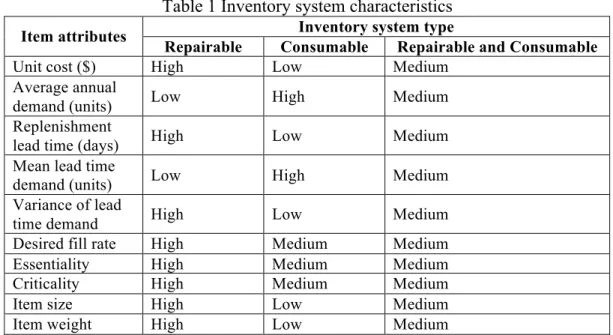
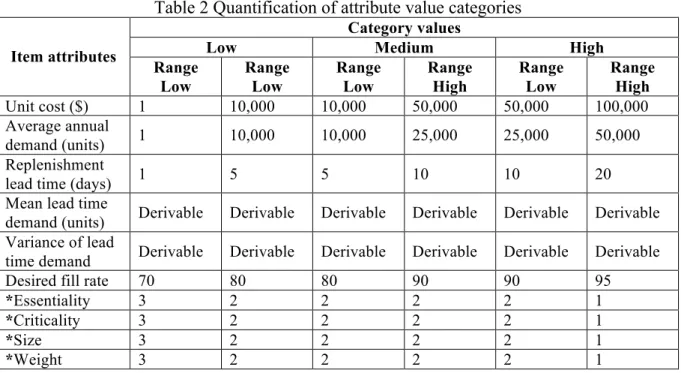
This research considers inventory systems that can be roughly classified as repairable, consumable or both. Table 1 summarizes the assumptions regarding the characteristics of the different types of inventory systems while Table 2 quantifies the attributes that are considered. In Table 1, repairable item inventory systems have items that are characterized by high unit costs, low average annual demand, high replenishment lead times, low mean lead time demand, high variance of lead time demand, high desired
fill rate, high essentiality values, and high criticality values. The quantification of attribute categories is based on a study of datasets used by Deshpande et al. (2003) in their study on the inventory system of the Defense Logistics Agency (DLA). In Table 2, the attribute value categories are given. For example, from Table 2, it can be noted that if the attribute category value of unit cost for items in a given inventory system is defined as high, the items in such an inventory system should have unit cost values ranging from $50,000 to $100,000. The other attributes and their categories can be interpreted in a similar fashion. These attributes and categories for the different types of inventory systems will be used during the clustering analysis and as part of a data generation procedure used in the experiments to make inferences concerning how well the segmentation methods perform for different types of systems and item types.
Table 1 and Table 2 placed near here
Assuming an inventory system that has many items that have the characteristics given in Table 1 and 2, the next step is to consider methods for grouping or clustering the items and setting policies
3.2 Issues related to Grouping or Clustering the Items
The most frequently used inventory classification scheme is ABC inventory classification. This classification is based on ranking the items by the product of each item’s annual demand and its unit cost. Typically, approximately 20% of items account for about 80% of the total annual dollar usage (Silver et al. (1998)). Classification of items is also often performed within the application of group technology, primarily based on physical or other characteristics that are important in the production process. The type of groups obtained using such techniques may satisfy limited goals of the overall supply
chain; however, in practice there may be many other objectives that need to be satisfied. Thus, it is important to try to group items based on additional operationally and functionally important attributes so as to obtain practical groups. Clustering algorithms, which have not been traditionally applied to the area of inventory management, can be used for this purpose.
The main clustering method used in this research is the Unweighted Pair Group Method Using Arithmetic Averages or the UPGMA clustering method. During the experimentation, the performance of the K-means clustering algorithm is also examined. Statistical Analysis Software (SAS) was used for the clustering of the datasets. Romesberg (1984) gives the steps in clustering problems: 1) attribute selection, 2) data matrix formation and standardization, 3) computing similarity metrics, and 4) forming the clusters. In addition, Romesberg (1984) describes the UPGMA and K-means algorithms. UPGMA is a hierarchical form of clustering. In a hierarchical clustering technique the data are not partitioned into a particular number of classes or clusters at a single step. Instead the classification consists of a series of partitions, which may run from a single cluster containing all individuals, to n clusters each containing a single individual. The key issues for this research are 1) attribute selection, 2) the number of clusters, and 3) similarity metrics. The attributes examined are given in Table 1. The usefulness of various attributes to the formation of clusters and number of clusters are examined within the experiments. The similarity metric used here is the Euclidean distance coefficient based on the standardized attribute values. See Everitt et al. (2001). Given a method for forming groups is available, the next important issue is how to incorporate the groups
into a policy setting procedure. The next two sections discuss alternative methods for when and how to use the groups in the inventory segmentation problem.
3.3 Multi-Item Group Policies (MIGP) Inventory Segmentation
The inventory segmentation problem is how to form groups and how to set policies. The MIGP methodology: 1) groups inventory items based on some attributes using a clustering algorithm, 2) determines an inventory policy for each group (i.e. determines a group policy), and 3) has each item within each group use the group policy for its individual inventory policy. In this approach, step 2 is accomplished by applying the multi-item back order model (P1) to the groups. This effectively reduces the size of the optimization problem where N is now the number of groups rather than the number of items. A key issue in this procedure is how to determine the other parameters of the optimization problem (e.g. item demand rate, lead time, holding cost, etc.) for each group prior to applying the optimization procedure. This is denoted as the group policy deciding criteria. For example, let
€
Gj represent the set of items in group
€
j having
€
mj = Gj as the number of items in the group. Then, if the group policy deciding criteria is the average of the attribute values of items in the group then
€
Lgj
=
(
1 mj)
Lii∈Gj
∑
represents the lead time of group€
j in the multi-item back order optimization problem.
Clearly, there is a trade-off associated with the computational savings associated with solving the optimization problem based on groups and the use of the group’s inventory policy on the individual items within the group. If the items are truly similar, then applying a group policy may not cause a significant increase in total cost or decrease
addition, it is easier to manage a smaller number of groups than potentially hundreds of thousands of individual items.
3.4 Grouped Multi-Item Individual Policies (GMIIP) Inventory Segmentation
In the MIGP inventory segmentation methodology, after the items are grouped a group policy deciding criteria is applied and then the optimization problem is solved on the groups. The GMIIP segmentation methodology implements the same logical steps as the MIGP segmentation methodology with one major change. Instead of using a group policy deciding criteria, the GMIIP methodology calculates individual inventory policies for every item within the groups. The statistical clustering algorithm serves the purpose of providing inventory groups that are versatile, practical, and operationally useful. Once the right number and type of groups are formed, these groups are treated as separate sub-problems for the multi-product backorder model.
The complex problem involving policy calculations for a large number of items has now been broken down into several smaller problems. This permits each sub problem to be more readily (quickly) solved. While this achieves managerial convenience with some extra computational cost to solve each sub problem, the items do not lose their total identity because they have their own individual policies. The only loss of identity that the items experience is due to the interactions in the multi-item backorder model. This is because the sub-problems are solved individually and the items within different groups no longer compete within the constraints. Thus, the GMIIP segmentation methodology makes it possible to eliminate one major factor for the loss of identity of the items. At the same time (hopefully) achieving more practical and operationally useful inventory groups than those formed by the conventional inventory grouping techniques like ABC analysis.
The GMIIP technique may yield an inventory segmentation solution that gives a lower penalty cost than the MIGP technique but with increased computation.
In the next section, a set of experiments is used to understand the effectiveness of the MIGP and GMIIP methods by computing the penalty cost and computation times associated with any loss of optimality for not solving the entire multi-item back order problem.
4 Experiments and Results
This section discusses the experiments and the results of the analysis. The overall goal is to gain insights by comparing the performance of the MIGP, GMIIP and ABC analysis techniques with respect to performance metrics like penalty cost, execution time for policy calculations, fill rate and customer wait time. The clustering process can be sensitive to the characteristics of the inventory system, thus it is also important to examine the factors involved in the inventory segmentation process for different types of inventory systems when considering the effectiveness of the segmentation procedures. In order to be able to test the performance of the methods, a procedure is needed that can generate problem instances for the segmentation processes.
4.1 Data Generation Procedure
A procedure to generate problem instances for testing purposes was developed based on the discussion in Section 3 (Tables 1 and 2). In order to develop a method to generate artificial datasets that contain relationships between the generated values of various attributes some assumptions between the attributes based on experience and Deshpande et al. (2003) were made:
• The average annual demand directly proportional to the mean demand during the
replenishment lead-time.
• The average annual demand is directly proportional to the variance of demand during
the replenishment lead-time.
• The average annual demand is directly proportional to the essentiality of the item. • The average annual demand is directly proportional to the criticality of the item. • The average annual demand is directly proportional to the desired fill rate of the item.
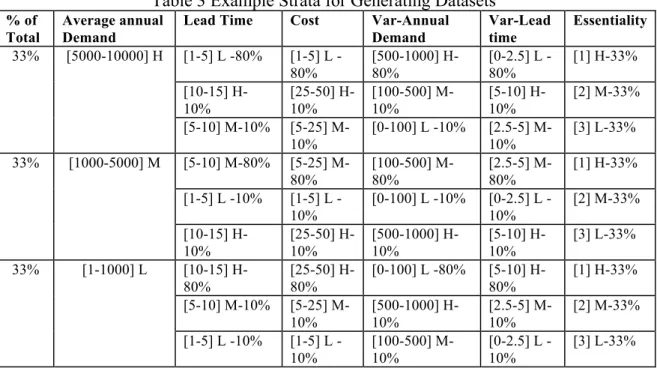
These assumptions are based on reasonable intuitive notions that are expected in typical inventory system datasets. For example, high demand items will tend to have low unit costs. In addition, high demand items tend to have lower lead times. For high demand items, it is intuitive that the mean demand during the lead-time and the variance of demand during the lead-time will tend to be high and hence these two attributes were considered to be directly proportional to the attribute “demand”. Highly essential items will be procured more and hence they tend to have a high annual demand. Similarly highly critical items will also tend to be procured more and hence will have high demand. This helps to explain the assumption regarding the relationship between the pairs of attributes “demand and essentiality” and “demand and criticality”. Those items for which the value of the attribute desired fill-rate is very high will tend to be procured more and hence may tend to exhibit a higher annual demand. This helps to explain the assumption regarding the relationship between the attributes “average annual demand” and “fill-rate”. Based on the above assumptions a procedure was developed to randomly generate datasets with desirable characteristics based on a sequence of conditional probability distributions. Table 3 contains an example specification for generating attribute values
for an inventory system. For example, in Table 3, the attribute average annual demand is stratified into 3 strata ([1, 1000] low demand, [1000-5000] medium demand, [5000-10000] high demand). A probability distribution is specified across the strata (in this example it is equally likely (33%) to get demand from a particular stratum). Once the stratum is chosen, then the attribute value is randomly generated from the stratum using a uniform distribution over the stratum’s range. This process continues for each of the other attributes.
Table 3 placed near here
For example, suppose the high average annual demand stratum was randomly selected, to generate the lead-time, one of the strata for the lead-time values must then be chosen. Once that stratum is chosen, a value for the lead-time is then drawn. The strata and allocation of probability across the strata were set based on the previously described intuitive assumptions. For example, the low stratum for lead-time has an 80% chance of being selected for high demand items. Thus, the procedure will tend to generate high demand items with low lead-time values. Other strata for the attributes criticality, size, weight, and fill-rate were also used, but not shown here due to limitations on space.
It should be clear that this procedure will not represent any particular real inventory system (and readers may question the ultimate validity of the assumptions); however, that is not the point. The point is to be able to generate reasonable large-scale datasets (with some control over their properties) such that a relative comparison
between the segmentation methods can be examined. In the experiments, different allocations for the conditional probability distributions for the strata as well as ranges for the strata were examined to attempt to mimic different kinds of inventory systems. Such
a data generation procedure is necessary in order to allow experimentation involving such factors as the type of inventory system, number of items, etc. as well as to gain some understanding into the importance of various attributes during the clustering procedure. While it may be preferable to test on real data sets, real data sets do not permit easy control over a wide range of attribute values. To our knowledge, no such data generation procedure is described elsewhere in the literature. The procedure used in this research represents a first step at developing an important component for testing algorithms and methods for large-scale inventory systems. Once datasets can be generated, experimental analysis of the effect of the segmentation strategies can be completed.
4.2 Screening and Segmentation Experiments
In order to examine the effectiveness of the MIGP and GMIIP procedures a two-phase experimental plan was developed. The first phase involves a set of screening experiments to understand the basic behavior of the responses and to establish important factors for further investigation. The second phase of the analysis examined a prioritized response function to try to develop recommendations as to the most appropriate segmentation strategy given different types of datasets.
The key responses to be considered during both phases are:
• Penalty cost – The total inventory cost increase due to setting the policies based
on a segmentation strategy.
• Execution time – The time to execute the policy setting algorithm. • Average fill rate – The average fill rate achieved for the items.
Penalty cost, average fill rate, and customer wait time provide insights into the trade-offs for cost and service due to the application of the segmentation techniques. Execution time provides a surrogate for ease in managing the items.
4.2.1 Screening Experiments and Results
Because the purpose of the experiments is to screen factors, only the MIGP procedure was analyzed. In this analysis, the following factors are of interest:
• Algorithm based factors: number of clusters, clustering algorithm, group policy
deciding criteria. For number of clusters, the levels are high [80% of the total number of SKU’s in the data set], and low [20% of the total number of SKU’s in the data set]. For the clustering algorithm the UPGMA method was compared to the K-means method. For the group policy deciding criteria, using the mean of the group is compared to using the median of the group for policy setting was compared.
• Attribute based factors: unit cost, average annual demand, replenishment
lead-time, mean lead-time demand, variance of lead lead-time, essentiality, criticality, item size, item weight, desired fill rate. For these factors, the levels are simply the presence or absence of the factor during the application of the segmentation procedure.
The algorithm-based factors can provide for an understanding of how the cluster algorithm factors affect the responses. The attribute-based factors indicate which attribute may be important to include in the clustering. It is important to note that the analysis shown here is illustrative and that an organization planning on applying
to consider for their specific situation. The results presented here should provide guidance during that application.
There are a total of 13 factors. Thus, for screening purposes, a fractional factorial design approach was used. A 213-6 resolution IV design (1/64 fraction with 128 runs, 1 replicate per run) was chosen. This provides a clean estimate of the main effects assuming that three way interactions and above are negligible. The experiments were applied to two different datasets containing 10,000 SKUs. The datasets were generated using the aforementioned data generation methodology to represent two different systems (one consumable and one repairable). The observed values of responses for each of the design points were analyzed using the Statistical Analysis Software (SAS) package by examining the ANOVA results.
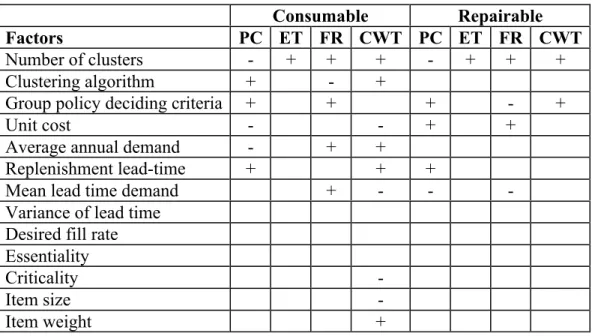
Table 4 placed near here
Table 4 presents a summary of the results for each of the factors. In the table, a “+” indicates that the factor had a positive effect on the response, “-“ indicates that the factor had a negative effect on the response, and a blank cell indicates that the factor was not significant. The significance was tested using a type 1 error of 0.05.
The results of the analysis mostly confirm intuition concerning the experiments. For example, it is clear that the number of clusters within the algorithm significantly affects all of the performance measures. In particular, as the number of clusters increases the penalty cost associated with the grouping decreases. This should be as expected since there is less loss of identity when there are more groups. The results indicate the performance measures fill rate and customer wait time increase as the number of clusters increases. Finally, as expected, the execution time increases as the number of clusters
increases. The choice of clustering algorithm (UPGMA or K-Means) has an effect for the consumable items, but not for the repairable items. Switching from UPGMA to K-Means increases the penalty cost and customer wait time. The group policy deciding criterion has an effect on the penalty cost and fill rate for consumables, and on penalty cost, fill rate and customer wait time for repairable items. Switching from the mean to the median increases the penalty cost.
The attribute-based factors have mixed results. As expected, the unit cost, demand, lead-time and mean lead-time demand affect the penalty cost as well as the fill rate and customer wait time. Recall that for attribute based factors, the presence or absence of the attribute is being tested within the clustering algorithm. Since the policy setting algorithm relies heavily on these attributes it should be natural that they have an effect. The other attributes indicate no effect, except in the case of criticality, item size, and item weight for customer wait time. This is an artifact of the assumptions used the generate the data which cause items with similar characteristics to be grouped together, even though these attributes are not involved in the policy setting algorithm.
Based on the ANOVA results (not shown here), the following algorithm-based factors were selected for phase 2 analysis: number of clusters, group policy deciding criteria, and algorithm type. When applying the clustering procedure a set of attributes must be selected. Using the results of phase 1, the following attribute-based factors: unit cost, lead-time, mean lead-time demand, essentiality, criticality, and size were selected. These selections were based on the significance and magnitude of the effect within the consumable and repairable system experiments. The unit cost, time, and mean lead-time demand clearly showed some effect across the cases. The effect of essentiality,
criticality, and size was marginal; however, they were included because their presence or absence would not have much effect but possibly change the groupings.
4.2.2 Combined Response Experiments and Results
The purpose of the combined response experiments is primarily to understand the effect of the number of clusters, group policy criterion, and clustering algorithm on the behavior of the MIGP and GMIIP procedures and how they compare to applying ABC analysis.
In the conventional inventory classification technique of ABC analysis, the inventory items are divided into three operational groups “A”, “B” and “C”. This classification is based on the cost and average annual demand of the inventory items. Within a segmentation context, we assume that a particular group shares a common inventory policy. The class “A” items are supposed to be 20% out of the total and account for 80% of the annual dollar usage. The class “B” items are supposed to be 60% out of the total and account for 15% of the annual dollar usage. The class “C” items are supposed to be 20% of the total and account for 5% of the annual dollar usage. Thus, by using common policies for items in each of these three groups, more emphasis and attention is given on those items that are important.
As shown in the previous section, the screening experiments demonstrated that there exists trade-offs between the responses (penalty cost, fill rate, customer wait time, and execution time) for the various factors when segmentation is applied. Because of this, the individual responses were prioritized and combined into a single overall response so that recommendations based on the importance of the responses to an inventory manager can be developed.
The combined response was formulated as follows. Let
€
n be the total number of experimental design points with
€
j=1,2,…n indicating the
€
jthdesign point. Let
€
Rijk be the
€
ith response (1= total cost, 2 = fill rate, 3 = customer wait time, 4 = execution time) for the
€
jthdesign point of the
€
kth segmentation procedure (k = MIGP, GMIIP, ABC). Let Multi-Item Individual Policies (MIIP) refer to solving problem (P1) without any grouping. Define
€
Dijk =Rijk−RijMIIP as the percent difference between the MIIP value for the
€
ith response for the jth design point and the MIIP solutions value of the
€
ith response for the jth design point. For example,
€
D1MIGPj represents the penalty cost due to applying
the MIGP segmentation procedure. Let
€
Pi represent the priority that the inventory manager assigns to the
€
ith response. Define
€
Dkj as the overall prioritized response for
the
€
jthdesign point, where
€
Dkj =P1×D1kj+P2×D2kj+P3×D3kj−P4 ×D4kj.
It is important to note that because of the loss of identity caused by grouping, the values observed for the responses cost, fill rate, and customer wait time will be inferior to the solution obtained by using the MIIP approach. The execution time for policy calculations will be reduced because of using the inventory segmentation approach and hence the values observed for the response execution time should be superior to those observed by using the MIIP approach. Hence, for the responses cost, fill rate, and customer wait time, it is desirable to minimize the percentage difference of their values with respect to the solution obtained by the MIIP approach, while for the response execution time it is desirable maximize the percentage saving in the execution time or maximize D4kj. Hence a negative coefficient has been assigned to the term D
4j
k in the
etc.) could be used for developing a combined response, this linearly additive response was deemed reasonable because of its simplicity and because of its ability to sufficiently capture the trade-offs between the individual responses.
In the final experiments, looking for a factorial combination that tends to minimize the combined response function will be useful. Thus, for a given set of priority values for the four responses, a recommended strategy for inventory segmentation for a given type of inventory system may be obtained. The following cases were considered when comparing the MIGP, GMIIP, and ABC segmentation techniques.
• Case 1: Cost has the highest priority, with all other responses being equally important
( € P1=0.85, € P2=0.05, € P3 =0.05, € P4 =0.05)
• Case 2: Execution time has the highest priority, with all other responses being equally
important ( € P1=0.05, € P2 =0.05, € P3=0.05, € P4 =0.85)
• Case 3: Fill rate has the highest priority, with all other responses being equally
important ( € P1=0.05, € P2 =0.85, € P3=0.05, € P4 =0.05)
• Case 4: Customer wait time has the highest priority, with all other responses being
equally important ( € P1=0.05, € P2 =0.05, € P3 =0.85, € P4 =0.05)
• Case 5: All responses have the same importance (
€ P1=0.25, € P2=0.25, € P3=0.25, € P4 =0.25)
To examine the types of recommendations that may be made for typical repairable items inventory system, a repairable system dataset containing 10000 items was generated. Then, a set of experiments as outlined in Table 5 was performed for each of the segmentation methods for which Dkj (k = MIGP, GMIIP, ABC) was determined. Given
the analysis. Finally, the resulting response surface model for each segmentation method was examined to determine the set of levels that resulted in the smallest value of the combined response function for each of the five priority cases.
Table 5 placed near here
As seen from the Table 5, the factor “Number of Clusters” was tested for eight different levels. These levels indicate the number of clusters or inventory groups to be formed. For example the level “10%” means that the number of inventory groups formed is 10% of the total number of items present in the inventory system. Thus, the experiments range from a very low number of inventory groups or clusters (10%) to a very high number of inventory groups or clusters (80%). Four different levels for the factor “Group Policy Criteria” were selected. These levels include the mean, median, minimum and the maximum group policy deciding criteria. For the clustering algorithm the UPGMA and the Ward’s Minimum Variance clustering algorithm available in SAS were selected.
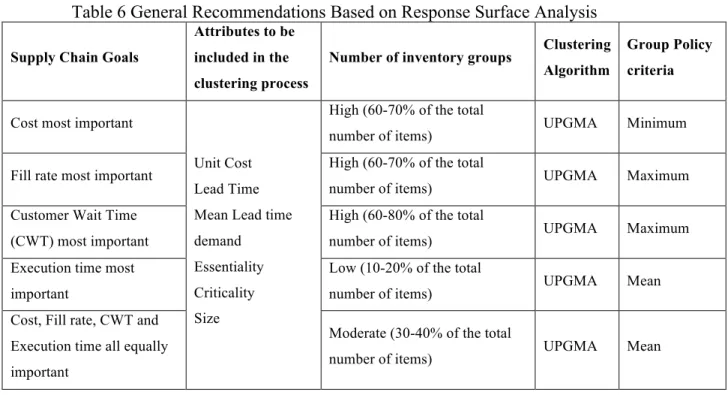
Table 6 summarizes the recommendations based on the experiments. The results indicate that the attributes unit cost, lead time, mean lead time demand, essentiality, criticality, and size should all be included in the segmentation process. In addition, in all cases the UPGMA clustering method should be used. If low cost is the most important supply chain goal then there should be a high number of groups (at least 60%) and that the minimum of the group should be used as the group policy deciding criteria. If execution time is more important then there should be less groups and the mean of the group should be used as the group policy deciding criteria. It is interesting to not that the
maximum should be preferred for the group policy deciding criteria when the supply chain goal is focused on customer service (i.e. fill rate and/or customer wait time).
Table 6 placed near here
Because of the complex nature of the inventory segmentation problem it is difficult to achieve an effective trade-off between the managerial convenience due to inventory classification and the penalty incurred due to the loss of identity. Hence every inventory segmentation strategy will have its own advantages and disadvantages. It is important to choose an inventory classification technique that is best suited to the type of inventory system under consideration. The purpose of the comparison between the three inventory classification techniques is to develop the relative advantages and disadvantages of each of these techniques from the perspective of important performance metrics. Next, the experiments conducted for this comparison and analysis of the results is discussed.
Table 7 presents the percentage above the MIIP values. Recall that the MIIP values represent the non-segmented solutions and thus the best that can be achieve. In terms of all the performance measures (penalty cost, fill rate, and customer wait time) the GMIIP approach does the best because it assigns the policies individually. The ABC approach is the least preferred in terms of these performance measures. Figure 1 illustrates the execution time for the sample problems. It is observed that the MIGP segmentation methodology takes longer to calculate group policies than both the GMIIP and the ABC analysis techniques. This is also an intuitive result as the number of groups for which we need to calculate inventory policies is highest in case of the MIGP technique. In ABC analysis we constantly have 3 inventory groups and hence the
execution time is the lowest in this case. It is important to note here that in case of the GMIIP technique, we have to individually calculate inventory policies for items in each of the groups (sub problems) formed. Hence if parallel computing resources are not available, GMIIP will take more time than what is observed in these results. Our experiments assume that we have as many computing resources as the number of groups formed using the GMIIP inventory classification technique.
Table 7 placed near here
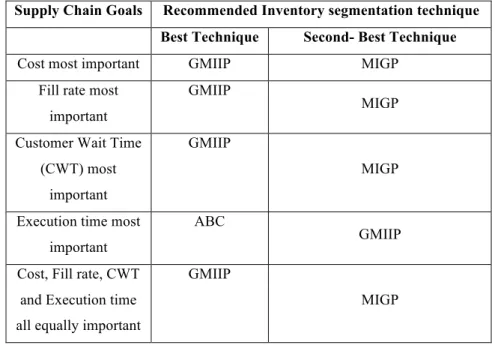
Table 8 summarizes the results based on the supply chain goals. These recommendations are based on the results obtained by comparing the performance of these three techniques. It is important to choose the right type of inventory segmentation methodology that suits the goals of the supply chain under consideration. Also, the feasibility of using these methods has to be evaluated. Hence we recommend the best and also the second best inventory segmentation technique for the supply chain goals considered.
Table 8 placed near here
These recommendations can be used in combination with the recommendations to choose the inventory segmentation technique. Thus a strategy can be developed that helps to choose an inventory segmentation technique and further helps to arrive at a recommended combination of factors in the inventory segmentation process. This can help in finding an effective trade off between the managerial convenience and the loss of identity in the process of inventory classification.
5 Summary and Future Work
This paper presented techniques that can help achieve an effective trade off between the managerial convenience and penalty cost in the inventory classification or segmentation
process. It is very important to state here that managerial convenience is a highly subjective term and hence the results of an inventory segmentation process will depend on the expectations of the manager. Because of this, the research recommends strategies for inventory segmentation when different supply chain goals are important.
The primary focus of the work is in analyzing the impact of segmentation strategies for large-scale, multi-item inventory systems. The basic idea is to segment or group the items so that the items can be more easily managed, especially with regards to setting the inventory policies for the items. Statistical clustering techniques were examined to determine the effect of using different attributes within the clustering procedures and the resulting performance of the inventory policy settings. A new data generation procedure was developed and used to generate large-scale data sets for use during the experiments.
Two new approaches to the setting of the policies were developed and analyzed. The Multi-Item Group Policy (MIGP) procedure sets a policy for the group of items, such that all items in the group use the same policy parameters. This reduces the computations to set the policies significantly, but also causes a lack of identity for the items and a resulting lack of performance when compared to individual policy setting procedures. The Group Multi Item Individual Policy (GMIIP) procedure uses the resulting groups to set the policies of the individual items within the groups. This results in more computation but policies that are significantly closer to individually determining the policies for each item. The ABC approach to classifying the items was also compared to the MIGP and GMIIP procedures. The experimental results show that the MIGP and the GMIIP inventory segmentation techniques outperform conventional inventory classification technique like ABC analysis both from the perspective of achieving cost as
well as service oriented goals of the supply chain. Given a specific target of penalty cost and managerial convenience (preferred number of inventory groups to be managed) the MIGP and GMIIP techniques hold the potential to achieve the desired performance metrics for different types of inventory systems.
This research has established and tested a basic, generic framework to handle the challenging task of inventory classification. There are many aspects of this framework that can be further refined. In the MIGP and GMIIP inventory segmentation techniques, the items are grouped and the policies are set (either individually or for the group). There is a need to formulate an optimization model that combines the grouping and policy-making processes at the same time. Such an optimization model may help to explicitly capture the trade-offs between cost and service that result from the grouping processes. Finally, the ideas within this paper could be extended to the application of segmentation techniques on large-scale multi-item multi-echelon inventory systems, where the policy setting process is significantly more complicated.
Acknowledgements
Thanks to the anonymous reviewers for their suggestions to improve the article. This material is based upon work supported by the National Science Foundation under Grant No. 0437408. Any opinions, findings, and conclusions or recommendations expressed in this material are those of the author(s) and do not necessarily reflect the views of the National Science Foundation.
6 References
1. Al-Rifai´ M. H. and Rossetti, M. D. (2007), “An Efficient Heuristic Optimization Algorithm for a Two-Echelon (R, Q) Inventory System”, International Journal of Production Economics, Vol. 109, No. 1-2, pp. 195-213.
2. Caglar, D., Li, C-L. and Simchi-Levi, D. (2004), “Two-echelon spare parts inventory system subject to a service constraint”, IIE Transactions, Vol. 36, pp. 655-666.
3. Chakravarty, A. (1981), “Multi-item inventory aggregation into groups”, Journal of the Operational Research Society, Vol. 32, pp. 19-26.
4. Chu, C., Liang, G. and Liao, C. (2008), “Controlling inventory by combining ABC analysis and fuzzy classification”, Computers & Industrial Engineering, Vol. 55, no. 4, pp. 841-851
5. Cohen, M. A., Kamesam, P. V., Kleindorfer, P., Lee, H., and Tekerian, A. (1990), “Optimizer: IBM’s multi-echelon inventory system for managing service logistics”,
Interfaces, Vol. 20, No. 1, pp. 65-82.
6. Deshpande, V., Cohen, M.A., and Donohue, K. (2003), “An Empirical Study of Service Differentiation for Weapon System Service Parts”, Operations Research, Vol. 51, No. 4, pp. 518-530.
7. Deuermeyer, B. and Schwarz, L. B. (1981), “A Model for the Analysis of System Service Level in Warehouse/ Retailer Distribution Systems: the Identical Retailer Case”, in: L. B. Schwarz (Ed.), Studies in Management Sciences, Vol. 16, Multi-Level Production/ Inventory Control Systems, North-Holland, Amsterdam, pp. 163-193.
8. Ernst, R. and Cohen, M.A. (1986), “Operations Related Groups (ORGs): A Clustering Procedure for Production / Inventory Systems”, Journal of Operations Management, Vol. 9, No. 4, pp. 574-598.
9. Everitt, B.S., Landau, S., and Leese, M. (2001), Cluster Analysis, 4th edition, Oxford University Press Inc., New York.
10. Gümüs, A. T. and Güneri, A. F. (2007), “Multi-echelon inventory management in supply chains with uncertain demand and lead times: literature review from an operational research perspective”, Proceedings of the Institution of Mechanical Engineers, Part B: Journal of Engineering Manufacture, Vol. 221, No. 10, pp. 1553-1570.
11. Hopp, W. J., Spearman, M. L., and Zhang, R. Q. (1997), “Easily implementable inventory control policies”, Operations Research, Vol. 45, No. 3, pp. 327-340.
12. Hopp, W. J., Zhang, R. Q., and Spearman, M. L. (1999), “An easily implementable hierarchical heuristic for a two-echelon spare parts distribution system”, IIE Transactions, Vol. 31, pp. 977-988.
13. Lenard, J. and Roy, B. (1995), “Multi-item inventory control: a multi-criteria view”,
European Journal of Operational Research, Vol. 87, pp. 685-692.
14. Margulis, R. (2009), “Lowe’s, Whirlpool, Rite Aid, Kimberly-Clark, Wal-Mart, eBizPrize, Schneider National, and Safeway Honored at 12th VICS Achievement
Awards”, VICS Press Release,
<http://www.vics.org/docs/KSurvey/press_releases/pdf/VICS_2009_Winners_Releas e.pdf>, accessed 8/21/09.
15. Moore, R. and Cox, J. (1992), “An analysis of the forecasting function in large-scale inventory systems”, International Journal of Production Research, Vol. 30, No. 9, pp. 1987-2010.
16. Muckstadt, J. A., (2005), Analysis and Algorithms for Service Parts Supply Chains, Springer Science+Media, Inc.
17. Partovi, F. Y. and Anandarajan, M. (2002), “Classifying inventory using an artificial neural network approach”, Computers &Industrial Engineering, Vol. 41, No. 4, pp. 389-404
18. Ramanathan, R. (2006)., “ABC inventory classification with multiple criteria using weighted linear optimization”, Computers and Operations Research, Vol.33 (3), pp. 695-700
19. Romesburg, H. C. (1984), Cluster Analysis for Researchers, 1st edition, Lifetime Learning Publications, California.
20. Silver, E. A., Pyke, D. F., and Peterson, R. (1998), Inventory Management and Production Planning and Scheduling, 3rd edition, John Wiley & Sons, New York. 21. Svoronos, A and Zipkin, P. (1988), “Estimating the performance of multi-level
inventory systems”, Operations Research, Vol. 36, No. 1, pp. 57-72.
22. Williams, B. D. and Tokar, T. (2008), “A review of inventory management research in major logistics journals – Themes and future directions”, The International Journal of Logistics Management, Vol. 19, No. 2, pp. 212-232.
23. Zhou, P. and Fan, L. (2007), “A note on multi-criteria ABC inventory classification using weighted linear optimization”, European Journal of Operational Research, Vol. 182, pp. 1488-1491.
24. Zipkin, P. H. (2002), Foundations of Inventory Management, McGraw-Hill Companions, Inc.
Table 1 Inventory system characteristics
Inventory system type Item attributes
Repairable Consumable Repairable and Consumable
Unit cost ($) High Low Medium Average annual
demand (units) Low High Medium Replenishment
lead time (days) High Low Medium Mean lead time
demand (units) Low High Medium Variance of lead
time demand High Low Medium Desired fill rate High Medium Medium Essentiality High Medium Medium Criticality High Medium Medium Item size High Low Medium Item weight High Low Medium
Table 2 Quantification of attribute value categories
Category values
Low Medium High
Item attributes Range Low Range Low Range Low Range High Range Low Range High Unit cost ($) 1 10,000 10,000 50,000 50,000 100,000 Average annual demand (units) 1 10,000 10,000 25,000 25,000 50,000 Replenishment
lead time (days) 1 5 5 10 10 20 Mean lead time
demand (units) Derivable Derivable Derivable Derivable Derivable Derivable Variance of lead
time demand Derivable Derivable Derivable Derivable Derivable Derivable Desired fill rate 70 80 80 90 90 95
*Essentiality 3 2 2 2 2 1
*Criticality 3 2 2 2 2 1
*Size 3 2 2 2 2 1
*Weight 3 2 2 2 2 1
*Note: The category values for the attributes essentiality, criticality, size and weight have the following meaning: 1 = high, 2 = medium, 3 = low.
Table 3 Example Strata for Generating Datasets % of
Total
Average annual Demand
Lead Time Cost Var-Annual Demand Var-Lead time Essentiality 33% [5000-10000] H [1-5] L -80% [15] L -80% [500-1000] H-80% [02.5] L -80% [1] H-33% [10-15] H-10% [25-50] H-10% [100-500] M-10% [5-10] H-10% [2] M-33% [5-10] 10% [5-25] M-10% [0-100] L -10% [2.5-5] M-10% [3] L-33% 33% [1000-5000] M [5-10] 80% [5-25] M-80% [100-500] M-80% [2.5-5] M-80% [1] H-33% [1-5] L -10% [15] L -10% [0-100] L -10% [02.5] L -10% [2] M-33% [10-15] H-10% [25-50] H-10% [500-1000] H-10% [5-10] H-10% [3] L-33% 33% [1-1000] L [10-15] H-80% [25-50] H-80% [0-100] L -80% [5-10] H-80% [1] H-33% [5-10] 10% [5-25] M-10% [500-1000] H-10% [2.5-5] M-10% [2] M-33% [1-5] L -10% [15] L -10% [100-500] M-10% [02.5] L -10% [3] L-33%
Table 4 Summary of Screening Experimental Results
Consumable Repairable
Factors PC ET FR CWT PC ET FR CWT
Number of clusters - + + + - + + +
Clustering algorithm + - +
Group policy deciding criteria + + + - +
Unit cost - - + +
Average annual demand - + +
Replenishment lead-time + + +
Mean lead time demand + - - -
Variance of lead time Desired fill rate Essentiality
Criticality -
Item size -
Table 5 Factors and Levels for Combined Response Experiments
Factors Levels
Number of clusters 10%, 20%, 30%, 40%, 50%, 60%, 70%, 80% Group Policy Criterion Mean, median, minimum, maximum
Table 6 General Recommendations Based on Response Surface Analysis Supply Chain Goals
Attributes to be included in the clustering process
Number of inventory groups Clustering Algorithm
Group Policy criteria
Cost most important High (60-70% of the total
number of items) UPGMA Minimum Fill rate most important High (60-70% of the total
number of items) UPGMA Maximum Customer Wait Time
(CWT) most important
High (60-80% of the total
number of items) UPGMA Maximum Execution time most
important
Low (10-20% of the total
number of items) UPGMA Mean Cost, Fill rate, CWT and
Execution time all equally important
Unit Cost Lead Time Mean Lead time demand
Essentiality Criticality Size
Moderate (30-40% of the total
Table 7 Percentage above the MIIP value for MIGP, GMIIP, and ABC Analysis
Penalty Cost Fill Rate Customer Wait Time
Size MIGP ABC GMIIP MIGP ABC GMIIP MIGP ABC GMIIP
2 25.48 39.50 3.29 22.329 53.531 1.086 23.40 45.68 1.56 4 31.79 44.70 3.44 22.782 54.841 1.086 23.80 52.70 1.70 6 34.36 47.18 3.96 23.505 55.073 1.086 24.52 57.08 1.71 8 38.24 51.28 4.79 24.572 55.045 1.086 25.00 59.20 1.80 10 40.14 55.14 5.05 24.723 55.439 1.087 26.34 63.44 1.89