1
The safe implementation of a
prison-based methadone
maintenance programme: 7
year time-series analysis of
primary care prescribing data
Nat MJ Wright
HMP Leeds Healthcare Department
2 Gloucester Terrace
Armley
Leeds
LS12 2TJ
[email protected]
(corresponding author)
Charlotte French
HMP Leeds Healthcare Department
2 Gloucester Terrace
Armley
Leeds
LS12 2TJ
[email protected]
Victoria Allgar
John Hughlings Jackson Building
University of York
Heslington
York YO10 5DD
2
Abstract
Aims: To evaluate the impact and safety of the introduction of a general
practitioner with a special interest (GPsi) in substance misuse led methadone
prescribing service into a UK prison between 2003 and 2010.
Methods: Time series analysis of secondary prescribing data pertaining to
opiate maintenance therapies, opiate detoxification therapies and opiate
related deaths for the time period 2003 to 2010.
Results: Results show that following introduction of a GPsi in substance
misuse there was a statistically significant increase in both methadone
maintenance and detoxification treatments. Over time the rate of methadone
maintenance prescribing plateaued with a corresponding decrease in the rate
of methadone detoxification prescribing. There were no methadone related
deaths in prison over the study period.
Conclusion: The phased introduction of opiate replacement therapies into a
busy remand prison did not result in any deaths within the prison for which
opiate replacement was identified as the cause. GPsi led opiate prescribing
programmes can be introduced safely into secure environments.
3
Background
Recently published statistics show that the prison population for England and
Wales was 84,586 at the end of August 2010 [1]. This figure represents an
increase in the prison population of approximately 30 per cent since 1999.
The increase was due to a combination of tougher sentencing and
enforcement outcomes, and a more serious mix of offence groups coming
before the courts. It equates to a prison population rate of 153/100,000 of the
national population. Internationally there are countries with a higher proportion
of the population imprisoned. For example the United States has the highest
prison population rate in the world with 714 per 100,000 of the national
population in prison and Russia 629/100,000 of the national population, [2].
Upon reception into prison up to 80% of offenders test positive for either
heroin or cocaine [3]. A cross-sectional survey of a sample of the UK prison
population conducted in 1998 revealed that 38% of male remand prisoners
and 48% of sentenced prisoners admitted to using drugs during their current
period of imprisonment. The survey was conducted at a time when there was
very little drug treatment available in the UK prison setting. The practice of
coerced detoxification from opiate maintenance was commonplace upon
reception into prison leading to a class action brought against the Home
Office for negligent drug treatment provision whilst in prison [4]. An out of
court compensation settlement led to a growing pressure to develop prison
based drug treatment services. Compensation was provided as it was
acknowledged that opiate maintenance and detoxification therapies had
4
There was an established evidence base that opiate maintenance reduced
rates of crime, illicit drug use, and injecting practice yet prisoners were not
routinely provided this treatment. Also there was an emerging UK evidence
base that rates of self-harm and suicides were markedly increased in the
week following reception into prison and that uncontrolled symptoms of opiate
withdrawal were a contributory factor [5]. At that time the vast majority of
primary care services were provided by doctors employed by the Home Office
and not the National Health Service (NHS). Not all practitioners offering
primary care services held a certificate of accreditation in general practice.
Nevertheless some drug users were able to become abstinent whilst in prison.
However in the absence of safe prison based primary care prescribing of
opiate maintenance there is an increased risk of drug related death upon
release from prison. This is due to accidental overdose in the community if
similar drug misuse practices are re-commenced upon release following a
period of enforced abstinence in prison leading to a loss of tolerance to
prescribed opiates. An analysis of almost 50,000 newly released prisoners in
England and Wales during the period 1998 to 2000 highlighted over 440
deaths, of which over 250 (59%) were drug-related [6]. In the year following
release, the drug-related mortality rate was 5.2 per 1000 per annum among
men and 5.9 per 1000 per annum among women. However, all-cause
mortality in the first and second weeks following prison release for men was
37 and 26 deaths per 1000 per annum, respectively. In total, 95% of these
deaths were drug-related. All-cause mortality in the first and second weeks
5
annum, respectively, all of which were drug-related [6]. These data highlights
the period of the first two weeks post-release from prison as a time of high risk
for opioid-related deaths.
In June 2004, in such a context of litigation and drug related death post
prison-release, an opiate maintenance programme was introduced into a
remand prison in the North of England with a population of approximately
1200 prisoners. The introduction was phased and preceded the widespread
introduction of such programmes across both the national and international
prison estate. Examples of the international context at that time are that in the
Australian penal system, a prison based randomised controlled trial evaluating
the effectiveness of methadone maintenance had just been published [7]. Key
findings were that at five-month follow-up in prison, those receiving
methadone maintenance reported significant reductions in heroin use, drug
injection and syringe sharing. Four years later, a USA randomised controlled
trial evaluating the effectiveness of prison based opiate maintenance therapy
was published. The researchers randomly allocated two hundred and eleven
users prisoners to either counselling in prison, with passive referral to
treatment upon release; counselling and transfer (counselling in prison with
transfer to methadone maintenance treatment upon release); or counselling
and methadone (methadone maintenance and counselling in prison,
continued in a community-based methadone maintenance program upon
release). Key findings were at one-month follow-up post release a higher
engagement in treatment and lower proportion of individuals testing positive
6
maintenance [8]. However neither of these two trials specifically mentioned
GP involvement in the provision of opiate maintenance to prisoner
populations. We are unaware of any published empirical research pertaining
to core competencies required by GPs in prescribing that has traditionally
been viewed as high risk. In response to such a gap in the evidence base this
paper reports the findings from a time series analysis of seven years
prescribing data for opiate maintenance which took place at a time of
increasing international research activity evaluating the introduction of such
maintenance therapy into prison settings.
Methods
The introduction of a methadone maintenance programme was undertaken by
a general practitioner with special interest (GPsi) in substance misuse who
commenced prison based drug treatment in December 2003 in Her Majesty’s
Prison (HMP) Leeds, a remand prison with a capacity for 1283 prisoners,
where the average length of stay for each prisoner was thirteen weeks. A
consensus document between the UK Royal College of General Practitioners
(RCGP) and Royal College of Psychiatrists, supported by the National
Treatment Agency for Substance Misuse defined the competencies of a GPsi
as having received specific higher-level training in the management of
substance misusers in primary care, usually the Royal College of General
Practitioners’ Certificate in the management of drug misuse in primary care,
Part 2. The document recommended that such practitioners can deliver a
fuller range of drug treatment services and, as a result of additional ongoing
7
more autonomously, accepting referrals from generic GP colleagues, and take
responsibility for more complex cases in substance misuse [9].
For the first six months from January to June 2004 methadone was not
prescribed but organisational changes were made to facilitate the introduction
of a methadone maintenance programme. Such changes included writing a
policy containing guidelines for safe prescribing, dispensing and
administration; and stock requisition. In June 2004 the GPsi commenced a
weekly prescribing clinic for opiate maintenance. Fifteen months later the
number of clinics was increased to five per week. All new treatment inductions
(new commencements) were seen in this clinic. However over the following
two years patients stable on methadone maintenance treatment were followed
up in generic (ie not substance misuse specific) prison GP clinics. Over time
new inductions (commencements) onto maintenance treatment and
methadone detoxification regimes were initiated in clinics run by prison GPs
who had acquired core competencies to work as a GPsi in substance misuse.
“New treatment inductions” included those who were initiated on methadone
for the first time following a clinical history consistent with opioid dependence
and a urine sample positive for either opiates, methadone or buprenorphine. It
included new treatment inductions in either normal prison working hours or
evening clinics for patients newly received into prison. It also included those
assessed in such evening clinics where community prescribed opiate
maintenance had been disrupted due to an absence of methadone
prescribing in police custody at the time the study was taking place. Repeat
8
those who were re-imprisoned during the study period who had previously
been included as a “new treatment induction”. Methadone prescribing for both
maintenance and detoxification was initiated at a dose of 30mg daily if the
patient was assessed on first night reception, and at a dose of 20mg daily if
the patient was assessed in the routine prison clinic. The rationale for such
prescribing regimes was that compared to patients presenting in routine
clinics, patients presenting at first night prison reception typically both
reported and exhibited more severe symptoms and signs of withdrawal.
Subsequently for those receiving a detoxification regime at an initial dose of
20mg od (once daily), the dose would be increased the following day to 30mg
od for a period of six days prior to a reducing regime from 30mg od to zero
over a two week period. In total such a prescribing regime would be of three
weeks duration. For those receiving a maintenance prescribing regime at an
initial dose of 20mg od, the dose would be increased the following day to
30mg od. Any subsequent increases would only take place following review
by a GP. Subsequently published national guidelines for prison recommend
that “to ensure patient safety within this context, methadone treatment
programmes should be established through a process of dose induction. Initial
doses of five to ten milligrams of methadone (1mg in 1ml mixture) are to be
given, at least six hours apart” [10]. National guidelines published in 2007
pertaining to drug treatment recommended “in general, the initial daily dose
will be in the range of 10–30 mg. If tolerance is low or uncertain then 10–20
mg is more appropriate. With heavily dependent misusers who are tolerant,
and where the clinician is experienced or competent, a first dose can be up to
9
Anonymised secondary data for both maintenance and detoxification
treatments was retrieved from the Pharmacy Manager prison pharmacy
dispensing databases for the period covering the start of January 2003 to end
March 2010. Once retrieved, the data was aggregated into discrete three
month time periods according to the date of first receipt of a methadone
prescription. Methadone prescribing was introduced into the prison in May
2004. Therefore by obtaining data at equally- spaced time intervals (ie. three
month time periods) both pre and post-intervention, it was possible to analyse
by an interrupted time-series methodology. . Durbin-Watson statistics were
used to test for serial correlation (a relationship between values separated
from each other by a given time lag). The trend component of this time-series
is examined to determine the long-term variation of the trends in prescribing
methadone maintenance and detoxification therapies in the prison and
community. The basic model: Yt = bo + b1T + b2D + b3P + et, where T is time
from the start of the observational period, D is a dummy variable for pre or
post intervention and P is time since the intervention; et is the random
variation at time t not explained by the model. Ordinary Least Squares
regression was undertaken to analyse prescribing trends over time, with 3
independent variables: T – time, D – dummy for pre-post intervention and P –
time since the intervention. The model can determine the change over time
before the intervention was implemented, change in the outcome measure
from the last time point before the intervention to the first time point after the
intervention, and the difference in the slope of the time period before the
10
least squares regression assumes that the error terms associated with each
observation (time point) are uncorrelated.
Results
Over the study period a total of 4551 patients were inducted onto methadone
maintenance and 3181 patients received a detoxification treatment.
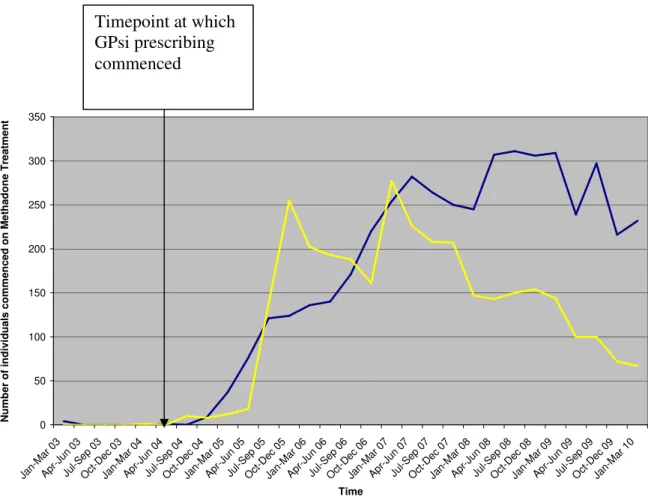
For methadone maintenance, the numbers of individuals receiving
maintenance prescriptions rise steadily from its introduction in 2004, to 282 in
April - June 2007. Subsequently, prescriptions remain within the range of
245-311 until October - December 2009, where they fall to 216 before rising
slightly at the beginning of 2010 to 232.
Figure 1 shows the number of inductions “new commencements”
maintenance and detoxification episodes between the time period start of
January 2003 to end of March 2010 and this is displayed in table format in
appendix 1.
<<<<Figure 1 here>>>>
Ordinary least squares regression was undertaken to analyse prescribing
trends over time. Durbin-Watson statistics to test for serial correlation of the
error terms was not significant (p=0.556), meaning that there was no
autocorrelation. The trend prior to intervention was flat (p=.978), as would be
expected. Following the intervention of GPsi prescribing there was an
11
significant (p=0.085). Also there was no significant change in trend
immediately after the intervention (0.494). However over time post the
intervention of a GPsi there is a statistically significant increase for methadone
maintenance treatment episodes (p=0.002).
As regards the results for detoxification treatments, prior to the time-point April
- July 2006, detoxification treatments appear to have been preferred to
maintenance. The number of detoxification prescriptions rose dramatically
from 18 (April-June 2005) to 255 (October – December 2005), staying higher
than those for methadone until the end of 2006, when they fell to 161. There
then appears to be a rapid increase in detoxification therapies prescribed in
January-March 2007, reaching 277. However after this increase, methadone
detoxification prescriptions have remained lower than those for methadone
maintenance and have decreased steadily from 277 at the beginning of 2007
to 67 in January – March 2010. Ordinary least squares regression was
undertaken to analyse prescribing trends over time. Durbin-Watson statistics
to test for serial correlation of the error terms was not significant (p=0.597),
meaning that there was no autocorrelation. The trend prior to intervention was
flat (p=0.935), as would be expected. Following the intervention of GPsi
prescribing there was an increase in patients receiving detoxification (Graph
1), which was significant (p=0.016). There was no significant change in trend
after the intervention (p=0.864). However over time post the intervention of a
GPsi there was no statistically significant increase in detoxification treatment
12
Drug-related deaths
There were no opioid related deaths in the prison over the study period prior
to the introduction of methadone maintenance treatment. During the time
period of 2003-2010 there was one death of a patient receiving methadone
treatment at the time of death. His death occurred in 2006 one week after
initiation of methadone at a daily dose of 30mg. However toxicology
investigations highlighted the illicit use of mirtazapine, a sedative
antidepressant [12]. At inquest the coroner reported that the prescribing of
methadone maintenance was appropriate in this case and therefore, this
patient’s death was not attributed to his methadone treatment. Thus, there are
no methadone related deaths recorded at HMP Leeds since its introduction in
2004.
Discussion
Following the intervention of a GPsi led prescribing service for substance
misuse there was a steady increase over the following four and half years in
patients being initiated onto methadone maintenance. The fact that the
increase only became statistically significant over time is evidence that the
implementation was phased to ensure that the system was safe. From the
time-point April-June 2008 a further increase in the number of patients being
initiated onto methadone maintenance is evidence of a second prison based
GPsi receiving the core competencies to work with substance misuse and the
practice of methadone induction therefore becoming normalised in the prison
13
Following the introduction of a GPsi led prescribing service there was an
immediate statistically significant increase in patients receiving detoxification
regimes. However two years after the introduction there was a decline in
detoxification prescribing, the decline starting in the time-point April-June
2006. This can be explained by the fact that the local prescribing protocol
changed. Initially due to pressure on the service a patient could only be
initiated onto opiate maintenance if they had failed to become abstinent upon
completion of a detoxification regime. However as over 80% of drug users in
the prison failed to achieve abstinence [13], the protocol was changed to
permit patients to be inducted onto methadone maintenance where
appropriate. In the time-point January -March 2007 there was a further
increase in methadone detoxification treatments. This can be explained by the
recruitment of a new GP who at the time of recruitment did not possess the
core competencies of a GPsi. Therefore the prescribing interventions of the
GP were limited to offering detoxification (and not maintenance) regimes. As
the GP acquired the core competencies to practice as a GPsi, the number of
maintenance treatments continued to rise and over time a corresponding fall
in detoxification treatments.
In 2001, a UK based taskforce highlighted that the prison environment can be
a difficult and complex one in which to work as a doctor. It highlighted that the
nature of the prisoner population meant that prison based doctors would
require particular skills in dealing with alcohol and substance misuse. It also
highlighted the inherent risks of professional isolation working in prison
14
structure of primary care provision in prison settings [14]. A key clinical
governance concern was that not all doctors providing primary care services
in the UK prison estate at that time were trained in the skills of general
practice. In 2001 the UK Royal College of General Practitioners commenced a
training unit dedicated to training general practitioners in the knowledge and
skills required to competently offer treatment to drug users. At the time of
writing, since the inception of this course 14,137 individuals have been trained
in the basics of drug treatment and 2016 have received training to confer the
competencies required to practice as a GPsi in substance misuse [15]. We
would suggest that the RCGP has learned lessons that can be disseminated
internationally. The RCGP through the Membership of Royal College of
General Practitioners International academic examination currently has a
successful formula for internationally conferring generic primary care core
competencies. The challenge for the RCGP will be how it can replicate this
successful generic international primary care model in the field of primary care
drug treatment. We would suggest that networking with international policy
leads, and international marketing of training programmes are key to
disseminating best training practice. International data pertaining to the
background of doctors providing primary care based drug treatment in prison
settings is lacking. It is possible that other countries are facing similar clinical
governance concerns regarding the safety of prison primary care based drug
treatment. There is evidence from research conducted in the Belgian prison
healthcare service of prisoners consulting the GP 3.8 times more than a
demographically equivalent population in the community [16]. The high
15
misuse. However there is a paucity of research evaluating primary care based
drug treatment provision. Clearly if internationally prisoners are high users of
primary care services then general practitioners who have received training in
the provision of safe drug treatment will be key to increasing the international
provision of prison based drug treatment. It would not be our aspiration that
such general practitioners would necessarily adopt the UK title of “general
practitioner with a special interest”. Rather the purpose of this paper has been
in describing the core competencies to ensure safe primary care provision. It
is the competencies rather than the terminology that we would wish to share
with the international readership.
The main strength of this research is in highlighting that such primary care
development is possible and that methadone replacement therapies can
safely be introduced into prison settings providing such a practice is by GPs
possessing a GPsi level of core competency. Additionally generic GPs are
able to safely offer detoxification regimes within clear prescribing protocols.
This is an important message to the GP field. The burden of investigation
upon GPs practicing in secure environments is intense. In the UK, every
death in custody is by statute subject to scrutiny by Coroner’s Inquiry [17] and
investigation by the Prisons and Probation Ombudsman [18]. Therefore GPs
seeking to provide opiate maintenance therapies in the prison setting should
only do so having undertaken either further training or supervision in the
management of substance misuse. In 2007, the World Health Organisation
through its Health in Prisons Project recommended opiate maintenance
16
estate [19]. Our research has provided a primary care workforce model which
will be able to facilitate the safe and effective implementation of this key
international policy recommendation. A primary care workforce is critical to
increasing availability of drug treatment. Indeed in 1978 the WHO endorsed
the critical importance of primary care organisations as the central focus for
promoting improvements in population health [20].
The main limitation of this research is that it is limited to prescribing data
collated at one remand prison and therefore we would be confident that our
findings could be generalised with confidence only to remand prisons with
similar health needs relating to substance misuse. Also it was not possible to
cross-check our data against coronial records to evaluate the impact of the
programme upon opioid related deaths post release from prison. We suggest
this is an area for future research activity. Also our research did not collect
data pertaining to buprenorphine medication as this was not routinely
prescribed in the prison at the time of initiating data collection. The reason for
this was that the UK prisons at that time had widespread problems regarding
buprenorphine abuse and therefore prescribing of such medication was not
encouraged [21].
Our research has shown that a GPsi led prison drug treatment service is safe
if on first night reception the first induction dose of methadone does not
exceed 30mg and if in routine “outpatient” prison clinics the first induction
dose of methadone does not exceed 20mg. This provides evidence for future
17
recommend a more cautious approach of initial induction at doses of
methadone 5-10mg given at least six hours apart” [10]. Not every prison will
have access to a GPsi. However increasingly clinical leads in prisons are
practicing at a GPsi level of competency and our findings would support
higher initial induction doses being prescribed in prison first night reception
centres.
In demonstrating that methadone maintenance prescribing can be safely
introduced into prison settings, our findings raise questions regarding
long-term outcomes of patients receiving such maintenance treatment. The
outcomes of survival, re-offending, abstinence and retention in treatment
post-release are all areas that merit future research activity. Also comparing
prescribing data between prisons internationally would facilitate the comparing
of clinical standards and frameworks and lead to enhanced sharing of
international best practice. Future research activity should also analyse
prescribing data for buprenorphine as this is increasingly being used for both
maintenance and detoxification in prison settings.
In summary our research has highlighted that a GPsi led phased
implementation of methadone maintenance into prisons does not compromise
patient safety.
Competing Interests
18
Author contributions
NW provided access to the prescribing data from HMP Leeds and participated
in the design of the project and drafted the manuscript. CF gathered and
processed the data required to analyse the number of individuals commenced
on methadone and also assisted in drafting the manuscript. VA conducted the
statistical analysis and drafted this into the methods and results sections. All
authors read and approved the final manuscript.
Authors Information
Nat Wright is the Associate Medical Director for Specialist Services and
Vulnerable Groups, Leeds Community Healthcare. This role entails providing
medical leadership to a cluster of prisons.
Charlotte French undertook this work whilst completing a BSc in primary
health care.
Victoria Allgar is Senior Lecturer in Medical Statistics at Hull and York Medical
School/Health Sciences, University of York.
Acknowledgements
We wish to acknowledge Chris Rowlands, head of pharmacy and clinical lead
for HMP Leeds, for her help in retrieving the data from the pharmacy
dispensing system. We also wish to acknowledge Sophie Wilkinson,
Rose Kennedy, Nadia Hendrickse-Welsh and Matthew Limm, all of whom
19
Appendix 1
Table 1: Numbers of Methadone Maintenance and Detoxification new treatments issued from 2003-2010
Time period
Methadone Maintenance New Treatment Induction episodes
Methadone New Detoxification Treatment episodes Jan-Mar 2003 4 0 Apr-Jun 2003 0 0 Jul-Sep 2003 0 0 Oct-Dec 2003 0 0 Jan-Mar 2004 0 1 Apr-Jun 2004 1 0 Jul-Sep 2004 0 10 Oct-Dec 2004 9 8 Jan-Mar 2005 37 12 Apr-Jun 2005 76 18 Jul-Sep 2005 121 138 Oct-Dec 2005 124 255 Jan-Mar 2006 136 202 Apr-Jun 2006 140 193 Jul-Sep 2006 171 188 Oct-Dec 2006 220 161 Jan-Mar 2007 254 277 Apr-Jun 2007 282 226 Jul-Sep 2007 264 208 Oct-Dec 2007 250 207 Jan-Mar 2008 245 147 Apr-Jun 2008 307 143 Jul-Sep 2008 311 150 Oct-Dec 2008 306 154 Jan-Mar 2009 309 144 Apr-Jun 2009 239 100 Jul-Sep 2009 297 100 Oct-Dec 2009 216 72 Jan-Mar 2010 232 67 TOTAL 4551 3181
20
References
[1] Ministry of Justice 2010. Population in custody monthly tables August 2010
England and Wales: Ministry of Justice Statistics bulletin
http://webarchive.nationalarchives.gov.uk/20110218140638/http://www.justice .gov.uk/publications/docs/pop-in-custody-aug2010.pdf (accessed
11/06/2013).
[2] Walmsley R. World Prison Population List (eighth edition). London: International Centre for Prison Studies, 2009.
[3] National Offender Management Service (2005) Strategy for the
Management and Treatment of Problematic Drug Users within the Correctional Facilities, London, National Offender Management Service.
[4] Silverman J 2006. Prisoners who take on the system.
http://news.bbc.co.uk/1/hi/uk/6146606.stm (accessed 11/06/13).
[5] Shaw J, Appleby L and Baker D. Safer Prisons: A National Study of Prison
Suicides 1999–2000 by the National Confidential Inquiry into Suicides and Homicides by People with Mental Illness. London: Department of Health,
2003.
[6] Farrell M and Marsden J. Drug related mortality among newly released
offenders 1998-2000. London: Home Office, 2005.
http://webarchive.nationalarchives.gov.uk/20110218135832/http:/rds.homeoffi ce.gov.uk/rds/pdfs05/rdsolr4005.pdf (Accessed: 11/06/13).
[7] Dolan K, Shearer J, MacDonald M, Mattick RP, Hall W and Wodak A. A randomised controlled trial of methadone maintenance treatment versus wait list control in an Australian prison system. Drug and Alcohol Dependence 2003; 72: 59-65.
[8] Kinlock TW, Gordon MS, Schwartz RP, O’Grady K, Fitzgerald TT and Wilson M. A randomized clinical trial of methadone maintenance for prisoners: results at 1-month post-release. Drug and Alcohol Dependence 2007; 91: 220–227.
[9] Royal College of General Practitioners and Royal College of Psychiatrists.
Roles and responsibilities of doctors in the provision of treatment for drug and alcohol misusers Council Report CR131 London: Royal College of
Psychiatrists, 2005.
[10] Department of Health, National Treatment Agency for Substance Misuse, Royal College of General Practitioners, Royal College of Psychiatrists and Royal Pharmaceutical Society of Great Britain. Clinical Management of Drug
Dependence in the Adult Prison Setting, including psychosocial treatment as a core part. London: Department of Health, 2006.
21
[11] Department of Health (England) and the devolved administrations. Drug
misuse and Dependence: UK guidelines on Clinical Management. London:
Department of Health (England), the Scottish Government, Welsh Assembly Government and Northern Ireland Executive, 2007.
[12] Shaw S, Report by the Prisons and Probation Ombudsman for England
and Wales (April 2007). Investigation into the circumstances surrounding the death of a man at HMP Leeds in July 2006. http://www.ppo.gov.uk/docs/046-06-death-of-a-male-prisoner.pdf (Accessed 11/06/13).
[13] Wright NMJ, Sheard L, Adams CE, Rushforth B, Harrison W, Bound N, Hart R, Tompkins CNE. The Leeds Evaluation of Efficacy of Detoxification
Study (LEEDS) Prisons Project: A randomised controlled trial comparing methadone and buprenorphine for opiate detoxification. British Journal of
General Practice 2011; 61 (593): 710-711.
[14] Prison Health Task Force and Policy Unit 2001. Report of the Working Group on Doctors Working in Prisons.
http://webarchive.nationalarchives.gov.uk/20130107105354/http://www.dh.gov .uk/prod_consum_dh/groups/dh_digitalassets/@dh/@en/documents/digitalass et/dh_4034220.pdf. (Accessed 11/06/2013).
[15] Schwarz M. Numbers completing RCGP certificate in substance misuse courses. Personal Communications, 11/1/13.
[16] Feron JM, Paulus D, Tonglet R, Lorant V and Pestiaux D. Substantial use of primary health care by prisoners: epidemiological description and possible explanations. Journal of Epidemiology and Community Health 2005;59:651– 655.
[17] Coroner’s Act 1988.
http://www.legislation.gov.uk/ukpga/1988/13/contents (Accessed 11/06/2013).
[18] Prisons and Probation Ombudsman 2012.
http://www.ppo.gov.uk/investigating-fatal-accidents.html (Accessed 11/06/2013).
[19] World Health Organisation 2007. Health in prisons: A WHO guide to the
essentials in prison health.
http://www.euro.who.int/__data/assets/pdf_file/0009/99018/E90174.pdf
(Accessed 11/06/2013).
[20] WHO Primary Healthcare: Report of the International Conference on
Primary Healthcare at Alma-Ata, USSR, September 6-12. Geneva:
WHO/UNICEF, 1978.
[21] Ministry of Justice. A Survey of Buprenorphine Misuse in Prison. London: HM Prison Service, 2007. National Offender Management Service. Strategy
22
Correctional Facilities. London: National Offender Management Service,
0 50 100 150 200 250 300 350 Ja n-Mar 03 Apr -Jun 03 Jul-S ep 0 3 Oct -Dec 03 Ja n-Mar 04 Apr -Jun 04 Jul-S ep 0 4 Oct -Dec 04 Ja n-Mar 05 Apr -Jun 05 Jul-S ep 0 5 Oct -Dec 05 Ja n-Mar 06 Apr -Jun 06 Jul-S ep 0 6 Oct -Dec 06 Ja n-Mar 07 Apr -Jun 07 Jul-S ep 0 7 Oct -Dec 07 Ja n-Mar 08 Apr -Jun 08 Jul-S ep 0 8 Oct -Dec 08 Ja n-Mar 09 Apr -Jun 09 Jul-S ep 0 9 Oct -Dec 09 Ja n-Mar 10 Time N u m b e r o f in d iv id u a ls c o m m e n c e d o n M e th a d o n e T re a tm e n t Maintenance Detox
Figure 1: Number of individuals commenced on Methadone for either Maintenance or Detoxification at HMP Leeds from 2003-2010
Timepoint at which GPsi prescribing commenced