LAS 2005: critiquing and r
efl
ecting
Postgraduate Essentials: An
online transition program for
commencing PhD students
Wendy LarcombeThe University of Melbourne
Anthony McCosker
The University of Melbourne
Abstract: Postgraduate Essentials is the fi rst online interactive course in Australia designed to build an inclusive postgraduate learning community while delivering integrated candidature information, transition advice and academic skills support to students in their fi rst year of PhD candidature. In content and focus, Postgraduate Essentials aims to complement and enhance traditional research supervision to ensure that an increasingly diverse student population has access to information, skills support and an active peer-network. It does this by facilitating new PhD students’ transition to a research environment and their membership of the postgraduate student community, and by providing support to develop the academic and professional skills that underpin successful completion of common fi rst year PhD requirements. This paper refl ects on the experiences of the Language and Academic Skills (LAS) advisers on the Postgraduate Essentials project team, and on students’ participation in and evaluations of the program in 2004. We focus on the unexpectedly high enrolment of on-campus students who already have access to face-to-face academic skills programs. We observe that student expectations regarding levels and modes of academic skills support, coupled with the resource-intensive nature of multimedia development, create additional demands on LAS advisers’ time, skills and resources. For projects such as Postgraduate Essentials to be sustainable, we recommend a collaborative approach that utilizes the skills and expertise of key staff in different areas of teaching and support.
Key words: academic skills, postgraduate learning communities, online learning support
Introduction
Postgraduate Essentials is a 12-week online interactive course designed to support
Postgraduate Essentials is a 12-week online interactive course designed to support
Postgraduate Essentials
University of Melbourne PhD students in their fi rst year of candidature. Over the six fortnightly modules, the course familiarizes students with the common stages and requirements of PhD candidature and assists them to develop academic and professional skills – such as literature reviewing and network building – that underpin a successful fi rst year. The program also aims to enhance students’ experiences of postgraduate research by facilitating interaction and community-building among this often isolated and diverse student cohort.
This paper reviews the 2004 pilot offerings of Postgraduate EssentialsPostgraduate EssentialsPostgraduate Essentials in the context of in the context of
the increasing demand for academic skills support services from postgraduate students. It considers current applications of online support for this cohort and describes the aims
and features of Postgraduate Essentials. We analyse the high level of interest in this form
of online support among the general cohort of postgraduate research students. Finally, we explore the implications of the program for Language and Academic Skills (LAS) advisers in terms of the resources, skills and time needed to develop and maintain this type of program.
Background: online support for research postgraduate students
Recent years have seen a substantial increase in the demand for language and academic skills support services at the postgraduate level. At the University of Melbourne, postgraduate students are disproportionately high users of the individual tutorial service offered by the Language and Learning Skills Unit (LLSU), and the LLSU offers more than 100 hours per semester of teaching (workshops and short courses) at the postgraduate level. Support is most commonly sought for the development of academic writing skills; oral presentation skills classes are also well attended. Time and project management skills form the third signifi cant area of work at this level.
Two main factors are readily identifi able as driving the increase in demand for academic support at the postgraduate level at the University of Melbourne: fi rstly, the overall increase in numbers of students undertaking postgraduate research and coursework degrees (School of Graduate Studies, 2003, p. 9); and, secondly, the increasingly diverse cultural and educational backgrounds of postgraduate students (Pearson and Ford, 1997, p. ix). Postgraduate research students face additional pressures from the institutional focus on ‘timely completions’ and the subsequent reduction of average completion time for a PhD – from 3.95 years in 1997 to 3.63 years in 2002 (School of Graduate Studies, 2003, p. 9).
Most universities have developed a range of strategies to address increasing demands for LAS services. Campus-based workshops, seminars and short courses are common as are, increasingly, various forms of online support including Internet-based access to advisers and academic skills resources. The move to provide online academic support for postgraduate students is a logical one, given that the majority of online courses are offered at the postgraduate level (Bell, Bush, Nicholson, O’Brien, & Tran, 2002, p. ix) and that online learning appears to have ‘wider applicability and acceptance among postgraduate
LAS 2005: critiquing and r
efl
ecting
students’ (Bell et al., 2002, p. 2). Potentially, online delivery is also better able to address the geographical distribution of postgraduate research students – whether enrolled in online or campus-based courses – and their need for greater fl exibility in access to services, given work and family commitments. For many postgraduate coursework and research students, the capacity for web-based communication with language and learning skills advisers as well as academic supervisors is an important feature of online learning support.
Increasingly, universities are developing online communication tools for forming and maintaining learning communities, and the benefi ts are being investigated in a range of educational settings (Reisman, Flores, & Edge, 2003; Bell et al., 2002; Borthwick & Wissler, 2003). However, only limited attention has been paid to the use of online learning communities for PhD learning and support. Communication tools and activities such as email lists or bulletin boards are usually positioned as ‘supplementary’ forms of online delivery for disciplinary specifi c subject areas (Bell et al., 2002, pp. 5-6). According to Honey, Gunn and North (2004, p. 414), the use of these basic kinds of online communication tools in combination with traditional on-campus course delivery works well with a relatively homogenous, disciplinary based, postgraduate cohort such as postgraduate nursing students. Stacey (1996) outlines similar uses of electronic conferencing, email and fi le transfer technology for Deakin University Education Doctorate students. However, Love (2001, p. 4) sees both synchronous and asynchronous online discussion groups as of particular relevance to PhD ‘research training’. In principle at least, web-based communication tools, and the formation and facilitation of learning communities, enable forms of collaboration and knowledge building (Brook & Oliver, 2003) that are ideal for postgraduate research cohorts.
Online learning support at the postgraduate level has also been applied in developing higher degree research students’ ‘generic capabilities’ (Borthwick & Wissler, 2003). These are generally defi ned as ‘workplace related skills’ or ‘the skills and attributes that have a direct link to postgraduate research students’ employability’ (Borthwick & Wissler, 2003, p. 1). They include: leadership and communication, project management, commercialization of research, entrepreneurship and public policy (Borthwick & Wissler, 2003, p. 30). These programs aim to capitalise on what is described as a desire, from both industry employers and research students, for stronger university-industry research links and skills training (Harman, 2002; Gilbert, Balatti, Turner, & Whitehourse, 2004). A signifi cant example in Australian tertiary education is the Australian Technology Network’s (ATN) Learning Employment Aptitudes Program (LEAP), an inter-university online generic capabilities project. Aiming to develop research students’ employment related skills, LEAP is able to effectively utilise online technologies to provide self-paced and moderated resources while enabling discussion-based network and community building related to the topic areas (Borthwick & Wissler, 2003, p. 55).
Postgraduate Essentials at the University of Melbourne utilizes the capacities of online
Postgraduate Essentials at the University of Melbourne utilizes the capacities of online
Postgraduate Essentials
support for both community-building and development of students’ generic capabilities. In addition, it aims to provide an integrated transition program to support students in their fi rst year of PhD candidature. The decision to develop an online program emerged out of the need for more fl exible access to postgraduate transition, administration and academic skills support. Traditionally a ‘campus-based university’ with an emphasis on face-to-face interaction and a ‘campus experience’, the University of Melbourne’s research
postgraduates are nonetheless widely distributed: the University has 9 regional and rural campuses across Victoria and arrangements with more than 25 institutions approved to supervise postgraduate research. While research postgraduate students based at the main Parkville campus enjoy access to a comprehensive range of short courses, workshops, seminars and skills development programs, students based at regional and smaller metropolitan campuses - including affi liated teaching hospitals and research institutes - do not enjoy the same ease of access to many of the transition initiatives and academic programs available to their Parkville-based colleagues. Improving the provision of services to students at regional and remote campuses and affi liated research sites was a specifi c priority in the operational plans of LLSU and the School of Graduate Studies (SGS) in 2003 and 2004.
Postgraduate Essentials
Postgraduate Essentials was offered as a pilot program in each semester of 2004. With its
Postgraduate Essentials was offered as a pilot program in each semester of 2004. With its
Postgraduate Essentials
own online course facilitator and a panel of advisers on-call, the 12-week course provides an effective ‘one-stop-shop’ for practical information and advice on:
• Starting your PhD – settling into your department, locating resources and identifying the main milestones of a PhD;
• Getting Organised – time, task and information management strategies, including a guide to creating an EndNote library;
• Working with your Supervisor – discussion of supervision styles and various supervision relationships; tips for making the most of supervision meetings and ensuring effective communication;
• Searching the Literature – why and how you search for literature relevant to your project using the latest databases, journal indexes and search strategies;
• Writing a Literature Review – strategies for organizing a drafting a literature review; and
• Preparing for Confi rmation – information on the process and requirements for ‘confi rming’ PhD candidature, with advice on preparing the written report and the oral presentation.
The original objective of Postgraduate EssentialsPostgraduate EssentialsPostgraduate Essentials was to provide access to academic was to provide access to academic
and research skills support for students unable to attend face-to-face programs available at the Parkville campus. When the needs of the ‘non-Parkville’ students were analysed, however, it became evident that they also ‘missed out’ on a range of networking and transition opportunities regularly available at Parkville. A second objective was thus developed: to offset the isolation of non-Parkville PhD students by facilitating their transition and integration into the broader academic community of the University and, in particular, the peer-network of postgraduate research students. To facilitate this objective, it was decided to integrate within the program:
• synchronous and asynchronous discussion forums for student interaction and networking. These are supported by an online course facilitator, a ‘Who’s who on the course’ page with photos and profi les, a ‘who’s online’ function, an introductory activity and prompted discussion topics;
LAS 2005: critiquing and r
efl
ecting
• online support and advice from a panel of ‘experts’ including staff from the School of Graduate Studies, language and learning skills advisers, the postgraduate research consultant, experienced academic supervisors and representatives from the Postgraduate Association;
• structured information on particular aspects of the PhD organised in a roughly chronological sequence of topics, refl ecting students’ shifting focus as they move through the fi rst 6 to 12 months of candidature; and
• interactive learning activities and resources, including videos, quizzes and animated literature searches, designed to support the main tasks encountered in the fi rst year of a PhD – searching and reviewing the literature and presenting a detailed written and oral research proposal.
Overall, then, Postgraduate EssentialsPostgraduate EssentialsPostgraduate Essentials was intended to provide non-Parkville PhD students was intended to provide non-Parkville PhD students
with an integrated program that supports research candidature by providing a gateway to administrative information, academic skills advice, information management strategies and tools, and community building forums and opportunities. It was hoped to engage the target student cohort by providing ‘just-in-time’ information and authentic tasks and examples, and by adopting a user-centred design that caters to students from different
backgrounds and disciplines. The Postgraduate EssentialsPostgraduate EssentialsPostgraduate Essentials project team was committed project team was committed
to providing non-Parkville students with the same level of support that Parkville-based students can access. For this reason, while students are able to use the material as a stand-alone web-resource of generic information and advice if they choose, we aimed to provide a ‘course’ experience with access to advisers and opportunities to address individual needs.
A major surprise from the pilot of Postgraduate EssentialsPostgraduate EssentialsPostgraduate Essentials – one that caught the program – one that caught the program
organizing group off-guard – was the high level of demand from Parkville-based students to participate in the course. The project team decided that no students should be excluded from the pilot; consequently, the Autumn 2004 course enrolled 92 students before closing enrolments, and the Spring 2004 course enrolled 121 students.
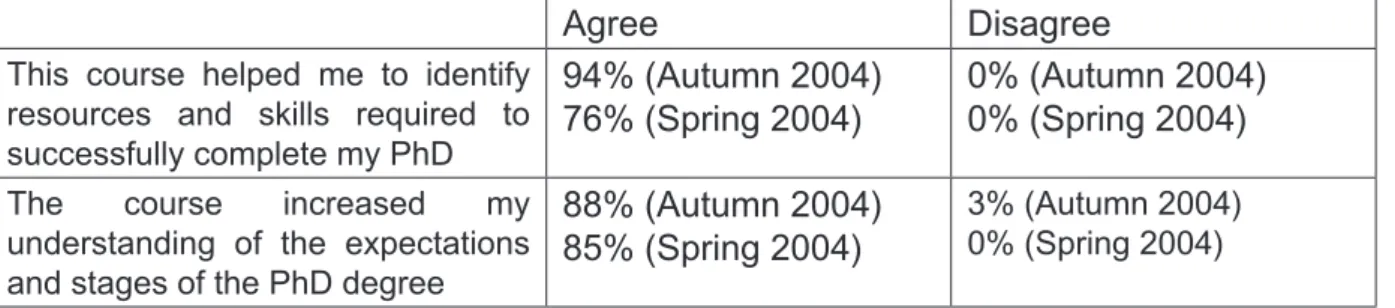
Formal and informal student evaluations of both the Autumn and Spring offerings endorsed the value to all commencing research students of a program designed to support PhD candidature.
Agree Disagree
This course helped me to identify resources and skills required to successfully complete my PhD
94% (Autumn 2004) 76% (Spring 2004)
0% (Autumn 2004) 0% (Spring 2004)
The course increased my understanding of the expectations and stages of the PhD degree
88% (Autumn 2004) 85% (Spring 2004)
3% (Autumn 2004) 0% (Spring 2004) Table 1: Student evaluations of the 2004 pilot of Postgraduate Essentials.
Completed online evaluation questionnaires were returned by 35 students from the Autumn cohort, and 24 students from the Spring cohort. Focus groups and individual phone interviews were also conducted as part of the pilot program evaluation. Students’ comments underlined the importance of concurrent support to supplement the traditional
supervision relationship, and a number of respondents identifi ed confi dence-building as an important, practical benefi t of the course:
[A] good opportunity to share knowledge with people who wouldn’t judge your lack of knowledge.
[A]fter I have work through them [course modules] I feel more confi dent. I’ve only just enrolled in my PhD studies so I found the course extremely useful as a ‘lead up’ activity. I’ve been working at the University for a number of years so people assume I already know how to do a PhD – I didn’t. What PGE has done is help me get oriented to the task ahead, providing plenty of practical tips.
Most students enrolled in the program had not previously participated in an online course
and so Postgraduate EssentialsPostgraduate EssentialsPostgraduate Essentials also provided a valuable introduction to online learning also provided a valuable introduction to online learning
and communication options and strategies.
The goal of ensuring equitable delivery of services to students at a range of distributed sites was largely realised with a high level of interest and participation among the cohort of non-Parkville students. Approximately 40% of students enrolled in each pilot were studying at non-Parkville sites, primarily at hospitals and medical research institutes. Given that between 25 and 30% of Melbourne’s PhD students are located at non-Parkville sites this represented a disproportionate uptake of the course by non-Parkville students. However, the majority of course participants (60%) were located at Parkville, undertaking research in all 11 faculties, with high levels of participation among Engineering and Arts students. This was particularly surprising given that no advertising had been conducted at Parkville.
LAS advisers’ refl ections on
Postgraduate Essentials
2004
Two LLSU advisers were involved in the design, development and piloting of Postgraduate
Essentials in 2003 and 2004. Wendy Larcombe was involved with the project from its
Essentials in 2003 and 2004. Wendy Larcombe was involved with the project from its
Essentials
inception in late 2002 and was the principal curriculum designer and text writer. Anthony McCosker joined the project team in February 2004; he contributed additional content material and acted as an online adviser for both iterations of the course in 2004. Our
refl ections here focus on the high uptake of Postgraduate EssentialsPostgraduate EssentialsPostgraduate Essentials and what this might and what this might
reveal about students and supervisors’ expectations regarding structured and integrated candidature support for all postgraduate research students, not only those in designated equity groups.
Through the 2004 pilot of Postgraduate EssentialsPostgraduate EssentialsPostgraduate Essentials it became evident that, at the level it became evident that, at the level
of research higher degrees, students now expect that face-to-face programs for generic capabilities and other forms of candidature support will be supplemented with online resources and programs. Parkville-based students at Melbourne already have access to a range of face-to-face services offered by departments, faculties, the LLSU, the Information Division, the Postgraduate Association (UMPA) and the School of Graduate Studies (SGS).
LAS 2005: critiquing and r
efl
ecting
in conjunction with the face-to-face courses and programs available. Academic staff have
also been highly enthusiastic about Postgraduate Essentials, considering it as a means
for providing their research students with a PhD ‘transition’, if not ‘training’, program. Strong support in referrals from academic supervisors indicates that such programs, designed not to replace any of the duties and responsibilities of supervisors but rather to complement their work, now enjoy an accepted role within academic research culture. Most departments and faculties offer some form of structured support for their Honours
and Masters students. In this respect, Postgraduate EssentialsPostgraduate EssentialsPostgraduate Essentials is a familiar extension of is a familiar extension of
existing ‘research-training’ programs. Because it caters for students from all disciplinary
backgrounds, however, Postgraduate EssentialsPostgraduate EssentialsPostgraduate Essentials intentionally shifts the focus from intentionally shifts the focus from
specifi c aspects of research, project development and thesis writing, to the processes and resources that can help to frame and direct those experiences. For example, in synchronous chat, two students and an academic skills adviser discussed reading groups as a way of managing and working through the academic literature in their fi eld. In chat about their respective reading groups it emerged that they are quite different in form: one group has all members read and discuss one reading per week on an area of theory, the other group requires each student to take a turn summarising two or three articles so that other group members do not have to read them. One student is working in the humanities, dealing with postcolonial theory; the other in science dealing with genetics. The differences became a point of discussion, while the main focus was on the strategies and techniques students use to get organised and stay on track in the fi rst year of their research.
Students’ usage of the chat and discussion forum functions has ratifi ed Postgraduate
Essentials as an
Essentials as an
Essentials integratedintegratedintegrated form of community building, academic support and skills form of community building, academic support and skills development. The content of the modules delivers offi cial handbook, examination, confi rmation and other candidature information; tuition in the use of database and citation software; and project management, writing and academic skills resources and guidance. These forms of support and learning may not be the central or sole focus of students’ experience of the program, however, which also reinforces a sense of coherence and shared PhD identity, centring on common aspects of the initial stages of the PhD, and focussing attention and discussion around the research process and PhD experience.
In our view, Postgraduate EssentialsPostgraduate EssentialsPostgraduate Essentials is most successful insofar as it provides rich is most successful insofar as it provides rich
opportunities for students to discuss the processes and skills of postgraduate research – and their myriad differences and similarities – with the static and interactive information and resources acting as the signifi cant context and prompt for that discussion. Moderators and advisers play an essential role in facilitating the community-building aspects of the program. Students are empowered in the PhD process when they have access to advisers, when they are able to pass on their own knowledge and discoveries to other students, and when they are able to post links, make suggestions, and ask even the ‘dumb’ questions about particular aspects of the PhD process. It appears to be particularly enabling for PhD students to have a ‘safe’ zone for peer discussion and refl ection on the PhD experience beyond the view and judgement of academic supervisors and departmental colleagues.
On refl ection, these features of Postgraduate EssentialsPostgraduate EssentialsPostgraduate Essentials may help to explain why it may help to explain why it
has attracted such a high level of interest even among students who currently access other forms of academic skills programs, networking opportunities and administrative
support. In this respect, Postgraduate EssentialsPostgraduate EssentialsPostgraduate Essentials supplements and complements other supplements and complements other LAS offerings, providing a new option within the range of academic skills support for the Parkville-based cohort. Off-campus student support has also been improved as a result of Postgraduate Essentials, although it does not replicate the more intensive modes of academic skills support and development, available to Parkville-based students through face-to-face short courses. In this sense, the program is only a partial answer to some of the academic support needs of non-Parkville students. As this section has discussed,
however, Postgraduate EssentialsPostgraduate EssentialsPostgraduate Essentials is able to support student learning at the PhD level in is able to support student learning at the PhD level in
other ways: by fostering a peer-community, emphasizing the common elements of the PhD student experience, facilitating students’ transition into higher degree candidature, and building their confi dence to undertake the required tasks leading up to confi rmation of their candidature.
Implications of the 2004 pilot of
Postgraduate Essentials
The outcomes of the 2004 pilot of Postgraduate EssentialsPostgraduate EssentialsPostgraduate Essentials have encouraged us to pause have encouraged us to pause
and refl ect on the diverse composition and distribution of the postgraduate research cohort; PhD students’ needs and expectations when it comes to candidature support, information literacy and generic skills development; and on how LAS advisers can best
cater for this cohort in the future. The manner in which Postgraduate EssentialsPostgraduate EssentialsPostgraduate Essentials was was
taken up by on-campus students and supervisors has extended our understanding of the types of support that all research students and supervisors now expect. We also need to consider the implications of this form of support, however, in terms of the resources, skills and time needed to produce such programs, and on the continuing requirement to stretch existing staff and resources to meet ever-increasing and changing demands.
An online program such as Postgraduate EssentialsPostgraduate EssentialsPostgraduate Essentials appears to be an effective means appears to be an effective means
of providing key resources and networking opportunities for the postgraduate research student cohort. A number of features can be identifi ed as contributing to the program’s effectiveness; in our analysis these relate, fi rstly, to the communication opportunities provided by the course and, secondly, to the capacity of the program to highlight common stages and requirements of the PhD at a point when specialization often isolates research students. Above all, however, the integrated nature of the program – combining academic skills, literature searching and management skills, candidature information, links and discussion forums – appears to be central to its capacity to address and ‘integrate’ commencing PhD students.
In this respect, the collaborative development of Postgraduate EssentialsPostgraduate EssentialsPostgraduate Essentials has been has been
fundamental to its success. Utilizing the skills, resources and programs of the LLSU, the School of Graduate Studies and the Information Division respectively has ensured that the program has ‘something for everyone’ as well as making it a genuine ‘one-stop-shop’. The creation of content in a way that places resources and tasks for academic skills development alongside information literacy, supervision, and candidature support has provided both challenges and benefi ts for LAS advisers. Working within an integrated online context allows us to more effectively combine our knowledge with key staff from other areas of the university to meet the broad range of students’ needs and expectations in terms of candidature support. The main challenge here is that collaboration itself takes time – time to achieve common understandings, to formulate common objectives and
LAS 2005: critiquing and r
efl
ecting
to negotiate responsibilities and workloads. Time was also needed for LAS advisers, used to face-to-face teaching, to become familiar with and skilled in developing learning resources for an online environment and in facilitating online discussion.
The formation of a coherent learning community through Postgraduate EssentialsPostgraduate EssentialsPostgraduate Essentials has has
certainly required ongoing facilitation and maintenance. This has been a challenging part of the running of the program; although each module provides stand-alone, self-access candidature support material, the success of the program relies on active participation in discussion by a portion of the enrolled cohort. In the two iterations of the course, active engagement with the material and participation in discussion has developed primarily through skilled and diligent moderation. As Brook and Oliver (2003, p. 147) point out, ‘simply employing the software and hoping that conditions conductive to the formation of community will develop’ is not enough to foster a strong learning community (see also
Hiltz, 1997). With Postgraduate Essentials, sustained facilitation by a moderator with PhD
qualifi cations has worked best when coupled with regular postings by ‘expert’ advisers responsible for enriching the static and interactive material of the different modules. The shared commitment of the three Units to maintaining, staffi ng and updating the program has helped to ensure that the cost of future iterations of the program is not too onerous. This is not an insignifi cant consideration. It is now well recognized that online programs do not necessarily offer a cost-effi cient alternative to face-to-face courses (Bell et al., 2002, p. 2) and the often ‘invisible’ workload of online moderation (Stacey, 1996, p. 2) needs to be acknowledged.
It has been clear, through the piloting of Postgraduate Essentials, that development and
delivery of an online support program places an additional demand on LAS advisers’ time and professional skills. Furthermore, the program has not lessened the teaching and tutorial load of LAS advisers and staff from the other units involved. Indeed, its uptake by Parkville-based students and the high rate of referrals to the program by academic supervisors are likely to mean that increased numbers of postgraduate students are better informed about and more likely to attempt to access the other face-to-face types of academic skills support available. In this sense, the program raises the profi le of academic and information skills among students who otherwise may not have known of or accessed
these services. Rather than meet demand for academic support services, Postgraduate
Essentials is likely to foster it.
Essentials is likely to foster it.
Essentials
It is equally clear, however, that all postgraduate research students now expect to be able to access online learning resources and discussion and networking opportunities, as well as candidature and administrative information. The cohort of commencing PhD students at the University of Melbourne has proved to be particularly welcoming of candidature support in the form of a structured, online program facilitated by an online moderator with completed PhD qualifi cations. Academic supervisors also appreciate that an integrated transition program for this student cohort can effectively complement research supervision and enhance students’ PhD experience. Online access to candidature and learning support is evidently appealing to both time-poor students and their supervisors. If LAS advisers were not equally time-poor, the further development and expansion of online support options for research postgraduates would similarly offer both potential and reward.
Acknowledgements
Postgraduate Essentials has been developed and is maintained by the School of Graduate
Postgraduate Essentials has been developed and is maintained by the School of Graduate
Postgraduate Essentials
Studies (SGS), the Language and Learning Skills Unit (LLSU) and the Information Division at The University of Melbourne. The project team includes Teresa Tjia and Dr Jeanette Fyffe (SGS), Dr Wendy Larcombe and Dr Anthony McCosker (LLSU), Sabina Robertson and Claire Brooks (Information Division). The courseware was designed by Courseware Development Services, Information Division, with the support of a Courseware Design and Development Program grant.
References
Bell, M., Bush, D., Nicholson, P., O’Brien, D., & Tran, T. (2002) Universities online: A survey of online education and services in Australia. Canberra: Commonwealth Department of Education, Science and Training.
Borthwick, J., & Wissler, R. (2003). Postgraduate research students and generic capabilities: Online directions. Canberra: Commonwealth Department of Education, Science and Training.
Brook, C., & Oliver, R. (2003). Online learning communities: Investigating a design framework. Australian Journal of Educational Technology, 19 (2), 139-160.
Gilbert, R., Balatti, J., Turner, P., & Whitehourse, H. (2004). The generic skills debate in research higher degrees. Higher Education Research and Development, 23 (3), 375-88.
Harman, G. (2002). Producing PhD graduates in Australia for the knowledge economy. Higher Education Research and Development, 21 (2), 179-190.
Hiltz, S. R. (1997). Impacts of college level courses via asynchronous learning networks: Some preliminary results. Journal of Asynchronous Learning Networks, 1 (2), 1-19.
Honey, M., Gunn, C., & North, N. (2004, December). Creating a learning community of postgraduate nurses through online discussion. Paper presented at the ASCILITE conference, Perth, Australia.
Love, T. (2001, December). New directions in PhDs: Online considerations. Paper presented at the Australian Association for Research in Education 2001 International Education Research Conference, Fremantle, Australia.
Pearson, M., & Ford, L. (1997). Open and fl exible PhD study and research. Canberra: Evaluations and Investigations Program, Higher Education Division, Department of Employment, Education, Training and Youth Affairs.
Reisman, S., Flores, J. G., & Edge, D. (Eds.). (2003). Electronic learning communities: Issues and practices. Greenwich, Conn.: Information Age Pub.
Stacey, E. (1996, April). E-quality in professional doctorates and postgraduate studies: Making an EdD happen. Paper presented at the Quality in Postgraduate Research Annual Conference: Is it Happening, Adelaide, Australia.
School of Graduate Studies (2003). School of Graduate Studies Annual Report 2003. Melbourne: University of Melbourne.