(2014) Teacher knowledge for modelling and problem
solving. In: 8th British Congress of Mathematics
Education, 14 - 17 April 2014, Nottingham, U.K..
Access from the University of Nottingham repository:
http://eprints.nottingham.ac.uk/32201/1/BCME8-43.pdf
Copyright and reuse:
The Nottingham ePrints service makes this work by researchers of the University of Nottingham available open access under the following conditions.
· Copyright and all moral rights to the version of the paper presented here belong to the individual author(s) and/or other copyright owners.
· To the extent reasonable and practicable the material made available in Nottingham ePrints has been checked for eligibility before being made available.
· Copies of full items can be used for personal research or study, educational, or not-for-profit purposes without prior permission or charge provided that the authors, title and full bibliographic details are credited, a hyperlink and/or URL is given for the original metadata page and the content is not changed in any way.
· Quotations or similar reproductions must be sufficiently acknowledged.
Please see our full end user licence at:
http://eprints.nottingham.ac.uk/end_user_agreement.pdf
A note on versions:
The version presented here may differ from the published version or from the version of record. If you wish to cite this item you are advised to consult the publisher’s version. Please see the repository url above for details on accessing the published version and note that access may require a subscription.
Teacher knowledge for modelling and problem solving Geoff Wake, Colin Foster and Malcolm Swan
University of Nottingham
This article reports on a study that has researched teacher professional learning in lesson study communities that enquired into how we might better support students develop skills in problem solving and mathematical modelling. A rationale for professional development of this type, both in in terms of its structure and focus, is presented followed by an illustrative description from the study of a typical research lesson and issues raised in the post-lesson discussion. This is used to provide insight into some of the key issues to consider in developing teacher knowledge for modelling and problem solving.
Keywords: teacher knowledge; professional learning; lesson study; modelling; problem solving
Introduction and background
It is noticeable in education that there is a convergence of national curricula around the world with common structures emerging that are particularly affected by international studies such as TIMSS and PISA. The PISA framework (OECD, 2003) that gives structure to mathematics as a domain of study is perhaps particularly influential in this regard. PISA attempts to measure student ability to
identify and understand the role that mathematics plays in the world, to make well-founded judgements and to use and engage with mathematics in ways that meets the needs of that individualÕs life as a constructive, concerned and reflective citizen. (ibid., p. 24)
However, curricula tend to embrace epistemologies that emphasise the PISA frameworkÕs mathematical content areas: quantity, space and shape, change and relationships and uncertainty. The mathematics signalled by such terms is well understood by mathematics teachers around the world, who tend to focus their teaching on ensuring studentsÕ technical facility with mathematical procedures associated with these areas. Such teaching is potentially well-informed by the work of researchers who have also, until relatively recently, in the main, prioritised research into childrenÕs understanding of key mathematical concepts (for example see Watson, Jones and Pratt, 2013). Issues surrounding the teaching and learning of problem solving skills and modelling are much less well understood. Although in the international mathematics education community there is a strong and active group that is concerned with the development of mathematical modelling and its applications (ICTMA: the international community of teachers of mathematical modelling and applications), this contributes a relatively small proportion of the output of the active mathematics education research community. (For an overview of current areas of concern and focus, see the summary of recent research activity of the international group for the Psychology of Mathematics Education (Matos, 2013).) What is known about how students learn to solve problems and how teachers might support their development in this is at a much earlier stage of development than research that, for
example, seeks to explore studentsÕ understanding of mathematical concepts, the affective domain of learning, or teachersÕ pedagogies.
As Cai and Howson (2013) argue, there is discernible evidence of some convergence of mathematics curricula due to the international comparative studies, and there has been a noticeable increase in interest in mathematical modelling and problem solving around the world, instigated in no small part by the influence of PISA. In this paper, therefore, we focus on this important emergent area in school mathematics and report research into the development of teacher knowledge and teaching practice in relation to mathematical modelling and problem solving within a professional learning community of teachers. The research involved a sub-group of teachers from four of nine schools that worked for a year on a project enquiring into classroom practice using a lesson study model. The impetus for the project arose from earlier work12 that had produced innovative teaching materials aimed at motivating learners with utility and purpose (Ainley, Pratt and Hansen, 2006) through working on substantial problems set in a variety of Ôcase studyÕ contexts. These Ôcase studiesÕ and additional assessment tasks stimulate problem-solving and modelling activities in lessons. Such activity was the focus of the research lessons within the lesson study cycle that provided the focus of the professional learning of the teachers, and indeed the researchers that worked on the project reported here.
Lesson study and theoretical perspectives
Fundamental to our research is a concept of professional learning that is focused on enquiry into teaching, learning and classroom practice. The aim of this project, therefore, was to develop professional learning communities in which teachers worked together and learned from each other. The communities were informed by Ôknowledgeable othersÕ, whose role was to stimulate the community by drawing on a range of expertise that is research-informed.
The project was fortunate to be able to work with colleagues from IMPULS in Japan13 who, working in their own culture of well-established lesson-study communities, were at the same time, in reaction to developments in the Japanese curriculum, beginning to tackle some of the same issues in relation to problem solving. Lesson study based on the Japanese model has become increasingly widely known and adapted for use across geographical and cultural boundaries since the publication of Stigler and HiebertÕs book The Teaching Gap (1999). The model is perhaps particularly attractive as it has the potential to meet the requirements that we know facilitate effective professional learning (Joubert and Sutherland, 2009); namely, that it is:
¥ sustained over substantial periods of time
¥ collaborative within mathematics departments/teams
¥ informed by outside expertise
¥ evidence-based/research-informed
¥ attentive to the development of the mathematics itself.
As Doig and Groves (2012) point out, drawing on their experiences in Australia, there is a need to adapt rather than adopt the Japanese model when working in another culture. However, in our work as a community we maintained what we saw
12
The Bowland Maths project provides teacher support, including motivating materials/tasks for use with students in classrooms that promote problem solving.
as crucial aspects of the Japanese model. Fundamental to our model is the expertise brought to partnerships by Ôknowledgeable othersÕ and the focus on the interaction of learning with materials and the mathematical experiences and learning they generate (Lewis et al., 2006). The importance of these in the Japanese model is perhaps signified by the fact that the words used to describe them (koshi and kyozaikenkyu Ð Takahashi and Yoshida, 2004; Doig et al., 2012, respectively) are often left in the original Japanese in the literature, as they embody meaning that is often not well-understood outside Japan.
Our model for professional learning communities is one that draws on BeachÕs construct of collateral learning (Beach, 1999). This does not only place value on the usual notion of learning having to be in a constantly ÔupwardÕ, that is hierarchically vertical, direction, with knowledge becoming forever more abstract and divorced from the everyday. It also recognises and values the different professional expertise that participants bring as they come together to expand the object of their activity, so that learning together is facilitated in what might be thought of as a horizontal direction.
In general we adopt a Cultural Historical Activity Theoretically (CHAT) informed view of the work of the different communities involved. It is not intended to give a detailed account of this here (for a more detailed overview see Wake, Foster and Swan, 2013). From this perspective, central to the work of the professional learning community is the activity system of the mathematics classroom, with teacher and pupils working together as a community in pursuit of the learning of mathematics. As Brousseau (1997) recognised, such communities are culturally and historically situated and evolved in their ways of working and can be considered to operate with a
contrat didactique that embodies expectations of all as to what should constitute practices in such situations. Lesson study brings into the shared experience of teachers and other educators a new activity system, the lesson study group, which has as its object professional learning through inquiry into practice. Important in providing a bridge between these two activity systems is the Ôlesson planÕ for the research lesson that is used to identify specific aspects of teaching and learning in relation to studentsÕ problem solving. In activity theory terms we consider this document to be a boundary object (Star and Griesemer, 1989), having different meanings in the two settings yet retaining a common essence focused on student learning and teaching practices. The lesson plan provides a script with which the teacher works in the classroom. Prior to this it has been developed collaboratively by the lesson study community, and consequently provides a central focus for communication between participants, eventually coming to embody their values, understandings, beliefs and intentions. Again, in the post-lesson discussion the lesson plan as a document is of central importance in providing a mediating instrument that facilitates discussion of planned intentions and their enactment as pedagogical practices in the classroom.
In this conceptualisation of lesson study in activity theory terms we consider that professional learning takes place at the boundaries between the different activity systems in which community participants operate, and the lesson plan, as a boundary object, plays a crucial role in facilitating reflection on action and perspective making and taking (Boland and Tenkasi, 1995) on issues in relation to teaching and learning. The research
To provide insight into the model of professional learning and the issues that arise, the detail of one research lesson is summarised here. This comes from a cluster of four schools that worked collaboratively over the space of one year on thirteen research
lessons (a further fifteen research lessons were carried out by the cluster of the remaining five schools). This draws on data that includes video and audio recording of collaborative planning meetings, pre- and post- lesson discussions and the research lesson itself. Additional data used includes the different iterations of the lesson plan for the research lesson, classroom materials and student productions.
Case study: Ô110 years onÕ
The lesson was in a Midlands academy with a year 9 class that had little experience of working on problem-solving/modelling tasks. The students had worked on the task in the lesson prior to the research lesson, providing the teacher with insight into the different ways in which they were understanding and representing the situation presented. The focus of the research lesson was to understand better how mathematical representations may assist structuring and supporting mathematical thinking.
The task
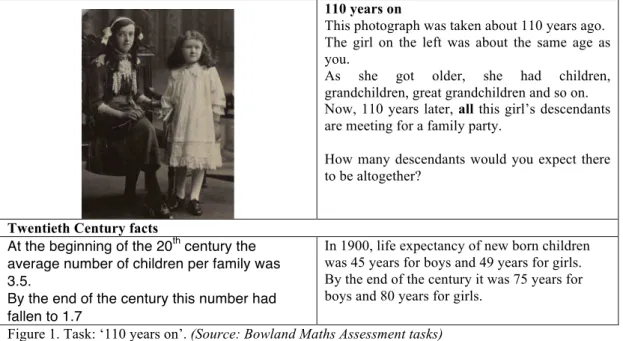
110 years on
This photograph was taken about 110 years ago. The girl on the left was about the same age as you.
As she got older, she had children, grandchildren, great grandchildren and so on. Now, 110 years later, all this girlÕs descendants are meeting for a family party.
How many descendants would you expect there to be altogether?
Twentieth Century facts
At the beginning of the 20th century the average number of children per family was 3.5.
By the end of the century this number had fallen to 1.7
In 1900, life expectancy of new born children was 45 years for boys and 49 years for girls. By the end of the century it was 75 years for boys and 80 years for girls.
Figure 1. Task: Ô110 years onÕ. (Source: Bowland Maths Assessment tasks)
The lesson
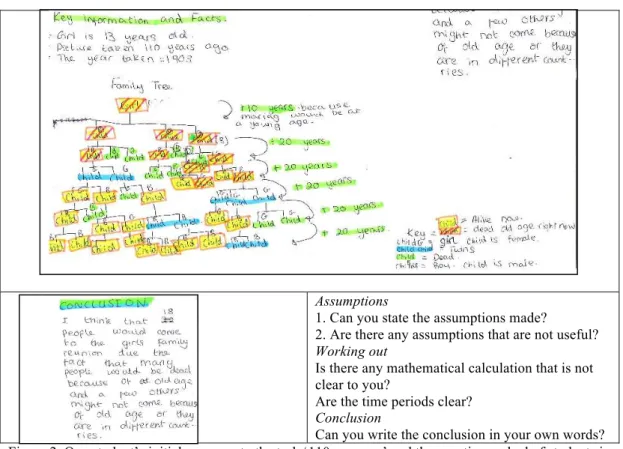
1. Introduction (1 minute): The teacher reminded students of the task they had been working on in the previous lesson and asked them to respond to questions posed about one studentÕs work (Figure 2) that was distributed to all students in the class.
2. Individual work followed by student discussion in groups of 2 or 3 (8 minutes): Students worked individually, writing answers to the questions (Figure 2) on the sheet provided and then, when asked, discussed their responses in small groups. As an example, one observed group spent time discussing the level of detail that was missing from the diagram (e.g. there may be children who would die young).
Assumptions
1. Can you state the assumptions made?
2. Are there any assumptions that are not useful? Working out
Is there any mathematical calculation that is not clear to you?
Are the time periods clear? Conclusion
Can you write the conclusion in your own words? Figure 2. One studentÕs initial response to the task Ô110 years onÕ and the questions asked of students in phase 1 of the lesson.
3. Whole-class discussion (6 minutes): The teacher focused a whole-class discussion on the questions they had just answered and discussed. Some groups contributed their thinking and the student whose work had been used explained how he had attempted to work with the information about the average number of children being 3.5 per family. The remainder of the discussion focused on whether or not the assumptions, calculations and conclusion were clearly communicated. At this point again the student whose work had been scrutinised explained how he had been able to find a solution by counting the yellow-coloured boxes in his diagram.
4. Individual work followed by whole-class sharing (4 minutes): Pupils were asked to write down a checklist that they had developed in the previous lesson to set out a problem-solving strategy. Pupils appeared to have memorised the key steps and were able to write these down.
5. Individual work with informal group discussion (36 minutes): In the main part of the lesson students were asked to improve their work, ÒThat doesnÕt mean you have to start again. You are just improving your work, so you are correcting the parts that donÕt look correct to you.Ó As the teacher circulated she initially assisted students to focus on communicating a more complete solution, referring students to their ÔchecklistÕ. After about 15 minutes most of the groups of students had started to discuss their work, often trying to make sense of how each otherÕs diagrams related to the assumptions they had made. In this time the teacher circulated, often questioning individual students as she attempted to make sense of how the conclusion they had reached could be found from their mathematical diagram.
6. Individual work followed by whole class discussion [Neriage] (15 minutes): Students were all given an individual copy of one studentÕs work. This student was asked what changes he had made in todayÕs lesson and he indicated that he had redrawn the diagram to arrive at a different conclusion. Following an opportunity for individual students to take a careful look at the work, having been asked to write
down on the diagram what they liked and any improvements that he could make, the whole class were able to ask questions of the boy who had produced it. In general this discussion allowed students to gain a better understanding of the studentÕs thinking that he had not communicated in the diagram. Comments often focused on whether or not the assumptions that this particular student had made were reasonable.
The post-lesson discussion
In the post-lesson discussion the lesson study community, together with a member of the IMPULS project, acting as the Ôknowledgeable otherÕ, raised the following points in relation to the problem-solving focus of the project in general and the research question for this lesson in particular.
Comparing and contrasting approaches: The teacher had changed the lesson at an early stage so that students had an opportunity to critique only one piece of student work (Figure 2). Similarly, the neriage phase of the lesson had been curtailed to allow students to spend more time on updating their own work. In this section of the lesson there was therefore time to again consider only one piece of student work, as opposed to the two pieces planned.
Using diagrams for individual mathematical thinking and for communicating with others: Much of the lesson had focused on diagrams as communicative devices, with students thinking about how they could make sense of someone elseÕs diagram. However, the lesson was designed to unpack how mathematical diagrams can assist mathematical thinking. It was noted that even when such thinking is flawed, and this is embodied in the diagram, it can be helpful in assisting a student to see where the problem lies. A particular example of this was illustrated by one of the observers. The diagram that had been considered at the end of the lesson demonstrated evidence of the student moving to more abstract understanding, that is, away from the detailed structure of the situation being directly mapped by the diagram. Similar shifts in student thinking had been noted by others.
For students (and teachers) what is the mathematics? For many students, the focus throughout was on obtaining an answer; not necessarily a reasonable one. Many widely varying answers were obtained. Students prioritised calculations over drawing diagrams, even where it was clear that diagrams would assist their mathematical thinking.
The important role of making assumptions: Many students did not seem to understand the purpose of making assumptions. Most appeared to interpret assumptions as Ôfilling out detailsÕ, both relevant and irrelevant, such as wars, death due to disease, occurrences of twins, and so on. Students did not understand making assumptions as being important in simplifying the problem in ways that allow the structure to surface and exploration of key parameters to be facilitated. In this regard, the structure of the lesson plan and the key role that the framing of the task and subsequent written and oral questions played in the initial critiquing phase of the lesson, was raised.
The range of answers obtained in modelling problems, as in this case, was considered as a potential way of focusing students to explore how their assumptions interact with the structure of the problem (and how these are encapsulated in diagrams).
Collaborative working: The structure of the lesson in invoking collaborative, as opposed to individual working, and learning was discussed. The role of the task and the pedagogic moves made by the teacher during the lesson were considered and
the question of how to provoke all of the groups to discuss the role of diagrams in supporting mathematical reasoning was raised. The issue of the usual role of diagrams in mathematics where students learn to develop a specific type of diagram in response to mathematical needs was considered as a potential barrier, with students thinking that there is possibly a Ôcorrect diagramÕ for any given problem.
Discussion
The research lesson and post-lesson discussion described here provide insight into the problems associated with focusing lessons on the complexities of aspects of problem solving. At issue in this particular lesson was how diagrammatic representations might afford, or indeed constrain, individual mathematical thinking. Although there was plentiful evidence in the lesson that a studentÕs diagram affects their individual thinking and understanding, this was not explicitly highlighted or discussed as part of the lesson, even though in some instances students were observed discussing such matters in small groups. Such issues were not formalised and shared in the lesson and students did not, therefore, gain insight into how in future problems they might develop diagrams in ways that prove helpful. In this particular problem, and in general, the assumptions that students make play an important role in enhancing or reducing the complexity of the reality that they end up exploring, and consequently the level of detail that the diagram needs to encompass. As can be seen from the issues raised in the post-lesson discussion, it was felt that, even if discussion of the use of mathematical diagrams to support mathematical thinking had failed to occur at an early stage of the lesson, at a later time attention could have been (re-) focused by considering the wide variation in studentsÕ solutions and/or by provoking students to consider varying key parameters in the problem.
The outcomes of the illustrative lesson recounted here in some detail were not atypical of our experiences to date. We are left with the question of why is it difficult to focus teaching on, and how do we improve learning of, problem-solving skills/strategies/competencies? Perhaps key in discussion of this is the question that was raised in the post-lesson discussion: ÔFor students (and teachers) what is the mathematics?Õ BrousseauÕs construct of the contrat didactique suggests that important in this regard is the teacherÕs epistemological stance, which the students eagerly adopt, even though this remains below the surface. In this particular research lesson, as we observed in others, the solution and its communication were prioritised, as they often would be in Ôstandard lessonsÕ, with both teacher and students having difficulty in shifting their attention to mathematical process. This leaves us with a thorny problem of how we might develop new epistemologies that prioritise and emphasise how mathematics is used to solve problems. Alongside such a restructuring of what it means to learn and use mathematics we need to be sensitive to how tasks as initially posed, and altered Ôin the momentÕ by pedagogic moves by teachers in lessons can, if we are not careful, shift the attention of students in ways that might realign their actions so as to re-attain the usual state of equilibrium of mathematics lessons. Fundamental to these requirements is the need for the teacher to recognise their existing epistemological position, a vision of what this might become and the journey that they will take to achieve this. How as an on-going research project we tackle this issue provides a significant challenge. Our proposed approach is to return to our theoretical view and consider how we might design for such reflection and realignment of classroom goals and objectives. Perhaps a way forward is to consider the mode of professional learning that Engestršm facilitated in his Ôchange
laboratoryÕ, in which he experimented in problematising and rethinking ways of professional working (Engestršm, 2001).
References
Ainley, J., Pratt, D. & Hansen, A. (2006) Connecting engagement and focus in
pedagogic task design. British Educational Research Journal, 32, 23Ð38.
Beach K.D. (1999) Consequential transitions: A sociocultural expedition beyond
transfer in education. Review of Research in Education, 24, 101-139.
Boland, R.J. & Tenkasi, R.V. (1995) Perspective making and perspective taking in
communities of knowing. Organization Science, 6(4), 350-372.
Bowland Maths Assessment tasks: http://www.bowlandmaths.org.uk/
Brousseau, G. (1997) Theory of Didactical Situations in Mathematics. Dordrecht:
Kluwer.
Cai, J & Howson, G. (2013) Towards an International Mathematics Curriculum. In
Clements, K. et al. (Eds.), Third International Handbook of Mathematics
Education (pp. 949-974). New York: Springer.
Doig, B. & Groves, S. (2012) Japanese lesson study: Teacher professional
development through communities of inquiry. Mathematics Teacher
Education and Development, 13(1), 77-93.
Engestršm, Y. (2001) Expansive learning at work: Toward an activity theoretical
reconceptualization. Journal of Education and Work, 14(1), 133-156.
Joubert, M. & Sutherland, R. (2009) A perspective on the literature": CPD for
teachers of mathematics. Sheffield:NCETM.
OECD (Organisation for Economic Co-operation and Development) (2003) The PISA
2003 Assessment Framework Ð Mathematics, Reading, Science and Problem Solving Knowledge and Skills. Paris: OECD.
Star, S.L. & Griesemer, J.R. (1989). Institutional ecology, ÒtranslationsÓ and boundary objects: Amateurs and professionals in BerkeleyÕs Museum of
Vertebrate Zoology, 1907Ð39. Social Studies of Science, 19(3), 387-420.
Stigler, J.W. & Hiebert, J. (1999) The Teaching Gap: Best ideas from the worldÕs
teachers for improving education in the classroom. New York: Free Press.
Takahashi, A. & Yoshida, M. (2004) Lesson-Study Communities. Teaching Children
Mathematics, 10(9), 436‐437.
Wake, G., Foster, C. & Swan, M. (2013) A theoretical lens on lesson study: professional learning across boundaries. In Lindmeir, A.M. & Heinze, A.
(Eds.) Proceedings of the 37th Conference of the International Group for the
Psychology of Mathematics Education (pp, 4-369 Ð 4-376). Kiel: PME.
Watson, A., Jones, K. & Pratt, D. (2013) Key Ideas in Teaching Mathematics: