1
A Needs-based Evaluation of EAP Syllabuses
Sayyed Mohammad Alavi1
Shiva Kaivanpanah2
Yoones Taase3
Received: 01/05/2017 Accepted: 05/09/2017 Available online: 02/02/2018 Abstract
The main purpose of the present study was to analyze reading comprehension needs of undergraduate students and determine whether EAP syllabuses are developed based on these reading comprehension needs. The other purpose of the study was to see how EAP classes represent reading comprehension needs. To this end, 656 undergraduate students, 75 graduate students, 150 post-graduate students, 75 content teachers and 30 EAP teachers of 15 randomly selected academic disciplines filled in a reading comprehension needs analysis questionnaire. Open ended questions, classroom observation and content analysis of the syllabuses were also used to triangulate the data in terms of sources and methods. The findings indicated that reading comprehension needs were considered either ‘important’ or ‘very important’ by all participants. Significant differences were found in the perceptions of participants regarding the importance of sub-skills and strategies of reading comprehension needs such as skimming the text, knowledge of general vocabulary and knowledge of specialized terminologies. Classroom observations showed that EAP classes do not address undergraduate students’ reading comprehension needs but translate the texts and provide Persian meaning of general and specific words. More importantly, it was found that EAP syllabuses have not been fully developed based on reading comprehension needs of undergraduate students. The findings suggest that an eclectic multi-layered approach to syllabus design which takes into account content-based, task-based, text-based and genre-based approaches and critically considers voices of different EAP stakeholders should be considered in redesigning EAP syllabuses.
Keywords: Needs analysis, syllabus design, ESP, EAP 1. Introduction
The design and implementation of any curriculum for EAP courses should take into consideration different language needs of target learners. Awareness of learners’ needs is a distinctive feature of English for Specific Purposes (ESP) (Hutchinson & Waters, 1987).
1 Corresponding Author, Department of English language and literature, Faculty of foreign languages and
literatures, University of Tehran, Tehran, Iran. Email: [email protected]
2 Department of English language and literature, Faculty of foreign languages and literatures, University of
Tehran, Tehran, Iran. Email: [email protected]
3 PhD. Candidate, Department of English language and literature, Faculty of foreign languages and literatures,
2
Hence, course organizers should recognize the ways in which ESP courses fit the learners’ needs by developing appropriate syllabi.
Hutchinson and Waters (1987) distinguish between target needs or “what the learner needs to do in the target situation” and learning needs or “what the learner needs to do in order to learn” (p.54). Target situation needs are categorized into necessities, lacks and wants. What the learners are supposed to know in order to perform effectively in the target situation is defined as necessities and what learners already know in order to determine the required necessities are defined as lacks. Wants, also called subjective needs, are what the learners feel they need in order to operate in a target situation which may be in conflict with the perceptions of course designers, sponsors, and teachers. The route from the starting point (lacks) to the destination (necessities) is conceptualized as learning needs (Hutchinson & Waters, 1987).
There is a general consensus that needs analysis is the defining feature of ESP and EAP (Flowerdew & Peacock, 2001).The importance of needs analysis in EAP course design has been highlighted in the literature. Needs analysis as a “key instrument in course design” (West, 1994, p. 2) lies at the heart of EAP approach and is considered as a reliable starting point for ESAP course design (Bocanegra-Valle, 2016; Flowerdew, 2013; Hamp-Lyons, 2001). Moreover, as the fundamental element of an EAP approach to course design, needs analysis is the unalienable point of departure for designing EAP syllabus and materials (Flowerdew & Peacock, 2001). Since the EAP syllabus is designed based on needs, it is likely to be motivating for learners and make an obvious relevance of what they are studying (Basturkmenn, 2006).
EAP syllabus is “a plan of what is to be achieved through teaching and learning, identifying what will be worked on in reaching the overall course aims and providing a basis for evaluating students’ progress” (Hyland, 2006, p. 83). A combination of reasons for ESP syllabus are listed such as defining the component parts of language knowledge and providing a practical basis for assessment and textbooks, giving moral support to teachers and learners, making language learning task manageable, providing a platform for materials development and a visible platform for testing ESP programs in reaching the course objectives (Hutchinson & Waters, 1987). Basturkmen (2006) notes that since the content in ESP derives from real life situations, syllabus designers should select the most relevant language discourses in terms of socio-cultural and stylistic variations to meet the learners’ target requirements properly; therefore, it is important to present the language using an eclectic method by combining the required features of the language systematically and gradually according to the target objectives. In fact, since ESP prepares learners for academic, professional, or workplace environments, “a key feature of ESP course design is that the syllabus is based on an analysis of the needs of the students” (Basturkmen, 2006, p. 18).
3
problems in some academic reading skills such as understanding technical vocabulary, understanding organization of a text, identifying key ideas and supporting ideas/examples, and note taking. In another study to reconceptualize college students’ needs in English for general and specific/academic purposes, Liu, Chang, Yang, and Sun (2011), investigated the perception of 972 Taiwanese college students from six universities in terms of needs, necessities, wants, lacks, and their reasons for course enrollment. They found that students had perceptions of necessities, wants, and lacks in terms of reading English textbooks, letters and E-mails, manuals, websites, newspapers and magazines in EGP and ESP courses. Reading was found to be the most important reason for enrollment in EGP and ESP courses.
Needs analysis projects have also been implemented in Iran. Published studies in related journals are limited to a study by Mazdayasna and Tahririan (2008) who used a needs analysis questionnaire, interviews and classroom observations to develop a profile of ESP needs of Iranian students of nursing and midwifery, and found that the courses do not sufficiently take into account learning needs, present level of foreign language proficiency, objectives of the course, resources available in terms of staff, materials, equipment, finances and time constraint, the skill of the teachers, and the teacher’s knowledge of the specific area. In another study, Atai and Nazari (2011) explored reading comprehension needs of Iranian EAP students of Health Information Management and found that skimming texts, using bilingual general dictionaries, scanning texts, knowledge of HIM terminologies, guessing meanings of words, and understanding main ideas were perceived as either ‘important’ or ‘very important’ by all the participants. In the third published study, Atai and Shoja (2011) examined academic language needs of Iranian students of computer engineering. They found that in spite of inconsistencies in participants’ perceptions of target situation needs, written skills and language components were perceived important by undergraduate and graduate students, content teachers and EAP teachers.
4
According to Atai and Nazari (2011), the main objective of the present discipline-based ESAP courses at Iranian universities is to train autonomous readers who are able to read textbooks and related journals of their specific fields. Although several needs analysis projects have been conducted in Iran (e.g., Atai & Nazari, 2011; Atai & Shoja, 2011; Mazdayasna & Tahririan, 2008; Soodmand Afshar & Movassaq, 2016), a detailed analysis of reading comprehension needs and their reflection in EAP syllabuses will add to our understanding of the current EAP syllabus. Therefore, the present study addresses the following questions:
1. What are the target reading comprehension needs of undergraduate students? 2. Is there any statistically significant difference among undergraduate students, graduate students, post-graduate students, content teachers and EAP teachers in terms of reading comprehension needs of undergraduate students?
3. Do EAP classes cater for reading comprehension needs of undergraduate students?
4. To what extent have EAP syllabuses been developed based on reading
comprehension needs of undergraduate students?
2. Methodology
2.1 Participants
Different stakeholders of 15 randomly selected academic disciplines participated in the present study. The first group of the participants included 656 undergraduates Iranian EAP learners who were studying English for Specific/Academic Purposes (ESAP) as a compulsory course at the University of Tehran. Some of them had passed the EAP reading courses in previous terms and some were passing the course at the time of data collection. The second group of the participants comprised 75 graduate students who had passed at least one EAP reading course during their bachelor studies. The third group involved 225 postgraduate students (MA/MS and Ph.D., 15 in each field) at the University of Tehran. They were Persian native speakers who had passed at least one compulsory EAP reading course at their bachelor studies. The next group comprised 75 content teachers with different academic ranks who varied in their teaching experience of subject matter courses at the University of Tehran. The last group of participants consisted of 30 ESP teachers with different academic ranks and varying teaching experiences at the University of Tehran.
2.2 Corpus
5
undergraduates. The reflection of the identified reading comprehension needs including skimming, scanning, general vocabulary knowledge, knowledge of technical terms, bilingual and monolingual general and specialized dictionaries, general understanding of the texts, guessing the meaning of unknown words using context, understanding main idea of sentences, familiarity with different genres like textbooks and articles, understanding the relationship between texts, charts, tables and pictures, drawing conclusion and understanding implied ideas, understanding the ideas like cause and effect, reading scientific articles, reading specialized documents, maps, charts, graphs, pictures, and reading specialized manuals, forms, instructions, and reports were considered in the syllabuses. If the syllabuses comprised the identified needs, they were coded as ‘covered’; otherwise, they were coded as ‘not covered’ (Soodman Afshar & Movassagh, 2016). For example, the objective of EAP course for Psychology is to familiarize students with words and terms of psychology and enable students to comprehend psychology texts. Therefore, knowledge of general and specific vocabulary is coded ‘covered’ in the syllabus. The presentation of each individual item of the needs in the EAP syllabuses were summed up, multiplied by 100 and divided into 15 to obtain the percentage of reflection of each of the reading comprehension needs in the syllabuses. The syllabuses were content analyzed twice by the researcher and another rater. The Kappa measure of inter-coder agreement (kappa=.82) was significant at 0.00 level. According to Peat (2001, as cited in Pallant, 2016), a Kappa value of .5 represents a moderate agreement, .7 represents a good agreement and above .8 represents a very good agreement.
2.3Instruments
To analyze the reading comprehension needs of Iranian undergraduate students, a validated questionnaire developed by Atai and Nazari (2011) was employed. The first part of the questionnaire elicits demographic information of the participants. The second part which contains 20 items on a four-Likert scale (‘not important’, ‘rather important’, ‘important’, and ‘very important’) measures target situation reading comprehension needs of undergraduate students in terms of the following five constructs of reading comprehension: direct cognitive strategies for receiving messages, compensation strategies, vocabulary and syntactic knowledge, direct cognitive strategies for analyzing and reasoning and knowledge of different genres. The Cronbach alpha reliability index was estimated .85. The last part of the questionnaire includes four open-ended questions eliciting participants’ views regarding the problems of undergraduate students in reading comprehension in EAP classes and their solutions to these problems. The open-ended questions were content analyzed to elicit the recurrent themes.
2.4 Classroom observation and field notes
6
the corresponding disciplines were carried out to triangulate the data of needs analysis in terms of the covered needs in classes, EAP classroom activities and problems, and students’ difficulties (Basturkman, 2006). In addition, field notes as “the most common method of recording the data collected during observation” (Ary, Jacobs, Sorenson & Walker, 2010, p. 463) were employed to support the observations. Before entering the classes, the informed consent of the teachers was obtained.
4. Results
4.1 Target Reading Comprehension Needs
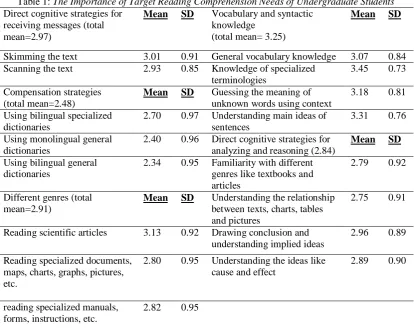
Table 1 shows the target reading comprehension needs of undergraduate students. The results revealed that almost all reading comprehension sub-skills were perceived as either ‘important’ or ‘very important’ by stakeholders. More specifically, knowledge of specialized terminologies (X=3.45), understanding main ideas of sentences (X=3.31), guessing the meaning of unknown words using context (M=3.18), reading scientific articles (X=3.13), general vocabulary knowledge (X=3.07) and skimming the texts (X=3.01) were considered ‘very important’. In addition, scanning the text (MX=2.93), drawing conclusion and understanding implied ideas (X=2.96), understanding the ideas like cause and effect (MX=2.89), reading specialized manuals, forms, instructions, reports, etc. (X=2.82), reading specialized documents, maps, charts, graphs, and pictures (X=2.80), familiarity with different genres like textbooks and articles (MX=2.79), understanding the relationship between texts, charts, tables and pictures (M=2.80), using bilingual specialized dictionaries (X=2.70), using monolingual general dictionaries (X=2.40), and using bilingual general dictionaries (X=2.34) were considered as ‘important’. Vocabulary and syntactic knowledge (X=3.25) were considered the most important sub-construct of target reading comprehension needs.
4.2 Examining the normality assumption of parametric tests
7
Table 1: The Importance of Target Reading Comprehension Needs of Undergraduate Students
Direct cognitive strategies for receiving messages (total mean=2.97)
Mean SD Vocabulary and syntactic knowledge
(total mean= 3.25)
Mean SD
Skimming the text 3.01 0.91 General vocabulary knowledge 3.07 0.84 Scanning the text 2.93 0.85 Knowledge of specialized
terminologies
3.45 0.73 Compensation strategies
(total mean=2.48)
Mean SD Guessing the meaning of unknown words using context
3.18 0.81 Using bilingual specialized
dictionaries
2.70 0.97 Understanding main ideas of sentences
3.31 0.76 Using monolingual general
dictionaries
2.40 0.96 Direct cognitive strategies for analyzing and reasoning (2.84)
Mean SD Using bilingual general
dictionaries
2.34 0.95 Familiarity with different genres like textbooks and articles
2.79 0.92
Different genres (total mean=2.91)
Mean SD Understanding the relationship between texts, charts, tables and pictures
2.75 0.91
Reading scientific articles 3.13 0.92 Drawing conclusion and understanding implied ideas
2.96 0.89
Reading specialized documents, maps, charts, graphs, pictures, etc.
2.80 0.95 Understanding the ideas like cause and effect
2.89 0.90
reading specialized manuals, forms, instructions, etc.
2.82 0.95
8
Table 2: Chi-Square Results Comparing the Perception of Stakeholders Regarding the Importance of Target Reading Comprehension Needs
Target RC Needs Chi df Sig. Target RC Needs Chi df Sig
Skimming the text 36.92 12 0.00 Understanding main ideas of sentences
20.10 12 0.06 Scanning the text 11.72 12 0.46 Familiarity with different
genres like textbooks and articles
39.71 12 0.00
Using bilingual specialized dictionaries
21.74 12 0.04 Understanding the relationship between texts, charts, tables and pictures
33.76 12 0.00
Using monolingual general dictionaries
13.34 12 0.34 Drawing conclusion and understanding implied ideas
35.66 12 0.00
Using bilingual general dictionaries
28.86 12 0.00 Understanding the ideas like cause and effect
25.91 12 0.01 General vocabulary
knowledge
22.18 12 0.03 Reading scientific articles 18.67 12 0.09 Knowledge of specialized
terminologies
49.33 12 0.00 Reading specialized documents, maps, charts, graphs, etc.
32.50 12 0.01
Guessing the meaning of unknown words using context
34.41 12 0.00 Reading specialized manuals, forms,
instructions, reports, etc.
14.09 12 0.29
4.3 Content Analysis of the Open-Ended Questions
At the end of the questionnaire, four open ended questions were included to identify problems of EAP classes from participants’ perspectives and acquire their suggestions and solutions regarding these problems. The results are reported below.
1. Stakeholders believed that undergraduates’ low proficiency prevented them from active participation in EAP classes. EAP teachers reported that low proficiency of students is the main reason for the use of translation as the main type of classroom activities. They suggested that in high school more credits be allocated to General English courses so that students enroll in the EAP courses at universities with higher level of general English knowledge which in turn facilitates learning of specialized knowledge in EAP courses.
9
teacher-centered making students passive recipients of knowledge. To make classes more interactive, they suggested that technology should be used in presenting materials and more varied teaching techniques should be employed by teachers.
3. Another problem identified by undergraduates, graduates and post-graduates was lack of specialized knowledge of ELT instructors teaching EAP reading and low general proficiency of ESP subject matter teachers teaching EAP courses. EAP teachers believed that the courses should be taught by subject teachers who have a high command of general English.
4. All the stakeholders believed that since students are not familiar with specialized concepts and subject-specific areas of their fields and EAP courses are mainly offered in the first year, undergraduates are not familiar with the topics and themes of EAP courses. To help them better understand what they read, they suggested that EAP courses be offered in final terms and the number of EAP course credits in the curriculums should be increased.
5. Undergraduates believed that the textbooks used in EAP classes are difficult because they contain long sentences and paragraphs, complicated sentence structures and unknown vocabulary. Besides, it was reported that the materials are monotonous, boring and outdated. Students suggested that texts should be shortened and their difficulty level should be decreased. The outdated topics of the texts should also be replaced with topics representing new areas of developments in science. Suggestions were provided to shorten the texts, decrease their difficulty level, and include texts with new and interesting topics and themes.
4.4 Classroom Observations
To find out how reading comprehension needs of undergraduate students are represented in EAP classes, 60 classes taught by 15 ELT teachers and EAP teachers were observed, (each teacher was observed for four sessions). The classes were held once a week and lasted for 90 minutes; the medium of instruction in majority of the classes was Persian.
10
text, skim and scan the text, and guess the meaning of unknown words using context and suffix/prefix.
In the class students were mainly asked to read the texts and translate them into Persian and provide the Persian equivalents of a list of semi-specialized and specialized words. Teachers were providers of knowledge and corrected students’ errors. There was no group work or pair work; students answered comprehension questions individually. In general, students’ activities were mostly limited to writing translation of the texts, providing Persian equivalents of words, and asking for clarification in cases they could not comprehend the overall meaning. In a few cases (seven cases), ELT teachers asked students to scan the texts for specific information or skim the texts for main ideas; occasionally, they asked students to guess the meaning of unknown words using suffixes and prefixes.
Students could not read and understand texts easily. They were unable to understand long sentences with complicated sentence structure and unknown vocabulary. Since they translated the sentences word by word and phrase by phrase, their understanding of the meaning of the text was hampered. Teachers could not cover the entire unit in one session due to time limitations, and when they wanted to skip some parts of the text, students could not comprehend what they read on their own. Sometimes, EAP teachers were not sure about the answers to comprehension questions.
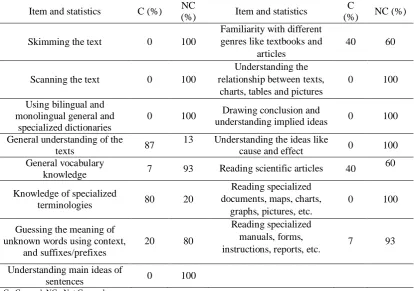
4.5 Reflection of the RC needs of learners in EAP syllabuses
11
Table 3: Reading Comprehension Needs Addressed in EAP Syllabuses
Item and statistics C (%) NC
(%) Item and statistics
C
(%) NC (%) Skimming the text 0 100
Familiarity with different genres like textbooks and
articles
40 60
Scanning the text 0 100
Understanding the relationship between texts,
charts, tables and pictures
0 100
Using bilingual and monolingual general and
specialized dictionaries
0 100 Drawing conclusion and
understanding implied ideas 0 100 General understanding of the
texts 87
13 Understanding the ideas like
cause and effect 0 100 General vocabulary
knowledge 7 93 Reading scientific articles 40
60
Knowledge of specialized
terminologies 80 20
Reading specialized documents, maps, charts,
graphs, pictures, etc.
0 100
Guessing the meaning of unknown words using context,
and suffixes/prefixes
20 80
Reading specialized manuals, forms,
instructions, reports, etc. 7 93 Understanding main ideas of
sentences 0 100
C= Covered, NC= Not Covered
5. Discussion
12
EAP courses at universities. This is in line with the findings of Atai and Nazari (2011) who reported that skimming texts, using bilingual general dictionaries, scanning texts, knowledge of HIM terminologies, guessing meanings of words, and understanding main ideas were perceived as either ‘important’ or ‘very important’ by all the students. The results are partly in agreement with Mazdayasna and Tahririan (2008) showing that nursing and midwifery students needed to develop their reading skills such as reading specialized textbooks and research articles ‘to a great extent’.
In the present study significant differences were found among the perceptions of all participants regarding sub-skills and strategies of reading comprehension needs. The result are in line with the previous literature (Atai & Nazari, 2011; Atai & Shoja, 2011, Mazdayasna & Tahririan, 2008; Soodmand Afshar & Movassagh, 2016) pointing to significant differences among the perceptions of undergraduates, graduates, ESP instructors and subject specific teachers regarding target academic needs of the undergraduate students.
The third research question examined whether EAP classes represent reading comprehension needs of undergraduate students or not. Classroom observations indicated that EAP classes mainly represented translating specific texts into Persian, general understanding of the text, general vocabulary and specific vocabulary; teachers did not implicitly or explicitly instruct different sub-skills and strategies of reading comprehension and their activities were limited to answering comprehension questions at the end of the texts. The predominant use of translation in the class can be attributed to the teaching method, i.e., Grammar Translation Method, at schools and universities. In addition, EAP teachers’ possible unawareness of reading strategies can be another reason for the overuse of translation in EAP classes. The results are in agreement with previous studies on EAP classroom observation (Atai & Nazari, 2011; Atai & Shoja, 2011, Mazdayasna & Tahririan, 2008; Soodmand Afshar & Movassagh, 2016) indicating that teachers do not implicitly or explicitly teach different aspects of EAP texts. As noted in the open-ended comments in the present study and previous research, another possible reason for these results may be EAP teachers’ low command of general English and specifically reading comprehension sub-skills and strategies. This is echoed by Atai (2002) who noted that “EAP instructors should reconsider their role in struggling with EAP context and to widen the repertoire of their language teaching strategies” (p. 13).
13
writing needs of undergraduate students. A possible reason that EAP syllabuses have not been developed based on reading comprehension needs of undergraduate students can be lack of knowledge of syllabus designers about different aspects of reading comprehension. Another possible reason that EAP syllabuses did not reflect undergraduate needs is that in Iran EAP syllabuses and textbooks are designed and developed by a ministry (Ministry of Science, Research, and Technology) or an organization (SAMT) neglecting the voices of students and other stakeholders. In order to develop and adjust the syllabuses to students’ needs, the monologic nature of EAP syllabus design should be replaced with dialogic interaction and negotiation of syllabuses, content of the courses and even teaching methodology with undergraduate and post-graduate students, teachers and other stakeholders (Benesch, 2001).
6. Conclusion and Implications
The main objective of every program evaluation including needs analysis is accountability along with development and improvement of the programs (Keily & Rea-Dockins, 2009) which can be implemented by considering concerns, perceptions, and opinions of different stakeholders especially the end-users who are undergraduate students in the present study. Two EAP problems were echoed in this study including the difficult outdated content of the
courses and low general proficiency of students (Atai & Nazari, 2011; Evans & Green, 2007; Mazdayasna & Tahririan, 2008; Porcaro, 2013; Soodmand Afshar & Movassagh, 2016). To assist low proficient students to deal easily with difficult outdated texts, a practical alternative can be considering content and language integrated learning (Flowedew, 2013). To this end, the most recent topics and themes related to developments of science in different majors can be selected through negotiation with graduate and postgraduate students, content teachers and ESP teachers. The selected contents can be used to integrate teaching different sub-skills and strategies of reading comprehension needs. It should be noted that since EAP courses in Iranian universities are limited to two-to-six credits during the whole program and students cannot be expected to obtain good command of English language, simplification and adaptation of content materials can be considered to amend low general proficiency of undergraduates.
14
in that it sees language as a functional rather than formal artefact” (Flowerdew, 2005, p. 137).
Closely related to content-based, task-based and text-based approach is the genre-based approach which emphasizes the (social) contexts in which genres are constructed, and how language is used in these contexts. In line with the previous literature, reading different genres especially research article was identified as a very important need of undergraduates in this study. However, no account of the research article genre and other genres such as recounts, procedure, report, and explanation (Hyland, 2006) was provided in the syllabuses. In redesigning the EAP syllabuses, the Swlaes’ notion of genre which has been widely used in ESAP pedagogy (e.g., Feak & Swales, 2009; Swales & Feak, 2009) can be used to conjoin “genre, structure, communicative purpose, language choice, context, and discourse community” (Cotos, Huffman & Link, 2015). In effect, EAP syllabuses can include genres which are mostly used in different disciplines along with their rhetorical structures (moves and steps) lexico-grammatical features, communicative purposes as well as conventions of discourse community.
References
Ary, D., Jacobs, L. C., Sorenson, C., & Walker, D.A. (2010). An introduction to research in
education. Wadsworth: Cengage Learning.
Atai, M. R. (2002). Iranian EAP programs in practice: A study of key methodological aspects.
Sheikhbahaee ELT Journal, 1(2), 1-15.
Atai, M. R., & Nazari, O. (2011). Exploring reading comprehension needs of Iranian EAP students of health information management (HIM): A triangulated approach. System, 39, 30-43.
Atai, M. R., & Shoja, L. (2011). A triangulated study of academic language needs of Iranian students of computer engineering: Are the courses on track? RELC Journal, 43, 305-323.
Basturkmen, H. (2006). Ideas and options in English for Specific Purposes. New Jersey: Lawrence Erlbaum Associates, Inc.
Benesch, S. (2001). Critical English for academic purposes: Theory, politics, and practice.
Mahwah, NJ: Lawrence Erlbaum Associates, Inc.
Bocanegra-Valle, A. (2016). Needs analysis for curriculum design. In K. Hyland, & P. Shaw (Eds.), The Routledge handbook of English for academic purposes (pp.608-625). New York: Routledge.
15
Cotos, E., Huffman, S., & Link, S. (2015). Furthering and applying move/step constructs: Technology-driven marshalling of Swalesian genre theory for EAP pedagogy. English
for Academic Purposes, 19, 52-72.
Cowling, J. D. (2007). Needs analysis: Planning a syllabus for a series of intensive workplace courses at a leading Japanese company. English for SpecificPurposes, 26, 426-442. Dornyei, Z. (2007). Research methods in applied linguistics: Quantitative, qualitative and
mixed methodologies. Oxford: Oxford University Press.
Dudley-Evans, T., & St John, M. (1998). Developments in English for Specific Purposes: A
multidisciplinary approach. Cambridge: Cambridge University Press.
Edwards, N. (2000). Language for business: Effective needs assessment, syllabus design and materials preparation
in a practical ESP case study. English for Specific Purposes, 19(3), 291-296.
Ellis, R. (2003). Task-based language learning and teaching. Oxford: Oxford University Press. Evans, S., & Green, C. (2007). Why EAP is necessary: A survey of Hong Kong tertiary
students. English for Academic Purposes 6 (1), 3-17.
Feak, C. B., & Swales, J. M. (2009). Telling a research story: Writing the literature review.
Ann Arbor: University of Michigan Press.
Feez, S. (2002). Text-based syllabus design. Macquarie University, NCELTR.
Flowerdew, J., & Peacock, M. (2001). The EAP curriculum: Issues, methods and challenges. In J. Flowerdew & M. Peacock (Eds.), Research perspectives on English for academic
purposes (pp. 177-194). Cambridge: Cambridge University Press.
Flowerdew, L. (2005). An integration of corpus-based and genre-based approaches to text analysis in EAP/ESP: Countering criticisms against corpus-based methodologies.
English for Specific Purposes, 24, 321-332.
Flowerdew, L. (2013). Integrating traditional and critical approaches to syllabus design: the ‘what’, the ‘how’ and the ‘why?’ English for Academic Purposes, 4, 135-147.
Hamp-Lyons, E. (2001). English for academic purposes. In R. Carter, & D. Nunan (Eds.), The Cambridge guide to teaching English to speakers of other languages (pp. 121-134).
Cambridge: Cambridge University Press.
Hyland, K. (2006). English for Academic Purposes. New York: Routledge.
Hutchinson, S., & Waters, A. (1987). English for Specific Purposes: A learning centered
approach. Cambridge: University Press.
Jin, L., Y, Chang. , F, Yang., & Y, Sun. (2011). Is what I need what I want? Reconceptualising college students’ needs in English courses for general and specific/academic purposes.
English for Academic Purposes, 10, 271-280.
Kiely, R., & Rea-Dickins, P. (2009). Evaluation and learning in language programs. In K. Knapp, & B. Seidlhofer (Eds.), Handbook of foreign language communication and
16
Long, M.H. (2005). Second Language Needs Analysis. Cambridge: Cambridge University Press. Mazdayasna, G., & M.H., Tahririan. (2008). Developing a profile of the ESP needs of Iranian
students: The case of students of nursing and midwifery. English for Academic Purposes, 7, 277-289.
Morell, T. (2007). What enhances EFL students' participation in lecture discourse? Student, lecturer and discourse perspectives. English for Academic Purposes, 6, 222-237. Pallant, J. (2016). SPSS Survival Manual. (6th ed.). NSW. Australi: Allen & Unwin.
Peat, J. (2001). Health science research: A handbook of quantitative methods. Sydney: Allen & Unwin.
Porcaro, J. W. (2013). Teaching English for science and technology: An approach for reading with engineering English. English Teaching Forum, 2, 32-39.
Soodman Afshar, H. & Movassagh, H. (2016). EAP education in Iran: Where does the problem lie? Where are we heading? English for Academic Purposes. 22, 132-151.
Swales, J. M., & Feak, C. B. (2009). Abstracts and the writing of abstracts. Ann Arbor, MI: University of Michigan Press.