Inequality and Segregation
∗
Rajiv Sethi
†Rohini Somanathan
‡September 4, 2001
Abstract
This paper explores the manner in which race and income interact to determine patterns of residential location in metropolitan areas. We use a framework in which individuals care about both the level of affluence and the racial composition of their communities, and in which there are differences in income both within and between groups. Three main findings emerge. First, conditional on income, black households experience lower neighborhood quality relative to whites at any stable equilibrium. Second, extreme levels of segregation can be stable when racial income disparities are either large or negligible, but unstable in some intermediate range. Third, there exist multiple stable equilibria with very different levels of segregation when racial income disparities are sufficiently small. These results hold even when preferences are pro-integrationist, in the sense that racially mixed neighborhoods within a certain range are strictly preferred by all households to homogenous neighborhoods of either type.
∗An earlier version of this paper was entitled “Race, Income and Neighborhood Sorting.”
†Department of Economics, Barnard College, Columbia University ([email protected]).
‡Department of Economics, University of Michigan, and Planning Unit, Indian Statistical Institute - Delhi ([email protected]).
1
Introduction
Several decades have elapsed since the landmark Civil Rights Act of 1964 outlawed discrimi-nation in employment and public education, and the 1968 Open Housing Act extended these protections to the sale and rent of housing. Over this period racial disparities in educational
attainment and household income have narrowed, a significant population of middle class
African Americans has emerged, and the attitudes of white Americans towards integrated
schools and neighborhoods have softened considerably.1
Despite these changes, a high degree of racial segregation remains a striking feature of the urban landscape. The average black resident of metropolitan America lives in a neighborhood that is only 33% white and 54% black, while the average white resident lives in one that is 83% white and 7% black (Lewis Mumford Center, 2001). The contrast is even sharper in cities with significant black populations. If each census tract in the New York metropolitan area were to reflect the racial composition of the city as a whole, 82% of black residents would need to move to a different location; the correspondingfigure for 1990 was also 82%. According to this measure of residential unevenness, metropolitan segregation in the nation as a whole declined by 3.6 percentage points during the 1990’s, and the decline in areas with significant black populations (in excess of 10%) was just 3.1 percentage points. These recentfindings are consistent with the pattern of gradual and uneven declines in residential segregation has been documented for earlier decades (Massey and Denton, 1993, Farley and Frey, 1994, Cutler et al., 1999). In comparison with changes in laws, attitudes and the racial composition of the middle class, the pace of change in residential patterns has been glacial. There is a broad consensus in the empirical literature that racial income disparities play a relatively minor role in accounting for observed levels of segregation. The levels of segregation experienced by black households are uniformly high across all income categories (Denton and Massey 1988, Farley and Frey 1994). As Farley et al. (1994, p. 751) note, “if residential segregation were a matter of income, rich blacks would live with rich whites and poor blacks
with poor whites. This does not happen.”2 Consequently, segregation has been largely
1Approximately one-half of black Americans now live in midlle or upper income households as compared
with about one-fifth in 1960. The black-white gap in high school completion rates for 25-29 year olds dropped from 20 percentage points in 1967 to 7 points in 1996. Median black household income rose by 41% between 1967 and 1999 while the median white household income rose by 24% (U.S. Census Bureau, 2000, Council of Economic Advisors, 1998). In 1963 only 39% of white respondents disagreed with the statement that whites had a right to keep blacks out of their neighborhood; by 1996 this had risen to 86% (Schuman et al., 1997). Additional evidence on attitudes is discussed in Section 2 below.
attributed to the combined effects of preferences over neighborhood racial composition and discrimination in real estate and mortgage lending markets.
While the measured effect of racial inequality on residential segregation may be small, it would be a mistake to conclude that inequality is unimportant in understanding the de-terminants of segregation. This paper is concerned with the manner in which racial income disparitiesinteract with preferences over neighborhood racial composition to determine pat-terns of residential location in metropolitan areas. Intuition might suggest that a narrowing of racial income disparities, increasing acceptance of integration in racial attitudes, and laws against overt discrimination, should all act to induce a steady reduction in levels of seg-regation. We argue that this view of the determinants of segregation is overly simplistic. The relationship between neighborhood racial preferences and segregation is complex and depends in subtle ways on both intraracial and interracial disparities in income.
To explore this relationship, we analyze a model in which incomes vary both within
and between groups, and individuals care about both the level of affluence and the racial
composition of the communities in which they reside. This concern with racial composition may be pro-integrationist, in that households prefer some degree of mixing to homogenous neighborhoods of either type. Individuals are able to locate in any neighborhood, provided that they are willing and able to outbid others to do so.3 In equilibrium, the profile of
rents and the allocation of households across neighborhoods must be such that no household would strictly prefer to live elsewhere. We focus on equilibrium allocations that arestable in the sense that small perturbations in the neighborhood of the equilibrium are self-correcting under the dynamics of decentralized neighborhood choice.
We obtain three main results. First, conditional on income, black households
experi-ence lower neighborhood quality than white households at any stable equilibrium. This has implications for the transmission of racial inequality across generations. In the presence of neighborhood peer effects, the income of black households will underpredict the future eco-nomic success of their children relative to white households. This effect, which arises even when preferences over neighborhood racial composition are strongly pro-integrationist, could not occur if location decisions were based on income alone.
two components, one of which can be interpreted as the effect of racial income disparities alone. Applying this to thirty major metropolitan areas, we find that between one-tenth and one-quarter of the observed segregation in 1990 can be attributed to the direct effect of racial income disparities.
3This may not be possible in practice due to racial steering by real estate agents or discrimination in
mortgage lending markets (Yinger, 1995). We abstract from such overt discrimination because its effects on segregation are well understood, and because doing so allows us to better focus on the questions at hand.
Second, extreme levels of segregation can be stable if racial income disparities are either very great or very small, but unstable in some intermediate range. A narrowing of racial income disparities is therefore consistent withincreasing segregation. From a cross-sectional perspective, one ought not to expect cities with the smallest racial income disparities to be the ones with the lowest levels of segregation. The intuition underlying this result is as follows. When income disparities are large, high income black households are not
sig-nificantly wealthier than lower income white households. When affluent neighborhoods are
overwhelmingly white, lower income whites are willing and able to outbid (slightly) higher income blacks for housing in such neighborhoods. On the other hand, when racial income disparities are negligible, differences in mean income across segregated neighborhoods are also small. Since higher income black households have less to gain in terms of improved neighborhood quality by moving to a white neighborhood, they are again outbid by lower income whites for housing there.
Third, when racial income disparities are sufficiently small, multiple equilibria exist, and these equilibria can differ dramatically in their corresponding levels of segregation and wel-fare. The existence of multiple equilibria suggests that although stable integration may become viable as racial income disparities lessen, history may trap a city in a segregated
equilibrium. This is where social policy may be most effective: temporary incentives for
integration may give rise to permanent effects. Integration comes at the cost of higher strat-ification by income, however, so integrationist policies need not be unambiguously welfare enhancing even when preferences are strongly pro-integrationist.
Our work is closely related to two literatures which deal with the decentralized dynam-ics of neighborhood choice. The idea that extreme levels of segregation can arise under a broad range of preferences over neighborhood composition was developed in seminal work by Schelling (1971, 1972). This analysis contains the important insight that even when all individuals prefer integrated neighborhoods to highly segregated ones, integration may be unsustainable in that a few random shocks can tip the system to a segregated equilibrium.
It is difficult, therefore, to deduce anything about individual preferences from aggregate
patterns of residential location.4 While Schelling’s analysis neglects the role of prices in
rationing housing demand, broadly similar conclusions hold in models that take full account of adjustments in rents (Yinger, 1976, Schnare and McRae, 1978, Kern, 1981). This
litera-4“People who have to choose between polarized extremes ... will often choose in a way that reinforces the
polarization. Doing so is no evidence that they prefer segregation, only that, if segregation exists and they have to choose between exclusive association, people elect like rather than unlike environments.” (Schelling, 1978, p.146).
ture neglects the fact that individuals consider both race and income when making location choices, and that forces acting to produce stratification by income can substantially mitigate the amount of racial segregation that results. While extreme levels of segregation are consis-tent with pro-integrationist preferences in our model, it is also the case that, under certain circumstances, stable equilibria can entail greater integration than any individual, black or white, considers ideal.
There is also an extensive literature on neighborhood sorting when individuals differ with respect to their incomes and sort themselves across jurisdictions on the basis of neighbor-hood characteristics such as local taxation, redistribution, public education, or peer-effects (De Bartolome, 1990, Epple and Romer, 1991, Benabou, 1992, Fernandez and Rogerson, 1996, Durlauf, 1996, Epple and Platt, 1998). Stratification by income occurs in many such models. The concern of this literature is not with stratification per se, but rather its effects on redistribution, the provision of local public goods, efficiency, growth, and the intergener-ational transmission of inequality. What is missing from this body of work is the possibility that individuals care about certain intrinsic characteristics of others with whom they share their neighborhoods, that such preferences are themselves related to group membership, and that there is inequality both within and between groups. Adding these components to the analysis yields significant new insights that appear neither in the segregation litera-ture descended from Schelling, nor in the literalitera-ture on neighborhood sorting in the Tiebout tradition.
The paper is organized as follows. Section 2 provides some discussion and justification for our key assumption that individuals care about both the racial composition and the level of affluence in their communities. The model is developed in Section 3, and its equilibrium properties characterized in Section 4. Section 5 examines the relationship between racial income disparities and residential segregation, and Section 6 concludes. All proofs are in an Appendix.
2
Preferences
Extensive survey evidence on the racial attitudes of Americans has been collected for more than half a century (Schuman et al., 1997). Several studies have specifically attempted to ascertain the preferences of respondents over neighborhood racial composition (Farley et. al., 1978, 1993, Bobo et al., 1986). The best recent evidence comes from a vast ‘Multi-City Study of Urban Inequality’ funded jointly by the Ford Foundation and the Russell Sage Foundation.
Subjects drawn from the Los Angeles and Boston metropolitan areas were asked to construct an “ideal neighborhood that had the ethnic and racial mix” that the respondent “personally would feel most comfortable in”. They did so by examining a card depicting three rows
of five houses each, imagining their own house to be at the center of the middle row, and
assigning to each of remaining houses an ethnic/racial category using the letters A (Asian), B (Black), W (White) and H (Hispanic). The study found overwhelming evidence that “all groups prefer both substantial numbers of co-ethnic neighbors and considerable integration” (Zubrinsky Charles, 2001, p.257). On average, the ideal neighborhood consisted of a plurality of the respondent’s own type (ranging from 40% for black respondents to 52% for whites)
together with significant representation from other groups. Only 2.5% of blacks to 11.1%
of whites considered homogeneous neighborhoods populated only with their own type to be ideal. Overall, this reflects a clear desire for some degree of integration on the part of all groups, with a bias towards members of one’s own group. This is consistent with prior studies of attitudes towards racial composition and motivates the specification used in this paper.
Why might individuals care about the racial composition of their neighborhoods? Farley et al. (1994) trace white attitudes to negative racial stereotypes, and black attitudes to antic-ipated hostility from whites. Ellen (2000) argues that white households hold an exaggerated view (relative to black households) of the association between changes in racial composition and structural decline in neighborhood quality. Whites are consequently less willing than blacks to settle in neighborhoods which have recently experienced increases in the share of the black residents. O’Flaherty (1999) has argued that interracial transactions of many kinds
are rendered difficult because the signals blacks and whites send each other through their
actions and words “are garbled by stereotypes and the possibility of animosity.” The fact that communication is easier and less ambiguous when it does not cross racial lines could account for a desire to live with a substantial number of co-ethnics. Signals also play a key role in the search-theoretic model of Lundberg and Startz (1998), where signals from members of one’s own group are interpreted with less noise than signals from others. Again this can lead endogenously to a desire to associate primarily with co-ethnics. While we take preferences over neighborhood racial composition to be exogenously given, our specification is consistent with these interpretations. In addition, we allow for the possibility that there may be a preference for some degree of integration on the part of both blacks and whites, as suggested by the survey evidence.
indi-viduals also care about the level of affluence in their communities. There are a number of reasons why this might be the case. The quality of public schools is liable to be better in
more affluent neighborhoods even if government per-pupil expenditures are uniform across
the city. This is the case because voluntary contributions to parent-teacher associations increase with income, and because human capital transfers that occur in the home have spillover effects in school. The presence of positive role models (and the absence of negative
ones) is correlated with the degree of affluence of a community. Living an a more affluent
community provides entry into social networks which can be lucrative. And if the external upkeep of one’s residence is a normal good with positive external effects, more affluent com-munities will be more desirable. Each of these effects have been discussed extensively in the literature (Bond and Coulson, 1984, De Bartolome, 1990, and Benabou, 1992). Although the desire to live in a more affluent community can be endogenously derived on the basis of any of the above concerns, we shall treat it simply as a primitive of the model in order to better focus on the main questions of interest.
3
The Model
Consider a city with a continuum of households and two disjoint neighborhoods of equal
size. Households differ along two dimensions, income and race. There are two races, black
and white, each with equal population shares in the city as a whole. Income is assumed to lie within the unit interval and is denoted byy ∈[0,1]. Within each racial group the income distribution is represented by the distribution functions Fb(y)andFw(y).
Any allocation of households across neighborhoods will imply both a racial composition
and a distribution of income within each neighborhood. Let yj¯ denote the mean income
in neighborhood j ∈ {1,2}, βj the share of neighborhood j’s population that is black, and
ωj = 1−βj the proportion of neighborhood j’s population that is white. Housing units are
identical, and rents are accordingly uniform within each neighborhood. Let ρj denote the
rent in neighborhood j. We shall assume that households care about both the mean income
and the racial composition of the neighborhood in which they reside. Neighborhoods will generally not be identical with respect to these criteria, so rents for housing will typically differ across neighborhoods in equilibrium. All income not spent on rent is used for private consumption.
Apart from their private consumption, individuals care about the general affluence and
desirable than those with lower mean incomes for all members of the population. Addi-tionally, black and white households differ systematically with regard to their preferences over neighborhood racial composition. We shall assume for simplicity that the preferences of blacks and whites are symmetric in a sense to be made clear below. We do not assume, however, that preferences are monotonic in neighborhood racial composition. In particular, we allow for the possibility that households strictly prefer an integrated neighborhood to one in which their own group is numerically dominant, and that being part of a sizeable minority may be more attractive than being part of an overwhelming majority.
Preferences are represented by the following simple, separable utility function
u(y−ρ,y, r¯ ) = log(y−ρ) + ¯y+v(r),
where y −ρ is private consumption, y¯ is neighborhood mean income, r ∈ {β,ω} is the
neighborhood population share of the individual’s own race, andv(r) is given by
v(r) =r(1−r+η). (1)
The parameter η∈ [0,1] measures the degree to which residence with co-ethnics is desired.
When η = 0 each individual’s ideal neighborhood racial composition consists of a equal
shares of blacks and whites. More generally, the ideal racial composition for an individual is to have a share 12(1 +η) of her own type in the neighborhood. Larger values of η therefore correspond to a greater bias towards one’s own group. Except in the extreme caseη = 1,such preferences are nonmonotonic: all individuals prefer some degree of integration to complete segregation. For any value ofη < 1
2,the range of neighborhood compositions that are strictly
preferred to complete segregation includes allocations in which the individual is in a minority. Our interest in this paper lies in the relationship between income disparities and the extent of segregation. We approach this question by considering a family of uniform income distributions that depend on a single parameter, which captures the extent of racial income disparities. Specifically, the income distribution among black households is uniform with sup-port£0,1
2(1 +α) ¤
and that among white households is uniform with support £1
2(1−α),1 ¤
. The parameterα ∈[0,1]represents racial income disparities, withα = 0 corresponding to a
completely hierarchical distribution of income and α= 1 corresponding to identical income
distributions. Given values of the parameters η andα, there exists some set of equilibrium household allocations. We next characterize the structure of equilibrium allocations, and proceed to discuss the effects of changes in the underlying parameters.
4
Equilibrium Allocations
Equilibrium in this model is an allocation of households across neighborhoods and a pair of rents (ρ1,ρ2) such that no household strictly prefers a neighborhood different from its
own. In other words, equilibrium requires that for any household with income y residing in
neighborhoodj, it must be the case that for all neighborhoods k,
u(y−ρj,yj¯, rj)≥u(yi−ρk,yk, rk¯ ),
wherer =βfor black households,r =ωfor white households. We shall refer to an allocation in which each neighborhood contains only a single race assegregated, and all other equilibria as integrated.
We say that an allocation isintraracially stratified if there exist threshold income levelsy˜b
andy˜w such that all black households with income above (below)y˜b and all white households
with income above (below)y˜w reside in the same neighborhood. At any intraracially stratified
allocation, one neighborhood is populated by a combination of black households with income below y˜b and white households with income below y˜w, while the other is populated by a
combination of black households with income above y˜b and white households with income
above y˜w. This is consistent with complete segregation (if y˜b = 1 and y˜w = 0), with pure
stratification by income (ify˜b = ˜yw), and a variety of other patterns of neighborhood sorting
including equal neighborhood racial compositions and equal neighborhood mean incomes. We shall refer to the neighborhood containing households above the two threshold income levels as the upper-tail neighborhood.
At any intraracially stratified equilibrium, the mean incomes and racial compositions
in each neighborhood can all be expressed as a function of the threshold income level for
white households. Let z = ˜yw denote the threshold income for whites. Then, since each
neighborhood must accommodate half the population and the distribution functions are symmetric, we haveyb˜ = 1−z. The share of black households in neighborhood 1 is therefore
β1(z) = F (˜yb) F (˜yb) +F (˜yw) = 2˜yb 1 +α = 2 (1−z) 1 +α . (2)
Since each group is of equal size, we have β1 = 1−ω1 = 1−β2 = ω2, all of which can be
expressed as functions of z. Finally, mean incomes in the two neighborhoods are
¯ y1(z) = 2 1 +α Z 1−z 0 ydy + 2 1 +α Z z 1 2(1−α) ydy (3) ¯ y2(z) = 2 1 +α Z 1 2(1+α) 1−z ydy + 2 1 +α Z 1 z ydy (4)
both of which are also fully determined byz.
Figure 1 shows how the mean income in the two neighborhoods varies with z for a
numerical example.5 When z = z
min = 1/4 (the lower bound of the support of the white
income distribution), there is complete residential segregation by race, with the second
(all-white) neighborhood having higher mean income. As z rises from this minimum value, the
lowest income whites in the second neighborhood are replaced by the highest income blacks
from the first, which leads to greater income disparities across neighborhoods. The point
at which neighborhood income disparities are greatest occurs when z = 1/2, since yb˜ = ˜yw
at this point. This would be the outcome if sorting were based on income alone. As z
rises beyond this point, overall stratification begins to decline. When z = zmax ≈ 0.90 the
two neighborhoods have identical mean incomes; beyond this point the second (upper-tail) neighborhood has lower mean income since it consists of all but the poorest segments of
the less affluent race together with a few of the wealthiest members of the more affluent
race. While it is possible for the upper-tail neighborhood to have lower mean income at an intraracially stratified allocation, we show below that this cannot occur in equilibrium.
0.25 1
0.25 0.75
Income of the Marginal White Household, z
Mean Incomes in the two Neighborhoods
zmax y2(z)
y1(z)
_
_
Figure 1. Mean neighborhood income as a function of the marginal white household.
It is trivially the case that an allocation of households in which the two neighborhoods have identical racial compositions, mean incomes, and rents is an equilibrium, since all indi-viduals are indifferent between the two neighborhoods. Such an allocation will be unstable under the dynamics of decentralized location choices. For instance, a small perturbation that raises both the white population share and the mean income of one neighborhood relative to the other will lead to cumulative divergence from the equilibrium, as wealthier white house-holds (and possibly also wealthier black househouse-holds) outbid poorer ones to locate in the more
affluent community. In order for an equilibrium to be stable, therefore, the neighborhoods
must differ either with respect to racial compositions or with respect to mean income. In
general, as we show below, they will differ along both dimensions.
If we disregard the trivial and unstable equilibrium in which neighborhoods are identical, the structure of equilibrium allocations is described by the following result.
Proposition 1 Any equilibrium in which the neighborhoods are non-identical is intraracially stratified. The upper-tail neighborhood has higher rents and higher mean income if the equi-librium is integrated.
This states that equilibria must be stratified by income within each race though not neces-sarily at the level of the population as a whole. Furthermore, rents must be higher in the wealthier neighborhood under integration (though this need not be the case under segrega-tion). Accordingly, we may assume without loss of generality that the second neighborhood is the upper-tail neighborhood and has higher mean income and higher rents whenever seg-regation is incomplete.
To simplify notation, set ρ1 = 0 and ρ2 =ρ. Any equilibrium (other than the one with
identical neighborhoods) may then be described by the pair (z,ρ). In order for a particular value ofz to be an equilibrium, blacks with incomeyb˜ = 1−z and whites with incomeyw˜ =z
must indifferent between the two neighborhoods. These indifference conditions are
log (1−z) + ¯y1+v(β1) = log (1−z−ρ) + ¯y2 +v(β2) (5)
log (z) + ¯y1+v(ω1) = log (z−ρ) + ¯y2+v(ω2) (6)
The two indifference conditions yields two function ρb(z) andρw(z) which identify the rent
at which the corresponding marginal household will be indifferent between the two
neigh-borhoods, given the racial compositions and neighborhood income distributions induced by
z. We shall refer to these as the marginal bid-rent curves for black and white households
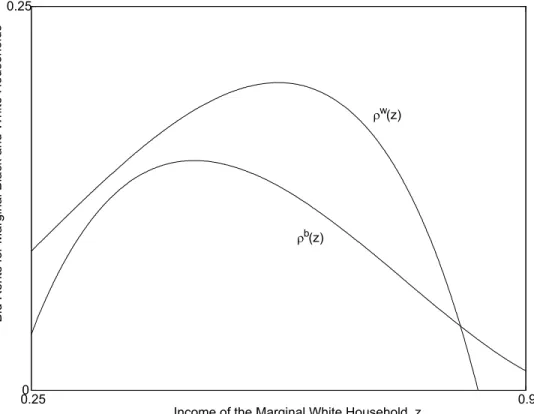
A numerical example (withη = 1/5) is shown in Figure 2. Only values ofz belowzmax≈
0.90are consistent with equilibrium since values of z above this imply lower mean income in the upper-tail neighborhood, violating Proposition 1. At z = 1/4, the second neighborhood is entirely white. Despite the fact that the marginal white household is considerably poorer than the marginal black household, the former is willing to pay more than the latter to live in the second neighborhood: ρb(1/4)<ρw(1/4). Hence for any rentρbetween ρb(1/4)and
ρw(1/4)complete segregation is an equilibrium. As z rises, the income differential between the two neighborhoods also rises, making it more attractive to both groups. Furthermore, the increasing share of black households in the second neighborhood reinforces this effect,
again for both groups. However, the rise in the share of black households in the second
neighborhood has a disproportionately larger impact on the rent that black households are willing to pay and hence ρb rises more rapidly thanρw. Eventually as z rises above 1/2, the
income differential between the two neighborhoods starts to narrow. At this point the second neighborhood is still majority white. At some point the two neighborhoods have the same racial composition, beyond which the upper-tail neighborhood becomes majority-black. This causesρw to decline sharply and eventually intersectρb. This point of intersection constitutes
an integrated equilibrium.
0.250 0.9
0.25
Income of the Marginal White Household, z
Bid Rents for Marginal Black and White Households
ρw(z)
ρb(z)
The integrated equilibrium in Figure 2 is unusual in that the upper-tail neighborhood, despite being slightly more affluent, is predominantly occupied by members of the less affluent race. In fact, it is easy to see that this equilibrium must beunstable: a small perturbation in the allocation of households would lead to cumulative divergence away from this allocation. For z slightly below the equilibrium value z∗, ρw(z) > ρb(z). Hence the marginal white
household is willing to pay more than the marginal black household to live in the upper-tail neighborhood. This would lead to an inflow of whites into the second neighborhood, further reducingz. Since there is no other point at whichρw(z) =ρb(z),the onlystable equilibrium involves complete segregation. More formally, we define the stability of equilibrium as follows:
Definition 1 An integrated equilibrium allocation z is stable if dρw/dz > dρb/dz at z. The
segregated equilibrium allocation z = 0 is stable if there exists some ¯ε > 0 such that for all
ε<¯ε, ρb(ε)<ρw(ε).
This definition states that an integrated equilibrium is stable if a small increase inz (which lowers the share of white households in the upper-tail neighborhood) results in a larger increase (or smaller decline) in the bid rent of the marginal white household relative to that
of the marginal black household. In other words, the equilibrium is stable if a rise in z
causes the marginal white household to outbid the marginal black household to live in the
upper-tail neighborhood, thus driving z back down.6 Similarly, the segregated equilibrium
(z = 0) is stable if a small increase in z results in the marginal white household willing to pay more than the marginal black household to live in the upper-tail neighborhood, again driving z back down. If an equilibrium is not stable, we shall say that it isunstable.
6This definition of stability implicitly assumes that when individuals relocate, they do so in a manner
0.250 0.9 0.25
Income of the Marginal White Household, z
Bid Rents for Marginal Black and White Households
ρw(z)
ρb(z)
Figure 3. Marginal Bid Rent Curves: Stable Integration
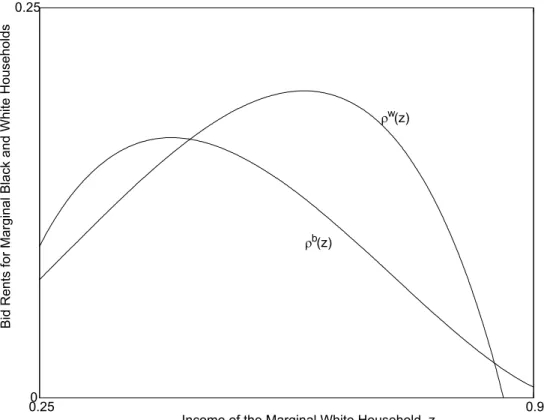
The marginal bid-rent curves for a second example (with η = 1/9) are shown in Figure
3. This time ρb exceeds ρw when z =z
min = 1/4. The wealthiest black households are now
willing to outbid the poorest white households to live in an all-white neighborhood, in order
that they may benefit from the higher mean income. The unique stable equilibrium is now
integrated, and there is a second integrated equilibrium which is unstable. Socioeconomic stratification in the stable equilibrium is higher than in the previous example but still falls short of the maximum possible stratification. Increasing tolerance leads to greater integra-tion, as one might expect, but it also leads to greater disparities in mean income across neighborhoods.
The purpose of the above examples is to shed some light on the structure of equilibria and to introduce the definition of stability. The following result shows that a stable equilibrium does indeed exist in the model, and characterizes one of its properties.
Proposition 2 There exists at least one stable equilibrium. If α 6= 1, then y˜b >y˜w at any stable equilibrium.
This states that the wealthiest households in the lower income neighborhood will be black. In other words, there exists a range of incomes lying betweeny˜w andy˜b such that households
falling within this range will be in the poorer neighborhood if and only if they are black. This group of households will also have higher levels of private consumption than white households with comparable incomes, since a smaller share of income is spent on housing. White and black households with the same income will therefore experience systematically different levels of neighborhood quality. Note that Proposition 2 holds no matter how close
to perfectly pro-integrationist (η = 0) preferences happen to be, and no matter how much
integration occurs in equilibrium: there will always be a set of households who experience
lower neighborhood quality conditional on income if they are black. In the presence of
human capital externalities, the income of this group of black households will underpredict the future economic success of their children relative to the income of white households, an effect that could not occur under stratification alone. This is a sobering thought. Even in a world without overt discrimination, and one in which the desire for integration is strong, the advantage of being born to affluence is magnified if one is also born to an affluent race.7
5
Income Disparities and Segregation
Racial disparities in the distribution of income can be tracked in this model by looking at
changes in the parameter α. When α = 0 we have a completely hierarchical distribution
of income, with the poorest white household being wealthier than the most affluent black
household. Increases in α correspond to declines in racial income disparities. In the limit-ing case α = 1, the two income distributions are identical. The following result identifies conditions under which complete segregation is a stable equilibrium.
Proposition 3 For anyη>0, there existαl∈(0,1]and αh ∈[0,1)such that and complete
segregation is stable if α∈[0,αl]∪[αh,1].
Proposition 3 states that complete segregation is stable whenever racial income disparities are either negligible or extremely high. When racial income disparities are large, even alloca-tions involving pure stratification by income will be highly segregated, and preferences over
neighborhood racial composition reinforce and exacerbate this effect. Hence the stability
of complete segregation in this case is not surprising. Less obvious is the second part of the result, which states that complete segregation must be stable if racial income disparities are sufficientlysmall. This occurs because, when the two income distributions are virtually
7For a model of the process by which residential segregation shapes the intergenerational transmission of
identical, complete segregation does not result in substantial income disparities across neigh-borhoods. This in turn implies that the benefit to wealthier black households from moving to higher income, predominantly white neighborhoods is small. Even a slight preference for all-black over all-white neighborhoods can overwhelm this effect and lead to stable patterns of extreme segregation. Consequently, the relationship between racial income disparities and the stability of segregated equilibria is nonmonotonic: segregation may be inconsistent with intermediate values of α while it is consistent with values of α lying at either extreme.
0 1
0 0.25
Income of the Marginal White Household, z
Bid Rents for Marginal Black and White Households
ρw(z)
ρb(z)
Figure 4. Marginal Bid Rent Curves: Multiple Stable Equilibria
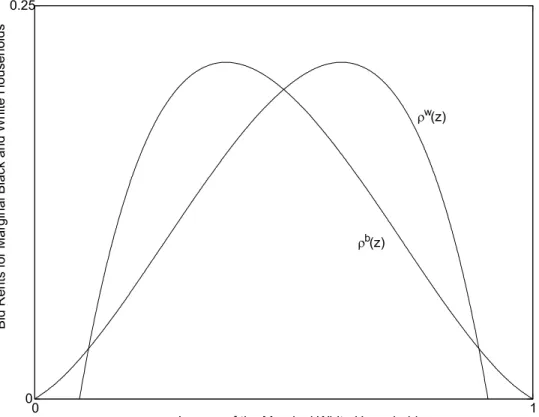
Stability of complete segregation does not imply that integrated equilibria cannot also be stable. Figure 4 illustrates this for the special case of α = 1 andη = 1/5. The marginal bid rent functions are symmetric and there are two stable equilibria, one involving complete segregation (with z = 0) and the other involving complete stratification (with z = 0.5).8
More generally, it is the case that when racial income disparities are negligible, multiple equilibria exist:
Proposition 4 Suppose η is sufficiently small. Then there exists α˜ ∈ (0,1) such that a stable and integrated equilibrium exists for all α ∈ (˜α,1]. When α = 1 this equilibrium involves identical neighborhood racial compositions and complete stratification by income.
Proposition 4 states that as long as preferences over neighborhood racial composition are not too extreme, there is a second stable equilibrium when racial disparities in the distribution of income are small. In the limiting case when such disparities disappear, there is a stable equilibrium in which there is effectively no racial segregation in residential patterns.
Figure 5. Racial Income Disparities and Stable Segregation
Figure 5 shows how the set of stable equilibria varies with changes in racial income disparities for a numerical example (η = 1/9). When racial income disparities are extreme (αclose to zero) complete segregation is the only stable outcome. As racial income disparities narrow there comes a point when the segregated equilibrium loses stability and the unique stable equilibrium involves some degree of mixing. Beyond this point, convergence of incomes
goes hand in hand with greater integration. Eventually α crosses a threshold and multiple
can lead to persistent segregation or to increasing integration: depending on which of the equilibria is selected.
One implication of Proposition 4 is that stable equilibria can exist which involve higher levels of integration than any household, black or white, considers ideal. For example, if
η = 1/2, the ideal neighborhood for each household requires that it be in a 75% majority.
Yet if α = 1, a stable equilibrium exists in which the threshold income is 1/2 for each
race, there is complete stratification by income, and exactly half the households in each neighborhood are black. To see why this is stable, suppose that random perturbations cause
z to rise so that the second neighborhood is now majority black. Based on preferences over
neighborhood composition alone, the marginal black household would outbid the marginal white household for housing in the second neighborhood, leading to cumulative divergence from the equilibrium. But withz exceeding1/2,the marginal black household is less affluent than the marginal white household. Based on preferences for neighborhood mean income alone, the latter would outbid the former for housing in the second neighborhood. The combined effect of these two forces determines whether integration is stable. If preferences
over neighborhood racial composition are not too strong, the latter effect dominates and
integration is stable.
Combining the two previous results, we see that racial disparities in the distribution of income play a subtle and important role in determining patterns of segregation. Even when preferences are strongly pro-integrationist and the ideal neighborhood for all individuals is close to perfectly mixed, complete segregation can result if racial income disparities are negligible or extreme. Multiple equilibria are inevitable when racial income disparities are small. The existence of multiple equilibria suggests that although stable integration may become viable as racial income disparities lessen, a city may remain trapped in the basin of attraction of the segregated equilibrium due to historical patterns of segregation. This is where social policy may be most effective: temporary incentives for segregation may give rise to permanent effects.
In the simple model considered here, the integrated equilibrium results in greater so-cial surplus if preferences are sufficiently pro-integrationist. Integration comes at the cost of greater stratification, however, and this conclusion need not hold once the efficiency ef-fects of stratification are accounted for. These effects can arise because the quality of one’s
neighborhood affects incentives for human capital accumulation, and hence also aggregate
production and growth (Benabou 1996). There are conditions under which stratification
un-ambiguously welfare improving even when preferences are pro-integrationist. In addition, a shift to an equilibrium with greater integration (and correspondingly greater stratification) lowers neighborhood quality in the poorest neighborhood, which consists disproportionately
of black households. The movement of upper-income black households to more affluent
com-munities worsens the conditions for those left behind; a point that has been emphasized by Wilson (1987).
Finally, our results imply that one cannot expect a narrowing of racial income disparities to lead inevitably to lower segregation. While the convergence of incomes might imply greater integration at integrated equilibria, it may also cause segregated allocations to become stable. From a cross-sectional perspective, cities with lower levels of racial inequality need not be the least segregated. And from a historical perspective, the march towards greater integration may be halted and reversed in some cities as racial inequalitydeclines.
6
Conclusions
Given the long history of slavery and legally enforced segregation in the United States, race has a degree of salience in American life that far exceeds that of any other socially designated attribute. Nowhere is this more apparent than in the composition of our communities. Although racial attitudes will doubtless continue to evolve, preferences over neighborhood
racial composition will remain an important factor affecting household location decisions
in the foreseeable future. Such preferences are reflected in the patterns of segregation and stratification that prevail in our cities, but in subtle and sometimes unexpected ways.
The main results of our analysis may be summarized as follows. First, when preferences over neighborhood racial composition influence household location decisions in the manner specified, black households will experience lower neighborhood quality conditional on income than white households. This does not arise from overt discrimination, and is consistent with a desire on the part of all households to live in highly integrated communities. Second, segregated allocations will be stable when racial income disparities are either very great or very small, but may be unstable when racial inequality lies in some intermediate range. And third, multiple equilibria arise when racial income disparities are narrow, with extreme segregation and high levels of integration both being consistent with stability.
Our analysis is abstract enough to permit other interpretations. If, instead of race, the dominant attribute governing location decisions were linguistic preference, religious affi lia-tion, or any other observable trait, our basic findings would continue to apply. It is also not
necessary to interpret neighborhoods in a spacial sense: interaction in clubs or other volun-tary associations will be subject to the same kind of dynamics. One could consider wealth rather than income disparities, and owned rather than rented housing without substantive modification to the model.
The most obvious extensions of this work would be to allow for multiple neighborhoods, a range of overall racial compositions in the city, broader classes of income distributions and preferences, intrinsic differences in neighborhood quality, and multiple racial or ethnic groups. Exploring these extensions will yield answers to new questions, generate additional insights, and determine the extent to which the basic insights emerging in this paper hold under more general conditions.
Appendix
Proof of Proposition 1
If the equilibrium is segregated then the result is immediate. Accordingly, suppose that we
have integration. Consider first the case in which the neighborhoods have the same mean
income. Without loss of generality, supposeρ2 ≥ρ1. Then no black household would reside in the second neighborhood unless v(β2) ≥ v(β1) and no white household would reside there unless v(ω2) ≥ v(ω1). Since β1 = 1−ω1 = 1− β2 = ω2, these conditions imply
v(β1) =v(1−β1)and henceβ1 = 12. But this contradicts the hypothesis that neighborhoods
are non-identical. Hence the neighborhoods cannot be integrated if they have the same mean income.
We may therefore assume, without loss of generality that y¯2 > y¯1. We begin by showing
that ρ2 > ρ1. Suppose, by way of contradiction, that ρ2 ≤ ρ1. Since the second
neighbor-hood has higher mean income and lower rents, no black household would reside in the first
neighborhood unless v(β1)> v(β2). But is this is satisfied, then v(ω2)> v(ω1), so no white
household would reside in the first neighborhood. This contradicts the hypothesis that the equilibrium is integrated. We have therefore proved thatρ2 >ρ1.
Next consider a black household with income y˜ which chooses the first neighborhood.
We therefore have
log(˜y−ρ1) + ¯y1+v(β1)≥log(˜y−ρ2) + ¯y2+v(β2)
For any income y define f(y) ≡ (y−ρ1)/(y−ρ2) and δ = ¯y2 −y¯1 +v(β2)−v(β1). The
above inequality may therefore be writtenf(˜y)≥eδ. Note that sinceρ
2 >ρ1,
f0(y) =− ρ2−ρ1
(y−ρ2) 2 <0.
Hence for any y < y,˜ we have f(y) > eδ and any black household with income y < y˜ will
have a strict preference for the poorer neighborhood. Exactly the same argument (replacing
β withω) can be used to prove that the result holds for white households. We have therefore
proved that there must be two threshold income levels y˜b and y˜w such that the second
neighborhood is populated by a combination of black households with income abovey˜b and
white households with income above y˜w.
To show that the second neighborhood must be more affluent than the first, suppose, by
way of contradiction, that y¯2 < y¯1. Then, since the most affluent black household resides
The same argument shows that all white households must also reside in this neighborhood, contradicting the fact that each neighborhood can accommodate only half the population.
Proof of Proposition 2
If ρw(0) > ρb(0) complete segregation is stable and the result is immediate. Furthermore,
if α = 1 then complete segregation is stable by Proposition 3 (proved below). Accordingly,
suppose that ρw(0) < ρb(0) and α
6
= 1. Since α 6= 1 the second (upper-tail) neighborhood has a higher share of whites than the first and is also more affluent when z = 1/2 (com-plete stratification). Since the marginal white and black households have the same income,
ρw(1/2)>ρb(1/2).By continuity of the marginal bid rent functions andρw(0)<ρb(0), there
must be somez ∈(0,1/2) which at which ρw(z) =ρb(z). This is an equilibrium.
To prove the second claim consider an integrated equilibrium in which the marginal black and white households have incomey˜b andy˜w respectively and the equilibrium rent isρ. Note
from (1) that v(r)−v(1−r) = η(2r−1). Hence the indifference conditions (5-6) may be written
ρ = ˜yb¡1−ey¯1−y¯2eη(2β1−1)¢ ρ = ˜yw¡1−ey¯1−y¯2e−η(2β1−1)¢
Now suppose, by way of contradiction, that yb˜ < yw˜ . Then the above implies eη(2β1−1) <
e−η(2β1−1) and hence 2β
1−1 < 0. (The upper-tail neighborhood must be majority black).
Letφb(z)andφw(z) be the bid rents for black and white households with incomesyb˜ andyw˜
respectively, when the allocation is shifted to z.
φb(z) = ˜yb¡1−ey¯1(z)−y¯2(z)eη(2β1(z)−1)¢ φw(z) = ˜yw¡1−ey¯1(z)−y¯2(z)eη(1−2β1(z))¢
Let z = ˜yw +ε where ε > 0. Note that 2β1(z)−1 < 2β1(˜yw)−1 < 0 and y¯1(z)−y¯2(z) >
¯
y1(˜yw)−y¯2(˜yw). Hence
φb(z)−φw(z) = ˜yb−yw˜ +e¯y1(z)−y¯2(z)¡ywe˜ η(1−2β1(z))−ybe˜ η(2β1(z)−1)¢
> yb˜ −yw˜ +ey¯1(˜yw)−y¯2(˜yw)¡yw˜ eη(1−2β1(˜yw))
−ybe˜ η(2β1(˜yw)−1)¢= 0
Henceφb(z)>φw(z).By continuity, if ε is sufficiently small, ρb(z)>ρw(z)and the
Proof of Proposition 3
Under complete segregation β1 =ω2 = 1 andz = (1−α)/2. Mean incomes are given by
¯ y1 = 2 1 +α Z 1 2(1+α) 0 ydy= 1 4+ 1 4α ¯ y2 = 2 1 +α Z 1 1 2(1−α) ydy= 3 4− 1 4α
The indifference conditions for the marginal households are
log µ 1 2(1 +α) ¶ + 1 4(1 +α) +η = log µ 1 2(1 +α)−ρ ¶ +1 4(3−α) log µ 1 2(1−α) ¶ + 1 4(1 +α) = log µ 1 2(1−α)−ρ ¶ +1 4(3−α) +η which yields ρb(zmin) = 1 2 e12− 1 2α−η+e 1 2− 1 2α−ηα−1−α e12− 1 2α−η ρw(zmin) = − 1 2 −e12− 1 2α+η+e 1 2− 1 2α+ηα+ 1−α e12− 1 2α+η Taking limits lim α→0ρ b(z min) = lim α→0 1 2 e12− 1 2α−η +e 1 2− 1 2α−ηα−1−α e12− 1 2α−η = 1 2 ³ 1−e−12+η ´ lim α→0ρ w(z min) = lim α→0− 1 2 −e12− 1 2α+η +e 1 2− 1 2α+ηα+ 1−α e12− 1 2α+η = 1 2 ³ e12+η−1 ´ e−12−η Subtracting, lim α→0 ¡ ρw(zmin)−ρb(zmin) ¢ = 1 2 ³ e12+η −1 ´ e−12−η − 1 2 ³ 1−e−12+η ´ = 1 2 ¡ e2η −1¢e−12−η >0
Hence, regardless ofη complete segregation is stable. Next take limits
lim α→1ρ b(z min) = lim α→1 1 2 e12− 1 2α−η +e 1 2− 1 2α−ηα−1−α e12− 1 2α−η = 1−eη <0 lim α→1ρ w(z min) = lim α→1− 1 2 −e12− 1 2α+η +e 1 2− 1 2α+ηα+ 1−α e12− 1 2α+η = 0
Hence again complete segregation is stable. Since the marginal bid rent functions are con-tinuous in α,the result follows.
Proof of Proposition 4
Define the functions
Fb(z,ρ) ≡ log (1−z) + ¯y1+v(β1)−log (1−z−ρ)−y¯2 −v(1−β1)
Fw(z,ρ) ≡ logz+ ¯y1+v(1−β1)−log (z−ρ)−y¯2−v(β1)
The indifference conditions for the marginal households then imply that an equilibrium,
Fb(z,ρ) =Fw(z,ρ) = 0. Since these functions are differentiable, the implicit function
theo-rem may be used to define the two continuous and differentiable functions ρb(z) and ρw(z)
which satisfy dρb dz = − ∂Fb(z,ρ)/∂z ∂Fb(z,ρ)/∂ρ = −(1−z−ρ) µ −1 1 −z + ¯y 0 1+β01v0(β1) + 1 1−z−ρ−y¯ 0 2+β01v0(1−β1) ¶ (7) dρw dz = − ∂Fw(z,ρ)/∂z ∂Fw(z,ρ)/∂ρ = −(z−ρ) µ 1 z + ¯y 0 1 −β01v0(1−β1)− 1 z−ρ −y¯ 0 2−β01v0(β1) ¶ (8) at the equilibrium rentρ. From (2—4) we obtain
β01(z) = − 2 1 +α ¯ y10(z) = 4z−2 1 +α ¯ y20(z) = 2−4z 1 +α
From (1), we have v0(r) = 1−2r +η. When α = 1, there is an integrated equilibrium
with β1 = z = 12. At this equilibrium we therefore have β
0
1 = −1, y¯10 = 0 = ¯y20, and
v0(β
1) =η=v0(1−β1). Substituting these values in (7—8) yields after simplification
dρb dz ¯ ¯ ¯ ¯ z=1 2 − dρ w dz ¯ ¯ ¯ ¯ z=1 2 = 2η−4ρ(1 +η)
Using the indifference conditions at the equilibrium, we get ρ = 12³1−e−12
´ . Hence at equilibrium, dρb dz ¯ ¯ ¯ ¯ z=1 2 − dρ w dz ¯ ¯ ¯ ¯ z=1 2 = 2η−2³1−e−12 ´ (1 +η)
This is negative if and only if η < e12 −1≈ 0.65. Hence, forη sufficiently small and α= 1,
the integrated equilibrium is stable. By continuity, the same applies when α is sufficiently close to1.
References
[1] Benabou, R. (1992). “Workings of a City: Location, Education, and Production.”
Quar-terly Journal of Economics 108: 619-52.
[2] Benabou, R. (1996). “Heterogeneity, Stratification, and Growth: Macroeconomic
Im-plications of Community Structure and School Finance.” American Economic Review
86: 584-609.
[3] Bobo, L., H. Schuman, and C. Steeh (1986). “Changing Attitudes Toward Residential
Segregation.” In Housing Desegregation and Federal Policy, edited by J.M. Goering.
Chapel Hill: University of North Carolina Press.
[4] Bond, E.W and E.N. Coulson (1889). “Externalities, Filtering, and Neighborhood
Change”Journal of Urban Economics 26: 231-49.
[5] Council of Economic Advisors (1998).The Economic Report of the President.
Washing-ton: U.S. Government Printing Office.
[6] Cutler, D.M., E.L. Glaeser and J.L. Vigdor (1999). “The Rise and Decline of the
Amer-ican Ghetto.”Journal of Political Economy 107: 455—506.
[7] de Bartolome, C.A.M. (1990). “Equilibrium and Inefficiency in a Community Model
with Peer Group Effects.” Journal of Political Economy 98: 110-33
[8] Denton, N.A. and D.S. Massey (1988). “Residential Segregation of Blacks, Hispanics
and Asians by Socioeconomic Status and Generation.” Social Science Quarterly 69:
797—817.
[9] Durlauf, S.N. (1996). “A Theory of Persistent Income Inequality”.Journal of Economic
Growth 1: 75-93.
[10] Ellen, I.G. (2000). Sharing America’s Neighborhoods: The Prospects for Stable Racial
Integration. Cambridge: Harvard University Press.
[11] Epple, D. and G.J. Platt (1998). “Equilibrium and Local Redistribution in an Urban
Economy When Households Differ in Both Preferences and Incomes.”Journal of Urban
Economics 43: 23-51.
[12] Epple, D. and T. Romer (1991). “Mobility and Redistribution” Journal of Political Economy 99: 828-58.
[13] Farley, R., M. Krysan, T. Jackson, C. Steeh, and K. Reeves (1993). “Causes of Continued Racial Residential Segregation in Detroit: ‘Chocolate City, Vanilla Suburbs’ Revisited”
Journal of Housing Research 4: 1-38.
[14] Farley, R., H. Schuman, S. Bianci, D. Colasanto, and S. Hatchett (1978). “‘Chocolate City, Vanilla Suburbs’: Will the Trend Toward Racially Separate Communities
Con-tinue?” Social Science Research 7: 319-44.
[15] Farley, R., C. Steeh, M. Krysan, T. Jackson, and K. Reeves (1994). “Stereotypes and
Segregation: Neighborhoods in the Detroit Area.” American Journal of Sociology 100:
750-80.
[16] Farley, R. and W.H. Frey (1994). “Changes in the Segregation of Whites from Blacks
during the 1980: Small Steps toward a more Integrated Society.”American Sociological
Review 59: 23—45.
[17] Fernandez, R. and R. Rogerson (1996). “Income Distribution, Communities, and the
Quality of Public Education.” Quarterly Journal of Economics 111: 135-64.
[18] Kern, C.R. (1981). “Racial Prejudice and Residential Segregation: The Yinger Model
Revisited” Journal of Urban Economics 10: 164-72.
[19] Lewis Mumford Center for Comparative Urban and Regional Research (2001).
“Eth-nic Diversity Grows, Neighborhood Integration Is at a Standstill.”Metropolitan Racial
and Ethnic Change: Census 2000 Reports. State University of New York at Albany (http://www.albany.edu/mumford/census).
[20] Loury, G.C. (1977). “A Dynamic Theory of Racial Income Differences.” In Women,
Minorities and Employment Discrimination, edited by Phyllis Wallace and Annette LaMond.
[21] Lundberg, S. and R. Startz (1998). “Race, Information, and Segregation.” Mimeo, Uni-versity of Washington.
[22] Massey, D.S. and N.A. Denton (1993).American Apartheid: Segregation and the Making
of the Underclass. Cambridge: Harvard University Press.
[23] O’Flaherty, B. (1999). “Troubled Transactions and their Consequences: Race in the United States.” Mimeo, Columbia University.
[24] Schelling, T.C. (1971). “Dynamic Models of Segregation.”Journal of Mathematical So-ciology 1: 143—86.
[25] Schelling, T.C. (1972). “A Process of Residential Segregation: Neighborhood Tipping.” In Racial Discrimination in Economic Life, edited by A.H. Pascal. Lexington, MA: Lexington Books.
[26] Schelling, T.C. (1978). Micromotives and Macrobehavior. New York: W.W. Norton.
[27] Schnare and McRae (1978). “The Dynamics of Neighborhood Change.” Urban Studies
15: 327-331.
[28] Schuman, H., C. Steeh, L. Bobo, and M. Krysan (1997). Racial Attitudes in America:
Trends and Interpretations, Revised Edition. Cambridge: Harvard University Press. [29] Sethi, R. and R. Somanathan (2001). “Racial Income Disparities and the Measurement
of Segregation.” Mimeo, Barnard College, Columbia University.
[30] U.S. Census Bureau (2000). Current Population Reports, P60-209, Money Income in
the United States: 1999. Washington: U.S. Government Printing Office.
[31] Wilson, W.J. (1987). The Truly Disadvantaged: The Inner City, the Underclass, and
Public Policy. Chicago: University of Chicago Press.
[32] Yinger, J. (1976). “Racial Prejudice and Racial Residential Segregation in an Urban
Model.”Journal of Urban Economics 1: 21-47.
[33] Yinger, J. (1995). Closed Doors, Opportunities Lost: The Continuing Costs of Housing
Discrimination. New York: Russell Sage Foundation.
[34] Zubrinsky Charles, C. (2001). “Processes of Racial Residential Segregation.” In
Ur-ban Inequality: Evidence from Four Cities, edited by Alice O’Connor, Chris Tilly, and Lawrence D. Bobo. New York: Russell Sage Foundation.