© 2018, IRJET | Impact Factor value: 6.171 | ISO 9001:2008 Certified Journal
| Page 4419
Performance Study of a Small Scale Water Current Turbine
Mohammad Sultan Mahmud
1, Kawsar Nayeem Reza
2, Md. Zahidur Rahman
31,2,3,
Department of Mechanical Engineering, Khulna University of Engineering & Technology, Khulna 9203,
Bangladesh
---***---Abstract -
Ocean or river currents are potentiallysignificant and currently untapped resource of energy. Ocean or river currents thus contain an abundant source of energy that can be captured and converted to a usable form. So the hydropower from the river is one of the best renewable sources. Hydropower source is predictable compared to wind or solar energy. For generation of electricity using the kinetic energy of natural water resources, Savonius rotor is one of the best types of turbine. The Savonius turbine is more popular as wind turbine. However, in present work, the performance was tested of Savonius type rotors used as a water current turbines application. In present investigation was investigated at different speeds of water flow. It is found that the maximum power output can be obtained at higher velocity of water.
Key Words: Hydropower, Water Current Turbine, Savonius Rotor, Mechanical power, Hydraulic efficiency.
1. INTRODUCTION
In the recent time, the increase of crude oil price has reminded many quarters on the transient nature of fossil fuel. On the other hand, environmental issues are forcing governments to consider the incentives for development of alternative clean sources of energy [1].
There is a tremendous amount of free energy in the wind which is available for energy conversion. The use of wind machines to harness the energy in the water is not a new concept and can be dated back as far back as the Chinese in 2000 B.C. These early machines were used for pumping water for irrigation purposes and later developed as windmills for grinding grain. It has only really been in the last century that intensive research and development have gone into the use of water energy for electricity generation.
Also another potential sources of clean energy is the ocean or hydro kinetic energy. A number of different types of water machines, or water turbines are exist today. They can generally be categorized into two main categories, those whose rotor shaft rotates around a horizontal axis and those whose rotor rotates around a vertical axis. Horizontal axis water turbines, or HAWTs, have blades mounted radially from the rotor. Modern types usually have two or three blades and are generally used for large scale grid connected electrical power generation. Vertical axis water turbines, or VAWTs, are not as common and only recently have they been used for large scale electricity generation. Previously they had applications as ventilators and water pumps. With the idea of designing and building a suitable small-scale water turbine in mind various HAWTs and VAWTs were
researched to determine whether or not they would be suitable. Simple construction and cost of materials was a major driving factor in the decision but there was also a need for a design which was robust. It was decided upon to build a vertical axis water turbine as on a small scale they possess the required design factors mentioned above and also have the advantage that they do not have to be orientated into the wind i.e. operate independent of water direction.
The Savonius type vertical axis wind rotor was first invented by S. J. Savonius in 1929. The design was based on the principle of Flettner's rotor. The rotor was formed by cutting a Flettner's cylinder from top to bottom and then moved the two semi-cylinder surfaces sideways along the cutting plane so that the cross-section resembled the letter 'S'. It can be directly placed in flowing stream of water to generate mechanical power from kinetic energy of flowing fluid. It operates on the principle that a drag differential is created between the concave and the convex surface which induces rotation. Efficiencies of the Savonius rotor are generally low when compared with those other vertical axis turbines, such as the Darrieus rotor. The reason for lower efficiency is the nature of fluid flow over the rotor blades which produce positive and negative torque on leading and trailing rotor blades respectively. As smaller size Savonius rotors reduces in the use of material and manufacturing cost. In general, applications of Savonius rotor, includes ventilation pumping water, driving an electrical generator [1].
A. A. Kadam, et al. [2] exhibited the learned about Savonius wind rotors and recognize the different execution parameters to build its proficiency. The exploratory outcomes demonstrate that two cutting edges rotor is more stable in operation than at least three rotor sharp edges, the power coefficient increments with expanding the viewpoint proportion. The rotor sharp edges with end plates gave higher effectiveness than those of without end plates. CFD examination was done to ponder the stream conduct of a turning two container Savonius rotor.
N. H. Mahmoud et al. [3] investigates diverse geometries of Savonius wind turbine are tentatively concentrated keeping in mind the end goal to decide the best operation parameters. It was discovered that, the two sharp edges rotor is more productive than three and four ones. The rotor with end plates gives higher proficiency than those of without end plates.
© 2018, IRJET | Impact Factor value: 6.171 | ISO 9001:2008 Certified Journal
| Page 4420
about is finished looking at the exhibitions of two sharpedges and three edges rotor. The edges are manufactured with aluminum sheet with the viewpoint proportion of one with zero cover and separation. The experiments were conducted with the subsonic passage under low speed conditions.
Frederikus Wenehenubun et al. [5] means to examine the impact of number of cutting edges on the execution of the model of Savonius sort wind turbine. The investigations used to observe at 2, 3 and 4 cutting edges twist turbines to indicate tip speed proportion, torque and power coefficient related with wind speed. A reenactment utilizing ANSYS 13.0 programming will indicate weight dissemination of wind turbine. The aftereffects of study demonstrated that number of sharp edges impact the execution of wind turbine. Savonius display with three cutting edges has the best execution at high tip speed proportion. The most astounding tip speed proportion is 0.555 for twist speed of 7 m/s.
K. K. Sharma, et al. [6] displayed contemplate on the execution of three-can Savonius rotor by with Fluent 6.0 Computational Fluid Dynamics software. The stream conduct around the rotor was likewise broke down with the assistance of weight, speed and vorticity forms, for various cover proportions.
J. L. Menet [7] introduced the investigation on a twofold stage Savinious rotor for power generation. The reasonable model is created for age of power for the low speed application. The changed auto alternator is utilized for age of electricity. The test thinks about is led on the model at Situ. B. Wahyudi, et al. [8] has been completed investigation on the execution of hydrokinetic turbines of Savonius utilizing a Tandem Blade Savonius (TBS) rotor. The investigation incorporated the three sorts cutting edge setup of TBS as Overlap, symmetrically and Convergence. The reenactment comes about more than three design clear that the joining TBS have best execution than different sorts.
Bhaskar Jyoti Choudhury, et al. [9] has been investigated stream qualities of two bladed Savonius rotor with utilizing ANSYS Fluent programming. The examination chiefly focused on varieties of drag and torque coefficient for each 10 degree rotor cutting edge angle. The conduct of edge additionally contemplated with thought static weight, speed, vorticity and turbulent dynamic vitality by utilizing CFD programming. The consequences of the investigation inferred that drag and torque co-productive are greatest at 0 and 30 degree rotor edge edges separately, vorticity and turbulent dynamic vitality indicates most extreme incentive at 30 degree rotor sharp edge point.
Widodo W. S., et al. [10] has introduced the plan and investigation of the Savonius rotor cutting edge for limit 5 kW control Output. The Savonious cutting edge for evaluated control output were outlined and the auxiliary investigation were completed for checking the basic steadiness of wind turbine blade. The conduct of twist stream over sharp edge is additionally advocated utilizing the computational liquid examination. The consequences of the investigation
reasoned that the arched parts of sharp edge demonstrates the greatest thickness of wind.
Ivan Dobrev, et al. [11] has been completed the examination think about on the course through savonius vertical hub wind turbine sort with viewpoint proportion having equivalent to just about 1. The reenactment with both two dimensional and three dimensional models utilizing CFD programming is dissected sub-current field condition and execution of cutting edge structure is evaluated. The recreation comes about were tentatively approved utilizing wind burrow PIV (Particle picture velocimetry) with rotor azimuthal.
Anum [12] has tended to the change of Savonius rotor execution with fractional differential condition. Examinations were led to demonstrate the impact of geometrical setup on the rotor execution regarding coefficient of torque and power, and power yield.
Patel C. R. et al. [13] has been explored on the streamlined execution of Savonius wind turbine. In this examination wind burrow was utilized to locate the streamlined qualities like torque coefficient, drag coefficient and control coefficient of three bladed Savonius wind turbine rotor models, with and without cover proportion, at different Reynolds numbers. The computational liquid examination software were utilized for approving the numerical investigation, also think about researched the exhibitions with and without cover proportion at higher Reynolds numbers and results reasoned that zero cover proportion indicates great exhibitions than other configuration.
K. K. Sharma, et al. [14] has been learned about the execution of a two-organize two-bladed design of the Savonius rotor. Subsonic breeze burrow is created to complete the trial work. The parameters examined with changes in tip speed ratio, overlap and control coefficient alongside changes in the torque coefficient. The upgraded cover proportion was utilized to create greatest execution of the rotor. The consequences of the investigation demonstrated that a greatest control coefficient of 0.517 was gotten at 9.37% cover condition.
© 2018, IRJET | Impact Factor value: 6.171 | ISO 9001:2008 Certified Journal
| Page 4421
that can be applied to the design of full scale marine currentturbines. Technologies to harness river and ocean current energy are at an early developing stage, and only a few prototypes and demonstration units have yet been tested.
2. Water Current Turbine and Geometric
Parameters of Savonius Rotor
To date there are only a few technologies that have progressed as far as the full-scale deployment and testing. When designing a rotor for marine current generation, there are two types of rotors to consider. These are the Savonius rotor and the propeller rotor each with its own unique characteristics. The reasons to choose Savonius rotor over other types are stated below:
- they are simple machines, so they are easy to build; - their high starting torque enables them not only to run, but also to start whatever the wind velocity;
- they are supposed to run even in case of ‘‘strong’’ winds (when most of fast running wind turbines must be stopped);
- the components which convert the mechanical energy extracted from the wind into electrical energy can be located at the surface level;
- maintenance operations are considerably simplified. The above advantages outweigh its low efficiency and slow running speed makes it an ideal economical choice to meet small-scale power requirement [15].
[image:3.595.309.545.163.345.2]Wind turbines are defined by a performance curve which gives power coefficient (or torque coefficient) as a function of λ. Such a curve is determined experimentally (Fig - 1). It is known (Betz theory) that for a horizontal axis wind turbine, the power coefficient is always inferior to the theoretical value 0.593. In fact, the best modern wind machines hardly reach this maximal value of the power coefficient [7].
Fig - 1: Performances of main conventional wind machine and also water turbine [7].
Fig - 2 indicates schematic diagram of Savonius rotor with nomenclatures used. Three parameters, (1) aspect ratio α, (2) rotors stack and (3) Overlap ratio, β, are predominantly affecting performance of Savonius turbine.
Fig - 2: Schematic of a single-stage Savonius rotor. (a) Front view; (b) top view [2].
The aspect ratio represents the overall height of rotor (H) relative to diameter (D). The relation is shown by
α= H/D
The starting torque of the turbine is high but it is not consistently constant. One way of overcoming this fluctuating torque is to stack the rotors. The starting torque of double stack rotor is never negative, whatever the direction of the current.
Overlap ratio is one important factor affecting the performance of the turbine. The overlap ratio is defined as the ratio of overlap distance between the two blades (e) to the chord length of the blade (d). The relation is shown by
β= e/d
3. Performance Parameters of Savonius rotor
The performance of the Savonius rotor is estimated from the power and torque coefficients in comparison with the tip speed ratio (TSR) λ. TSR is a ratio between the speed of tip blade and water velocity (V) through the blade obtained by
TSR (λ) = Vrotor/V= ωR/V
The power coefficient (CP) of the Savonius rotor is
defined as the ratio of the power generated by the rotor to the available wind power and is given by,
CP =Pturbine/Pavailable
Power, Pturbine= Tω (watt)
[image:3.595.35.538.550.802.2]© 2018, IRJET | Impact Factor value: 6.171 | ISO 9001:2008 Certified Journal
| Page 4422
CP = Tω/ (1/2×ρSV3)
Where, ρ is water density and S is swept area of rotor. The CP is usually estimated from field or wind tunnel
tests, and with the help of numerical techniques that solve the conservation equations of the wind flow. It has been proved that a turbine can have the maximum possible CP of
59.3%. This limit is termed as the Betz limit.
The torque coefficient (CT) is defined as the ratio of the
actual torque produecd by the turbine (Tturbine) to the
theoretical torque available in the wind (Tavailable) and can be
expressed by
CT =Tturbine/Tavaialble Tturbine = F × r Tavaialble =1/2 ×qAV2R CT = (F × r)/ (1/2×qAV2R)
Under static condition, the net rotor torque is termed as static torque which is mostly responsible for the starting capability of the rotor. However, at rotating condition, the net rotor torque is termed as dynamic torque and is mostly responsible for its power converting capability. The high static torque coefficient of the Savonius rotor plays a crucial role in improving the starting capability of vertical-axis Darrieus rotor [16].
4. EXPERIMENTAL SETUP AND PROCEDURE
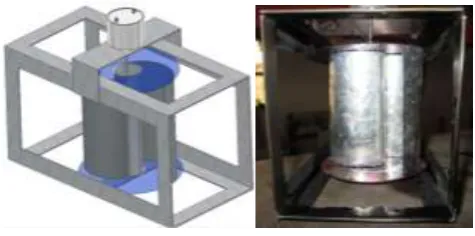
[image:4.595.323.534.74.215.2]Based on the literature reviews, we find that there are two types of test rig for the testing of the Savonius rotor. They are horizontal test rig and vertical test rig in terms of the axis orientation. We adopted the vertical axis testing rig considering the easy alignment of each component. The main components of this vertical test setup are holding frame, the Savonius turbine, mechanical bearings, couplings, shaft, a driving motor, and motor controller. With a basic Savonius water turbine design selected a small-scale model was designed shown in fig - 3. The overall size of the water turbine and its supporting structure was limited to a maximum height of 0.08 m, length of 0.15 m and width of 0.07 m. These specifications were set at the start to ensure that it would be of a suitable size for the test facilities in which it was to be fabricated and also provide for ease of relocation and storage. The rotor was designed so as the turbine could start from any water direction. Suitable bearings, rotor shaft and frame were carefully selected and fabricated (fig - 4). All materials used had to be fit for the purpose intended with the main criteria being robustness from loads imposed from wind and other forces and also being able to withstand the elements of nature.
Fig - 3: Geometry of Savonius rotor.
[image:4.595.322.560.300.418.2]The experiments were carried out in a water channel of the experimental facilities at the university. The testing procedure is that we first regulated the flow controller to keep the water velocity at a constant value.
Fig - 4: Geometry of Savonius turbine with supporting structure.
Then, we used the motor controller to run the motor at a constant rotational speed. According to the wind speed and rotational speed, one tip speed ratio can be calculated. The rotational speed of the turbine is measured using DC tachometer. A number of water channel tests were carried out for setup under different condition. Tests were also performed on the turbine rotor to find how fast that it rotated under free flow of water.
5. EXPERIMENTAL RESULTS
The required data of volume, time, cross-sectional area of channel and rpm of the rotor are collected from the experimental setup of the small scale turbine. From these data; input power, output hydraulic power and hydraulic efficiency was calculated.
© 2018, IRJET | Impact Factor value: 6.171 | ISO 9001:2008 Certified Journal
| Page 4423
60
80
100 120 140 160
0.5 0.55 0.6 0.65 0.7
R
P
M
Velocity (m/s)
Fig - 5: Graphical relation between flowing water velocity and rpm of rotor blade.
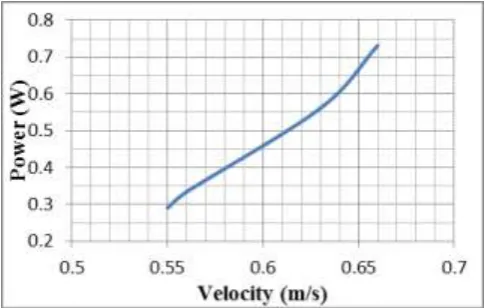
[image:5.595.54.310.87.216.2]Fig - 6 illustrates output power with wind speed for the investigated turbines. The turbine gives higher mechanical power output at higher velocity of water flow. The maximum power output observed at 0.66 m/s is 0.73 watt.
Fig - 6: Graphical relation between flowing water velocity and delivered power of rotor blade. Fig - 7 presents that the hydraulic efficiency the turbine with respect to velocity of water. It was found that the hydraulic efficiency the turbine increases with increase in water velocity. Figure 8 shows the hydraulic efficiency curve as a function of rotational speed. This curve is different from the curve of fig - 7.
15% 20% 25% 30% 35%
0.5 0.55 0.6 0.65 0.7
H
y
d
ra
u
li
c
ef
fi
ci
en
cy
Velocity (m/s)
Fig - 7: Graphical relation between flowing water velocity and hydraulic efficiency of rotor blade.
15% 20% 25% 30% 35%
80 110 140 170
H
y
d
ra
u
li
c
ef
fi
ci
en
cy
RPM
Fig - 8: Graphical relation between rpm and hydraulicefficiency of rotor blade.
3. CONCLUSIONS
A model of Savonius type water current turbine was designed and investigated. The main observations are summarized as follows:
From the curve between velocity of flowing water and rpm of the rotor of model, it has been observed that if velocity increase then rpm will be increased and if rpm of rotor increase then hydraulic efficiency will be increased. The turbine gives higher mechanical power output at higher velocity of water flow. The maximum power output observed at 0.66 m/s is 0.73 watt. Also, it was found that the hydraulic efficiency the turbine increases with increase in water velocity.
It can be observed that this kind of turbine is cheaper to build and of high productivity considering not only the delivered power, but the whole produced energy during a given period of use. Thus it is particularly adapted to local production of electricity, such as in sailing applications, to generate electricity on a sailboat.
REFERENCES
[1] M. Nakajima; S. Iio, T. Ikeda, “Performance of Double-step Savonius Rotor for Environmentally Friendly Hydraulic Turbine”, J. of Fluid Sci. and Tech. (2008) 3(3):410-419
[image:5.595.50.293.321.475.2]© 2018, IRJET | Impact Factor value: 6.171 | ISO 9001:2008 Certified Journal
| Page 4424
[3] N.H. Mahmoud, An experimental study on improvementof Savonius rotor performance, International Journal of Alexandria Engineering Journal (2012) 51, 19–25.
[4] Mohammed Hadi Ali, Experimental Comparison Study for Savonius Wind Turbine of Two & Three Blades At Low Wind Speed, International Journal of Modern Engineering Research(IJMER) www.ijmer.com Vol. 3, Issue. 5, Sep - Oct. 2013 pp-2978-2986 ISSN: 2249-6645.
[5] Frederikus Wenehenubun, An experimental study on the performance of Savonius wind turbines related with the number of blades, 2nd International Conference on Sustainable Energy Engineering and Application, ICSEEA 2014 Energy Procedia 68 (2015) 297 – 304.
[6] K.K. Sharma and R. Gupta, Flow Field Around Three Bladed Savonius Rotor, International Journal of Applied Engineering Research. ISSN 0973-4562, Volume 8, Number 15 (2013) pp. 1773-1782
[7] J. L. Menet, A double-step Savonius rotor for local production of electricity: a design study, International Journal of Renewable Energy 29 (2004) 1843–1862.
[8] B. Wahyudi, S. Soeparman, S. Wahyudi, and W. Denny., A Simulation Study of Flow and Pressure Distribution Patterns in and around of Tandem Blade Rotor of Savonius (TBS) Hydrokinetic Turbine Model, Journal of Clean Energy Technologies, Vol. 1, No. 4, October 2013.
[9] Bhaskar Jyoti Choudhury and Gaurav Saraf, Computational Analysis of Flow around a Two-Bladed Savonius Rotor, ISESCO JOURNAL of Science and Technology ,Volume 10 - Number 17 - May 2014 (39-48) [10] Widodo, W.S., Chin, A.C., Haeryip Sihombing, And Yuhazri, M.Y., Design And Analysis Of 5 Kw Savonius Rotor Blade, Global Engineers & Technologists Review.
[11] Ivan Dobrev, Fawaz Massouh, CFD and PIV investigation of unsteady flow through Savonius wind turbine, Energy Procedia 6 (2011) 711–720.
[12] Anum, Investigation on the Enhancement of the Performance of the Savonius rotor Depends on Partial Differential Equation, International Journal of Innovative Research in Science, Engineering and Technology(ISO 3297: 2007 Certified Organization) Vol. 2, Issue 8, August 2013
[13] Patel C.R., Patel V.K., Prabhu S.V. and Eldho T.I., Investigation of Overlap Ratio for Savonius Type Vertical Axis Hydro Turbine, International Journal of Soft
Computing and Engineering (IJSCE) ISSN: 2231-2307, Volume-3, Issue-2, May 2013.
[14] K.K. Sharma.; R.Gupta , A. Biswas, Performance Measurement of a Two-Stage Two-Bladed Savonius Rotor, International Journal Of Renewable Energy Research, Vol.4, No.1, 2014
[15] M. J. A. Khan, M. T. Iqbal, and J. E. Quaicoe, River Current Turbine Technology: Progress, Prospects and Challenges, Renewable & Sustainable Energy Reviews Journal, 2008.
![Fig - 1: Performances of main conventional wind machine and also water turbine [7].](https://thumb-us.123doks.com/thumbv2/123dok_us/8132711.797354/3.595.35.538.550.802/fig-performances-main-conventional-wind-machine-water-turbine.webp)