© 2017, IRJET | Impact Factor value: 5.181 | ISO 9001:2008 Certified Journal | Page 2320
Experimental Study to Improve the Performance and Emission
Characteristics of HCCI Engine using Blends of Bio-diesel and CNG
Mr. Dhruval S. Patel
1, Mr. Prof. Mandhata Yadav
21
Student, Merchant Institute of technology, Mehsana,Gujarat, India
2
Assistant Professor, Merchant Institute of technology, Mehsana,Gujarat, India
---***---Abstract -
In search of a suitable fuel alternative to fast
depleting fossil fuel and oil reserves and in serious consideration of the environmental issues associated with the extensive use of fuels based on petrochemicals, research work is in progress worldwide. In this thesis could find the gap that, many research paper works on different bio-fuels with diesel fuel. However, the cost of biodiesel is the major hurdle to its commercialization in comparison to petroleum-based diesel fuel. The high cost is primarily due to the raw material, mostly neat vegetable oil. Used cooking oil is one of the economical sources for biodiesel production. However, the products formed during frying, can affect the transesterification reaction and the biodiesel properties. So, In this thesis tried to derive objective by executing work for use of bio-fuels is waste cooking oil from palm oil blending with diesel fuel.The bio-diesel has been produced via esterification process. The main purpose of trans-esterification process of oil is to separate glycerine from oil to reduce the boiling point, flash point, pour point, and especially the viscosity of oil. It is important to note that combustion process has almost the same or even better ignition and combustion properties in comparison to the reference diesel fuel. Reduce CO and NOx Emission compare to diesel fuel HCCI combustion is the potential to work with high thermal efficiency, low fuel consumption, and extremely low NOx and PM emission. Finally The Experiment is conduct to blend of palm-oil with diesel and CNG mode in HCCI engine.
Key Words: Homogeneous charge compression ignition
engine, Diesel, Palm Oil, Bio-diesel, CNG, Performance and Exhaust emission
1. INTRODUCTION
The internal combustion engine is the key to the modern
society. There are two types of the IC engine namely the Spark Ignition (SI) engine and the Compression Ignition (CI) engine. Petrol and Diesel are at present the principle fuels for SI and CI engines. The IC engine is known to be one of the major sources of air pollution in the environment. And mainly responsible to global warming issues. The IC engine is known as one of the major sources of air pollutants in the environment. Bio diesel is capable of solving the problem of fuel supply in a decentralized fashion and simultaneously reduces environment related problems. HCCI engines are being actively developed because they have the potential to be highly efficient and to produce low emissions. HCCI
engines can have efficiencies close to those of diesel engines, with low levels of emissions of NOx and PM.
2. Objective & Methodology
Prepare The Palm Oil Bio-Diesel, Production, and Characterization.
To modify of a single cylinder diesel engine run in to HCCI mode fueled with Diesel , Bio-diesel and CNG.
HCCI Engine Performance Measurement.
To Improve the Performance and Emission Characteristics.
Reduce the Pollutant emission.
Optimization of Diesel ,Bio-diesel and CNG
2.1 Transesterification process
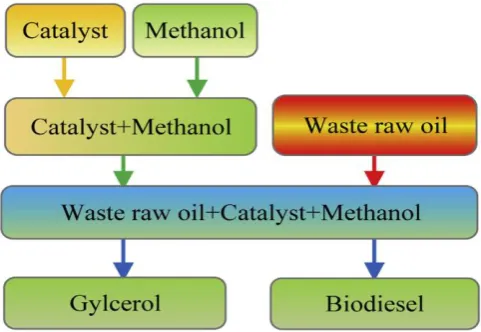
[image:1.595.309.550.554.720.2]Biodiesel will be prepared from raw Palm oil for the present study. The general transesterification process was followed for bio diesel preparation discussed below. Biodiesel is generally produced by transesterification of triglyceride;a triglyceride reacts with an alcohol in the presence of a strong acid orbase, producing a mixture of fatty acids alkyl esters and glycerol. The overall process is a sequence of three consecutive and reversible reactions, in which di and monoglycerides are formed as intermediates. The stoichiometric reaction requires 1 mol of a triglyceride and 3 mol of the alcohol. However, an excess of the alcohol issued to increase the yields of the alkyl esters and to allow its phase separation from the glycerol formed.
© 2017, IRJET | Impact Factor value: 5.181 | ISO 9001:2008 Certified Journal | Page 2321
2.3 Properties of Bio-diesel And Diesel
Table 1 Properties of Bio-diesel And Diesel
[image:2.595.326.527.135.415.2]3. Engine Modification.
Injector cut off set upFigure 2 Mechanism for Injector cutoff
The optical sensor is used for the purpose of injector cutoff. The setup includes a pulley with a single window on it and a sensor system bundled in an acrylic C- shaped clamp. The C- shaped clamp has an optic ray emission end and the other end acting as the receiving end. The pulley is installed on a shaft extended from the crank shaft and it rotates with the speed of engine.
Vaporizer Installation
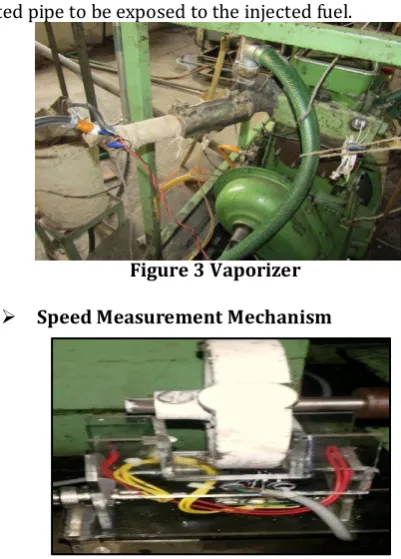
The vaporizer is used for the purpose of vaporizing the fuel from main injector. This helps in the achievement of homogenous mixture in the engine cylinder. The installation
of the vaporizer is on the extension pipe of the inlet manifold of the engine. At the end of the vaporizer, injector is attached at some angle that provides complete area of the heated pipe to be exposed to the injected fuel.
Figure 3 Vaporizer
Speed Measurement Mechanism
Figure 4 Speed Measurement with the help of pulley The speed measurement is done with the help of the same pulley used in the injector cutoff mechanism. The pulley is installed with magnets on its periphery to create some magnetic field and the field is sensed by the proximate sensor attached to the C- shaped acrylic clamp. Hence the speed is displayed with the sensed data from this mechanism.
Data Acquisition System
Figure 5 Data Acquisition Unit
The Data Acquisition Unit (DAU) has connectors for inputs from various sensors and also 4 LED lights.
Property Method of Testing
Palm Biodiesel
Diesel
Kinematic viscosity at 40°C(cst)
U-tube 4.8 3.0
Density @15°C (Kg/m3) Gravimetry 876 833 Flash point(°C) Open cup 130°C 74°C Fire point(°C) Open cup 171°C 120°C Cloud point(°C) ASTM D2500 13°C -16°C Pour point(°C) ASTM D5853 17°C -25°C Calorific Value(KJ/kg) Bomb
calorimeter
38600 42850
Water content(mg/kg) KF 411 105
Ceten no ISO 5165 62.8 49.0
Acid value(KOH/g) Tritrimetry 0.30 0.35 Total Glycerol Percent by
Mass(% m/m)
GC 0.14 ---
Methanol Percent by Mass(% m/m)
[image:2.595.29.294.140.477.2] [image:2.595.325.537.535.700.2]© 2017, IRJET | Impact Factor value: 5.181 | ISO 9001:2008 Certified Journal | Page 2322
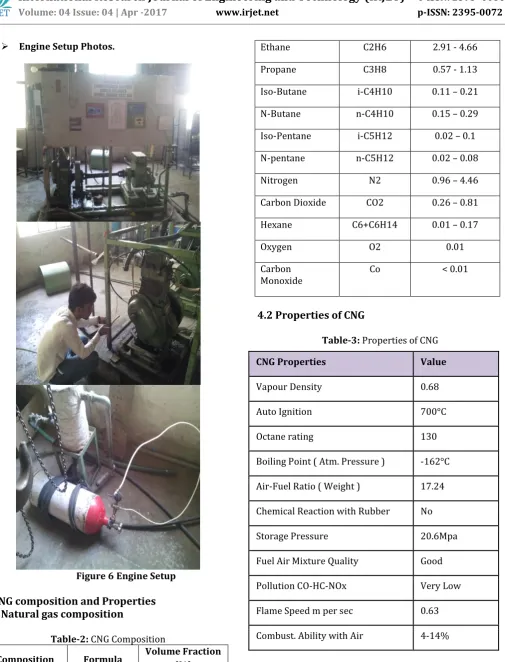
Engine Setup Photos.
Figure 6 Engine Setup
4 CNG composition and Properties
4.1 Natural gas composition
Table-2: CNG Composition
Composition Formula Volume Fraction (%)
Methane CH4 91.82 - 94.39
Ethane C2H6 2.91 - 4.66
Propane C3H8 0.57 - 1.13
Iso-Butane i-C4H10 0.11 – 0.21
N-Butane n-C4H10 0.15 – 0.29
Iso-Pentane i-C5H12 0.02 – 0.1
N-pentane n-C5H12 0.02 – 0.08
Nitrogen N2 0.96 – 4.46
Carbon Dioxide CO2 0.26 – 0.81
Hexane C6+C6H14 0.01 – 0.17
Oxygen O2 0.01
Carbon
Monoxide Co < 0.01
[image:3.595.53.559.59.722.2]4.2 Properties of CNG
Table-3: Properties of CNG
CNG Properties Value
Vapour Density 0.68
Auto Ignition 700°C
Octane rating 130
Boiling Point ( Atm. Pressure ) -162°C
Air-Fuel Ratio ( Weight ) 17.24
Chemical Reaction with Rubber No
Storage Pressure 20.6Mpa
Fuel Air Mixture Quality Good
Pollution CO-HC-NOx Very Low
Flame Speed m per sec 0.63
© 2017, IRJET | Impact Factor value: 5.181 | ISO 9001:2008 Certified Journal | Page 2323
5. Engine set up
The experimental work has been carried out on a single cylinder, vertical, water cooled. four stroke and high speed diesel engine. The detailed specifications are given in table 4 and experimental setup is shown in figure 7. The engine is coupled with an eddy current dynamometer. The thermocouples are fixed to measure water inlet-outlet temperatures to engine and calorimeter, exhaust gas inlet-outlet temperatures to calorimeter and room temperature. These temperatures are shown on digital temperature indicator. The exhaust gas analyzer is connected to the exhaust pipe to measure the concentrations of gaseous emissions such as carbon monoxide, HC, NOx.
Table 4: Detailed specifications of engine set up Engine Kirloskar AVI
General details Four stroke, CI, vertical, water cooled, single cylinder
Bore x stroke 87.5 mm x 110 mm
Compression ratio 17.5:1
Capacity 661 cc
Rated output 5.2 kW at 1500 rpm
Dynamo meter Eddy current, water cooled.
[image:4.595.305.560.118.661.2]Gas analyzer BrainBee Automotive, model AGS-688
Figure 7 Test Engine
© 2017, IRJET | Impact Factor value: 5.181 | ISO 9001:2008 Certified Journal | Page 2324
7. CONCLUSION
The
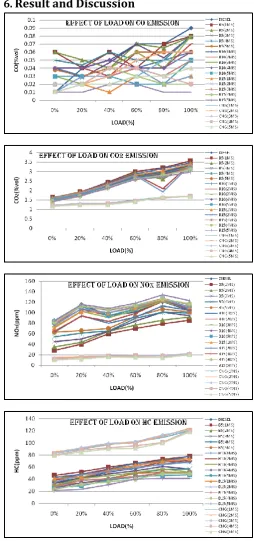
effect of Diesel,B5,B10,B15 and CNG with varying loads on Carbon monoxide emissions are concluded that the High load condition CO emission is lower for B5,B10,B15 and CNG compare to Diesel Fuel. For blending percentage increase than CO emission decrease.B15(5ms) is best result compare to all other fuels for emission of CO. The effect of Diesel,B5,B10,B15 and CNG with varying loads on Carbon dioxide emissions are concluded that the CNG fuel for all load and all ms condition CO2 emission is lower compare to Diesel,B5,B10,B15 fuel. In bio-diesel for blending percentage increase than CO2 emission decrease. In bio-diesel B15 for all load at 3,4,5 ms condition CO2 emission is lower compare to Diesel,B5,B10 fuel. Then CNG is the best result compare to all other fuel.
The effect of Diesel,B5,B10,B15 and CNG with varying loads on NOx emissions are concluded that the CNG fuel for all load and all ms condition NOx emission is lower compare to Diesel,B5,B10,B15 fuel. In bio-diesel blending B5 is Nox emission lower compare to other blending. In bio-diesel for blending percentage increase than NOx emission increase.
The effect of Diesel,B5,B10,B15 and CNG with varying loads on NOx emissions are concluded that the HC fuel for all load and all ms condition HCemission is higher compare to Diesel,B5,B10,B15 fuel. In bio-diesel for blending percentage increase than HC emissiondecrease. B15(5ms) is best result compare to all
fuels for emission of HC.
The variations of Fuel consumption with varying Load under various Diesel,B5,B10,B15 and CNG are concluded that the fuel consumption of High load condition CNG is lower FC compare to Diesel,B5,B10,B15.A high load condition B15(1ms) is Higher FC compare to to Diesel,B5,B10,CNG. In bio-diesel for blending percentage increase than FC increase. B5,B10,B15 for all load at 3,4,5 ms condition FC is lower compare to Diesel fuel. B5 is most suitable compare to B10,B15.
The variations of Break power with varying Load under various Diesel,B5,B10,B15 and CNG are concluded that the Break power of high load condition is lower of B5,B10,B15 and CNG
Compare to Diesel. For B5,B10,B15 and CNG at 20% load and 1,2ms condition BP is higher compare to Diesel fuel.CNG is the best result compare to B5,B10,B15. In bio-diesel for blending percentage increase than BP decrease.
© 2017, IRJET | Impact Factor value: 5.181 | ISO 9001:2008 Certified Journal | Page 2325
The variations of Break Thermal Eff.with varying Load under various Diesel, B5, B10, B15 and CNG are concluded that the Break Thermal Eff. of high load condition CNG is higher and B15(1ms) is lower compare to all other fuels. In bio-diesel for blending percentage increase than SFC decrease.
8. SCOPE OF FUTURE WORK
By using blending of more than one alternative fuel can also be useful in HCCI engine for finding out the optimized results.
One can also be used this blend with some additives for much improved performance characteristics.
9. REFERANCES
1] V.E. Kozlov, I.V. Chechet , S.G. Matveev , N.S. Titova ,A.M. Starik, “Modeling study of combustion and pollutant formation in HCCI engine operating on hydrogen rich fuel blends”, international journal of hydrogen energy xxx ( 2016 )1e1 2
[2] A.AzizHairuddin , TalalYusaf , AndrewP.Wandel, “A review of hydrogen and natural gas addition in diesel HCCI engines”, Renewable and Sustainable Energy Reviews 32(2014)739–761
[3] Rakesh Kumar Maurya, Nekkanti Akhil, “Numerical investigation of ethanol fuelled HCCI engine using stochastic reactor model. Part 2: Parametric study of performance and emissions characteristics using new reduced ethanol oxidation mechanism” , Energy Conversion and Management 121 (2016) 55–70
[4] Mingfa Yao, Zhaolei Zheng, Haifeng Liu, “Progress and recent trends in homogeneous charge compression ignition (HCCI) engines”, Progress in Energy and Combustion Science 35 (2009) 398–437
[5] Sina Voshtani, Masoud Reyhanian, Mohammadali Ehteram, Vahid Hosseini, “Investigating various effects of reformer gas enrichment on a natural gas-fueled HCCI combustion engine”, international journal of hydrogen energy 39 (2014) 19799e19809 [6] Alberto A. Boretti, “Diesel-like and HCCI-like operation of a truck engine converted to hydrogen”, international journal of hydrogen energy 36 (2011) 15382e1 5391
[7] S.V. Khandal, N.R. Banapurmath, V.N. Gaitonde, S.S. Hiremath, “Paradigm shift from mechanical direct injection diesel engines to advanced injection strategies of diesel homogeneous charge compression ignition (HCCI) engines- A comprehensive review”, Renewable and Sustainable Energy Reviews 70 (2017) 369–384
[8] Harisankar Bendu , B.B.V.L. Deepak , S. Murugan, “Application of GRNN for the prediction of performance and exhaust emissions in HCCI engine using ethanol”, Energy Conversion and Management 122 (2016) 165–173
[9] Ali Yousefzadeh, Omid Jahanian, “Using detailed chemical kinetics 3D-CFD model to investigate combustion phase of a CNG-HCCI engine according to control strategy requirements”, Energy Conversion and Management xxx (2016) xxx–xxx [10] M. Mohamed Ibrahim, A. Ramesh, “Investigations on the effects of intake temperature and charge dilution in a hydrogen fueled HCCI engine”, international journal of hydrogen energy 39 (2014) 14097e14108
[11] Ayatallah Gharehghani, Reza Hosseini , Mostafa Mirsalim , S. Ali Jazayeri ,Talal Yusaf, “An experimental study on reactivity controlled compression ignition engine fueled with biodiesel/natural gas”, Energy xxx (2015) 1e10
[12] Harisankar Bendu, B.B.V.L. Deepak , S. Murugan, “Multi-objective optimization of ethanol fuelled HCCI engine performance using hybrid GRNN–PSO”, Applied Energy 187 (2017) 601–611
[13] A. Tsolakis, A. Megaritis, D. Yap, “Application of exhaust gas fuel reforming in diesel and homogeneous charge compression ignition (HCCI) engines fuelled with biofuels”, Energy 33 (2008) 462–470
[14] Rakesh Kumar Maurya, Nekkanti Akhil, “Development of a new reduced hydrogen combustion mechanism with NOx and parametric study of hydrogen HCCI combustion using stochastic reactor model”, Energy Conversion and Management 132 (2017) 65–81
[15] M.A. Kalam, H.H. Masjuki, M.H. Jayed, A.M. Liaquat, “Emission and performance characteristics of an indirect ignition diesel engine fuelled with waste cooking oil”, Energy 36 (2011) 397e402
[16] Rasim Behçet , Recep Yumrutas, Hasan Oktay, “Effects of fuels produced from fish and cooking oils on performance and emissions of a diesel engine” , Energy 71 (2014) 645e655 [17] G. Sakthivel, G. Nagarajan, M. Ilangkumaran, Aditya Bajirao Gaikwad, “Comparative analysis of performance, emission and combustion parameters of diesel engine fuelled with ethyl ester of fish oil and its diesel blends” , Fuel 132 (2014) 116–124
[18] Ali M.A. Attia, Ahmad E. Hassaneen, “Influence of diesel fuel blended with biodiesel produced from waste cooking oil on diesel engine performance” , Fuel 167 (2016) 316–328