© 2017, IRJET | Impact Factor value: 5.181 | ISO 9001:2008 Certified Journal
| Page 1054
E-TOLL PAYMENT USING AZURE CLOUD
M Vikram
1, M R Rajeswari
2,V Veeralakshmi
31Student
&
Dept. of Information Technology, Prince Shri Venkateshwara Padmavathy Engineering College, Chennai, India 2Assistant Professor&
Dept. of Information Technology, Prince Shri Venkateshwara Padmavathy Engineering College,Chennai, India
3Associate Professor, Dept. of Information Technology, Prince Shri Venkateshwara Padmavathy Engineering College Chennai, India
---***---Abstract-
Internet of Things is the inter-working
of physical devices, vehicles which is referred as smart
devices, building and other items embedded with
electronics, cloud, software, sensors, actuators and
network connectivity that enables the objects to collect
and exchange data
The IoT allows objects to be sensed
or controlled remotely across existing network
infrastructure, creating opportunities for most direct
integration of the physical world into computer-based
systems, and resulting in improved efficiency, accuracy
and economic benefit in addition to reduced human
intervention. Three of the main concerns that
accompany the Internet of Things are the breach of
privacy, over-reliance on technology and the loss of jobs.
There are security measures that are taken to protect
information, but there is always possibility of hackers
breaking into the system and stealing the data. Toll Gate
Payment application have been of great assistance in
lessening the over congestion that has become a part of
the metropolitan cities these days. It is one of the
uncomplicated ways to manage the great run of traffic.
The travelers passing through this mode of transport,
carried by their transport that allows them to be aware
of the account of money that has been paid and the
money left in the tag. It relieves the traveler of the
burden of waiting in the queue to make the toll payment,
which decreases the fuel-consumption and taking cash
with them can be avoided. Here, it avoids this type of
problem. User get gate pass by recognize the vehicle
registration number using RFID so user don’t need to
wait in tollgate.
Key Words: RFID tag, Cloud, Sensor, Security, Raspberry Pi
1.INTRODUCTION
The Internet of Things (IoT) is an important topic in technology industry, policy, and engineering circles and has become headline news in both the specialty press and the popular media. This technology is embodied in a wide spectrum of networked products, systems, and sensors, which take advantage of advancements in computing power,
electronics miniaturization, and network interconnections to offer new capabilities not previously possible. An abundance of conferences, reports, and news articles discuss and debate the prospective impact of the “IoT revolution”—from new market opportunities and business models to concerns about security, privacy, and technical interoperability.
The large-scale implementation of IoT devices promises to transform many aspects of the way we live. For consumers, new IoT products like Internet-enabled appliances, home automation components, and energy management devices are moving us toward a vision of the “smart home”, offering more security and energy efficiency. Other personal IoT devices like wearable fitness and health monitoring devices and network enabled medical devices are transforming the way healthcare services are delivered. This technology promises to be beneficial for people with disabilities and the elderly, enabling improved levels of independence and quality of life at a reasonable cost. [1] IoT systems like networked vehicles, intelligent traffic systems, and sensors embedded in roads and bridges move us closer to the idea of “smart cities”, which help minimize congestion and energy consumption. IoT technology offers the possibility to transform agriculture, industry and energy production and distribution by increasing the availability of information along the value chain of production using networked sensors. However, IoT raises many issues and challenges that need to be considered and addressed for potential benefits to be realized.
The Internet Society cares about the IoT as it represents a growing aspect of how people and institutions are likely to interact with the Internet in their personal, social, and economic lives. If even modest projections are correct, am explosion of IoT applications could present a fundamental shift in how users engage with and are impacted by the Internet, raising new issues and different dimensions of existing challenges across consumers concerns, technology, policy and law. IoT also will likely have varying consequences in different economies and regions, bringing a diverse set of opportunities and challenges across the globe.
© 2017, IRJET | Impact Factor value: 5.181 | ISO 9001:2008 Certified Journal
| Page 1055
Manu of these early M2M solutions, however, were based onclosed purpose-built networks and proprietary or industry-specific standards [2], rather than on Internet Protocol(IP) based networks and Internet standards.
Using IP to connect devices other than computers to the Internet is not a new idea. The first Internet “device” an IP enabled toaster that could be turned on and off over the Internet was featured at an Internet conference in 1990. [3] Over the next several years, other “things” were IP enabled, including a soda machine [4] at Carnegie Mellon University in the US and a coffee pot [5] in the Trojan Room at the University if Cambridge in the UK. From these whimsical beginnings, a robust field of research and development into “smart object networking” [6] helped create the foundation for today’s Internet of Things. The users of IoT devices are likely to be more concerned with the services delivered and implication of using those services than issues of when or where data passes through an IP based network.
2.
INTERNET OF THINGS COMMUNICATION
MODELS
From an operational perspective, it is useful to think about how IoT devices connect and communicate in terms of their technical communication model. In March 2015, The Internet Architecture Board(IAB) released a guiding architectural document for networking of smart objects (RFC 7452) [7], which outlines a framework of four common communication models used by IoT devices. The discussion below presents this framework and explains key characteristics of each models in the framework.
2.1
Device to Deivce Communication Model
Wherever Times is specified, Times Roman or Times New Roman may be used. If neither is available on your word processor, please use the font closest in appearance to Times. Avoid using bit-mapped fonts if possible. True-Type 1 or Open Type fonts are preferred. Please embed symbol fonts, as well, for math, etc. The device to device communication model represents two or more devices that directly connect and communicate between one another, rather than through an intermediary application server. These devices communicate over many types of networks, including IP networks or the Internet. Often, however these devices use protocols like Bluetooth, [8][9] Z-Wave, [10] ZigBee [11] to establish direct device to device communication, as shown in Figure 1.
Fig. 1Device to Device communication
These devices to device networks allow devices that adhere to a communication protocol to communicate and exchange messages to achieve their function. This communication model is commonly used in application lie home automation systems, which typically use small data packets of information to communicate between devices with relatively low data requirements. Residential IoT devices like light bulbs, light switches thermostats, and door locks normally send small amounts of information to each other in a home automation scenario.
2.2 Device to Cloud communication model
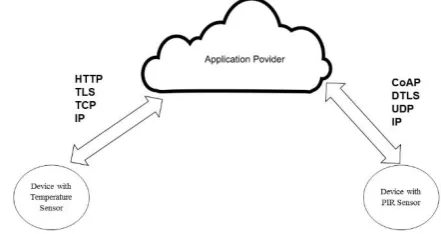
In a device to cloud communication model, the IoT device connects directly to an Internet Cloud service like an application service provider to exchange data and control message traffic. This approach frequently takes advantages of existing communication mechanism like traditional wired Ethernet or Wi-Fi connections to establish a connection between the device and the IP network, which ultimately connects to the cloud service. This is shown in Figure 2. This communication model is employed by some popular consumer IoT devices like the Nest Labs Learning Thermostat. [12] and the Samsung SmartTV[13]. In the case of the Nest Learning Thermostat, the device transmits data to a cloud database where the data can be used to analyze home energy consumption. Further, this cloud connection enables the user to obtain remote access to their thermostat via a smartphone or Web interface, and it also supports software updates to the thermostat. Similarly, with the Samsung SmartTV technology, the television uses an Internet connection to transmit user viewing information to Samsung for analysis and enables the interactive voice recognition features of the TV. In these cases, the device to cloud model adds value to the end user by extending the capabilities of the device beyond its native features.
Fig.2 Device to Cloud Communication model diagram.
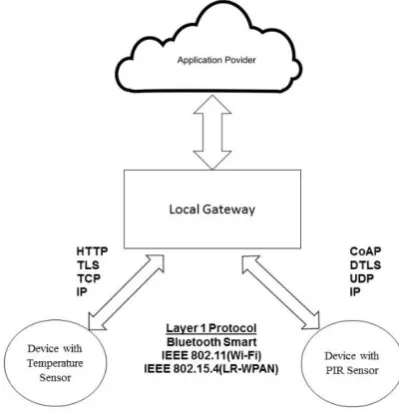
2.3 Device to Gateway communication model
[image:2.595.320.541.534.651.2]© 2017, IRJET | Impact Factor value: 5.181 | ISO 9001:2008 Certified Journal
| Page 1056
which acts as an intermediary between the device and cloudservice and provides security and other functionality such as data or protocol translation. The model is shown in Figure 3.
Several forms of this model are found in consumer devices. In many cases, the local gateway device is a smartphone running an app to communicate with a device and relay data to a cloud service. This is often the model employed with popular consumer items like personal fitness tracker. These devices do not have the native ability to connect directly to a cloud service, so they frequently rely on smartphone app software to serve as an intermediary gateway to connect the fitness device to the cloud. The other form of this device to gateway model is the emergence of “hub” device in home automation application. These are devices that serve as a local gateway between individual IoT devices and a cloud service, but they can also bridge the interoperability gap between devices themselves.
Fig. 3 Device to Gateway communication model diagram
2.4 Back-End Data Sharing Model
The back-end data sharing model refers to a
communication architecture that enables users to
export and analyze smart object data from a cloud
service in combination with data from other sources.
This architecture supports “the user’s desire for
granting access to the uploaded sensor data to third
parties”. [15] This approach is an extension of the
single device to cloud communication model, which can
lead to data silos where “IoT devices upload data only
to a single application service provider”. A back-end
sharing architecture allows the data collected from
single IoT device data streams to be aggregated and
analyzed. The back-end data sharing model suggests a
federated cloud services approach or cloud
applications programmer interfaces(APIs) are needed
to achieve interoperability of smart device data hosted
in the cloud. [16] A graphical representation of this
design is shown in Figure 4.
Often in the single device to cloud model, the data
each IoT sensor or system produces sits in a
stand-alone data silo. An effective back-end data sharing
architecture would allow the company to easily access
and analyze the data in the cloud produced by the
whole spectrum of devices in the building. This kind of
architecture facilitates data portability needs. Effective
back-end data-sharing
Fig. 4 Back-end data sharing model
which deals with Cloud, Internet and Mobile Application to architectures allow users to move their data when they switch between IoT services, breaking down traditional data silo barriers. In this communication model is only as effective as the underlying IoT system design. Back-end data sharing architectures cannot fully overcome closed system designs.
3.
RELATED WORKS
Kurti Sanghvi, Prof.Amol Jolekar [17] proposed that the Automating the payment of Toll tax at toll plaza that the money will be deducted the money from the account that is associated with the vehicle registration number automatically. The toll gate will open only if the payment is successful. The process which they proposed is a time consuming one because the user must wait in the queue for their turn. Sometimes the authentication for the account may fail. The main drawback of this methodology is that if there is no money in that specified account then the payment cannot be done and vehicle cannot pass through.
[image:3.595.316.548.274.457.2] [image:3.595.62.262.322.529.2]© 2017, IRJET | Impact Factor value: 5.181 | ISO 9001:2008 Certified Journal
| Page 1057
which is nothing but like a memory card in which we
are going to store the details of person and certain
amount. The main objective of this smart card is to pay
the toll gate tax using smart card. Smart card must be
recharged with some amount and whenever a person
wants to pay the toll gate tax, he needs to insert his
smart card and deduct amount using keypad. By using
this kind of smart card there is no need to carry the
amount in form of cash and so we can have security as
well. Keil-µ vision software used for simulation.
Integrating features of all the hardware components
used have developed it. Presence of every module has
been reasoned out and placed carefully thus
contributing to the best working of the unit.
Elmer R Magsino and Ivan W. H. Ho [19] proposed that
intelligent tollgate queue selector for improving server
utilization and vehicle waiting time. The incorporation
of a fuzzy logic controller in a highway tollgate system
can effectively decrease a vehicle’s average waiting
time and average queue length, and improve the
server’s utilization. This is true for both homogeneous
and nonhomogeneous vehicular arrivals in the highway
lanes especially with tollgates of fast service time. As
an added feature to the FLCQ selector, an early warning
signal was introduced to allow the server to reduce its
service time when the traffic is building up due to
relatively long service times. This work can be further
extended by including a practical modeling of the
service time reduction and the scalability of servers, i.e.
deactivation of existing servers or addition of needed
servers based on existing infrastructure. The
nonhomogeneous service time of manual servers can
also be taken into consideration. Finally, allowing
communications between vehicles and highway
infrastructure of patterns/features detected by camera
or sensors will further develop a more intelligent and
highly adaptive highway tollgate system in the future.
4
.
PROPOSED SYSTEM
IoT is an effective technology to solve the real-time
problems and automating the process. IoT is a
technology which deals with Cloud, Internet and
Mobile Application to produce a solution. In the is
paper each process is automated and the decisions are
taken in the Cloud with the data obtained from the
Raspberry Pi and the reference data obtained from the
mobile after making the payment. In this paper, the
payment for the toll gate is done through the mobile
application named E-TOLL. Payment is done using the
digital wallets, credit card, debit card and net banking.
Once the payment is successful the immediately the
vehicle registration number and transaction id will be
forwarded to the Azure Cloud and it will be stored as a
reference data. The RFID (Radio Frequency Identifier)
tag will be attached with the vehicle and the vehicle
registration number will be embedded into the RFID
tag. When the vehicle reaches, the toll gate the RFID
reader will automatically reads the vehicle registration
number which is embedded in the RFID tag. Then the
vehicle registration number will be forwarded to the
cloud and checks whether the payment is done or not.
If the payment is done the response will be sent to the
device and the action will be taken depending upon the
response from the Cloud. If the payment is done, then
the tollgate will open. Otherwise, the toll gate will not
open.
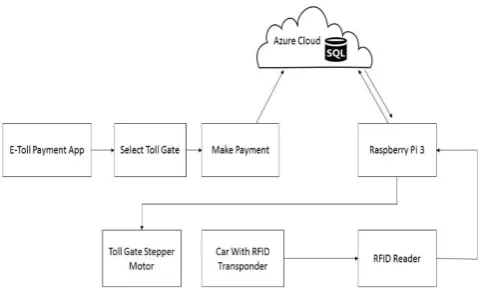
Fig. 5 Architecture of E-Toll Payment using Azure Cloud
[image:4.595.313.554.332.481.2]© 2017, IRJET | Impact Factor value: 5.181 | ISO 9001:2008 Certified Journal
| Page 1058
interoperable Electronic Toll Collection technologies.
When the user has entered the source and destination
details, the application will automatically show the tolls
which are present in the travelling route and the toll
amount also. The user can select the tolls to which they
want to make the payment. The user can select as many
toll gates as they want. According to tolls they have
selected the user has to make the payment. The
payment can be done using the different digital wallets
or credit card or debit card or net banking. Once the
payment is successful, then immediately the
transaction id and vehicle registration number will be
transmitted to the Azure cloud. The transaction id and
vehicle registration number will be stored in the blob
in the storage account. The blob is one of the storage
type in the storage account. The blob is considered to
the reference data and the file in the blob will be
periodically updated.
The RFID (Radio Frequency Identifier) receiver will be
integrated with the raspberry pi device. The RFID
receiver will receive the data transmitted by the RFID
transponder. The RFID transponder will be attached to
the vehicle and the transponder will be written with
the vehicle registration number. The transponder uses
the WORM (Write Once Read Many) technique to write
the vehicle registration number. When the RFID
receiver receive the data, its being forwarded to the
raspberry pi device and the raspberry pi device
forwards the data to the azure cloud through the MQTT
(Message Queue Telemetry Transport). The raspberry
device will connect with the IoT hub in the Azure cloud.
A single IoT hub can connect to 500 devices. The IoT
hub forwards the data to the Stream Analysis. The
Stream Analysis has two inputs. One is the reference
data and the other is the data stream. The reference
data contains the data transmitted from the mobile
application and the data stream consist of the data
from raspberry pi. The query will be written to fetch
the necessary information from the two input and give
the output. The output will be the IoT hub where the
data is again sent to the device from the device it
received the data. And if the received data is true then
the toll gate will open then the user can leave the toll.
In case the received data is false then the toll gate will
not open unless the user has made the payment. Every
day the scheduler will automatically create the
necessary file and backup the data at the end of the
day.
4.1 Mobile Application
The payment for the toll gates are done using the mobile application which has been created. The mobile application has been designed in the android platform. The mobile application uses the Azure cloud database server for storing and retrieving the data from the Cloud. The salt hashing technique is used to hash the password that is being entered during the registration in the mobile application. Whenever the user tries to login, the password entered is converted into hash value and checked with hash value stored in the database. If the validation is successful then the user is logged in, otherwise the user cannot login into their account. The Figure 6 displays the screen where the user enters the travel details like source, destination and the vehicle type. Based on the vehicle type the rate for the toll amount is being calculated.
Fig 6. Mobile Application Travel Details Screen
[image:5.595.330.535.300.629.2]© 2017, IRJET | Impact Factor value: 5.181 | ISO 9001:2008 Certified Journal
| Page 1059
Fig. 7 Mobile Application Toll Gate List Screen5. CONCLUSIONS
The concept of the E-Toll Payment using Azure Cloud is presented. The recent technological application that makes the human life more beneficial in the present world have been discussed. The new standard of Internet of Things is already is in competition with each other is also one of the talk of the topic in near future when other more standards are coming soon. The E-Toll Payment application using Azure will reduce the amount of time waiting in the queue to pay for the toll gate. They can make the payment through the digital wallets or Internet banking or different options. The payment can be done for the multiple toll gate and the records can be easily maintained.
REFERENCES
[1] For more information on IoT as it relates with those
with disabilities see for example: Valerio, Pablo.
“Google: IoT Can Help The Disabled.”
InformationWeek, March 10, 2015.
http://www.informationweek.com/mobile/mobile- devices/google-iot-can-help-thedisabled/a/d-id/1319404; and, Domingo, Mari Carmen. “An Overview of the Internet of Things for People with
Disabilities.” Journal of Network and Computer Applications 35, no. 2 (March 2012): 584–96. doi:10.1016/j.jnca.2011.10.015. M. Young, The Technical Writer’s Handbook. Mill Valley, CA: University Science, 1989.
[2] Polsonetti, Chantal. “Know the Difference Between IoT
and M2M.” Automation World, July 15, 2014.
http://www.automationworld.com/cloud-computing/know-difference-between-iot-and-m2m I. S. Jacobs and C. P. Bean, “Fine particles, thin films and exchange anisotropy,” in Magnetism, vol. III, G. T. Rado and H. Suhl, Eds. New York: Academic, 1963, pp. 271– 350.
[3] "The Internet Toaster." Living Internet, 7 Jan. 2000.
Web. 06 Sept. 2015.
http://www.livinginternet.com/i/ia_myths_toast.htm
[4] "The "Only" Coke Machine on the Internet." Carnegie
Mellon University Computer Science Department, n.d.
Web. 06 Sept. 2015.
https://www.cs.cmu.edu/~coke/history_long.txt.
[5] Stafford-Fraser, Quentin. "The Trojan Room Coffee
Pot." N.p., May 1995. Web. 06 Sept. 2015.
[6] RFC 7452, “Architectural Considerations in Smart
Object Networking” (March 2015),
https://tools.ietf.org/html/rfc7452.
[7] Tschofenig, H., et. al., Architectural Considerations in
Smart Object Networking. Tech. no. RFC 7452. Internet Architecture Board, Mar. 2015. Web. https://www.rfc-editor.org/rfc/rfc7452.txt.
[8] http://www.bluetooth.com. [9] http://www.bluetooth.org. [10] http://www.z-wave.com. [11] http://www.zigbee.org.
[12] “Meet the Nest Thermostat | Nest.” Nest Labs. Web. 31
Aug. 2015. https://nest.com/thermostat/meet-nest-thermostat/.
[13] “Samsung Privacy Policy--SmartTV Supplement.”
Samsung Corp. Web. 29 Sept. 2015.
http://www.samsung.com/sg/info/privacy/smarttv.h tml
[14] “How It Works.” SmartThings, 2015.
http://www.smartthings.com/how-it-works.
[15] Tschofenig, H., et. al., p. 9.
[16] An example of a generic (non-IoT) off-the-shelf,
federated cloud-sharing tool is ownCloud, produced by ownCloud.org. https://owncloud.org/blog/faster- easier-file-sync-and-share-with-federated-self-hosted-owncloud-8-0/.
[17] Kurti Sanghvi and Prof. Amol Joglekar, “Automating
the Paymenr of Toll Tax at Toll Payment”, International Journal of Cimputer Science and Information Technologies, Vol. 6(3), 2015.
[18] V Sridhar and M Nagendra, “ Smart Card Based Toll
Gate Automated System”, International Journal if Advanced Research in Computer Engineering and Technology, Volume 1, Issue 5, July 2012.
[19] Elmer R. Magsino and Ivan W. H. Ho, “An Intelligent
[image:6.595.38.283.114.453.2]